

- Market Size (2026)
- USD 1.2 Bn
- Forecast (2036)
- USD 9.5 Bn
- CAGR (2026 to 2036)
- 23.0%
How big is Rehabilitation Exoskeletons Market in 2026?
USD 1.2 billion in 2026 and USD 9.5 billion by 2036 at a 23.0% CAGR.
Sales of rehabilitation exoskeletons are projected to rise from USD 1.2 billion in 2026 to USD 9.5 billion by 2036 at a 23.0% CAGR. Clinical demand is projected to expand as gait systems enter repeatable stroke and spinal cord injury programs. Lifeward reported in February 2026 that Aetna joined Humana and UnitedHealthcare in covering eligible ReWalk users across plans representing about 16 million Medicare Advantage beneficiaries. This coverage gives clinicians a broader funded route and connects the category with medical rehabilitation robotics through practical personal use.
Funding routes differ sharply between the United States and Japan as each country converts clinical interest into orders through a separate payment model. United States demand relies on insurer review for personal devices under individual coverage decisions and documented need. Japanese medical HAL programs use clinic rental services that spread equipment cost across treatment volume. Wandercraft secured USD 75 million in June 2025 to expand Atalante X and support personal exoskeleton development. The financing gives hospital committees a stronger basis for reviewing therapeutic devices within routine care programs. Each committee must assess therapist capacity and service response so the equipment can enter a full treatment schedule.
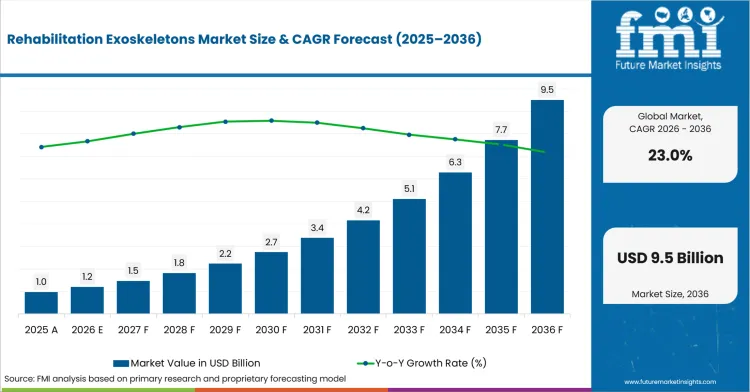
Key Takeaways of Rehabilitation Exoskeletons Market
- Demand for rehabilitation exoskeletons is driven by coverage decisions bringing devices into formal medical purchasing routes across clinic and personal-use settings for eligible patients with documented need.
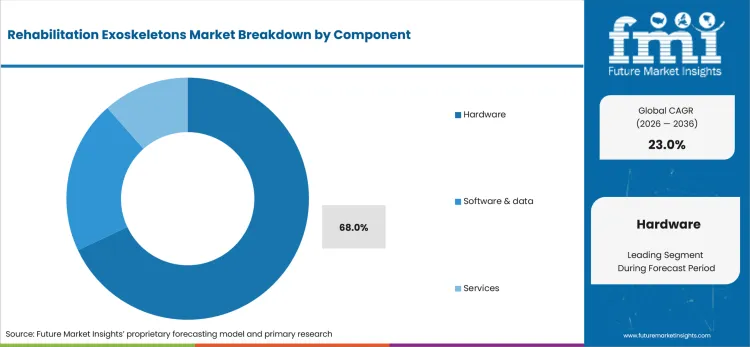
- By component, hardware is expected to lead with 68.0% share in 2026, driven by the cost of fitted frames and powered joints within each installed system.
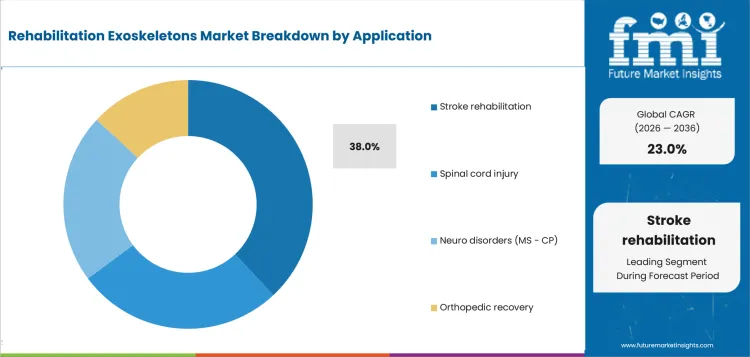
- Stroke rehabilitation is the dominant application segment, projected to hold 38.0% share in 2026, owing to repeatable sessions and established methods for measuring functional walking improvement.
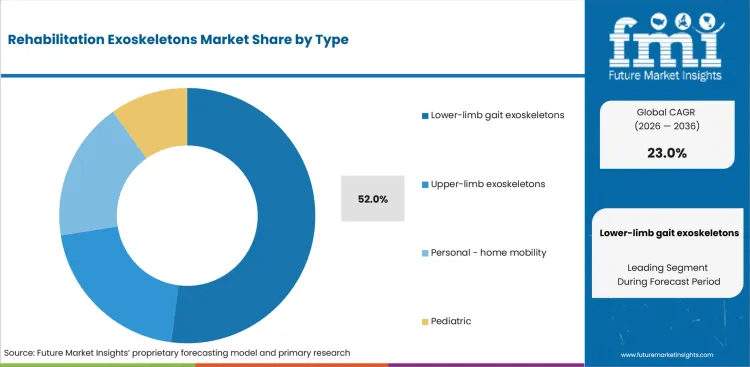
- Lower-limb gait exoskeletons are estimated to lead the type category with 52.0% share in 2026, supported by broad use in stroke and spinal cord injury programs.
- Software and service revenue is expected to gain importance as clinics manage treatment records and maintenance across larger equipment fleets.
- The United States, South Korea, European Union, and Japan are expected to grow at 24.0%, 24.0%, 23.0%, and 21.5% CAGR respectively through the forecast period, shaped by differing coverage policies and clinical service capacity.
- Competition centers on CYBERDYNE, Ekso Bionics, Lifeward, Wandercraft, Angel Robotics, and Fourier Intelligence, with vendors differentiating through institutional gait platforms, personal mobility reimbursement work, and self-balancing gait system development.
Analyst Perspective
"The rehabilitation robotics market is entering a stage where commercial viability is determined by clinical utilization rather than technical capability alone. Healthcare providers are assessing whether robotic systems can be integrated into routine therapy schedules, improve patient throughput, and deliver measurable functional outcomes across diverse patient populations. Expanding clinical indications may broaden market opportunities, but sustained adoption will favor manufacturers that support evidence-based treatment protocols, therapist training, reimbursement navigation, and long-term clinical success."
- Anurag Sharma, Principal Analyst at Future Market Insights
Source: FMI's proprietary forecasting model and primary research
How is the Rehabilitation Exoskeletons Market segmented?
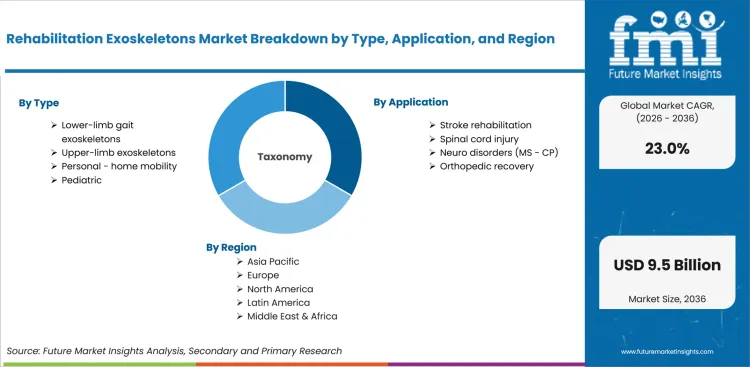
The rehabilitation exoskeletons industry is segmented by type, application, component, end user, business model, and region.
The category is assessed through six dimensions covering Type, Application, Component, End User, Business Model, and Region. Type and Application distinguish the physical system from the condition addressed during each rehabilitation program. Component analysis separates fitted hardware from software and services while End User analysis compares clinics and hospitals with home settings. Business Model compares capital purchase with rental or insurance-funded ownership and Region captures differences in reimbursement access. These categories let readers compare clinical purpose with purchasing method and show why one product can follow different commercial routes. Together these dimensions provide clear therapy area coverage without mixing adjacent industrial robotics or general mobility equipment.
What supports demand for lower-limb gait exoskeletons within the type category?
Lower-limb gait systems provide practical value through repeated walking sessions that fit an established therapy schedule. A May 2025 Wandercraft case study recorded more than 60 patients completing over 750 Atalante X sessions and 1.02 million steps during one year at Villa Beretta. Each session required one therapist and the program delivered two to three sessions per patient each week. This operating record strengthens demand within medical bionic systems by showing that one platform can support a varied treatment schedule.
- By Type, lower-limb gait exoskeletons are forecast to represent 52.0% of revenue in 2026 as they fit structured walking programs. The systems support repeated practice across stroke and spinal cord injury care and give clinics clearer session planning than narrower upper-limb uses. Their broad clinical role protects equipment use across several patient groups during the treatment week.
- Rehabilitation clinics are expected to favor lower-limb platforms that adjust across patient heights and changing support needs during each scheduled session. A wider fit range reduces equipment swaps during the treatment day and protects therapist time across a fuller patient schedule. This flexibility can improve equipment use without requiring a separate system for every eligible patient group.
How is stroke rehabilitation positioned within the application category?
Stroke programs need repeated gait sessions and clear measures of walking change across each treatment cycle. Wandercraft stated in February 2025 that a 64-year-old stroke survivor completed a four-week Atalante X program. Gait speed rose from 0.09 to 0.19 meters per second and cadence increased 27.8% during the program. The measures came from one case and require broader confirmation to guide wider treatment decisions. Those results show why measurable stroke outcomes support careful clinical adoption across structured rehabilitation programs and planned treatment reviews.
- Stroke rehabilitation is estimated to account for 38.0% of Application revenue in 2026 owing to repeatable therapy protocols and clear functional goals. Clinicians can track walking speed and balance across planned sessions that follow a consistent documentation process. This structure makes stroke programs easier to schedule than conditions with less predictable recovery paths and changing therapy goals.
- Hospitals are anticipated to purchase lower-limb systems for stroke programs and spinal injury treatment under separate therapy protocols. Shared platform use can improve equipment use across the treatment week while clinicians maintain distinct goals and records for each condition. Commercial demand depends on whether the system fits established routines without adding excessive setup work during busy clinic schedules.
Why does hardware retain the greater component share?
Powered joints and fitted frames account for much of the cost inside a rehabilitation exoskeleton used during repeated therapy sessions. Ekso Bionics disclosed in June 2025 that its repository contained about 350,000 patient sessions and over 15 million step records. The company uses this information to develop controls and clinical review tools that connect hardware with structured patient monitoring. This data requirement makes rehabilitation exoskeletons comparable with medical and biomedical instruments that combine physical equipment with recorded clinical performance.
- Hardware is projected to hold 68.0% of Component spending in 2026 as powered joints and fitted structures remain costly parts. Each system needs batteries and sensors that work reliably throughout repeated sessions under changing patient support needs. These physical requirements place the initial equipment purchase above later software or maintenance charges across most institutional programs.
- Clinical operators are expected to spend more on software and service contracts as device fleets expand across several treatment sites. Session records support treatment review and equipment planning across clinicians who share responsibility for the same device fleet. Recurring service revenue should rise as companies connect data tools with dependable maintenance and training support throughout routine clinical use.
What are the drivers, restraints, and opportunities in the Rehabilitation Exoskeletons Market?
Reimbursement coverage is projected to support adoption, documentation work is anticipated to slow completed deliveries, and specialist outpatient centers are expected to widen treatment access.
- Driver: Coverage precedents are expected to convert more personal exoskeleton prescriptions into funded medical equipment deliveries for eligible patients.
- Restraint: Documentation work and high purchase values are anticipated to extend the interval between clinical recommendation and completed delivery.
- Opportunity: Specialist outpatient centers are projected to widen access by pairing exoskeleton sessions with trained clinical support outside major hospital departments.
Personal exoskeleton demand depends on a payer accepting the device as necessary medical equipment for an eligible patient. A June 2025 Lifeward announcement stated that an Administrative Law Judge found ReWalk reasonable and necessary for one Medicare beneficiary. The decision created an appeal precedent for future reviews and gave clinicians a clearer basis for documenting medical need. This development can improve funded access for patients whose clinical records establish a clear need for personal walking support and daily mobility.
High purchase values continue to create financial pressure despite an established reimbursement route for eligible personal exoskeleton users. Lifeward disclosed in February 2025 that BARMER had provided 20 ReWalk devices during the preceding years. That volume shows how fitting and documentation work can limit completed deliveries under an approved coverage process. Companies need service teams that manage clinical records and training beside the equipment throughout each funded delivery and follow-up period.
Specialist outpatient centers can widen access by combining exoskeleton sessions with clinical screening and follow-up care. CYBERDYNE announced in April 2026 that Osaka Central Robocare Center opened beside a clinic serving people with stroke and spinal cord injury. The center provides Neuro HALFIT through one treatment setting that links the device with specialist clinical care. This model creates an opening for healthcare services partners that can support fitting and repeated care beyond major hospital departments.
Which country CAGRs are profiled in the Rehabilitation Exoskeletons Market?
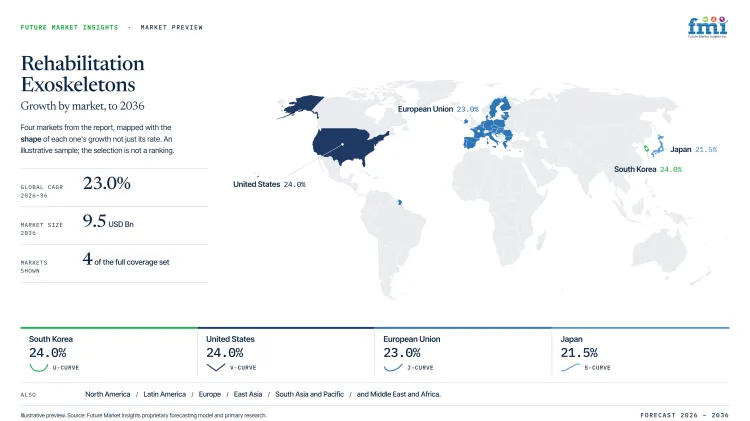
| Country | CAGR |
|---|---|
| Japan | 21.5% |
| South Korea | 24.0% |
| European Union | 23.0% |
| United States | 24.0% |
Source: FMI's proprietary forecasting model and primary research
How do country-level CAGRs compare in the Rehabilitation Exoskeletons Market?
The country comparison spans 3.0 percentage points and shows a tightly clustered outlook across the rehabilitation exoskeletons market. South Korea and the United States share the highest CAGR at 24.0%, followed by the European Union at 23.0% and Japan at 21.5%. The limited spread indicates that rehabilitation robotics is gaining traction across all four markets, although healthcare priorities, rehabilitation models and technology adoption pathways differ.
- South Korea records a CAGR of 24.0%. Rehabilitation centers and hospitals are increasingly incorporating robotic exoskeletons into mobility training programs to support gait recovery, improve therapy consistency and expand access to technology-assisted rehabilitation.
- The United States also posts a CAGR of 24.0%, matching South Korea's growth rate. Demand is influenced by growing use of advanced rehabilitation technologies in hospitals, outpatient clinics and specialized recovery centers, where exoskeletons are evaluated for improving patient mobility and therapy outcomes.
- The European Union follows at 23.0%, only 1.0 percentage point below the leading markets. Rehabilitation providers across the region continue integrating robotic mobility systems into neurological and orthopedic rehabilitation programs. Adoption differs among member states because healthcare funding models, clinical infrastructure and investment priorities are not uniform.
- Japan reaches a CAGR of 21.5%, standing 1.5 percentage points behind the European Union. Interest remains closely tied to rehabilitation technologies that assist patients recovering from stroke, spinal cord injuries and other mobility impairments while supporting more efficient delivery of physical therapy.
Comparable CAGRs do not necessarily produce identical commercial opportunities. Differences in rehabilitation infrastructure, reimbursement frameworks, clinical adoption, patient demographics and investment in healthcare technology influence purchasing decisions and long-term market development. The full report provides country-level CAGR analysis across North America, Latin America, Europe, East Asia, South Asia, Oceania and the Middle East and Africa.
Country-wise Analysis
Country growth depends on the payment route and clinical service structure surrounding each rehabilitation exoskeleton. Japan uses medical HAL rental programs and South Korea combines hospital rehabilitation with wearable robotics development. Germany shapes European adoption through insurer agreements while the United States relies on Medicare coverage decisions for personal systems. Clinical assessment and balance testing can connect these devices with stabilometric platforms during routine treatment planning and progress review.
-
Japanese clinics have an established service route for medical HAL systems and rental-based treatment programs. The country is estimated to post 21.5% CAGR from 2026 to 2036 with use extending across covered conditions. In May 2026, CYBERDYNE stated that public insurance applied to ten neuromuscular and spinal conditions for its new lower-limb model. The same device had medical approval in Japan and certification in Europe through a common product design. Rental access lets facilities match equipment cost with treatment demand and service support across an established clinical network. Japanese growth should depend on wider use across approved conditions and better equipment scheduling within existing facilities.
- South Korean developers combine university research with wearable systems designed for clinical rehabilitation and assisted daily mobility. Demand is forecast to expand at 24.0% CAGR from 2026 to 2036 driven by companies turning tested control systems into approved medical products. Angel Robotics listed a Malaysian medical device approval for ANGEL SUIT H10 in its official newsroom on 30 April 2026. The company identifies the system as a hip-assist wearable robot for walking support and rehabilitation training. This approval shows that Korean developers can carry domestic engineering into regulated overseas healthcare channels. The expansion places powered mobility systems within consumer healthcare channels that require local fitting and training. Commercial progress depends on clinical evidence and service support that protect safe product use across each approved program.
- European adoption depends on national payment routes and one medical-device framework across member states. The region is projected to record 23.0% CAGR from 2026 to 2036 with companies broadening clinical indications and hospital access. Wandercraft disclosed in August 2025 that expanded CE Mark coverage followed use at more than 100 rehabilitation centers. The company stated that over 100 patients with tetraplegia or tetraparesis represented 12% of total Atalante X users. This evidence broadens the addressable clinical group but does not create one payment method across the region. Companies need local reimbursement support and training that convert regulatory clearance into funded routine care.
- United States demand depends on whether personal exoskeleton coverage becomes routine across Medicare and Medicare Advantage plans. Sales are anticipated to rise at 24.0% CAGR from 2026 to 2036 supported by more predictable claim processing. Lifeward's September 2025 announcement recorded the first commercial Medicare Advantage payment for a ReWalk 7 system. The company stated that the claim was processed in less than 30 days and recent Medicare claims had taken 30 to 60 days. Clinics need complete medical records and trained staff to support each request without avoidable delay. Claim execution now affects demand beside device clearance and gives manufacturers with reimbursement support a better route from prescription to delivery.
Who are the notable companies in the Rehabilitation Exoskeletons Market?
CYBERDYNE Inc., Lifeward Ltd., Ekso Bionics, Wandercraft, Angel Robotics Co., Ltd., and Fourier Intelligence are the notable companies profiled in this market.
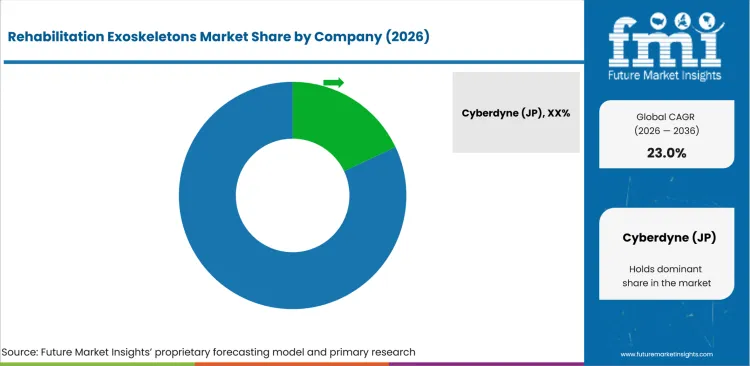
Competition separates personal mobility systems from institutional gait platforms and integrated rehabilitation portfolios that cover several recovery stages. Lifeward focuses on insurance-funded personal walking systems and CYBERDYNE combines medical HAL treatment with rental services. Ekso Bionics and Wandercraft support therapist-controlled gait training across hospital rehabilitation programs that require structured product use. Angel Robotics and Fourier Intelligence broaden the Asian product mix through clinical and community rehabilitation products. This competition links device design with wearable robotics research but commercial value depends on training and funded access. Product features create measurable value through improved treatment capacity or patient mobility within routine care.
- Lifeward and CYBERDYNE focus on personal mobility routes that require medical evidence and a clear funding model for every completed delivery. Lifeward focuses on reimbursement support and CYBERDYNE combines medical HAL equipment with clinic service networks and rental access in Japan.
- Ekso Bionics and Wandercraft focus on institutional gait rehabilitation through powered systems that support therapist-controlled sessions and structured progress reviews. Ekso Bionics uses clinical data for product development and Wandercraft differentiates its platform through self-balancing operation and a documented hospital footprint.
- Angel Robotics and Fourier Intelligence extend competition from Asia through lower-limb devices and wider rehabilitation portfolios for hospital and community care. Commercial progress depends on local approvals and distributor training that protects routine product use following installation across regional treatment networks.
Competitive Benchmarking: Rehabilitation Exoskeletons Market
| Company | Institutional Gait Systems | Personal Mobility | Reimbursement Support | Geographic Reach |
|---|---|---|---|---|
| CYBERDYNE Inc. | High | Medium | Medium | High |
| Lifeward Ltd. | Medium | High | High | High |
| Ekso Bionics | High | High | Medium | High |
| Wandercraft | High | Medium | Low | High |
| Angel Robotics Co., Ltd. | Medium | Medium | Low | Medium |
| Fourier Intelligence | High | Low | Low | Medium |
Scoring basis: High indicates broad verified capability in the stated area and Medium reflects relevant but partial capability. Low reflects limited direct evidence across the same capability and geographic comparison used for every company.
Source: Future Market Insights competitive analysis, 2026. Ratings reflect verified portfolio relevance and documented company activity.
Key Developments in the Rehabilitation Exoskeletons Market
- In June 2026, CYBERDYNE Inc. opened the PERKESO National Neuro-Robotics and Cybernics Rehabilitation Centre in Malaysia with 65 HAL units. The official announcement stated that the facility could serve up to 700 patients at one time and about 3,000 patients each year. The project shows how a national rehabilitation program can support institutional equipment orders and long-term service demand across several patient groups.
- In June 2025, Wandercraft finalized a strategic partnership with Renault Group that included a minority investment and industrial support. The official announcement stated that Renault manufacturing knowledge would support lower-cost production of Wandercraft exoskeletons and robots. This support can reduce manufacturing cost for future exoskeleton supply as Wandercraft expands from limited clinical orders toward wider commercial production and planned personal mobility programs.
- In April 2025, Ekso Bionics appointed Bionic P&O as a non-exclusive distributor for Ekso Indego Personal within the orthotics and prosthetics sector. The official announcement connected the personal exoskeleton with a regional network operating across 12 states. This route can broaden local evaluation and fitting support across participating clinics without requiring Ekso Bionics to build every regional service point directly and independently.
- In March 2025, Lifeward Ltd.received FDA 510(k) clearance for the ReWalk 7 Personal Exoskeleton through an official company announcement. The seventh-generation system added new and enhanced features for people with spinal cord injury within the current personal walking platform. The clearance gives Lifeward a current product for expanding reimbursement routes and lets clinicians retain established fitting and training procedures within existing clinical programs.
Key Players in the Rehabilitation Exoskeletons Market
Institutional gait rehabilitation platforms
- Ekso Bionics
- Wandercraft
- CYBERDYNE Inc.
Personal mobility systems
- Lifeward Ltd.
- Angel Robotics Co., Ltd.
Integrated rehabilitation portfolios
- Fourier Intelligence
Rehabilitation Exoskeletons Market - Report Scope
| Coverage field | Report scope |
|---|---|
| Market breakdown | Type, Application, Component, End User, Business Model, and Region. |
| Quantitative units | USD billion |
| Market definition | Powered or wearable exoskeleton systems used for rehabilitation training and personal mobility following neurological or physical impairment. |
| Regions covered | North America, Latin America, Europe, East Asia, South Asia and Pacific, and Middle East and Africa. |
| Countries covered | United States, Canada, Germany, United Kingdom, France, China, Japan, South Korea, India, and more than 20 countries within regional estimates. |
| Companies profiled | CYBERDYNE Inc., Lifeward Ltd., Ekso Bionics, Wandercraft, Angel Robotics Co., Ltd., and Fourier Intelligence. |
| Forecast period | 2026 to 2036 |
| Research approach | Bottom-up device demand estimates supported by institutional purchasing patterns. |
Source: Future Market Insights analysis based on proprietary forecasting models and primary research.
Rehabilitation Exoskeletons Market - Research Methodology
| Method | Approach |
|---|---|
| Primary Research | FMI analysts gathered input from manufacturers, service providers, technology developers, distributors, end users, procurement teams, and subject-matter experts. Interviews examined purchasing decisions, product or service evaluation, adoption barriers, approval requirements, pricing considerations, and expectations for technical or commercial support. Respondents were also asked what evidence is required before a trial, pilot, or initial order develops into regular purchasing. |
| Desk Research | Desk research covered government statistics, regulatory publications, trade data, industry associations, technical literature, standards, company filings, product information, and official corporate announcements. Sources were reviewed for relevance, publication date, geographic coverage, and consistency with the defined market scope. Claims relating to performance, applications, approvals, capacity, investment, and commercial activity were retained only when supported by credible public evidence. |
| Market Sizing and Forecasting | The market model combined the baseline value with historical performance, segment structure, pricing and volume indicators, adoption levels, company participation, and country-level demand conditions. Forecast assumptions considered economic activity, investment trends, regulatory developments, technology adoption, purchasing cycles, supply availability, and barriers to wider market use. Segment and regional estimates were reconciled before the final market total was calculated. |
| Data Validation | Estimates were checked against multiple independent indicators, including public data, company activity, trade patterns, industry developments, and findings from primary interviews. Validation also tested whether products, services, applications, and company revenues fell within the defined market boundaries. Adjacent categories, unsupported claims, overlapping revenues, and activities without direct market relevance were excluded to reduce double counting and maintain consistency across segments and countries. |
Source: Future Market Insights analysis based on proprietary forecasting models and primary research.
Rehabilitation Exoskeletons Market by Segments
Rehabilitation Exoskeletons Market segmented by Type:
- Lower-limb gait exoskeletons
- Upper-limb exoskeletons
- Personal and home mobility exoskeletons
- Pediatric exoskeletons
Rehabilitation Exoskeletons Market segmented by Application:
- Stroke rehabilitation
- Spinal cord injury rehabilitation
- Neurological disorder rehabilitation
- Orthopedic recovery
Rehabilitation Exoskeletons Market segmented by Component:
- Hardware
- Software and clinical data
- Maintenance and clinical services
Rehabilitation Exoskeletons Market segmented by End User:
- Rehabilitation clinics
- Hospitals
- Home users
- Research institutes
Rehabilitation Exoskeletons Market segmented by Business Model:
- Capital purchase
- Rental and subscription
- Insurance-reimbursed personal ownership
- Clinical pilot programs
Rehabilitation Exoskeletons Market by Region:
- North America
- United States
- Canada
- Latin America
- Brazil
- Mexico
- Argentina
- Europe
- Germany
- United Kingdom
- France
- Italy
- Spain
- East Asia
- China
- Japan
- South Korea
- South Asia and Pacific
- India
- ASEAN
- Australia
- New Zealand
- Middle East and Africa
- GCC Countries
- South Africa
- Türkiye
Research Sources and Bibliography
- Lifeward Ltd. “Lifeward’s ReWalk Personal Exoskeleton Now Covered by Aetna, Coverage Expands to Include Three of the Largest Medicare Advantage Insurers.” Lifeward, 17 February 2026. https://golifeward.com/blog/lifewards-rewalk-personal-exoskeleton-now-covered-by-aetna-coverage-expands-to-include-three-of-the-largest-medicare-advantage-insurers/
- Wandercraft. “Wandercraft announces Series D Round, bringing $75M in total funding secured for global acceleration of AI-powered robotics.” Wandercraft, 11 June 2025. https://www.wandercraft.eu/articles/wandercraft-announces-series-d-round-bringing-75m-in-total-funding-secured-for-global-acceleration-of-ai-powered-robotics
- Wandercraft. “New study shows how Atalante X fits seamlessly into rehabilitation workflows.” Wandercraft, 15 May 2025. https://www.wandercraft.eu/articles/wandercraft-showcases-advancements-in-rehabilitation-with-atalante-x-at-rehabweek-2025
- Wandercraft. “Wandercraft’s Atalante X enables significant gait improvements in post-stroke gait rehabilitation in new case study.” Wandercraft, 13 February 2025. https://www.wandercraft.eu/articles/wandercrafts-atalante-x-enables-significant-gait-improvements-in-post-stroke-gait-rehabilitation-in-new-case-study
- Ekso Bionics Holdings, Inc. “Ekso Bionics’ Acceptance into NVIDIA Connect Program Bears Early Fruit.” ChronoScale Holdings Corporation, 18 June 2025. https://ir.chronoscale.com/press-releases/detail/780/ekso-bionics-acceptance-into-nvidia-connect-program
- Lifeward Ltd. “Administrative Law Judge Determines ReWalk Personal Exoskeleton is ‘Reasonable and Necessary’ for Medicare Beneficiary.” Lifeward, 24 June 2025. https://golifeward.com/blog/administrative-law-judge-determines-rewalk-personal-exoskeleton-is-reasonable-and-necessary-for-medicare-beneficiary/
- Lifeward Ltd. “Lifeward Finalizes Personal Exoskeleton Reimbursement Agreement with BARMER, Adding 8.5 Million Covered Lives in Germany.” Lifeward, 5 February 2025. https://golifeward.com/blog/lifeward-finalizes-personal-exoskeleton-reimbursement-agreement-with-barmer-adding-8-5-million-covered-lives-in-germany/
- Angel Robotics Co., Ltd. “Angel Robotics Secures Medical Device Approval for ‘ANGEL SUIT H10’ in Malaysia.” Angel Robotics, 30 April 2026. https://www.angel-robotics.com/en
- Angel Robotics Co., Ltd. “ANGEL SUIT H10 | Angel Robotics.” Angel Robotics, n.d. https://www.angel-robotics.com/en/products/angel-suit/h10
- Wandercraft. “Wandercraft announces CE Mark expansion for Atalante X, advancing care for patients with tetraplegia and other complex neurological conditions.” Wandercraft, 19 August 2025. https://www.wandercraft.eu/articles/wandercraft-announces-ce-mark-expansion-for-atalante-x-advancing-care-for-patients-with-tetraplegia-and-other-complex-neurological-conditions
- Lifeward Ltd. “First Commercial Medicare Advantage Plan Provides Payment for ReWalk 7 Personal Exoskeleton.” Lifeward, 9 September 2025. https://golifeward.com/blog/first-commercial-medicare-advantage-plan-provides-payment-for-rewalk-7-personal-exoskeleton/
- Wandercraft. “Introducing Calvin-40.” Wandercraft, 6 June 2025. https://www.wandercraft.eu/articles/renault-group-finalises-a-strategic-partnership-with-wandercraft
- Ekso Bionics Holdings, Inc. “Bionic P&O Chosen as First Distributor of Ekso Indego® Personal Within the Orthotics & Prosthetics Industry.” ChronoScale Holdings Corporation, 23 April 2025. https://ir.chronoscale.com/press-releases/detail/774/bionic-po-chosen-as-first-distributor-of-ekso-indego
- Lifeward Ltd. “FDA Issues Clearance for ReWalk 7 Exoskeleton.” Lifeward, 13 March 2025. https://golifeward.com/blog/fda-issues-clearance-for-rewalk-7-exoskeleton/
- CYBERDYNE Inc. “CYBERDYNE.” CYBERDYNE, n.d. https://www.cyberdyne.jp/en/
- Lifeward Ltd. “ReWalk Personal Exoskeleton.” Lifeward, n.d. https://golifeward.com/products/rewalk-personal-exoskeleton/
This bibliography is provided for reader reference and uses primary government, standards-body, official trade body, and company sources.
This Report Answers
- What market value is estimated for 2026 and 2036?
- What CAGR is projected from 2026 to 2036?
- Which Type and Application segments account for the greater shares in 2026?
- How do reimbursement routes affect personal exoskeleton demand?
- How do country CAGRs compare among the four profiled economies?
- Which companies compete through institutional gait platforms or personal mobility products?
- What limits return from an institutional device purchase?
- How were company capabilities and geographic reach compared?
- What should rehabilitation providers assess during exoskeleton company selection?
Frequently Asked Questions
What is driving growth in the Rehabilitation Exoskeletons Market?
Coverage decisions are expanding funded access for eligible personal users through documented medical need and clearer payment routes. Repeatable gait programs support institutional demand through scheduled therapy and measurable functional goals across several recovery stages.
Who are the key players in the Rehabilitation Exoskeletons Market?
CYBERDYNE and Lifeward serve medical mobility needs through different funding and service models across major regions. Ekso Bionics and Wandercraft support clinic-based gait rehabilitation through powered platforms and structured therapist programs.
What is a notable restraint in the Rehabilitation Exoskeletons Market?
High purchase values and detailed documentation can delay access for eligible patients seeking personal mobility support. Clinics face a separate financial risk if treatment volume cannot support regular equipment use throughout the contract period.
Why should executives track the Rehabilitation Exoskeletons Market?
Executives should track whether clinical evidence converts into funded routine use across hospitals and personal mobility programs. That transition determines revenue quality and the service capacity required for durable growth.
What business problem does the Rehabilitation Exoskeletons Market address?
Rehabilitation exoskeletons support repeated movement practice following neurological injury through guided and measurable treatment sessions. Personal systems can extend assisted walking beyond clinics for eligible users who receive funded access.
What should procurement teams evaluate during company selection?
Care providers should compare patient fit and therapist training with maintenance response across the contract period. Personal systems need a clear reimbursement process that supports complete documentation and finished equipment delivery.
What limits return on investment for purchasers?
Low patient throughput can leave institutional devices underused across the expected service life of the equipment. Service interruptions and incomplete therapist training reduce productive treatment sessions and weaken the financial return.
What supports long-term commercial confidence?
Verified clinical use and dependable maintenance support build confidence across treatment teams and funding organizations. Clear reimbursement routes turn eligible prescriptions into funded equipment deliveries for personal users with documented need.
Preview the report firsthand - request a free sample
Get SampleGet the brochure for pricing and purchase details.
Get PDFTable of Content
- Key Takeaways
- Market Size and CAGR
- Top Growth Driver
- Fastest Growing Segment
- Leading Region
- Key Companies
- Emerging Opportunities
- Executive Summary
- Global Market Outlook
- Demand-side Trends
- Supply-side Trends
- Technology Roadmap Analysis
- Analysis and Recommendations
- Analyst Perspective (What is happening? Why now? What should investors know?)
- Key Questions Answered
- How large is the market?
- What is the CAGR?
- What are key trends?
- Which region dominates?
- Who are the leaders?
- Market Overview
- Market Coverage / Taxonomy
- Market Definition / Scope / Limitations
- Research Methodology
- Chapter Orientation
- Analytical Lens and Working Hypotheses
- Market Structure, Signals, and Trend Drivers
- Benchmarking and Cross-market Comparability
- Market Sizing, Forecasting, and Opportunity Mapping
- Research Design and Evidence Framework
- Desk Research Programme (Secondary Evidence)
- Expert Input and Fieldwork (Primary Evidence)
- Tooling, Models, and Reference Databases
- Data Engineering and Model Build
- Quality Assurance and Audit Trail
- Market Background
- Market Dynamics (Drivers, Restraints, Opportunity, Trends)
- Scenario Forecast (Optimistic, Likely, Conservative)
- Impact Analysis
- AI Impact
- Sustainability Impact
- Regulatory Impact
- Technology Impact
- Consumer / Buyer Analysis
- Purchase Drivers
- Adoption Barriers
- Buyer Journey
- Opportunity Map Analysis
- Product Life Cycle Analysis
- Supply Chain Analysis
- Investment Feasibility Matrix
- Value Chain Analysis
- PESTLE and Porter's Analysis
- Regulatory Landscape
- Regional Parent Market Outlook
- Production and Consumption Statistics
- Import and Export Statistics
- Global Market Analysis and Forecast, 2021 to 2036
- Historical Market Size Value (USD Bn) Analysis, 2021 to 2025
- Current and Future Market Size Value (USD Bn) Projections, 2026 to 2036
- Y-o-Y Growth Trend Analysis
- Absolute $ Opportunity Analysis
- Global Market Pricing Analysis, 2021 to 2036
- Global Market Analysis and Forecast, By Type, 2021 to 2036
- Introduction / Key Findings
- Historical Market Size Value (USD Bn) Analysis By Type, 2021 to 2025
- Current and Future Market Size Value (USD Bn) Analysis and Forecast By Type, 2026 to 2036
- Lower-limb gait exoskeletons
- Upper-limb exoskeletons
- Personal - home mobility
- Pediatric
- Lower-limb gait exoskeletons
- Y-o-Y Growth Trend Analysis By Type, 2021 to 2025
- Absolute $ Opportunity Analysis By Type, 2026 to 2036
- Global Market Analysis and Forecast, By Application, 2021 to 2036
- Introduction / Key Findings
- Historical Market Size Value (USD Bn) Analysis By Application, 2021 to 2025
- Current and Future Market Size Value (USD Bn) Analysis and Forecast By Application, 2026 to 2036
- Stroke rehabilitation
- Spinal cord injury
- Neuro disorders (MS - CP)
- Orthopedic recovery
- Stroke rehabilitation
- Y-o-Y Growth Trend Analysis By Application, 2021 to 2025
- Absolute $ Opportunity Analysis By Application, 2026 to 2036
- Global Market Analysis and Forecast, By Component, 2021 to 2036
- Introduction / Key Findings
- Historical Market Size Value (USD Bn) Analysis By Component, 2021 to 2025
- Current and Future Market Size Value (USD Bn) Analysis and Forecast By Component, 2026 to 2036
- Hardware
- Software & data
- Services
- Hardware
- Y-o-Y Growth Trend Analysis By Component, 2021 to 2025
- Absolute $ Opportunity Analysis By Component, 2026 to 2036
- Global Market Analysis and Forecast, By End User, 2021 to 2036
- Introduction / Key Findings
- Historical Market Size Value (USD Bn) Analysis By End User, 2021 to 2025
- Current and Future Market Size Value (USD Bn) Analysis and Forecast By End User, 2026 to 2036
- Rehab clinics
- Hospitals
- Home users
- Research institutes
- Rehab clinics
- Y-o-Y Growth Trend Analysis By End User, 2021 to 2025
- Absolute $ Opportunity Analysis By End User, 2026 to 2036
- Global Market Analysis and Forecast, By Business Model, 2021 to 2036
- Introduction / Key Findings
- Historical Market Size Value (USD Bn) Analysis By Business Model, 2021 to 2025
- Current and Future Market Size Value (USD Bn) Analysis and Forecast By Business Model, 2026 to 2036
- Capital purchase
- Rental - subscription
- Insurance-reimbursed personal
- Pilot programs
- Capital purchase
- Y-o-Y Growth Trend Analysis By Business Model, 2021 to 2025
- Absolute $ Opportunity Analysis By Business Model, 2026 to 2036
- Global Market Analysis and Forecast, By Region, 2021 to 2036
- Introduction
- Historical Market Size Value (USD Bn) Analysis By Region, 2021 to 2025
- Current Market Size Value (USD Bn) Analysis and Forecast By Region, 2026 to 2036
- North America
- Latin America
- Western Europe
- Eastern Europe
- East Asia
- South Asia and Pacific
- Middle East & Africa
- Market Attractiveness Analysis By Region
- North America Market Analysis and Forecast, By Country, 2021 to 2036
- Historical Market Size Value (USD Bn) Trend Analysis By Market Taxonomy, 2021 to 2025
- Market Size Value (USD Bn) Forecast By Market Taxonomy, 2026 to 2036
- By Country
- USA
- Canada
- By Type
- By Application
- By Component
- By End User
- By Business Model
- By Country
- Market Attractiveness Analysis
- By Country
- By Type
- By Application
- By Component
- By End User
- By Business Model
- Key Takeaways
- Latin America Market Analysis and Forecast, By Country
- Historical Market Size Value (USD Bn) Trend Analysis By Market Taxonomy, 2021 to 2025
- Market Size Value (USD Bn) Forecast By Market Taxonomy, 2026 to 2036
- By Country
- Brazil
- Mexico
- Chile
- Rest of Latin America
- By Type
- By Application
- By Component
- By End User
- By Business Model
- By Country
- Market Attractiveness Analysis
- By Country
- By Type
- By Application
- By Component
- By End User
- By Business Model
- Key Takeaways
- Western Europe Market Analysis and Forecast, By Country
- Historical Market Size Value (USD Bn) Trend Analysis By Market Taxonomy, 2021 to 2025
- Market Size Value (USD Bn) Forecast By Market Taxonomy, 2026 to 2036
- By Country
- Germany
- UK
- Italy
- Spain
- France
- Nordic
- BENELUX
- Rest of Western Europe
- By Type
- By Application
- By Component
- By End User
- By Business Model
- By Country
- Market Attractiveness Analysis
- By Country
- By Type
- By Application
- By Component
- By End User
- By Business Model
- Key Takeaways
- Eastern Europe Market Analysis and Forecast, By Country
- Historical Market Size Value (USD Bn) Trend Analysis By Market Taxonomy, 2021 to 2025
- Market Size Value (USD Bn) Forecast By Market Taxonomy, 2026 to 2036
- By Country
- Russia
- Poland
- Hungary
- Balkan & Baltic
- Rest of Eastern Europe
- By Type
- By Application
- By Component
- By End User
- By Business Model
- By Country
- Market Attractiveness Analysis
- By Country
- By Type
- By Application
- By Component
- By End User
- By Business Model
- Key Takeaways
- East Asia Market Analysis and Forecast, By Country
- Historical Market Size Value (USD Bn) Trend Analysis By Market Taxonomy, 2021 to 2025
- Market Size Value (USD Bn) Forecast By Market Taxonomy, 2026 to 2036
- By Country
- China
- Japan
- South Korea
- By Type
- By Application
- By Component
- By End User
- By Business Model
- By Country
- Market Attractiveness Analysis
- By Country
- By Type
- By Application
- By Component
- By End User
- By Business Model
- Key Takeaways
- South Asia and Pacific Market Analysis and Forecast, By Country
- Historical Market Size Value (USD Bn) Trend Analysis By Market Taxonomy, 2021 to 2025
- Market Size Value (USD Bn) Forecast By Market Taxonomy, 2026 to 2036
- By Country
- India
- ASEAN
- Australia & New Zealand
- Rest of South Asia and Pacific
- By Type
- By Application
- By Component
- By End User
- By Business Model
- By Country
- Market Attractiveness Analysis
- By Country
- By Type
- By Application
- By Component
- By End User
- By Business Model
- Key Takeaways
- Middle East & Africa Market Analysis and Forecast, By Country
- Historical Market Size Value (USD Bn) Trend Analysis By Market Taxonomy, 2021 to 2025
- Market Size Value (USD Bn) Forecast By Market Taxonomy, 2026 to 2036
- By Country
- Kingdom of Saudi Arabia
- Other GCC Countries
- Türkiye
- South Africa
- Other African Union
- Rest of Middle East & Africa
- By Type
- By Application
- By Component
- By End User
- By Business Model
- By Country
- Market Attractiveness Analysis
- By Country
- By Type
- By Application
- By Component
- By End User
- By Business Model
- Key Takeaways
- Key Countries Market Analysis
- USA
- Pricing Analysis
- Market Share Analysis, 2025
- By Type
- By Application
- By Component
- By End User
- By Business Model
- Canada
- Pricing Analysis
- Market Share Analysis, 2025
- By Type
- By Application
- By Component
- By End User
- By Business Model
- Mexico
- Pricing Analysis
- Market Share Analysis, 2025
- By Type
- By Application
- By Component
- By End User
- By Business Model
- Brazil
- Pricing Analysis
- Market Share Analysis, 2025
- By Type
- By Application
- By Component
- By End User
- By Business Model
- Chile
- Pricing Analysis
- Market Share Analysis, 2025
- By Type
- By Application
- By Component
- By End User
- By Business Model
- Germany
- Pricing Analysis
- Market Share Analysis, 2025
- By Type
- By Application
- By Component
- By End User
- By Business Model
- UK
- Pricing Analysis
- Market Share Analysis, 2025
- By Type
- By Application
- By Component
- By End User
- By Business Model
- Italy
- Pricing Analysis
- Market Share Analysis, 2025
- By Type
- By Application
- By Component
- By End User
- By Business Model
- Spain
- Pricing Analysis
- Market Share Analysis, 2025
- By Type
- By Application
- By Component
- By End User
- By Business Model
- France
- Pricing Analysis
- Market Share Analysis, 2025
- By Type
- By Application
- By Component
- By End User
- By Business Model
- India
- Pricing Analysis
- Market Share Analysis, 2025
- By Type
- By Application
- By Component
- By End User
- By Business Model
- ASEAN
- Pricing Analysis
- Market Share Analysis, 2025
- By Type
- By Application
- By Component
- By End User
- By Business Model
- Australia & New Zealand
- Pricing Analysis
- Market Share Analysis, 2025
- By Type
- By Application
- By Component
- By End User
- By Business Model
- China
- Pricing Analysis
- Market Share Analysis, 2025
- By Type
- By Application
- By Component
- By End User
- By Business Model
- Japan
- Pricing Analysis
- Market Share Analysis, 2025
- By Type
- By Application
- By Component
- By End User
- By Business Model
- South Korea
- Pricing Analysis
- Market Share Analysis, 2025
- By Type
- By Application
- By Component
- By End User
- By Business Model
- Russia
- Pricing Analysis
- Market Share Analysis, 2025
- By Type
- By Application
- By Component
- By End User
- By Business Model
- Poland
- Pricing Analysis
- Market Share Analysis, 2025
- By Type
- By Application
- By Component
- By End User
- By Business Model
- Hungary
- Pricing Analysis
- Market Share Analysis, 2025
- By Type
- By Application
- By Component
- By End User
- By Business Model
- Kingdom of Saudi Arabia
- Pricing Analysis
- Market Share Analysis, 2025
- By Type
- By Application
- By Component
- By End User
- By Business Model
- Türkiye
- Pricing Analysis
- Market Share Analysis, 2025
- By Type
- By Application
- By Component
- By End User
- By Business Model
- South Africa
- Pricing Analysis
- Market Share Analysis, 2025
- By Type
- By Application
- By Component
- By End User
- By Business Model
- USA
- Market Structure Analysis
- Competition Dashboard
- Competition Benchmarking
- Market Share Analysis of Top Players
- By Regional
- By Type
- By Application
- By Component
- By End User
- By Business Model
- Emerging Startups
- Innovation Benchmarking
- Competition Analysis
- Competition Deep Dive
- Cyberdyne (JP)
- Overview
- Product Portfolio
- Profitability by Market Segments
- Sales Footprint
- Strategy Overview
- Marketing Strategy
- Product Strategy
- Channel Strategy
- Angel Robotics (KR)
- Lifeward - ReWalk (IL-US)
- Ekso Bionics (US)
- Ottobock (DE)
- Cyberdyne (JP)
- Case Studies
- Success Stories
- Recent Developments
- Competition Deep Dive
- Assumptions & Acronyms Used


