

- Market Size (2026)
- USD 2760.7 Mn
- Forecast (2036)
- USD 5085.7 Mn
- CAGR (2026 to 2036)
- 6.3%
Industrial Air Make-up System Market Size, Market Forecast and Outlook By FMI
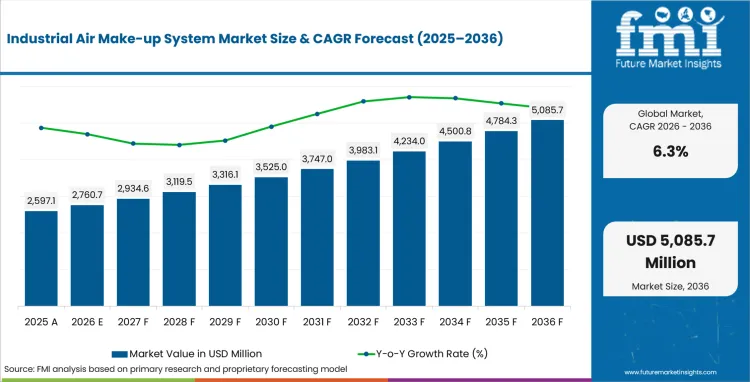
USD 2,760.7 million in 2026 and USD 5,085.7 million by 2036 at a 6.3% CAGR.
The industrial air make-up system market is expected to rise from USD 2,597.1 million in 2025 to USD 5,085.7 million by 2036 at a 6.3% CAGR. Exhaust-heavy factories sites need replacement outdoor air before negative pressure affects doors, hoods and worker comfort. This makes ventilation equipment planning part of production continuity instead of a basic comfort choice.
| Metric | Value |
|---|---|
| 2026 Market Size | USD 2,760.7 million |
| 2036 Market Size | USD 5,085.7 million |
| Forecast CAGR | 6.3% from 2026 to 2036 |
| Leading Unit Type | Direct-fired MAUs |
| Direct-fired MAUs Share in 2026 | 44.0% |
| Leading Airflow Capacity | 5,000-20,000 CFM |
| 5,000-20,000 CFM Share in 2026 | 49.0% |
| Fastest-growing Country | China |
| China CAGR | 7.2% by 2036 |
Summary of the Industrial Air Make-up System Market
| Market Signal | Commercial Impact |
|---|---|
| Demand and Growth Drivers | Demand for industrial make-up air systems is being driven by facilities that require balanced airflow and stable replacement air to support operations and worker safety.
|
| Product and Segment View | Direct-fired units, mid-capacity systems, industrial ventilation applications, manufacturing facilities, and HVAC contractors are expected to dominate their respective segments.
|
| Geography and Growth Outlook | China and India are expected to remain the principal growth markets, supported by industrial expansion and infrastructure development.
|
| Competitive Landscape | Competition remains centered on airflow performance, burner technology, contractor networks, and integrated air-side solutions.
|
| Analyst Perspective | Industrial make-up air systems are increasingly becoming specification-driven assets where operational performance outweighs initial purchase cost.
- Nikhil Kaitwade, Principal Analyst at FMI |
Industry is being shaped by factory activity, warehouse throughput and supplier portfolio changes. Federal Reserve data released in June 2026 showed total USA industrial production was 1.7% above its year-earlier level in May 2026. The USA Census Bureau said in May 2026 that first-quarter 2026 e-commerce sales reached USD 326.7 billion. Greenheck's December 2024 refrigerant transition for direct gas-fired make-up air units shows suppliers are also adjusting cooling-ready products. These facts connect the market to active production, distribution growth and equipment redesign.
Which factors support expansion in the industrial air make-up system market?
Finished unit revenue is supported by replacement projects that solve air balance problems inside working facilities. Contractor-led retrofits then add value. Each installation needs site checks plus fuel access and controls coordination.
- Market value is reinforced by packaged make-up air units that replace exhausted air in factories and process rooms.
- Supplier pricing reflects burner design and fan capacity before controls integration and installation labor are added.
- Revenue improves from tighter warehouses needing outdoor air that reduces dock-area drafts and pressure swings.
- Buyer confidence is strengthened by supplier selection tools, local service access and commissioning support.
Why is the industrial air make-up system market growing?
Industrial buyers are moving make-up air units from comfort-equipment budgets into safety and production-continuity planning.
Growth is expected to follow process exhaust intensity before comfort ventilation. Federal Reserve data released in June 2026 showed manufacturing output increased 0.7% in April 2026 before holding steady in May 2026. This is important because paint booths and welding lines remove conditioned air while production is running. Buyers therefore need units that match exhaust load and stay serviceable after installation.
How is the industrial air make-up system market segmented?
The industrial air make-up system industry is segmented by unit type and airflow capacity. It also covers application plus end use and sales channel.
- Direct-fired MAUs are projected to secure 44.0% share in 2026, driven by high-CFM outdoor air heating demand in factories.
- The mid-capacity band is anticipated to hold 49.0% share in 2026, reflecting its fit across mid-sized plant zones.
- Industrial ventilation is expected to capture 38.0% share in 2026, reflecting general exhaust replacement requirements tied to plant uptime.
- Manufacturing is forecast to represent 42.0% share in 2026, driven by process exhaust and pressure balance requirements.
- HVAC contractors are estimated to account for 41.0% share in 2026, attributable to retrofit projects needing field coordination before equipment release.
Why do direct-fired MAUs hold a notable position in the industrial air make-up system market?
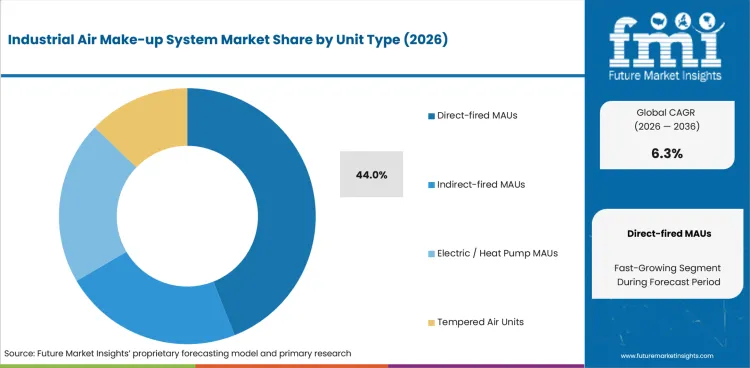
- Direct-fired MAUs are projected to account for 44.0% share in 2026, attributable to efficient heating of large outdoor air volumes.
- Buyers select these units in factories that need simple high-airflow heating and rapid contractor commissioning.
How does the 5,000-20,000 CFM capacity band perform in the industrial air make-up system market?
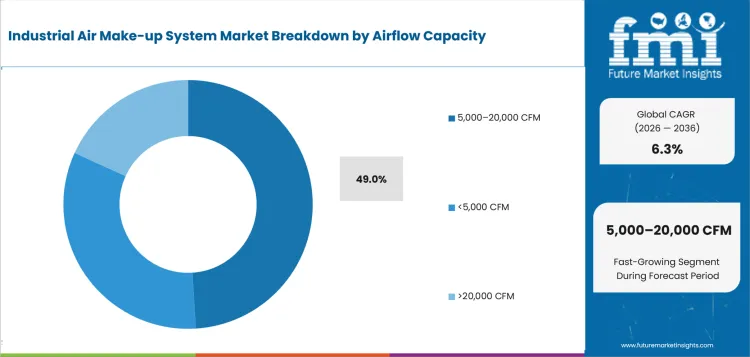
- Medium-capacity units are estimated to hold 49.0% share in 2026, benefiting from paint booth banks and warehouse zones that fit this airflow range.
- Contractor-led projects favor packaged selection, attributable to reduced custom engineering time and faster submittals.
What drives demand across industrial ventilation applications in the industrial air make-up system market?
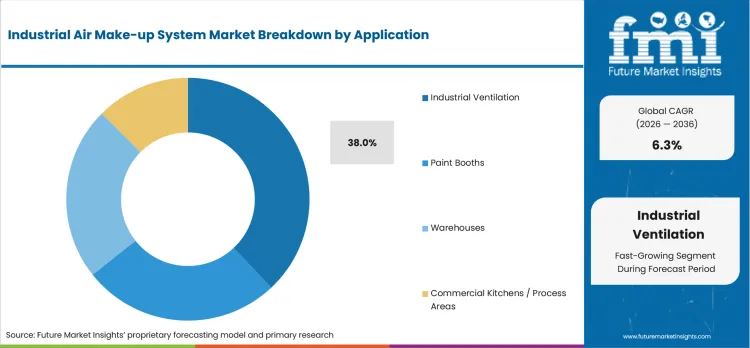
- Industrial ventilation is anticipated to account for 38.0% share in 2026, gaining relevance from broad use in general exhaust replacement.
- Plant teams value pressure balance, driven by capture performance risk from poor air replacement.
Which end-use segment shows a prominent position in the industrial air make-up system market?
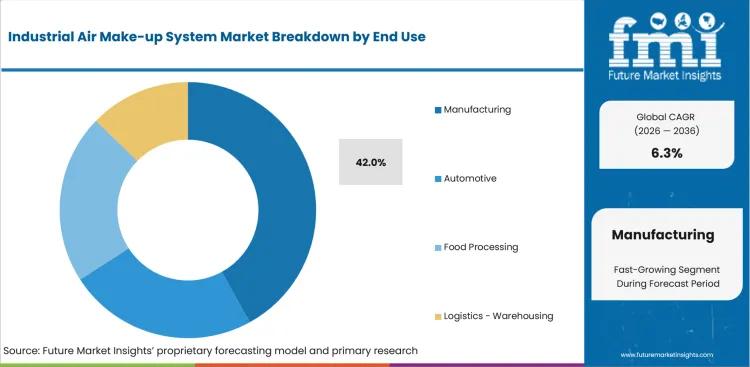
- Manufacturing is expected to represent 42.0% share in 2026, driven by welding and finishing areas that create steady ventilation loads.
- Factory buyers prioritize uptime and commissioning help due to air imbalance risk that can interrupt production before energy savings are measured.
How are buyers selecting across sales channel options in the industrial air make-up system market?
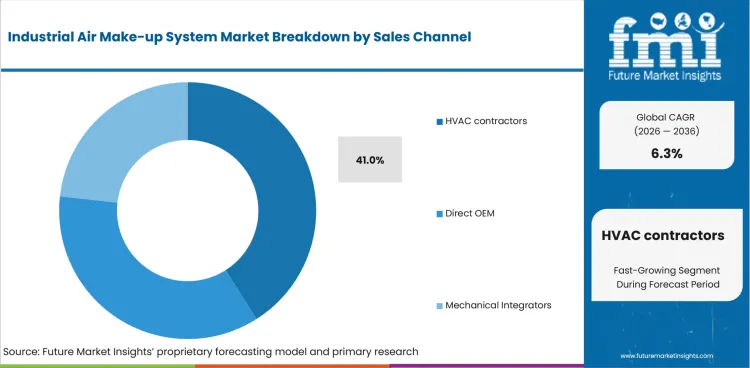
- HVAC contractors are projected to account for 41.0% share in 2026, strengthened by site checks and gas-line coordination.
- Direct OEM sales remain important for large plants that standardize specifications across multiple facilities.
What are the drivers, restraints and opportunities in the industrial air make-up system market?
Exhaust replacement and compliance support demand while fuel access and electrical capacity limit some retrofit plans.
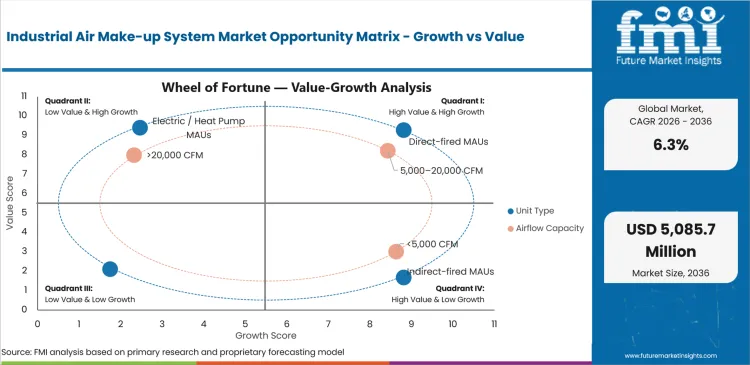
- Driver: Process exhaust replacement is expected to increase demand for make-up air units that stabilize room pressure during production.
- Restraint: Gas service limits and electrical capacity constraints can delay upgrades in older industrial buildings.
- Opportunity: Heat pump and cooling-equipped MAUs create value, gaining support from electrification targets in warehouses and process areas.
Paint Booth Air Balance Raises Specification Discipline
Paint booth projects need tighter airflow checks because replacement air affects capture velocity and finish quality. Current eCFR language for 29 CFR 1910.94 limits make-up air velocity through spray-booth doors to 200 feet per minute. That limit gives contractors a clear design boundary before they balance supply and exhaust. Suppliers that help verify pressure behavior can reduce field rework.
Food Processing Ventilation Needs Cleanable Air Supply
Food plants use make-up air to control heat and moisture near process lines. NBS said in February 2026 that value added for processing of food from agricultural and sideline products rose 5.6% in 2025. The figure points to a large food-processing base that still needs cleanable air packages near ovens and washdown zones. This connects make-up air selection to food processing equipment layouts.
Supplier Portfolio Moves Reshape Unit Options
Supplier portfolios are widening because buyers want burner depth and controls compatibility in the same project. Modine said in March 2025 that it agreed to acquire AbsolutAire. The company described AbsolutAire as a manufacturer of direct-fired heating and make-up air systems. The deal added about USD 25 million in annual revenue to Modine's indoor air quality portfolio. This gives industrial buyers another supplier route for projects that combine burner selection and control support.
Which countries are growing fastest in the industrial air make-up system market?
China 7.2% CAGR, India 7.0% CAGR, South Korea 6.6% CAGR, the United States 6.4% CAGR, Germany 5.7% CAGR, Japan 5.6% CAGR, the United Kingdom 5.3% CAGR, France 5.2% CAGR through 2036.
.webp "Top Country Growth Comparison Industrial Air Make Up System Market Cagr (2026 2036)")
| Country | CAGR |
|---|---|
| China | 7.2% |
| India | 7.0% |
| South Korea | 6.6% |
| United States | 6.4% |
| Germany | 5.7% |
| Japan | 5.6% |
| United Kingdom | 5.3% |
| France | 5.2% |
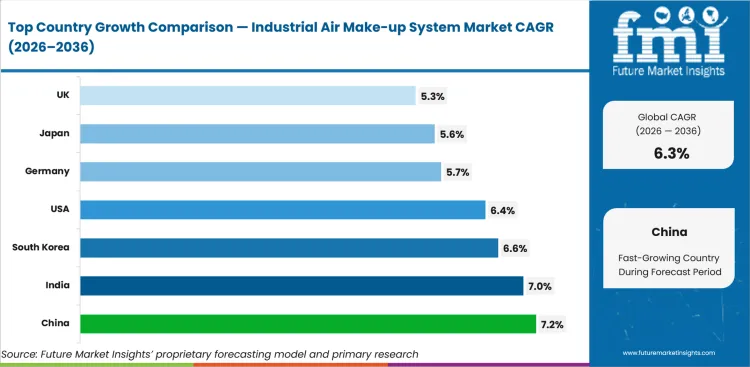
Source: Future Market Insights, 2026.
How do country-level CAGRs compare in the industrial air make-up system market?
- China is forecast to record 7.2% CAGR by 2036 due to industrial park upgrades and local manufacturing activity.
- India is expected to expand at 7.0% CAGR through 2036 owing to factory output and warehouse construction.
- South Korea is projected to grow at 6.6% CAGR by 2036 supported by export-oriented electronics and shipbuilding sites.
- The United States is estimated to rise at 6.4% CAGR through 2036 driven by replacement work in large industrial facilities.
- Germany is forecast to post 5.7% CAGR by 2036 as retrofit demand offsets cautious factory investment.
- Japan is projected to grow at 5.6% CAGR through 2036 because compact factories need quality-focused ventilation upgrades.
- The United Kingdom is expected to expand at 5.3% CAGR by 2036 due to warehouse and food plant projects.
- France is forecast to record 5.2% CAGR through 2036 attributable to process ventilation upgrades and energy scrutiny.
What is shaping industrial air make-up system demand in China?
A 7.2% CAGR through 2036 reflects factory construction and industrial park ventilation upgrades.
Country Market Snapshot Table
| Parameter | Value |
|---|---|
| Market Size in 2025 (Value) | USD 475.7 million |
| Market Size in 2026 (Value) | USD 510.0 million |
| Market Forecast in 2036 (Value) | USD 1,022.2 million |
| CAGR (2026 to 2036) | 7.2% |
| Years Considered | 2021 to 2036 |
| Base Year | 2025 |
| Forecast Period | 2026 to 2036 |
| Units Considered | Value (USD million) |
| Leading Sub-Region | Yangtze River Delta and Pearl River Delta |
China Industrial Air Make-up System Market Outlook
China demand starts in dense industrial parks that run paint, welding and process exhaust loads at scale. These facilities need make-up air systems that keep production areas balanced after exhaust fans remove conditioned air.
Domestic HVAC integrators guide many projects. Buyers need quick site support and local documentation. Foreign brands remain relevant in China only where subsidiaries or distributors can prove service access.
Key Growth Drivers
- Factory output gives China a clear base for ventilation replacement inside plant upgrade budgets. According to NBS in February 2026, manufacturing value added increased 6.4% in 2025 across China. That production scale helps explain why industrial parks continue to specify make-up air during refurbishment.
- Export production adds another route for make-up air demand in paint and assembly areas. The NBS communiqué also placed goods exports 6.1% higher in 2025. Higher outbound manufacturing volumes keep attention on stable finishing and assembly environments inside large industrial plants.
- Industrial park upgrades create repeat demand for mid-CFM units attributable to production hall and warehouse zone requirements.
- Local HVAC suppliers help buyers shorten commissioning time, reinforced by nearby service that reduces downtime after installation.
Key Restraints
- Energy review can slow gas-fired system approvals in public industrial projects. NBS said in February 2026 that energy consumption per unit of GDP fell 5.0% in 2025. That efficiency pressure can make buyers compare burner choice and controls more closely before approval.
- Large plants can require custom air distribution design before packaged units are released, attributable to uneven process exhaust loads.
- Imported components can face longer submittal cycles, driven by local documentation requirements and service approval checks.
What makes China unique
China is unique for industrial parks that create dense clusters of exhaust-heavy facilities and regional HVAC suppliers.
Key Companies
- Holtop
- DunAn
- EuroKlimat
- TICA
Sales & Marketing Channels
- Direct OEM
- HVAC contractors
- Mechanical integrators
- Industrial distributors
- Design institutes
Country Segment Breakdown Table
| Segment | Sub-Segments |
|---|---|
| By Unit Type | Direct-fired MAUs, Indirect-fired MAUs, Electric / Heat Pump MAUs, Tempered Air Units |
| By Airflow Capacity | <5,000 CFM, 5,000-20,000 CFM, >20,000 CFM |
| By Application | Industrial Ventilation, Paint Booths, Warehouses, Commercial Kitchens / Process Areas |
| By End Use | Manufacturing, Automotive, Food Processing, Logistics / Warehousing |
| By Sales Channel | Direct OEM, HVAC Contractors, Mechanical Integrators |
| Key Sub-Regions Covered, Manufacturing and automation corridors | Yangtze River Delta, Pearl River Delta, Beijing-Tianjin-Hebei, Chengdu-Chongqing, Wuhan corridor |
Frequently Asked Questions
How fast is China industrial air make-up system market growing?
Sales in China are forecast to grow at 7.2% CAGR from 2026 to 2036.
Who competes in China industrial air make-up system market?
Holtop, DunAn, EuroKlimat, TICA compete through local portfolios, installer access and service reach.
What supports adoption in China industrial air make-up system market?
Adoption is supported by industrial park ventilation upgrades and domestic HVAC integrator reach.
How fast is the industrial air make-up system market growing in India?
A 7.0% CAGR through 2036 reflects manufacturing output and rising warehouse ventilation needs.
Country Market Snapshot Table
| Parameter | Value |
|---|---|
| Market Size in 2025 (Value) | USD 112.1 million |
| Market Size in 2026 (Value) | USD 120.0 million |
| Market Forecast in 2036 (Value) | USD 236.1 million |
| CAGR (2026 to 2036) | 7.0% |
| Years Considered | 2021 to 2036 |
| Base Year | 2025 |
| Forecast Period | 2026 to 2036 |
| Units Considered | Value (USD million) |
| Leading Sub-Region | Western and southern manufacturing corridors |
India Industrial Air Make-up System Market Outlook
India demand builds from factory additions in automotive, food processing and logistics corridors. Plant teams need make-up air that removes heat and fumes without creating pressure problems near production floors.
Regional HVAC contractors remain central to the buying process. Installation depends on duct routing, fuel access and power capacity. Domestic AHU suppliers are well placed for mid-capacity projects that need faster delivery.
Key Growth Drivers
- Factory activity gives India a practical demand base for new and retrofit ventilation projects nationwide. The June 2026 MoSPI release placed manufacturing output growth at 6.2% for April 2026. That growth keeps make-up air relevant for plants adding exhaust during capacity additions around production floors.
- Construction-linked industrial work raises utility upgrade needs inside Indian plants and nearby logistics sites. PIB stated in May 2026 that cement production increased 9.4% in April 2026. That building activity supports future plant spaces that need ducting and outdoor air capacity planning.
- Automotive and food processing sites create demand for filtered air supply, driven by process-area comfort and hygiene requirements.
- Domestic AHU manufacturing helps shorten lead times, backed by local availability for mid-CFM industrial projects.
Key Restraints
- Fuel and utility constraints can delay gas-fired or electric make-up air upgrades. A May 2026 PIB release showed natural gas production declined 4.3% in April 2026. This matters for facilities that must confirm fuel availability before selecting direct-fired equipment.
- Older industrial sheds often need structural checks before rooftop or curb-mounted MAUs are installed, attributable to load and access limits.
- Price-sensitive projects may delay controls packages, attributable to installed cost reviews that continue until production complaints become visible.
What makes India unique
India is unique for industrial corridor buildout and a large domestic AHU manufacturing base.
Key Companies
- ZECO Aircon
- Voltas
- Blue Star
- Systemair India
- Greenheck India
Sales & Marketing Channels
- HVAC contractors
- Mechanical integrators
- Direct OEM
- Industrial EPC firms
- Regional distributors
Country Segment Breakdown Table
| Segment | Sub-Segments |
|---|---|
| By Unit Type | Direct-fired MAUs, Indirect-fired MAUs, Electric / Heat Pump MAUs, Tempered Air Units |
| By Airflow Capacity | <5,000 CFM, 5,000-20,000 CFM, >20,000 CFM |
| By Application | Industrial Ventilation, Paint Booths, Warehouses, Commercial Kitchens / Process Areas |
| By End Use | Manufacturing, Automotive, Food Processing, Logistics / Warehousing |
| By Sales Channel | Direct OEM, HVAC Contractors, Mechanical Integrators |
| Key Sub-Regions Covered, Manufacturing and automation corridors | Maharashtra, Gujarat, Tamil Nadu, Karnataka, Telangana, NCR industrial belt |
Frequently Asked Questions
How fast is India industrial air make-up system market growing?
Sales in India are forecast to grow at 7.0% CAGR from 2026 to 2036.
Who competes in India industrial air make-up system market?
ZECO Aircon, Voltas, Blue Star, Systemair India compete through local portfolios, installer access and service reach.
What supports adoption in India industrial air make-up system market?
Adoption is reinforced by factory corridor growth and mid-capacity AHU supply from local manufacturers.
How is South Korea performing in the industrial air make-up system market?
A 6.6% CAGR through 2036 reflects export manufacturing and industrial ventilation replacement activity.
Country Market Snapshot Table
| Parameter | Value |
|---|---|
| Market Size in 2025 (Value) | USD 103.2 million |
| Market Size in 2026 (Value) | USD 110.0 million |
| Market Forecast in 2036 (Value) | USD 208.4 million |
| CAGR (2026 to 2036) | 6.6% |
| Years Considered | 2021 to 2036 |
| Base Year | 2025 |
| Forecast Period | 2026 to 2036 |
| Units Considered | Value (USD million) |
| Leading Sub-Region | Seoul Capital Area and southeast industrial belt |
South Korea Industrial Air Make-up System Market Outlook
South Korea demand is shaped by electronics, battery production and shipbuilding campuses. These sites use controlled air replacement around process exhaust and clean production areas.
Large industrial groups often buy through integrated engineering channels. Local HVAC manufacturers and global subsidiaries remain relevant when they can prove service response and documentation support.
Key Growth Drivers
- Export production supports ventilation upgrades in electronics and shipbuilding plants that depend on stable operating environments. MOEF's June 2026 economic update showed exports increased 53.2% in May 2026. That export cycle keeps make-up air tied to production halls that run process exhaust continuously.
- Factory utilization gives equipment buyers a reason to protect replacement-air reliability inside busy production plants. Statistics Korea's May 2026 release placed manufacturing capacity utilization at 73.7% in April 2026. High utilization makes unplanned pressure problems harder to tolerate because active production shifts leave fewer commissioning windows.
- Battery and semiconductor facilities need controlled outdoor air, driven by process exhaust and cleanroom-adjacent production zones.
- Domestic HVAC brands support rapid service response, strengthened by industrial campus and logistics hub requirements.
Key Restraints
- Investment timing can shift quickly in export-led industries that rely on large equipment orders. MOEF said in June 2026 that facilities investment decreased 3.6% month over month in May 2026. That decline can delay non-urgent ventilation packages until export customers confirm schedules.
- High-spec projects can require longer validation before air-side equipment is released, attributable to documentation and performance review needs.
- Space limits in dense plants can make duct routing more difficult than unit selection, tied to congested mechanical areas.
What makes South Korea unique
South Korea is unique for export-led industrial campuses that need fast service response and precise documentation.
Key Companies
- Century Corporation
- LG Electronics
- Samsung HVAC
- HI Air Korea
Sales & Marketing Channels
- Mechanical integrators
- Direct OEM
- HVAC contractors
- Industrial distributors
- Engineering procurement firms
Country Segment Breakdown Table
| Segment | Sub-Segments |
|---|---|
| By Unit Type | Direct-fired MAUs, Indirect-fired MAUs, Electric / Heat Pump MAUs, Tempered Air Units |
| By Airflow Capacity | <5,000 CFM, 5,000-20,000 CFM, >20,000 CFM |
| By Application | Industrial Ventilation, Paint Booths, Warehouses, Commercial Kitchens / Process Areas |
| By End Use | Manufacturing, Automotive, Food Processing, Logistics / Warehousing |
| By Sales Channel | Direct OEM, HVAC Contractors, Mechanical Integrators |
| Key Sub-Regions Covered, Manufacturing and automation corridors | Seoul Capital Area, Ulsan, Busan, Daegu, Gyeonggi, Chungcheong industrial zones |
Frequently Asked Questions
How fast is South Korea industrial air make-up system market growing?
Sales in South Korea are forecast to grow at 6.6% CAGR from 2026 to 2036.
Who competes in South Korea industrial air make-up system market?
Century Corporation, LG Electronics, Samsung HVAC, HI Air Korea compete through local portfolios, installer access and service reach.
What supports adoption in South Korea industrial air make-up system market?
Adoption is shaped by export manufacturing sites that need controlled air around process exhaust.
What supports industrial air make-up system growth in the United States?
A 6.4% CAGR through 2036 reflects retrofit demand in factories, warehouses and paint facilities.
Country Market Snapshot Table
| Parameter | Value |
|---|---|
| Market Size in 2025 (Value) | USD 714.3 million |
| Market Size in 2026 (Value) | USD 760.0 million |
| Market Forecast in 2036 (Value) | USD 1,413.3 million |
| CAGR (2026 to 2036) | 6.4% |
| Years Considered | 2021 to 2036 |
| Base Year | 2025 |
| Forecast Period | 2026 to 2036 |
| Units Considered | Value (USD million) |
| Leading Sub-Region | Midwest and Sun Belt manufacturing corridors |
United States Industrial Air Make-up System Market Outlook
United States demand is concentrated in large factories, paint shops and distribution buildings. Buyers often replace basic heaters with engineered MAUs that address pressure balance and worker comfort.
Contractor reach strongly affects supplier selection. Retrofit work includes curb coordination, gas piping and controls integration. Local service access helps suppliers protect repeat accounts after commissioning.
Key Growth Drivers
- Durable manufacturing creates a natural replacement base for exhaust-heavy plants and paint areas. Federal Reserve data released in June 2026 showed durable goods output rose 0.8% in May 2026. That output base supports make-up air projects in facilities that need stable pressure during production.
- Warehouse activity keeps dock-area ventilation inside project scope for distribution buildings. The USA Census Bureau said in May 2026 that e-commerce represented 16.9% of retail sales in the first quarter of 2026. That channel mix gives operators a reason to improve tempered outdoor air near loading areas.
- Paint booth and finishing facilities need make-up air, shaped by airflow stabilization requirements around production shifts.
- Large service networks help contractors standardize unit selection, reinforced by multi-site industrial accounts that need repeatable support.
Key Restraints
- Energy cost reviews can slow high-outdoor-air heating projects during retrofit planning. EIA's June 2026 data put Henry Hub spot prices at USD 3.15 per million Btu in May 2026. That gas-price reference can push buyers to compare burner efficiency and controls before approval.
- Permitting and rooftop structural checks can add time to older facility retrofits, tied to load review and code coordination needs.
- Controls integration can become a bottleneck, attributable to outdated building systems that need extra coordination before commissioning.
What makes United States unique
The United States is unique for a large retrofit base and a strong contractor-led distribution structure.
Key Companies
- Greenheck
- CaptiveAire
- Modine
- Cambridge Air Solutions
- Nortek Air Solutions
- Accurex
Sales & Marketing Channels
- HVAC contractors
- Mechanical integrators
- Direct OEM
- Industrial distributors
- Factory service networks
Country Segment Breakdown Table
| Segment | Sub-Segments |
|---|---|
| By Unit Type | Direct-fired MAUs, Indirect-fired MAUs, Electric / Heat Pump MAUs, Tempered Air Units |
| By Airflow Capacity | <5,000 CFM, 5,000-20,000 CFM, >20,000 CFM |
| By Application | Industrial Ventilation, Paint Booths, Warehouses, Commercial Kitchens / Process Areas |
| By End Use | Manufacturing, Automotive, Food Processing, Logistics / Warehousing |
| By Sales Channel | Direct OEM, HVAC Contractors, Mechanical Integrators |
| Key Sub-Regions Covered, Manufacturing and automation corridors | Midwest manufacturing belt, Southeast automotive corridor, Texas industrial corridor, California logistics hubs, Great Lakes region |
Frequently Asked Questions
How fast is United States industrial air make-up system market growing?
Sales in United States are forecast to grow at 6.4% CAGR from 2026 to 2036.
Who competes in United States industrial air make-up system market?
Greenheck, CaptiveAire, Modine, Cambridge Air Solutions compete through local portfolios, installer access and service reach.
What supports adoption in United States industrial air make-up system market?
Adoption is supported by retrofit work in factories, warehouses and paint facilities.
What is the industrial air make-up system outlook in Germany?
A 5.7% CAGR through 2036 reflects retrofit demand and disciplined factory investment cycles.
Country Market Snapshot Table
| Parameter | Value |
|---|---|
| Market Size in 2025 (Value) | USD 222.3 million |
| Market Size in 2026 (Value) | USD 235.0 million |
| Market Forecast in 2036 (Value) | USD 409.1 million |
| CAGR (2026 to 2036) | 5.7% |
| Years Considered | 2021 to 2036 |
| Base Year | 2025 |
| Forecast Period | 2026 to 2036 |
| Units Considered | Value (USD million) |
| Leading Sub-Region | Bavaria and North Rhine-Westphalia industrial corridors |
Germany Industrial Air Make-up System Market Outlook
Industry in Germany is driven by automotive and process manufacturing sites that need reliable exhaust replacement. Buyers usually expect documented efficiency, burner detail and integration planning before approval.
Local AHU manufacturers remain well placed as engineering teams value detailed submittals and service continuity. Retrofit timing can remain cautious when factory orders soften.
Key Growth Drivers
- Order backlogs support selective ventilation replacement in German industrial sites. The June 2026 Destatis release showed manufacturing order stocks rose 8.4% year over year in April 2026. That backlog keeps plant managers focused on avoiding airflow problems that could interrupt scheduled production.
- Production continuity keeps air-side upgrades relevant in machinery and automotive plants. Destatis data also showed manufacturing production rose 0.4% in April 2026. Even modest output growth can sustain replacement demand when ventilation protects booth and process stability.
- Local engineered AHU suppliers support custom configurations that reflect cold-region outdoor air treatment requirements.
- Automotive painting and finishing lines continue to need stable make-up air tied to strict process controls.
Key Restraints
- Factory investment timing remains cautious in sectors facing uneven order intake. The June 2026 Destatis release placed new manufacturing orders 3.8% lower in April 2026. That decline can make buyers delay higher-spec controls or custom air distribution packages.
- High energy scrutiny can push buyers to demand longer payback reviews before approving gas-fired units.
- Complex building envelopes can increase design time, attributable to rooftop and plant-room release constraints.
What makes Germany unique
Germany is unique for engineering-led specifications and a dense base of domestic AHU manufacturers.
Key Companies
- robatherm
- WOLF Anlagen-Technik
- Menerga
- Systemair
Sales & Marketing Channels
- Mechanical integrators
- HVAC contractors
- Direct OEM
- Engineering consultants
- Regional service partners
Country Segment Breakdown Table
| Segment | Sub-Segments |
|---|---|
| By Unit Type | Direct-fired MAUs, Indirect-fired MAUs, Electric / Heat Pump MAUs, Tempered Air Units |
| By Airflow Capacity | <5,000 CFM, 5,000-20,000 CFM, >20,000 CFM |
| By Application | Industrial Ventilation, Paint Booths, Warehouses, Commercial Kitchens / Process Areas |
| By End Use | Manufacturing, Automotive, Food Processing, Logistics / Warehousing |
| By Sales Channel | Direct OEM, HVAC Contractors, Mechanical Integrators |
| Key Sub-Regions Covered, Manufacturing and automation corridors | Bavaria, Baden-Württemberg, North Rhine-Westphalia, Lower Saxony, Saxony industrial clusters |
Frequently Asked Questions
How fast is Germany industrial air make-up system market growing?
Sales in Germany are forecast to grow at 5.7% CAGR from 2026 to 2036.
Who competes in Germany industrial air make-up system market?
robatherm, WOLF Anlagen-Technik, Menerga, Systemair compete through local portfolios, installer access and service reach.
What supports adoption in Germany industrial air make-up system market?
Adoption is guided by engineering-led retrofit planning and domestic AHU manufacturing depth.
How is the industrial air make-up system forecast developing in Japan?
A 5.6% CAGR through 2036 reflects compact factory retrofits and quality-led production ventilation.
Country Market Snapshot Table
| Parameter | Value |
|---|---|
| Market Size in 2025 (Value) | USD 179.9 million |
| Market Size in 2026 (Value) | USD 190.0 million |
| Market Forecast in 2036 (Value) | USD 327.6 million |
| CAGR (2026 to 2036) | 5.6% |
| Years Considered | 2021 to 2036 |
| Base Year | 2025 |
| Forecast Period | 2026 to 2036 |
| Units Considered | Value (USD million) |
| Leading Sub-Region | Kanto, Chubu and Kansai industrial corridors |
Japan Industrial Air Make-up System Market Outlook
Japan sector outlook is shaped by compact factories and quality-sensitive production lines. Make-up air units are selected to manage pressure and process exhaust without wasting mechanical space.
Domestic HVAC brands remain important. Buyers value local engineering support and maintenance continuity. Heat pump and hybrid packages gain attention in facilities reviewing energy use.
Key Growth Drivers
- Industrial recovery supports ventilation upgrades in factory zones that need precise air balance during active production cycles. METI's June 2026 release placed Japan's production index at 102.5 in April 2026. That index gives a useful signal for factory activity behind replacement-air planning.
- Inventory adjustment creates room for efficiency-led retrofit planning in Japanese manufacturing sites. The same METI release showed inventories declined 5.0% year over year in April 2026. Lower inventories can make production managers more willing to schedule airflow upgrades during operational resets.
- Automotive and electronics plants need stable air replacement tied to finishing, assembly and inspection environment requirements.
- Domestic OEM support helps buyers integrate make-up air equipment, shaped by compact mechanical space constraints.
Key Restraints
- Energy efficiency review can lengthen approval for gas-fired systems in compact factories. METI data also showed shipments increased 1.8% year over year in April 2026. That shipment activity can keep projects moving while buyers check fuel use and space constraints.
- Space constraints in older plants can limit equipment placement and duct routing options tied to congested mechanical layouts.
- Buyers often require extended technical review before non-standard air-side packages are approved, attributable to integration risk.
What makes Japan unique
Japan is unique for compact plant layouts that increase the value of local engineering support.
Key Companies
- Daikin Industries
- Mitsubishi Electric
- Toshiba Carrier
- Panasonic
Sales & Marketing Channels
- Direct OEM
- HVAC contractors
- Mechanical integrators
- Authorized distributors
- Facility service partners
Country Segment Breakdown Table
| Segment | Sub-Segments |
|---|---|
| By Unit Type | Direct-fired MAUs, Indirect-fired MAUs, Electric / Heat Pump MAUs, Tempered Air Units |
| By Airflow Capacity | <5,000 CFM, 5,000-20,000 CFM, >20,000 CFM |
| By Application | Industrial Ventilation, Paint Booths, Warehouses, Commercial Kitchens / Process Areas |
| By End Use | Manufacturing, Automotive, Food Processing, Logistics / Warehousing |
| By Sales Channel | Direct OEM, HVAC Contractors, Mechanical Integrators |
| Key Sub-Regions Covered, Manufacturing and automation corridors | Kanto, Chubu, Kansai, Kyushu, Tohoku manufacturing zones |
Frequently Asked Questions
How fast is Japan industrial air make-up system market growing?
Sales in Japan are forecast to grow at 5.6% CAGR from 2026 to 2036.
Who competes in Japan industrial air make-up system market?
Daikin Industries, Mitsubishi Electric, Toshiba Carrier, Panasonic compete through local portfolios, installer access and service reach.
What supports adoption in Japan industrial air make-up system market?
Adoption is supported by compact factory retrofits and local HVAC engineering support.
What is shaping industrial air make-up system demand in the United Kingdom?
A 5.3% CAGR through 2036 reflects food manufacturing, warehousing and energy-led retrofit decisions.
Country Market Snapshot Table
| Parameter | Value |
|---|---|
| Market Size in 2025 (Value) | USD 161.4 million |
| Market Size in 2026 (Value) | USD 170.0 million |
| Market Forecast in 2036 (Value) | USD 284.9 million |
| CAGR (2026 to 2036) | 5.3% |
| Years Considered | 2021 to 2036 |
| Base Year | 2025 |
| Forecast Period | 2026 to 2036 |
| Units Considered | Value (USD million) |
| Leading Sub-Region | Midlands and northern industrial corridors |
United Kingdom Industrial Air Make-up System Market Outlook
United Kingdom demand is concentrated in food plants, warehouses and light manufacturing sites. Buyers review make-up air as part of comfort, hygiene and energy planning.
Contractors influence final selection in retrofit-led and site-specific projects. Local suppliers with heating and ventilation portfolios remain useful when duct, heater and controls decisions must be solved together.
Key Growth Drivers
- Food manufacturing gives the United Kingdom a clear setting for hygienic air replacement projects. ONS data released in July 2025 showed food manufacturing represented 21% of UK manufacturers' sales in 2024. That industry share explains why contractors still discuss filtered and tempered air near process areas.
- Manufacturing output keeps a sizable installed base for retrofit work across the United Kingdom. The same ONS release put manufacturers' product sales at GBP 452.2 billion in 2024. That base supports replacement demand even when projects remain selective and cost reviewed.
- Warehouse operators need tempered outdoor air, driven by drafts near loading and dispatch zones.
- Local heating and ventilation suppliers support contractor-led projects, strengthened by mid-sized industrial building demand.
Key Restraints
- Energy cost reviews remain central to project approvals for high-outdoor-air systems. DESNZ reported in March 2026 that manufacturing electricity averaged 18.5 pence per kWh in quarter 1 2025. That cost pressure can make buyers check controls and heating choice before ordering.
- Space limits in older estates can make rooftop and ductwork coordination difficult, tied to constrained building layouts.
- Compliance reviews around combustion and emissions can extend specification time for direct-fired units attributable to permitting caution.
What makes United Kingdom unique
The United Kingdom is unique for food manufacturing scale and a retrofit-heavy contractor channel.
Key Companies
- Powrmatic
- FläktGroup
- Reznor UK
- Systemair UK
Sales & Marketing Channels
- HVAC contractors
- Mechanical integrators
- Direct OEM
- Facilities management firms
- Regional distributors
Country Segment Breakdown Table
| Segment | Sub-Segments |
|---|---|
| By Unit Type | Direct-fired MAUs, Indirect-fired MAUs, Electric / Heat Pump MAUs, Tempered Air Units |
| By Airflow Capacity | <5,000 CFM, 5,000-20,000 CFM, >20,000 CFM |
| By Application | Industrial Ventilation, Paint Booths, Warehouses, Commercial Kitchens / Process Areas |
| By End Use | Manufacturing, Automotive, Food Processing, Logistics / Warehousing |
| By Sales Channel | Direct OEM, HVAC Contractors, Mechanical Integrators |
| Key Sub-Regions Covered, Manufacturing and automation corridors | Midlands, Northern England, Greater London logistics belt, Scotland central belt, South Wales industrial zones |
Frequently Asked Questions
How fast is United Kingdom industrial air make-up system market growing?
Sales in United Kingdom are forecast to grow at 5.3% CAGR from 2026 to 2036.
Who competes in United Kingdom industrial air make-up system market?
Powrmatic, FläktGroup, Reznor UK, Systemair UK compete through local portfolios, installer access and service reach.
What supports adoption in United Kingdom industrial air make-up system market?
Adoption is reinforced by food plant ventilation needs and contractor-led retrofit projects.
How does France compare in the industrial air make-up system market?
A 5.2% CAGR through 2036 reflects measured retrofit demand across process and logistics facilities.
Country Market Snapshot Table
| Parameter | Value |
|---|---|
| Market Size in 2025 (Value) | USD 142.6 million |
| Market Size in 2026 (Value) | USD 150.0 million |
| Market Forecast in 2036 (Value) | USD 249.0 million |
| CAGR (2026 to 2036) | 5.2% |
| Years Considered | 2021 to 2036 |
| Base Year | 2025 |
| Forecast Period | 2026 to 2036 |
| Units Considered | Value (USD million) |
| Leading Sub-Region | Île-de-France, Auvergne-Rhône-Alpes and Hauts-de-France |
France Industrial Air Make-up System Market Outlook
France demand is tied to food processing and logistics. Aerospace and general manufacturing facilities add project depth. Buyers need make-up air that supports pressure balance and energy-aware operation.
Local ventilation suppliers and European AHU brands remain important. Projects often require documentation and installer support. Public-sector energy scrutiny can shape approvals in retrofit projects.
Key Growth Drivers
- Manufacturing output supports selected plant ventilation upgrades in French process and assembly sites. INSEE's March 2026 update showed manufacturing output rose 1.6% in the three months to February 2026. That increase gives plant teams a reason to maintain airflow reliability during retrofit planning.
- Food and process industries support air replacement near heat and moisture sources inside French production facilities. INSEE data released in January 2026 showed industrial output increased 1.8% year over year in December 2025. That activity helps connect make-up air demand to production areas that need controlled supply air.
- Warehouse and logistics sites need air balance, shaped by dock doors and dense worker zones.
- Local ventilation brands support contractor-led projects, strengthened by documented product ranges that help installers release equipment choices.
Key Restraints
- Energy and emissions review can extend capital approval cycles for French industrial retrofits. Eurostat data released in May 2026 placed EU non-household electricity prices at EUR 18.37 per 100 kWh in the second half of 2025. That price context can push buyers toward tighter control review before gas or electric packages are approved.
- Multi-site industrial buyers may delay projects until controls compatibility is clarified, attributable to integration risk.
- Custom AHU projects can face longer lead times, driven by cleanable or low-noise configuration requirements.
What makes France unique
France is unique for food and aerospace clusters that require documented ventilation quality.
Key Companies
- France Air
- Aldes
- CIAT
- FläktGroup
Sales & Marketing Channels
- HVAC contractors
- Mechanical integrators
- Direct OEM
- Industrial distributors
- Energy service companies
Country Segment Breakdown Table
| Segment | Sub-Segments |
|---|---|
| By Unit Type | Direct-fired MAUs, Indirect-fired MAUs, Electric / Heat Pump MAUs, Tempered Air Units |
| By Airflow Capacity | <5,000 CFM, 5,000-20,000 CFM, >20,000 CFM |
| By Application | Industrial Ventilation, Paint Booths, Warehouses, Commercial Kitchens / Process Areas |
| By End Use | Manufacturing, Automotive, Food Processing, Logistics / Warehousing |
| By Sales Channel | Direct OEM, HVAC Contractors, Mechanical Integrators |
| Key Sub-Regions Covered, Manufacturing and automation corridors | Île-de-France, Auvergne-Rhône-Alpes, Hauts-de-France, Grand Est, Occitanie industrial zones |
Frequently Asked Questions
How fast is France industrial air make-up system market growing?
Sales in France are forecast to grow at 5.2% CAGR from 2026 to 2036.
Who competes in France industrial air make-up system market?
France Air, Aldes, CIAT, FläktGroup compete through local portfolios, installer access and service reach.
What supports adoption in France industrial air make-up system market?
Adoption is shaped by process ventilation upgrades and documented installer support.
Who are the leading companies in the industrial air make-up system market?
Greenheck, CaptiveAire, Modine, Cambridge Air Solutions, Systemair, Daikin Applied, Trane, Nortek Air Solutions
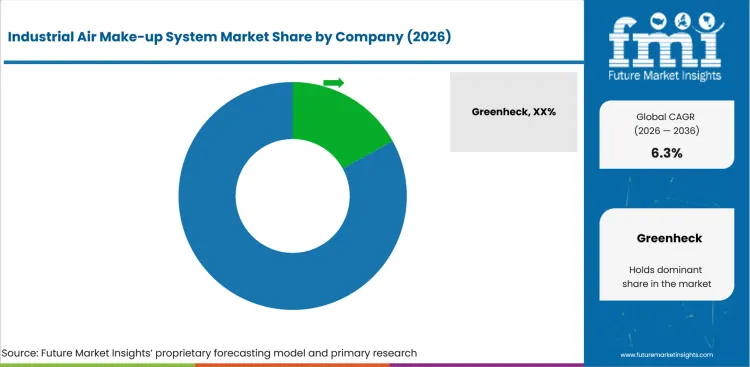
- Competition is based on airflow range and heating technology, tied to suppliers that help contractors complete submittals.
- Service reach matters in retrofit projects, tied to field checks that are often needed before equipment release.
- Portfolio breadth helps suppliers combine make-up air and cooling options inside one bid.
- Regional companies compete well, strengthened by local support that shortens commissioning and maintenance cycles.
Competitive outlook in the market includes dedicated make-up air specialists, air-handling manufacturers and broader HVAC equipment companies. Suppliers compete on burner efficiency and airflow capacity. Control support and contractor relationships shape repeat accounts. Manufacturing and warehouse accounts increasingly compare make-up air packages with related building automation systems to manage pressure balance and energy use. Larger suppliers gain an advantage when they pair equipment with commissioning support and controller compatibility. Companies with verified local manufacturing, regional distributors and installer training are better positioned in retrofit-heavy markets.
How do top industrial air make-up system companies compare?
Companies differ by make-up air depth and heating flexibility. Contractor support and geographic reach shape buyer selection.
| Company | Make-up Air Depth | Heating Flexibility | Contractor Support | Controls/Service Depth | Geographic Footprint |
|---|---|---|---|---|---|
| Greenheck | High | Gas and cooling options | High | High | Global |
| CaptiveAire | High | Direct-fired and kitchen ventilation | High | Medium | North America |
| Modine | High | Gas-fired and HVAC products | Medium | Medium | North America and Europe |
| Cambridge Air Solutions | High | Direct-fired and tempered air | High | Medium | North America |
| Systemair | Medium | Air-handling and ventilation range | Medium | Medium | Global |
| Daikin Applied | Medium | Rooftop and air-side systems | Medium | High | Global |
| Nortek Air Solutions | Medium | Custom air-handling range | Medium | High | North America |
Source: Future Market Insights, 2026.
Who are the key players in the industrial air make-up system market?
Key companies include global HVAC groups and regional make-up air specialists.
Key global companies leading the industrial air make-up system market include:
- Greenheck
- CaptiveAire
- Modine
- Cambridge Air Solutions
- Systemair
- Daikin Applied
- Trane
- Nortek Air Solutions
- Accurex
- Munters
Key Developments in Industrial Air Make-up System Market
- In March 2025, Modine agreed to acquire AbsolutAire and add direct-fired make-up air systems to its indoor air quality portfolio.
- In May 2026, Trane and Valent announced an exclusive supply agreement for the United States and Canada. The agreement expands access to DOAS and energy recovery products, which helps buyers source outside-air systems through a wider service-backed channel.
- In January 2026, Daikin expanded its Compact series with the Compact R air handling unit. The unit covers airflow rates from 500 to 6,000 m³/h and gives retrofit buyers a compact ventilation option where plant-room space is limited.
Key Players in the Industrial Air Make-up System Market
North America
- Greenheck
- CaptiveAire
- Modine
- Cambridge Air Solutions
- Nortek Air Solutions
- Accurex
Europe
- Systemair
- FläktGroup
- robatherm
- WOLF Anlagen-Technik
- Menerga
- France Air
- Aldes
- CIAT
- Powrmatic
- Reznor UK
Asia Pacific
- Daikin Industries
- Mitsubishi Electric
- Toshiba Carrier
- Panasonic
- Holtop
- DunAn
- EuroKlimat
- TICA
- ZECO Aircon
- Voltas
- Blue Star
- Century Corporation
- LG Electronics
- Samsung HVAC
- HI Air Korea
What is included in the industrial air make-up system market report scope?
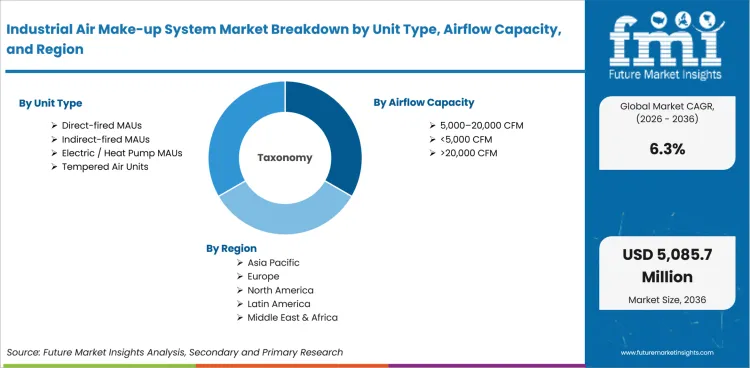
| Parameter | Details |
|---|---|
| Forecast period | 2026 to 2036 |
| Historical period | 2021 to 2025 |
| Quantitative unit | Value in USD million |
| Segmentation by unit type | Direct-fired MAUs, Indirect-fired MAUs, Electric / Heat Pump MAUs, Tempered Air Units |
| Segmentation by airflow capacity | <5,000 CFM, 5,000-20,000 CFM, >20,000 CFM |
| Segmentation by application | Industrial Ventilation, Paint Booths, Warehouses, Commercial Kitchens / Process Areas |
| Segmentation by end use | Manufacturing, Automotive, Food Processing, Logistics / Warehousing |
| Segmentation by sales channel | Direct OEM, HVAC Contractors, Mechanical Integrators |
| Regions covered | North America, Latin America, Europe, East Asia, South Asia & Pacific, Middle East & Africa |
| Countries covered | United States, United Kingdom, Germany, France, Japan, China, South Korea, India |
| Key companies profiled | Greenheck, CaptiveAire, Modine, Cambridge Air Solutions, Systemair, Daikin Applied, Trane, Nortek Air Solutions |
| Approach | Primary interviews, desk research, company validation and forecast triangulation |
Source: Future Market Insights, 2026.
What is the scope and definition of the industrial air make-up system market?
| Attribute | Detail |
|---|---|
| Market Definition | Packaged industrial systems that supply filtered and tempered outdoor air to replace air removed by exhaust systems. |
| Functions Covered | Air replacement, Pressure balance, Outdoor air heating, Outdoor air cooling, Filtration, Controls integration |
| Applications Covered | Industrial ventilation, Paint booths, Warehouses, Commercial kitchens and process areas |
| End-Use Industries | Manufacturing, Automotive, Food processing, Logistics and warehousing |
| Grades Covered | Direct-fired, Indirect-fired, Electric and heat pump, Tempered air configurations |
| Inclusions | Commercially supplied industrial make-up air units, controls packages and associated sales channels. |
| Exclusions | Residential ventilation units, portable air purifiers, standalone exhaust fans and comfort-only rooftop HVAC systems. |
Source: Future Market Insights, 2026.
How was the industrial air make-up system market research conducted?
| Method | Description |
|---|---|
| Primary Research | FMI analysts reviewed buying behavior among plant engineers, facility managers, HVAC contractors and mechanical integrators. |
| Desk Research | Desk work reviewed OSHA ventilation rules, product portfolios, company releases and official industrial statistics. |
| Market Sizing & Forecasting | The model combined unit value, airflow capacity mix, country-level industrial demand and sales channel influence. |
| Data Validation | Forecasts were checked against company portfolios, official statistics and contractor-led procurement patterns. |
Industrial Air Make-up System Market Breakdown by Unit Type, Airflow Capacity, Application, End Use, Sales Channel, and Region
Industrial Air Make-up System Market Segmented by Unit Type
- Direct-fired MAUs
- Indirect-fired MAUs
- Electric / Heat Pump MAUs
- Tempered Air Units
Industrial Air Make-up System Market Segmented by Airflow Capacity
- <5,000 CFM
- 5,000–20,000 CFM
- >20,000 CFM
Industrial Air Make-up System Market Segmented by Application
- Industrial Ventilation
- Paint Booths
- Warehouses
- Commercial Kitchens / Process Areas
Industrial Air Make-up System Market Segmented by End Use
- Manufacturing
- Automotive
- Food Processing
- Logistics / Warehousing
Industrial Air Make-up System Market Segmented by Sales Channel
- Direct OEM
- HVAC Contractors
- Mechanical Integrators
Industrial Air Make-up System Market by Region
- North America
- Latin America
- Europe
- East Asia
- South Asia & Pacific
- Middle East & Africa
Bibliography
- Cambridge Air Solutions. (2026, January). Make-up air systems and industrial ventilation applications. Cambridge Air Solutions.
- CaptiveAire. (2026, February). Make-up air and industrial ventilation equipment. CaptiveAire Systems.
- Department for Energy Security and Net Zero. (2026, March). Quarterly energy prices: March 2026. GOV.UK.
- Destatis. (2026, June). Industry and manufacturing statistical releases for April 2026. Federal Statistical Office of Germany.
- eCFR. (2026, June). Occupational safety and health standards for spray finishing using flammable and combustible materials. National Archives and Records Administration.
- Eurostat. (2026, May). Non-household electricity prices in second half of 2025: -3.5%. European Commission.
- Federal Reserve Board. (2026, June). Industrial production and capacity utilization for May 2026. Board of Governors of the Federal Reserve System.
- Greenheck. (2024, December). Direct gas-fired make-up air units transition to R-454B refrigerant. Greenheck Fan Corporation.
- Greenheck. (2026, January). Make-up air units product range. Greenheck Fan Corporation.
- INSEE. (2026, March). Industrial production index releases for France. Institut National de la Statistique et des Études Économiques.
- METI. (2026, June). Revised report for April 2026 indices of industrial production. Ministry of Economy, Trade and Industry.
- Ministry of Economy and Finance. (2026, June). Current economic situation in Korea. Republic of Korea.
- Modine. (2025, March). Modine announces agreement to acquire AbsolutAire. Modine Manufacturing Company.
- National Bureau of Statistics of China. (2026, February). Statistical Communiqué of the People’s Republic of China on the 2025 National Economic and Social Development. National Bureau of Statistics of China.
- Office for National Statistics. (2025, July). UK manufacturers’ sales by product: 2024. Office for National Statistics.
- Press Information Bureau. (2026, June). Index of Industrial Production records 4.9% growth in April 2026. Government of India.
- Press Information Bureau. (2026, May). Index of eight core industries for April 2026. Government of India.
- Statistics Korea. (2026, May). Industrial activity trends for April 2026. Statistics Korea.
- USA Census Bureau. (2026, May). Quarterly retail e-commerce sales: First quarter 2026. United States Department of Commerce.
- USA Energy Information Administration. (2026, June). Short-term energy outlook and Henry Hub natural gas price data. United States Department of Energy.
- Trane. May 14, 2026. Trane, Valent Announce Exclusive Supply Agreement in USA, Canada. Trane Commercial HVAC.
- Daikin Europe N.V. January 7, 2026. Daikin expands its Compact series with the new Compact R air handling unit. Daikin.
This report answers
- The report explains market size and forecast value to give buyers a clear CAGR view for industrial air make-up systems from 2026 to 2036.
- Segment coverage identifies unit type and airflow capacity leaders across application plus end-use and sales channel comparisons.
- Country analysis compares China and India plus South Korea and the United States plus Germany and Japan plus the United Kingdom and France.
- The report evaluates drivers and restraints tied to fuel access plus compliance needs and retrofit timing.
- Competitive review covers supplier positioning, recent developments and company relevance across verified industrial air-side portfolios.
Frequently Asked Questions
How large is the Industrial Air Make up System Market expected to be in the near term?
The market is expanding as factories and warehouses prioritize replacement air to maintain pressure balance and operational reliability.
What is the long term outlook for the Industrial Air Make up System Market?
The outlook remains steady as make up air systems become part of safety, uptime, and production continuity planning rather than comfort upgrades.
How fast is the Industrial Air Make up System Market expected to grow?
Growth is driven by sustained industrial activity and retrofit needs in exhaust heavy facilities.
What is the main driver of industrial air make up system demand?
Demand is driven by the need to replace exhausted air in manufacturing environments without disrupting pressure or worker safety.
Demand is driven by the need to replace exhausted air in manufacturing environments without disrupting pressure or worker safety.
Direct fired make up air units dominate because they efficiently heat large volumes of outdoor air in industrial settings.
Which airflow capacity range is most widely used?
Mid capacity systems are most widely used as they fit common factory zones, paint areas, and warehouse spaces.
Which application generates the highest demand?
Industrial ventilation leads demand due to general exhaust replacement requirements tied to plant uptime.
Which end use segment contributes the most?
Manufacturing leads adoption as welding, finishing, and process areas create continuous make up air requirements.
Manufacturing leads adoption as welding, finishing, and process areas create continuous make up air requirements.
HVAC contractors lead sales because site checks and commissioning coordination shape final equipment selection.
Which regions show strong adoption of industrial air make up systems?
East Asia, South Asia, North America, and Europe show strong adoption through industrial expansion and retrofit cycles.
East Asia, South Asia, North America, and Europe show strong adoption through industrial expansion and retrofit cycles.
China, India, the United States, South Korea, Germany, Japan, the United Kingdom, and France are key markets.
What supports China’s growth momentum?
Industrial park upgrades and large scale factory construction support continued system deployment.
Why is India an important growth market?
Manufacturing corridor expansion and rising warehouse capacity drive demand for mid capacity make up air solutions.
What drives adoption in the United States?
Retrofit demand in factories, warehouses, and paint facilities supports steady system replacement activity.
What restrains faster growth in the industrial air make up system market?
Gas availability, electrical capacity limits, and structural constraints in older buildings can delay upgrades.
Who are the leading companies in the Industrial Air Make up System Market?
Leading companies include Greenheck, CaptiveAire, Modine, Cambridge Air Solutions, Systemair, Daikin Applied, Trane, and Nortek Air Solutions.
How do suppliers differentiate industrial air make up systems?
Suppliers differentiate through burner design, airflow range, controls integration, and contractor support.
Preview the report firsthand - request a free sample
Get SampleGet the brochure for pricing and purchase details.
Get PDFTable of Content
- Key Takeaways
- Market Size and CAGR
- Top Growth Driver
- Fastest Growing Segment
- Leading Region
- Key Companies
- Emerging Opportunities
- Executive Summary
- Global Market Outlook
- Demand-side Trends
- Supply-side Trends
- Technology Roadmap Analysis
- Analysis and Recommendations
- Analyst Perspective (What is happening? Why now? What should investors know?)
- Key Questions Answered
- How large is the market?
- What is the CAGR?
- What are key trends?
- Which region dominates?
- Who are the leaders?
- Market Overview
- Market Coverage / Taxonomy
- Market Definition / Scope / Limitations
- Research Methodology
- Chapter Orientation
- Analytical Lens and Working Hypotheses
- Market Structure, Signals, and Trend Drivers
- Benchmarking and Cross-market Comparability
- Market Sizing, Forecasting, and Opportunity Mapping
- Research Design and Evidence Framework
- Desk Research Programme (Secondary Evidence)
- Expert Input and Fieldwork (Primary Evidence)
- Tooling, Models, and Reference Databases
- Data Engineering and Model Build
- Quality Assurance and Audit Trail
- Market Background
- Market Dynamics (Drivers, Restraints, Opportunity, Trends)
- Scenario Forecast (Optimistic, Likely, Conservative)
- Impact Analysis
- AI Impact
- Sustainability Impact
- Regulatory Impact
- Technology Impact
- Consumer / Buyer Analysis
- Purchase Drivers
- Adoption Barriers
- Buyer Journey
- Opportunity Map Analysis
- Product Life Cycle Analysis
- Supply Chain Analysis
- Investment Feasibility Matrix
- Value Chain Analysis
- PESTLE and Porter's Analysis
- Regulatory Landscape
- Regional Parent Market Outlook
- Production and Consumption Statistics
- Import and Export Statistics
- Global Market Analysis and Forecast, 2021 to 2036
- Historical Market Size Value (USD Million) & Volume (Unit) Analysis, 2021 to 2025
- Current and Future Market Size Value (USD Million) & Volume (Unit) Projections, 2026 to 2036
- Y-o-Y Growth Trend Analysis
- Absolute $ Opportunity Analysis
- Global Market Pricing Analysis, 2021 to 2036
- Global Market Analysis and Forecast, By Value (USD Million) & Volume (Unit) Type, 2021 to 2036
- Introduction / Key Findings
- Historical Market Size Value (USD Million) & Volume (Unit) Analysis By Value (USD Million) & Volume (Unit) Type, 2021 to 2025
- Current and Future Market Size Value (USD Million) & Volume (Unit) Analysis and Forecast By Value (USD Million) & Volume (Unit) Type, 2026 to 2036
- Direct-fired MAUs
- Indirect-fired MAUs
- Electric / Heat Pump MAUs
- Tempered Air Value (USD Million) & Volume (Unit)s
- Direct-fired MAUs
- Y-o-Y Growth Trend Analysis By Value (USD Million) & Volume (Unit) Type, 2021 to 2025
- Absolute $ Opportunity Analysis By Value (USD Million) & Volume (Unit) Type, 2026 to 2036
- Global Market Analysis and Forecast, By Airflow Capacity, 2021 to 2036
- Introduction / Key Findings
- Historical Market Size Value (USD Million) & Volume (Unit) Analysis By Airflow Capacity, 2021 to 2025
- Current and Future Market Size Value (USD Million) & Volume (Unit) Analysis and Forecast By Airflow Capacity, 2026 to 2036
- 5,000–20,000 CFM
- <5,000 CFM
- >20,000 CFM
- 5,000–20,000 CFM
- Y-o-Y Growth Trend Analysis By Airflow Capacity, 2021 to 2025
- Absolute $ Opportunity Analysis By Airflow Capacity, 2026 to 2036
- Global Market Analysis and Forecast, By Application, 2021 to 2036
- Introduction / Key Findings
- Historical Market Size Value (USD Million) & Volume (Unit) Analysis By Application, 2021 to 2025
- Current and Future Market Size Value (USD Million) & Volume (Unit) Analysis and Forecast By Application, 2026 to 2036
- Industrial Ventilation
- Paint Booths
- Warehouses
- Commercial Kitchens / Process Areas
- Industrial Ventilation
- Y-o-Y Growth Trend Analysis By Application, 2021 to 2025
- Absolute $ Opportunity Analysis By Application, 2026 to 2036
- Global Market Analysis and Forecast, By Sales Channel, 2021 to 2036
- Introduction / Key Findings
- Historical Market Size Value (USD Million) & Volume (Unit) Analysis By Sales Channel, 2021 to 2025
- Current and Future Market Size Value (USD Million) & Volume (Unit) Analysis and Forecast By Sales Channel, 2026 to 2036
- HVAC contractors
- Direct OEM
- Mechanical Integrators
- HVAC contractors
- Y-o-Y Growth Trend Analysis By Sales Channel, 2021 to 2025
- Absolute $ Opportunity Analysis By Sales Channel, 2026 to 2036
- Global Market Analysis and Forecast, By Region, 2021 to 2036
- Introduction
- Historical Market Size Value (USD Million) & Volume (Unit) Analysis By Region, 2021 to 2025
- Current Market Size Value (USD Million) & Volume (Unit) Analysis and Forecast By Region, 2026 to 2036
- North America
- Latin America
- Western Europe
- Eastern Europe
- East Asia
- South Asia and Pacific
- Middle East & Africa
- Market Attractiveness Analysis By Region
- North America Market Analysis and Forecast, By Country, 2021 to 2036
- Historical Market Size Value (USD Million) & Volume (Unit) Trend Analysis By Market Taxonomy, 2021 to 2025
- Market Size Value (USD Million) & Volume (Unit) Forecast By Market Taxonomy, 2026 to 2036
- By Country
- USA
- Canada
- Mexico
- By Value (USD Million) & Volume (Unit) Type
- By Airflow Capacity
- By Application
- By Sales Channel
- By Country
- Market Attractiveness Analysis
- By Country
- By Value (USD Million) & Volume (Unit) Type
- By Airflow Capacity
- By Application
- By Sales Channel
- Key Takeaways
- Latin America Market Analysis and Forecast, By Country
- Historical Market Size Value (USD Million) & Volume (Unit) Trend Analysis By Market Taxonomy, 2021 to 2025
- Market Size Value (USD Million) & Volume (Unit) Forecast By Market Taxonomy, 2026 to 2036
- By Country
- Brazil
- Chile
- Rest of Latin America
- By Value (USD Million) & Volume (Unit) Type
- By Airflow Capacity
- By Application
- By Sales Channel
- By Country
- Market Attractiveness Analysis
- By Country
- By Value (USD Million) & Volume (Unit) Type
- By Airflow Capacity
- By Application
- By Sales Channel
- Key Takeaways
- Western Europe Market Analysis and Forecast, By Country
- Historical Market Size Value (USD Million) & Volume (Unit) Trend Analysis By Market Taxonomy, 2021 to 2025
- Market Size Value (USD Million) & Volume (Unit) Forecast By Market Taxonomy, 2026 to 2036
- By Country
- Germany
- UK
- Italy
- Spain
- France
- Nordic
- BENELUX
- Rest of Western Europe
- By Value (USD Million) & Volume (Unit) Type
- By Airflow Capacity
- By Application
- By Sales Channel
- By Country
- Market Attractiveness Analysis
- By Country
- By Value (USD Million) & Volume (Unit) Type
- By Airflow Capacity
- By Application
- By Sales Channel
- Key Takeaways
- Eastern Europe Market Analysis and Forecast, By Country
- Historical Market Size Value (USD Million) & Volume (Unit) Trend Analysis By Market Taxonomy, 2021 to 2025
- Market Size Value (USD Million) & Volume (Unit) Forecast By Market Taxonomy, 2026 to 2036
- By Country
- Russia
- Poland
- Hungary
- Balkan & Baltic
- Rest of Eastern Europe
- By Value (USD Million) & Volume (Unit) Type
- By Airflow Capacity
- By Application
- By Sales Channel
- By Country
- Market Attractiveness Analysis
- By Country
- By Value (USD Million) & Volume (Unit) Type
- By Airflow Capacity
- By Application
- By Sales Channel
- Key Takeaways
- East Asia Market Analysis and Forecast, By Country
- Historical Market Size Value (USD Million) & Volume (Unit) Trend Analysis By Market Taxonomy, 2021 to 2025
- Market Size Value (USD Million) & Volume (Unit) Forecast By Market Taxonomy, 2026 to 2036
- By Country
- China
- Japan
- South Korea
- By Value (USD Million) & Volume (Unit) Type
- By Airflow Capacity
- By Application
- By Sales Channel
- By Country
- Market Attractiveness Analysis
- By Country
- By Value (USD Million) & Volume (Unit) Type
- By Airflow Capacity
- By Application
- By Sales Channel
- Key Takeaways
- South Asia and Pacific Market Analysis and Forecast, By Country
- Historical Market Size Value (USD Million) & Volume (Unit) Trend Analysis By Market Taxonomy, 2021 to 2025
- Market Size Value (USD Million) & Volume (Unit) Forecast By Market Taxonomy, 2026 to 2036
- By Country
- India
- ASEAN
- Australia & New Zealand
- Rest of South Asia and Pacific
- By Value (USD Million) & Volume (Unit) Type
- By Airflow Capacity
- By Application
- By Sales Channel
- By Country
- Market Attractiveness Analysis
- By Country
- By Value (USD Million) & Volume (Unit) Type
- By Airflow Capacity
- By Application
- By Sales Channel
- Key Takeaways
- Middle East & Africa Market Analysis and Forecast, By Country
- Historical Market Size Value (USD Million) & Volume (Unit) Trend Analysis By Market Taxonomy, 2021 to 2025
- Market Size Value (USD Million) & Volume (Unit) Forecast By Market Taxonomy, 2026 to 2036
- By Country
- Kingdom of Saudi Arabia
- Other GCC Countries
- Türkiye
- South Africa
- Other African Union
- Rest of Middle East & Africa
- By Value (USD Million) & Volume (Unit) Type
- By Airflow Capacity
- By Application
- By Sales Channel
- By Country
- Market Attractiveness Analysis
- By Country
- By Value (USD Million) & Volume (Unit) Type
- By Airflow Capacity
- By Application
- By Sales Channel
- Key Takeaways
- Key Countries Market Analysis
- USA
- Pricing Analysis
- Market Share Analysis, 2025
- By Value (USD Million) & Volume (Unit) Type
- By Airflow Capacity
- By Application
- By Sales Channel
- Canada
- Pricing Analysis
- Market Share Analysis, 2025
- By Value (USD Million) & Volume (Unit) Type
- By Airflow Capacity
- By Application
- By Sales Channel
- Mexico
- Pricing Analysis
- Market Share Analysis, 2025
- By Value (USD Million) & Volume (Unit) Type
- By Airflow Capacity
- By Application
- By Sales Channel
- Brazil
- Pricing Analysis
- Market Share Analysis, 2025
- By Value (USD Million) & Volume (Unit) Type
- By Airflow Capacity
- By Application
- By Sales Channel
- Chile
- Pricing Analysis
- Market Share Analysis, 2025
- By Value (USD Million) & Volume (Unit) Type
- By Airflow Capacity
- By Application
- By Sales Channel
- Germany
- Pricing Analysis
- Market Share Analysis, 2025
- By Value (USD Million) & Volume (Unit) Type
- By Airflow Capacity
- By Application
- By Sales Channel
- UK
- Pricing Analysis
- Market Share Analysis, 2025
- By Value (USD Million) & Volume (Unit) Type
- By Airflow Capacity
- By Application
- By Sales Channel
- Italy
- Pricing Analysis
- Market Share Analysis, 2025
- By Value (USD Million) & Volume (Unit) Type
- By Airflow Capacity
- By Application
- By Sales Channel
- Spain
- Pricing Analysis
- Market Share Analysis, 2025
- By Value (USD Million) & Volume (Unit) Type
- By Airflow Capacity
- By Application
- By Sales Channel
- France
- Pricing Analysis
- Market Share Analysis, 2025
- By Value (USD Million) & Volume (Unit) Type
- By Airflow Capacity
- By Application
- By Sales Channel
- India
- Pricing Analysis
- Market Share Analysis, 2025
- By Value (USD Million) & Volume (Unit) Type
- By Airflow Capacity
- By Application
- By Sales Channel
- ASEAN
- Pricing Analysis
- Market Share Analysis, 2025
- By Value (USD Million) & Volume (Unit) Type
- By Airflow Capacity
- By Application
- By Sales Channel
- Australia & New Zealand
- Pricing Analysis
- Market Share Analysis, 2025
- By Value (USD Million) & Volume (Unit) Type
- By Airflow Capacity
- By Application
- By Sales Channel
- China
- Pricing Analysis
- Market Share Analysis, 2025
- By Value (USD Million) & Volume (Unit) Type
- By Airflow Capacity
- By Application
- By Sales Channel
- Japan
- Pricing Analysis
- Market Share Analysis, 2025
- By Value (USD Million) & Volume (Unit) Type
- By Airflow Capacity
- By Application
- By Sales Channel
- South Korea
- Pricing Analysis
- Market Share Analysis, 2025
- By Value (USD Million) & Volume (Unit) Type
- By Airflow Capacity
- By Application
- By Sales Channel
- Russia
- Pricing Analysis
- Market Share Analysis, 2025
- By Value (USD Million) & Volume (Unit) Type
- By Airflow Capacity
- By Application
- By Sales Channel
- Poland
- Pricing Analysis
- Market Share Analysis, 2025
- By Value (USD Million) & Volume (Unit) Type
- By Airflow Capacity
- By Application
- By Sales Channel
- Hungary
- Pricing Analysis
- Market Share Analysis, 2025
- By Value (USD Million) & Volume (Unit) Type
- By Airflow Capacity
- By Application
- By Sales Channel
- Kingdom of Saudi Arabia
- Pricing Analysis
- Market Share Analysis, 2025
- By Value (USD Million) & Volume (Unit) Type
- By Airflow Capacity
- By Application
- By Sales Channel
- Türkiye
- Pricing Analysis
- Market Share Analysis, 2025
- By Value (USD Million) & Volume (Unit) Type
- By Airflow Capacity
- By Application
- By Sales Channel
- South Africa
- Pricing Analysis
- Market Share Analysis, 2025
- By Value (USD Million) & Volume (Unit) Type
- By Airflow Capacity
- By Application
- By Sales Channel
- USA
- Market Structure Analysis
- Competition Dashboard
- Competition Benchmarking
- Market Share Analysis of Top Players
- By Regional
- By Value (USD Million) & Volume (Unit) Type
- By Airflow Capacity
- By Application
- By Sales Channel
- Emerging Startups
- Innovation Benchmarking
- Competition Analysis
- Competition Deep Dive
- Greenheck
- Overview
- Product Portfolio
- Profitability by Market Segments (Product/Region/Sales Channel)
- Sales Footprint
- Strategy Overview
- Marketing Strategy
- Product Strategy
- Channel Strategy
- CaptiveAire
- Modine
- Cambridge Air Solutions
- Systemair
- Daikin Applied
- Nortek Air Solutions
- Greenheck
- Case Studies
- Success Stories
- Recent Developments
- Competition Deep Dive
- Assumptions & Acronyms Used


