

- Market Size (2026)
- USD 185.0 Mn
- Forecast (2036)
- USD 388.4 Mn
- CAGR (2026 to 2036)
- 7.7%
How big is the industrial alarm rationalization software market in 2026?
USD 185.0 million in 2026 and USD 388.4 million by 2036 at a 7.7% CAGR.
The industrial alarm rationalization software market is forecast to grow from USD 171.8 million in 2025 to USD 388.4 million by 2036. Demand is linked to alarm lifecycle compliance and control-room modernization. Engineering Software is forecast to represent 48.6% share in 2026. Process Automation is expected to secure 54.8% share because continuous plants carry heavier alarm loads.
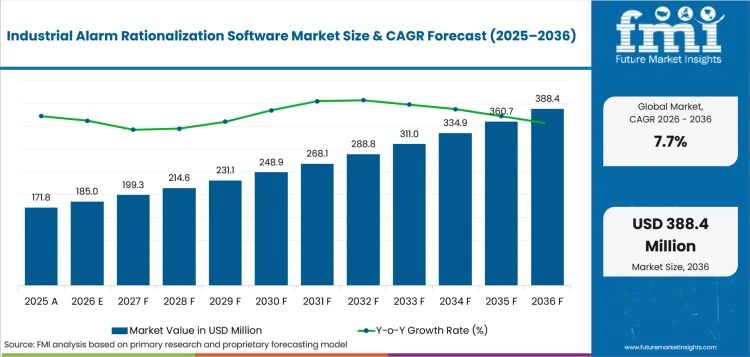
Industrial Alarm Rationalization Software Market Overview: Size and Forecast
- 2025 Market Size: USD 171.8 million
- 2026 Market Size: USD 185.0 million
- 2036 Market Size: USD 388.4 million
- Forecast CAGR: 7.7% from 2026 to 2036
- Leading Offering: Engineering Software
- Engineering Software Share in 2026: 48.6%
- Leading Deployment: Process Automation
- Process Automation Share in 2026: 54.8%
- Fastest-growing Country: India
- India CAGR: 8.7% by 2036
Summary of the Industrial Alarm Rationalization Software Market
- Demand and Growth Drivers
- Alarm lifecycle programs are expected to support the 7.7% CAGR as plants formalize alarm philosophy and change records.
- Process Automation is projected to represent 54.8% share in 2026 due to higher alarm density in continuous units.
- Safety Control is forecast to hold 38.4% share in 2026 because alarm priority affects abnormal-event response.
- India is estimated to record 8.7% CAGR as refinery, pharma, and manufacturing upgrades expand the buyer pool.
- Product and Segment View
- Engineering Software leads the By Offering segment with 48.6% share as master alarm databases replace offline spreadsheets.
- Process Automation leads the By Deployment segment because refineries and chemical plants need lifecycle records.
- Chemicals is expected to represent 29.5% share in 2026 due to hazardous process complexity.
- North America is forecast to account for 34.0% By Region share because installed DCS estates are large.
- Geography and Competitive Outlook
- The United States is projected at 7.5% CAGR due to refinery scale and established automation suppliers.
- China is expected to expand at 8.4% CAGR as large industrial sites increase alarm analytics use.
- Honeywell, Emerson, Yokogawa, ABB, Siemens, Rockwell Automation, AVEVA, and ProcessVue form the verified supplier set.
- Specialist vendors compete on rationalization workflow depth and DCS suppliers compete on operator-station integration.
- Analyst Opinion
- Nikhil Kaitwade, Principal Consultant at Future Market Insights for process automation, says, “This market is moving from alarm cleanup to alarm governance. Buyers ask whether software can justify alarm need and guide operator action. They also need a change record after engineering work. Demand is most concentrated in process plants where a bad alarm setting can create downtime or safety exposure. Suppliers win when the master alarm database connects to the control system and produces output that operators can use.”
Software selection is moving beyond nuisance alarm cleanup. Buyers need master alarm databases that store alarm need, cause, consequence, priority, and operator action. ISA describes the ISA-18 series as a lifecycle framework for alarm systems in process industries. OPC Foundation describes OPC UA as secure and manufacturer-independent data exchange across industrial systems.
Which factors support expansion in the industrial alarm rationalization software market?
Control-room modernization and alarm lifecycle records are the main value drivers across regulated process plants.
- Market value is supported by software licenses that replace spreadsheet-based alarm lists with auditable master alarm databases.
- Services remain material because rationalization workshops need alarm philosophy rules and operator response mapping.
- Remote operations increase demand for alarm context that supervisors can review outside the main control room.
- Pricing power is higher where platforms combine change control, KPI dashboards, and DCS integration in one package.
Why is the industrial alarm rationalization software market growing?
Process plants are moving toward alarm governance because safety reviews need a documented reason and operator response for each alarm.
Growth is tied to adjacent investment in industrial automation and SCADA alarm management. Honeywell states that its Alarm Performance Optimizer assesses enterprise alarm health and streamlines rationalization activity. That supports software spend tied to repeatable improvement cycles instead of one-time alarm count reduction. Brownfield integration is a second reason because plants often run mixed DCS, PLC, historian, and SCADA layers.
How is the industrial alarm rationalization software market segmented?
The industrial alarm rationalization software industry is segmented by offering, deployment, application, end-use industry, buyer type, service model, and region.
- Engineering Software is projected to secure 48.6% share in 2026 due to master alarm database demand.
- Process Automation is expected to account for 54.8% share in 2026 because continuous plants carry heavier alarm loads.
- Safety Control is forecast to hold 38.4% share in 2026 as alarm priority affects incident response.
- Chemicals is estimated to represent 29.5% share in 2026 due to hazardous process complexity.
- North America is projected to account for 34.0% share in 2026 because standards-based alarm programs are more established.
Why does Engineering Software lead by offering?
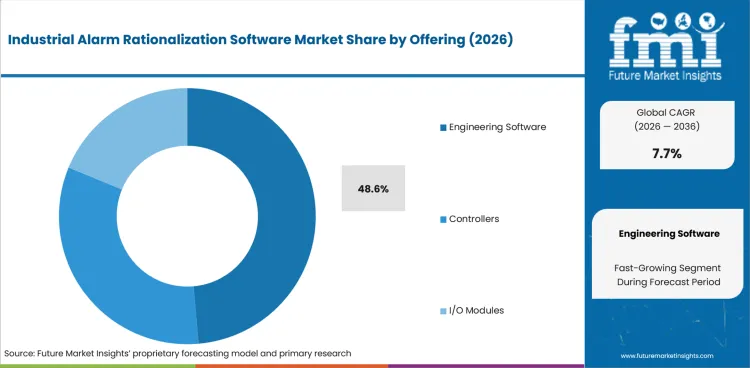
- Engineering Software is projected to account for 48.6% share in 2026 because buyers need a central alarm record.
- Services remain attached because workshop output must be converted into approved settings and response instructions.
Which deployment type leads the market?
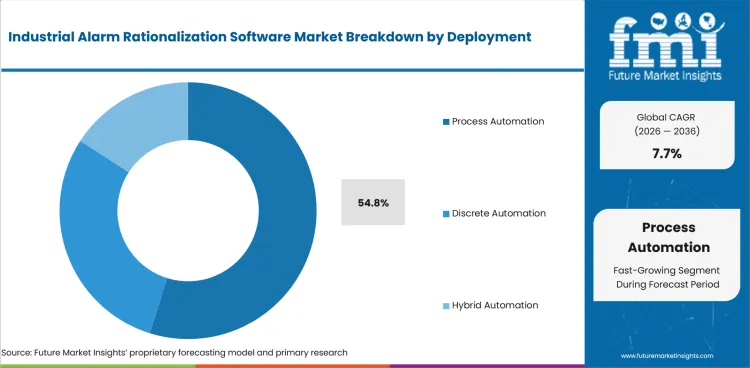
- Process Automation is expected to represent 54.8% share in 2026 as chemical and refining plants carry continuous alarm loads.
- Discrete Automation buyers usually start with HMI cleanup before they fund full lifecycle workflows.
Which application leads the market?
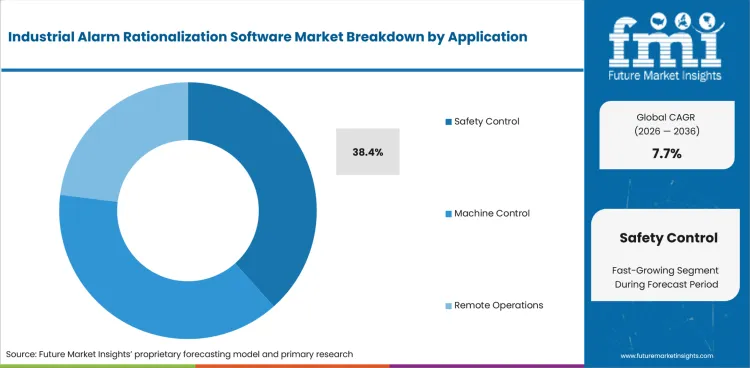
- Safety Control is forecast to hold 38.4% share in 2026 because alarm priority guides abnormal-event handling.
- Remote Operations is gaining attention where supervisors need alarm context across distributed sites.
Which end-use industry leads the market?
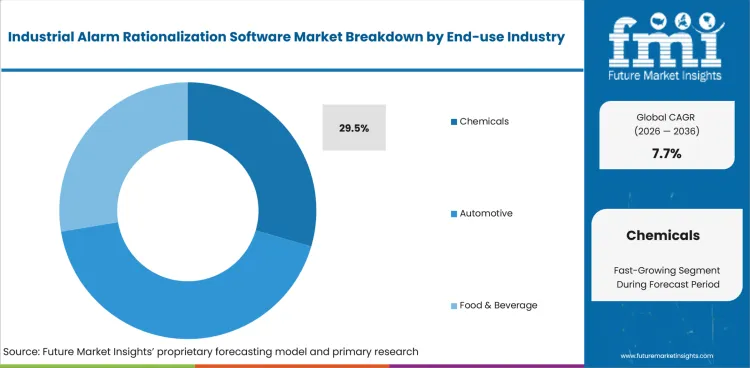
- Chemicals is estimated to account for 29.5% share in 2026 due to batch and continuous process complexity.
- Pharmaceuticals adds value where validated operations need traceable alarm records and management of change.
Which region leads the market?
- North America is projected to represent 34.0% share in 2026 due to mature DCS estates and supplier presence.
- East Asia is forecast to grow faster because China and South Korea are increasing high-tech manufacturing capacity.
What are the driver, restraints, and opportunities in the industrial alarm rationalization software market?
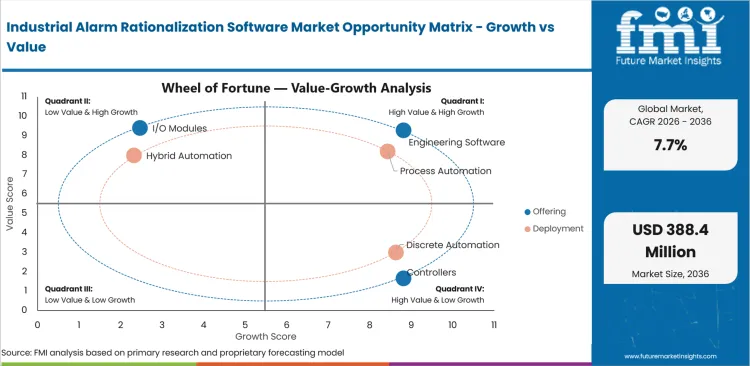
Standards-aligned alarm governance and DCS upgrades support demand while data quality issues and cybersecurity review slow deployment.
- Driver: Alarm lifecycle programs are expected to increase spending on documentation, prioritization, and management of change functions.
- Restraint: Poor tag quality can slow workshop output when alarm names and response details are inconsistent.
- Opportunity: Vendor-neutral tools are expected to gain share where enterprises run mixed DCS and PLC systems.
Industrial Alarm Rationalization Software Market Demand Outlook
Demand is moving from periodic alarm reviews toward live governance. Plants need a documented reason and operator response for each alarm. Software vendors gain relevance when they combine rationalization workflow with audit trails and performance dashboards. Nuisance alarm control remains the daily pain point that starts many projects. Yokogawa describes Exaquantum/ARA as an alarm reporting and analysis solution that identifies alarm and event patterns. This gives teams a ranked work list before workshops begin.
Buyer Segmentation and Purchase Behavior Analysis
Primary buyers include process safety managers, control engineers, operations leaders, DCS integrators, and corporate automation teams. Large sites usually buy software with services. Smaller sites often begin with alarm KPI reporting before moving to full rationalization.
Procurement decisions are shaped by integration depth and the ability to maintain a master alarm database after engineering changes. Tools that connect with existing DCS and historian environments lower manual cleanup effort. That feature matters more than dashboard count in brownfield plants.
Which countries are growing fastest in the industrial alarm rationalization software market?
India 8.7% CAGR, China 8.4% CAGR, South Korea 8.0% CAGR, United States 7.5% CAGR, Germany 7.3% CAGR, United Kingdom 7.1% CAGR, France 7.0% CAGR, and Japan 6.8% CAGR through 2036.
.webp "Top Country Growth Comparison Industrial Alarm Rationalization Software Market Cagr (2026 2036)")
| Country | CAGR |
|---|---|
| India | 8.7% |
| China | 8.4% |
| South Korea | 8.0% |
| United States | 7.5% |
| Germany | 7.3% |
| United Kingdom | 7.1% |
| France | 7.0% |
| Japan | 6.8% |
Source: Future Market Insights, 2026.
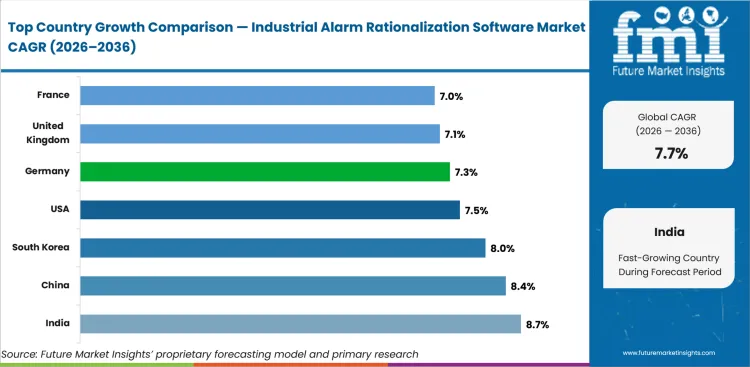
How do country-level CAGRs compare in the industrial alarm rationalization software market?
- India is forecast to record 8.7% CAGR by 2036 as refinery and pharmaceutical upgrades widen the buyer pool.
- China is projected to expand at 8.4% CAGR due to large process sites and high-tech manufacturing investment.
- South Korea is estimated to grow at 8.0% CAGR as semiconductor and battery plants need traceable alarm workflows.
- The United States is forecast at 7.5% CAGR due to refinery scale and established automation suppliers.
- Germany is projected to grow at 7.3% CAGR as chemical parks keep alarm governance needs active.
- The United Kingdom is estimated to rise at 7.1% CAGR as COMAH sites sustain safety-documentation demand.
- France is forecast to advance at 7.0% CAGR because pharma and specialty chemicals support batch alarm reviews.
- Japan is projected to post 6.8% CAGR as reliability-led process plants take a cautious rollout path.
How fast is the India industrial alarm rationalization software market growing?
A 8.7% CAGR through 2036 reflects industrial automation upgrades and process safety governance demand.
Country Market Snapshot Table
| Parameter | Value |
|---|---|
| Market Size in 2025 (Value) | USD 8.9 million |
| Market Size in 2026 (Value) | USD 9.7 million |
| Market Forecast in 2036 (Value) | USD 22.4 million |
| CAGR (2026 to 2036) | 8.7% |
| Years Considered | 2021 to 2036 |
| Base Year | 2025 |
| Forecast Period | 2026 to 2036 |
| Units Considered | Value (USD million) |
| Leading Sub-Region | Gujarat and Maharashtra process corridors |
India Industrial Alarm Rationalization Software Market Outlook
India is the fastest-growing profiled country due to refinery, pharmaceutical, chemical, and manufacturing upgrades. Alarm rationalization demand usually starts with services and then moves into software renewal.
Domestic EPC firms and global DCS vendors shape buying. Multi-site manufacturers are expected to standardize alarm records as process safety expectations tighten.
Key Growth Drivers
- Manufacturing expansion supports control-room budgets because PIB reported 7.8% IIP growth in December 2025.
- Refinery capacity creates a clear process buyer base because PPAC placed installed capacity at 258.1 MMTPA.
- Pharmaceutical and batch chemical plants need audit-ready alarm records that support validation and incident response.
- EPC and DCS lifecycle contracts create services-led entry points before full software rollout across plants.
Key Restraints
- Monthly activity can fluctuate because PIB reported that IIP growth moderated to 4.8% in January 2026.
- Smaller plants may treat alarm review as a compliance exercise until downtime reduction becomes visible.
- Skilled rationalization facilitators remain limited outside large process corridors and major industrial clusters.
What makes India unique
India is unique because refinery scale and pharmaceutical manufacturing growth create a fast services-to-software conversion path.
Key Companies
- Honeywell Automation India Ltd.
- Yokogawa India Ltd.
- Emerson Electric Co. India
- Siemens India Ltd.
- ABB India Ltd.
- Forbes Marshall Pvt. Ltd.
Sales & Marketing Channels
- Refinery modernization projects
- Pharmaceutical validation programs
- Chemical plant EPC projects
- System integrators
- DCS service contracts
- Corporate process safety teams
Country Segment Breakdown Table
| Segment | Sub-Segments |
|---|---|
| By Offering | Controllers · I/O Modules · Engineering Software · Services |
| By Deployment | Discrete Automation · Process Automation · Hybrid Automation |
| By Application | Machine Control · Line Integration · Safety Control · Remote Operations |
| By End-use Industry | Automotive · Food & Beverage · Chemicals · Pharmaceuticals · Electronics · Metals |
| By Buyer Type | Plant Operators · DCS Integrators · Process Safety Teams · Corporate Automation Groups |
| By Service Model | Software License · SaaS Subscription · Engineering Services · Managed Alarm Governance |
| Key Sub-Regions Covered, Manufacturing and automation corridors | Gujarat · Maharashtra · Tamil Nadu · Karnataka · Telangana · Andhra Pradesh |
Frequently Asked Questions
How fast is India industrial alarm rationalization software market growing?
Sales in India are forecast to rise at 8.7% CAGR from 2026 to 2036.
Who leads India industrial alarm rationalization software market?
Honeywell Automation India Ltd., Yokogawa India Ltd., Emerson Electric Co. India, Siemens India Ltd. compete through local automation and process-industry service channels.
What is driving adoption in India industrial alarm rationalization software market?
Adoption in India is supported by process automation upgrades and need for audit-ready alarm records.
How fast is the China industrial alarm rationalization software market growing?
A 8.4% CAGR through 2036 reflects industrial automation upgrades and process safety governance demand.
Country Market Snapshot Table
| Parameter | Value |
|---|---|
| Market Size in 2025 (Value) | USD 24.4 million |
| Market Size in 2026 (Value) | USD 26.4 million |
| Market Forecast in 2036 (Value) | USD 59.0 million |
| CAGR (2026 to 2036) | 8.4% |
| Years Considered | 2021 to 2036 |
| Base Year | 2025 |
| Forecast Period | 2026 to 2036 |
| Units Considered | Value (USD million) |
| Leading Sub-Region | Yangtze River Delta and Pearl River Delta industrial zones |
China Industrial Alarm Rationalization Software Market Outlook
China demand is supported by large process sites and fast industrial software uptake. Alarm rationalization is often tied to control-room modernization in chemical, energy, metals, and electronics plants.
Local and global vendors compete on project integration. Enterprise buyers want software that can support multi-site alarm records and local engineering approval.
Key Growth Drivers
- Industrial output supports automation budgets because official data showed value added by large industrial enterprises rose 5.4% in the first five months of 2026.
- High-tech manufacturing demand is supported by official data showing industrial robot output growth of 27.9% in May 2026.
- Chemical parks need common alarm workflows because multi-unit sites must align alarm priority and operator response across shifts.
- State-owned and private plant groups are expected to widen software use when DCS modernization moves from site projects to enterprise programs.
Key Restraints
- Short-cycle demand can remain uneven because official data showed April industrial output rose only 0.05% month over month.
- Local data hosting and cybersecurity review can lengthen vendor approval for remote alarm analytics.
- Mixed imported and domestic control systems increase connector work before one master alarm database can be deployed.
What makes China unique
China is unique because large process sites and high-tech manufacturing investment create multi-site alarm governance needs.
Key Companies
- Supcon Technology Co. Ltd.
- HollySys Automation Technologies Ltd.
- Yokogawa China
- Honeywell China
- ABB China
- Siemens China
Sales & Marketing Channels
- Chemical park projects
- State-owned enterprise frameworks
- System integrators
- DCS modernization programs
- Electronics manufacturing sites
- Metals plant engineering
Country Segment Breakdown Table
| Segment | Sub-Segments |
|---|---|
| By Offering | Controllers · I/O Modules · Engineering Software · Services |
| By Deployment | Discrete Automation · Process Automation · Hybrid Automation |
| By Application | Machine Control · Line Integration · Safety Control · Remote Operations |
| By End-use Industry | Automotive · Food & Beverage · Chemicals · Pharmaceuticals · Electronics · Metals |
| By Buyer Type | Plant Operators · DCS Integrators · Process Safety Teams · Corporate Automation Groups |
| By Service Model | Software License · SaaS Subscription · Engineering Services · Managed Alarm Governance |
| Key Sub-Regions Covered, Manufacturing and automation corridors | Yangtze River Delta · Pearl River Delta · Shandong · Jiangsu · Zhejiang · Guangdong |
Frequently Asked Questions
How fast is China industrial alarm rationalization software market growing?
Sales in China are forecast to rise at 8.4% CAGR from 2026 to 2036.
Who leads China industrial alarm rationalization software market?
Supcon Technology Co. Ltd., HollySys Automation Technologies Ltd., Yokogawa China, Honeywell China compete through local automation and process-industry service channels.
What is driving adoption in China industrial alarm rationalization software market?
Adoption in China is supported by process automation upgrades and need for audit-ready alarm records.
How fast is the South Korea industrial alarm rationalization software market growing?
A 8.0% CAGR through 2036 reflects industrial automation upgrades and process safety governance demand.
Country Market Snapshot Table
| Parameter | Value |
|---|---|
| Market Size in 2025 (Value) | USD 7.8 million |
| Market Size in 2026 (Value) | USD 8.4 million |
| Market Forecast in 2036 (Value) | USD 18.1 million |
| CAGR (2026 to 2036) | 8.0% |
| Years Considered | 2021 to 2036 |
| Base Year | 2025 |
| Forecast Period | 2026 to 2036 |
| Units Considered | Value (USD million) |
| Leading Sub-Region | Gyeonggi and Ulsan industrial corridors |
South Korea Industrial Alarm Rationalization Software Market Outlook
South Korea demand is shaped by semiconductor, battery, petrochemical, and high-reliability manufacturing sites. Alarm records are needed where operations must protect uptime and product quality.
Software buyers often require integration with high-availability control systems. Local engineering partners are important because site qualification can be demanding.
Key Growth Drivers
- Semiconductor investment supports alarm workflow demand because MOTIR reported exports rose 22.2% to USD 173.4 billion in 2025.
- High-value electronics exposure is clear because Invest KOREA placed semiconductor exports at USD 141.9 billion in 2024.
- Battery and materials plants need traceable alarm workflows where process excursions can affect yield and safety.
- Petrochemical complexes in Ulsan and Yeosu create demand for alarm prioritization across continuous units.
Key Restraints
- Capital timing can vary because KOSTAT reported equipment investment decreased 3.6% in December 2025.
- Confidentiality and network segmentation rules can limit remote access for vendor-hosted alarm analytics.
- Supplier qualification can extend sales cycles when software must fit semiconductor and battery production controls.
What makes South Korea unique
South Korea is unique because semiconductor and battery uptime requirements make alarm governance a production-risk tool.
Key Companies
- LS Electric Co. Ltd.
- Samsung SDS Co. Ltd.
- Yokogawa Korea Co. Ltd.
- Honeywell Korea
- ABB Korea
- Emerson Korea
Sales & Marketing Channels
- Semiconductor engineering teams
- Battery plant projects
- Petrochemical complexes
- System integrators
- Corporate IT and OT security teams
- Automation service partners
Country Segment Breakdown Table
| Segment | Sub-Segments |
|---|---|
| By Offering | Controllers · I/O Modules · Engineering Software · Services |
| By Deployment | Discrete Automation · Process Automation · Hybrid Automation |
| By Application | Machine Control · Line Integration · Safety Control · Remote Operations |
| By End-use Industry | Automotive · Food & Beverage · Chemicals · Pharmaceuticals · Electronics · Metals |
| By Buyer Type | Plant Operators · DCS Integrators · Process Safety Teams · Corporate Automation Groups |
| By Service Model | Software License · SaaS Subscription · Engineering Services · Managed Alarm Governance |
| Key Sub-Regions Covered, Manufacturing and automation corridors | Gyeonggi · Ulsan · Yeosu · Incheon · Daejeon · Busan |
Frequently Asked Questions
How fast is South Korea industrial alarm rationalization software market growing?
Sales in South Korea are forecast to rise at 8.0% CAGR from 2026 to 2036.
Who leads South Korea industrial alarm rationalization software market?
LS Electric Co. Ltd., Samsung SDS Co. Ltd., Yokogawa Korea Co. Ltd., Honeywell Korea compete through local automation and process-industry service channels.
What is driving adoption in South Korea industrial alarm rationalization software market?
Adoption in South Korea is supported by process automation upgrades and need for audit-ready alarm records.
How fast is the United States industrial alarm rationalization software market growing?
A 7.5% CAGR through 2036 reflects industrial automation upgrades and process safety governance demand.
Country Market Snapshot Table
| Parameter | Value |
|---|---|
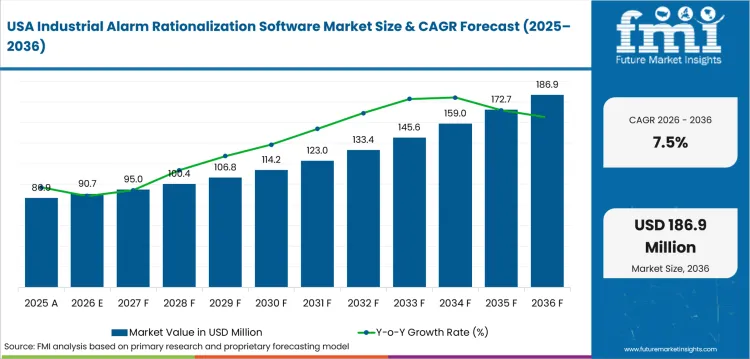
| Market Size in 2025 (Value) | USD 52.0 million |
| Market Size in 2026 (Value) | USD 55.9 million |
| Market Forecast in 2036 (Value) | USD 115.1 million |
| CAGR (2026 to 2036) | 7.5% |
| Years Considered | 2021 to 2036 |
| Base Year | 2025 |
| Forecast Period | 2026 to 2036 |
| Units Considered | Value (USD million) |
| Leading Sub-Region | Texas Gulf Coast and Midwest process corridors |
United States Industrial Alarm Rationalization Software Market Outlook
United States demand is shaped by refinery scale and established DCS estates. Alarm rationalization is usually funded as part of safety review, modernization, and control-room improvement programs.
Suppliers with service depth have an advantage because plants need workshops before alarm changes are approved. Multi-site owners are also using alarm KPIs to compare operating discipline across assets.
Key Growth Drivers
- Refinery modernization gives alarm rationalization a clear entry point because EIA reported 18.4 million barrels per calendar day of U.S. operable atmospheric distillation capacity.
- Manufacturing uptime supports engineering software demand because the Federal Reserve placed manufacturing capacity utilization at 75.7% in May 2026.
- DCS lifecycle programs remain active across refinery and chemical sites that need traceable alarm priority and operator response records.
- Established Honeywell, Emerson, Rockwell Automation, and ABB service channels shorten approval paths for alarm workshops and renewals.
Key Restraints
- ICS vulnerability review can slow cloud-connected alarm projects because CISA released ten Industrial Control Systems advisories in August 2024.
- Brownfield plants often require tag cleanup before rationalization data can be trusted across historian and DCS layers.
- Procurement teams can delay standalone software spending when alarm work is bundled into larger control-room modernization budgets.
What makes United States unique
The United States combines refinery scale with a large automation supplier base and a strong process safety services ecosystem.
Key Companies
- Honeywell International Inc.
- Emerson Electric Co.
- Rockwell Automation Inc.
- ABB Inc.
- AVEVA Group Limited
- PAS Global LLC
Sales & Marketing Channels
- DCS modernization programs
- Process safety consultants
- System integrators
- Corporate automation teams
- Refinery service contracts
- Pharmaceutical engineering teams
Country Segment Breakdown Table
| Segment | Sub-Segments |
|---|---|
| By Offering | Controllers · I/O Modules · Engineering Software · Services |
| By Deployment | Discrete Automation · Process Automation · Hybrid Automation |
| By Application | Machine Control · Line Integration · Safety Control · Remote Operations |
| By End-use Industry | Automotive · Food & Beverage · Chemicals · Pharmaceuticals · Electronics · Metals |
| By Buyer Type | Plant Operators · DCS Integrators · Process Safety Teams · Corporate Automation Groups |
| By Service Model | Software License · SaaS Subscription · Engineering Services · Managed Alarm Governance |
| Key Sub-Regions Covered, Manufacturing and automation corridors | Texas Gulf Coast · Louisiana · California · Midwest chemicals corridor · Pennsylvania · New Jersey |
Frequently Asked Questions
How fast is United States industrial alarm rationalization software market growing?
Sales in United States are forecast to rise at 7.5% CAGR from 2026 to 2036.
Who leads United States industrial alarm rationalization software market?
Honeywell International Inc., Emerson Electric Co., Rockwell Automation Inc., ABB Inc. compete through local automation and process-industry service channels.
What is driving adoption in United States industrial alarm rationalization software market?
Adoption in United States is supported by process automation upgrades and need for audit-ready alarm records.
How fast is the Germany industrial alarm rationalization software market growing?
A 7.3% CAGR through 2036 reflects industrial automation upgrades and process safety governance demand.
Country Market Snapshot Table
| Parameter | Value |
|---|---|
| Market Size in 2025 (Value) | USD 9.9 million |
| Market Size in 2026 (Value) | USD 10.6 million |
| Market Forecast in 2036 (Value) | USD 21.5 million |
| CAGR (2026 to 2036) | 7.3% |
| Years Considered | 2021 to 2036 |
| Base Year | 2025 |
| Forecast Period | 2026 to 2036 |
| Units Considered | Value (USD million) |
| Leading Sub-Region | North Rhine-Westphalia and Rhine-Ruhr chemical corridor |
Germany Industrial Alarm Rationalization Software Market Outlook
Germany demand is tied to chemical parks, formal engineering discipline, and process safety documentation. Buyers prefer tools that can support traceability, approval routes, and long control-system lifecycles.
DCS suppliers and local integrators play a large role. Software gains traction when it supports German-language workflow, version control, and structured alarm review.
Key Growth Drivers
- Factory automation upgrades remain relevant because Destatis reported industrial production growth of 0.4% in April 2026.
- Manufacturing scale supports alarm governance because deutschland.de placed manufacturing-sector turnover at 2,900 billion euros in 2024.
- Engineering-led procurement favors documented alarm philosophy, version control, and formal change records across chemical parks.
- Siemens, ABB, Emerson, and Yokogawa channels help integrate alarm data with existing PCS and DCS environments.
Key Restraints
- Cyber review can delay remote alarm access because BSI described one IT-service-provider attack affecting 72 municipal customers.
- Imported intermediate inputs complicate rollout planning when automation upgrades depend on equipment availability.
- Formal approval cycles can stretch multi-site standardization when safety documentation and worker consultation are required.
What makes Germany unique
Germany is unique because chemical parks and formal engineering governance make alarm records part of process safety discipline.
Key Companies
- Siemens AG
- ABB Germany
- Yokogawa Deutschland GmbH
- Emerson Process Management GmbH
- Honeywell Germany
- Phoenix Contact GmbH & Co. KG
Sales & Marketing Channels
- Chemical park operators
- System integrators
- DCS lifecycle service
- Process safety consultants
- Pharma engineering teams
- Industrial software partners
Country Segment Breakdown Table
| Segment | Sub-Segments |
|---|---|
| By Offering | Controllers · I/O Modules · Engineering Software · Services |
| By Deployment | Discrete Automation · Process Automation · Hybrid Automation |
| By Application | Machine Control · Line Integration · Safety Control · Remote Operations |
| By End-use Industry | Automotive · Food & Beverage · Chemicals · Pharmaceuticals · Electronics · Metals |
| By Buyer Type | Plant Operators · DCS Integrators · Process Safety Teams · Corporate Automation Groups |
| By Service Model | Software License · SaaS Subscription · Engineering Services · Managed Alarm Governance |
| Key Sub-Regions Covered, Manufacturing and automation corridors | North Rhine-Westphalia · Bavaria · Baden-Wurttemberg · Lower Saxony · Hesse · Hamburg |
Frequently Asked Questions
How fast is Germany industrial alarm rationalization software market growing?
Sales in Germany are forecast to rise at 7.3% CAGR from 2026 to 2036.
Who leads Germany industrial alarm rationalization software market?
Siemens AG, ABB Germany, Yokogawa Deutschland GmbH, Emerson Process Management GmbH compete through local automation and process-industry service channels.
What is driving adoption in Germany industrial alarm rationalization software market?
Adoption in Germany is supported by process automation upgrades and need for audit-ready alarm records.
How fast is the United Kingdom industrial alarm rationalization software market growing?
A 7.1% CAGR through 2036 reflects industrial automation upgrades and process safety governance demand.
Country Market Snapshot Table
| Parameter | Value |
|---|---|
| Market Size in 2025 (Value) | USD 10.8 million |
| Market Size in 2026 (Value) | USD 11.6 million |
| Market Forecast in 2036 (Value) | USD 23.0 million |
| CAGR (2026 to 2036) | 7.1% |
| Years Considered | 2021 to 2036 |
| Base Year | 2025 |
| Forecast Period | 2026 to 2036 |
| Units Considered | Value (USD million) |
| Leading Sub-Region | North Sea support base and Humber chemical corridor |
United Kingdom Industrial Alarm Rationalization Software Market Outlook
United Kingdom demand is linked to COMAH compliance and brownfield automation upgrades. Alarm rationalization is most visible in chemicals, energy, water, and pharmaceuticals.
Vendors gain when software supports audit-ready alarm records and operator guidance. Smaller plants may start with KPI reporting before approving a full master alarm database.
Key Growth Drivers
- Manufacturing recovery supports alarm review budgets because ONS reported manufacturing output growth of 0.4% in April 2026.
- Safety governance supports alarm philosophy work because HSE reported 124 worker fatalities across Great Britain in 2024 to 2025.
- COMAH-regulated chemical and storage sites need clearer alarm priority records when operators handle hazardous substances and escalation procedures.
- System integrators remain central because British plants often combine legacy PLC assets with newer SCADA and historian layers.
Key Restraints
- Cyber review can slow remote alarm access because the UK survey found 69% of large businesses reported a breach or attack.
- Mature process sites may fund periodic alarm KPI reviews before committing to enterprise master alarm database software.
- Smaller operators can struggle to reserve operations staff for rationalization workshops during production campaigns.
What makes United Kingdom unique
United Kingdom is unique because COMAH governance and North Sea-linked process assets keep alarm documentation visible to safety teams.
Key Companies
- ABB Limited
- Emerson Process Management Ltd.
- Yokogawa United Kingdom Ltd.
- Honeywell Control Systems Ltd.
- AVEVA Group Limited
- ProcessVue Ltd.
Sales & Marketing Channels
- COMAH site programs
- Water utility frameworks
- Process safety consultancies
- System integrators
- North Sea service networks
- Pharma engineering teams
Country Segment Breakdown Table
| Segment | Sub-Segments |
|---|---|
| By Offering | Controllers · I/O Modules · Engineering Software · Services |
| By Deployment | Discrete Automation · Process Automation · Hybrid Automation |
| By Application | Machine Control · Line Integration · Safety Control · Remote Operations |
| By End-use Industry | Automotive · Food & Beverage · Chemicals · Pharmaceuticals · Electronics · Metals |
| By Buyer Type | Plant Operators · DCS Integrators · Process Safety Teams · Corporate Automation Groups |
| By Service Model | Software License · SaaS Subscription · Engineering Services · Managed Alarm Governance |
| Key Sub-Regions Covered, Manufacturing and automation corridors | Humber · Teesside · Aberdeen · Manchester · West Midlands · South East England |
Frequently Asked Questions
How fast is United Kingdom industrial alarm rationalization software market growing?
Sales in United Kingdom are forecast to rise at 7.1% CAGR from 2026 to 2036.
Who leads United Kingdom industrial alarm rationalization software market?
ABB Limited, Emerson Process Management Ltd., Yokogawa United Kingdom Ltd., Honeywell Control Systems Ltd. compete through local automation and process-industry service channels.
What is driving adoption in United Kingdom industrial alarm rationalization software market?
Adoption in United Kingdom is supported by process automation upgrades and need for audit-ready alarm records.
How fast is the France industrial alarm rationalization software market growing?
A 7.0% CAGR through 2036 reflects industrial automation upgrades and process safety governance demand.
Country Market Snapshot Table
| Parameter | Value |
|---|---|
| Market Size in 2025 (Value) | USD 7.5 million |
| Market Size in 2026 (Value) | USD 8.0 million |
| Market Forecast in 2036 (Value) | USD 15.8 million |
| CAGR (2026 to 2036) | 7.0% |
| Years Considered | 2021 to 2036 |
| Base Year | 2025 |
| Forecast Period | 2026 to 2036 |
| Units Considered | Value (USD million) |
| Leading Sub-Region | Ile-de-France and Auvergne-Rhone-Alpes industrial clusters |
France Industrial Alarm Rationalization Software Market Outlook
France demand is supported by specialty chemicals, pharma validation, and industrial modernization programs. Buyers value alarm records that can support quality review and operational continuity.
Schneider Electric and AVEVA visibility helps software discovery. Adoption is stronger where plant teams link rationalization to validated workflow and incident prevention.
Key Growth Drivers
- Manufacturing activity supports control-room investment because INSEE reported manufacturing output growth of 0.4% in April 2026.
- Industrial policy supports software-enabled modernization because France 2030 represents 54 billion euros of planned investment.
- Batch pharma and specialty chemical sites need alarm response records that support validation and operational continuity.
- Schneider Electric and AVEVA channels improve software visibility where buyers want alarm analysis inside a wider operations stack.
Key Restraints
- Hazard-site review remains strict because the French inspection review counted 236 Seveso-site events for 2024.
- Mature plants may treat alarm rationalization as an audit item unless downtime or safety exposure is visible.
- Mixed supplier estates increase interface work before alarm records can stay aligned after engineering changes.
What makes France unique
France is unique because specialty chemicals and pharma validation create demand for documented alarm decision records.
Key Companies
- Schneider Electric SE
- AVEVA France
- Yokogawa France SAS
- Emerson Process Management France
- ABB France
- Actemium
Sales & Marketing Channels
- Pharmaceutical validation projects
- Chemical plant modernization
- System integrators
- Safety consultants
- Energy transition sites
- Industrial software distributors
Country Segment Breakdown Table
| Segment | Sub-Segments |
|---|---|
| By Offering | Controllers · I/O Modules · Engineering Software · Services |
| By Deployment | Discrete Automation · Process Automation · Hybrid Automation |
| By Application | Machine Control · Line Integration · Safety Control · Remote Operations |
| By End-use Industry | Automotive · Food & Beverage · Chemicals · Pharmaceuticals · Electronics · Metals |
| By Buyer Type | Plant Operators · DCS Integrators · Process Safety Teams · Corporate Automation Groups |
| By Service Model | Software License · SaaS Subscription · Engineering Services · Managed Alarm Governance |
| Key Sub-Regions Covered, Manufacturing and automation corridors | Ile-de-France · Auvergne-Rhone-Alpes · Hauts-de-France · Normandy · Grand Est · Provence-Alpes-Cote d Azur |
Frequently Asked Questions
How fast is France industrial alarm rationalization software market growing?
Sales in France are forecast to rise at 7.0% CAGR from 2026 to 2036.
Who leads France industrial alarm rationalization software market?
Schneider Electric SE, AVEVA France, Yokogawa France SAS, Emerson Process Management France compete through local automation and process-industry service channels.
What is driving adoption in France industrial alarm rationalization software market?
Adoption in France is supported by process automation upgrades and need for audit-ready alarm records.
How fast is the Japan industrial alarm rationalization software market growing?
A 6.8% CAGR through 2036 reflects industrial automation upgrades and process safety governance demand.
Country Market Snapshot Table
| Parameter | Value |
|---|---|
| Market Size in 2025 (Value) | USD 12.3 million |
| Market Size in 2026 (Value) | USD 13.1 million |
| Market Forecast in 2036 (Value) | USD 25.3 million |
| CAGR (2026 to 2036) | 6.8% |
| Years Considered | 2021 to 2036 |
| Base Year | 2025 |
| Forecast Period | 2026 to 2036 |
| Units Considered | Value (USD million) |
| Leading Sub-Region | Kanto and Kansai process manufacturing corridors |
Japan Industrial Alarm Rationalization Software Market Outlook
Japan demand is reliability-led and supplier-driven. Plants favor alarm rationalization when it can be linked to stable operations and proven automation support.
Rollouts are deliberate because engineering review and quality expectations are high. Yokogawa and other automation suppliers support adoption through established control-system relationships.
Key Growth Drivers
- Process plants retain demand for alarm lifecycle tools because METI placed the production index at 104.7 in its October 2025 industrial production release.
- Manufacturing remains a core buyer base because the Statistics Bureau of Japan stated that manufacturing represents around 20% of nominal GDP.
- Yokogawa control-system relationships support alarm analysis where buyers prefer lifecycle service from established automation suppliers.
- Pharma and electronics facilities favor auditable operator guidance because workflow changes must pass reliability review before rollout.
Key Restraints
- Workshop staffing can be constrained because MHLW stated Japan has an aging rate of around 30%.
- Conservative site qualification can slow alarm setting changes when plants require extended review before release.
- Cybersecurity separation rules can limit remote alarm access across plants that run tightly segmented networks.
What makes Japan unique
Japan is unique because reliability culture and Yokogawa supplier depth keep alarm governance closely linked to control-system lifecycle support.
Key Companies
- Yokogawa Electric Corporation
- Azbil Corporation
- Mitsubishi Electric Corporation
- Omron Corporation
- Honeywell Japan
- Emerson Japan
Sales & Marketing Channels
- DCS lifecycle service
- Pharma validation teams
- Electronics plant engineering
- Chemical plant maintenance
- System integrators
- ICS security programs
Country Segment Breakdown Table
| Segment | Sub-Segments |
|---|---|
| By Offering | Controllers · I/O Modules · Engineering Software · Services |
| By Deployment | Discrete Automation · Process Automation · Hybrid Automation |
| By Application | Machine Control · Line Integration · Safety Control · Remote Operations |
| By End-use Industry | Automotive · Food & Beverage · Chemicals · Pharmaceuticals · Electronics · Metals |
| By Buyer Type | Plant Operators · DCS Integrators · Process Safety Teams · Corporate Automation Groups |
| By Service Model | Software License · SaaS Subscription · Engineering Services · Managed Alarm Governance |
| Key Sub-Regions Covered, Manufacturing and automation corridors | Kanto · Kansai · Chubu · Kyushu · Tohoku · Chugoku |
Frequently Asked Questions
How fast is Japan industrial alarm rationalization software market growing?
Sales in Japan are forecast to rise at 6.8% CAGR from 2026 to 2036.
Who leads Japan industrial alarm rationalization software market?
Yokogawa Electric Corporation, Azbil Corporation, Mitsubishi Electric Corporation, Omron Corporation compete through local automation and process-industry service channels.
What is driving adoption in Japan industrial alarm rationalization software market?
Adoption in Japan is supported by process automation upgrades and need for audit-ready alarm records.
Who are the leading companies in the industrial alarm rationalization software market?
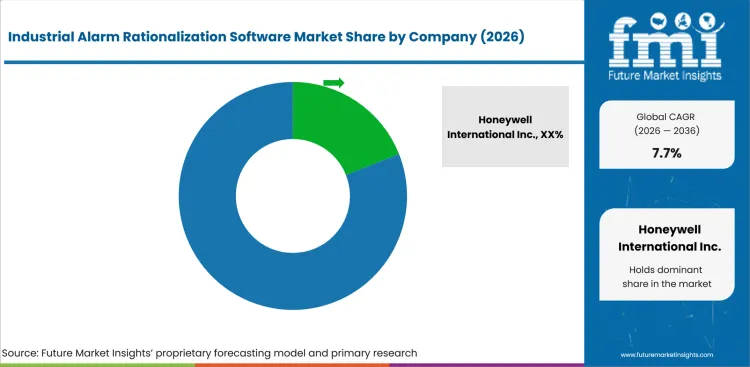
Honeywell, Emerson, Yokogawa, ABB, Siemens, Rockwell Automation, AVEVA, and ProcessVue are the most relevant suppliers.
- DCS suppliers hold an advantage when alarm rationalization must connect directly with operator stations and engineering databases.
- Specialist alarm software companies gain share where plants need vendor-neutral master alarm database workflows.
- System integrators remain important because rationalization workshops require plant context and approved response guidance.
- Services-led suppliers can win early projects before converting clients into software renewal programs.
Competition is split between DCS suppliers and alarm-management specialists. Honeywell, Emerson, Yokogawa, ABB, Siemens, and Rockwell Automation compete on installed-base integration. AVEVA and ProcessVue compete on vendor-neutral alarm analysis and master alarm database depth.
The best-positioned suppliers combine rationalization workflow with live performance analytics and engineering services. Buyers prefer platforms that keep alarm records aligned after control-system changes. Service capacity matters because rationalization output is only useful when operators and process safety teams approve it.
How do top industrial alarm rationalization software companies compare?
Honeywell and Emerson score strongest on DCS integration while ProcessVue and AVEVA score higher on vendor-neutral workflow depth.
| Company | Relevance to Market Title | Alarm Rationalization Depth | DCS Integration | Service Capability | Geographic Footprint |
|---|---|---|---|---|---|
| Honeywell | Very High | Very Strong | Very Strong | Very Strong | Global |
| Emerson | Very High | Strong | Very Strong | Very Strong | Global |
| Yokogawa | Very High | Strong | Very Strong | Strong | Global |
| ABB | High | Moderate to Strong | Very Strong | Strong | Global |
| Siemens | High | Moderate | Very Strong | Strong | Global |
| Rockwell Automation | High | Moderate | Strong | Strong | Global |
| AVEVA | High | Strong | Moderate | Moderate | Global |
| ProcessVue | Very High | Very Strong | Moderate | Strong | Europe and global projects |
Source: Future Market Insights competitive analysis, 2026.
Who are the key players in the industrial alarm rationalization software market?
Honeywell, Emerson, Yokogawa, ABB, Siemens, Rockwell Automation, AVEVA, and ProcessVue are listed with Hexagon and PAS Global among other suppliers.
Key global companies leading the industrial alarm rationalization software market include:
- Honeywell International Inc.
- Emerson Electric Co.
- Yokogawa Electric Corporation
- ABB Ltd.
- Siemens AG
- Rockwell Automation Inc.
- AVEVA Group Limited
- ProcessVue
- Hexagon AB
- PAS Global LLC
Key Developments in Industrial Alarm Rationalization Software Market
- In March 2024, Emerson expanded the DeltaV Version 15 Feature Pack 1 platform with software functions covering SCADA and operations management.
- In July 2024, ProcessVue released Guardian 2.0 to provide a unified layer for alarm rationalization and management of change.
- In August 2024, Yokogawa launched OpreX Open Automation SI Kit and an OPC UA Management Package for alarm parameter management.
- In April 2026, Yokogawa announced O-PAS OPC UA Client certification for the Open Automation SI Kit release 1.02.10.
Key Players in the Industrial Alarm Rationalization Software Market
Global Automation Groups
- Honeywell International Inc.
- Emerson Electric Co.
- Yokogawa Electric Corporation
- ABB Ltd.
- Siemens AG
- Rockwell Automation Inc.
Alarm Management and Software Specialists
- AVEVA Group Limited
- ProcessVue
- Hexagon AB
- PAS Global LLC
Regional Integration and Control-system Partners
- Forbes Marshall Pvt. Ltd.
- Actemium
- Phoenix Contact GmbH & Co. KG
- Azbil Corporation
- LS Electric Co. Ltd.
Industrial Alarm Rationalization Software Market - Report Scope
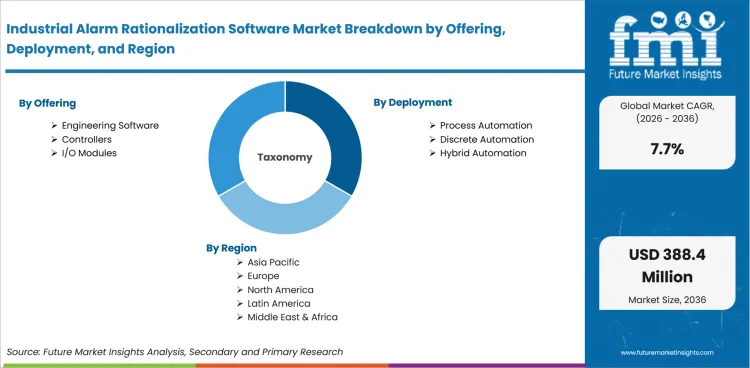
| Parameter | Details |
|---|---|
| Forecast period | 2026 to 2036 |
| Historical period | 2021 to 2025 |
| Quantitative unit | Revenue in USD million |
| By offering | Controllers, I/O modules, engineering software, services |
| By deployment | Discrete automation, process automation, hybrid automation |
| By application | Machine control, line integration, safety control, remote operations |
| By end-use industry | Automotive, food and beverage, chemicals, pharmaceuticals, electronics, metals |
| By buyer type | Plant operators, DCS integrators, process safety teams, corporate automation groups |
| By service model | Software license, SaaS subscription, engineering services, managed alarm governance |
| Regions covered | North America, Latin America, Europe, East Asia, South Asia and Pacific, Middle East and Africa |
| Countries covered | India, China, South Korea, United States, Germany, United Kingdom, France, Japan |
| Key companies profiled | Honeywell, Emerson, Yokogawa, ABB, Siemens, Rockwell Automation, AVEVA, ProcessVue |
| Approach | Bottom-up software-boundary approach using license revenue, service attach rates, installed automation intensity, and process-industry exposure |
Source: Future Market Insights, 2026.
Industrial Alarm Rationalization Software Market - Scope & Definition
| Attribute | Detail |
|---|---|
| Market Definition | Software and related services used to review, justify, prioritize, document, and govern industrial alarms across process and discrete control environments. |
| Functions Covered | Alarm rationalization, master alarm database management, alarm philosophy workflows, KPI analysis, alarm shelving records, change control, and operator response guidance. |
| Applications Covered | Machine control, line integration, safety control, remote operations, control-room modernization, and process safety governance. |
| End-Use Industries | Automotive, food and beverage, chemicals, pharmaceuticals, electronics, metals, energy, and other process-intensive industrial operations. |
| Grades Covered | Software license, SaaS subscription, engineering services, managed alarm governance, and controller-linked alarm handling support. |
| Inclusions | Commercial alarm rationalization platforms, alarm analysis modules, master alarm databases, engineering services, DCS-linked alarm workflow tools, and related controller or I/O context. |
| Exclusions | Consumer alarms, building fire panels, access control systems, cybersecurity monitoring tools without alarm rationalization, and one-off safety studies without software-enabled alarm governance. |
Industrial Alarm Rationalization Software Market - Research Methodology
| Method | Description |
|---|---|
| Primary Research | FMI analyst interviews with process safety consultants, automation engineers, plant operations leaders, DCS integrators, and alarm management service providers across key markets. |
| Desk Research | Review of ISA and IEC alarm guidance, official industrial statistics, supplier product documents, verified company releases, and process automation references. |
| Market Sizing & Forecasting | Bottom-up software-boundary approach using license value, service attach rates, installed automation intensity, country-level process industry exposure, and renewal behavior. |
| Data Validation | Cross-verification using supplier portfolios, country industrial activity, verified alarm management workflows, and process safety adoption indicators. |
Industrial Alarm Rationalization Software Market Breakdown by Offering, Deployment, Application, End-use Industry, Buyer Type, Service Model, and Region
Industrial Alarm Rationalization Software Market Segmented by Offering
- Controllers
- I/O Modules
- Engineering Software
- Services
Industrial Alarm Rationalization Software Market Segmented by Deployment
- Discrete Automation
- Process Automation
- Hybrid Automation
Industrial Alarm Rationalization Software Market Segmented by Application
- Machine Control
- Line Integration
- Safety Control
- Remote Operations
Industrial Alarm Rationalization Software Market Segmented by End-use Industry
- Automotive
- Food & Beverage
- Chemicals
- Pharmaceuticals
- Electronics
- Metals
Industrial Alarm Rationalization Software Market Segmented by Buyer Type
- Plant Operators
- DCS Integrators
- Process Safety Teams
- Corporate Automation Groups
Industrial Alarm Rationalization Software Market Segmented by Service Model
- Software License
- SaaS Subscription
- Engineering Services
- Managed Alarm Governance
Industrial Alarm Rationalization Software Market by Region
- North America
- Latin America
- Europe
- East Asia
- South Asia and Pacific
- Middle East and Africa
Research Sources and Bibliography
- ABB. (2025). Alarm management and process automation service information.
- AVEVA. (2025). ProcessVue alarm management software.
- BSI. (2024). The state of IT security in Germany in 2024.
- Cybersecurity and Infrastructure Security Agency. (2024, August 13). CISA releases ten Industrial Control Systems advisories.
- Emerson Electric Co. (2024, March 26). DeltaV distributed control system Version 15 Feature Pack 1.
- Federal Reserve Board. (2026, June 15). Industrial production and capacity utilization G.17.
- Federal Statistical Office of Germany. (2026, June 9). Production in April 2026: +0.4% on the previous month.
- French Ministry for Ecological Transition. (2025, May 16). Bilan de l action de l inspection des installations classees.
- Deutschland.de. (2025, March 27). Germany’s industry: The most important facts and figures.
- Government of France. (2026). Understanding France 2030.
- Health and Safety Executive. (2025, July 30). Work-related fatal injuries in Great Britain.
- Honeywell. (2025). Alarm Performance Optimizer.
- INSEE. (2026, June 5). In April 2026, manufacturing output increased by 0.4%.
- International Society of Automation. (2026). ISA-18 series of standards.
- Invest KOREA. (2025, October 2). South Korea semiconductor industry and investment status.
- Statistics Bureau of Japan. (2025, September). Statistical Handbook of Japan 2025.
- KOSTAT. (2026, January 31). Monthly Industrial Statistics, December 2025.
- Ministry of Economy, Trade and Industry Japan. (2025, December 12). Indices of Industrial Production: Revised report for October 2025.
- Ministry of Health, Labour and Welfare Japan. (2024, August 26). Global Health Vision of Ministry of Health, Labour and Welfare.
- Ministry of Trade, Industry and Resources South Korea. (2026, January 2). Korea annual exports reach new highs in 2025.
- National Bureau of Statistics of China. (2026, May 19). Industrial production operation in April 2026.
- OPC Foundation. (2025, September 22). OPC Unified Architecture: Secure and platform-independent industrial communication.
- Petroleum Planning and Analysis Cell India. (2026, May 1). India Oil and Gas Ready Reckoner for FY 2025-26.
- Press Information Bureau India. (2026, January 28). India Index of Industrial Production records growth of 7.8 percent in December 2025.
- Press Information Bureau India. (2026, March 2). Quick estimate of Index of Industrial Production and use-based index for January 2026.
- ProcessVue. (2024, July 9). Guardian 2.0 release.
- State Council of China. (2026, May 18). Equipment and high-tech manufacturing leads China industrial output.
- State Council of China. (2026, June 16). China industrial output sees growth extended in January to May 2026.
- U.S. Energy Information Administration. (2025, June 30). U.S. refining capacity largely unchanged as of January 2025.
- U.K. Department for Science, Innovation and Technology. (2026, April 30). Cyber security breaches survey 2025/2026.
- Yokogawa Electric Corporation. (2024, August 13). OpreX Open Automation SI Kit and OPC UA Management Package.
- Yokogawa Electric Corporation. (2026, April 9). O-PAS OPC UA Client certification for Open Automation SI Kit.
This Report Answers
- Market size estimates for 2026 and forecasts through 2036 for the industrial alarm rationalization software market.
- Insights across more than 30 regional and country-level markets.
- Analysis of demand drivers, buyer adoption patterns, software renewal behavior, and purchasing criteria.
- Evaluation of leading offering and deployment segments including engineering software and process automation.
- Assessment of standards alignment, DCS integration, and alarm lifecycle governance requirements.
- Identification of growth opportunities across safety control, remote operations, and managed alarm governance.
- Evaluation of competitive positioning across DCS suppliers, alarm software specialists, and system integrators.
- Country-level growth analysis covering India, China, South Korea, the United States, Germany, the United Kingdom, France, and Japan.
- Assessment of the competitive landscape including leading automation and alarm management software companies.
- Regional outlooks across North America, Europe, East Asia, South Asia and Pacific, Latin America, and Middle East and Africa.
- Delivery of market data, forecasts, and supporting analysis in PDF and Excel formats.
Frequently Asked Questions
What is the growth prospect for industrial alarm rationalization software?
Demand for industrial alarm rationalization software is expected to rise as process plants replace spreadsheet-based alarm records with auditable master alarm databases.
Which companies are expected to shape the industrial alarm rationalization software market?
Honeywell, Emerson, Yokogawa, ABB, Siemens, Rockwell Automation, AVEVA, and ProcessVue are expected to shape competition through control-system integration and workflow depth.
Why are process plants investing in alarm rationalization software?
Process plants are investing in alarm rationalization software to reduce nuisance alarms and document operator response requirements.
Why are master alarm databases important in this market?
Master alarm databases support traceable alarm priority, cause, consequence, and response records after engineering changes.
Which deployment segment is gaining attention?
Process automation gains the most attention because continuous plants carry higher alarm density and stronger documentation needs.
How do standards influence alarm rationalization software selection?
Standards influence selection by making alarm lifecycle documentation and management of change harder to maintain through spreadsheets.
Why do services remain important?
Services remain important because rationalization workshops need operator input and process safety review before changes are approved.
Which countries are most attractive for suppliers?
India, China, and South Korea are the faster-growth country opportunities because industrial automation upgrades are expanding the buyer pool.
Preview the report firsthand - request a free sample
Get SampleGet the brochure for pricing and purchase details.
Get PDFTable of Content
- Executive Summary
- Global Market Outlook
- Demand-side Trends
- Supply-side Trends
- Technology Roadmap Analysis
- Analysis and Recommendations
- Market Overview
- Market Coverage / Taxonomy
- Market Definition / Scope / Limitations
- Research Methodology
- Research Design
- Primary Research
- Desk Research
- Market Sizing and Forecasting
- Data Validation
- Global Market Analysis 2021 to 2025 and Forecast, 2026 to 2036
- Historical Market Size Value (USD Million) Analysis, 2021 to 2025
- Current and Future Market Size Value (USD Million) Projections, 2026 to 2036
- Y-o-Y Growth Trend Analysis
- Absolute $ Opportunity Analysis
- Global Market Pricing Analysis 2021 to 2025 and Forecast 2026 to 2036
- Global Market Analysis 2021 to 2025 and Forecast 2026 to 2036, By Offering
- Introduction / Key Findings
- Historical Market Size Value (USD Million) Analysis By Offering, 2021 to 2025
- Current and Future Market Size Value (USD Million) Analysis By Offering, 2026 to 2036
- Global Market Analysis 2021 to 2025 and Forecast 2026 to 2036, By Deployment
- Introduction / Key Findings
- Historical Market Size Value (USD Million) Analysis By Deployment, 2021 to 2025
- Current and Future Market Size Value (USD Million) Analysis By Deployment, 2026 to 2036
- Global Market Analysis 2021 to 2025 and Forecast 2026 to 2036, By Application
- Introduction / Key Findings
- Historical Market Size Value (USD Million) Analysis By Application, 2021 to 2025
- Current and Future Market Size Value (USD Million) Analysis By Application, 2026 to 2036
- Global Market Analysis 2021 to 2025 and Forecast 2026 to 2036, By End-use Industry
- Introduction / Key Findings
- Historical Market Size Value (USD Million) Analysis By End-use Industry, 2021 to 2025
- Current and Future Market Size Value (USD Million) Analysis By End-use Industry, 2026 to 2036
- Global Market Analysis 2021 to 2025 and Forecast 2026 to 2036, By Buyer Type
- Introduction / Key Findings
- Historical Market Size Value (USD Million) Analysis By Buyer Type, 2021 to 2025
- Current and Future Market Size Value (USD Million) Analysis By Buyer Type, 2026 to 2036
- Global Market Analysis 2021 to 2025 and Forecast 2026 to 2036, By Service Model
- Introduction / Key Findings
- Historical Market Size Value (USD Million) Analysis By Service Model, 2021 to 2025
- Current and Future Market Size Value (USD Million) Analysis By Service Model, 2026 to 2036
- Global Market Analysis 2021 to 2025 and Forecast 2026 to 2036, By Region
- Introduction / Key Findings
- Historical Market Size Value (USD Million) Analysis By Region, 2021 to 2025
- Current and Future Market Size Value (USD Million) Analysis By Region, 2026 to 2036
- North America Market Analysis 2021 to 2025 and Forecast 2026 to 2036
- Pricing Analysis
- Market Share Analysis, 2025
- By Country
- By Offering
- By Deployment
- By Application
- By End-use Industry
- By Buyer Type
- By Service Model
- Country-level Analysis
- United States
- Canada
- Latin America Market Analysis 2021 to 2025 and Forecast 2026 to 2036
- Pricing Analysis
- Market Share Analysis, 2025
- By Country
- By Offering
- By Deployment
- By Application
- By End-use Industry
- By Buyer Type
- By Service Model
- Country-level Analysis
- Brazil
- Mexico
- Rest of Latin America
- Western Europe Market Analysis 2021 to 2025 and Forecast 2026 to 2036
- Pricing Analysis
- Market Share Analysis, 2025
- By Country
- By Offering
- By Deployment
- By Application
- By End-use Industry
- By Buyer Type
- By Service Model
- Country-level Analysis
- Germany
- France
- United Kingdom
- Italy
- Spain
- BENELUX
- Nordics
- Rest of Western Europe
- Eastern Europe Market Analysis 2021 to 2025 and Forecast 2026 to 2036
- Pricing Analysis
- Market Share Analysis, 2025
- By Country
- By Offering
- By Deployment
- By Application
- By End-use Industry
- By Buyer Type
- By Service Model
- Country-level Analysis
- Russia
- Poland
- Rest of Eastern Europe
- East Asia Market Analysis 2021 to 2025 and Forecast 2026 to 2036
- Pricing Analysis
- Market Share Analysis, 2025
- By Country
- By Offering
- By Deployment
- By Application
- By End-use Industry
- By Buyer Type
- By Service Model
- Country-level Analysis
- China
- Japan
- South Korea
- South Asia and Pacific Market Analysis 2021 to 2025 and Forecast 2026 to 2036
- Pricing Analysis
- Market Share Analysis, 2025
- By Country
- By Offering
- By Deployment
- By Application
- By End-use Industry
- By Buyer Type
- By Service Model
- Country-level Analysis
- India
- ASEAN
- Australia & New Zealand
- Rest of South Asia and Pacific
- Middle East & Africa Market Analysis 2021 to 2025 and Forecast 2026 to 2036
- Pricing Analysis
- Market Share Analysis, 2025
- By Country
- By Offering
- By Deployment
- By Application
- By End-use Industry
- By Buyer Type
- By Service Model
- Country-level Analysis
- GCC Countries
- South Africa
- Turkey
- Rest of Middle East & Africa
- Market Structure Analysis
- Competition Dashboard
- Competition Benchmarking
- Market Share Analysis of Top Players
- By Region
- By Offering
- By Deployment
- By Application
- By End-use Industry
- By Buyer Type
- By Service Model
- Emerging Startups
- Innovation Benchmarking
- Competition Analysis
- Competition Deep Dive
- Company Profiles
- Case Studies
- Success Stories
- Recent Developments
- Assumptions & Acronyms Used
- List of Tables: Industrial Alarm Rationalization Software Market
- List of Figures: Industrial Alarm Rationalization Software Market


