

- Market Size (2026)
- USD 1.9 Bn
- Forecast (2036)
- USD 6.9 Bn
- CAGR (2026 to 2036)
- 13.8%
How big is Digital Neuro Biomarkers Market in 2026?
USD 1.9 billion in 2026 and USD 6.9 billion by 2036 at a 13.8% CAGR.
Sales in the digital neuro biomarkers market are projected to grow at 13.8% CAGR through 2036, increasing from USD 1.9 billion in 2026 to USD 6.9 billion by 2036. Neurological studies increasingly need measurements that describe cognition and movement between scheduled clinic assessments across ordinary participant settings. Regulators are therefore examining whether digital measures can complement accepted endpoints without weakening interpretation or participant protection. In July 2026, the FDA opened a funding opportunity for studies comparing digital measurements with traditional clinical measures in regulated drug development. The program includes balance and reaction-time tasks intended to capture early non-memory signs associated with dementia progression. The funding program gives digital health systems a clearer evidence route for connecting sensor output with trial decisions and regulatory review.
Commercial adoption depends on repeatable measurement across devices and participant settings rather than accuracy within one development dataset. Large remote programs also need evidence that participants can complete repeated assessments without creating unmanageable gaps or selective dropout. In March 2025 Cambridge Cognition reported that 23,004 United States participants completed smartphone-based CANTAB assessments in the Intuition brain-health study. The result demonstrates that large unsupervised cognitive programs can operate across dispersed populations with common consumer devices. Remote patient monitoring workflows still require adherence thresholds and remediation rules that preserve comparability throughout extended neurological studies. Providers earn recurring revenue through documented repeatability and dependable participant support across scheduled visits and ordinary home conditions.
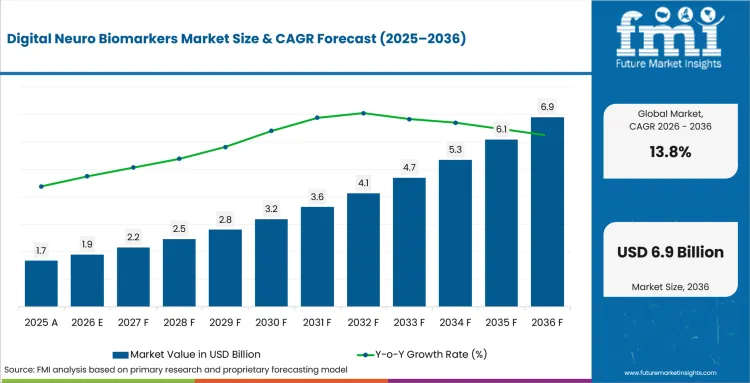
Key Takeaways of Digital Neuro Biomarkers Market
- Neurological trials and care pathways need objective measurements between episodic clinic assessments to support timely decisions across research and routine care.
- Software-based digital biomarkers are expected to account for 34.0% by product type in 2026, supported by scalable delivery through smartphones and controlled cloud platforms.
- Alzheimer’s disease is projected to represent 29.0% of application in 2026, reflecting demand for sensitive measures of early cognitive and functional change.
- Hospitals and neurology clinics are anticipated to capture 38.0% share in 2026, reinforced by specialist interpretation and established referral pathways.
- Uncertain clinical validity and population bias remain material restraints across neurological research and care programs. Missing longitudinal data can also delay regulatory review and weaken confidence in measured treatment effects.
- Global endpoint platforms compete with focused neurological specialists across distinct delivery models and disease workflows. Organizations compare validation depth and workflow integration alongside participant support and accountable implementation delivery services.
Analyst Perspective
“Digital neuro biomarkers create commercial value by turning activity and speech as well as movement and cognition into measurements that support defined neurological decisions. Trial sponsors need repeatable performance across representative patients and ordinary devices before digital measures can influence regulated development programs. Health systems reward providers that combine validation with specialist-ready reports and participant support across accountable data-integrity safeguards.”
- Anurag Sharma, Principal Analyst, Future Market Insights
How is the Digital Neuro Biomarkers Market segmented?
The digital neuro biomarkers market is segmented by product type, application, end user, distribution channel, technology, and region.
The market is assessed by product type, application, end user, distribution channel, technology, and region. Product type separates software measures from wearables, mobile applications, speech tools, and multimodal platforms according to data collection and analysis. Application identifies the neurological condition or mental-health use case that gives each measure clinical meaning. End user distinguishes hospitals, pharmaceutical companies, research institutes, contract research organizations, and home-care providers according to interpretation and follow-up responsibility. Distribution channel records whether organizations purchase directly, subscribe through cloud platforms, work with technology partners, use medical-device distributors, or source through online platforms. Technology separates AI/ML processing from wearable sensing, mobile delivery, cloud analytics, and voice phenotyping.
What keeps software-Based digital biomarkers ahead within product type?
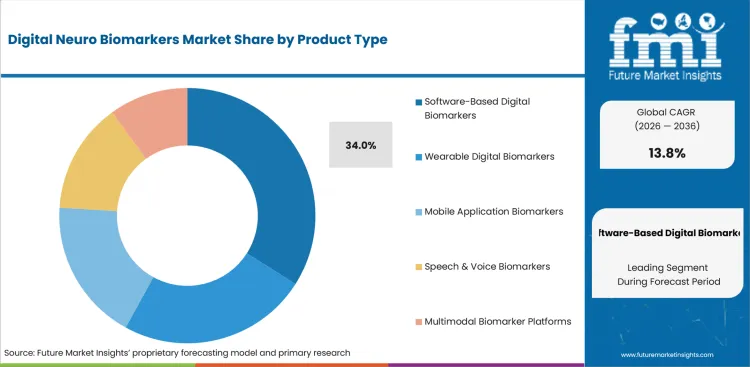
Software-based biomarkers deliver cognitive tasks and scoring logic through common digital interfaces across clinic and home settings. Their commercial advantage comes from consistent scheduling and centralized data-quality checks across distributed neurological studies. In July 2025 Linus Health expanded Anywhere to pharmaceutical companies and other partners through browser-based delivery on a participant’s own device. The launch showed how software can extend validated assessments across remote locations without separate site hardware. Integration with wearable healthcare devices can also combine active cognitive tasks with passive signals inside one study workflow.
- By product type, software-based digital biomarkers are estimated to hold 34.0% in 2026 owing to scalable delivery through familiar devices. Centralized configuration reduces setup differences across sites and supports consistent assessment schedules throughout multinational studies. The position depends on controlled software updates that preserve measurement behavior across intended populations and protocol periods.
- Pharmaceutical companies adopt software platforms that combine data capture with audit trails and configurable neurological assessments. A reusable platform supports several protocols without rebuilding every workflow or retraining every participating study site. Renewal depends on visible quality checks and responsive participant assistance throughout extended decentralized programs across different countries and protocol periods.
Which buying mechanism supports alzheimer’s disease in the application category?
Alzheimer’s programs need measurements that detect subtle cognitive and functional change before broad decline becomes clear during routine visits. Digital tasks must separate disease progression from learning effects and device familiarity across repeated assessment schedules. A direct care pathway also needs a documented clinical action for every concerning result within practice. In January 2026 Altoida and Mindspan announced a pilot for up to 100 adults that integrates AI/AR cognitive assessment into personalized care and tests diagnostic efficiency.
- Alzheimer’s disease is projected to hold 29.0% share in 2026 owing to demand for sensitive measures of early cognitive change. Drug programs need longitudinal endpoints that support screening and treatment-response decisions without repeated specialist visits. The segment depends on disease-specific validation that separates impairment from normal variation across age and device experience.
- Drug developers use digital assessments to screen participants and monitor response between scheduled neurological evaluations. Adoption strengthens if results guide a defined enrollment decision or trigger a documented follow-up action within the protocol. Alzheimer’s biomarker diagnostics remain complementary because digital function measures cannot replace biological confirmation or specialist interpretation during therapeutic development.
What supports the position of hospitals & neurology clinics within the end user category?
Neurology clinics remain responsible for interpreting digital findings and connecting them with medication history or neurological examination results. In March 2025 Linus Health launched Anywhere for Health Systems as an FDA-listed remote cognitive assessment with electronic-record integrations and structured reports. The launch supports scalable screening within established referral pathways rather than standalone consumer testing across unconnected care settings. Clinics gain value from portable medical devices that produce concise reports and clear escalation routes for patients needing specialist review.
- The end user category is forecast to be led by hospitals and neurology clinics at 38.0% share in 2026 due to specialist interpretation requirements. Clinical teams can compare digital changes with examinations and treatment history before selecting the next care action. Their position weakens if integration adds documentation work or unclear findings create repeated manual review.
- Hospitals adopt platforms that fit existing referral pathways and electronic-record workflows used by neurological care teams. Neurologists need actionable reports that connect digital findings with examinations instead of raw sensor streams requiring separate technical interpretation. Implementation requires staff training and clear escalation rules for inconsistent results across smaller clinics with limited informatics capacity.
Why does direct enterprise sales lead the distribution channel category?
Direct contracts give trial sponsors and health systems control over data ownership and implementation responsibilities across complex deployments. Large programs also need one accountable service team for configuration and technical support throughout implementation. In April 2025 Cambridge Cognition announced two Phase 3 contracts combining digital cognitive and voice assessments within named depression protocols. The contracts show that clinical trial operations purchase integrated measurement services around study-specific requirements and named protocols. Direct negotiation supports security review and protocol-level configuration across participating sites and connected data systems.
- In 2026, direct enterprise sales are expected to lead distribution channel with 36.0% share due to complex integration and validation requirements. Large organizations negotiate data-transfer duties and technical support within one accountable agreement covering implementation and operational response. The channel is less practical for small feasibility programs that cannot absorb lengthy security reviews or minimum contract values.
- Trial sponsors favor direct agreements that assign configuration and participant support to one accountable service organization. Enterprise contracts also support phased expansion from an initial study into several therapeutic development programs. Renewal depends on transparent implementation costs and consistent measurement across protocol amendments and device replacements. Participating countries also need dependable support throughout extended study periods and changing protocol requirements globally.
How does artificial intelligence & machine Learning shape demand in the technology category?
AI/ML systems convert frequent speech and movement data together with cognitive signals into measures that researchers can compare across extended studies. Commercial use requires interpretable outputs and validation across intended neurological populations and ordinary participant settings. Multimodal programs also need coordinated data capture across several devices and assessment locations during each study. In July 2025 Ametris and Modality.AI announced a partnership combining wearable measures with AI-based audio and visual biomarkers for neurodegenerative trials. The collaboration supports self-guided assessments across participant homes and clinical sites through integrated healthcare AI platforms.
- By technology, artificial intelligence and machine learning are forecast to represent 32.0% in 2026 driven by demand for sensitive progression measures. Algorithms can process speech and movement patterns at frequencies that manual review cannot sustain across large programs. The position remains conditional on bias testing and controlled change management across every deployed software version.
- Research teams adopt AI models that provide interpretable outputs and documented performance across representative neurological groups. Automated checks can flag missing or implausible sensor data before database lock and reduce late remediation. Adoption slows if model updates alter endpoint behavior during an active study, so sponsors require version control and prespecified recalibration rules.
What are the drivers, restraints, and opportunities in the Digital Neuro Biomarkers Market?
Frequent objective measurement supports trial decisions, but incomplete validation can delay adoption. The strongest opportunity lies in disease-specific endpoints tied to defined clinical actions.
- Driver: Frequent remote measurement provides objective evidence of neurological change between scheduled clinic assessments and daily activities.
- Restraint: Device bias and incomplete longitudinal data can prevent reliable interpretation across intended neurological populations.
- Opportunity: Disease-specific endpoints can connect continuous measurement with defined enrollment and treatment decisions alongside documented follow-up actions.
Neurological trials gain more informative data through frequent measurements collected between scheduled clinic visits and ordinary daily activities. Frequent assessment can reveal gait or balance changes that episodic rating scales miss during ordinary participant activity. In October 2025 Clario enrolled the first participant in an Oxford collaboration using Opal wearable sensors for Parkinson’s research. The program combines in-clinic gait and balance tests with continuous remote mobility measures across participant homes. The evidence supports neurology clinical trials that need disease-specific endpoints reflecting progression across everyday settings rather than isolated laboratory performance.
Device bias and participant nonadherence create a material restraint by altering the measured signal across intended populations. Regulated programs need lifecycle controls that cover model development and every approved software change throughout commercial use. In January 2025 the FDA issued draft guidance addressing transparency and bias across the lifecycle of AI-enabled medical devices. Sponsors therefore need population-specific performance checks and procedures for handling missing or implausible neurological data. Commercial review lengthens if measurements cannot remain comparable across software versions and ordinary home conditions.
Disease-specific pathways create an opportunity for providers that connect digital signals with defined care or trial decisions. Commercial scale improves through integration with established health-plan workflows that assign responsibility for clinical follow-up and participant support. In July 2025 Linus Health and League announced an integration bringing online cognitive screening into private health-plan platforms. The collaboration links remote assessment with educational content and care pathways for members identified at risk. Digital therapeutics programs can use objective monitoring alongside interventions, but reimbursement and clinical ownership require clear implementation rules.
Which country CAGRs are profiled in the Digital Neuro Biomarkers Market?
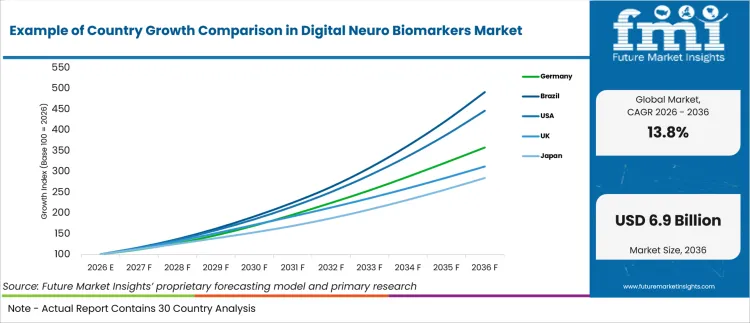
| Country | CAGR |
|---|---|
| Brazil | 17.2% |
| USA | 16.1% |
| South Korea | 14.3% |
| Germany | 13.6% |
| Australia | 12.7% |
| UK | 12.1% |
| Japan | 11.0% |
How do country-level CAGRs compare in the Digital Neuro Biomarkers Market?
The country forecasts show a differentiated growth pattern across the digital neuro biomarkers market, with a noticeable transition from early-adoption markets to healthcare systems where implementation is progressing at a more measured pace. Brazil and the USA form an upper group with only 1.1 percentage points separating their forecasts, reflecting strong momentum in the use of digital tools for neurological assessment and monitoring. South Korea and Germany create a closely aligned middle band, while Australia and the UK remain within a narrow 0.6-point range. A wider gap emerges between the UK and Japan, placing Japan outside the main grouping despite continued market expansion. This pattern reflects differences in digital health integration, neurological disease monitoring initiatives and the adoption of software-driven biomarkers within clinical and research settings. Market development is increasingly influenced by the ability to generate continuous real-world neurological data and translate it into actionable clinical insights.
- Brazil benefits from growing investment in digital health technologies and increasing use of remote monitoring tools that support neurological assessment outside traditional care environments.
- The USA reflects strong demand for data-driven healthcare solutions, supported by active development of digital biomarkers for neurological disorders, cognitive health and clinical trial applications.
- South Korea continues to advance through its highly digitized healthcare ecosystem and expanding adoption of artificial intelligence and connected health technologies in patient monitoring.
- Germany's outlook is influenced by increasing use of digital diagnostics and growing interest in objective neurological measurement tools that can complement conventional clinical assessments.
- Australia supports market expansion through investments in digital health infrastructure and greater use of remote monitoring technologies across neurological care pathways.
- The UK benefits from growing efforts to integrate digital biomarkers into research programs, clinical decision-making and long-term neurological disease management frameworks.
- Japan maintains steady growth as healthcare providers evaluate digital neurological assessment tools, although adoption remains closely linked to clinical validation and integration within established care models.
Similar CAGRs do not necessarily translate into identical commercialization opportunities. Differences in regulatory pathways, clinical validation requirements, digital health reimbursement models and healthcare data infrastructure can significantly influence the deployment of digital neuro biomarkers. As a result, companies may face distinct adoption and market access conditions despite broadly comparable growth trends. The full report provides country-level CAGR analysis across North America, Latin America, Europe, East Asia, South Asia, Oceania and the Middle East and Africa.
Country-wise Analysis
- Brazil requires medical-software developers and local representatives to select the correct Anvisa route for every regulated neurological product. Digital neuro biomarker sales in Brazil are forecast to expand at 17.2% CAGR by 2036, supported by scalable assessment needs beyond specialist centers. Clear classification guidance helps overseas developers plan registration and documentation through one defined national process. In October 2025 Anvisa published an updated manual covering medical equipment and software as a medical device. The manual aligns guidance with current risk rules and explains product classification for manufacturers and legal representatives. Portuguese documentation and concentrated neurology capacity raise training and support costs outside major urban centers. Commercial entry therefore depends on a local regulatory partner and a service model that reaches referral hospitals without weakening response times.
- United States trial sponsors already use wearable and software measures across decentralized neurological research programs. Connected platforms must also satisfy formal cybersecurity duties throughout design and premarket review as well as commercial maintenance. The USA digital neuro biomarkers sector is projected to record 16.1% CAGR during the assessment period, reinforced by active drug development and mature clinical-trial infrastructure. In February 2026 the FDA issued final guidance covering device design and premarket documentation for products with cybersecurity risk. The guidance helps sponsors assign security and maintenance responsibilities across connected neurological platforms during implementation and continuing use. Fragmented health-system integration and inconsistent payer routes can delay routine-care expansion beyond established research settings. Providers therefore need enterprise security support and evidence that each digital measure remains reliable across intended devices.
- South Korea applies a dedicated approval framework to digital medical products entering clinical use through hospitals and research programs. Adoption of digital neuro biomarkers in South Korea is estimated to expand at 14.3% CAGR through 2036, enabled by dense hospital networks and advanced mobile infrastructure. Domestic technology partners can support integration across large medical centers and regional hospitals through established local service relationships. In April 2025 the Ministry of Food and Drug Safety issued Notice 2025-25 covering approval and evaluation requirements for digital medical products. The route provides a clear regulatory basis but requires detailed Korean-language evidence and formal product review. Hospital security checks and continuing technical support duties create practical friction during purchasing and multi-site implementation. Providers need local service capacity that reaches regional networks and resolves device issues without disrupting longitudinal data collection.
- Germany links reimbursed digital-health access with formal evidence of clinical benefit and data protection for qualifying products. In December 2025 the Federal Ministry of Health stated that DiGA had become part of regular care under continuing data-protection requirements. Digital neuro biomarker demand in Germany is forecast to rise at 13.6% CAGR over the forecast period, sustained by the established DiGA assessment route. The pathway gives eligible products a prescription-based route to insured patients rather than direct consumer purchase. German-language support and formal benefit documentation can extend launch schedules for narrowly validated neurological tools. Smaller developers therefore need local reimbursement expertise and evidence that remote measurements improve a defined care decision within routine neurology workflows.
- Australian providers must establish whether neurological software is regulated before supplying it through clinical or research channels. Large service distances also raise training and support costs beyond major metropolitan centers and specialist hospital networks. In Australia digital neuro biomarker demand is predicted to advance at 12.7% CAGR through 2036, influenced by remote-care needs across dispersed populations. In February 2026 the Therapeutic Goods Administration clarified that qualifying software requires ARTG inclusion unless an exclusion or exemption applies. ARTG inclusion gives hospitals an accountable purchasing basis for regulated neurological platforms and their continuing compliance duties. Local clinical acceptance remains a material friction for tools without evidence from comparable Australian care settings. Providers need remote onboarding and dependable technical support that does not rely on frequent specialist travel.
- United Kingdom health systems evaluate AI medical devices through regulated testing and NHS implementation requirements. By 2036 the UK digital neuro biomarkers market is projected to grow at 12.1% CAGR, reinforced by supervised routes for unfamiliar software risks. Novel products can use regulatory sandboxes to resolve evidence questions ahead of wider clinical and health-system deployment. In June 2025 the MHRA opened a second AI Airlock cohort following a pilot that tested four AI medical technologies. The program gives developers direct regulatory feedback through tailored testing plans with public-sector and industry specialists. NHS integration and budget ownership remain substantial frictions for platforms entering routine neurological pathways and local service arrangements. Providers also need evidence that remote measures improve a defined care decision instead of adding another unconnected dashboard.
- Japan assigns neurological and psychiatric software to a specialized medical-device review team within its SaMD structure. Japan is estimated to post 11.0% CAGR in digital neuro biomarkers over the forecast period, shaped by precise assessment demand and strict quality expectations. Priority-review access gives qualifying developers a route to earlier consultation and continuing regulatory support throughout the review process. In June 2026 the Ministry of Health, Labour and Welfare established rolling applications for priority-review designation from fiscal 2026. Japanese localization and trusted in-country service remain material requirements for hospitals and clinical research organizations. Extensive documentation creates cost friction for smaller overseas developers entering Japanese clinical and research settings. Commercial success therefore depends on localized evidence and dependable technical support across participating study sites.
Who are the notable companies in the Digital Neuro Biomarkers Market?
Clario (Thermo Fisher Scientific), Ametris, Koneksa, Linus Health, Cambridge Cognition, Rune Labs, BioSensics, and Altoida are the notable companies shaping this market.
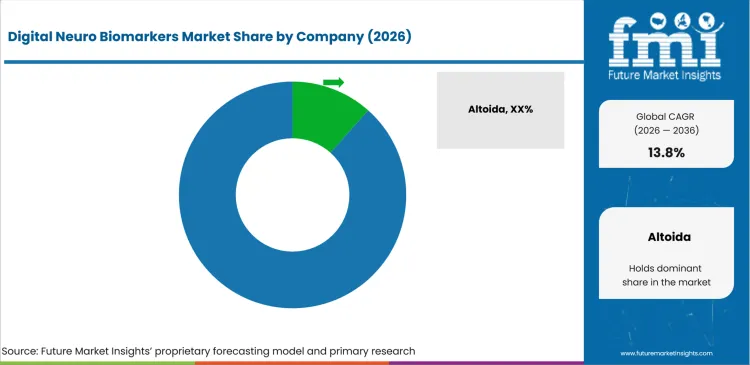
The competitive landscape is layered and not uniformly concentrated, with companies competing through different measurement and delivery models. Clario and Ametris address multinational trials through broad endpoint operations and global implementation across study locations. Koneksa combines device-agnostic capture with measurement science across several neurological signals and sponsored therapeutic development programs. Linus Health and Cambridge Cognition focus on cognitive workflows across clinical research and routine care. Rune Labs and BioSensics build disease-specific depth around movement and longitudinal function and Altoida focuses on investigational cognitive biomarkers. Competition also overlaps with connected remote monitoring platforms that extend objective measurement beyond scheduled neurological visits. Entry is possible through a narrow validated endpoint, but expansion requires regulatory evidence and dependable implementation across participating sites.
- Clario and Ametris combine wearable data with broad endpoint operations across multinational clinical programs and complex sponsor accounts. Their scale supports device deployment and data management together with technical support across many participating countries. Koneksa competes through device-agnostic measurement science and study-level validation across several neurological signal types and therapeutic programs.
- Linus Health and Cambridge Cognition focus on cognitive assessment across research and healthcare workflows with structured reporting. Their advantage comes from validated tasks that fit defined clinical or protocol decisions across intended populations. Altoida offers a narrower investigational route through AI/AR measures of cognitive and functional performance within pilot care workflows.
- Rune Labs and BioSensics concentrate on movement and longitudinal function across Parkinson’s disease and related neurological programs. Their disease-specific depth supports detailed signal interpretation through wearables and multimodal assessments across ordinary settings. Expansion depends on integration with sponsor systems and dependable participant support throughout extended studies globally.
Competitive Benchmarking: Digital Neuro Biomarkers Market
| Company | Workflow or Platform Depth | Governance and Proof | Enterprise Deployment | Geographic Reach |
|---|---|---|---|---|
| Clario (Thermo Fisher Scientific) | High | High | High | Global |
| Ametris | High | High | High | Global |
| Koneksa | High | High | Medium | Multi-country |
| Linus Health | Medium | High | Medium | North America and Europe |
| Cambridge Cognition | High | High | High | Global |
| Rune Labs | Medium | High | Medium | North America |
| BioSensics | High | High | Medium | 30+ countries |
| Altoida | Medium | Medium | Low | Multi-country research |
Key Developments in the Digital Neuro Biomarkers Market
- In March 2026, Thermo Fisher Scientific completed its acquisition of Clario Holdings and placed the business within Laboratory Products and Biopharma Services. The transaction connects Clario’s digital endpoint data with Thermo Fisher’s wider clinical research operations and service infrastructure. Clario remains an operating brand focused on endpoint data collection and analysis across complex trials. The completed ownership change expands integration scope for pharmaceutical programs that need device and patient data alongside global study services.
- In May 2025, Rune Labs announced a clinical program with the Parkinson’s Foundation that combines PD GENEration testing with wearable data from StrivePD and Apple Watch. The program links genetic findings with real-world movement measures across Parkinson’s disease research and clinical development. It combines genetic testing with continuous movement evidence that can support earlier diagnosis and more precise trial recruitment. Its commercial relevance lies in improving participant selection and endpoint interpretation for sponsored programs targeting narrower neurological subgroups.
- In April 2026, Koneksa reached database lock for the KH007 study evaluating digital measures of Parkinson’s disease progression. The twelve-month study enrolled 82 participants and reported approximately 95% adherence across remotely collected measures. The dataset covers active and passive measures collected across participant homes and supervised clinical settings. The completed evidence gives sponsors a clearer basis for assessing reliability and clinically meaningful change before selecting digital endpoints for later therapeutic programs.
- In March 2026, Linus Health secured a group purchasing agreement with Provista that expanded access to its cognitive assessment tools for physician practices. The agreement includes the Core Cognitive Evaluation and the remote Anywhere platform for participating medical practices. Provista clients gain access through an established contracting network that serves physician groups across several healthcare settings. The commercial route can reduce contracting friction and support wider routine-care adoption of digital cognitive assessment.
Key Players in the Digital Neuro Biomarkers Market
Integrated Clinical Trial Platforms
- Clario (Thermo Fisher Scientific)
- Ametris
- Koneksa
Cognitive Assessment Specialists
- Linus Health
- Cambridge Cognition
- Altoida
Neurology Measurement Specialists
- Rune Labs
- BioSensics
Digital Neuro Biomarkers Market - Report Scope
| Coverage field | Report scope |
|---|---|
| Market breakdown | Product type, application, end user, distribution channel, technology, and region. |
| Market Definition | Software-derived measures from smartphones, wearables, sensors, speech, movement, cognition, or interaction patterns used to characterize neurological disease or treatment response. |
| Regions Covered | North America, Latin America, Western Europe, East Asia, South Asia and Pacific, and Middle East and Africa. |
| Countries Covered | Brazil, USA, South Korea, Germany, Australia, UK, and Japan. |
| Key Companies Profiled | Clario (Thermo Fisher Scientific), Ametris, Koneksa, Linus Health, Cambridge Cognition, Rune Labs, BioSensics, and Altoida. |
| Forecast Period | 2026 to 2036. |
| Approach | Hybrid bottom-up and top-down market sizing supported by revenue mapping, demand-side validation, and segment- and country-level reconciliation. |
Digital Neuro Biomarkers Market - Research Methodology
| Method | Approach |
|---|---|
| Primary Research | FMI analysts gathered input from manufacturers, service providers, technology developers, distributors, end users, procurement teams, and subject-matter experts. Interviews examined purchasing decisions, product or service evaluation, adoption barriers, approval requirements, pricing considerations, and expectations for technical or commercial support. Respondents were also asked what evidence is required before a trial, pilot, or initial order develops into regular purchasing. |
| Desk Research | Desk research covered government statistics, regulatory publications, trade data, industry associations, technical literature, standards, company filings, product information, and official corporate announcements. Sources were reviewed for relevance, publication date, geographic coverage, and consistency with the defined market scope. Claims relating to performance, applications, approvals, capacity, investment, and commercial activity were retained only when supported by credible public evidence. |
| Market Sizing and Forecasting | The market model combined the baseline value with historical performance, segment structure, pricing and volume indicators, adoption levels, company participation, and country-level demand conditions. Forecast assumptions considered economic activity, investment trends, regulatory developments, technology adoption, purchasing cycles, supply availability, and barriers to wider market use. Segment and regional estimates were reconciled before the final market total was calculated. |
| Data Validation | Estimates were checked against multiple independent indicators, including public data, company activity, trade patterns, industry developments, and findings from primary interviews. Validation also tested whether products, services, applications, and company revenues fell within the defined market boundaries. Adjacent categories, unsupported claims, overlapping revenues, and activities without direct market relevance were excluded to reduce double counting and maintain consistency across segments and countries. |
Digital Neuro Biomarkers Market by Segments
Digital Neuro Biomarkers Market segmented by Product Type:
- Software-Based Digital Biomarkers
- Cognitive Assessment Software
- AI-Based Neurological Analytics
- Wearable Digital Biomarkers
- Smartwatches
- Wearable Motion Sensors
- Mobile Application Biomarkers
- Smartphone Cognitive Tests
- Digital Symptom Tracking Apps
- Speech & Voice Biomarkers
- Speech Pattern Analysis
- Voice Recognition Biomarkers
- Multimodal Biomarker Platforms
- Integrated Digital Biomarker Suites
- Cloud-Based Analytics Platforms
Digital Neuro Biomarkers Market segmented by Application:
- Alzheimer’s Disease
- Early Diagnosis
- Disease Progression Monitoring
- Parkinson’s Disease
- Motor Symptom Assessment
- Tremor Monitoring
- Multiple Sclerosis
- Fatigue Monitoring
- Gait Assessment
- Mental Health Disorders
- Depression Monitoring
- Cognitive Impairment Assessment
- Epilepsy & Other Neurological Disorders
- Seizure Detection
- Remote Neurological Monitoring
Digital Neuro Biomarkers Market segmented by End User:
- Hospitals & Neurology Clinics
- Specialty Neurology Centers
- Multispecialty Hospitals
- Pharmaceutical & Biotechnology Companies
- Clinical Trial Sponsors
- Drug Development Companies
- Academic & Research Institutes
- Universities
- Neuroscience Research Centers
- Contract Research Organizations
- Phase I-IV CROs
- Data Analytics CROs
- Home Healthcare Providers
- Remote Patient Monitoring Providers
- Digital Care Providers
Digital Neuro Biomarkers Market segmented by Distribution Channel:
- Direct Enterprise Sales
- Hospital Contracts
- Pharma Enterprise Agreements
- Cloud-Based Subscription Platforms
- SaaS Platforms
- Web-Based Dashboards
- Technology & Healthcare Partners
- System Integrators
- Digital Health Partners
- Medical Device Distributors
- Authorized Distributors
- Value-Added Resellers
- Online Platforms
- Digital Health Marketplaces
- B2B Procurement Portals
Digital Neuro Biomarkers Market segmented by Technology:
- Artificial Intelligence & Machine Learning
- Deep Learning Algorithms
- Predictive Analytics
- Wearable Sensor Technology
- Inertial Measurement Sensors
- Biosignal Sensors
- Mobile Health Technologies
- Smartphone-Based Monitoring
- Tablet-Based Cognitive Testing
- Cloud Computing & Analytics
- Cloud Data Storage
- Remote Analytics Platforms
- Voice & Digital Phenotyping
- Speech Analytics
- Behavioral Pattern Recognition
Digital Neuro Biomarkers Market by Region:
- North America
- United States
- Canada
- Europe
- Germany
- United Kingdom
- France
- Italy
- Spain
- Asia Pacific
- China
- Japan
- South Korea
- Taiwan
- Singapore
- Latin America
- Brazil
- Mexico
- Argentina
- Middle East & Africa
- GCC Countries
- South Africa
- Israel
Research Sources and Bibliography
- USA Food and Drug Administration. (2026, July 20).
- Cambridge Cognition. (2025, March 6).
- BioSensics. (2025, February 26)
- Linus Health. (2025, July 28)
- Altoida. (2026, January 13).
- Linus Health. (2025, March 18).
- Cambridge Cognition. (2025, April 3)
- Ametris. (2025, July 17)
- Clario. (2025, October 6).
- U.S. Food and Drug Administration. (2025, January 6)
- Linus Health. (2025, July 28)
- Agência Nacional de Vigilância Sanitária. (2025, October 22)
- U.S. Food and Drug Administration. (2026, February).
- Ministry of Food and Drug Safety. (2025, April 15).
- Federal Ministry of Health. (2025, December 15).
- Therapeutic Goods Administration. (2026, February 24).
- Medicines and Healthcare products Regulatory Agency. (2025, June 23).
- Ministry of Health, Labour and Welfare. (2026, June 15).
- Thermo Fisher Scientific. (2026, March 24).
- Rune Labs. (2025, December 23)
- Koneksa. (2026, April 23).
- Linus Health. (2026, March 26).
This bibliography is provided for reader reference and is not exhaustive. The full report contains the complete reference list and detailed citations
This Report Answers
- What is the digital neuro biomarkers market value in 2026 and 2036?
- What CAGR is projected for digital neuro biomarkers between 2026 and 2036?
- Which product type holds the dominant share in 2026?
- Which application receives the leading share in 2026?
- Which end user and distribution channel lead their respective categories?
- How do country CAGRs compare across the seven profiled markets?
- Which companies provide exact-market digital neurological measurement capabilities?
- Which regulatory and validation conditions determine commercial deployment?
Frequently Asked Questions
How big is the Digital Neuro Biomarkers Market in 2026?
The digital neuro biomarkers market is valued at USD 1.9 billion in 2026 and is forecast to reach USD 6.9 billion by 2036. Demand is supported by neurological research and care pathways seeking objective measurements between clinic assessments through smartphones, wearables, speech analysis, movement tracking, and cognitive assessment platforms.
What is the CAGR of the Digital Neuro Biomarkers Market from 2026 to 2036?
The digital neuro biomarkers market grows at a CAGR of 13.8% between 2026 and 2036, supported by increasing use of software-based assessments, AI-driven analysis, wearable sensing, and remote measurement across neurological clinical trials and healthcare settings.
Which product type leads the Digital Neuro Biomarkers Market?
Software-based digital biomarkers account for 34.0% of the digital neuro biomarkers market by product type in 2026, supported by scalable delivery through smartphones and browser-based platforms that enable consistent cognitive and neurological assessments across clinical and remote settings.
How much will the Digital Neuro Biomarkers Market add between 2026 and 2036?
The digital neuro biomarkers market is set to add USD 5.0 billion between 2026 and 2036, growing from USD 1.9 billion to USD 6.9 billion as digital assessments, wearable sensors, AI-based analytics, and remote neurological monitoring become more widely integrated into research and care workflows.
Who are the leading companies in the Digital Neuro Biomarkers Market?
Five companies lead the digital neuro biomarkers market, including Clario, Ametris, Koneksa, Linus Health, and Cambridge Cognition, competing through digital endpoint platforms, neurological measurement technologies, cognitive assessments, wearable data, AI-driven analysis, and clinical trial integration.
Preview the report firsthand - request a free sample
Get SampleGet the brochure for pricing and purchase details.
Get PDFTable of Content
- Key Takeaways
- Market Size and CAGR
- Top Growth Driver
- Fastest Growing Segment
- Leading Region
- Key Companies
- Emerging Opportunities
- Executive Summary
- Global Market Outlook
- Demand-side Trends
- Supply-side Trends
- Technology Roadmap Analysis
- Analysis and Recommendations
- Analyst Perspective (What is happening? Why now? What should investors know?)
- Key Questions Answered
- How large is the market?
- What is the CAGR?
- What are key trends?
- Which region dominates?
- Who are the leaders?
- Market Overview
- Market Coverage / Taxonomy
- Market Definition / Scope / Limitations
- Research Methodology
- Chapter Orientation
- Analytical Lens and Working Hypotheses
- Market Structure, Signals, and Trend Drivers
- Benchmarking and Cross-market Comparability
- Market Sizing, Forecasting, and Opportunity Mapping
- Research Design and Evidence Framework
- Desk Research Programme (Secondary Evidence)
- Expert Input and Fieldwork (Primary Evidence)
- Tooling, Models, and Reference Databases
- Data Engineering and Model Build
- Quality Assurance and Audit Trail
- Market Background
- Market Dynamics (Drivers, Restraints, Opportunity, Trends)
- Scenario Forecast (Optimistic, Likely, Conservative)
- Impact Analysis
- AI Impact
- Sustainability Impact
- Regulatory Impact
- Technology Impact
- Consumer / Buyer Analysis
- Purchase Drivers
- Adoption Barriers
- Buyer Journey
- Opportunity Map Analysis
- Product Life Cycle Analysis
- Supply Chain Analysis
- Investment Feasibility Matrix
- Value Chain Analysis
- PESTLE and Porter's Analysis
- Regulatory Landscape
- Regional Parent Market Outlook
- Production and Consumption Statistics
- Import and Export Statistics
- Global Market Analysis and Forecast, 2021 to 2036
- Historical Market Size Value (USD Billion) Analysis, 2021 to 2025
- Current and Future Market Size Value (USD Billion) Projections, 2026 to 2036
- Y-o-Y Growth Trend Analysis
- Absolute $ Opportunity Analysis
- Global Market Pricing Analysis, 2021 to 2036
- Global Market Analysis and Forecast, By Product Type, 2021 to 2036
- Introduction / Key Findings
- Historical Market Size Value (USD Billion) Analysis By Product Type, 2021 to 2025
- Current and Future Market Size Value (USD Billion) Analysis and Forecast By Product Type, 2026 to 2036
- Software-Based Digital Biomarkers
- Cognitive Assessment Software
- AI-Based Neurological Analytics
- Wearable Digital Biomarkers
- Smartwatches
- Wearable Motion Sensors
- Mobile Application Biomarkers
- Smartphone Cognitive Tests
- Digital Symptom Tracking Apps
- Speech & Voice Biomarkers
- Speech Pattern Analysis
- Voice Recognition Biomarkers
- Multimodal Biomarker Platforms
- Integrated Digital Biomarker Suites
- Cloud-Based Analytics Platforms
- Software-Based Digital Biomarkers
- Y-o-Y Growth Trend Analysis By Product Type, 2021 to 2025
- Absolute $ Opportunity Analysis By Product Type, 2026 to 2036
- Global Market Analysis and Forecast, By Application, 2021 to 2036
- Introduction / Key Findings
- Historical Market Size Value (USD Billion) Analysis By Application, 2021 to 2025
- Current and Future Market Size Value (USD Billion) Analysis and Forecast By Application, 2026 to 2036
- Alzheimer's Disease
- Early Diagnosis
- Disease Progression Monitoring
- Parkinson's Disease
- Motor Symptom Assessment
- Tremor Monitoring
- Multiple Sclerosis
- Fatigue Monitoring
- Gait Assessment
- Mental Health Disorders
- Depression Monitoring
- Cognitive Impairment Assessment
- Epilepsy & Other Neurological Disorders
- Seizure Detection
- Remote Neurological Monitoring
- Alzheimer's Disease
- Y-o-Y Growth Trend Analysis By Application, 2021 to 2025
- Absolute $ Opportunity Analysis By Application, 2026 to 2036
- Global Market Analysis and Forecast, By End User, 2021 to 2036
- Introduction / Key Findings
- Historical Market Size Value (USD Billion) Analysis By End User, 2021 to 2025
- Current and Future Market Size Value (USD Billion) Analysis and Forecast By End User, 2026 to 2036
- Hospitals & Neurology Clinics
- Specialty Neurology Centers
- Multispecialty Hospitals
- Pharmaceutical & Biotechnology Companies
- Clinical Trial Sponsors
- Drug Development Companies
- Academic & Research Institutes
- Universities
- Neuroscience Research Centers
- Contract Research Organizations
- Phase I-IV CROs
- Data Analytics CROs
- Home Healthcare Providers
- Remote Patient Monitoring Providers
- Digital Care Providers
- Hospitals & Neurology Clinics
- Y-o-Y Growth Trend Analysis By End User, 2021 to 2025
- Absolute $ Opportunity Analysis By End User, 2026 to 2036
- Global Market Analysis and Forecast, By Distribution Channel, 2021 to 2036
- Introduction / Key Findings
- Historical Market Size Value (USD Billion) Analysis By Distribution Channel, 2021 to 2025
- Current and Future Market Size Value (USD Billion) Analysis and Forecast By Distribution Channel, 2026 to 2036
- Direct Enterprise Sales
- Hospital Contracts
- Pharma Enterprise Agreements
- Cloud-Based Subscription Platforms
- SaaS Platforms
- Web-Based Dashboards
- Technology & Healthcare Partners
- System Integrators
- Digital Health Partners
- Medical Device Distributors
- Authorized Distributors
- Value-Added Resellers
- Online Platforms
- Digital Health Marketplaces
- B2B Procurement Portals
- Direct Enterprise Sales
- Y-o-Y Growth Trend Analysis By Distribution Channel, 2021 to 2025
- Absolute $ Opportunity Analysis By Distribution Channel, 2026 to 2036
- Global Market Analysis and Forecast, By Technology, 2021 to 2036
- Introduction / Key Findings
- Historical Market Size Value (USD Billion) Analysis By Technology, 2021 to 2025
- Current and Future Market Size Value (USD Billion) Analysis and Forecast By Technology, 2026 to 2036
- Artificial Intelligence & Machine Learning
- Deep Learning Algorithms
- Predictive Analytics
- Wearable Sensor Technology
- Inertial Measurement Sensors
- Biosignal Sensors
- Mobile Health Technologies
- Smartphone-Based Monitoring
- Tablet-Based Cognitive Testing
- Cloud Computing & Analytics
- Cloud Data Storage
- Remote Analytics Platforms
- Voice & Digital Phenotyping
- Speech Analytics
- Behavioral Pattern Recognition
- Artificial Intelligence & Machine Learning
- Y-o-Y Growth Trend Analysis By Technology, 2021 to 2025
- Absolute $ Opportunity Analysis By Technology, 2026 to 2036
- Global Market Analysis and Forecast, By Region, 2021 to 2036
- Introduction
- Historical Market Size Value (USD Billion) Analysis By Region, 2021 to 2025
- Current Market Size Value (USD Billion) Analysis and Forecast By Region, 2026 to 2036
- North America
- Latin America
- Western Europe
- Eastern Europe
- East Asia
- South Asia and Pacific
- Middle East & Africa
- Market Attractiveness Analysis By Region
- North America Market Analysis and Forecast, By Country, 2021 to 2036
- Historical Market Size Value (USD Billion) Trend Analysis By Market Taxonomy, 2021 to 2025
- Market Size Value (USD Billion) Forecast By Market Taxonomy, 2026 to 2036
- By Country
- USA
- Canada
- By Product Type
- By Application
- By End User
- By Distribution Channel
- By Technology
- By Country
- Market Attractiveness Analysis
- By Country
- By Product Type
- By Application
- By End User
- By Distribution Channel
- By Technology
- Key Takeaways
- Latin America Market Analysis and Forecast, By Country
- Historical Market Size Value (USD Billion) Trend Analysis By Market Taxonomy, 2021 to 2025
- Market Size Value (USD Billion) Forecast By Market Taxonomy, 2026 to 2036
- By Country
- Brazil
- Mexico
- Chile
- Rest of Latin America
- By Product Type
- By Application
- By End User
- By Distribution Channel
- By Technology
- By Country
- Market Attractiveness Analysis
- By Country
- By Product Type
- By Application
- By End User
- By Distribution Channel
- By Technology
- Key Takeaways
- Western Europe Market Analysis and Forecast, By Country
- Historical Market Size Value (USD Billion) Trend Analysis By Market Taxonomy, 2021 to 2025
- Market Size Value (USD Billion) Forecast By Market Taxonomy, 2026 to 2036
- By Country
- Germany
- UK
- Italy
- Spain
- France
- Nordic
- BENELUX
- Rest of Western Europe
- By Product Type
- By Application
- By End User
- By Distribution Channel
- By Technology
- By Country
- Market Attractiveness Analysis
- By Country
- By Product Type
- By Application
- By End User
- By Distribution Channel
- By Technology
- Key Takeaways
- Eastern Europe Market Analysis and Forecast, By Country
- Historical Market Size Value (USD Billion) Trend Analysis By Market Taxonomy, 2021 to 2025
- Market Size Value (USD Billion) Forecast By Market Taxonomy, 2026 to 2036
- By Country
- Russia
- Poland
- Hungary
- Balkan & Baltic
- Rest of Eastern Europe
- By Product Type
- By Application
- By End User
- By Distribution Channel
- By Technology
- By Country
- Market Attractiveness Analysis
- By Country
- By Product Type
- By Application
- By End User
- By Distribution Channel
- By Technology
- Key Takeaways
- East Asia Market Analysis and Forecast, By Country
- Historical Market Size Value (USD Billion) Trend Analysis By Market Taxonomy, 2021 to 2025
- Market Size Value (USD Billion) Forecast By Market Taxonomy, 2026 to 2036
- By Country
- China
- Japan
- South Korea
- By Product Type
- By Application
- By End User
- By Distribution Channel
- By Technology
- By Country
- Market Attractiveness Analysis
- By Country
- By Product Type
- By Application
- By End User
- By Distribution Channel
- By Technology
- Key Takeaways
- South Asia and Pacific Market Analysis and Forecast, By Country
- Historical Market Size Value (USD Billion) Trend Analysis By Market Taxonomy, 2021 to 2025
- Market Size Value (USD Billion) Forecast By Market Taxonomy, 2026 to 2036
- By Country
- India
- ASEAN
- Australia & New Zealand
- Rest of South Asia and Pacific
- By Product Type
- By Application
- By End User
- By Distribution Channel
- By Technology
- By Country
- Market Attractiveness Analysis
- By Country
- By Product Type
- By Application
- By End User
- By Distribution Channel
- By Technology
- Key Takeaways
- Middle East & Africa Market Analysis and Forecast, By Country
- Historical Market Size Value (USD Billion) Trend Analysis By Market Taxonomy, 2021 to 2025
- Market Size Value (USD Billion) Forecast By Market Taxonomy, 2026 to 2036
- By Country
- Kingdom of Saudi Arabia
- Other GCC Countries
- Türkiye
- South Africa
- Other African Union
- Rest of Middle East & Africa
- By Product Type
- By Application
- By End User
- By Distribution Channel
- By Technology
- By Country
- Market Attractiveness Analysis
- By Country
- By Product Type
- By Application
- By End User
- By Distribution Channel
- By Technology
- Key Takeaways
- Key Countries Market Analysis
- USA
- Pricing Analysis
- Market Share Analysis, 2025
- By Product Type
- By Application
- By End User
- By Distribution Channel
- By Technology
- Canada
- Pricing Analysis
- Market Share Analysis, 2025
- By Product Type
- By Application
- By End User
- By Distribution Channel
- By Technology
- Mexico
- Pricing Analysis
- Market Share Analysis, 2025
- By Product Type
- By Application
- By End User
- By Distribution Channel
- By Technology
- Brazil
- Pricing Analysis
- Market Share Analysis, 2025
- By Product Type
- By Application
- By End User
- By Distribution Channel
- By Technology
- Chile
- Pricing Analysis
- Market Share Analysis, 2025
- By Product Type
- By Application
- By End User
- By Distribution Channel
- By Technology
- Germany
- Pricing Analysis
- Market Share Analysis, 2025
- By Product Type
- By Application
- By End User
- By Distribution Channel
- By Technology
- UK
- Pricing Analysis
- Market Share Analysis, 2025
- By Product Type
- By Application
- By End User
- By Distribution Channel
- By Technology
- Italy
- Pricing Analysis
- Market Share Analysis, 2025
- By Product Type
- By Application
- By End User
- By Distribution Channel
- By Technology
- Spain
- Pricing Analysis
- Market Share Analysis, 2025
- By Product Type
- By Application
- By End User
- By Distribution Channel
- By Technology
- France
- Pricing Analysis
- Market Share Analysis, 2025
- By Product Type
- By Application
- By End User
- By Distribution Channel
- By Technology
- India
- Pricing Analysis
- Market Share Analysis, 2025
- By Product Type
- By Application
- By End User
- By Distribution Channel
- By Technology
- ASEAN
- Pricing Analysis
- Market Share Analysis, 2025
- By Product Type
- By Application
- By End User
- By Distribution Channel
- By Technology
- Australia & New Zealand
- Pricing Analysis
- Market Share Analysis, 2025
- By Product Type
- By Application
- By End User
- By Distribution Channel
- By Technology
- China
- Pricing Analysis
- Market Share Analysis, 2025
- By Product Type
- By Application
- By End User
- By Distribution Channel
- By Technology
- Japan
- Pricing Analysis
- Market Share Analysis, 2025
- By Product Type
- By Application
- By End User
- By Distribution Channel
- By Technology
- South Korea
- Pricing Analysis
- Market Share Analysis, 2025
- By Product Type
- By Application
- By End User
- By Distribution Channel
- By Technology
- Russia
- Pricing Analysis
- Market Share Analysis, 2025
- By Product Type
- By Application
- By End User
- By Distribution Channel
- By Technology
- Poland
- Pricing Analysis
- Market Share Analysis, 2025
- By Product Type
- By Application
- By End User
- By Distribution Channel
- By Technology
- Hungary
- Pricing Analysis
- Market Share Analysis, 2025
- By Product Type
- By Application
- By End User
- By Distribution Channel
- By Technology
- Kingdom of Saudi Arabia
- Pricing Analysis
- Market Share Analysis, 2025
- By Product Type
- By Application
- By End User
- By Distribution Channel
- By Technology
- Türkiye
- Pricing Analysis
- Market Share Analysis, 2025
- By Product Type
- By Application
- By End User
- By Distribution Channel
- By Technology
- South Africa
- Pricing Analysis
- Market Share Analysis, 2025
- By Product Type
- By Application
- By End User
- By Distribution Channel
- By Technology
- USA
- Market Structure Analysis
- Competition Dashboard
- Competition Benchmarking
- Market Share Analysis of Top Players
- By Regional
- By Product Type
- By Application
- By End User
- By Distribution Channel
- By Technology
- Emerging Startups
- Innovation Benchmarking
- Competition Analysis
- Competition Deep Dive
- Altoida
- Overview
- Product Portfolio
- Profitability by Market Segments
- Sales Footprint
- Strategy Overview
- Marketing Strategy
- Product Strategy
- Channel Strategy
- Rune Labs
- Neurotrack
- BioSensics
- Koneksa
- Cognition Kit
- Clario
- ActiGraph
- Cambridge Cognition
- Linus Health
- Altoida
- Case Studies
- Success Stories
- Recent Developments
- Competition Deep Dive
- Assumptions & Acronyms Used


