

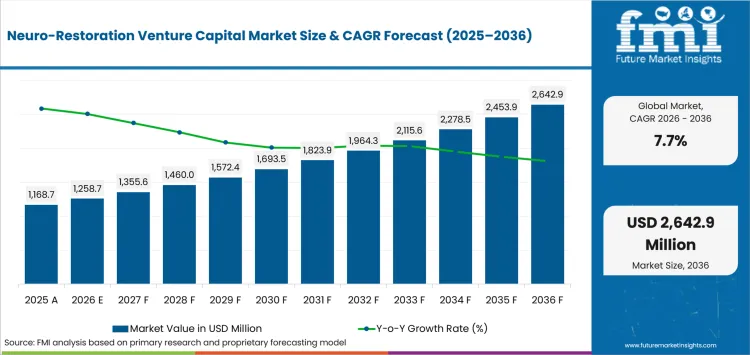
- Market Size (2026)
- USD 1258.7 Mn
- Forecast (2036)
- USD 2642.9 Mn
- CAGR (2026 to 2036)
- 7.7%
How big is Neuro-Restoration Venture Capital Market in 2026?
USD 1258.7 million in 2026 and USD 2642.9 million by 2036 at a 7.7% CAGR.
Demand for neuro-restoration venture capital is expected to grow at 7.7% CAGR by 2036, increasing valuation from USD 1,258.7 million in 2026 to USD 2,642.9 million during the forecast period. Investors commit larger rounds once a developer connects neural recording or stimulation with a defined restoration endpoint and a credible regulatory sequence. Neuralink reported in June 2025 that its USD 650 million Series E followed five participants using its implant across trials in three countries. The financing demonstrates how human performance and manufacturing readiness can reduce uncertainty around brain-computer interfaces without establishing routine commercial access. Earlier companies receive smaller checks because feasibility evidence does not resolve implant production or long-term participant support. Investment terms therefore depend on the next clinical milestone and the operating resources required to complete it.
Saudi Arabia and the United States provide different routes from venture financing toward regulated clinical infrastructure. Saudi-backed investment can combine strategic capital with a planned specialty center while United States programs depend on authorized studies and established implant teams. Paradromics reported in February 2025 that NEOM Investment Fund would support a BCI center of excellence in Saudi Arabia through a strategic partnership. The arrangement links funding with future clinical capacity rather than treating capital as an isolated balance-sheet event. Investors comparing brain implants must examine trial access and service ownership alongside technical performance across each national route. A local partnership creates limited value unless the developer also defines regulatory responsibility and long-term support for implanted participants.
Key Takeaways of Neuro-Restoration Venture Capital Market
- Demand for neuro-restoration venture capital is driven by measurable human function data supporting defined clinical milestones and credible financing sequences.
- By funding stage, seed funding holds the leading share at 33.8% in 2026, owing to frequent feasibility and prototype validation rounds.
- Neural implants lead the technology category with 40.6% share in 2026, as sustained capital supports surgery and manufacturing requirements.
- Venture capital firms account for 30.0% of investor share in 2026, owing to syndication and follow-on capacity.
- Medical device companies capture 43.9% of end-user share in 2026, despite heavier quality and service obligations.
- South Korea, the United Kingdom, and the United States show distinct funding dynamics, shaped by renewed venture investment, coordinated public neurotechnology programs, and translational trial infrastructure, while Japan and Germany require locally credible approval and financing routes.
- Competition centers on Neuralink, Precision Neuroscience, Synchron, ONWARD Medical, SpineX, Blackrock Neurotech, and CorTec, with vendors differentiating through cortical interface designs, endovascular implantation approaches, spinal stimulation platforms, and neural interface infrastructure.
Analyst Perspective
"The neuro-restoration venture capital market is becoming more selective as investors shift attention from scientific promise to commercial execution. Funding decisions increasingly reflect clinical evidence, regulatory progress, manufacturing readiness, and reimbursement potential rather than early-stage demonstrations alone. Companies that reduce development uncertainty through well-defined milestones and scalable commercialization strategies are expected to attract stronger long-term investment interest."
- Anurag Sharma, Principal Analyst at Future Market Insights
Source: FMI’s proprietary forecasting model and primary research
How is the Neuro-Restoration Venture Capital Market segmented?
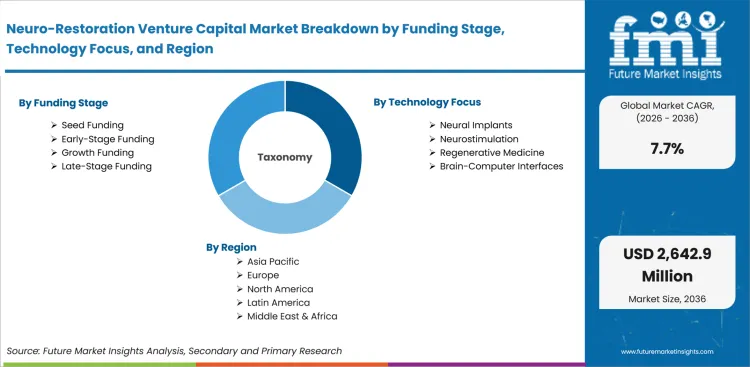
The neuro-restoration venture capital market is segmented by funding stage, technology focus, investor type, end user, and region.
The segmentation framework separates financing maturity from technical architecture and the organizations committing capital or using development outputs. Funding stage distinguishes seed funding from early-stage funding and growth funding plus late-stage funding across the investment lifecycle. Technology focus classifies neural implants alongside neurostimulation and regenerative medicine plus brain-computer interfaces within product development. Investor type separates venture capital firms from corporate investors and government funding agencies plus angel investors. End user distinguishes medical device companies from biotechnology companies and research institutes plus startups within the commercialization chain. Regional analysis applies the same boundary across countries with different clinical infrastructure and investment channels.
What supports demand for seed Funding within the funding stage category?
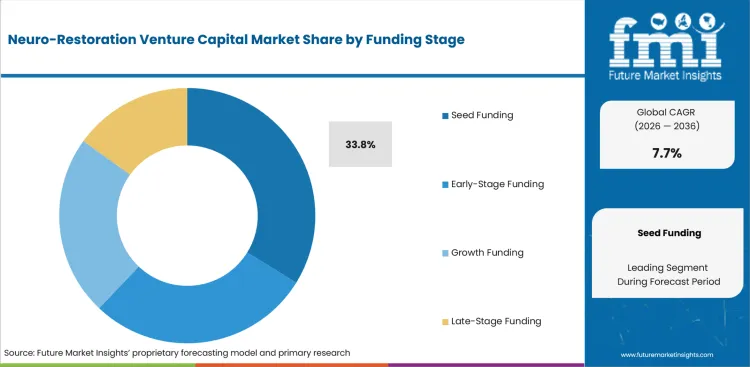
Early neuro-restoration companies must prove a workable mechanism so later investors can price clinical and manufacturing risk. NIH’s current funding page lists November 2024 notices covering prototype implementation and small clinical studies for nervous-system devices. The milestone-driven programs include safety testing and IDE preparation before a product enters more expensive human development. Investors also use neurological biomarkers to define measurable endpoints that can support later financing decisions.
- Within funding stage, seed funding accounts for 33.8% share in 2026 due to frequent feasibility rounds across competing approaches. Modest early checks can resolve technical ownership and prototype performance before expensive human studies require larger institutional syndicates.
- Founders and specialist funds use seed funding to establish design controls and a credible regulatory sequence before recruiting institutional partners. Adoption improves when the next round depends on a named submission or restoration endpoint instead of another broad research objective.
How are Neural Implants positioned within the technology focus category?
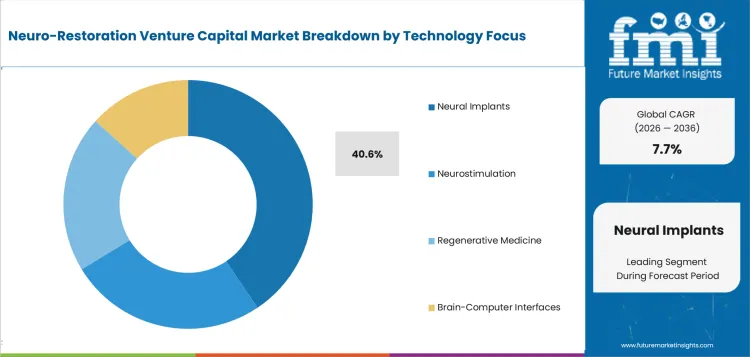
Neural implants combine specialized electrodes and surgery with software development and prolonged participant support across regulated programs. Investors distinguish a cleared component from a complete wireless BCI system during formal commercial diligence. The distinction affects budgets for implantable neurostimulator electrodes because software and packaging still require clinical validation. Capital plans must therefore separate component access from complete-system authorization and long-term clinical service responsibility.
- In 2026, neural implants represent 40.6% of technology focus, supported by high capital requirements across manufacturing and clinical evidence. Precision Neuroscience reported in April 2025 that FDA cleared its cortical array for commercial use lasting up to thirty days in United States clinical settings.
- Medical technology funds select neural implants when direct neural access offers functional performance that less invasive approaches cannot match. Their diligence must account for surgical risk and explant responsibilities plus maintenance obligations throughout multi-year participation and structured post-study clinical follow-up.
How do venture capital firms evaluate the Investor type category?
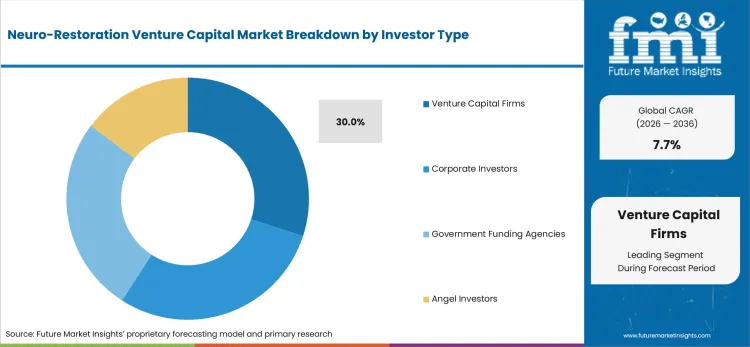
Specialist venture funds assess clinical evidence alongside financing duration and the operating consequences of implanted technology. Investment committees also examine whether a company can recruit later syndicate partners without compressing necessary development work. Similar specialist expertise matters across regenerative medicine programs with lengthy evidence and manufacturing validation requirements. Network access and follow-on capacity therefore influence investment decisions as much as the initial check size.
- Venture capital firms represent 30.0% of investor type in 2026 due to their capacity to syndicate milestone-based financing. Repeated rounds let companies increase capital commitments as technical evidence and regulatory clarity improve across several extended development cycles.
- Company boards prefer venture capital firms that can recruit later partners and evaluate medical-device regulation across extended development periods. Precision Neuroscience reported in November 2025 that SCI Ventures invested while adding paralysis-focused clinical and regulatory networks across the United States and Europe.
What makes medical device companies central to the end user category?
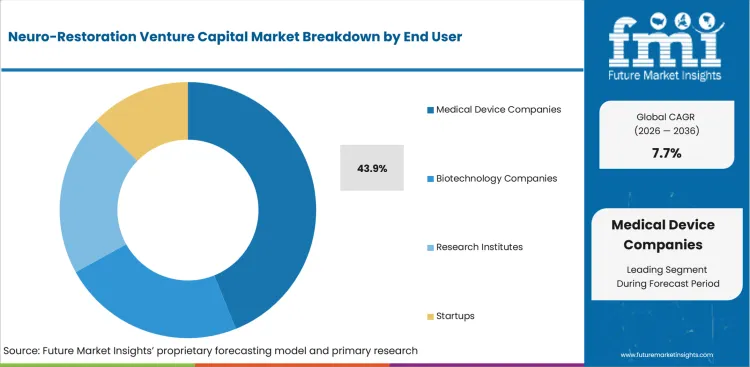
Medical device companies convert laboratory systems into controlled products with manufacturing records and post-market responsibilities. Regulatory planning must connect technical evidence with payer and clinical needs before a submission locks the development strategy. FDA reported in July 2026 that 133 devices were enrolled in its United States TAP pilot. Developers of medical devices can use early engagement to expose commercialization barriers before larger financing rounds commit substantial capital.
- Medical device companies capture 43.9% share within end user in 2026 owing to ownership of regulated development and service infrastructure. Their position reflects responsibility for design controls and clinical evidence plus manufacturing scale and continuing post-market support.
- Venture investors favor medical device companies that can protect implanted products through dependable quality systems and field support. Capital requirements increase whenever a developer lacks manufacturing partners or a documented route for long-term participant care across multiple expanding clinical sites.
What are the drivers, restraints, and opportunities in the Neuro-Restoration Venture Capital Market?
Measurable restoration evidence supports investment, long development timelines restrain financing, and coordinated regulatory pathways create a practical commercialization opening.
- Driver: Human functional outcomes connect technical progress with a defined clinical milestone and a stronger financing decision.
- Restraint: Long development timelines and changing public support increase dilution risk before routine product revenue becomes available.
- Opportunity: Earlier regulatory and payer coordination can reduce evidence gaps that delay investment-backed commercialization for qualifying devices.
Human restoration evidence improves financing quality because investors can connect technical performance with a named functional outcome. Implant programs become easier to evaluate once participants complete meaningful communication or computer-control tasks through direct use. Paradromics reported in June 2026 that the first United States participant received Connexus within its FDA-approved study for speech restoration and computer control. The procedure gives investors a concrete clinical milestone for comparing neurostimulation systems with recording-based platforms. Capital becomes more defensible as clinical progress changes participant capability and establishes the next regulated development step.
Funding continuity limits adoption because implant development cannot pause safely between manufacturing work and participant follow-up. NIH reported in June 2026 that its United States BRAIN Initiative received USD 429 million during fiscal 2026 after receiving USD 321 million during fiscal 2025. The same report states that dedicated Cures Act funding ends completely after fiscal 2026. Companies therefore need private contingency capital for studies whose schedules extend beyond annual public appropriations. Investors should require longer financing runways before programs begin costly human enrollment or manufacturing validation.
Regulatory alignment creates an opening for companies that develop access evidence alongside safety and technical performance. Closed-loop brain interfaces may require payer outcomes that differ from the metrics used during early engineering studies. FDA reported in July 2026 that the United States TAP program had expanded across every Office of Health Technologies and referenced the new RAPID Medicare pathway. Developers can use coordinated engagement to identify adoption barriers before pivotal plans become difficult to change. Investment committees gain a clearer commercialization route when access evidence appears inside the clinical strategy.
Which country CAGRs are profiled in the Neuro-Restoration Venture Capital Market?
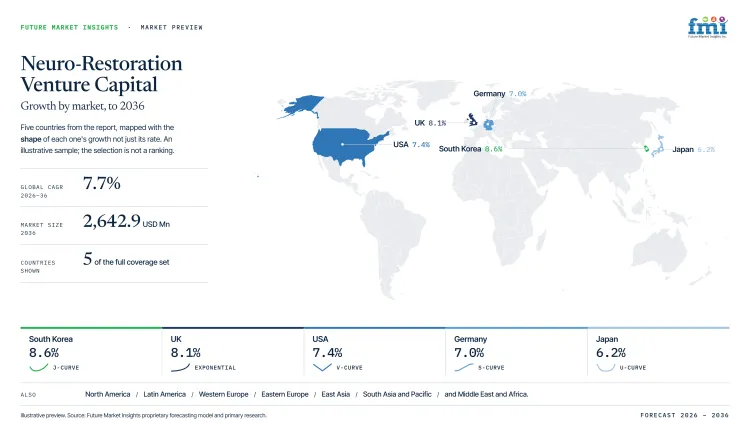
| Country | CAGR |
|---|---|
| USA | 7.4% |
| UK | 8.1% |
| Germany | 7.0% |
| Japan | 6.2% |
| South Korea | 8.6% |
How do country-level CAGRs compare in theNeuro-Restoration Venture Capital Market?
The country CAGRs span 2.4 percentage points and form two close groups around different national pathways. South Korea and the UK remain separated by 0.5 percentage point despite different public funding and device regulation structures. The USA and Germany are separated by 0.4 percentage point and both connect translational research with established medical-device institutions. Japan remains outside those groups because local authorization and representation add another commercialization sequence for foreign developers. The measured spacing describes modeled expansion rather than current investment scale or installed clinical capacity within each country.
- South Korea and the UK form a close upper group through different combinations of venture liquidity and coordinated public research support.
- The USA occupies a middle position where federal translational programs coexist with separate reimbursement and specialist-capacity requirements.
- Germany remains close to the USA through public fund support and domestic engineering depth across life-science technology development.
- Japan follows a distinct route that combines neuroscience project funding with mandatory local authorization structures for foreign device manufacturers.
- The complete range remains moderate because every profiled country requires expensive human evidence and durable service arrangements for implanted systems.
Similar forecast rates can create different entry conditions because national capital does not automatically provide trial access or regulatory representation. Investors should compare approval sequence and service ownership plus financing continuity before assigning equal value to nearby modeled rates. The full report provides country-level CAGR analysis across North America, Latin America, Europe, East Asia, South Asia, Oceania and the Middle East and Africa.
Country-wise Analysis
- United States developers can combine specialized clinical sites with federal programs that prepare neural devices for first-in-human studies. The USA neuro-restoration venture capital market is projected to grow at 7.4% CAGR through 2036 supported by milestone financing around regulated human evidence. NIH described Blueprint MedTech in June 2026 as an incubator providing non-dilutive support and commercialization resources through first-in-human readiness. The program gives early developers a practical adoption enabler before large private rounds become commercially realistic. Reimbursement evidence and specialized surgical capacity remain material adoption frictions beyond initial technical product development. Investors need budgets that separate trial expansion from manufacturing validation and continuing post-implant service obligations.
- The United Kingdom combines coordinated public research funding with NHS sites capable of supporting regulated neurotechnology studies. The UK neuro-restoration venture capital market is anticipated to advance at 8.1% CAGR through 2036 through translational programs and specialist clinical access. ARIA reported in January 2025 that eighteen teams joined its United Kingdom Precision Neurotechnologies program across four research areas. The Government Office for Science reported in February 2025 that commercial translation remains slow because reliable devices and manufacturing scale remain difficult. Non-invasive brain stimulation research benefits from public capital but later adoption requires a named sponsor and a credible health-service pathway.
- Germany provides public fund support and domestic engineering capability across established deep-technology and life-science companies. The German neuro-restoration venture capital market is projected to record 7.0% CAGR during the forecast, attributable to fund access and medical-device development expertise. The Federal Ministry for Economic Affairs and Energy reported in January 2026 that EIF German Equity expanded startup finance across German life sciences and deep technology. The program enables venture formation but does not provide clinical authorization or implant service capacity. Developers may conduct early validation abroad and receive limited domestic operating feedback from German clinical teams. Investors should examine regulatory geography and manufacturing scale separately from each developer’s registered corporate headquarters.
- Japan routes higher-risk devices through formal review and requires foreign developers to appoint a local marketing authorization holder. Adoption of neuro-restoration venture capital in Japan is estimated to expand at 6.2% CAGR between 2026 and 2036 owing to sustained neuroscience programs and disciplined device review. AMED reported in June 2025 that Japan selected projects across basic and applied neuroscience within its Integrated Neuroscience Program. PMDA states that Class IV devices require ministry approval and foreign manufacturers must use a Japanese authorization holder. The research base supports licensing and company formation but mandatory local representation increases total capital needs.
- South Korea combines renewed venture investment with a medical-device system that requires traceability for many long-term implants. South Korea’s neuro-restoration venture capital market is estimated to post 8.6% CAGR through 2036 driven by larger venture pools and biohealth interest. The Ministry of SMEs and Startups reported in February 2026 that 2025 Korean venture investment reached approximately USD 9.3 billion and biohealth captured 17.4%. MFDS states that many implanted devices require formal tracking records across manufacturers and participating clinical users. Domestic capital supports syndication but authorization and traceability duties create material long-term commercial service costs.
Who are the notable companies in the Neuro-Restoration Venture Capital Market?
Neuralink, Synchron, Blackrock Neurotech, ONWARD Medical, Precision Neuroscience, Paradromics, CorTec, and SpineX are the notable companies shaping this market.
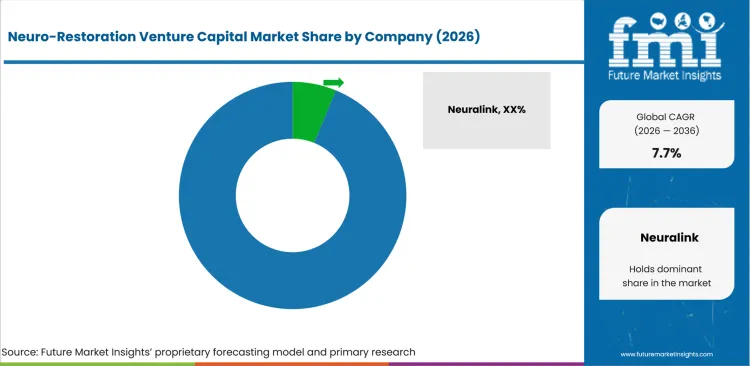
The competitive field combines venture-backed implant developers with stimulation companies and research-platform providers serving different restoration pathways. Investors compare each restoration endpoint with regulatory status and the capital needed for manufacturing scale and participant support. Neuralink and Precision Neuroscience pursue cortical systems through different electrode designs while Synchron uses an endovascular implantation route. Paradromics and CorTec operate regulated human programs for implanted interfaces with distinct communication and stroke-rehabilitation objectives. ONWARD Medical sells a spinal stimulation system while SpineX develops non-invasive therapy through clinical studies. Blackrock Neurotech supplies established research infrastructure and develops a clinical interface within the same neural technology ecosystem.
- Intracortical developers include Neuralink and Precision Neuroscience plus Paradromics across regulated human clinical development programs. Their financing plans require implant production and surgical workflow development plus continuing long-duration participant support before routine commercialization becomes practical.
- Synchron differentiates through an endovascular system that relies on neurointerventional devices and catheter-based implantation inside specialist hospitals. Its investment case depends on repeatable deployment and stable signal performance across authorized human studies in the United States and Australia.
- ONWARD Medical and SpineX represent stimulation-based restoration pathways with distinctly different regulatory and commercial maturity. Blackrock Neurotech supplies established research systems while CorTec develops an implantable platform through an FDA-authorized clinical stroke rehabilitation research study.
Competitive Benchmarking: Neuro-Restoration Venture Capital Market
| Company | Restoration Platform | Clinical Progress | Commercial Access | Geographic Reach |
|---|---|---|---|---|
| Neuralink | High | Medium | Low | United States and selected international trial markets |
| Synchron | High | Medium | Low | United States and Australia |
| Blackrock Neurotech | High | Medium | Medium | Global research markets |
| ONWARD Medical | High | High | High | United States and Europe |
| Precision Neuroscience | High | High | Medium | United States |
| Paradromics | High | Medium | Low | United States |
| CorTec | High | Medium | Low | United States and Europe |
| SpineX | Medium | Medium | Low | United States |
Restoration Platform is High for an integrated human system with defined functional output and Medium for a narrower direct modality with documented human use. Clinical Progress is High for a cleared product or substantial multi-site human evidence and Medium for an active authorized study. Commercial Access is High for routine product sales with continuing support and Medium for restricted research or component sales. Low indicates documented investigational access without routine sales and never represents missing official evidence.
Key Developments in the Neuro-Restoration Venture Capital Market
- In November 2025, Synchron announced USD 200 million in Series D financing for Stentrode commercialization and next-generation development. The official announcement connected the capital with clinical execution and manufacturing preparation before pivotal studies across the company’s endovascular program. The financing supports operating capacity that must precede routine commercial access for an investigational system without current approval in any geography.
- In January 2025, ONWARD Medical announced the first commercial sales of ARC-EX to UW Medicine and Next Steps Chicago in the United States. The official release stated that FDA had granted De Novo classification in December 2024 for clinic use following chronic spinal cord injury. The sales created a practical benchmark for investors evaluating installation and service revenue across specialized rehabilitation sites.
- In November 2025, Paradromics received FDA Investigational Device Exemption approval for the Connect-One early feasibility study in the United States. The initial plan covered two participants living within four hours of three participating United States research clinical sites. The authorization advanced Connexus into regulated human evaluation without establishing routine commercial availability for general clinical customers.
- In July 2025, CorTec announced the first human implantation of Brain Interchange during an FDA-authorized stroke study at Harborview Medical Center in Seattle. The system records cortical activity and delivers targeted stimulation during an authorized rehabilitation study for stroke recovery. The procedure provided a defined clinical milestone for a German developer without creating routine product access.
Key Players in the Neuro-Restoration Venture Capital Market
Implantable Brain-Computer Interface Developers
- Neuralink
- Synchron
- Precision Neuroscience
- Paradromics
- CorTec
Stimulation and Restoration Platform Companies
- ONWARD Medical
- SpineX
Neural Research Infrastructure Providers
- Blackrock Neurotech
Neuro-Restoration Venture Capital Market - Report Scope
| Coverage field | Report scope |
|---|---|
| Market breakdown | Funding stage, technology focus, investor type, end user, and region. |
| Quantitative Units | USD million |
| Market Definition | Equity investment directed toward companies developing neurotechnology intended to restore communication or movement and other sensory or neurological functions. |
| Regions Covered | North America, Latin America, Western Europe, Eastern Europe, East Asia, South Asia and Pacific, and Middle East and Africa. |
| Countries Covered | USA, UK, Germany, Japan, and South Korea are profiled directly within the comparative country analysis. |
| Key Companies Profiled | Neuralink, Synchron, Blackrock Neurotech, ONWARD Medical, Precision Neuroscience, Paradromics, CorTec, and SpineX. |
| Forecast Period | 2026 to 2036 with 2025 used as the historical baseline. |
| Approach | Hybrid bottom-up and top-down market sizing supported by primary interviews and authoritative official desk research. |
Neuro-Restoration Venture Capital Market - Research Methodology
| Method | Approach |
|---|---|
| Primary Research | FMI analysts gathered input from manufacturers, service providers, technology developers, distributors, end users, procurement teams, and subject-matter experts. Interviews examined purchasing decisions, product or service evaluation, adoption barriers, approval requirements, pricing considerations, and expectations for technical or commercial support. Respondents were also asked what evidence is required before a trial, pilot, or initial order develops into regular purchasing. |
| Desk Research | Desk research covered government statistics, regulatory publications, trade data, industry associations, technical literature, standards, company filings, product information, and official corporate announcements. Sources were reviewed for relevance, publication date, geographic coverage, and consistency with the defined market scope. Claims relating to performance, applications, approvals, capacity, investment, and commercial activity were retained only when supported by credible public evidence. |
| Market Sizing and Forecasting | The market model combined the baseline value with historical performance, segment structure, pricing and volume indicators, adoption levels, company participation, and country-level demand conditions. Forecast assumptions considered economic activity, investment trends, regulatory developments, technology adoption, purchasing cycles, supply availability, and barriers to wider market use. Segment and regional estimates were reconciled before the final market total was calculated. |
| Data Validation | Estimates were checked against multiple independent indicators, including public data, company activity, trade patterns, industry developments, and findings from primary interviews. Validation also tested whether products, services, applications, and company revenues fell within the defined market boundaries. Adjacent categories, unsupported claims, overlapping revenues, and activities without direct market relevance were excluded to reduce double counting and maintain consistency across segments and countries. |
Neuro-Restoration Venture Capital Market by Segments
Neuro-Restoration Venture Capital Market segmented by Funding Stage:
- Seed Funding
- Early-Stage Funding
- Growth Funding
- Late-Stage Funding
Neuro-Restoration Venture Capital Market segmented by Technology Focus:
- Neural Implants
- Neurostimulation
- Regenerative Medicine
- Brain-Computer Interfaces
Neuro-Restoration Venture Capital Market segmented by Investor Type:
- Venture Capital Firms
- Corporate Investors
- Government Funding Agencies
- Angel Investors
Neuro-Restoration Venture Capital Market segmented by End User:
- Medical Device Companies
- Biotechnology Companies
- Research Institutes
- Startups
Neuro-Restoration Venture Capital Market by Region:
- North America
- United States
- Canada
- Latin America
- Brazil
- Mexico
- Argentina
- Chile
- Western Europe
- Germany
- France
- United Kingdom
- Italy
- Spain
- Benelux
- Nordics
- Eastern Europe
- Poland
- Czech Republic
- Romania
- Hungary
- East Asia
- China
- Japan
- South Korea
- South Asia and Pacific
- India
- ASEAN
- Australia and New Zealand
- Middle East and Africa
- GCC Countries
- South Africa
- Türkiye
- Israel
Research Sources and Bibliography
- Neuralink. (2025, June 2).
- Paradromics. (2025, February 12).
- Precision Neuroscience. (2025, April 17).
- Precision Neuroscience. (2025, November 5).
- USA Food and Drug Administration. (2026, July 1).Paradromics. (2026, June 17).
- National Institutes of Health. (2026, June 8).
- Advanced Research and Invention Agency. (2025, January 20).
- Government Office for Science. (2025, February 14).
- Federal Ministry for Economic Affairs and Energy. (2026, January 13).
- Japan Agency for Medical Research and Development. (2025, June 25).
- Pharmaceuticals and Medical Devices Agency. (n.d.). Retrieved July 20, 2026.
- Ministry of SMEs and Startups. (2026, February 19).
- Neuralink. (2026, January 28).
- Synchron. (2025, November 6).
- ONWARD Medical. (2025, January 9).
- Paradromics. (2025, November 20).
- CorTec. (2025, July 29).
This bibliography is provided for reader reference and is not exhaustive. The full report contains the complete reference list and detailed citations.
This Report Answers
- How large is the neuro-restoration venture capital market in 2026 and 2036?
- Which clinical and financing milestones support the 7.7% CAGR through 2036?
- Why does seed funding hold the selected funding stage share during 2026?
- How do neural implants influence capital requirements across technology focus?
- How do country growth rates compare across USA and UK plus Germany and Japan plus South Korea?
- Which companies combine restoration technology with verified clinical or commercial progress?
- What limits investment returns across lengthy neurotechnology development timelines?
- How do regulatory and coverage pathways change financing decisions for neuro-restoration companies?
- What supports long-term confidence in the neuro-restoration venture capital market?
Frequently Asked Questions
What is driving growth in the Neuro-Restoration Venture Capital Market?
Human evidence that demonstrates restored communication or movement gives investors a measurable basis for milestone financing decisions. Regulatory engagement also clarifies the capital required before broader studies and commercial access become achievable.
Who are the key players in the Neuro-Restoration Venture Capital Market?
Neuralink and Synchron plus Precision Neuroscience and Paradromics develop implantable interfaces within regulated human programs. ONWARD Medical and SpineX plus Blackrock Neurotech and CorTec provide stimulation or research-platform alternatives with different commercial maturity.
What notable restraint affects the Neuro-Restoration Venture Capital Market?
Implanted neurotechnology requires lengthy clinical programs and specialized manufacturing plus durable participant support throughout the device lifecycle. Funding becomes harder whenever early demonstrations cannot establish a credible authorization or reimbursement sequence with practical service ownership.
Why should executives track the Neuro-Restoration Venture Capital Market?
Financing patterns reveal which restoration approaches are progressing from feasibility toward regulated human use and routine commercial delivery. Executives can compare partnership timing and acquisition options before valuations rise around decisive clinical milestones.
What business problem does the Neuro-Restoration Venture Capital Market address?
The neuro-restoration venture capital market finances companies that translate neural recording or stimulation into products intended to restore lost neurological function. Venture capital bridges expensive development stages that ordinary research grants or early product revenue cannot support alone.
What should investment committees evaluate in the Neuro-Restoration Venture Capital Market?
Investment committees should compare functional evidence and regulatory status plus manufacturing readiness and long-term service obligations. Committees should also test whether the next financing milestone creates independent value instead of another unfocused technical demonstration.
What limits return on investment in the Neuro-Restoration Venture Capital Market?
Repeated financing rounds can dilute early ownership before a neuro-restoration system receives authorization or produces routine revenue. Returns also weaken when surgical capacity and reimbursement evidence or participant support remain outside the company operating plan.
What supports long-term commercial confidence in the Neuro-Restoration Venture Capital Market?
Long-term confidence depends on reproducible human performance and a transparent route from clinical evidence toward regulatory decisions. Companies also need manufacturing controls and dependable service arrangements that protect implanted participants throughout product use.
Preview the report firsthand - request a free sample
Get SampleGet the brochure for pricing and purchase details.
Get PDFTable of Content
- Key Takeaways
- Market Size and CAGR
- Top Growth Driver
- Fastest Growing Segment
- Leading Region
- Key Companies
- Emerging Opportunities
- Executive Summary
- Global Market Outlook
- Demand-side Trends
- Supply-side Trends
- Technology Roadmap Analysis
- Analysis and Recommendations
- Analyst Perspective (What is happening? Why now? What should investors know?)
- Key Questions Answered
- How large is the market?
- What is the CAGR?
- What are key trends?
- Which region dominates?
- Who are the leaders?
- Market Overview
- Market Coverage / Taxonomy
- Market Definition / Scope / Limitations
- Research Methodology
- Chapter Orientation
- Analytical Lens and Working Hypotheses
- Market Structure, Signals, and Trend Drivers
- Benchmarking and Cross-market Comparability
- Market Sizing, Forecasting, and Opportunity Mapping
- Research Design and Evidence Framework
- Desk Research Programme (Secondary Evidence)
- Expert Input and Fieldwork (Primary Evidence)
- Tooling, Models, and Reference Databases
- Data Engineering and Model Build
- Quality Assurance and Audit Trail
- Market Background
- Market Dynamics (Drivers, Restraints, Opportunity, Trends)
- Scenario Forecast (Optimistic, Likely, Conservative)
- Impact Analysis
- AI Impact
- Sustainability Impact
- Regulatory Impact
- Technology Impact
- Consumer / Buyer Analysis
- Purchase Drivers
- Adoption Barriers
- Buyer Journey
- Opportunity Map Analysis
- Product Life Cycle Analysis
- Supply Chain Analysis
- Investment Feasibility Matrix
- Value Chain Analysis
- PESTLE and Porter's Analysis
- Regulatory Landscape
- Regional Parent Market Outlook
- Production and Consumption Statistics
- Import and Export Statistics
- Global Market Analysis and Forecast, 2021 to 2036
- Historical Market Size Value (USD Million) Analysis, 2021 to 2025
- Current and Future Market Size Value (USD Million) Projections, 2026 to 2036
- Y-o-Y Growth Trend Analysis
- Absolute $ Opportunity Analysis
- Global Market Pricing Analysis, 2021 to 2036
- Global Market Analysis and Forecast, By Funding Stage, 2021 to 2036
- Introduction / Key Findings
- Historical Market Size Value (USD Million) Analysis By Funding Stage, 2021 to 2025
- Current and Future Market Size Value (USD Million) Analysis and Forecast By Funding Stage, 2026 to 2036
- Seed Funding
- Early-Stage Funding
- Growth Funding
- Late-Stage Funding
- Seed Funding
- Y-o-Y Growth Trend Analysis By Funding Stage, 2021 to 2025
- Absolute $ Opportunity Analysis By Funding Stage, 2026 to 2036
- Global Market Analysis and Forecast, By Technology Focus, 2021 to 2036
- Introduction / Key Findings
- Historical Market Size Value (USD Million) Analysis By Technology Focus, 2021 to 2025
- Current and Future Market Size Value (USD Million) Analysis and Forecast By Technology Focus, 2026 to 2036
- Neural Implants
- Neurostimulation
- Regenerative Medicine
- Brain-Computer Interfaces
- Neural Implants
- Y-o-Y Growth Trend Analysis By Technology Focus, 2021 to 2025
- Absolute $ Opportunity Analysis By Technology Focus, 2026 to 2036
- Global Market Analysis and Forecast, By Investor Type, 2021 to 2036
- Introduction / Key Findings
- Historical Market Size Value (USD Million) Analysis By Investor Type, 2021 to 2025
- Current and Future Market Size Value (USD Million) Analysis and Forecast By Investor Type, 2026 to 2036
- Venture Capital Firms
- Corporate Investors
- Government Funding Agencies
- Angel Investors
- Venture Capital Firms
- Y-o-Y Growth Trend Analysis By Investor Type, 2021 to 2025
- Absolute $ Opportunity Analysis By Investor Type, 2026 to 2036
- Global Market Analysis and Forecast, By End User, 2021 to 2036
- Introduction / Key Findings
- Historical Market Size Value (USD Million) Analysis By End User, 2021 to 2025
- Current and Future Market Size Value (USD Million) Analysis and Forecast By End User, 2026 to 2036
- Medical Device Companies
- Biotechnology Companies
- Research Institutes
- Startups
- Medical Device Companies
- Y-o-Y Growth Trend Analysis By End User, 2021 to 2025
- Absolute $ Opportunity Analysis By End User, 2026 to 2036
- Global Market Analysis and Forecast, By Region, 2021 to 2036
- Introduction
- Historical Market Size Value (USD Million) Analysis By Region, 2021 to 2025
- Current Market Size Value (USD Million) Analysis and Forecast By Region, 2026 to 2036
- North America
- Latin America
- Western Europe
- Eastern Europe
- East Asia
- South Asia and Pacific
- Middle East & Africa
- Market Attractiveness Analysis By Region
- North America Market Analysis and Forecast, By Country, 2021 to 2036
- Historical Market Size Value (USD Million) Trend Analysis By Market Taxonomy, 2021 to 2025
- Market Size Value (USD Million) Forecast By Market Taxonomy, 2026 to 2036
- By Country
- USA
- Canada
- By Funding Stage
- By Technology Focus
- By Investor Type
- By End User
- By Country
- Market Attractiveness Analysis
- By Country
- By Funding Stage
- By Technology Focus
- By Investor Type
- By End User
- Key Takeaways
- Latin America Market Analysis and Forecast, By Country
- Historical Market Size Value (USD Million) Trend Analysis By Market Taxonomy, 2021 to 2025
- Market Size Value (USD Million) Forecast By Market Taxonomy, 2026 to 2036
- By Country
- Brazil
- Mexico
- Chile
- Rest of Latin America
- By Funding Stage
- By Technology Focus
- By Investor Type
- By End User
- By Country
- Market Attractiveness Analysis
- By Country
- By Funding Stage
- By Technology Focus
- By Investor Type
- By End User
- Key Takeaways
- Western Europe Market Analysis and Forecast, By Country
- Historical Market Size Value (USD Million) Trend Analysis By Market Taxonomy, 2021 to 2025
- Market Size Value (USD Million) Forecast By Market Taxonomy, 2026 to 2036
- By Country
- Germany
- UK
- Italy
- Spain
- France
- Nordic
- BENELUX
- Rest of Western Europe
- By Funding Stage
- By Technology Focus
- By Investor Type
- By End User
- By Country
- Market Attractiveness Analysis
- By Country
- By Funding Stage
- By Technology Focus
- By Investor Type
- By End User
- Key Takeaways
- Eastern Europe Market Analysis and Forecast, By Country
- Historical Market Size Value (USD Million) Trend Analysis By Market Taxonomy, 2021 to 2025
- Market Size Value (USD Million) Forecast By Market Taxonomy, 2026 to 2036
- By Country
- Russia
- Poland
- Hungary
- Balkan & Baltic
- Rest of Eastern Europe
- By Funding Stage
- By Technology Focus
- By Investor Type
- By End User
- By Country
- Market Attractiveness Analysis
- By Country
- By Funding Stage
- By Technology Focus
- By Investor Type
- By End User
- Key Takeaways
- East Asia Market Analysis and Forecast, By Country
- Historical Market Size Value (USD Million) Trend Analysis By Market Taxonomy, 2021 to 2025
- Market Size Value (USD Million) Forecast By Market Taxonomy, 2026 to 2036
- By Country
- China
- Japan
- South Korea
- By Funding Stage
- By Technology Focus
- By Investor Type
- By End User
- By Country
- Market Attractiveness Analysis
- By Country
- By Funding Stage
- By Technology Focus
- By Investor Type
- By End User
- Key Takeaways
- South Asia and Pacific Market Analysis and Forecast, By Country
- Historical Market Size Value (USD Million) Trend Analysis By Market Taxonomy, 2021 to 2025
- Market Size Value (USD Million) Forecast By Market Taxonomy, 2026 to 2036
- By Country
- India
- ASEAN
- Australia & New Zealand
- Rest of South Asia and Pacific
- By Funding Stage
- By Technology Focus
- By Investor Type
- By End User
- By Country
- Market Attractiveness Analysis
- By Country
- By Funding Stage
- By Technology Focus
- By Investor Type
- By End User
- Key Takeaways
- Middle East & Africa Market Analysis and Forecast, By Country
- Historical Market Size Value (USD Million) Trend Analysis By Market Taxonomy, 2021 to 2025
- Market Size Value (USD Million) Forecast By Market Taxonomy, 2026 to 2036
- By Country
- Kingdom of Saudi Arabia
- Other GCC Countries
- Türkiye
- South Africa
- Other African Union
- Rest of Middle East & Africa
- By Funding Stage
- By Technology Focus
- By Investor Type
- By End User
- By Country
- Market Attractiveness Analysis
- By Country
- By Funding Stage
- By Technology Focus
- By Investor Type
- By End User
- Key Takeaways
- Key Countries Market Analysis
- USA
- Pricing Analysis
- Market Share Analysis, 2025
- By Funding Stage
- By Technology Focus
- By Investor Type
- By End User
- Canada
- Pricing Analysis
- Market Share Analysis, 2025
- By Funding Stage
- By Technology Focus
- By Investor Type
- By End User
- Mexico
- Pricing Analysis
- Market Share Analysis, 2025
- By Funding Stage
- By Technology Focus
- By Investor Type
- By End User
- Brazil
- Pricing Analysis
- Market Share Analysis, 2025
- By Funding Stage
- By Technology Focus
- By Investor Type
- By End User
- Chile
- Pricing Analysis
- Market Share Analysis, 2025
- By Funding Stage
- By Technology Focus
- By Investor Type
- By End User
- Germany
- Pricing Analysis
- Market Share Analysis, 2025
- By Funding Stage
- By Technology Focus
- By Investor Type
- By End User
- UK
- Pricing Analysis
- Market Share Analysis, 2025
- By Funding Stage
- By Technology Focus
- By Investor Type
- By End User
- Italy
- Pricing Analysis
- Market Share Analysis, 2025
- By Funding Stage
- By Technology Focus
- By Investor Type
- By End User
- Spain
- Pricing Analysis
- Market Share Analysis, 2025
- By Funding Stage
- By Technology Focus
- By Investor Type
- By End User
- France
- Pricing Analysis
- Market Share Analysis, 2025
- By Funding Stage
- By Technology Focus
- By Investor Type
- By End User
- India
- Pricing Analysis
- Market Share Analysis, 2025
- By Funding Stage
- By Technology Focus
- By Investor Type
- By End User
- ASEAN
- Pricing Analysis
- Market Share Analysis, 2025
- By Funding Stage
- By Technology Focus
- By Investor Type
- By End User
- Australia & New Zealand
- Pricing Analysis
- Market Share Analysis, 2025
- By Funding Stage
- By Technology Focus
- By Investor Type
- By End User
- China
- Pricing Analysis
- Market Share Analysis, 2025
- By Funding Stage
- By Technology Focus
- By Investor Type
- By End User
- Japan
- Pricing Analysis
- Market Share Analysis, 2025
- By Funding Stage
- By Technology Focus
- By Investor Type
- By End User
- South Korea
- Pricing Analysis
- Market Share Analysis, 2025
- By Funding Stage
- By Technology Focus
- By Investor Type
- By End User
- Russia
- Pricing Analysis
- Market Share Analysis, 2025
- By Funding Stage
- By Technology Focus
- By Investor Type
- By End User
- Poland
- Pricing Analysis
- Market Share Analysis, 2025
- By Funding Stage
- By Technology Focus
- By Investor Type
- By End User
- Hungary
- Pricing Analysis
- Market Share Analysis, 2025
- By Funding Stage
- By Technology Focus
- By Investor Type
- By End User
- Kingdom of Saudi Arabia
- Pricing Analysis
- Market Share Analysis, 2025
- By Funding Stage
- By Technology Focus
- By Investor Type
- By End User
- Türkiye
- Pricing Analysis
- Market Share Analysis, 2025
- By Funding Stage
- By Technology Focus
- By Investor Type
- By End User
- South Africa
- Pricing Analysis
- Market Share Analysis, 2025
- By Funding Stage
- By Technology Focus
- By Investor Type
- By End User
- USA
- Market Structure Analysis
- Competition Dashboard
- Competition Benchmarking
- Market Share Analysis of Top Players
- By Regional
- By Funding Stage
- By Technology Focus
- By Investor Type
- By End User
- Emerging Startups
- Innovation Benchmarking
- Competition Analysis
- Competition Deep Dive
- Neuralink
- Overview
- Product Portfolio
- Profitability by Market Segments
- Sales Footprint
- Strategy Overview
- Marketing Strategy
- Product Strategy
- Channel Strategy
- Synchron
- Blackrock Neurotech
- Onward Medical
- NeuroPace
- Abbott
- Medtronic
- SpineX
- Precision Neuroscience
- Paradromics
- Neuralink
- Case Studies
- Success Stories
- Recent Developments
- Competition Deep Dive
- Assumptions & Acronyms Used


