

- Market Size (2026)
- USD 738.0 Mn
- Forecast (2036)
- USD 1660.0 Mn
- CAGR (2026 to 2036)
- 8.4%
How big is neurofibromatosis therapeutics market size?
USD 738.0 million in 2026 and USD 1,660.0 million by 2036 at an 8.4% CAGR.
The neurofibromatosis therapeutics industry is projected to expand at 8.4% CAGR between 2026 and 2036. Valuation rises from USD 738.0 million in 2026 to USD 1,660.0 million by 2036. Physicians treating rare genetic conditions now prioritize measurable tumor responses and age-inclusive treatment access. A Food and Drug Administration review issued in February 2025 evaluated 114 patients receiving mirdametinib. This clinical evidence directly supports recurring imaging and long-term toxicity management across specialist centers. Leading care teams to rely on these detailed evaluations to deliver safe and effective long-term therapies.
International healthcare networks adopt distinct clinical strategies to manage neurofibromatosis effectively. United States and Germany treatment centers favor regulator-backed efficacy records during therapy reviews. China and India care networks emphasize specialist access and affordable follow-up. Ongoing research continually expands such global treatment possibilities. A United States clinical trial registry update issued in May 2026 listed planned enrollment of 200 participants for a selumetinib prevention study. This preventative research will ultimately extend treatment toward earlier risk-directed care.
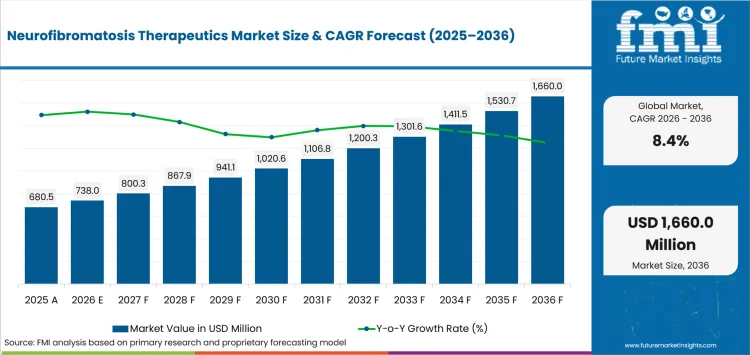
| Metric | Value |
|---|---|
| 2025 Market Size | USD 680.5 million |
| 2026 Market Size | USD 738.0 million |
| 2036 Market Size | USD 1,660.0 million |
| Forecast CAGR (2026-2036) | 8.4% |
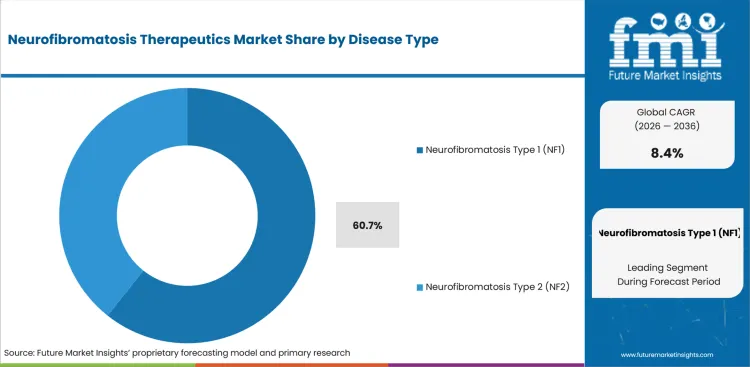
| Disease Type Focus | Neurofibromatosis Type 1 (NF1) (60.7% share in 2026) |
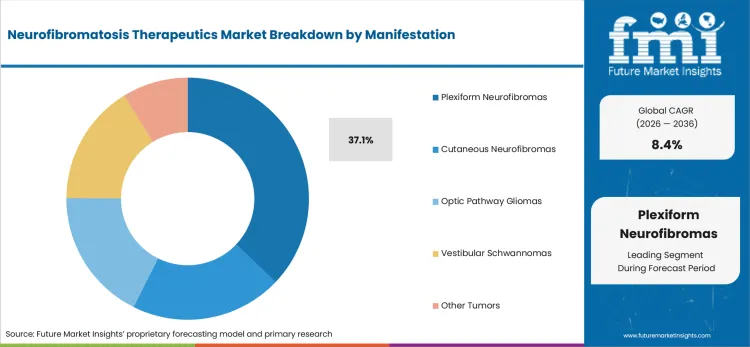
| Manifestation Focus | Plexiform Neurofibromas (37.1% share in 2026) |
| End User Focus | Hospitals (33.0% share in 2026) |
Summary of Neurofibromatosis Therapeutics Market
| Market Signal | Commercial Impact |
|---|---|
| Demand and Growth Drivers | Therapy selection develops as specialist teams require measurable tumor response. Care pathways also need manageable monitoring across long treatment periods.
|
| Product and Segment View | Segment direction is led by neurofibromatosis type 1. Plexiform neurofibromas and hospitals follow within established care pathways.
|
| Geography and Growth Outlook | Approval timing and specialist capacity create different country pathways. Continuing clinician education also influences commercial progress.
|
| Competitive View | Competition centers on approved MEK inhibitors and focused investigational programs. Companies also compete through clinical support and specialist education.
|
| Analyst Perspective | Neurofibromatosis therapeutics create durable value through measurable clinical benefit. Repeatable specialist pathways support continuing treatment.
|
Source: Future Market Insights analysis, 2026.
How is neurofibromatosis therapeutics market segmented?
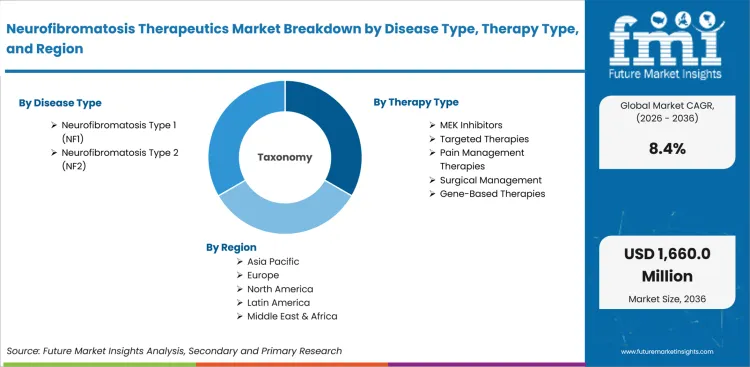
The neurofibromatosis therapeutics industry is segmented by disease type, therapy type, manifestation, end user, and region.
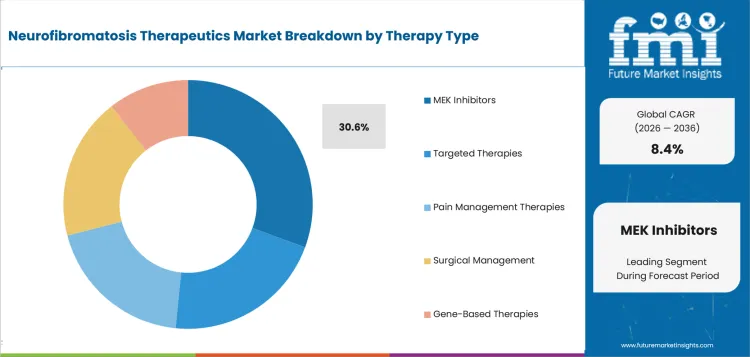
The neurofibromatosis therapeutics market is segmented by disease type, therapy type, manifestation, end user, and region. Disease-type coverage includes neurofibromatosis type 1 and neurofibromatosis type 2. Therapy-type coverage addresses MEK inhibitors and targeted therapies with pain management therapies, surgical management, and gene-based therapies. Manifestation coverage encompasses plexiform neurofibromas and cutaneous neurofibromas followed by optic pathway gliomas, vestibular schwannomas, and other tumors. End-user coverage spans hospitals and specialty neurology centers with oncology centers and academic and research institutes supporting specialist care. Regional coverage includes North America and Latin America together with Europe, East Asia, South Asia, Oceania, and Middle East and Africa.
What supports demand for neurofibromatosis type 1 within disease type?
Friedman’s GeneReviews revision published in April 2025 reported plexiform neurofibromas in about half of people living with NF1, demonstrating a substantial population requiring regular tumor surveillance. Multisystem complications connect genetic assessment with neurology and oncology services across repeated imaging reviews and symptom-management visits. Coordinated surveillance helps clinicians identify changes requiring treatment or closer specialist observation.
- Neurofibromatosis type 1 is set to represent 60.7% share of disease-type in 2026, helped by approved MEK inhibitors for symptomatic inoperable plexiform neurofibromas. Adult and pediatric indications strengthen treatment continuity across lifelong specialist care.
- Neurofibromatosis type 2 creates distinct treatment needs through vestibular schwannomas and other nervous-system tumors affecting hearing or balance. Smaller patient numbers concentrate medicine use within referral centers, and complex neurologic complications sustain multidisciplinary follow-up.
How do MEK inhibitors shape therapy demand?
Randomized evidence improves confidence during therapy selection for adults requiring systemic intervention. Chen and colleagues reported in June 2025 a confirmed response among 20% of selumetinib-treated adults versus 5% among placebo recipients, providing randomized evidence for systemic MEK inhibition. Response findings support specialist comparison of durable benefit across small molecule inhibitors used within adult NF1 care.
- MEK inhibitors are anticipated to secure 30.6% share in 2026, reflected by regulatory validation across adult and pediatric NF1-associated plexiform neurofibromas. Prescribers balance oral dosing against cardiac and ocular monitoring during prolonged treatment.
- Targeted medicines and gene-based research examine disease mechanisms outside approved plexiform-neurofibroma indications. Pain management and surgery address symptoms across cutaneous tumors and nervous-system lesions during long specialist care.
Why do plexiform neurofibromas shape manifestation demand?
Yang and colleagues reported in January 2026 pain and fatigue among 80.0% of surveyed adults with symptomatic NF1-associated plexiform neurofibromas, documenting substantial daily burden. Functional limitations support treatment assessment beyond tumor-volume change during continuing specialist review. Patient-reported outcomes provide added context for evaluating meaningful improvement during therapy.
- By manifestation, plexiform neurofibromas are forecast to garner 37.1% share in 2026 owing to inoperable lesions associated with pain and functional impairment. Systemic treatment relies on MRI-based quantitative biomarkers for volumetric response review and continuation decisions.
- Cutaneous neurofibromas create appearance and comfort concerns requiring manifestation-specific care. Optic pathway gliomas and vestibular schwannomas threaten vision or hearing across affected patients.
Why do hospitals lead end-user demand?
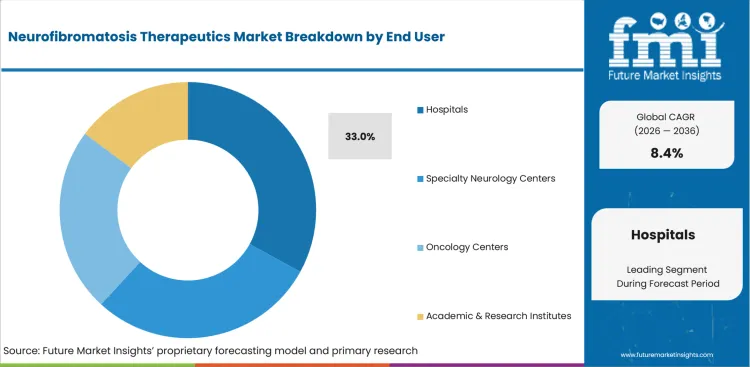
Shared clinical procedures improve evidence comparison across participating specialist institutions. Healx reported in February 2025 an NF1 Clinical Trials Consortium involving 24 clinical centers across United States and Australia, showing hospital concentration within therapy development. Multisite participation supports consistent protocols across rare-disease programs requiring coordinated referrals.
- Based on end-user, hospitals are projected to account for 33.0% share in 2026 due to multidisciplinary teams combining genetic assessment with imaging and medicine oversight. Integrated services connect diagnosis with dose adjustment during long treatment periods.
- Specialty neurology centers and oncology centers extend access for referred patients needing focused consultation. Academic research institutes support clinical trials through clinical diagnostics and genetic confirmation across longitudinal care.
What are drivers, restraints, and opportunities in neurofibromatosis therapeutics market?
Regulatory expansion and measurable response support targeted therapy selection. Chronic toxicity and uneven specialist access may delay continuing use.
- Driver: Specialist teams seek medicines producing measurable tumor reduction and functional relief. Expanded age coverage supports treatment continuity across lifelong NF1 care.
- Restraint: Long treatment courses require recurring safety assessment. Dose interruption may reduce persistence among patients needing sustained disease control.
- Opportunity: Investigational programs address cutaneous tumors and preventive treatment. Focused delivery may improve tolerability across untreated NF-related conditions.
Measurable benefit supports wider specialist consideration across eligible adult treatment pathways. Gross and colleagues reported in January 2025 an objective response rate of 63.6% among adults receiving selumetinib. Lower pain intensity supported physician confidence in personalized medicine. Adult evidence strengthens demand beyond pediatric care.
KOMET investigators reported in May 2025 noting dermatitis acneiform among 59% of adults receiving selumetinib. Dermatology review and organ monitoring add work across recurring prescriptions. Cumulative toxicity may weaken treatment persistence. Continuing safety demands may limit use among patients requiring prolonged therapy.
Localized treatment creates development potential across manifestations lacking approved systemic options. NFlection Therapeutics reported in May 2024 a 47% reduction in pERK levels with its topical NFX-179 concentration. Local administration may reduce systemic exposure. Cutaneous tumors gain a focused treatment pathway.
How are country CAGRs aligned in neurofibromatosis therapeutics market?
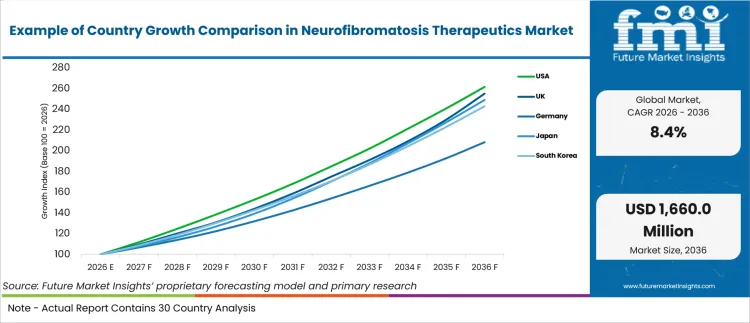
| Country or Market | CAGR |
|---|---|
| USA | 10.1% |
| UK | 9.8% |
| Japan | 9.6% |
| South Korea | 9.3% |
| Germany | 7.6% |
Source: Future Market Insights analysis, 2026.
How do country-level CAGRs compare in neurofibromatosis therapeutics market?
Country comparison shows a measured step-down across profiled markets. USA leads the supplied range, followed by UK and Japan. South Korea forms the next forecast tier, and Germany closes the stated sequence. The 2.5-percentage-point spread shows profiled markets sharing a positive outlook, although their relative positions indicate different levels of market momentum.
- USA leads the comparison due to expanded treatment access across adult and pediatric care pathways.
- UK follows USA through additional licensing activity and established rare-disease services.
- Japan and South Korea form the next forecast band based on specialist-center activity and structured clinical care.
- Germany records measured expansion across established rare-disease and multidisciplinary treatment services.
Markets carrying similar CAGRs may present different entry conditions led by reimbursement policy and specialist capacity. Full analysis covers North America, Latin America, Europe, East Asia, South Asia, Oceania, and Middle East and Africa.
Country-wise Analysis
- Neurofibromatosis therapeutics sales in United States are anticipated to rise at 10.1% CAGR between 2026 and 2036, reflected by expanded age coverage across established specialist networks. Food and Drug Administration action issued in September 2025 extended selumetinib eligibility to children aged 1 year and older, increasing access during early childhood. Earlier eligibility encourages longitudinal management from pediatric diagnosis into adult care.
- Medicines and Healthcare products Regulatory Agency approval issued in December 2025 introduced mirdametinib for patients aged 2 years and older, expanding licensed treatment choice across specialist services. Additional product choice supports comparison of formulation and tolerability during prolonged care. Demand in the United Kingdom is projected to expand at 9.8% CAGR by 2036, aided by established rare-disease pathways and multidisciplinary referral capacity.
- Academic hospitals support volumetric imaging and genetic diagnosis across Japanese NF1 programs, providing structured settings for evidence-based treatment review. Sector in Japan is forecast to record 9.6% CAGR during the study period, influenced by specialist concentration and international clinical-research participation. A United States clinical study record updated in March 2026 listed 145 participants in AstraZeneca’s global KOMET study, strengthening evidence available to local investigators.
- Industry in South Korea is estimated to increase at 9.3% CAGR from 2026 to 2036, driven by rare-disease policy development and specialist hospital capacity. Korea Disease Control and Prevention Agency reported in January 2025 support eligibility across 1,338 rare diseases, improving financial assistance for qualifying households. Policy support encourages diagnosis and continuing treatment across designated referral pathways.
- German specialist centers manage NF1 care through established rare-disease and oncology services, supporting coordinated imaging and toxicity review. European Medicines Agency information published in September 2025 covered Koselugo for patients aged 3 years and older, extending access across pediatric and adult pathways. Demand in Germany is predicted to grow at 7.6% CAGR through 2036, reflecting measured uptake across established treatment centers.
Who are notable companies in neurofibromatosis therapeutics market?
AstraZeneca supplies Koselugo for symptomatic inoperable NF1-associated plexiform neurofibromas. Merck KGaA, Darmstadt, Germany supports Gomekli and Ezmekly through its SpringWorks business. Healx advances HLX-1502. NFlection Therapeutics develops NFX-179. Pasithea Therapeutics develops PAS-004.
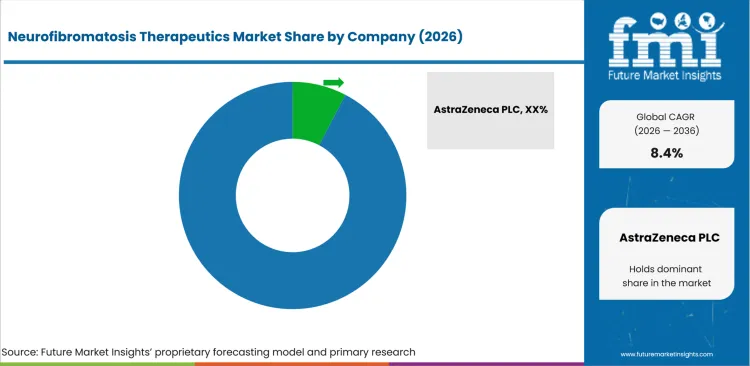
Competition centers on approved MEK inhibitors and focused investigational programs. Specialist teams compare age coverage and dose form. Safety management and clinical support also shape product review. AstraZeneca supports established systemic treatment led by Koselugo. Merck KGaA adds mirdametinib through its SpringWorks business. Healx develops an oral investigational option. NFlection Therapeutics focuses on topical treatment for cutaneous neurofibromas. Pasithea Therapeutics advances a macrocyclic MEK inhibitor.
- AstraZeneca and Merck KGaA compete based on approved systemic therapies. Clinical teams compare administration and long-term safety support.
- Healx advances HLX-1502 as an oral investigational therapy. Specialist experience may guide future positioning.
- NFlection Therapeutics develops topical MEK inhibition for cutaneous neurofibromas. Dermatology programs assess convenience and local treatment benefit.
- Pasithea Therapeutics develops PAS-004 for NF1-associated plexiform neurofibromas. Clinical progress may support later-stage research.
Competitive Benchmarking: Neurofibromatosis Therapeutics Market
| Company | Portfolio Depth | Clinical Match | Service Support | Service Reach |
|---|---|---|---|---|
| AstraZeneca PLC | High | High | High | Global |
| Merck KGaA, Darmstadt, Germany | High | High | High | United States and selected European markets |
| Healx Ltd. | Medium | High | Medium | Selected clinical sites |
| NFlection Therapeutics, Inc. | Medium | High | Medium | United States development sites |
| Pasithea Therapeutics Corp. | Medium | High | Medium | United States development sites |
Source: Future Market Insights competitive analysis, 2026.
Key Developments in Neurofibromatosis Therapeutics Market
- In May 2025, Pasithea Therapeutics initiated its multicenter PAS-004 study in adults with symptomatic NF1-associated plexiform neurofibromas unsuitable for complete resection. Clinical entry advanced PAS-004 into direct NF1 evaluation across adults requiring systemic treatment.
- In July 2025, Merck KGaA completed its acquisition of SpringWorks Therapeutics. Gomekli entered a larger rare-tumor business with expanded commercial infrastructure.
- In November 2025, AstraZeneca received United States approval for Koselugo in adults with NF1-associated symptomatic inoperable plexiform neurofibromas. Adult authorization expanded treatment access beyond pediatric care and strengthened AstraZeneca’s position across systemic NF1 therapy pathways.
Key Players in Neurofibromatosis Therapeutics Market
Approved systemic therapy companies
- AstraZeneca PLC
- Merck KGaA, Darmstadt, Germany
Clinical-stage systemic therapy developer
- Healx Ltd.
Manifestation-focused therapy developers
- NFlection Therapeutics, Inc.
- Pasithea Therapeutics Corp.
Neurofibromatosis Therapeutics Market Report Scope
| Coverage field | Report scope |
|---|---|
| Market breakdown | Neurofibromatosis Therapeutics Market breakdown by disease type, therapy type, manifestation, end user, and region |
| Market Definition | Neurofibromatosis therapeutics include medicines and clinical interventions used to manage NF1, NF2, associated tumors, pain, and functional complications. |
| Regions Covered | North America, Latin America, Europe, East Asia, South Asia, Oceania, and Middle East and Africa |
| Countries Covered | USA, UK, Germany, Japan, South Korea, China, and India, with additional country profiles included in full analysis |
| Key Companies Profiled | AstraZeneca PLC, Merck KGaA, Healx Ltd., NFlection Therapeutics, Inc., and Pasithea Therapeutics Corp. |
| Forecast Period | 2026 to 2036 |
| Approach | Hybrid bottom-up and top-down methodology using segment shares, country CAGRs, regulatory evidence, clinical activity, and company participation |
Source: Future Market Insights analysis, 2026.
Neurofibromatosis Therapeutics Market - Research Methodology
| Method | Approach |
|---|---|
| Primary Research | FMI analysts gathered input from manufacturers, service providers, technology developers, distributors, end users, procurement teams, and subject-matter experts. Interviews examined purchasing decisions, product or service evaluation, adoption barriers, approval requirements, pricing considerations, and expectations for technical or commercial support. Respondents were also asked what evidence is required before a trial, pilot, or initial order develops into regular purchasing. |
| Desk Research | Desk research covered government statistics, regulatory publications, trade data, industry associations, technical literature, standards, company filings, product information, and official corporate announcements. Sources were reviewed for relevance, publication date, geographic coverage, and consistency with the defined market scope. Claims relating to performance, applications, approvals, capacity, investment, and commercial activity were retained only when supported by credible public evidence. |
| Market Sizing and Forecasting | The market model combined the baseline value with historical performance, segment structure, pricing and volume indicators, adoption levels, company participation, and country-level demand conditions. Forecast assumptions considered economic activity, investment trends, regulatory developments, technology adoption, purchasing cycles, supply availability, and barriers to wider market use. Segment and regional estimates were reconciled before the final market total was calculated. |
| Data Validation | Estimates were checked against multiple independent indicators, including public data, company activity, trade patterns, industry developments, and findings from primary interviews. Validation also tested whether products, services, applications, and company revenues fell within the defined market boundaries. Adjacent categories, unsupported claims, overlapping revenues, and activities without direct market relevance were excluded to reduce double counting and maintain consistency across segments and countries. |
Source: Future Market Insights analysis, 2026.
Neurofibromatosis Therapeutics Market by Segments
Neurofibromatosis Therapeutics Market segmented by Disease Type:
- Neurofibromatosis Type 1 (NF1)
- Neurofibromatosis Type 2 (NF2)
Neurofibromatosis Therapeutics Market segmented by Therapy Type:
- MEK Inhibitors
- Targeted Therapies
- Pain Management Therapies
- Surgical Management
- Gene-Based Therapies
Neurofibromatosis Therapeutics Market segmented by Manifestation:
- Plexiform Neurofibromas
- Cutaneous Neurofibromas
- Optic Pathway Gliomas
- Vestibular Schwannomas
- Other Tumors
Neurofibromatosis Therapeutics Market segmented by End User:
- Hospitals
- Specialty Neurology Centers
- Oncology Centers
- Academic & Research Institutes
Neurofibromatosis Therapeutics Market segmented by Region:
- North America
- Latin America
- Europe
- East Asia
- South Asia
- Oceania
- Middle East and Africa
Research Sources and Bibliography
- Chen, A. P., O’Sullivan Coyne, G., Wolters, P. L., Martin, S., Farschtschi, S., Blanco, I., Chen, Z., Darrigo, L. G., Jr., Eoli, M., Whittle, J. R., Nishida, Y., Lamarca, R., de la Rosa Rodriguez, R., Adeyemi, A., Herrero, I., Llorente, N., Diede, S. J., Dombi, E., & Wolkenstein, P. (2025, June 21). Efficacy and safety of selumetinib in adults with neurofibromatosis type 1 and symptomatic, inoperable plexiform neurofibromas: A multicentre, international, randomised, placebo-controlled, parallel, double-blind, phase 3 study. The Lancet, 405(10496), 2217-2230.
- Chen, A. P., O’Sullivan Coyne, G. H., Wolters, P. L., Martin, S., Farschtschi, S., Blanco, I., Chen, Z., Darrigo, L. G., Jr., Eoli, M., Whittle, J. R., Nishida, Y., Lamarca, R., de la Rosa Rodriguez, R., Adeyemi, A., Herrero, I., Llorente, N., Diede, S. J., Dombi, E., & Wolkenstein, P. (2025, May 28). Efficacy and safety of selumetinib in adults with neurofibromatosis type 1 and symptomatic, inoperable plexiform neurofibroma: Primary analysis of KOMET. Journal of Clinical Oncology, 43(16 Suppl.), 3014.
- Pasithea Therapeutics Corp. (2025, August 14). Quarterly report for the period ended June 30, 2025 (Form 10-Q). USA Securities and Exchange Commission.
- AstraZeneca PLC. (2025, November 20). Koselugo approved in the US for adults with neurofibromatosis type 1.
- ClinicalTrials.gov. (2026, March 23). Efficacy and safety of selumetinib in adults with NF1 who have symptomatic, inoperable plexiform neurofibromas (NCT04924608).
- ClinicalTrials.gov. (2026, May 29). Selumetinib for the prevention of plexiform neurofibroma growth in NF type 1 (NCT06188741).
- European Medicines Agency. (2025, September 19). Koselugo: Opinion on variation to marketing authorisation.
- Friedman, J. M. (2025, April 3). Neurofibromatosis 1. In GeneReviews.
- Gross, A. M., O’Sullivan Coyne, G., Dombi, E., Tibery, C., Herrick, W. G., Martin, S., Angus, S. P., Shern, J. F., Rhodes, S. D., Foster, J. C., Rubinstein, L. V., Baldwin, A., Davis, C., Dixon, S. A. H., Fagan, M., Ong, M. J., Wolters, P. L., Tamula, M. A., Reid, O., ... Widemann, B. C. (2025, January 6). Selumetinib in adults with NF1 and inoperable plexiform neurofibroma: A phase 2 trial. Nature Medicine, 31(1), 105-115.
- Healx. (2025, February 24). Healx announces first patient dosed in phase 2 trial evaluating HLX-1502 for the treatment of neurofibromatosis type 1.
- Korea Disease Control and Prevention Agency. (2025, January 20). KDCA expands rare disease medical expense support program for 2025.
- Medicines and Healthcare products Regulatory Agency. (2025, December 11). Mirdametinib approved to treat plexiform neurofibromas in children, adolescents, and adults with neurofibromatosis type 1.
- Merck KGaA, Darmstadt, Germany. (2025, July 1). Completes acquisition of SpringWorks Therapeutics to accelerate sustainable growth of its healthcare business.
- NFlection Therapeutics, Inc. (2024, May 1). NFlection Therapeutics announces publication of clinical data demonstrating the effect of NFX-179 topical MEK inhibitor on cutaneous neurofibromas in persons with neurofibromatosis type 1.
- USA Food and Drug Administration. (2025, February 11). FDA approves mirdametinib for adult and pediatric patients with neurofibromatosis type 1 who have symptomatic plexiform neurofibromas not amenable to complete resection.
- USA Food and Drug Administration. (2025, September 10). FDA approves selumetinib for pediatric patients 1 year of age and older with neurofibromatosis type 1 with symptomatic, inoperable plexiform neurofibromas.
- Yang, X., Done, N., Cunnington, M., Gao, Y., Dettling, T., Pfefferkorn, J., Young-Xu, L., Duh, M. S., & Wolters, P. L. (2026, January 24). Clinical and humanistic burden among adults with neurofibromatosis type 1 and symptomatic plexiform neurofibroma in the United States. Neurology and Therapy, 15, 597-616.
This bibliography is provided for reader reference and is not exhaustive. The full report contains the complete reference list and detailed citations.
This Report Answers
- What segments influence demand across disease type, therapy type, manifestation, end user, and region?
- How do specialist teams evaluate neurofibromatosis therapeutics prior to routine clinical use?
- How do country CAGRs differ across profiled markets?
- What companies compete through approved therapies and investigational programs?
- How are forecasts validated through bottom-up and top-down analysis?
- What evidence supports formulary inclusion and treatment expansion?
- How do tumor response and functional benefit influence therapy selection?
- Which conditions weaken returns for therapy developers?
- How do monitoring requirements influence continuing treatment?
- What company capabilities improve long-term specialist confidence?
Frequently Asked Questions
What supports demand in neurofibromatosis therapeutics market?
Specialist teams seek therapies producing measurable tumor reduction and meaningful symptom relief across inoperable neurofibromatosis-associated disease requiring prolonged clinical oversight. Care providers favor treatment options supported by manageable monitoring requirements and clear evidence guiding continuation decisions across multidisciplinary services.
Who are key players in neurofibromatosis therapeutics market?
AstraZeneca and Merck KGaA maintain established positions through approved therapies addressing symptomatic inoperable neurofibromatosis type 1-associated plexiform neurofibromas. Healx and Pasithea Therapeutics advance differentiated clinical programs targeting systemic disease pathways and manifestation-specific treatment needs.
What restraint affects neurofibromatosis therapeutics market?
Chronic toxicity may reduce treatment persistence among patients requiring sustained pathway inhibition and repeated specialist assessment throughout extended therapy periods. Limited cardiac and imaging capacity may delay adoption across smaller care settings lacking coordinated monitoring services.
Why do executives track neurofibromatosis therapeutics market?
Regulatory expansion changes eligible age groups and influences treatment sequencing across pediatric and adult neurofibromatosis care pathways. Clinical evidence and reimbursement access guide investment decisions involving approved medicines and emerging therapeutic programs.
What business problem does neurofibromatosis therapeutics market address?
Neurofibromatosis therapeutics address symptomatic tumors and functional impairment across inherited tumor disorders. Clinical teams require measurable disease control supported by manageable long-term safety demands and coordinated specialist follow-up.
What do hospital teams evaluate prior to selecting therapies?
Hospital teams evaluate response durability and treatment persistence prior to formulary inclusion or pathway adoption. Dose form and imaging capacity also influence final therapy selection across multidisciplinary services.
Which conditions weaken returns for therapy developers?
Commercial returns weaken if clinical benefit addresses small patient groups or remains limited to narrowly defined manifestations requiring extensive specialist oversight. Limited diagnosis and uneven treatment access may reduce commercial reach across eligible populations.
How do companies build long-term specialist confidence?
Companies build specialist confidence due to dependable clinical evidence and clear protocols covering dosing and response assessment. Continuing medical education and responsive clinical support encourage sustained medicine use across participating treatment centers.
Preview the report firsthand - request a free sample
Get SampleGet the brochure for pricing and purchase details.
Get PDFTable of Content
- Key Takeaways
- Market Size and CAGR
- Top Growth Driver
- Fastest Growing Segment
- Leading Region
- Key Companies
- Emerging Opportunities
- Executive Summary
- Global Market Outlook
- Demand-side Trends
- Supply-side Trends
- Technology Roadmap Analysis
- Analysis and Recommendations
- Analyst Perspective (What is happening? Why now? What should investors know?)
- Key Questions Answered
- How large is the market?
- What is the CAGR?
- What are key trends?
- Which region dominates?
- Who are the leaders?
- Market Overview
- Market Coverage / Taxonomy
- Market Definition / Scope / Limitations
- Research Methodology
- Chapter Orientation
- Analytical Lens and Working Hypotheses
- Market Structure, Signals, and Trend Drivers
- Benchmarking and Cross-market Comparability
- Market Sizing, Forecasting, and Opportunity Mapping
- Research Design and Evidence Framework
- Desk Research Programme (Secondary Evidence)
- Expert Input and Fieldwork (Primary Evidence)
- Tooling, Models, and Reference Databases
- Data Engineering and Model Build
- Quality Assurance and Audit Trail
- Market Background
- Market Dynamics (Drivers, Restraints, Opportunity, Trends)
- Scenario Forecast (Optimistic, Likely, Conservative)
- Impact Analysis
- AI Impact
- Sustainability Impact
- Regulatory Impact
- Technology Impact
- Consumer / Buyer Analysis
- Purchase Drivers
- Adoption Barriers
- Buyer Journey
- Opportunity Map Analysis
- Product Life Cycle Analysis
- Supply Chain Analysis
- Investment Feasibility Matrix
- Value Chain Analysis
- PESTLE and Porter's Analysis
- Regulatory Landscape
- Regional Parent Market Outlook
- Production and Consumption Statistics
- Import and Export Statistics
- Global Market Analysis and Forecast, 2021 to 2036
- Historical Market Size Value (USD Million) Analysis, 2021 to 2025
- Current and Future Market Size Value (USD Million) Projections, 2026 to 2036
- Y-o-Y Growth Trend Analysis
- Absolute $ Opportunity Analysis
- Global Market Pricing Analysis, 2021 to 2036
- Global Market Analysis and Forecast, By Disease Type, 2021 to 2036
- Introduction / Key Findings
- Historical Market Size Value (USD Million) Analysis By Disease Type, 2021 to 2025
- Current and Future Market Size Value (USD Million) Analysis and Forecast By Disease Type, 2026 to 2036
- Neurofibromatosis Type 1 (NF1)
- Neurofibromatosis Type 2 (NF2)
- Neurofibromatosis Type 1 (NF1)
- Y-o-Y Growth Trend Analysis By Disease Type, 2021 to 2025
- Absolute $ Opportunity Analysis By Disease Type, 2026 to 2036
- Global Market Analysis and Forecast, By Therapy Type, 2021 to 2036
- Introduction / Key Findings
- Historical Market Size Value (USD Million) Analysis By Therapy Type, 2021 to 2025
- Current and Future Market Size Value (USD Million) Analysis and Forecast By Therapy Type, 2026 to 2036
- MEK Inhibitors
- Targeted Therapies
- Pain Management Therapies
- Surgical Management
- Gene-Based Therapies
- MEK Inhibitors
- Y-o-Y Growth Trend Analysis By Therapy Type, 2021 to 2025
- Absolute $ Opportunity Analysis By Therapy Type, 2026 to 2036
- Global Market Analysis and Forecast, By Manifestation, 2021 to 2036
- Introduction / Key Findings
- Historical Market Size Value (USD Million) Analysis By Manifestation, 2021 to 2025
- Current and Future Market Size Value (USD Million) Analysis and Forecast By Manifestation, 2026 to 2036
- Plexiform Neurofibromas
- Cutaneous Neurofibromas
- Optic Pathway Gliomas
- Vestibular Schwannomas
- Other Tumors
- Plexiform Neurofibromas
- Y-o-Y Growth Trend Analysis By Manifestation, 2021 to 2025
- Absolute $ Opportunity Analysis By Manifestation, 2026 to 2036
- Global Market Analysis and Forecast, By End User, 2021 to 2036
- Introduction / Key Findings
- Historical Market Size Value (USD Million) Analysis By End User, 2021 to 2025
- Current and Future Market Size Value (USD Million) Analysis and Forecast By End User, 2026 to 2036
- Hospitals
- Specialty Neurology Centers
- Oncology Centers
- Academic & Research Institutes
- Hospitals
- Y-o-Y Growth Trend Analysis By End User, 2021 to 2025
- Absolute $ Opportunity Analysis By End User, 2026 to 2036
- Global Market Analysis and Forecast, By Region, 2021 to 2036
- Introduction
- Historical Market Size Value (USD Million) Analysis By Region, 2021 to 2025
- Current Market Size Value (USD Million) Analysis and Forecast By Region, 2026 to 2036
- North America
- Latin America
- Western Europe
- Eastern Europe
- East Asia
- South Asia and Pacific
- Middle East & Africa
- Market Attractiveness Analysis By Region
- North America Market Analysis and Forecast, By Country, 2021 to 2036
- Historical Market Size Value (USD Million) Trend Analysis By Market Taxonomy, 2021 to 2025
- Market Size Value (USD Million) Forecast By Market Taxonomy, 2026 to 2036
- By Country
- USA
- Canada
- By Disease Type
- By Therapy Type
- By Manifestation
- By End User
- By Country
- Market Attractiveness Analysis
- By Country
- By Disease Type
- By Therapy Type
- By Manifestation
- By End User
- Key Takeaways
- Latin America Market Analysis and Forecast, By Country
- Historical Market Size Value (USD Million) Trend Analysis By Market Taxonomy, 2021 to 2025
- Market Size Value (USD Million) Forecast By Market Taxonomy, 2026 to 2036
- By Country
- Brazil
- Mexico
- Chile
- Rest of Latin America
- By Disease Type
- By Therapy Type
- By Manifestation
- By End User
- By Country
- Market Attractiveness Analysis
- By Country
- By Disease Type
- By Therapy Type
- By Manifestation
- By End User
- Key Takeaways
- Western Europe Market Analysis and Forecast, By Country
- Historical Market Size Value (USD Million) Trend Analysis By Market Taxonomy, 2021 to 2025
- Market Size Value (USD Million) Forecast By Market Taxonomy, 2026 to 2036
- By Country
- Germany
- UK
- Italy
- Spain
- France
- Nordic
- BENELUX
- Rest of Western Europe
- By Disease Type
- By Therapy Type
- By Manifestation
- By End User
- By Country
- Market Attractiveness Analysis
- By Country
- By Disease Type
- By Therapy Type
- By Manifestation
- By End User
- Key Takeaways
- Eastern Europe Market Analysis and Forecast, By Country
- Historical Market Size Value (USD Million) Trend Analysis By Market Taxonomy, 2021 to 2025
- Market Size Value (USD Million) Forecast By Market Taxonomy, 2026 to 2036
- By Country
- Russia
- Poland
- Hungary
- Balkan & Baltic
- Rest of Eastern Europe
- By Disease Type
- By Therapy Type
- By Manifestation
- By End User
- By Country
- Market Attractiveness Analysis
- By Country
- By Disease Type
- By Therapy Type
- By Manifestation
- By End User
- Key Takeaways
- East Asia Market Analysis and Forecast, By Country
- Historical Market Size Value (USD Million) Trend Analysis By Market Taxonomy, 2021 to 2025
- Market Size Value (USD Million) Forecast By Market Taxonomy, 2026 to 2036
- By Country
- China
- Japan
- South Korea
- By Disease Type
- By Therapy Type
- By Manifestation
- By End User
- By Country
- Market Attractiveness Analysis
- By Country
- By Disease Type
- By Therapy Type
- By Manifestation
- By End User
- Key Takeaways
- South Asia and Pacific Market Analysis and Forecast, By Country
- Historical Market Size Value (USD Million) Trend Analysis By Market Taxonomy, 2021 to 2025
- Market Size Value (USD Million) Forecast By Market Taxonomy, 2026 to 2036
- By Country
- India
- ASEAN
- Australia & New Zealand
- Rest of South Asia and Pacific
- By Disease Type
- By Therapy Type
- By Manifestation
- By End User
- By Country
- Market Attractiveness Analysis
- By Country
- By Disease Type
- By Therapy Type
- By Manifestation
- By End User
- Key Takeaways
- Middle East & Africa Market Analysis and Forecast, By Country
- Historical Market Size Value (USD Million) Trend Analysis By Market Taxonomy, 2021 to 2025
- Market Size Value (USD Million) Forecast By Market Taxonomy, 2026 to 2036
- By Country
- Kingdom of Saudi Arabia
- Other GCC Countries
- Türkiye
- South Africa
- Other African Union
- Rest of Middle East & Africa
- By Disease Type
- By Therapy Type
- By Manifestation
- By End User
- By Country
- Market Attractiveness Analysis
- By Country
- By Disease Type
- By Therapy Type
- By Manifestation
- By End User
- Key Takeaways
- Key Countries Market Analysis
- USA
- Pricing Analysis
- Market Share Analysis, 2025
- By Disease Type
- By Therapy Type
- By Manifestation
- By End User
- Canada
- Pricing Analysis
- Market Share Analysis, 2025
- By Disease Type
- By Therapy Type
- By Manifestation
- By End User
- Mexico
- Pricing Analysis
- Market Share Analysis, 2025
- By Disease Type
- By Therapy Type
- By Manifestation
- By End User
- Brazil
- Pricing Analysis
- Market Share Analysis, 2025
- By Disease Type
- By Therapy Type
- By Manifestation
- By End User
- Chile
- Pricing Analysis
- Market Share Analysis, 2025
- By Disease Type
- By Therapy Type
- By Manifestation
- By End User
- Germany
- Pricing Analysis
- Market Share Analysis, 2025
- By Disease Type
- By Therapy Type
- By Manifestation
- By End User
- UK
- Pricing Analysis
- Market Share Analysis, 2025
- By Disease Type
- By Therapy Type
- By Manifestation
- By End User
- Italy
- Pricing Analysis
- Market Share Analysis, 2025
- By Disease Type
- By Therapy Type
- By Manifestation
- By End User
- Spain
- Pricing Analysis
- Market Share Analysis, 2025
- By Disease Type
- By Therapy Type
- By Manifestation
- By End User
- France
- Pricing Analysis
- Market Share Analysis, 2025
- By Disease Type
- By Therapy Type
- By Manifestation
- By End User
- India
- Pricing Analysis
- Market Share Analysis, 2025
- By Disease Type
- By Therapy Type
- By Manifestation
- By End User
- ASEAN
- Pricing Analysis
- Market Share Analysis, 2025
- By Disease Type
- By Therapy Type
- By Manifestation
- By End User
- Australia & New Zealand
- Pricing Analysis
- Market Share Analysis, 2025
- By Disease Type
- By Therapy Type
- By Manifestation
- By End User
- China
- Pricing Analysis
- Market Share Analysis, 2025
- By Disease Type
- By Therapy Type
- By Manifestation
- By End User
- Japan
- Pricing Analysis
- Market Share Analysis, 2025
- By Disease Type
- By Therapy Type
- By Manifestation
- By End User
- South Korea
- Pricing Analysis
- Market Share Analysis, 2025
- By Disease Type
- By Therapy Type
- By Manifestation
- By End User
- Russia
- Pricing Analysis
- Market Share Analysis, 2025
- By Disease Type
- By Therapy Type
- By Manifestation
- By End User
- Poland
- Pricing Analysis
- Market Share Analysis, 2025
- By Disease Type
- By Therapy Type
- By Manifestation
- By End User
- Hungary
- Pricing Analysis
- Market Share Analysis, 2025
- By Disease Type
- By Therapy Type
- By Manifestation
- By End User
- Kingdom of Saudi Arabia
- Pricing Analysis
- Market Share Analysis, 2025
- By Disease Type
- By Therapy Type
- By Manifestation
- By End User
- Türkiye
- Pricing Analysis
- Market Share Analysis, 2025
- By Disease Type
- By Therapy Type
- By Manifestation
- By End User
- South Africa
- Pricing Analysis
- Market Share Analysis, 2025
- By Disease Type
- By Therapy Type
- By Manifestation
- By End User
- USA
- Market Structure Analysis
- Competition Dashboard
- Competition Benchmarking
- Market Share Analysis of Top Players
- By Regional
- By Disease Type
- By Therapy Type
- By Manifestation
- By End User
- Emerging Startups
- Innovation Benchmarking
- Competition Analysis
- Competition Deep Dive
- AstraZeneca PLC
- Overview
- Product Portfolio
- Profitability by Market Segments
- Sales Footprint
- Strategy Overview
- Marketing Strategy
- Product Strategy
- Channel Strategy
- SpringWorks Therapeutics, Inc.
- Merck & Co., Inc.
- Novartis AG
- Pfizer Inc.
- Roche Holding AG
- Johnson & Johnson
- Recursion Pharmaceuticals, Inc.
- Healx Ltd.
- Pasithea Therapeutics Corp.
- AstraZeneca PLC
- Case Studies
- Success Stories
- Recent Developments
- Competition Deep Dive
- Assumptions & Acronyms Used


