

- Market Size (2026)
- USD 7.2 Bn
- Forecast (2036)
- USD 39.4 Bn
- CAGR (2026 to 2036)
- 18.5%
How big is T-Cell Engager Therapeutics Market in 2026?
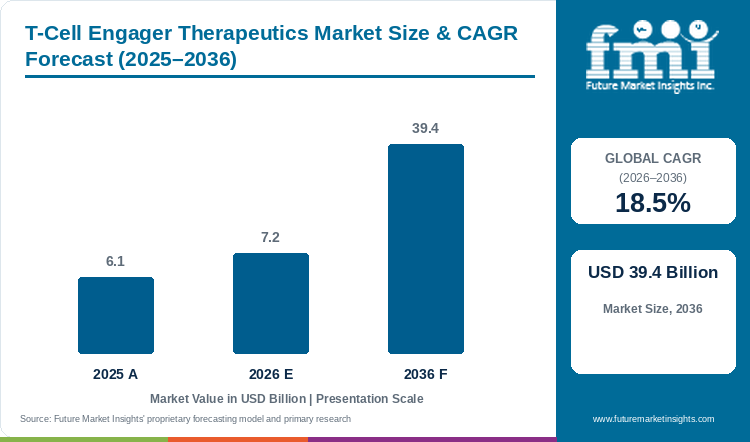
At an anticipated 18.5% CAGR, the t-cell engager therapeutics market is projected to scale from an estimated USD 7.2 Billion in 2026 (following USD 6.1 Billion in 2025) to USD 39.4 Billion by 2036.
Cross-linking endogenous CD3 effector T lymphocytes directly to tumor-surface proteins forms a synthetic cytolytic synapse that lyses malignant cells without waiting weeks for ex vivo chimeric antigen receptor t cell therapy manufacturing, which is why BCMA is estimated to concentrate 31.8% of target antigen demand in 2026 across relapsed plasma cell disorders. Commercial adoption scales rapidly as bispecific constructs advance from late-line hematologic salvage into solid tumors and earlier treatment lines, corroborated in November 2025 when U.S. Food and Drug Administration reviewers granted traditional approval to tarlatamab-dlle (Imdelltra) for extensive-stage small cell lung cancer after Phase 3 DeLLphi-304 trial data showed median overall survival of 13.6 months versus 8.3 months on chemotherapy [1]. Across international oncology markets, ten-year expansion is predicted from 14.1% yearly in Japan up to 22.6% in Poland between 2026 and 2036, even though agent-specific step-up observation requirements and cytokine release syndrome protocols still limit unmonitored community clinic initiation. Future Market Insights projects that worldwide t-cell engager therapeutics demand rises from USD 6.1 Billion during 2025 to an estimated USD 7.2 Billion in 2026, before an expected 18.5% CAGR lifts forecast 2036 sales to USD 39.4 Billion and adds USD 32.2 Billion in biopharmaceutical value.
Key Market Trends & Insights
- By target antigen: BCMA is estimated to concentrate 31.8% of 2026 target antigen sales because three commercial bispecific antibodies anchor relapsed and refractory multiple myeloma treatment sequences.
- By indication: Multiple myeloma is projected to comprise 42.1% of 2026 indication revenue as combined daratumumab regimens move bispecific antibodies into second-line hematology care.
- By molecular format: Bispecific IgG-like antibodies are expected to deliver 71.2% of 2026 molecular format turnover owing to FcRn-mediated serum half-life extension that permits weekly or biweekly subcutaneous dosing.
- By end user: Tertiary hospitals are anticipated to capture 53.7% of 2026 end user procurement because several hematologic bispecific labels require 24-to-48-hour inpatient step-up observation while abbreviated 6-to-8-hour outpatient regimens still rely on hospital ICU escalation networks.
Regional Highlights
- Fastest national therapy uptake: Expanding Polish Myeloma Consortium clinical access and public reimbursement are forecast to lift Poland by 22.6% per year from 2026 to 2036 across academic hematology clinics.
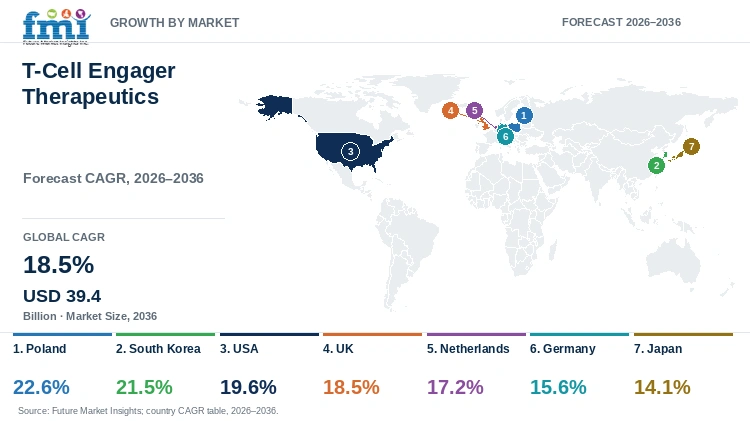
- Other national oncology rates: South Korean oncology demand climbs at a projected 21.5% per annum and U.S. billings rise at an expected 19.6%, outpacing British trusts (18.5%) and Dutch hospitals (17.2%) alongside anticipated rates of 15.6% in Germany and 14.1% in Japan.
Market Size & Forecast
Table 1: Market Size and Forecast for the T-Cell Engager Therapeutics Market (USD billion and CAGR percentage), 2025 to 2036
| Metric | Value |
|---|---|
| 2025 Market Size | USD 6.1 Billion |
| Estimated Market Size in 2026 | USD 7.2 Billion |
| Projected Market Size by 2036 | USD 39.4 Billion |
| CAGR, 2026 to 2036 | 18.5% |
| Added Revenue, 2026 to 2036 | USD 32.2 Billion |
Hospital oncology pharmacies and cellular therapy units are standardizing prophylactic corticosteroid and interleukin-6 receptor blockade protocols to shift bispecific induction from inpatient wards into ambulatory infusion suites. In July 2025, the European Medicines Agency updated its European Public Assessment Report for Lynozyfic (linvoseltamab) following EU conditional marketing authorization, detailing response-adapted dosing every four weeks after week 24 alongside cytokine release syndrome premedication [2]. Standardized titration guidelines allow regional cancer clinics to administer engineered monoclonal antibodies and bispecific constructs safely without overwhelming intensive care unit bed capacity.
Clinical Inpatient Monitoring and Adverse Event Management Sizing
Table 2: Clinical Inpatient Monitoring and Adverse Event Management Indicators for the T-Cell Engager Therapeutics Market (USD Billion and operational ranges), mixed historical and forecast years from 2025 to 2036
| Metric | 2025 | 2026 | 2036 |
|---|---|---|---|
| Market size (USD Billion) | 6.1 | 7.2 | 39.4 |
| Active clinical infusion center network (thousand sites) | 4.2 to 5.8 | 4.8 to 6.5 | 14.5 to 19.8 |
| Average post-infusion observation duration per patient (hours) | 24 to 48 | 16 to 36 | 6 to 12 |
| Annualized toxicity management expenditure per facility (USD) | 38,000 to 72,000 | 42,000 to 78,000 | 95,000 to 165,000 |
Operational note: Infusion center figures represent accredited tertiary hospitals and oncology clinics equipped with continuous hemodynamic telemetry and rapid intensive-care escalation protocols for step-up dosing.
Transitioning post-dose step-up observation from 24-to-48-hour inpatient stays for several myeloma bispecifics to abbreviated 6-to-8-hour monitored healthcare-setting protocols under updated labels such as tarlatamab-dlle is expected to expand weekly infusion chair turnover through 2036. Biopharma sponsors also partner with biologics manufacturing specialists to scale high-concentration subcutaneous vial filling for ambulatory clinics.
Hospital Pharmacy Drug Acquisition & Formulary Procurement Sizing
Hospital pharmacy and therapeutics committees evaluate bispecific T-cell engagers using immuno oncology assays and minimal residual disease endpoints while weighing total inpatient stay expenses alongside response-adapted dosing intervals.
Table 3: Hospital Pharmacy Drug Acquisition Indicators for the T-Cell Engager Therapeutics Market (USD and patient metrics), mixed historical and forecast years from 2025 to 2036
| Metric | 2025 | 2026 | 2036 |
|---|---|---|---|
| Treated commercial patient population (thousand patients) | 28.5 | 33.2 | 150.5 |
| Average annual drug acquisition cost per patient course (USD) | 214,000 | 216,800 | 261,800 |
| Hospital pharmacy preparation fee per infusion cycle (USD) | 1,450 to 2,800 | 1,400 to 2,750 | 950 to 1,850 |
| Supportive tocilizumab co-medication cost per patient course (USD) | 8,500 to 16,000 | 8,200 to 15,500 | 4,200 to 8,800 |
Table 4: Target Antigen Sector Procurement Indicators for the T-Cell Engager Therapeutics Market (USD Billion and percentages), 2026
| Benchmark Indicator | 2026 Value | Institutional Reference Basis |
|---|---|---|
| Global market valuation, 2026 | USD 7.2 Billion | 2026 commercial hospital and specialty pharmacy drug sales baseline |
| Multiple myeloma indication revenue, 2026 | USD 3.0 Billion | 42.1% share of global oncology indication billings |
| BCMA target antigen revenue, 2026 | USD 2.3 Billion | 31.8% share of global target antigen prescriptions |
| Bispecific IgG-like antibody revenue, 2026 | USD 5.1 Billion | 71.2% share of commercial molecular format sales |
Analyst Perspective
"Moving bispecific T-cell engagers into second-line combination regimens depends on safe outpatient step-up dosing. Subcutaneous formulations and prophylactic cytokine blockade are expanding community oncology clinic capacity."
- Anurag Sharma, Principal Consultant, Future Market Insights.
How is the t-cell engager therapeutics market segmented?
The t-cell engager therapeutics market is segmented by target antigen, indication, molecular format, end user, and region. In 2026, BCMA is estimated to account for 31.8%, multiple myeloma for 42.1%, bispecific IgG-like antibodies for 71.2%, and hospitals for 53.7%.
By target antigen: BCMA, CD19, CD20, GPRC5D, DLL3, and gp100.
By indication: multiple myeloma, acute lymphoblastic leukemia, non-Hodgkin lymphoma, small cell lung cancer, and uveal melanoma.
By molecular format: bispecific IgG-like antibodies, BiTE fragment molecules, and ImmTAC molecules.
By end user: hospitals, cancer centers, and specialty clinics.
What Anchors BCMA at 31.8% of Target Antigen Prescriptions?
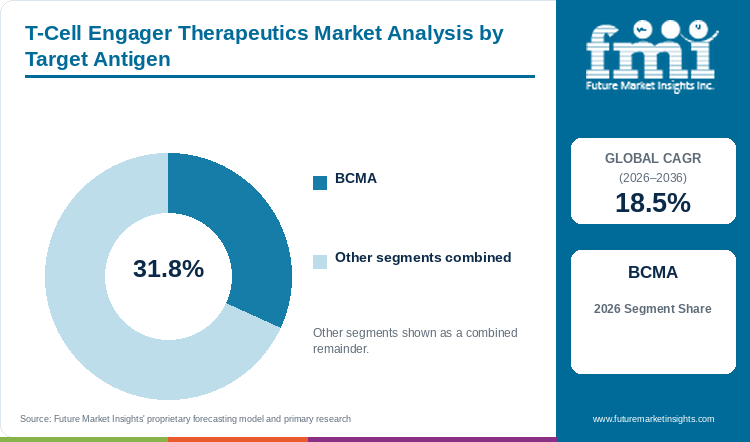
BCMA is estimated to concentrate 31.8% of 2026 target antigen prescriptions, stemming from selective expression on malignant plasma cells.
Table 5: Target Antigen Share for the T-Cell Engager Therapeutics Market (percentage share), 2026
| Target Antigen | Share (2026) |
|---|---|
| BCMA | 31.8% |
| Other Segments Combined | 68.2%* |
| Total | 100.0% |
*Note: Combined share of remaining target antigen categories totaling 100.0% of 2026 market demand.
Table 6: Target Antigen Leadership and Market Growth for the T-Cell Engager Therapeutics Market (segment and CAGR percentage), 2026 to 2036
| Metric | Value |
|---|---|
| Global CAGR (2026 to 2036) | 18.5% |
| Leading Segment | BCMA |
Restricted expression of B-cell maturation antigen on differentiated plasma cells minimizes off-tumor organ toxicity while driving deep minimal residual disease negativity in relapsed myeloma. Hematologists prescribe commercial BCMA-directed engineered antibodies such as teclistamab and elranatamab alongside linvoseltamab immediately after patients progress on proteasome inhibitors and immunomodulatory drugs. Response-adapted biweekly or monthly maintenance schedules also extend treatment duration and total multi-cycle vial demand per patient.
- Three commercialized myeloma bispecifics are estimated to enable BCMA to concentrate 31.8% of 2026 target antigen revenue.
- Regeneron Pharmaceuticals received accelerated approval from the U.S. Food and Drug Administration in July 2025 for linvoseltamab-gcpt (Lynozyfic) after LINKER-MM1 demonstrated a 70% objective response rate [3].
Why Does Multiple Myeloma Comprise 42.1% of Indication Sales?
Multiple myeloma is projected to comprise 42.1% of 2026 indication sales, aided by second-line combination approvals and multi-relapse sequencing.
Clonal evolution across bone marrow plasma cells causes multiple myeloma patients to relapse repeatedly after frontline triplet or quadruplet induction, creating a multi-line demand pool for T-cell redirecting therapies. Oncologists sequence BCMA-directed and GPRC5D-directed antibody therapy constructs across successive relapses or pair them with anti-CD38 antibodies to deepen remission durability. Moving these combinations into first-relapse settings multiplies the eligible treated patient population.
- Sequential multi-relapse prescribing and earlier-line combination labels are projected to give multiple myeloma 42.1% of 2026 indication turnover.
- Johnson & Johnson secured U.S. FDA approval in March 2026 for TECVAYLI (teclistamab-cqyv) plus DARZALEX FASPRO in relapsed or refractory multiple myeloma after at least one prior therapy line based on Phase 3 MajesTEC-3 data showing an 83% reduction in progression or death risk [4].
How Do Bispecific IgG-Like Antibodies Deliver 71.2% of Molecular Format Revenue?
Bispecific IgG-like antibodies are expected to deliver 71.2% of 2026 molecular format revenue, benefiting from FcRn half-life extension.
Full-length IgG-like heterodimeric architectures retain neonatal Fc receptor recycling, extending systemic circulation to allow weekly or biweekly subcutaneous injections rather than continuous 28-day infusion pumps. Protein engineers silence Fc-gamma receptor binding within constructs used for relapsed refractory large b cell lymphoma treatment to prevent non-specific macrophage activation while preserving potent CD3 T-cell synapse formation. Standard mammalian Chinese hamster ovary cell culture processes also simplify commercial-scale bioreactor manufacturing.
- Extended serum half-life and subcutaneous administration convenience are expected to place bispecific IgG-like antibodies at 71.2% of 2026 format billings.
- F. Hoffmann-La Roche Ltd presented Phase 3 CELESTIMO and GO40516 clinical data in December 2025 showing that subcutaneous Lunsumio (mosunetuzumab) regimens support fixed-duration outpatient lymphoma care [5].
What Drives Tertiary Hospitals to Capture 53.7% of End User Procurement?
Hospitals are anticipated to capture 53.7% of 2026 end user procurement, accompanied by step-up observation and ICU escalation infrastructure.
Post-dose observation requirements for cytokine release syndrome and neurotoxicity vary by therapeutic agent and dosing step across commercial prescribing labels. While several multiple myeloma bispecifics specify 24-to-48-hour inpatient monitoring during Cycle 1 step-up titration, updated labels such as the September 2026 FDA revision for tarlatamab-dlle permit 6-to-8-hour observation in an appropriate healthcare setting. Tertiary hospitals capture the largest procurement share by staffing 24-hour intensive care units for inpatient priming and high-acuity referrals while coordinating hybrid maintenance handoffs with outpatient clinics.
- Agent-specific Cycle 1 inpatient admission rules and on-site ICU escalation infrastructure alongside hospital day-unit monitoring are anticipated to give hospitals 53.7% of 2026 end user procurement.
- Asian myeloma clinical investigators reported in Clinical Lymphoma, Myeloma and Leukemia in October 2025 that managing step-up cytokine release syndrome and opportunistic infections requires structured tertiary hospital coordination [6].
What are the drivers, restraints, and opportunities in the t-cell engager therapeutics market?
Earlier-line combination approvals and solid-tumor DLL3 launches are projected to propel t-cell engager therapeutics demand through 2036, while inpatient toxicity observation requirements accelerate subcutaneous outpatient reformulations.
- Driver: Phase 3 survival gains in first-relapse myeloma and second-line small cell lung cancer expand bispecific antibody prescribing into larger oncology patient cohorts.
- Restraint: Agent-specific step-up hospitalization windows for several hematologic bispecifics and cytokine release syndrome protocols strain inpatient bed capacity and complicate standalone clinic initiation.
- Opportunity: High-concentration subcutaneous injections and abbreviated 6-to-8-hour outpatient monitoring protocols are expected to expand adoption across community cancer networks through 2036.
Growth Analysis and Future Potential: Earlier Treatment Line Regulatory Expansions
Advancing bispecific antibodies from fourth-line salvage settings into second-line solid tumors and first-relapse hematologic regimens expands both eligible patient numbers and median treatment duration. Patients treated in earlier lines possess fitter endogenous T-cell repertoires that generate higher complete response rates when paired with standard lung cancer therapeutics. In July 2025, Phase 3 DeLLphi-304 investigators published landmark results in The New England Journal of Medicine showing that tarlatamab reduced the risk of death by 40% versus chemotherapy across 509 small-cell lung cancer patients [7]. Earlier-line label expansions lock in multi-month maintenance revenue across regional oncology formularies.
Risk Assessment and Operational Hurdles: Clinical Toxicity Monitoring and Staffing Demands
Managing acute inflammatory toxicities during initial step-up priming remains a major operational hurdle where prescribing labels specify inpatient observation or immediate intensive-care transfer capability. Although updated solid-tumor labels such as tarlatamab-dlle now allow 6-to-8-hour monitored healthcare-setting observation during Cycle 1, several hematologic bispecifics still require 24-to-48-hour inpatient monitoring across checkpoint inhibitor refractory cancer care centers. In October 2025, the European Medicines Agency updated its European Public Assessment Report for Columvi (glofitamab) to require obinutuzumab pretreatment and patient alert cards alongside immediate medical support for cytokine release syndrome and neurotoxicity [8]. Smaller practices without hospital admission agreements or extended-hour monitoring chairs must coordinate Cycle 1 referrals with regional tertiary hospitals.
Commercial Opportunity Analysis: Ambulatory Transition via Subcutaneous Formulations
Reformulating intravenous infusions into low-volume subcutaneous injections and validating prophylactic tocilizumab pre-medication allow cancer centers to shift Cycle 1 dosing into outpatient day hospitals. Ambulatory administration eliminates multi-day inpatient bed charges and frees infusion chairs across high-volume hematology clinics prescribing anti neoplastic pharmaceutical agents. In June 2025, OneOncology and Tennessee Oncology clinicians published multidisciplinary workflow guidelines in the Journal of the Advanced Practitioner in Oncology detailing practice-champion protocols and hospital admission pathways for community outpatient bispecific administration [9]. Biopharma developers that secure abbreviated outpatient monitoring labels are projected to capture rapid market share across community oncology networks through 2036.
T-Cell Engager Therapeutics Market by Country (2026 to 2036)
Future Market Insights finds that expanding Polish Myeloma Consortium clinical access carries Polish hospital demand to a projected 22.6% yearly gain through 2036, surpassing South Korean centers at 21.5% and American oncology networks at 19.6% while Japanese clinics record an expected 14.1%. National health technology assessment timelines and outpatient step-up infusion capacity govern commercial uptake across each healthcare system.
Table 7: Country CAGR and Primary Growth Levers for the T-Cell Engager Therapeutics Market (CAGR percentage and operational drivers), 2026 to 2036
| Country | CAGR (2026 to 2036) | Primary Growth Lever |
|---|---|---|
| Poland | 22.6% | Polish Myeloma Consortium clinical adoption and academic hematology center expansion |
| South Korea | 21.5% | Nationwide tertiary hospital teclistamab adoption and National Health Insurance expansion |
| USA | 19.6% | Second-line FDA label approvals and NCCN-guided transition to outpatient step-up dosing |
| UK | 18.5% | Multicenter NHS trust real-world adoption of CD20 and BCMA bispecific antibodies |
| Netherlands | 17.2% | Amsterdam UMC sequential BCMA-to-GPRC5D immunotherapy pathways and academic hospital networks |
| Germany | 15.6% | University hospital real-world bispecific sequencing and extensive inpatient ICU capacity |
| Japan | 14.1% | MonumenTAL-1 clinical validation of talquetamab and accredited cancer hospital safety protocols |
Source: Future Market Insights analysis
Poland T-Cell Engager Therapeutics Market Outlook (2026 to 2036)
Unlike Western European healthcare systems where bispecific antibodies enter routine hospital formularies immediately after marketing authorization, Poland channels high-cost oncology biologics through centralized Ministry of Health drug programs and academic clinical networks. In February 2025, Poznan University of Medical Sciences and Polish Myeloma Consortium investigators reported in Acta Haematologica Polonica from the multicenter POMOST study that expanding access to teclistamab and elranatamab alongside talquetamab is transforming relapsed myeloma care across Poland [10]. Specialist nursing shortages outside Warsaw and Poznan alongside Krakow still constrain overnight step-up bed capacity, prompting drug makers to fund hub-and-spoke clinical training. Driven by expanding public program enrollment, Polish hospital spending on t-cell engager therapeutics is forecast to expand 22.6% each year through 2036.
Key takeaway: In Poland, Polish Myeloma Consortium clinical programs and academic hematology hub networks are projected to drive rapid commercial bispecific adoption.
South Korea T-Cell Engager Therapeutics Market Outlook (2026 to 2036)
In July 2025, Korean hematology investigators across 11 university hospitals published a nationwide retrospective analysis in Cancer Research and Treatment showing that teclistamab achieved a 66.7% overall response rate and 14.1-month median progression-free survival in Korean relapsed myeloma patients [11]. South Korea differs markedly from geographically dispersed oncology markets because more than three-fifths of complex hematologic infusions are concentrated inside Seoul's largest tertiary university hospitals, allowing rapid standardized step-up protocol deployment. Supported by these high-volume cellular immunotherapy wards, South Korean t-cell engager therapeutics expenditure is expected to climb at a 21.5% annual clip from 2026 to 2036, while biopharma sponsors submit domestic survival evidence to expand National Health Insurance reimbursement.
Key takeaway: In South Korea, nationwide university hospital efficacy data and concentrated Seoul tertiary cancer centers are expected to support rapid hematologic bispecific volume growth.
USA T-Cell Engager Therapeutics Market Outlook (2026 to 2036)
Outpatient migration of Cycle 1 step-up dosing into community oncology clinics using prophylactic tocilizumab and remote wearable patient telemetry distinguishes the United States from inpatient-bound European and Asian hospital systems. In May 2025, the National Comprehensive Cancer Network published its updated Version 1.2025 Multiple Myeloma Clinical Practice Guidelines Insights integrating bispecific antibodies across systemic treatment sequences [12]. Backed by Medicare Part B drug coverage and March 2026 second-line FDA approval of teclistamab plus daratumumab, American t-cell engager therapeutics billings are anticipated to grow 19.6% per year until 2036, even as inpatient bundle limits prompt biopharmaceutical manufacturers to deploy field reimbursement navigators and 6-to-8-hour outpatient monitoring protocols across community oncology practices.
Key takeaway: In the USA, second-line FDA approvals and NCCN-guided outpatient step-up protocols are anticipated to drive broad expansion into community oncology networks.
UK T-Cell Engager Therapeutics Market Outlook (2026 to 2036)
Whereas U.S. oncologists prescribe newly approved bispecifics across decentralized community clinics, access across the United Kingdom is structured around regional National Health Service hospital trusts and centralized clinical commissioning. In May 2026, investigators across 34 UK NHS centers published a real-world retrospective analysis of 332 relapsed large B-cell lymphoma patients in Haematologica demonstrating manageable Grade 1/2 cytokine release syndrome rates with glofitamab and epcoritamab [13]. Reflecting growing referrals across regional NHS cancer alliances, British t-cell engager therapeutics revenue is predicted to rise 18.5% per annum through 2036, while biopharmaceutical suppliers fund structured ambulatory day-unit monitoring protocols and wearable digital telemetry kits to relieve acute NHS inpatient ward bed shortages.
Key takeaway: In the UK, multicenter NHS trust real-world validation and ambulatory day-unit protocols are predicted to sustain predictable procurement across regional cancer networks.
Netherlands T-Cell Engager Therapeutics Market Outlook (2026 to 2036)
Clinical uptake in the Netherlands is uniquely structured around HOVON cooperative hematology clinical trials and centralized academic medical center treatment pathways that coordinate sequential T-cell redirecting therapies. In May 2025, Amsterdam UMC hematology investigators published clinical guidance in The Lancet Haematology examining sequential T-cell redirecting therapy transitioning from BCMA-targeted constructs to GPRC5D-directed bispecifics in relapsed multiple myeloma [14]. Anchored by specialized hematology departments in Amsterdam and Rotterdam alongside Utrecht university medical centers, Dutch t-cell engager therapeutics sales are estimated to advance at a 17.2% yearly pace between 2026 and 2036 as biopharmaceutical manufacturers enter outcome-based reimbursement arrangements and longitudinal survival registries to accelerate academic hospital formulary release.
Key takeaway: In the Netherlands, academic medical center antigen-sequencing pathways and structured national reimbursement agreements are estimated to govern disciplined bispecific adoption.
Germany T-Cell Engager Therapeutics Market Outlook (2026 to 2036)
Germany stands apart from other European oncology markets by granting immediate statutory health insurance reimbursement upon European Marketing Authorization alongside extensive university hospital intensive-care capacity for step-up dosing. In July 2026, hematology investigators at University Hospital Schleswig-Holstein and University Medical Center Hamburg-Eppendorf published a propensity-matched analysis of 822 bispecific-treated myeloma patients in Leukemia & Lymphoma demonstrating comparable efficacy between teclistamab and talquetamab across later treatment lines [15]. Driven by early specialist prescribing across German university cancer centers, German t-cell engager therapeutics billings are slated to expand 15.6% per year between 2026 and 2036, while global biopharmaceutical innovators generate head-to-head progression-free survival data to defend net realized vial prices.
Key takeaway: In Germany, immediate post-EMA reimbursement and extensive university hospital ICU capacity are forecast to support steady clinical adoption across oncology centers.
Japan T-Cell Engager Therapeutics Market Outlook (2026 to 2036)
Unlike North American cancer centers that increasingly initiate bispecific dosing in outpatient clinics, Japanese regulatory safety rules mandate multi-day inpatient hospitalization across step-up priming cycles combined with post-marketing surveillance at accredited cancer hospitals. In December 2025, Japanese MonumenTAL-1 investigators published clinical results in the International Journal of Hematology showing that weekly talquetamab achieved a 77.8% overall response rate and 74.1% twelve-month survival among Japanese relapsed myeloma patients with exclusively Grade 1/2 cytokine release syndrome [16]. Supported by universal national health insurance coverage for elderly hematology patients, Japanese t-cell engager therapeutics revenue is envisioned to rise 14.1% each year until 2036 as manufacturers train regional hospital oncologists in cytokine toxicity management.
Key takeaway: In Japan, strong domestic MonumenTAL-1 clinical response rates and universal elderly insurance coverage are expected to sustain steady growth across designated cancer hospitals.
Full report country CAGRs cover: North America; Latin America; Western Europe; Eastern Europe; East Asia; South Asia and Pacific; Middle East and Africa.
Who are the notable companies in the t-cell engager therapeutics market?
Amgen Inc., Johnson & Johnson, F. Hoffmann-La Roche Ltd, Pfizer Inc., AbbVie Inc., Genmab A/S, Regeneron Pharmaceuticals, Inc., and Immunocore Holdings plc are the notable companies in the t-cell engager therapeutics market.
According to FMI, competition spans multinational oncology pharmaceutical leaders and specialized antibody engineering pioneers alongside co-development biotechnology partners. Suppliers compete on novel solid-tumor target antigens such as DLL3 and gp100 alongside subcutaneous formulation convenience that reduces clinic chair time. Hospital formulary committees select manufacturers based on overall survival durability and step-up cytokine release syndrome rates alongside uninterrupted cold-chain vial supply.
- Multinational Oncology Giants: Johnson & Johnson and F. Hoffmann-La Roche Ltd alongside Pfizer Inc. commercialize approved BCMA and GPRC5D as well as CD20 bispecifics across global hospital formularies.
- Specialized Biopharmaceutical Innovators: Amgen Inc. and Regeneron Pharmaceuticals engineer DLL3-targeted solid-tumor BiTE molecules and high-affinity BCMA VelociBi antibodies.
- Collaborative Development Specialists: AbbVie Inc. and Genmab A/S co-develop subcutaneous DuoBody lymphoma therapies while Immunocore Holdings advances soluble TCR-based ImmTAC molecules.
Competitive Benchmarking: T-Cell Engager Therapeutics Market
Table 8: Competitive Benchmarking for the T-Cell Engager Therapeutics Market (qualitative capability ratings), 2026
| Company | Marketed Antigen Coverage | Line & Indication Breadth | Initiation Practicality | Geographic Reach |
|---|---|---|---|---|
| Johnson & Johnson | High | High | Medium | High |
| Amgen Inc. | High | High | High | High |
| F. Hoffmann-La Roche Ltd | Medium | High | High | High |
| Pfizer Inc. | Medium | Medium | Medium | High |
| AbbVie Inc. | Medium | High | Medium | High |
| Genmab A/S | Medium | High | Medium | High |
| Regeneron Pharmaceuticals, Inc. | Medium | Medium | Low | High |
| Immunocore Holdings plc | Medium | Medium | Low | Medium |
Scoring basis: Marketed Antigen Coverage is rated High when a company commercializes bispecifics across two or more distinct surface antigens such as BCMA and GPRC5D or CD19 and DLL3. Line & Indication Breadth reflects regulatory clearances spanning both hematologic malignancies and solid tumors or earlier treatment lines. Initiation Practicality reflects approved subcutaneous delivery and shortened outpatient post-dose observation windows across American and European alongside Asian cancer networks.
Key Developments in the T-Cell Engager Therapeutics Market
- In October 2026, AbbVie Inc. and Genmab A/S announced positive Phase 3 EPCORE DLBCL-2 trial results showing that fixed-duration subcutaneous epcoritamab plus R-CHOP reduced the risk of disease progression or death by 51% in newly diagnosed diffuse large B-cell lymphoma [17].
- In April 2026, Pfizer Inc. announced positive Phase 3 MagnetisMM-5 topline results demonstrating a statistically significant progression-free survival improvement for subcutaneous ELREXFIO (elranatamab) monotherapy in double-class exposed relapsed multiple myeloma [18].
- In September 2026, Amgen Inc. secured U.S. FDA approval for an IMDELLTRA (tarlatamab-dlle) prescribing information update reducing Cycle 1 Day 1 and Day 8 post-infusion monitoring from 22-to-24 hours down to 6-to-8 hours [19].
Key Players in the T-Cell Engager Therapeutics Market
Multinational Oncology Giants
- Johnson & Johnson
- F. Hoffmann-La Roche Ltd
- Pfizer Inc.
Specialized Biopharmaceutical Innovators
- Amgen Inc.
- Regeneron Pharmaceuticals, Inc.
Collaborative Development Specialists
- AbbVie Inc.
- Genmab A/S
- Immunocore Holdings plc
T-Cell Engager Therapeutics Market - Report Scope
Table 9: Report Scope for the T-Cell Engager Therapeutics Market (coverage fields and definitions), 2026 to 2036
| Coverage field | Report scope |
|---|---|
| Market breakdown | Target Antigen; Indication; Molecular Format; End User; Region |
| Quantitative Units | USD Billion |
| Market Definition | Includes biopharmaceutical manufacturer net revenue from commercial sales of approved bispecific and multi-specific T-cell engaging antibodies, BiTE constructs, and ImmTAC TCR molecules. Category Scope Note: The valuation covers off-the-shelf CD3-redirecting biologics across hematologic and solid-tumor indications, while excluding autologous or allogeneic CAR-T cell therapies, antibody-drug conjugates, hospital inpatient bed charges, and supportive tocilizumab co-medication sales. |
| Regions Covered | North America; Latin America; Western Europe; Eastern Europe; East Asia; South Asia and Pacific; Middle East and Africa |
| Countries Covered | Poland, South Korea, USA, UK, Netherlands, Germany, Japan, and additional countries in the full report |
| Key Companies Covered | Amgen Inc., Johnson & Johnson, F. Hoffmann-La Roche Ltd, Pfizer Inc., AbbVie Inc., Genmab A/S, Regeneron Pharmaceuticals, Inc., Immunocore Holdings plc |
| Forecast Period | 2026 to 2036 |
| Approach | Primary and secondary research with market triangulation. |
T-Cell Engager Therapeutics Market - Research Methodology
Table 10: Research Methodology for the T-Cell Engager Therapeutics Market (research methods and approach), 2026 edition
| Method | Approach |
|---|---|
| Primary Research | Primary interviews were conducted with hematologic oncologists, thoracic medical oncologists, hospital oncology pharmacy directors, and biopharma market-access executives to verify step-up dosing workflows and line-of-therapy sequencing. |
| Secondary Research | Secondary research encompassed FDA CDER Biologics License Application approvals, EMA European Public Assessment Reports, ASH and ASCO clinical trial abstracts, and corporate Form 10-K oncology product disclosures. |
| Market Sizing and Forecasting | Market sizing and forecasting for 2026 to 2036 were constructed using line-specific cancer incidence and relapse epidemiology models multiplied by annual treatment duration and net realized drug prices. |
| Data Triangulation and Validation | Estimates are validated against audited brand revenues for Blincyto, Tecvayli, Talvey, Elrexfio, Epkinly, Columvi, Lunsumio, Kimmtrak, Lynozyfic, and Imdelltra without double counting combination partner drugs. |
| Country Forecasting Model | Country-level CAGRs are calibrated against the 18.5% global baseline using national oncology drug reimbursement timelines, accredited cellular-therapy hospital bed density, and second-line label adoption. |
| Operational Benchmark Traceability | Operational indicators in Tables 2, 3, and 4 are synthesized from FDA REMS and step-up label guidelines, CMS ASP drug payment limits, and ASH real-world hospital toxicity registries. |
T-Cell Engager Therapeutics Market by Segments
T-Cell Engager Therapeutics Market segmented by Target Antigen:
- BCMA
- CD19
- CD20
- GPRC5D
- DLL3
- gp100
T-Cell Engager Therapeutics Market segmented by Indication:
- Multiple Myeloma
- Acute Lymphoblastic Leukemia
- Non-Hodgkin Lymphoma
- Small Cell Lung Cancer
- Uveal Melanoma
T-Cell Engager Therapeutics Market segmented by Molecular Format:
- Bispecific IgG-Like Antibodies
- BiTE Fragment Molecules
- ImmTAC Molecules
T-Cell Engager Therapeutics Market segmented by End User:
- Hospitals
- Cancer Centers
- Specialty Clinics
T-Cell Engager Therapeutics Market by Region
- North America
- United States
- Canada
- Latin America
- Brazil
- Mexico
- Argentina
- Chile
- Western Europe
- Germany
- France
- United Kingdom
- Italy
- Spain
- Benelux
- Nordics
- Eastern Europe
- Poland
- Czech Republic
- Romania
- Hungary
- East Asia
- China
- Japan
- South Korea
- South Asia and Pacific
- India
- ASEAN
- Australia and New Zealand
- Middle East and Africa
- GCC Countries
- South Africa
- Türkiye
- Israel
Research Sources and Bibliography
- [1] U.S. Food and Drug Administration (FDA). (2025, November 19). FDA grants traditional approval to tarlatamab-dlle for extensive stage small cell lung cancer. U.S. Food and Drug Administration.
- [2] European Medicines Agency (EMA). (2025, July 22). Lynozyfic | European Medicines Agency (EMA). European Medicines Agency.
- [3] U.S. Food and Drug Administration (FDA). (2025, July 02). FDA grants accelerated approval to linvoseltamab-gcpt for relapsed or refractory multiple myeloma. U.S. Food and Drug Administration.
- [4] Johnson & Johnson. (2026, March 05). Johnson & Johnson Announces U.S. FDA Approval of TECVAYLI plus DARZALEX FASPRO for Relapsed/Refractory Multiple Myeloma, Offering a Potential New Standard of Care as Early as Second Line. Johnson & Johnson.
- [5] F. Hoffmann-La Roche Ltd. (2025, December 07). Roche presents Lunsumio data showing potential across earlier treatment lines in indolent and aggressive lymphomas. F. Hoffmann-La Roche Ltd.
- [6] Soekojo, C., Chung, S. J., Tsai, M. T., & Chng, W. J. (2025, October 11). Perspectives on Anti-BCMA Bispecific Antibodies use in Multiple Myeloma-Experience from Asian Countries. Clinical Lymphoma, Myeloma and Leukemia.
- [7] Mountzios, G., Sun, L., Cho, B. C., & Rudin, C. M. (2025, July 24). Tarlatamab in Small-Cell Lung Cancer after Platinum-Based Chemotherapy. The New England Journal of Medicine.
- [8] European Medicines Agency (EMA). (2025, October 24). Columvi | European Medicines Agency (EMA). European Medicines Agency.
- [9] Donnellan, W., Lin, S. W., Abbas, J., & Raff, L. (2025, June 25). Operationalization and Use of Bispecific T-Cell-Engaging Antibodies in Community Practices: Multidisciplinary Perspectives on Developing Logistics and Workflow for Cytokine Release Syndrome Management. Journal of the Advanced Practitioner in Oncology.
- [10] Dytfeld, D., & Jakubowiak, A. (2025, February 27). Shaping the future of multiple myeloma therapy: innovations in bispecific antibodies and emerging strategies in Poland. Acta Haematologica Polonica.
- [11] Yi, J. H., Lee, J. H., Jung, S. H., & Yoon, D. H. (2025, July 30). Real-World Efficacy and Safety of Teclistamab for Patients with Relapsed or Refractory Multiple Myeloma: Nationwide Retrospective Analysis of the Named Patient Program in Korea. Cancer Research and Treatment.
- [12] Kumar, S. K., Callander, N. S., Adekola, K., & Kumar, R. (2025, May 15). NCCN Guidelines Insights: Multiple Myeloma, Version 1.2025. Journal of the National Comprehensive Cancer Network.
- [13] Osborne, W., Haynes, E., Wilson, W., & Townsend, W. (2026, May 14). Glofitamab and epcoritamab for large B cell lymphoma: a real-world retrospective UK analysis of efficacy, tolerability, and impact of treatment sequencing. Haematologica.
- [14] van de Donk, N. W. C. J., & Fernandez de Larrea, C. (2025, May 15). Sequential CAR T-cell therapy in myeloma: going from BCMA to GPRC5D. The Lancet Haematology.
- [15] Leitner, T., Oelschläger, L., Henriquez Mosquera, F., & Khandanpour, C. (2026, July 28). Real-world analyses of bispecific antibodies and CAR-T cell therapy in relapsed or refractory multiple myeloma: a global TriNetX discovery and contemporary validation cohort. Leukemia & Lymphoma.
- [16] Ito, S., Kuroda, Y., Sunami, K., & Takamatsu, Y. (2025, December 17). Talquetamab in Japanese patients with relapsed/refractory multiple myeloma in the MonumenTAL-1 study. International Journal of Hematology.
- [17] AbbVie Inc. and Genmab A/S. (2026, October 05). AbbVie and Genmab Announce Epcoritamab in Combination with R-CHOP Demonstrates Significant Improvement in Progression-Free Survival versus R-CHOP in Patients with Newly Diagnosed Diffuse Large B-Cell Lymphoma. AbbVie Inc.
- [18] Pfizer Inc. (2026, April 29). Pfizer's ELREXFIO Significantly Improves Progression-Free Survival for Double-Class Exposed Patients with Relapsed or Refractory Multiple Myeloma. Pfizer Inc.
- [19] Amgen Inc. (2026, September 14). FDA Approves Reduced Monitoring Time for First Two Doses of IMDELLTRA. Amgen Inc.
- [20] Regeneron Pharmaceuticals, Inc. (2025, December 07). Lynozyfic (linvoseltamab) Monotherapy in Newly Diagnosed Multiple Myeloma (NDMM) Shows Impressive Responses, Supporting Rationale as a Potential Foundation in Frontline Treatment. Regeneron Pharmaceuticals, Inc.
- [21] Immunocore Holdings plc. (2026, April 19). KIMMTRAK doubles the likelihood of being alive at five years for first line HLA-A*02:01+ patients with metastatic uveal melanoma. Immunocore Holdings plc.
This bibliography is provided for reader reference and is not exhaustive. The full report contains the complete reference list and detailed citations.
This Report Answers
- How large is the t-cell engager therapeutics market in 2026 and what is forecast for 2036?
- Which earlier-line clinical approvals support commercial demand across oncology centers?
- Why does BCMA represent the leading target antigen segment in 2026?
- Why does multiple myeloma dominate the indication breakdown globally?
- How do growth rates compare across Poland, South Korea, the USA, the UK, the Netherlands, Germany, and Japan?
- Which leading pharmaceutical companies manufacture and develop commercial T-cell engagers?
- What clinical toxicity hurdles restrict outpatient administration in community clinics?
- What operational capabilities should hospital buyers verify prior to adding novel bispecific therapies?
Frequently Asked Questions
How big is the t-cell engager therapeutics market in 2026, and what is forecast for 2036?
Global t-cell engager therapeutics sales are estimated at USD 7.2 Billion in 2026 (up from USD 6.1 Billion in 2025) and are projected to reach USD 39.4 Billion by 2036 as bispecific antibodies move into earlier oncology treatment lines.
What is the CAGR for the t-cell engager therapeutics market from 2026 to 2036?
Future Market Insights estimates that worldwide revenue is projected to grow at an 18.5% CAGR from 2026 to 2036, representing an anticipated USD 32.2 Billion increase in annual biopharmaceutical turnover between 2026 and 2036.
Which target antigen segment leads the t-cell engager therapeutics market?
BCMA is estimated to concentrate 31.8% of 2026 target antigen demand owing to selective expression on malignant plasma cells and three approved multiple myeloma bispecifics.
Which molecular format leads the t-cell engager therapeutics market?
Bispecific IgG-like antibodies are expected to deliver 71.2% of 2026 molecular format revenue because FcRn-mediated half-life extension enables convenient weekly or biweekly subcutaneous dosing.
Which country has a notable growth outlook during the assessment period?
As per FMI, Poland leads national growth with a projected 22.6% CAGR through 2036, backed by Polish Myeloma Consortium clinical adoption across tertiary hematology centers.
Who are the key players in the market?
Notable biopharmaceutical manufacturers include Amgen Inc., Johnson & Johnson, F. Hoffmann-La Roche Ltd, Pfizer Inc., AbbVie Inc., Genmab A/S, Regeneron Pharmaceuticals, Inc., and Immunocore Holdings plc.
Preview the report firsthand - request a free sample
Get SampleGet the brochure for pricing and purchase details.
Get PDFTable of Content
- Key Takeaways
- Market Size and CAGR
- Top Growth Driver
- Fastest Growing Segment
- Leading Region
- Key Companies
- Emerging Opportunities
- Executive Summary
- Global Market Outlook
- Demand-side Trends
- Supply-side Trends
- Technology Roadmap Analysis
- Analysis and Recommendations
- Analyst Perspective (What is happening? Why now? What should investors know?)
- Key Questions Answered
- How large is the market?
- What is the CAGR?
- What are key trends?
- Which region dominates?
- Who are the leaders?
- Market Overview
- Market Coverage / Taxonomy
- Market Definition / Scope / Limitations
- Research Methodology
- Chapter Orientation
- Analytical Lens and Working Hypotheses
- Market Structure, Signals, and Trend Drivers
- Benchmarking and Cross-market Comparability
- Market Sizing, Forecasting, and Opportunity Mapping
- Research Design and Evidence Framework
- Desk Research Programme (Secondary Evidence)
- Expert Input and Fieldwork (Primary Evidence)
- Tooling, Models, and Reference Databases
- Data Engineering and Model Build
- Quality Assurance and Audit Trail
- Market Background
- Market Dynamics (Drivers, Restraints, Opportunity, Trends)
- Scenario Forecast (Optimistic, Likely, Conservative)
- Impact Analysis
- AI Impact
- Sustainability Impact
- Regulatory Impact
- Technology Impact
- Consumer / Buyer Analysis
- Purchase Drivers
- Adoption Barriers
- Buyer Journey
- Opportunity Map Analysis
- Product Life Cycle Analysis
- Supply Chain Analysis
- Investment Feasibility Matrix
- Value Chain Analysis
- PESTLE and Porter's Analysis
- Regulatory Landscape
- Regional Parent Market Outlook
- Production and Consumption Statistics
- Import and Export Statistics
- Global Market Analysis and Forecast, 2021 to 2036
- Historical Market Size Value (USD Billion) Analysis, 2021 to 2025
- Current and Future Market Size Value (USD Billion) Projections, 2026 to 2036
- Y-o-Y Growth Trend Analysis
- Absolute $ Opportunity Analysis
- Global Market Pricing Analysis, 2021 to 2036
- Global Market Analysis and Forecast, By Target Antigen, 2021 to 2036
- Introduction / Key Findings
- Historical Market Size Value (USD Billion) Analysis By Target Antigen, 2021 to 2025
- Current and Future Market Size Value (USD Billion) Analysis and Forecast By Target Antigen, 2026 to 2036
- BCMA
- CD19
- CD20
- GPRC5D
- DLL3
- gp100
- Y-o-Y Growth Trend Analysis By Target Antigen, 2021 to 2025
- Absolute $ Opportunity Analysis By Target Antigen, 2026 to 2036
- Global Market Analysis and Forecast, By Indication, 2021 to 2036
- Introduction / Key Findings
- Historical Market Size Value (USD Billion) Analysis By Indication, 2021 to 2025
- Current and Future Market Size Value (USD Billion) Analysis and Forecast By Indication, 2026 to 2036
- Multiple Myeloma
- Acute Lymphoblastic Leukemia
- Non-Hodgkin Lymphoma
- Small Cell Lung Cancer
- Uveal Melanoma
- Y-o-Y Growth Trend Analysis By Indication, 2021 to 2025
- Absolute $ Opportunity Analysis By Indication, 2026 to 2036
- Global Market Analysis and Forecast, By Molecular Format, 2021 to 2036
- Introduction / Key Findings
- Historical Market Size Value (USD Billion) Analysis By Molecular Format, 2021 to 2025
- Current and Future Market Size Value (USD Billion) Analysis and Forecast By Molecular Format, 2026 to 2036
- Bispecific IgG-Like Antibodies
- BiTE Fragment Molecules
- ImmTAC Molecules
- Y-o-Y Growth Trend Analysis By Molecular Format, 2021 to 2025
- Absolute $ Opportunity Analysis By Molecular Format, 2026 to 2036
- Global Market Analysis and Forecast, By End User, 2021 to 2036
- Introduction / Key Findings
- Historical Market Size Value (USD Billion) Analysis By End User, 2021 to 2025
- Current and Future Market Size Value (USD Billion) Analysis and Forecast By End User, 2026 to 2036
- Hospitals
- Cancer Centers
- Specialty Clinics
- Y-o-Y Growth Trend Analysis By End User, 2021 to 2025
- Absolute $ Opportunity Analysis By End User, 2026 to 2036
- Global Market Analysis and Forecast, By Region, 2021 to 2036
- Introduction
- Historical Market Size Value (USD Billion) Analysis By Region, 2021 to 2025
- Current Market Size Value (USD Billion) Analysis and Forecast By Region, 2026 to 2036
- North America
- Latin America
- Western Europe
- Eastern Europe
- East Asia
- South Asia and Pacific
- Middle East and Africa
- Market Attractiveness Analysis By Region
- North America Market Analysis and Forecast, By Country, 2021 to 2036
- Historical Market Size Value (USD Billion) Trend Analysis By Market Taxonomy, 2021 to 2025
- Market Size Value (USD Billion) Forecast By Market Taxonomy, 2026 to 2036
- By Country
- United States
- Canada
- By Target Antigen
- By Indication
- By Molecular Format
- By End User
- By Country
- Market Attractiveness Analysis
- By Country
- By Target Antigen
- By Indication
- By Molecular Format
- By End User
- Key Takeaways
- Latin America Market Analysis and Forecast, By Country
- Historical Market Size Value (USD Billion) Trend Analysis By Market Taxonomy, 2021 to 2025
- Market Size Value (USD Billion) Forecast By Market Taxonomy, 2026 to 2036
- By Country
- Brazil
- Mexico
- Argentina
- Chile
- By Target Antigen
- By Indication
- By Molecular Format
- By End User
- By Country
- Market Attractiveness Analysis
- By Country
- By Target Antigen
- By Indication
- By Molecular Format
- By End User
- Key Takeaways
- Western Europe Market Analysis and Forecast, By Country
- Historical Market Size Value (USD Billion) Trend Analysis By Market Taxonomy, 2021 to 2025
- Market Size Value (USD Billion) Forecast By Market Taxonomy, 2026 to 2036
- By Country
- Germany
- France
- United Kingdom
- Italy
- Spain
- Benelux
- Nordics
- By Target Antigen
- By Indication
- By Molecular Format
- By End User
- By Country
- Market Attractiveness Analysis
- By Country
- By Target Antigen
- By Indication
- By Molecular Format
- By End User
- Key Takeaways
- Eastern Europe Market Analysis and Forecast, By Country
- Historical Market Size Value (USD Billion) Trend Analysis By Market Taxonomy, 2021 to 2025
- Market Size Value (USD Billion) Forecast By Market Taxonomy, 2026 to 2036
- By Country
- Poland
- Czech Republic
- Romania
- Hungary
- By Target Antigen
- By Indication
- By Molecular Format
- By End User
- By Country
- Market Attractiveness Analysis
- By Country
- By Target Antigen
- By Indication
- By Molecular Format
- By End User
- Key Takeaways
- East Asia Market Analysis and Forecast, By Country
- Historical Market Size Value (USD Billion) Trend Analysis By Market Taxonomy, 2021 to 2025
- Market Size Value (USD Billion) Forecast By Market Taxonomy, 2026 to 2036
- By Country
- China
- Japan
- South Korea
- By Target Antigen
- By Indication
- By Molecular Format
- By End User
- By Country
- Market Attractiveness Analysis
- By Country
- By Target Antigen
- By Indication
- By Molecular Format
- By End User
- Key Takeaways
- South Asia and Pacific Market Analysis and Forecast, By Country
- Historical Market Size Value (USD Billion) Trend Analysis By Market Taxonomy, 2021 to 2025
- Market Size Value (USD Billion) Forecast By Market Taxonomy, 2026 to 2036
- By Country
- India
- ASEAN
- Australia and New Zealand
- By Target Antigen
- By Indication
- By Molecular Format
- By End User
- By Country
- Market Attractiveness Analysis
- By Country
- By Target Antigen
- By Indication
- By Molecular Format
- By End User
- Key Takeaways
- Middle East and Africa Market Analysis and Forecast, By Country
- Historical Market Size Value (USD Billion) Trend Analysis By Market Taxonomy, 2021 to 2025
- Market Size Value (USD Billion) Forecast By Market Taxonomy, 2026 to 2036
- By Country
- GCC Countries
- South Africa
- Türkiye
- Israel
- By Target Antigen
- By Indication
- By Molecular Format
- By End User
- By Country
- Market Attractiveness Analysis
- By Country
- By Target Antigen
- By Indication
- By Molecular Format
- By End User
- Key Takeaways
- Key Countries Market Analysis
- United States
- Pricing Analysis
- Market Share Analysis, 2025
- By Target Antigen
- By Indication
- By Molecular Format
- By End User
- Canada
- Pricing Analysis
- Market Share Analysis, 2025
- By Target Antigen
- By Indication
- By Molecular Format
- By End User
- Mexico
- Pricing Analysis
- Market Share Analysis, 2025
- By Target Antigen
- By Indication
- By Molecular Format
- By End User
- Brazil
- Pricing Analysis
- Market Share Analysis, 2025
- By Target Antigen
- By Indication
- By Molecular Format
- By End User
- Chile
- Pricing Analysis
- Market Share Analysis, 2025
- By Target Antigen
- By Indication
- By Molecular Format
- By End User
- Germany
- Pricing Analysis
- Market Share Analysis, 2025
- By Target Antigen
- By Indication
- By Molecular Format
- By End User
- United Kingdom
- Pricing Analysis
- Market Share Analysis, 2025
- By Target Antigen
- By Indication
- By Molecular Format
- By End User
- Italy
- Pricing Analysis
- Market Share Analysis, 2025
- By Target Antigen
- By Indication
- By Molecular Format
- By End User
- Spain
- Pricing Analysis
- Market Share Analysis, 2025
- By Target Antigen
- By Indication
- By Molecular Format
- By End User
- France
- Pricing Analysis
- Market Share Analysis, 2025
- By Target Antigen
- By Indication
- By Molecular Format
- By End User
- India
- Pricing Analysis
- Market Share Analysis, 2025
- By Target Antigen
- By Indication
- By Molecular Format
- By End User
- ASEAN
- Pricing Analysis
- Market Share Analysis, 2025
- By Target Antigen
- By Indication
- By Molecular Format
- By End User
- Australia and New Zealand
- Pricing Analysis
- Market Share Analysis, 2025
- By Target Antigen
- By Indication
- By Molecular Format
- By End User
- China
- Pricing Analysis
- Market Share Analysis, 2025
- By Target Antigen
- By Indication
- By Molecular Format
- By End User
- Japan
- Pricing Analysis
- Market Share Analysis, 2025
- By Target Antigen
- By Indication
- By Molecular Format
- By End User
- South Korea
- Pricing Analysis
- Market Share Analysis, 2025
- By Target Antigen
- By Indication
- By Molecular Format
- By End User
- Poland
- Pricing Analysis
- Market Share Analysis, 2025
- By Target Antigen
- By Indication
- By Molecular Format
- By End User
- Hungary
- Pricing Analysis
- Market Share Analysis, 2025
- By Target Antigen
- By Indication
- By Molecular Format
- By End User
- Türkiye
- Pricing Analysis
- Market Share Analysis, 2025
- By Target Antigen
- By Indication
- By Molecular Format
- By End User
- South Africa
- Pricing Analysis
- Market Share Analysis, 2025
- By Target Antigen
- By Indication
- By Molecular Format
- By End User
- Netherlands
- Pricing Analysis
- Market Share Analysis, 2025
- By Target Antigen
- By Indication
- By Molecular Format
- By End User
- United States
- Market Structure Analysis
- Competition Dashboard
- Competition Benchmarking
- Market Share Analysis of Top Players
- By Regional
- By Target Antigen
- By Indication
- By Molecular Format
- By End User
- Emerging Startups
- Innovation Benchmarking
- Competition Analysis
- Competition Deep Dive
- Johnson & Johnson
- Overview
- Product Portfolio
- Profitability by Market Segments
- Sales Footprint
- Strategy Overview
- Marketing Strategy
- Product Strategy
- Channel Strategy
- Amgen Inc.
- F. Hoffmann-La Roche Ltd
- Pfizer Inc.
- AbbVie Inc.
- Genmab A/S
- Regeneron Pharmaceuticals, Inc.
- Immunocore Holdings plc
- Johnson & Johnson
- Case Studies
- Success Stories
- Recent Developments
- Competition Deep Dive
- Assumptions & Acronyms Used


