

- Market Size (2026)
- USD 2997.2 Mn
- Forecast (2036)
- USD 6839.3 Mn
- CAGR (2026 to 2036)
- 8.6%
How big is Cellular Repair Agents Market in 2026?
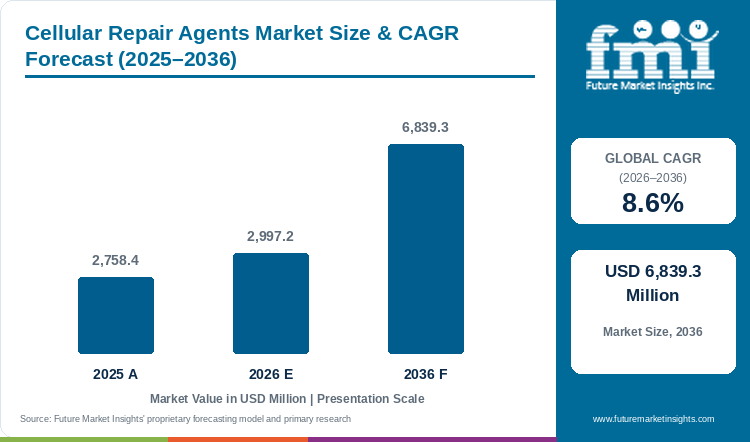
The cellular repair agents market was valued at USD 2,758.4 million in 2025, stands at USD 2,997.2 million in 2026 and will reach USD 6,839.3 million by 2036. Sales of cellular repair agents are set to expand at an 8.6% CAGR from 2026 to 2036, adding USD 3,842.1 million of new revenue over the decade.
Key drivers of the cellular repair agents market include an ageing population and a large base of aesthetic clinic patients. In October 2025, the World Health Organization projected that people aged 60 and over will reach 1.4 billion by 2030, one in six people worldwide [1]. ISAPS counted 20.5 million non-surgical aesthetic procedures in 2024, and clinics sell repair actives as aftercare after many of these treatments [2]. Apart from that, the FDA accepted NMN as lawful in dietary supplements on 29 September 2025, reopening a large U.S. channel for nutricosmetics [3]. As per FMI, bioactive peptides lead with a 33.9% share in 2026, and sales of repair skincare and capsules will keep rising through 2036.
Key Market Trends & Insights
- By agent type, bioactive peptides account for 33.9% of sales in 2026, as formulators add small amounts to serums, creams and lip products.
- By source, biotechnology-derived grades take 41.2% of 2026 sales, as brand chemists want batches traced to fermentation, enzyme or cell-culture processes.
- By application, anti-ageing facial skincare accounts for 46.3% of sales in 2026. German skin and face care sales grew 11.1% in 2025, faster than any other beauty product group [4].
- By end user, prestige and masstige beauty brands buy 39.5% of cellular repair agents in 2026, refreshing serum and cream claims each season. Croda grew Beauty Actives sales by 6% in 2025 [5].
Regional Highlights
- Fastest-growing profiled country: South Korea (10.4% CAGR, 2026 to 2036).
- By country: the USA (9.2%) and Brazil (8.8%) come next, and Japan posts the slowest profiled CAGR at 6.8% through 2036.
- Demand for cellular repair agents in South Korea is rising with export-led serum launches. Skincare exports reached USD 8.5 billion in 2025, close to three-quarters of all Korean cosmetics shipped abroad [6].
Market Size & Forecast
Table 1: Market Size and Forecast for the Cellular Repair Agents Market (USD million and percentage), 2025 to 2036
| Metric | Value |
|---|---|
| 2025 Market Size | USD 2,758.4 million |
| Estimated Market Size in 2026 | USD 2,997.2 million |
| Projected Market Size by 2036 | USD 6,839.3 million |
| CAGR, 2026 to 2036 | 8.6% |
| Added Revenue, 2026 to 2036 | USD 3,842.1 million |
| Market Expansion Multiple | 2.3x |
Revenue from cellular repair agents comes mainly from prestige serums and dermocosmetic creams, with capsules for skin health forming a smaller but fast-growing channel. Niagen Bioscience grew ingredient revenue 45% to USD 27.9 million in 2025, owing to larger bulk orders for nicotinamide riboside [7]. In April 2026, Symrise presented Cellexora MD, an exosome active made from leftover organic apple material, at in-cosmetics Global [8]. However, the FDA states that no exosome product is approved in the USA [9]. Niagen also expects lower ingredient sales in 2026, as partners face more rival producers [10]. FMI finds that suppliers with non-human exosome grades and clear NAD+ filings will pick up most new longevity skincare contracts in the coming decade.
Buyer Base, NAD+ Supply and Ingredient Compliance
Older shoppers and clinic patients form the main buyer base for cellular repair agents. People aged 60 and over are projected to rise from 1 billion in 2020 to 1.4 billion by 2030 [1]. Peptide, NAD+ and exosome serums are moving into dermatology and masstige ranges, putting repair actives in front of many more of these shoppers. FMI sees clinic aftercare as a second route to market, since ISAPS counted 20.5 million non-surgical procedures in 2024 [2]. South Korea is the fastest-growing country at a 10.4% CAGR through 2036, backed by skincare exports of USD 8.5 billion in 2025, or 74.7% of cosmetics exports [6]. The USA follows at 9.2% over the same years with more than 6.1 million aesthetic procedures in 2024, and Brazil grows at 8.8% with 3.1 million, the second-highest total worldwide [2]. Japan grows slowest at 6.8%, as 29.4% of people are aged 65 or over [11], and most of these shoppers already use anti-ageing skincare.
Demand for NAD+ precursors is recovering in the USA after the FDA changed course on NMN. On 29 September 2025, the agency accepted that NMN had been sold as a dietary supplement as early as 2017 [3]. In December 2025, the FDA also set aside 2022 objections to NMN filings from SyncoZymes and Kingdomway [12]. Due to this, FMI expects sales of cellular repair supplements to recover through 2027. Niagen Bioscience grew ingredient revenue 45% to USD 27.9 million in 2025, and the Tru Niagen consumer line rose 27% to USD 97.7 million [7]. However, second-quarter 2026 net sales slipped to USD 29.8 million from USD 31.1 million a year earlier [10]. Volumes of NAD+ boosters are set to rise even as the price per kilogram falls. Exosome buyers are moving to plant and microbial grades, as Korea and the EU bar material of human origin in cosmetics [13]. In the USA, the FDA states that no exosome product is approved [9]. Growth factors and exosomes hold 17.4% of agent type sales in 2026, and non-human grades will carry most new volume in this segment. DNA repair enzymes are a small segment at 6.7% of 2026 sales, used mostly in after-sun care [14]. T4 endonuclease V speeds DNA repair up to about fourfold, yet only one clinical trial has measured an anti-ageing benefit [14].
Table 2: Buyer Base and Ingredient Compliance Indicators for the Cellular Repair Agents Market (people, procedures, percentages, USD values and rule dates), mixed reporting years from 2023 to 2030
| Indicator | Data Point | Relevance to Demand | Source |
|---|---|---|---|
| People aged 60 and over | About 1.4 billion by 2030, one in six people worldwide | Widens the pool of older buyers paying for repair serums and capsules. | [1] |
| Non-surgical aesthetic procedures | 20.5 million in 2024, within close to 38 million total procedures | Each injectable, peel or laser session creates an aftercare need for repair actives. | [2] |
| FDA position on NMN | Accepted as lawful in dietary supplements on 29 September 2025 | Reopens the U.S. supplement channel for NAD+ precursor capsules. | [3] |
| NMN filing letters | Earlier objections set aside for SyncoZymes and Kingdomway in December 2025 | Gives named NMN producers a clear filing status for U.S. supplement sales. | [12] |
| Niagen ingredient revenue | USD 27.9 million in 2025, up 45% | Shows rising bulk orders for nicotinamide riboside. | [7] |
| Korean rule on human-origin material | Human cells, tissues and culture media barred outside set standards since November 2023 | Pushes exosome buyers toward plant and microbial grades. | [13] |
| Korean skincare exports | USD 8.5 billion in 2025, 74.7% of cosmetics exports | Carries Korean repair serums and the actives inside into foreign markets. | [6] |
| German skin and face care sales | Up 11.1% in 2025, the fastest beauty product group | Signals strong demand for facial care in Europe's largest beauty market. | [4] |
| Japan population aged 65 or older | A record 29.4% in the 2025 census | Sets a large but well-served base of older skincare users. | [11] |
Table 3: Ageing Population and Aesthetic Procedure Benchmarks for the Cellular Repair Agents Market (mixed currencies and units), 2024-2036, mixed years
| Indicator | Value | Source |
|---|---|---|
| Global cellular repair agents market, 2026 | USD 2,997.2 million | Forecast by Future Market Insights |
| Korean cosmetics export markets, 2025 | 202 countries | [6] |
| Value gained over 2026-2036 | USD 3,842.1 million | Forecast by Future Market Insights |
| People aged 60 and over, 2030 | 1.4 billion | [1] |
| U.S. aesthetic procedures, 2024 | More than 6.1 million | [2] |
| Non-surgical aesthetic procedures, 2024 | 20.5 million | [2] |
| Brazil surgical procedures, 2024 | 2.3 million, the highest worldwide | [2] |
| Niagen Bioscience ingredient sales, 2025 | USD 27.9 million (+45%) | [7] |
| Tru Niagen consumer sales, 2025 | USD 97.7 million (+27%) | [7] |
| Korean skincare exports, 2025 | USD 8.5 billion | [6] |
Analyst Perspective
“Clinic aftercare and home routines will carry more of the growth in cellular repair agents than single product launches. Suppliers proving a non-human origin with clinical data that dermatologists accept are set to secure the larger orders through 2036.”
- Nikhil Kaitwade, Principal Consultant, Future Market Insights.
How is the cellular repair agents market segmented?
The cellular repair agents market is studied across agent type, source, application and end user, with a regional split across seven world regions. In 2026, bioactive peptides hold 33.9%, biotechnology-derived grades 41.2%, anti-ageing facial skincare 46.3%, and prestige and masstige beauty brands 39.5% of each category.
By agent type: bioactive peptides, NAD+ precursors (NMN, NR), growth factors and exosomes, plant stem cell and botanical regenerative actives, mitochondrial and antioxidant repair actives, and DNA repair enzymes.
By source: biotechnology-derived, chemically synthesised, plant-derived, and marine-derived.
By application: anti-ageing facial skincare, oral nutricosmetics and supplements, post-procedure and barrier repair care, sun care and after-sun, hair and scalp care, and body and hand care.
By end user: prestige and masstige beauty brands, dermocosmetic and medical skincare brands, nutraceutical and supplement makers, dermatology and aesthetic clinics, and contract manufacturers.
By region: North America, Latin America, Western Europe, Eastern Europe, East Asia, South Asia and Pacific, and Middle East and Africa.
Why are bioactive peptides the first choice among agent types?
Bioactive peptides command 33.9% of agent type sales in 2026, supported by a long record of use in serums and creams.
Table 4: Agent Type Share for the Cellular Repair Agents Market (percentage share), 2026
| Agent Type | Share (2026) |
|---|---|
| Bioactive Peptides | 33.9% |
| Other Segments Combined | 66.1% |
| Total | 100% |
Table 5: Agent Type Leadership and Market Growth for the Cellular Repair Agents Market (segment and CAGR percentage), 2026 to 2036
| Metric | Value |
|---|---|
| Global CAGR (2026 to 2036) | 8.6% |
| Leading Segment | Bioactive Peptides |
Bioactive peptides lead the agent type split with a 33.9% share in 2026, as formulators need only small amounts per batch of serum, cream or lip product. Croda's Sederma has sold palmitoylated peptides since 1992 and Matrixyl since 2000, giving brand chemists a long safety record [15]. In February 2026, Lubrizol reported visible improvement in lip roughness and wrinkle appearance within 14 days of using oil-soluble Argireline YOUth [16]. Steady cosmetic peptide manufacturing capacity keeps peptide prices within reach of masstige brands. Growth factors and exosomes form a smaller 17.4% of the split, and peptides are expected to stay above 30% of agent type sales by 2036.
- Bioactive peptides hold 33.9% of agent type sales in 2026, owing to low use levels and decades of safe use in new launches.
- Oil-soluble and encapsulated barrier repair peptides are now carrying repair claims into lipsticks, eye products and makeup.
Why do brand chemists favour biotechnology-derived grades by source?
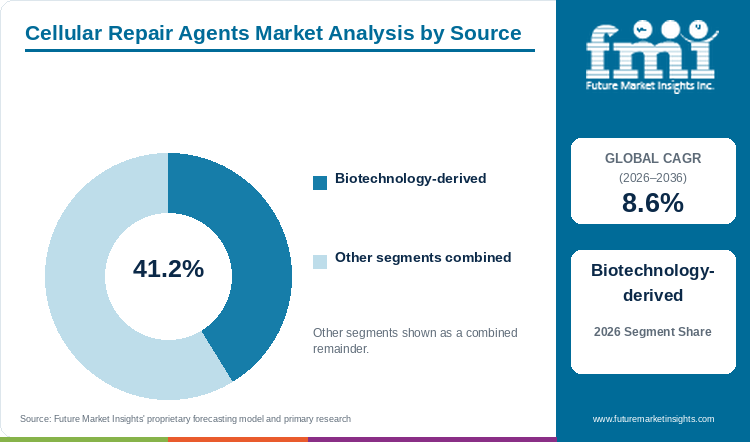
Biotechnology-derived grades take 41.2% of the source category in 2026, as each batch traces back to a controlled process.
Biotechnology-derived grades hold 41.2% of the source category in 2026, as brand chemists want NMN, exosomes and growth factors from traceable enzyme, fermentation or cell-culture batches. According to FMI, this batch traceability keeps biotech grades ahead of chemically synthesised peptides, which rank second. Shoppers preferring natural ingredients keep plant actives in plant stem cell skincare products, and Givaudan Active Beauty added Evernityl in March 2025 [17]. Evernityl is a solvent-free extract made from an unused part of Laminaria hyperborea algae, serving buyers seeking a natural-origin story. Faster growth in exosome and NAD+ volumes is set to push biotechnology-derived grades above 45% of source sales by 2036.
- Traceable fermentation and enzyme processes give biotechnology-derived grades a 41.2% share of 2026 source sales.
- Marine and plant grades appeal to brands marketing a natural origin, and batch data on active content helps these grades gain listings.
Why does anti-ageing facial skincare lead application demand?
Anti-ageing facial skincare captures 46.3% of application sales in 2026, as a face serum is often the first repair purchase.
Anti-ageing facial skincare takes 46.3% of application sales in 2026, as a repair serum or night cream is usually the first purchase once shoppers notice lines or sun damage. In Germany, skin and face care sales grew 11.1% in 2025, the fastest of any beauty product group [4]. Oral nutricosmetics and supplements follow at 19.8%, helped by NAD+ capsules sold for skin health. In November 2025, Niagen Bioscience launched Tru Niagen Beauty, a capsule with 100 mg of nicotinamide riboside for skin, hair and nails [18]. Face products are set to keep more than 40% of application sales through 2036, and capsules will narrow part of the gap.
- Anti-ageing facial skincare commands a 46.3% share in 2026, backed by the fastest sales growth of any German beauty product group in 2025 [4].
- Brands pairing a repair serum with a matching capsule can raise the value of each shopper's routine during the forecast period.
Why do prestige and masstige beauty brands buy the largest end user share?
Prestige and masstige beauty brands buy 39.5% of cellular repair agents by end user in 2026, owing to frequent serum and cream relaunches.
Prestige and masstige beauty brands buy 39.5% of cellular repair agents by end user in 2026, as serums and creams are relaunched with new claims each season. Croda grew Beauty Actives sales by 6% in 2025 and plans to supply masstige ranges next [5]. FMI estimates that dermatology and aesthetic clinics hold 13.7%, yet clinic sales of exosome-based skincare are growing as Korean suppliers sell directly to physicians. In October 2025, ExoCoBio announced 15 new ASCE plus products for an exosome summit in Seoul [19]. Clinic share is projected to pass 16% by 2036 as aftercare kits sell alongside injectables and lasers.
- Prestige and masstige beauty brands hold a 39.5% share in 2026 and will stay the largest end user, as serum and cream relaunches keep orders coming.
- Switching a repair active means repeating stability, safety and claim tests, so most brands keep a supplier for several product cycles.
What are the drivers, restraints, and opportunities in the cellular repair agents market?
Older shoppers and clinic aftercare are raising repeat purchases of cellular repair agents. Thin clinical data and bans on human-origin material slow some claims, and doctor-sold capsule and serum kits open the largest new revenue source.
- Driver: Key drivers of the cellular repair agents market include a growing over-60 population and more non-surgical aesthetic treatments that create repeat aftercare buyers.
- Restraint: Limited clinical data and bans on human-origin ingredients slow claims for several actives. Falling NAD+ precursor prices are also cutting revenue per kilogram for producers.
- Opportunity: Clinic kits pairing a repair serum with an NAD+ or peptide capsule offer the clearest opportunity, and FMI expects these kits to raise repeat orders through 2036.
Clinic Aftercare Builds Repeat Orders
Adoption of cellular repair skincare is growing fastest in aesthetic clinics, which send many patients home with a repair serum or peptide aftercare kit. In June 2025, ISAPS reported 20.5 million non-surgical procedures worldwide for 2024, and American practices performed more than 6.1 million aesthetic procedures in total [2]. Patients pleased with the result often buy the same stem cell repair cream again for home use. Key trends in the cellular repair agents market point to clinic aftercare raising orders for repair actives faster than unit sales of finished skincare through 2036.
Thin Clinical Data Holds Back Claims
Limited clinical data is slowing claims for several repair actives. In August 2025, a review in Cosmetics found only one clinical trial measuring a benefit of DNA-repair enzymes on signs of ageing [14]. Exosome sellers face stricter sourcing rules, as South Korea bars human cells, tissues and culture media from cosmetics outside set standards [13]. Brands then need extra tests and new grades before placing a claim on the pack. Weak trial data and origin rules may hold back launches in the DNA repair and exosome segments for several years.
Practitioner Kits Open New Revenue
Doctors and clinics are becoming a new sales route for NAD+ capsules sold with repair serums. In November 2025, Niagen Bioscience planned to offer Tru Niagen Beauty through doctors and other health practitioners from February 2026 [18]. In December 2025, the FDA set aside earlier objections to the NMN filings of SyncoZymes and Inner Mongolia Kingdomway Pharmaceutical [12]. A clear filing status lets NMN producers sell to U.S. supplement brands again. Suppliers selling a repair capsule together with a matching serum stand to gain larger repeat orders from practitioners.
Which country CAGRs are profiled in the cellular repair agents market?
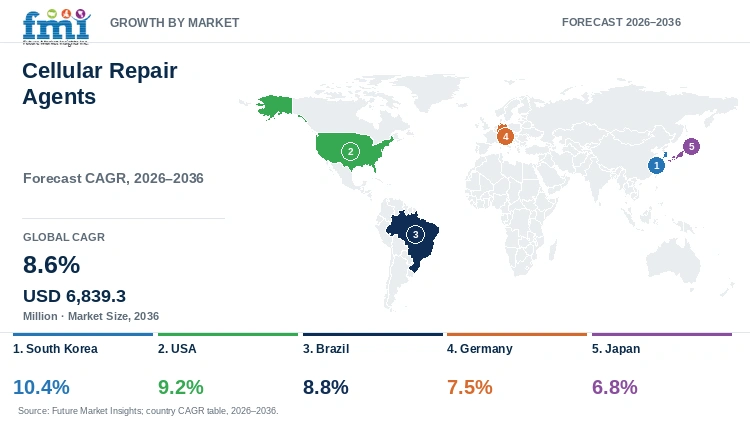
Sales of cellular repair agents rise fastest in South Korea, at a 10.4% CAGR over 2026 to 2036, and slowest in Japan, at 6.8% over the same period. Across all five countries, growth tracks clinic aftercare volumes, the number of older shoppers new to repair serums and local rules on NMN and human-origin material.
Table 6: Country CAGRs and Primary Growth Levers for the Cellular Repair Agents Market (CAGR percentage), 2026 to 2036
| Country | CAGR (2026-2036) | Primary Growth Lever |
|---|---|---|
| South Korea | 10.4% | Non-human exosome and peptide serums for export |
| USA | 9.2% | NMN supplements and clinic aftercare kits |
| Brazil | 8.8% | Topical aftercare for plastic surgery patients |
| Germany | 7.5% | Trading up to dermocosmetic serums |
| Japan | 6.8% | Richer serums for existing older users |
Source: Future Market Insights
South Korea Cellular Repair Agents Market Outlook (2026-2036)
South Korea is set to post a 10.4% CAGR in sales of cellular repair agents through 2036, the highest among profiled countries. Korea's MFDS has kept human cells, tissues and culture media out of cosmetics outside set standards since November 2023 [13]. Korean brands now buy exosomes made from plants and microbes, and these grades can also be sold into the EU. Skincare exports reached USD 8.5 billion in 2025, and Korean cosmetics went to 202 countries that year [6]. Clinic sales are growing too, as ExoCoBio said in October 2025 that 15 new ASCE plus products would be shown to more than 250 physicians and researchers in Seoul [19].
Key takeaway: Plant and microbial exosome serums made for export keep South Korea in first place through 2036.
USA Cellular Repair Agents Market Outlook (2026-2036)
FMI expects the USA to rank second, with sales of cellular repair agents growing at a 9.2% CAGR through 2036. NMN supplements returned to the market after the FDA accepted NMN as lawful in dietary supplements on 29 September 2025 [3]. American practices performed more than 6.1 million aesthetic procedures in 2024, the most of any country, and each treatment creates a need for aftercare serums [2]. However, exosome claims carry more risk, as the FDA states that no exosome product is approved [9].
Key takeaway: NMN supplements and clinic aftercare kits will bring most new U.S. orders.
Brazil Cellular Repair Agents Market Outlook (2026-2036)
Plastic surgery patients are the main buyers of repair actives in Brazil, which ranked first worldwide for surgical procedures in 2024 with 2.3 million [2]. Anvisa does not allow cosmetics to be injected, and in November 2023 the agency suspended products from three companies whose labels encouraged injection [20]. Due to this, cosmetic-grade repair actives stay in creams and serums used after surgery. Natura relaunched Chronos as Chronos Derma in March 2025 after tests with more than 30,000 women and dermatology specialists [21]. Local launches of this kind support an 8.8% CAGR for Brazil through 2036.
Key takeaway: Topical aftercare for a very large surgery patient base drives Brazilian sales.
Germany Cellular Repair Agents Market Outlook (2026-2036)
Beiersdorf's Derma unit, home to Eucerin, grew organic sales 11.7% in 2025, led by the Epigenetics Serum [22]. Mass skincare is slower, as the group's consumer business grew only 1.8% in Western Europe that year [22]. German shoppers already use repair actives widely, so growth in Germany is projected at a 7.5% CAGR through 2036. Most new sales will come from shoppers switching to a richer cellular repair cream or serum.
Key takeaway: German growth comes from shoppers moving from basic face creams to dermocosmetic serums.
Japan Cellular Repair Agents Market Outlook (2026-2036)
Japan's 2025 census counted a record 29.4% of people aged 65 or older [11]. Most of these shoppers already buy anti-ageing skincare, leaving few first-time buyers. Demand for cellular repair agents in Japan is heading for a 6.8% CAGR through 2036, below every other profiled country. Capsule makers face stricter rules, as factories making tablet and capsule Foods with Function Claims are required to follow GMP from 1 September 2026 [23]. NMN and other NAD+ suppliers with GMP-made grades will gain these brands as customers.
Key takeaway: Sales in Japan rely on loyal older users trading up and on GMP-made NAD+ capsules.
Who are the notable companies in the cellular repair agents market?
Competition in cellular repair agents centres on Croda, Lubrizol, Givaudan, Symrise, ExoCoBio, Niagen Bioscience, Inner Mongolia Kingdomway Pharmaceutical and SyncoZymes.
Supply of cellular repair agents is moderately fragmented across ingredient houses, NAD+ precursor producers and exosome developers selling to different buyers. Croda, Lubrizol and Givaudan supply peptides and biotech skin actives to global beauty brands, and Croda grew Beauty Actives sales by 6% in 2025 [5]. Niagen Bioscience, Kingdomway and SyncoZymes compete more on price and filing status, with Niagen expecting lower ingredient sales in 2026 [10]. Symrise and ExoCoBio are adding non-human exosome actives and clinic skincare lines to reach brands and physicians.
- Peptide and biotech active specialists: Croda, Lubrizol, and Givaudan sell signal peptides and biotech skin actives to global beauty brands, backed by large application labs.
- NAD+ precursor producers: Niagen Bioscience supplies nicotinamide riboside in bulk, and Inner Mongolia Kingdomway Pharmaceutical and SyncoZymes compete in NMN after regaining U.S. filing status in December 2025 [12].
- Exosome and regenerative ingredient developers: Symrise and ExoCoBio are adding plant-based exosome grades and clinic skincare lines for brands and physicians seeking non-human actives.
Competitive Benchmarking: Cellular Repair Agents Market
Table 7: Competitive Benchmarking for the Cellular Repair Agents Market (qualitative capability ratings), 2026
| Company | Peptides | NAD+ Supply | Exosomes | Reach |
|---|---|---|---|---|
| Croda | High | Low | Medium | High |
| Lubrizol | High | Low | Low | High |
| Givaudan | High | Low | Medium | High |
| Symrise | Medium | Low | High | High |
| ExoCoBio | Low | Low | High | Medium |
| Niagen Bioscience | Low | High | Low | Medium |
| Kingdomway | Low | High | Low | Medium |
| SyncoZymes | Low | High | Low | Low |
High marks a wide published range or supply record in the rated area, Medium marks a narrower but proven offer, and Low marks limited public documentation or a supporting role.
Key Developments in the Cellular Repair Agents Market
- Symrise presented Cellexora MD, an exosome active made from leftover organic apple material, during the April 2026 edition of in-cosmetics Global [8].
- In February 2026, Lubrizol released lip data for the oil-soluble Argireline YOUth peptide, showing visible improvement in lip roughness within 14 days [16].
- In November 2025, Niagen Bioscience moved into skin supplements with Tru Niagen Beauty, combining 100 mg of nicotinamide riboside with astaxanthin and hyaluronic acid [18].
- Givaudan launched Evernityl in March 2025, a solvent-free algae extract made from unused Laminaria hyperborea material for skin health and longevity [17].
Key Players in the Cellular Repair Agents Market
Peptide and Biotech Active Specialists
- Croda International Plc
- The Lubrizol Corporation
- Givaudan SA
NAD+ Precursor Producers
- Niagen Bioscience, Inc.
- Inner Mongolia Kingdomway Pharmaceutical Limited
- SyncoZymes
Exosome and Regenerative Ingredient Developers
- Symrise AG
- ExoCoBio Inc.
Cellular Repair Agents Market - Report Scope
Table 8: Report Scope for the Cellular Repair Agents Market (coverage fields and definitions), 2026 to 2036
| Coverage field | Report scope |
|---|---|
| Market breakdown | Agent type; source; application; end user; region |
| Quantitative units | USD million |
| Market definition | First-sale revenue from active ingredients sold to beauty, dermocosmetic, clinic and supplement brands for repairing and renewing skin cells. Coverage spans bioactive peptides, NAD+ precursors, growth factors and exosomes, plant stem cell and botanical regenerative actives, mitochondrial and antioxidant repair actives and DNA repair enzymes. Retail value of finished creams, serums and supplements, prescription drugs, cell therapies and general moisturising ingredients is excluded. |
| Regions covered | North America; Latin America; Western Europe; Eastern Europe; East Asia; South Asia and Pacific; Middle East and Africa |
| Countries covered | South Korea; USA; Brazil; Germany; Japan |
| Key companies profiled | Croda, Lubrizol, Givaudan, Symrise, ExoCoBio, Niagen Bioscience, Inner Mongolia Kingdomway Pharmaceutical, SyncoZymes |
| Forecast period | 2026 to 2036 |
| Approach | Bottom-up and top-down sizing that reconciles ingredient supplier sales with skincare and supplement launches, clinic procedure volumes and country adoption. |
Cellular Repair Agents Market - Research Methodology
Table 9: Research Methodology for the Cellular Repair Agents Market (research methods and approach), 2026 edition
| Method | Approach |
|---|---|
| Primary Research | Interviews with cosmetic chemists, ingredient sales managers, dermocosmetic brand teams, aesthetic clinic buyers and supplement formulators covered use levels, claim support, pricing and supplier choice. |
| Desk Research | Desk research drew on supplier results, cosmetic and supplement regulator notices, new dietary ingredient filings, aesthetic procedure surveys, population statistics and company announcements. |
| Market Sizing and Forecasting | Market sizing combines the 2025 base value, segment shares, price per kilogram by agent type, launch activity, clinic procedure volumes and country conditions. |
| Data Validation | Estimates are cross-checked against supplier results, regulator records and primary interviews. Finished product value, drugs and cell therapies are excluded to avoid double counting. |
Cellular Repair Agents Market by Segments
Cellular Repair Agents Market segmented by Agent Type:
- Bioactive peptides
- NAD+ precursors (NMN, NR)
- Growth factors and exosomes
- Plant stem cell and botanical regenerative actives
- Mitochondrial and antioxidant repair actives
- DNA repair enzymes
Cellular Repair Agents Market segmented by Source:
- Biotechnology-derived
- Chemically synthesised
- Plant-derived
- Marine-derived
Cellular Repair Agents Market segmented by Application:
- Anti-ageing facial skincare
- Oral nutricosmetics and supplements
- Post-procedure and barrier repair care
- Sun care and after-sun
- Hair and scalp care
- Body and hand care
Cellular Repair Agents Market segmented by End User:
- Prestige and masstige beauty brands
- Dermocosmetic and medical skincare brands
- Nutraceutical and supplement makers
- Dermatology and aesthetic clinics
- Contract manufacturers
Cellular Repair Agents Market by Region
- North America
- United States
- Canada
- Latin America
- Brazil
- Mexico
- Argentina
- Chile
- Western Europe
- Germany
- France
- United Kingdom
- Italy
- Spain
- Benelux
- Nordics
- Eastern Europe
- Poland
- Czech Republic
- Romania
- Hungary
- East Asia
- Japan
- South Korea
- South Asia and Pacific
- ASEAN
- Australia and New Zealand
- Middle East and Africa
- GCC Countries
- South Africa
- Türkiye
- Israel
Research Sources and Bibliography
- [1] World Health Organization. (2025, October 1). Ageing and health (fact sheet).https://www.who.int/news-room/fact-sheets/detail/ageing-and-health
- [2] International Society of Aesthetic Plastic Surgery (ISAPS). (2025, June 19). ISAPS Global Survey 2024 press release.https://www.isaps.org/media/sqqoodpf/global-survey-2024-press-release-english.pdf
- [3] Natural Products Association. (2025, September 29). Amid Pressure from NPA, FDA Declares NMN Lawful in Dietary Supplements.https://www.npanational.org/news/amid-pressure-from-npa-fda-declares-nmn-lawful-in-dietary-supplements/
- [4] IKW (German Cosmetic, Toiletry, Perfumery and Detergent Association). (2025, December 3). Market Data.https://www.ikw.org/en/market-data
- [5] Croda International Plc. (2026, February 24). Results for the year ended 31 December 2025.https://www.croda.com/en-gb/media-hub/news/general/2025-full-year-results
- [6] Korea JoongAng Daily (reporting Ministry of Food and Drug Safety data). (2026, May 23). Korea surpasses U.S. in cosmetics exports with record $11.4 billion.https://www.koreajoongangdaily.com/business/korea-surpasses-us-in-cosmetics-exports-with-record-114-billion/12713991
- [7] Niagen Bioscience, Inc. (via BioSpace). (2026, March 4). Niagen Bioscience Reports 30% Year-Over-Year Net Sales Increase to $129.4 million, 103% Net Income Increase to $17.4 million or $0.22 Basic EPS in 2025.https://www.biospace.com/press-releases/niagen-bioscience-reports-30-year-over-year-net-sales-increase-to-129-4-million-103-net-income-increase-to-17-4-million-or-0-22-basic-eps-in-2025
- [8] Symrise AG. (2026, April 14). Symrise accelerates innovation and champions longevity and inner beauty at in-cosmetics Global 2026.https://www.symrise.com/newsroom/article/symrise-accelerates-innovation-and-champions-longevity-and-inner-beauty-at-in-cosmetics-global-2026/
- [9] U.S. Food and Drug Administration. (2020, July 22). Consumer Alert on Regenerative Medicine Products Including Stem Cells and Exosomes.https://www.fda.gov/vaccines-blood-biologics/consumers-biologics/consumer-alert-regenerative-medicine-products-including-stem-cells-and-exosomes
- [10] Niagen Bioscience, Inc. (via BioSpace). (2026, August 4). Niagen Bioscience, Inc. Reports Second Quarter 2026 Financial Results.https://www.biospace.com/press-releases/niagen-bioscience-inc-reports-second-quarter-2026-financial-results
- [11] Bernama (reporting Kyodo News). (2026, September 29). Japan Elderly Population Hits Fresh High At 29.4 Per Cent: 2025 Census.https://bernama.com/en/world/news.php?id=2613292
- [12] NutraIngredients. (2025, December 9). FDA reinstates NDI status of NMN with new letters to ingredient players.https://www.nutraingredients.com/Article/2025/12/09/fda-reinstates-ndi-status-of-nmn-with-new-letters-to-ingredient-players
- [13] ChemLinked (REACH24H Consulting Group). (2025, April 7). Global Regulations on Exosomes in Cosmetic Products.https://cosmetic.chemlinked.com/expert-article/global-regulations-on-exosomes-in-cosmetic-products
- [14] Musielak, E. and Krajka-Kuźniak, V., Cosmetics (MDPI). (2025, August 12). Enzymes DNA Repair in Skin Photoprotection: Strategies Counteracting Skin Cancer Development and Photoaging Strategies.https://www.mdpi.com/2079-9284/12/4/172
- [15] Croda Beauty (Croda International Plc). (n.d.; accessed 2026, October). Peptides timeline.https://www.crodabeauty.com/en-gb/capabilities/peptides/timeline
- [16] SOFW (reporting The Lubrizol Corporation). (2026, February 11). Lubrizol: New data reveal the power of Argireline YOUth peptide in lipstick applications.https://sofw.com/en/news/latest-news/personal-care/5763-lubrizol-new-data-reveal-the-power-of-argireline-r-youth-peptide-in-lipstick-applications
- [17] Personal Care Insights. (2025, March 24). Givaudan launches Evernityl, an algae-based anti-aging ingredient.https://www.personalcareinsights.com/news/givaudan-evernityl-algae-sustainable-anti-aging-ingredient-launch.html
- [18] Niagen Bioscience, Inc. (2025, November 13). Niagen Bioscience Launches Tru Niagen Beauty, The First NAD+ Skincare Supplement in the U.S., Featuring Niagen Patented Nicotinamide Riboside.https://s205.q4cdn.com/770776702/files/doc_news/Niagen-Bioscience-Launches-Tru-Niagen-Beauty--The-First-NAD-Skincare-Supplement-in-the-U-S--Featuring-Niagen-Patented-Nicotinamide-Ri-REDQJ.pdf
- [19] The Asia Business Daily (Asia Economy). (2025, October 31). ExoCoBio Unveils New Products from Skincare Brand "ASCE plus".https://view.asiae.co.kr/en/article/2025103110183108063
- [20] Folha de Pernambuco (reporting Agência O Globo). (2023, November 16). Anvisa alerta sobre proibição de cosméticos injetáveis; entenda os riscos e as regras.https://www.folhape.com.br/noticias/anvisa-alerta-sobre-proibicao-de-cosmeticos-injetaveis-entenda-os/301906/
- [21] Mercado&Consumo. (2025, March 13). Natura entra no mercado de dermocosméticos com relançamento da linha Chronos.https://mercadoeconsumo.com.br/13/03/2025/inovacao/natura-entra-no-mercado-de-dermocosmeticos-com-relancamento-da-linha-chronos/
- [22] Beiersdorf AG. (2026, March 2). Full year results 2025: Beiersdorf grows in a slowing market, Derma outperforms.https://beiersdorf.com/newsroom/press-information/all-press-releases/2026/03/02-full-year-results-2025-beiersdorf-grows-in-a-slowing-market-derma-outperforms
- [23] NutraIngredients. (2024, July 8). Kobayashi knock-on effect: Japanese functional foods businesses legally bound to four new rules from Sep.https://www.nutraingredients.com/Article/2024/07/08/japanese-functional-foods-businesses-legally-bound-to-four-new-rules-from-sep/
This bibliography is provided for reader reference. The full report contains the complete reference list and detailed citations.
This Report Answers
- What is the size of the cellular repair agents market in 2026?
- What value will cellular repair agents reach by 2036, and at what CAGR?
- Which agent type leads sales of cellular repair agents, and why?
- Which source and application account for the largest purchases of cellular repair agents?
- Which profiled country records the fastest growth in cellular repair agents through 2036?
- Which peptide, NAD+ and exosome suppliers shape competition in this market?
Frequently Asked Questions
How large is the cellular repair agents market expected in 2026?
Sales of cellular repair agents are estimated at USD 2,997.2 million in 2026, up from USD 2,758.4 million in 2025. Older shoppers and clinic patients will add most new sales, taking the market to USD 6,839.3 million by 2036.
What CAGR is projected for the cellular repair agents market through 2036?
FMI projects an 8.6% CAGR for the cellular repair agents market from 2026 to 2036. Clinic aftercare, NAD+ capsules and the return of NMN supplements in the USA will support this pace.
Which agent type holds a notable market share in 2026?
Bioactive peptides will hold 33.9% of agent type sales in 2026. Formulators trust a long safety record and need only small amounts in each serum or cream.
Which application holds a notable share in 2026?
Anti-ageing facial skincare will account for 46.3% of application sales in 2026. A face serum or night cream is usually the first repair product a shopper buys.
Which country has a notable expansion outlook through 2036?
South Korea will post the fastest profiled growth, at a 10.4% CAGR from 2026 to 2036. Exports of Korean repair serums made with plant and microbial exosomes will support this outlook.
Who are the key companies in the cellular repair agents market?
According to FMI, the key suppliers are Croda, Lubrizol, Givaudan, Symrise, ExoCoBio, Niagen Bioscience, Inner Mongolia Kingdomway Pharmaceutical and SyncoZymes. Competition centres on clinical data, non-human sourcing and NAD+ filing status.
Preview the report firsthand - request a free sample
Get SampleGet the brochure for pricing and purchase details.
Get PDFTable of Content
- Key Takeaways
- Market Size and CAGR
- Top Growth Driver
- Fastest Growing Segment
- Leading Region
- Key Companies
- Emerging Opportunities
- Executive Summary
- Global Market Outlook
- Demand-side Trends
- Supply-side Trends
- Technology Roadmap Analysis
- Analysis and Recommendations
- Analyst Perspective (What is happening? Why now? What should investors know?)
- Key Questions Answered
- How large is the market?
- What is the CAGR?
- What are key trends?
- Which region dominates?
- Who are the leaders?
- Market Overview
- Market Coverage / Taxonomy
- Market Definition / Scope / Limitations
- Research Methodology
- Chapter Orientation
- Analytical Lens and Working Hypotheses
- Market Structure, Signals, and Trend Drivers
- Benchmarking and Cross-market Comparability
- Market Sizing, Forecasting, and Opportunity Mapping
- Research Design and Evidence Framework
- Desk Research Programme (Secondary Evidence)
- Expert Input and Fieldwork (Primary Evidence)
- Tooling, Models, and Reference Databases
- Data Engineering and Model Build
- Quality Assurance and Audit Trail
- Market Background
- Market Dynamics (Drivers, Restraints, Opportunity, Trends)
- Scenario Forecast (Optimistic, Likely, Conservative)
- Impact Analysis
- AI Impact
- Sustainability Impact
- Regulatory Impact
- Technology Impact
- Consumer / Buyer Analysis
- Purchase Drivers
- Adoption Barriers
- Buyer Journey
- Opportunity Map Analysis
- Product Life Cycle Analysis
- Supply Chain Analysis
- Investment Feasibility Matrix
- Value Chain Analysis
- PESTLE and Porter's Analysis
- Regulatory Landscape
- Regional Parent Market Outlook
- Production and Consumption Statistics
- Import and Export Statistics
- Global Market Analysis and Forecast, 2021 to 2036
- Historical Market Size Value (USD Million) Analysis, 2021 to 2025
- Current and Future Market Size Value (USD Million) Projections, 2026 to 2036
- Y-o-Y Growth Trend Analysis
- Absolute $ Opportunity Analysis
- Global Market Pricing Analysis, 2021 to 2036
- Global Market Analysis and Forecast, By Agent Type, 2021 to 2036
- Introduction / Key Findings
- Historical Market Size Value (USD Million) Analysis By Agent Type, 2021 to 2025
- Current and Future Market Size Value (USD Million) Analysis and Forecast By Agent Type, 2026 to 2036
- Bioactive peptides
- NAD+ precursors (NMN, NR)
- Growth factors and exosomes
- Plant stem cell and botanical regenerative actives
- Mitochondrial and antioxidant repair actives
- DNA repair enzymes
- Y-o-Y Growth Trend Analysis By Agent Type, 2021 to 2025
- Absolute $ Opportunity Analysis By Agent Type, 2026 to 2036
- Global Market Analysis and Forecast, By Source, 2021 to 2036
- Introduction / Key Findings
- Historical Market Size Value (USD Million) Analysis By Source, 2021 to 2025
- Current and Future Market Size Value (USD Million) Analysis and Forecast By Source, 2026 to 2036
- Biotechnology-derived
- Chemically synthesised
- Plant-derived
- Marine-derived
- Y-o-Y Growth Trend Analysis By Source, 2021 to 2025
- Absolute $ Opportunity Analysis By Source, 2026 to 2036
- Global Market Analysis and Forecast, By Application, 2021 to 2036
- Introduction / Key Findings
- Historical Market Size Value (USD Million) Analysis By Application, 2021 to 2025
- Current and Future Market Size Value (USD Million) Analysis and Forecast By Application, 2026 to 2036
- Anti-ageing facial skincare
- Oral nutricosmetics and supplements
- Post-procedure and barrier repair care
- Sun care and after-sun
- Hair and scalp care
- Body and hand care
- Y-o-Y Growth Trend Analysis By Application, 2021 to 2025
- Absolute $ Opportunity Analysis By Application, 2026 to 2036
- Global Market Analysis and Forecast, By End User, 2021 to 2036
- Introduction / Key Findings
- Historical Market Size Value (USD Million) Analysis By End User, 2021 to 2025
- Current and Future Market Size Value (USD Million) Analysis and Forecast By End User, 2026 to 2036
- Prestige and masstige beauty brands
- Dermocosmetic and medical skincare brands
- Nutraceutical and supplement makers
- Dermatology and aesthetic clinics
- Contract manufacturers
- Y-o-Y Growth Trend Analysis By End User, 2021 to 2025
- Absolute $ Opportunity Analysis By End User, 2026 to 2036
- Global Market Analysis and Forecast, By Region, 2021 to 2036
- Introduction
- Historical Market Size Value (USD Million) Analysis By Region, 2021 to 2025
- Current Market Size Value (USD Million) Analysis and Forecast By Region, 2026 to 2036
- North America
- Latin America
- Western Europe
- Eastern Europe
- East Asia
- South Asia and Pacific
- Middle East and Africa
- Market Attractiveness Analysis By Region
- North America Market Analysis and Forecast, By Country, 2021 to 2036
- Historical Market Size Value (USD Million) Trend Analysis By Market Taxonomy, 2021 to 2025
- Market Size Value (USD Million) Forecast By Market Taxonomy, 2026 to 2036
- By Country
- United States
- Canada
- By Agent Type
- By Source
- By Application
- By End User
- By Country
- Market Attractiveness Analysis
- By Country
- By Agent Type
- By Source
- By Application
- By End User
- Key Takeaways
- Latin America Market Analysis and Forecast, By Country
- Historical Market Size Value (USD Million) Trend Analysis By Market Taxonomy, 2021 to 2025
- Market Size Value (USD Million) Forecast By Market Taxonomy, 2026 to 2036
- By Country
- Brazil
- Mexico
- Argentina
- Chile
- By Agent Type
- By Source
- By Application
- By End User
- By Country
- Market Attractiveness Analysis
- By Country
- By Agent Type
- By Source
- By Application
- By End User
- Key Takeaways
- Western Europe Market Analysis and Forecast, By Country
- Historical Market Size Value (USD Million) Trend Analysis By Market Taxonomy, 2021 to 2025
- Market Size Value (USD Million) Forecast By Market Taxonomy, 2026 to 2036
- By Country
- Germany
- France
- United Kingdom
- Italy
- Spain
- Benelux
- Nordics
- By Agent Type
- By Source
- By Application
- By End User
- By Country
- Market Attractiveness Analysis
- By Country
- By Agent Type
- By Source
- By Application
- By End User
- Key Takeaways
- Eastern Europe Market Analysis and Forecast, By Country
- Historical Market Size Value (USD Million) Trend Analysis By Market Taxonomy, 2021 to 2025
- Market Size Value (USD Million) Forecast By Market Taxonomy, 2026 to 2036
- By Country
- Poland
- Czech Republic
- Romania
- Hungary
- By Agent Type
- By Source
- By Application
- By End User
- By Country
- Market Attractiveness Analysis
- By Country
- By Agent Type
- By Source
- By Application
- By End User
- Key Takeaways
- East Asia Market Analysis and Forecast, By Country
- Historical Market Size Value (USD Million) Trend Analysis By Market Taxonomy, 2021 to 2025
- Market Size Value (USD Million) Forecast By Market Taxonomy, 2026 to 2036
- By Country
- Japan
- South Korea
- By Agent Type
- By Source
- By Application
- By End User
- By Country
- Market Attractiveness Analysis
- By Country
- By Agent Type
- By Source
- By Application
- By End User
- Key Takeaways
- South Asia and Pacific Market Analysis and Forecast, By Country
- Historical Market Size Value (USD Million) Trend Analysis By Market Taxonomy, 2021 to 2025
- Market Size Value (USD Million) Forecast By Market Taxonomy, 2026 to 2036
- By Country
- ASEAN
- Australia and New Zealand
- By Agent Type
- By Source
- By Application
- By End User
- By Country
- Market Attractiveness Analysis
- By Country
- By Agent Type
- By Source
- By Application
- By End User
- Key Takeaways
- Middle East and Africa Market Analysis and Forecast, By Country
- Historical Market Size Value (USD Million) Trend Analysis By Market Taxonomy, 2021 to 2025
- Market Size Value (USD Million) Forecast By Market Taxonomy, 2026 to 2036
- By Country
- GCC Countries
- South Africa
- Türkiye
- Israel
- By Agent Type
- By Source
- By Application
- By End User
- By Country
- Market Attractiveness Analysis
- By Country
- By Agent Type
- By Source
- By Application
- By End User
- Key Takeaways
- Key Countries Market Analysis
- United States
- Pricing Analysis
- Market Share Analysis, 2025
- By Agent Type
- By Source
- By Application
- By End User
- Canada
- Pricing Analysis
- Market Share Analysis, 2025
- By Agent Type
- By Source
- By Application
- By End User
- Mexico
- Pricing Analysis
- Market Share Analysis, 2025
- By Agent Type
- By Source
- By Application
- By End User
- Brazil
- Pricing Analysis
- Market Share Analysis, 2025
- By Agent Type
- By Source
- By Application
- By End User
- Chile
- Pricing Analysis
- Market Share Analysis, 2025
- By Agent Type
- By Source
- By Application
- By End User
- Germany
- Pricing Analysis
- Market Share Analysis, 2025
- By Agent Type
- By Source
- By Application
- By End User
- United Kingdom
- Pricing Analysis
- Market Share Analysis, 2025
- By Agent Type
- By Source
- By Application
- By End User
- Italy
- Pricing Analysis
- Market Share Analysis, 2025
- By Agent Type
- By Source
- By Application
- By End User
- Spain
- Pricing Analysis
- Market Share Analysis, 2025
- By Agent Type
- By Source
- By Application
- By End User
- France
- Pricing Analysis
- Market Share Analysis, 2025
- By Agent Type
- By Source
- By Application
- By End User
- ASEAN
- Pricing Analysis
- Market Share Analysis, 2025
- By Agent Type
- By Source
- By Application
- By End User
- Australia and New Zealand
- Pricing Analysis
- Market Share Analysis, 2025
- By Agent Type
- By Source
- By Application
- By End User
- Japan
- Pricing Analysis
- Market Share Analysis, 2025
- By Agent Type
- By Source
- By Application
- By End User
- South Korea
- Pricing Analysis
- Market Share Analysis, 2025
- By Agent Type
- By Source
- By Application
- By End User
- Poland
- Pricing Analysis
- Market Share Analysis, 2025
- By Agent Type
- By Source
- By Application
- By End User
- Hungary
- Pricing Analysis
- Market Share Analysis, 2025
- By Agent Type
- By Source
- By Application
- By End User
- Türkiye
- Pricing Analysis
- Market Share Analysis, 2025
- By Agent Type
- By Source
- By Application
- By End User
- South Africa
- Pricing Analysis
- Market Share Analysis, 2025
- By Agent Type
- By Source
- By Application
- By End User
- United States
- Market Structure Analysis
- Competition Dashboard
- Competition Benchmarking
- Market Share Analysis of Top Players
- By Regional
- By Agent Type
- By Source
- By Application
- By End User
- Emerging Startups
- Innovation Benchmarking
- Competition Analysis
- Competition Deep Dive
- Croda
- Overview
- Product Portfolio
- Profitability by Market Segments
- Sales Footprint
- Strategy Overview
- Marketing Strategy
- Product Strategy
- Channel Strategy
- Lubrizol
- Givaudan
- Symrise
- ExoCoBio
- Niagen Bioscience
- Kingdomway
- SyncoZymes
- Croda International Plc
- The Lubrizol Corporation
- Givaudan SA
- Inner Mongolia Kingdomway Pharmaceutical Limited
- Symrise AG
- Croda
- Case Studies
- Success Stories
- Recent Developments
- Competition Deep Dive
- Assumptions & Acronyms Used


