

- Market Size (2026)
- USD 1120.6 Mn
- Forecast (2036)
- USD 3449.5 Mn
- CAGR (2026 to 2036)
- 11.9%
How big is the e-waste leaching reagents market in 2026?
USD 1,120.6 million in 2026 and USD 3449.5 million by 2036 at an 11.9% CAGR.
The e-waste leaching reagents market is projected to grow from USD 1,001.4 million in 2025 to USD 3,449.5 million by 2036 at an 11.9% CAGR. Formal e-waste management programs are increasing the need for controlled chemistry that can recover copper and precious metals from complex scrap streams. Acid leachants are forecast to hold 45.0% share in 2026, supported by larger lots of copper-rich boards.
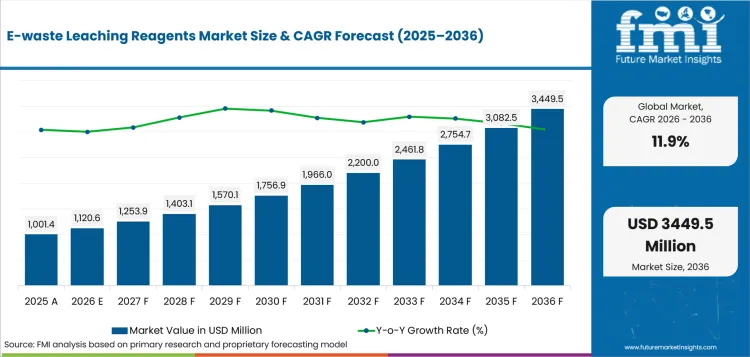
| Metric | Value |
|---|---|
| 2026 Market Size | USD 1,120.6 million |
| 2036 Market Size | USD 3,449.5 million |
| Forecast CAGR (2026-2036) | 11.9% |
| Leading Reagent Type | Acid Leachants |
| Acid Leachants Share (2026) | 45.0% |
| Leading Target Metal | Copper |
| Copper Share (2026) | 41.0% |
| Leading Feedstock | Printed Circuit Boards |
| Printed Circuit Boards Share (2026) | 52.0% |
| Fastest-growing Country | China |
| China CAGR by 2036 | 13.6% |
Summary of the E-waste Leaching Reagents Market
| Market Signal | Commercial Impact |
|---|---|
| Demand and Growth Drivers | Demand for e-waste leaching reagents is projected to expand through 2036 as electronics recyclers and hydrometallurgical facilities increase urban mining activities to recover valuable metals from electronic waste streams.
|
| Product and Segment View | Acid leachants, copper recovery, printed circuit board processing, and direct bulk supply continue to lead their respective market segments.
|
| Geography and Growth Outlook | Asia continues to lead market expansion as governments strengthen formal recycling infrastructure and resource recovery initiatives.
|
| Competitive Landscape | Competition increasingly focuses on reagent efficiency, metal recovery performance, and sustainable recycling solutions.
|
| Analyst Perspective | E-waste leaching reagents are becoming a strategic component of urban mining as recyclers seek higher recovery efficiency, process consistency, and environmentally responsible metal extraction.
- Nikhil Kaitwade, Principal Analyst at Future Market Insights |
Supplier selection is shifting toward recovery yield and residue documentation. ITU and UNITAR reported in March 2024 that global e-waste reached 62 billion kg in 2022. Only 22.3% was formally collected and recycled. This gap supports more structured metal recovery from e-waste investment. Buyers need safer routes for boards and connectors.
Which factors support expansion in the e-waste leaching reagents market?
Formal recycling growth and payable metal recovery support reagent spending across controlled hydrometallurgy routes.
- Market value is supported by PCB and connector processing before metal recycling buyers add higher-value purification steps.
- Supplier pricing reflects reagent strength and safety documentation before plant service support affects repeat contracts.
- Revenue improves due to conversion of mixed boards into copper and precious metal streams under documented recovery routes.
- Retail and OEM take-back programs increase feedstock visibility for processors that can document residues and recovered metals.
Why is the e-waste leaching reagents market growing?
Formal e-waste processing is increasing reagent demand through controlled metal recovery after shredding and board separation.
Growth is supported by the gap between e-waste generation and documented recycling. UNITAR reported in March 2024 that global e-waste is on track to reach 82 million tonnes by 2030. That gap makes waste recycling services more important for formal feedstock capture and creates demand for selective reagent systems. Municipal programs also make waste management services relevant to feedstock planning.
The value case is clear in streams that carry copper and precious metals. ITU reported that metals embedded in 2022 e-waste were valued at USD 91 billion. Buyers are therefore screening suppliers on recovery value and effluent control instead of only price per tonne of reagent.
How is the e-waste leaching reagents market segmented?
The e-waste leaching reagents industry is segmented by reagent type, target metal, feedstock, end use, and sales channel.
- Acid leachants are projected to hold 45.0% share in 2026 due to their fit for current copper recovery routes.
- Copper is expected to hold 41.0% share in 2026, supported by base-metal recovery volume from printed circuit boards.
- Printed circuit boards are anticipated to hold 52.0% share in 2026, attributable to higher recovered metal value per tonne.
- E-waste recyclers are forecast to hold 43.0% share in 2026, driven by wet recovery additions among authorized processors.
- Direct bulk supply is estimated to hold 57.0% share in 2026 due to reagent strength control and delivery reliability.
Which reagent type category holds a notable share in the e-waste leaching reagents market?
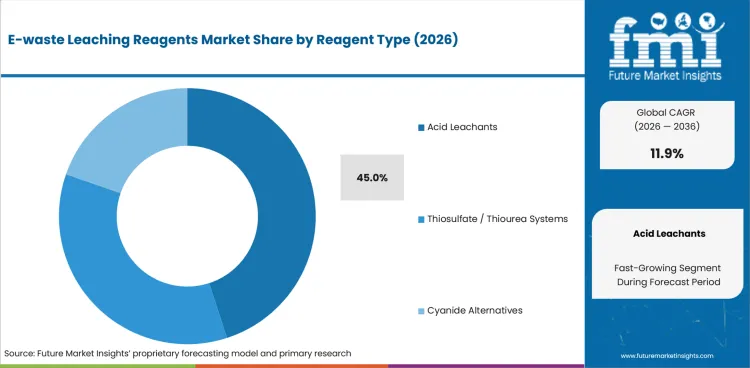
- Acid leachants are projected to account for 45.0% share in 2026, supported by copper-bearing boards and plant familiarity.
- Cyanide alternatives gain testing interest among refiners seeking safer gold and silver recovery routes.
How does the target metal segment perform in the e-waste leaching reagents market?
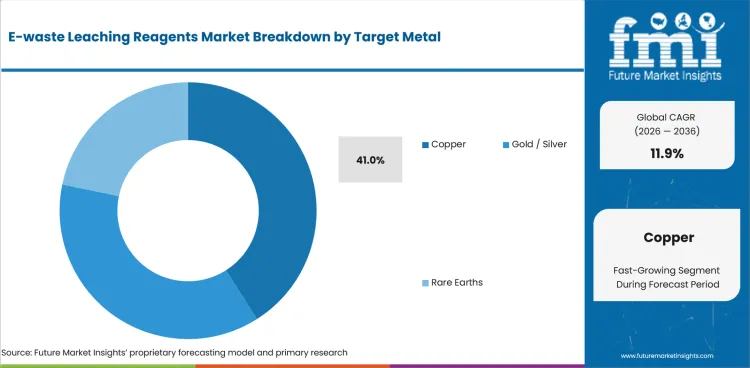
- Copper is expected to represent 41.0% share in 2026 owing to board tonnage that supports larger reagent volumes.
- Gold and silver recovery remains value-focused, supported by selective systems that control base-metal interference.
What drives demand across feedstock options in the e-waste leaching reagents market?
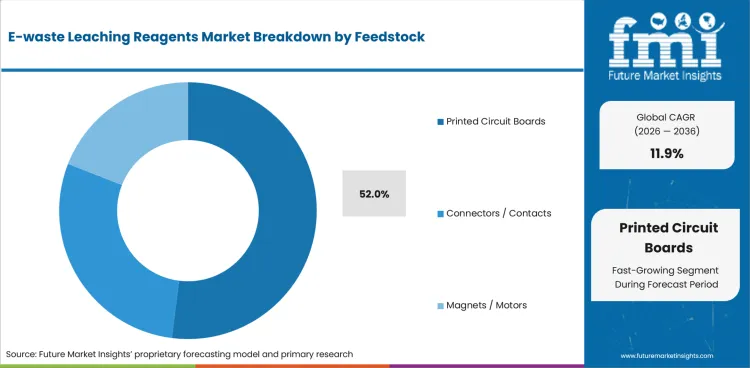
- Printed circuit boards are anticipated to hold 52.0% share in 2026, attributable to higher metal value per tonne.
- Magnets and motors require different pretreatment. This keeps rare-earth recovery more selective than board leaching.
Which end-use segment shows a prominent position in the e-waste leaching reagents market?
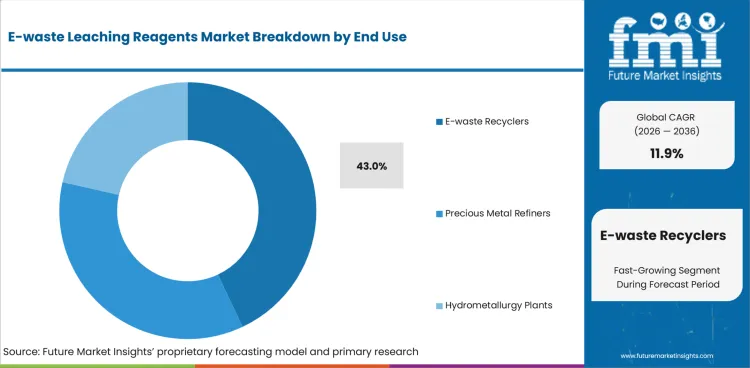
- E-waste recyclers are projected to account for 43.0% share in 2026, driven by wet recovery additions by more operators.
- Precious metal refiners buy selective systems for e-scrap that carries gold and silver despite base-metal interference.
How are buyers selecting across sales channel options in the e-waste leaching reagents market?
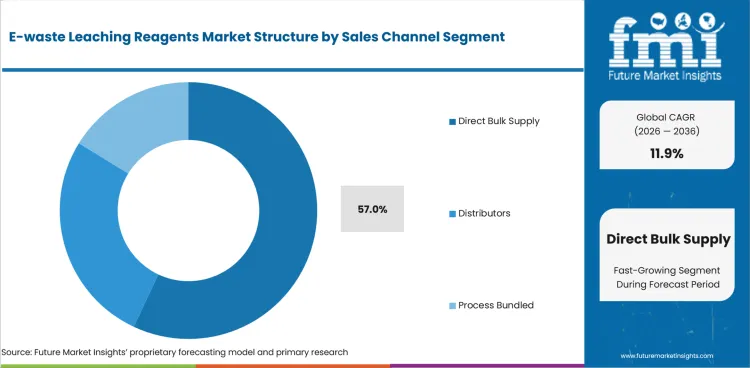
- Direct bulk supply is estimated to hold 57.0% share in 2026, supported by dosing accuracy and delivery reliability.
- Process-bundled sales gain relevance due to buyer need for reagent chemistry and residue management guidance.
What are the driver, restraints, and opportunities in the e-waste leaching reagents market?
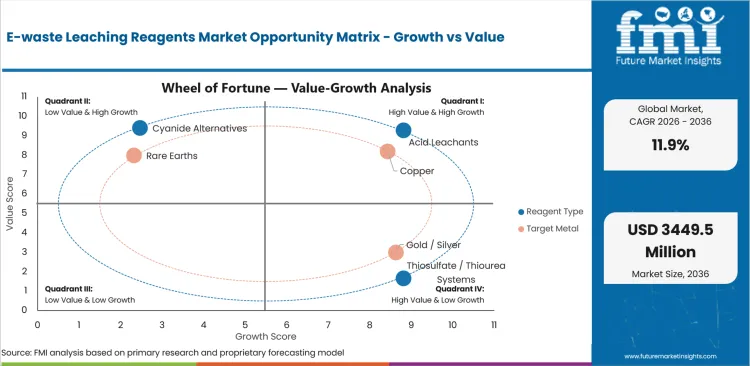
Board-value recovery supports growth while feedstock variability and residue treatment limit faster adoption.
- Driver: Printed circuit board value is expected to support reagent use in controlled copper and precious metal recovery.
- Restraint: Mixed e-waste composition can raise reagent consumption and reduce predictable recovery yields.
- Opportunity: Lower-toxicity leaching agents can gain testing demand among refiners needing safer gold and silver routes.
E-waste Leaching Reagents Market Demand Outlook
Demand is moving toward reagent packages that combine metal selectivity with residue control. ITU reported in March 2024 that only 22.3% of global e-waste was formally collected and recycled in 2022. This creates a practical opening for formal processors that can recover metal value and document waste-liquid handling.
Board Metal Recovery and Feedstock Discipline
Printed circuit boards are the main feedstock route for near-term reagent demand. UNITAR reported in March 2024 that small IT and telecommunication equipment generated 4.6 million tonnes of e-waste in 2022. Better collection of this stream is expected to support reagent trials for boards and connectors.
Residue Control and Low-toxicity Chemistry
Alternative systems need proof against established cyanide and acid routes. Suppliers serving battery materials recycling face similar scrutiny around liquid residues and trace metal recovery. E-waste buyers are expected to ask for comparable documentation before approving new reagent packages. Supplier portfolios can overlap with beneficiation reagents for plants adapting mining chemistry to urban scrap.
Which countries are growing fastest in the e-waste leaching reagents market?
China 13.6% CAGR, India 13.1% CAGR, United States 12.4% CAGR, South Korea 12.2% CAGR, Germany 11.8% CAGR, France 11.4% CAGR, United Kingdom 11.2% CAGR, and Japan 10.9% CAGR through 2036.
.webp "Top Country Growth Comparison E Waste Leaching Reagents Market Cagr (2026 2036)")
| Country | CAGR |
|---|---|
| China | 13.6% |
| India | 13.1% |
| United States | 12.4% |
| South Korea | 12.2% |
| Germany | 11.8% |
| France | 11.4% |
| United Kingdom | 11.2% |
| Japan | 10.9% |
Source: Future Market Insights, 2026.
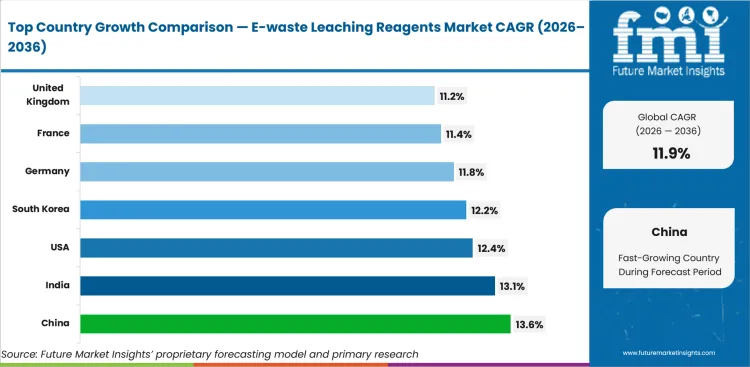
How do country-level CAGRs compare in the e-waste leaching reagents market?
China and India show the most material country outlooks, while Japan records a more selective but technically disciplined expansion profile.
- China is forecast to record 13.6% CAGR by 2036, supported by appliance trade-in policy and formal recycling scale.
- India is forecast to record 13.1% CAGR by 2036, led by authorized recycler growth and EPR reporting.
- United States is forecast to record 12.4% CAGR by 2036, attributable to domestic recovery capacity and certified recycler demand.
- South Korea is forecast to record 12.2% CAGR by 2036, reflecting electronics manufacturing depth and precious metal recovery links.
- Germany is forecast to record 11.8% CAGR by 2036, supported by strict WEEE rules and established metals processing.
- France is forecast to record 11.4% CAGR by 2036, backed by organized WEEE networks and local recycling operators.
- United Kingdom is forecast to record 11.2% CAGR by 2036, shaped by WEEE evidence discipline and approved treatment routes.
- Japan is forecast to record 10.9% CAGR by 2036, reinforced by manufacturer recycling discipline and selective refiner demand.
How is the e-waste leaching reagents market forecast developing in China?
A 13.6% CAGR through 2036 reflects appliance trade-in policy and formal recycling scale.
Country Market Snapshot Table
| Parameter | Value |
|---|---|
| Market Size in 2025 (Value) | USD 244.7 million |
| Market Size in 2026 (Value) | USD 278.0 million |
| Market Forecast in 2036 (Value) | USD 995.0 million |
| CAGR (2026 to 2036) | 13.6% |
| Years Considered | 2021 to 2036 |
| Base Year | 2025 |
| Forecast Period | 2026 to 2036 |
| Units Considered | Value (USD million) |
| Leading Sub-Region | Beijing-Tianjin-Hebei and Yangtze River Delta recovery corridors |
China E-waste Leaching Reagents Market Outlook
China reagent demand is driven by appliance trade-in policy and state-backed resource recycling. The State Council plan and China Resources Recycling Group create clearer feedstock channels for boards and appliance scrap.
Local buyers assess acids and oxidants on recovery yield before price. Suppliers that document residue handling for recycling parks should be better placed in bulk contracts.
Key Growth Drivers
- Appliance trade-in policy is expected to increase formal feedstock. The State Council March 2024 plan targets a 30% rise in used household appliance recycling by 2027.
- China demand gains support from new recycling infrastructure. The China Resources Recycling Group was established in October 2024 and carried CNY 10 billion in registered capital.
- Large board processors need bulk acids and oxidants that can handle variable copper fractions.
- Domestic electronics brands are expected to support higher-quality collection streams via trade-in channels.
Key Restraints
- Feedstock variability can raise reagent use in mixed appliance streams before valuable boards are separated.
- Residue compliance can slow cyanide-alternative trials if effluent treatment capacity is not added early.
- Price pressure remains visible in bulk reagent contracts. China’s 2027 recycling target shifts more volume into formal channels.
What makes China unique
China combines appliance trade-in policy with large electronics processing scale.
Key Companies
- China Resources Recycling Group
- TCL Environmental Technology
- GEM Co., Ltd.
- ATRenew Inc.
- China Minmetals
- China Baowu Steel Group
Sales & Marketing Channels
- State-backed recycling platforms
- OEM trade-in programs
- Industrial chemical distributors
- Regional recycling parks
- Direct bulk reagent contracts
- Smelter procurement
Country Segment Breakdown Table
| Segment | Sub-Segments |
|---|---|
| By Reagent Type | Acid Leachants · Thiosulfate / Thiourea Systems · Cyanide Alternatives · Oxidants / Reductants |
| By Target Metal | Copper · Gold / Silver · Rare Earths · Nickel / Cobalt / Other |
| By Feedstock | Printed Circuit Boards · Connectors / Contacts · Magnets / Motors · Mixed E-waste |
| By End Use | E-waste Recyclers · Precious Metal Refiners · Hydrometallurgy Plants · Smelter Feed Pretreatment |
| By Sales Channel | Direct Bulk Supply · Distributors · Process Bundled |
| Key Sub-Regions Covered, Urban Recycling Clusters | Beijing-Tianjin-Hebei, Yangtze River Delta |
Frequently Asked Questions
How fast is China e-waste leaching reagents market growing?
Sales in China are forecast to expand at 13.6% CAGR from 2026 to 2036.
Who leads China e-waste leaching reagents market?
China Resources Recycling Group, TCL Environmental Technology, GEM Co., Ltd., and ATRenew Inc. compete through local or regional recovery presence.
What is driving adoption in China e-waste leaching reagents market?
Adoption is supported by formal collection and traceable residue control.
What supports e-waste leaching reagents market growth in India?
A 13.1% CAGR through 2036 reflects authorized recycler growth and registered feedstock gains.
Country Market Snapshot Table
| Parameter | Value |
|---|---|
| Market Size in 2025 (Value) | USD 76.0 million |
| Market Size in 2026 (Value) | USD 86.0 million |
| Market Forecast in 2036 (Value) | USD 294.5 million |
| CAGR (2026 to 2036) | 13.1% |
| Years Considered | 2021 to 2036 |
| Base Year | 2025 |
| Forecast Period | 2026 to 2036 |
| Units Considered | Value (USD million) |
| Leading Sub-Region | Delhi NCR, Bengaluru, Hyderabad, Pune, and Chennai recycling clusters |
India E-waste Leaching Reagents Market Outlook
India reagent industry is expected to be driven by the shift from dismantling into authorized wet recovery. The CPCB EPR portal gives recyclers and producers a clearer route for registered feedstock movement.
Buyers in India are likely to value-wastewater guidance and practical dosing support. Suppliers that serve authorized recyclers can gain access by reducing trial risk for PCB fractions.
Key Growth Drivers
- India demand is supported by formal EPR reporting. PIB reported in August 2025 that the CPCB online E-Waste EPR portal covers producers and recyclers.
- Authorized processing demand is reinforced by India’s e-waste outlook. NITI Aayog reported in 2026 that e-waste could reach 14 MMT by 2030.
- Recyclers are expected to buy process support alongside reagents during the move from dismantling into wet recovery.
- Local suppliers gain relevance for buyers needing lower-capex reagent packages and wastewater guidance.
Key Restraints
- Informal collection can restrict consistent board supply for authorized leaching plants.
- Wastewater treatment costs can delay wet lines for recyclers operating under tight capex budgets.
- Regulatory audits can slow new reagent use after CPCB rules were updated on 17 May 2024.
What makes India unique
India offers formalization upside with authorized recyclers gaining more registered feedstock.
Key Companies
- Attero
- E-Parisaraa
- Cerebra Integrated Technologies
- Eco Recycling Ltd.
- TES-AMM India
- Namo eWaste Management
Sales & Marketing Channels
- Authorized recycler contracts
- CPCB EPR portal procurement
- Industrial chemical dealers
- Direct technical support sales
- OEM take-back programs
- Regional aggregator networks
Country Segment Breakdown Table
| Segment | Sub-Segments |
|---|---|
| By Reagent Type | Acid Leachants · Thiosulfate / Thiourea Systems · Cyanide Alternatives · Oxidants / Reductants |
| By Target Metal | Copper · Gold / Silver · Rare Earths · Nickel / Cobalt / Other |
| By Feedstock | Printed Circuit Boards · Connectors / Contacts · Magnets / Motors · Mixed E-waste |
| By End Use | E-waste Recyclers · Precious Metal Refiners · Hydrometallurgy Plants · Smelter Feed Pretreatment |
| By Sales Channel | Direct Bulk Supply · Distributors · Process Bundled |
| Key Sub-Regions Covered, Urban Recycling Clusters | Delhi NCR, Bengaluru, Hyderabad, Pune, Chennai |
Frequently Asked Questions
How fast is India e-waste leaching reagents market growing?
Sales in India are forecast to expand at 13.1% CAGR from 2026 to 2036.
Who leads India e-waste leaching reagents market?
Attero, E-Parisaraa, Cerebra Integrated Technologies, and Eco Recycling Ltd. compete through local or regional recovery presence.
What is driving adoption in India e-waste leaching reagents market?
Adoption is supported by formal collection and traceable residue control.
How fast is the e-waste leaching reagents market growing in the United States?
A 12.4% CAGR through 2036 reflects certified recycling discipline and domestic recovery capacity.
Country Market Snapshot Table
| Parameter | Value |
|---|---|
| Market Size in 2025 (Value) | USD 191.3 million |
| Market Size in 2026 (Value) | USD 215.0 million |
| Market Forecast in 2036 (Value) | USD 692.0 million |
| CAGR (2026 to 2036) | 12.4% |
| Years Considered | 2021 to 2036 |
| Base Year | 2025 |
| Forecast Period | 2026 to 2036 |
| Units Considered | Value (USD million) |
| Leading Sub-Region | Great Lakes, Southeast, Texas, and West Coast recycling corridors |
United States E-waste Leaching Reagents Market Outlook
United States reagent demand is tied to certified electronics recycling and domestic metal recovery. EPA certification discipline makes batch records and safe reagent handling more important for wet-process trials.
Buyers screen suppliers on audit trails and recovered metal value. Domestic copper supply pressure gives PCB recovery projects a clearer reason to test acid leachants and lower-toxicity systems.
Key Growth Drivers
- United States demand is supported by certification discipline. EPA noted in August 2025 that two accredited standards exist for electronics recyclers.
- Secondary copper interest gains support from USGS January 2025 data showing U.S. mine copper output declined 3% in 2024.
- Domestic PCB recovery projects are expected to lift testing for acid leachants and lower-toxicity systems.
- Direct bulk supply is favored by processors that need audit trails and consistent batch documentation.
Key Restraints
- Copper price exposure can restrict reagent trials. USGS projected the COMEX copper price to average USD 4.80 per pound in 2025.
- State-level handling rules can add permit work before recyclers introduce new liquid processes.
- Certified recyclers may reject chemistries that lack safety data or residue treatment instructions.
What makes United States unique
The United States connects reagent buying with domestic metal security and certified recycling.
Key Companies
- Aurubis Richmond LLC
- Mint Innovation
- ERI
- Sims Lifecycle Services
- BASF Environmental Catalyst and Metal Solutions
- Umicore Precious Metals Recycling
Sales & Marketing Channels
- Direct recycler contracts
- ITAD procurement programs
- Industrial reagent distributors
- Defense and electronics supply chains
- Certified recycler networks
- Closed-loop manufacturer programs
Country Segment Breakdown Table
| Segment | Sub-Segments |
|---|---|
| By Reagent Type | Acid Leachants · Thiosulfate / Thiourea Systems · Cyanide Alternatives · Oxidants / Reductants |
| By Target Metal | Copper · Gold / Silver · Rare Earths · Nickel / Cobalt / Other |
| By Feedstock | Printed Circuit Boards · Connectors / Contacts · Magnets / Motors · Mixed E-waste |
| By End Use | E-waste Recyclers · Precious Metal Refiners · Hydrometallurgy Plants · Smelter Feed Pretreatment |
| By Sales Channel | Direct Bulk Supply · Distributors · Process Bundled |
| Key Sub-Regions Covered, Urban Recycling Clusters | Great Lakes, Southeast, Texas, West Coast |
Frequently Asked Questions
How fast is United States e-waste leaching reagents market growing?
Sales in United States are forecast to expand at 12.4% CAGR from 2026 to 2036.
Who leads United States e-waste leaching reagents market?
Aurubis Richmond LLC, Mint Innovation, ERI, and Sims Lifecycle Services compete through local or regional recovery presence.
What is driving adoption in United States e-waste leaching reagents market?
Adoption is supported by formal collection and traceable residue control.
How does South Korea perform in the e-waste leaching reagents market?
A 12.2% CAGR through 2036 reflects electronics manufacturing depth and precious-metal recovery links.
Country Market Snapshot Table
| Parameter | Value |
|---|---|
| Market Size in 2025 (Value) | USD 54.4 million |
| Market Size in 2026 (Value) | USD 61.0 million |
| Market Forecast in 2036 (Value) | USD 192.9 million |
| CAGR (2026 to 2036) | 12.2% |
| Years Considered | 2021 to 2036 |
| Base Year | 2025 |
| Forecast Period | 2026 to 2036 |
| Units Considered | Value (USD million) |
| Leading Sub-Region | Seoul, Incheon, Gyeonggi, Ulsan, and Chungcheong recycling corridors |
South Korea E-waste Leaching Reagents Market Outlook
South Korea reagent demand is tied to electronics manufacturing scrap and precious metal recovery. The EEEV framework gives recyclers a policy base for recovering valuable metals from electrical equipment.
Specialist refiners shape supplier selection in South Korea. LS MnM and TORECOM show why local hydrometallurgical capacity can support copper and precious metal leaching trials.
Key Growth Drivers
- South Korea demand is shaped by statutory recovery goals. The IEA policy database showed active EEEV Act status in June 2025.
- Specialist refining demand gains support from LS MnM’s recycling subsidiaries. LS MnM states that TORECOM holds a domestic hydrometallurgical recycling position for precious metals.
- Electronics manufacturing clusters create stable board and connector streams for selective leaching trials.
- Local refiners are expected to buy reagents that improve gold and copper recovery without adding high residue burden.
Key Restraints
- Public feedstock data are less visible than policy data, which can limit supplier forecasting accuracy.
- Complex semiconductor and electronics scrap can require more sampling before reagent contracts are approved.
- Regulatory expansion can add classification work under South Korea’s EEEV framework for electrical and electronic equipment recovery.
What makes South Korea unique
South Korea aligns electronics manufacturing depth with precious-metal recovery capability.
Key Companies
- LS MnM
- GRM
- TORECOM
- Korea Electronics Recycling Cooperative
- SK tes Korea
- Korea Zinc
Sales & Marketing Channels
- Electronics OEM recycling programs
- Specialist refiner procurement
- Industrial chemical distributors
- ITAD service channels
- Smelter raw material buying
- EPR-compliance service providers
Country Segment Breakdown Table
| Segment | Sub-Segments |
|---|---|
| By Reagent Type | Acid Leachants · Thiosulfate / Thiourea Systems · Cyanide Alternatives · Oxidants / Reductants |
| By Target Metal | Copper · Gold / Silver · Rare Earths · Nickel / Cobalt / Other |
| By Feedstock | Printed Circuit Boards · Connectors / Contacts · Magnets / Motors · Mixed E-waste |
| By End Use | E-waste Recyclers · Precious Metal Refiners · Hydrometallurgy Plants · Smelter Feed Pretreatment |
| By Sales Channel | Direct Bulk Supply · Distributors · Process Bundled |
| Key Sub-Regions Covered, Urban Recycling Clusters | Seoul, Incheon, Gyeonggi, Ulsan, Chungcheong |
Frequently Asked Questions
How fast is South Korea e-waste leaching reagents market growing?
Sales in South Korea are forecast to expand at 12.2% CAGR from 2026 to 2036.
Who leads South Korea e-waste leaching reagents market?
LS MnM, GRM, TORECOM, and Korea Electronics Recycling Cooperative compete through local or regional recovery presence.
What is driving adoption in South Korea e-waste leaching reagents market?
Adoption is supported by formal collection and traceable residue control.
What is shaping e-waste leaching reagents demand in Germany?
An 11.8% CAGR through 2036 reflects strict WEEE controls and established metal-processing capacity.
Country Market Snapshot Table
| Parameter | Value |
|---|---|
| Market Size in 2025 (Value) | USD 64.4 million |
| Market Size in 2026 (Value) | USD 72.0 million |
| Market Forecast in 2036 (Value) | USD 219.7 million |
| CAGR (2026 to 2036) | 11.8% |
| Years Considered | 2021 to 2036 |
| Base Year | 2025 |
| Forecast Period | 2026 to 2036 |
| Units Considered | Value (USD million) |
| Leading Sub-Region | North Rhine-Westphalia, Bavaria, Saxony, and Hamburg logistics corridors |
Germany E-waste Leaching Reagents Market Outlook
Germany reagent demand is tied to strict WEEE control and high equipment flow. Eurostat data on EEE placed on the market supports the need for formal board and connector recovery routes.
Suppliers in Germany need safety documentation and reliable bulk delivery. Chemical clusters and metals processors give reagent suppliers a stronger base for residue-controlled trials.
Key Growth Drivers
- Germany demand is supported by high equipment flow. Eurostat reported in October 2025 that Germany placed 38.9 kg of EEE per person on the market in 2023.
- Formal collection access supports board feedstock. German take-back rules cover small WEEE up to 25 cm at eligible retailers.
- Reagent suppliers benefit from chemical clusters that can support safety data and consistent bulk deliveries.
- Smelter buyers are expected to favor suppliers that can document trace metals and residue handling.
Key Restraints
- Collection-rate pressure can limit feedstock visibility. EEA reported in March 2025 that the EU WEEE collection rate was 40.6% in 2022.
- Strict permitting can delay wet-process additions that require new wastewater treatment controls.
- Commodity acids face margin pressure from buyer comparisons between reagent cost and payable metal yield.
What makes Germany unique
Germany combines strict WEEE controls with a deep metal refining and chemical supplier base.
Key Companies
- Aurubis AG
- Heraeus Precious Metals
- BASF SE
- REMONDIS Electrorecycling
- TSR Recycling
- Electrocycling GmbH
Sales & Marketing Channels
- Certified WEEE processors
- Industrial chemical distributors
- Smelter procurement teams
- Producer responsibility schemes
- Direct bulk reagent supply
- Metals recovery service partners
Country Segment Breakdown Table
| Segment | Sub-Segments |
|---|---|
| By Reagent Type | Acid Leachants · Thiosulfate / Thiourea Systems · Cyanide Alternatives · Oxidants / Reductants |
| By Target Metal | Copper · Gold / Silver · Rare Earths · Nickel / Cobalt / Other |
| By Feedstock | Printed Circuit Boards · Connectors / Contacts · Magnets / Motors · Mixed E-waste |
| By End Use | E-waste Recyclers · Precious Metal Refiners · Hydrometallurgy Plants · Smelter Feed Pretreatment |
| By Sales Channel | Direct Bulk Supply · Distributors · Process Bundled |
| Key Sub-Regions Covered, Urban Recycling Clusters | North Rhine-Westphalia, Bavaria, Saxony, Hamburg logistics corridors |
Frequently Asked Questions
How fast is Germany e-waste leaching reagents market growing?
Sales in Germany are forecast to expand at 11.8% CAGR from 2026 to 2036.
Who leads Germany e-waste leaching reagents market?
Aurubis AG, Heraeus Precious Metals, BASF SE, and REMONDIS Electrorecycling compete through local or regional recovery presence.
What is driving adoption in Germany e-waste leaching reagents market?
Adoption is supported by formal collection and traceable residue control.
What is the e-waste leaching reagents outlook in France?
An 11.4% CAGR through 2036 reflects organized WEEE treatment networks and local recycling operators.
Country Market Snapshot Table
| Parameter | Value |
|---|---|
| Market Size in 2025 (Value) | USD 53.9 million |
| Market Size in 2026 (Value) | USD 60.0 million |
| Market Forecast in 2036 (Value) | USD 176.6 million |
| CAGR (2026 to 2036) | 11.4% |
| Years Considered | 2021 to 2036 |
| Base Year | 2025 |
| Forecast Period | 2026 to 2036 |
| Units Considered | Value (USD million) |
| Leading Sub-Region | Ile-de-France, Auvergne-Rhone-Alpes, Hauts-de-France, and Normandy recovery corridors |
France E-waste Leaching Reagents Market Outlook
France reagent demand is tied to organized WEEE networks and local treatment capacity. Eurostat collection data and Paprec processing capacity support a practical base for selective chemistry trials.
French buyers are likely to favor suppliers that provide local safety documentation and regional service. Eco-organization tenders can make residue evidence and recovered-metal traceability important during supplier selection.
Key Growth Drivers
- France demand is supported by collection maturity. Eurostat reported France at a 44.2% WEEE collection rate for 2023.
- Local treatment capacity supports reagent trials. Paprec states that it processes 100,000 tonnes of WEEE per year across eight plants.
- Operators are expected to use selective chemistry for board fractions carrying copper and precious metals.
- Chemical suppliers gain relevance for recyclers needing French-language safety documents and regional delivery support.
Key Restraints
- France still needs better collection to reach directive ambition. The 65% WEEE target remains above current performance.
- High compliance expectations can slow adoption of new leachants that lack residue handling evidence.
- Feedstock sorting gaps can reduce recovery economics before metals enter solution.
What makes France unique
France has organized WEEE treatment networks and local operators with recycling capacity.
Key Companies
- Veolia
- SUEZ
- Paprec D3E
- Derichebourg Environnement
- WEEECycling
- Solvay
Sales & Marketing Channels
- Eco-organization tender channels
- Certified recycler procurement
- Industrial chemical distributors
- Direct refiner contracts
- Public-private collection programs
- Regional treatment networks
Country Segment Breakdown Table
| Segment | Sub-Segments |
|---|---|
| By Reagent Type | Acid Leachants · Thiosulfate / Thiourea Systems · Cyanide Alternatives · Oxidants / Reductants |
| By Target Metal | Copper · Gold / Silver · Rare Earths · Nickel / Cobalt / Other |
| By Feedstock | Printed Circuit Boards · Connectors / Contacts · Magnets / Motors · Mixed E-waste |
| By End Use | E-waste Recyclers · Precious Metal Refiners · Hydrometallurgy Plants · Smelter Feed Pretreatment |
| By Sales Channel | Direct Bulk Supply · Distributors · Process Bundled |
| Key Sub-Regions Covered, Urban Recycling Clusters | Ile-de-France, Auvergne-Rhone-Alpes, Hauts-de-France, Normandy |
Frequently Asked Questions
How fast is France e-waste leaching reagents market growing?
Sales in France are forecast to expand at 11.4% CAGR from 2026 to 2036.
Who leads France e-waste leaching reagents market?
Veolia, SUEZ, Paprec D3E, and Derichebourg Environnement compete through local or regional recovery presence.
What is driving adoption in France e-waste leaching reagents market?
Adoption is supported by formal collection and traceable residue control.
How is the e-waste leaching reagents market performing in the United Kingdom?
An 11.2% CAGR through 2036 reflects WEEE evidence discipline and approved treatment routes.
Country Market Snapshot Table
| Parameter | Value |
|---|---|
| Market Size in 2025 (Value) | USD 48.6 million |
| Market Size in 2026 (Value) | USD 54.0 million |
| Market Forecast in 2036 (Value) | USD 156.1 million |
| CAGR (2026 to 2036) | 11.2% |
| Years Considered | 2021 to 2036 |
| Base Year | 2025 |
| Forecast Period | 2026 to 2036 |
| Units Considered | Value (USD million) |
| Leading Sub-Region | Midlands, North West, London, Scotland, and South East treatment corridors |
United Kingdom E-waste Leaching Reagents Market Outlook
United Kingdom reagent demand is tied to WEEE evidence rules and approved treatment routes. GOV.UK reporting gives processors a clearer basis for tracking collection and treatment flows.
Suppliers need to show dosing records and safe-storage support for AATF customers. Precious metal recovery partnerships make circuit board and contact chemistry more relevant for local processors.
Key Growth Drivers
- United Kingdom demand is supported by current reporting. GOV.UK updated WEEE data for quarter 1 of 2026 in June 2026.
- Traceability needs gain support from UK evidence rules. GOV.UK guidance states in March 2026 that approved parties provide WEEE evidence for reuse and treatment.
- Precious metal recovery partnerships create demand for chemistry suitable for circuit boards and contacts.
- Approved treatment facilities are expected to prefer suppliers that provide dosing records and safe-storage support.
Key Restraints
- Distributor take-back rules can narrow channel flexibility under UK one-for-one like-for-like collection guidance.
- Smaller WEEE operators may avoid wet recovery if liquid residues raise compliance costs.
- Market scale is below the United States and China, which limits bulk reagent leverage.
What makes United Kingdom unique
The United Kingdom links reagent demand with WEEE reporting and approved treatment channels.
Key Companies
- The Royal Mint
- Sims Lifecycle Services
- SWEEEP Kuusakoski
- Environcom
- Enva
- Mint Innovation UK partners
Sales & Marketing Channels
- Approved authorized treatment facilities
- Producer compliance schemes
- ITAD procurement channels
- Precious metal recovery partnerships
- Specialist WEEE processors
- Direct technical service contracts
Country Segment Breakdown Table
| Segment | Sub-Segments |
|---|---|
| By Reagent Type | Acid Leachants · Thiosulfate / Thiourea Systems · Cyanide Alternatives · Oxidants / Reductants |
| By Target Metal | Copper · Gold / Silver · Rare Earths · Nickel / Cobalt / Other |
| By Feedstock | Printed Circuit Boards · Connectors / Contacts · Magnets / Motors · Mixed E-waste |
| By End Use | E-waste Recyclers · Precious Metal Refiners · Hydrometallurgy Plants · Smelter Feed Pretreatment |
| By Sales Channel | Direct Bulk Supply · Distributors · Process Bundled |
| Key Sub-Regions Covered, Urban Recycling Clusters | Midlands, North West, London, Scotland, South East |
Frequently Asked Questions
How fast is United Kingdom e-waste leaching reagents market growing?
Sales in United Kingdom are forecast to expand at 11.2% CAGR from 2026 to 2036.
Who leads United Kingdom e-waste leaching reagents market?
The Royal Mint, Sims Lifecycle Services, SWEEEP Kuusakoski, and Environcom compete through local or regional recovery presence.
What is driving adoption in United Kingdom e-waste leaching reagents market?
Adoption is supported by formal collection and traceable residue control.
What is shaping the e-waste leaching reagents market in Japan?
A 10.9% CAGR through 2036 reflects manufacturer recycling discipline and selective refiner demand.
Country Market Snapshot Table
| Parameter | Value |
|---|---|
| Market Size in 2025 (Value) | USD 70.3 million |
| Market Size in 2026 (Value) | USD 78.0 million |
| Market Forecast in 2036 (Value) | USD 219.5 million |
| CAGR (2026 to 2036) | 10.9% |
| Years Considered | 2021 to 2036 |
| Base Year | 2025 |
| Forecast Period | 2026 to 2036 |
| Units Considered | Value (USD million) |
| Leading Sub-Region | Kanto, Kansai, Chubu, Kyushu, and Tohoku recycling corridors |
Japan E-waste Leaching Reagents Market Outlook
Japan reagent demand is tied to manufacturer recycling programs and high-purity refiner requirements. Panasonic PETEC and DOWA Eco-System show how appliance and e-scrap routes feed selective metal recovery.
Buyers in Japan are likely to approve reagent changes only after clear yield and residue evidence. Established smelter routes make compatibility more important than broad substitution.
Key Growth Drivers
- Japan demand gains support from organized appliance recycling. Panasonic reported in September 2025 that PETEC had recycled 20 million home appliances from its 2001 start to May 2025.
- E-scrap refining demand is reinforced by DOWA Eco-System’s official statement that it can recycle 22 metallic elements from e-scrap.
- Smelter buyers are expected to favor reagent systems that improve purity without disrupting established recovery routes.
- Manufacturer recycling programs create controlled streams for selective reagent testing.
Key Restraints
- Adoption remains selective in established smelter routes that already manage high-grade printed circuit board streams.
- Japan requires careful evidence before reagent substitution in established appliance and electronics recovery chains.
- Processing economics can limit low-volume rare-earth recovery for magnets and motors that need different pretreatment.
What makes Japan unique
Japan favors high-purity recovery and documented chain-of-custody over broad reagent substitution.
Key Companies
- JX Metals Circular Solutions
- DOWA Eco-System
- Mitsubishi Materials
- Panasonic Eco Technology Center
- TANAKA Precious Metals
- Renet Japan Group
Sales & Marketing Channels
- Manufacturer recycling networks
- Smelter procurement teams
- Direct refiner contracts
- Home appliance recycling routes
- Industrial chemical suppliers
- Urban mining technology partnerships
Country Segment Breakdown Table
| Segment | Sub-Segments |
|---|---|
| By Reagent Type | Acid Leachants · Thiosulfate / Thiourea Systems · Cyanide Alternatives · Oxidants / Reductants |
| By Target Metal | Copper · Gold / Silver · Rare Earths · Nickel / Cobalt / Other |
| By Feedstock | Printed Circuit Boards · Connectors / Contacts · Magnets / Motors · Mixed E-waste |
| By End Use | E-waste Recyclers · Precious Metal Refiners · Hydrometallurgy Plants · Smelter Feed Pretreatment |
| By Sales Channel | Direct Bulk Supply · Distributors · Process Bundled |
| Key Sub-Regions Covered, Urban Recycling Clusters | Kanto, Kansai, Chubu, Kyushu, Tohoku |
Frequently Asked Questions
How fast is Japan e-waste leaching reagents market growing?
Sales in Japan are forecast to expand at 10.9% CAGR from 2026 to 2036.
Who leads Japan e-waste leaching reagents market?
JX Metals Circular Solutions, DOWA Eco-System, Mitsubishi Materials, and Panasonic Eco Technology Center compete through local or regional recovery presence.
What is driving adoption in Japan e-waste leaching reagents market?
Adoption is supported by formal collection and traceable residue control.
Who are the leading companies in the E-waste Leaching Reagents Market?
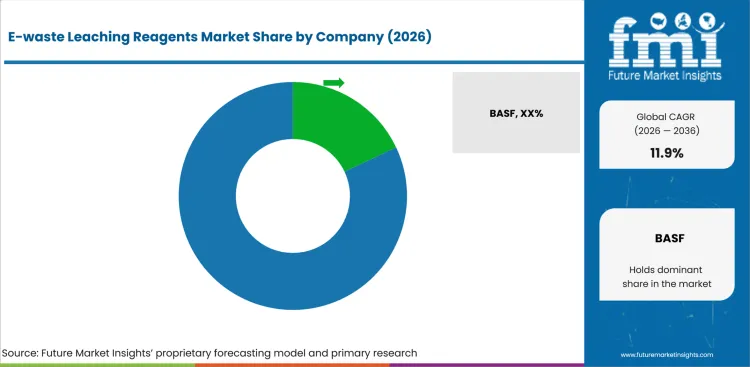
BASF, Solvay, Aurubis, Umicore, JX Advanced Metals, DOWA Eco-System, Mitsubishi Materials, Mint Innovation, Attero, and LS MnM are profiled in this market.
- Competition is based on reagent chemistry depth and safety documentation.
- Recovery-side companies influence reagent selection via commercial plants that define chemistry needs for metal recycling equipment and wet recovery systems.
- Hydrometallurgy specialists gain advantage by supporting acid balance and residue treatment.
- Regional recyclers improve supplier access by providing local feedstock insight and technical trial data.
The competitive base includes industrial chemical suppliers and metal refiners. Chemical suppliers compete on reagent strength and technical service. Recovery-side companies shape demand through plant trials on boards and mixed scrap.
Capital projects and operating footprints matter in this market. Aurubis opened its ASPA recycling plant in Belgium in September 2024. JX Advanced Metals started JX Metals Circular Solutions in July 2024. These moves support recycled metal supply planning by bringing more structured secondary metal recovery into commercial channels.
BASF and Solvay are positioned around industrial chemistry and customer support. Aurubis, Umicore, JX Advanced Metals, DOWA Eco-System, and Mitsubishi Materials are positioned around metals recovery and refining. Mint Innovation and Attero are positioned in city-scale recovery and regional e-waste processing that require process-ready chemistry.
How do top e-waste leaching reagents companies compare?
Companies differ by chemistry depth and residue support.
| Company | Hydrometallurgy Chemistry Depth | E-scrap Recovery Fit | Residue Compliance Support | Channel Reach | Geographic Footprint |
|---|---|---|---|---|---|
| BASF | High | Medium | High | Direct and distributor | Global |
| Solvay | High | Medium | High | Direct and distributor | Global |
| Aurubis | Medium | High | High | Direct scrap procurement | Europe and United States |
| Umicore | Medium | High | High | Direct industrial sourcing | Europe and global sourcing |
| JX Advanced Metals | Medium | High | High | Direct and partner channels | Japan and global |
| DOWA Eco-System | Medium | High | High | Direct refiner channels | Japan and Asia |
| Mitsubishi Materials | Medium | High | High | Digital and direct channels | Japan and global |
| Mint Innovation | Medium | High | Medium | Partnership and facility channels | Australia and United States |
| Attero | Medium | High | Medium | Direct recycler channels | India |
| LS MnM | Medium | High | High | Direct industrial channels | South Korea |
Source: Company disclosures and Future Market Insights analysis, 2026.
Who are the key players in the E-waste Leaching Reagents Market?
Global chemical suppliers and regional e-waste recyclers form the competitive set.
Key global companies leading the E-waste Leaching Reagents Market include:
- BASF
- Solvay
- Aurubis
- Umicore
- JX Advanced Metals
- DOWA Eco-System
- Mitsubishi Materials
- Mint Innovation
- Attero
- LS MnM
Key Developments in E-waste Leaching Reagents Market
- In September 2024, Aurubis opened its ASPA hydrometallurgical recycling plant in Beerse to extract tin and precious metals faster from anode sludges.
- In July 2024, JX Advanced Metals started JX Metals Circular Solutions for resource circulation of waste home appliances and electronic equipment.
- In March 2026, Mint Innovation and HP produced certified closed-loop recycled copper from printed circuit boards for PC manufacturing.
Key Players in the E-waste Leaching Reagents Market
Chemical reagent suppliers
- BASF
- Solvay
- Heraeus Precious Metals
Metal refiners and recovery companies
- Aurubis
- Umicore
- JX Advanced Metals
- DOWA Eco-System
- Mitsubishi Materials
- LS MnM
Regional e-waste recyclers and technology specialists
- Mint Innovation
- Attero
- ERI
- Sims Lifecycle Services
- Paprec D3E
- Veolia
- SUEZ
- GEM Co., Ltd.
E-waste Leaching Reagents Market - Report Scope
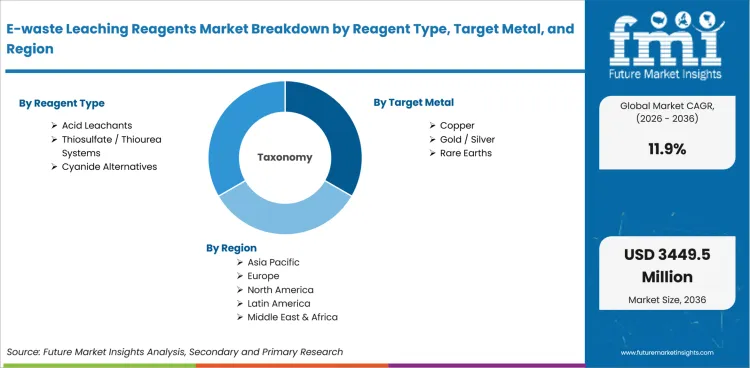
| Attribute | Detail |
|---|---|
| Forecast period | 2026 to 2036 |
| Historical period | 2021 to 2025 |
| Quantitative unit | USD million |
| Reagent Type | Acid Leachants, Thiosulfate / Thiourea Systems, Cyanide Alternatives, Oxidants / Reductants |
| Target Metal | Copper, Gold / Silver, Rare Earths, Nickel / Cobalt / Other |
| Feedstock | Printed Circuit Boards, Connectors / Contacts, Magnets / Motors, Mixed E-waste |
| End Use | E-waste Recyclers, Precious Metal Refiners, Hydrometallurgy Plants, Smelter Feed Pretreatment |
| Sales Channel | Direct Bulk Supply, Distributors, Process Bundled |
| Regions covered | North America, Latin America, Western Europe, Eastern Europe, East Asia, South Asia & Pacific, Middle East & Africa |
| Countries covered | United States, United Kingdom, Germany, France, Japan, China, South Korea, India |
| Key companies profiled | BASF, Solvay, Aurubis, Umicore, JX Advanced Metals, DOWA Eco-System, Mitsubishi Materials, Mint Innovation, Attero, LS MnM |
| Approach | Top-down and bottom-up modeling with source validation and company relevance checks |
Source: Future Market Insights, 2026.
E-waste Leaching Reagents Market - Scope & Definition
| Attribute | Detail |
|---|---|
| Market Definition | The market covers acids, thiosulfate systems, thiourea systems, cyanide alternatives, oxidants, and reductants used to dissolve metals from electronic scrap. |
| Functions Covered | Metal dissolution, selectivity control, oxidation and reduction support, acid balance, residue handling support. |
| Applications Covered | Printed circuit boards, connectors and contacts, magnets and motors, mixed e-waste, smelter feed pretreatment. |
| End-Use Industries | E-waste recyclers, precious metal refiners, hydrometallurgy plants, smelter feed pretreatment users. |
| Grades Covered | Industrial reagent grades, specialty hydrometallurgy grades, reagent packages with process support. |
| Inclusions | Commercially supplied leaching reagents used for e-waste metal recovery across the forecast period. |
| Exclusions | Mechanical shredders, smelting furnaces, collection bins, landfill treatment chemicals, battery-only recycling chemicals sold outside e-waste streams. |
E-waste Leaching Reagents Market - Research Methodology
| Method | Description |
|---|---|
| Primary Research | FMI analysts reviewed buyer input from recyclers, refiners, hydrometallurgy plant operators, reagent distributors, and recovery technology firms. |
| Desk Research | Desk research reviewed regulatory references, official e-waste statistics, company disclosures, product information, and public recycling documents. |
| Market Sizing & Forecasting | The model combined estimated reagent volume, contract pricing, target metal mix, feedstock use rates, and country-level formal recycling activity. |
| Data Validation | Forecasts were checked against e-waste generation, formal collection trends, metal recovery routes, and company evidence. |
E-waste Leaching Reagents Market Breakdown by Reagent Type, Target Metal, Feedstock, End Use, Sales Channel, and Region
E-waste Leaching Reagents Market Segmented by Reagent Type:
- Acid Leachants
- Thiosulfate / Thiourea Systems
- Cyanide Alternatives
- Oxidants / Reductants
E-waste Leaching Reagents Market Segmented by Target Metal:
- Copper
- Gold / Silver
- Rare Earths
- Nickel / Cobalt / Other
E-waste Leaching Reagents Market Segmented by Feedstock:
- Printed Circuit Boards
- Connectors / Contacts
- Magnets / Motors
- Mixed E-waste
E-waste Leaching Reagents Market Segmented by End Use:
- E-waste Recyclers
- Precious Metal Refiners
- Hydrometallurgy Plants
- Smelter Feed Pretreatment
E-waste Leaching Reagents Market Segmented by Sales Channel:
- Direct Bulk Supply
- Distributors
- Process Bundled
E-waste Leaching Reagents Market by Region:
- North America
- Latin America
- Western Europe
- Eastern Europe
- East Asia
- South Asia & Pacific
- Middle East & Africa
Research Sources and Bibliography
- International Telecommunication Union. (2024, March 20). The Global E-waste Monitor 2024.
- United Nations Institute for Training and Research. (2024, March 20). Global E-Waste Monitor 2024: Electronic waste rising five times faster than documented e-waste recycling.
- Eurostat. (2025, October 30). Over 32 kg/person of new electrical and electronic gear.
- Eurostat. (2025, October). Waste statistics: Electrical and electronic equipment.
- European Environment Agency. (2025, March 2). Waste electrical and electronic equipment collection rate indicator.
- GOV.UK. (2026, June 1). Waste electrical and electronic equipment in the UK.
- GOV.UK. (2026, March 24). WEEE evidence and national protocols guidance.
- Office for Product Safety and Standards. (2026, April). Distributor takeback scheme guidance.
- U.S. Environmental Protection Agency. (2025, August 15). Certified electronics recyclers.
- U.S. Geological Survey. (2025, January). Copper: Mineral Commodity Summaries 2025.
- U.S. Geological Survey. (2026, January). Copper: Mineral Commodity Summaries 2026.
- State Council of the People’s Republic of China. (2024, March 25). China promotes large-scale equipment upgrades and trade-ins of consumer goods.
- International Energy Agency. (2025, November 2). Establishment of the China Resources Recycling Group.
- Press Information Bureau, Government of India. (2025, August 11). Electronic waste management.
- Central Pollution Control Board. (2024, May 17). E-Waste Management Rules, 2022.
- NITI Aayog. (2026, January). Advancing circular economy of waste electrical and electronic equipment and lithium-ion batteries in India.
- International Energy Agency. (2025, June 24). Act on resource circulation of electrical and electronic equipment and vehicles (EEEV Act).
- LS MnM. (2026). Environmental management and recycling raw materials.
- Aurubis. (2024, September 4). Aurubis opens ASPA recycling plant in Belgium.
- JX Advanced Metals Corporation. (2024, July 1). Start of operations at JX Metals Circular Solutions.
- Mitsubishi Materials Corporation. (2025, December 18). Regarding acquisition of shares of Elemental USA E-Waste & ITAD, Inc.
- Mitsubishi Materials Corporation. (2026). E-scrap recycling business.
- Mint Innovation. (2026, March 4). Mint Innovation collaborates with HP to produce certified closed-loop recycled copper.
- Panasonic Holdings Corporation. (2025, September 29). Panasonic in numbers: 20 million home appliances recycled.
- GEM Co., Ltd. (2026). Recycling industries across China.
This Report Answers
- The report explains how market value is expected to move from 2026 to 2036.
- The report identifies the main segment categories shaping demand across reagent type and feedstock choices.
- The report compares country-level growth outlooks and the operating reasons behind each profile.
- The report reviews competition across chemical suppliers and recovery companies.
- The report clarifies how waste management services and formal collection systems influence reagent purchasing.
- The report separates e-waste reagent demand from adjacent beneficiation reagents and battery-only recovery routes.
Frequently Asked Questions
How large is the E waste Leaching Reagents Market expected to be in the near term?
The market is expanding as formal e waste recycling programs increase demand for controlled metal recovery chemistry.
What is the long term outlook for the E waste Leaching Reagents Market?
The outlook remains strong as urban mining moves toward documented, scalable hydrometallurgical recovery routes.
How fast is the E waste Leaching Reagents Market expected to grow?
Growth is driven by rising electronic waste volumes and the need to recover payable metals under regulated conditions.
What is the main driver of e waste leaching reagent demand?
Demand is driven by printed circuit board processing that concentrates copper and precious metals.
Which reagent type leads the e-waste leaching reagents market?
Acid leachants lead the reagent type segment due to their fit with copper-rich board recovery.
Which target metal category leads demand?
Copper leads target metal demand through volume recovery from printed circuit boards.
Which feedstock category is dominant?
Printed circuit boards are the main feedstock category due to higher metal value per tonne.
Which sales channel leads the market?
Direct bulk supply leads through plant demand for consistent reagent strength and batch traceability.
Which country shows a notable growth outlook?
China shows a notable growth outlook through appliance trade-in policy and formal recycling scale.
What is the main restraint for reagent adoption?
Feedstock variability and residue treatment cost can delay new wet-processing chemistry.
Which companies are profiled in the market?
BASF, Solvay, Aurubis, Umicore, JX Advanced Metals, DOWA Eco-System, Mitsubishi Materials, Mint Innovation, Attero, and LS MnM are profiled.
Preview the report firsthand - request a free sample
Get SampleGet the brochure for pricing and purchase details.
Get PDFTable of Content
- Key Takeaways
- Market Size and CAGR
- Top Growth Driver
- Fastest Growing Segment
- Leading Region
- Key Companies
- Emerging Opportunities
- Executive Summary
- Global Market Outlook
- Demand-side Trends
- Supply-side Trends
- Technology Roadmap Analysis
- Analysis and Recommendations
- Analyst Perspective (What is happening? Why now? What should investors know?)
- Key Questions Answered
- How large is the market?
- What is the CAGR?
- What are key trends?
- Which region dominates?
- Who are the leaders?
- Market Overview
- Market Coverage / Taxonomy
- Market Definition / Scope / Limitations
- Research Methodology
- Chapter Orientation
- Analytical Lens and Working Hypotheses
- Market Structure, Signals, and Trend Drivers
- Benchmarking and Cross-market Comparability
- Market Sizing, Forecasting, and Opportunity Mapping
- Research Design and Evidence Framework
- Desk Research Programme (Secondary Evidence)
- Expert Input and Fieldwork (Primary Evidence)
- Tooling, Models, and Reference Databases
- Data Engineering and Model Build
- Quality Assurance and Audit Trail
- Market Background
- Market Dynamics (Drivers, Restraints, Opportunity, Trends)
- Scenario Forecast (Optimistic, Likely, Conservative)
- Impact Analysis
- AI Impact
- Sustainability Impact
- Regulatory Impact
- Technology Impact
- Consumer / Buyer Analysis
- Purchase Drivers
- Adoption Barriers
- Buyer Journey
- Opportunity Map Analysis
- Product Life Cycle Analysis
- Supply Chain Analysis
- Investment Feasibility Matrix
- Value Chain Analysis
- PESTLE and Porter's Analysis
- Regulatory Landscape
- Regional Parent Market Outlook
- Production and Consumption Statistics
- Import and Export Statistics
- Global Market Analysis and Forecast, 2021 to 2036
- Historical Market Size Value (USD Million) Analysis, 2021 to 2025
- Current and Future Market Size Value (USD Million) Projections, 2026 to 2036
- Y-o-Y Growth Trend Analysis
- Absolute $ Opportunity Analysis
- Global Market Pricing Analysis, 2021 to 2036
- Global Market Analysis and Forecast, By Reagent Type, 2021 to 2036
- Introduction / Key Findings
- Historical Market Size Value (USD Million) Analysis By Reagent Type, 2021 to 2025
- Current and Future Market Size Value (USD Million) Analysis and Forecast By Reagent Type, 2026 to 2036
- Acid Leachants
- Thiosulfate / Thiourea Systems
- Cyanide Alternatives
- Acid Leachants
- Y-o-Y Growth Trend Analysis By Reagent Type, 2021 to 2025
- Absolute $ Opportunity Analysis By Reagent Type, 2026 to 2036
- Global Market Analysis and Forecast, By Target Metal, 2021 to 2036
- Introduction / Key Findings
- Historical Market Size Value (USD Million) Analysis By Target Metal, 2021 to 2025
- Current and Future Market Size Value (USD Million) Analysis and Forecast By Target Metal, 2026 to 2036
- Copper
- Gold / Silver
- Rare Earths
- Copper
- Y-o-Y Growth Trend Analysis By Target Metal, 2021 to 2025
- Absolute $ Opportunity Analysis By Target Metal, 2026 to 2036
- Global Market Analysis and Forecast, By Feedstock, 2021 to 2036
- Introduction / Key Findings
- Historical Market Size Value (USD Million) Analysis By Feedstock, 2021 to 2025
- Current and Future Market Size Value (USD Million) Analysis and Forecast By Feedstock, 2026 to 2036
- Printed Circuit Boards
- Connectors / Contacts
- Magnets / Motors
- Printed Circuit Boards
- Y-o-Y Growth Trend Analysis By Feedstock, 2021 to 2025
- Absolute $ Opportunity Analysis By Feedstock, 2026 to 2036
- Global Market Analysis and Forecast, By End Use, 2021 to 2036
- Introduction / Key Findings
- Historical Market Size Value (USD Million) Analysis By End Use, 2021 to 2025
- Current and Future Market Size Value (USD Million) Analysis and Forecast By End Use, 2026 to 2036
- E-waste Recyclers
- Precious Metal Refiners
- Hydrometallurgy Plants
- E-waste Recyclers
- Y-o-Y Growth Trend Analysis By End Use, 2021 to 2025
- Absolute $ Opportunity Analysis By End Use, 2026 to 2036
- Global Market Analysis and Forecast, By Sales Channel, 2021 to 2036
- Introduction / Key Findings
- Historical Market Size Value (USD Million) Analysis By Sales Channel, 2021 to 2025
- Current and Future Market Size Value (USD Million) Analysis and Forecast By Sales Channel, 2026 to 2036
- Direct Bulk Supply
- Distributors
- Process Bundled
- Direct Bulk Supply
- Y-o-Y Growth Trend Analysis By Sales Channel, 2021 to 2025
- Absolute $ Opportunity Analysis By Sales Channel, 2026 to 2036
- Global Market Analysis and Forecast, By Region, 2021 to 2036
- Introduction
- Historical Market Size Value (USD Million) Analysis By Region, 2021 to 2025
- Current Market Size Value (USD Million) Analysis and Forecast By Region, 2026 to 2036
- North America
- Latin America
- Western Europe
- Eastern Europe
- East Asia
- South Asia and Pacific
- Middle East & Africa
- Market Attractiveness Analysis By Region
- North America Market Analysis and Forecast, By Country, 2021 to 2036
- Historical Market Size Value (USD Million) Trend Analysis By Market Taxonomy, 2021 to 2025
- Market Size Value (USD Million) Forecast By Market Taxonomy, 2026 to 2036
- By Country
- USA
- Canada
- Mexico
- By Reagent Type
- By Target Metal
- By Feedstock
- By End Use
- By Sales Channel
- By Country
- Market Attractiveness Analysis
- By Country
- By Reagent Type
- By Target Metal
- By Feedstock
- By End Use
- By Sales Channel
- Key Takeaways
- Latin America Market Analysis and Forecast, By Country
- Historical Market Size Value (USD Million) Trend Analysis By Market Taxonomy, 2021 to 2025
- Market Size Value (USD Million) Forecast By Market Taxonomy, 2026 to 2036
- By Country
- Brazil
- Chile
- Rest of Latin America
- By Reagent Type
- By Target Metal
- By Feedstock
- By End Use
- By Sales Channel
- By Country
- Market Attractiveness Analysis
- By Country
- By Reagent Type
- By Target Metal
- By Feedstock
- By End Use
- By Sales Channel
- Key Takeaways
- Western Europe Market Analysis and Forecast, By Country
- Historical Market Size Value (USD Million) Trend Analysis By Market Taxonomy, 2021 to 2025
- Market Size Value (USD Million) Forecast By Market Taxonomy, 2026 to 2036
- By Country
- Germany
- UK
- Italy
- Spain
- France
- Nordic
- BENELUX
- Rest of Western Europe
- By Reagent Type
- By Target Metal
- By Feedstock
- By End Use
- By Sales Channel
- By Country
- Market Attractiveness Analysis
- By Country
- By Reagent Type
- By Target Metal
- By Feedstock
- By End Use
- By Sales Channel
- Key Takeaways
- Eastern Europe Market Analysis and Forecast, By Country
- Historical Market Size Value (USD Million) Trend Analysis By Market Taxonomy, 2021 to 2025
- Market Size Value (USD Million) Forecast By Market Taxonomy, 2026 to 2036
- By Country
- Russia
- Poland
- Hungary
- Balkan & Baltic
- Rest of Eastern Europe
- By Reagent Type
- By Target Metal
- By Feedstock
- By End Use
- By Sales Channel
- By Country
- Market Attractiveness Analysis
- By Country
- By Reagent Type
- By Target Metal
- By Feedstock
- By End Use
- By Sales Channel
- Key Takeaways
- East Asia Market Analysis and Forecast, By Country
- Historical Market Size Value (USD Million) Trend Analysis By Market Taxonomy, 2021 to 2025
- Market Size Value (USD Million) Forecast By Market Taxonomy, 2026 to 2036
- By Country
- China
- Japan
- South Korea
- By Reagent Type
- By Target Metal
- By Feedstock
- By End Use
- By Sales Channel
- By Country
- Market Attractiveness Analysis
- By Country
- By Reagent Type
- By Target Metal
- By Feedstock
- By End Use
- By Sales Channel
- Key Takeaways
- South Asia and Pacific Market Analysis and Forecast, By Country
- Historical Market Size Value (USD Million) Trend Analysis By Market Taxonomy, 2021 to 2025
- Market Size Value (USD Million) Forecast By Market Taxonomy, 2026 to 2036
- By Country
- India
- ASEAN
- Australia & New Zealand
- Rest of South Asia and Pacific
- By Reagent Type
- By Target Metal
- By Feedstock
- By End Use
- By Sales Channel
- By Country
- Market Attractiveness Analysis
- By Country
- By Reagent Type
- By Target Metal
- By Feedstock
- By End Use
- By Sales Channel
- Key Takeaways
- Middle East & Africa Market Analysis and Forecast, By Country
- Historical Market Size Value (USD Million) Trend Analysis By Market Taxonomy, 2021 to 2025
- Market Size Value (USD Million) Forecast By Market Taxonomy, 2026 to 2036
- By Country
- Kingdom of Saudi Arabia
- Other GCC Countries
- Türkiye
- South Africa
- Other African Union
- Rest of Middle East & Africa
- By Reagent Type
- By Target Metal
- By Feedstock
- By End Use
- By Sales Channel
- By Country
- Market Attractiveness Analysis
- By Country
- By Reagent Type
- By Target Metal
- By Feedstock
- By End Use
- By Sales Channel
- Key Takeaways
- Key Countries Market Analysis
- USA
- Pricing Analysis
- Market Share Analysis, 2025
- By Reagent Type
- By Target Metal
- By Feedstock
- By End Use
- By Sales Channel
- Canada
- Pricing Analysis
- Market Share Analysis, 2025
- By Reagent Type
- By Target Metal
- By Feedstock
- By End Use
- By Sales Channel
- Mexico
- Pricing Analysis
- Market Share Analysis, 2025
- By Reagent Type
- By Target Metal
- By Feedstock
- By End Use
- By Sales Channel
- Brazil
- Pricing Analysis
- Market Share Analysis, 2025
- By Reagent Type
- By Target Metal
- By Feedstock
- By End Use
- By Sales Channel
- Chile
- Pricing Analysis
- Market Share Analysis, 2025
- By Reagent Type
- By Target Metal
- By Feedstock
- By End Use
- By Sales Channel
- Germany
- Pricing Analysis
- Market Share Analysis, 2025
- By Reagent Type
- By Target Metal
- By Feedstock
- By End Use
- By Sales Channel
- UK
- Pricing Analysis
- Market Share Analysis, 2025
- By Reagent Type
- By Target Metal
- By Feedstock
- By End Use
- By Sales Channel
- Italy
- Pricing Analysis
- Market Share Analysis, 2025
- By Reagent Type
- By Target Metal
- By Feedstock
- By End Use
- By Sales Channel
- Spain
- Pricing Analysis
- Market Share Analysis, 2025
- By Reagent Type
- By Target Metal
- By Feedstock
- By End Use
- By Sales Channel
- France
- Pricing Analysis
- Market Share Analysis, 2025
- By Reagent Type
- By Target Metal
- By Feedstock
- By End Use
- By Sales Channel
- India
- Pricing Analysis
- Market Share Analysis, 2025
- By Reagent Type
- By Target Metal
- By Feedstock
- By End Use
- By Sales Channel
- ASEAN
- Pricing Analysis
- Market Share Analysis, 2025
- By Reagent Type
- By Target Metal
- By Feedstock
- By End Use
- By Sales Channel
- Australia & New Zealand
- Pricing Analysis
- Market Share Analysis, 2025
- By Reagent Type
- By Target Metal
- By Feedstock
- By End Use
- By Sales Channel
- China
- Pricing Analysis
- Market Share Analysis, 2025
- By Reagent Type
- By Target Metal
- By Feedstock
- By End Use
- By Sales Channel
- Japan
- Pricing Analysis
- Market Share Analysis, 2025
- By Reagent Type
- By Target Metal
- By Feedstock
- By End Use
- By Sales Channel
- South Korea
- Pricing Analysis
- Market Share Analysis, 2025
- By Reagent Type
- By Target Metal
- By Feedstock
- By End Use
- By Sales Channel
- Russia
- Pricing Analysis
- Market Share Analysis, 2025
- By Reagent Type
- By Target Metal
- By Feedstock
- By End Use
- By Sales Channel
- Poland
- Pricing Analysis
- Market Share Analysis, 2025
- By Reagent Type
- By Target Metal
- By Feedstock
- By End Use
- By Sales Channel
- Hungary
- Pricing Analysis
- Market Share Analysis, 2025
- By Reagent Type
- By Target Metal
- By Feedstock
- By End Use
- By Sales Channel
- Kingdom of Saudi Arabia
- Pricing Analysis
- Market Share Analysis, 2025
- By Reagent Type
- By Target Metal
- By Feedstock
- By End Use
- By Sales Channel
- Türkiye
- Pricing Analysis
- Market Share Analysis, 2025
- By Reagent Type
- By Target Metal
- By Feedstock
- By End Use
- By Sales Channel
- South Africa
- Pricing Analysis
- Market Share Analysis, 2025
- By Reagent Type
- By Target Metal
- By Feedstock
- By End Use
- By Sales Channel
- USA
- Market Structure Analysis
- Competition Dashboard
- Competition Benchmarking
- Market Share Analysis of Top Players
- By Regional
- By Reagent Type
- By Target Metal
- By Feedstock
- By End Use
- By Sales Channel
- Emerging Startups
- Innovation Benchmarking
- Competition Analysis
- Competition Deep Dive
- BASF
- Overview
- Product Portfolio
- Profitability by Market Segments (Product/Region/Sales Channel)
- Sales Footprint
- Strategy Overview
- Marketing Strategy
- Product Strategy
- Channel Strategy
- Solvay
- Aurubis
- Umicore
- JX Advanced Metals
- DOWA Eco-System
- Mitsubishi Materials
- Mint Innovation
- BASF
- Case Studies
- Success Stories
- Recent Developments
- Competition Deep Dive
- Assumptions & Acronyms Used


