

- Market Size (2026)
- USD 491.2 Bn
- Forecast (2036)
- USD 1175.4 Bn
- CAGR (2026 to 2036)
- 9.1%
How big is Biologics Market in 2026?
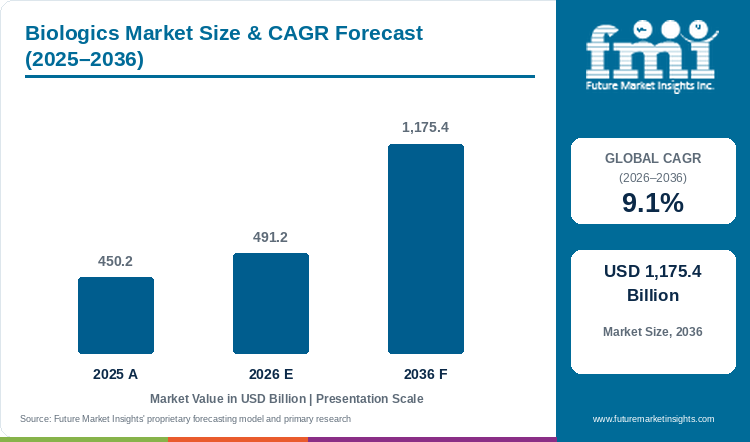
Demand is projected to expand at 9.1% CAGR from 2026 to 2036. Market value rises from USD 450.2 billion in 2025 to USD 491.24 billion in 2026 and USD 1,175.4 billion by 2036.
Biological medicines combine a therapeutic purpose with production methods that depend on biological sources, making manufacturing and characterization central to their commercial supply. The category includes products with very different structures and care requirements, so a recombinant protein, antibody and cell-based product should not be treated as interchangeable forms of the same medicine. [1][2] Monoclonal antibodies and oncology hold substantial positions within the drug-class and application classifications, while other products serve autoimmune, infectious and rare-disease settings. Biosimilar and biologics development adds a related competitive pathway, with EMA explaining why a biosimilar requires a comparability assessment rather than simply following the ordinary generic model. [2] Purchasing also depends on the treatment setting and the ability to supply the relevant product consistently, because a medicine's availability needs to support its actual clinical use. Regulatory frameworks differ across markets, as reflected in UK licensing guidance and India's published biological-product resources. [3][4] Through 2036, market expansion is expected to reflect the interaction of established treatment demand, product development and manufacturing capability, with evidence remaining specific to each medicine and indication. [1][2][3][4]
Key Market Trends & Insights
- Biological manufacturing and product characterization remain closely connected, because the production process contributes to the quality attributes examined for the actual medicine. [1][2]
- Biosimilar competition is developing through comparability-based regulatory pathways, with approved reference products providing a defined basis for the assessment. [2][3]
- Oncology and antibody portfolios create substantial expenditure, while other biological products serve distinct treatment areas with different manufacturing and supply requirements.
Regional Highlights
- US oversight spans a broad range of biological products, with FDA resources distinguishing their scientific and regulatory characteristics from a single conventional drug category. [1]
- Germany and France operate within the European biological-medicine framework, while local treatment and supply arrangements influence the actual commercial demand. [2]
- UK licensing guidance and India's biological-product resources demonstrate different regulatory settings, making the current status and scope of each document relevant to development planning. [3][4]
Market Size & Forecast
Table 1: Market Size and Forecast for Biologics Market (USD billion and percentage), 2025 to 2036
| Metric | Value |
|---|---|
| 2025 market value | USD 450.2 billion |
| 2026 market value | USD 491.24 billion |
| 2036 market value | USD 1,175.4 billion |
| CAGR 2026 to 2036 | 9.1% |
| Revenue increase 2026 to 2036 | USD 684.16 billion |
| Market expansion 2026 to 2036 | 2.39 times |
The market is projected to expand from USD 491.24 billion in 2026 to USD 1175.40 billion by 2036, at a CAGR of 9.1%. Growth depends on suitable medicines reaching their treatment settings with reliable supply. Biopharmaceutical contract manufacturing can provide specialist production capacity alongside manufacturers' internal facilities, with the process and characterization requirements determined by the biological product being supplied and the evidence supporting its intended use. [1][2][3][4]
Why are biological manufacturing and comparability commercially important?
A biological medicine is characterized through more than its name or intended use, because its source and production process contribute to the product that is evaluated. EMA's biosimilar framework requires comparison with an approved reference medicine, while UK guidance provides the corresponding local development context. These requirements connect analytical capability, manufacturing consistency and the evidence needed for the proposed product. [1][2][3]
Table 2: Industry evidence relevant to the biologics market
| Indicator | Data point or observation | Market relevance | Source |
|---|---|---|---|
| Biological product range | FDA includes vaccines, cells and therapeutic proteins among biological products | Different classes need distinct characterization and supply approaches | [1] |
| Biosimilar comparability | EMA distinguishes biosimilars from ordinary generic medicines | Similarity is assessed against a defined reference product | [2] |
| Indian development resources | CDSCO lists 2016 guidance and a 2025 consultation draft | A draft and an established guideline have different status | [4] |
Analyst Perspective
"Biologics market expansion is expected to favor companies able to manage clinical innovation and reliable manufacturing together."
- Anurag Sharma, Principal Consultant for Healthcare, FMI
How is the Biologics Market segmented?
The market is segmented by Drug Class, Application, Manufacturing Type, Drug Classification, Mode of Purchase, Source, Distribution Channel, and Region.
The market is segmented by drug class, application, manufacturing type, drug classification, mode of purchase, biological source and distribution channel. Coverage includes antibodies, recombinant proteins, vaccines, cellular and gene-based products, with applications across cancer, infectious, autoimmune and rare diseases. Contract and in-house manufacturing, branded and generic classifications, prescription and over-the-counter categories, several biological sources and hospital, retail and online pharmacy channels complete the analytical coverage. Reference biologics and biosimilars are counted within one biological-medicines revenue total, with biosimilar sales forming part of the biologics market rather than an additional market added to it; conventional chemically synthesized medicines are excluded.
Why do monoclonal antibodies retain the larger drug-class share?
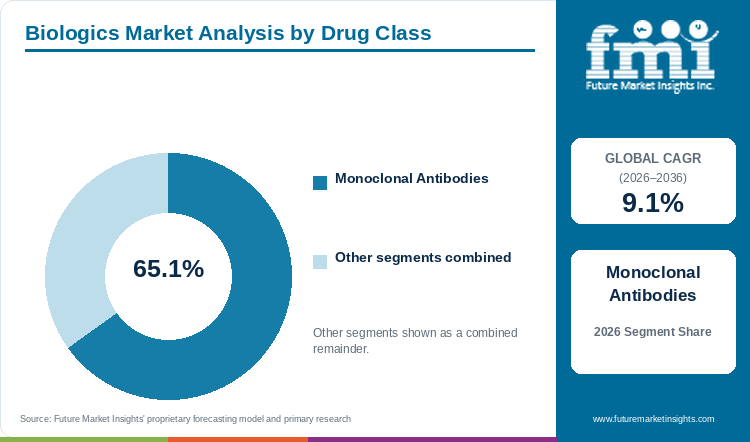
The Monoclonal Antibodies segment is projected to account for 65.1% of drug class demand in 2026.
Table 3: Drug Class Share for Biologics Market (percentage share), 2026
| Drug Class | Estimated share (2026) |
|---|---|
| Monoclonal Antibodies | 65.1% |
| Other drug classes | 34.9% |
| Total | 100.0% |
Table 4: Segment Position and Market Growth for Biologics Market, 2026 to 2036
| Metric | Value |
|---|---|
| Global CAGR (2026 to 2036) | 9.1% |
| Profiled drug class segment | Monoclonal Antibodies |
Monoclonal antibodies occupy several established treatment areas, giving the class a broad commercial base rather than dependence on one disease or customer setting. Their demand position reflects portfolios used across indications, while each medicine retains its own evidence, approved use and supply requirements. [2] Production and characterization also matter because an antibody is a complex biological product rather than a simple interchangeable chemical ingredient. EMA's description of biological medicines and biosimilar comparability illustrates why analytical and manufacturing capability remain relevant when another product is developed against a reference medicine. [2] The segment's position therefore connects treatment breadth with the practical ability to produce and supply a consistent product, while clinical suitability remains specific to the actual antibody and indication.
- Monoclonal Antibodies are projected to represent 65.1% of drug-class demand in 2026, spanning established therapeutic portfolios that require product-specific characterization and dependable biological production. [1][2]
- Biological characterization and manufacturing consistency remain important when evaluating an antibody or a proposed biosimilar against the relevant product requirements. [1][2]
Why does the Cancer segment hold a substantial application share?
The Cancer segment is projected to account for 32.4% of application demand in 2026.
Table 5: Application Share for Biologics Market (percentage share), 2026
| Application | Estimated share (2026) |
|---|---|
| Cancer | 32.4% |
| Other applications | 67.6% |
| Total | 100.0% |
Cancer includes treatment pathways in which biological medicines contribute through specific products and indications, creating a substantial commercial application within the wider market. Monoclonal antibody therapies account for part of that treatment activity, with each product's evidence defining the setting in which it can be used. [2] Expenditure can involve specialist prescribing and institutional supply, making availability and coordination with the treatment setting relevant to purchasing. Demand consequently depends on the actual disease, indication and medicine, with established portfolios contributing to the breadth and value of the application. A new product must establish its own treatment role and manufacturing suitability, while continuing supply of existing medicines remains a practical requirement for the institutions and care teams that use them. [1][2]
- Cancer is projected to account for 32.4% of application demand in 2026, combining specialist prescribing and institutional supply across defined biological treatment portfolios.
- Specialist care and institutional supply make product availability relevant, while each medicine retains its own indication and supporting evidence. [1][2]
What are the drivers, restraints, and opportunities in the Biologics Market?
Treatment demand creates a commercial base for biologics only when the relevant medicine can be characterized, manufactured and supplied consistently. That requirement makes analytical and production capability central to growth across both reference products and proposed biosimilars. Additional competition around established medicines offers an opportunity, although the evidence task, affordability and purchasing route remain specific to the product and the treatment setting it is intended to serve. [1][2][3][4]
Driver
Established treatment demand across oncology, autoimmune conditions and other indications creates a continuing base for biological medicines, while development programs can add products with distinct therapeutic purposes. [1][2] Manufacturing capability is a connected driver because a medicine needs to be supplied consistently in the form evaluated for its intended use. Biosimilar pathways also create a route for additional competition around reference products, with the evidence based on an appropriate comparability exercise appropriate to the reference medicine and its biological characteristics. [2][3]
Restraint
Biological production and characterization can be demanding, with manufacturing processes contributing to the product attributes that need to be evaluated. A proposed biosimilar also requires a structured comparison with its reference medicine, making development more involved than an ordinary generic substitution. [1][2][3] Supply needs can differ across product classes and treatment settings, while affordability and purchasing arrangements affect access. These conditions limit the assumption that scientific promise alone creates a commercially usable medicine or that every indication offers the same route to demand.
Opportunity
Biosimilar development creates an opportunity to broaden competition around established reference medicines, while regulatory guidance provides a defined route for evaluating the proposed product. [2][3] Pharmacovigilance services remain relevant after authorization because safety information continues to accumulate during use, alongside the manufacturer's responsibility for consistent supply. [1] Companies that connect analytical capability with reliable production can address a practical requirement across several biological classes, while the actual opportunity depends on the medicine, indication and market within the relevant development and purchasing pathway. [4]
Which country CAGRs are profiled in the Biologics Market?
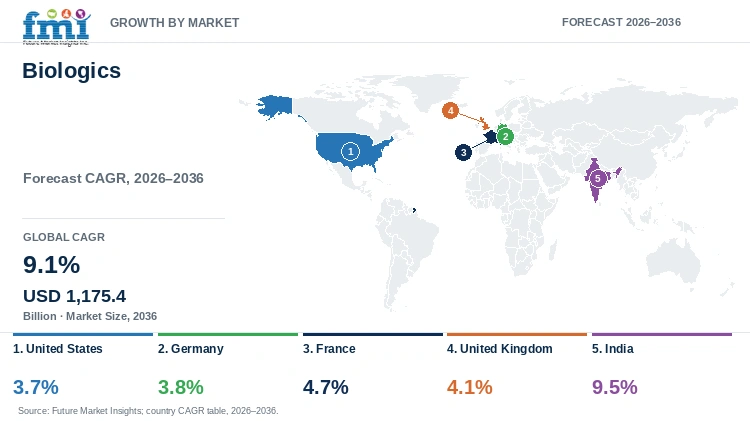
Table 6: Country CAGR Comparison for Biologics Market (CAGR percentage), 2026 to 2036
| Country | CAGR | Forecast period |
|---|---|---|
| United States | 3.7% | 2026 to 2036 |
| Germany | 3.8% | 2026 to 2036 |
| France | 4.7% | 2026 to 2036 |
| United Kingdom | 4.1% | 2026 to 2036 |
| India | 9.5% | 2026 to 2036 |
Country-wise Analysis
United States Biologics Market Outlook (2026 to 2036)
The US market includes a broad range of biological products, with FDA resources identifying categories such as therapeutic proteins, vaccines and cell-based products. [1] This breadth makes the product class important before demand or manufacturing requirements are compared, because the care pathway for an antibody is different from that of a cellular product. The market is projected to expand at a CAGR of 3.7% from 2026 to 2036. Established treatment portfolios create continuing expenditure, while additional development depends on evidence appropriate to the actual medicine and indication. Suppliers need to connect those clinical uses with reliable manufacturing and distribution, making scientific capability and dependable product availability related commercial requirements rather than independent reasons to assume broad market access.
Germany Biologics Market Outlook (2026 to 2036)
Germany's pharmaceutical and research base supports demand across established biological treatment areas, while manufacturers operate within the European framework for product quality and biosimilar evaluation. EMA explains that biological source and manufacturing complexity make biosimilar assessment different from an ordinary generic comparison. [2] Germany's market is projected to grow at a CAGR of 3.8% from 2026 to 2036. This setting gives analytical and manufacturing capabilities a direct commercial role, particularly when a company needs to characterize a proposed product against a reference medicine. Local demand also depends on the actual indication and care setting, with oncology and other specialist uses creating different supply needs. A broad research base therefore supports development without establishing that every program will become an authorized or widely purchased treatment.
France Biologics Market Outlook (2026 to 2036)
French biological-medicine demand includes specialist treatment settings in which product availability needs to match the actual care pathway, rather than simply reflect the size of a manufacturer's portfolio. The market is projected to expand at a CAGR of 4.7% from 2026 to 2036. Within the European framework, EMA evaluates biosimilarity through a defined comparison with an approved reference medicine, while treatment and purchasing arrangements remain relevant to local access. [2] This creates a commercial environment in which established products and additional competition can coexist, but the route to demand depends on the medicine and indication. Suppliers therefore need both an appropriate product and dependable supply, with the clinical use determining how a biological therapy enters the treatment setting.
United Kingdom Biologics Market Outlook (2026 to 2036)
MHRA's biosimilar licensing guidance was updated in February 2025 and applies within the UK-wide licensing setting, giving developers a defined local resource for the evidence expected of proposed products. [3] The distinction between a reference medicine and a biosimilar remains central to that development pathway, while advanced therapy products have separate considerations. The UK biologics market is projected to grow at a CAGR of 4.1% from 2026 to 2036. For suppliers, regulatory planning needs to connect with the manufacturing process and the treatment setting in which the medicine will be used. A familiar therapeutic category does not remove product-specific requirements, making characterization and reliable supply relevant alongside the commercial demand generated by established care pathways.
India Biologics Market Outlook (2026 to 2036)
India's biological-product resources include established guidance and a consultation on revised similar-biologics requirements, giving developers several documents whose status needs to be distinguished. CDSCO lists the 2016 guideline and identifies the 2025 revision as a draft circulated for comments. [4] The market is projected to expand at a CAGR of 9.5% from 2026 to 2036. Manufacturing and analytical capabilities are commercially important because a biological product needs consistent production and evidence appropriate to its intended use. Local development can address several treatment areas, while a proposed similar biologic requires an assessment connected with the relevant reference medicine. The opportunity therefore depends on the actual product and current regulatory pathway, rather than treating the existence of a draft document as completed authorization for a program.
Who are the notable companies in the Biologics Market?
Amgen; Roche; AbbVie; Pfizer; AstraZeneca
Biologics competition involves therapeutic portfolios, analytical capability and dependable manufacturing, with each contributing a different part of the commercial pathway. A company developing a new biological medicine addresses a different evidence task from one demonstrating biosimilarity to an established reference product, although both need suitable production and product characterization. [1][2][3] The purchasing comparison also depends on the indication and treatment setting, making portfolio breadth alone insufficient to describe every participant's position. Established supply and product-specific capabilities remain useful distinctions across this varied market.
Competitive Benchmarking: Biologics Market
Table 7: Competitive positioning for the biologics market
| Company | Positioning | Commercial distinction |
|---|---|---|
| Amgen | Biological therapies and biosimilar products | Provides biological medicine portfolios across established treatment areas. |
| Roche | Specialist biological medicines | Participates in antibody-based and other specialist treatment portfolios. |
| AbbVie | Immunology and other biological therapies | Supplies biological products within specialist pharmaceutical care. |
| Pfizer | Biological medicines and biosimilars | Participates in reference and follow-on biological product categories. |
| AstraZeneca | Specialist biologics and oncology medicines | Provides biological products within relevant specialist portfolios. |
Key Developments in the Biologics Market
- MHRA updated its biosimilar licensing guidance in February 2025, providing clarifications within the UK-wide framework for proposed similar biological medicines. [3]
- CDSCO circulated revised similar-biologics guidance for consultation in 2025, with its published resources identifying that document as a draft rather than a completed final authorization framework. [4]
- EMA's current biosimilar overview describes comparability with an approved reference medicine and the distinct scientific basis for biological products, supporting a structured route to additional competition. [2]
Key Players in the Biologics Market
Biological therapies and biosimilar products
- Amgen
Specialist biological medicines
- Roche
Immunology and other biological therapies
- AbbVie
Biological medicines and biosimilars
- Pfizer
Specialist biologics and oncology medicines
- AstraZeneca
Biologics Market - Report Scope
Table 8: Report Scope for Biologics Market, 2026 to 2036
| Coverage field | Report scope |
|---|---|
| Market | Biologics Market |
| Revenue boundary | Biological medicines including reference products and biosimilars, counted once within the same biologics total; conventional chemically synthesized medicines are excluded. |
| Historical reference | 2025 |
| Base year | 2026 |
| Forecast period | 2026 to 2036 |
| Currency and units | USD billion |
| Segmentation | Drug Class, Application, Manufacturing Type, Drug Classification, Mode of Purchase, Source, Distribution Channel |
| Geographic coverage | North America, Latin America, East Asia, South Asia & Pacific, Western Europe, Eastern Europe, Middle East and Africa |
| Country and market profiles | United States, Germany, France, United Kingdom, India |
| Representative companies | Amgen; Roche; AbbVie; Pfizer; AstraZeneca |
Biologics Market - Research Methodology
Table 9: Research Methodology for Biologics Market, 2026 edition
| Method | Approach |
|---|---|
| Market definition | Biological medicines are examined through their source, product class and therapeutic application. |
| Manufacturing assessment | Production and characterization are considered alongside the actual medicine and indication. |
| Segmentation | Drug class, application, production, classification, purchase, source and distribution preserve their stated coverage. |
| Geographic assessment | Five country profiles connect projected demand with local treatment settings and current regulatory resources. |
| Competitive assessment | Participant portfolios are compared with their development and manufacturing roles. |
| Evidence review | Official regulator resources distinguish established guidance, comparability principles and draft consultation documents. |
Biologics Market by Segments
Biologics Market segmented by Drug Class:
- Monoclonal Antibodies
- Recombinant Hormones/Proteins
- Vaccines
- Cellular Based Biologics
- Gene-based Biologics
- Therapeutic Enzymes
- Others
Biologics Market segmented by Application:
- Infectious Diseases
- Cancer
- Autoimmune Diseases
- Rare Diseases
- Others
Biologics Market segmented by Manufacturing Type:
- Contract Manufacturing
- In-house Manufacturing
Biologics Market segmented by Drug Classification:
- Branded Drugs
- Generic Drugs
Biologics Market segmented by Mode of Purchase:
- Prescription Drugs
- Over-the-Counter Drugs
Biologics Market segmented by Source:
- Bacterial Cells
- Yeast Cells
- Plant Cells
- Animal Cells
- Other Sources
Biologics Market segmented by Distribution Channel:
- Hospital Pharmacies
- Retail Pharmacies
- Online Pharmacies
Biologics Market by Region
- North America
- United States
- Canada
- Latin America
- Brazil
- Mexico
- Argentina
- Chile
- Western Europe
- Germany
- France
- United Kingdom
- Italy
- Spain
- Benelux
- Nordics
- Eastern Europe
- Poland
- Czech Republic
- Romania
- Hungary
- East Asia
- China
- Japan
- South Korea
- South Asia and Pacific
- India
- ASEAN
- Australia and New Zealand
- Middle East and Africa
- GCC Countries
- South Africa
- Türkiye
- Israel
Research Sources and Bibliography
- [1] US Food and Drug Administration. Accessed 15 October 2026. Frequently Asked Questions About Therapeutic Biological Products
- [2] European Medicines Agency. Accessed 15 October 2026. Biosimilar medicines: Overview
- [3] UK Medicines and Healthcare products Regulatory Agency. Accessed 15 October 2026. Guidance on the licensing of biosimilar products
- [4] Central Drugs Standard Control Organization, India. Accessed 15 October 2026. Biologicals: guidelines and consultation resources
This Report Answers
- How large is the biologics market in 2026?
- What is the outlook through 2036?
- Which drug class has the larger share?
- Which application has a substantial share?
- Is a biosimilar the same as an ordinary generic medicine?
Frequently Asked Questions
How large is the biologics market in 2026?
The market is estimated at USD 491.24 billion in 2026, compared with USD 450.2 billion in 2025.
What is the outlook through 2036?
The market is projected to reach USD 1175.40 billion by 2036, at a CAGR of 9.1% from 2026 to 2036.
Which drug class has the larger share?
Monoclonal antibodies represent a projected 65.1% of drug-class demand in 2026, supported by established therapeutic portfolios.
Which application has a substantial share?
The Cancer segment holds a projected 32.4% share of application demand in 2026, reflecting the role of biological medicines in defined cancer-treatment pathways.
Is a biosimilar the same as an ordinary generic medicine?
EMA distinguishes biosimilars from ordinary generics because biological source and manufacturing complexity require a defined comparability assessment. [2]
Preview the report firsthand - request a free sample
Get SampleGet the brochure for pricing and purchase details.
Get PDFTable of Content
- Key Takeaways
- Market Size and CAGR
- Top Growth Driver
- Fastest Growing Segment
- Leading Region
- Key Companies
- Emerging Opportunities
- Executive Summary
- Global Market Outlook
- Demand-side Trends
- Supply-side Trends
- Technology Roadmap Analysis
- Analysis and Recommendations
- Analyst Perspective (What is happening? Why now? What should investors know?)
- Key Questions Answered
- How large is the market?
- What is the CAGR?
- What are key trends?
- Which region dominates?
- Who are the leaders?
- Market Overview
- Market Coverage / Taxonomy
- Market Definition / Scope / Limitations
- Research Methodology
- Chapter Orientation
- Analytical Lens and Working Hypotheses
- Market Structure, Signals, and Trend Drivers
- Benchmarking and Cross-market Comparability
- Market Sizing, Forecasting, and Opportunity Mapping
- Research Design and Evidence Framework
- Desk Research Programme (Secondary Evidence)
- Expert Input and Fieldwork (Primary Evidence)
- Tooling, Models, and Reference Databases
- Data Engineering and Model Build
- Quality Assurance and Audit Trail
- Market Background
- Market Dynamics (Drivers, Restraints, Opportunity, Trends)
- Scenario Forecast (Optimistic, Likely, Conservative)
- Impact Analysis
- AI Impact
- Sustainability Impact
- Regulatory Impact
- Technology Impact
- Consumer / Buyer Analysis
- Purchase Drivers
- Adoption Barriers
- Buyer Journey
- Opportunity Map Analysis
- Product Life Cycle Analysis
- Supply Chain Analysis
- Investment Feasibility Matrix
- Value Chain Analysis
- PESTLE and Porter's Analysis
- Regulatory Landscape
- Regional Parent Market Outlook
- Production and Consumption Statistics
- Import and Export Statistics
- Global Market Analysis and Forecast, 2021 to 2036
- Historical Market Size Value (USD Billion) Analysis, 2021 to 2025
- Current and Future Market Size Value (USD Billion) Projections, 2026 to 2036
- Y-o-Y Growth Trend Analysis
- Absolute $ Opportunity Analysis
- Global Market Pricing Analysis, 2021 to 2036
- Global Market Analysis and Forecast, By Drug Class, 2021 to 2036
- Introduction / Key Findings
- Historical Market Size Value (USD Billion) Analysis By Drug Class, 2021 to 2025
- Current and Future Market Size Value (USD Billion) Analysis and Forecast By Drug Class, 2026 to 2036
- Monoclonal Antibodies
- Recombinant Hormones/Proteins
- Vaccines
- Cellular Based Biologics
- Gene-based Biologics
- Therapeutic Enzymes
- Others
- Y-o-Y Growth Trend Analysis By Drug Class, 2021 to 2025
- Absolute $ Opportunity Analysis By Drug Class, 2026 to 2036
- Global Market Analysis and Forecast, By Application, 2021 to 2036
- Introduction / Key Findings
- Historical Market Size Value (USD Billion) Analysis By Application, 2021 to 2025
- Current and Future Market Size Value (USD Billion) Analysis and Forecast By Application, 2026 to 2036
- Infectious Diseases
- Cancer
- Autoimmune Diseases
- Rare Diseases
- Others
- Y-o-Y Growth Trend Analysis By Application, 2021 to 2025
- Absolute $ Opportunity Analysis By Application, 2026 to 2036
- Global Market Analysis and Forecast, By Manufacturing Type, 2021 to 2036
- Introduction / Key Findings
- Historical Market Size Value (USD Billion) Analysis By Manufacturing Type, 2021 to 2025
- Current and Future Market Size Value (USD Billion) Analysis and Forecast By Manufacturing Type, 2026 to 2036
- Contract Manufacturing
- In-house Manufacturing
- Y-o-Y Growth Trend Analysis By Manufacturing Type, 2021 to 2025
- Absolute $ Opportunity Analysis By Manufacturing Type, 2026 to 2036
- Global Market Analysis and Forecast, By Drug Classification, 2021 to 2036
- Introduction / Key Findings
- Historical Market Size Value (USD Billion) Analysis By Drug Classification, 2021 to 2025
- Current and Future Market Size Value (USD Billion) Analysis and Forecast By Drug Classification, 2026 to 2036
- Branded Drugs
- Generic Drugs
- Y-o-Y Growth Trend Analysis By Drug Classification, 2021 to 2025
- Absolute $ Opportunity Analysis By Drug Classification, 2026 to 2036
- Global Market Analysis and Forecast, By Mode of Purchase, 2021 to 2036
- Introduction / Key Findings
- Historical Market Size Value (USD Billion) Analysis By Mode of Purchase, 2021 to 2025
- Current and Future Market Size Value (USD Billion) Analysis and Forecast By Mode of Purchase, 2026 to 2036
- Prescription Drugs
- Over-the-Counter Drugs
- Y-o-Y Growth Trend Analysis By Mode of Purchase, 2021 to 2025
- Absolute $ Opportunity Analysis By Mode of Purchase, 2026 to 2036
- Global Market Analysis and Forecast, By Source, 2021 to 2036
- Introduction / Key Findings
- Historical Market Size Value (USD Billion) Analysis By Source, 2021 to 2025
- Current and Future Market Size Value (USD Billion) Analysis and Forecast By Source, 2026 to 2036
- Bacterial Cells
- Yeast Cells
- Plant Cells
- Animal Cells
- Other Sources
- Y-o-Y Growth Trend Analysis By Source, 2021 to 2025
- Absolute $ Opportunity Analysis By Source, 2026 to 2036
- Global Market Analysis and Forecast, By Distribution Channel, 2021 to 2036
- Introduction / Key Findings
- Historical Market Size Value (USD Billion) Analysis By Distribution Channel, 2021 to 2025
- Current and Future Market Size Value (USD Billion) Analysis and Forecast By Distribution Channel, 2026 to 2036
- Hospital Pharmacies
- Retail Pharmacies
- Online Pharmacies
- Y-o-Y Growth Trend Analysis By Distribution Channel, 2021 to 2025
- Absolute $ Opportunity Analysis By Distribution Channel, 2026 to 2036
- Global Market Analysis and Forecast, By Region, 2021 to 2036
- Introduction
- Historical Market Size Value (USD Billion) Analysis By Region, 2021 to 2025
- Current Market Size Value (USD Billion) Analysis and Forecast By Region, 2026 to 2036
- North America
- Latin America
- East Asia
- South Asia & Pacific
- Western Europe
- Eastern Europe
- Middle East and Africa
- Market Attractiveness Analysis By Region
- North America Market Analysis and Forecast, By Country, 2021 to 2036
- Historical Market Size Value (USD Billion) Trend Analysis By Market Taxonomy, 2021 to 2025
- Market Size Value (USD Billion) Forecast By Market Taxonomy, 2026 to 2036
- By Country
- United States
- By Drug Class
- By Application
- By Manufacturing Type
- By Drug Classification
- By Mode of Purchase
- By Source
- By Distribution Channel
- By Country
- Market Attractiveness Analysis
- By Country
- By Drug Class
- By Application
- By Manufacturing Type
- By Drug Classification
- By Mode of Purchase
- By Source
- By Distribution Channel
- Key Takeaways
- Latin America Market Analysis and Forecast, By Country
- Historical Market Size Value (USD Billion) Trend Analysis By Market Taxonomy, 2021 to 2025
- Market Size Value (USD Billion) Forecast By Market Taxonomy, 2026 to 2036
- By Country
- By Drug Class
- By Application
- By Manufacturing Type
- By Drug Classification
- By Mode of Purchase
- By Source
- By Distribution Channel
- Market Attractiveness Analysis
- By Country
- By Drug Class
- By Application
- By Manufacturing Type
- By Drug Classification
- By Mode of Purchase
- By Source
- By Distribution Channel
- Key Takeaways
- East Asia Market Analysis and Forecast, By Country
- Historical Market Size Value (USD Billion) Trend Analysis By Market Taxonomy, 2021 to 2025
- Market Size Value (USD Billion) Forecast By Market Taxonomy, 2026 to 2036
- By Country
- China
- By Drug Class
- By Application
- By Manufacturing Type
- By Drug Classification
- By Mode of Purchase
- By Source
- By Distribution Channel
- By Country
- Market Attractiveness Analysis
- By Country
- By Drug Class
- By Application
- By Manufacturing Type
- By Drug Classification
- By Mode of Purchase
- By Source
- By Distribution Channel
- Key Takeaways
- South Asia & Pacific Market Analysis and Forecast, By Country
- Historical Market Size Value (USD Billion) Trend Analysis By Market Taxonomy, 2021 to 2025
- Market Size Value (USD Billion) Forecast By Market Taxonomy, 2026 to 2036
- By Country
- India
- By Drug Class
- By Application
- By Manufacturing Type
- By Drug Classification
- By Mode of Purchase
- By Source
- By Distribution Channel
- By Country
- Market Attractiveness Analysis
- By Country
- By Drug Class
- By Application
- By Manufacturing Type
- By Drug Classification
- By Mode of Purchase
- By Source
- By Distribution Channel
- Key Takeaways
- Western Europe Market Analysis and Forecast, By Country
- Historical Market Size Value (USD Billion) Trend Analysis By Market Taxonomy, 2021 to 2025
- Market Size Value (USD Billion) Forecast By Market Taxonomy, 2026 to 2036
- By Country
- Germany
- France
- United Kingdom
- By Drug Class
- By Application
- By Manufacturing Type
- By Drug Classification
- By Mode of Purchase
- By Source
- By Distribution Channel
- By Country
- Market Attractiveness Analysis
- By Country
- By Drug Class
- By Application
- By Manufacturing Type
- By Drug Classification
- By Mode of Purchase
- By Source
- By Distribution Channel
- Key Takeaways
- Eastern Europe Market Analysis and Forecast, By Country
- Historical Market Size Value (USD Billion) Trend Analysis By Market Taxonomy, 2021 to 2025
- Market Size Value (USD Billion) Forecast By Market Taxonomy, 2026 to 2036
- By Country
- By Drug Class
- By Application
- By Manufacturing Type
- By Drug Classification
- By Mode of Purchase
- By Source
- By Distribution Channel
- Market Attractiveness Analysis
- By Country
- By Drug Class
- By Application
- By Manufacturing Type
- By Drug Classification
- By Mode of Purchase
- By Source
- By Distribution Channel
- Key Takeaways
- Middle East and Africa Market Analysis and Forecast, By Country
- Historical Market Size Value (USD Billion) Trend Analysis By Market Taxonomy, 2021 to 2025
- Market Size Value (USD Billion) Forecast By Market Taxonomy, 2026 to 2036
- By Country
- By Drug Class
- By Application
- By Manufacturing Type
- By Drug Classification
- By Mode of Purchase
- By Source
- By Distribution Channel
- Market Attractiveness Analysis
- By Country
- By Drug Class
- By Application
- By Manufacturing Type
- By Drug Classification
- By Mode of Purchase
- By Source
- By Distribution Channel
- Key Takeaways
- Key Countries Market Analysis
- United States
- Pricing Analysis
- Market Share Analysis, 2025
- By Drug Class
- By Application
- By Manufacturing Type
- By Drug Classification
- By Mode of Purchase
- By Source
- By Distribution Channel
- Germany
- Pricing Analysis
- Market Share Analysis, 2025
- By Drug Class
- By Application
- By Manufacturing Type
- By Drug Classification
- By Mode of Purchase
- By Source
- By Distribution Channel
- United Kingdom
- Pricing Analysis
- Market Share Analysis, 2025
- By Drug Class
- By Application
- By Manufacturing Type
- By Drug Classification
- By Mode of Purchase
- By Source
- By Distribution Channel
- France
- Pricing Analysis
- Market Share Analysis, 2025
- By Drug Class
- By Application
- By Manufacturing Type
- By Drug Classification
- By Mode of Purchase
- By Source
- By Distribution Channel
- India
- Pricing Analysis
- Market Share Analysis, 2025
- By Drug Class
- By Application
- By Manufacturing Type
- By Drug Classification
- By Mode of Purchase
- By Source
- By Distribution Channel
- China
- Pricing Analysis
- Market Share Analysis, 2025
- By Drug Class
- By Application
- By Manufacturing Type
- By Drug Classification
- By Mode of Purchase
- By Source
- By Distribution Channel
- United States
- Market Structure Analysis
- Competition Dashboard
- Competition Benchmarking
- Market Share Analysis of Top Players
- By Regional
- By Drug Class
- By Application
- By Manufacturing Type
- By Drug Classification
- By Mode of Purchase
- By Source
- By Distribution Channel
- Emerging Startups
- Innovation Benchmarking
- Competition Analysis
- Competition Deep Dive
- Amgen
- Overview
- Product Portfolio
- Profitability by Market Segments
- Sales Footprint
- Strategy Overview
- Marketing Strategy
- Product Strategy
- Channel Strategy
- Roche
- AbbVie
- Pfizer
- AstraZeneca
- Amgen
- Case Studies
- Success Stories
- Recent Developments
- Competition Deep Dive
- Assumptions & Acronyms Used


