

- Market Size (2026)
- USD 1053.6 Mn
- Forecast (2036)
- USD 2471.5 Mn
- CAGR (2026 to 2036)
- 8.9%
How big is Relapsed Refractory Large B-Cell Lymphoma Treatment Market size?
USD 1,053.6 million in 2026 and USD 2,471.5 million by 2036 at an 8.9% CAGR.
Sales of relapsed refractory large B-cell lymphoma treatment market are estimated to rise at 8.9% CAGR through 2036, increasing valuation from USD 1,053.6 million in 2026 to USD 2,471.5 million by 2036. Oncology teams now choose cellular and antibody options much earlier in the treatment cycle. Strong survival data directly drives this shifting clinical approach. In February 2025, a USA Food and Drug Administration publication highlighted this progress with the report analyzing an ECHELON-3 study population of 230 patients. This crucial trial supported brentuximab vedotin with lenalidomide and rituximab. Such a combination targets relapsed or refractory large B-cell lymphoma and the randomized evidence offers new options for patients who cannot undergo stem-cell transplantation. It also provides a viable path forward for individuals ineligible for CAR-T therapy. Resulting with such clinical insights helping hospitals selecting effective protocols for vulnerable individuals.
Diverse regulatory frameworks influence doctors adopting new lymphoma treatments globally. United States and Germany treatment centers favor earlier-line evidence due to established cell-therapy services. Networks in South Korea and the UK promote treatments compatible with national reimbursement. New clinical updates provide essential data to guide these regional decisions. Genmab reported an EPCORE DLBCL-1 progression-free survival hazard ratio of 0.74 in January 2026. This metric evaluated epcoritamab and lenalidomide against a combination of rituximab along with gemcitabine and oxaliplatin. Comparative trial results are likely to directly influence upcoming formulary reviews. Such reviews specifically involve patients unsuitable for intensive salvage therapy. Resulting with regional adaptations ensuring oncology teams to deliver practical care based on local guidelines.
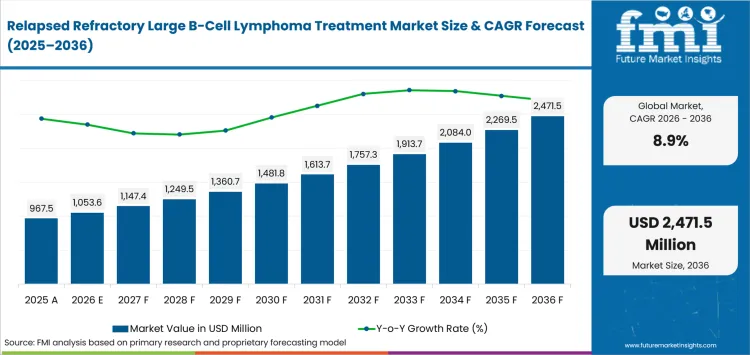
Key Takeaways of Relapsed Refractory Large B-Cell Lymphoma Treatment Market
- Demand for relapsed/refractory large B-cell lymphoma treatments is driven by oncologists seeking durable responses among patients experiencing relapse or resistance, with earlier-line evidence supporting broader treatment access.
- By line of therapy, second-line is expected to lead with 40.4% share in 2026, led by earlier intervention following frontline treatment failure.
- Hospitals are the dominant end-user segment, projected to hold 33.7% share in 2026, helped by infusion capacity and adverse-event monitoring.
- CAR-T cell therapy is estimated to lead the treatment type category with 33.4% share in 2026, guided by durable remission evidence among eligible patients.
- Outpatient administration and treatment-center education access remain critical to adoption, reducing bed pressure for selected antibody and cellular-therapy regimens while shaping regional uptake.
- The United States, Germany, and South Korea are expected to lead growth at 10.1%, 9.4%, and 8.9% CAGR respectively through 2036, supported by treatment-center capacity, structured reimbursement, and tertiary-care infrastructure.
- Competition centers on Roche, Genentech, Gilead Sciences, Kite, AbbVie, and Genmab, with vendors differentiating through Polivy and Lunsumio antibody-based pathways, Yescarta cellular therapy, and Epkinly subcutaneous administration with ongoing combination trials.
Analyst Perspective
"Long-term adoption will depend on therapies that demonstrate durable clinical benefit while fitting the operational realities of specialized treatment centers. Physicians and payers are placing greater emphasis on comparative evidence, patient selection, manufacturing reliability, and treatment sequencing as advanced therapies enter routine practice. Companies that strengthen referral networks, expand clinician education, and support consistent patient access will be better positioned to sustain growth across hematology care programs."
- Anurag Sharma, Principal Consultant for Healthcare at Future Market Insights
Source: Future Market Insights analysis, 2026.
How is Relapsed Refractory Large B-Cell Lymphoma Treatment Market segmented?
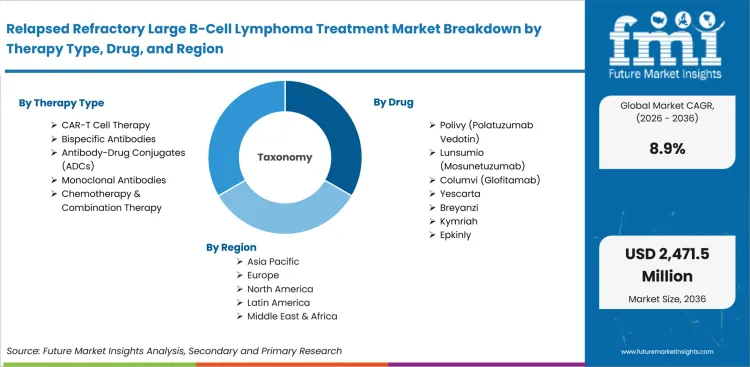
The relapsed refractory large B-cell lymphoma treatment market is segmented by therapy type, drug, line of therapy, end user, and region.
The relapsed refractory large B-cell lymphoma treatment market is segmented by therapy type, drug, line of therapy, end user, and region. Therapy type coverage begins with CAR-T cell therapy and bispecific antibodies. Antibody-drug conjugates and monoclonal antibodies extend treatment assessment. Chemotherapy combinations complete therapy type coverage. Drug analysis reviews Polivy, Lunsumio, and Columvi across antibody-based regimens. Yescarta, Breyanzi, and Kymriah cover cellular treatment. Epkinly completes drug assessment. Line-of-therapy analysis separates second-line care from third-line and later treatment. End-user coverage distinguishes hospitals from cancer centers. Specialty oncology clinics and academic institutes complete end-user assessment. Regional analysis follows the geographic structure listed in the report scope.
Why does CAR-T Cell Therapy shape therapy type selection?
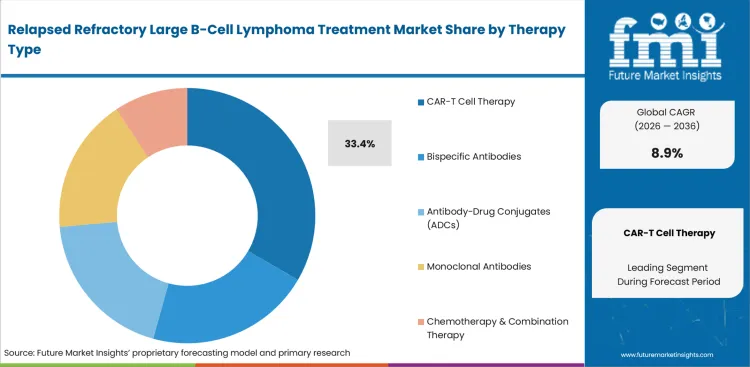
Gilead Sciences reported in December 2025 stating a pooled two-year overall survival rate of 64.9% for Yescarta across comparative second-line analyses. Durable survival evidence strengthens clinical consideration of engineered cell therapy among eligible patients experiencing early relapse following initial chemoimmunotherapy. Treatment-center certification and manufacturing coordination remain central to successful delivery.
- CAR-T cell therapy garners 33.4% share of therapy type in 2026, driven by durable remission outcomes among eligible patients with refractory disease or early relapse. Certified centers manage cell collection and manufacturing; clinical teams then supervise infusion and recovery.
- Bispecific antibodies provide ready-to-administer treatment for patients lacking access or eligibility for cellular therapy. Antibody-based alternatives remain useful in later lines as clinicians adapt treatment to prior exposure and current disease behavior.
Why does Polivy shape drug selection?
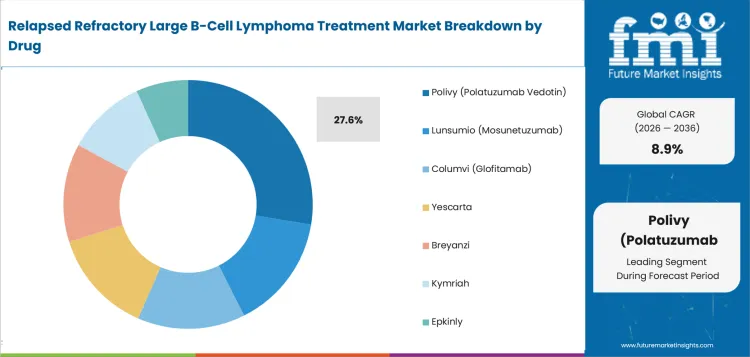
Combination evidence positions Polivy for review within targeted oncology biologics strategies intended to extend remission without cellular manufacturing. Roche reported in June 2025 a median progression-free survival period of 11.5 months for Lunsumio combined with Polivy among patients with relapsed or refractory large B-cell lymphoma.
- By drug, Polivy commands 27.6% share in 2026 owing to established combination use among transplant-ineligible and heavily treated patients. Hospital teams review previous therapy and marrow reserve, examining infection risk and treatment-related neuropathy during regimen selection.
- Lunsumio and Columvi provide CD20xCD3 treatment under separate dosing schedules with Epkinly adding a subcutaneous option with its own monitoring plan. Yescarta and Breyanzi require patient-specific manufacturing with Kymriah following the same treatment-center pathway.
Why does Second-Line lead line-of-therapy demand?
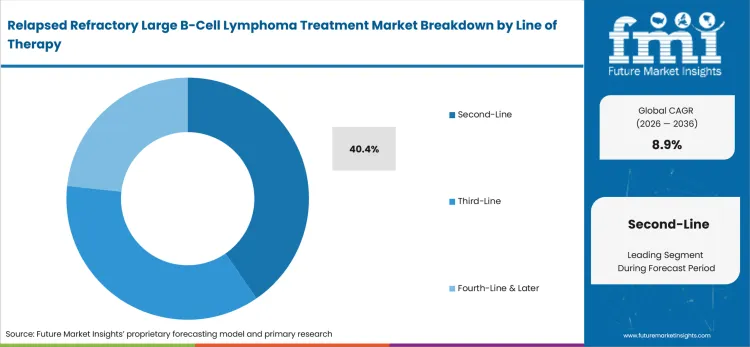
Genmab announced in June 2025 an overall response rate of 87% for investigational epcoritamab plus R-ICE among transplant-eligible patients with relapsed or refractory diffuse large B-cell lymphoma. High response activity encourages earlier assessment of next-generation immunotherapies among patients requiring rapid disease control following frontline failure.
- Second-line represents 40.4% share in 2026, driven by earlier CAR-T use and developing bispecific combinations following frontline failure. Clinical teams compare relapse timing with transplant eligibility, confirming access to specialist treatment centers.
- Third-line care uses advanced therapies selected according to previous exposure and remaining treatment options. Fourth-line and later care requires careful sequencing to limit repeated toxicity, and address resistant disease.
Why do hospitals lead end-user demand?
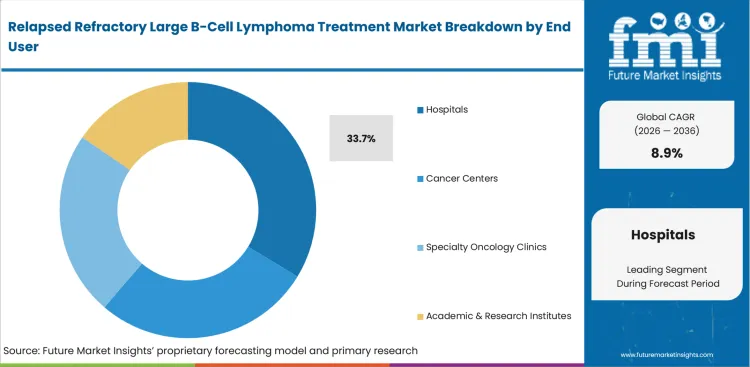
Hospital hematology programs are likely to gain operational flexibility as cellular-therapy experience expands. A USA Food and Drug Administration action issued in June 2025 removed Risk Evaluation and Mitigation Strategy requirements for 6 approved autologous CAR-T cell immunotherapies. Revised requirements reduce administrative demands for certified dispensing and retain boxed warnings with post-treatment safety monitoring.
- Based on end user, hospitals secure 33.7% share in 2026 owing to infusion infrastructure and immediate specialist access. Clinical teams monitor cellular and bispecific therapies closely, enabling early identification of immune-related complications.
- Cancer centers and specialty oncology clinics extend treatment access through referral relationships with cellular-therapy institutions. Academic institutes contribute research capacity for biomarker studies and clinical evaluation of new antibody therapy.
What are drivers, restraints, and opportunities in Relapsed Refractory Large B-Cell Lymphoma Treatment Market?
Clinical demand reflects treatment failure following frontline chemoimmunotherapy and limited remission durability across heavily treated populations. Adoption may slow as referral complexity and manufacturing delays interrupt timely treatment.
- Driver: Earlier-line evidence encourages treatment teams to assess bispecific antibodies and antibody-drug conjugates sooner following documented relapse.
- Restraint: Complex toxicity monitoring and specialist requirements limit routine administration among facilities lacking experienced hematology teams or emergency support.
- Opportunity: Outpatient regimens and fixed-duration combinations may extend advanced treatment access beyond major academic centers through structured referral and monitoring arrangements.
Roche reported in May 2025 a 40% overall-survival improvement for Columvi combined with gemcitabine and oxaliplatin compared to rituximab and oxaliplatin. Such improvement favors earlier bispecific-antibody adoption among transplant-ineligible patients requiring a readily available treatment. Comparative evidence may strengthen payer and clinical-guideline evaluation across later-line blood cancer treatment pathways.
Adverse-event management remains a limiting condition for advanced treatment expansion. Gilead Sciences reported in June 2025 grade-three-or-higher cytokine release syndrome among 9% of large B-cell lymphoma patients represented in Yescarta safety information. Treatment centers require trained staff and rapid escalation protocols. Continuing follow-up supports safe management of immune-mediated events.
Genmab reported in September 2025 first-full-dose outpatient administration for 92% of patients during EPCORE NHL-6 evaluation. Outpatient delivery could reduce bed pressure across centers prepared for structured observation. Treatment expansion remains dependent upon patient selection and clear transfer arrangements.
How are country CAGRs aligned in relapsed refractory large B-cell lymphoma treatment market?
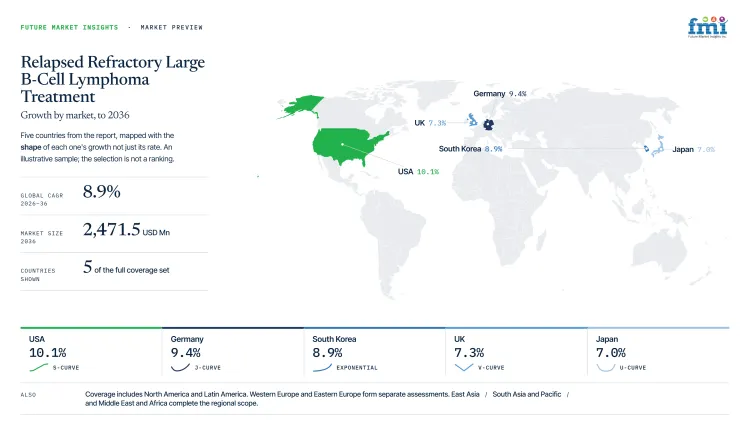
| Country or Market | CAGR |
|---|---|
| USA | 10.1% |
| Germany | 9.4% |
| South Korea | 8.9% |
| UK | 7.3% |
| Japan | 7.0% |
Source: Future Market Insights analysis, 2026.
How do country-level CAGRs compare in Relapsed Refractory Large B-Cell Lymphoma Treatment Market?
Country forecasts show a gradual decline from USA to Japan across the profiled comparison. Germany and South Korea occupy the next positions through specialist capacity and organized treatment access. UK and Japan progress at a measured pace under public reimbursement structures. Trial availability and coverage timing create separate adoption conditions across national treatment systems.
- USA records the leading profiled rate, aided by extensive certified treatment centers and earlier access to newly approved therapies.
- Germany ranks second as university hospitals and regulated care pathways encourage advanced lymphoma treatment adoption.
- South Korea follows through concentrated tertiary-care infrastructure and coordinated national coverage decisions.
- UK posts measured expansion as national assessment processes and specialist referral channels govern treatment access.
- Japan closes the comparison through centralized clinical expertise and structured post-treatment monitoring practices.
Comparable CAGRs do not produce identical access conditions across profiled countries. North America and Latin America begin the geographic assessment. Western Europe and Eastern Europe receive separate regional evaluations. East Asia, South Asia and Pacific, and Middle East and Africa complete report coverage.
Country-wise Analysis
- Relapsed refractory large B-cell lymphoma treatment market in the United States is estimated to grow at 10.1% CAGR during the forecast period, driven by extensive cellular-therapy capacity and rapid uptake of newly approved regimens. Major oncology networks coordinate specialist referrals and clinical-trial access. Experienced teams also manage adverse events across cellular and antibody-based treatment programs. USA Census Bureau data released in June 2025 recorded 61.2 million residents aged 65 years or older during 2024, expanding the population requiring hematologic cancer assessment and age-adapted treatment pathways.
- German Federal Statistical Office data published in June 2025 showed residents aged 65 years or older represented 23.2% of Germany’s population during 2024. An older demographic increases clinical need for transplant-ineligible regimens and outpatient antibody treatment delivered through university hospitals. Sector in Germany is predicted to record 9.4% CAGR between 2026 and 2036 as structured reimbursement enables hematology centers to participate in multicenter European trials.
- Concentrated tertiary hospitals enable advanced diagnosis and cellular-therapy delivery within metropolitan treatment networks. Industry in South Korea is projected to scale at 8.9% CAGR during the study period, backed by specialist capacity and coordinated national coverage decisions accelerate treatment access. Bank of Korea analysis issued in June 2025 reported people aged 65 years or older represented 20% of the national population at year-end 2024, strengthening demand for treatment pathways suitable for older lymphoma patients.
- Office for National Statistics estimates published in September 2025 placed the UK population at 69.3 million during mid-2024, indicating a sizeable national pool requiring hematology and oncology services. Sales in the United Kingdom are set to rise at 7.3% CAGR from 2026 to 2036, guided by specialized treatment centers and national technology assessment. Referral timing may influence access to CAR-T treatment outside major teaching hospitals. Regional infusion capacity also affects bispecific therapy availability.
- Centralized cancer hospitals and disciplined post-treatment monitoring enable measured use of cellular therapies and bispecific antibodies. Statistics Bureau of Japan reported in April 2025 a population of 36.243 million residents aged 65 years or older during 2024, reinforcing clinical demand for regimens suitable for older and transplant-ineligible patients. Demand in Japan is forecast to expand at 7.0% CAGR over 2026 to 2036, reflecting specialist review and gradual reimbursement expansion.
Who are notable companies in Relapsed Refractory Large B-Cell Lymphoma Treatment Market?
F. Hoffmann-La Roche Ltd. and Genentech maintain participation led by Polivy along with Columvi, and Lunsumio. Gilead Sciences and Kite address cellular treatment driven by Yescarta. Bristol Myers Squibb supplies Breyanzi. Novartis supports Kymriah, and AbbVie works with Genmab on Epkinly combination studies.
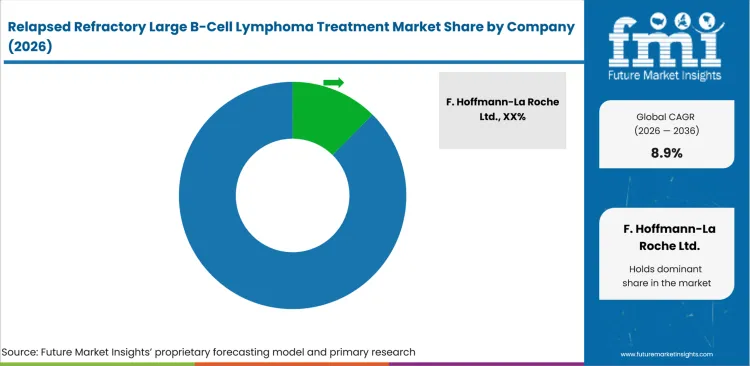
Regeneron Pharmaceuticals supports later-line diffuse large B-cell lymphoma treatment in Europe due to Ordspono. Pfizer and Takeda participate based on Adcetris development and commercialization arrangements. Incyte supports tafasitamab-based treatment through Monjuvi or Minjuvi in approved territories. Competition is projected to center on remission durability and treatment duration. Safety management and patient eligibility influence the administration setting. Cellular-therapy suppliers are expected to compete driven by manufacturing reliability and certified-center support. Bispecific-antibody companies may emphasize ready availability and outpatient administration. Antibody-drug conjugate suppliers are likely to seek combination roles among patients unsuitable for intensive cellular treatment.
- F. Hoffmann-La Roche Ltd. and Genentech maintain a diversified lymphoma portfolio spanning antibody-drug conjugates and CD20xCD3 bispecific antibodies. Clinical review focuses on sequencing Polivy and Lunsumio across treatment lines.
- Gilead Sciences and Kite retain a prominent cellular-therapy position depending on Yescarta. Treatment-center support and manufacturing reliability guide continuing adoption across eligible second-line patients.
- Bristol Myers Squibb competes through Breyanzi and its differentiated cellular-therapy evidence base. Clinical teams examine outpatient administration and earlier-line use during product comparison. Safety management remains part of the final review.
- AbbVie and Genmab strengthen review of Epkinly through subcutaneous administration and continuing combination trials. Outpatient transition protocols influence use across hospital and regional cancer programs.
- Regeneron and Incyte compete due to targeted antibody portfolios addressing later-line treatment needs. Pfizer and Takeda add antibody-drug conjugate participation. Commercial progress reflects approved indications and geographic reimbursement.
Competitive Benchmarking: Relapsed Refractory Large B-Cell Lymphoma Treatment Market
| Company | Portfolio Depth | Clinical Match | Service Support | Service Reach |
|---|---|---|---|---|
| F. Hoffmann-La Roche Ltd./Genentech, Inc. | High | High | High | Global oncology presence |
| Gilead Sciences, Inc./Kite, a Gilead Company | High | High | High | International cellular-therapy network |
| Bristol Myers Squibb | High | High | High | Multi-country certified treatment centers |
| Novartis AG | High | High | High | International treatment-center coverage |
| AbbVie Inc. | High | High | High | Hospital and outpatient programs |
| Genmab A/S | High | High | Medium | North America, Europe, and selected Asian markets |
| Regeneron Pharmaceuticals, Inc. | Medium | High | Medium | European commercial access |
| Pfizer Inc. | High | Medium | High | Global oncology channels |
| Incyte Corporation | Medium | Medium | Medium | North America, Europe, and Japan |
| Takeda Pharmaceutical Company Limited | High | Medium | High | International markets outside selected Pfizer territories |
Source: Future Market Insights competitive analysis, 2026.
Key Developments in Relapsed Refractory Large B-Cell Lymphoma Treatment Market
- In January 2025, Bristol Myers Squibb announced Health Canada approval of Breyanzi for second-line treatment of adults with relapsed or refractory diffuse large B-cell lymphoma. Approval expanded access to CAR-T therapy among patients experiencing early relapse or resistance following frontline treatment.
- In April 2025, Roche announced European Commission approval of Columvi combined with gemcitabine and oxaliplatin for relapsed or refractory diffuse large B-cell lymphoma following initial therapy. Company findings reported a 41% reduction in the risk of death, supporting fixed-duration bispecific treatment review for transplant-ineligible patients.
- In June 2026, Genmab announced positive Phase III EPCORE DLBCL-4 results for epcoritamab plus lenalidomide among patients with relapsed or refractory diffuse large B-cell lymphoma. Company information reported a statistically significant progression-free survival improvement, supporting further review of a chemotherapy-free combination.
Key Players in Relapsed Refractory Large B-Cell Lymphoma Treatment Market
Cellular-therapy companies
- Gilead Sciences, Inc./Kite, a Gilead Company
- Bristol Myers Squibb
- Novartis AG
Bispecific-antibody and antibody-drug conjugate companies
- F. Hoffmann-La Roche Ltd.
- Genentech, Inc.
- AbbVie Inc.
- Genmab A/S
- Regeneron Pharmaceuticals, Inc.
- Pfizer Inc.
- Takeda Pharmaceutical Company Limited
Targeted antibody participant
- Incyte Corporation
Relapsed Refractory Large B-Cell Lymphoma Treatment Market Report Scope
| Coverage field | Report scope |
|---|---|
| Market breakdown | Relapsed refractory large B-cell lymphoma treatment market breakdown by therapy type, drug, line of therapy, end user, and region. |
| Quantitative Units | Revenue in USD Million, CAGR in %. |
| Market Definition | Treatments used for large B-cell lymphoma returning following prior therapy or failing to produce adequate disease control. |
| Regions Covered | Coverage includes North America and Latin America. Western Europe and Eastern Europe form separate assessments. East Asia, South Asia and Pacific, and Middle East and Africa complete the regional scope. |
| Countries Covered | North America includes USA and Canada. Latin America covers Brazil and Mexico. Europe includes Germany, France, UK, Italy, and Spain. Asian coverage includes China, Japan, South Korea, India, and Australia. GCC countries and other national markets complete the scope. |
| Key Companies Profiled | Cellular-therapy profiles include Gilead Sciences, Kite, Bristol Myers Squibb, and Novartis. Antibody-focused profiles include Roche, Genentech, AbbVie, Genmab, Regeneron, Pfizer, Incyte, and Takeda. |
| Forecast Period | 2026 to 2036 |
| Approach | Hybrid bottom-up and top-down analysis uses therapy adoption and patient eligibility. Treatment sequencing, regulatory activity, trial evidence, and country access conditions inform the forecast. |
Source: Future Market Insights analysis, 2026.
Relapsed Refractory Large B-Cell Lymphoma Treatment Market - Research Methodology
| Method | Approach |
|---|---|
| Primary Research | FMI analysts gathered input from manufacturers, service providers, technology developers, distributors, end users, sourcing teams, and subject-matter experts. Interviews examined purchasing decisions, product or service evaluation, adoption barriers, approval requirements, pricing considerations, and expectations for technical or commercial support. Respondents were also asked what evidence is required before a trial, pilot, or initial order develops into regular purchasing. |
| Desk Research | Desk research covered government statistics, regulatory publications, trade data, industry associations, technical literature, standards, company filings, product information, and official corporate announcements. Sources were reviewed for relevance, publication date, geographic coverage, and consistency with the defined market scope. Claims relating to performance, applications, approvals, capacity, investment, and commercial activity were retained only when supported by credible public evidence. |
| Market Sizing and Forecasting | The market model combined the baseline value with historical performance, segment structure, pricing and volume indicators, adoption levels, company participation, and country-level demand conditions. Forecast assumptions considered economic activity, investment trends, regulatory developments, technology adoption, purchasing cycles, supply availability, and barriers to wider market use. Segment and regional estimates were reconciled before the final market total was calculated. |
| Data Validation | Estimates were checked against multiple independent indicators, including public data, company activity, trade patterns, industry developments, and findings from primary interviews. Validation also tested whether products, services, applications, and company revenues fell within the defined market boundaries. Adjacent categories, unsupported claims, overlapping revenues, and activities without direct market relevance were excluded to reduce double counting and maintain consistency across segments and countries. |
Source: Future Market Insights analysis, 2026.
Relapsed Refractory Large B-Cell Lymphoma Treatment Market by Segments
Relapsed Refractory Large B-Cell Lymphoma Treatment Market segmented by Therapy Type:
- CAR-T Cell Therapy
- Bispecific Antibodies
- Antibody-Drug Conjugates
- Monoclonal Antibodies
- Chemotherapy and Combination Therapy
Relapsed Refractory Large B-Cell Lymphoma Treatment Market segmented by Drug:
- Polivy (Polatuzumab Vedotin)
- Lunsumio (Mosunetuzumab)
- Columvi (Glofitamab)
- Yescarta
- Breyanzi
- Kymriah
- Epkinly
Relapsed Refractory Large B-Cell Lymphoma Treatment Market segmented by Line of Therapy:
- Second-Line
- Third-Line
- Fourth-Line and Later
Relapsed Refractory Large B-Cell Lymphoma Treatment Market segmented by End User:
- Hospitals
- Cancer Centers
- Specialty Oncology Clinics
- Academic and Research Institutes
Relapsed Refractory Large B-Cell Lymphoma Treatment Market segmented by Region:
- North America
- Latin America
- Western Europe
- Eastern Europe
- East Asia
- South Asia and Pacific
- Middle East and Africa
Research Sources and Bibliography
- Bristol Myers Squibb. (2025, January 13). CAR T-cell therapy Breyanzi approved for second-line relapsed or refractory diffuse large B-cell lymphoma.
- Bank of Korea. (2025, June 23). Toward sustainable employment for older workers in aging Korea [BOK Issue Note 2025-08].
- Genmab A/S. (2025, June 15). Genmab announces epcoritamab investigational combination therapy demonstrates high response rates in relapsed or refractory diffuse large B-cell lymphoma.
- Genmab A/S. (2025, September 3). Genmab announces updated results from the Phase II EPCORE NHL-6 trial.
- Genmab A/S. (2026, January 16). Genmab announces topline results for epcoritamab from the Phase III EPCORE DLBCL-1 trial.
- Genmab A/S. (2026, June 29). Genmab announces positive Phase III results for epcoritamab plus lenalidomide in relapsed or refractory diffuse large B-cell lymphoma.
- German Federal Statistical Office. (2025, June 20). Population by age groups (from 2011).
- Gilead Sciences, Inc. (2025, June 1). Kite presents new real-world data supporting use of potentially curative Yescarta in outpatient care for patients with relapsed or refractory large B-cell lymphoma at ASCO 2025.
- Gilead Sciences, Inc. (2025, December 7). Yescarta delivers consistent safety, efficacy, and quality-of-life benefits across relapsed or refractory large B-cell lymphoma analyses at ASH 2025.
- Office for National Statistics. (2025, September 26). Population estimates for the UK, England, Wales, Scotland and Northern Ireland: Mid-2024.
- Roche. (2025, April 14). European Commission approves Columvi as the first bispecific antibody for diffuse large B-cell lymphoma after initial therapy.
- Roche. (2025, May 23). New two-year follow-up of Columvi extends overall survival in relapsed or refractory diffuse large B-cell lymphoma patients.
- Roche. (2025, June 20). Roche’s Lunsumio and Polivy combination significantly prolongs remission in relapsed or refractory large B-cell lymphoma.
- Statistics Bureau of Japan. (2025, April 14). Current population estimates as of October 1, 2024.
- USA Census Bureau. (2025, June 26). Older adults outnumber children in 11 states and nearly half of USA counties.
- USA Food and Drug Administration. (2025, February 11). FDA approves brentuximab vedotin with lenalidomide and rituximab for relapsed or refractory large B-cell lymphoma.
- USA Food and Drug Administration. (2025, June 27). FDA eliminates Risk Evaluation and Mitigation Strategies for autologous chimeric antigen receptor CAR T-cell immunotherapies.
This bibliography is provided for reader reference and is not exhaustive. The full report contains the complete reference list and detailed citations.
This Report Answers
- What segments influence demand across therapy type, drug, line of therapy, end user, and region?
- How do hematology teams evaluate advanced lymphoma treatments prior to routine clinical use?
- How do country CAGRs differ across profiled markets with distinct treatment-center capacity and reimbursement access?
- What companies compete through cellular therapy, bispecific antibodies, antibody-drug conjugates, and targeted antibody combinations?
- How are forecasts validated through hybrid bottom-up and top-down analysis using independent clinical and commercial indicators?
- What evidence do hospital committees examine prior to adding advanced lymphoma regimens?
- How do response durability and adverse-event management influence treatment selection?
- What limits return on investment for hospitals adding complex cellular-therapy services?
- How do education records and specialist guidance influence hospital approval across hematology teams?
- What company capabilities improve long-term clinical confidence and continuing therapy utilization?
Frequently Asked Questions
How big is the Relapsed Refractory Large B-Cell Lymphoma Treatment Market in 2026?
The relapsed refractory large B-cell lymphoma treatment market is valued at USD 1053.6 million in 2026 and is forecast to reach USD 2471.5 million by 2036. Growth reflects oncology teams choosing cellular and antibody-based options earlier in the treatment cycle as survival data strengthens across relapsed and refractory patient populations.
What is the CAGR of the Relapsed Refractory Large B-Cell Lymphoma Treatment Market from 2026 to 2036?
The relapsed refractory large B-cell lymphoma treatment market grows at a CAGR of 8.9% between 2026 and 2036, supported by earlier-line adoption of CAR-T therapy and bispecific antibodies as hospitals gain infusion capacity and experience managing immune-related adverse events across eligible patient groups.
Which line of therapy leads the Relapsed Refractory Large B-Cell Lymphoma Treatment Market?
Second-line treatment accounts for 40.4% of the relapsed refractory large B-cell lymphoma treatment market by line of therapy in 2026, driven by earlier CAR-T use and developing bispecific combinations following frontline treatment failure among patients requiring rapid disease control and specialist referral.
How much will the Relapsed Refractory Large B-Cell Lymphoma Treatment Market add between 2026 and 2036?
The relapsed refractory large B-cell lymphoma treatment market is set to add USD 1417.9 million between 2026 and 2036, growing from USD 1053.6 million to USD 2471.5 million as earlier-line evidence extends cellular and antibody-based treatment access across eligible hematology programs worldwide.
Who are the leading companies in the Relapsed Refractory Large B-Cell Lymphoma Treatment Market?
Five companies lead the relapsed refractory large B-cell lymphoma treatment market, including F. Hoffmann-La Roche Ltd., Gilead Sciences, Bristol Myers Squibb, Novartis, and AbbVie, competing through CAR-T cell therapy, CD20xCD3 bispecific antibodies, and antibody-drug conjugates across hospital and specialty oncology treatment pathways.
Preview the report firsthand - request a free sample
Get SampleGet the brochure for pricing and purchase details.
Get PDFTable of Content
- Key Takeaways
- Market Size and CAGR
- Top Growth Driver
- Fastest Growing Segment
- Leading Region
- Key Companies
- Emerging Opportunities
- Executive Summary
- Global Market Outlook
- Demand-side Trends
- Supply-side Trends
- Technology Roadmap Analysis
- Analysis and Recommendations
- Analyst Perspective (What is happening? Why now? What should investors know?)
- Key Questions Answered
- How large is the market?
- What is the CAGR?
- What are key trends?
- Which region dominates?
- Who are the leaders?
- Market Overview
- Market Coverage / Taxonomy
- Market Definition / Scope / Limitations
- Research Methodology
- Chapter Orientation
- Analytical Lens and Working Hypotheses
- Market Structure, Signals, and Trend Drivers
- Benchmarking and Cross-market Comparability
- Market Sizing, Forecasting, and Opportunity Mapping
- Research Design and Evidence Framework
- Desk Research Programme (Secondary Evidence)
- Expert Input and Fieldwork (Primary Evidence)
- Tooling, Models, and Reference Databases
- Data Engineering and Model Build
- Quality Assurance and Audit Trail
- Market Background
- Market Dynamics (Drivers, Restraints, Opportunity, Trends)
- Scenario Forecast (Optimistic, Likely, Conservative)
- Impact Analysis
- AI Impact
- Sustainability Impact
- Regulatory Impact
- Technology Impact
- Consumer / Buyer Analysis
- Purchase Drivers
- Adoption Barriers
- Buyer Journey
- Opportunity Map Analysis
- Product Life Cycle Analysis
- Supply Chain Analysis
- Investment Feasibility Matrix
- Value Chain Analysis
- PESTLE and Porter's Analysis
- Regulatory Landscape
- Regional Parent Market Outlook
- Production and Consumption Statistics
- Import and Export Statistics
- Global Market Analysis and Forecast, 2021 to 2036
- Historical Market Size Value (USD Million) Analysis, 2021 to 2025
- Current and Future Market Size Value (USD Million) Projections, 2026 to 2036
- Y-o-Y Growth Trend Analysis
- Absolute $ Opportunity Analysis
- Global Market Pricing Analysis, 2021 to 2036
- Global Market Analysis and Forecast, By Therapy Type, 2021 to 2036
- Introduction / Key Findings
- Historical Market Size Value (USD Million) Analysis By Therapy Type, 2021 to 2025
- Current and Future Market Size Value (USD Million) Analysis and Forecast By Therapy Type, 2026 to 2036
- CAR-T Cell Therapy
- Bispecific Antibodies
- Antibody-Drug Conjugates (ADCs)
- Monoclonal Antibodies
- Chemotherapy & Combination Therapy
- CAR-T Cell Therapy
- Y-o-Y Growth Trend Analysis By Therapy Type, 2021 to 2025
- Absolute $ Opportunity Analysis By Therapy Type, 2026 to 2036
- Global Market Analysis and Forecast, By Drug, 2021 to 2036
- Introduction / Key Findings
- Historical Market Size Value (USD Million) Analysis By Drug, 2021 to 2025
- Current and Future Market Size Value (USD Million) Analysis and Forecast By Drug, 2026 to 2036
- Polivy (Polatuzumab Vedotin)
- Lunsumio (Mosunetuzumab)
- Columvi (Glofitamab)
- Yescarta
- Breyanzi
- Kymriah
- Epkinly
- Polivy (Polatuzumab Vedotin)
- Y-o-Y Growth Trend Analysis By Drug, 2021 to 2025
- Absolute $ Opportunity Analysis By Drug, 2026 to 2036
- Global Market Analysis and Forecast, By Line of Therapy, 2021 to 2036
- Introduction / Key Findings
- Historical Market Size Value (USD Million) Analysis By Line of Therapy, 2021 to 2025
- Current and Future Market Size Value (USD Million) Analysis and Forecast By Line of Therapy, 2026 to 2036
- Second-Line
- Third-Line
- Fourth-Line & Later
- Second-Line
- Y-o-Y Growth Trend Analysis By Line of Therapy, 2021 to 2025
- Absolute $ Opportunity Analysis By Line of Therapy, 2026 to 2036
- Global Market Analysis and Forecast, By End User, 2021 to 2036
- Introduction / Key Findings
- Historical Market Size Value (USD Million) Analysis By End User, 2021 to 2025
- Current and Future Market Size Value (USD Million) Analysis and Forecast By End User, 2026 to 2036
- Hospitals
- Cancer Centers
- Specialty Oncology Clinics
- Academic & Research Institutes
- Hospitals
- Y-o-Y Growth Trend Analysis By End User, 2021 to 2025
- Absolute $ Opportunity Analysis By End User, 2026 to 2036
- Global Market Analysis and Forecast, By Region, 2021 to 2036
- Introduction
- Historical Market Size Value (USD Million) Analysis By Region, 2021 to 2025
- Current Market Size Value (USD Million) Analysis and Forecast By Region, 2026 to 2036
- North America
- Latin America
- Western Europe
- Eastern Europe
- East Asia
- South Asia and Pacific
- Middle East & Africa
- Market Attractiveness Analysis By Region
- North America Market Analysis and Forecast, By Country, 2021 to 2036
- Historical Market Size Value (USD Million) Trend Analysis By Market Taxonomy, 2021 to 2025
- Market Size Value (USD Million) Forecast By Market Taxonomy, 2026 to 2036
- By Country
- USA
- Canada
- By Therapy Type
- By Drug
- By Line of Therapy
- By End User
- By Country
- Market Attractiveness Analysis
- By Country
- By Therapy Type
- By Drug
- By Line of Therapy
- By End User
- Key Takeaways
- Latin America Market Analysis and Forecast, By Country
- Historical Market Size Value (USD Million) Trend Analysis By Market Taxonomy, 2021 to 2025
- Market Size Value (USD Million) Forecast By Market Taxonomy, 2026 to 2036
- By Country
- Brazil
- Mexico
- Chile
- Rest of Latin America
- By Therapy Type
- By Drug
- By Line of Therapy
- By End User
- By Country
- Market Attractiveness Analysis
- By Country
- By Therapy Type
- By Drug
- By Line of Therapy
- By End User
- Key Takeaways
- Western Europe Market Analysis and Forecast, By Country
- Historical Market Size Value (USD Million) Trend Analysis By Market Taxonomy, 2021 to 2025
- Market Size Value (USD Million) Forecast By Market Taxonomy, 2026 to 2036
- By Country
- Germany
- UK
- Italy
- Spain
- France
- Nordic
- BENELUX
- Rest of Western Europe
- By Therapy Type
- By Drug
- By Line of Therapy
- By End User
- By Country
- Market Attractiveness Analysis
- By Country
- By Therapy Type
- By Drug
- By Line of Therapy
- By End User
- Key Takeaways
- Eastern Europe Market Analysis and Forecast, By Country
- Historical Market Size Value (USD Million) Trend Analysis By Market Taxonomy, 2021 to 2025
- Market Size Value (USD Million) Forecast By Market Taxonomy, 2026 to 2036
- By Country
- Russia
- Poland
- Hungary
- Balkan & Baltic
- Rest of Eastern Europe
- By Therapy Type
- By Drug
- By Line of Therapy
- By End User
- By Country
- Market Attractiveness Analysis
- By Country
- By Therapy Type
- By Drug
- By Line of Therapy
- By End User
- Key Takeaways
- East Asia Market Analysis and Forecast, By Country
- Historical Market Size Value (USD Million) Trend Analysis By Market Taxonomy, 2021 to 2025
- Market Size Value (USD Million) Forecast By Market Taxonomy, 2026 to 2036
- By Country
- China
- Japan
- South Korea
- By Therapy Type
- By Drug
- By Line of Therapy
- By End User
- By Country
- Market Attractiveness Analysis
- By Country
- By Therapy Type
- By Drug
- By Line of Therapy
- By End User
- Key Takeaways
- South Asia and Pacific Market Analysis and Forecast, By Country
- Historical Market Size Value (USD Million) Trend Analysis By Market Taxonomy, 2021 to 2025
- Market Size Value (USD Million) Forecast By Market Taxonomy, 2026 to 2036
- By Country
- India
- ASEAN
- Australia & New Zealand
- Rest of South Asia and Pacific
- By Therapy Type
- By Drug
- By Line of Therapy
- By End User
- By Country
- Market Attractiveness Analysis
- By Country
- By Therapy Type
- By Drug
- By Line of Therapy
- By End User
- Key Takeaways
- Middle East & Africa Market Analysis and Forecast, By Country
- Historical Market Size Value (USD Million) Trend Analysis By Market Taxonomy, 2021 to 2025
- Market Size Value (USD Million) Forecast By Market Taxonomy, 2026 to 2036
- By Country
- Kingdom of Saudi Arabia
- Other GCC Countries
- Türkiye
- South Africa
- Other African Union
- Rest of Middle East & Africa
- By Therapy Type
- By Drug
- By Line of Therapy
- By End User
- By Country
- Market Attractiveness Analysis
- By Country
- By Therapy Type
- By Drug
- By Line of Therapy
- By End User
- Key Takeaways
- Key Countries Market Analysis
- USA
- Pricing Analysis
- Market Share Analysis, 2025
- By Therapy Type
- By Drug
- By Line of Therapy
- By End User
- Canada
- Pricing Analysis
- Market Share Analysis, 2025
- By Therapy Type
- By Drug
- By Line of Therapy
- By End User
- Mexico
- Pricing Analysis
- Market Share Analysis, 2025
- By Therapy Type
- By Drug
- By Line of Therapy
- By End User
- Brazil
- Pricing Analysis
- Market Share Analysis, 2025
- By Therapy Type
- By Drug
- By Line of Therapy
- By End User
- Chile
- Pricing Analysis
- Market Share Analysis, 2025
- By Therapy Type
- By Drug
- By Line of Therapy
- By End User
- Germany
- Pricing Analysis
- Market Share Analysis, 2025
- By Therapy Type
- By Drug
- By Line of Therapy
- By End User
- UK
- Pricing Analysis
- Market Share Analysis, 2025
- By Therapy Type
- By Drug
- By Line of Therapy
- By End User
- Italy
- Pricing Analysis
- Market Share Analysis, 2025
- By Therapy Type
- By Drug
- By Line of Therapy
- By End User
- Spain
- Pricing Analysis
- Market Share Analysis, 2025
- By Therapy Type
- By Drug
- By Line of Therapy
- By End User
- France
- Pricing Analysis
- Market Share Analysis, 2025
- By Therapy Type
- By Drug
- By Line of Therapy
- By End User
- India
- Pricing Analysis
- Market Share Analysis, 2025
- By Therapy Type
- By Drug
- By Line of Therapy
- By End User
- ASEAN
- Pricing Analysis
- Market Share Analysis, 2025
- By Therapy Type
- By Drug
- By Line of Therapy
- By End User
- Australia & New Zealand
- Pricing Analysis
- Market Share Analysis, 2025
- By Therapy Type
- By Drug
- By Line of Therapy
- By End User
- China
- Pricing Analysis
- Market Share Analysis, 2025
- By Therapy Type
- By Drug
- By Line of Therapy
- By End User
- Japan
- Pricing Analysis
- Market Share Analysis, 2025
- By Therapy Type
- By Drug
- By Line of Therapy
- By End User
- South Korea
- Pricing Analysis
- Market Share Analysis, 2025
- By Therapy Type
- By Drug
- By Line of Therapy
- By End User
- Russia
- Pricing Analysis
- Market Share Analysis, 2025
- By Therapy Type
- By Drug
- By Line of Therapy
- By End User
- Poland
- Pricing Analysis
- Market Share Analysis, 2025
- By Therapy Type
- By Drug
- By Line of Therapy
- By End User
- Hungary
- Pricing Analysis
- Market Share Analysis, 2025
- By Therapy Type
- By Drug
- By Line of Therapy
- By End User
- Kingdom of Saudi Arabia
- Pricing Analysis
- Market Share Analysis, 2025
- By Therapy Type
- By Drug
- By Line of Therapy
- By End User
- Türkiye
- Pricing Analysis
- Market Share Analysis, 2025
- By Therapy Type
- By Drug
- By Line of Therapy
- By End User
- South Africa
- Pricing Analysis
- Market Share Analysis, 2025
- By Therapy Type
- By Drug
- By Line of Therapy
- By End User
- USA
- Market Structure Analysis
- Competition Dashboard
- Competition Benchmarking
- Market Share Analysis of Top Players
- By Regional
- By Therapy Type
- By Drug
- By Line of Therapy
- By End User
- Emerging Startups
- Innovation Benchmarking
- Competition Analysis
- Competition Deep Dive
- F. Hoffmann-La Roche Ltd.
- Overview
- Product Portfolio
- Profitability by Market Segments
- Sales Footprint
- Strategy Overview
- Marketing Strategy
- Product Strategy
- Channel Strategy
- Genentech, Inc.
- Gilead Sciences, Inc.
- Bristol Myers Squibb
- Novartis AG
- AbbVie Inc.
- Genmab A/S
- Regeneron Pharmaceuticals, Inc.
- AstraZeneca PLC
- BeiGene, Ltd.
- F. Hoffmann-La Roche Ltd.
- Case Studies
- Success Stories
- Recent Developments
- Competition Deep Dive
- Assumptions & Acronyms Used


