

- Market Size (2026)
- USD 2.8 Bn
- Forecast (2036)
- USD 6.6 Bn
- CAGR (2026 to 2036)
- 8.9%
How big is the Cell Migration and Cell Invasion Assay Market in 2026?
USD 2.8 billion in 2026 and USD 6.6 billion by 2036 at an 8.9% CAGR.
Sales of cell migration and cell invasion assays are estimated to rise at 8.9% CAGR through 2036. Valuation is expected to increase from USD 2.8 billion in 2026 to USD 6.6 billion by 2036 as laboratories standardize cell culture media preparation and analysis settings. Growing investment in advanced cancer research and imaging technologies is also increasing the adoption of migration and invasion assays for studying tumor behavior and metastatic processes. NCI reported four CCBIR centers in July 2026 that develop cellular and organ-scale imaging technologies for cancer biology.
The United States combines a large cancer-research network with direct access to specialized biomolecular imagers and assay support. NCI reported 74 designated cancer centers across 37 states and the District of Columbia in May 2026. Other countries depend more on concentrated academic facilities or distributor service, which produces different order-conversion conditions despite similar forecast rates.
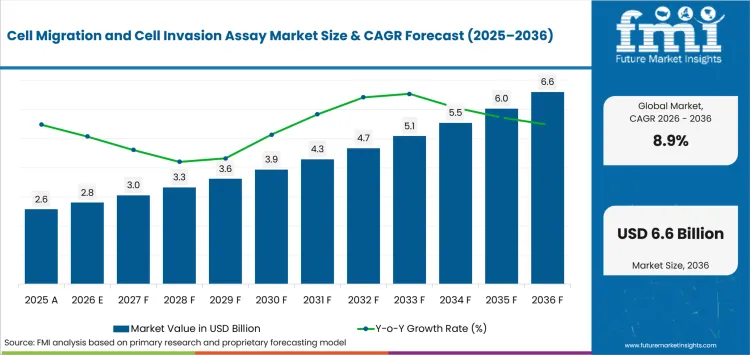
Key Takeaways of Cell Migration And Cell Invasion Assay Market
- Oncology and drug-development laboratories require functional measurements that distinguish cell movement from proliferation or image-processing artifacts across controlled studies.
- Assay kits are projected to represent 38.0% of product-type demand in 2026 due to standardized inserts and documented workflows.
- Cancer research is estimated to account for 42.0% of application demand in 2026 owing to continuing metastasis and invasion studies.
- Pharmaceutical and biotechnology companies are forecast to capture 39.0% of end-user demand in 2026 due to screening and preclinical evaluation requirements.
- Matrix composition and assay geometry restrict comparability as laboratories must validate cell density and endpoint timing across repeated experimental series.
- Thermo Fisher Scientific Inc., Corning Incorporated, Merck KGaA, Agilent Technologies, Inc., Bio-Techne Corporation, Revvity, Inc., Danaher Corporation and Sartorius AG serve distinct assay and analysis requirements.
Analyst Perspective
"Migration and invasion results inform compound decisions once laboratories separate motility from proliferation and matrix-related artifacts. Commercial value depends on comparable biology across inserts and three-dimensional matrices plus kinetic imaging and software-assisted analysis."
- Anurag Sharma, Principal Consultant, Future Market Insights
How is the Cell Migration and Cell Invasion Assay Market segmented?
The cell migration and cell invasion assay industry is segmented by product type, application, end user, distribution channel, assay type and region.
The market covers six dimensions. Product type includes assay kits, consumables, instruments and software or analysis tools. Applications include cancer research, drug discovery and development, stem cell research and immunology research. End users cover pharmaceutical and biotechnology companies, academic institutes, contract research organizations and hospitals or diagnostic laboratories. Distribution channels include direct sales, laboratory distributors, online sales and specialty life-science suppliers. Assay types cover transwell, scratch, three-dimensional invasion and microfluidic formats. Regional coverage follows the standard FMI taxonomy.
What supports assay kits within the product type category?
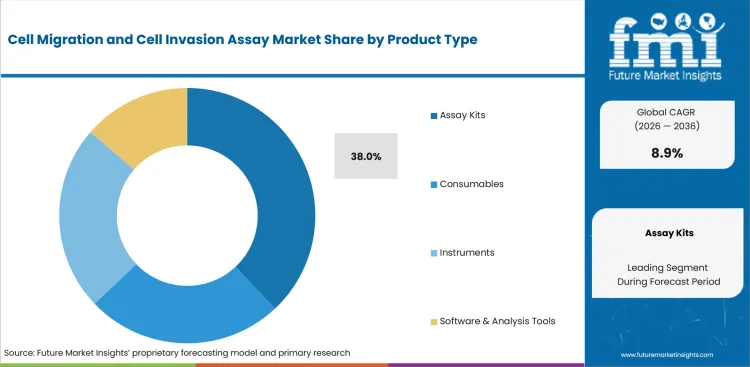
Assay kits package defined inserts with compatible reagents and documented procedures for migration or invasion studies. Research groups compare these formats with single-cell analysis systems to judge preparation effort and method-transfer requirements.
- Assay kits are set to lead the product type category with 38.0% share in 2026 due to standardized components that reduce preparation differences across routine laboratory studies.
- Packaged assays reduce separate orders for membranes and detection reagents. Laboratories must qualify matrix lots and incubation periods during controlled method transfer between instruments or research sites.
What makes cancer research central to the application category?
Cancer researchers use functional endpoints to separate cell movement from proliferation across treatment conditions. Complex 3D cell culture models add matrix structure and changing mechanical resistance to those comparisons.
- Based on application, cancer research is projected to account for 42.0% in 2026 due to metastasis programs that require comparable movement and matrix-penetration measurements.
- FDA encouraged developers to submit cell-line and organoid data within investigational applications in April 2025. Metastasis teams need separate laboratory controls that distinguish altered invasion from general toxicity across treatments and dose levels.
How do drug developers evaluate the leading end-user segment?
Pharmaceutical and biotechnology companies use migration or invasion data whenever a compound could alter tissue penetration or metastatic behavior. Integrated high-throughput screening workflows require transferable plate formats and interpretation rules across compound series and sites.
- In 2026 pharmaceutical and biotechnology companies are expected to lead the end-user category with 39.0% share due to functional endpoints needed for preclinical decisions.
- Internal assay groups need application support for method qualification and instrument integration. Transfers to contract laboratories require matched controls that preserve compound decisions across external research sites.
What role do transwell assays play within the assay type category?
Transwell assays separate cells from a chemoattractant with a porous membrane and add an extracellular matrix layer for invasion studies. Laboratories can use microscopy, fluorescence or colorimetric endpoints without changing the core chamber design.
- By assay type, transwell assays are forecast to represent 37.0% in 2026 driven by established membrane workflows that support several cell models and endpoint methods.
- Laboratories pair transwell readouts with flow cytometry to separate altered motility from changes in cell populations. Scratch and microfluidic formats answer different questions and require distinct geometry controls.
What are the drivers, restraints and opportunities in the Cell Migration and Cell Invasion Assay Market?
Functional phenotypic evidence supports demand despite format variability as integrated imaging increases information yield across cellular studies.
- Driver: Discovery teams need functional evidence that treatments or genetic changes alter motility under controlled laboratory conditions.
- Restraint: Matrix density and assay geometry can produce different outcomes across laboratories that use separate preparation methods.
- Opportunity: Integrated platforms can combine continuous acquisition with three-dimensional models and standardized image analysis across repeated studies.
Functional endpoints help discovery teams prioritize compounds that alter cell behavior without a clear molecular signal. Consistent automated cell culture systems improve starting-population control and treatment comparisons across screening runs.
Laboratories must compare formats under matched conditions so geometry does not distort treatment decisions. Németh and colleagues reported greater scratch-assay variability than zone-exclusion formats in November 2025. Method qualification remains necessary as teams combine migration data with immune marker panels.
Continuous imaging records movement during incubation and reduces manual endpoint handling. Companies can pair validated 3D cell culture plasticware with software that applies consistent segmentation across spheroid or hydrogel experiments.
Which country CAGRs are profiled in the Cell Migration and Cell Invasion Assay Market?
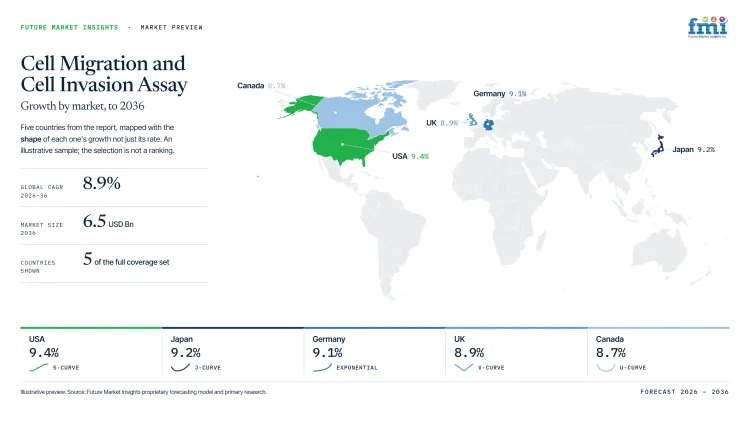
| Country | CAGR |
|---|---|
| United States | 9.4% |
| Japan | 9.2% |
| Germany | 9.1% |
| United Kingdom | 8.9% |
| Canada | 8.7% |
How do country-level CAGRs compare in the Cell Migration and Cell Invasion Assay Market?
Displayed CAGRs span 0.7 percentage point and measure forecast pace instead of current market size. Service coverage and research access matter commercially more than small differences across the displayed rates.
- The United States combines broad cancer-research capacity with direct technical support across major laboratory clusters.
- Japan relies on metropolitan imaging expertise and domestic distribution for specialized cellular assay workflows nationwide.
- Germany links core facilities with translational oncology networks that require method validation and compatible data rules.
- The United Kingdom depends on academic platforms that distribute advanced imaging access across university research groups.
- Canada combines centralized provincial facilities with long service distances that affect replenishment and instrument support.
Comparable CAGRs can produce different market entry conditions across laboratory networks with unequal service coverage and research access. The full report provides country-level CAGR analysis across North America, Latin America, Europe, East Asia, South Asia and Pacific, and the Middle East and Africa.
Country-wise Analysis
- United States cancer centers combine broad oncology research capacity with direct manufacturer service for imaging systems and assay qualification across major biomedical hubs that conduct repeated treatment studies using shared cellular models within nationally connected research systems. Cell migration and cell invasion assay demand is predicted to advance at 9.4% CAGR through 2036 as the national research base supports recurring purchases of consumables and automated analysis platforms. NCI reported a USD 7.35 billion fiscal 2026 appropriation in May 2026; converting that funding into comparable assay orders will depend on common controls and dependable technical coverage across independently operated laboratories.
- Japanese metropolitan laboratories consist of advanced imaging expertise with domestic distributors that provide translated documentation and scheduled application support for multicenter cellular programs using specialized microscopy plus complex biological and organoid models. Japan's cell migration and cell invasion assay outlook is anticipated to advance at 9.2% CAGR over the assessment period as concentrated facilities support specialized purchases across oncology and regenerative research networks. AMED selected one project from nine proposals for its Japan-Canada cancer call in February 2026, making protocol alignment and reliable service scheduling especially important for repeat assay demand beyond major urban centers.
- German university medical centers use shared imaging facilities and regional life-science clusters for cellular research that requires coordinated validation across institutions with separate purchasing procedures and tightly scheduled equipment access for repeated oncology and treatment-comparison studies nationwide. Cell migration and cell invasion assay sales in Germany are forecast to expand at 9.1% CAGR by 2036 as translational oncology networks support specialized purchases across university laboratories and research hospitals. DFG funded a multicenter colorectal-cancer stroma center in May 2025; participating laboratories will need common controls and compatible data rules before distributed programs translate into comparable assay results and recurring orders.
- United Kingdom academic core laboratories connect university researchers with shared imaging platforms and distributor support for consumables plus advanced analysis systems across national molecular and cellular medicine networks and hospitals. The United Kingdom cell migration and cell invasion assay sector is projected to record 8.9% CAGR during the forecast period as grant-funded projects support instrument access and recurring consumable demand. UKRI opened a molecular and cellular medicine award in May 2025 with typical three-year funding at 80% of full economic cost, so shared equipment schedules and local service contracts will determine how quickly awards translate into repeat assay purchases across university sites.
- Canadian university hospitals rely on provincial research centers and centralized imaging facilities that serve laboratory groups across long distances with separate purchasing systems and uneven access to urgent technical support during repeated oncology studies. By 2036 Canada is projected to grow at 8.7% CAGR as collaborative cancer programs support demand for assay consumables and automated analysis platforms across academic and hospital research networks. CIHR announced more than USD 41 million for 19 cancer prevention teams in February 2026; interprovincial shipping and distant technical service may lengthen qualification cycles before funded projects become repeat orders across provincial institutions.
Who are the notable companies in the Cell Migration and Cell Invasion Assay Market?
Thermo Fisher Scientific Inc., Corning Incorporated, Merck KGaA, Agilent Technologies, Inc., Bio-Techne Corporation, Revvity, Inc., Danaher Corporation and Sartorius AG are the notable companies serving this market.
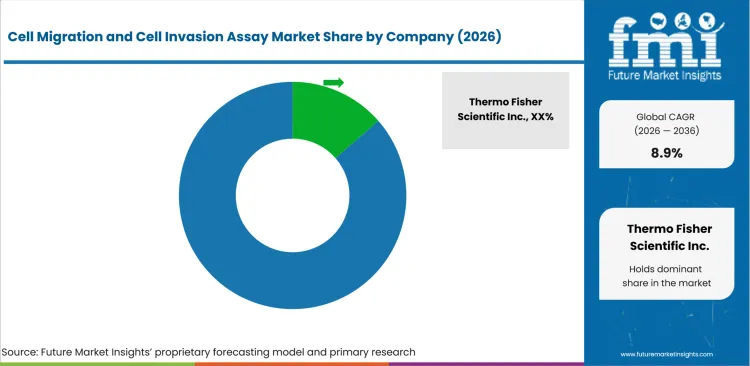
The competitive field remains fragmented across consumable manufacturers, extracellular-matrix specialists and automated imaging providers. Software validation and application support create higher entry barriers for kinetic or high-content platforms. Laboratories often combine assay inputs with analysis systems from different suppliers as no portfolio covers every workflow equally.
- Thermo Fisher Scientific Inc. and Corning Incorporated compete with broad cell-culture inputs plus laboratory imaging or three-dimensional workflow support.
- Merck KGaA and Bio-Techne Corporation add research reagents and extracellular-matrix capabilities that support controlled invasion workflows.
- Agilent Technologies, Inc. and Sartorius AG focus on kinetic analysis. Revvity, Inc. and Danaher Corporation extend competition with high-end cellomics platforms and integrated software.
Competitive Benchmarking: Cell Migration and Cell Invasion Assay Market
| Company | Assay Input Breadth | Live-Cell or Imaging Analysis | 3D or ECM Capability | Geographic Reach |
|---|---|---|---|---|
| Thermo Fisher Scientific Inc. | High | High | Medium | Global |
| Corning Incorporated | High | Low | High | Global |
| Merck KGaA | High | Low | High | Global |
| Agilent Technologies, Inc. | Medium | High | Medium | Global |
| Bio-Techne Corporation | High | Low | High | Global |
| Revvity, Inc. | Low | High | Medium | Global |
| Danaher Corporation | Low | High | High | Global |
| Sartorius AG | Medium | High | High | Global |
Key Developments in the Cell Migration and Cell Invasion Assay Market
- In December 2025, Agilent Technologies released 21 CFR Part 11 compliance software for the xCELLigence RTCA eSight platform. The update added secure authentication, electronic signatures and audit trails that extend continuous live-cell analysis into documented regulated workflows.
- In July 2025, Sartorius launched the Incucyte CX3 system with confocal fluorescence imaging for continuous three-dimensional cell analysis. The platform measures as many as six microplates in parallel and reduces transfers between acquisition systems during complex-model studies.
- In January 2025, Revvity announced Phenologic.AI software for brightfield cellular imaging within Harmony and Signals Image Artist workflows. The release added pretrained analysis that standardizes interpretation across live-cell images and repeated high-content screening datasets.
Key Players in the Cell Migration and Cell Invasion Assay Market
Assay Kits and Extracellular Matrix Platforms
- Thermo Fisher Scientific Inc.
- Corning Incorporated
- Merck KGaA
- Bio-Techne Corporation
Real-Time Cell Analysis Platforms
- Agilent Technologies, Inc.
- Sartorius AG
High-Content Imaging Platforms
- Revvity, Inc.
- Danaher Corporation
Cell Migration and Cell Invasion Assay Market - Report Scope
| Coverage field | Report scope |
|---|---|
| Market breakdown | By product type, application, end user, distribution channel, assay type and region. |
| Quantitative Units | Revenue USD billion and CAGR in %. |
| Market Definition | Commercially supplied assay kits, consumables, instruments and analysis tools used to measure cell migration, chemotaxis and invasion across research or preclinical workflows. |
| Regions Covered | North America, Latin America, Europe, East Asia, South Asia and Pacific, and Middle East and Africa. |
| Countries Covered | United States, Japan, Germany, United Kingdom, Canada, and 20+ countries included in the full report. |
| Key Companies Profiled | Thermo Fisher Scientific Inc., Corning Incorporated, Merck KGaA, Agilent Technologies, Inc., Bio-Techne Corporation, Revvity, Inc., Danaher Corporation and Sartorius AG. |
| Forecast Period | 2026 to 2036. |
| Approach | Primary and secondary research with market triangulation. |
Cell Migration and Cell Invasion Assay Market - Research Methodology
| Method | Approach |
|---|---|
| Primary Research | FMI analysts gathered input from manufacturers, service providers, technology developers, distributors, end users, procurement teams, and subject-matter experts. Interviews examined purchasing decisions, product or service evaluation, adoption barriers, approval requirements, pricing considerations, and expectations for technical or commercial support. Respondents were also asked what evidence is required before a trial, pilot, or initial order develops into regular purchasing. |
| Desk Research | Desk research covered government statistics, regulatory publications, trade data, industry associations, technical literature, standards, company filings, product information, and official corporate announcements. Sources were reviewed for relevance, publication date, geographic coverage, and consistency with the defined market scope. Claims relating to performance, applications, approvals, capacity, investment, and commercial activity were retained only when supported by credible public evidence. |
| Market Sizing and Forecasting | The market model combined the baseline value with historical performance, segment structure, pricing and volume indicators, adoption levels, company participation, and country-level demand conditions. Forecast assumptions considered economic activity, investment trends, regulatory developments, technology adoption, purchasing cycles, supply availability, and barriers to wider market use. Segment and regional estimates were reconciled before the final market total was calculated. |
| Data Validation | Estimates were checked against multiple independent indicators, including public data, company activity, trade patterns, industry developments, and findings from primary interviews. Validation also tested whether products, services, applications, and company revenues fell within the defined market boundaries. Adjacent categories, unsupported claims, overlapping revenues, and activities without direct market relevance were excluded to reduce double counting and maintain consistency across segments and countries. |
Cell Migration and Cell Invasion Assay Market by Segments
Cell Migration and Cell Invasion Assay Market segmented by Product Type:
- Assay Kits
- Transwell Migration Assay Kits
- Matrigel Invasion Assay Kits
- Consumables
- Cell Culture Inserts
- Extracellular Matrix Reagents
- Instruments
- Live Cell Imaging Systems
- Automated Cell Analyzers
- Software and Analysis Tools
- Image Analysis Software
- Data Management Software
Cell Migration and Cell Invasion Assay Market segmented by Application:
- Cancer Research
- Metastasis Studies
- Tumor Cell Invasion Analysis
- Drug Discovery and Development
- Lead Compound Screening
- Preclinical Drug Evaluation
- Stem Cell Research
- Stem Cell Migration Studies
- Regenerative Medicine Research
- Immunology Research
- Immune Cell Trafficking
- Inflammation Studies
Cell Migration and Cell Invasion Assay Market segmented by End User:
- Pharmaceutical and Biotechnology Companies
- Pharmaceutical Companies
- Biotechnology Companies
- Academic and Research Institutes
- Universities
- Government Research Institutes
- Contract Research Organizations (CROs)
- Preclinical CROs
- Discovery Research CROs
- Hospitals and Diagnostic Laboratories
- Clinical Research Hospitals
- Specialty Laboratories
Cell Migration and Cell Invasion Assay Market segmented by Distribution Channel:
- Direct Sales
- Key Account Sales
- OEM Supply Agreements
- Laboratory Distributors
- Regional Distributors
- Global Life Science Distributors
- Online Sales
- Manufacturer Websites
- E-Commerce Platforms
- Specialty Life Science Suppliers
- Research Reagent Suppliers
- Laboratory Equipment Suppliers
Cell Migration and Cell Invasion Assay Market segmented by Assay Type:
- Transwell Assays
- Boyden Chamber Assays
- Modified Transwell Assays
- Scratch (Wound Healing) Assays
- Manual Scratch Assays
- Automated Scratch Assays
- 3D Cell Invasion Assays
- Spheroid Invasion Assays
- Hydrogel-Based Assays
- Microfluidic Assays
- Chemotaxis Assays
- Gradient-Based Assays
Cell Migration and Cell Invasion Assay Market by Region:
- North America
- United States
- Canada
- Mexico
- Latin America
- Brazil
- Chile
- Rest of Latin America
- Western Europe
- Germany
- United Kingdom
- Italy
- Spain
- France
- Nordics
- Benelux
- Rest of Western Europe
- Eastern Europe
- Russia
- Poland
- Hungary
- Balkan and Baltic States
- Rest of Eastern Europe
- East Asia
- China
- Japan
- South Korea
- South Asia and Pacific
- India
- ASEAN
- Australia and New Zealand
- Rest of South Asia and Pacific
- Middle East and Africa
- Kingdom of Saudi Arabia
- Other GCC Countries
- Türkiye
- South Africa
- Other African Union Countries
- Rest of Middle East and Africa
Research Sources and Bibliography
- National Cancer Institute. (2026, July 13). Cellular Cancer Biology Imaging Research (CCBIR).
- National Cancer Institute. (2026, May 20). NCI-Designated Cancer Centers.
- USA Food and Drug Administration. (2025, April 10). FDA Announces Plan to Phase Out Animal Testing Requirement for Monoclonal Antibodies and Other Drugs.
- Németh, A., Bányai, G. L., Andrészek, M., Dobos, N. K., Köllőd, C., & Garay, T. (2025, November 28). Comparison of in vitro migration assays evaluating nintedanib’s migration inhibitory effects on melanoma cells.
- National Cancer Institute. (2026, May 14). NCI Budget and Appropriations.
- Japan Agency for Medical Research and Development. (2026, February 27). FY 2025 Advanced International Collaborative Research Program: Japan-Canada Joint Call.
- Deutsche Forschungsgemeinschaft. (2025, May 30). DFG to Fund 13 New Collaborative Research Centres.
- UK Research and Innovation. (2025, May 2). Molecular and cellular medicine: new investigator.
- Canadian Institutes of Health Research. (2026, February 26). Government of Canada and partners invest over $41M to advance cancer prevention research and improve early detection.
- Thermo Fisher Scientific Inc. (2025, April 23). Thermo Fisher Scientific Reports First Quarter 2025 Results.
- Corning Incorporated. (2025, January 26). SLAS 2025.
- Merck KGaA. (2025, March 6). Company Profile and Structure: Life Science.
- Agilent Technologies, Inc. (2025, March 24). Agilent xCELLigence RTCA Instrumentation Supports Potency Assay Development for CAR T Therapy.
- Agilent Technologies, Inc. (2025, December 1). Agilent Announces 21 CFR Part 11 Compliance Software for xCELLigence RTCA eSight.
- Bio-Techne Corporation. (2026, February 2). Bio-Techne Expands 3D Stem Cell and Organoid Culture Portfolio with a Fully Defined Synthetic Alternative.
- Revvity, Inc. (2025, January 23). Revvity Ignites Scientific Breakthroughs at SLAS2025.
- Molecular Devices, LLC. (2025, January 16). Molecular Devices Fast-Tracks High-Quality Imaging and Analysis with New ImageXpress HCS.ai High-Content Screening System.
- Sartorius AG. (2025, July 31). Incucyte CX3 System transforms continuous analysis of 3D cell models with confocal imaging and unmatched throughput.
This bibliography is provided for reader reference and is not exhaustive. The full report contains the complete reference list and detailed citations.
This Report Answers
- How large is the cell migration and cell invasion assay market in 2026 and 2036?
- Which laboratory conditions support demand for migration and invasion assay workflows?
- Which product type accounts for the largest approved share in 2026?
- How does cancer research shape application demand across functional assay programs?
- Why do pharmaceutical and biotechnology companies account for the largest end-user share?
- How do profiled country growth rates differ through 2036?
- Which companies supply assay components and automated cell-analysis platforms?
- What limits reproducibility across transwell, scratch, 3D and microfluidic assay formats?
Frequently Asked Questions
How big is the cell migration and cell invasion assay market in 2026?
In 2026, the cell migration and cell invasion assay market is estimated at USD 2.8 billion. The industry is projected to reach USD 6.6 billion by 2036 as laboratories expand functional testing across oncology and drug-development programs.
What is the CAGR of the cell migration and cell invasion assay market from 2026 to 2036?
An 8.9% CAGR is projected for the cell migration and cell invasion assay market from 2026 to 2036. The cell migration and cell invasion assay market depends on reproducible preparation and analysis methods that support comparable decisions across research sites using different assay formats.
Which product type is projected to lead the cell migration and cell invasion assay market?
A 38.0% share is projected for assay kits within the cell migration and cell invasion assay market by product type in 2026. The cell migration and cell invasion assay market favors defined inserts and compatible reagents that reduce setup differences across repeated studies and research teams.
Which application is projected to dominate the cell migration and cell invasion assay market?
A 42.0% share is estimated for cancer research within the cell migration and cell invasion assay market by application in 2026. The cell migration and cell invasion assay market supports metastasis programs that compare tumor-cell movement and matrix penetration across treatments and extracellular environments.
Which companies are active in the cell migration and cell invasion assay market?
Companies in the cell migration and cell invasion assay market across assay inputs and automated analysis platforms includes Thermo Fisher Scientific Inc., Corning Incorporated, Merck KGaA, Agilent Technologies, Inc., Bio-Techne Corporation, Revvity, Inc., Danaher Corporation and Sartorius AG.
Preview the report firsthand - request a free sample
Get SampleGet the brochure for pricing and purchase details.
Get PDFTable of Content
- Key Takeaways
- Market Size and CAGR
- Top Growth Driver
- Fastest Growing Segment
- Leading Region
- Key Companies
- Emerging Opportunities
- Executive Summary
- Global Market Outlook
- Demand-side Trends
- Supply-side Trends
- Technology Roadmap Analysis
- Analysis and Recommendations
- Analyst Perspective (What is happening? Why now? What should investors know?)
- Key Questions Answered
- How large is the market?
- What is the CAGR?
- What are key trends?
- Which region dominates?
- Who are the leaders?
- Market Overview
- Market Coverage / Taxonomy
- Market Definition / Scope / Limitations
- Research Methodology
- Chapter Orientation
- Analytical Lens and Working Hypotheses
- Market Structure, Signals, and Trend Drivers
- Benchmarking and Cross-market Comparability
- Market Sizing, Forecasting, and Opportunity Mapping
- Research Design and Evidence Framework
- Desk Research Programme (Secondary Evidence)
- Expert Input and Fieldwork (Primary Evidence)
- Tooling, Models, and Reference Databases
- Data Engineering and Model Build
- Quality Assurance and Audit Trail
- Market Background
- Market Dynamics (Drivers, Restraints, Opportunity, Trends)
- Scenario Forecast (Optimistic, Likely, Conservative)
- Impact Analysis
- AI Impact
- Sustainability Impact
- Regulatory Impact
- Technology Impact
- Consumer / Buyer Analysis
- Purchase Drivers
- Adoption Barriers
- Buyer Journey
- Opportunity Map Analysis
- Product Life Cycle Analysis
- Supply Chain Analysis
- Investment Feasibility Matrix
- Value Chain Analysis
- PESTLE and Porter's Analysis
- Regulatory Landscape
- Regional Parent Market Outlook
- Production and Consumption Statistics
- Import and Export Statistics
- Global Market Analysis and Forecast, 2021 to 2036
- Historical Market Size Value (USD Billion) Analysis, 2021 to 2025
- Current and Future Market Size Value (USD Billion) Projections, 2026 to 2036
- Y-o-Y Growth Trend Analysis
- Absolute $ Opportunity Analysis
- Global Market Pricing Analysis, 2021 to 2036
- Global Market Analysis and Forecast, By Product Type, 2021 to 2036
- Introduction / Key Findings
- Historical Market Size Value (USD Billion) Analysis By Product Type, 2021 to 2025
- Current and Future Market Size Value (USD Billion) Analysis and Forecast By Product Type, 2026 to 2036
- Assay Kits
- Transwell Migration Assay Kits
- Matrigel Invasion Assay Kits
- Consumables
- Cell Culture Inserts
- Microplates & Reagents
- Instruments
- High-Content Imaging Systems
- Automated Cell Analyzers
- Software & Analysis Tools
- Image Analysis Software
- Data Management Software
- Assay Kits
- Y-o-Y Growth Trend Analysis By Product Type, 2021 to 2025
- Absolute $ Opportunity Analysis By Product Type, 2026 to 2036
- Global Market Analysis and Forecast, By Application, 2021 to 2036
- Introduction / Key Findings
- Historical Market Size Value (USD Billion) Analysis By Application, 2021 to 2025
- Current and Future Market Size Value (USD Billion) Analysis and Forecast By Application, 2026 to 2036
- Cancer Research
- Metastasis Studies
- Tumor Cell Invasion Analysis
- Drug Discovery & Development
- Lead Compound Screening
- Preclinical Drug Evaluation
- Stem Cell Research
- Stem Cell Migration Studies
- Regenerative Medicine Research
- Immunology Research
- Immune Cell Trafficking
- Inflammation Studies
- Cancer Research
- Y-o-Y Growth Trend Analysis By Application, 2021 to 2025
- Absolute $ Opportunity Analysis By Application, 2026 to 2036
- Global Market Analysis and Forecast, By End User, 2021 to 2036
- Introduction / Key Findings
- Historical Market Size Value (USD Billion) Analysis By End User, 2021 to 2025
- Current and Future Market Size Value (USD Billion) Analysis and Forecast By End User, 2026 to 2036
- Pharmaceutical & Biotechnology Companies
- Pharmaceutical Companies
- Biotechnology Companies
- Academic & Research Institutes
- Universities
- Government Research Institutes
- Contract Research Organizations (CROs)
- Preclinical CROs
- Discovery Research CROs
- Hospitals & Diagnostic Laboratories
- Clinical Research Hospitals
- Specialty Laboratories
- Pharmaceutical & Biotechnology Companies
- Y-o-Y Growth Trend Analysis By End User, 2021 to 2025
- Absolute $ Opportunity Analysis By End User, 2026 to 2036
- Global Market Analysis and Forecast, By Distribution Channel, 2021 to 2036
- Introduction / Key Findings
- Historical Market Size Value (USD Billion) Analysis By Distribution Channel, 2021 to 2025
- Current and Future Market Size Value (USD Billion) Analysis and Forecast By Distribution Channel, 2026 to 2036
- Direct Sales
- Key Account Sales
- OEM Supply Agreements
- Laboratory Distributors
- Regional Distributors
- Global Life Science Distributors
- Online Sales
- Manufacturer Websites
- E-Commerce Platforms
- Specialty Life Science Suppliers
- Research Reagent Suppliers
- Laboratory Equipment Suppliers
- Direct Sales
- Y-o-Y Growth Trend Analysis By Distribution Channel, 2021 to 2025
- Absolute $ Opportunity Analysis By Distribution Channel, 2026 to 2036
- Global Market Analysis and Forecast, By Assay Type, 2021 to 2036
- Introduction / Key Findings
- Historical Market Size Value (USD Billion) Analysis By Assay Type, 2021 to 2025
- Current and Future Market Size Value (USD Billion) Analysis and Forecast By Assay Type, 2026 to 2036
- Transwell Assays
- Boyden Chamber Assays
- Modified Transwell Assays
- Scratch (Wound Healing) Assays
- Manual Scratch Assays
- Automated Scratch Assays
- 3D Cell Invasion Assays
- Spheroid Invasion Assays
- Hydrogel-Based Assays
- Microfluidic Assays
- Chemotaxis Assays
- Gradient-Based Assays
- Transwell Assays
- Y-o-Y Growth Trend Analysis By Assay Type, 2021 to 2025
- Absolute $ Opportunity Analysis By Assay Type, 2026 to 2036
- Global Market Analysis and Forecast, By Region, 2021 to 2036
- Introduction
- Historical Market Size Value (USD Billion) Analysis By Region, 2021 to 2025
- Current Market Size Value (USD Billion) Analysis and Forecast By Region, 2026 to 2036
- North America
- Latin America
- Western Europe
- Eastern Europe
- East Asia
- South Asia and Pacific
- Middle East & Africa
- Market Attractiveness Analysis By Region
- North America Market Analysis and Forecast, By Country, 2021 to 2036
- Historical Market Size Value (USD Billion) Trend Analysis By Market Taxonomy, 2021 to 2025
- Market Size Value (USD Billion) Forecast By Market Taxonomy, 2026 to 2036
- By Country
- USA
- Canada
- By Product Type
- By Application
- By End User
- By Distribution Channel
- By Assay Type
- By Country
- Market Attractiveness Analysis
- By Country
- By Product Type
- By Application
- By End User
- By Distribution Channel
- By Assay Type
- Key Takeaways
- Latin America Market Analysis and Forecast, By Country
- Historical Market Size Value (USD Billion) Trend Analysis By Market Taxonomy, 2021 to 2025
- Market Size Value (USD Billion) Forecast By Market Taxonomy, 2026 to 2036
- By Country
- Brazil
- Mexico
- Chile
- Rest of Latin America
- By Product Type
- By Application
- By End User
- By Distribution Channel
- By Assay Type
- By Country
- Market Attractiveness Analysis
- By Country
- By Product Type
- By Application
- By End User
- By Distribution Channel
- By Assay Type
- Key Takeaways
- Western Europe Market Analysis and Forecast, By Country
- Historical Market Size Value (USD Billion) Trend Analysis By Market Taxonomy, 2021 to 2025
- Market Size Value (USD Billion) Forecast By Market Taxonomy, 2026 to 2036
- By Country
- Germany
- UK
- Italy
- Spain
- France
- Nordic
- BENELUX
- Rest of Western Europe
- By Product Type
- By Application
- By End User
- By Distribution Channel
- By Assay Type
- By Country
- Market Attractiveness Analysis
- By Country
- By Product Type
- By Application
- By End User
- By Distribution Channel
- By Assay Type
- Key Takeaways
- Eastern Europe Market Analysis and Forecast, By Country
- Historical Market Size Value (USD Billion) Trend Analysis By Market Taxonomy, 2021 to 2025
- Market Size Value (USD Billion) Forecast By Market Taxonomy, 2026 to 2036
- By Country
- Russia
- Poland
- Hungary
- Balkan & Baltic
- Rest of Eastern Europe
- By Product Type
- By Application
- By End User
- By Distribution Channel
- By Assay Type
- By Country
- Market Attractiveness Analysis
- By Country
- By Product Type
- By Application
- By End User
- By Distribution Channel
- By Assay Type
- Key Takeaways
- East Asia Market Analysis and Forecast, By Country
- Historical Market Size Value (USD Billion) Trend Analysis By Market Taxonomy, 2021 to 2025
- Market Size Value (USD Billion) Forecast By Market Taxonomy, 2026 to 2036
- By Country
- China
- Japan
- South Korea
- By Product Type
- By Application
- By End User
- By Distribution Channel
- By Assay Type
- By Country
- Market Attractiveness Analysis
- By Country
- By Product Type
- By Application
- By End User
- By Distribution Channel
- By Assay Type
- Key Takeaways
- South Asia and Pacific Market Analysis and Forecast, By Country
- Historical Market Size Value (USD Billion) Trend Analysis By Market Taxonomy, 2021 to 2025
- Market Size Value (USD Billion) Forecast By Market Taxonomy, 2026 to 2036
- By Country
- India
- ASEAN
- Australia & New Zealand
- Rest of South Asia and Pacific
- By Product Type
- By Application
- By End User
- By Distribution Channel
- By Assay Type
- By Country
- Market Attractiveness Analysis
- By Country
- By Product Type
- By Application
- By End User
- By Distribution Channel
- By Assay Type
- Key Takeaways
- Middle East & Africa Market Analysis and Forecast, By Country
- Historical Market Size Value (USD Billion) Trend Analysis By Market Taxonomy, 2021 to 2025
- Market Size Value (USD Billion) Forecast By Market Taxonomy, 2026 to 2036
- By Country
- Kingdom of Saudi Arabia
- Other GCC Countries
- Türkiye
- South Africa
- Other African Union
- Rest of Middle East & Africa
- By Product Type
- By Application
- By End User
- By Distribution Channel
- By Assay Type
- By Country
- Market Attractiveness Analysis
- By Country
- By Product Type
- By Application
- By End User
- By Distribution Channel
- By Assay Type
- Key Takeaways
- Key Countries Market Analysis
- USA
- Pricing Analysis
- Market Share Analysis, 2025
- By Product Type
- By Application
- By End User
- By Distribution Channel
- By Assay Type
- Canada
- Pricing Analysis
- Market Share Analysis, 2025
- By Product Type
- By Application
- By End User
- By Distribution Channel
- By Assay Type
- Mexico
- Pricing Analysis
- Market Share Analysis, 2025
- By Product Type
- By Application
- By End User
- By Distribution Channel
- By Assay Type
- Brazil
- Pricing Analysis
- Market Share Analysis, 2025
- By Product Type
- By Application
- By End User
- By Distribution Channel
- By Assay Type
- Chile
- Pricing Analysis
- Market Share Analysis, 2025
- By Product Type
- By Application
- By End User
- By Distribution Channel
- By Assay Type
- Germany
- Pricing Analysis
- Market Share Analysis, 2025
- By Product Type
- By Application
- By End User
- By Distribution Channel
- By Assay Type
- UK
- Pricing Analysis
- Market Share Analysis, 2025
- By Product Type
- By Application
- By End User
- By Distribution Channel
- By Assay Type
- Italy
- Pricing Analysis
- Market Share Analysis, 2025
- By Product Type
- By Application
- By End User
- By Distribution Channel
- By Assay Type
- Spain
- Pricing Analysis
- Market Share Analysis, 2025
- By Product Type
- By Application
- By End User
- By Distribution Channel
- By Assay Type
- France
- Pricing Analysis
- Market Share Analysis, 2025
- By Product Type
- By Application
- By End User
- By Distribution Channel
- By Assay Type
- India
- Pricing Analysis
- Market Share Analysis, 2025
- By Product Type
- By Application
- By End User
- By Distribution Channel
- By Assay Type
- ASEAN
- Pricing Analysis
- Market Share Analysis, 2025
- By Product Type
- By Application
- By End User
- By Distribution Channel
- By Assay Type
- Australia & New Zealand
- Pricing Analysis
- Market Share Analysis, 2025
- By Product Type
- By Application
- By End User
- By Distribution Channel
- By Assay Type
- China
- Pricing Analysis
- Market Share Analysis, 2025
- By Product Type
- By Application
- By End User
- By Distribution Channel
- By Assay Type
- Japan
- Pricing Analysis
- Market Share Analysis, 2025
- By Product Type
- By Application
- By End User
- By Distribution Channel
- By Assay Type
- South Korea
- Pricing Analysis
- Market Share Analysis, 2025
- By Product Type
- By Application
- By End User
- By Distribution Channel
- By Assay Type
- Russia
- Pricing Analysis
- Market Share Analysis, 2025
- By Product Type
- By Application
- By End User
- By Distribution Channel
- By Assay Type
- Poland
- Pricing Analysis
- Market Share Analysis, 2025
- By Product Type
- By Application
- By End User
- By Distribution Channel
- By Assay Type
- Hungary
- Pricing Analysis
- Market Share Analysis, 2025
- By Product Type
- By Application
- By End User
- By Distribution Channel
- By Assay Type
- Kingdom of Saudi Arabia
- Pricing Analysis
- Market Share Analysis, 2025
- By Product Type
- By Application
- By End User
- By Distribution Channel
- By Assay Type
- Türkiye
- Pricing Analysis
- Market Share Analysis, 2025
- By Product Type
- By Application
- By End User
- By Distribution Channel
- By Assay Type
- South Africa
- Pricing Analysis
- Market Share Analysis, 2025
- By Product Type
- By Application
- By End User
- By Distribution Channel
- By Assay Type
- USA
- Market Structure Analysis
- Competition Dashboard
- Competition Benchmarking
- Market Share Analysis of Top Players
- By Regional
- By Product Type
- By Application
- By End User
- By Distribution Channel
- By Assay Type
- Emerging Startups
- Innovation Benchmarking
- Competition Analysis
- Competition Deep Dive
- Thermo Fisher Scientific Inc.
- Overview
- Product Portfolio
- Profitability by Market Segments
- Sales Footprint
- Strategy Overview
- Marketing Strategy
- Product Strategy
- Channel Strategy
- Corning Incorporated
- Merck KGaA
- Agilent Technologies, Inc.
- Bio-Techne Corporation
- PerkinElmer Inc.
- Abcam plc
- Danaher Corporation
- Sartorius AG
- PromoCell GmbH
- Thermo Fisher Scientific Inc.
- Case Studies
- Success Stories
- Recent Developments
- Competition Deep Dive
- Assumptions & Acronyms Used


