

- Industry Size (2025)
- USD 950 Mn
- Forecast (2035)
- USD 1958 Mn
- CAGR (2025 to 2035)
- 7.5%
Flow Cytometry Immune Marker Panels Market Forecast and Outlook 2025 to 2035
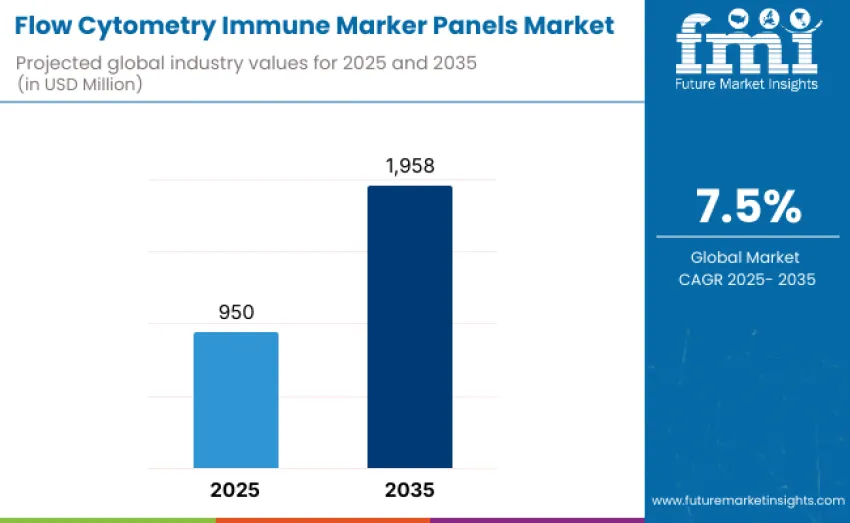
The flow cytometry immune marker panels market is projected to reach USD 1,958 million by 2035, recording an absolute increase of USD 1,008 million over the forecast period. Value stands at USD 950 million in 2025 and is set to rise at a CAGR of 7.5% during the forecast period 2025 to 2035. Growth is driven by increasing demand for high-resolution immune profiling in research, clinical diagnostics, and drug development, alongside rising adoption of multiplexed flow cytometry platforms in immunology, oncology, and infectious disease monitoring. Expanding applications in immunotherapy, vaccine development, and personalized medicine, coupled with increasing investments in automated cytometry instruments and standardized panels, support expansion.
Growth reflects evolving immunology workflows, where researchers and clinicians require comprehensive immune profiling capabilities to monitor immune cell populations, activation states, and functional responses. Flow cytometry immune marker panels including monoclonal antibody-based panels, multicolor staining kits, and lyophilized ready-to-use formats enable simultaneous assessment of multiple cellular markers with high sensitivity and specificity. These panels provide improved analytical efficiency, often yielding 40-60 percent higher throughput compared with conventional single-parameter assays, enabling detailed characterization of T-cell, B-cell, NK-cell, and myeloid populations for research and clinical decision-making.
Quick Stats for Flow Cytometry Immune Marker Panels Market
- Flow Cytometry Immune Marker Panels Market Value (2025): USD 950 million
- Flow Cytometry Immune Marker Panels Market Forecast Value (2035): USD 1,958 million
- Flow Cytometry Immune Marker Panels Market Forecast CAGR: 7.5%
- Leading Product Type in Flow Cytometry Immune Marker Panels Market: Immunophenotyping panels (45% share)
- Key Growth Regions in Flow Cytometry Immune Marker Panels Market: Asia Pacific, Europe, and North America
- Top Players in Flow Cytometry Immune Marker Panels Market: BD Biosciences, Beckman Coulter, Thermo Fisher, MiltenyiBiotec
Technological advancements are driving adoption. Innovations in fluorochrome chemistry, multicolor panel design, and automated sample preparation systems improve signal resolution, reduce background noise, and enable accurate multiplexed detection of complex cellular phenotypes. Integration with high-throughput cytometers, microfluidic sample handling, and advanced data analysis software supports reproducible workflows and scalable immune monitoring in both research and clinical environments. These technological improvements are particularly valuable for longitudinal studies, clinical trials, and immunotherapy monitoring where reproducibility, accuracy, and data richness are critical.
Flow Cytometry Immune Marker Panels Market Year-over-Year Forecast (2025 to 2035)
Between 2025 and 2030, flow cytometry immune marker panels market is projected to expand from USD 950 million to USD 1,363.8 million, resulting in a value increase of USD 413.8 million, representing 41.1% of total forecast growth for the decade. This growth phase is expected to be driven by increasing adoption of immune profiling technologies in clinical diagnostics and translational research, ongoing innovation in multi-parameter panel design, and enhanced integration of high-throughput cytometry platforms with laboratory information management systems.
From 2030 to 2035, growth continues from USD 1,363.8 million to USD 1,958 million, adding another USD 594.2 million, constituting 58.9% of overall ten-year expansion. This period is expected to be shaped by adoption of highly multiplexed immune marker panels, advanced spectral cytometry technologies, and enhanced data analytics capabilities enabling deeper immunophenotyping insights.
Flow Cytometry Immune Marker Panels Market Key Takeaways
| Metric | Value |
|---|---|
| Market Value (2025) | USD 950 million |
| Market Forecast Value (2035) | USD 1,958 million |
| Forecast CAGR (2025 to 2035) | 7.5% |
Why Is the Flow Cytometry Immune Marker Panels Market Growing Worldwide?
Global flow cytometry immune marker panels market is expanding as researchers and clinical laboratories increasingly seek high-precision solutions for cellular analysis, immunophenotyping, and biomarker detection. Rising demand is driven by need for accurate, multiplexed assays that can accelerate immunology research, drug development, and diagnostic workflows. Advanced flow cytometry panels offer improvements in assay sensitivity, reproducibility, and throughput, enabling laboratories to generate robust data sets more efficiently than traditional single-marker approaches.
Growth is supported by increasing prevalence of immune-related disorders, oncology studies, and infectious disease research, which necessitate comprehensive immune profiling using multi-color and high-parameter panels. Government and institutional initiatives promoting biomedical research, translational medicine, and precision healthcare are facilitating adoption of standardized immune marker panels in academic, hospital, and contract research organization (CRO) settings.
How Are the Flow Cytometry Immune Marker Panels Market Segmented by Product Type, Application, and Region?
Flow cytometry immune marker panels market is segmented by product type, application, and region. By product type, it is divided into immunophenotyping panels, functional assays, custom/research panels, companion diagnostic panels and others. Based on application, it is categorized into oncology/CAR-T monitoring, infectious disease & vaccine R&D, immunology research, clinical immunomonitoring. Regionally, it is divided into Asia Pacific, Europe, North America, Latin America, and Middle East & Africa. Each segment demonstrates distinct growth patterns driven by research requirements, technology adoption rates, and laboratory infrastructure development across diverse immunology environments worldwide. (118 words)
By Product Type, Immunophenotyping Panels Account for 45% Share
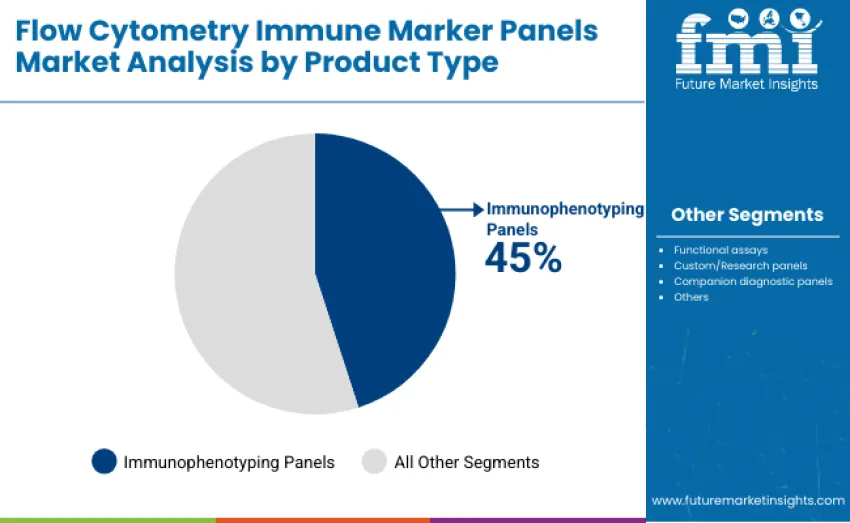
Immunophenotyping panels constitute the largest product type segment, accounting for an estimated 45% of revenue in 2025. This dominance is attributed to their widespread use in identifying and quantifying immune cell subsets across clinical diagnostics, immuno-oncology, and translational research. These panels are routinely applied in hematologic malignancy profiling, immune status assessment, and therapy response monitoring, where standardized marker combinations and reproducibility are critical. Functional assay panels represent approximately 20% of revenue, supported by their role in assessing cytokine secretion, cell activation, proliferation, and signaling pathways. Their adoption has been reinforced by increasing demand for functional immune readouts in immuno-oncology research, drug development, and vaccine response evaluation.
By Application, Oncology and CAR-T Monitoring Dominates with 38% Share
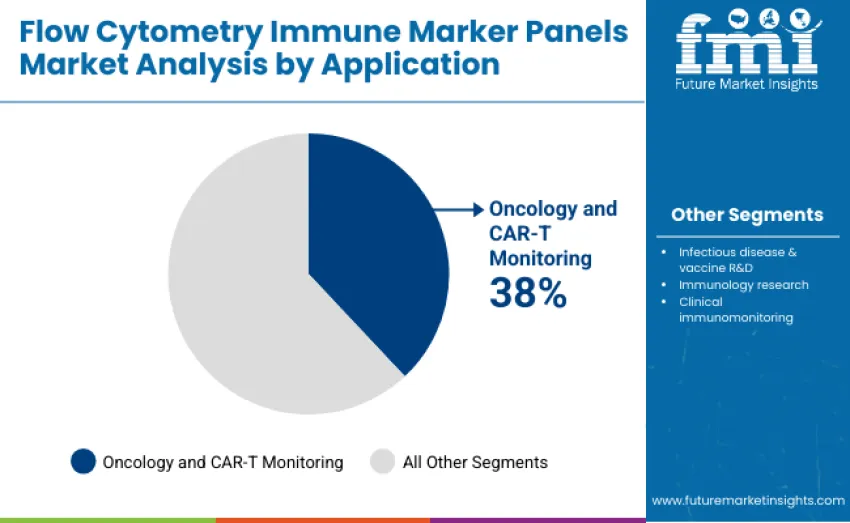
Oncology and CAR-T monitoring represents the largest application segment, accounting for an estimated 38% of revenue in 2025. Strong demand is driven by expanding use of immune marker panels to monitor tumor immune microenvironments, assess treatment response, and track immune reconstitution in patients receiving checkpoint inhibitors and cell-based therapies. High-parameter flow cytometry panels are increasingly embedded in both clinical trials and routine cancer care workflows. Immunology research contributes approximately 22% of revenue, supported by continued investment in academic and institutional research focused on immune cell biology, signaling mechanisms, and disease pathogenesis. Marker panels remain essential tools for dissecting complex immune interactions and generating high-quality mechanistic data. Infectious disease and vaccine R&D accounts for around 20% of revenue, reflecting sustained need for immune response monitoring in vaccine development, pathogen-response studies, and immune correlates of protection analysis.
What Are the Major Drivers, Restraints, and Emerging Trends Influencing the Flow Cytometry Immune Marker Panels Market?
Flow cytometry immune marker panels Market is driven by three key factors. First, rising adoption of multiparametric flow cytometry for immune profiling strengthens demand for standardized immune marker panels across research, clinical diagnostics, and vaccine development. Second, increasing global burden of autoimmune, infectious, and oncologic diseases requires high-sensitivity T-cell, B-cell, NK-cell, and myeloid lineage characterization for diagnosis, monitoring, and immunotherapy assessment. Third, rapid expansion of immuno-oncology and personalized medicine programs accelerates use of validated, high-plex panels that support biomarker discovery, patient stratification, and translational research.
What Are the Key Restraints Affecting Adoption in the Flow Cytometry Immune Marker Panels Market?
Market restraints include high acquisition and operational costs associated with multiparametric panels, advanced cytometers, and skilled personnel requirements. Variability in panel design, fluorochrome combinations, and sample preparation can reduce reproducibility and limit cross-laboratory comparability. Additionally, stringent regulatory and quality-control requirements for clinical diagnostics slow adoption in regulated healthcare environments.
What Key Trends Are Shaping the Future of the Flow Cytometry Immune Marker Panels Market?
Key trends include rapid development of pre-validated, high-plex immune marker panels optimized for automated and spectral flow cytometry platforms. Advancements in novel fluorochromes, spectral unmixing algorithms, and digital data-analysis tools are enhancing sensitivity and throughput. Growing emphasis on standardized workflows supports high-throughput immune monitoring and multi-center clinical research.
How Are Leading Countries Driving Growth in Flow Cytometry Immune Marker Panels Market?
| Country/Region | CAGR (2025 to 2035) |
|---|---|
| India | 9.5% |
| China | 9.0% |
| USA | 8.0% |
| Europe | 7.2% |
| Brazil | 7.0% |
| Germany | 7.0% |
| France | 6.8% |
| UK | 6.5% |
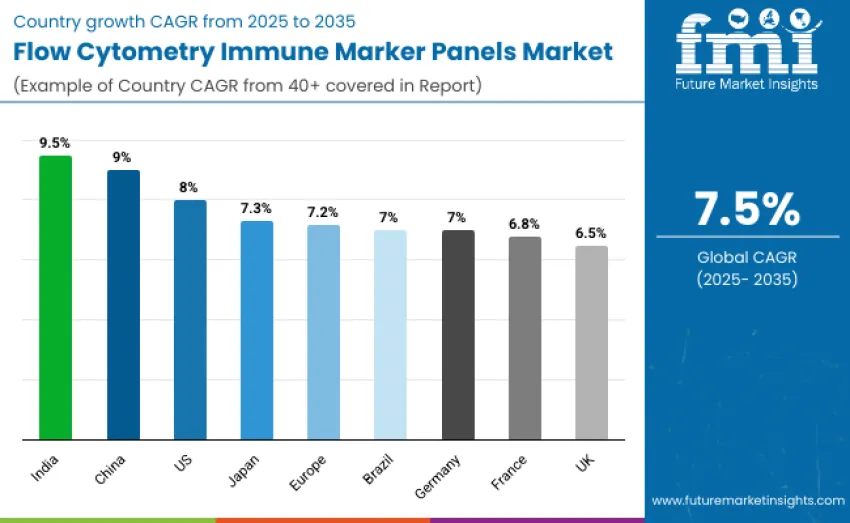
India leads the flow cytometry immune marker panels landscape with a strong 9.5% CAGR, driven by rapid growth in immunology research, translational medicine, and government-backed biotechnology programs. China follows at 9.0%, supported by expanding diagnostics capacity and large-scale adoption of multiplex immune marker panels. The USA grows at 8.0% with widespread high-throughput integration across clinical and research settings. Europe records 7.2% growth, with Germany at 7.0%, France at 6.8%, and the UK at 6.5%, driven by precision medicine and clinical trial expansion. Brazil advances at 7.0% through expanding laboratory networks and rising immuno-oncology adoption.
How Are Hospital Networks and Clinical Research Initiatives Driving Growth in China?
China's flow cytometry immune marker panels market is projected to grow at a CAGR of 9.0% through 2035, supported by rapid development of hospital networks, translational research programs, and oncology-focused diagnostic laboratories in Beijing, Shanghai, and Guangzhou. Flow cytometry panels are increasingly applied for immunophenotyping, leukemia and lymphoma diagnostics, and immune response monitoring in clinical trials. Domestic biotech manufacturers provide high-throughput reagents and automated panels, optimizing workflow efficiency. Collaborative initiatives between academic institutions, hospitals, and diagnostic developers promote technical training, assay standardization, and multi-site validation programs.
Why Are Expanding Clinical Labs and Research Programs Accelerating Growth in India?
India's flow cytometry immune marker panels market is projected to grow at a CAGR of 9.5% through 2035, driven by expansion of specialized clinical laboratories and translational research centers in Bengaluru, Hyderabad, and Mumbai, supporting hematology, oncology, and immunology testing. Flow cytometry panels are increasingly used in diagnostic workflows for leukemia, lymphomas, and immune monitoring in clinical trials. Collaborations with international diagnostic suppliers ensure access to standardized panels, training, and technical support. Government initiatives such as the National Health Mission and biotechnology promotion schemes support laboratory infrastructure upgrades and research integration.
How Are Regulatory Standards and Precision Medicine Driving Adoption in Germany?
Germany's flow cytometry immune marker panels market is projected to grow at a CAGR of 7.0% through 2035, supported by strict IVDR compliance, laboratory accreditation requirements, and integration of panels in university hospitals in Berlin, Munich, and Frankfurt. Panels are employed in immunophenotyping, hematologic malignancy diagnostics, and monitoring immunotherapy response. Biotech suppliers provide standardized reagents and automated panels compatible with laboratory information management systems. Precision medicine initiatives encourage integration of flow cytometry data with genomic and proteomic profiling for personalized patient management. Collaborative research networks ensure protocol standardization, multi-center validation, and quality control for widespread clinical adoption.
How Are Regional Healthcare Networks and Laboratory Partnerships Driving Growth in Brazil?
Brazil's flow cytometry immune marker panels market is projected to grow at a CAGR of 7.0% through 2035, supported by integration of panels in regional healthcare networks and tertiary care hospitals across São Paulo, Rio de Janeiro, Brasília, and Porto Alegre. Panels are increasingly deployed for immunophenotyping, transplant monitoring, and monitoring immune response in hematologic disorders. Local biotech companies manufacture affordable and robust reagents suitable for high-volume testing in public and private laboratories. Partnerships between academic research centers and hospital laboratories facilitate standardized workflows, proficiency testing, and staff training programs. Public health initiatives targeting early cancer detection and infectious disease monitoring provide incentives for adopting flow cytometry panels, enabling wider laboratory coverage across metropolitan and regional centers.
How Are Clinical Research Networks and Biotech Innovation Fueling Growth in United States?
United States flow cytometry immune marker panels market is projected to grow at a CAGR of 8.0% through 2035, driven by extensive use of panels in oncology and immunology research centers in Boston, San Francisco, and New York. Panels are applied for immune cell phenotyping, minimal residual disease detection, and immunotherapy monitoring. Leading biotechnology and diagnostic companies provide pre-validated, automation-ready panels with integrated software solutions to streamline laboratory workflows. Multi-institutional clinical trials, supported by the National Institutes of Health and private research funding, contribute to widespread adoption. Collaborative networks between hospitals, academic centers, and pharmaceutical companies support standardized protocols, cross-site validation, and real-world evidence collection, reinforcing panel reliability in research and clinical applications.
How Are Academic Hospitals and Government Programs Driving Expansion in United Kingdom?
United Kingdom's flow cytometry immune marker panels market is projected to grow at a CAGR of 6.5% through 2035, supported by NHS hospitals and research-intensive universities in London, Manchester, Bristol, and Edinburgh, which utilize panels for immune profiling, hematology diagnostics, and infectious disease monitoring. Partnerships with European and domestic assay manufacturers provide standardized reagents, validation protocols, and laboratory training. Government-backed initiatives promote precision medicine programs and translational research, enabling multi-site studies and deployment of panels across public and private laboratories. Integration with laboratory information management systems ensures workflow efficiency, data reproducibility, and compliance with regulatory standards, supporting both research and clinical adoption. NHS hospitals and university research centers implement panels for immune profiling and hematology diagnostics.
How Are Precision Medicine Programs and Laboratory Modernization Supporting Growth in Europe?
Europe’s flow cytometry immune marker panels market is projected to grow at a 7.2% CAGR through 2035, supported by strong precision medicine initiatives, expanding immunology and oncology research programs, and widespread adoption of standardized multiparametric panels across academic hospitals and clinical laboratories. Leading centers in Germany, the UK, France, and the Netherlands are integrating high-plex immune marker panels for immunophenotyping, clinical trial stratification, and immune monitoring. EU regulatory frameworks and investments in automated cytometry platforms enhance assay reproducibility and multi-site comparability. Growing collaboration between research institutes and diagnostic manufacturers supports training, validation, and harmonized data workflows.
How Are Translational Research Networks and Immunology Programs Driving Growth in France?
France’s flow cytometry immune marker panels market is projected to grow at a 6.8% CAGR through 2035, driven by expanding translational immunology programs and modernization of diagnostic laboratories within Paris, Lyon, Marseille, and Toulouse. Hospitals and cancer centers increasingly deploy standardized immune marker panels to support leukemia diagnostics, immunotherapy monitoring, and vaccine research. National research agencies and hospital networks promote biomarker validation, multi-center clinical studies, and adoption of high-throughput cytometry workflows. Partnerships between universities, public research institutes, and diagnostic developers enhance workforce training, assay optimization, and integration with automated analyzers and laboratory information systems.
How Competitive Is the Global Flow Cytometry Immune Marker Panels Market and What Defines Its Structure?
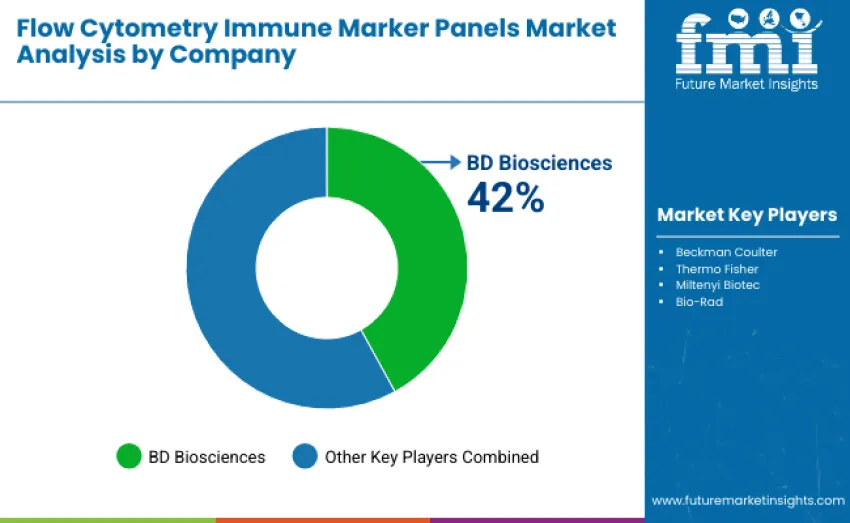
Flow cytometry immune marker panels market shows moderate consolidation, with around 12–15 meaningful participants competing across clinical diagnostics, immuno-oncology, vaccine research, and translational medicine. BD Biosciences leads decisively, holding 42% share, the largest among all players. Its leadership is supported by a comprehensive portfolio of clinical-grade and RUO immune marker panels, deep integration with BD FACSymphony, FACSLyric, and FACSCanto platforms, and long-standing partnerships with hospitals, research institutes, and global pharmaceutical companies. Thermo Fisher Scientific follows as a major global competitor, leveraging broad reagent portfolios, proprietary antibody technologies, and a strong global distribution ecosystem.
Beckman Coulter Life Sciences competes as a powerful challenger through integrated workflows combining instruments, validated reagent panels, and advanced analysis software. MiltenyiBiotec maintains a differentiated niche through magnetic cell separation tools and highly specialized immune marker panels tailored for immunology and cell therapy research. Bio-Rad Laboratories contributes through research-oriented antibody panels and reagents designed for high-complexity cytometry applications.
Key Players in the Flow Cytometry Immune Marker Panels Market
- BD Biosciences
- Beckman Coulter
- Thermo Fisher
- MiltenyiBiotec
- Bio-Rad
Scope of the Report
| Item | Value |
|---|---|
| Quantitative Units | USD 950 million |
| Product Type | Immunophenotyping panels, Functional assays, Custom/Research panels, Companion diagnostic panels, Others |
| Application | Oncology/CAR-T monitoring, Infectious disease & vaccine R&D, Immunology research, Clinical immunomonitoring |
| Regions Covered | Asia Pacific, Europe, North America, Latin America, Middle East & Africa |
| Country Covered | China, India, Germany, Brazil, USA, UK, Japan, and 40+ countries |
| Key Companies Profiled | BD Biosciences, Beckman Coulter, Thermo Fisher, Miltenyi Biotec , Bio-Rad |
| Additional Attributes | Dollar sales by product type and application, regional uptake across Asia Pacific, Europe, and North America, competitive landscape of immune marker panel and reagent suppliers, technical performance needs, integration with cytometers and software, and advances in fluorochromes, conjugation, and high-resolution, workflow-optimized panel designs shape market evolution |
Flow Cytometry Immune Marker Panels Market by Segments
By Product Type:
- Immunophenotyping panels
- Functional assays
- Custom / Research panels
- Companion diagnostic panels
- Others
By Application:
- Oncology / CAR-T monitoring
- Infectious disease & vaccine R&D
- Immunology research
- Clinical immunomonitoring
By Region:
- Asia Pacific
- China
- India
- Japan
- South Korea
- Vietnam
- Australia & New Zealand
- ASEAN
- Rest of Asia Pacific
- Europe
- Germany
- United Kingdom
- France
- Italy
- Spain
- Netherlands
- Nordic
- BENELUX
- Rest of Europe
- North America
- United States
- Canada
- Mexico
- Latin America
- Brazil
- Argentina
- Rest of Latin America
- Middle East & Africa
- Kingdom of Saudi Arabia
- Other GCC Countries
- Turkey
- South Africa
- Other African Union
- Rest of Middle East & Africa
Bibliography
- Becton, Dickinson and Company. (2023). Multicolor flow cytometry panels for immunophenotyping and clinical research applications. BD Biosciences Technical Publications.
- Bio-Rad Laboratories. (2023). Flow cytometry immune marker panels for oncology, immunology, and vaccine research. Bio-Rad Life Science Group Application Guides.
- Thermo Fisher Scientific. (2023). Immune profiling and flow cytometry panel design for translational and clinical research. Thermo Fisher Scientific Scientific White Papers.
- Beckman Coulter Life Sciences. (2023). Standardized and custom flow cytometry panels for clinical immunomonitoring and CAR T cell analysis. Beckman Coulter Life Sciences Technical Bulletins.
Frequently Asked Questions
How big is the flow cytometry immune marker panels market in 2025?
The global flow cytometry immune marker panels market is valued at USD 950 million in 2025.
What will be the size of the flow cytometry immune marker panels market in 2035?
The market is projected to reach USD 1,958 million by 2035.
How fast will the flow cytometry immune marker panels market grow between 2025 and 2035?
The market will grow at a CAGR of 7.5% from 2025 to 2035.
Which product type leads the flow cytometry immune marker panels market in 2025?
Immunophenotyping panels lead the market with a 45% share in 2025.
Who are the major players in the flow cytometry immune marker panels market?
Key players include BD Biosciences, Beckman Coulter, Thermo Fisher, Miltenyi Biotec, and Bio-Rad.
Preview the report firsthand - request a free sample
Get SampleGet the brochure for pricing and purchase details.
Get PDFTable of Content
- Executive Summary
- Regional Level Market Outlook
- Demand-side Trends
- Supply-side Trends
- Technology Roadmap Analysis
- Analysis and Recommendations
- Market Overview
- Market Coverage / Taxonomy
- Market Definition / Scope / Limitations
- Market Background
- Market Dynamics
- Drivers
- Restraints
- Opportunity
- Trends
- Scenario Forecast
- Demand in Optimistic Scenario
- Demand in Likely Scenario
- Demand in Conservative Scenario
- Opportunity Assessment
- Products Market Assessment
- Value Chain Analysis
- Participants and their Roles
- Raw Material Suppliers
- Manufacturers
- Mid-Level Participants
- Wholesalers and Distributors
- Profit Margin Analysis
- Operating Margins By Region
- Notes on Value Added at Each Node in the Value Chain
- Participants and their Roles
- Strategic Divestments/ Investments
- Market Trade Assessment
- Import-Export Analysis
- Supply Demand Gap Assessment
- White –Space Opportunity Assessment and Mapping
- PESTLE and Porter’s Analysis
- Regulatory Landscape
- By Key Regions
- By Key Countries
- Regional Parent Market Outlook
- Product Launches & Development
- Technological Advancement
- Market Dynamics
- Regional Level Market Analysis 2020 to 2024 and Forecast, 2025 to 2035
- Historical Market Size USD Million Analysis, 2020 to 2024
- Current and Future Market Size USD Million Projections, 2025 to 2035
- Y-o-Y Growth Trend Analysis
- Absolute $ Opportunity Analysis
- Regional Level Market Analysis 2020 to 2024 and Forecast 2025 to 2035, By Product
- Introduction / Key Findings
- Historical Market Size USD Million Analysis By Product, 2020 to 2024
- Current and Future Market Size USD Million Analysis and Forecast By Product, 2025 to 2035
- Immunophenotyping panels
- Functional assays
- Custom / Research panels
- Companion diagnostic panels
- Others
- Y-o-Y Growth Trend Analysis By Product, 2020 to 2024
- Absolute $ Opportunity Analysis By Product, 2025 to 2035
- Regional Level Market Analysis 2020 to 2024 and Forecast 2025 to 2035, By Application
- Introduction / Key Findings
- Historical Market Size USD Million Analysis By Application, 2020 to 2024
- Current and Future Market Size USD Million Analysis and Forecast By Application, 2025 to 2035
- Oncology / CAR-T monitoring
- Infectious disease & vaccine R&D
- Immunology research
- Clinical immunomonitoring
- Y-o-Y Growth Trend Analysis By Application, 2020 to 2024
- Absolute $ Opportunity Analysis By Application, 2025 to 2035
- Regional Level Market Analysis 2020 to 2024 and Forecast 2025 to 2035, By End User
- Introduction / Key Findings
- Historical Market Size USD Million Analysis By End User, 2020 to 2024
- Current and Future Market Size USD Million Analysis and Forecast By End User, 2025 to 2035
- Research institutes
- Clinical labs & hospitals
- Pharma R&D
- CROs
- Y-o-Y Growth Trend Analysis By End User, 2020 to 2024
- Absolute $ Opportunity Analysis By End User, 2025 to 2035
- Regional Level Market Analysis 2020 to 2024 and Forecast 2025 to 2035, By Region
- Introduction
- Historical Market Size USD Million Analysis By Region, 2020 to 2024
- Current Market Size USD Million Analysis and Forecast By Region, 2025 to 2035
- North America
- Latin America
- East Asia
- South Asia
- Western Europe
- Eastern Europe
- Middle East & Africa
- Market Attractiveness Analysis By Region
- North America Market Analysis 2020 to 2024 and Forecast 2025 to 2035, By Country
- Historical Market Size USD Million Trend Analysis By Market Taxonomy, 2020 to 2024
- Market Size USD Million Forecast By Market Taxonomy, 2025 to 2035
- By Country
- USA
- Canada
- Mexico
- By Product
- By Application
- By End User
- By Country
- Market Attractiveness Analysis
- By Country
- By Product
- By Application
- By End User
- Key Takeaways
- Latin America Market Analysis 2020 to 2024 and Forecast 2025 to 2035, By Country
- Historical Market Size USD Million Trend Analysis By Market Taxonomy, 2020 to 2024
- Market Size USD Million Forecast By Market Taxonomy, 2025 to 2035
- By Country
- Brazil
- Argentina
- Rest of Latin America
- By Product
- By Application
- By End User
- By Country
- Market Attractiveness Analysis
- By Country
- By Product
- By Application
- By End User
- Key Takeaways
- East Asia Market Analysis 2020 to 2024 and Forecast 2025 to 2035, By Country
- Historical Market Size USD Million Trend Analysis By Market Taxonomy, 2020 to 2024
- Market Size USD Million Forecast By Market Taxonomy, 2025 to 2035
- By Country
- China
- Japan
- South Korea
- By Product
- By Application
- By End User
- By Country
- Market Attractiveness Analysis
- By Country
- By Product
- By Application
- By End User
- Key Takeaways
- South Asia Market Analysis 2020 to 2024 and Forecast 2025 to 2035, By Country
- Historical Market Size USD Million Trend Analysis By Market Taxonomy, 2020 to 2024
- Market Size USD Million Forecast By Market Taxonomy, 2025 to 2035
- By Country
- India
- ASEAN Countries
- Australia & New Zealand
- Rest of South Asia
- By Product
- By Application
- By End User
- By Country
- Market Attractiveness Analysis
- By Country
- By Product
- By Application
- By End User
- Key Takeaways
- Western Europe Market Analysis 2020 to 2024 and Forecast 2025 to 2035, By Country
- Historical Market Size USD Million Trend Analysis By Market Taxonomy, 2020 to 2024
- Market Size USD Million Forecast By Market Taxonomy, 2025 to 2035
- By Country
- Germany
- UK
- France
- Italy
- Spain
- BENELUX
- Nordic Countries
- Rest of Western Europe
- By Product
- By Application
- By End User
- By Country
- Market Attractiveness Analysis
- By Country
- By Product
- By Application
- By End User
- Key Takeaways
- Eastern Europe Market Analysis 2020 to 2024 and Forecast 2025 to 2035, By Country
- Historical Market Size USD Million Trend Analysis By Market Taxonomy, 2020 to 2024
- Market Size USD Million Forecast By Market Taxonomy, 2025 to 2035
- By Country
- Russia
- Hungary
- Poland
- Rest of Eastern Europe
- By Product
- By Application
- By End User
- By Country
- Market Attractiveness Analysis
- By Country
- By Product
- By Application
- By End User
- Key Takeaways
- Middle East & Africa Market Analysis 2020 to 2024 and Forecast 2025 to 2035, By Country
- Historical Market Size USD Million Trend Analysis By Market Taxonomy, 2020 to 2024
- Market Size USD Million Forecast By Market Taxonomy, 2025 to 2035
- By Country
- Saudi Arabia
- Other GCC Countries
- Türkiye
- South Africa
- Rest of MEA
- By Product
- By Application
- By End User
- By Country
- Market Attractiveness Analysis
- By Country
- By Product
- By Application
- By End User
- Key Takeaways
- Market Structure Analysis
- Competition Dashboard
- Competition Benchmarking
- Market Share Analysis of Top Players
- By Regional
- By Product
- By Application
- By End User
- Competition Analysis
- Competition Deep Dive
- BD Biosciences
- Overview
- Product Portfolio
- Key Financials
- Key Developments
- Global/Regional Footprint
- Strategy Overview
- Marketing Strategy
- SWOT
- Analyst Comment
- Beckman Coulter
- Overview
- Product Portfolio
- Key Financials
- Key Developments
- Global/Regional Footprint
- Strategy Overview
- Marketing Strategy
- SWOT
- Analyst Comment
- Thermo Fisher
- Overview
- Product Portfolio
- Key Financials
- Key Developments
- Global/Regional Footprint
- Strategy Overview
- Marketing Strategy
- SWOT
- Analyst Comment
- Miltenyi Biotec
- Overview
- Product Portfolio
- Key Financials
- Key Developments
- Global/Regional Footprint
- Strategy Overview
- Marketing Strategy
- SWOT
- Analyst Comment
- Bio-Rad
- Overview
- Product Portfolio
- Key Financials
- Key Developments
- Global/Regional Footprint
- Strategy Overview
- Marketing Strategy
- SWOT
- Analyst Comment
- BD Biosciences
- Competition Deep Dive
- Assumptions & Acronyms Used
- Research Methodology


