

- Market Size (2026)
- USD 9.0 Bn
- Forecast (2036)
- USD 30.0 Bn
- CAGR (2026 to 2036)
- 12.8%
How big is the CD19 Therapeutics Market in 2026?
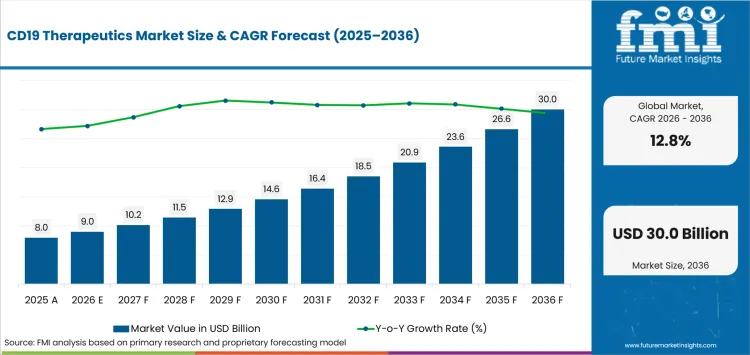
USD 9.0 billion in 2026 and USD 30.0 billion by 2036 at a 12.8% CAGR.
Demand in the CD19 therapeutics market is anticipated to push valuation from USD 9.0 billion in 2026 to USD 30.0 billion by 2036, expanding at 12.8% CAGR over the forecast period. Approved CAR T-cell therapy pathways broaden the treated population across defined leukemia and lymphoma indications worldwide. Gene therapy manufacturing must align collection and release schedules before hospitals administer each individualized dose safely.
Regulatory experience provides a clearer review base for complex cellular products but leaves product-specific controls intact. FDA reported in January 2026 that CBER had approved close to 50 cell and gene therapies during the previous decade. Each CD19 program therefore needs cell therapy manufacturing controls tied to release testing and specialist monitoring.
Key Takeaways of CD19 Therapeutics Market
- Demand expands as approved CD19 therapies reach B-cell malignancies through qualified hospitals and coordinated referral pathways.
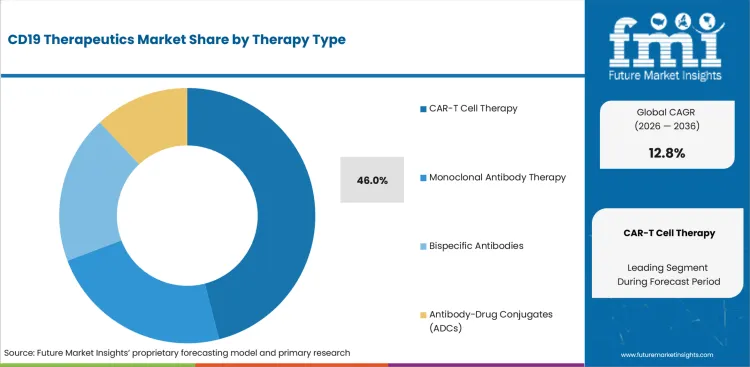
- CAR-T cell therapy is projected to represent 46.0% of therapy type demand in 2026 due to established clinical pathways.
- B-cell acute lymphoblastic leukemia is estimated to account for 37.0% of application demand in 2026 owing to defined relapsed disease use.
- Hospitals are forecast to capture 39.0% of end-user demand in 2026 supported by integrated infusion and toxicity management capabilities.
- Individualized manufacturing and specialist monitoring restrict access as treatment centers coordinate collection and product release around each clinical schedule.
- The field includes Gilead Sciences, Bristol Myers Squibb, Novartis, Autolus Therapeutics, Cellectis, Imugene, Caribou Biosciences and Allogene Therapeutics.
Analyst Perspective
“CD19 developers face a timing problem before infusion as manufacturing can outlast a rapidly progressing patient’s treatment window. Commercial advantage will follow products that preserve durable B-cell targeting while reducing turnaround variability and specialist monitoring burden.”
- Anurag Sharma, Principal Consultant, Future Market Insights
How is the CD19 Therapeutics Market segmented?
The CD19 therapeutics industry is segmented by therapy type, application, end user, distribution channel, technology platform and region.
Therapy type covers CAR-T cells, monoclonal antibodies, bispecific antibodies and antibody-drug conjugates across treatment routes. Applications include B-cell acute lymphoblastic leukemia and three lymphoma categories requiring separate evidence and treatment sequencing. End users span hospitals and specialist centers while distribution and technology categories track delivery routes and platform design.
What supports CAR-T cell therapy within the therapy type category?
CAR-T cell therapy redirects engineered T cells toward CD19-positive malignant B cells through a route established across next-generation immunotherapies. Approved commercial products connect target recognition with specialist infusion and post-treatment monitoring inside qualified hematology centers.
- By therapy type, CAR-T cell therapy is estimated to hold 46.0% in 2026 owing to established commercial use across specialist leukemia and lymphoma pathways.
- Commercial expansion requires additional approved indications while treatment centers preserve product-specific safety controls throughout each individualized care pathway. FDA approved Aucatzyl in November 2024 for adults with relapsed or refractory B-cell precursor acute lymphoblastic leukemia.
How does B-cell acute lymphoblastic leukemia shape application demand?
B-cell acute lymphoblastic leukemia gives CD19 targeting a defined clinical role for patients whose disease returns following previous treatment. Adjacent leukemia therapeutics pathways provide established diagnostics and specialist referral routes for urgent treatment decisions across adult and pediatric care.
- Based on application, B-cell acute lymphoblastic leukemia is projected to account for 37.0% in 2026 due to defined adult and pediatric treatment pathways.
- Specialist teams review disease burden and previous therapy to select targeted treatment for relapsed patients. Remission depth and transplant eligibility then shape how clinicians sequence CD19-directed therapy within the broader care plan and subsequent consolidation strategy.
What role do hospitals play within the end user category?
Hospitals combine hematology expertise with collection services and intensive monitoring inside coordinated specialist environments serving complex cellular treatment pathways. Existing cell therapy trials strengthen protocol experience across centers managing lymphodepletion and acute toxicities under standardized escalation plans.
- In 2026, hospitals are expected to lead the end-user category with 39.0% share because qualified centers coordinate collection and infusion workflows.
- Hospital teams connect bridging treatment and lymphodepletion with product receipt through one clinical record covering the entire scheduled treatment episode. Critical care and infection services support rapid escalation during cytokine release syndrome or neurologic complications following infusion.
How does autologous cell therapy influence technology platform demand?
Autologous platforms use each patient’s T cells as starting material and preserve direct chain-of-identity control through manufacturing. Their established role within advanced therapy products reflects approved workflows and extensive treatment-center experience across commercial cellular therapy programs.
- The technology platform category is forecast to be led by autologous cell therapy at 43.0% share in 2026 due to approved patient-derived products.
- Manufacturers test each product’s identity and critical release attributes during ex vivo engineering for qualified treatment centers. Commercial delivery nevertheless depends on successful collection and timely return of a conforming dose to the treating hospital.
What are the drivers, restraints and opportunities in the CD19 Therapeutics Market?
Approved indication expansion supports demand despite individualized production limits, with dual-target and off-the-shelf platforms offering alternative development routes.
- Driver: Approved indication expansion adds defined treatment pathways across B-cell malignancies and increases eligible referrals to qualified centers.
- Restraint: Individualized manufacturing and specialist facility requirements create scheduling pressure across collection and monitoring workflows.
- Opportunity: Dual-target and off-the-shelf platforms seek shorter availability and broader response coverage across resistant disease pathways.
Indication expansion converts CD19 biology into reimbursable treatment routes for defined B-cell malignancies across specialist oncology networks. FDA approved Breyanzi for relapsed marginal zone lymphoma in December 2025 and widened its CD19 portfolio. The label gives qualified centers another referral pathway for heavily treated adults with limited treatment options.
Individualized production remains a material restraint as biologics contract manufacturing adds specialist capacity across clinical programs. Collection and release timing can consume the treatment window for patients with rapidly progressing disease. Hospitals reserve trained staff and monitoring capacity around uncertain product return dates for scheduled infusions.
Dual-target constructs and donor-derived platforms aim to reduce antigen escape or shorten product availability through genome editing routes. Developers must prove durable response and consistent release before hospitals revise complex established treatment protocols. Commercial adoption depends on reducing operational burden without shifting safety risk toward treatment-center monitoring teams.
Which country CAGRs are profiled in the CD19 Therapeutics Market?
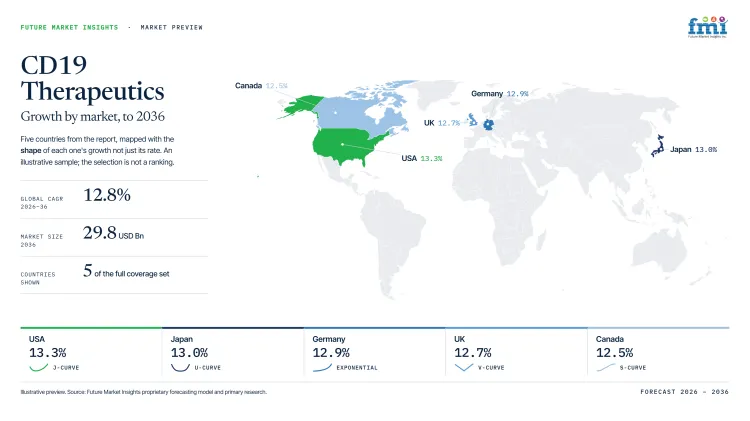
| Country | CAGR |
|---|---|
| United States | 13.3% |
| Japan | 13.0% |
| Germany | 12.9% |
| United Kingdom | 12.7% |
| Canada | 12.5% |
How do country-level CAGRs compare in the CD19 Therapeutics Market?
The displayed country CAGRs span 0.8 percentage point across five established regulatory systems with developed advanced-therapy oversight. The narrow spacing masks substantial differences in reimbursement routes and available specialist treatment capacity nationwide.
- The United States exceeds Japan by 0.3 percentage point as broader treatment networks support recurring label expansion.
- Japan remains 0.1 percentage point above Germany despite greater dependence on concentrated metropolitan hospital capacity.
- Germany stands 0.2 percentage point above the United Kingdom as benefit assessment shapes reimbursed access conditions.
- The United Kingdom remains 0.2 percentage point above Canada through nationally commissioned specialist treatment routes.
- Canada closes the displayed range as provincial funding decisions limit uniform access across distant qualified centers.
Comparable CAGRs can produce different entry conditions across national regulatory systems and specialist treatment networks. The full report covers additional national markets across every defined regional taxonomy and commercial operating environment.
Country-wise Analysis
- United States treatment routes rely on qualified CAR-T centers that coordinate payer authorization with leukapheresis and infusion across regional networks serving referrals beyond local oncology practices in multiple states nationwide and neighboring rural communities. Adoption of CD19 therapeutics in the United States is estimated to expand at 13.3% CAGR through 2036, supported by broad FDA pathways and extensive treatment experience across established academic centers nationwide. FDA eliminated classwide REMS requirements for approved autologous CAR-T products in June 2025 and reduced one administrative layer although individualized manufacturing and uneven regional capacity continue delaying treatment for patients with rapidly progressing disease.
- Japan relies on designated regenerative medicine hospitals that coordinate patient-specific collection with scheduled manufacturing and transport across metropolitan networks serving complex hematology cases from distant regional communities throughout surrounding prefectures and remote island populations. CD19 therapeutics sales in Japan are forecast to expand at 13.0% CAGR by 2036, influenced by established approvals and specialist expertise concentrated within major urban treatment centers and coordinated referral practices nationwide. PMDA listed Kymriah and Yescarta alongside Breyanzi among approved regenerative medical products through November 2025 although limited qualified sites and demanding logistics consistently restrict urgent treatment access outside major cities nationwide for referred patients.
- Germany combines university hospitals and advanced therapy centers with statutory benefit assessment that determines reimbursement conditions following centralized European authorization across major regional hematology referral networks and community oncology services throughout federal states nationwide. The German CD19 therapeutics sector is projected to record 12.9% CAGR during the assessment period, reinforced by experienced clinical teams and formal reimbursement review across established specialist centers and coordinated referral pathways. G-BA completed a lisocabtagene maraleucel benefit assessment for follicular lymphoma in October 2025 and clarified one access route although detailed evidence requirements and cross-site manufacturing coordination remain persistent commercial treatment frictions nationwide today.
- United Kingdom treatment delivery relies on commissioned NHS centers that coordinate eligibility review with cell collection and post-infusion monitoring across organized specialist networks serving remote referrals beyond local oncology services throughout England and Wales. The United Kingdom’s CD19 therapeutics outlook is anticipated to advance at 12.7% CAGR over the assessment period, supported by coordinated appraisal and established cellular therapy services across regional treatment hubs nationwide today. NICE recommended lisocabtagene maraleucel in March 2025 for defined adults with relapsed or refractory large B-cell lymphoma although treatment-center capacity and long-distance patient routing continue limiting timely national access for eligible patients nationwide.
- Canada combines federal product oversight with provincial funding decisions and selected cell therapy centers that coordinate collection or infusion across extensive territories serving geographically dispersed patient populations and remote northern communities across several provinces. CD19 therapeutics demand in Canada is forecast to rise at 12.5% CAGR over the forecast period, shaped by active regulation and specialist programs operating within several provincial health systems and funding pathways. Health Canada reviewed serious risks across Breyanzi and Kymriah alongside Tecartus and Yescarta in January 2025 although provincial reimbursement differences and long travel distances continue restricting equitable treatment access for remote patients nationwide.
Who are the notable companies in the CD19 Therapeutics Market?
Gilead Sciences, Bristol Myers Squibb, Novartis, Autolus Therapeutics, Cellectis, Imugene, Caribou Biosciences and Allogene Therapeutics are notable companies serving this market.
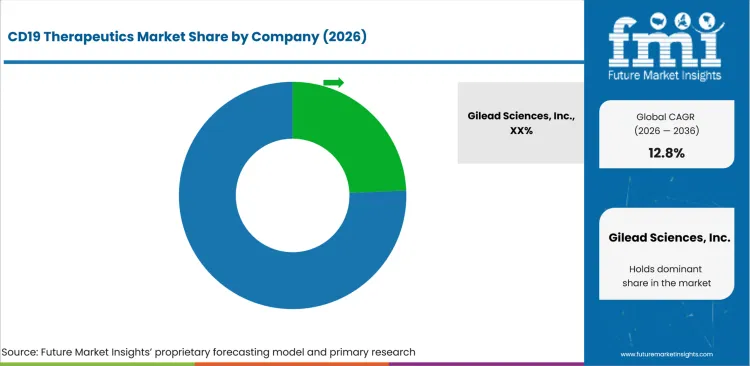
Commercial competition is concentrated among four companies with approved autologous CD19 products and established treatment-center networks. The development field remains fragmented as allogeneic and gene-edited platforms must prove dependable release and durable response against established treatment networks. Antibody-based competition remains commercially relevant through approved monoclonal antibodies using conventional distribution and administration routes.
- Gilead Sciences and Bristol Myers Squibb compete through broad approved portfolios and established treatment-center networks across several lymphoma indications.
- Novartis and Autolus Therapeutics operate approved autologous products serving distinct leukemia and lymphoma populations through specialized manufacturing routes.
- Cellectis supplies licensed gene-editing rights linked to cema-cel while Imugene, Caribou Biosciences and Allogene Therapeutics advance active allogeneic CD19 programs.
Competitive Benchmarking: CD19 Therapeutics Market
| Company | Commercial CD19 Portfolio | Clinical Maturity | Delivery Model | Geographic Reach |
|---|---|---|---|---|
| Gilead Sciences | High | High | High | Global |
| Bristol Myers Squibb | High | High | High | Global |
| Novartis | Medium | High | High | Global |
| Autolus Therapeutics | Medium | High | High | United States, United Kingdom and European Union |
| Cellectis | Low | High | Medium | United States, European Union and United Kingdom licensed territories |
| Imugene | Low | Medium | Medium | Australia and United States |
| Caribou Biosciences | Low | Medium | Medium | United States clinical activity |
| Allogene Therapeutics | Low | High | High | United States and Asia-Pacific trials |
Key Developments in the CD19 Therapeutics Market
- In June 2026, Caribou Biosciences reported long-term vispa-cel data in second-line large B-cell lymphoma and continued an allogeneic program designed for outpatient administration.
- In April 2026, Allogene Therapeutics reported interim ALPHA3 results for cema-cel in first-line consolidation large B-cell lymphoma and continued pivotal allogeneic development.
- In February 2026, Gilead Sciences reported an FDA label update for Yescarta that removed the previous primary central nervous system lymphoma limitation.
Key Players in the CD19 Therapeutics Market
Commercial CD19 CAR-T Companies
- Gilead Sciences, Inc.
- Bristol Myers Squibb
- Novartis AG
- Autolus Therapeutics plc
Gene-Edited and Licensed CD19 Platforms
- Cellectis S.A.
- Imugene Limited
Allogeneic CD19 CAR-T Developers
- Caribou Biosciences, Inc.
- Allogene Therapeutics, Inc.
CD19 Therapeutics Market - Report Scope
| Coverage field | Report scope |
|---|---|
| Market breakdown | By therapy type, application, end user, distribution channel, technology platform and region. |
| Quantitative Units | Revenue in USD billion and CAGR in %. |
| Market Definition | Approved and investigational therapies targeting CD19 across defined B-cell malignancy applications and specialist treatment pathways. |
| Regions Covered | North America, Latin America, Europe, East Asia, South Asia and Pacific, and Middle East and Africa. |
| Countries Covered | United States, Japan, Germany, United Kingdom, Canada, and 20+ countries included in the full report. |
| Key Companies Profiled | Gilead Sciences, Bristol Myers Squibb, Novartis, Autolus Therapeutics, Cellectis, Imugene, Caribou Biosciences and Allogene Therapeutics. |
| Forecast Period | 2026 to 2036. |
| Approach | Primary and secondary research with market triangulation. |
CD19 Therapeutics Market - Research Methodology
| Method | Approach |
|---|---|
| Primary Research | FMI analysts gathered input from manufacturers, service providers, technology developers, distributors, end users, procurement teams, and subject-matter experts. Interviews examined purchasing decisions, product or service evaluation, adoption barriers, approval requirements, pricing considerations, and expectations for technical or commercial support. Respondents were also asked what evidence is required before a trial, pilot, or initial order develops into regular purchasing. |
| Desk Research | Desk research covered government statistics, regulatory publications, trade data, industry associations, technical literature, standards, company filings, product information, and official corporate announcements. Sources were reviewed for relevance, publication date, geographic coverage, and consistency with the defined market scope. Claims relating to performance, applications, approvals, capacity, investment, and commercial activity were retained only when supported by credible public evidence. |
| Market Sizing and Forecasting | The market model combined the baseline value with historical performance, segment structure, pricing and volume indicators, adoption levels, company participation, and country-level demand conditions. Forecast assumptions considered economic activity, investment trends, regulatory developments, technology adoption, purchasing cycles, supply availability, and barriers to wider market use. Segment and regional estimates were reconciled before the final market total was calculated. |
| Data Validation | Estimates were checked against multiple independent indicators, including public data, company activity, trade patterns, industry developments, and findings from primary interviews. Validation also tested whether products, services, applications, and company revenues fell within the defined market boundaries. Adjacent categories, unsupported claims, overlapping revenues, and activities without direct market relevance were excluded to reduce double counting and maintain consistency across segments and countries. |
CD19 Therapeutics Market by Segments
CD19 Therapeutics Market segmented by Therapy Type:
- CAR-T Cell Therapy
- Autologous CAR-T Therapy
- Allogeneic CAR-T Therapy
- Monoclonal Antibody Therapy
- Anti-CD19 Monoclonal Antibodies
- Engineered Antibody Therapies
- Bispecific Antibodies
- CD19-CD3 Bispecific Antibodies
- T Cell Engagers
- Antibody-Drug Conjugates
- Internalizing ADCs
- Targeted Cytotoxic ADCs
CD19 Therapeutics Market segmented by Application:
- B-Cell Acute Lymphoblastic Leukemia
- Relapsed-Refractory B-ALL
- Pediatric B-ALL
- Diffuse Large B-Cell Lymphoma
- Relapsed DLBCL
- High-Risk DLBCL
- Follicular Lymphoma
- Relapsed Follicular Lymphoma
- Refractory Follicular Lymphoma
- Mantle Cell Lymphoma
- Relapsed Mantle Cell Lymphoma
- Refractory Mantle Cell Lymphoma
CD19 Therapeutics Market segmented by End User:
- Hospitals
- Tertiary Care Hospitals
- Cancer Specialty Hospitals
- Cancer Treatment Centers
- Comprehensive Cancer Centers
- Cell Therapy Centers
- Specialty Clinics
- Hematology Clinics
- Oncology Clinics
- Academic and Research Institutes
- University Hospitals
- Clinical Research Centers
CD19 Therapeutics Market segmented by Distribution Channel:
- Hospital Pharmacies
- Inpatient Pharmacies
- Outpatient Hospital Pharmacies
- Specialty Pharmacies
- Oncology Specialty Pharmacies
- Cell Therapy Pharmacies
- Direct Manufacturer Supply
- Treatment Center Supply
- Specialty Distribution Networks
- Retail Pharmacies
- Chain Pharmacies
- Independent Pharmacies
CD19 Therapeutics Market segmented by Technology Platform:
- Autologous Cell Therapy
- Patient-Derived T Cells
- Ex Vivo Cell Engineering
- Allogeneic Cell Therapy
- Donor-Derived T Cells
- Gene-Edited Allogeneic Cells
- Antibody-Based Therapeutics
- Monoclonal Antibodies
- Bispecific Antibodies
- Gene Editing Platforms
- CRISPR-Based Engineering
- TALEN-Based Engineering
CD19 Therapeutics Market by Region:
- North America
- United States
- Canada
- Mexico
- Latin America
- Brazil
- Chile
- Rest of Latin America
- Western Europe
- Germany
- United Kingdom
- Italy
- Spain
- France
- Nordics
- Benelux
- Rest of Western Europe
- Eastern Europe
- Russia
- Poland
- Hungary
- Balkan and Baltic States
- Rest of Eastern Europe
- East Asia
- China
- Japan
- South Korea
- South Asia and Pacific
- India
- ASEAN
- Australia and New Zealand
- Rest of South Asia and Pacific
- Middle East and Africa
- Kingdom of Saudi Arabia
- Other GCC Countries
- Türkiye
- South Africa
- Other African Union Countries
- Rest of Middle East and Africa
Research Sources and Bibliography
- USA Food and Drug Administration. (2026, January 11). FDA Increases Flexibility on Requirements for Cell and Gene Therapies to Advance Innovation.
- USA Food and Drug Administration. (2025, June 26). FDA Eliminates Risk Evaluation and Mitigation Strategies (REMS) for Autologous Chimeric Antigen Receptor (CAR) T cell Immunotherapies.
- USA Food and Drug Administration. (2024, November 8). FDA approves obecabtagene autoleucel for adults with relapsed or refractory B-cell precursor acute lymphoblastic leukemia.
- USA Food and Drug Administration. (2025, December 4). FDA approves lisocabtagene maraleucel for relapsed or refractory marginal zone lymphoma.
- Cellectis. (2026, May 11). Cellectis Reports Financial Results for the First Quarter 2026.
- Pharmaceuticals and Medical Devices Agency. (2025, November). List of Approved Products.
- Gemeinsamer Bundesausschuss. (2025, October 2). Nutzenbewertungsverfahren zum Wirkstoff Lisocabtagen maraleucel (Neues Anwendungsgebiet: follikuläres Lymphom, nach ≥ 2 Vortherapien).
- National Institute for Health and Care Excellence. (2025, March 26). Lisocabtagene maraleucel for treating relapsed or refractory large B-cell lymphoma after first-line chemoimmunotherapy when a stem cell transplant is suitable.
- Health Canada. (2025, January 29). Health Product InfoWatch: January 2025.
- Gilead Sciences. (2026, February 6). FDA Approves Label Update for Kite’s Yescarta® for Relapsed/Refractory Primary Central Nervous System Lymphoma.
- Allogene Therapeutics. (2026, April 13). Allogene Therapeutics Reports Interim Futility Analysis from Pivotal ALPHA3 Trial Showing 58.3% MRD Clearance with Cemacabtagene Ansegedleucel (Cema-Cel) vs. 16.7% in Observation Arm in First-Line Consolidation LBCL.
- Caribou Biosciences. (2026, June 11). Caribou Biosciences Reports Long-Term Vispa-cel Data in Second-line Large B Cell Lymphoma at EHA 2026.
- Imugene Limited. (2026, May 30). Safety and Efficacy of Azer-cel, an Allogeneic CD19-Directed CAR T-Cell Therapy, in CAR T-Naive Patients with Relapsed/Refractory Non-Hodgkin Lymphoma and Chronic Lymphocytic Leukemia.
- Autolus Therapeutics plc. (2026, May 14). Autolus Therapeutics Reports First Quarter 2026 Financial Results and Business Updates.
- Allogene Therapeutics. (2026, April 21). Allogene Therapeutics Expands Pivotal Phase 2 ALPHA3 Trial to South Korea and Australia.
- Gilead Sciences. (2026, May 21). New ASCO and EHA 2026 Data Demonstrate Gilead and Kite’s Momentum Across Antibody-Drug Conjugates and Cell Therapy in Oncology.
- Bristol Myers Squibb. (2025, December 4). Bristol Myers Squibb’s Breyanzi Approved by the USA FDA as the First and Only CAR T Cell Therapy for Adults with Relapsed or Refractory Marginal Zone Lymphoma (MZL).
This bibliography is provided for reader reference and is not exhaustive. The full report contains the complete reference list and detailed citations.
This Report Answers
- How large is the CD19 therapeutics market in 2026 and 2036?
- Which operating conditions support approved CD19 treatment pathways?
- Why does CAR-T cell therapy hold the largest therapy-type share?
- How does B-cell acute lymphoblastic leukemia shape application demand?
- Why do hospitals remain central to collection and infusion workflows?
- How do growth conditions differ across the profiled countries?
- Which companies operate commercial and investigational CD19 platforms?
- What constrains broader adoption across qualified treatment centers?
Frequently Asked Questions
How big is the CD19 therapeutics market in 2026?
In 2026, the CD19 therapeutics market is valued at USD 8.96 billion across cellular and antibody-based treatment approaches. Approved indications and qualified hospital capacity support the projected increase to USD 29.84 billion by 2036 through coordinated product release and patient monitoring.
What is the CAGR of the CD19 therapeutics market from 2026 to 2036?
The CD19 therapeutics market is projected to expand at 12.8% CAGR from 2026 to 2036 across major treatment regions. Additional approved indications and dependable manufacturing support that forecast as qualified centers coordinate collection or infusion with specialist toxicity management.
Which therapy type is projected to account for 46.0% of the CD19 therapeutics market?
CAR-T cell therapy is projected to account for 46.0% of the CD19 therapeutics market by therapy type in 2026. Approved products across leukemia and lymphoma settings support its position alongside treatment-center experience with patient selection and structured post-infusion monitoring.
Which application is projected to account for leading share the CD19 therapeutics market?
B-cell acute lymphoblastic leukemia is estimated to represent 37.0% of the CD19 therapeutics market by application in 2026. Defined relapsed or refractory treatment pathways support specialist referrals and time-sensitive clinical decisions regarding remission depth or subsequent transplantation planning decisions.
Which technology platform is projected to dominate the CD19 therapeutics market?
Autologous cell therapy is projected to represent 43.0% of the CD19 therapeutics market by technology platform in 2026. Approved patient-derived products support its current position despite individualized collection and manufacturing schedules that delay treatment availability across qualified hospital networks.
Which companies are active in the CD19 therapeutics market?
Companies profiled in the CD19 therapeutics market include Gilead Sciences and Bristol Myers Squibb alongside Novartis and Autolus Therapeutics. Cellectis and Imugene join Caribou Biosciences and Allogene Therapeutics across verified gene-edited or allogeneic development routes serving complex B-cell malignancies.
Preview the report firsthand - request a free sample
Get SampleGet the brochure for pricing and purchase details.
Get PDFTable of Content
- Key Takeaways
- Market Size and CAGR
- Top Growth Driver
- Fastest Growing Segment
- Leading Region
- Key Companies
- Emerging Opportunities
- Executive Summary
- Global Market Outlook
- Demand-side Trends
- Supply-side Trends
- Technology Roadmap Analysis
- Analysis and Recommendations
- Analyst Perspective (What is happening? Why now? What should investors know?)
- Key Questions Answered
- How large is the market?
- What is the CAGR?
- What are key trends?
- Which region dominates?
- Who are the leaders?
- Market Overview
- Market Coverage / Taxonomy
- Market Definition / Scope / Limitations
- Research Methodology
- Chapter Orientation
- Analytical Lens and Working Hypotheses
- Market Structure, Signals, and Trend Drivers
- Benchmarking and Cross-market Comparability
- Market Sizing, Forecasting, and Opportunity Mapping
- Research Design and Evidence Framework
- Desk Research Programme (Secondary Evidence)
- Expert Input and Fieldwork (Primary Evidence)
- Tooling, Models, and Reference Databases
- Data Engineering and Model Build
- Quality Assurance and Audit Trail
- Market Background
- Market Dynamics (Drivers, Restraints, Opportunity, Trends)
- Scenario Forecast (Optimistic, Likely, Conservative)
- Impact Analysis
- AI Impact
- Sustainability Impact
- Regulatory Impact
- Technology Impact
- Consumer / Buyer Analysis
- Purchase Drivers
- Adoption Barriers
- Buyer Journey
- Opportunity Map Analysis
- Product Life Cycle Analysis
- Supply Chain Analysis
- Investment Feasibility Matrix
- Value Chain Analysis
- PESTLE and Porter's Analysis
- Regulatory Landscape
- Regional Parent Market Outlook
- Production and Consumption Statistics
- Import and Export Statistics
- Global Market Analysis and Forecast, 2021 to 2036
- Historical Market Size Value (USD Billion) Analysis, 2021 to 2025
- Current and Future Market Size Value (USD Billion) Projections, 2026 to 2036
- Y-o-Y Growth Trend Analysis
- Absolute $ Opportunity Analysis
- Global Market Pricing Analysis, 2021 to 2036
- Global Market Analysis and Forecast, By Therapy Type, 2021 to 2036
- Introduction / Key Findings
- Historical Market Size Value (USD Billion) Analysis By Therapy Type, 2021 to 2025
- Current and Future Market Size Value (USD Billion) Analysis and Forecast By Therapy Type, 2026 to 2036
- CAR-T Cell Therapy
- Autologous CAR-T Therapy
- Allogeneic CAR-T Therapy
- Monoclonal Antibody Therapy
- Anti-CD19 Monoclonal Antibodies
- Engineered Antibody Therapies
- Bispecific Antibodies
- CD19-CD3 Bispecific Antibodies
- T Cell Engagers
- Antibody-Drug Conjugates (ADCs)
- Internalizing ADCs
- Targeted Cytotoxic ADCs
- CAR-T Cell Therapy
- Y-o-Y Growth Trend Analysis By Therapy Type, 2021 to 2025
- Absolute $ Opportunity Analysis By Therapy Type, 2026 to 2036
- Global Market Analysis and Forecast, By Application, 2021 to 2036
- Introduction / Key Findings
- Historical Market Size Value (USD Billion) Analysis By Application, 2021 to 2025
- Current and Future Market Size Value (USD Billion) Analysis and Forecast By Application, 2026 to 2036
- B-Cell Acute Lymphoblastic Leukemia (B-ALL)
- Relapsed-Refractory B-ALL
- Pediatric B-ALL
- Diffuse Large B-Cell Lymphoma (DLBCL)
- Relapsed DLBCL
- High-Risk DLBCL
- Follicular Lymphoma
- Relapsed Follicular Lymphoma
- Refractory Follicular Lymphoma
- Mantle Cell Lymphoma
- Relapsed Mantle Cell Lymphoma
- Refractory Mantle Cell Lymphoma
- B-Cell Acute Lymphoblastic Leukemia (B-ALL)
- Y-o-Y Growth Trend Analysis By Application, 2021 to 2025
- Absolute $ Opportunity Analysis By Application, 2026 to 2036
- Global Market Analysis and Forecast, By End User, 2021 to 2036
- Introduction / Key Findings
- Historical Market Size Value (USD Billion) Analysis By End User, 2021 to 2025
- Current and Future Market Size Value (USD Billion) Analysis and Forecast By End User, 2026 to 2036
- Hospitals
- Tertiary Care Hospitals
- Cancer Specialty Hospitals
- Cancer Treatment Centers
- Comprehensive Cancer Centers
- Cell Therapy Centers
- Specialty Clinics
- Hematology Clinics
- Oncology Clinics
- Academic & Research Institutes
- University Hospitals
- Clinical Research Centers
- Hospitals
- Y-o-Y Growth Trend Analysis By End User, 2021 to 2025
- Absolute $ Opportunity Analysis By End User, 2026 to 2036
- Global Market Analysis and Forecast, By Distribution Channel, 2021 to 2036
- Introduction / Key Findings
- Historical Market Size Value (USD Billion) Analysis By Distribution Channel, 2021 to 2025
- Current and Future Market Size Value (USD Billion) Analysis and Forecast By Distribution Channel, 2026 to 2036
- Hospital Pharmacies
- Inpatient Pharmacies
- Outpatient Hospital Pharmacies
- Specialty Pharmacies
- Oncology Specialty Pharmacies
- Cell Therapy Pharmacies
- Direct Manufacturer Supply
- Treatment Center Supply
- Specialty Distribution Networks
- Retail Pharmacies
- Chain Pharmacies
- Independent Pharmacies
- Hospital Pharmacies
- Y-o-Y Growth Trend Analysis By Distribution Channel, 2021 to 2025
- Absolute $ Opportunity Analysis By Distribution Channel, 2026 to 2036
- Global Market Analysis and Forecast, By Technology Platform, 2021 to 2036
- Introduction / Key Findings
- Historical Market Size Value (USD Billion) Analysis By Technology Platform, 2021 to 2025
- Current and Future Market Size Value (USD Billion) Analysis and Forecast By Technology Platform, 2026 to 2036
- Autologous Cell Therapy
- Patient-Derived T Cells
- Ex Vivo Cell Engineering
- Allogeneic Cell Therapy
- Donor-Derived T Cells
- Gene-Edited Allogeneic Cells
- Antibody-Based Therapeutics
- Monoclonal Antibodies
- Bispecific Antibodies
- Gene Editing Platforms
- CRISPR-Based Engineering
- TALEN-Based Engineering
- Autologous Cell Therapy
- Y-o-Y Growth Trend Analysis By Technology Platform, 2021 to 2025
- Absolute $ Opportunity Analysis By Technology Platform, 2026 to 2036
- Global Market Analysis and Forecast, By Region, 2021 to 2036
- Introduction
- Historical Market Size Value (USD Billion) Analysis By Region, 2021 to 2025
- Current Market Size Value (USD Billion) Analysis and Forecast By Region, 2026 to 2036
- North America
- Latin America
- Western Europe
- Eastern Europe
- East Asia
- South Asia and Pacific
- Middle East & Africa
- Market Attractiveness Analysis By Region
- North America Market Analysis and Forecast, By Country, 2021 to 2036
- Historical Market Size Value (USD Billion) Trend Analysis By Market Taxonomy, 2021 to 2025
- Market Size Value (USD Billion) Forecast By Market Taxonomy, 2026 to 2036
- By Country
- USA
- Canada
- By Therapy Type
- By Application
- By End User
- By Distribution Channel
- By Technology Platform
- By Country
- Market Attractiveness Analysis
- By Country
- By Therapy Type
- By Application
- By End User
- By Distribution Channel
- By Technology Platform
- Key Takeaways
- Latin America Market Analysis and Forecast, By Country
- Historical Market Size Value (USD Billion) Trend Analysis By Market Taxonomy, 2021 to 2025
- Market Size Value (USD Billion) Forecast By Market Taxonomy, 2026 to 2036
- By Country
- Brazil
- Mexico
- Chile
- Rest of Latin America
- By Therapy Type
- By Application
- By End User
- By Distribution Channel
- By Technology Platform
- By Country
- Market Attractiveness Analysis
- By Country
- By Therapy Type
- By Application
- By End User
- By Distribution Channel
- By Technology Platform
- Key Takeaways
- Western Europe Market Analysis and Forecast, By Country
- Historical Market Size Value (USD Billion) Trend Analysis By Market Taxonomy, 2021 to 2025
- Market Size Value (USD Billion) Forecast By Market Taxonomy, 2026 to 2036
- By Country
- Germany
- UK
- Italy
- Spain
- France
- Nordic
- BENELUX
- Rest of Western Europe
- By Therapy Type
- By Application
- By End User
- By Distribution Channel
- By Technology Platform
- By Country
- Market Attractiveness Analysis
- By Country
- By Therapy Type
- By Application
- By End User
- By Distribution Channel
- By Technology Platform
- Key Takeaways
- Eastern Europe Market Analysis and Forecast, By Country
- Historical Market Size Value (USD Billion) Trend Analysis By Market Taxonomy, 2021 to 2025
- Market Size Value (USD Billion) Forecast By Market Taxonomy, 2026 to 2036
- By Country
- Russia
- Poland
- Hungary
- Balkan & Baltic
- Rest of Eastern Europe
- By Therapy Type
- By Application
- By End User
- By Distribution Channel
- By Technology Platform
- By Country
- Market Attractiveness Analysis
- By Country
- By Therapy Type
- By Application
- By End User
- By Distribution Channel
- By Technology Platform
- Key Takeaways
- East Asia Market Analysis and Forecast, By Country
- Historical Market Size Value (USD Billion) Trend Analysis By Market Taxonomy, 2021 to 2025
- Market Size Value (USD Billion) Forecast By Market Taxonomy, 2026 to 2036
- By Country
- China
- Japan
- South Korea
- By Therapy Type
- By Application
- By End User
- By Distribution Channel
- By Technology Platform
- By Country
- Market Attractiveness Analysis
- By Country
- By Therapy Type
- By Application
- By End User
- By Distribution Channel
- By Technology Platform
- Key Takeaways
- South Asia and Pacific Market Analysis and Forecast, By Country
- Historical Market Size Value (USD Billion) Trend Analysis By Market Taxonomy, 2021 to 2025
- Market Size Value (USD Billion) Forecast By Market Taxonomy, 2026 to 2036
- By Country
- India
- ASEAN
- Australia & New Zealand
- Rest of South Asia and Pacific
- By Therapy Type
- By Application
- By End User
- By Distribution Channel
- By Technology Platform
- By Country
- Market Attractiveness Analysis
- By Country
- By Therapy Type
- By Application
- By End User
- By Distribution Channel
- By Technology Platform
- Key Takeaways
- Middle East & Africa Market Analysis and Forecast, By Country
- Historical Market Size Value (USD Billion) Trend Analysis By Market Taxonomy, 2021 to 2025
- Market Size Value (USD Billion) Forecast By Market Taxonomy, 2026 to 2036
- By Country
- Kingdom of Saudi Arabia
- Other GCC Countries
- Türkiye
- South Africa
- Other African Union
- Rest of Middle East & Africa
- By Therapy Type
- By Application
- By End User
- By Distribution Channel
- By Technology Platform
- By Country
- Market Attractiveness Analysis
- By Country
- By Therapy Type
- By Application
- By End User
- By Distribution Channel
- By Technology Platform
- Key Takeaways
- Key Countries Market Analysis
- USA
- Pricing Analysis
- Market Share Analysis, 2025
- By Therapy Type
- By Application
- By End User
- By Distribution Channel
- By Technology Platform
- Canada
- Pricing Analysis
- Market Share Analysis, 2025
- By Therapy Type
- By Application
- By End User
- By Distribution Channel
- By Technology Platform
- Mexico
- Pricing Analysis
- Market Share Analysis, 2025
- By Therapy Type
- By Application
- By End User
- By Distribution Channel
- By Technology Platform
- Brazil
- Pricing Analysis
- Market Share Analysis, 2025
- By Therapy Type
- By Application
- By End User
- By Distribution Channel
- By Technology Platform
- Chile
- Pricing Analysis
- Market Share Analysis, 2025
- By Therapy Type
- By Application
- By End User
- By Distribution Channel
- By Technology Platform
- Germany
- Pricing Analysis
- Market Share Analysis, 2025
- By Therapy Type
- By Application
- By End User
- By Distribution Channel
- By Technology Platform
- UK
- Pricing Analysis
- Market Share Analysis, 2025
- By Therapy Type
- By Application
- By End User
- By Distribution Channel
- By Technology Platform
- Italy
- Pricing Analysis
- Market Share Analysis, 2025
- By Therapy Type
- By Application
- By End User
- By Distribution Channel
- By Technology Platform
- Spain
- Pricing Analysis
- Market Share Analysis, 2025
- By Therapy Type
- By Application
- By End User
- By Distribution Channel
- By Technology Platform
- France
- Pricing Analysis
- Market Share Analysis, 2025
- By Therapy Type
- By Application
- By End User
- By Distribution Channel
- By Technology Platform
- India
- Pricing Analysis
- Market Share Analysis, 2025
- By Therapy Type
- By Application
- By End User
- By Distribution Channel
- By Technology Platform
- ASEAN
- Pricing Analysis
- Market Share Analysis, 2025
- By Therapy Type
- By Application
- By End User
- By Distribution Channel
- By Technology Platform
- Australia & New Zealand
- Pricing Analysis
- Market Share Analysis, 2025
- By Therapy Type
- By Application
- By End User
- By Distribution Channel
- By Technology Platform
- China
- Pricing Analysis
- Market Share Analysis, 2025
- By Therapy Type
- By Application
- By End User
- By Distribution Channel
- By Technology Platform
- Japan
- Pricing Analysis
- Market Share Analysis, 2025
- By Therapy Type
- By Application
- By End User
- By Distribution Channel
- By Technology Platform
- South Korea
- Pricing Analysis
- Market Share Analysis, 2025
- By Therapy Type
- By Application
- By End User
- By Distribution Channel
- By Technology Platform
- Russia
- Pricing Analysis
- Market Share Analysis, 2025
- By Therapy Type
- By Application
- By End User
- By Distribution Channel
- By Technology Platform
- Poland
- Pricing Analysis
- Market Share Analysis, 2025
- By Therapy Type
- By Application
- By End User
- By Distribution Channel
- By Technology Platform
- Hungary
- Pricing Analysis
- Market Share Analysis, 2025
- By Therapy Type
- By Application
- By End User
- By Distribution Channel
- By Technology Platform
- Kingdom of Saudi Arabia
- Pricing Analysis
- Market Share Analysis, 2025
- By Therapy Type
- By Application
- By End User
- By Distribution Channel
- By Technology Platform
- Türkiye
- Pricing Analysis
- Market Share Analysis, 2025
- By Therapy Type
- By Application
- By End User
- By Distribution Channel
- By Technology Platform
- South Africa
- Pricing Analysis
- Market Share Analysis, 2025
- By Therapy Type
- By Application
- By End User
- By Distribution Channel
- By Technology Platform
- USA
- Market Structure Analysis
- Competition Dashboard
- Competition Benchmarking
- Market Share Analysis of Top Players
- By Regional
- By Therapy Type
- By Application
- By End User
- By Distribution Channel
- By Technology Platform
- Emerging Startups
- Innovation Benchmarking
- Competition Analysis
- Competition Deep Dive
- Gilead Sciences, Inc.
- Overview
- Product Portfolio
- Profitability by Market Segments
- Sales Footprint
- Strategy Overview
- Marketing Strategy
- Product Strategy
- Channel Strategy
- Bristol Myers Squibb
- Novartis AG
- F. Hoffmann-La Roche Ltd.
- Johnson & Johnson
- Autolus Therapeutics plc
- Fate Therapeutics, Inc.
- Cellectis S.A.
- Caribou Biosciences, Inc.
- Allogene Therapeutics, Inc.
- Gilead Sciences, Inc.
- Case Studies
- Success Stories
- Recent Developments
- Competition Deep Dive
- Assumptions & Acronyms Used


