

- Market Size (2026)
- USD 860.0 Mn
- Forecast (2036)
- USD 1940.0 Mn
- CAGR (2026 to 2036)
- 8.5%
How big is Schwannomatosis Therapeutics Market size?
USD 860.0 million in 2026 and USD 1940.0 million by 2036 at an 8.5% CAGR.
Sales for schwannomatosis therapeutics are projected to expand at 8.5% CAGR between 2026 and 2036, increasing valuation from USD 860.0 million in 2026 to USD 1,940.0 million by 2036. Specialist medical teams focus on critical outcomes when treating rare genetic tumors, assessing tumor control and hearing preservation during care planning. Patient pain relief and treatment tolerance heavily shape longer follow-up decisions. Clinical studies offer new hope for effective targeted treatments. Plotkin and colleagues reported a 23% radiographic response across all evaluated tumors following brigatinib treatment in June 2024. Such promising result supports targeted-therapy review for progressive NF2-related disease across specialist programs. The clinical advancements help doctors design more effective long-term care plans.
Regional healthcare systems adopt unique strategies to manage complex schwannomatosis cases. United States and Germany care networks prioritize molecular confirmation and multidisciplinary follow-up. United Kingdom and Japan services emphasize referral coordination alongside hearing or pain management. Regulatory updates help ensure that critical therapies remain accessible across these regions. European Medicines Agency records updated in March 2026 identify Recordati Netherlands B.V. as the Sylvant authorization holder. The active product stewardship successfully supports continuing siltuximab availability for investigator-led pain evaluation. Such global regulatory updates secure vital treatment options for patients.
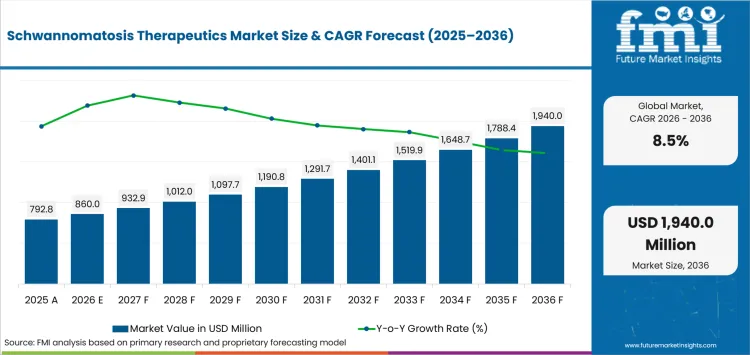
Key Takeaways of Schwannomatosis Therapeutics Market
- Demand for schwannomatosis therapeutics is driven by neurology teams connecting molecular diagnosis with long-term symptom control, with multidisciplinary services examining hearing preservation and pain relief across repeated follow-up visits.
- By disease type, SMARCB1-associated schwannomatosis is expected to lead with 54.4% share in 2026, reflecting its central position within molecularly defined disease pathways.
- First-line treatment is the dominant treatment setting segment, projected to hold 47.8% share in 2026, as specialist teams seek early control of tumor and symptom progression.
- Pain management therapies are estimated to lead the therapy type category with 32.6% share in 2026, driven by persistent bodily pain across non-NF2 disease presentations.
- Clinical-trial access and genomic testing capacity remain critical to adoption, shaping treatment confidence and subtype confirmation across referral networks.
- Japan, the United Kingdom, and the United States are expected to lead growth at 10.4%, 10.1%, and 9.5% CAGR respectively through 2036, supported by specialist-center density and coordinated genomic referral services.
- Competition centers on Takeda Pharmaceutical Company, PRG S&T, Puma Biotechnology, and Roche, with vendors differentiating through tumor response evidence from brigatinib, gene-directed Trineumin development, and multi-arm trials involving neratinib and retifanlimab combined with bevacizumab.
Analyst Perspective
"The schwannomatosis therapeutics market is advancing as treatment strategies become more multidisciplinary and evidence-driven. Clinical adoption will depend on therapies that demonstrate meaningful improvements in tumor control, pain management, and long-term neurological outcomes across carefully selected patient populations. As research progresses, companies generating robust clinical evidence and supporting coordinated care across genetics, neurology, and specialized treatment centers are likely to strengthen their position in this emerging therapeutic landscape."
- Anurag Sharma, Principal Consultant for Healthcare at Future Market Insights
Source: Future Market Insights analysis, 2026.
How is Schwannomatosis Therapeutics Market segmented?
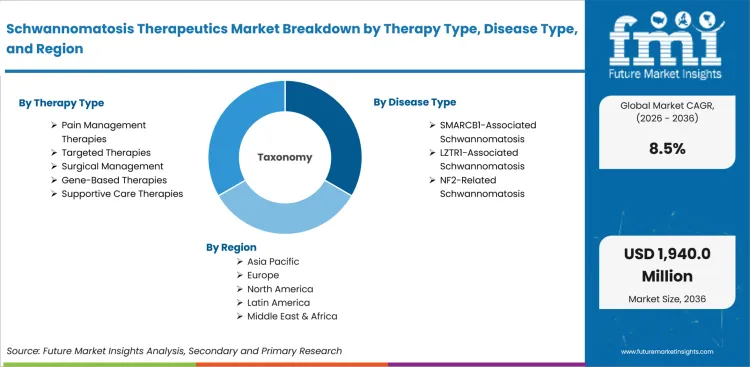
The schwannomatosis therapeutics industry is segmented by therapy type, disease type, treatment setting, end user, and region.
The schwannomatosis therapeutics market is segmented by therapy type, disease type, treatment setting, end user, and region. Therapy type coverage includes pain management therapies and targeted therapies followed by surgical management and gene-based therapies with supportive care therapies. Disease type coverage addresses SMARCB1-associated schwannomatosis and LZTR1-associated schwannomatosis with NF2-related schwannomatosis. Treatment setting coverage encompasses first-line treatment and recurrent disease management supported by chronic symptom management. End-user coverage spans hospitals and specialty neurology centers with pain management clinics and academic research institutes. Regional coverage includes North America and Latin America together with Western Europe and Eastern Europe. East Asia and South Asia and Pacific follow with Middle East and Africa completing geographic analysis.
Why do pain management therapies shape therapy type selection?
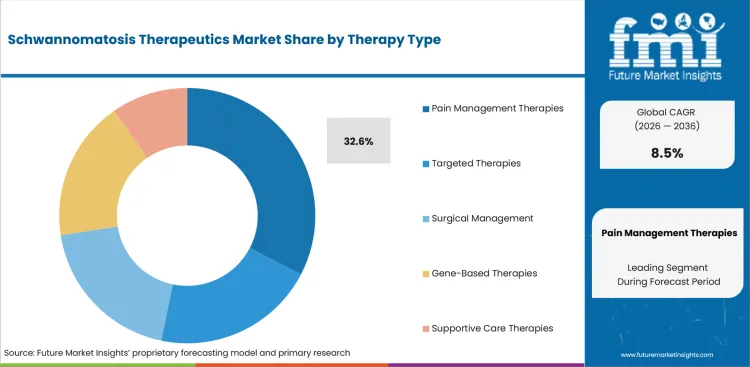
Lawson McLean and colleagues selected 40 articles for final analysis in May 2025. Evidence documented mobility limitations and reduced physical function across schwannomatosis populations. Quality-of-life burdens encourage structured symptom assessment during long-term neurological follow-up.
- Based on therapy type, pain management therapies hold 32.6% share in 2026 owing to recurring pain. Specialists compare analgesic response and adverse-event profiles during extended treatment periods.
- Targeted therapies and surgical management address measurable tumor progression across selected patients. Gene-based and supportive approaches serve investigational or functional needs across distinct profiles.
Why does SMARCB1-associated schwannomatosis shape disease type demand?
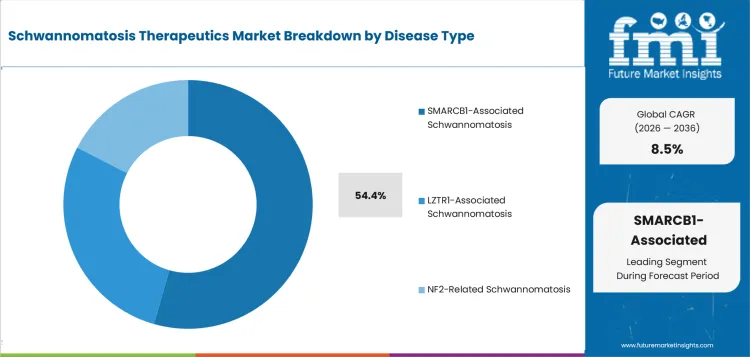
Expanded testing improves classification across isolated and multifocal schwannoma presentations. Showcasing the same, Smith and colleagues assessed 154 people using germline and tumor testing in October 2024. Results exposed diagnostic overlap among people lacking conventional NF2-related clinical criteria.
- By disease type, SMARCB1-associated schwannomatosis represents 54.4% share in 2026 since it is driven by established molecular classification. Neurology teams align imaging schedules and treatment review with genotype-specific tumor patterns.
- LZTR1-associated disease presents distinct penetrance and tumor distribution across affected families. NF2-related cases require closer monitoring of vestibular tumors and hearing outcomes.
How does first-line treatment retain treatment setting strength?
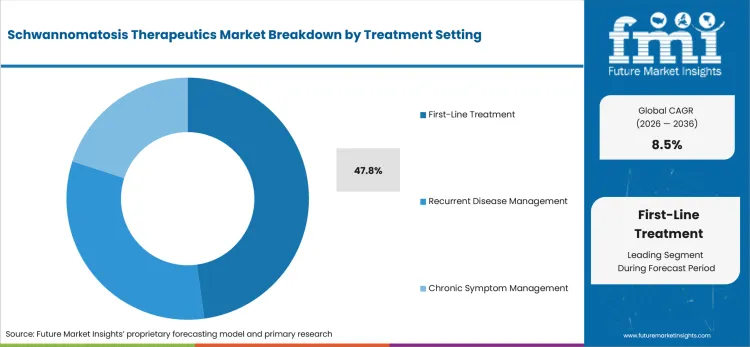
Plotkin and colleagues enrolled patients across 6 clinical sites in June 2024. Multicenter participation demonstrates specialist coordination during investigational treatment delivery. Centralized imaging review supports consistent response assessment across participating institutions.
- In 2026, first-line treatment garners 47.8% share as it is backed by early specialist assessment. Initial care plans establish imaging baselines and symptom priorities for therapy selection.
- Recurrent disease management addresses renewed tumor activity following a previous intervention. Chronic symptom management promotes long-duration pain care without immediate procedural escalation.
Why do hospitals lead end-user demand?
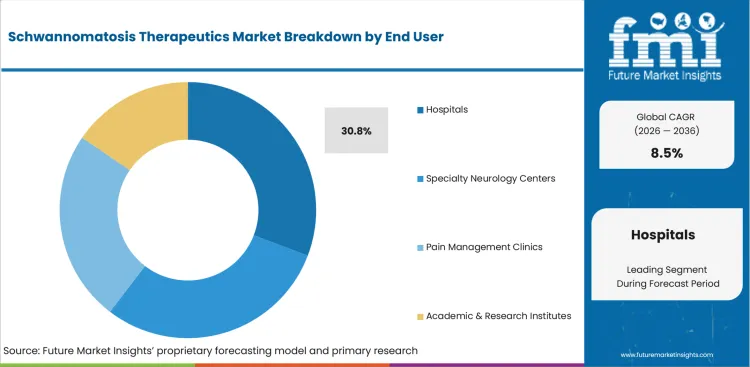
Children’s Tumor Foundation reported nearly 80 NF clinics across the United States and Canada in February 2026. Network scale illustrates institutional demand for organized rare-disease services across North America. Recognized centers connect patient education with participation in clinical research programs.
- Hospitals secure 30.8% share of end-user in 2026, helped by multidisciplinary diagnostic access. Referral centers coordinate imaging and pathology with surgery and hearing assessment.
- Specialty neurology centers provide focused surveillance for stable or genetically defined cases. Pain clinics and academic institutes contribute symptom follow-up and research participation.
What are drivers, restraints, and opportunities in Schwannomatosis Therapeutics Market?
Molecular diagnosis and persistent symptom needs support therapy evaluation. Limited approved options and fragmented specialist access may delay routine treatment decisions.
- Driver: Specialist teams need dependable pain control and tumor-directed evidence across lifelong care. Coordinated referral pathways support treatment selection across complex neurological presentations.
- Restraint: Limited disease-specific approvals restrict standard treatment choices across molecular subtypes. Small patient groups complicate comparative evidence generation across clinical programs.
- Opportunity: Platform trials permit several therapeutic approaches within shared disease protocols. Molecular selection may improve study efficiency across rare patient groups.
Specialist-network expansion supports earlier diagnosis and treatment review across affected families. Children’s Tumor Foundation reported 3 new NF Clinic Network members in February 2025. Added sites improve multidisciplinary assessment and research referral across North America.
Limited approved therapy creates an evidence barrier across rare neurological disorders. England Rare Diseases Action Plan reported in April 2026 only 5% of rare conditions have an approved and effective treatment. Schwannomatosis programs rely on carefully governed off-label use and investigational studies.
Pain-focused platform studies create an opportunity for controlled evaluation across several mechanisms. ClinicalTrials registry updated in April 2026 lists estimated enrollment of 40 participants for STARFISH. Shared screening and outcome methods may accelerate comparison of siltuximab and erenumab across schwannomatosis pain.
How are country CAGRs aligned in Schwannomatosis Therapeutics Market?
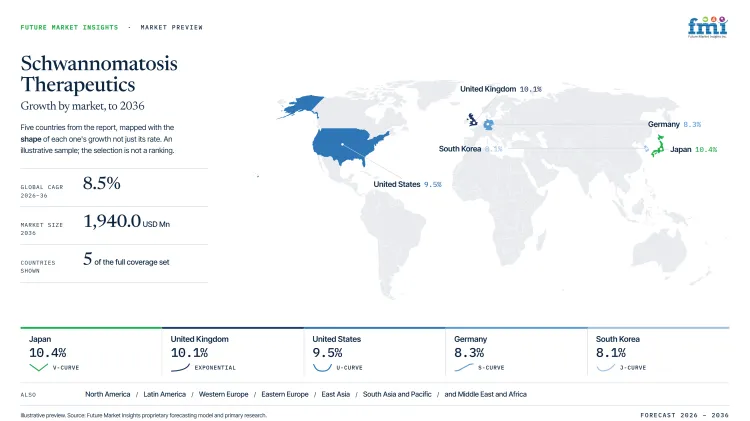
| Country | CAGR |
|---|---|
| Japan | 10.4% |
| United Kingdom | 10.1% |
| United States | 9.5% |
| Germany | 8.3% |
| South Korea | 8.1% |
Source: Future Market Insights analysis, 2026.
How do country-level CAGRs compare in Schwannomatosis Therapeutics Market?
Country comparison shows a gradual step-down in growth across profiled markets. Japan occupies the upper end of the range followed closely by the United Kingdom. United States forms a middle tier supported by specialist clinics and active clinical studies. Germany and South Korea complete the comparison through hospital capacity and early-stage research programs. The 2.3-percentage-point spread shows shared expansion potential across profiled markets, although relative positions indicate different levels of market momentum.
- Japan leads the comparison and establishes East Asia as an important specialist-care cluster.
- United Kingdom follows Japan and maintains a narrow gap from the leading market.
- United States forms the next growth band supported by dedicated NF clinics and active studies.
- Germany maintains steady expansion across hospital-based neurological referral services.
- South Korea records the slowest pace among profiled markets even due to the focused research activity.
Markets with broadly similar CAGRs may present different entry conditions due to trial access and reimbursement review. The full report provides country-level analysis across North America, Latin America, Europe, Asia Pacific, and Middle East and Africa.
Country-wise Analysis
- Schwannomatosis therapeutics sector in Japan is anticipated to rise at 10.4% CAGR from 2026 to 2036, backed by concentrated neurological expertise and sustained specialty-care demand. Referral coordination supports molecular confirmation and long-term monitoring across academic hospitals. Statistics Bureau of Japan reported in April 2025 an older population of 36.243 million during 2024. Concentrated ageing pressure supports neurological and hearing services serving complex specialty needs.
- Schwannomatosis therapeutics market in the United Kingdom is projected to expand at 10.1% CAGR by 2036, driven by rare-disease genomics and coordinated national referral services. Specialist centers connect molecular diagnosis with neurology and pain services across established care routes. England Rare Diseases Action Plan recorded Generation Study recruitment across 27 hospitals in February 2025. Active genomic infrastructure supports molecular diagnosis across coordinated clinical networks.
- Schwannomatosis therapeutics demand in the United States is estimated to record 9.5% CAGR between 2026 and 2036, guided by dedicated NF clinics and active platform trials. Clinical research access may improve treatment review for progressive tumors and chronic pain. Children’s Tumor Foundation announced 8 new NF Clinic Network members in February 2026. Added specialist sites expand coordinated care and research referral capacity.
- Schwannomatosis therapeutics sector in Germany is forecast to register 8.3% CAGR during the study period, helped by hospital-based neurology and genetic services. Academic centers contribute molecular testing and long-term follow-up across rare nerve-sheath tumor cases. German Federal Statistical Office recorded 1,874 hospitals as of September 2024, indicating hospital capacity for specialist referral and multidisciplinary care.
- Schwannomatosis therapeutics sales in South Korea are expected to scale at 8.1% CAGR during the forecast period, aided by early-stage therapy development and tertiary-center research. Local clinical programs may strengthen regional experience in molecularly selected NF2-related disease. ClinicalTrials registry updated in January 2026 lists estimated enrollment of 25 participants for PRG-N-01 evaluation. Domestic study capacity strengthens local experience with molecularly selected disease.
Who are notable companies in Schwannomatosis Therapeutics Market?
Takeda Pharmaceutical Company Limited supports brigatinib through published schwannomatosis trial evidence. PRG S&T Co., Ltd. advances Trineumin led by a gene-directed development program. Puma Biotechnology, Inc. contributes neratinib to multi-arm evaluation. Incyte Corporation supports retifanlimab research with bevacizumab supplied by Roche. Recordati S.p.A. provides siltuximab stewardship for pain-focused investigation.
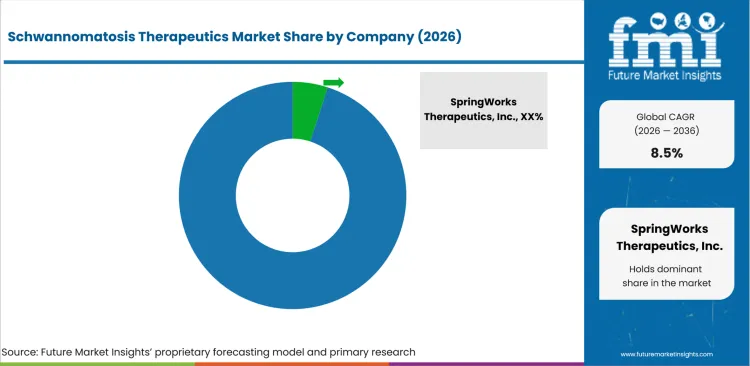
Competition in schwannomatosis therapeutics is expected to center on disease-specific evidence and trial execution. Specialist teams are likely to compare tumor response and hearing outcomes across molecularly defined cohorts. Pain-focused programs are projected to receive review through controlled symptom measures and tolerability records. Company progress is anticipated to depend on study continuity and medicine access across rare patient groups.
- Takeda Pharmaceutical Company Limited receives attention due to brigatinib evidence across progressive schwannomatosis. Specialist teams assess tumor response and hearing outcomes during treatment review.
- PRG S&T Co., Ltd. competes depending on Trineumin development across nerve-sheath tumors. Dose-finding progress may inform later efficacy evaluation across hearing and tumor outcomes.
- Puma Biotechnology, Inc. and Incyte Corporation support multi-arm study activity based on established oncology development capabilities. Clinical continuity may strengthen evaluation across molecularly selected patient groups.
- Roche Holding Ltd and Recordati S.p.A. support combination and pain-focused investigation through continuing medicine stewardship. Investigator-led results determine future disease-specific positioning.
Competitive Benchmarking: Schwannomatosis Therapeutics Market
| Company | Portfolio Depth | Clinical Match | Service Support | Service Reach |
|---|---|---|---|---|
| Takeda Pharmaceutical Company Limited | High | High | High | Global |
| PRG S&T Co., Ltd. | Medium | High | Medium | South Korea development sites |
| Puma Biotechnology, Inc. | Medium | High | Medium | United States trial network |
| Incyte Corporation | Medium | High | High | United States and selected global markets |
| Roche Holding Ltd | High | High | High | Global |
| Recordati S.p.A. | Medium | Medium | High | Europe and selected global markets |
Source: Future Market Insights competitive analysis, 2026.
Key Developments in Schwannomatosis Therapeutics Market
- In February 2026, Children’s Tumor Foundation reported early progress from PRG S&T Co., Ltd. involving Trineumin in an NF2-related schwannomatosis trial in Korea. Update strengthened visibility for gene-directed small-molecule development across progressive tumor cases.
- In April 2026, Children’s Tumor Foundation reported brigatinib inclusion in National Comprehensive Cancer Network guidelines for NF2-related schwannomatosis. Guideline recognition improves clinical discussion and payer review for an evidence-backed off-label option.
- In May 2026, ClinicalTrials registry listed active INTUITT-NF2 substudies involving brigatinib and neratinib with retifanlimab combined with bevacizumab. Multi-arm design supports comparative screening across several NF2-related tumor types under one platform protocol.
Key Players in Schwannomatosis Therapeutics Market
Targeted Therapy Participants
- Takeda Pharmaceutical Company Limited
- Puma Biotechnology, Inc.
- Incyte Corporation
- Roche Holding Ltd
Pain-Focused Biologic Participant
- Recordati S.p.A.
Gene-Directed Development Participant
- PRG S&T Co., Ltd.
Schwannomatosis Therapeutics Market Report Scope
| Coverage Field | Report Scope |
|---|---|
| Market Breakdown | Schwannomatosis therapeutics market breakdown by therapy type, disease type, treatment setting, end user, and region |
| Market Definition | Schwannomatosis therapeutics include medicines and surgical care used for molecularly defined schwannomatosis and associated tumor or pain management. |
| Regions Covered | North America, Latin America, Western Europe, Eastern Europe, East Asia, South Asia and Pacific, and Middle East and Africa |
| Countries Covered | United States, United Kingdom, Germany, Japan, South Korea |
| Key Companies Profiled | Takeda Pharmaceutical Company Limited, PRG S&T Co., Ltd., Puma Biotechnology, Inc., Incyte Corporation, Roche Holding Ltd, and Recordati S.p.A. |
| Forecast Period | 2026 to 2036 |
| Approach | Hybrid bottom-up and top-down method using segment shares and country CAGRs with clinical evidence and company participation. |
Source: Future Market Insights analysis, 2026.
Schwannomatosis Therapeutics Market - Research Methodology
| Method | Approach |
|---|---|
| Primary Research | FMI analysts gathered input from manufacturers, service providers, technology developers, distributors, end users, procurement teams, and subject-matter experts. Interviews examined purchasing decisions, product or service evaluation, adoption barriers, approval requirements, pricing considerations, and expectations for technical or commercial support. Respondents were also asked what evidence is required before a trial, pilot, or initial order develops into regular purchasing. |
| Desk Research | Desk research covered government statistics, regulatory publications, trade data, industry associations, technical literature, standards, company filings, product information, and official corporate announcements. Sources were reviewed for relevance, publication date, geographic coverage, and consistency with the defined market scope. Claims relating to performance, applications, approvals, capacity, investment, and commercial activity were retained only when supported by credible public evidence. |
| Market Sizing and Forecasting | The market model combined the baseline value with historical performance, segment structure, pricing and volume indicators, adoption levels, company participation, and country-level demand conditions. Forecast assumptions considered economic activity, investment trends, regulatory developments, technology adoption, purchasing cycles, supply availability, and barriers to wider market use. Segment and regional estimates were reconciled before the final market total was calculated. |
| Data Validation | Estimates were checked against multiple independent indicators, including public data, company activity, trade patterns, industry developments, and findings from primary interviews. Validation also tested whether products, services, applications, and company revenues fell within the defined market boundaries. Adjacent categories, unsupported claims, overlapping revenues, and activities without direct market relevance were excluded to reduce double counting and maintain consistency across segments and countries. |
Source: Future Market Insights analysis, 2026.
Schwannomatosis Therapeutics Market by Segments
Schwannomatosis Therapeutics Market segmented by Therapy Type:
- Pain Management Therapies
- Targeted Therapies
- Surgical Management
- Gene-Based Therapies
- Supportive Care Therapies
Schwannomatosis Therapeutics Market segmented by Disease Type:
- SMARCB1-Associated Schwannomatosis
- LZTR1-Associated Schwannomatosis
- NF2-Related Schwannomatosis
Schwannomatosis Therapeutics Market segmented by Treatment Setting:
- First-Line Treatment
- Recurrent Disease Management
- Chronic Symptom Management
Schwannomatosis Therapeutics Market segmented by End User:
- Hospitals
- Specialty Neurology Centers
- Pain Management Clinics
- Academic & Research Institutes
Schwannomatosis Therapeutics Market segmented by Region:
- North America
- Latin America
- Western Europe
- Eastern Europe
- East Asia
- South Asia and Pacific
- Middle East and Africa
Research Sources and Bibliography
- Children’s Tumor Foundation. (2025, February 4). NF Clinic Network expansion: Recently joined NF clinics.
- Children’s Tumor Foundation. (2026, February 5). Welcoming eight new clinics to the NF Clinic Network.
- Children’s Tumor Foundation. (2026, February 26). Inside a new clinical trial for NF2-SWN: Early progress on Trineumin (PRG-N-01).
- Children’s Tumor Foundation. (2026, April 28). Brigatinib now in the NCCN guidelines for NF2-SWN.
- Department of Health and Social Care. (2025, February 28). England Rare Diseases Action Plan 2025: Annexes.
- Department of Health and Social Care. (2026, April 14). England Rare Diseases Action Plan 2026: Main report.
- European Medicines Agency. (2026, January 27). Avastin.
- European Medicines Agency. (2026, March 24). Sylvant.
- German Federal Statistical Office. (2024, September 27). Medical facilities, hospital beds and movement of patient.
- Lawson McLean, A. C., Rosahl, S. K., Lawson McLean, A., Fehringer, P., Freier, A., Löschner, D., Kamp, M. A., Senft, C., & Demetriades, A. K. (2025, May 22). Quality of life assessment in schwannomatosis: A systematic review. Brain and Spine, 5, 104279.
- National Library of Medicine. (2026, January 23). Study to determine optimal dose and evaluate efficacy and safety of PRG-N-01 in patients with neurofibromatosis type II.
- National Library of Medicine. (2026, April 23). Screening trial for pain relief in schwannomatosis.
- ClinicalTrials.gov. (2026, May 6). Innovative trial for understanding the impact of targeted therapies in NF2-related schwannomatosis (INTUITT-NF2).
- Plotkin, S. R., Yohay, K. H., Nghiemphu, P. L., Dinh, C. T., Babovic-Vuksanovic, D., Merker, V. L., Bakker, A., Fell, G., Trippa, L., & Blakeley, J. O. (2024, June 20). Brigatinib in NF2-related schwannomatosis with progressive tumors. The New England Journal of Medicine, 390(24), 2284-2294.
- Puma Biotechnology, Inc. (2025, March 26). Puma Biotechnology to present clinical data on neratinib at the AACR Annual Meeting 2025.
- Smith, M. J., Perez-Becerril, C., van der Meer, M., Burghel, G. J., Waller, S. J., Carney, M., Bunstone, S., Fryer, K., Bowers, N. L., Hartley, C. L., Smith, P. T., Rutherford, S. A., Freeman, S. R., Lloyd, S. K. W., Pathmanaban, O. N., King, A. T., Halliday, D., Duff, C., & Evans, D. G. (2024). Genetic findings in people with schwannomas who do not meet clinical diagnostic criteria for NF2-related schwannomatosis. Journal of Medical Genetics, 61(11), 1011-1015.
- Statistics Bureau of Japan. (2025, April 14). Current population estimates as of October 1, 2024.
- Takeda Pharmaceutical Company Limited. (2026, June 17). Annual report on Form 20-F for fiscal year 2025.
This bibliography is provided for reader reference and is not exhaustive. The full report contains the complete reference list and detailed citations.
This Report Answers
- How large is schwannomatosis therapeutics market across forecast period?
- What supports expansion across molecularly defined disease pathways?
- Why do pain management therapies lead therapy type selection?
- How does SMARCB1-associated schwannomatosis influence disease segmentation?
- Why does first-line treatment retain treatment setting strength?
- How do country outlooks differ across profiled markets?
- What companies participate in schwannomatosis-focused therapy development?
- What limits treatment adoption across specialist services?
- What evidence should hospital teams review during therapy selection?
- How may platform trials improve rare-disease development efficiency?
Frequently Asked Questions
What supports demand in schwannomatosis therapeutics market?
Demand is likely to be supported by specialist teams seeking dependable pain control and tumor-directed evidence. Coordinated referral pathways are expected to improve molecular diagnosis and investigational treatment access.
Who are key players in schwannomatosis therapeutics market?
Key companies are anticipated to include Takeda Pharmaceutical Company Limited and PRG S&T Co., Ltd. among others. Competition is likely to reflect clinical evidence and study continuity across rare-disease programs.
What restraint affects schwannomatosis therapeutics market?
Limited disease-specific approvals restrain routine treatment selection across molecular subtypes. Small patient groups may slow comparative evidence generation across clinical programs.
Why do executives track schwannomatosis therapeutics market?
Executives are expected to track therapy progress as clinical evidence affects rare-disease investment and portfolio planning. Trial continuity and specialist access are likely to guide program review across participating organizations.
What business problem does schwannomatosis therapeutics market address?
Schwannomatosis therapies address chronic pain and progressive nerve-sheath tumors requiring coordinated specialist care. Clinical teams need treatment pathways supporting tumor control and sustained symptom management.
What do hospital teams evaluate prior to selecting therapies?
Hospital teams are likely to evaluate tumor response and hearing outcomes with pain relief and tolerability. Molecular alignment and clinical-support requirements are expected to guide final treatment review.
What limits return on investment for therapy developers?
Return on investment weakens when recruitment and study continuity remain below planned levels. Fragmented referral pathways and limited eligible populations may reduce development efficiency.
How do companies build long-term clinical confidence?
Companies build clinical confidence through dependable evidence across molecularly defined patient groups. Continuing study support and transparent safety reporting are expected to influence long-term treatment use.
Preview the report firsthand - request a free sample
Get SampleGet the brochure for pricing and purchase details.
Get PDFTable of Content
- Key Takeaways
- Market Size and CAGR
- Top Growth Driver
- Fastest Growing Segment
- Leading Region
- Key Companies
- Emerging Opportunities
- Executive Summary
- Global Market Outlook
- Demand-side Trends
- Supply-side Trends
- Technology Roadmap Analysis
- Analysis and Recommendations
- Analyst Perspective (What is happening? Why now? What should investors know?)
- Key Questions Answered
- How large is the market?
- What is the CAGR?
- What are key trends?
- Which region dominates?
- Who are the leaders?
- Market Overview
- Market Coverage / Taxonomy
- Market Definition / Scope / Limitations
- Research Methodology
- Chapter Orientation
- Analytical Lens and Working Hypotheses
- Market Structure, Signals, and Trend Drivers
- Benchmarking and Cross-market Comparability
- Market Sizing, Forecasting, and Opportunity Mapping
- Research Design and Evidence Framework
- Desk Research Programme (Secondary Evidence)
- Expert Input and Fieldwork (Primary Evidence)
- Tooling, Models, and Reference Databases
- Data Engineering and Model Build
- Quality Assurance and Audit Trail
- Market Background
- Market Dynamics (Drivers, Restraints, Opportunity, Trends)
- Scenario Forecast (Optimistic, Likely, Conservative)
- Impact Analysis
- AI Impact
- Sustainability Impact
- Regulatory Impact
- Technology Impact
- Consumer / Buyer Analysis
- Purchase Drivers
- Adoption Barriers
- Buyer Journey
- Opportunity Map Analysis
- Product Life Cycle Analysis
- Supply Chain Analysis
- Investment Feasibility Matrix
- Value Chain Analysis
- PESTLE and Porter's Analysis
- Regulatory Landscape
- Regional Parent Market Outlook
- Production and Consumption Statistics
- Import and Export Statistics
- Global Market Analysis and Forecast, 2021 to 2036
- Historical Market Size Value (USD Million) Analysis, 2021 to 2025
- Current and Future Market Size Value (USD Million) Projections, 2026 to 2036
- Y-o-Y Growth Trend Analysis
- Absolute $ Opportunity Analysis
- Global Market Pricing Analysis, 2021 to 2036
- Global Market Analysis and Forecast, By Therapy Type, 2021 to 2036
- Introduction / Key Findings
- Historical Market Size Value (USD Million) Analysis By Therapy Type, 2021 to 2025
- Current and Future Market Size Value (USD Million) Analysis and Forecast By Therapy Type, 2026 to 2036
- Pain Management Therapies
- Targeted Therapies
- Surgical Management
- Gene-Based Therapies
- Supportive Care Therapies
- Pain Management Therapies
- Y-o-Y Growth Trend Analysis By Therapy Type, 2021 to 2025
- Absolute $ Opportunity Analysis By Therapy Type, 2026 to 2036
- Global Market Analysis and Forecast, By Disease Type, 2021 to 2036
- Introduction / Key Findings
- Historical Market Size Value (USD Million) Analysis By Disease Type, 2021 to 2025
- Current and Future Market Size Value (USD Million) Analysis and Forecast By Disease Type, 2026 to 2036
- SMARCB1-Associated Schwannomatosis
- LZTR1-Associated Schwannomatosis
- NF2-Related Schwannomatosis
- SMARCB1-Associated Schwannomatosis
- Y-o-Y Growth Trend Analysis By Disease Type, 2021 to 2025
- Absolute $ Opportunity Analysis By Disease Type, 2026 to 2036
- Global Market Analysis and Forecast, By Treatment Setting, 2021 to 2036
- Introduction / Key Findings
- Historical Market Size Value (USD Million) Analysis By Treatment Setting, 2021 to 2025
- Current and Future Market Size Value (USD Million) Analysis and Forecast By Treatment Setting, 2026 to 2036
- First-Line Treatment
- Recurrent Disease Management
- Chronic Symptom Management
- First-Line Treatment
- Y-o-Y Growth Trend Analysis By Treatment Setting, 2021 to 2025
- Absolute $ Opportunity Analysis By Treatment Setting, 2026 to 2036
- Global Market Analysis and Forecast, By End User, 2021 to 2036
- Introduction / Key Findings
- Historical Market Size Value (USD Million) Analysis By End User, 2021 to 2025
- Current and Future Market Size Value (USD Million) Analysis and Forecast By End User, 2026 to 2036
- Hospitals
- Specialty Neurology Centers
- Pain Management Clinics
- Academic & Research Institutes
- Hospitals
- Y-o-Y Growth Trend Analysis By End User, 2021 to 2025
- Absolute $ Opportunity Analysis By End User, 2026 to 2036
- Global Market Analysis and Forecast, By Region, 2021 to 2036
- Introduction
- Historical Market Size Value (USD Million) Analysis By Region, 2021 to 2025
- Current Market Size Value (USD Million) Analysis and Forecast By Region, 2026 to 2036
- North America
- Latin America
- Western Europe
- Eastern Europe
- East Asia
- South Asia and Pacific
- Middle East & Africa
- Market Attractiveness Analysis By Region
- North America Market Analysis and Forecast, By Country, 2021 to 2036
- Historical Market Size Value (USD Million) Trend Analysis By Market Taxonomy, 2021 to 2025
- Market Size Value (USD Million) Forecast By Market Taxonomy, 2026 to 2036
- By Country
- USA
- Canada
- By Therapy Type
- By Disease Type
- By Treatment Setting
- By End User
- By Country
- Market Attractiveness Analysis
- By Country
- By Therapy Type
- By Disease Type
- By Treatment Setting
- By End User
- Key Takeaways
- Latin America Market Analysis and Forecast, By Country
- Historical Market Size Value (USD Million) Trend Analysis By Market Taxonomy, 2021 to 2025
- Market Size Value (USD Million) Forecast By Market Taxonomy, 2026 to 2036
- By Country
- Brazil
- Mexico
- Chile
- Rest of Latin America
- By Therapy Type
- By Disease Type
- By Treatment Setting
- By End User
- By Country
- Market Attractiveness Analysis
- By Country
- By Therapy Type
- By Disease Type
- By Treatment Setting
- By End User
- Key Takeaways
- Western Europe Market Analysis and Forecast, By Country
- Historical Market Size Value (USD Million) Trend Analysis By Market Taxonomy, 2021 to 2025
- Market Size Value (USD Million) Forecast By Market Taxonomy, 2026 to 2036
- By Country
- Germany
- UK
- Italy
- Spain
- France
- Nordic
- BENELUX
- Rest of Western Europe
- By Therapy Type
- By Disease Type
- By Treatment Setting
- By End User
- By Country
- Market Attractiveness Analysis
- By Country
- By Therapy Type
- By Disease Type
- By Treatment Setting
- By End User
- Key Takeaways
- Eastern Europe Market Analysis and Forecast, By Country
- Historical Market Size Value (USD Million) Trend Analysis By Market Taxonomy, 2021 to 2025
- Market Size Value (USD Million) Forecast By Market Taxonomy, 2026 to 2036
- By Country
- Russia
- Poland
- Hungary
- Balkan & Baltic
- Rest of Eastern Europe
- By Therapy Type
- By Disease Type
- By Treatment Setting
- By End User
- By Country
- Market Attractiveness Analysis
- By Country
- By Therapy Type
- By Disease Type
- By Treatment Setting
- By End User
- Key Takeaways
- East Asia Market Analysis and Forecast, By Country
- Historical Market Size Value (USD Million) Trend Analysis By Market Taxonomy, 2021 to 2025
- Market Size Value (USD Million) Forecast By Market Taxonomy, 2026 to 2036
- By Country
- China
- Japan
- South Korea
- By Therapy Type
- By Disease Type
- By Treatment Setting
- By End User
- By Country
- Market Attractiveness Analysis
- By Country
- By Therapy Type
- By Disease Type
- By Treatment Setting
- By End User
- Key Takeaways
- South Asia and Pacific Market Analysis and Forecast, By Country
- Historical Market Size Value (USD Million) Trend Analysis By Market Taxonomy, 2021 to 2025
- Market Size Value (USD Million) Forecast By Market Taxonomy, 2026 to 2036
- By Country
- India
- ASEAN
- Australia & New Zealand
- Rest of South Asia and Pacific
- By Therapy Type
- By Disease Type
- By Treatment Setting
- By End User
- By Country
- Market Attractiveness Analysis
- By Country
- By Therapy Type
- By Disease Type
- By Treatment Setting
- By End User
- Key Takeaways
- Middle East & Africa Market Analysis and Forecast, By Country
- Historical Market Size Value (USD Million) Trend Analysis By Market Taxonomy, 2021 to 2025
- Market Size Value (USD Million) Forecast By Market Taxonomy, 2026 to 2036
- By Country
- Kingdom of Saudi Arabia
- Other GCC Countries
- Türkiye
- South Africa
- Other African Union
- Rest of Middle East & Africa
- By Therapy Type
- By Disease Type
- By Treatment Setting
- By End User
- By Country
- Market Attractiveness Analysis
- By Country
- By Therapy Type
- By Disease Type
- By Treatment Setting
- By End User
- Key Takeaways
- Key Countries Market Analysis
- USA
- Pricing Analysis
- Market Share Analysis, 2025
- By Therapy Type
- By Disease Type
- By Treatment Setting
- By End User
- Canada
- Pricing Analysis
- Market Share Analysis, 2025
- By Therapy Type
- By Disease Type
- By Treatment Setting
- By End User
- Mexico
- Pricing Analysis
- Market Share Analysis, 2025
- By Therapy Type
- By Disease Type
- By Treatment Setting
- By End User
- Brazil
- Pricing Analysis
- Market Share Analysis, 2025
- By Therapy Type
- By Disease Type
- By Treatment Setting
- By End User
- Chile
- Pricing Analysis
- Market Share Analysis, 2025
- By Therapy Type
- By Disease Type
- By Treatment Setting
- By End User
- Germany
- Pricing Analysis
- Market Share Analysis, 2025
- By Therapy Type
- By Disease Type
- By Treatment Setting
- By End User
- UK
- Pricing Analysis
- Market Share Analysis, 2025
- By Therapy Type
- By Disease Type
- By Treatment Setting
- By End User
- Italy
- Pricing Analysis
- Market Share Analysis, 2025
- By Therapy Type
- By Disease Type
- By Treatment Setting
- By End User
- Spain
- Pricing Analysis
- Market Share Analysis, 2025
- By Therapy Type
- By Disease Type
- By Treatment Setting
- By End User
- France
- Pricing Analysis
- Market Share Analysis, 2025
- By Therapy Type
- By Disease Type
- By Treatment Setting
- By End User
- India
- Pricing Analysis
- Market Share Analysis, 2025
- By Therapy Type
- By Disease Type
- By Treatment Setting
- By End User
- ASEAN
- Pricing Analysis
- Market Share Analysis, 2025
- By Therapy Type
- By Disease Type
- By Treatment Setting
- By End User
- Australia & New Zealand
- Pricing Analysis
- Market Share Analysis, 2025
- By Therapy Type
- By Disease Type
- By Treatment Setting
- By End User
- China
- Pricing Analysis
- Market Share Analysis, 2025
- By Therapy Type
- By Disease Type
- By Treatment Setting
- By End User
- Japan
- Pricing Analysis
- Market Share Analysis, 2025
- By Therapy Type
- By Disease Type
- By Treatment Setting
- By End User
- South Korea
- Pricing Analysis
- Market Share Analysis, 2025
- By Therapy Type
- By Disease Type
- By Treatment Setting
- By End User
- Russia
- Pricing Analysis
- Market Share Analysis, 2025
- By Therapy Type
- By Disease Type
- By Treatment Setting
- By End User
- Poland
- Pricing Analysis
- Market Share Analysis, 2025
- By Therapy Type
- By Disease Type
- By Treatment Setting
- By End User
- Hungary
- Pricing Analysis
- Market Share Analysis, 2025
- By Therapy Type
- By Disease Type
- By Treatment Setting
- By End User
- Kingdom of Saudi Arabia
- Pricing Analysis
- Market Share Analysis, 2025
- By Therapy Type
- By Disease Type
- By Treatment Setting
- By End User
- Türkiye
- Pricing Analysis
- Market Share Analysis, 2025
- By Therapy Type
- By Disease Type
- By Treatment Setting
- By End User
- South Africa
- Pricing Analysis
- Market Share Analysis, 2025
- By Therapy Type
- By Disease Type
- By Treatment Setting
- By End User
- USA
- Market Structure Analysis
- Competition Dashboard
- Competition Benchmarking
- Market Share Analysis of Top Players
- By Regional
- By Therapy Type
- By Disease Type
- By Treatment Setting
- By End User
- Emerging Startups
- Innovation Benchmarking
- Competition Analysis
- Competition Deep Dive
- SpringWorks Therapeutics, Inc.
- Overview
- Product Portfolio
- Profitability by Market Segments
- Sales Footprint
- Strategy Overview
- Marketing Strategy
- Product Strategy
- Channel Strategy
- AstraZeneca PLC
- Merck & Co., Inc.
- Novartis AG
- Pfizer Inc.
- Roche Holding AG
- Recursion Pharmaceuticals, Inc.
- Healx Ltd.
- Pasithea Therapeutics Corp.
- Johnson & Johnson
- SpringWorks Therapeutics, Inc.
- Case Studies
- Success Stories
- Recent Developments
- Competition Deep Dive
- Assumptions & Acronyms Used


