

- Market Size (2026)
- USD 45.0 Mn
- Forecast (2036)
- USD 356.7 Mn
- CAGR (2026 to 2036)
- 23%
How big is the Neuro-Restoration Spinal Cord Injury Venture Capital Market?
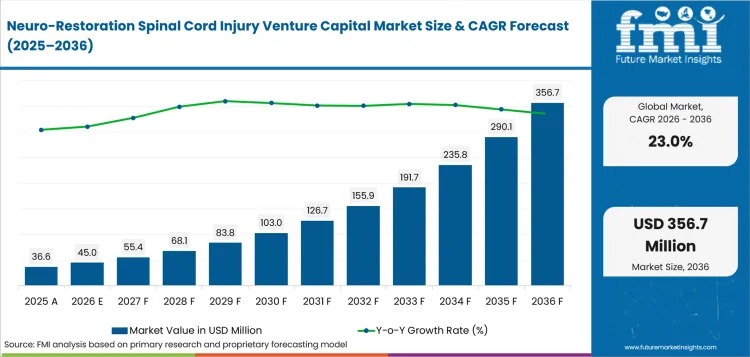
The Neuro-Restoration Spinal Cord Injury Venture Capital Market is projected to grow from USD 45.0 million in 2026 to USD 356.7 million by 2036, at a CAGR of 23%.
The Neuro-Restoration Spinal Cord Injury Venture Capital Market was valued at USD 36.6 million in 2025 and is estimated at USD 45.0 million in 2026. The market is projected to reach USD 356.7 million by 2036 at a CAGR of 23.0% during the forecast period. Early-Stage Funding is expected to account for a 52.0% share in 2026, while Specialist Venture Funds are projected to represent a 46.0% share.
Neuro-Restoration Spinal Cord Injury Venture Capital Market Overview: Size and Forecast
- 2025 Market Size: USD 36.6 million
- 2026 Market Size: USD 45.0 million
- 2036 Market Size: USD 356.7 million
- Forecast CAGR: 23.0% from 2026 to 2036
- Featured Funding Stage: Early-Stage Funding
- Early-Stage Funding Share in 2026: 52.0%
- Featured Investor Type: Specialist Venture Funds
- Specialist Venture Funds Share in 2026: 46.0%
- Country CAGR Highlight: China
- China CAGR: 25.1% by 2036
Summary of the Neuro-Restoration Spinal Cord Injury Venture Capital Market
- Demand and Growth Drivers
- FDA authorization for ARC-EX gives investors a clearer device pathway for restoration-focused spinal stimulation.
- Dedicated SCI funds improve deal formation as founders no longer rely only on broad neuroscience investors.
- BCI trials expand the investable universe as paralysis patients become a defined clinical entry group.
- Cell and drug programs gain funding when preclinical packages can support first-in-human trial design.
- Product and Segment View
- With an estimated 52.0% share in 2026, early-stage funding is expected to remain the main funding stage because first proof remains the largest financing gap.
- Specialist Venture Funds are projected to represent 46.0% of Investor Type in 2026 with diligence shaped by clinical endpoints and device risk.
- Neurotechnology is anticipated to hold 44.0% of Focus Area in 2026 as brain computing interfaces widen the restoration investment pool.
- Geography and Competitive Outlook
- The United States is projected to grow at a CAGR of 24.5% through 2036 with FDA and foundation-backed translation support.
- The United Kingdom is expected to grow at a CAGR of 22.4% through 2036 as spinal research charities bridge science and funding.
- Germany is forecast to grow at a CAGR of 21.8% through 2036 with strong rehabilitation research and cautious venture conversion.
- Japan is expected to grow at a CAGR of 21.6% through 2036 as regenerative medicine expertise supports selective financing.
- Analyst Opinion
- Anurag Sharma, Principal Consultant at Future Market Insights for the healthcare domain, says, “I see this market as a risk-filtering system more than a simple venture category. Investors are not just buying exposure to spinal cord injury science. They are paying for proof that a therapy can restore a measurable function and survive clinical review. The notable pull is coming from three places. One is non-invasive stimulation with regulatory evidence. The second is brain-computer interface work that can show daily function gains. The third is biological repair with clear patient selection and follow-up plans. The pressure point is cost of evidence. Small companies must fund long trials before payers or acquirers can judge value.”
SCI Ventures launched a venture philanthropy fund in June 2024 to accelerate restorative treatments for spinal cord injury and paralysis, which gives the category a dedicated capital formation vehicle.
Investor interest is shifting from broad paralysis research toward assets with near-term functional recovery claims and clearer regulatory pathways.
Why is the Neuro-Restoration Spinal Cord Injury Venture Capital Market growing?
FDA authorization for ARC-EX gives investors a clearer device pathway for restoration-focused spinal stimulation. Dedicated SCI funds improve deal formation as founders no longer rely only on broad neuroscience investors.
- FDA authorization for ARC-EX gives investors a clearer device pathway for restoration-focused spinal stimulation.
- Dedicated SCI funds improve deal formation as founders no longer rely only on broad neuroscience investors.
- BCI trials expand the investable universe as paralysis patients become a defined clinical entry group.
Investor behavior is changing as SCI restoration assets gain clearer proof points in devices and neurotechnology. The FDA De Novo decision for ARCEX classified the system as a Class II device for improving hand sensation and strength in adults with chronic incomplete cervical SCI. That decision gives investors a defined regulatory example for non-invasive spinal stimulation. It also turns clinical endpoint design into a capital trigger instead of a purely scientific milestone. Companies that can link device use to measurable daily function are better placed to move from grants into priced rounds. Dedicated capital is expanding as nonprofit foundations try to close the gap between discovery and venture readiness.
How is the Neuro-Restoration Spinal Cord Injury Venture Capital Market segmented?
The Neuro-Restoration Spinal Cord Injury Venture Capital Market is segmented by funding stage, investor type, focus area, end user, and region.
- With an estimated 52.0% share in 2026, early-stage funding is expected to remain the main funding stage because first proof remains the largest financing gap.
- Specialist Venture Funds are projected to represent 46.0% of Investor Type in 2026 with diligence shaped by clinical endpoints and device risk.
- Neurotechnology is anticipated to hold 44.0% of Focus Area in 2026 as brain computing interfaces widen the restoration investment pool.
How does Early-Stage Funding contribute to the funding stage category?
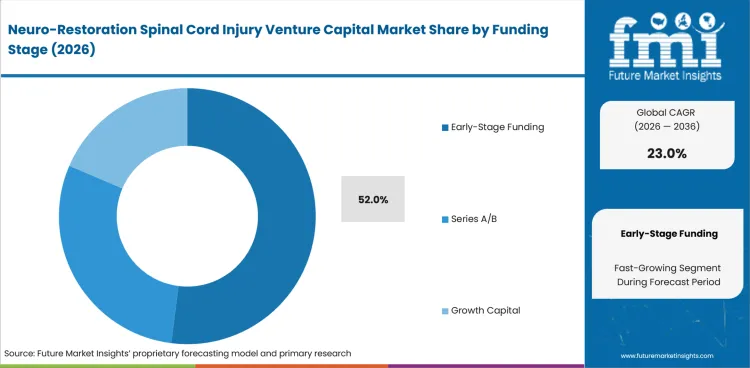
- Early-Stage Funding is projected to account for a 52.0% share in 2026 as most SCI restoration startups need first clinical proof before institutional syndicates accept product risk.
- Seed investors usually test whether founders can define responder criteria before they test pricing power. This makes trial design skill a funding asset in SCI restoration.
What supports demand for Specialist Venture Funds?
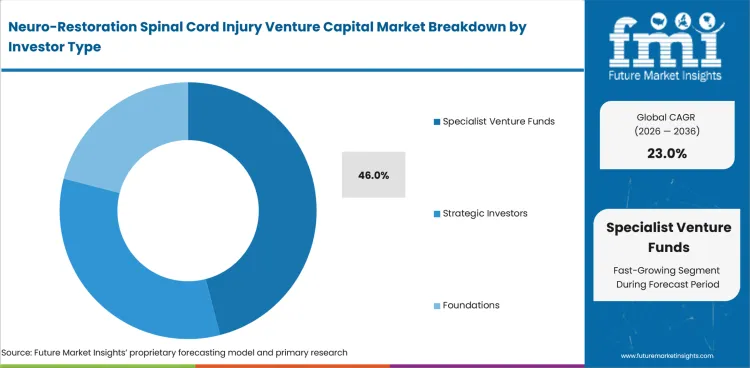
- Specialist Venture Funds are estimated to represent a 46.0% share in 2026 as technical diligence needs SCI clinicians, neuroengineers, and regulatory advisors.
- Generalist funds often enter after a specialist validates endpoints and patient access. That makes specialist syndicate leadership more important than headline check size.
How do buyers evaluate Neurotechnology within the focus area category?
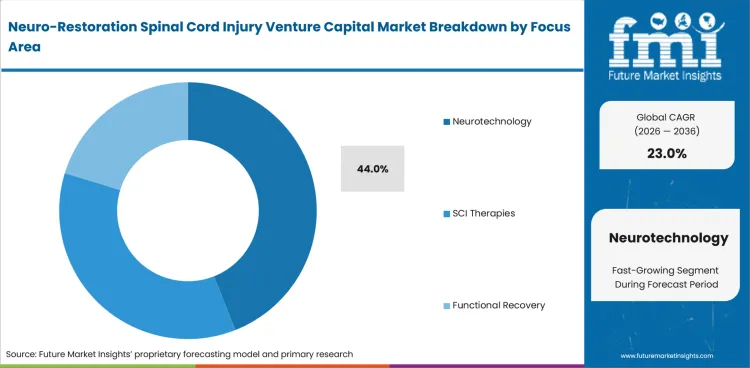
- Neurotechnology is anticipated to account for a 44.0% share in 2026 as stimulation and BCI platforms show visible patient interaction before full reimbursement proof.
- Investors compare neuromodulation closed-loop brain-computer interfaces with SCI stimulation systems by surgical burden, endpoint clarity, and pathway speed.
What market factors influence demand for Biotech Startups?
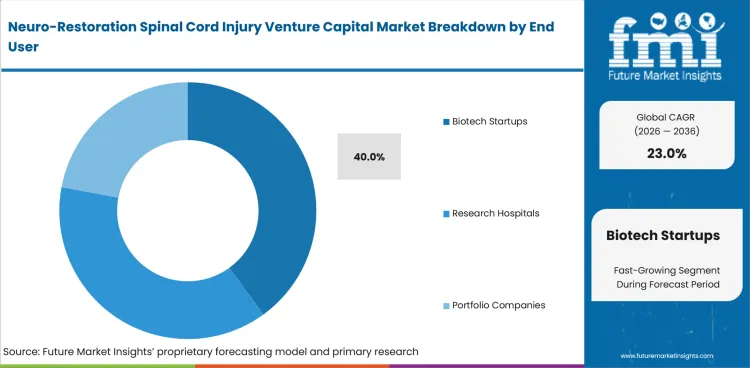
- Biotech Startups are expected to represent a 40.0% share in 2026 as drug and cell therapy programs need capital before licensing talks become credible.
- Biology-based SCI companies face longer cash cycles than device firms. Investors look for manufacturing control and pre-IND packages before supporting larger rounds.
How does North America affect the regional outlook?
- North America is projected to account for a 54.0% share in 2026 as FDA signals and foundation networks shape most visible SCI restoration financing.
- The region’s advantage comes from investor access and trial-site density. Companies can test clinical utility before expanding toward Europe or East Asia.
What drives and restrains the market?
.webp "Top Country Growth Comparison Neuro Restoration Spinal Cord Injury Venture Capital Market Cagr (2026 2036)")
Driver: Regulatory proof in spinal stimulation lowers the perceived distance between lab science and investable medical technology; restraint: Trial cost is the established restraint as small patient pools require careful site selection and long follow-up; opportunity: in hybrid models that pair foundation money with venture investors after first functional evidence.
The market reflects a balance between the identified demand driver, adoption constraints, and the supplier opportunity outlined below.
- Driver: Regulatory proof in spinal stimulation lowers the perceived distance between lab science and investable medical technology.
- Restraint: Trial cost is the established restraint as small patient pools require careful site selection and long follow-up.
- Opportunity: in hybrid models that pair foundation money with venture investors after first functional evidence.
Functional Endpoint Financing: Funding moves faster when a company can translate neurological recovery into a measurable function. ONWARD Medical’s FDA authorization for ARC-EX created a reference point for hand strength and sensation endpoints in chronic cervical SCI. Its reported early system sales and rehabilitation-clinic reach are used here as commercialization-readiness signals for investors, not as direct venture-capital revenue. These sales figures matter for investors as they connect regulatory proof with early commercial pull.
The Christopher & Dana Reeve Foundation and Spinal Research announced USD 1.5 million in preclinical grants for traumatic SCI treatments in 2026. That type of grant is small compared with venture rounds, but it can fund the experiments that unlock venture diligence. Foundations improve market formation when they back pre-IND and pre-IDE work. Investors then see a cleaner package with better translational evidence and fewer unknowns around clinical rationale. Trial Cost Bottleneck: The main restraint is not lack of scientific ideas. It is the cost and time needed to prove that a restoration signal is real.
Which factors support expansion?
Commercial expansion is reinforced by the value, workflow, and recurring-demand factors below.
- The market value rises as FDA-cleared stimulation systems reduce uncertainty for investors evaluating neurostimulation devices in spinal injury settings.
- Specialist venture investors price assets around functional endpoints as hand strength and sensation outcomes carry clearer commercial meaning.
- Foundation-backed capital lowers early risk as SCI Ventures and Reeve Foundation grants create a bridge before institutional venture rounds.
Which country markets are included in the CAGR comparison?
The selected CAGR comparison covers China (25.1%), United States (24.5%), India (24.0%), South Korea (22.7%), and United Kingdom (22.4%) through 2036.
| Country | CAGR |
|---|---|
| China | 25.1% |
| United States | 24.5% |
| India | 24.0% |
| South Korea | 22.7% |
| United Kingdom | 22.4% |
Source: Future Market Insights analysis based on the supplied country forecast table.
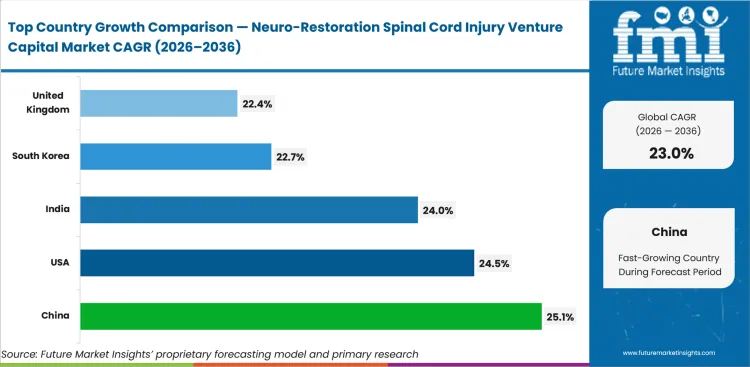
How do country-level CAGRs compare?
- China (CAGR: 25.1%): China is projected to record a CAGR of 25.1% through 2036 as clinical activity and neurotechnology policy interest strengthen investor attention.
- United States (CAGR: 24.5%): The United States is projected to record a CAGR of 24.5% through 2036 as FDA signals and nonprofit capital shorten the investor learning curve.
- India (CAGR: 24.0%): India is forecast to grow at a CAGR of 24.0% through 2036 as unmet clinical need and low-cost innovation create selective investor interest.
- South Korea (CAGR: 22.7%): South Korea is expected to record a CAGR of 22.7% through 2036 as hospital-linked rehabilitation networks and digital health capacity support selective investment.
- United Kingdom (CAGR: 22.4%): The United Kingdom is expected to grow at a CAGR of 22.4% through 2036 as charity-backed SCI science meets a cautious venture environment.
The global Neuro-Restoration Spinal Cord Injury Venture Capital Market is forecast to record a CAGR of 23% from 2026 to 2036. The supplied study covers 8 named country forecasts across the report regions.
How is the Neuro-Restoration Spinal Cord Injury Venture Capital Market developing in China?
China is projected to record a CAGR of 25.1% through 2036. The country outlook identifies this demand signal: BCI clinical activity creates strong visibility for neuro-restoration platforms.
Country Market Snapshot
| Country | China |
|---|---|
| Forecast CAGR | 25.1% |
| Clinical activity | Chinese trial records show active work in BCI and regenerative approaches. |
| Investor behavior | Local capital favors platform technologies with national neurotechnology relevance. |
| Policy context | Brain science and medical robotics priorities improve adjacent investor attention. |
| Application mix | Stem cell, biomaterial, and BCI approaches are visible in trial records. |
| Restraint | Public evidence quality varies across private company claims. |
| Primary demand signal | China is projected to record a CAGR of 25.1% through 2036 as clinical activity and neurotechnology policy interest strengthen investor attention. |
| Market context | China combines large clinical capacity with fast neurotechnology ambition, which supports the elevated forecast country CAGR. |
Market Outlook
China is projected to record a CAGR of 25.1% through 2036 as clinical activity and neurotechnology policy interest strengthen investor attention. A 2026 clinical trial protocol in China described BCI technology as having transformative potential for people with paralysis and noted progress in China and abroad. That signal matters for venture capital because BCI platforms can attract both medical and technology investors. It also widens SCI restoration beyond drug development.
Key Growth Drivers
- BCI clinical activity creates strong visibility for neuro-restoration platforms.
- Hospital networks can support recruitment for selected SCI trials.
- Local technology investors can support neuroengineering assets with broader platform value.
- Stem cell, biomaterial, and BCI approaches are visible in trial records.
Key Restraints
- Public evidence for private SCI venture deals is often hard to verify.
- Regulatory and ethics review clarity varies across therapy types and sites.
- Public evidence quality varies across private company claims.
Country Market FAQs
Why should executives monitor Neuro-Restoration Spinal Cord Injury Venture Capital Market demand in China?
•Executives should monitor China because local buyer readiness, stem cell, biomaterial, and BCI approaches are visible in trial records, and service capacity can influence account timing and market-entry priorities.
What should suppliers localize for China?
Suppliers should localize proof points, pricing logic, partner coverage, and training support around buyer access and account ownership and local support coverage.
What adoption risk needs attention in China?
Executive teams should watch adoption risk because public evidence for private sci venture deals is often hard to verify can delay conversion from evaluation to commercial deployment.
How is the Neuro-Restoration Spinal Cord Injury Venture Capital Market developing in the United States?
The United States is projected to record a CAGR of 24.5% through 2036. The country outlook identifies this demand signal: FDA device precedent creates a stronger path for stimulation and spinal cord stimulators tied to recovery.
Country Market Snapshot
| Country | United States |
|---|---|
| Forecast CAGR | 24.5% |
| Regulatory anchor | FDA De Novo authorization for ARCEX gives US investors a concrete device precedent. |
| Foundation route | Reeve Foundation and SCI Ventures improve early deal sourcing for restoration assets. |
| Clinical channel | Rehabilitation clinics become first buyers for non-invasive stimulation systems. |
| Investor signal | Neuralink’s Series E funding raises attention across paralysis-linked BCI platforms. |
| Restraint | Reimbursement timing can slow commercial conversion after regulatory clearance. |
| Primary demand signal | The United States is projected to record a CAGR of 24.5% through 2036 as FDA signals and nonprofit capital shorten the investor learning curve. |
| Market context | The United States is the only selected country with both a major FDA restoration device precedent and deep specialist venture access. |
Market Outlook
The United States is projected to record a CAGR of 24.5% through 2036 as FDA signals and nonprofit capital shorten the investor learning curve. Buyer behavior centers on proof that a device or therapy can improve function in a named SCI subgroup. The FDA’s ARCEX order defines use in adults aged 18 to 75 with chronic incomplete cervical SCI. That boundary helps investors judge addressable use and trial quality. It also keeps capital focused on credible restoration claims.
Key Growth Drivers
- FDA device precedent creates a stronger path for stimulation and spinal cord stimulators tied to recovery.
- Reeve Foundation activity gives founders access to SCI experts and patient-focused funders.
- US rehabilitation centers offer early commercial testing for clinic-based restoration systems.
- The United States is the only selected country with both a major FDA restoration device precedent and deep specialist venture access.
Key Restraints
- Payer evidence requirements can delay commercial uptake after early regulatory success.
- Trial recruitment stays difficult as SCI subgroups vary by injury level and chronicity.
- Reimbursement timing can slow commercial conversion after regulatory clearance.
Country Market FAQs
Why should executives monitor Neuro-Restoration Spinal Cord Injury Venture Capital Market demand in the United States?
Executives should monitor the United States because local buyer readiness, local use-case priorities, and service capacity can influence account timing and market-entry priorities.
What should suppliers localize for the United States?
Suppliers should localize proof points, pricing logic, partner coverage, and training support around reeve foundation and sci ventures improve early deal sourcing for restoration assets and rehabilitation clinics become first buyers for non-invasive stimulation systems.
What adoption risk needs attention in the United States?
Executive teams should watch adoption risk because payer evidence requirements can delay commercial uptake after early regulatory success can delay conversion from evaluation to commercial deployment.
How is the Neuro-Restoration Spinal Cord Injury Venture Capital Market developing in India?
India is projected to record a CAGR of 24.0% through 2036. The country outlook identifies this demand signal: ICMR guidance creates a clearer evidence screen for cell therapy claims.
Country Market Snapshot
| Country | India |
|---|---|
| Forecast CAGR | 24.0% |
| Policy anchor | ICMR guidance lists evidence status for stem cell therapy in spinal cord injury. |
| Clinical route | Indian Spinal Injuries Centre appears in national ethics committee records. |
| Investor behavior | Capital favors lower-cost care models and translational partnerships. |
| Channel signal | Hospital-led evidence remains central before private investment scales. |
| Restraint | Unapproved stem cell claims raise diligence and trust concerns. |
| Primary demand signal | India is forecast to grow at a CAGR of 24.0% through 2036 as unmet clinical need and low-cost innovation create selective investor interest. |
| Market context | India offers a large unmet need setting where evidence discipline can separate credible restoration companies from weak claims. |
Market Outlook
India is forecast to grow at a CAGR of 24.0% through 2036 as unmet clinical need and low-cost innovation create selective investor interest. Indian Council of Medical Research guidance includes evidence status for stem cell therapy in spinal cord injury, which is important for investor discipline. That guidance warns the market against weak therapeutic claims. It also makes credible clinical validation more valuable for companies seeking capital.
Key Growth Drivers
- ICMR guidance creates a clearer evidence screen for cell therapy claims.
- Specialist hospitals provide clinical access for SCI studies and rehabilitation pilots.
- Cost-sensitive care needs support interest in non-invasive and scalable restoration tools.
- Hospital-led evidence remains central before private investment scales.
Key Restraints
- Unregulated therapy claims can reduce investor trust across the category.
- Venture funding remains limited for long-cycle SCI biology programs.
- Unapproved stem cell claims raise diligence and trust concerns.
Country Market FAQs
Why should executives monitor Neuro-Restoration Spinal Cord Injury Venture Capital Market demand in India?
Executives should monitor India because local buyer readiness, local use-case priorities, and service capacity can influence account timing and market-entry priorities.
What should suppliers localize for India?
Suppliers should localize proof points, pricing logic, partner coverage, and training support around indian spinal injuries centre appears in national ethics committee records and hospital-led evidence remains central before private investment scales.
What adoption risk needs attention in India?
Executive teams should watch adoption risk because unregulated therapy claims can reduce investor trust across the category can delay conversion from evaluation to commercial deployment.
How is the Neuro-Restoration Spinal Cord Injury Venture Capital Market developing in South Korea?
South Korea is projected to record a CAGR of 22.7% through 2036. The country outlook identifies this demand signal: National rehabilitation infrastructure supports patient access for functional recovery studies.
Country Market Snapshot
| Country | South Korea |
|---|---|
| Forecast CAGR | 22.7% |
| Clinical anchor | National health information bodies identify traumatic SCI as a distinct care need. |
| Rehabilitation signal | Multi-hospital rehabilitation research supports patient access channels. |
| Investor behavior | Korean capital often favors medtech and digital rehabilitation platforms. |
| Channel route | Hospital networks and national rehabilitation centers shape validation. |
| Restraint | Direct SCI restoration venture evidence is limited in public sources. |
| Primary demand signal | South Korea is expected to record a CAGR of 22.7% through 2036 as hospital-linked rehabilitation networks and digital health capacity support selective investment. |
| Market context | South Korea is suitable positioned for hospital-linked digital recovery and rehabilitation technology validation. |
Market Outlook
South Korea is expected to record a CAGR of 22.7% through 2036 as hospital-linked rehabilitation networks and digital health capacity support selective investment. Korea Disease Control and Prevention Agency health information describes traumatic SCI as a major injury category with acute and chronic care needs. That patient and care framework creates a market reference for restoration technologies. It does not prove direct venture flow, but it supports clinical relevance.
Key Growth Drivers
- National rehabilitation infrastructure supports patient access for functional recovery studies.
- Multi-hospital research pathways improve validation for digital and device-based tools.
- Medtech and digital health investors can assess SCI restoration through adjacent care models.
- South Korea is suitable positioned for hospital-linked digital recovery and rehabilitation technology validation.
Key Restraints
- Public records show limited direct SCI-only venture financing.
- Small patient pools can restrict trial speed for narrow restoration indications.
- Market access depends on consistent execution across national rehabilitation center partnerships and related local channels.
Country Market FAQs
Why should executives monitor Neuro-Restoration Spinal Cord Injury Venture Capital Market demand in South Korea?
Executives should monitor South Korea because local buyer readiness, local use-case priorities, and service capacity can influence account timing and market-entry priorities.
What should suppliers localize for South Korea?
Suppliers should localize proof points, pricing logic, partner coverage, and training support around hospital networks and national rehabilitation centers shape validation and hospital networks and national rehabilitation centers shape validation.
What adoption risk needs attention in South Korea?
Executive teams should watch adoption risk because public records show limited direct sci-only venture financing can delay conversion from evaluation to commercial deployment.
How is the Neuro-Restoration Spinal Cord Injury Venture Capital Market developing in the United Kingdom?
The United Kingdom is projected to record a CAGR of 22.4% through 2036. The country outlook identifies this demand signal: Spinal Research creates a route from academic SCI science toward investable packages.
Country Market Snapshot
| Country | United Kingdom |
|---|---|
| Forecast CAGR | 22.4% |
| Foundation anchor | Spinal Research supports translational SCI science and commercial readiness. |
| Investor route | UK founders often use charity grants before seeking venture funding. |
| Policy context | NHS evidence standards make functional outcomes central to financing. |
| Clinical signal | UK participation in global neurotechnology studies improves diligence value. |
| Restraint | Health technology assessment expectations raise the evidence threshold. |
| Primary demand signal | The United Kingdom is expected to grow at a CAGR of 22.4% through 2036 as charity-backed SCI science meets a cautious venture environment. |
| Market context | The United Kingdom converts charity-funded SCI science into venture-ready evidence through a disciplined clinical and health-system filter. |
Market Outlook
The United Kingdom is expected to grow at a CAGR of 22.4% through 2036 as charity-backed SCI science meets a cautious venture environment. Spinal Research reported field-building work through its annual research activity, including policy engagement around SCI research needs. That institutional role supports early science before commercial investors step in. The UK market therefore behaves like a translation filter. It is strong at shaping credible projects, but less aggressive than the United States in large private rounds.
Key Growth Drivers
- Spinal Research creates a route from academic SCI science toward investable packages.
- NHS evidence culture pushes startups to define functional outcomes early.
- UK neurotechnology centers strengthen trial collaboration with global developers.
- The United Kingdom converts charity-funded SCI science into venture-ready evidence through a disciplined clinical and health-system filter.
Key Restraints
- NHS adoption requires strong health-economic evidence before routine buying.
- Early-stage venture pools are smaller than US pools for high-risk SCI restoration.
- Health technology assessment expectations raise the evidence threshold.
Country Market FAQs
Why should executives monitor Neuro-Restoration Spinal Cord Injury Venture Capital Market demand in the United Kingdom?
Executives should monitor the United Kingdom because local buyer readiness, local use-case priorities, and service capacity can influence account timing and market-entry priorities.
What should suppliers localize for the United Kingdom?
Suppliers should localize proof points, pricing logic, partner coverage, and training support around uk founders often use charity grants before seeking venture funding and local support coverage.
What adoption risk needs attention in the United Kingdom?
Executive teams should watch adoption risk because NHS adoption requires strong health-economic evidence before routine buying can delay conversion from evaluation to commercial deployment.
Which companies are discussed in the Neuro-Restoration Spinal Cord Injury Venture Capital Market?
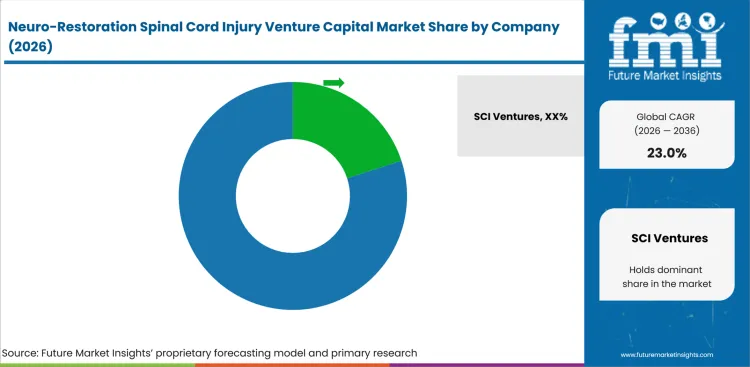
The preview discusses SCI Ventures, Christopher & Dana Reeve Foundation, Wings for Life, Spinal Research, and ONWARD Medical among the companies active in this market.
Market concentration is moderate because few investors understand SCI science and venture timing at the same depth. SCI Ventures holds a distinct position as a dedicated venture philanthropy vehicle for restoration-focused spinal injury assets. Smaller companies compete through focused endpoints, strong advisory boards, and credible first-patient evidence.
Entry barriers are high as trials require specialist sites, durable endpoints, and patient recruitment discipline. Competitive advantage in this market comes from evidence sequencing. SCI Ventures entered the market as a dedicated fund rather than a general neuroscience investor, which gives it stronger screening power for restoration assets.
How is competition structured?
Competition reflects differences in specialization, portfolio scope, geographic reach, evidence, and customer access.
The competitive structure is role-based because investors, foundations, and technology developers shape capital formation together.
- Venture Philanthropy and Mission Funds: SCI Ventures, Christopher & Dana Reeve Foundation, Wings for Life, and Spinal Research create early funding routes for SCI restoration. Their strengths include patient-network access, expert review, and bridge capital before institutional rounds.
- Neuro-Restoration Developers: ONWARD Medical, Neuralink, NervGen Pharma, Lineage Cell Therapeutics, and Axonis Therapeutics represent investable SCI-relevant platforms. ONWARD Medical has device authorization and early clinic sales. Neuralink brings large-scale BCI funding and paralysis trials.
- Clinical Translation Platforms: Research hospitals and rehabilitation centers influence valuation even when they are not venture-backed companies. They provide patient access, endpoint testing, and clinical credibility.
How do selected companies compare?
The selected companies differ in portfolio focus, geographic reach, evidence depth, and channel strength.
| Company | Competitive position |
|---|---|
| SCI Ventures | SCI Ventures is especially relevant as it connects foundation capital with venture-style portfolio discipline. |
| Christopher & Dana Reeve Foundation | Christopher & Dana Reeve Foundation supports SCI research grants, patient-network access, and translational evidence building that can reduce early diligence risk for restoration-focused assets. |
| Wings for Life | Wings for Life funds spinal cord research and early translational science, helping projects build evidence before institutional investors or strategic partners assess commercial potential. |
| Spinal Research | Spinal Research supports SCI research and field-building activity that can prepare UK-linked restoration concepts for later commercial financing or partnership discussions. |
| ONWARD Medical | ONWARD Medical has device authorization and early clinic sales. |
What are the key developments in the Neuro-Restoration Spinal Cord Injury Venture Capital Market?
- In March 2024, Reeve Foundation announced USD 3.1 million in SCI research grants. The grants support clinical trials and research tools for therapeutic development.
- In March 2024, NervGen Pharma announced a USD 20 million bought deal offering. The proceeds supported working capital and future growth initiatives for its clinical-stage program.
- In April 2024, ONWARD Medical submitted a De Novo application to FDA for ARC-EX. The filing moved its restoration device toward US market authorization.
Selected Companies in the Neuro-Restoration Spinal Cord Injury Venture Capital Market
Companies referenced in this preview
- SCI Ventures.
- Christopher & Dana Reeve Foundation.
- Wings for Life.
- Spinal Research.
- ONWARD Medical.
- Neuralink.
- NervGen Pharma.
- Lineage Cell Therapeutics.
- Axonis Therapeutics.
- NeuroRestore.
Market Scope & Definition
| Market definition | Values |
|---|---|
| Functions covered | Specialist Venture Funds, Strategic Investors, Foundations |
| Applications covered | Portfolio Companies, Research Hospitals, Biotech Startups |
| End-use industries | Portfolio Companies, Research Hospitals, Biotech Startups |
| Inclusions | Market scope covers Early-Stage Funding, Series A/B, Growth Capital, Specialist Venture Funds, Strategic Investors, Foundations, SCI Therapies, Neurotechnology, Functional Recovery, Portfolio Companies, Research Hospitals, Biotech Startups, and the selected global country coverage from 2026 to 2036. |
| Exclusions | Market exclusions cover general disability services, broad neuroscience grants without SCI restoration focus, chronic pain devices without functional recovery intent, hospital rehabilitation revenue, and non-venture donations with no translational investment pathway. |
Research Methodology
| Primary Research | FMI analysts reviewed venture investors, SCI foundations, translational neuroscience founders, rehabilitation clinicians, and clinical trial sponsors. Interviews focused on capital triggers, trial cost pressure, endpoint choice, and investor rejection reasons. |
|---|---|
| Desk Research | FMI reviewed FDA device files, clinical trial records, foundation releases, company filings, and nonprofit research funding updates. The analysis used official sources to separate direct SCI restoration evidence from broader neurotechnology proxy signals. |
| Market Sizing and Forecasting | FMI combined disclosed SCI venture activity, foundation fund commitments, company financing rounds, and milestone-linked capital needs. Country weightings were adjusted for trial infrastructure, investor depth, regulatory clarity, and local translational research signals. |
| Data Validation | Forecasts were checked against nonprofit financing activity, device authorization events, BCI funding rounds, and clinical-stage SCI company disclosures. Final values were cross-checked against the locked USD 45.0 million 2026 anchor and the 23.0% CAGR. |
What does the report cover?
The report covers funding stage, investor type, focus area, end user, and region across the 2026-2036 forecast period in 30+ countries.
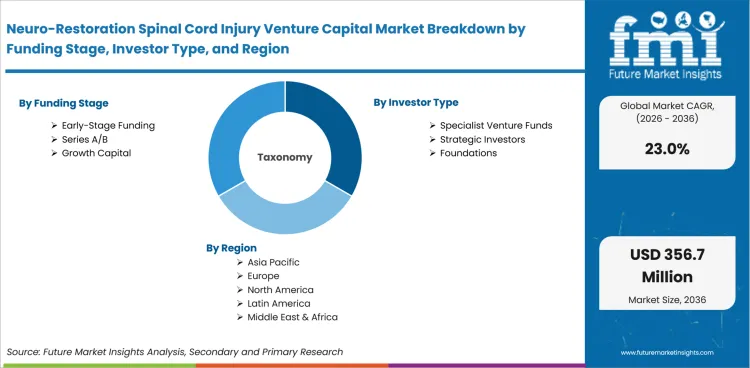
| Periods | Base year 2025; estimated year 2026; forecast period 2026-2036 |
|---|---|
| Quantitative units | USD 45.0 million in 2026 to USD 356.7 million by 2036, at a CAGR of 23.0% |
| Segment axes | funding stage, investor type, focus area, end user, and region |
| Regions | North America, Europe, East Asia, Middle East, and Rest of World |
| Countries | United States, United Kingdom, Germany, France, Japan, China, South Korea, India and 30+ |
| Companies | SCI Ventures, Christopher & Dana Reeve Foundation, Wings for Life, Spinal Research, ONWARD Medical, Neuralink, NervGen Pharma, Lineage Cell Therapeutics, Axonis Therapeutics |
| Approach | Hybrid bottom-up and selected-down methodology using disclosed financing, trial evidence, regulatory milestones, and country-specific translation signals. |
Market Segmentation Analysis
Segmented by Funding Stage
- Early-Stage Funding.
- Series A/B.
- Growth Capital.
Segmented by Investor Type
- Specialist Venture Funds.
- Strategic Investors.
- Foundations.
Segmented by Focus Area
- SCI Therapies.
- Neurotechnology.
- Functional Recovery.
Segmented by End User
- Portfolio Companies.
- Research Hospitals.
- Biotech Startups.
By Region
- North America.
- United States.
- Canada.
- Europe.
- Germany.
- United Kingdom.
- France.
- East Asia.
- Japan.
- South Korea.
- Middle East.
- UAE.
- Saudi Arabia.
- Rest of World.
Research Sources and Bibliography
- 1. National Institute of Neurological Disorders and Stroke. (2026, March 13). Spinal cord injury. National Institutes of Health.
- 2. NIH BRAIN Initiative. (2025, March 25). Understanding the BRAIN Initiative budget. National Institutes of Health.
- 3. USA Food and Drug Administration. (2024, December 19). De Novo classification request for ARCEX System. USAFood and Drug Administration.
- 4. Christopher & Dana Reeve Foundation. (2024, June 10). SCI Ventures launches venture philanthropy fund to accelerate restorative treatments for spinal cord injury. Christopher & Dana Reeve Foundation.
- 5. Christopher & Dana Reeve Foundation. (2024, March 6). Reeve Foundation announces USD 3.1M spinal cord injury research grants. Christopher & Dana Reeve Foundation.
- 6. Wings for Life. (2026). Our 2025 year in review. Wings for Life.
- 7. Neuralink. (2025, June 2). Neuralink raises USD 650M Series E. Neuralink.
- 8. ONWARD Medical. (2024, December 19). ONWARD Medical receives FDA De Novo classification and US market authorization. ONWARD Medical.
- 9. ONWARD Medical. (2026, March 31). ONWARD Medical reports full year 2025 financial and operating results. ONWARD Medical.
- 10. NervGen Pharma. (2024, March 21). NervGen announces USD 20 million bought deal offering. NervGen Pharma.
- 11. Lineage Cell Therapeutics. (2024, February 13). Lineage announces FDA clearance of IND amendment for OPC1 cell transplant. Lineage Cell Therapeutics.
- 12. French National Research Agency. (2024). Motor neuron synergies as a new biomarker of neurological impairments. ANR.
- 13. Indian Council of Medical Research. (2024). Evidence based status of SCT for spinal cord injury. ICMR.
- 14. Korea Disease Control and Prevention Agency. (2026). Traumatic spinal cord injury health information. KDCA.
- 15. ClinicalTrials.gov. (2026). Epidural and dorsal root stimulation in spinal cord injury. USA National Library of Medicine.
The bibliography is provided for reader reference and uses primary government, regulator, academic, foundation, company, or official clinical registry sources.
This Report Answers
- What is the projected value of the Neuro-Restoration Spinal Cord Injury Venture Capital Market in 2026?
- What value is forecast for the Neuro-Restoration Spinal Cord Injury Venture Capital Market by 2036?
- What CAGR is forecast for the Neuro-Restoration Spinal Cord Injury Venture Capital Market from 2026 to 2036?
- What 2026 share is projected for Early-Stage Funding within the funding stage category?
- What 2026 share is projected for Specialist Venture Funds within the investor type category?
- Which demand factors support the Neuro-Restoration Spinal Cord Injury Venture Capital Market outlook?
- Which restraints and opportunities affect adoption in the Neuro-Restoration Spinal Cord Injury Venture Capital Market?
- How are country CAGR outlooks, including China at 25.1%, compared?
- Which companies and product developments are covered in the competitive analysis?
- What is included in the market scope, and how is the forecast validated?
Frequently Asked Questions
Why should executives track the Neuro-Restoration Spinal Cord Injury Venture Capital Market?
Executives should track this market because it can affect capital allocation, supplier strategy, operating risk, and competitive positioning across end-use settings.
What business problem does the Neuro-Restoration Spinal Cord Injury Venture Capital Market address?
It helps executive teams judge where customer pain, supplier capability, compliance exposure, and implementation economics justify investment, procurement, or market-entry decisions.
What should procurement leaders evaluate before selecting suppliers?
Procurement leaders should assess evidence quality, integration fit, service coverage, compliance readiness, total cost of ownership, and supplier execution capability.
What can limit return on investment for buyers?
Return on investment can be limited by low utilization, integration delays, training gaps, unclear ownership, pricing pressure, or weak fit with existing workflows.
How can suppliers build executive confidence?
Suppliers can build confidence by proving implementation speed, risk reduction, support depth, reference use cases, and measurable outcomes for budget owners.
Preview the report firsthand - request a free sample
Get SampleGet the brochure for pricing and purchase details.
Get PDFTable of Content
- Key Takeaways
- Market Size and CAGR
- Top Growth Driver
- Fastest Growing Segment
- Leading Region
- Key Companies
- Emerging Opportunities
- Executive Summary
- Global Market Outlook
- Demand-side Trends
- Supply-side Trends
- Technology Roadmap Analysis
- Analysis and Recommendations
- Analyst Perspective (What is happening? Why now? What should investors know?)
- Key Questions Answered
- How large is the market?
- What is the CAGR?
- What are key trends?
- Which region dominates?
- Who are the leaders?
- Market Overview
- Market Coverage / Taxonomy
- Market Definition / Scope / Limitations
- Research Methodology
- Chapter Orientation
- Analytical Lens and Working Hypotheses
- Market Structure, Signals, and Trend Drivers
- Benchmarking and Cross-market Comparability
- Market Sizing, Forecasting, and Opportunity Mapping
- Research Design and Evidence Framework
- Desk Research Programme (Secondary Evidence)
- Expert Input and Fieldwork (Primary Evidence)
- Tooling, Models, and Reference Databases
- Data Engineering and Model Build
- Quality Assurance and Audit Trail
- Market Background
- Market Dynamics (Drivers, Restraints, Opportunity, Trends)
- Scenario Forecast (Optimistic, Likely, Conservative)
- Impact Analysis
- AI Impact
- Sustainability Impact
- Regulatory Impact
- Technology Impact
- Consumer / Buyer Analysis
- Purchase Drivers
- Adoption Barriers
- Buyer Journey
- Opportunity Map Analysis
- Product Life Cycle Analysis
- Supply Chain Analysis
- Investment Feasibility Matrix
- Value Chain Analysis
- PESTLE and Porter's Analysis
- Regulatory Landscape
- Regional Parent Market Outlook
- Production and Consumption Statistics
- Import and Export Statistics
- Global Market Analysis and Forecast, 2021 to 2036
- Historical Market Size Value (USD Million) Analysis, 2021 to 2025
- Current and Future Market Size Value (USD Million) Projections, 2026 to 2036
- Y-o-Y Growth Trend Analysis
- Absolute $ Opportunity Analysis
- Global Market Pricing Analysis, 2021 to 2036
- Global Market Analysis and Forecast, By Funding Stage, 2021 to 2036
- Introduction / Key Findings
- Historical Market Size Value (USD Million) Analysis By Funding Stage, 2021 to 2025
- Current and Future Market Size Value (USD Million) Analysis and Forecast By Funding Stage, 2026 to 2036
- Early-Stage Funding
- Series A/B
- Growth Capital
- Early-Stage Funding
- Y-o-Y Growth Trend Analysis By Funding Stage, 2021 to 2025
- Absolute $ Opportunity Analysis By Funding Stage, 2026 to 2036
- Global Market Analysis and Forecast, By Investor Type, 2021 to 2036
- Introduction / Key Findings
- Historical Market Size Value (USD Million) Analysis By Investor Type, 2021 to 2025
- Current and Future Market Size Value (USD Million) Analysis and Forecast By Investor Type, 2026 to 2036
- Specialist Venture Funds
- Strategic Investors
- Foundations
- Specialist Venture Funds
- Y-o-Y Growth Trend Analysis By Investor Type, 2021 to 2025
- Absolute $ Opportunity Analysis By Investor Type, 2026 to 2036
- Global Market Analysis and Forecast, By Focus Area, 2021 to 2036
- Introduction / Key Findings
- Historical Market Size Value (USD Million) Analysis By Focus Area, 2021 to 2025
- Current and Future Market Size Value (USD Million) Analysis and Forecast By Focus Area, 2026 to 2036
- Neurotechnology
- SCI Therapies
- Functional Recovery
- Neurotechnology
- Y-o-Y Growth Trend Analysis By Focus Area, 2021 to 2025
- Absolute $ Opportunity Analysis By Focus Area, 2026 to 2036
- Global Market Analysis and Forecast, By End User, 2021 to 2036
- Introduction / Key Findings
- Historical Market Size Value (USD Million) Analysis By End User, 2021 to 2025
- Current and Future Market Size Value (USD Million) Analysis and Forecast By End User, 2026 to 2036
- Biotech Startups
- Research Hospitals
- Portfolio Companies
- Biotech Startups
- Y-o-Y Growth Trend Analysis By End User, 2021 to 2025
- Absolute $ Opportunity Analysis By End User, 2026 to 2036
- Global Market Analysis and Forecast, By Region, 2021 to 2036
- Introduction
- Historical Market Size Value (USD Million) Analysis By Region, 2021 to 2025
- Current Market Size Value (USD Million) Analysis and Forecast By Region, 2026 to 2036
- North America
- Latin America
- Western Europe
- Eastern Europe
- East Asia
- South Asia and Pacific
- Middle East & Africa
- Market Attractiveness Analysis By Region
- North America Market Analysis and Forecast, By Country, 2021 to 2036
- Historical Market Size Value (USD Million) Trend Analysis By Market Taxonomy, 2021 to 2025
- Market Size Value (USD Million) Forecast By Market Taxonomy, 2026 to 2036
- By Country
- USA
- Canada
- Mexico
- By Funding Stage
- By Investor Type
- By Focus Area
- By End User
- By Country
- Market Attractiveness Analysis
- By Country
- By Funding Stage
- By Investor Type
- By Focus Area
- By End User
- Key Takeaways
- Latin America Market Analysis and Forecast, By Country
- Historical Market Size Value (USD Million) Trend Analysis By Market Taxonomy, 2021 to 2025
- Market Size Value (USD Million) Forecast By Market Taxonomy, 2026 to 2036
- By Country
- Brazil
- Chile
- Rest of Latin America
- By Funding Stage
- By Investor Type
- By Focus Area
- By End User
- By Country
- Market Attractiveness Analysis
- By Country
- By Funding Stage
- By Investor Type
- By Focus Area
- By End User
- Key Takeaways
- Western Europe Market Analysis and Forecast, By Country
- Historical Market Size Value (USD Million) Trend Analysis By Market Taxonomy, 2021 to 2025
- Market Size Value (USD Million) Forecast By Market Taxonomy, 2026 to 2036
- By Country
- Germany
- UK
- Italy
- Spain
- France
- Nordic
- BENELUX
- Rest of Western Europe
- By Funding Stage
- By Investor Type
- By Focus Area
- By End User
- By Country
- Market Attractiveness Analysis
- By Country
- By Funding Stage
- By Investor Type
- By Focus Area
- By End User
- Key Takeaways
- Eastern Europe Market Analysis and Forecast, By Country
- Historical Market Size Value (USD Million) Trend Analysis By Market Taxonomy, 2021 to 2025
- Market Size Value (USD Million) Forecast By Market Taxonomy, 2026 to 2036
- By Country
- Russia
- Poland
- Hungary
- Balkan & Baltic
- Rest of Eastern Europe
- By Funding Stage
- By Investor Type
- By Focus Area
- By End User
- By Country
- Market Attractiveness Analysis
- By Country
- By Funding Stage
- By Investor Type
- By Focus Area
- By End User
- Key Takeaways
- East Asia Market Analysis and Forecast, By Country
- Historical Market Size Value (USD Million) Trend Analysis By Market Taxonomy, 2021 to 2025
- Market Size Value (USD Million) Forecast By Market Taxonomy, 2026 to 2036
- By Country
- China
- Japan
- South Korea
- By Funding Stage
- By Investor Type
- By Focus Area
- By End User
- By Country
- Market Attractiveness Analysis
- By Country
- By Funding Stage
- By Investor Type
- By Focus Area
- By End User
- Key Takeaways
- South Asia and Pacific Market Analysis and Forecast, By Country
- Historical Market Size Value (USD Million) Trend Analysis By Market Taxonomy, 2021 to 2025
- Market Size Value (USD Million) Forecast By Market Taxonomy, 2026 to 2036
- By Country
- India
- ASEAN
- Australia & New Zealand
- Rest of South Asia and Pacific
- By Funding Stage
- By Investor Type
- By Focus Area
- By End User
- By Country
- Market Attractiveness Analysis
- By Country
- By Funding Stage
- By Investor Type
- By Focus Area
- By End User
- Key Takeaways
- Middle East & Africa Market Analysis and Forecast, By Country
- Historical Market Size Value (USD Million) Trend Analysis By Market Taxonomy, 2021 to 2025
- Market Size Value (USD Million) Forecast By Market Taxonomy, 2026 to 2036
- By Country
- Kingdom of Saudi Arabia
- Other GCC Countries
- Türkiye
- South Africa
- Other African Union
- Rest of Middle East & Africa
- By Funding Stage
- By Investor Type
- By Focus Area
- By End User
- By Country
- Market Attractiveness Analysis
- By Country
- By Funding Stage
- By Investor Type
- By Focus Area
- By End User
- Key Takeaways
- Key Countries Market Analysis
- USA
- Pricing Analysis
- Market Share Analysis, 2025
- By Funding Stage
- By Investor Type
- By Focus Area
- By End User
- Canada
- Pricing Analysis
- Market Share Analysis, 2025
- By Funding Stage
- By Investor Type
- By Focus Area
- By End User
- Mexico
- Pricing Analysis
- Market Share Analysis, 2025
- By Funding Stage
- By Investor Type
- By Focus Area
- By End User
- Brazil
- Pricing Analysis
- Market Share Analysis, 2025
- By Funding Stage
- By Investor Type
- By Focus Area
- By End User
- Chile
- Pricing Analysis
- Market Share Analysis, 2025
- By Funding Stage
- By Investor Type
- By Focus Area
- By End User
- Germany
- Pricing Analysis
- Market Share Analysis, 2025
- By Funding Stage
- By Investor Type
- By Focus Area
- By End User
- UK
- Pricing Analysis
- Market Share Analysis, 2025
- By Funding Stage
- By Investor Type
- By Focus Area
- By End User
- Italy
- Pricing Analysis
- Market Share Analysis, 2025
- By Funding Stage
- By Investor Type
- By Focus Area
- By End User
- Spain
- Pricing Analysis
- Market Share Analysis, 2025
- By Funding Stage
- By Investor Type
- By Focus Area
- By End User
- France
- Pricing Analysis
- Market Share Analysis, 2025
- By Funding Stage
- By Investor Type
- By Focus Area
- By End User
- India
- Pricing Analysis
- Market Share Analysis, 2025
- By Funding Stage
- By Investor Type
- By Focus Area
- By End User
- ASEAN
- Pricing Analysis
- Market Share Analysis, 2025
- By Funding Stage
- By Investor Type
- By Focus Area
- By End User
- Australia & New Zealand
- Pricing Analysis
- Market Share Analysis, 2025
- By Funding Stage
- By Investor Type
- By Focus Area
- By End User
- China
- Pricing Analysis
- Market Share Analysis, 2025
- By Funding Stage
- By Investor Type
- By Focus Area
- By End User
- Japan
- Pricing Analysis
- Market Share Analysis, 2025
- By Funding Stage
- By Investor Type
- By Focus Area
- By End User
- South Korea
- Pricing Analysis
- Market Share Analysis, 2025
- By Funding Stage
- By Investor Type
- By Focus Area
- By End User
- Russia
- Pricing Analysis
- Market Share Analysis, 2025
- By Funding Stage
- By Investor Type
- By Focus Area
- By End User
- Poland
- Pricing Analysis
- Market Share Analysis, 2025
- By Funding Stage
- By Investor Type
- By Focus Area
- By End User
- Hungary
- Pricing Analysis
- Market Share Analysis, 2025
- By Funding Stage
- By Investor Type
- By Focus Area
- By End User
- Kingdom of Saudi Arabia
- Pricing Analysis
- Market Share Analysis, 2025
- By Funding Stage
- By Investor Type
- By Focus Area
- By End User
- Türkiye
- Pricing Analysis
- Market Share Analysis, 2025
- By Funding Stage
- By Investor Type
- By Focus Area
- By End User
- South Africa
- Pricing Analysis
- Market Share Analysis, 2025
- By Funding Stage
- By Investor Type
- By Focus Area
- By End User
- USA
- Market Structure Analysis
- Competition Dashboard
- Competition Benchmarking
- Market Share Analysis of Top Players
- By Regional
- By Funding Stage
- By Investor Type
- By Focus Area
- By End User
- Emerging Startups
- Innovation Benchmarking
- Competition Analysis
- Competition Deep Dive
- SCI Ventures
- Overview
- Product Portfolio
- Profitability by Market Segments (Product/Region/Sales Channel)
- Sales Footprint
- Strategy Overview
- Marketing Strategy
- Product Strategy
- Channel Strategy
- Christopher & Dana Reeve Foundation.
- Wings for Life.
- Spinal Research.
- ONWARD Medical.
- Neuralink.
- SCI Ventures
- Case Studies
- Success Stories
- Recent Developments
- Competition Deep Dive
- Assumptions & Acronyms Used


