

- Market Size (2026)
- USD 55.0 Mn
- Forecast (2036)
- USD 435.9 Mn
- CAGR (2026 to 2036)
- 23%
How big is the Neuro-Restoration Venture Funding Market?
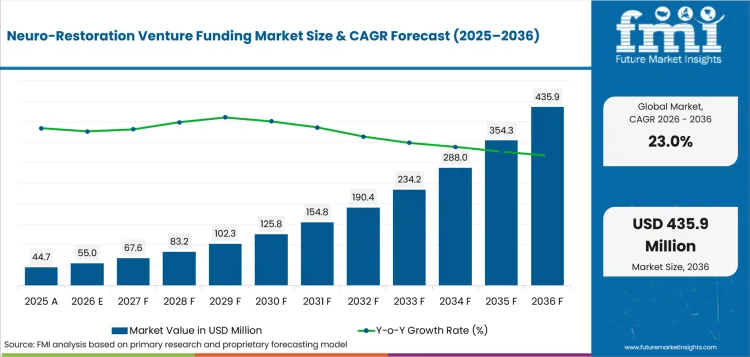
The Neuro-Restoration Venture Funding Market is projected to grow from USD 55.0 million in 2026 to USD 435.9 million by 2036, at a CAGR of 23%.
The Neuro-Restoration Venture Funding Market was valued at USD 44.7 million in 2025.
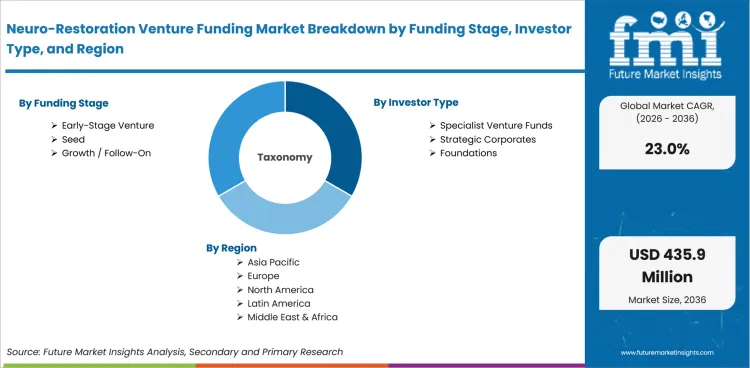
It is expected to grow from USD 55.0 million in 2026 to USD 435.9 million by 2036 at a 23.0% CAGR. Early-Stage Venture is projected to account for a 48.0% share in 2026. Specialist Venture Funds are expected to represent a 52.0% share in 2026.
| Metric | Value |
|---|---|
| Market Name | Neuro-Restoration Venture Funding Market |
| 2025 Market Size | USD 44.7 Million |
| 2026 Market Size | USD 55.0 Million |
| 2036 Market Size | USD 435.9 Million |
| Forecast Period | 2026–2036 |
| CAGR (2026–2036) | 23.0% |
| Featured Funding Stage | Early-Stage Venture |
| Early-Stage Venture Share (2026) | 48.0% |
| Featured Investor Type | Specialist Venture Funds |
| Specialist Venture Funds Share (2026) | 52.0% |
| Country CAGR Highlight | China |
| China CAGR (by 2036) | 26.8% |
Summary of the Neuro-Restoration Venture Funding Market
| Market Signal | Commercial Impact |
|---|---|
| Demand and Growth Drivers | Venture funding is increasingly focused on measurable functional recovery in spinal cord injury.
|
| Product and Segment View | Early-stage venture funding and neurotechnology platforms continue to dominate investment activity.
|
| Geography and Competitive Outlook | The United States, China, and India are expected to remain key venture investment hubs.
|
| Analyst Perspective | Venture capital is shifting toward clinically validated neuro-restoration platforms with clear commercialization pathways.
— Anurag Sharma, Principal Consultant, Healthcare Domain, Future Market Insights |
SCI Ventures launched in June 2024 as a venture philanthropy fund focused on seed and Series A rounds for paralysis-focused companies.
That structure matters for CEOs since it narrows the gap between lab validation and commercial capital.
Why is the Neuro-Restoration Venture Funding Market growing?
Spinal cord injury investors are funding function-restoration endpoints that can be measured in trials and patient workflow. BCI companies are attracting larger checks as device platforms move from proof-of-concept toward regulated human studies.
- Spinal cord injury investors are funding function-restoration endpoints that can be measured in trials and patient workflow.
- BCI companies are attracting larger checks as device platforms move from proof-of-concept toward regulated human studies.
- Foundation-backed venture models reduce early risk by pairing patient mission knowledge with venture discipline.
Clinical translation is the main reason this funding pool is expanding beyond small research grants. The United States Department of Defense Spinal Cord Injury Research Program had invested over USD 200 million in SCI research and development by May 2026. That public funding does not equal venture revenue, but it creates a pipeline of validated questions and investigator networks. Investors use those networks to judge whether a company can reach meaningful endpoints without building every study capability from scratch. The practical result is a stronger seed-to-Series A route for companies with credible trial access. Regulatory clarity is creating a second funding trigger for neuro-restoration technologies.
How is the Neuro-Restoration Venture Funding Market segmented?
The Neuro-Restoration Venture Funding Market is segmented by funding stage, investor type, focus area, end user, and region.
- Early-Stage Venture is projected to account for a 48.0% share in 2026 as paralysis-focused platforms need trial readiness before scale capital.
- With an estimated 52.0% share in 2026, specialist venture funds are expected to remain a leading investor type because deeper scientific diligence is needed before capital release.
- Neurotechnology platforms are anticipated to hold 46.0% of focus-area funding in 2026 with BCI and stimulation endpoints supporting investor review.
How does Early-Stage Venture contribute to the funding stage category?
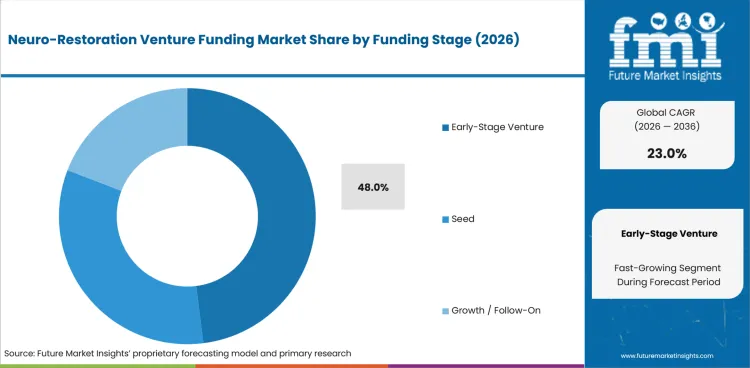
- Early-Stage Venture is projected to account for a 48.0% share in 2026 as investors prefer assets with preclinical validation and a near clinical plan.
- Seed rounds remain vital for academic spinouts, but Series A investors compare patient-selection plans and regulatory evidence before pricing larger checks.
What supports demand for Specialist Venture Funds?
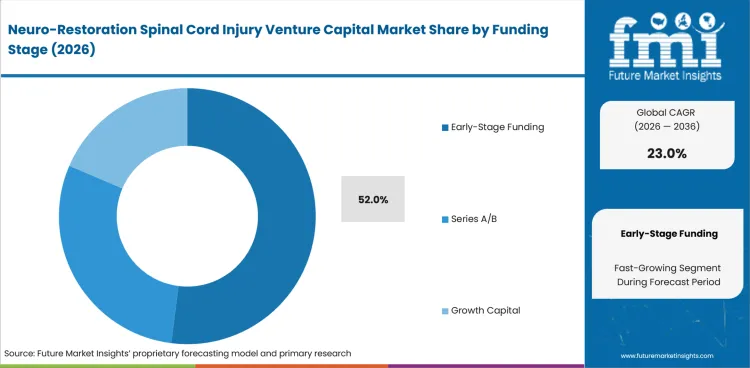
- Specialist Venture Funds are expected to represent a 52.0% share in 2026 as generalist funds need expert review for neurobiology and device safety.
- Foundations influence early valuation by funding scientific gaps first, which reduces diligence burden for investors entering later rounds.
How do buyers evaluate Neurotechnology within the focus area category?
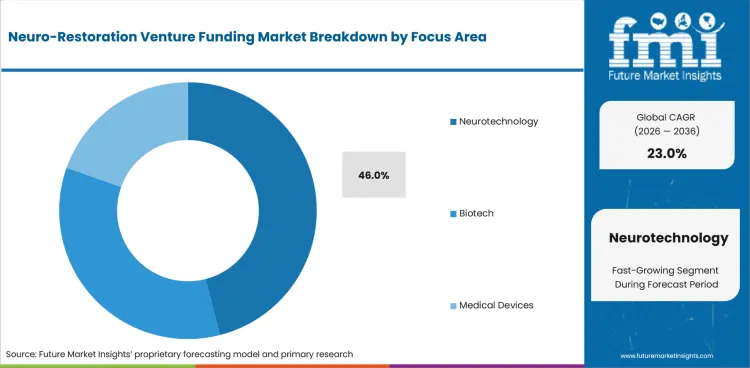
- Neurotechnology is anticipated to hold a 46.0% share in 2026 as BCI and spinal stimulation systems offer measurable functional outcomes.
- Device programs attract milestone capital when they can connect signal decoding, stimulation output, and rehabilitation use in one pathway.
What market factors influence demand for Portfolio Companies?
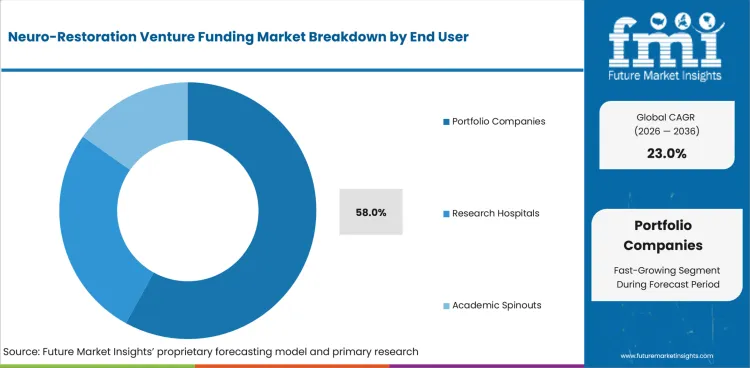
- Portfolio Companies are projected to account for a 58.0% share in 2026 as investors favor entities with management teams and IP control.
- Research hospitals remain important deal sources, but investors usually require a spinout structure before committing venture-scale capital.
How does North America affect the regional outlook?
- North America is expected to account for a 44.0% share in 2026 as United States trial sites and federal programs anchor investor confidence.
- European and Asian deal flow is expanding, but market-entry plans often benchmark against United States regulatory and reimbursement evidence.
What drives and restrains the market?
Driver: BCI trial entry drives investor confidence as implantable and minimally invasive platforms move into patient studies; restraint: Regulatory complexity restrains funding since neuro-restoration assets often combine device, software, surgery, and rehabilitation evidence; opportunity: china creates an opportunity as regulated BCI activity gives investors a faster commercialization reference point.
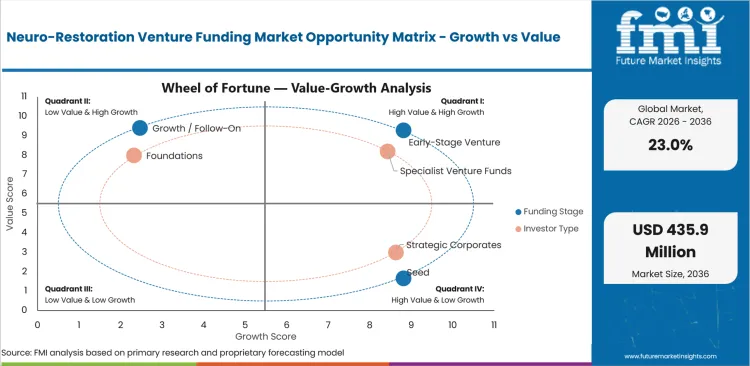
The market reflects a balance between the identified demand driver, adoption constraints, and the supplier opportunity outlined below.
- Driver: BCI trial entry drives investor confidence as implantable and minimally invasive platforms move into patient studies.
- Restraint: Regulatory complexity restrains funding since neuro-restoration assets often combine device, software, surgery, and rehabilitation evidence.
- Opportunity: china creates an opportunity as regulated BCI activity gives investors a faster commercialization reference point.
BCI Trial Entry Capital: BCI trial entry is pulling venture funding into neuro-restoration faster than older grant-only pathways. Neuralink announced a USD 650 million Series E round in June 2025 to expand patient access and advance brain-interface programs. This scale of capital changes investor expectations across the category. It signals that high-risk BCI assets can attract large investors when clinical access and technical progress become visible. Smaller neuro-restoration firms benefit indirectly since investors gain confidence in the size of the addressable problem.
Foundation Venture De-Risking: Foundation-backed capital is important in this market since patient missions and scientific review sit close together. The Christopher & Dana Reeve Foundation and Spinal Research announced USD 1.5 million in January 2026 grants for four preclinical traumatic spinal cord injury studies. This type of capital does not replace venture financing, but it prepares programs for investable translation. It helps founders answer biological and endpoint questions before valuation discussions begin. Investors gain better evidence and patients gain a faster path from discovery toward clinical use. Regulatory Evidence Bottleneck: Regulatory evidence remains the most important bottleneck for capital conversion.
Which factors support expansion?
Commercial expansion is reinforced by the value, workflow, and recurring-demand factors below.
- Market value is rising as seed and Series A capital moves toward neuro-restoration platforms with defined clinical endpoints.
- Larger follow-on rounds are expected as BCI and spinal stimulation firms convert feasibility data into regulated trial programs.
- Foundations continue to support early translational work since many assets are too narrow for broad healthcare funds at inception.
Which country markets are included in the CAGR comparison?
The selected CAGR comparison covers China (26.8%), India (25.0%), South Korea (24.1%), United States (22.6%), and Germany (22.1%) through 2036.
.webp "Top Country Growth Comparison Neuro Restoration Venture Funding Market Cagr (2026 2036)")
| Country | CAGR |
|---|---|
| China | 26.8% |
| India | 25.0% |
| South Korea | 24.1% |
| United States | 22.6% |
| Germany | 22.1% |
Source: Future Market Insights analysis based on the supplied country forecast table.
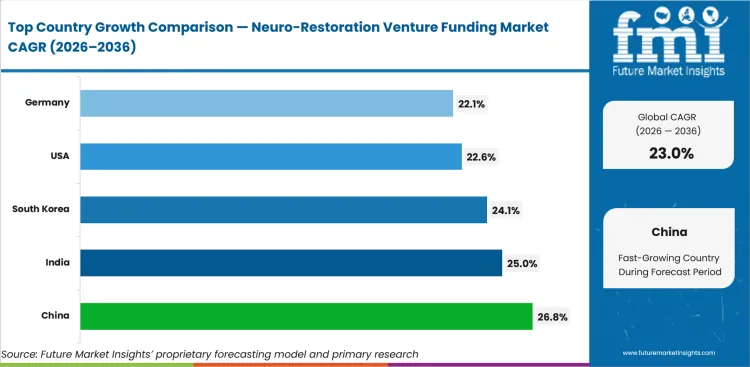
How do country-level CAGRs compare?
- China (CAGR: 26.8%): China is moving quickly in BCI commercialization for paralysis and hand function restoration.
- India (CAGR: 25.0%): India’s opportunity is early and tied to public grants, academic transfer, and assistive technology needs.
- South Korea (CAGR: 24.1%): South Korea is shaped by public R&D intensity and digital health hardware capacity.
- United States (CAGR: 22.6%): United States deal flow is shaped by BCI trials, SCI research programs, and specialist medical device investors.
- Germany (CAGR: 22.1%): Germany links neurotechnology engineering depth with European medtech investor interest.
The global Neuro-Restoration Venture Funding Market is forecast to record a CAGR of 23% from 2026 to 2036. The supplied study covers 8 named country forecasts across the report regions.
How is the Neuro-Restoration Venture Funding Market developing in China?
China is projected to record a CAGR of 26.8% through 2036. The country outlook identifies this demand signal: China is moving quickly in BCI commercialization for paralysis and hand function restoration.
Country Market Snapshot
| Country | China |
|---|---|
| Forecast CAGR | 26.8% |
| Demand anchor | China is moving quickly in BCI commercialization for paralysis and hand function restoration. |
| Regulatory signal | China approved a BCI device for commercial use in March 2026. |
| Company signal | Neuracle Medical Technology developed NEO for quadriplegia from cervical spinal cord injury. |
| Policy context | BCI has been positioned as a future industry in China’s technology plans. |
| Restraint | International investors may need stronger transparency on trial data and long-term safety. |
| Channel behavior | Hospital-led commercialization and policy-backed device review shape investor entry. |
| Primary demand signal | China is moving quickly in BCI commercialization for paralysis and hand function restoration. |
Market Outlook
China has become the comparatively rapid selected market because regulated BCI activity is closer to public-use pathways. China’s public neurotechnology activity gives investors a reference point for paralysis-related BCI commercialization. The signal is used here as market-formation context for funding demand, rather than as direct venture-flow evidence. China is projected to record a CAGR of 26.8% through 2036 as regulatory clearance and policy focus improve capital visibility.
Key Growth Drivers
- NEO approval gives China a public commercialization signal in invasive BCI.
- Policy focus on BCI improves investor confidence in local technology platforms.
- Hospital-based device pathways can speed early market exposure for approved systems.
- China is moving quickly in BCI commercialization for paralysis and hand function restoration.
Key Restraints
- Public evidence on long-term safety and durability needs deeper investor review.
- Cross-border investors face data access and regulatory transparency challenges.
- International investors may need stronger transparency on trial data and long-term safety.
Country Market FAQs
Why should executives monitor Neuro-Restoration Venture Funding Market demand in China?
Executives should monitor China because local buyer readiness, china is moving quickly in BCI commercialization for paralysis and hand function restoration, and service capacity can influence account timing and market-entry priorities.
What should suppliers localize for China?
Suppliers should localize proof points, pricing logic, partner coverage, and training support around buyer access and account ownership and hospital-led commercialization and policy-backed device review shape investor entry.
What adoption risk needs attention in China?
Executive teams should watch adoption risk because public evidence on long-term safety and durability needs deeper investor review can delay conversion from evaluation to commercial deployment.
How is the Neuro-Restoration Venture Funding Market developing in India?
India is projected to record a CAGR of 25.0% through 2036. The country outlook identifies this demand signal: India’s opportunity is early and tied to public grants, academic transfer, and assistive technology needs.
Country Market Snapshot
| Country | India |
|---|---|
| Forecast CAGR | 25.0% |
| Demand anchor | India’s opportunity is early and tied to public grants, academic transfer, and assistive technology needs. |
| Technology signal | MeitY documented Vivan-BCI as a government-funded non-invasive BCI assistive system in July 2025. |
| Funding route | BIRAC provides early-stage biotechnology grants of INR 50 lakhs through the BIG scheme. |
| Channel behavior | Academic labs and government-funded proof-of-concept programs shape early commercialization. |
| Restraint | Venture investors need stronger clinical validation and specialist device pathways. |
| Market role | India can generate low-cost assistive and non-invasive neurotechnology concepts. |
| Primary demand signal | India’s opportunity is early and tied to public grants, academic transfer, and assistive technology needs. |
Market Outlook
India’s market is smaller but important for cost-sensitive neuro-restoration innovation. A July 2025 MeitY technology-transfer document described Vivan-BCI as a government-funded non-invasive brain-machine interface assistive system for children with special needs. This does not prove a large venture market, but it shows a path from public research toward technology transfer. India is forecast to grow at a CAGR of 25.0% through 2036 as early proof-of-concept funding and assistive technology needs expand.
Key Growth Drivers
- Government-funded BCI projects support academic technology transfer.
- BIRAC grants can support biotech proof-of-concept formation.
- Cost-sensitive assistive care needs create scope for non-invasive and hybrid platforms.
- India’s opportunity is early and tied to public grants, academic transfer, and assistive technology needs.
Key Restraints
- Specialist neuro-restoration investors are limited compared with the United States.
- Clinical validation pathways for advanced BCI and regenerative products remain early.
- Venture investors need stronger clinical validation and specialist device pathways.
Country Market FAQs
Why should executives monitor Neuro-Restoration Venture Funding Market demand in India?
Executives should monitor India because local buyer readiness, india’s opportunity is early and tied to public grants, academic transfer, and assistive technology needs, and service capacity can influence account timing and market-entry priorities.
What should suppliers localize for India?
Suppliers should localize proof points, pricing logic, partner coverage, and training support around birac provides early-stage biotechnology grants of inr 50 lakhs through the big scheme and academic labs and government-funded proof-of-concept programs shape early commercialization.
What adoption risk needs attention in India?
Executive teams should watch adoption risk because specialist neuro-restoration investors are limited compared with the united states can delay conversion from evaluation to commercial deployment.
How is the Neuro-Restoration Venture Funding Market developing in South Korea?
South Korea is projected to record a CAGR of 24.1% through 2036. The country outlook identifies this demand signal: South Korea is shaped by public R&D intensity and digital health hardware capacity.
Country Market Snapshot
| Country | South Korea |
|---|---|
| Forecast CAGR | 24.1% |
| Demand anchor | South Korea is shaped by public R&D intensity and digital health hardware capacity. |
| Funding context | Government research spending plans for 2026 point to larger AI and advanced technology support. |
| Clinical channel | University hospitals remain the main route for early neurotechnology study access. |
| Investor behavior | Venture activity is selective and often follows government-backed technology priorities. |
| Restraint | Direct public evidence for paralysis-specific venture funding is limited. |
| Market role | South Korea can support enabling technologies for BCI and neurorehabilitation systems. |
| Primary demand signal | South Korea is shaped by public R&D intensity and digital health hardware capacity. |
Market Outlook
South Korea is an early-stage growth market for neuro-restoration funding rather than a mature specialist pool. Government R&D spending plans for 2026 include record research investment, which supports advanced technology areas that can feed neurotechnology translation. The direct paralysis venture funding record is thinner than in the United States or China. That means investors will look for enabling technologies and academic-hospital validation before backing stand-alone companies.
Key Growth Drivers
- High national R&D intensity supports enabling BCI and neurotechnology work.
- University hospitals can support early feasibility studies for advanced devices.
- Domestic electronics capability can support sensors and signal-processing components.
- South Korea is shaped by public R&D intensity and digital health hardware capacity.
Key Restraints
- Direct paralysis-focused venture evidence remains limited in public sources.
- Founders may need overseas partners for specialist clinical and regulatory validation.
- The practical constraint is the limited number of publicly visible neuro-restoration companies.
Country Market FAQs
Why should executives monitor Neuro-Restoration Venture Funding Market demand in South Korea?
Executives should monitor South Korea because local buyer readiness, south korea is shaped by public R&D intensity and digital health hardware capacity, and service capacity can influence account timing and market-entry priorities.
What should suppliers localize for South Korea?
Suppliers should localize proof points, pricing logic, partner coverage, and training support around buyer access and account ownership and university hospitals remain the main route for early neurotechnology study access.
What adoption risk needs attention in South Korea?
Executive teams should watch adoption risk because direct paralysis-focused venture evidence remains limited in public sources can delay conversion from evaluation to commercial deployment.
How is the Neuro-Restoration Venture Funding Market developing in the United States?
The United States is projected to record a CAGR of 22.6% through 2036. The country outlook identifies this demand signal: United States deal flow is shaped by BCI trials, SCI research programs, and specialist medical device investors.
Country Market Snapshot
| Country | United States |
|---|---|
| Forecast CAGR | 22.6% |
| Demand anchor | United States deal flow is shaped by BCI trials, SCI research programs, and specialist medical device investors. |
| Policy context | FDA BCI guidance gives founders a clearer route for nonclinical testing and clinical study planning. |
| Funding route | SCI Ventures and Reeve Foundation activity support disease-specific investment review for paralysis technologies. |
| Clinical signal | Neuralink and Paradromics show how severe paralysis use cases attract venture and regulatory attention. |
| Restraint | Reimbursement evidence is difficult since restorative claims must be proven across clinical and home-use settings. |
| Channel signal | University hospitals and rehabilitation centers influence whether early devices gain credible trial access. |
| Primary demand signal | United States deal flow is shaped by BCI trials, SCI research programs, and specialist medical device investors. |
Market Outlook
United States demand behaves like a specialist venture market rather than a broad healthcare funding category. Investors screen for clinical endpoint quality, patient recruitment access, and regulatory planning before they value platform breadth. The notable route runs through academic labs, clinical sites, and foundations that understand spinal cord injury. That route favors founders who can prove functional benefit rather than publish only biological promise.
Key Growth Drivers
- BCI human studies create visible proof points for investors assessing severe paralysis use cases.
- Federal SCI funding supports investigator networks that can feed academic spinouts.
- Foundation-backed venture activity reduces early biology and endpoint risk.
- United States deal flow is shaped by BCI trials, SCI research programs, and specialist medical device investors.
Key Restraints
- Payment evidence remains difficult for technologies that combine surgery, software, and rehabilitation.
- Specialist clinical sites limit the speed of multicenter trials in early neuro-restoration programs.
- Reimbursement evidence is difficult since restorative claims must be proven across clinical and home-use settings.
Country Market FAQs
Why should executives monitor Neuro-Restoration Venture Funding Market demand in the United States?
•Executives should monitor the United States because local buyer readiness, united states deal flow is shaped by BCI trials, sci research programs, and specialist medical device investors, and service capacity can influence account timing and market-entry priorities.
What should suppliers localize for the United States?
Suppliers should localize proof points, pricing logic, partner coverage, and training support around sci ventures and reeve foundation activity support disease-specific investment review for paralysis technologies and university hospitals and rehabilitation centers influence whether early devices gain credible trial access.
What adoption risk needs attention in the United States?
Executive teams should watch adoption risk because payment evidence remains difficult for technologies that combine surgery, software, and rehabilitation can delay conversion from evaluation to commercial deployment.
How is the Neuro-Restoration Venture Funding Market developing in Germany?
Germany is projected to record a CAGR of 22.1% through 2036. The country outlook identifies this demand signal: Germany links neurotechnology engineering depth with European medtech investor interest.
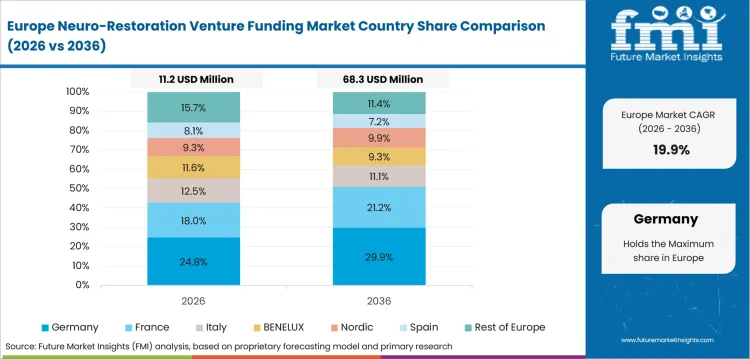
Country Market Snapshot
| Country | Germany |
|---|---|
| Forecast CAGR | 22.1% |
| Demand anchor | Germany links neurotechnology engineering depth with European medtech investor interest. |
| Company signal | CorTec develops fully implantable BCI systems and received FDA Breakthrough Device Designation in April 2026. |
| Strategic investor role | Ottobock participated as a cornerstone investor in ONWARD Medical’s 2025 capital increase. |
| Policy context | German neurotechnology debate emphasizes public funding and trusted translational infrastructure. |
| Restraint | Clinical commercialization often requires cross-border regulatory and reimbursement planning. |
| Channel behavior | Corporate medtech partnerships can matter more than stand-alone startup fundraising. |
| Primary demand signal | Germany links neurotechnology engineering depth with European medtech investor interest. |
Market Outlook
Germany’s demand pattern is shaped by engineering capability and strategic medtech participation. German BCI and neurotechnology companies provide adjacent evidence that regulated restoration platforms can move toward clinical validation. This supports investor interest in implantable closed-loop systems with motor recovery endpoints without treating one device milestone as direct funding-flow proof. It also supports investor interest in implantable closed-loop systems with motor recovery endpoints.
Key Growth Drivers
- German BCI engineering firms can attract global regulatory attention.
- Ottobock’s role in ONWARD Medical shows strategic interest from rehabilitation technology companies.
- European medtech investors value devices with clear motor recovery use cases.
- Germany links neurotechnology engineering depth with European medtech investor interest.
Key Restraints
- Reimbursement systems can slow uptake after regulatory milestones.
- Specialist neurosurgical and rehabilitation trial access limits early study speed.
- Clinical commercialization often requires cross-border regulatory and reimbursement planning.
Country Market FAQs
Why should executives monitor Neuro-Restoration Venture Funding Market demand in Germany?
Executives should monitor Germany because local buyer readiness, germany links neurotechnology engineering depth with european medtech investor interest, and service capacity can influence account timing and market-entry priorities.
What should suppliers localize for Germany?
Suppliers should localize proof points, pricing logic, partner coverage, and training support around buyer access and account ownership and corporate medtech partnerships can matter more than stand-alone startup fundraising.
What adoption risk needs attention in Germany?
Executive teams should watch adoption risk because reimbursement systems can slow uptake after regulatory milestones can delay conversion from evaluation to commercial deployment.
Which companies are discussed in the Neuro-Restoration Venture Funding Market?
The preview discusses SCI Ventures, Wings for Life, Christopher & Dana Reeve Foundation, Spinal Research, and Neuralink among the companies active in this market.
The market is concentrated around a few specialist funders and clinical-stage neurotechnology companies. Smaller companies compete by proving specific functional endpoints before seeking broad platform valuations. Foundations hold influence since they fund early biology and patient-specific evidence gaps.
Entry barriers are high due to trial access, safety evidence, and specialist investor diligence. Strategic corporates enter through cornerstone investments, licensing, and clinical platform partnerships. Competition in this market is not defined by product volume. It is defined by who can de-risk a restoration claim before the next financing event.
How is competition structured?
Competition reflects differences in specialization, portfolio scope, geographic reach, evidence, and customer access.
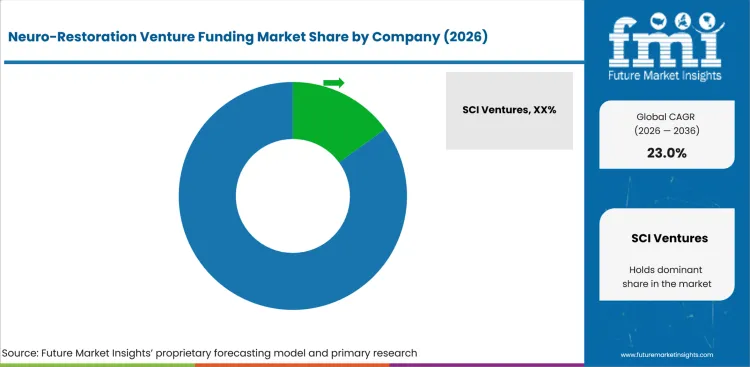
The competitive structure is role-based since funders and portfolio companies shape the market together.
- Specialist Funders: SCI Ventures, Wings for Life, Christopher & Dana Reeve Foundation, and Spinal Research support disease-specific capital formation. SCI Ventures supplies venture discipline for paralysis-focused companies. Foundations supply patient mission knowledge and scientific review.
- Clinical Platform Companies: Neuralink, ONWARD Medical, Paradromics, Precision Neuroscience, and Synchron define investor benchmarks through BCI and spinal stimulation programs. These firms compete on signal decoding, device safety, clinical access, and regulatory progress.
- Translational Biotech and Device Firms: Healx, NervGen Pharma, and CorTec show how neuro-restoration funding extends beyond implantable BCI. Healx applies AI-driven drug discovery to chronic spinal cord injury. NervGen works on regenerative therapeutics.
How do selected companies compare?
The selected companies differ in portfolio focus, geographic reach, evidence depth, and channel strength.
| Company | Competitive position |
|---|---|
| SCI Ventures | SCI Ventures supplies venture discipline for paralysis-focused companies. |
| Wings for Life | Specialist Funders: SCI Ventures, Wings for Life, Christopher & Dana Reeve Foundation, and Spinal Research support disease-specific capital formation. |
| Christopher & Dana Reeve Foundation | Specialist Funders: SCI Ventures, Wings for Life, Christopher & Dana Reeve Foundation, and Spinal Research support disease-specific capital formation. |
| Spinal Research | Specialist Funders: SCI Ventures, Wings for Life, Christopher & Dana Reeve Foundation, and Spinal Research support disease-specific capital formation. |
| Neuralink | Clinical Platform Companies: Neuralink, ONWARD Medical, Paradromics, Precision Neuroscience, and Synchron define investor benchmarks through BCI and spinal stimulation programs. |
What are the key developments in the Neuro-Restoration Venture Funding Market?
- In June 2024, SCI Ventures launched a venture philanthropy fund focused on seed and Series A financing for paralysis-focused companies. The launch created a specialist capital route for SCI technologies.
- In March 2024, ONWARD Medical raised EUR 20 million through a capital increase. The financing supported spinal cord stimulation therapies for movement and functional recovery.
- In April 2024, Neuralink reported its first human BCI implantation under the PRIME study. The milestone improved investor visibility around severe paralysis applications.
Selected Companies in the Neuro-Restoration Venture Funding Market
Companies referenced in this preview
- SCI Ventures.
- Wings for Life.
- Christopher & Dana Reeve Foundation.
- Spinal Research.
- Neuralink.
- ONWARD Medical.
- Paradromics.
- Precision Neuroscience.
- Synchron.
- Healx.
Market Scope & Definition
| Market definition | The Neuro-Restoration Venture Funding Market covers venture and venture-philanthropy capital directed toward companies and translational platforms working to restore function after spinal cord injury, paralysis, or severe motor impairment. |
|---|---|
| Functions covered | Specialist Venture Funds, Strategic Corporates, Foundations |
| Applications covered | Portfolio Companies, Research Hospitals, Academic Spinouts |
| End-use industries | Portfolio Companies, Research Hospitals, Academic Spinouts |
| Inclusions | Market scope includes seed funding, early-stage venture rounds, follow-on rounds, specialist venture funds, strategic corporates, foundations, neurotechnology platforms, biotech programs, medical device systems, portfolio companies, research hospitals, academic spinouts, and selected global geographies within the 2026 to 2036 revenue scope. |
| Exclusions | The market excludes general neuroscience venture funding, consumer brain wellness devices, chronic pain-only stimulation, generic rehabilitation services, hospital equipment purchasing, and grant-only academic work with no commercial translation route. |
Research Methodology
| Primary Research | FMI analysts reviewed inputs from venture fund managers, neurotechnology founders, translational research teams, spinal injury foundations, and rehabilitation center stakeholders. Interviews focused on deal qualification, clinical endpoint readiness, and barriers to follow-on financing. |
|---|---|
| Desk Research | Desk work reviewed official grant pages, foundation announcements, regulatory guidance, company funding statements, clinical technology updates, and public investor materials. The addressable pool was defined by restorative intent rather than broad neurology exposure. |
| Market Sizing and Forecasting | The model combined identifiable capital flow, funding-stage mix, country-level translation capacity, and investable pipeline depth. Forecasts were adjusted for regulatory timelines and the gap between academic proof and company formation. |
| Data Validation | FMI cross-checked forecast direction against spinal cord injury funding programs, BCI regulatory signals, and company financing events. Validation also reviewed whether named companies had direct restoration use cases rather than adjacent neurotechnology exposure. |
What does the report cover?
The report covers funding stage, investor type, focus area, end user, and region across the 2026-2036 forecast period in 30+ countries.
| Periods | Base year 2025; estimated year 2026; forecast period 2026-2036 |
|---|---|
| Quantitative units | USD 55.0 million in 2026 to USD 435.9 million by 2036, at a CAGR of 23.0% |
| Segment axes | funding stage, investor type, focus area, end user, and region |
| Regions | North America, Europe, East Asia, Middle East, and Rest of World |
| Countries | United States, United Kingdom, Germany, France, Japan, China, South Korea, India and 30+ |
| Companies | SCI Ventures, Wings for Life, Christopher & Dana Reeve Foundation, Spinal Research, Neuralink, ONWARD Medical, Paradromics, Precision Neuroscience, Synchron, Healx, NervGen Pharma, CorTec |
| Approach | Hybrid bottom-up and selected-down methodology using identifiable funding events, specialist fund activity, clinical translation signals, and country-level evidence strength. |
Market Segmentation Analysis
Segmented by Funding Stage
- Seed.
- Early-Stage Venture.
- Growth / Follow-On.
Segmented by Investor Type
- Specialist Venture Funds.
- Strategic Corporates.
- Foundations.
Segmented by Focus Area
- Neurotechnology.
- Biotech.
- Medical Devices.
Segmented by End User
- Portfolio Companies.
- Research Hospitals.
- Academic Spinouts.
By Region
- North America.
- United States.
- Canada.
- Europe.
- Germany.
- United Kingdom.
- France.
- East Asia.
- Japan.
- South Korea.
- Middle East.
- UAE.
- Saudi Arabia.
- Rest of World.
Research Sources and Bibliography
- 1. Christopher & Dana Reeve Foundation. (2024, June 10). SCI Ventures launches venture philanthropy fund to accelerate restorative treatments for spinal cord injury and a cure for paralysis. https://www.christopherreeve.org/community/about-us/press-releases/sci-ventures-launches-venture-philanthropy-fund-to-accelerate-restorative-treatments-for-spinal-cord-injury-and-a-cure-for-paralysis/
- 2. SCI Ventures. (2026). Investment portfolio. https://www.sciventures.com/portfolio
- 3. ONWARD Medical. (2025, October 24). ONWARD Medical successfully raises over EUR 50 million in capital increase. https://ir.onwd.com/static-files/2f780a0c-87dc-4137-b23d-939db1efb6ba
- 4. ONWARD Medical. (2024, March 21). ONWARD Medical successfully raises EUR 20 million in a capital increase. https://echanges.dila.gouv.fr/OPENDATA/AMF/119/2024/03/FC119524372_20240321.pdf
- 5. Neuralink. (2025, June 2). Neuralink raises $650 million Series E. https://neuralink.com/updates/neuralink-raises-650m-series-e/
- 6. Neuralink. (2025, May 1). Neuralink receives breakthrough device designation for speech. https://neuralink.com/updates/neuralink-receives-breakthrough-device-designation-for-speech/
- 7. Neuralink. (2024, April 12). PRIME study progress update. https://neuralink.com/updates/prime-study-progress-update/
- 8. Paradromics. (2024, July 1). Paradromics accepted to FDA regulatory accelerator program and announces new patient registry. https://paradromics.com/news/paradromics-accepted-to-fda-regulatory-accelerator-program-and-announces-new-patient-registry/
- 9. Paradromics. (2025, February 12). NEOM Investment Fund partners with Paradromics to drive innovation in neurotechnology healthcare. https://www.paradromics.com/news/neom-investment-fund-partners-with-paradromics-to-drive-innovation-in-neurotechnology-healthcare
- 10. Healx. (2025, July 1). Healx and SCI Ventures join forces to uncover cures for paralysis with AI-driven drug discovery. https://healx.ai/healx-and-sci-ventures-join-forces-to-uncover-cures-for-paralysis-with-ai-driven-drug-discovery/
- 11. United States Department of Defense Congressionally Directed Medical Research Programs. (2026, May 13). Spinal Cord Injury Research Program. https://cdmrp.health.mil/scirp/default
- 12. United States Food and Drug Administration. (2026, June 5). Breakthrough Devices Program. https://www.fda.gov/medical-devices/how-study-and-market-your-device/breakthrough-devices-program
- 13. United States Food and Drug Administration. (2021, May 20). Implanted brain-computer interface devices for patients with paralysis or amputation. https://www.fda.gov/regulatory-information/search-fda-guidance-documents/implanted-brain-computer-interface-BCI-devices-patients-paralysis-or-amputation-non-clinical-testing
- 14. Spinal Research. (2026). Call opens for neurotechnology clinical pilot study. https://spinal-research.org/news/call-opens-for-neurotechnology-clinical-pilot-study/
- 15. French National Research Agency. (2024). Regenerative medicine for spinal cord injury. https://anr.fr/Project-ANR-23-CE52-0009
- 16. Japan Agency for Medical Research and Development. (2026). Programs. https://www.amed.go.jp/en/
The bibliography is provided for reader reference and uses official company, government, regulatory, academic, or foundation sources.
This Report Answers
- What is the projected value of the Neuro-Restoration Venture Funding Market in 2026?
- What value is forecast for the Neuro-Restoration Venture Funding Market by 2036?
- What CAGR is forecast for the Neuro-Restoration Venture Funding Market from 2026 to 2036?
- What 2026 share is projected for Early-Stage Venture within the funding stage category?
- What 2026 share is projected for Specialist Venture Funds within the investor type category?
- Which demand factors support the Neuro-Restoration Venture Funding Market outlook?
- Which restraints and opportunities affect adoption in the Neuro-Restoration Venture Funding Market?
- How are country CAGR outlooks, including China at 26.8%, compared?
- Which companies and product developments are covered in the competitive analysis?
- What is included in the market scope, and how is the forecast validated?
Frequently Asked Questions
Why should executives track the Neuro-Restoration Venture Funding Market?
Executives should track this market because it can affect capital allocation, supplier strategy, operating risk, and competitive positioning across end-use settings.
What business problem does the Neuro-Restoration Venture Funding Market address?
It helps executive teams judge where customer pain, supplier capability, compliance exposure, and implementation economics justify investment, procurement, or market-entry decisions.
What should procurement leaders evaluate before selecting suppliers?
Procurement leaders should assess evidence quality, integration fit, service coverage, compliance readiness, total cost of ownership, and supplier execution capability.
What can limit return on investment for buyers?
Return on investment can be limited by low utilization, integration delays, training gaps, unclear ownership, pricing pressure, or weak fit with existing workflows.
How can suppliers build executive confidence?
Suppliers can build confidence by proving implementation speed, risk reduction, support depth, reference use cases, and measurable outcomes for budget owners.
Preview the report firsthand - request a free sample
Get SampleGet the brochure for pricing and purchase details.
Get PDFTable of Content
- Key Takeaways
- Market Size and CAGR
- Top Growth Driver
- Fastest Growing Segment
- Leading Region
- Key Companies
- Emerging Opportunities
- Executive Summary
- Global Market Outlook
- Demand-side Trends
- Supply-side Trends
- Technology Roadmap Analysis
- Analysis and Recommendations
- Analyst Perspective (What is happening? Why now? What should investors know?)
- Key Questions Answered
- How large is the market?
- What is the CAGR?
- What are key trends?
- Which region dominates?
- Who are the leaders?
- Market Overview
- Market Coverage / Taxonomy
- Market Definition / Scope / Limitations
- Research Methodology
- Chapter Orientation
- Analytical Lens and Working Hypotheses
- Market Structure, Signals, and Trend Drivers
- Benchmarking and Cross-market Comparability
- Market Sizing, Forecasting, and Opportunity Mapping
- Research Design and Evidence Framework
- Desk Research Programme (Secondary Evidence)
- Expert Input and Fieldwork (Primary Evidence)
- Tooling, Models, and Reference Databases
- Data Engineering and Model Build
- Quality Assurance and Audit Trail
- Market Background
- Market Dynamics (Drivers, Restraints, Opportunity, Trends)
- Scenario Forecast (Optimistic, Likely, Conservative)
- Impact Analysis
- AI Impact
- Sustainability Impact
- Regulatory Impact
- Technology Impact
- Consumer / Buyer Analysis
- Purchase Drivers
- Adoption Barriers
- Buyer Journey
- Opportunity Map Analysis
- Product Life Cycle Analysis
- Supply Chain Analysis
- Investment Feasibility Matrix
- Value Chain Analysis
- PESTLE and Porter's Analysis
- Regulatory Landscape
- Regional Parent Market Outlook
- Production and Consumption Statistics
- Import and Export Statistics
- Global Market Analysis and Forecast, 2021 to 2036
- Historical Market Size Value (USD Million) Analysis, 2021 to 2025
- Current and Future Market Size Value (USD Million) Projections, 2026 to 2036
- Y-o-Y Growth Trend Analysis
- Absolute $ Opportunity Analysis
- Global Market Pricing Analysis, 2021 to 2036
- Global Market Analysis and Forecast, By Funding Stage, 2021 to 2036
- Introduction / Key Findings
- Historical Market Size Value (USD Million) Analysis By Funding Stage, 2021 to 2025
- Current and Future Market Size Value (USD Million) Analysis and Forecast By Funding Stage, 2026 to 2036
- Early-Stage Venture
- Seed
- Growth / Follow-On
- Early-Stage Venture
- Y-o-Y Growth Trend Analysis By Funding Stage, 2021 to 2025
- Absolute $ Opportunity Analysis By Funding Stage, 2026 to 2036
- Global Market Analysis and Forecast, By Investor Type, 2021 to 2036
- Introduction / Key Findings
- Historical Market Size Value (USD Million) Analysis By Investor Type, 2021 to 2025
- Current and Future Market Size Value (USD Million) Analysis and Forecast By Investor Type, 2026 to 2036
- Specialist Venture Funds
- Strategic Corporates
- Foundations
- Specialist Venture Funds
- Y-o-Y Growth Trend Analysis By Investor Type, 2021 to 2025
- Absolute $ Opportunity Analysis By Investor Type, 2026 to 2036
- Global Market Analysis and Forecast, By Focus Area, 2021 to 2036
- Introduction / Key Findings
- Historical Market Size Value (USD Million) Analysis By Focus Area, 2021 to 2025
- Current and Future Market Size Value (USD Million) Analysis and Forecast By Focus Area, 2026 to 2036
- Neurotechnology
- Biotech
- Medical Devices
- Neurotechnology
- Y-o-Y Growth Trend Analysis By Focus Area, 2021 to 2025
- Absolute $ Opportunity Analysis By Focus Area, 2026 to 2036
- Global Market Analysis and Forecast, By End User, 2021 to 2036
- Introduction / Key Findings
- Historical Market Size Value (USD Million) Analysis By End User, 2021 to 2025
- Current and Future Market Size Value (USD Million) Analysis and Forecast By End User, 2026 to 2036
- Portfolio Companies
- Research Hospitals
- Academic Spinouts
- Portfolio Companies
- Y-o-Y Growth Trend Analysis By End User, 2021 to 2025
- Absolute $ Opportunity Analysis By End User, 2026 to 2036
- Global Market Analysis and Forecast, By Region, 2021 to 2036
- Introduction
- Historical Market Size Value (USD Million) Analysis By Region, 2021 to 2025
- Current Market Size Value (USD Million) Analysis and Forecast By Region, 2026 to 2036
- North America
- Latin America
- Western Europe
- Eastern Europe
- East Asia
- South Asia and Pacific
- Middle East & Africa
- Market Attractiveness Analysis By Region
- North America Market Analysis and Forecast, By Country, 2021 to 2036
- Historical Market Size Value (USD Million) Trend Analysis By Market Taxonomy, 2021 to 2025
- Market Size Value (USD Million) Forecast By Market Taxonomy, 2026 to 2036
- By Country
- USA
- Canada
- Mexico
- By Funding Stage
- By Investor Type
- By Focus Area
- By End User
- By Country
- Market Attractiveness Analysis
- By Country
- By Funding Stage
- By Investor Type
- By Focus Area
- By End User
- Key Takeaways
- Latin America Market Analysis and Forecast, By Country
- Historical Market Size Value (USD Million) Trend Analysis By Market Taxonomy, 2021 to 2025
- Market Size Value (USD Million) Forecast By Market Taxonomy, 2026 to 2036
- By Country
- Brazil
- Chile
- Rest of Latin America
- By Funding Stage
- By Investor Type
- By Focus Area
- By End User
- By Country
- Market Attractiveness Analysis
- By Country
- By Funding Stage
- By Investor Type
- By Focus Area
- By End User
- Key Takeaways
- Western Europe Market Analysis and Forecast, By Country
- Historical Market Size Value (USD Million) Trend Analysis By Market Taxonomy, 2021 to 2025
- Market Size Value (USD Million) Forecast By Market Taxonomy, 2026 to 2036
- By Country
- Germany
- UK
- Italy
- Spain
- France
- Nordic
- BENELUX
- Rest of Western Europe
- By Funding Stage
- By Investor Type
- By Focus Area
- By End User
- By Country
- Market Attractiveness Analysis
- By Country
- By Funding Stage
- By Investor Type
- By Focus Area
- By End User
- Key Takeaways
- Eastern Europe Market Analysis and Forecast, By Country
- Historical Market Size Value (USD Million) Trend Analysis By Market Taxonomy, 2021 to 2025
- Market Size Value (USD Million) Forecast By Market Taxonomy, 2026 to 2036
- By Country
- Russia
- Poland
- Hungary
- Balkan & Baltic
- Rest of Eastern Europe
- By Funding Stage
- By Investor Type
- By Focus Area
- By End User
- By Country
- Market Attractiveness Analysis
- By Country
- By Funding Stage
- By Investor Type
- By Focus Area
- By End User
- Key Takeaways
- East Asia Market Analysis and Forecast, By Country
- Historical Market Size Value (USD Million) Trend Analysis By Market Taxonomy, 2021 to 2025
- Market Size Value (USD Million) Forecast By Market Taxonomy, 2026 to 2036
- By Country
- China
- Japan
- South Korea
- By Funding Stage
- By Investor Type
- By Focus Area
- By End User
- By Country
- Market Attractiveness Analysis
- By Country
- By Funding Stage
- By Investor Type
- By Focus Area
- By End User
- Key Takeaways
- South Asia and Pacific Market Analysis and Forecast, By Country
- Historical Market Size Value (USD Million) Trend Analysis By Market Taxonomy, 2021 to 2025
- Market Size Value (USD Million) Forecast By Market Taxonomy, 2026 to 2036
- By Country
- India
- ASEAN
- Australia & New Zealand
- Rest of South Asia and Pacific
- By Funding Stage
- By Investor Type
- By Focus Area
- By End User
- By Country
- Market Attractiveness Analysis
- By Country
- By Funding Stage
- By Investor Type
- By Focus Area
- By End User
- Key Takeaways
- Middle East & Africa Market Analysis and Forecast, By Country
- Historical Market Size Value (USD Million) Trend Analysis By Market Taxonomy, 2021 to 2025
- Market Size Value (USD Million) Forecast By Market Taxonomy, 2026 to 2036
- By Country
- Kingdom of Saudi Arabia
- Other GCC Countries
- Türkiye
- South Africa
- Other African Union
- Rest of Middle East & Africa
- By Funding Stage
- By Investor Type
- By Focus Area
- By End User
- By Country
- Market Attractiveness Analysis
- By Country
- By Funding Stage
- By Investor Type
- By Focus Area
- By End User
- Key Takeaways
- Key Countries Market Analysis
- USA
- Pricing Analysis
- Market Share Analysis, 2025
- By Funding Stage
- By Investor Type
- By Focus Area
- By End User
- Canada
- Pricing Analysis
- Market Share Analysis, 2025
- By Funding Stage
- By Investor Type
- By Focus Area
- By End User
- Mexico
- Pricing Analysis
- Market Share Analysis, 2025
- By Funding Stage
- By Investor Type
- By Focus Area
- By End User
- Brazil
- Pricing Analysis
- Market Share Analysis, 2025
- By Funding Stage
- By Investor Type
- By Focus Area
- By End User
- Chile
- Pricing Analysis
- Market Share Analysis, 2025
- By Funding Stage
- By Investor Type
- By Focus Area
- By End User
- Germany
- Pricing Analysis
- Market Share Analysis, 2025
- By Funding Stage
- By Investor Type
- By Focus Area
- By End User
- UK
- Pricing Analysis
- Market Share Analysis, 2025
- By Funding Stage
- By Investor Type
- By Focus Area
- By End User
- Italy
- Pricing Analysis
- Market Share Analysis, 2025
- By Funding Stage
- By Investor Type
- By Focus Area
- By End User
- Spain
- Pricing Analysis
- Market Share Analysis, 2025
- By Funding Stage
- By Investor Type
- By Focus Area
- By End User
- France
- Pricing Analysis
- Market Share Analysis, 2025
- By Funding Stage
- By Investor Type
- By Focus Area
- By End User
- India
- Pricing Analysis
- Market Share Analysis, 2025
- By Funding Stage
- By Investor Type
- By Focus Area
- By End User
- ASEAN
- Pricing Analysis
- Market Share Analysis, 2025
- By Funding Stage
- By Investor Type
- By Focus Area
- By End User
- Australia & New Zealand
- Pricing Analysis
- Market Share Analysis, 2025
- By Funding Stage
- By Investor Type
- By Focus Area
- By End User
- China
- Pricing Analysis
- Market Share Analysis, 2025
- By Funding Stage
- By Investor Type
- By Focus Area
- By End User
- Japan
- Pricing Analysis
- Market Share Analysis, 2025
- By Funding Stage
- By Investor Type
- By Focus Area
- By End User
- South Korea
- Pricing Analysis
- Market Share Analysis, 2025
- By Funding Stage
- By Investor Type
- By Focus Area
- By End User
- Russia
- Pricing Analysis
- Market Share Analysis, 2025
- By Funding Stage
- By Investor Type
- By Focus Area
- By End User
- Poland
- Pricing Analysis
- Market Share Analysis, 2025
- By Funding Stage
- By Investor Type
- By Focus Area
- By End User
- Hungary
- Pricing Analysis
- Market Share Analysis, 2025
- By Funding Stage
- By Investor Type
- By Focus Area
- By End User
- Kingdom of Saudi Arabia
- Pricing Analysis
- Market Share Analysis, 2025
- By Funding Stage
- By Investor Type
- By Focus Area
- By End User
- Türkiye
- Pricing Analysis
- Market Share Analysis, 2025
- By Funding Stage
- By Investor Type
- By Focus Area
- By End User
- South Africa
- Pricing Analysis
- Market Share Analysis, 2025
- By Funding Stage
- By Investor Type
- By Focus Area
- By End User
- USA
- Market Structure Analysis
- Competition Dashboard
- Competition Benchmarking
- Market Share Analysis of Top Players
- By Regional
- By Funding Stage
- By Investor Type
- By Focus Area
- By End User
- Emerging Startups
- Innovation Benchmarking
- Competition Analysis
- Competition Deep Dive
- SCI Ventures
- Overview
- Product Portfolio
- Profitability by Market Segments (Product/Region/Sales Channel)
- Sales Footprint
- Strategy Overview
- Marketing Strategy
- Product Strategy
- Channel Strategy
- Wings for Life
- Christopher & Dana Reeve Foundation
- Spinal Research.
- Neuralink.
- ONWARD Medical.
- Paradromics.
- Precision Neuroscience.
- SCI Ventures
- Case Studies
- Success Stories
- Recent Developments
- Competition Deep Dive
- Assumptions & Acronyms Used


