

- Market Size (2026)
- USD 1314.6 Mn
- Forecast (2036)
- USD 2864.5 Mn
- CAGR (2026 to 2036)
- 8.1%
How big is Neurorehabilitation Technology Market in 2026?
USD 1,314.6 million in 2026 and USD 2,864.5 million by 2036 at an 8.1% CAGR.
Demand in the neurorehabilitation technology market is anticipated to push valuation from USD 1,314.6 million in 2026 to USD 2,864.5 million by 2036, expanding at an 8.1% CAGR over the forecast period. Neurological teams create the purchasing mechanism by seeking repeatable therapy intensity without adding equivalent clinician hours across scheduled sessions. The World Health Organization reported in May 2025 that an estimated 2.4 billion people worldwide may benefit from rehabilitation services. Providers therefore evaluate whether medical rehabilitation robotics can extend task repetition while preserving therapist control and measurable progression. Comparable robotic rehab tools matter most when their data informs treatment changes instead of producing isolated activity counts. Capital spending becomes defensible when hospitals connect patient selection with scheduled utilization and documented functional outcomes.
National purchasing routes remain materially different despite similar clinical goals across hospital and community rehabilitation services. United States providers must connect device use with coded therapy services and complete documentation across each billed episode. Japanese recovery hospitals concentrate intensive treatment inside structured wards that rely on multidisciplinary staffing and defined clinical schedules. Systems combining neurostimulation systems with motor training require additional protocol control because stimulation settings create separate safety responsibilities. Products using brain-computer interfaces require signal calibration and patient-specific training that can lengthen implementation during routine clinical use. Manufacturers therefore compete through workflow design and clinical support rather than device specifications alone during institutional procurement. Commercial adoption strengthens when local service teams reduce downtime and translate device output into ordinary treatment decisions.
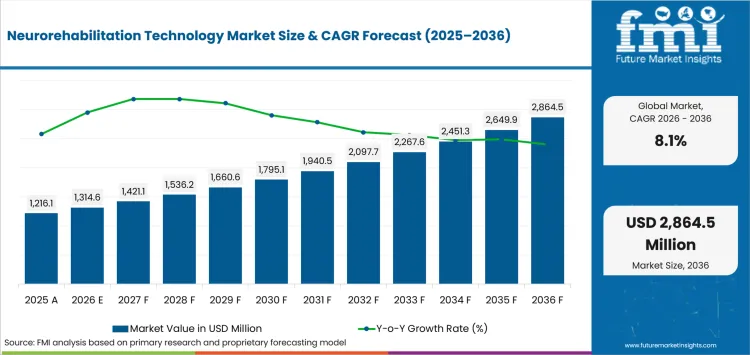
Key Takeaways of Neurorehabilitation Technology Market
- Demand for neurorehabilitation technology is driven by neurology services seeking increased therapeutic repetition without weakening clinical control or documentation quality.
- By technology, robotic rehabilitation holds the leading share at 36.4% in 2026, through repeatable motor-training applications.
- Stroke rehabilitation is the dominant application segment, accounting for 38.7% share in 2026, through sustained gait and upper-limb recovery needs.
- Hospitals account for 39.8% of end-user revenue in 2026, through specialist staffing and capital purchasing capacity.
- Hardware captures 37.0% of product-type revenue in 2026, despite installation and maintenance requirements that increase ownership costs.
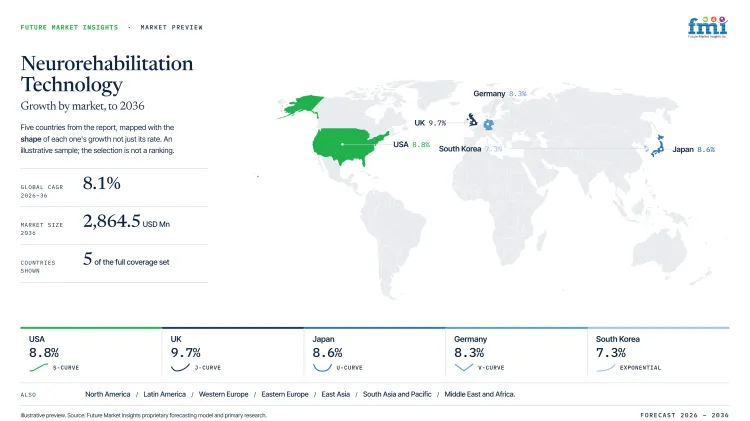
- The UK, USA, and Japan record CAGRs of 9.7%, 8.8%, and 8.6% respectively through 2036, shaped by coordinated stroke pathways, coverage documentation, and domestic medical-device pathways, while Germany and South Korea require dependable local service due to distributed facilities and selective coverage.
- Competition centers on DIH (Hocoma, Tyromotion), Fourier Rehab, CYBERDYNE, Ekso Bionics, Lifeward, MindMaze Therapeutics, and Neuro Rehab VR, with vendors differentiating through broad robotic ecosystems, proprietary connected feedback platforms, wearable mobility systems, and software-led therapy.
Analyst Perspective
"The commercial outlook for rehabilitation technologies will be shaped by sustained clinical utilization rather than technical capability alone. Healthcare organizations are increasingly distinguishing therapeutic outcomes from operational performance, recognizing that both influence investment decisions in different ways. Successful adoption will require clearly defined patient selection, structured implementation, and dependable service support that minimizes disruption while enabling rehabilitation programs to operate efficiently over the long term."
- Anurag Sharma, Principal Analyst at Future Market Insights
Source: FMI’s proprietary forecasting model and primary research
How is the Neurorehabilitation Technology Market segmented?
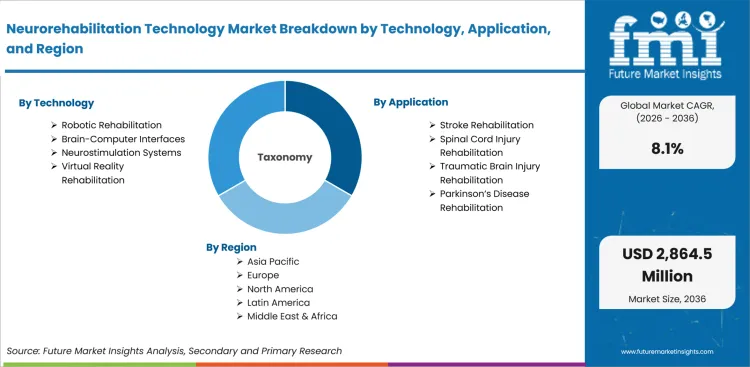
The neurorehabilitation technology industry is segmented by technology, application, end user, product type, and region.
Technology separates robotic rehabilitation from brain-computer interfaces and neurostimulation systems together with virtual reality rehabilitation within clinical programs. Application analysis distinguishes stroke rehabilitation from spinal cord injury and traumatic brain injury programs alongside Parkinson’s disease rehabilitation. End-user categories separate hospitals from rehabilitation centers and specialty clinics together with home care settings across distinct care environments. Product type divides revenue among hardware and software alongside services and wearable systems that carry different support requirements. Regional analysis compares purchasing routes across North America and Latin America together with Europe and Asia-Pacific markets. The framework measures commercially available equipment and associated software or services that directly support neurological rehabilitation delivery.
How do robotic systems change therapy capacity within the Technology category?
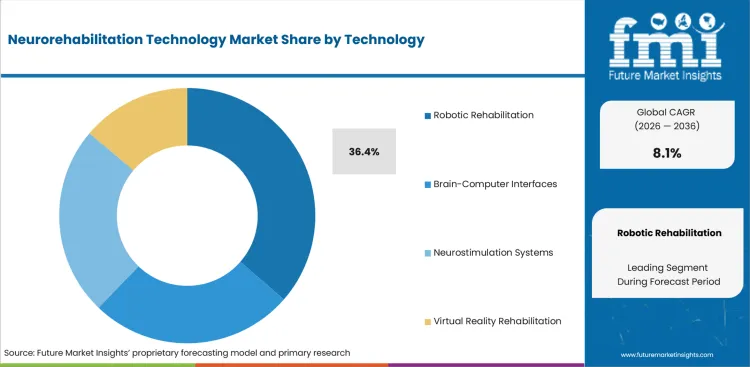
Robotic rehabilitation systems deliver guided movement with adjustable assistance across repeated sessions under therapist supervision. Wearable exoskeleton systems and stationary designs address different patient needs and room constraints within the same clinical program. A randomized trial published by the Annals of Indian Academy of Neurology in January 2026 followed 42 subacute ischemic stroke patients in India through 15 robot-assisted sessions. The results support representative clinical validation before hospitals assign robotic capacity across broader neurological caseloads.
- Within technology, robotic rehabilitation accounts for 36.4% share in 2026 through its direct role in repetitive motor training. Physical assistance and session measurement allow clinicians to adjust support across recovery stages without replacing therapist judgment during progression decisions.
- Rehabilitation departments favor modular robotic platforms that serve several neurological conditions without frequent hardware changes across ordinary schedules. Adjustable supports improve flexibility across inpatient and outpatient programs while fitting time and trained supervision remain necessary for safe daily utilization during crowded treatment schedules.
Why does stroke rehabilitation anchor the Application category?
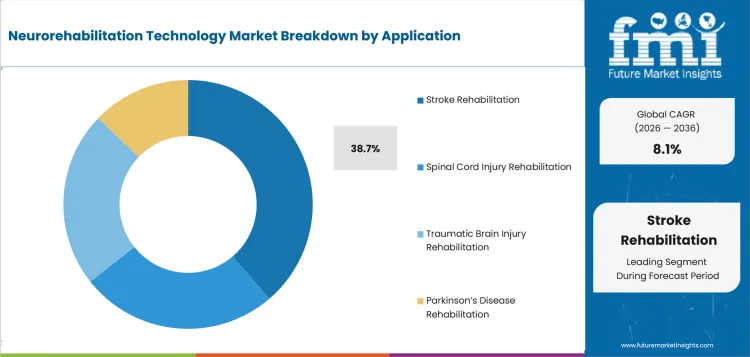
Stroke programs require sustained motor practice across patients whose strength and cognition change throughout each recovery phase. Treatment pathways often span inpatient rehabilitation and outpatient follow-up so clinicians need comparable records across several provider settings. Flexible protocols remain necessary because impairment patterns differ markedly among patients who share similar diagnoses and recovery timelines. Technologies gain practical value when they standardize repetition without narrowing individualized progression decisions across successive recovery stages.
- By application, stroke rehabilitation holds 38.7% share in 2026 owing to broad gait and upper-limb recovery needs. The Centers for Disease Control and Prevention reported in October 2024 that more than 795,000 people experience stroke annually in the United States. Recurring clinical volume supports device use across multidisciplinary pathways in hospital and outpatient rehabilitation settings.
- Stroke teams favor platforms that combine motor training with cognitive feedback and progress reporting across successive care settings. Connected digital therapeutics extend assigned practice beyond supervised sessions and preserve measurable adherence for later clinical review across several recovery phases without creating separate records.
What makes hospitals the primary End User for complex systems?
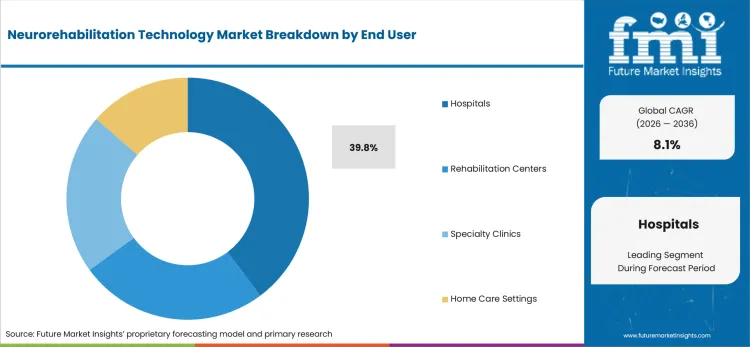
Hospitals concentrate neurologists and rehabilitation physicians alongside therapists who can screen patients and manage contraindications across complex pathways. Biomedical engineering departments provide installation oversight and continuing maintenance for regulated rehabilitation equipment across clinical facilities. Clinical governance coordinates training and secure data access with escalation responsibilities across each neurological service line. Purchasing remains sensitive to room availability and staff time because specialized systems must fit existing treatment schedules.
- Hospitals hold 39.8% of end-user revenue in 2026 through specialist staffing and higher capital capacity. Their position also reflects access to inpatient neurological cases requiring intensive supervised rehabilitation across several clinical disciplines and coordinated technical support functions.
- Documentation quality affects hospital adoption because technology cannot create reimbursable care without records for each treatment episode. The Centers for Medicare & Medicaid Services reported in June 2026 that insufficient documentation caused 84.3% of improper CORF payments during the United States 2024 reporting period. Hospital leaders need device records connecting treatment activity with each therapist’s clinical purpose and progression decision.
How does hardware shape deployment within the Product Type category?
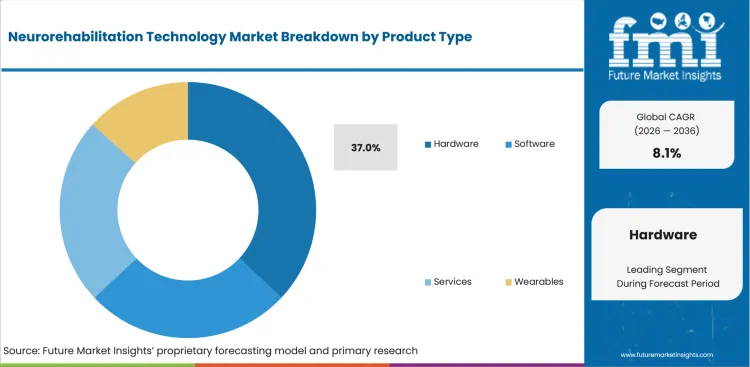
Hardware determines physical assistance and sensing accuracy across devices interacting directly with impaired movement during supervised therapy. Robotic joints and wearable frames require patient-specific fitting that software controls cannot replace during clinical preparation. Headsets and sensors create ergonomic and cybersecurity requirements in shared hospital environments during extended sessions. The United States Food and Drug Administration reported in June 2026 that probable national risks for augmented and virtual reality medical devices include cybersickness and strain. Procurement teams must evaluate physical safety and digital controls within one implementation plan for each facility.
- By product type, hardware represents 37.0% in 2026, driven by the cost of actuators and sensing components within protected treatment systems. Installation and safety validation increase the initial budget beyond the device price and create continuing maintenance obligations.
- Providers compare fixed robotic stations with wearable medical robots that can serve different rooms and patient pathways. Portable designs improve scheduling flexibility across shared equipment pools although battery management and fitting time can limit daily throughput during scheduled treatment blocks.
What are the drivers, restraints, and opportunities in the Neurorehabilitation Technology Market?
Neurological disease burden supports demand for repeatable rehabilitation technology; workforce and reimbursement constraints limit routine deployment; connected care creates an opportunity for supervised home practice.
- Driver: Neurological services need scalable methods that increase motor practice and preserve measurable performance across extended recovery pathways.
- Restraint: Equipment cost and specialist training can prevent technically capable systems from reaching dependable daily utilization across routine clinical schedules.
- Opportunity: Connected therapy can link supervised treatment with structured home practice and remote clinical review across longer recovery pathways.
Neurological disease burden creates sustained pressure on rehabilitation services across conditions requiring repeated motor or cognitive therapy. The World Health Organization reported in March 2024 that more than three billion people lived with a neurological condition worldwide during 2021. Rehabilitation providers therefore need technologies that increase treatment intensity without removing clinical judgment or patient-specific progression. Purchasing becomes defensible when measurable practice improves staffing capacity and documented outcomes across ordinary neurological services.
Specialist workforce shortages limit utilization because advanced systems require trained operators and dependable referral pathways across multiple care settings. The World Health Organization reported in April 2024 that many lower-income countries had fewer than ten skilled rehabilitation practitioners per million residents. Equipment cannot address that gap without implementation support and dependable local maintenance across active installations. Manufacturers must provide training and service models that sustain utilization beyond an initial demonstration period. Facilities otherwise carry capital costs without enough qualified treatment sessions to meet expected operating returns across routine schedules.
Connected care creates a verified opening for extending selected exercises beyond hospital walls without removing clinical oversight. The Centers for Medicare & Medicaid Services added three remote therapeutic monitoring codes to the United States 2026 therapy-services framework in March 2026 for qualified reporting and review. Comparable remote patient monitoring platforms show how scheduled data review can support follow-up across dispersed patients. Technology providers must define escalation rules and clinician responsibilities because automated feedback cannot manage neurological deterioration or unsafe movement independently.
Which country CAGRs are profiled in the Neurorehabilitation Technology Market?
| Country | CAGR |
|---|---|
| USA | 8.8% |
| UK | 9.7% |
| Germany | 8.3% |
| Japan | 8.6% |
| South Korea | 7.3% |
How do country-level CAGRs compare in the Neurorehabilitation Technology Market?
The country CAGR rates span 2.4 percentage points from 7.3% to 9.7% across the complete forecast interval. The narrow spread shows broadly positive momentum, but the spacing reflects different payment routes and service structures rather than equivalent current market size.
- The UK forms the upper comparison band through coordinated public pathways and established community rehabilitation planning. Its separation from the USA measures 0.9 percentage point, which can influence supplier expectations for multi-site sourcing without proving a larger current revenue base.
- The USA and Japan sit within 0.2 percentage point of each other despite different commercial systems. American adoption depends on insurer documentation and institutional budgets, whereas Japanese adoption benefits from concentrated recovery wards with narrower approved treatment pathways.
- Germany remains 0.3 percentage point below Japan and 0.5 point below the USA during the forecast comparison. Its large rehabilitation facility network supports equipment utilization, yet dispersed ownership increases service distance and training costs across regional purchasing organizations.
- South Korea sits 1.0 percentage point below Germany and creates the lower comparison band within the displayed country set. Selective reimbursement can support defined robotic procedures, although additional platforms require separate evidence and coverage decisions until institutions can commit routine budgets.
Country entry plans should begin with the local payment unit and the organization responsible for operator training. A favorable CAGR cannot offset weak maintenance coverage or unclear patient eligibility across purchasing institutions. The full report provides country-level CAGR analysis across North America, Latin America, Europe, East Asia, South Asia, Oceania and the Middle East and Africa.
Country-wise Analysis
- United States rehabilitation providers purchase regulated systems through hospital capital budgets and coded therapy services requiring complete clinical documentation. Demand for neurorehabilitation technology in the USA is forecast to rise at 8.8% CAGR through 2036, supported by provider networks and device-review routes. The Centers for Medicare & Medicaid Services reported in March 2026 that the national KX modifier threshold was USD 2,480 for combined physical and speech-language therapy services and separately for occupational therapy. Regional clinical and technical teams create a direct service route for multistate institutional rehabilitation programs. Coverage variation across insurers remains a material friction for projected equipment utilization across provider settings. Hospitals should confirm patient indications and service response times before approving a long-term investment model.
- England organizes stroke rehabilitation through integrated delivery networks and a seven-day community service connecting hospital discharge with home-based care. The UK neurorehabilitation technology market is forecast to record 9.7% CAGR from 2026 to 2036 through coordinated public pathways. Hocoma lists Brighthedge as its United Kingdom service partner for several gait and upper-limb systems. NHS England reported in December 2025 that around 80,000 people experience a stroke across England each year. Tyromotion states that regional partners can arrange institutional financing through established local commercial channels nationwide. Coordinated pathways provide a direct adoption enabler but public procurement requires evidence of capacity or functional improvement. Suppliers need durable training plans as responsibility shifts from acute hospitals toward community rehabilitation teams.
- Germany combines a rehabilitation facility base with decentralized ownership across public and private provider networks. The German neurorehabilitation technology market is estimated to advance at 8.3% CAGR between 2026 and 2036 through established institutional treatment capacity. Destatis reported in September 2025 that Germany operated 1,067 prevention or rehabilitation facilities with 160,697 beds during 2024. The institutional base creates a direct utilization enabler across neurological treatment networks and purchasing groups. Tyromotion maintains a German contact route and structured service packages across the DACH operating region. Distributed ownership remains a material friction because technician travel and clinician training must remain dependable across distant facilities. Rehabilitation providers should confirm regional service coverage and financing terms before approving multi-device capital programs.
- Japan’s hospitals concentrate neurological rehabilitation in dedicated wards with multidisciplinary staffing across the hospital system. Demand for neurorehabilitation technology in Japan is predicted to advance at 8.6% CAGR through 2036, supported by recovery wards. Eligible Medical HAL treatment receives public reimbursement under defined Japanese neurological indications across medical facilities. The Ministry of Health, Labour and Welfare reported in June 2025 that about 95,000 recovery beds operated across 1,620 institutions during 2023. Concentrated wards support adoption but fitting requirements and narrow reimbursement indications constrain demand across hospitals. CYBERDYNE provides required safety training and continuing education for clinical operators across qualified treatment institutions. Facilities should confirm approved indications and training capacity before forecasting robotic utilization across scheduled treatment programs.
- South Korean hospitals evaluate complex rehabilitation procedures through national health-technology review and selective reimbursement decisions. Demand for neurorehabilitation technology in South Korea is forecast to rise at 7.3% CAGR during the forecast period, supported by review pathways for systems. Hocoma lists JUNGWOO Trade as the local sales and service partner for several institutional systems. The local partner route creates a direct maintenance enabler for hospitals operating complex rehabilitation equipment. The Health Insurance Review & Assessment Service published coverage criteria in March 2026 for electromyography-driven hand robot-assisted rehabilitation under clinical conditions. Coverage remains limited to approved equipment and defined patients which restricts broader platform access across institutions nationally. Distributors need evidence packages addressing approval and clinical training within each selected national reimbursement route.
Who are the notable companies in the Neurorehabilitation Technology Market?
DIH through Hocoma, Tyromotion, Fourier Rehab, CYBERDYNE, Lifeward, Ekso Bionics, MindMaze Therapeutics, and Neuro Rehab VR are notable companies shaping this market.
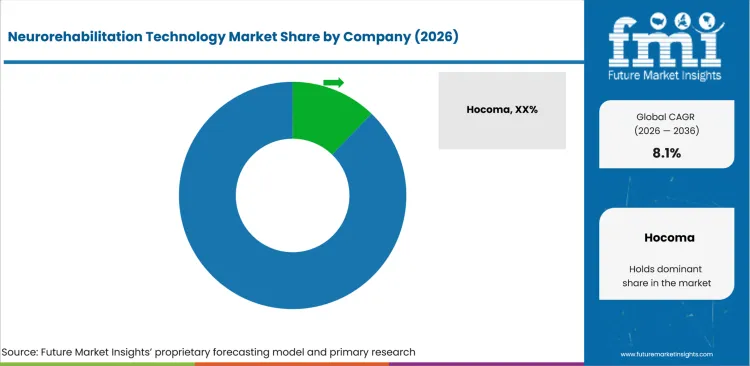
The competitive field combines broad rehabilitation ecosystems with focused wearable systems and software-led therapy platforms across clinical and home settings. Robotic portfolio companies compete through treatment coverage and integration support across several neurological conditions and facility types. Wearable developers compete through mobility training and regulatory access within clinical or personal pathways that require distinct support models. MindMaze Therapeutics reported in April 2026 that its United States commercial expansion covered hospital and outpatient programs alongside home-based neurotherapy. The adjacent medical robots field provides a useful comparison for safety responsibilities and service economics across regulated clinical equipment. Commercial selection depends on verified pathway fit and dependable local service rather than corporate scale.
- DIH through Hocoma and Tyromotion provide broad robotic portfolios with clinical integration and technical support across institutional rehabilitation settings. Fourier Rehab adds upper-limb and gait systems through an integrated digital hub that connects several therapy devices and supports coordinated clinical reporting.
- CYBERDYNE focuses on wearable gait systems with required professional training and region-specific indications across qualified clinical institutions. Ekso Bionics provides clinic-based exoskeletons with specialist support for institutional rehabilitation programs across active treatment centers. Lifeward combines clinical and personal mobility products through operating teams in the United States and Germany.
- MindMaze Therapeutics and Neuro Rehab VR focus on software-led treatment and immersive practice across clinical or home environments. Comparable eldercare assistive robots show why usability and support become central as therapy extends beyond specialist departments into community and home environments.
Competitive Benchmarking: Neurorehabilitation Technology Market
| Company | Robotic Motor Training | Digital Therapy and Measurement | Care-Pathway Support | Geographic Reach |
|---|---|---|---|---|
| DIH through Hocoma | High | High | High | Global |
| Tyromotion | High | High | High | Global |
| Fourier Rehab | High | High | Medium | Global |
| CYBERDYNE | High | Medium | High | Global |
| Lifeward | High | Medium | High | North America, Europe, and Israel |
| Ekso Bionics | High | High | High | Global |
| MindMaze Therapeutics | Low | High | Medium | Global |
| Neuro Rehab VR | Low | High | Medium | United States |
Key Developments in the Neurorehabilitation Technology Market
- In May 2026, ChronoScale Corporation's board committed to a plan to divest its wholly owned Ekso Bionics subsidiary and focus operations on its cloud business. A July 2026 holding-company transaction made ChronoScale Holdings Corporation the publicly traded parent of ChronoScale Corporation. Hospitals should verify whether the announced Ekso divestiture changes service continuity or parts responsibilities before expanding installed rehabilitation programs.
- In March 2025, Lifeward received United States Food and Drug Administration clearance for the ReWalk 7 personal exoskeleton for individuals with spinal cord injury. The company linked United States sales to product availability while practical access remained dependent on assessment and training. Reimbursement approval through applicable payer pathways continues to determine whether eligible users can obtain the cleared system.
- In January 2025, CYBERDYNE obtained Japanese manufacturing and marketing approval for the small-size Medical HAL Lower Limb Type B. The approved configuration extends Cybernics Treatment access to patients approximately 100 to 150 centimeters tall who could not use the standard model. Facilities must confirm eligible neurological indications and complete required operator training before incorporating the approved configuration into routine treatment.
- In June 2025, Fourier Rehab signed a strategic memorandum with Brooks Rehabilitation to study ArmMotus EMU and ExoMotus M4 in Florida. The collaboration places upper-limb and gait systems inside a specialist clinical environment for structured protocol development. Researchers can evaluate performance without treating technical study activity as proof of broader commercial adoption.
Key Players in the Neurorehabilitation Technology Market
Integrated Rehabilitation Robotics Providers
- DIH through Hocoma
- Tyromotion
- Fourier Rehab
Wearable Mobility and Exoskeleton Providers
- CYBERDYNE
- Lifeward
- Ekso Bionics
Digital and Immersive Neurotherapy Providers
- MindMaze Therapeutics
- Neuro Rehab VR
Neurorehabilitation Technology Market - Report Scope
| Coverage field | Report scope |
|---|---|
| Market breakdown | Technology, application, end user, product type, and region. |
| Quantitative Units | Revenue in USD Million, CAGR in %. |
| Market Definition | Commercial hardware and associated software or services used directly to support neurological rehabilitation assessment and therapy delivery. |
| Regions Covered | North America, Latin America, Western Europe, Eastern Europe, East Asia, South Asia and Pacific, Middle East and Africa. |
| Countries Covered | USA, UK, Germany, Japan, South Korea, and more than 30 countries within the complete report. |
| Key Companies Profiled | DIH through Hocoma, Tyromotion, Fourier Rehab, CYBERDYNE, Lifeward, Ekso Bionics, MindMaze Therapeutics, Neuro Rehab VR. |
| Forecast Period | 2026 to 2036. |
| Approach | Hybrid bottom-up and top-down market sizing with segment and country validation across the defined revenue boundary. |
Neurorehabilitation Technology Market - Research Methodology
| Method | Approach |
|---|---|
| Primary Research | FMI analysts gathered input from manufacturers, service providers, technology developers, distributors, end users, sourcing teams, and subject-matter experts. Interviews examined purchasing decisions, product or service evaluation, adoption barriers, approval requirements, pricing considerations, and expectations for technical or commercial support. Respondents were also asked what evidence is required before a trial, pilot, or initial order develops into regular purchasing. |
| Desk Research | Desk research covered government statistics, regulatory publications, trade data, industry associations, technical literature, standards, company filings, product information, and official corporate announcements. Sources were reviewed for relevance, publication date, geographic coverage, and consistency with the defined market scope. Claims relating to performance, applications, approvals, capacity, investment, and commercial activity were retained only when supported by credible public evidence. |
| Market Sizing and Forecasting | The market model combined the baseline value with historical performance, segment structure, pricing and volume indicators, adoption levels, company participation, and country-level demand conditions. Forecast assumptions considered economic activity, investment trends, regulatory developments, technology adoption, purchasing cycles, supply availability, and barriers to wider market use. Segment and regional estimates were reconciled before the final market total was calculated. |
| Data Validation | Estimates were checked against multiple independent indicators, including public data, company activity, trade patterns, industry developments, and findings from primary interviews. Validation also tested whether products, services, applications, and company revenues fell within the defined market boundaries. Adjacent categories, unsupported claims, overlapping revenues, and activities without direct market relevance were excluded to reduce double counting and maintain consistency across segments and countries. |
Neurorehabilitation Technology Market by Segments
Neurorehabilitation Technology Market segmented by Technology:
- Robotic Rehabilitation
- Brain-Computer Interfaces
- Neurostimulation Systems
- Virtual Reality Rehabilitation
Neurorehabilitation Technology Market segmented by Application:
- Stroke Rehabilitation
- Spinal Cord Injury Rehabilitation
- Traumatic Brain Injury Rehabilitation
- Parkinson's Disease Rehabilitation
Neurorehabilitation Technology Market segmented by End User:
- Hospitals
- Rehabilitation Centers
- Specialty Clinics
- Home Care Settings
Neurorehabilitation Technology Market segmented by Product Type:
- Hardware
- Software
- Services
- Wearables
Neurorehabilitation Technology Market by Region:
- North America
- United States
- Canada
- Latin America
- Brazil
- Mexico
- Argentina
- Chile
- Western Europe
- Germany
- France
- United Kingdom
- Italy
- Spain
- Benelux
- Nordics
- Eastern Europe
- Poland
- Czech Republic
- Romania
- Hungary
- East Asia
- China
- Japan
- South Korea
- South Asia and Pacific
- India
- ASEAN
- Australia and New Zealand
- Middle East and Africa
- GCC Countries
- South Africa
- Türkiye
- Israel
Research Sources and Bibliography
- NHS England. (2025, December 2). ‘Life-changing’ AI support helping stroke patients get a second chance.
- World Health Organization. (2025, May 2). OpenTeleRehab: a success story of inclusive telerehabilitation.
- Fiedorova, I., Banikova, S., Adamec, T., Konde, A., Hanzlikova, P., Ganesh, A., Bar, M., & Volny, O. (2026, January 1). Robot-assisted gait therapy in the subacute phase of ischemic stroke: A randomized controlled trial. Annals of Indian Academy of Neurology, 29(1), 52-58.
- World Health Organization. (2024, April 22). Rehabilitation.
- World Health Organization. (2024, March 14). Over 1 in 3 people affected by neurological conditions, the leading cause of illness and disability worldwide.
- Centers for Disease Control and Prevention. (2024, October 24). Stroke facts.
- Centers for Medicare & Medicaid Services. (2026, March 10). Therapy services.
- Centers for Medicare & Medicaid Services. (2026, June 5). Comprehensive outpatient rehabilitation facility services.
- USA Food and Drug Administration. (2026, June 16). Augmented reality and virtual reality in medical devices.
- NHS England. (n.d.). NHS England’s work on stroke.
- NHS England. (2022, February 28). National service model for an integrated community stroke service.
- Statistisches Bundesamt (Destatis). (2025, September 10). Vorsorge- oder Rehabilitationseinrichtungen 2024 nach Trägern und Bundesländern [Prevention or rehabilitation facilities in 2024 by ownership and federal state].
- Ministry of Health, Labour and Welfare. (2025, June 13). [Minutes of the third 2025 inpatient and outpatient care survey and evaluation subcommittee].
- Health Insurance Review & Assessment Service. (2026, March 5). [Electromyography-driven hand robot-assisted rehabilitation treatment].
- Hocoma. (n.d.). Sales and service partners.
- Hocoma. (n.d.). Lokomat product training.
- Hocoma. (n.d.). Technical services.
- Tyromotion. (n.d.). Rehabilitation equipment overview.
- Tyromotion. (n.d.). Service & support.
- Tyromotion. (n.d.). FAQ.
- Fourier Rehab. (n.d.). The most advanced rehabilitation robots.
- Fourier Rehab. (2025, June 3). Fourier Rehab and Brooks Rehabilitation sign strategic MOU to advance research in robotic neurorehabilitation.
- CYBERDYNE. (n.d.). Medical HAL - Lower Limb Type.
- CYBERDYNE. (n.d.). Medical HAL - Single Joint Type.
- CYBERDYNE. (2025, January 31). Notice of medical device approval for small-size model of Medical HAL in Japan.
- CYBERDYNE. (2016, June 23). Under the supervision of medical professionals, the manual for proper usage of HAL® for Medical Use (Lower Limb Type) has now been published: Commencement of the world’s first insured robotic treatment covered under general public health insurance.
- Lifeward. (2025, March 13). FDA issues clearance for ReWalk 7 exoskeleton.
- ChronoScale Corporation. (2026, June 4). Current report (Form 8-K).
- ChronoScale Holdings Corporation. (2026, July 8). Registration statement (Form S-8).
- MindMaze Therapeutics. (2026, April 15). MindMaze Therapeutics publishes 2025 annual report and corporate update.
- MindMaze Therapeutics. (n.d.). MindMotion GO - neurorehabilitation across the continuum of care.
- MindMaze Therapeutics. (n.d.). Contact MindMaze Therapeutics.
- Neuro Rehab VR. (n.d.). Information about our XR therapy system.
- Neuro Rehab VR. (2024, March 8). Why is onboarding and training important for VR for rehab?
This bibliography is provided for reader reference and is not exhaustive. The full report contains the complete reference list and detailed citations.
This Report Answers
- How large is the neurorehabilitation technology market during 2026 and how does valuation change through 2036?
- Which operating conditions support the 8.1% CAGR across major neurological rehabilitation technology categories through 2036?
- Why does robotic rehabilitation hold the main technology position and what constrains usable clinical capacity?
- How do stroke pathways influence demand across hospitals and rehabilitation centers within different national systems?
- Which country growth rates are profiled for the USA and UK alongside Germany and Japan and South Korea?
- How do notable companies differ across robotics and digital therapy alongside pathway support and geographic reach worldwide?
- Which reimbursement and workforce conditions limit adoption despite technically capable rehabilitation equipment?
- What recent approvals and partnerships affect competitive development across wearable and institutional therapy systems?
- Which commercial checks support investment decisions across implementation and training alongside maintenance and outcome measurement?
Frequently Asked Questions
How big is the Neurorehabilitation Technology Market in 2026?
The neurorehabilitation technology market is valued at USD 1314.6 million in 2026 and is forecast to reach USD 2864.5 million by 2036. Growth reflects neurological teams seeking repeatable therapy intensity without adding equivalent clinician hours across scheduled rehabilitation sessions.
What is the CAGR of the Neurorehabilitation Technology Market from 2026 to 2036?
The neurorehabilitation technology market grows at a CAGR of 8.1% between 2026 and 2036, supported by neurological services needing scalable methods that increase motor practice while preserving measurable performance across extended patient recovery pathways.
Which technology leads the Neurorehabilitation Technology Market?
Robotic rehabilitation accounts for 36.4% of the neurorehabilitation technology market by technology in 2026, driven by its direct role in repetitive motor training that lets clinicians adjust physical assistance across recovery stages without replacing therapist judgment.
How much will the Neurorehabilitation Technology Market add between 2026 and 2036?
The neurorehabilitation technology market is set to add USD 1549.9 million between 2026 and 2036, growing from USD 1314.6 million to USD 2864.5 million as robotic and digital therapy platforms extend across a widening base of hospital rehabilitation programs.
Who are the leading companies in the Neurorehabilitation Technology Market?
Five companies lead the neurorehabilitation technology market, including DIH through Hocoma, Tyromotion, Fourier Rehab, CYBERDYNE, and Lifeward, competing through broad robotic ecosystems, focused exoskeleton platforms, and software-led neurological therapy systems.
Preview the report firsthand - request a free sample
Get SampleGet the brochure for pricing and purchase details.
Get PDFTable of Content
- Key Takeaways
- Market Size and CAGR
- Top Growth Driver
- Fastest Growing Segment
- Leading Region
- Key Companies
- Emerging Opportunities
- Executive Summary
- Global Market Outlook
- Demand-side Trends
- Supply-side Trends
- Technology Roadmap Analysis
- Analysis and Recommendations
- Analyst Perspective (What is happening? Why now? What should investors know?)
- Key Questions Answered
- How large is the market?
- What is the CAGR?
- What are key trends?
- Which region dominates?
- Who are the leaders?
- Market Overview
- Market Coverage / Taxonomy
- Market Definition / Scope / Limitations
- Research Methodology
- Chapter Orientation
- Analytical Lens and Working Hypotheses
- Market Structure, Signals, and Trend Drivers
- Benchmarking and Cross-market Comparability
- Market Sizing, Forecasting, and Opportunity Mapping
- Research Design and Evidence Framework
- Desk Research Programme (Secondary Evidence)
- Expert Input and Fieldwork (Primary Evidence)
- Tooling, Models, and Reference Databases
- Data Engineering and Model Build
- Quality Assurance and Audit Trail
- Market Background
- Market Dynamics (Drivers, Restraints, Opportunity, Trends)
- Scenario Forecast (Optimistic, Likely, Conservative)
- Impact Analysis
- AI Impact
- Sustainability Impact
- Regulatory Impact
- Technology Impact
- Consumer / Buyer Analysis
- Purchase Drivers
- Adoption Barriers
- Buyer Journey
- Opportunity Map Analysis
- Product Life Cycle Analysis
- Supply Chain Analysis
- Investment Feasibility Matrix
- Value Chain Analysis
- PESTLE and Porter's Analysis
- Regulatory Landscape
- Regional Parent Market Outlook
- Production and Consumption Statistics
- Import and Export Statistics
- Global Market Analysis and Forecast, 2021 to 2036
- Historical Market Size Value (USD Million) Analysis, 2021 to 2025
- Current and Future Market Size Value (USD Million) Projections, 2026 to 2036
- Y-o-Y Growth Trend Analysis
- Absolute $ Opportunity Analysis
- Global Market Pricing Analysis, 2021 to 2036
- Global Market Analysis and Forecast, By Technology, 2021 to 2036
- Introduction / Key Findings
- Historical Market Size Value (USD Million) Analysis By Technology, 2021 to 2025
- Current and Future Market Size Value (USD Million) Analysis and Forecast By Technology, 2026 to 2036
- Robotic Rehabilitation
- Brain-Computer Interfaces
- Neurostimulation Systems
- Virtual Reality Rehabilitation
- Robotic Rehabilitation
- Y-o-Y Growth Trend Analysis By Technology, 2021 to 2025
- Absolute $ Opportunity Analysis By Technology, 2026 to 2036
- Global Market Analysis and Forecast, By Application, 2021 to 2036
- Introduction / Key Findings
- Historical Market Size Value (USD Million) Analysis By Application, 2021 to 2025
- Current and Future Market Size Value (USD Million) Analysis and Forecast By Application, 2026 to 2036
- Stroke Rehabilitation
- Spinal Cord Injury Rehabilitation
- Traumatic Brain Injury Rehabilitation
- Parkinson’s Disease Rehabilitation
- Stroke Rehabilitation
- Y-o-Y Growth Trend Analysis By Application, 2021 to 2025
- Absolute $ Opportunity Analysis By Application, 2026 to 2036
- Global Market Analysis and Forecast, By End User, 2021 to 2036
- Introduction / Key Findings
- Historical Market Size Value (USD Million) Analysis By End User, 2021 to 2025
- Current and Future Market Size Value (USD Million) Analysis and Forecast By End User, 2026 to 2036
- Hospitals
- Rehabilitation Centers
- Specialty Clinics
- Home Care Settings
- Hospitals
- Y-o-Y Growth Trend Analysis By End User, 2021 to 2025
- Absolute $ Opportunity Analysis By End User, 2026 to 2036
- Global Market Analysis and Forecast, By Product Type, 2021 to 2036
- Introduction / Key Findings
- Historical Market Size Value (USD Million) Analysis By Product Type, 2021 to 2025
- Current and Future Market Size Value (USD Million) Analysis and Forecast By Product Type, 2026 to 2036
- Hardware
- Software
- Services
- Wearables
- Hardware
- Y-o-Y Growth Trend Analysis By Product Type, 2021 to 2025
- Absolute $ Opportunity Analysis By Product Type, 2026 to 2036
- Global Market Analysis and Forecast, By Region, 2021 to 2036
- Introduction
- Historical Market Size Value (USD Million) Analysis By Region, 2021 to 2025
- Current Market Size Value (USD Million) Analysis and Forecast By Region, 2026 to 2036
- North America
- Latin America
- Western Europe
- Eastern Europe
- East Asia
- South Asia and Pacific
- Middle East & Africa
- Market Attractiveness Analysis By Region
- North America Market Analysis and Forecast, By Country, 2021 to 2036
- Historical Market Size Value (USD Million) Trend Analysis By Market Taxonomy, 2021 to 2025
- Market Size Value (USD Million) Forecast By Market Taxonomy, 2026 to 2036
- By Country
- USA
- Canada
- By Technology
- By Application
- By End User
- By Product Type
- By Country
- Market Attractiveness Analysis
- By Country
- By Technology
- By Application
- By End User
- By Product Type
- Key Takeaways
- Latin America Market Analysis and Forecast, By Country
- Historical Market Size Value (USD Million) Trend Analysis By Market Taxonomy, 2021 to 2025
- Market Size Value (USD Million) Forecast By Market Taxonomy, 2026 to 2036
- By Country
- Brazil
- Mexico
- Chile
- Rest of Latin America
- By Technology
- By Application
- By End User
- By Product Type
- By Country
- Market Attractiveness Analysis
- By Country
- By Technology
- By Application
- By End User
- By Product Type
- Key Takeaways
- Western Europe Market Analysis and Forecast, By Country
- Historical Market Size Value (USD Million) Trend Analysis By Market Taxonomy, 2021 to 2025
- Market Size Value (USD Million) Forecast By Market Taxonomy, 2026 to 2036
- By Country
- Germany
- UK
- Italy
- Spain
- France
- Nordic
- BENELUX
- Rest of Western Europe
- By Technology
- By Application
- By End User
- By Product Type
- By Country
- Market Attractiveness Analysis
- By Country
- By Technology
- By Application
- By End User
- By Product Type
- Key Takeaways
- Eastern Europe Market Analysis and Forecast, By Country
- Historical Market Size Value (USD Million) Trend Analysis By Market Taxonomy, 2021 to 2025
- Market Size Value (USD Million) Forecast By Market Taxonomy, 2026 to 2036
- By Country
- Russia
- Poland
- Hungary
- Balkan & Baltic
- Rest of Eastern Europe
- By Technology
- By Application
- By End User
- By Product Type
- By Country
- Market Attractiveness Analysis
- By Country
- By Technology
- By Application
- By End User
- By Product Type
- Key Takeaways
- East Asia Market Analysis and Forecast, By Country
- Historical Market Size Value (USD Million) Trend Analysis By Market Taxonomy, 2021 to 2025
- Market Size Value (USD Million) Forecast By Market Taxonomy, 2026 to 2036
- By Country
- China
- Japan
- South Korea
- By Technology
- By Application
- By End User
- By Product Type
- By Country
- Market Attractiveness Analysis
- By Country
- By Technology
- By Application
- By End User
- By Product Type
- Key Takeaways
- South Asia and Pacific Market Analysis and Forecast, By Country
- Historical Market Size Value (USD Million) Trend Analysis By Market Taxonomy, 2021 to 2025
- Market Size Value (USD Million) Forecast By Market Taxonomy, 2026 to 2036
- By Country
- India
- ASEAN
- Australia & New Zealand
- Rest of South Asia and Pacific
- By Technology
- By Application
- By End User
- By Product Type
- By Country
- Market Attractiveness Analysis
- By Country
- By Technology
- By Application
- By End User
- By Product Type
- Key Takeaways
- Middle East & Africa Market Analysis and Forecast, By Country
- Historical Market Size Value (USD Million) Trend Analysis By Market Taxonomy, 2021 to 2025
- Market Size Value (USD Million) Forecast By Market Taxonomy, 2026 to 2036
- By Country
- Kingdom of Saudi Arabia
- Other GCC Countries
- Türkiye
- South Africa
- Other African Union
- Rest of Middle East & Africa
- By Technology
- By Application
- By End User
- By Product Type
- By Country
- Market Attractiveness Analysis
- By Country
- By Technology
- By Application
- By End User
- By Product Type
- Key Takeaways
- Key Countries Market Analysis
- USA
- Pricing Analysis
- Market Share Analysis, 2025
- By Technology
- By Application
- By End User
- By Product Type
- Canada
- Pricing Analysis
- Market Share Analysis, 2025
- By Technology
- By Application
- By End User
- By Product Type
- Mexico
- Pricing Analysis
- Market Share Analysis, 2025
- By Technology
- By Application
- By End User
- By Product Type
- Brazil
- Pricing Analysis
- Market Share Analysis, 2025
- By Technology
- By Application
- By End User
- By Product Type
- Chile
- Pricing Analysis
- Market Share Analysis, 2025
- By Technology
- By Application
- By End User
- By Product Type
- Germany
- Pricing Analysis
- Market Share Analysis, 2025
- By Technology
- By Application
- By End User
- By Product Type
- UK
- Pricing Analysis
- Market Share Analysis, 2025
- By Technology
- By Application
- By End User
- By Product Type
- Italy
- Pricing Analysis
- Market Share Analysis, 2025
- By Technology
- By Application
- By End User
- By Product Type
- Spain
- Pricing Analysis
- Market Share Analysis, 2025
- By Technology
- By Application
- By End User
- By Product Type
- France
- Pricing Analysis
- Market Share Analysis, 2025
- By Technology
- By Application
- By End User
- By Product Type
- India
- Pricing Analysis
- Market Share Analysis, 2025
- By Technology
- By Application
- By End User
- By Product Type
- ASEAN
- Pricing Analysis
- Market Share Analysis, 2025
- By Technology
- By Application
- By End User
- By Product Type
- Australia & New Zealand
- Pricing Analysis
- Market Share Analysis, 2025
- By Technology
- By Application
- By End User
- By Product Type
- China
- Pricing Analysis
- Market Share Analysis, 2025
- By Technology
- By Application
- By End User
- By Product Type
- Japan
- Pricing Analysis
- Market Share Analysis, 2025
- By Technology
- By Application
- By End User
- By Product Type
- South Korea
- Pricing Analysis
- Market Share Analysis, 2025
- By Technology
- By Application
- By End User
- By Product Type
- Russia
- Pricing Analysis
- Market Share Analysis, 2025
- By Technology
- By Application
- By End User
- By Product Type
- Poland
- Pricing Analysis
- Market Share Analysis, 2025
- By Technology
- By Application
- By End User
- By Product Type
- Hungary
- Pricing Analysis
- Market Share Analysis, 2025
- By Technology
- By Application
- By End User
- By Product Type
- Kingdom of Saudi Arabia
- Pricing Analysis
- Market Share Analysis, 2025
- By Technology
- By Application
- By End User
- By Product Type
- Türkiye
- Pricing Analysis
- Market Share Analysis, 2025
- By Technology
- By Application
- By End User
- By Product Type
- South Africa
- Pricing Analysis
- Market Share Analysis, 2025
- By Technology
- By Application
- By End User
- By Product Type
- USA
- Market Structure Analysis
- Competition Dashboard
- Competition Benchmarking
- Market Share Analysis of Top Players
- By Regional
- By Technology
- By Application
- By End User
- By Product Type
- Emerging Startups
- Innovation Benchmarking
- Competition Analysis
- Competition Deep Dive
- Hocoma
- Overview
- Product Portfolio
- Profitability by Market Segments
- Sales Footprint
- Strategy Overview
- Marketing Strategy
- Product Strategy
- Channel Strategy
- Ekso Bionics
- ReWalk Robotics
- Bionik Laboratories
- Tyromotion
- Abbott
- Medtronic
- MindMaze
- Neofect
- Kinestica
- Hocoma
- Case Studies
- Success Stories
- Recent Developments
- Competition Deep Dive
- Assumptions & Acronyms Used


