

- Market Size (2026)
- USD 8680.0 Mn
- Forecast (2036)
- USD 14967.8 Mn
- CAGR (2026 to 2036)
- 5.6%
How big is the Neuro-Restoration Spinal Cord Injury Market in 2026?
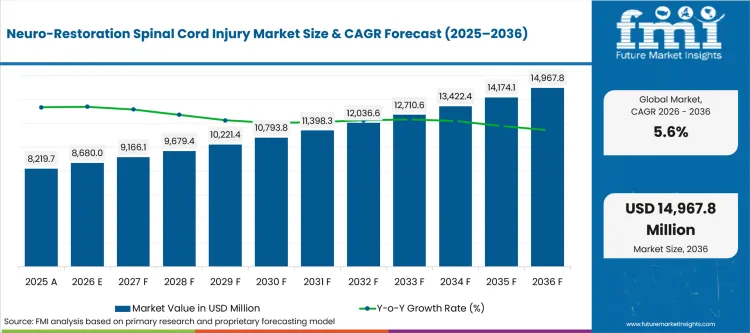
USD 8,680.0 million in 2026 and USD 14,967.8 million by 2036 at a 5.6% CAGR.
Demand in the Neuro-Restoration Spinal Cord Injury Market is tied to specialist care delivery after spinal cord injury. Buyers need evidence, rehabilitation capacity, patient-selection discipline, and realistic implementation planning before wider adoption.
The source base points to a market shaped by clinical burden and investigation activity. WHO spinal cord injury fact sheet frames the condition and rehabilitation need, while ClinicalTrials.gov spinal cord injury search gives a view of therapy-pipeline activity that buyers watch before making service or supplier commitments.
The operating problem is capacity as much as product readiness. Neurorehabilitation providers must decide whether therapy type, injury severity, staffing, monitoring, and follow-up requirements fit daily care workflows. Suppliers with clear clinical-use boundaries and lower training burden are easier to assess.
| Metric | Value |
|---|---|
| 2025 Market Size | USD 8,219.7 million |
| 2026 Market Size | USD 8,680.0 million |
| 2036 Market Size | USD 14,967.8 million |
| Forecast CAGR (2026-2036) | 5.6% |
| Injury Severity Focus | Complete Injury |
| Complete Injury Share (2026) | 62.0% |
| Patient Age Group Focus | Adult |
| Adult Share (2026) | 58.2% |
| End User Focus | Neurorehabilitation Hospitals |
| Neurorehabilitation Hospitals Share (2026) | 53.5% |
Summary of the Neuro-Restoration Spinal Cord Injury Market
| Market Signal | Commercial Impact |
|---|---|
| Demand and Growth Drivers | Demand is expected to remain closely linked to long-term rehabilitation needs following spinal cord injury, with hospitals prioritizing therapies that align with specialist care pathways and rehabilitation capacity.
|
| Product and Segment View | Complete Injury, Adult patients, and Neurorehabilitation Hospitals are estimated to lead their respective categories in 2026 as buyers prioritize therapies suited to specialist rehabilitation environments.
|
| Geography and Growth Outlook | Regional growth is expected to depend on specialist infrastructure, affordability, reimbursement support, and the ability to deliver evidence-based rehabilitation across healthcare systems.
|
| Competitive Landscape | Competition is anticipated to focus on clinical evidence, technology capabilities, technical support, and the ability to meet specialist rehabilitation requirements.
|
| Analyst Perspective | Clinical adoption is expected to depend on evidence strength, rehabilitation capacity, and the ability to integrate neuro-restoration therapies into specialist care pathways without increasing implementation complexity.
|
How is the Neuro-Restoration Spinal Cord Injury Market segmented?
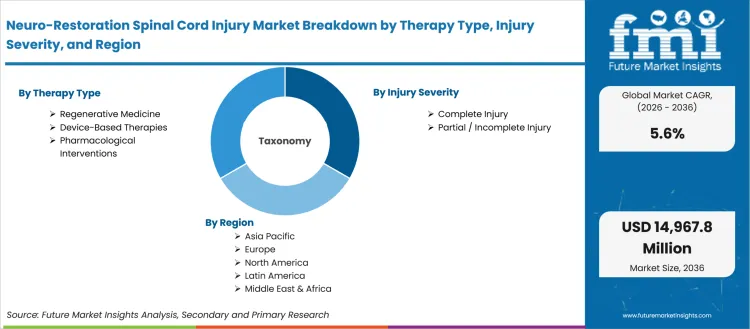
The Neuro-Restoration Spinal Cord Injury Market industry is segmented by Therapy Type, Injury Severity, Patient Age Group, End User, and Region and Country.
By therapy type, the market covers Regenerative Medicine, Device-Based Therapies, and Pharmacological Interventions. By injury severity, the market covers Complete Injury and Partial / Incomplete Injury. By patient age group, the market covers Adult, Pediatric, and Geriatric. By end user, the market covers Neurorehabilitation Hospitals, Specialty Clinics, and Research Centers. By region and country, the market covers North America (United States, Canada), Europe (Germany, United Kingdom, France), East Asia (Japan, South Korea), Middle East (UAE, Saudi Arabia), and Rest of World.
Why does Complete Injury carry weight within Injury Severity?
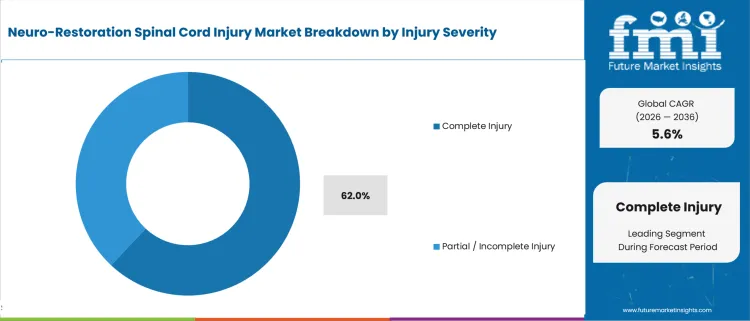
Complete Injury demand within Injury Severity is shaped by care-pathway fit and the level of documentation needed before buyer approval. Complete injury cases place more weight on specialist care planning, realistic clinical goals, rehabilitation capacity, and evidence quality.
- Complete Injury accounts for 62% share within Injury Severity in 2026. The segment is valued at USD 5,096.2 million in 2025, USD 5,381.6 million in 2026, and USD 9,280.0 million by 2036. WHO spinal cord injury fact sheet supports the burden and rehabilitation context behind specialist demand.
- For care providers, the practical issue is clinical fit. Adoption depends on whether evidence, staffing, monitoring, and follow-up requirements can be managed without adding avoidable risk.
What keeps Adult relevant in the Patient Age Group category?
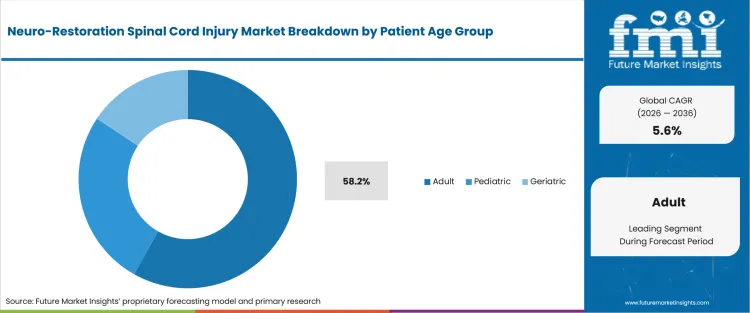
Adult demand within Patient Age Group is shaped by care-pathway fit and the level of documentation needed before buyer approval. Adult patients account for a large care base, so buyers assess therapy readiness, follow-up burden, and reimbursement fit carefully.
- Adult accounts for 58.2% share within Patient Age Group in 2026. The segment is valued at USD 4,783.9 million in 2025, USD 5,051.8 million in 2026, and USD 8,711.3 million by 2036. ClinicalTrials.gov spinal cord injury search provides therapy-pipeline and clinical investigation context.
- For care providers, the practical issue is clinical fit. Adoption depends on whether evidence, staffing, monitoring, and follow-up requirements can be managed without adding avoidable risk.
How do buyers evaluate Neurorehabilitation Hospitals within End User?
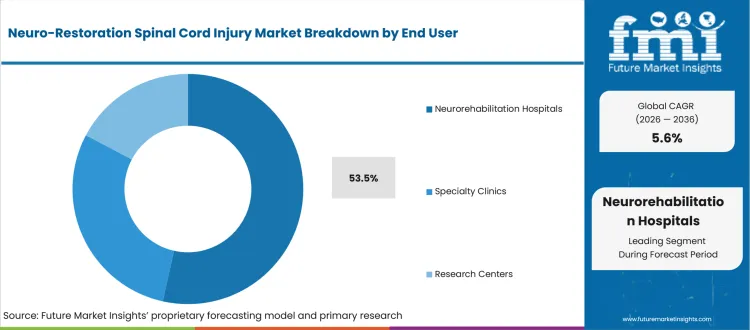
Neurorehabilitation Hospitals demand within End User is shaped by care-pathway fit and the level of documentation needed before buyer approval. Neurorehabilitation hospitals are central because they combine specialist staff, monitoring capacity, and therapy-management workflows.
- Neurorehabilitation Hospitals accounts for 53.5% share within End User in 2026. The segment is valued at USD 4,397.5 million in 2025, USD 4,643.8 million in 2026, and USD 8,007.8 million by 2036. NIH/NINDS spinal cord injury gives condition, treatment, and research background for buyer review.
- For care providers, the practical issue is clinical fit. Adoption depends on whether evidence, staffing, monitoring, and follow-up requirements can be managed without adding avoidable risk.
Where does Regenerative Medicine fit within Therapy Type demand?
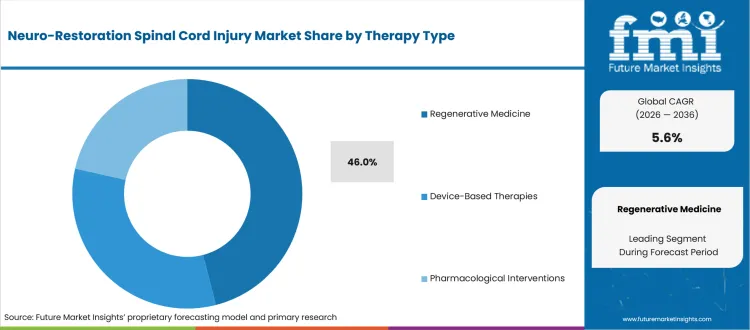
Regenerative Medicine demand within Therapy Type is shaped by care-pathway fit and the level of documentation needed before buyer approval. Regenerative medicine demand depends on clinical evidence, safety review, specialist handling, and readiness for controlled implementation.
- Regenerative Medicine accounts for 46% share within Therapy Type in 2026. The segment is valued at USD 3,781.1 million in 2025, USD 3,992.8 million in 2026, and USD 6,885.2 million by 2036. ONWARD Medical ARC-EX FDA De Novo authorization provides the source context used for this demand view.
- For care providers, the practical issue is clinical fit. Adoption depends on whether evidence, staffing, monitoring, and follow-up requirements can be managed without adding avoidable risk.
What explains the Partial / Incomplete Injury position within Injury Severity?
Partial / Incomplete Injury demand within Injury Severity is shaped by care-pathway fit and the level of documentation needed before buyer approval. Complete injury cases place more weight on specialist care planning, realistic clinical goals, rehabilitation capacity, and evidence quality.
- Partial / Incomplete Injury accounts for 38% share within Injury Severity in 2026. The segment is valued at USD 3,123.5 million in 2025, USD 3,298.4 million in 2026, and USD 5,687.8 million by 2036. ONWARD Medical ARC-EX therapy information provides the source context used for this demand view.
- For care providers, the practical issue is clinical fit. Adoption depends on whether evidence, staffing, monitoring, and follow-up requirements can be managed without adding avoidable risk.
What are the drivers, restraints, and opportunities in the Neuro-Restoration Spinal Cord Injury Market?
Near-term purchases are being shaped by the operating requirement, implementation constraint, and expansion route outlined below.
- The main driver is that clinical need, therapy investigation, and provider adoption support demand where care pathways can absorb the service burden. Buyers need a practical reason to approve spend, so demand improves where evidence can be linked to clinical investigation records, rehabilitation evidence, and clear care-pathway documentation.
- The main restraint is that safety review, reimbursement limits, access barriers, and uneven specialist capacity restrain adoption. Adoption slows when buyer teams cannot see the payback, safety boundary, service owner, or documentation path clearly enough for approval.
- The opportunity lies in specialty-center access, evidence generation, and practical rehabilitation support create the strongest expansion route. Suppliers can use this route only when they bring practical evidence, local support, and a realistic implementation plan.
Demand is more defensible where specialist teams can connect clinical need with clear evidence and workable access. WHO spinal cord injury fact sheet anchors the operating context, so buyer decisions should be tied to care-pathway fit with less weight on general healthcare-spending claims.
The profiled country rows reconcile to USD 8,680.0 million in 2026 and USD 14,967.8 million by 2036 at a 5.6% CAGR. This matters because country growth can look attractive while reimbursement, safety monitoring, or specialist access still limits near-term procurement.
Implementation friction comes from the need to connect clinician confidence, payer or hospital controls, supplier qualification, and continuity of therapy support. Suppliers with clean documentation and a clear support owner are less likely to create approval delays.
Which country CAGRs are profiled in the Neuro-Restoration Spinal Cord Injury Market?
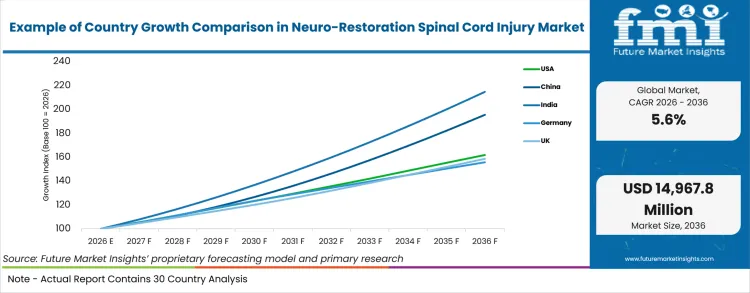
| Country | CAGR |
|---|---|
| United States | 4.92% |
| China | 6.92% |
| India | 7.93% |
| Germany | 4.52% |
| United Kingdom | 4.72% |
| Japan | 4.12% |
| South Korea | 5.32% |
| Rest of World | 6.32% |
How do country-level CAGRs compare in the Neuro-Restoration Spinal Cord Injury Market?
Country growth in the Neuro-Restoration Spinal Cord Injury Market should be read through specialist access, documentation quality, reimbursement discipline, and therapy continuity. The same CAGR can reflect different operating constraints, so executives should compare how each country handles clinical evidence, supplier qualification, and care delivery.
- United States records USD 2,690.8 million in 2026, USD 4,348.9 million by 2036, and 4.92% CAGR. Demand is shaped by specialist access, payer review, liability control, and the need for clear clinical-use documentation. Procurement teams therefore ask for evidence, service coverage, and payer-aware access planning before widening supplier use.
- China records USD 868.0 million in 2026, USD 1,695.4 million by 2036, and 6.92% CAGR. Hospital access, qualification discipline, and supplier repeatability are important because clinical procurement must be supported across larger care networks. This puts repeatability, documentation, and local support at the center of supplier review.
- India records USD 520.8 million in 2026, USD 1,116.8 million by 2036, and 7.93% CAGR. Growth depends on affordability, specialist availability, and the ability to maintain evidence-backed care beyond major urban centers. Suppliers need affordable support models, evidence that works in specialist settings, and reliable channel continuity.
- Germany records USD 781.2 million in 2026, USD 1,215.1 million by 2036, and 4.52% CAGR. Buyers place more weight on documentation, clinical governance, and supplier traceability before widening use. Supplier review therefore centers on traceable files, consistent quality, and clear clinical governance support.
- United Kingdom records USD 607.6 million in 2026, USD 963.4 million by 2036, and 4.72% CAGR. Access is filtered through managed budgets, specialist referral pathways, and a need to show practical care value. Buyers need proof that supplier support can fit managed budgets and controlled specialty pathways.
- Japan records USD 694.4 million in 2026, USD 1,039.4 million by 2036, and 4.12% CAGR. Adoption depends on disciplined clinical pathways, reliability, and careful follow-up in compact specialist settings. Supplier confidence depends on reliability, follow-up support, and careful documentation.
- South Korea records USD 347.2 million in 2026, USD 583.0 million by 2036, and 5.32% CAGR. Specialist networks are compact and quality expectations are high, so evidence, access discipline, and service reliability carry weight. Buyers are likely to favor suppliers that can respond quickly and document quality without adding clinical workload.
- Rest of World records USD 2,170.0 million in 2026, USD 4,005.9 million by 2036, and 6.32% CAGR. Adoption depends on local reimbursement, distributor continuity, and the availability of specialist support. Local access, distributor reliability, and continuity support decide how far adoption can move beyond early demand.
Who are the notable companies in the Neuro-Restoration Spinal Cord Injury Market?
ONWARD Medical, Lifeward, Ekso Bionics, Wandercraft, Medtronic, Abbott, Boston Scientific, Lineage Cell Therapeutics, and NervGen Pharma are the notable companies shaping this market.
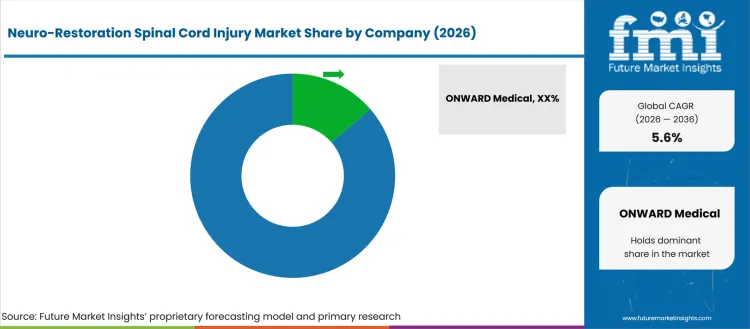
Competition is split across non-invasive spinal cord stimulation, robotic rehabilitation, implantable neuromodulation, and investigational regenerative or neuroreparative therapies. Hospitals and rehabilitation centers do not evaluate these suppliers in the same way. Device suppliers must prove workflow fit and service support, while therapeutic developers are judged through trial design, safety review, and patient-selection discipline.
- ONWARD Medical, Lifeward, Ekso Bionics, and Wandercraft are relevant where neuro-restoration is tied to rehabilitation delivery and assistive mobility. Their buyer case depends on clinical evidence, training requirements, center readiness, reimbursement fit, and the ability to support use beyond a demonstration setting.
- Medtronic, Abbott, and Boston Scientific remain relevant through spinal cord stimulation and neuromodulation portfolios. Their competitive strength is not direct substitution for all SCI restoration approaches, but installed clinical infrastructure, physician familiarity, and service capability in stimulation-based care.
- Lineage Cell Therapeutics and NervGen Pharma matter on the investigational therapy side. Buyers and investors should read their relevance through clinical-stage progress, safety data, delivery requirements, and whether the therapy can eventually fit a specialist rehabilitation pathway.
Competitive Benchmarking: Neuro-Restoration Spinal Cord Injury Market
| Company | SCI Portfolio Relevance | Clinical Evidence Fit | Service or Trial Support | Geographic Footprint |
|---|---|---|---|---|
| ONWARD Medical | High | High | Strong | United States and Europe |
| Lifeward | High | Medium | Strong | United States, Europe, and Israel |
| Ekso Bionics | High | Medium | Strong | United States and international |
| Wandercraft | Medium | Medium | Medium | Europe and United States expansion |
| Medtronic | Medium | High | High | Global |
| Abbott | Medium | High | High | Global |
| Boston Scientific | Medium | High | High | Global |
| Lineage Cell Therapeutics | Medium | Clinical-stage | Strong | United States |
| NervGen Pharma | Medium | Clinical-stage | Strong | North America |
Source: Future Market Insights competitive analysis, 2026. Ratings reflect relative portfolio relevance, workflow or project fit, service capability, and geographic reach.
Key Developments in the Neuro-Restoration Spinal Cord Injury Market
- In December 2024, ONWARD Medical received FDA De Novo classification and US market authorization for the ARC-EX System. The development matters because it gives rehabilitation centers a cleared non-invasive spinal cord stimulation option for defined SCI use.
- In March 2025, Lifeward received FDA 510(k) clearance for the ReWalk 7 personal exoskeleton. The clearance is relevant because personal exoskeleton procurement depends on device generation, service support, and home or community-use readiness.
- In 2025, Lineage Cell Therapeutics advanced the DOSED clinical study for OPC1 in subacute and chronic spinal cord injury. The trial activity matters because regenerative approaches will remain procurement-relevant only where delivery, safety, and follow-up requirements can be managed in specialist settings.
- In 2025, NervGen reported expanded CONNECT SCI study data for NVG-291 in chronic spinal cord injury. The development is relevant to the market because neuroreparative candidates are judged through patient-selection, durability, and safety evidence before they can influence care pathways.
Key Players in the Neuro-Restoration Spinal Cord Injury Market
Non-invasive Stimulation and Rehabilitation Devices
- ONWARD Medical
- Lifeward
- Ekso Bionics
- Wandercraft
Neuromodulation Platform Suppliers
- Medtronic
- Abbott
- Boston Scientific
Investigational Regenerative and Neuroreparative Therapy Developers
- Lineage Cell Therapeutics
- NervGen Pharma
Neuro-Restoration Spinal Cord Injury Market - Report Scope
| Coverage field | Report scope |
|---|---|
| Market breakdown | Neuro-Restoration Spinal Cord Injury Market Breakdown Therapy Type, Injury Severity, Patient Age Group, End User, By Region and Country |
| Market Definition | Commercial demand covered under Neuro-Restoration Spinal Cord Injury Market, including country demand, segment demand, and supplier-selection context |
| Regions Covered | East Asia, Europe, North America, Rest of World, South Asia |
| Countries Covered | United States, China, India, Germany, United Kingdom, Japan, South Korea, Rest of World |
| Key Companies Profiled | ONWARD Medical, Lifeward, Ekso Bionics, Wandercraft, Medtronic, Abbott, Boston Scientific, Lineage Cell Therapeutics, and NervGen Pharma |
| Forecast Period | 2026 to 2036 |
| Approach | Global, country, and segment assessment using public source evidence and market context |
Neuro-Restoration Spinal Cord Injury Market - Research Methodology
| Method | Approach |
|---|---|
| Primary Research | The assessment covers buyer needs, supplier roles, country demand, and segment-level adoption patterns. |
| Desk Research | WHO spinal cord injury fact sheet; ClinicalTrials.gov spinal cord injury search; NIH/NINDS spinal cord injury. Official company portfolio, product, label, and press-release pages were reviewed where company names were used. |
| Market Sizing and Forecasting | Global, country, and segment values were assessed across demand pools, country adoption, segment share, and forecast-period growth. |
| Data Validation | Country totals, segment shares, and forecast values are presented on one reconciled base. |
Neuro-Restoration Spinal Cord Injury Market by Segments
Neuro-Restoration Spinal Cord Injury Market segmented by Therapy Type:
- Regenerative Medicine
- Device-Based Therapies
- Pharmacological Interventions
Neuro-Restoration Spinal Cord Injury Market segmented by Injury Severity:
- Complete Injury
- Partial / Incomplete Injury
Neuro-Restoration Spinal Cord Injury Market segmented by Patient Age Group:
- Adult
- Pediatric
- Geriatric
Neuro-Restoration Spinal Cord Injury Market segmented by End User:
- Neurorehabilitation Hospitals
- Specialty Clinics
- Research Centers
Neuro-Restoration Spinal Cord Injury Market segmented by Region and Country:
- North America (United States, Canada)
- Europe (Germany, United Kingdom, France)
- East Asia (Japan, South Korea)
- Middle East (UAE, Saudi Arabia)
- Rest of World
Research Sources and Bibliography
- 1. WHO spinal cord injury fact sheet. Burden, prevalence, consequences, and rehabilitation need.
- 2. ClinicalTrials.gov spinal cord injury search. Therapy pipeline and clinical investigation context.
- 3. NIH/NINDS spinal cord injury. Clinical condition, treatment, and research background.
- 4. ONWARD Medical ARC-EX FDA De Novo authorization.
- 5. ONWARD Medical ARC-EX therapy information.
- 6. Lifeward ReWalk 7 FDA clearance.
- 7. Ekso Bionics spinal cord injury exoskeletons.
- 8. Wandercraft personal exoskeleton.
- 9. Medtronic neurostimulation systems.
- 10. Abbott neuromodulation products.
- 11. Boston Scientific spinal cord stimulation systems.
- 12. Lineage Cell Therapeutics OPC1.
- 13. NervGen Pharma clinical trials overview.
This Report Answers
- What is the expected global value of the Neuro-Restoration Spinal Cord Injury Market in 2026 and 2036?
- What CAGR is forecast for the Neuro-Restoration Spinal Cord Injury Market during the 2026 to 2036 period?
- Which country value and CAGR rows are included for Neuro-Restoration Spinal Cord Injury Market?
- Which segment groups and subsegments carry the higher 2026 shares?
- How do country values reconcile with the global 2026 and 2036 totals?
- Which public sources support the market, country, and segment context?
- Which named companies shape competition in the Neuro-Restoration Spinal Cord Injury Market?
- What adoption risk, procurement risk, or supplier-selection issue should executives watch?
- How does FMI size and forecast Neuro-Restoration Spinal Cord Injury Market across countries and segments?
- Which supplier or development signals affect executive decisions?
Frequently Asked Questions
Why should executives track the Neuro-Restoration Spinal Cord Injury Market?
Executives should track this market because adoption depends on clinical evidence, access controls, supplier qualification, and continuity of care. A forecast is less useful if the buyer cannot translate it into safe procurement and service planning.
What business problem does the Neuro-Restoration Spinal Cord Injury Market address?
The market addresses the need to connect specialist therapy use with documentation, reimbursement discipline, and care-delivery capacity. Buyers need a way to compare supplier fit before wider approval creates risk for clinicians or patients.
What should procurement leaders evaluate before selecting suppliers?
Procurement leaders should compare evidence quality, specification fit, regulatory documentation, service ownership, channel reliability, and country exposure. The strongest supplier case is the one that reduces approval work after the purchase decision.
What can limit return on investment for buyers?
Return on investment can be limited when safety review, reimbursement access, specialist capacity, or supplier documentation is weak. Buyers can reduce this risk by phasing adoption and assigning clear ownership for evidence review, supply continuity, and support response.
How can suppliers build executive confidence?
Suppliers build confidence by providing clean files, realistic implementation guidance, responsive service, and proof that quality and availability can be maintained. Buyer trust improves when the supplier can explain what happens after approval, as well as before sale.
Preview the report firsthand - request a free sample
Get SampleGet the brochure for pricing and purchase details.
Get PDFTable of Content
- Key Takeaways
- Market Size and CAGR
- Top Growth Driver
- Fastest Growing Segment
- Leading Region
- Key Companies
- Emerging Opportunities
- Executive Summary
- Global Market Outlook
- Demand-side Trends
- Supply-side Trends
- Technology Roadmap Analysis
- Analysis and Recommendations
- Analyst Perspective (What is happening? Why now? What should investors know?)
- Key Questions Answered
- How large is the market?
- What is the CAGR?
- What are key trends?
- Which region dominates?
- Who are the leaders?
- Market Overview
- Market Coverage / Taxonomy
- Market Definition / Scope / Limitations
- Research Methodology
- Chapter Orientation
- Analytical Lens and Working Hypotheses
- Market Structure, Signals, and Trend Drivers
- Benchmarking and Cross-market Comparability
- Market Sizing, Forecasting, and Opportunity Mapping
- Research Design and Evidence Framework
- Desk Research Programme (Secondary Evidence)
- Expert Input and Fieldwork (Primary Evidence)
- Tooling, Models, and Reference Databases
- Data Engineering and Model Build
- Quality Assurance and Audit Trail
- Market Background
- Market Dynamics (Drivers, Restraints, Opportunity, Trends)
- Scenario Forecast (Optimistic, Likely, Conservative)
- Impact Analysis
- AI Impact
- Sustainability Impact
- Regulatory Impact
- Technology Impact
- Consumer / Buyer Analysis
- Purchase Drivers
- Adoption Barriers
- Buyer Journey
- Opportunity Map Analysis
- Product Life Cycle Analysis
- Supply Chain Analysis
- Investment Feasibility Matrix
- Value Chain Analysis
- PESTLE and Porter's Analysis
- Regulatory Landscape
- Regional Parent Market Outlook
- Production and Consumption Statistics
- Import and Export Statistics
- Global Market Analysis and Forecast, 2021 to 2036
- Historical Market Size Value (USD Million) Analysis, 2021 to 2025
- Current and Future Market Size Value (USD Million) Projections, 2026 to 2036
- Y-o-Y Growth Trend Analysis
- Absolute $ Opportunity Analysis
- Global Market Pricing Analysis, 2021 to 2036
- Global Market Analysis and Forecast, By Therapy Type, 2021 to 2036
- Introduction / Key Findings
- Historical Market Size Value (USD Million) Analysis By Therapy Type, 2021 to 2025
- Current and Future Market Size Value (USD Million) Analysis and Forecast By Therapy Type, 2026 to 2036
- Regenerative Medicine
- Device-Based Therapies
- Pharmacological Interventions
- Regenerative Medicine
- Y-o-Y Growth Trend Analysis By Therapy Type, 2021 to 2025
- Absolute $ Opportunity Analysis By Therapy Type, 2026 to 2036
- Global Market Analysis and Forecast, By Injury Severity, 2021 to 2036
- Introduction / Key Findings
- Historical Market Size Value (USD Million) Analysis By Injury Severity, 2021 to 2025
- Current and Future Market Size Value (USD Million) Analysis and Forecast By Injury Severity, 2026 to 2036
- Complete Injury
- Partial / Incomplete Injury
- Complete Injury
- Y-o-Y Growth Trend Analysis By Injury Severity, 2021 to 2025
- Absolute $ Opportunity Analysis By Injury Severity, 2026 to 2036
- Global Market Analysis and Forecast, By Patient Age Group, 2021 to 2036
- Introduction / Key Findings
- Historical Market Size Value (USD Million) Analysis By Patient Age Group, 2021 to 2025
- Current and Future Market Size Value (USD Million) Analysis and Forecast By Patient Age Group, 2026 to 2036
- Adult
- Pediatric
- Geriatric
- Adult
- Y-o-Y Growth Trend Analysis By Patient Age Group, 2021 to 2025
- Absolute $ Opportunity Analysis By Patient Age Group, 2026 to 2036
- Global Market Analysis and Forecast, By End User, 2021 to 2036
- Introduction / Key Findings
- Historical Market Size Value (USD Million) Analysis By End User, 2021 to 2025
- Current and Future Market Size Value (USD Million) Analysis and Forecast By End User, 2026 to 2036
- Neurorehabilitation Hospitals
- Specialty Clinics
- Research Centers
- Neurorehabilitation Hospitals
- Y-o-Y Growth Trend Analysis By End User, 2021 to 2025
- Absolute $ Opportunity Analysis By End User, 2026 to 2036
- Global Market Analysis and Forecast, By Region, 2021 to 2036
- Introduction
- Historical Market Size Value (USD Million) Analysis By Region, 2021 to 2025
- Current Market Size Value (USD Million) Analysis and Forecast By Region, 2026 to 2036
- North America
- Latin America
- Western Europe
- Eastern Europe
- East Asia
- South Asia and Pacific
- Middle East & Africa
- Market Attractiveness Analysis By Region
- North America Market Analysis and Forecast, By Country, 2021 to 2036
- Historical Market Size Value (USD Million) Trend Analysis By Market Taxonomy, 2021 to 2025
- Market Size Value (USD Million) Forecast By Market Taxonomy, 2026 to 2036
- By Country
- USA
- Canada
- By Therapy Type
- By Injury Severity
- By Patient Age Group
- By End User
- By Country
- Market Attractiveness Analysis
- By Country
- By Therapy Type
- By Injury Severity
- By Patient Age Group
- By End User
- Key Takeaways
- Latin America Market Analysis and Forecast, By Country
- Historical Market Size Value (USD Million) Trend Analysis By Market Taxonomy, 2021 to 2025
- Market Size Value (USD Million) Forecast By Market Taxonomy, 2026 to 2036
- By Country
- Brazil
- Mexico
- Chile
- Rest of Latin America
- By Therapy Type
- By Injury Severity
- By Patient Age Group
- By End User
- By Country
- Market Attractiveness Analysis
- By Country
- By Therapy Type
- By Injury Severity
- By Patient Age Group
- By End User
- Key Takeaways
- Western Europe Market Analysis and Forecast, By Country
- Historical Market Size Value (USD Million) Trend Analysis By Market Taxonomy, 2021 to 2025
- Market Size Value (USD Million) Forecast By Market Taxonomy, 2026 to 2036
- By Country
- Germany
- UK
- Italy
- Spain
- France
- Nordic
- BENELUX
- Rest of Western Europe
- By Therapy Type
- By Injury Severity
- By Patient Age Group
- By End User
- By Country
- Market Attractiveness Analysis
- By Country
- By Therapy Type
- By Injury Severity
- By Patient Age Group
- By End User
- Key Takeaways
- Eastern Europe Market Analysis and Forecast, By Country
- Historical Market Size Value (USD Million) Trend Analysis By Market Taxonomy, 2021 to 2025
- Market Size Value (USD Million) Forecast By Market Taxonomy, 2026 to 2036
- By Country
- Russia
- Poland
- Hungary
- Balkan & Baltic
- Rest of Eastern Europe
- By Therapy Type
- By Injury Severity
- By Patient Age Group
- By End User
- By Country
- Market Attractiveness Analysis
- By Country
- By Therapy Type
- By Injury Severity
- By Patient Age Group
- By End User
- Key Takeaways
- East Asia Market Analysis and Forecast, By Country
- Historical Market Size Value (USD Million) Trend Analysis By Market Taxonomy, 2021 to 2025
- Market Size Value (USD Million) Forecast By Market Taxonomy, 2026 to 2036
- By Country
- China
- Japan
- South Korea
- By Therapy Type
- By Injury Severity
- By Patient Age Group
- By End User
- By Country
- Market Attractiveness Analysis
- By Country
- By Therapy Type
- By Injury Severity
- By Patient Age Group
- By End User
- Key Takeaways
- South Asia and Pacific Market Analysis and Forecast, By Country
- Historical Market Size Value (USD Million) Trend Analysis By Market Taxonomy, 2021 to 2025
- Market Size Value (USD Million) Forecast By Market Taxonomy, 2026 to 2036
- By Country
- India
- ASEAN
- Australia & New Zealand
- Rest of South Asia and Pacific
- By Therapy Type
- By Injury Severity
- By Patient Age Group
- By End User
- By Country
- Market Attractiveness Analysis
- By Country
- By Therapy Type
- By Injury Severity
- By Patient Age Group
- By End User
- Key Takeaways
- Middle East & Africa Market Analysis and Forecast, By Country
- Historical Market Size Value (USD Million) Trend Analysis By Market Taxonomy, 2021 to 2025
- Market Size Value (USD Million) Forecast By Market Taxonomy, 2026 to 2036
- By Country
- Kingdom of Saudi Arabia
- Other GCC Countries
- Türkiye
- South Africa
- Other African Union
- Rest of Middle East & Africa
- By Therapy Type
- By Injury Severity
- By Patient Age Group
- By End User
- By Country
- Market Attractiveness Analysis
- By Country
- By Therapy Type
- By Injury Severity
- By Patient Age Group
- By End User
- Key Takeaways
- Key Countries Market Analysis
- USA
- Pricing Analysis
- Market Share Analysis, 2025
- By Therapy Type
- By Injury Severity
- By Patient Age Group
- By End User
- Canada
- Pricing Analysis
- Market Share Analysis, 2025
- By Therapy Type
- By Injury Severity
- By Patient Age Group
- By End User
- Mexico
- Pricing Analysis
- Market Share Analysis, 2025
- By Therapy Type
- By Injury Severity
- By Patient Age Group
- By End User
- Brazil
- Pricing Analysis
- Market Share Analysis, 2025
- By Therapy Type
- By Injury Severity
- By Patient Age Group
- By End User
- Chile
- Pricing Analysis
- Market Share Analysis, 2025
- By Therapy Type
- By Injury Severity
- By Patient Age Group
- By End User
- Germany
- Pricing Analysis
- Market Share Analysis, 2025
- By Therapy Type
- By Injury Severity
- By Patient Age Group
- By End User
- UK
- Pricing Analysis
- Market Share Analysis, 2025
- By Therapy Type
- By Injury Severity
- By Patient Age Group
- By End User
- Italy
- Pricing Analysis
- Market Share Analysis, 2025
- By Therapy Type
- By Injury Severity
- By Patient Age Group
- By End User
- Spain
- Pricing Analysis
- Market Share Analysis, 2025
- By Therapy Type
- By Injury Severity
- By Patient Age Group
- By End User
- France
- Pricing Analysis
- Market Share Analysis, 2025
- By Therapy Type
- By Injury Severity
- By Patient Age Group
- By End User
- India
- Pricing Analysis
- Market Share Analysis, 2025
- By Therapy Type
- By Injury Severity
- By Patient Age Group
- By End User
- ASEAN
- Pricing Analysis
- Market Share Analysis, 2025
- By Therapy Type
- By Injury Severity
- By Patient Age Group
- By End User
- Australia & New Zealand
- Pricing Analysis
- Market Share Analysis, 2025
- By Therapy Type
- By Injury Severity
- By Patient Age Group
- By End User
- China
- Pricing Analysis
- Market Share Analysis, 2025
- By Therapy Type
- By Injury Severity
- By Patient Age Group
- By End User
- Japan
- Pricing Analysis
- Market Share Analysis, 2025
- By Therapy Type
- By Injury Severity
- By Patient Age Group
- By End User
- South Korea
- Pricing Analysis
- Market Share Analysis, 2025
- By Therapy Type
- By Injury Severity
- By Patient Age Group
- By End User
- Russia
- Pricing Analysis
- Market Share Analysis, 2025
- By Therapy Type
- By Injury Severity
- By Patient Age Group
- By End User
- Poland
- Pricing Analysis
- Market Share Analysis, 2025
- By Therapy Type
- By Injury Severity
- By Patient Age Group
- By End User
- Hungary
- Pricing Analysis
- Market Share Analysis, 2025
- By Therapy Type
- By Injury Severity
- By Patient Age Group
- By End User
- Kingdom of Saudi Arabia
- Pricing Analysis
- Market Share Analysis, 2025
- By Therapy Type
- By Injury Severity
- By Patient Age Group
- By End User
- Türkiye
- Pricing Analysis
- Market Share Analysis, 2025
- By Therapy Type
- By Injury Severity
- By Patient Age Group
- By End User
- South Africa
- Pricing Analysis
- Market Share Analysis, 2025
- By Therapy Type
- By Injury Severity
- By Patient Age Group
- By End User
- USA
- Market Structure Analysis
- Competition Dashboard
- Competition Benchmarking
- Market Share Analysis of Top Players
- By Regional
- By Therapy Type
- By Injury Severity
- By Patient Age Group
- By End User
- Emerging Startups
- Innovation Benchmarking
- Competition Analysis
- Competition Deep Dive
- ONWARD Medical
- Overview
- Product Portfolio
- Profitability by Market Segments
- Sales Footprint
- Strategy Overview
- Marketing Strategy
- Product Strategy
- Channel Strategy
- Lifeward
- Ekso Bionics
- Wandercraft
- Medtronic
- Abbott
- Boston Scientific
- Lineage Cell Therapeutics
- NervGen Pharma
- ONWARD Medical
- Case Studies
- Success Stories
- Recent Developments
- Competition Deep Dive
- Assumptions & Acronyms Used


