

- Market Size (2026)
- USD 1245.6 Mn
- Forecast (2036)
- USD 3030.9 Mn
- CAGR (2026 to 2036)
- 9.3%
How big is Spinal Cord Injury Venture Funding Market in 2026?
USD 1,245.6 million in 2026 and USD 3,030.9 million by 2036 at a 9.3% CAGR.
Demand for spinal cord injury venture funding is forecast to expand at 9.3% CAGR between 2026 and 2036, increasing valuation from USD 1,245.6 million in 2026 to USD 3,030.9 million by 2036. Capital enters this field through staged rounds that connect scientific proof with clinical preparation and regulated product development. In February 2026, CDMRP allocated USD 33.0 million to its Spinal Cord Injury Research Program for fiscal year 2026. Public research can advance technical and clinical milestones without covering every cost required for company formation or regulated production. Companies developing neurostimulation systems need private capital for quality systems and later clinical studies beyond public research support. Funding for spinal cord stimulators becomes more credible as management defines the next clinical milestone and the cash required to reach it. Investment committees gain confidence through milestones that another fund can assess without rebuilding the complete scientific case.
United States developers can reach large venture syndicates and specialist hospitals through established clinical networks. European companies often combine public grants with private rounds and cross-border regulatory planning across several national systems. Japanese and South Korean entrants rely more heavily on local partners for authorization and continuing service coverage. Blackrock Neurotech reported in July 2026 that five spinal cord injury participants received more than 168 million stimulation pulses across twenty-seven combined implant years. The long observation period improves diligence for brain-computer interfaces by clarifying technical exposure within a small but relevant human group. The evidence cannot remove financing risks related to surgery and manufacturing scale during wider commercial deployment. Investment in regenerative medicine follows a longer drug-development path and often requires larger reserves ahead of pivotal studies, so country value depends on capital depth together with trial access and a practical service route.
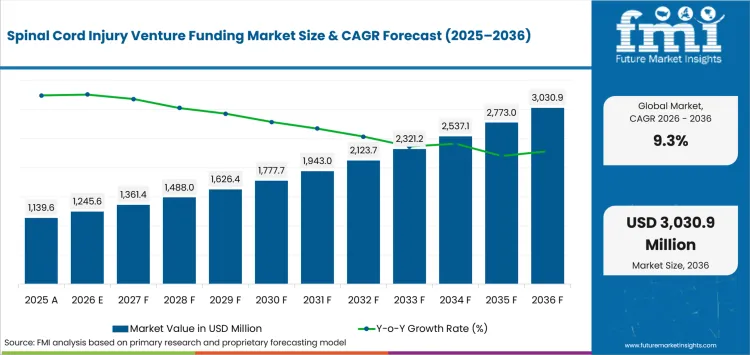
Summary of the Spinal Cord Injury Venture Funding Market
Key Takeaways
- Demand for spinal cord injury venture funding is driven by scientific progress, stronger clinical evidence, and clearer regulatory milestones that help investors assess development risk.
- By funding stage, seed funding is estimated to lead with 39.6% share in 2026, reflecting early company formation, translational research, and initial technology validation.
- Neurostimulation is projected to dominate the technology focus segment with 41.3% share in 2026, supported by visible engineering progress, clinical milestones, and defined regulatory pathways.
- Venture capital firms are forecast to hold 31.5% share in 2026 by investor type, owing to their participation in repeated funding rounds and active oversight of clinical development.
- South Korea is forecast to record the fastest growth at 11.5% CAGR, followed by Germany at 9.5% CAGR, supported by research networks, regulatory access, and investment in neurological technologies.
- Long clinical timelines, uncertain functional outcomes, manufacturing requirements, and limited later-stage capital remain the main barriers to wider investment.
- Competition includes SCI Ventures, ONWARD Medical, SpineX, Neuralink, Synchron, NervGen Pharma, and Ekso Bionics, with participants differentiated by technology focus, clinical progress, and financing requirements.
Analyst Perspective
“The central investment test is whether spinal cord injury programs convert scientific progress into clear clinical and regulatory milestones. Investors are separating broad paralysis claims from evidence collected directly in spinal cord injury populations. Funding plans also need to cover manufacturing, clinical support, and regulatory work beyond the next technical demonstration. Strong country-entry strategies define local authorization, service, and commercialization responsibilities across regulated healthcare systems.”
- Anurag Sharma, Principal Analyst, Future Market Insights
How is the spinal cord injury venture funding market segmented?
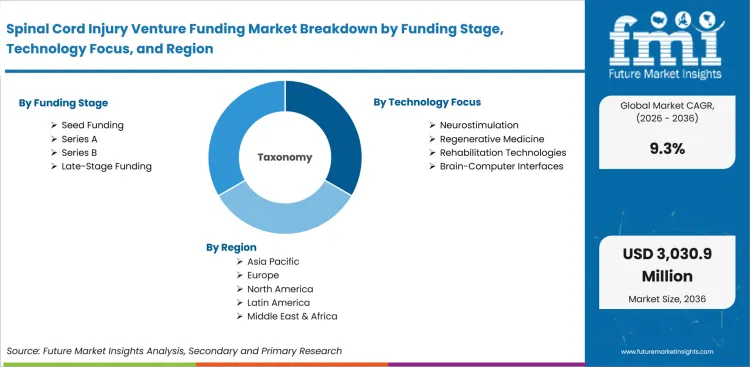
The spinal cord injury venture funding industry is segmented by funding stage, technology focus, investor type, end user, and region.
The funding-stage category separates seed financing from Series A and Series B rounds during early company development. Later-stage funding covers larger clinical studies and commercialization programs that require more capital and formal controls. Technology focus distinguishes neurostimulation and regenerative medicine from rehabilitation technologies and brain-computer interfaces across different development pathways. Investor type separates venture capital firms from corporate investors and government grant programs with different return requirements. Angel investors provide another route during company formation until institutional financing becomes practical for emerging clinical technology teams. End-user analysis distinguishes medical device startups from biotechnology companies and research institutions receiving development capital. Rehabilitation technology developers form another recipient group with specialized training and continuing service responsibilities across institutional care settings. Regional analysis reflects differences in capital depth and authorization pathways across national funding environments and specialist clinical networks.
How does Seed Funding shape the Funding Stage category?
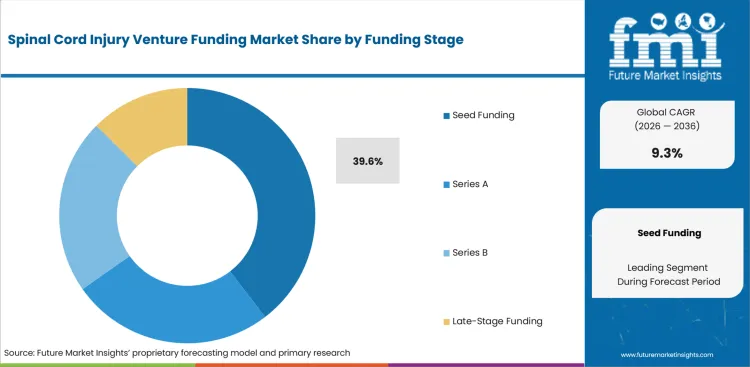
Early spinal cord injury companies need seed capital to convert laboratory findings into a defined product program. Investment reviews examine intellectual property and founder capability alongside the first clinical development plan and ownership structure. Programs developing brain implants also need budgets for surgical tools and secure clinical data systems. Seed rounds therefore fund the practical work required until a larger institutional financing becomes defensible.
- Seed funding is estimated to hold 39.6% share in 2026, attributable to the number of programs entering formal company development ahead of broad clinical validation. SCI Ventures states that its global strategy supports early companies focused on paralysis and biological spinal repair. The specialist mandate fits ownership work and preclinical funding ahead of a priced Series A round.
- Specialist funds and disease foundations connect founders with spinal injury clinicians and experienced research sites during early company formation. Their networks improve milestone design without treating a grant award as proof of commercial readiness across later financing rounds and formal clinical preparation.
How does Neurostimulation shape the Technology Focus category?
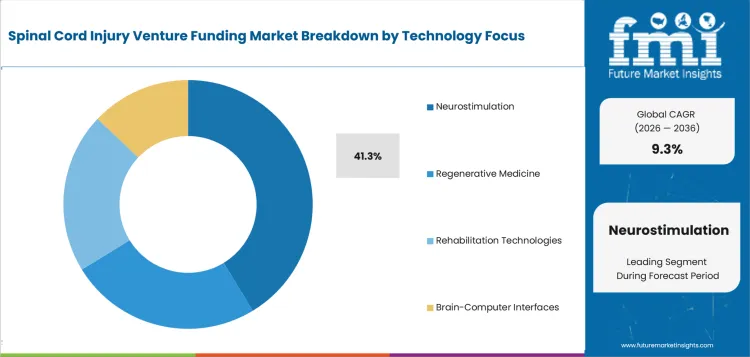
Neurostimulation programs create measurable engineering milestones through electrode design and protocols tied to defined functional goals. External and implanted systems require different study budgets and long-term clinical support models across early deployment programs. Funding committees must separate the value of closed-loop interfaces from implantation risks and continuing service duties. A credible financing plan links each technical milestone with a regulatory step and a funded clinical support model.
- By technology focus, neurostimulation is projected to represent 41.3% share in 2026, supported by visible progress from prototypes into regulated clinical programs. Functional results can support later rounds more directly than broad platform claims without a defined spinal cord injury use and measurable patient outcome.
- Clinical rehabilitation teams favor programs that define system programming and training duties across every participating site. In July 2025, ONWARD Medical submitted a United States home-use application and a European CE Mark application for ARC-EX. Investors also require a funded maintenance plan that supports reliable use during early commercialization across several clinical sites.
How do Venture Capital Firms shape the Investor Type category?
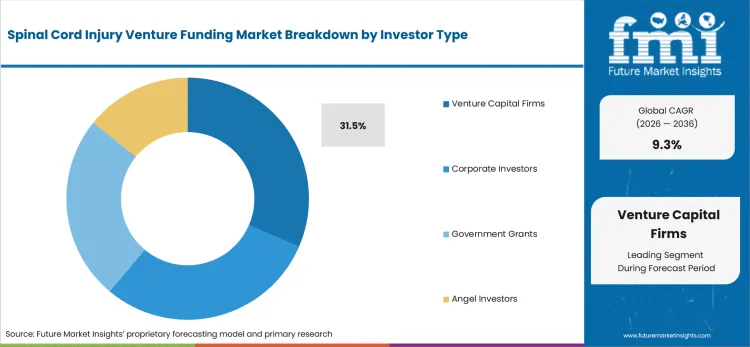
Venture capital firms finance repeated clinical and manufacturing milestones that can extend across several development years. Precision Neuroscience announced in November 2025 that SCI Ventures invested in its interface program for people living with paralysis. Condition-focused capital can therefore join a broader syndicate financing brain-computer interface implants without displacing later institutional investors. Investment reviews also examine surgical workflow and data reliability alongside the capital required for the next round.
- Venture capital firms are forecast to account for 31.5% share in 2026, owing to their ability to reserve capital for later rounds. A lead fund can coordinate specialist participants and larger institutions during costly clinical or regulatory transitions and manufacturing preparation.
- Company boards use venture financing plans to convert technical results into practical development choices across several planned rounds. Strategic investors and grant programs can add capital without providing the same governance structure or dependable follow-on reserves during later clinical development.
How do Medical Device Startups shape the End User category?
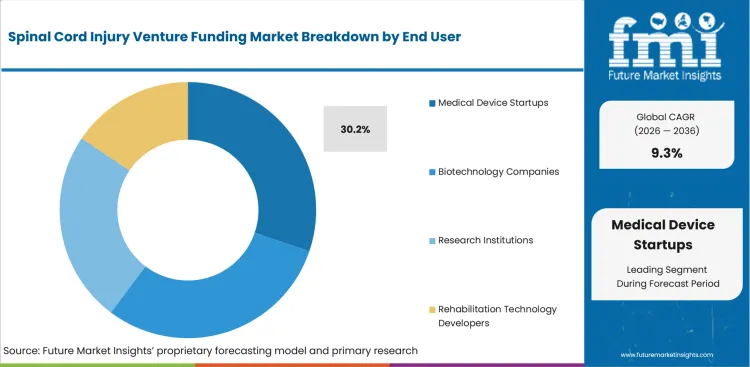
Medical device startups convert spinal cord injury research into regulated systems that combine hardware with software and clinical protocols. Their budgets must cover design controls and quality systems alongside studies measuring relevant functional outcomes. Comparisons with rehabilitation robotics help investors estimate training and service costs across institutional settings during early financing reviews. Focused teams can revise product design quickly but often lack the service infrastructure of established medical device companies.
- Based on end user, medical device startups are estimated to capture 30.2% share in 2026, driven by focused teams that carry early product risk before larger manufacturers participate. Their position reflects concentrated development work across stimulation systems and neural interfaces with regulated clinical uses and service obligations.
- Completed studies give investors a clearer basis for regulatory planning and manufacturing budgets across medical device programs. ClinicalTrials.gov recorded in February 2025 that SpineX completed a multicenter SCONE study with 126 participants. Startup credibility also depends on service models that support clinician training and dependable maintenance across initial commercial sites.
What are the drivers, restraints, and opportunities in the Spinal Cord Injury Venture Funding Market?
Clinical milestones support investment growth, while long development cycles and fragmented funding routes limit capital continuity across spinal cord injury programs.
- Driver: Direct functional evidence reduces uncertainty about whether a therapeutic or device program can justify its next financing stage.
- Restraint: Funding gaps emerge between academic discovery and regulated production across several scientific and commercial transitions.
- Opportunity: Specialist syndicates can match each technology with investors who understand its clinical burden and service model.
Functional evidence supports funding growth by changing the estimated probability that a program can reach its next regulated study. NervGen Pharma reported in May 2026 that all ten treated participants met its combined gait-response definition compared with one of ten placebo participants. The company also reported independent blinded biomechanical analyses supporting genuine neural recovery during the same study. The results do not establish regulatory approval or final clinical benefit across a broader population. Investment decisions improve as management connects each finding to a defined registrational design and capital requirement.
Capital continuity remains difficult as development passes from discovery into clinical testing and regulated production. CDMRP opened four separate FY2026 spinal cord injury research mechanisms in May 2026 for investigator-led and translation-focused work. The program divided support among clinical trials and clinical translation together with investigator-initiated and translational awards. Separate mechanisms reflect different review standards and funding purposes across the research path and company development needs. Company plans need private reserves for manufacturing and market access that public research awards do not automatically provide.
Specialist syndicates create value by matching each technology with investors who understand its clinical burden and service model. Neuralink reported in February 2025 that three participants used Telepathy for more than 4,900 combined hours across over 670 implanted days. The operating record can improve diligence around reliability and user value without replacing larger controlled studies. Investors can apply the same discipline to medical exoskeletons by separating rehabilitation performance from service capacity and durable payment routes. Better milestone design allows each financing round to resolve a specific uncertainty instead of supporting a broad technology promise.
Which country CAGRs are profiled in the Spinal Cord Injury Venture Funding Market?
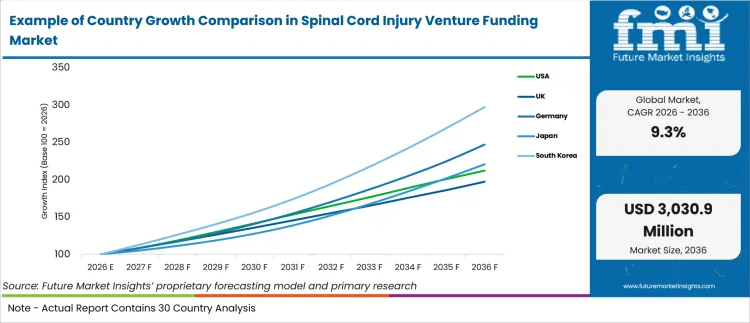
| Country | CAGR |
|---|---|
| USA | 7.8% |
| UK | 7.0% |
| Germany | 9.5% |
| Japan | 8.2% |
| South Korea | 11.5% |
How do country-level CAGRs compare in the Spinal Cord Injury Venture Funding Market?
The country comparison spans 4.5 percentage points and reveals three defined growth positions across the spinal cord injury venture funding market. South Korea and Germany form the upper group, although a 2.0-point gap separates the two countries. Japan and the USA create a closely aligned middle group with only 0.4 percentage points between their forecasts. A further 0.8-point difference between the USA and the UK places the UK at the lower end of the comparison. Countries with stronger venture capital networks, clinical research infrastructure and medical technology investment generally demonstrate faster funding growth.
- South Korea leads the comparison as healthcare investors continue to fund neurological devices, rehabilitation technologies and advanced treatment platforms for spinal cord injury.
- Germany remains 2.0 percentage points below South Korea and reflects a market where clinical research strength and medical technology expertise support continued investment.
- Japan remains 1.3 percentage points below Germany as advanced engineering capabilities and specialist hospitals support broader funding across neurological and rehabilitation programs.
- The USA remains only 0.4 percentage points below Japan as venture firms, universities and medical technology companies expand financing for research and clinical development.
- The UK remains 0.8 percentage points below the USA, supported by university research and public healthcare infrastructure, while limited growth capital affects later-stage expansion.
Comparable CAGRs can still produce different investment conditions. Differences in capital availability, clinical trial costs, regulatory pathways and commercialization requirements influence funding timelines and investor strategies. The full report provides country-level CAGR analysis across North America, Latin America, Europe, East Asia, South Asia, Oceania and the Middle East and Africa.
Country-wise Analysis
- American neurological startups can combine academic trial networks with several federal small-business pathways for early development. The USA spinal cord injury venture funding market is projected to grow at 7.8% CAGR over the assessment period, supported by deep specialist capital and established regulatory routes. In April 2026, NIH reported that Congress reauthorized its SBIR and STTR programs for five years. The renewal restored a nondilutive route for eligible biomedical companies preparing research and validation work. Later clinical studies create a material financing gap because federal awards do not cover every manufacturing or commercialization cost. Development plans therefore need an FDA strategy and sufficient reserves to reach the next financing milestone.
- British neuroscience ventures benefit from university research clusters and access to NHS clinical sites across several regions. The UK spinal cord injury venture funding market is estimated to advance at 7.0% CAGR during the 2026-2036 forecast period, shaped by strong research access and constrained scale-up financing. In July 2025, the United Kingdom government stated that life sciences companies struggled to access institutional capital for later-stage growth. The sector plan also targets shorter clinical trial setup and clearer medical technology access across public health services. Planned reforms support clinical preparation, yet centralized assessment can lengthen the route toward recurring commercial revenue. Neurological companies need private reserves that remain available throughout regulatory review and public adoption planning stages.
- German neurological companies can use specialist university hospitals and one European regulatory framework for multi-country development. Germany’s spinal cord injury venture funding market is forecast to grow at 9.5% CAGR between 2026 and 2036, due to international capital and regulated clinical infrastructure. KfW Research reported in May 2026 that healthcare startups represented 18% of first-quarter venture deals. The same release stated that more than three quarters of invested funds came from abroad. International participation expands financing capacity for neurological clinical programs that require several successive development rounds. Dependence on foreign capital creates a material financing constraint during periods of changing cross-border risk appetite and uneven domestic fundraising.
- Foreign neurological developers need a Japanese marketing authorization holder to manage submissions and post-market responsibilities. Japan’s spinal cord injury venture funding market is projected to record 8.2% CAGR over the 2026-2036 assessment period, owing to clinical engineering strength and specialist hospitals. The Japan Agency for Medical Research and Development described in June 2026 a program requiring registered venture capital participation for eligible pharmaceutical startups. The program supports nonclinical work through Phase 2 and accepts Japanese subsidiaries of overseas companies. The financing structure helps regenerative programs combine public development support with specialist private capital across early studies. Medical device developers face a material entry barrier from Japanese-language documentation and local technical support throughout authorization and commercial preparation.
- South Korean healthcare ventures operate within a capital system concentrated around Seoul and nearby technology centers. South Korea’s spinal cord injury venture funding market is forecast to expand at 11.5% CAGR over the forecast period, driven by active healthcare financing and rapid technology evaluation. In April 2026, the Ministry of SMEs and Startups reported USD 753 million of healthcare venture investment during 2025. The ministry also found that 87.7% of new-industry capital went to follow-on rounds and 79.1% remained in the capital region. The concentration supports companies with proven milestones but makes first financing and regional expansion harder. New neurological programs need specialist investors and clinical partners outside the main capital corridor for broader regional development.
Who are the notable companies in the Spinal Cord Injury Venture Funding Market?
SCI Ventures, ONWARD Medical, NervGen Pharma, Blackrock Neurotech, Neuralink, Synchron, Precision Neuroscience, SpineX, and Ekso Bionics are the notable organizations shaping this market.
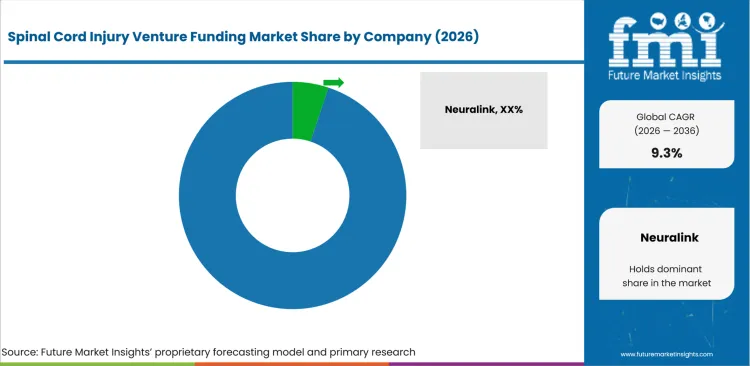
Competition combines specialist capital with drug developers and neural device companies across distinct development paths. SCI Ventures lists ONWARD Medical and NervGen Pharma in its paralysis portfolio and backs Precision Neuroscience. ONWARD Medical and SpineX develop spinal stimulation approaches through different clinical and regulatory routes for chronic spinal cord injury. Blackrock Neurotech supplies established research interfaces with direct human spinal cord injury experience across recording and sensory stimulation studies. Neuralink and Synchron pursue implanted communication interfaces through distinct surgical methods and regulated trial structures for paralysis. Comparisons with physiotherapy equipment help frame training and service requirements across rehabilitation settings with different institutional budgets. Company relevance depends on direct condition evidence and the development stage receiving capital across each technology pathway.
- SCI Ventures and NervGen Pharma represent condition-focused capital and regenerative therapy development across different risk profiles. Their investment cases depend on direct clinical evidence together with sufficient reserves for later regulated studies.
- ONWARD Medical and SpineX pursue spinal stimulation through different product designs and commercialization routes for chronic spinal cord injury. Blackrock Neurotech adds long-running intracortical research systems with direct human sensory evidence from participants living with spinal cord injury.
- Neuralink and Synchron develop implanted communication interfaces that require surgical partners and prolonged follow-up evidence. Precision Neuroscience and Ekso Bionics add less invasive cortical technology and rehabilitation equipment with different service needs.
Competitive Benchmarking: Spinal Cord Injury Venture Funding Market
| Company | Direct SCI Alignment | Human Evidence | Funding or Sales Progress | Geographic Reach |
|---|---|---|---|---|
| ONWARD Medical | High | High | High | North America and Europe |
| NervGen Pharma | High | High | High | North America |
| Blackrock Neurotech | High | High | High | Global research network |
| Neuralink | Medium | Medium | High | North America, Europe and Middle East |
| Synchron | Medium | Medium | High | United States and Australia |
| Precision Neuroscience | Medium | Medium | Medium | United States |
| SpineX | High | High | Medium | United States, Canada and India |
| Ekso Bionics | Medium | High | High | Global |
Direct SCI Alignment is High for a company or investment mandate centered on spinal cord injury. Medium requires explicit spinal cord injury eligibility within a broader paralysis or neurological program with documented company activity. Low reflects a documented secondary role inside another verified clinical focus with limited direct spinal cord injury activity. Human Evidence is High for direct human spinal cord injury results from a completed or active clinical program. Medium requires active human paralysis evidence or an authorized component without direct spinal cord injury outcomes. Low applies to verified preclinical development without human testing or documented clinical participation in spinal cord injury. Funding or Sales Progress is High for material financing or authorized commercial sales through a formal development route. Medium requires completed specialist financing or regulatory preparation without broad sales across the defined spinal cord injury market. Low applies to an early program supported through an initial study without later financing evidence. Geographic Reach records documented clinical or commercial regions rather than corporate headquarters or general corporate office locations.
Key Developments in the Spinal Cord Injury Venture Funding Market
- In January 2025, ONWARD Medical: Two United States clinics purchased ARC-EX following FDA De Novo authorization during December 2024. The first commercial orders established a practical reference for manufacturing readiness and clinician training in chronic incomplete spinal cord injury. Early sales also clarified the service resources needed as the company expanded from controlled studies into supported clinical use.
- In June 2025, Neuralink: A USD 650 million Series E round closed with institutional and strategic investors. The company reported five participants with severe paralysis across trials in three countries and two continents. The financing increased reserves for clinical expansion and manufacturing work but did not replace the need for longer safety evidence across a wider participant group.
- In November 2025, Synchron: A USD 200 million Series D round funded continued development of its endovascular brain-computer interface platform. The financing expanded resources for clinical studies and commercial preparation across specialized implantation sites and hospital partnerships. Investors gained a clearer view of the capital required for a neural interface program that depends on hospital partners and long follow-up.
- In May 2026, NervGen Pharma: An underwritten public offering was priced to raise approximately USD 60.0 million in gross proceeds. The company stated that the proceeds would support NVG-291 clinical development and general working capital. The larger reserve strengthened preparation for later studies without treating the financing event as proof of regulatory success and reduced near-term liquidity pressure during detailed clinical planning and study execution.
Key Players in the Spinal Cord Injury Venture Funding Market
Dedicated Capital and Regenerative Therapy
- SCI Ventures
- NervGen Pharma
Neurostimulation and Neural Interface Developers
- ONWARD Medical
- Blackrock Neurotech
- Neuralink
- Synchron
- Precision Neuroscience
- SpineX
Rehabilitation Technology Providers
- Ekso Bionics
Spinal Cord Injury Venture Funding Market - Report Scope
| Coverage field | Report scope |
|---|---|
| Market breakdown | Funding stage, technology focus, investor type, end user, and region. |
| Quantitative Units | USD Million |
| Market Definition | Equity, venture, strategic, and eligible nondilutive capital committed to companies developing spinal cord injury-specific neurostimulation, regenerative, neural interface, and rehabilitation technologies. The scope excludes routine device sales, hospital spending, and academic grants without a company development pathway. |
| Regions Covered | North America, Latin America, Europe, East Asia, South Asia, Oceania, and Middle East and Africa. |
| Countries Covered | USA, UK, Germany, Japan, and South Korea, with additional countries assessed in the full report. |
| Key Companies Profiled | SCI Ventures, ONWARD Medical, NervGen Pharma, Blackrock Neurotech, Neuralink, Synchron, Precision Neuroscience, SpineX, and Ekso Bionics. |
| Forecast Period | 2026 to 2036. |
| Approach | Hybrid bottom-up and top-down market sizing supported by primary interviews and official desk research. |
Spinal Cord Injury Venture Funding Market - Research Methodology
| Method | Approach |
|---|---|
| Primary Research | FMI analysts gathered input from manufacturers, service providers, technology developers, distributors, end users, procurement teams, and subject-matter experts. Interviews examined purchasing decisions, product or service evaluation, adoption barriers, approval requirements, pricing considerations, and expectations for technical or commercial support. Respondents were also asked what evidence is required before a trial, pilot, or initial order develops into regular purchasing. |
| Desk Research | Desk research covered government statistics, regulatory publications, trade data, industry associations, technical literature, standards, company filings, product information, and official corporate announcements. Sources were reviewed for relevance, publication date, geographic coverage, and consistency with the defined market scope. Claims relating to performance, applications, approvals, capacity, investment, and commercial activity were retained only when supported by credible public evidence. |
| Market Sizing and Forecasting | The market model combined the baseline value with historical performance, segment structure, pricing and volume indicators, adoption levels, company participation, and country-level demand conditions. Forecast assumptions considered economic activity, investment trends, regulatory developments, technology adoption, purchasing cycles, supply availability, and barriers to wider market use. Segment and regional estimates were reconciled before the final market total was calculated. |
| Data Validation | Estimates were checked against multiple independent indicators, including public data, company activity, trade patterns, industry developments, and findings from primary interviews. Validation also tested whether products, services, applications, and company revenues fell within the defined market boundaries. Adjacent categories, unsupported claims, overlapping revenues, and activities without direct market relevance were excluded to reduce double counting and maintain consistency across segments and countries. |
Spinal Cord Injury Venture Funding Market by Segments
Spinal Cord Injury Venture Funding Market segmented by Funding Stage:
- Seed Funding
- Series A
- Series B
- Late-Stage Funding
Spinal Cord Injury Venture Funding Market segmented by Technology Focus:
- Neurostimulation
- Regenerative Medicine
- Rehabilitation Technologies
- Brain-Computer Interfaces
Spinal Cord Injury Venture Funding Market segmented by Investor Type:
- Venture Capital Firms
- Corporate Investors
- Government Grants
- Angel Investors
Spinal Cord Injury Venture Funding Market segmented by End User:
- Medical Device Startups
- Biotechnology Companies
- Research Institutions
- Rehabilitation Technology Developers
Spinal Cord Injury Venture Funding Market by Region:
- North America
- United States
- Canada
- Latin America
- Brazil
- Mexico
- Argentina
- Chile
- Western Europe
- Germany
- France
- United Kingdom
- Italy
- Spain
- Benelux
- Nordics
- Eastern Europe
- Poland
- Czech Republic
- Romania
- Hungary
- East Asia
- China
- Japan
- South Korea
- South Asia and Pacific
- India
- ASEAN
- Australia and New Zealand
- Middle East and Africa
- GCC Countries
- South Africa
- Türkiye
- Israel
Research Sources and Bibliography
- Future Market Insights. (2026). Spinal cord injury venture funding market: Proprietary forecasting model and primary research.
- Congressionally Directed Medical Research Programs. (2026, February 4). CDMRP Announces $1.27 Billion, 34 Research Programs for Fiscal Year 2026.
- Blackrock Neurotech. (2026, July 15). Long-term safety and efficacy of intracortical microstimulation in humans.
- ONWARD Medical. (2025, July 1). ONWARD Medical files 510(k) with USA FDA for ARC-EX System home use and submits CE Mark application.
- Precision Neuroscience. (2025, November 5). Precision Neuroscience and SCI Ventures Partner to Bring Brain-Computer Interfaces to People Living with Paralysis.
- ClinicalTrials.gov. (2025, February 17). Spinal COrd NeuromodulaTor by SpIneX and ScoNE to Treat NeurogeniC BladdEr - SCONE "CONTINENCE" Clinical Study.
- NervGen Pharma. (2026, May 26). NervGen Announces Positive Independent, Blinded Biomechanical Gait Analyses Demonstrating Genuine Neural Recovery with NVG-291 in Phase 1b/2a CONNECT SCI Study.
- Congressionally Directed Medical Research Programs. (2026, May 6). Program Funding Opportunities: FY26 Spinal Cord Injury Research Program (SCIRP).
- Neuralink. (2025, February 5). A Year of Telepathy.
- National Institutes of Health. (2026, April 21). It’s Official: NIH’s Small Business Program Is Back.
- Department for Business and Trade, Department of Health and Social Care, Department for Science, Innovation and Technology, & Office for Life Sciences. (2025, July 16). Life Sciences Sector Plan.
- KfW Research. (2026, May 4). KfW Research: German venture capital market started the year 2026 on a solid footing.
- Pharmaceuticals and Medical Devices Agency. (n.d.). Regulations and Approval/Certification of Medical Devices.
- Japan Agency for Medical Research and Development. (2026, June 10). Strengthening Program for Pharmaceutical Startup Ecosystem.
- Ministry of SMEs and Startups. (2026, April 28). AI Leads the Pack as Korea’s New Industry Sectors Capture 76% of All Venture Investment in 2025.
- ONWARD Medical. (2025, January 9). ONWARD Medical Announces First Commercial Sales of ARC-EX System.
- Neuralink. (2025, June 2). Neuralink raises $650 million Series E.
- Synchron. (2025, November 6). Synchron Raises $200M Series D to Advance Brain-Computer Interface Technology.
- NervGen Pharma. (2026, May 21). NervGen Announces Pricing of US$60.0 Million Public Offering of Securities.
- NervGen Pharma. (2026, April 7). NervGen Pharma Announces Successful End-of-Phase 2 Meeting and FDA Alignment on RESTORE, a Phase 3 Registrational Study of NVG-291 for Chronic Tetraplegia.
- Neuralink. (2025, July 31). GB-PRIME Study Launch.
- Precision Neuroscience. (2025, April 17). Precision Neuroscience Receives FDA Clearance for High-Resolution Cortical Electrode Array.
- Ekso Bionics Holdings, Inc. (2026, February 23). Annual Report on Form 10-K for the Year Ended December 31, 2025.
- Blackrock Neurotech. (n.d.). Empowered by thought.
- Blackrock Neurotech. (2024, April 29). Tether invested $200M in Blackrock Neurotech, accelerating development and commercialization of implantable BCI technology.
The bibliography identifies the official publications and company materials supporting the market analysis and competitive assessment.
This Report Answers
- How large is the spinal cord injury venture funding market in 2026 and 2036?
- Which clinical milestones support investment across spinal cord injury technologies?
- Why does seed funding hold the largest funding stage share during 2026?
- How does neurostimulation shape investment across regulated spinal cord injury programs?
- Why do venture capital firms account for a substantial share of development capital?
- How do growth rates differ across USA, UK, Germany, Japan, and South Korea?
- Which organizations combine spinal cord injury relevance with clinical and commercialization capabilities?
- What financing gaps limit progress between research discovery and regulated product development?
- How should investors compare therapeutics, neural interfaces, stimulation platforms, and rehabilitation technologies?
Frequently Asked Questions
What is driving growth in the spinal cord injury venture funding market?
Human clinical milestones give investors clearer evidence about technical feasibility across several spinal cord injury technologies. Specialist capital connects scientific review with regulatory planning and follow-on financing across extended development timelines and risk periods.
Who are the key players in the spinal cord injury venture funding market?
SCI Ventures and ONWARD Medical represent specialist capital and spinal stimulation positions within the defined market. NervGen Pharma and several neural interface developers add therapeutic or device pathways with different financing requirements.
What is a notable restraint in the spinal cord injury venture funding market?
Long development cycles create financing gaps between academic discovery and regulated clinical development across successive company stages. Manufacturing and commercial access demand further capital from investors with different risk limits and return periods.
Why should executives track the spinal cord injury venture funding market?
Funding patterns reveal which technologies are progressing toward clinical studies and formal authorization across distinct development pathways. Executives can identify partnership openings and capital gaps during entry into complex neurological development programs and financing periods.
What business problem does the spinal cord injury venture funding market address?
The market supplies risk capital for companies converting spinal cord injury research into regulated therapies and devices. It bridges development stages that routine hospital purchasing and conventional research grants cannot fully finance.
What should investors evaluate in the spinal cord injury venture funding market?
Investors should compare direct condition-specific evidence with regulatory milestones and manufacturing readiness across each funded program. Clinical support obligations and follow-on capital needs require separate review during every financing decision and documented reserve plan.
What limits return on investment in the spinal cord injury venture funding market?
Weak clinical endpoints and uncertain reimbursement can delay later rounds or reduce strategic acquisition interest. High manufacturing and study costs also pressure returns for programs without clear milestone sequencing and financing reserves.
What supports long-term commercial confidence in the spinal cord injury venture funding market?
Long-term confidence grows through reproducible human evidence and financing plans that cover each planned regulatory transition. Reliable clinical partners and defined commercialization routes give later investors a practical basis for continued participation through later development.
Preview the report firsthand - request a free sample
Get SampleGet the brochure for pricing and purchase details.
Get PDFTable of Content
- Key Takeaways
- Market Size and CAGR
- Top Growth Driver
- Fastest Growing Segment
- Leading Region
- Key Companies
- Emerging Opportunities
- Executive Summary
- Global Market Outlook
- Demand-side Trends
- Supply-side Trends
- Technology Roadmap Analysis
- Analysis and Recommendations
- Analyst Perspective (What is happening? Why now? What should investors know?)
- Key Questions Answered
- How large is the market?
- What is the CAGR?
- What are key trends?
- Which region dominates?
- Who are the leaders?
- Market Overview
- Market Coverage / Taxonomy
- Market Definition / Scope / Limitations
- Research Methodology
- Chapter Orientation
- Analytical Lens and Working Hypotheses
- Market Structure, Signals, and Trend Drivers
- Benchmarking and Cross-market Comparability
- Market Sizing, Forecasting, and Opportunity Mapping
- Research Design and Evidence Framework
- Desk Research Programme (Secondary Evidence)
- Expert Input and Fieldwork (Primary Evidence)
- Tooling, Models, and Reference Databases
- Data Engineering and Model Build
- Quality Assurance and Audit Trail
- Market Background
- Market Dynamics (Drivers, Restraints, Opportunity, Trends)
- Scenario Forecast (Optimistic, Likely, Conservative)
- Impact Analysis
- AI Impact
- Sustainability Impact
- Regulatory Impact
- Technology Impact
- Consumer / Buyer Analysis
- Purchase Drivers
- Adoption Barriers
- Buyer Journey
- Opportunity Map Analysis
- Product Life Cycle Analysis
- Supply Chain Analysis
- Investment Feasibility Matrix
- Value Chain Analysis
- PESTLE and Porter's Analysis
- Regulatory Landscape
- Regional Parent Market Outlook
- Production and Consumption Statistics
- Import and Export Statistics
- Global Market Analysis and Forecast, 2021 to 2036
- Historical Market Size Value (USD Million) Analysis, 2021 to 2025
- Current and Future Market Size Value (USD Million) Projections, 2026 to 2036
- Y-o-Y Growth Trend Analysis
- Absolute $ Opportunity Analysis
- Global Market Pricing Analysis, 2021 to 2036
- Global Market Analysis and Forecast, By Funding Stage, 2021 to 2036
- Introduction / Key Findings
- Historical Market Size Value (USD Million) Analysis By Funding Stage, 2021 to 2025
- Current and Future Market Size Value (USD Million) Analysis and Forecast By Funding Stage, 2026 to 2036
- Seed Funding
- Series A
- Series B
- Late-Stage Funding
- Seed Funding
- Y-o-Y Growth Trend Analysis By Funding Stage, 2021 to 2025
- Absolute $ Opportunity Analysis By Funding Stage, 2026 to 2036
- Global Market Analysis and Forecast, By Technology Focus, 2021 to 2036
- Introduction / Key Findings
- Historical Market Size Value (USD Million) Analysis By Technology Focus, 2021 to 2025
- Current and Future Market Size Value (USD Million) Analysis and Forecast By Technology Focus, 2026 to 2036
- Neurostimulation
- Regenerative Medicine
- Rehabilitation Technologies
- Brain-Computer Interfaces
- Neurostimulation
- Y-o-Y Growth Trend Analysis By Technology Focus, 2021 to 2025
- Absolute $ Opportunity Analysis By Technology Focus, 2026 to 2036
- Global Market Analysis and Forecast, By Investor Type, 2021 to 2036
- Introduction / Key Findings
- Historical Market Size Value (USD Million) Analysis By Investor Type, 2021 to 2025
- Current and Future Market Size Value (USD Million) Analysis and Forecast By Investor Type, 2026 to 2036
- Venture Capital Firms
- Corporate Investors
- Government Grants
- Angel Investors
- Venture Capital Firms
- Y-o-Y Growth Trend Analysis By Investor Type, 2021 to 2025
- Absolute $ Opportunity Analysis By Investor Type, 2026 to 2036
- Global Market Analysis and Forecast, By End User, 2021 to 2036
- Introduction / Key Findings
- Historical Market Size Value (USD Million) Analysis By End User, 2021 to 2025
- Current and Future Market Size Value (USD Million) Analysis and Forecast By End User, 2026 to 2036
- Medical Device Startups
- Biotechnology Companies
- Research Institutions
- Rehabilitation Technology Developers
- Medical Device Startups
- Y-o-Y Growth Trend Analysis By End User, 2021 to 2025
- Absolute $ Opportunity Analysis By End User, 2026 to 2036
- Global Market Analysis and Forecast, By Region, 2021 to 2036
- Introduction
- Historical Market Size Value (USD Million) Analysis By Region, 2021 to 2025
- Current Market Size Value (USD Million) Analysis and Forecast By Region, 2026 to 2036
- North America
- Latin America
- Western Europe
- Eastern Europe
- East Asia
- South Asia and Pacific
- Middle East & Africa
- Market Attractiveness Analysis By Region
- North America Market Analysis and Forecast, By Country, 2021 to 2036
- Historical Market Size Value (USD Million) Trend Analysis By Market Taxonomy, 2021 to 2025
- Market Size Value (USD Million) Forecast By Market Taxonomy, 2026 to 2036
- By Country
- USA
- Canada
- By Funding Stage
- By Technology Focus
- By Investor Type
- By End User
- By Country
- Market Attractiveness Analysis
- By Country
- By Funding Stage
- By Technology Focus
- By Investor Type
- By End User
- Key Takeaways
- Latin America Market Analysis and Forecast, By Country
- Historical Market Size Value (USD Million) Trend Analysis By Market Taxonomy, 2021 to 2025
- Market Size Value (USD Million) Forecast By Market Taxonomy, 2026 to 2036
- By Country
- Brazil
- Mexico
- Chile
- Rest of Latin America
- By Funding Stage
- By Technology Focus
- By Investor Type
- By End User
- By Country
- Market Attractiveness Analysis
- By Country
- By Funding Stage
- By Technology Focus
- By Investor Type
- By End User
- Key Takeaways
- Western Europe Market Analysis and Forecast, By Country
- Historical Market Size Value (USD Million) Trend Analysis By Market Taxonomy, 2021 to 2025
- Market Size Value (USD Million) Forecast By Market Taxonomy, 2026 to 2036
- By Country
- Germany
- UK
- Italy
- Spain
- France
- Nordic
- BENELUX
- Rest of Western Europe
- By Funding Stage
- By Technology Focus
- By Investor Type
- By End User
- By Country
- Market Attractiveness Analysis
- By Country
- By Funding Stage
- By Technology Focus
- By Investor Type
- By End User
- Key Takeaways
- Eastern Europe Market Analysis and Forecast, By Country
- Historical Market Size Value (USD Million) Trend Analysis By Market Taxonomy, 2021 to 2025
- Market Size Value (USD Million) Forecast By Market Taxonomy, 2026 to 2036
- By Country
- Russia
- Poland
- Hungary
- Balkan & Baltic
- Rest of Eastern Europe
- By Funding Stage
- By Technology Focus
- By Investor Type
- By End User
- By Country
- Market Attractiveness Analysis
- By Country
- By Funding Stage
- By Technology Focus
- By Investor Type
- By End User
- Key Takeaways
- East Asia Market Analysis and Forecast, By Country
- Historical Market Size Value (USD Million) Trend Analysis By Market Taxonomy, 2021 to 2025
- Market Size Value (USD Million) Forecast By Market Taxonomy, 2026 to 2036
- By Country
- China
- Japan
- South Korea
- By Funding Stage
- By Technology Focus
- By Investor Type
- By End User
- By Country
- Market Attractiveness Analysis
- By Country
- By Funding Stage
- By Technology Focus
- By Investor Type
- By End User
- Key Takeaways
- South Asia and Pacific Market Analysis and Forecast, By Country
- Historical Market Size Value (USD Million) Trend Analysis By Market Taxonomy, 2021 to 2025
- Market Size Value (USD Million) Forecast By Market Taxonomy, 2026 to 2036
- By Country
- India
- ASEAN
- Australia & New Zealand
- Rest of South Asia and Pacific
- By Funding Stage
- By Technology Focus
- By Investor Type
- By End User
- By Country
- Market Attractiveness Analysis
- By Country
- By Funding Stage
- By Technology Focus
- By Investor Type
- By End User
- Key Takeaways
- Middle East & Africa Market Analysis and Forecast, By Country
- Historical Market Size Value (USD Million) Trend Analysis By Market Taxonomy, 2021 to 2025
- Market Size Value (USD Million) Forecast By Market Taxonomy, 2026 to 2036
- By Country
- Kingdom of Saudi Arabia
- Other GCC Countries
- Türkiye
- South Africa
- Other African Union
- Rest of Middle East & Africa
- By Funding Stage
- By Technology Focus
- By Investor Type
- By End User
- By Country
- Market Attractiveness Analysis
- By Country
- By Funding Stage
- By Technology Focus
- By Investor Type
- By End User
- Key Takeaways
- Key Countries Market Analysis
- USA
- Pricing Analysis
- Market Share Analysis, 2025
- By Funding Stage
- By Technology Focus
- By Investor Type
- By End User
- Canada
- Pricing Analysis
- Market Share Analysis, 2025
- By Funding Stage
- By Technology Focus
- By Investor Type
- By End User
- Mexico
- Pricing Analysis
- Market Share Analysis, 2025
- By Funding Stage
- By Technology Focus
- By Investor Type
- By End User
- Brazil
- Pricing Analysis
- Market Share Analysis, 2025
- By Funding Stage
- By Technology Focus
- By Investor Type
- By End User
- Chile
- Pricing Analysis
- Market Share Analysis, 2025
- By Funding Stage
- By Technology Focus
- By Investor Type
- By End User
- Germany
- Pricing Analysis
- Market Share Analysis, 2025
- By Funding Stage
- By Technology Focus
- By Investor Type
- By End User
- UK
- Pricing Analysis
- Market Share Analysis, 2025
- By Funding Stage
- By Technology Focus
- By Investor Type
- By End User
- Italy
- Pricing Analysis
- Market Share Analysis, 2025
- By Funding Stage
- By Technology Focus
- By Investor Type
- By End User
- Spain
- Pricing Analysis
- Market Share Analysis, 2025
- By Funding Stage
- By Technology Focus
- By Investor Type
- By End User
- France
- Pricing Analysis
- Market Share Analysis, 2025
- By Funding Stage
- By Technology Focus
- By Investor Type
- By End User
- India
- Pricing Analysis
- Market Share Analysis, 2025
- By Funding Stage
- By Technology Focus
- By Investor Type
- By End User
- ASEAN
- Pricing Analysis
- Market Share Analysis, 2025
- By Funding Stage
- By Technology Focus
- By Investor Type
- By End User
- Australia & New Zealand
- Pricing Analysis
- Market Share Analysis, 2025
- By Funding Stage
- By Technology Focus
- By Investor Type
- By End User
- China
- Pricing Analysis
- Market Share Analysis, 2025
- By Funding Stage
- By Technology Focus
- By Investor Type
- By End User
- Japan
- Pricing Analysis
- Market Share Analysis, 2025
- By Funding Stage
- By Technology Focus
- By Investor Type
- By End User
- South Korea
- Pricing Analysis
- Market Share Analysis, 2025
- By Funding Stage
- By Technology Focus
- By Investor Type
- By End User
- Russia
- Pricing Analysis
- Market Share Analysis, 2025
- By Funding Stage
- By Technology Focus
- By Investor Type
- By End User
- Poland
- Pricing Analysis
- Market Share Analysis, 2025
- By Funding Stage
- By Technology Focus
- By Investor Type
- By End User
- Hungary
- Pricing Analysis
- Market Share Analysis, 2025
- By Funding Stage
- By Technology Focus
- By Investor Type
- By End User
- Kingdom of Saudi Arabia
- Pricing Analysis
- Market Share Analysis, 2025
- By Funding Stage
- By Technology Focus
- By Investor Type
- By End User
- Türkiye
- Pricing Analysis
- Market Share Analysis, 2025
- By Funding Stage
- By Technology Focus
- By Investor Type
- By End User
- South Africa
- Pricing Analysis
- Market Share Analysis, 2025
- By Funding Stage
- By Technology Focus
- By Investor Type
- By End User
- USA
- Market Structure Analysis
- Competition Dashboard
- Competition Benchmarking
- Market Share Analysis of Top Players
- By Regional
- By Funding Stage
- By Technology Focus
- By Investor Type
- By End User
- Emerging Startups
- Innovation Benchmarking
- Competition Analysis
- Competition Deep Dive
- Neuralink
- Overview
- Product Portfolio
- Profitability by Market Segments
- Sales Footprint
- Strategy Overview
- Marketing Strategy
- Product Strategy
- Channel Strategy
- Onward Medical
- Abbott
- Medtronic
- Blackrock Neurotech
- NeuroPace
- Synchron
- SpineX
- ReWalk Robotics
- Ekso Bionics
- Neuralink
- Case Studies
- Success Stories
- Recent Developments
- Competition Deep Dive
- Assumptions & Acronyms Used


