

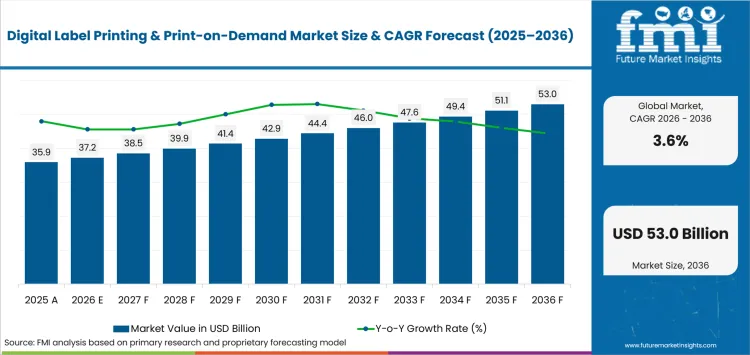
- Market Size (2026)
- USD 37.2 Bn
- Forecast (2036)
- USD 53.0 Bn
- CAGR (2026 to 2036)
- 3.6%
How big is Digital Label Printing & Print-on-Demand Market in 2026?
USD 37.2 billion in 2026 and USD 53.0 billion by 2036 at a 3.6% CAGR.
Sales of digital label printing and print-on-demand systems are projected to expand at 3.6% CAGR from 2026 to 2036, increasing valuation from USD 37.2 billion to USD 53.0 billion. Adoption of next-generation barcode technologies is increasing demand for flexible digital printing platforms capable of handling frequent data and design updates. GS1 reported in January 2025 that companies were testing next-generation barcodes in more than 45 countries representing about 85% of global GDP. The transition increases the need for variable-data output that preserves batch numbers and serialized information across frequent artwork changes. Stable color control and code verification through finishing protect the margin gained from faster setup by limiting costly rework.
United States retail networks manage label changes across stores and fulfillment sites through distributed equipment fleets and service routes. Japanese plants emphasize compact equipment and controlled product versions across facilities with tighter production space. Brother reported in January 2026 that its mobile thermal systems support in-aisle and warehouse labeling across distributed retail operations. The announcement confirms current workflow availability rather than proving broader category growth or immediate equipment purchasing. American projects should compare remote fleet management and local service response across every operating location. Japanese projects should emphasize compact equipment footprints and repeatable color across localized product ranges with frequent artwork changes. Equipment comparisons improve through service measures for industrial printers that separate rated speed from uptime and technical response coverage.
Key Takeaways
- Frequent artwork revisions and data-rich codes support short-run digital production that reduces plate preparation and obsolete label inventories.
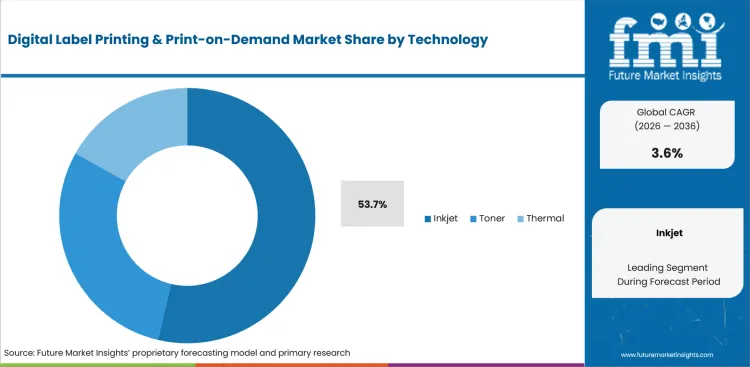
- By technology, inkjet is projected to account for 53.7% in 2026 due to rapid changeovers and controlled variable-data output.
- By end user, SMB is estimated to hold 42.5% in 2026 owing to compact workflows and varied customer orders.
- By application, product is forecast to represent 42.2% in 2026 driven by combined branding and traceability requirements.
- Substrate qualification and food-contact requirements extend approval cycles across labels that use different materials or curing conditions.
- Competition includes industrial color presses from Epson and HP Indigo; thermal systems from Zebra and Brother; and compact workflows from Primera, Afinia Label and Roland DG.
Analyst Perspective
"Digital label investment should begin with the substrates and variable-data changes handled during a normal production week. Equipment value depends on reproducing color and 2D codes across short runs without repeating setup for each regulated label version. Executives should compare verified uptime and finishing compatibility with obsolete inventory costs before expanding capacity across product lines."
- Nandini Roy Choudhury, Principal Analyst, Future Market Insights
How is the Digital Label Printing And Print-On-Demand Market segmented?
The digital label printing & print-on-demand industry is segmented by Technology, End User, Application, and Region.
Technology separates inkjet, toner, and thermal systems according to imaging method, consumable use, and control across data preparation, printing, and finishing. End user groups SMB, industrial, and retail operations by job frequency, production volume, staffing depth, and available floor space. Application divides product, shipping, and badge labels according to durability, information density, regulatory content, and the period each label must remain readable. Regional analysis compares service access, packaging rules, material approval routes, and production economics across countries. Thermal printing provides a related benchmark for fixed-data and logistics workflows across distributed shipping and retail operations. Digital color systems address frequent artwork changes and broader branding requirements across short-run product programs.
What supports Inkjet within the technology category?
Printed label production requires fast artwork changes and repeatable color across every approved substrate lot in commercial use. Epson announced in March 2025 that its SurePress L-4733AW and L-6534VW systems received Idealliance certification for color accuracy and registration. The certification gives label producers a documented comparison point for repeatability across variable jobs and approved production materials. Inkjet gains practical value through digital front ends that control files and color profiles from data preparation through finished-label inspection.
- Inkjet is set to lead the technology category with 53.7% share in 2026 due to faster changeovers across variable label jobs. Digital imaging removes plate preparation and supports variable-data output across mixed order sizes with frequent artwork changes. Repeatable color and code checks across approved materials protect this position during recurring commercial production runs.
- Label producers usually begin inkjet adoption with representative trials covering color stability and adhesion across the materials used most often. The same trial must confirm finishing compatibility and code readability at the intended line speed. Prolonged downtime removes the margin gained through short setup cycles and makes local maintenance coverage a commercial requirement.
What drives SMB's position within the end user category?
Small and medium-sized print operations manage varied local orders with limited prepress staffing and less floor space than a full production press line requires. Desktop label printers become valuable through direct design-to-output control that lets one operator prepare artwork and manage recurring short runs within the same workflow. Roland DG introduced the VersaSTUDIO BN2-30 and BD-12 in June 2025 for compact production spaces and documented a current route for adding capacity without large press infrastructure.
- Based on end user, SMB is projected to account for 42.5% in 2026 due to compact workflows and varied local order volumes. The segment fits operations that need short setup cycles without a dedicated industrial prepress team. Manageable service costs and sustained equipment use determine whether recurring local jobs support the investment.
- SMB adoption often starts with a narrow set of repeat jobs that reveals actual ink use and maintenance needs. Managers add new applications as staff gain confidence with color profiles and finishing adjustments across recurring production jobs. Financing and local service remain material constraints for operations without backup equipment or dedicated technical staff during busy production periods.
What makes product central within the application category?
Product labels carry branding and batch information alongside regulated content that changes by flavor and destination. Frequent revisions increase obsolete-inventory risk across portfolios with several identifiers and language versions in use. Controlled templates and approved materials must preserve design quality and traceability within one regulated release process. Afinia Label reported in July 2025 that an implantable-device manufacturer replaced bulk preprinted stock with on-demand variable production to reduce obsolete labels across identifiers and language versions.
- By application, product is forecast to represent 42.2% in 2026 driven by combined branding and traceability needs. The application carries brand design and regulated information across portfolios with frequent version-change cycles during recurring production. Controlled templates and material approval preserve its position across intended package formats and product versions during recurring commercial production.
- Brand teams adopt on-demand product labeling to reduce obsolete stock during artwork revisions and limited seasonal releases. Effective packaging print systems connect approved templates with controlled data fields and documented material combinations across production sites. Quality specialists must confirm migration limits and code readability prior to commercial release for every intended package format.
What are the drivers, restraints, and opportunities in the Digital Label Printing And Print-On-Demand Market?
Variable-data requirements support demand as substrate qualification slows conversion and packaging redesign creates an opening for controlled short-run updates.
- Driver: Data-rich codes and frequent artwork revisions support digital workflows that preserve accuracy across short production runs.
- Restraint: Substrate behavior and migration limits extend qualification across materials that respond differently during curing and application.
- Opportunity: Packaging rule changes create demand for controlled label revisions that reduce obsolete stock across changing product portfolios.
Data-rich codes create a direct demand driver by placing more product information inside the existing label area. GS1 ratified its retail 2D barcode implementation guideline in December 2025 with detailed requirements for barcode creation and print-quality verification. Digital barcode printer workflows update batch numbers and serialized fields without interrupting a complete production schedule. Label producers gain recurring work through programs that combine variable printing with documented code checks across every approved product version.
Substrate qualification creates a restraint through adhesion and migration differences across package structures used in commercial applications. Revised structures can change the surface and adhesive conditions covered by an existing label specification across affected product lines. The European Commission reported in February 2025 that the Packaging and Packaging Waste Regulation had entered into force with new design criteria for material use and recyclability. Each changed combination requires controlled tests prior to regular production because existing approval evidence may no longer cover the revised package.
PackUK published its disposal-fee modulation approach in June 2025 and linked future household packaging charges to recyclability. Modulated fees create an opportunity for digital label programs that support redesigns without accumulating obsolete printed stock. E-commerce packaging programs update sorting instructions and material claims through shorter cycles across several package versions. Digital print providers gain a stronger commercial opening through artwork control and approved materials with documented customer signoff for every revised format.
Which country CAGRs are profiled in the Digital Label Printing And Print-On-Demand Market?
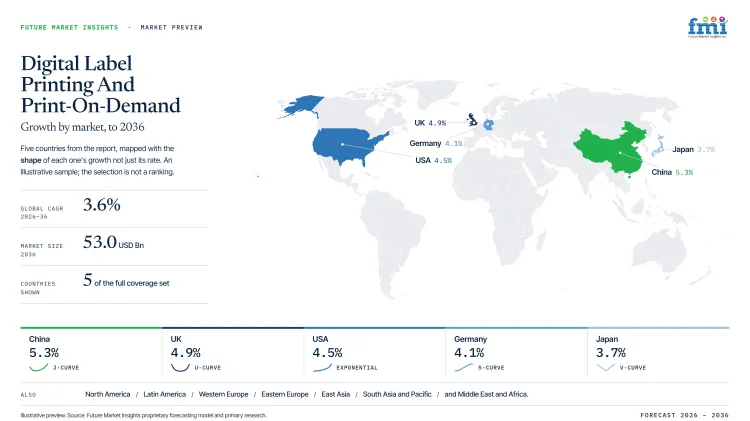
| Country | CAGR |
|---|---|
| USA | 4.5% |
| China | 5.3% |
| Germany | 4.1% |
| Japan | 3.7% |
| UK | 4.9% |
How do country-level CAGRs compare in the Digital Label Printing And Print-On-Demand Market?
The country forecasts show a clear progression across the digital label printing & print-on-demand market, with China and the UK forming an upper group supported by strong demand for short-run printing, customized packaging and flexible production models. The USA follows closely behind and remains connected to this group through a modest difference in projected growth. Germany and Japan create a lower pair with a relatively limited gap between their forecasts, reflecting more measured market expansion. The overall spread of 1.6 percentage points indicates that growth opportunities exist across all five countries despite differences in market maturity. This pattern reflects varying levels of digital printing adoption, demand for personalized packaging and the transition from conventional printing methods to on-demand production workflows.
- China shows a notable position within the comparison as expanding e-commerce activity and increasing demand for customized labels continue to accelerate adoption of digital printing technologies.
- The UK remains closely aligned with China as brand owners increasingly utilize short-run and variable-data printing solutions to improve product differentiation and operational flexibility.
- The USA benefits from a well-established print-on-demand ecosystem where demand for rapid turnaround times and customized packaging supports investment in digital label printing equipment.
- Germany reflects steady market development through the integration of advanced printing technologies and growing demand for efficient production of smaller label batches.
- Japan maintains a meaningful position within the comparison as manufacturers continue to adopt digital workflows that support precision printing, reduced waste and greater production flexibility.
Comparable CAGRs do not create identical market conditions across countries. Differences in printing infrastructure, packaging industry requirements, technology adoption rates and customer demand for customization can influence investment decisions and commercialization strategies. Similar growth forecasts may therefore reflect distinct operational priorities and competitive dynamics across digital label printing and print-on-demand applications. The full report provides country-level CAGR analysis across North America, Latin America, Europe, East Asia, South Asia, Oceania and the Middle East and Africa.
Country-wise Analysis
- United States label operations serve packaged foods that require ingredient and allergen statements across frequent recipe changes. The FDA issued food-allergen labeling guidance in January 2025 and clarified how major allergens must appear on product labels. By 2036 the USA digital label printing and print-on-demand market is projected to grow at 4.5% CAGR, aided by service coverage and recurring regulated revisions. The guidance creates direct work for controlled template updates across food portfolios with changing ingredient declarations. Regional equipment networks support expansion across production clusters that require reliable maintenance coverage and replacement support. Differing state packaging rules create friction for national specifications, so contracts should assign approval responsibility across every facility and product format.
- Chinese food producers must connect physical labels with digital information that remains readable and traceable across later revisions. In China, demand for digital label printing and print-on-demand systems is predicted to advance at 5.3% CAGR through 2036 due to packaged-food output and digital-label requirements. Dense manufacturing clusters support local equipment service and regular production use across concentrated consumer-goods operations. The State Administration for Market Regulation issued implementation rules in September 2025 for digital labels on prepackaged foods. The rules require clear digital presentation and traceable revision records across published information updates for packaged foods. Controlled digital records support repeat revisions without rebuilding every physical label from the beginning for each update. Export projects face additional friction because domestic rules must align with destination-market data and material requirements.
- German food and meat operations require clear product information across packaging that enters several retail channels. Germany's digital label printing and print-on-demand market is estimated to post 4.1% CAGR over the forecast period, influenced by regulated artwork changes and established service capacity. Germany's federal agriculture ministry extended the mandatory animal-husbandry labeling transition to March 2026 in May 2025. The change gives print operations a defined artwork deadline across affected fresh pork products sold through several retail channels. Experienced integrators support equipment replacement across industrial regions with established maintenance capabilities and local capacity. Smaller sites face longer service travel and narrower support choices, so investment plans should compare material libraries with response times at each location.
- Japanese production sites combine limited floor space with strict controls for claims on regulated food labels. Digital label printing and print-on-demand sales in Japan are forecast to expand at 3.7% CAGR by 2036, shaped by compact equipment needs and frequent version changes. Experienced printing teams support precise short-run work across localized product ranges with strict approval routines. Nearby maintenance routes reduce production risk for compact systems that operate without redundant equipment across smaller facilities. Japan's Consumer Affairs Agency proposed a food-labeling standards amendment in July 2025 for claims on functional foods. The change requires controlled artwork updates across affected products and documented review of every modified claim. Tight floor plans raise integration costs, so projects should prioritize automated calibration over maximum rated output.
- United Kingdom medicinal-pack operations require a clearly legible UK Only statement across products released into the national market. The Medicines and Healthcare products Regulatory Agency updated its Windsor Framework guidance in March 2025 and confirmed the requirement for new packs. Demand for digital label printing and print-on-demand systems in the UK is forecast to rise at 4.9% CAGR over the forecast period, reinforced by mandatory artwork changes and varied packaging programs. Digital workflows support controlled revisions without discarding large preprinted inventories across several regulated product lines. Separate UK and European Union requirements create friction for shared pack designs across medicines sold in both regions. Pharmaceutical production teams should confirm data ownership and approval routes across each regulated format prior to equipment expansion.
Who are the notable companies in the Digital Label Printing And Print-On-Demand Market?
Epson, Zebra, Brother, HP Indigo, Primera, Afinia Label, and Roland DG are the notable companies shaping this market.
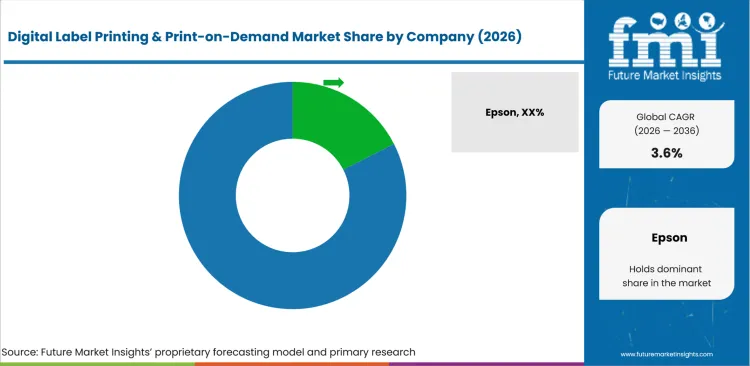
Competition spans industrial-scale digital presses and thermal label systems alongside integrated printer-cutters for compact production. Epson and HP Indigo address color-managed industrial output with workflow tools and regional service networks. Zebra and Brother focus on thermal labeling across retail and logistics environments with distributed equipment fleets and recurring media needs. Primera supports compact label printing and application for operations that do not require a full press line. Afinia Label combines digital printers with finishing equipment for short-run commercial work across specialized product programs. Roland DG links printing and contour cutting for customized labels and stickers across compact production environments with varied order sizes. Barcode consumables provide a related comparison for media coverage and printer compatibility across these company groups.
- Epson and HP Indigo compete through industrial presses that emphasize color control and repeatable output across varied label stocks. Afinia Label addresses shorter commercial runs through digital printers and finishing systems that support specialized product applications. Press selection depends on verified material coverage and local service capacity rather than rated speed alone.
- Zebra and Brother support thermal labeling across shipping and product-identification tasks in distributed retail and logistics environments. Primera adds compact printing and label application for operations that do not require a dedicated industrial press line. Consumable availability and fleet management shape practical equipment choice across operating locations with different service requirements.
- Roland DG combines printing and contour cutting for stickers and localized product labels within compact production spaces. Its commercial value depends on software compatibility and service response alongside finishing requirements beyond initial printing. Smaller operations gain a connected workflow that avoids separate cutting equipment and repeated file transfers.
Competitive Benchmarking: Digital Label Printing & Print-on-Demand Market
| Company | Digital Label Specification Fit | Print-on-Demand Workflow Support | Validation and Scale Support | Geographic Reach |
|---|---|---|---|---|
| Epson | High | High | High | Multi-region |
| Zebra | Medium | High | High | Multi-region |
| Brother | Medium | High | Medium | Multi-region |
| HP Indigo | High | High | High | Global |
| Primera | High | High | Medium | Multi-region |
| Afinia Label | High | High | Medium | Multi-region |
| Roland DG | Medium | High | High | Global |
Key Developments in the Digital Label Printing & Print-on-Demand Market
- In April 2026, Epson documented Casa Chocolates’ adoption of two ColorWorks CW-C6000A printers for daily small-batch product labels. The installation allowed immediate barcode and expiration-date updates without ordering large preprinted inventories for changing recipes. The deployment shows how on-demand color printing converts frequent product changes into controlled in-house production. Daily equipment use and automatic cutting also provide a clearer basis for measuring utilization across seasonal product ranges.
- In October 2025, Roland DG expanded Connect Designer with a Visual Communication Module that added vector editing and perforated-cut functions for labels and stickers. The cloud software sends prepared files directly to compatible printers and printer-cutters through automated output settings. The update reduces file-preparation work for small print operations that manage customized label jobs without dedicated prepress software. The change also preserves one connected workflow from design setup through contour cutting across repeated short jobs.
- In May 2026, Afinia Label published an Armina Bio deployment that replaced preprinted stock with an in-house L502 workflow. The installation supported variable designs and faster revisions through assistance from a local dealer during frequent small-batch changes. The documented project shows how compact digital equipment improves label control across product batches that do not justify large outsourced inventories. Local support also reduces training risk during the transition to in-house production across changing small-batch programs.
Key Players in the Digital Label Printing & Print-on-Demand Market
Industrial Digital Label Press Providers
- Epson
- HP Indigo
- Afinia Label
Desktop and Thermal Label Printing Providers
- Zebra
- Brother
- Primera
Integrated Print-and-Cut Providers
- Roland DG
Digital Label Printing & Print-on-Demand Market - Report Scope
| Coverage field | Report scope |
|---|---|
| Market breakdown | Technology, end user, application, and region. |
| Quantitative Units | Revenue in USD Million, CAGR in %. |
| Market Definition | Digital printing systems and associated workflows used to produce short-run or variable labels through inkjet, toner, or thermal technologies within print-on-demand operations. |
| Regions Covered | North America, Latin America, Western Europe, Eastern Europe, East Asia, South Asia and Pacific, and Middle East and Africa. |
| Countries Covered | USA, China, Germany, Japan, UK, and more than twenty-five additional countries in the full report. |
| Key Companies Profiled | Epson, Zebra, Brother, HP Indigo, Primera, Afinia Label, and Roland DG |
| Forecast Period | 2026 to 2036. |
| Approach | Hybrid bottom-up and top-down market sizing supported by primary interviews and official desk research. |
Digital Label Printing & Print-on-Demand Market - Research Methodology
| Method | Approach |
|---|---|
| Primary Research | FMI analysts gathered input from manufacturers, service providers, technology developers, distributors, end users, procurement teams, and subject-matter experts. Interviews examined purchasing decisions, product or service evaluation, adoption barriers, approval requirements, pricing considerations, and expectations for technical or commercial support. Respondents were also asked what evidence is required before a trial, pilot, or initial order develops into regular purchasing. |
| Desk Research | Desk research covered government statistics, regulatory publications, trade data, industry associations, technical literature, standards, company filings, product information, and official corporate announcements. Sources were reviewed for relevance, publication date, geographic coverage, and consistency with the defined market scope. Claims relating to performance, applications, approvals, capacity, investment, and commercial activity were retained only when supported by credible public evidence. |
| Market Sizing and Forecasting | The market model combined the baseline value with historical performance, segment structure, pricing and volume indicators, adoption levels, company participation, and country-level demand conditions. Forecast assumptions considered economic activity, investment trends, regulatory developments, technology adoption, purchasing cycles, supply availability, and barriers to wider market use. Segment and regional estimates were reconciled before the final market total was calculated. |
| Data Validation | Estimates were checked against multiple independent indicators, including public data, company activity, trade patterns, industry developments, and findings from primary interviews. Validation also tested whether products, services, applications, and company revenues fell within the defined market boundaries. Adjacent categories, unsupported claims, overlapping revenues, and activities without direct market relevance were excluded to reduce double counting and maintain consistency across segments and countries. |
Digital Label Printing & Print-on-Demand Market by Segments
Digital Label Printing & Print-on-Demand Market segmented by Technology:
- Inkjet
- Toner
- Thermal
Digital Label Printing & Print-on-Demand Market segmented by End User:
- SMB
- Industrial
- Retail
Digital Label Printing & Print-on-Demand Market segmented by Application:
- Product
- Shipping
- Badge Labels
Digital Label Printing & Print-on-Demand Market by Region:
- North America
- United States
- Canada
- Latin America
- Brazil
- Mexico
- Argentina
- Chile
- Western Europe
- Germany
- France
- United Kingdom
- Italy
- Spain
- Benelux
- Nordics
- Eastern Europe
- Poland
- Czech Republic
- Romania
- Hungary
- East Asia
- China
- Japan
- South Korea
- South Asia and Pacific
- India
- ASEAN
- Australia and New Zealand
- Middle East and Africa
- GCC Countries
- South Africa
- Türkiye
- Israel
Research Sources and Bibliography
- GS1 GO Customer Service Portal. (2025, January 8). How long will the transition to 2D barcodes take?
- GS1 AISBL. (2025, December). 2D Barcodes at Retail Point-of-Sale Implementation Guideline.
- Epson America, Inc. (2026, April 28). Artisan Chocolate Company Sweetens Labeling Operations with Epson ColorWorks.
- Epson America, Inc. (2025, March 3). Epson SurePress Models Receive Idealliance Digital Press System Certification.
- Roland DG Corporation. (2025, June 5). Roland DG Introduces Two VersaSTUDIO Printers to Expand the Capabilities of Its Compact Print/Cut and Direct-to-Object Devices.
- Afinia Label. (2025, July 17). Improving Compliance and Reducing Label Waste for an Implantable Device Manufacturer - Case Study.
- Directorate-General for Environment. (2025, February 11). New rules enter into force for a more sustainable and competitive packaging economy.
- PackUK. (2025, June 27). Extended producer responsibility for packaging: modulated disposal fees.
- USA Food and Drug Administration. (2025, January). Guidance for Industry: Questions and Answers Regarding Food Allergen Labeling (Edition 5).
- State Administration for Market Regulation. (2025, September 8).
- Bundesministerium für Landwirtschaft, Ernährung und Heimat. (2025, May 28). Übergangsfrist für Tierhaltungskennzeichnung wird verlängert.
- Consumer Affairs Agency. (2025, July 22).
- Medicines and Healthcare products Regulatory Agency. (2025, March 11). Labelling and packaging of medicinal products for human use following agreement of the Windsor Framework.
- Brother International Corporation. (2026, January 7). BROTHER TO SHOWCASE 100+ YEARS OF RETAIL INNOVATION AT NRF 2026- Retail printing and labeling solutions built for today’s modern retail environment.
- Primera Technology, Inc. (2025, September 8). International Petfood: PL400 Pouch Labeler by Primera.
- Roland DG Corporation. (2026, April 7). Roland DG continues to advance connected print workflows with Connect Designer expansion and VersaWorks 7 ColorMatch.
- Zebra Technologies Corporation. (2026, March 9). Zebra Opens Supplies Manufacturing Plant in Mexico, Advancing Asset Visibility and Automation Solutions in Latin America.
- Levit, H. (2026, February 11). A Decade of Digital Momentum: How HP Indigo and ePac Are Scaling the Future of Flexible Packaging.
- Roland DG Corporation. (2025, October 23). Roland DG expands Roland DG Connect Designer with new Visual Communication Module.
- Afinia Label. (2026, May 29). How Armina Bio Gained Control of Small-Batch Label Production.
This bibliography is provided for reader reference and is not exhaustive. The full report contains the complete reference list and detailed citations
This Report Answers
- How large is the digital label printing & print-on-demand market in 2026 and 2036?
- Which operating pressures support investment in short-run and variable label production?
- Why does Inkjet account for the largest Technology share in 2026?
- How does SMB influence equipment selection across the End User category?
- Why does Product capture the largest Application share in 2026?
- How do country growth rates differ across China, the UK, USA, Germany, and Japan?
- Which companies provide industrial presses, thermal printers, or integrated print-and-cut systems?
- What limits digital label performance across varied substrates and packaging requirements?
- How can print-on-demand workflows reduce obsolete inventories during frequent artwork changes?
Frequently Asked Questions
How big is the Digital Label Printing and Print-on-Demand Market in 2026?
The digital label printing and print-on-demand market is valued at USD 37.2 billion in 2026 and is forecast to reach USD 53.0 billion by 2036, reflecting growing demand for flexible digital printing platforms capable of handling frequent data and design updates across food, pharmaceutical, and consumer goods labeling programs.
What is the CAGR of the Digital Label Printing and Print-on-Demand Market from 2026 to 2036?
The digital label printing and print-on-demand market is projected to grow at a CAGR of 3.6% between 2026 and 2036, supported by data-rich barcode requirements and frequent artwork revisions that drive short-run digital workflows reducing plate preparation time and obsolete label inventory across changing product portfolios.
Which technology leads the Digital Label Printing and Print-on-Demand Market?
Inkjet accounts for 53.7% of the digital label printing and print-on-demand market by technology in 2026, driven by faster changeovers across variable label jobs and the ability to support data-rich output across mixed order sizes with frequent artwork changes without requiring plate preparation.
Which country is growing fastest in the Digital Label Printing and Print-on-Demand Market?
The digital label printing and print-on-demand market in China is projected to expand at a CAGR of 5.3% through 2036, ahead of the UK at 4.9%, the USA at 4.5%, Germany at 4.1%, and Japan at 3.7%, reflecting expanding e-commerce activity and increasing demand for customized labels alongside digital food-labeling regulations requiring traceable revision records across packaged consumer goods.
Who are the leading companies in the Digital Label Printing and Print-on-Demand Market?
Leading companies in the digital label printing and print-on-demand market include Epson, Zebra, Brother, HP Indigo, Primera, Afinia Label, and Roland DG, spanning industrial digital color presses, thermal label systems for retail and logistics, compact desktop workflows for small operations, and integrated print-and-cut platforms for customized short-run production.
Preview the report firsthand - request a free sample
Get SampleGet the brochure for pricing and purchase details.
Get PDFTable of Content
- Key Takeaways
- Market Size and CAGR
- Top Growth Driver
- Fastest Growing Segment
- Leading Region
- Key Companies
- Emerging Opportunities
- Executive Summary
- Global Market Outlook
- Demand-side Trends
- Supply-side Trends
- Technology Roadmap Analysis
- Analysis and Recommendations
- Analyst Perspective (What is happening? Why now? What should investors know?)
- Key Questions Answered
- How large is the market?
- What is the CAGR?
- What are key trends?
- Which region dominates?
- Who are the leaders?
- Market Overview
- Market Coverage / Taxonomy
- Market Definition / Scope / Limitations
- Research Methodology
- Chapter Orientation
- Analytical Lens and Working Hypotheses
- Market Structure, Signals, and Trend Drivers
- Benchmarking and Cross-market Comparability
- Market Sizing, Forecasting, and Opportunity Mapping
- Research Design and Evidence Framework
- Desk Research Programme (Secondary Evidence)
- Expert Input and Fieldwork (Primary Evidence)
- Tooling, Models, and Reference Databases
- Data Engineering and Model Build
- Quality Assurance and Audit Trail
- Market Background
- Market Dynamics (Drivers, Restraints, Opportunity, Trends)
- Scenario Forecast (Optimistic, Likely, Conservative)
- Impact Analysis
- AI Impact
- Sustainability Impact
- Regulatory Impact
- Technology Impact
- Consumer / Buyer Analysis
- Purchase Drivers
- Adoption Barriers
- Buyer Journey
- Opportunity Map Analysis
- Product Life Cycle Analysis
- Supply Chain Analysis
- Investment Feasibility Matrix
- Value Chain Analysis
- PESTLE and Porter's Analysis
- Regulatory Landscape
- Regional Parent Market Outlook
- Production and Consumption Statistics
- Import and Export Statistics
- Global Market Analysis and Forecast, 2021 to 2036
- Historical Market Size Value (USD Billion) Analysis, 2021 to 2025
- Current and Future Market Size Value (USD Billion) Projections, 2026 to 2036
- Y-o-Y Growth Trend Analysis
- Absolute $ Opportunity Analysis
- Global Market Pricing Analysis, 2021 to 2036
- Global Market Analysis and Forecast, By Technology, 2021 to 2036
- Introduction / Key Findings
- Historical Market Size Value (USD Billion) Analysis By Technology, 2021 to 2025
- Current and Future Market Size Value (USD Billion) Analysis and Forecast By Technology, 2026 to 2036
- Inkjet
- Toner
- Thermal
- Inkjet
- Y-o-Y Growth Trend Analysis By Technology, 2021 to 2025
- Absolute $ Opportunity Analysis By Technology, 2026 to 2036
- Global Market Analysis and Forecast, By End User, 2021 to 2036
- Introduction / Key Findings
- Historical Market Size Value (USD Billion) Analysis By End User, 2021 to 2025
- Current and Future Market Size Value (USD Billion) Analysis and Forecast By End User, 2026 to 2036
- SMB
- Industrial
- Retail
- SMB
- Y-o-Y Growth Trend Analysis By End User, 2021 to 2025
- Absolute $ Opportunity Analysis By End User, 2026 to 2036
- Global Market Analysis and Forecast, By Application, 2021 to 2036
- Introduction / Key Findings
- Historical Market Size Value (USD Billion) Analysis By Application, 2021 to 2025
- Current and Future Market Size Value (USD Billion) Analysis and Forecast By Application, 2026 to 2036
- Product
- Shipping
- Badge Labels
- Product
- Y-o-Y Growth Trend Analysis By Application, 2021 to 2025
- Absolute $ Opportunity Analysis By Application, 2026 to 2036
- Global Market Analysis and Forecast, By Region, 2021 to 2036
- Introduction
- Historical Market Size Value (USD Billion) Analysis By Region, 2021 to 2025
- Current Market Size Value (USD Billion) Analysis and Forecast By Region, 2026 to 2036
- North America
- Latin America
- Western Europe
- Eastern Europe
- East Asia
- South Asia and Pacific
- Middle East & Africa
- Market Attractiveness Analysis By Region
- North America Market Analysis and Forecast, By Country, 2021 to 2036
- Historical Market Size Value (USD Billion) Trend Analysis By Market Taxonomy, 2021 to 2025
- Market Size Value (USD Billion) Forecast By Market Taxonomy, 2026 to 2036
- By Country
- USA
- Canada
- By Technology
- By End User
- By Application
- By Country
- Market Attractiveness Analysis
- By Country
- By Technology
- By End User
- By Application
- Key Takeaways
- Latin America Market Analysis and Forecast, By Country
- Historical Market Size Value (USD Billion) Trend Analysis By Market Taxonomy, 2021 to 2025
- Market Size Value (USD Billion) Forecast By Market Taxonomy, 2026 to 2036
- By Country
- Brazil
- Mexico
- Chile
- Rest of Latin America
- By Technology
- By End User
- By Application
- By Country
- Market Attractiveness Analysis
- By Country
- By Technology
- By End User
- By Application
- Key Takeaways
- Western Europe Market Analysis and Forecast, By Country
- Historical Market Size Value (USD Billion) Trend Analysis By Market Taxonomy, 2021 to 2025
- Market Size Value (USD Billion) Forecast By Market Taxonomy, 2026 to 2036
- By Country
- Germany
- UK
- Italy
- Spain
- France
- Nordic
- BENELUX
- Rest of Western Europe
- By Technology
- By End User
- By Application
- By Country
- Market Attractiveness Analysis
- By Country
- By Technology
- By End User
- By Application
- Key Takeaways
- Eastern Europe Market Analysis and Forecast, By Country
- Historical Market Size Value (USD Billion) Trend Analysis By Market Taxonomy, 2021 to 2025
- Market Size Value (USD Billion) Forecast By Market Taxonomy, 2026 to 2036
- By Country
- Russia
- Poland
- Hungary
- Balkan & Baltic
- Rest of Eastern Europe
- By Technology
- By End User
- By Application
- By Country
- Market Attractiveness Analysis
- By Country
- By Technology
- By End User
- By Application
- Key Takeaways
- East Asia Market Analysis and Forecast, By Country
- Historical Market Size Value (USD Billion) Trend Analysis By Market Taxonomy, 2021 to 2025
- Market Size Value (USD Billion) Forecast By Market Taxonomy, 2026 to 2036
- By Country
- China
- Japan
- South Korea
- By Technology
- By End User
- By Application
- By Country
- Market Attractiveness Analysis
- By Country
- By Technology
- By End User
- By Application
- Key Takeaways
- South Asia and Pacific Market Analysis and Forecast, By Country
- Historical Market Size Value (USD Billion) Trend Analysis By Market Taxonomy, 2021 to 2025
- Market Size Value (USD Billion) Forecast By Market Taxonomy, 2026 to 2036
- By Country
- India
- ASEAN
- Australia & New Zealand
- Rest of South Asia and Pacific
- By Technology
- By End User
- By Application
- By Country
- Market Attractiveness Analysis
- By Country
- By Technology
- By End User
- By Application
- Key Takeaways
- Middle East & Africa Market Analysis and Forecast, By Country
- Historical Market Size Value (USD Billion) Trend Analysis By Market Taxonomy, 2021 to 2025
- Market Size Value (USD Billion) Forecast By Market Taxonomy, 2026 to 2036
- By Country
- Kingdom of Saudi Arabia
- Other GCC Countries
- Türkiye
- South Africa
- Other African Union
- Rest of Middle East & Africa
- By Technology
- By End User
- By Application
- By Country
- Market Attractiveness Analysis
- By Country
- By Technology
- By End User
- By Application
- Key Takeaways
- Key Countries Market Analysis
- USA
- Pricing Analysis
- Market Share Analysis, 2025
- By Technology
- By End User
- By Application
- Canada
- Pricing Analysis
- Market Share Analysis, 2025
- By Technology
- By End User
- By Application
- Mexico
- Pricing Analysis
- Market Share Analysis, 2025
- By Technology
- By End User
- By Application
- Brazil
- Pricing Analysis
- Market Share Analysis, 2025
- By Technology
- By End User
- By Application
- Chile
- Pricing Analysis
- Market Share Analysis, 2025
- By Technology
- By End User
- By Application
- Germany
- Pricing Analysis
- Market Share Analysis, 2025
- By Technology
- By End User
- By Application
- UK
- Pricing Analysis
- Market Share Analysis, 2025
- By Technology
- By End User
- By Application
- Italy
- Pricing Analysis
- Market Share Analysis, 2025
- By Technology
- By End User
- By Application
- Spain
- Pricing Analysis
- Market Share Analysis, 2025
- By Technology
- By End User
- By Application
- France
- Pricing Analysis
- Market Share Analysis, 2025
- By Technology
- By End User
- By Application
- India
- Pricing Analysis
- Market Share Analysis, 2025
- By Technology
- By End User
- By Application
- ASEAN
- Pricing Analysis
- Market Share Analysis, 2025
- By Technology
- By End User
- By Application
- Australia & New Zealand
- Pricing Analysis
- Market Share Analysis, 2025
- By Technology
- By End User
- By Application
- China
- Pricing Analysis
- Market Share Analysis, 2025
- By Technology
- By End User
- By Application
- Japan
- Pricing Analysis
- Market Share Analysis, 2025
- By Technology
- By End User
- By Application
- South Korea
- Pricing Analysis
- Market Share Analysis, 2025
- By Technology
- By End User
- By Application
- Russia
- Pricing Analysis
- Market Share Analysis, 2025
- By Technology
- By End User
- By Application
- Poland
- Pricing Analysis
- Market Share Analysis, 2025
- By Technology
- By End User
- By Application
- Hungary
- Pricing Analysis
- Market Share Analysis, 2025
- By Technology
- By End User
- By Application
- Kingdom of Saudi Arabia
- Pricing Analysis
- Market Share Analysis, 2025
- By Technology
- By End User
- By Application
- Türkiye
- Pricing Analysis
- Market Share Analysis, 2025
- By Technology
- By End User
- By Application
- South Africa
- Pricing Analysis
- Market Share Analysis, 2025
- By Technology
- By End User
- By Application
- USA
- Market Structure Analysis
- Competition Dashboard
- Competition Benchmarking
- Market Share Analysis of Top Players
- By Regional
- By Technology
- By End User
- By Application
- Emerging Startups
- Innovation Benchmarking
- Competition Analysis
- Competition Deep Dive
- Epson
- Overview
- Product Portfolio
- Profitability by Market Segments
- Sales Footprint
- Strategy Overview
- Marketing Strategy
- Product Strategy
- Channel Strategy
- Zebra
- Brother
- HP Indigo
- Primera
- Afinia
- Roland
- Epson
- Case Studies
- Success Stories
- Recent Developments
- Competition Deep Dive
- Assumptions & Acronyms Used


