

- Industry Size (2026)
- USD 2.5 Bn
- Forecast (2036)
- USD 3.6 Bn
- CAGR (2026 to 2036)
- 4.0%
Foil Labels Market Forecast and Outlook 2026 to 2036
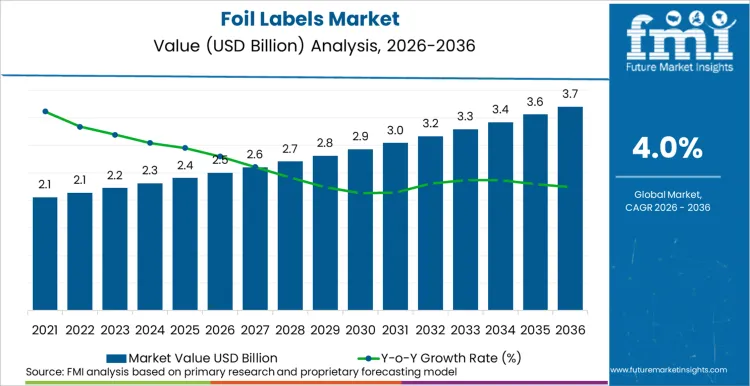
Foil labels market is poised to reach USD 2.5 billion in 2026, driven by an escalating demand for high-durability identification solutions in extreme industrial environments. The sector is projected to expand at a steady CAGR of 4.0% through 2036, pushing total sector worth beyond USD 3.6 billion by the conclusion of this assessment period. Increasing stringency of automotive safety standards, particularly UL 969, acts as a primary catalyst for this financial trajectory as per FMI's projection.
Counterfeit prevention and changing aesthetic preferences are significantly influencing industry expansion. Packaging engineers emphasize shelf appeal, utilizing the distinct reflectivity of hot stamping to capture consumer attention as per FMI's estimates. Clinical trials investigating the longevity of outdoor assets are creating needs for UV-stabilized foil constructions, instilling confidence among infrastructure developers regarding future product pipelines.
Growing awareness regarding brand integrity continues to fuel demand for tamper-evident void labels, creating sustained opportunities for security printing specialists. Government health initiatives targeting component traceability are facilitating wider adoption of serialized foil tags in transportation sectors. Companies are witnessing robust growth potential in developing nations, where expanding automotive production aligns perfectly with increased consumption of durable parts.
Quick Stats for Foil Labels Market
- Foil Labels Industry Value (2026): USD 2.5 Billion
- Foil Labels Industry Forecast Value (2036): USD 3.6 Billion
- Foil Labels Industry Forecast CAGR: 4.0%
- Foil Labels Industry Leading Form: Hot Stamping Foils (42.3%)
- Foil Labels Industry Leading End Use: Automotive (30.3%)
- Foil Labels Industry Leading Functionality: Metal Foils (49.5%)
- Foil Labels Industry Key Growth Regions: China, Brazil, USA
- Foil Labels Industry Key Players: 3M Company, Avery Dennison Corporation, UPM Raflatac, Hub Labels, Sappi Lanier
Companies are launching printed labels solutions that integrate near-field communication (NFC) beneath metallic surfaces for smart interaction. There is a notable trend towards acquiring regional converters to expand capabilities in short-run premium labeling. Manufacturers are also refining adhesive formulations to ensure compliance with emerging recycling protocols for plastic containers. This strategic pivot towards sustainable yet functional labeling ensures long-term relevance in a competitive landscape.
Does Gross Margin % Justify Premium Materials?
Specialized foil converters typically command gross margins between 28% and 34%, significantly higher than the 15-20% seen in standard labels. This premium reflects the value-added nature of metallic labels, which require precise die-cutting and expensive raw materials. Maintaining this margin relies on minimizing setup waste during the changeover between hot and cold foil processes.
How Does Production Cycle Time Vary by Technology?
Production cycle time is a critical differentiator; cold foil units can run inline at speeds up to 18,000 sheets per hour, whereas traditional hot stamping often tops out at 4,000 to 6,000 sheets per hour due to dwell time requirements. Converters balancing high-volume cold foil runs with high-margin hot stamp jobs optimize their overall throughput and asset utilization.
What Role Does Inventory Turnover Ratio Play?
Inventory turnover ratios generally average 5.5x to 7.0x annually for foil converters. Managing the shelf life of specialized pressure-sensitive adhesives and expensive foil rolls is vital to prevent capital lock-up. Efficient stock rotation ensures that time-sensitive self-adhesive labels materials perform reliably on high-speed application lines.
Foil Labels Market Key Takeaways
| Metric | Value |
|---|---|
| Industry Size (2026) | USD 2.5 Billion |
| Industry Value (2036) | USD 3.6 Billion |
| CAGR (2026–2036) | 4.0% |
Source: Future Market Insights (FMI) analysis, based on proprietary forecasting model and primary research
What Drivers Are Accelerating Premiumization Trends?
Shift toward luxury packaging is serving as a significant catalyst for broader acceptance of foil embellishments. Recent breakthroughs in wrap around labels application have demonstrated that metallic accents significantly improve on-shelf visibility compared to matte finishes. This holistic approach appeals to beverage and cosmetic giants seeking to justify premium price points through superior aesthetics. Clinical success of multi-part labels containing foil security features has expanded application possibilities in the pharmaceutical sector.
Education programs highlighting the correlation between packaging quality and perceived product value are driving procurement proactivity as per FMI's estimates. Converters are capitalizing on these trends by introducing tactile foil effects that simulate embossing. Integrating QR codes into foil designs is becoming considered standard, ensuring digital engagement is met without sacrificing the premium look.
How Is the Foil Labels Market Segmented Across Key Categories?
Global landscape is intricately segmented to address diverse requirements of automotive, construction, and consumer goods sectors, categorizing sector by material type, foil type, and end-use. Structural division allows stakeholders to identify specific growth pockets, such as rising demand for transfer foils in logistics or preference for metal foils in heavy machinery.
By analyzing these segments, manufacturers can tailor production lines to meet distinct needs of durable asset tracking versus fast-moving consumer goods branding. Segmentation also highlights shift from rigid metal plates to flexible polymer-based foils. As industry matures, granular segmentation becomes essential for understanding flow of capital and innovation, ensuring product development aligns perfectly with evolving durability mandates of global supply chains.
Why Do Metal Foils Maintain Dominance?
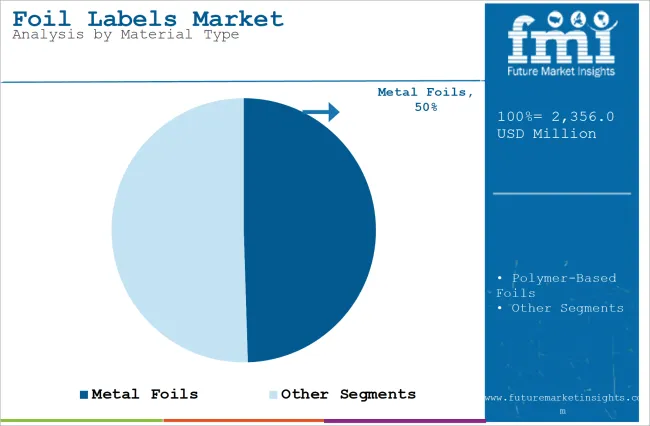
Metal Foils account for 49.5% of share in 2026, driven by their unmatched durability and resistance to harsh environmental conditions. Leadership position is underpinned by widespread adoption in the automotive and aerospace sectors, where labels must survive extreme heat and chemical exposure. Segment benefits from continuous alloy improvements, allowing for thinner gauges without compromising tensile strength.
Research focused on booklet label integration suggests that metal covers provide superior protection for multi-page instructions. Critical role in managing asset lifecycles further solidifies standing, as these labels remain legible for decades. As supply chains prioritize long-term traceability, demand for robust metal formats is expected to remain robust.
Why Do Hot Stamping Foils Lead the Market?
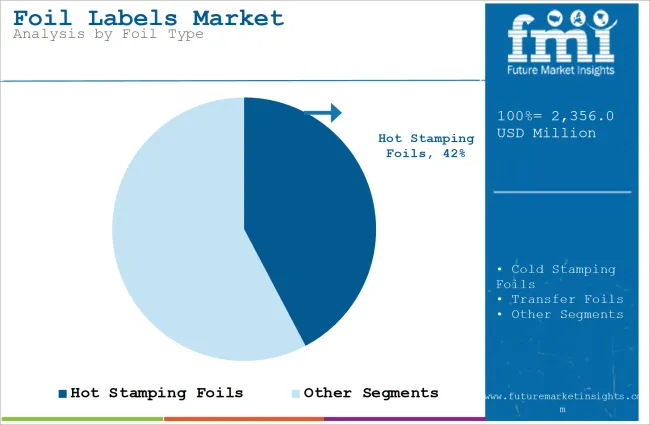
Hot Stamping Foils command 42.3% share of sector in 2026, reflecting global reliance on high-quality, permanent bonding for luxury and security applications. Dominance is inextricably linked to the superior brightness and tactile finish that only heat transfer can achieve. Manufacturers rely on specialized cut and stack labels processes to apply these foils to high-volume beverage runs as per FMI's projection.
These settings are essential for handling premium branding requirements, driving priority status in procurement budgets. Relentless pursuit of anti-counterfeiting measures ensures foils designed with holographic patterns remain top priority. High consumption volume necessitates dynamic material supply, bolstering sustained revenue streams for foil manufacturers.
How Will Digital Printing Redefine Sales?
Digital technology adoption is set to reshape sales landscapes by altering demand for traditional die-based stamping. As digital label printing evolves, brands access digital foil solutions that allow for variable data and short runs without expensive tooling. Shift toward personalization creates demand for unique, one-off metallic designs for promotional campaigns. Manufacturers failing to upgrade to digital embellishment capabilities risk losing visibility among agile startups. Availability of hybrid presses drives complimentary consumption of both analog and digital foils. Rise of "sleeking" technologies stimulates innovation, with companies differentiating offerings by providing metallic effects on demand without dies.
What Role Does Sustainability Play in Future Growth?
Eco-design adoption is set to reshape manufacturing priorities by demanding foils that do not render packaging unrecyclable. As waste reduction targets mount, brands demand sustainable labels solutions where the metallic layer is thin enough to bypass sorting sensors. Shift toward transfer foils creates demand for zero-waste application methods where no carrier film is left behind. Manufacturers failing to optimize label adhesive and ink systems for wash-off recyclability risk losing visibility among eco-conscious global brands. Availability of liner recycling programs drives complimentary consumption of pressure-sensitive solutions. Rise of bio-based carriers stimulates innovation, with companies differentiating offerings by providing superior environmental credentials.
How Are Anti-Counterfeiting Needs Influencing Design?
Security feature adoption is set to reshape manufacturing priorities by demanding overt and covert verification tools. As illicit trade mounts, brands demand packaging that validates authenticity instantly through holographic effects. Shift toward serialization-ready foils creates demand for materials compatible with laser marking. Manufacturers failing to optimize designs for track-and-trace risk losing visibility among security-conscious markets. Availability of micro-embossed foils drives complimentary consumption of secure packaging. Rise of blockchain-enabled supply chains stimulates innovation, with companies differentiating offerings by providing end-to-end traceability credentials through tamper-evident design.
How Will the Foil Labels Industry Evolve in Major Nations?
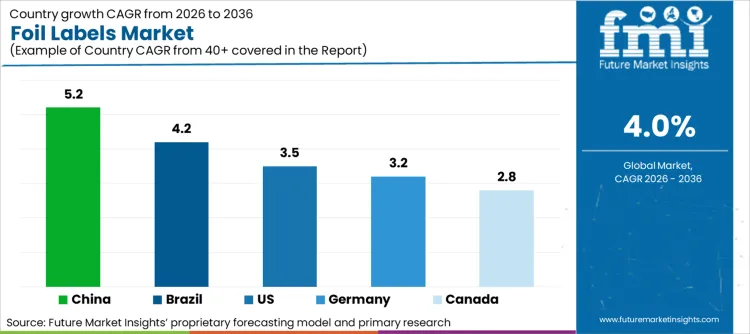
Global landscape for specialty identification is characterized by diverse growth patterns, influenced by industrial output and safety regulations. Established markets prioritize security and sustainability, whereas emerging economies rely on automotive expansion to support rising consumption. Asia-Pacific is emerging as rapid growth hub due to manufacturing dominance and expanding vehicle production. Conversely, North American sectors pivot towards high-value asset tracking and compliance labeling. Government initiatives in developing nations supporting industrial modernization ensure sustained demand for durable labeling solutions across all geographies.
| Country | CAGR (2026 to 2036) |
|---|---|
| China | 5.2% |
| Brazil | 4.2% |
| USA | 3.5% |
| Germany | 3.2% |
| Canada | 2.8% |
Source: Future Market Insights’ proprietary forecasting model and primary research
Why is the Foil Labels Sector in China Expanding?
Demand for industrial labels in China is projected to rise at 5.2% CAGR during assessment period. Initiatives emphasizing "Made in China 2025" industrial upgrades foster favorable environment for domestic and international vendors. Increasing investment in automotive manufacturing creates massive supply channel for durable engine labels. Rising electronics production requiring heat-resistant tags prompts local brands to seek compliant solutions. Shift is supported by government policies enforcing stricter product quality standards, accelerating uptake of reliable identification materials across country and fueling sector expansion.
Why is the Foil Labels Industry in Brazil Growing?
Foil Labels industry in Brazil is poised to expand at 4.2% CAGR. Surge is largely attributed to robust agricultural and automotive sectors. Government focus on improving logistics infrastructure encourages facilities to opt for durable tracking labels. Increasing partnerships between regional converters and global material suppliers necessitate availability of advanced adhesive grades. High humidity and temperature conditions combined with long-haul transport attract significant investment in weather-resistant labels. Strict adherence to export compliance regulations further drives adoption of quality-assured tracking materials.
Why is the Foil Labels Industry in the USA Showing Potential?
Sales of specialty labels in USA are set to grow at 3.5% CAGR through 2036. Expansion is underpinned by stringent UL and CSA directives regarding durable goods labeling. Growth is fueled by widespread shift towards premium packaging in craft beverage sectors. Rapid adoption of smart labels for asset management drives revenue generation per unit. Presence of major automotive and aerospace hubs within country streamlines supply chains. Emphasis on brand protection and anti-counterfeiting continues to be primary driver, maintaining USA's position as critical innovation generator as per FMI analyst opinion.
Why is the Foil Labels Industry in Germany Showing Stability?
Foil Labels industry in Germany is poised to expand at 3.2% CAGR. Surge is largely attributed to strong engineering heritage and focus on high-performance automotive components. Government focus on circular economy encourages facilities to opt for recyclable foil solutions. Increasing partnerships between machinery firms and label converters necessitate availability of high-precision application systems. High environmental standards combined with export-oriented manufacturing attract significant investment. Strict adherence to EU safety directives further drives adoption of compliant informational solutions.
Why is the Foil Labels Sector in Canada Expanding?
Demand for durable labels in Canada is projected to rise at 2.8% CAGR during assessment period. Initiatives emphasizing resource sector efficiency foster favorable environment for rugged tagging vendors. Increasing investment in food and beverage processing creates steady supply channel for premium foil labels. Rising awareness regarding product provenance prompts local administrators to seek secure solutions. Shift is supported by government policies encouraging transparent consumer information, accelerating uptake of extended content designs across country and fueling sector expansion.
What is the Competitive Outlook for the Foil Labels Market?
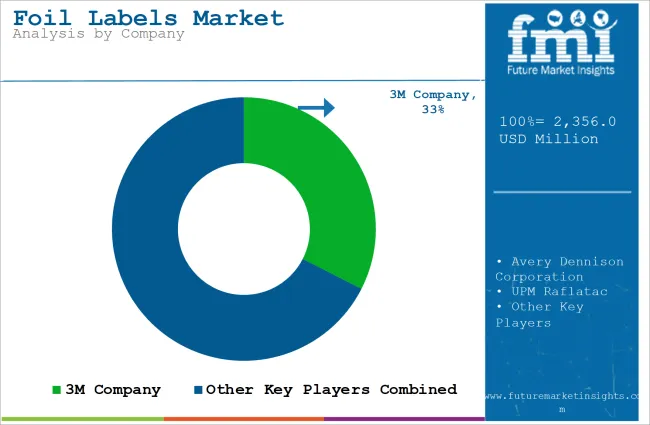
Market participants are increasingly focusing on vertical integration to capture value from high-growth industrial sectors. Leading players like 3M and Avery Dennison are directing investment toward developing high-performance adhesives that bond to low-surface-energy plastics as per FMI's estimates. Significant trend involves developing proprietary hot stamping foil formulations that reduce energy consumption during application.
Companies actively engage in strategic collaborations with pigment hot stamping foil suppliers to offer a wider color gamut. Sustainability emerges as competitive frontier, with providers exploring foil laminates that use recycled aluminum. Consolidation activities remain high as large packaging conglomerates acquire specialized label converters to broaden their value-added offerings against regional competitors. 3M Company holds a significant 26% share, leveraging its robust adhesive science capabilities.
Key Players in Foil Labels Market
- 3M Company
- Avery Dennison Corporation
- UPM Raflatac
- Hub Labels
- Sappi Lanier
- Multi-Color Corporation (MCC)
- E. I. du Pont de Nemours and Company
- Henkel AG & Company
- Brady Corporation Limited
- Cannon Inc.
- Xerox Corporation
- Cenveo Inc
Scope of Report
| Items | Values |
|---|---|
| Quantitative Units | USD Billion |
| Material Type | Metal Foils, Polymer-based foils |
| Foil Type | Hot Stamping Foils, Cold stamping foils, Transfer foils |
| End Use | Automotive, Construction, Transportation & logistics, Consumer durables, Others |
| Regions | North America, Europe, East Asia, South Asia, Latin America, MEA |
Key Segments of the Foil Labels Industry
Material Type
- Metal Foils
- Polymer-based foils
Foil Type
- Hot Stamping Foils
- Cold stamping foils
- Transfer foils
End Use
- Automotive
- Construction
- Transportation & logistics
- Consumer durables
- Others
Bibliography
- International Organization for Standardization. (2024). ISO 17351: Product identification and traceability using RFID and data carriers – Labeling and marking requirements. International Organization for Standardization.
- European Commission. (2024). Guidance on product labeling, marking, and traceability requirements under the General Product Safety Regulation (EU) 2023/988. European Commission, European Union.
- U.S. Food and Drug Administration. (2024). Labeling requirements for medical devices and combination products: Compliance policy and enforcement guidance. U.S. Food and Drug Administration, United States.
- Underwriters Laboratories. (2024). UL 969: Marking and labeling systems for durability, permanence, and legibility (current edition in force). Underwriters Laboratories, United States.
- International Automotive Task Force. (2024). IATF 16949: Automotive quality management systems – Product identification, labeling, and traceability requirements. International Automotive Task Force.
- European Committee for Standardization. (2024). EN standards for durable product marking, safety labels, and environmental resistance testing. European Committee for Standardization, European Union.
Frequently Asked Questions
How large is the demand for Foil Labels in the global market in 2026?
Demand for Foil Labels in global market is estimated to be valued at USD 2.5 billion in 2026 as per FMI's estimates.
What will be the market size of Foil Labels in the global market by 2036?
Market size for Foil Labels in global market is projected to reach USD 3.6 billion by 2036.
What is the expected demand growth for Foil Labels in the global market between 2026 and 2036?
Demand for Foil Labels in global market is expected to grow at CAGR of 4.0% between 2026 and 2036.
Which Material Type is poised to lead global sales by 2026?
Metal Foils are expected to be dominant material type, capturing approximately 49.5% of global market share in 2026 due to superior durability.
How significant is the role of Automotive End Use in driving Foil Labels adoption in 2026?
Automotive End Use represents critical application, projected to hold substantial 30.3% share of total market in 2026 as safety compliance needs rise.
Preview the report firsthand - request a free sample
Get SampleGet the brochure for pricing and purchase details.
Get PDFTable of Content
- Executive Summary
- Global Market Outlook
- Demand-side Trends
- Supply-side Trends
- Technology Roadmap Analysis
- Analysis and Recommendations
- Market Overview
- Market Coverage / Taxonomy
- Market Definition / Scope / Limitations
- Research Methodology
- Chapter Orientation
- Analytical Lens and Working Hypotheses
- Market Structure, Signals, and Trend Drivers
- Benchmarking and Cross-market Comparability
- Market Sizing, Forecasting, and Opportunity Mapping
- Research Design and Evidence Framework
- Desk Research Programme (Secondary Evidence)
- Company Annual and Sustainability Reports
- Peer-reviewed Journals and Academic Literature
- Corporate Websites, Product Literature, and Technical Notes
- Earnings Decks and Investor Briefings
- Statutory Filings and Regulatory Disclosures
- Technical White Papers and Standards Notes
- Trade Journals, Industry Magazines, and Analyst Briefs
- Conference Proceedings, Webinars, and Seminar Materials
- Government Statistics Portals and Public Data Releases
- Press Releases and Reputable Media Coverage
- Specialist Newsletters and Curated Briefings
- Sector Databases and Reference Repositories
- Roots Internal Knowledge Base and Historical Datasets
- Subscription Datasets and Paid Sources
- Social Channels, Communities, and Digital Listening Inputs
- Additional Desk Sources
- Expert Input and Fieldwork (Primary Evidence)
- Primary Modes
- Qualitative Interviews and Expert Elicitation
- Quantitative Surveys and Structured Data Capture
- Blended A8oach
- Why Primary Evidence is Used
- Field Techniques
- Interviews
- Surveys
- Focus Groups
- Observational and In-context Research
- Social and Community Interactions
- Stakeholder Universe Engaged
- C-suite Leaders
- Board Members
- Presidents and Vice Presidents
- R&D and Innovation Heads
- Technical Specialists
- Domain Subject-matter Experts
- Scientists
- Physicians and Other Healthcare Professionals
- Governance, Ethics, and Data Stewardship
- Research Ethics
- Data Integrity and Handling
- Primary Modes
- Tooling, Models, and Reference Databases
- Desk Research Programme (Secondary Evidence)
- Data Engineering and Model Build
- Data Acquisition and Ingestion
- Cleaning, Normalisation, and Verification
- Synthesis, Triangulation, and Analysis
- Quality Assurance and Audit Trail
- Market Background
- Market Dynamics
- Drivers
- Restraints
- Opportunity
- Trends
- Scenario Forecast
- Demand in Optimistic Scenario
- Demand in Likely Scenario
- Demand in Conservative Scenario
- Opportunity Map Analysis
- Product Life Cycle Analysis
- Supply Chain Analysis
- Investment Feasibility Matrix
- Value Chain Analysis
- PESTLE and Porter’s Analysis
- Regulatory Landscape
- Regional Parent Market Outlook
- Production and Consumption Statistics
- Import and Export Statistics
- Market Dynamics
- Global Market Analysis 2021 to 2025 and Forecast, 2026 to 2036
- Historical Market Size Value (USD Million) Analysis, 2021 to 2025
- Current and Future Market Size Value (USD Million) Projections, 2026 to 2036
- Y-o-Y Growth Trend Analysis
- Absolute $ Opportunity Analysis
- Global Market Pricing Analysis 2021 to 2025 and Forecast 2026 to 2036
- Global Market Analysis 2021 to 2025 and Forecast 2026 to 2036, By Material Type
- Introduction / Key Findings
- Historical Market Size Value (USD Million) Analysis By Material Type , 2021 to 2025
- Current and Future Market Size Value (USD Million) Analysis and Forecast By Material Type , 2026 to 2036
- Metal Foils
- Polymer-based foils
- Metal Foils
- Y-o-Y Growth Trend Analysis By Material Type , 2021 to 2025
- Absolute $ Opportunity Analysis By Material Type , 2026 to 2036
- Global Market Analysis 2021 to 2025 and Forecast 2026 to 2036, By Foil Type
- Introduction / Key Findings
- Historical Market Size Value (USD Million) Analysis By Foil Type, 2021 to 2025
- Current and Future Market Size Value (USD Million) Analysis and Forecast By Foil Type, 2026 to 2036
- Hot Stamping Foils
- Cold stamping foils
- Transfer foils
- Hot Stamping Foils
- Y-o-Y Growth Trend Analysis By Foil Type, 2021 to 2025
- Absolute $ Opportunity Analysis By Foil Type, 2026 to 2036
- Global Market Analysis 2021 to 2025 and Forecast 2026 to 2036, By End Use
- Introduction / Key Findings
- Historical Market Size Value (USD Million) Analysis By End Use, 2021 to 2025
- Current and Future Market Size Value (USD Million) Analysis and Forecast By End Use, 2026 to 2036
- Automotive
- Construction
- Transportation & logistics
- Consumer durables
- Others
- Automotive
- Y-o-Y Growth Trend Analysis By End Use, 2021 to 2025
- Absolute $ Opportunity Analysis By End Use, 2026 to 2036
- Global Market Analysis 2021 to 2025 and Forecast 2026 to 2036, By Region
- Introduction
- Historical Market Size Value (USD Million) Analysis By Region, 2021 to 2025
- Current Market Size Value (USD Million) Analysis and Forecast By Region, 2026 to 2036
- North America
- Latin America
- Western Europe
- Eastern Europe
- East Asia
- South Asia and Pacific
- Middle East & Africa
- Market Attractiveness Analysis By Region
- North America Market Analysis 2021 to 2025 and Forecast 2026 to 2036, By Country
- Historical Market Size Value (USD Million) Trend Analysis By Market Taxonomy, 2021 to 2025
- Market Size Value (USD Million) Forecast By Market Taxonomy, 2026 to 2036
- By Country
- USA
- Canada
- Mexico
- By Material Type
- By Foil Type
- By End Use
- By Country
- Market Attractiveness Analysis
- By Country
- By Material Type
- By Foil Type
- By End Use
- Key Takeaways
- Latin America Market Analysis 2021 to 2025 and Forecast 2026 to 2036, By Country
- Historical Market Size Value (USD Million) Trend Analysis By Market Taxonomy, 2021 to 2025
- Market Size Value (USD Million) Forecast By Market Taxonomy, 2026 to 2036
- By Country
- Brazil
- Chile
- Rest of Latin America
- By Material Type
- By Foil Type
- By End Use
- By Country
- Market Attractiveness Analysis
- By Country
- By Material Type
- By Foil Type
- By End Use
- Key Takeaways
- Western Europe Market Analysis 2021 to 2025 and Forecast 2026 to 2036, By Country
- Historical Market Size Value (USD Million) Trend Analysis By Market Taxonomy, 2021 to 2025
- Market Size Value (USD Million) Forecast By Market Taxonomy, 2026 to 2036
- By Country
- Germany
- UK
- Italy
- Spain
- France
- Nordic
- BENELUX
- Rest of Western Europe
- By Material Type
- By Foil Type
- By End Use
- By Country
- Market Attractiveness Analysis
- By Country
- By Material Type
- By Foil Type
- By End Use
- Key Takeaways
- Eastern Europe Market Analysis 2021 to 2025 and Forecast 2026 to 2036, By Country
- Historical Market Size Value (USD Million) Trend Analysis By Market Taxonomy, 2021 to 2025
- Market Size Value (USD Million) Forecast By Market Taxonomy, 2026 to 2036
- By Country
- Russia
- Poland
- Hungary
- Balkan & Baltic
- Rest of Eastern Europe
- By Material Type
- By Foil Type
- By End Use
- By Country
- Market Attractiveness Analysis
- By Country
- By Material Type
- By Foil Type
- By End Use
- Key Takeaways
- East Asia Market Analysis 2021 to 2025 and Forecast 2026 to 2036, By Country
- Historical Market Size Value (USD Million) Trend Analysis By Market Taxonomy, 2021 to 2025
- Market Size Value (USD Million) Forecast By Market Taxonomy, 2026 to 2036
- By Country
- China
- Japan
- South Korea
- By Material Type
- By Foil Type
- By End Use
- By Country
- Market Attractiveness Analysis
- By Country
- By Material Type
- By Foil Type
- By End Use
- Key Takeaways
- South Asia and Pacific Market Analysis 2021 to 2025 and Forecast 2026 to 2036, By Country
- Historical Market Size Value (USD Million) Trend Analysis By Market Taxonomy, 2021 to 2025
- Market Size Value (USD Million) Forecast By Market Taxonomy, 2026 to 2036
- By Country
- India
- ASEAN
- Australia & New Zealand
- Rest of South Asia and Pacific
- By Material Type
- By Foil Type
- By End Use
- By Country
- Market Attractiveness Analysis
- By Country
- By Material Type
- By Foil Type
- By End Use
- Key Takeaways
- Middle East & Africa Market Analysis 2021 to 2025 and Forecast 2026 to 2036, By Country
- Historical Market Size Value (USD Million) Trend Analysis By Market Taxonomy, 2021 to 2025
- Market Size Value (USD Million) Forecast By Market Taxonomy, 2026 to 2036
- By Country
- Kingdom of Saudi Arabia
- Other GCC Countries
- Turkiye
- South Africa
- Other African Union
- Rest of Middle East & Africa
- By Material Type
- By Foil Type
- By End Use
- By Country
- Market Attractiveness Analysis
- By Country
- By Material Type
- By Foil Type
- By End Use
- Key Takeaways
- Key Countries Market Analysis
- USA
- Pricing Analysis
- Market Share Analysis, 2025
- By Material Type
- By Foil Type
- By End Use
- Canada
- Pricing Analysis
- Market Share Analysis, 2025
- By Material Type
- By Foil Type
- By End Use
- Mexico
- Pricing Analysis
- Market Share Analysis, 2025
- By Material Type
- By Foil Type
- By End Use
- Brazil
- Pricing Analysis
- Market Share Analysis, 2025
- By Material Type
- By Foil Type
- By End Use
- Chile
- Pricing Analysis
- Market Share Analysis, 2025
- By Material Type
- By Foil Type
- By End Use
- Germany
- Pricing Analysis
- Market Share Analysis, 2025
- By Material Type
- By Foil Type
- By End Use
- UK
- Pricing Analysis
- Market Share Analysis, 2025
- By Material Type
- By Foil Type
- By End Use
- Italy
- Pricing Analysis
- Market Share Analysis, 2025
- By Material Type
- By Foil Type
- By End Use
- Spain
- Pricing Analysis
- Market Share Analysis, 2025
- By Material Type
- By Foil Type
- By End Use
- France
- Pricing Analysis
- Market Share Analysis, 2025
- By Material Type
- By Foil Type
- By End Use
- India
- Pricing Analysis
- Market Share Analysis, 2025
- By Material Type
- By Foil Type
- By End Use
- ASEAN
- Pricing Analysis
- Market Share Analysis, 2025
- By Material Type
- By Foil Type
- By End Use
- Australia & New Zealand
- Pricing Analysis
- Market Share Analysis, 2025
- By Material Type
- By Foil Type
- By End Use
- China
- Pricing Analysis
- Market Share Analysis, 2025
- By Material Type
- By Foil Type
- By End Use
- Japan
- Pricing Analysis
- Market Share Analysis, 2025
- By Material Type
- By Foil Type
- By End Use
- South Korea
- Pricing Analysis
- Market Share Analysis, 2025
- By Material Type
- By Foil Type
- By End Use
- Russia
- Pricing Analysis
- Market Share Analysis, 2025
- By Material Type
- By Foil Type
- By End Use
- Poland
- Pricing Analysis
- Market Share Analysis, 2025
- By Material Type
- By Foil Type
- By End Use
- Hungary
- Pricing Analysis
- Market Share Analysis, 2025
- By Material Type
- By Foil Type
- By End Use
- Kingdom of Saudi Arabia
- Pricing Analysis
- Market Share Analysis, 2025
- By Material Type
- By Foil Type
- By End Use
- Turkiye
- Pricing Analysis
- Market Share Analysis, 2025
- By Material Type
- By Foil Type
- By End Use
- South Africa
- Pricing Analysis
- Market Share Analysis, 2025
- By Material Type
- By Foil Type
- By End Use
- USA
- Market Structure Analysis
- Competition Dashboard
- Competition Benchmarking
- Market Share Analysis of Top Players
- By Regional
- By Material Type
- By Foil Type
- By End Use
- Competition Analysis
- Competition Deep Dive
- 3M Company
- Overview
- Product Portfolio
- Profitability by Market Segments (Product/Age /Sales Channel/Region)
- Sales Footprint
- Strategy Overview
- Marketing Strategy
- Product Strategy
- Channel Strategy
- Avery Dennison Corporation
- UPM Raflatac
- Hub Labels
- Sappi Lanier
- Multi-Color Corporation (MCC)
- E. I. du Pont de Nemours and Company
- Henkel AG & Company
- Brady Corporation Limited
- Cannon Inc.
- Xerox Corporation
- Cenveo Inc
- 3M Company
- Competition Deep Dive
- Assumptions & Acronyms Used


