

- Industry Size (2026)
- USD 2.0 Bn
- Forecast (2036)
- USD 3.3 Bn
- CAGR (2026 to 2036)
- 5.2%
Multi-Part Labels Market Forecast and Outlook 2026 to 2036
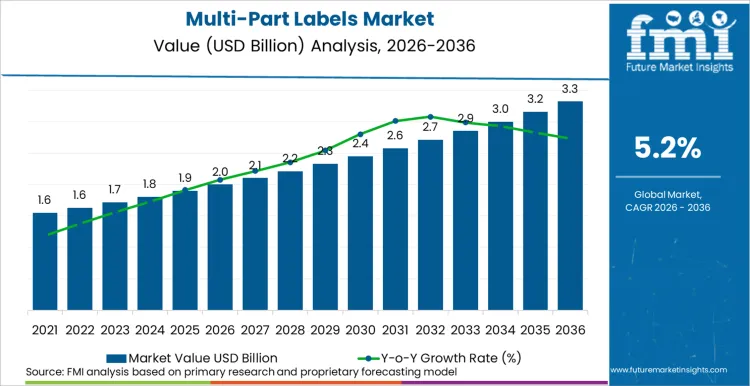
Multi-Part Labels market is expected to reach a valuation of USD 2.0 billion in 2026, driven by a surge in demand for extended content solutions on space-constrained packaging. Revenue from sales is projected to expand at a steady CAGR of 5.2% through 2036, pushing total sector worth beyond USD 3.3 billion by the conclusion of this assessment period. Escalating regulatory requirements for detailed product information in pharmaceuticals and chemicals act as a primary catalyst for this financial trajectory as per FMI's projection.
Manufacturers are channeling significant capital into developing piggyback and booklet label technologies, aiming to maximize printable area without compromising branding aesthetics. Brands are shifting focus from traditional single-layer tags to multi-layer formats, redefining procurement habits in major industrial economies. Such behavioral changes encourage printers to introduce comprehensive variable data printing portfolios utilizing advanced digital presses.
Logistics optimization and changing inventory management standards are significantly influencing industry expansion. Packaging engineers emphasize traceability, utilizing multi-part barcode labels to ensure accurate tracking through complex supply chains as per FMI's estimates. Clinical trials investigating the durability of removable adhesive layers are creating needs for high-performance substrates, instilling confidence among logistics providers regarding future product pipelines.
Growing awareness regarding counterfeit prevention continues to fuel demand for tamper-evident multi-part solutions, creating sustained opportunities for security label specialists. Government health initiatives targeting consumer transparency are facilitating wider adoption of extended text labels in retail settings. Companies are witnessing robust growth potential in developing nations, where rapid industrialization and rising e-commerce activities align perfectly with increased consumption of tracked goods.
Quick Stats for Multi-Part Labels Market
- Multi-Part Labels Industry Value (2026): USD 2.0 Billion
- Multi-Part Labels Industry Forecast Value (2036): USD 3.3 Billion
- Multi-Part Labels Industry Forecast CAGR: 5.2%
- Multi-Part Labels Industry Leading Form: Multi-Part Barcode Labels (43.2%)
- Multi-Part Labels Industry Leading End Use: Food and Beverages (49%)
- Multi-Part Labels Industry Leading Functionality: Multi-Part Content Labels
- Multi-Part Labels Industry Key Growth Regions: India, China, USA
- Multi-Part Labels Industry Key Players: Insignia Label Solutions Ltd., Buskro, LabelsPlus Ltd, CCL Design Stuttgart AG, Barcode Factory
Does Gross Margin % Reflect Customization Value?
In the specialized label sector, gross margins typically range between 25% and 35%, significantly higher than standard commercial printing. This premium reflects the value of multi-layer construction and variable data capabilities. Converters who successfully integrate complex wrap around label features into multi-part formats often command the higher end of this margin due to reduced competition in complex converting.
Why is Inventory Turnover Ratio Critical for Substrates?
Inventory turnover ratios, averaging 6.0x to 8.0x annually, are essential to manage the diverse range of face stocks and adhesives required for custom jobs. Efficient stock management prevents the expiration of sensitive pressure-sensitive materials. Optimized usage of stock for high-volume booklet label runs helps maintain lean operations and liquidity.
What Role Does Revenue Concentration Risk Play?
High revenue concentration is common, with many converters relying on a few large pharmaceutical or FMCG clients. Diversifying the client base is crucial to mitigate risk. Successful firms balance large contracts with a long tail of smaller, higher-margin jobs, ensuring stability even if demand for specific cut and stack labels fluctuates among key accounts.
Companies are launching repositionable labels lines that allow end-users to transfer tracking information seamlessly between documents. There is a notable trend towards acquiring niche competitors to expand capabilities in security labeling. Manufacturers are also refining adhesive formulations to ensure labels perform in extreme cold chain environments. This strategic pivot towards functional, value-added labeling ensures long-term relevance in a competitive landscape.
Multi-Part Labels Market Key Takeaways
| Metric | Value |
|---|---|
| Industry Size (2026) | USD 2.0 Billion |
| Industry Value (2036) | USD 3.3 Billion |
| CAGR (2026 to 2036) | 5.2% |
Source: Future Market Insights (FMI) analysis, based on proprietary forecasting model and primary research
What Drivers Are Accelerating Extended Content Adoption?
Shift toward extended content labels (ECL) is serving as a significant catalyst for broader acceptance of multi-part formats. Recent breakthroughs in shrink sleeve labels technology have demonstrated that consumers demand more transparency regarding ingredients than standard labels can accommodate. This holistic approach appeals to chemical and pharmaceutical giants seeking to include multi-lingual regulatory text on a single container. Clinical success of integrating tear-away coupons has expanded application possibilities. Education programs highlighting the legal risks of insufficient product labeling are driving procurement proactivity as per FMI's estimates. Converters are capitalizing on these trends by introducing piggyback labels for clinical trials. Integrating tactile features like braille labels into multi-part designs is becoming considered standard, ensuring inclusivity mandates are met without sacrificing information space.
How Is the Multi-Part Labels Market Segmented Across Key Categories?
Global landscape is intricately segmented to address diverse requirements of retail, logistics, and healthcare sectors, categorizing sector by product type, application, and region. Structural division allows stakeholders to identify specific growth pockets, such as rising demand for multi-part barcode labels in e-commerce fulfillment or preference for booklet labels in agrochemicals. By analyzing these segments, manufacturers can tailor production lines to meet distinct needs of high-speed food packaging lines versus specialized clinical trial kit assembly. Segmentation also highlights shift from standard paper-based stock to durable synthetic films for industrial use. As industry matures, granular segmentation becomes essential for understanding flow of capital and innovation, ensuring product development aligns perfectly with evolving traceability mandates of global supply chains.
Why Do Multi-Part Barcode Labels Maintain Dominance?
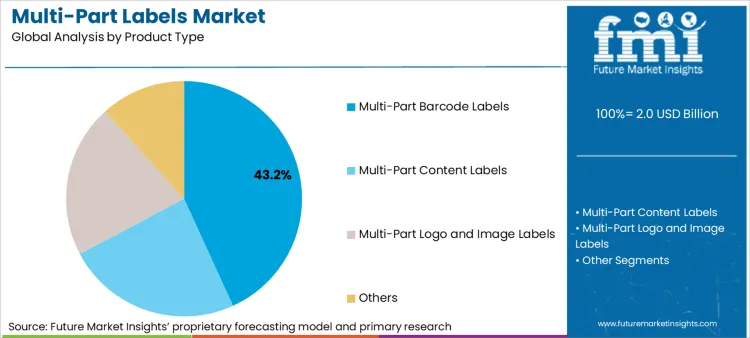
Multi-Part Barcode Labels account for 43.2% of share in 2026, driven by their critical role in inventory management and logistics tracking. Leadership position is underpinned by widespread adoption in shipping and receiving operations, where detachable barcode sections streamline record-keeping. Segment benefits from continuous adhesive improvements, allowing for clean removal and re-application on documentation. Research focused on inspection and inventory labels suggests that the utility of these labels in reducing data entry errors is unmatched. Critical role in managing supply chain visibility further solidifies standing, as these labels provide physical proof of custody transfer. As supply chains prioritize automation, demand for high-precision barcode formats is expected to remain robust.
Why Is Food and Beverages the Primary Revenue Stream?
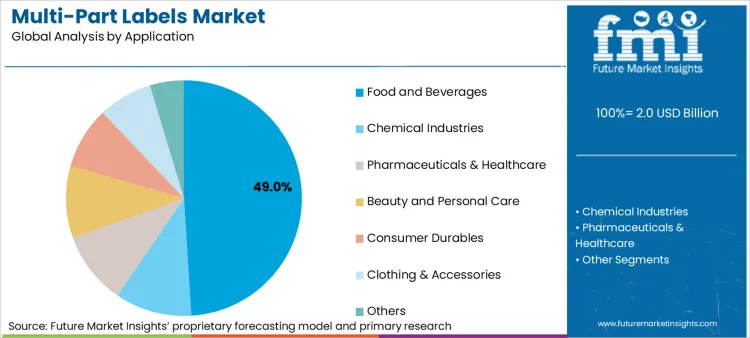
Food and Beverages applications command 49% share of sector in 2026, reflecting global reliance on packaged goods with extensive informational requirements. Dominance is inextricably linked to the need for promotional coupons, recipe suggestions, and regulatory compliance text on limited packaging real estate. Manufacturers rely on specialized multi-part solutions to engage consumers without cluttering brand design as per FMI's projection. These settings are essential for handling high-volume promotional campaigns, driving priority status in procurement budgets. Relentless pursuit of shelf appeal and consumer engagement ensures labels designed with interactive elements remain top priority. High consumption volume necessitates dynamic material supply, bolstering sustained revenue streams for label converters.
How Will Track-and-Trace Regulations Redefine Sales?
Traceability mandate adoption is set to reshape sales landscapes by altering demand for simple identification tags. As legislative frameworks evolve, industries access labels with integrated transferrable sections to maintain accurate records across the supply chain. Shift toward serialization creates demand for multi-part labels that facilitate easy documentation in logbooks and patient charts. Manufacturers failing to upgrade printing capabilities for variable data risk losing visibility among compliance-focused clients. Availability of durable, chemical-resistant multi-part labels drives complimentary consumption in the automotive and industrial sectors. Rise of anti-counterfeiting initiatives stimulates innovation, with companies differentiating offerings by ensuring chain-of-custody verification through physical label transfer.
What Role Does Customization Play in Future Growth?
Customization integration is emerging as a niche yet powerful growth driver. As brands seek deeper consumer engagement, packaging embedded with unique codes or collectible stickers offers enhanced interaction. This trend is particularly relevant in the toy and beverage sectors, where 3d printed stickers and labels can offer novel tactile experiences. Development of personalized marketing campaigns is gaining traction. Shift toward digital printing creates demand for labels that serve as both information carriers and marketing tools. Manufacturers investing in hybrid printing technologies risk gaining a competitive edge in high-value promotional segments.
How Are Sustainability Goals Influencing Design?
Eco-design adoption is set to reshape manufacturing priorities by demanding thinner label constructions and recyclable release liners. As waste reduction targets mount, brands demand multi-part labels that do not hinder the recycling of primary packaging. Shift toward wash-off adhesives creates demand for labels that separate cleanly during the recycling process. Manufacturers failing to optimize material selection for sustainability risk losing visibility among eco-conscious global brands. Availability of liner recycling programs drives complimentary consumption of pressure-sensitive solutions. Rise of bio-based face stocks stimulates innovation, with companies differentiating offerings by providing superior environmental credentials through certified sustainable materials.
How Will the Multi-Part Labels Industry Evolve in Major Nations?
Global landscape for specialty labeling is characterized by diverse growth patterns, influenced by retail modernization and industrial automation. Established markets prioritize efficiency and sustainability, whereas emerging economies rely on logistics expansion to support rising consumption. Asia-Pacific is emerging as rapid growth hub due to manufacturing dominance and expanding e-commerce networks. Conversely, North American sectors pivot towards high-value promotional and compliance labeling. Government initiatives in developing nations supporting digitalization of supply chains ensure sustained demand for advanced tracking solutions across all geographies.
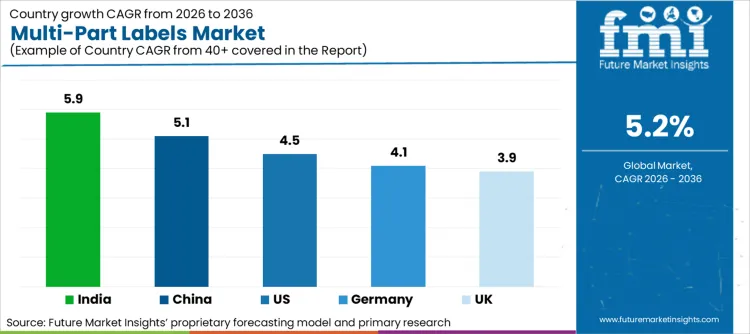
| Country | CAGR (2026 to 2036) |
|---|---|
| India | 5.9% |
| China | 5.1% |
| USA | 4.5% |
| Germany | 4.1% |
| UK | 3.9% |
Source: Future Market Insights’ proprietary forecasting model and primary research
Why is the Multi-Part Labels Sector in India Expanding?
Demand for functional labels in India is projected to rise at 5.9% CAGR during assessment period. Initiatives emphasizing "Make in India" logistics modernization foster favorable environment for domestic and international vendors. Increasing investment in organized retail and e-commerce warehousing creates massive supply channel for tracking labels. Rising pharmaceutical exports requiring stringent documentation prompts local brands to seek compliant multi-part solutions. Shift is supported by government policies incentivizing digital supply chain tracking, accelerating uptake of barcode solutions across country and fueling sector expansion.
Why is the Multi-Part Labels Industry in China Growing?
Multi-Part Labels industry in China is poised to expand at 5.1% CAGR. Surge is largely attributed to massive manufacturing base and booming online retail sector. Government focus on improving product quality and safety standards encourages facilities to opt for traceable labeling. Increasing partnerships between regional printers and global adhesive suppliers necessitate availability of advanced substrate grades. High volume of consumer electronics production combined with export logistics attract significant investment in inventory labels. Strict adherence to export compliance regulations further drives adoption of quality-assured tracking materials.
Why is the Multi-Part Labels Industry in the USA Showing Potential?
Sales of specialty labels in USA are set to grow at 4.5% CAGR through 2036. Expansion is underpinned by stringent FDA directives regarding extended content labeling for pharmaceuticals and food. Growth is fueled by widespread shift towards interactive consumer engagement via packaging. Rapid adoption of smart shipping labels for logistics optimization drives revenue generation per unit. Presence of major e-commerce giants within country streamlines supply chains. Emphasis on operational efficiency and error reduction continues to be primary driver, maintaining USA's position as critical innovation generator as per FMI analyst opinion.
Why is the Multi-Part Labels Industry in Germany Showing Stability?
Multi-Part Labels industry in Germany is poised to expand at 4.1% CAGR. Surge is largely attributed to strong industrial engineering heritage and focus on automotive and chemical sectors. Government focus on chemical safety (REACH) encourages facilities to opt for durable, multi-page booklet labels. Increasing partnerships between machinery firms and label converters necessitate availability of high-precision application systems. High environmental standards combined with export-oriented manufacturing attract significant investment. Strict adherence to EU labeling directives further drives adoption of compliant informational solutions.
Why is the Multi-Part Labels Sector in the UK Expanding?
Demand for packaging labels in UK is projected to rise at 3.9% CAGR during assessment period. Initiatives emphasizing retail efficiency and waste reduction foster favorable environment for innovative vendors. Increasing investment in food delivery and subscription services creates steady supply channel for functional labels. Rising awareness regarding product provenance prompts local administrators to seek traceable solutions. Shift is supported by government policies encouraging transparent consumer information, accelerating uptake of extended content designs across country and fueling sector expansion.
What is the Competitive Outlook for the Multi-Part Labels Market?
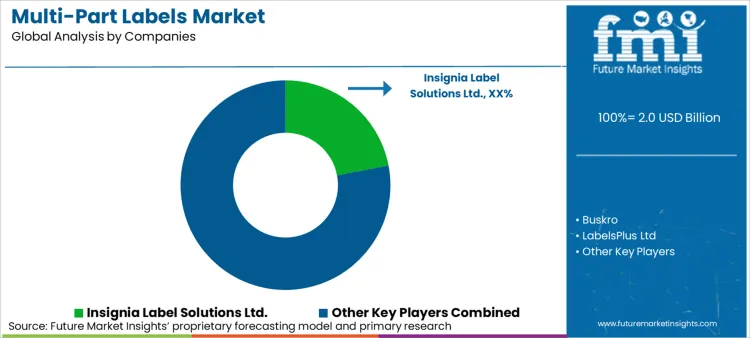
Market participants are increasingly focusing on technological integration to capture value from high-growth logistics sectors. Leading players like Insignia Label Solutions and CCL Design are directing investment toward digital hybrid printing presses to handle short-run variability as per FMI's estimates. Significant trend involves developing proprietary adhesive formulations that perform across diverse temperature ranges. Companies actively engage in strategic collaborations with label applicators manufacturers to ensure seamless integration on high-speed lines. Sustainability emerges as competitive frontier, with providers exploring linerless label technologies. Consolidation activities remain high as large packaging conglomerates acquire specialized labels converters to broaden their value-added offerings against regional competitors. Insignia Label Solutions Ltd. holds a significant 22% share, leveraging its robust custom solution capabilities.
Key Players in Multi-Part Labels Market
- Insignia Label Solutions Ltd.
- Buskro
- LabelsPlus Ltd
- CCL Design Stuttgart AG
- Barcode Factory
- Paragon Print Systems Inc.
- Multi-Action labels reinvented
- Barspell Technology
- Universal Tag, Inc.
- Label Lingo
Scope of Report
| Items | Values |
|---|---|
| Quantitative Units | USD Billion |
| Product Type | Multi-Part Barcode Labels, Multi-Part Content Labels, Multi-Part Logo and Image Labels, Others |
| Application | Food and Beverages, Chemical Industries, Pharmaceuticals & Healthcare, Beauty and Personal Care, Consumer Durables, Clothing & Accessories, Others |
| Regions | North America, Europe, East Asia, South Asia, Latin America, MEA |
Multi-Part Labels Market by Segments
Product Type:
- Multi-Part Barcode Labels
- Multi-Part Content Labels
- Multi-Part Logo and Image Labels
- Others
Application:
- Food and Beverages
- Chemical Industries
- Pharmaceuticals & Healthcare
- Beauty and Personal Care
- Consumer Durables
- Clothing & Accessories
- Others
Bibliography
- USA Food and Drug Administration. (2025). 21 CFR Part 201 - Labeling of drugs: Current regulatory requirements for prescription and nonprescription drug labeling. USA Food and Drug Administration, United States.
- USA Food and Drug Administration. (2025). 21 CFR Part 801 Subpart B - Labeling requirements for unique device identification (UDI). USA Food and Drug Administration, United States.
- USA Food and Drug Administration. (2025, June 25). Unique device identifier requirements for combination products with device constituent parts. USA Food and Drug Administration, United States.
- GS1. (2025, June 13). GS1 application identifiers: Data structure rules for barcode encoding and product identification. GS1, Global Standards Organization.
- USA Department of Agriculture, Agricultural Marketing Service. (2025). Country of origin labeling (COOL): Regulatory framework and compliance requirements under 7 CFR Parts 60 and 65. USA Department of Agriculture, United States.
Frequently Asked Questions
How large is the demand for Multi-Part Labels in the global market in 2026?
Demand for Multi-Part Labels in global market is estimated to be valued at USD 2.0 billion in 2026 as per FMI's estimates.
What will be the market size of Multi-Part Labels in the global market by 2036?
Market size for Multi-Part Labels in global market is projected to reach USD 3.3 billion by 2036.
What is the expected demand growth for Multi-Part Labels in the global market between 2026 and 2036?
Demand for Multi-Part Labels is expected to grow at CAGR of 5.2% between 2026 and 2036.
Which Product Type is poised to lead global sales by 2026?
Multi-Part Barcode Labels are expected to be dominant product type, capturing approximately 43.2% of global market share in 2026 due to logistics necessity.
How significant is the role of Food and Beverages Application in driving Multi-Part Labels adoption in 2026?
Food and Beverages Application represents critical end use, projected to hold substantial 49% share of total market in 2026 as promotional needs rise.
Preview the report firsthand - request a free sample
Get SampleGet the brochure for pricing and purchase details.
Get PDFTable of Content
- Executive Summary
- Global Market Outlook
- Demand-side Trends
- Supply-side Trends
- Technology Roadmap Analysis
- Analysis and Recommendations
- Market Overview
- Market Coverage / Taxonomy
- Market Definition / Scope / Limitations
- Research Methodology
- Chapter Orientation
- Analytical Lens and Working Hypotheses
- Market Structure, Signals, and Trend Drivers
- Benchmarking and Cross-market Comparability
- Company Annual and Sustainability Reports
- Peer-reviewed Journals and Academic Literature
- Corporate Websites, Product Literature, and Technical Notes
- Earnings Decks and Investor Briefings
- Statutory Filings and Regulatory Disclosures
- Technical White Papers and Standards Notes
- Trade Journals, Industry Magazines, and Analyst Briefs
- Conference Proceedings, Webinars, and Seminar Materials
- Government Statistics Portals and Public Data Releases
- Press Releases and Reputable Media Coverage
- Specialist Newsletters and Curated Briefings
- Sector Databases and Reference Repositories
- Roots Internal Knowledge Base and Historical Datasets
- Subscription Datasets and Paid Sources
- Social Channels, Communities, and Digital Listening Inputs
- Additional Desk Sources
- Expert Input and Fieldwork (Primary Evidence)
- Primary Modes
- Qualitative Interviews and Expert Elicitation
- Quantitative Surveys and Structured Data Capture
- Blended A7oach
- Why Primary Evidence is Used
- Field Techniques
- Interviews
- Surveys
- Focus Groups
- Observational and In-context Research
- Social and Community Interactions
- Stakeholder Universe Engaged
- C-suite Leaders
- Board Members
- Presidents and Vice Presidents
- R&D and Innovation Heads
- Technical Specialists
- Domain Subject-matter Experts
- Scientists
- Physicians and Other Healthcare Professionals
- Governance, Ethics, and Data Stewardship
- Research Ethics
- Data Integrity and Handling
- Primary Modes
- Tooling, Models, and Reference Databases
- Data Engineering and Model Build
- Data Acquisition and Ingestion
- Cleaning, Normalisation, and Verification
- Synthesis, Triangulation, and Analysis
- Quality Assurance and Audit Trail
- Market Background
- Market Dynamics
- Drivers
- Restraints
- Opportunity
- Trends
- Scenario Forecast
- Demand in Optimistic Scenario
- Demand in Likely Scenario
- Demand in Conservative Scenario
- Opportunity Map Analysis
- Product Life Cycle Analysis
- Supply Chain Analysis
- Investment Feasibility Matrix
- Value Chain Analysis
- PESTLE and Porter’s Analysis
- Regulatory Landscape
- Regional Parent Market Outlook
- Production and Consumption Statistics
- Import and Export Statistics
- Market Dynamics
- Global Market Analysis 2021 to 2025 and Forecast, 2026 to 2036
- Historical Market Size Value (USD Million) Analysis, 2021 to 2025
- Current and Future Market Size Value (USD Million) Projections, 2026 to 2036
- Y-o-Y Growth Trend Analysis
- Absolute $ Opportunity Analysis
- Global Market Pricing Analysis 2021 to 2025 and Forecast 2026 to 2036
- Global Market Analysis 2021 to 2025 and Forecast 2026 to 2036, By Product Type
- Introduction / Key Findings
- Historical Market Size Value (USD Million) Analysis By Product Type , 2021 to 2025
- Current and Future Market Size Value (USD Million) Analysis and Forecast By Product Type , 2026 to 2036
- Multi-Part Barcode Labels
- Multi-Part Content Labels
- Multi-Part Logo and Image Labels
- Others
- Multi-Part Barcode Labels
- Y-o-Y Growth Trend Analysis By Product Type , 2021 to 2025
- Absolute $ Opportunity Analysis By Product Type , 2026 to 2036
- Global Market Analysis 2021 to 2025 and Forecast 2026 to 2036, By Application
- Introduction / Key Findings
- Historical Market Size Value (USD Million) Analysis By Application, 2021 to 2025
- Current and Future Market Size Value (USD Million) Analysis and Forecast By Application, 2026 to 2036
- Food and Beverages
- Chemical Industries
- Pharmaceuticals & Healthcare
- Beauty and Personal Care
- Consumer Durables
- Clothing & Accessories
- Others
- Food and Beverages
- Y-o-Y Growth Trend Analysis By Application, 2021 to 2025
- Absolute $ Opportunity Analysis By Application, 2026 to 2036
- Global Market Analysis 2021 to 2025 and Forecast 2026 to 2036, By Region
- Introduction
- Historical Market Size Value (USD Million) Analysis By Region, 2021 to 2025
- Current Market Size Value (USD Million) Analysis and Forecast By Region, 2026 to 2036
- North America
- Latin America
- Western Europe
- Eastern Europe
- East Asia
- South Asia and Pacific
- Middle East & Africa
- Market Attractiveness Analysis By Region
- North America Market Analysis 2021 to 2025 and Forecast 2026 to 2036, By Country
- Historical Market Size Value (USD Million) Trend Analysis By Market Taxonomy, 2021 to 2025
- Market Size Value (USD Million) Forecast By Market Taxonomy, 2026 to 2036
- By Country
- USA
- Canada
- Mexico
- By Product Type
- By Application
- By Country
- Market Attractiveness Analysis
- By Country
- By Product Type
- By Application
- Key Takeaways
- Latin America Market Analysis 2021 to 2025 and Forecast 2026 to 2036, By Country
- Historical Market Size Value (USD Million) Trend Analysis By Market Taxonomy, 2021 to 2025
- Market Size Value (USD Million) Forecast By Market Taxonomy, 2026 to 2036
- By Country
- Brazil
- Chile
- Rest of Latin America
- By Product Type
- By Application
- By Country
- Market Attractiveness Analysis
- By Country
- By Product Type
- By Application
- Key Takeaways
- Western Europe Market Analysis 2021 to 2025 and Forecast 2026 to 2036, By Country
- Historical Market Size Value (USD Million) Trend Analysis By Market Taxonomy, 2021 to 2025
- Market Size Value (USD Million) Forecast By Market Taxonomy, 2026 to 2036
- By Country
- Germany
- UK
- Italy
- Spain
- France
- Nordic
- BENELUX
- Rest of Western Europe
- By Product Type
- By Application
- By Country
- Market Attractiveness Analysis
- By Country
- By Product Type
- By Application
- Key Takeaways
- Eastern Europe Market Analysis 2021 to 2025 and Forecast 2026 to 2036, By Country
- Historical Market Size Value (USD Million) Trend Analysis By Market Taxonomy, 2021 to 2025
- Market Size Value (USD Million) Forecast By Market Taxonomy, 2026 to 2036
- By Country
- Russia
- Poland
- Hungary
- Balkan & Baltic
- Rest of Eastern Europe
- By Product Type
- By Application
- By Country
- Market Attractiveness Analysis
- By Country
- By Product Type
- By Application
- Key Takeaways
- East Asia Market Analysis 2021 to 2025 and Forecast 2026 to 2036, By Country
- Historical Market Size Value (USD Million) Trend Analysis By Market Taxonomy, 2021 to 2025
- Market Size Value (USD Million) Forecast By Market Taxonomy, 2026 to 2036
- By Country
- China
- Japan
- South Korea
- By Product Type
- By Application
- By Country
- Market Attractiveness Analysis
- By Country
- By Product Type
- By Application
- Key Takeaways
- South Asia and Pacific Market Analysis 2021 to 2025 and Forecast 2026 to 2036, By Country
- Historical Market Size Value (USD Million) Trend Analysis By Market Taxonomy, 2021 to 2025
- Market Size Value (USD Million) Forecast By Market Taxonomy, 2026 to 2036
- By Country
- India
- ASEAN
- Australia & New Zealand
- Rest of South Asia and Pacific
- By Product Type
- By Application
- By Country
- Market Attractiveness Analysis
- By Country
- By Product Type
- By Application
- Key Takeaways
- Middle East & Africa Market Analysis 2021 to 2025 and Forecast 2026 to 2036, By Country
- Historical Market Size Value (USD Million) Trend Analysis By Market Taxonomy, 2021 to 2025
- Market Size Value (USD Million) Forecast By Market Taxonomy, 2026 to 2036
- By Country
- Kingdom of Saudi Arabia
- Other GCC Countries
- Turkiye
- South Africa
- Other African Union
- Rest of Middle East & Africa
- By Product Type
- By Application
- By Country
- Market Attractiveness Analysis
- By Country
- By Product Type
- By Application
- Key Takeaways
- Key Countries Market Analysis
- USA
- Pricing Analysis
- Market Share Analysis, 2025
- By Product Type
- By Application
- Canada
- Pricing Analysis
- Market Share Analysis, 2025
- By Product Type
- By Application
- Mexico
- Pricing Analysis
- Market Share Analysis, 2025
- By Product Type
- By Application
- Brazil
- Pricing Analysis
- Market Share Analysis, 2025
- By Product Type
- By Application
- Chile
- Pricing Analysis
- Market Share Analysis, 2025
- By Product Type
- By Application
- Germany
- Pricing Analysis
- Market Share Analysis, 2025
- By Product Type
- By Application
- UK
- Pricing Analysis
- Market Share Analysis, 2025
- By Product Type
- By Application
- Italy
- Pricing Analysis
- Market Share Analysis, 2025
- By Product Type
- By Application
- Spain
- Pricing Analysis
- Market Share Analysis, 2025
- By Product Type
- By Application
- France
- Pricing Analysis
- Market Share Analysis, 2025
- By Product Type
- By Application
- India
- Pricing Analysis
- Market Share Analysis, 2025
- By Product Type
- By Application
- ASEAN
- Pricing Analysis
- Market Share Analysis, 2025
- By Product Type
- By Application
- Australia & New Zealand
- Pricing Analysis
- Market Share Analysis, 2025
- By Product Type
- By Application
- China
- Pricing Analysis
- Market Share Analysis, 2025
- By Product Type
- By Application
- Japan
- Pricing Analysis
- Market Share Analysis, 2025
- By Product Type
- By Application
- South Korea
- Pricing Analysis
- Market Share Analysis, 2025
- By Product Type
- By Application
- Russia
- Pricing Analysis
- Market Share Analysis, 2025
- By Product Type
- By Application
- Poland
- Pricing Analysis
- Market Share Analysis, 2025
- By Product Type
- By Application
- Hungary
- Pricing Analysis
- Market Share Analysis, 2025
- By Product Type
- By Application
- Kingdom of Saudi Arabia
- Pricing Analysis
- Market Share Analysis, 2025
- By Product Type
- By Application
- Turkiye
- Pricing Analysis
- Market Share Analysis, 2025
- By Product Type
- By Application
- South Africa
- Pricing Analysis
- Market Share Analysis, 2025
- By Product Type
- By Application
- USA
- Market Structure Analysis
- Competition Dashboard
- Competition Benchmarking
- Market Share Analysis of Top Players
- By Regional
- By Product Type
- By Application
- Competition Analysis
- Competition Deep Dive
- Insignia Label Solutions Ltd.
- Overview
- Product Portfolio
- Profitability by Market Segments (Product/Age /Sales Channel/Region)
- Sales Footprint
- Strategy Overview
- Marketing Strategy
- Product Strategy
- Channel Strategy
- Buskro
- LabelsPlus Ltd
- CCL Design Stuttgart AG
- Barcode Factory
- Paragon Print Systems Inc.
- Multi-Action labels reinvented
- Barspell Technology
- Universal Tag, Inc.
- Label Lingo
- Insignia Label Solutions Ltd.
- Competition Deep Dive
- Assumptions & Acronyms Used


