

- Industry Size (2026)
- USD 1800.0 Mn
- Forecast (2036)
- USD 5111.0 Mn
- CAGR (2026 to 2036)
- 11.0%
Anode Foil Coatings Market Forecast and Outlook 2026 to 2036
The anode foil coatings market represents a critical component in the lithium-ion battery manufacturing ecosystem, projected to experience remarkable growth from USD 1,800.0 million in 2026 to USD 5,111.0 million by 2036, registering an impressive compound annual growth rate of 11.0% during the forecast period. This dynamic market segment serves as the backbone for advanced battery technologies, with coating formulations specifically engineered to enhance the electrochemical performance and structural integrity of battery anodes. The surge in demand is primarily attributed to the explosive growth in electric vehicle adoption, grid-scale energy storage deployments, and the continuous evolution of consumer electronics requiring higher energy density solutions.
Market dynamics are fundamentally driven by the transition toward sustainable transportation and the global push for renewable energy integration. Anode foil coatings play a pivotal role in optimizing battery performance by providing enhanced adhesion between active materials and current collectors, preventing delamination during charge-discharge cycles, and offering superior corrosion resistance in challenging electrochemical environments. The market's robust growth trajectory reflects the increasing sophistication of coating technologies, with manufacturers developing specialized formulations that address specific performance requirements across different battery chemistries and applications.
Quick Stats for Anode Foil Coatings Market
- Anode Foil Coatings Market Value (2026): USD 1,800.0 million
- Anode Foil Coatings Market Forecast Value (2036): USD 5,111.0 million
- Anode Foil Coatings Market Forecast CAGR: 11.0%
- Leading Foil Substrate in Anode Foil Coatings Market: Copper foil (72%)
- Key Growth Countries in Anode Foil Coatings Market: China, Brazil, USA, Germany, UK, South Korea, Japan
- Key Players in Anode Foil Coatings Market: Furukawa Electric, Nippon Denkai, JX Metals, Iljin Materials, Doosan
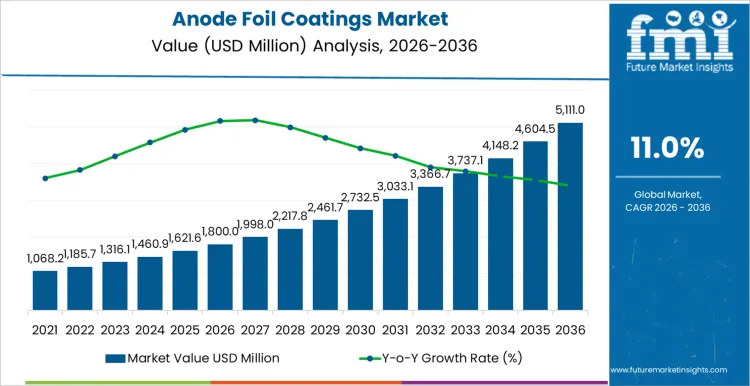
Anode Foil Coatings Market Key Takeaways
| Metric | Value |
|---|---|
| Market Value (2026) | USD 1,800.0 million |
| Market Forecast Value (2036) | USD 5,111.0 million |
| Forecast CAGR 2026 to 2036 | 11.0% |
Why Is Battery Technology Evolution Driving Anode Coating Innovation?
The rapid evolution of battery technologies is fundamentally transforming the requirements for anode foil coatings, creating unprecedented opportunities for specialized surface treatment solutions. Modern lithium-ion batteries demand increasingly sophisticated interface engineering to address challenges such as silicon anode battery expansion, dendrite formation prevention, and thermal management during high-rate charging protocols. Anode coatings have evolved from simple adhesion promoters to multifunctional barriers that simultaneously provide ionic conductivity enhancement, electronic conductivity optimization, and mechanical stress accommodation during battery cycling.
The integration of silicon-based anode materials presents unique challenges that drive coating innovation toward elastic and self-healing formulations. Silicon anodes can expand up to 300% during lithiation, requiring coatings that maintain interfacial integrity while accommodating extreme volume changes. Advanced coating systems now incorporate nanostructured architectures with controlled porosity, enabling lithium-ion transport while preventing electrolyte decomposition at the current collector interface. This technological progression is essential for achieving the energy density targets required for next-generation electric vehicles and grid-scale storage systems.
How Is the Market Structured Across Battery Applications?
The anode foil coatings market exhibits distinct segmentation patterns based on foil substrate types, coating functions, cell formats, and end-use applications, reflecting the diverse requirements of modern battery manufacturing. Market structure analysis reveals the dominance of copper foil substrates, driven by their superior electrical conductivity and established manufacturing infrastructure in the lithium-ion battery ecosystem. The segmentation also highlights the growing importance of specialized coating functions that address specific electrochemical and mechanical challenges in different battery applications.
Which Foil Substrate Dominates the Market?
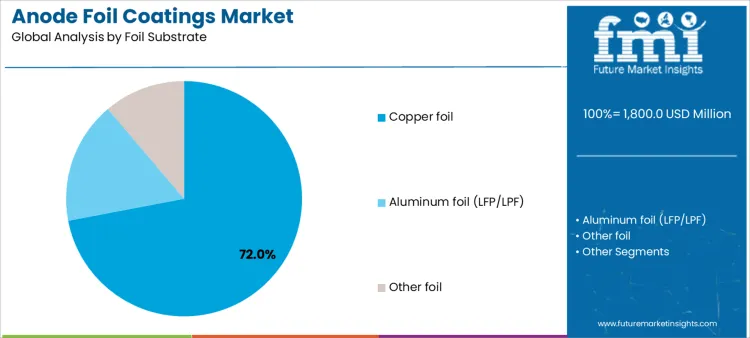
Copper foil substrates command 72.0% market share, representing the largest segment due to their exceptional electrical conductivity and compatibility with conventional lithium-ion battery chemistries. Copper's inherent properties make it the preferred current collector material for graphite and silicon-based anodes, providing low resistance pathways for electron transport during battery operation. The dominance of copper foil reflects the mature manufacturing ecosystem surrounding traditional lithium-ion technologies, where established processing equipment and supply chains favor copper-based solutions. Advanced surface treatments for copper foils include specialized primers that prevent copper dissolution in electrolytes and enhance adhesion with active materials.
Which Coating Function Generates the Highest Demand?
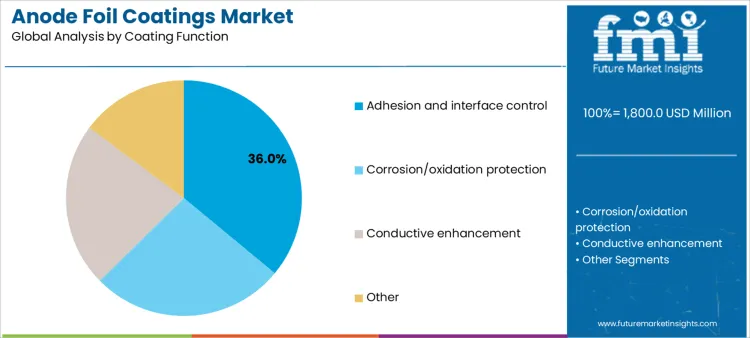
Adhesion and interface control functions dominate with 36.0% market share, reflecting the critical importance of maintaining stable electrode interfaces throughout battery lifecycles. These specialized coatings address delamination issues that can occur during thermal cycling, mechanical stress, and electrochemical aging processes. Interface control coatings typically incorporate polymer matrices with tailored surface chemistry designed to create strong chemical bonds with active materials while maintaining ionic conductivity. Advanced formulations include gradient coating architectures that provide different functional properties across the coating thickness, optimizing both adhesion strength and electrochemical performance.
Which Cell Format Leads in Coating Applications?
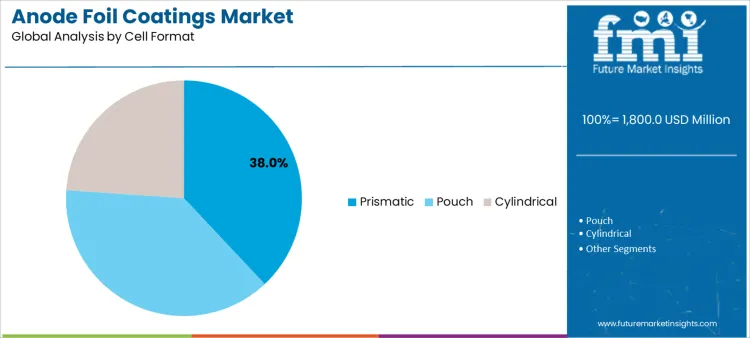
Prismatic cell formats capture 38.0% market share, representing the largest application segment due to their widespread adoption in automotive and stationary energy storage applications. Prismatic cells benefit from coating technologies that address the unique challenges of large-format electrodes, including thermal management, mechanical stress distribution, and uniform current collection across extensive surface areas. Coating requirements for prismatic cells emphasize thermal conductivity enhancement and mechanical reinforcement to handle the structural loads associated with large cell formats. Advanced coating systems for prismatic applications often incorporate thermally conductive fillers and stress-distributing polymer networks.
Which End Use Sector Drives Market Growth?
Electric vehicle (EV) cells dominate with 66.0% market share, reflecting the automotive industry's transition toward electrification and the demanding performance requirements of automotive battery applications. EV cells require coating solutions that address fast-charging capabilities, extended cycle life, and safety considerations under extreme operating conditions. Automotive applications drive innovation toward coatings that can withstand rapid temperature fluctuations, high charge/discharge rates, and mechanical vibrations encountered in vehicle operation. Specialized coating formulations for EV applications incorporate flame-retardant properties and enhanced thermal management capabilities.
How Is Advanced Manufacturing Integration Shaping Coating Demand?
The integration of advanced manufacturing technologies is revolutionizing anode foil coating applications through precision deposition methods and real-time quality control systems. Manufacturers are implementing closed-loop coating processes that monitor coating thickness, uniformity, and adhesion strength in real-time, enabling immediate process adjustments to maintain consistent quality standards. This technological evolution transforms coating application from a traditional wet-chemistry process to a sophisticated materials engineering discipline that requires precise control over molecular-level interactions between substrates and coating materials.
Industry players are developing integrated coating lines that combine multiple deposition technologies within single processing systems, enabling the creation of multilayer coating architectures with distinct functional layers. These systems incorporate plasma treatment, chemical vapor deposition, and solution-based coating processes in sequence, creating composite coatings that address multiple performance requirements simultaneously. The trend toward manufacturing integration creates competitive advantages for coating suppliers who can provide comprehensive process solutions rather than individual coating materials.
Do Environmental Regulations Limit Coating Development?
Environmental regulations and sustainability concerns present significant challenges for anode foil coating development, particularly regarding solvent usage, volatile organic compound emissions, and end-of-life recyclability considerations. Traditional coating formulations often rely on organic solvents that face increasing regulatory restrictions and require expensive emission control systems in manufacturing facilities. Compliance with environmental standards drives innovation toward water-based and solvent-free coating technologies, though these alternatives often present technical challenges related to wetting properties and coating uniformity on metallic substrates.
The transition toward sustainable coating technologies creates opportunities for manufacturers who can develop high-performance formulations that meet environmental compliance requirements while maintaining electrochemical performance standards. Bio-based coating materials and closed-loop solvent recovery systems are becoming essential capabilities for coating suppliers serving environmentally conscious battery manufacturers. Regulatory compliance costs and technical complexity favor larger coating manufacturers who can invest in advanced environmental controls and sustainable chemistry research.
How Does Next-Generation Battery Chemistry Create New Markets?
The development of next-generation battery chemistries, including solid-state electrolytes and lithium metal anodes, creates substantial opportunities for specialized coating technologies that address unique interfacial challenges. Solid-state batteries require coating solutions that facilitate ionic transport across solid-solid interfaces while maintaining mechanical contact under cycling-induced stress. These applications demand coatings with precisely controlled porosity, ionic conductivity, and mechanical properties that differ significantly from conventional liquid electrolyte systems.
Lithium metal anode technologies present opportunities for coatings that prevent dendrite formation and enable safe operation of high-energy-density battery systems. Specialized protective coatings for lithium metal must combine ionic selectivity, mechanical flexibility, and chemical stability in highly reactive environments. The commercialization of these advanced battery technologies creates new market segments where coating performance requirements extend beyond traditional adhesion and corrosion protection to include advanced electrochemical and mechanical functions.
How Is the Anode Foil Coatings Market Expected to Evolve Across Major Nations?
The global anode foil coatings market exhibits distinct regional growth patterns that reflect varying battery manufacturing capabilities, electric vehicle battery rates, and energy storage deployment strategies. Leading manufacturing hubs in Asia Pacific continue to drive coating demand through large-scale battery production facilities, while North American and European markets focus on advanced coating technologies that support domestic battery manufacturing initiatives and supply chain security objectives. The regional evolution reflects both established manufacturing ecosystems and emerging opportunities in developing battery markets.
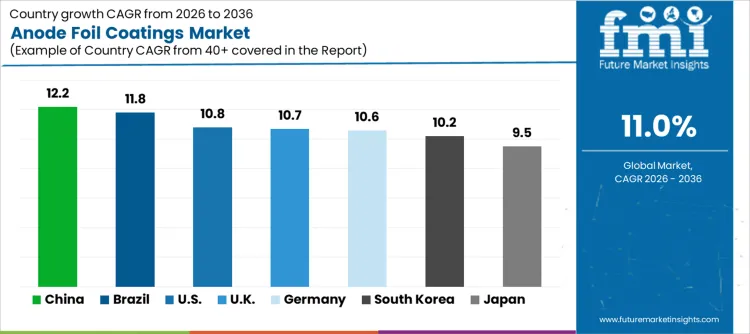
| Country | CAGR (%) |
|---|---|
| China | 12.2% |
| Brazil | 11.8% |
| USA | 10.8% |
| U.K. | 10.7% |
| Germany | 10.6% |
| South Korea | 10.2% |
| Japan | 9.5% |
What Factors Drive China's Leadership in Coating Adoption?
China's anode foil coatings market is projected to achieve a CAGR of 12.2%, representing the highest growth rate globally and reflecting the country's dominant position in lithium-ion battery manufacturing. The market expansion is fueled by massive production capacity investments across major battery manufacturers, including CATL, BYD, and EVE Energy, who are scaling production to meet both domestic and international demand. China's vertically integrated battery supply chain provides unique advantages for coating technology development, enabling close collaboration between foil manufacturers, coating suppliers, and battery producers to optimize coating formulations for specific cell designs and performance requirements.
The government's strong support for electric vehicle adoption through subsidies, infrastructure development, and regulatory mandates creates sustained demand for advanced battery technologies that drive coating innovation. China's battery manufacturers are increasingly focusing on high-nickel cathode chemistries and silicon-enhanced anodes that require sophisticated coating solutions to address thermal stability and cycle life challenges. The integration of artificial intelligence and automation in Chinese manufacturing facilities enables rapid optimization of coating processes and quality control systems.
Why Is Brazil Emerging as a Strategic Coating Market?
Brazil's anode foil coatings market is expected to grow at a CAGR of 11.8%, driven by the country's strategic position in the global battery supply chain and abundant natural resources critical for battery production. The market benefits from Brazil's rich lithium reserves and growing investments in battery manufacturing infrastructure that support local electric vehicle production and energy storage deployment. Government initiatives promoting renewable energy integration and electric mobility create favorable conditions for battery industry development, including specialized coating technologies that ensure reliable performance in Brazil's diverse climate conditions.
The establishment of battery manufacturing facilities by international companies, combined with partnerships between Brazilian mining companies and global battery producers, drives demand for advanced coating solutions that meet international quality standards. Brazil's focus on sustainable mining practices and environmental protection creates opportunities for eco-friendly coating technologies that align with corporate sustainability objectives. The country's growing automotive industry and expanding renewable energy sector provide diverse application opportunities for specialized anode coating solutions.
How Are US Manufacturing Incentives Shaping Coating Demand?
The United States anode foil coatings market is projected to record a CAGR of 10.8%, reflecting substantial government investments in domestic battery manufacturing through the Inflation Reduction Act and CHIPS Act incentives. Market growth is supported by major capacity expansions from companies like Tesla, GM, Ford, and international battery manufacturers establishing US production facilities to serve the North American automotive market. The emphasis on supply chain security and domestic sourcing creates opportunities for US-based coating suppliers who can provide reliable supply chains and technical support for advanced battery manufacturing operations.
The development of gigafactory-scale battery production facilities requires coating technologies that can support high-volume manufacturing while maintaining stringent quality standards for automotive applications. US manufacturers prioritize coating solutions that address fast-charging requirements, extended warranties, and safety standards demanded by American consumers. Research partnerships between coating companies, national laboratories, and universities drive innovation in advanced coating technologies that support next-generation battery chemistries and manufacturing processes.
What Drives the UK's Focus on Advanced Coating Technologies?
The United Kingdom's anode foil coatings market is estimated to expand at a CAGR of 10.7%, supported by the country's strategic focus on advanced battery technologies and commitment to net-zero emissions by 2050. Market development is driven by investments in battery research and development through institutions like the Faraday Institution and partnerships between automotive manufacturers and technology companies developing next-generation battery solutions. The UK's emphasis on technological innovation creates demand for specialized coating technologies that enable breakthrough battery performance and manufacturing efficiency.
Government support for electric vehicle adoption and battery manufacturing, including the establishment of battery gigafactories, drives demand for coating technologies that meet European safety and environmental standards. The UK's strong pharmaceutical and chemicals industry provides a foundation for developing sophisticated coating formulations that address the complex requirements of modern battery applications. Brexit implications and supply chain considerations motivate investment in domestic coating capabilities that support energy security and industrial competitiveness.
How Does Germany's Engineering Excellence Shape Coating Innovation?
Germany's anode foil coatings market is likely to rise at a CAGR of 10.6%, reflecting the country's leadership in automotive engineering and commitment to electric vehicle transition across its automotive industry. Market growth is supported by major investments from German automotive manufacturers, including Volkswagen, BMW, and Mercedes-Benz, who are developing comprehensive electric vehicle platforms that require advanced battery technologies. Germany's strong chemical industry and materials science capabilities provide advantages in developing sophisticated coating formulations that address the stringent performance requirements of German automotive standards.
The country's focus on Industry 4.0 and smart manufacturing drives adoption of advanced coating application technologies that integrate with automated production systems and real-time quality monitoring. German manufacturers prioritize coating solutions that enable long-term durability, precise performance control, and environmental compliance with European regulations. Research collaborations between German universities, automotive companies, and chemical manufacturers accelerate development of innovative coating technologies that support next-generation battery systems.
Why Is South Korea's Battery Expertise Driving Coating Demand?
South Korea's anode foil coatings market is projected to increase at a CAGR of 10.2%, driven by the country's established leadership in battery technology through companies like LG Energy Solution, Samsung SDI, and SK Innovation. Market expansion reflects South Korea's strategic position as a global battery supplier and ongoing investments in advanced battery chemistries that require specialized coating solutions. The country's semiconductor manufacturing expertise translates into sophisticated coating application technologies that enable precise control over coating properties and performance characteristics.
Government support for battery industry development, combined with strong research and development capabilities in materials science and electrochemistry, drives innovation in advanced coating technologies. South Korean manufacturers focus on high-energy-density battery solutions that require coatings capable of supporting extreme operating conditions and extended cycle life requirements. The country's export-oriented battery industry creates demand for coating technologies that meet diverse international standards and customer specifications.
How Does Japan's Quality Focus Shape Coating Development?
Japan's anode foil coatings market is likely to expand at a CAGR of 9.5%, reflecting the country's emphasis on precision manufacturing and quality excellence in battery technology development. Market growth is supported by Japanese companies' leadership in materials science and electrochemistry, with manufacturers like Panasonic, Toyota, and Murata developing advanced battery solutions that require sophisticated coating technologies. Japan's focus on reliability and longevity drives demand for coating formulations that provide exceptional stability and performance consistency over extended operational periods.
The country's automotive industry transition toward electrification, led by companies like Toyota and Nissan, creates opportunities for coating technologies that support diverse battery chemistries and application requirements. Japanese manufacturers prioritize coating solutions that address safety considerations, environmental impact, and manufacturing precision that align with traditional Japanese quality standards. Research institutions and corporate laboratories in Japan continue to advance coating science through fundamental research in interfacial phenomena and materials chemistry.
How Are Manufacturers Securing Market Share?
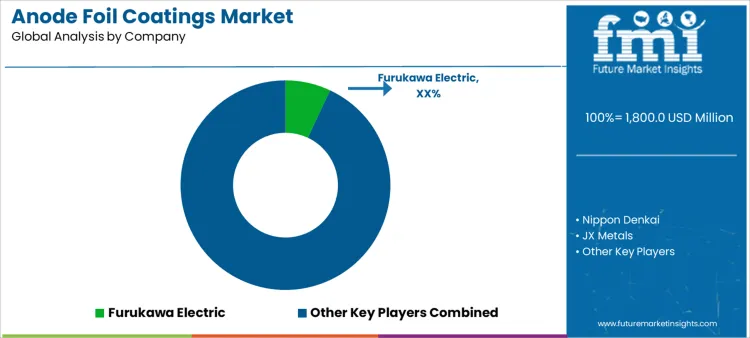
The competitive landscape for anode foil coatings is characterized by intense technological competition among established materials companies, specialized coating suppliers, and vertically integrated battery manufacturers seeking to control critical supply chain components. Market participants compete on the basis of coating performance, manufacturing scalability, technical support capabilities, and ability to develop customized solutions for specific battery applications. Strategic partnerships between coating suppliers and battery manufacturers have become essential for ensuring coating compatibility with evolving battery designs and manufacturing processes.
Innovation cycles in the anode foil coatings market are accelerating as companies race to develop solutions for next-generation battery technologies, including solid-state batteries, lithium metal anodes, and high-silicon anodes. Leading companies are investing heavily in research and development facilities, pilot coating lines, and advanced characterization equipment to maintain technological leadership. Mergers and acquisitions activity focuses on acquiring specialized chemistry capabilities, manufacturing capacity, and customer relationships that provide competitive advantages in rapidly evolving battery markets.
Market leaders differentiate themselves through comprehensive technical services that include coating development, process optimization, quality assurance, and ongoing technical support for battery manufacturers. The ability to provide integrated solutions that combine coating materials, application equipment, and process expertise creates competitive moats that are difficult for competitors to replicate. Global service networks and local technical support capabilities are becoming increasingly important as battery manufacturing becomes more geographically distributed.
Key Players
- Furukawa Electric
- Nippon Denkai
- JX Metals
- Iljin Materials
- Doosan
- Shandong Xinfa
- Mitsui Mining and Smelting
- LOTTE Energy Materials
Scope of Report
| Items | Values |
|---|---|
| Quantitative Units | USD Million |
| Foil Substrate Segments | Copper Foil; Aluminum Foil (LFP/LPF); Other Foil |
| Coating Function Types | Adhesion and Interface Control; Corrosion/Oxidation Protection; Conductive Enhancement; Other |
| Cell Format Types | Pouch; Prismatic; Cylindrical |
| End Use Segments | EV Cells; Energy Storage; Consumer/Industrial |
| Regions Covered | North America, Europe, Asia Pacific, Latin America, Middle East & Africa |
| Key Countries | USA, Germany, China, Brazil, U.K., South Korea, Japan |
| Key Companies Profiled | Furukawa Electric, Nippon Denkai, JX Metals, Iljin Materials, Doosan, and others |
Anode Foil Coatings Market by Segment
By Foil Substrate
- Copper Foil
- Aluminum Foil (LFP/LPF)
- Other Foil
By Coating Function
- Adhesion and Interface Control
- Corrosion/Oxidation Protection
- Conductive Enhancement
- Other
By Cell Format
- Pouch
- Prismatic
- Cylindrical
By End Use
- EV Cells
- Energy Storage
- Consumer/Industrial
Bibliography
- International Energy Agency. (2024). Global EV outlook 2024: Towards a global electric future. OECD Publishing.
- National Renewable Energy Laboratory. (2024). Battery performance and cost modeling for electric‑drive vehicles (NREL/TP‑5400‑85748). USA Department of Energy.
- USA Department of Energy, Office of Energy Efficiency and Renewable Energy. (2024). National blueprint for lithium batteries 2024-2030.
Frequently Asked Questions
How big is the anode foil coatings market in 2026?
The global anode foil coatings market is estimated to be valued at USD 1,800.0 million in 2026.
What will be the size of anode foil coatings market in 2036?
The market size for the anode foil coatings market is projected to reach USD 5,111.0 million by 2036.
How much will be the anode foil coatings market growth between 2026 and 2036?
The anode foil coatings market is expected to grow at a 11.0% CAGR between 2026 and 2036.
What are the key product types in the anode foil coatings market?
The key product types in anode foil coatings market are copper foil, aluminum foil (lfp/lpf) and other foil.
Which coating function segment to contribute significant share in the anode foil coatings market in 2026?
In terms of coating function, adhesion and interface control segment to command 36.0% share in the anode foil coatings market in 2026.
Preview the report firsthand - request a free sample
Get SampleGet the brochure for pricing and purchase details.
Get PDFTable of Content
- Executive Summary
- Global Market Outlook
- Demand-side Trends
- Supply-side Trends
- Technology Roadmap Analysis
- Analysis and Recommendations
- Market Overview
- Market Coverage / Taxonomy
- Market Definition / Scope / Limitations
- Market Background
- Market Dynamics
- Drivers
- Restraints
- Opportunity
- Trends
- Scenario Forecast
- Demand in Optimistic Scenario
- Demand in Likely Scenario
- Demand in Conservative Scenario
- Opportunity Map Analysis
- Product Life Cycle Analysis
- Supply Chain Analysis
- Investment Feasibility Matrix
- Value Chain Analysis
- PESTLE and Porter’s Analysis
- Regulatory Landscape
- Regional Parent Market Outlook
- Production and Consumption Statistics
- Import and Export Statistics
- Market Dynamics
- Global Market Analysis 2021 to 2025 and Forecast, 2026 to 2036
- Historical Market Size Value (USD Million) Analysis, 2021 to 2025
- Current and Future Market Size Value (USD Million) Projections, 2026 to 2036
- Y-o-Y Growth Trend Analysis
- Absolute $ Opportunity Analysis
- Global Market Pricing Analysis 2021 to 2025 and Forecast 2026 to 2036
- Global Market Analysis 2021 to 2025 and Forecast 2026 to 2036, By Foil Substrate
- Introduction / Key Findings
- Historical Market Size Value (USD Million) Analysis By Foil Substrate , 2021 to 2025
- Current and Future Market Size Value (USD Million) Analysis and Forecast By Foil Substrate , 2026 to 2036
- Copper foil
- Aluminum foil (LFP/LPF)
- Other foil
- Copper foil
- Y-o-Y Growth Trend Analysis By Foil Substrate , 2021 to 2025
- Absolute $ Opportunity Analysis By Foil Substrate , 2026 to 2036
- Global Market Analysis 2021 to 2025 and Forecast 2026 to 2036, By Coating Function
- Introduction / Key Findings
- Historical Market Size Value (USD Million) Analysis By Coating Function, 2021 to 2025
- Current and Future Market Size Value (USD Million) Analysis and Forecast By Coating Function, 2026 to 2036
- Adhesion and interface control
- Corrosion/oxidation protection
- Conductive enhancement
- Other
- Adhesion and interface control
- Y-o-Y Growth Trend Analysis By Coating Function, 2021 to 2025
- Absolute $ Opportunity Analysis By Coating Function, 2026 to 2036
- Global Market Analysis 2021 to 2025 and Forecast 2026 to 2036, By Cell Format
- Introduction / Key Findings
- Historical Market Size Value (USD Million) Analysis By Cell Format, 2021 to 2025
- Current and Future Market Size Value (USD Million) Analysis and Forecast By Cell Format, 2026 to 2036
- Prismatic
- Pouch
- Cylindrical
- Prismatic
- Y-o-Y Growth Trend Analysis By Cell Format, 2021 to 2025
- Absolute $ Opportunity Analysis By Cell Format, 2026 to 2036
- Global Market Analysis 2021 to 2025 and Forecast 2026 to 2036, By End Use
- Introduction / Key Findings
- Historical Market Size Value (USD Million) Analysis By End Use, 2021 to 2025
- Current and Future Market Size Value (USD Million) Analysis and Forecast By End Use, 2026 to 2036
- EV cells
- Energy storage
- Consumer/industrial
- EV cells
- Y-o-Y Growth Trend Analysis By End Use, 2021 to 2025
- Absolute $ Opportunity Analysis By End Use, 2026 to 2036
- Global Market Analysis 2021 to 2025 and Forecast 2026 to 2036, By Region
- Introduction
- Historical Market Size Value (USD Million) Analysis By Region, 2021 to 2025
- Current Market Size Value (USD Million) Analysis and Forecast By Region, 2026 to 2036
- North America
- Latin America
- Western Europe
- Eastern Europe
- East Asia
- South Asia and Pacific
- Middle East & Africa
- Market Attractiveness Analysis By Region
- North America Market Analysis 2021 to 2025 and Forecast 2026 to 2036, By Country
- Historical Market Size Value (USD Million) Trend Analysis By Market Taxonomy, 2021 to 2025
- Market Size Value (USD Million) Forecast By Market Taxonomy, 2026 to 2036
- By Country
- USA
- Canada
- Mexico
- By Foil Substrate
- By Coating Function
- By Cell Format
- By End Use
- By Country
- Market Attractiveness Analysis
- By Country
- By Foil Substrate
- By Coating Function
- By Cell Format
- By End Use
- Key Takeaways
- Latin America Market Analysis 2021 to 2025 and Forecast 2026 to 2036, By Country
- Historical Market Size Value (USD Million) Trend Analysis By Market Taxonomy, 2021 to 2025
- Market Size Value (USD Million) Forecast By Market Taxonomy, 2026 to 2036
- By Country
- Brazil
- Chile
- Rest of Latin America
- By Foil Substrate
- By Coating Function
- By Cell Format
- By End Use
- By Country
- Market Attractiveness Analysis
- By Country
- By Foil Substrate
- By Coating Function
- By Cell Format
- By End Use
- Key Takeaways
- Western Europe Market Analysis 2021 to 2025 and Forecast 2026 to 2036, By Country
- Historical Market Size Value (USD Million) Trend Analysis By Market Taxonomy, 2021 to 2025
- Market Size Value (USD Million) Forecast By Market Taxonomy, 2026 to 2036
- By Country
- Germany
- UK
- Italy
- Spain
- France
- Nordic
- BENELUX
- Rest of Western Europe
- By Foil Substrate
- By Coating Function
- By Cell Format
- By End Use
- By Country
- Market Attractiveness Analysis
- By Country
- By Foil Substrate
- By Coating Function
- By Cell Format
- By End Use
- Key Takeaways
- Eastern Europe Market Analysis 2021 to 2025 and Forecast 2026 to 2036, By Country
- Historical Market Size Value (USD Million) Trend Analysis By Market Taxonomy, 2021 to 2025
- Market Size Value (USD Million) Forecast By Market Taxonomy, 2026 to 2036
- By Country
- Russia
- Poland
- Hungary
- Balkan & Baltic
- Rest of Eastern Europe
- By Foil Substrate
- By Coating Function
- By Cell Format
- By End Use
- By Country
- Market Attractiveness Analysis
- By Country
- By Foil Substrate
- By Coating Function
- By Cell Format
- By End Use
- Key Takeaways
- East Asia Market Analysis 2021 to 2025 and Forecast 2026 to 2036, By Country
- Historical Market Size Value (USD Million) Trend Analysis By Market Taxonomy, 2021 to 2025
- Market Size Value (USD Million) Forecast By Market Taxonomy, 2026 to 2036
- By Country
- China
- Japan
- South Korea
- By Foil Substrate
- By Coating Function
- By Cell Format
- By End Use
- By Country
- Market Attractiveness Analysis
- By Country
- By Foil Substrate
- By Coating Function
- By Cell Format
- By End Use
- Key Takeaways
- South Asia and Pacific Market Analysis 2021 to 2025 and Forecast 2026 to 2036, By Country
- Historical Market Size Value (USD Million) Trend Analysis By Market Taxonomy, 2021 to 2025
- Market Size Value (USD Million) Forecast By Market Taxonomy, 2026 to 2036
- By Country
- India
- ASEAN
- Australia & New Zealand
- Rest of South Asia and Pacific
- By Foil Substrate
- By Coating Function
- By Cell Format
- By End Use
- By Country
- Market Attractiveness Analysis
- By Country
- By Foil Substrate
- By Coating Function
- By Cell Format
- By End Use
- Key Takeaways
- Middle East & Africa Market Analysis 2021 to 2025 and Forecast 2026 to 2036, By Country
- Historical Market Size Value (USD Million) Trend Analysis By Market Taxonomy, 2021 to 2025
- Market Size Value (USD Million) Forecast By Market Taxonomy, 2026 to 2036
- By Country
- Kingdom of Saudi Arabia
- Other GCC Countries
- Turkiye
- South Africa
- Other African Union
- Rest of Middle East & Africa
- By Foil Substrate
- By Coating Function
- By Cell Format
- By End Use
- By Country
- Market Attractiveness Analysis
- By Country
- By Foil Substrate
- By Coating Function
- By Cell Format
- By End Use
- Key Takeaways
- Key Countries Market Analysis
- USA
- Pricing Analysis
- Market Share Analysis, 2025
- By Foil Substrate
- By Coating Function
- By Cell Format
- By End Use
- Canada
- Pricing Analysis
- Market Share Analysis, 2025
- By Foil Substrate
- By Coating Function
- By Cell Format
- By End Use
- Mexico
- Pricing Analysis
- Market Share Analysis, 2025
- By Foil Substrate
- By Coating Function
- By Cell Format
- By End Use
- Brazil
- Pricing Analysis
- Market Share Analysis, 2025
- By Foil Substrate
- By Coating Function
- By Cell Format
- By End Use
- Chile
- Pricing Analysis
- Market Share Analysis, 2025
- By Foil Substrate
- By Coating Function
- By Cell Format
- By End Use
- Germany
- Pricing Analysis
- Market Share Analysis, 2025
- By Foil Substrate
- By Coating Function
- By Cell Format
- By End Use
- UK
- Pricing Analysis
- Market Share Analysis, 2025
- By Foil Substrate
- By Coating Function
- By Cell Format
- By End Use
- Italy
- Pricing Analysis
- Market Share Analysis, 2025
- By Foil Substrate
- By Coating Function
- By Cell Format
- By End Use
- Spain
- Pricing Analysis
- Market Share Analysis, 2025
- By Foil Substrate
- By Coating Function
- By Cell Format
- By End Use
- France
- Pricing Analysis
- Market Share Analysis, 2025
- By Foil Substrate
- By Coating Function
- By Cell Format
- By End Use
- India
- Pricing Analysis
- Market Share Analysis, 2025
- By Foil Substrate
- By Coating Function
- By Cell Format
- By End Use
- ASEAN
- Pricing Analysis
- Market Share Analysis, 2025
- By Foil Substrate
- By Coating Function
- By Cell Format
- By End Use
- Australia & New Zealand
- Pricing Analysis
- Market Share Analysis, 2025
- By Foil Substrate
- By Coating Function
- By Cell Format
- By End Use
- China
- Pricing Analysis
- Market Share Analysis, 2025
- By Foil Substrate
- By Coating Function
- By Cell Format
- By End Use
- Japan
- Pricing Analysis
- Market Share Analysis, 2025
- By Foil Substrate
- By Coating Function
- By Cell Format
- By End Use
- South Korea
- Pricing Analysis
- Market Share Analysis, 2025
- By Foil Substrate
- By Coating Function
- By Cell Format
- By End Use
- Russia
- Pricing Analysis
- Market Share Analysis, 2025
- By Foil Substrate
- By Coating Function
- By Cell Format
- By End Use
- Poland
- Pricing Analysis
- Market Share Analysis, 2025
- By Foil Substrate
- By Coating Function
- By Cell Format
- By End Use
- Hungary
- Pricing Analysis
- Market Share Analysis, 2025
- By Foil Substrate
- By Coating Function
- By Cell Format
- By End Use
- Kingdom of Saudi Arabia
- Pricing Analysis
- Market Share Analysis, 2025
- By Foil Substrate
- By Coating Function
- By Cell Format
- By End Use
- Turkiye
- Pricing Analysis
- Market Share Analysis, 2025
- By Foil Substrate
- By Coating Function
- By Cell Format
- By End Use
- South Africa
- Pricing Analysis
- Market Share Analysis, 2025
- By Foil Substrate
- By Coating Function
- By Cell Format
- By End Use
- USA
- Market Structure Analysis
- Competition Dashboard
- Competition Benchmarking
- Market Share Analysis of Top Players
- By Regional
- By Foil Substrate
- By Coating Function
- By Cell Format
- By End Use
- Competition Analysis
- Competition Deep Dive
- Furukawa Electric
- Overview
- Product Portfolio
- Profitability by Market Segments (Product/Age /Sales Channel/Region)
- Sales Footprint
- Strategy Overview
- Marketing Strategy
- Product Strategy
- Channel Strategy
- Nippon Denkai
- JX Metals
- Iljin Materials
- Doosan
- Shandong Xinfa
- Mitsui Mining and Smelting
- LOTTE Energy Materials
- Furukawa Electric
- Competition Deep Dive
- Assumptions & Acronyms Used
- Research Methodology


