

- Industry Size (2026)
- USD 1880 Mn
- Forecast (2036)
- USD 6440 Mn
- CAGR (2026 to 2036)
- 13.1%
Antistatic Coating Market Forecast and Outlook By FMI
The antistatic coating market is forecasted to total USD 1,880 million in 2026, and is expected to increase further to USD 6,440 million by 2036. As per FMI's projections, demand is slated to progress at a CAGR of 13.1% from 2026 to 2036. Structural realignment toward application-engineered, environmentally compliant, and durable antistatic coating systems is accelerating across electronics packaging converters, industrial equipment fabricators, display surface laminators, and textile processors in response to ESD sensitivity escalation, e-commerce logistics expansion, and sustainable manufacturing imperatives .
The electronics industry's relentless miniaturization has fundamentally elevated antistatic coatings from optional enhancement to yield-critical protection. According to the Japan Electronics and Information Technology Industries Association, global electronics and IT industry production grew by 9% year-on-year in 2024 and is projected to reach $3,990.9 billion in 2025. Approximately 30% of all failures in electronic components are attributed to ESD-related issues, creating urgent demand for validated antistatic protection across semiconductor packaging, PCB assembly, and finished device handling .
A preference for integrated antistatic coating systems combining permanent conductive properties, optical clarity, and substrate compatibility increasingly drives specification in this sector over migratory temporary antistats. Corporate actions demonstrate specific adoption of these engineered formats. BASF has introduced MasterTop BC 372AS, an antistatic epoxy-based coating available in slip-resistant formulations, targeting industrial flooring and sensitive manufacturing environments . 3M and AkzoNobel continue advancing conductive coating technologies validated across electronics, automotive, and aerospace applications .
Summary of Antistatic Coating Market
- The antistatic coating market comprises advanced coating formulations engineered to prevent electrostatic discharge through controlled surface resistivity (typically 10⁶–10¹¹ Ω/sq) and static decay rates, enabling damage-free handling, storage, and operation of electrostatic-sensitive devices and materials across electronics packaging, packaging and textiles, industrial applications, display surfaces, and consumer electronics .
- The defined scope is structured under FMI taxonomy with segmentation across application, coating technology, base material, and region, focusing exclusively on coatings with dedicated antistatic functionality and excluding migratory temporary antistats, non-coating ESD protection methods, and downstream application services.
- The antistatic coating market is projected to grow at a CAGR of 13.1% from 2026 to 2036, expanding from USD 1,880 million in 2026 to USD 6,440 million by 2036, based on FMI proprietary forecasting integrating semiconductor fabrication expansion, e-commerce logistics infrastructure investment, industrial automation proliferation, and sustainable coating innovation across North American, European, and Asia-Pacific supply chains .
- The sector is undergoing a structural transition from commoditized topical antistatic sprays to application-engineered, validated coating systems with documented surface resistivity stability, environmental durability, and substrate compatibility, as major electronics manufacturers, industrial equipment OEMs, and packaging converters institutionalize antistatic specifications within supplier qualification protocols.
- India is projected to be the fastest-growing country with a CAGR of 15.8% through 2036, propelled by the Production Linked Incentive scheme's electronics manufacturing localization requirements and rapid industrialization. China follows at 14.6% CAGR driven by domestic semiconductor capacity expansion and e-commerce logistics infrastructure build-out. The United States expands at 13.0% CAGR supported by defense electronics specifications and advanced packaging investment. Germany advances at 12.2% CAGR led by Industry 4.0 automation and automotive electronics ESD mandates. Japan grows at 10.0% CAGR shaped by mature semiconductor materials sector and Toray's advanced film innovations.
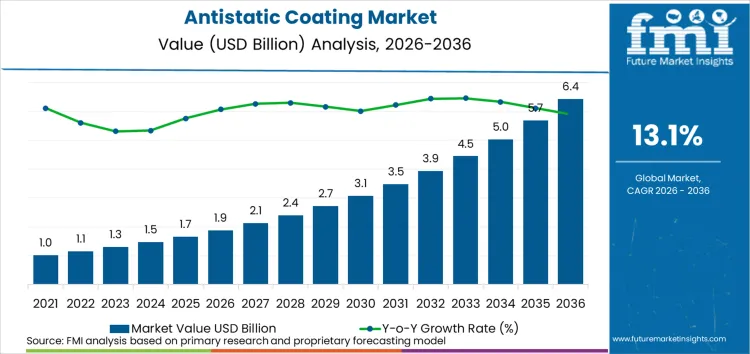
Antistatic Coating Market Key Takeaways
| Metrics | Values |
|---|---|
| Expected Value (2026E) | USD 1,880 million |
| Projected Value (2036F) | USD 6,440 million |
| CAGR (2026 to 2036) | 13.1% |
Source: FMI analysis, based on proprietary forecasting model and primary research
Why is the Antistatic Coating Market Growing?
Expansion of antistatic coating demand is propelled by electronics manufacturing expansion, e-commerce logistics infrastructure investment, industrial automation proliferation, and sustainable manufacturing imperatives. Institutional procurement specifications from global electronics OEMs, third-party logistics providers, and industrial equipment manufacturers are forcing immediate adoption of validated antistatic coating systems .
Electronics Manufacturing Expansion as Primary Demand Driver
The global electronics industry's sustained growth trajectory creates corresponding demand for ESD protection. JEITA projects global electronics and IT industry production to reach $3,990.9 billion in 2025, growing 8% annually. Each semiconductor wafer, printed circuit board, and finished electronic device requires antistatic protection during fabrication, assembly, transport, and storage. With ESD-related failures accounting for approximately 30% of all electronic component defects, the cost of inadequate protection-warranty claims, field failures, brand reputation damage-far exceeds the incremental cost of certified antistatic coatings .
E-Commerce Logistics Infrastructure Investment
The e-commerce industry's sustained expansion-USA e-commerce sales climbed 7.5% in Q2 2023 versus prior year, representing 15.4% of total retail sales-drives demand for antistatic protective packaging. Antistatic coatings applied to bubble covers, films, foams, and liners enable safe transport of electronics and sensitive components through high-throughput fulfillment networks where triboelectric charging from automated sortation equipment poses substantial ESD risk. Asia-Pacific's rapid e-commerce infrastructure build-out, particularly in China and India, accelerates regional demand growth .
Industrial Automation and Industry 4.0 Proliferation
The global shift toward automated manufacturing and Industry 4.0 initiatives intensifies ESD control requirements. Robotic pick-and-place systems, automated guided vehicles, and high-speed conveyor networks generate substantial triboelectric charges through repeated contact and separation of dissimilar materials. Antistatic coatings on work surfaces, component trays, and equipment housings suppress charge accumulation and provide consistent static dissipation, directly reducing production line ESD events. Emerging economies' rapid industrialization-particularly in India and Southeast Asia-amplifies this demand vector .
Regulatory and Standards Enforcement
ANSI/ESD S20.20 and IEC 61340-5-1 standards, increasingly referenced in global supply chain contracts, mandate documented ESD control programs including verified packaging and surface protection materials. China's GB/T 37977 series enforcement and India's progressive adoption of international ESD standards compel electronics manufacturers to upgrade from informal pink poly to certified antistatic systems. Regulatory compliance has transitioned from competitive differentiator to market access prerequisite .
How is Antistatic Coating Market Segmented?
Why does Electronics Packaging represent the dominant application segment?
Electronics packaging accounts for 48% of the antistatic coating market because it serves as the first line of defense against ESD damage throughout the global semiconductor and electronics supply chain-from wafer fabrication and component packaging through PCB assembly and finished device transport. Antistatic coatings applied to carrier tapes, reel covers, tray liners, tote boxes, and shipping bags prevent charge accumulation during high-speed automated handling and protect devices through extended distribution cycles. The proliferation of miniaturized, low-voltage electronics (3.3V, 1.8V, and below) has collapsed ESD damage thresholds, elevating antistatic packaging from optional accessory to yield-critical consumable .
Packaging and textiles (28% share) represent the second-largest application segment, encompassing industrial packaging films, cleanroom garments, and conductive textile coatings. Industrial applications (16% share) include equipment housings, work surfaces, and flooring in sensitive manufacturing environments. Display surfaces (6% share) address touchscreens and optical displays requiring transparent antistatic coatings with ≥90% transmission. Consumer electronics (2% share) encompasses device enclosures and accessories .
Why does Conductive Coatings maintain leadership in coating technology preferences?
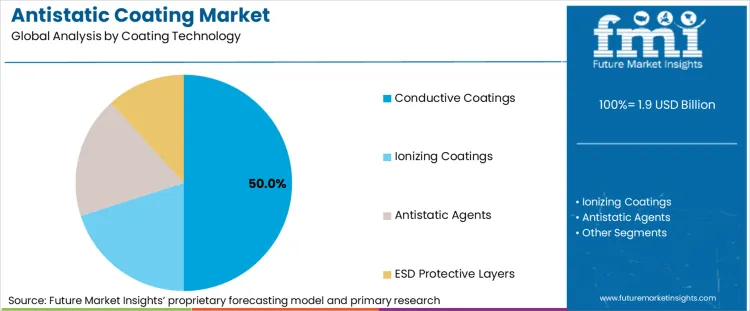
Conductive coatings hold 50% of coating technology demand because they provide the most robust and permanent antistatic performance across diverse substrates and end-use environments. These coatings-formulated with carbon black, conductive polymers (PEDOT:PSS), metal oxides, or carbon nanotubes-achieve surface resistivity of 10⁶-10⁹ Ω/sq with minimal humidity dependence, unlike migratory antistats that require ambient moisture for function and deplete over time. Conductive coatings survive abrasion, cleaning, and environmental aging, making them essential for automotive, aerospace, and industrial applications where long-term reliability is non-negotiable .
Ionizing coatings (28% share) utilize atmospheric corona discharge or soft X-ray technologies to neutralize surface charges without physical contact, primarily serving cleanroom and in-line web processing applications. Antistatic agents (14% share) encompass migratory surfactants and internal antistats for polyolefin films and molded components. ESD protective layers (6% share) include multi-layer barrier structures combining conductive and dissipative functionalities. Plasma treatments (2% share) address specialty applications requiring sub-10nm surface modification .
How does PET Film as the Primary Base Material drive Market Volume?
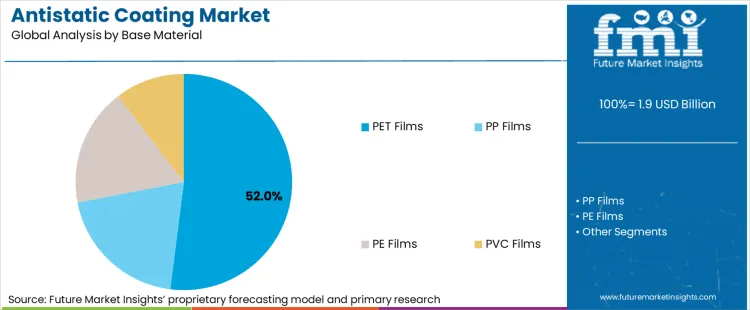
PET films constitute 52% of base material consumption in this sector. Dominance is driven by exceptional optical clarity (≥90% transmission), dimensional stability (<0.3% shrinkage at 150°C), high tensile strength enabling down-gauging, broad thickness range (12-250μm) accommodating diverse converting processes, and established surface chemistry facilitating robust coating adhesion. PET's carbonyl (C=O) and ether (C-O) functional groups enable chemical bonding with conductive polymer systems without extensive pretreatment-a decisive advantage versus polyolefins requiring corona or plasma treatment. Asia-Pacific manufacturers including Toray, Mitsubishi Chemical, and Toyobo continue advancing high-performance antistatic PET film grades for touch panel, display, and semiconductor applications .
PP films (24% share) serve applications requiring chemical resistance and lower cost profiles, particularly in industrial packaging and textile applications. PE films (16% share) dominate flexible bag and liner applications where sealability and economics are paramount. PVC films (8% share) address niche applications with specific regulatory compliance requirements. PC films, while representing minimal current volume, address premium automotive and electronics housing applications requiring impact resistance .
What Drivers, Restraints, Opportunities, and Trends Prevail in the Antistatic Coating Market?
Drivers
Electronics Industry Growth: Global electronics production expanding at 8% annually directly correlates with antistatic coating consumption. Each new semiconductor fab, PCB assembly line, and device assembly operation requires comprehensive ESD control infrastructure. Asia-Pacific's electronics manufacturing ecosystem-China, Taiwan, South Korea, Japan, and increasingly India-represents the highest-density demand cluster .
E-Commerce Logistics Expansion: The e-commerce sector's sustained double-digit growth in emerging markets drives demand for antistatic protective packaging. India and Southeast Asia's logistics infrastructure build-out, supported by government industrial policies, creates multi-year demand visibility for coated films and converted packaging products .
Industrial Automation Investment: Industry 4.0 initiatives and manufacturing automation investments amplify ESD risk. Automated material handling systems operating at 30,000+ components per hour generate triboelectric charges that conventional packaging cannot mitigate. Antistatic coatings on totes, trays, and machine surfaces provide consistent charge dissipation essential for automated production economics .
Regulatory and Standards Enforcement: China's GB/T 37977 series, India's progressive ESD standards adoption, and sustained ANSI/ESD S20.20 certification requirements create compliance-driven demand floors. Third-party audits at major electronics assembly sites now verify that all packaging materials entering EPA zones meet documented surface resistivity specifications .
Restraints
Raw Material Cost Volatility: Conductive polymers, carbon nanotubes, and specialty metal oxide precursors exhibit price fluctuations of 15-30% annually. For high-volume packaging applications where coating cost must remain below $0.50/m², this volatility complicates long-term supply agreements and favors vertically integrated suppliers with raw material backward integration .
Performance Trade-offs in Transparent Formulations: Transparent conductive coatings achieving ≥90% transmission with surface resistivity ≤10⁹ Ω/sq require indium tin oxide, silver nanowires, or advanced PEDOT:PSS formulations-costing 5-10× more than opaque carbon-black alternatives. This economics-performance trade-off segments the market, limiting transparent coating adoption to premium display applications .
Substrate Adhesion Challenges: While PET and PC accept antistatic coatings with excellent adhesion, polyolefin substrates (PE, PP) dominating flexible packaging applications require corona, plasma, or primer pretreatment. This additional processing step increases system cost and complexity, limiting antistatic coating penetration in high-volume polyethylene film applications .
Opportunity
Opportunity 1: Sustainable Antistatic Coating Formulations
Brand owner commitments to eliminate problematic black plastics (non-detectable by NIR sorters) and increase recycled content are driving demand for transparent or light-colored antistatic coatings detectable by recycling infrastructure. First-mover suppliers with certified sustainable antistatic coating portfolios-utilizing bio-based polymers, recycled PET substrates, or solvent-free coating processes-are capturing preferred supplier status with Fortune 500 electronics companies. The total addressable market for sustainable antistatic formulations exceeds USD 800 million by 2030 .
Opportunity 2: High-Temperature Antistatic Coatings
Toray's January 2026 commercialization of 160°C-resistant polypropylene release film demonstrates the market trajectory toward high-temperature antistatic materials. Advanced IC substrate manufacturing, carbon fiber prepreg processing, and battery component fabrication require antistatic coatings that maintain performance through 150-200°C thermal exposure. Suppliers bridging the gap between antistatic functionality and extreme thermal stability command substantial price premiums and multi-year supply agreements with semiconductor and advanced materials customers .
Opportunity 3: Regional Manufacturing Localization
Industrial policy in India (PLI scheme), United States (CHIPS Act), and European Union (Green Deal Industrial Plan) is accelerating domestic electronics manufacturing capacity and correspondingly, localized antistatic coating demand. Domestic coating suppliers in these regions are scaling production capacity through technology partnerships and capital subsidies. Early entrants establishing local manufacturing footprints capture import substitution opportunities and supply chain resilience premiums .
Trends
Trend 1: Migration from Opaque to Transparent Conductive Coatings
Environmental regulations and brand sustainability commitments are accelerating substitution of opaque carbon-black antistatic coatings with transparent or light-colored alternatives detectable by NIR recycling sorters. Major electronics brands have established 2028-2030 internal deadlines for eliminating non-detectable black plastics from packaging. Conductive polymers (PEDOT:PSS), silver nanowires, and hybrid metal oxide coatings are gaining share in mid-tier applications as cost-performance ratios improve .
Trend 2: Multifunctional Coating Integration
End-users increasingly demand single coatings that simultaneously provide antistatic functionality, abrasion resistance, oxygen/moisture barrier, and optical clarity. Multilayer co-extruded films with integrated antistatic layers and barrier coatings simplify supply chains while reducing total applied cost. Suppliers with proprietary co-extrusion and in-line coating capabilities capture margin expansion opportunities unavailable to single-function coating formulators .
Trend 3: Smart ESD Packaging with Embedded Monitoring
Integration of printed electronics with antistatic coatings enables "smart" packaging that monitors cumulative ESD exposure, humidity, and temperature. Passive RFID tags printed on conductive polymer layers can report whether a package has experienced electrostatic potentials above threshold during transit. While currently limited to high-value semiconductor and defense applications, commercialization is expected to accelerate as printed electronics manufacturing scales .
Trend 4: Regional Supply Chain Localization
CHIPS Act incentives in the U.S., EU Chips Act, and India's semiconductor mission are driving construction of new fabs and OSAT facilities outside traditional Asian hubs. Each new fab creates localized demand for antistatic coatings validated to its specific ESD control plan. Domestic coating converters are investing in cleanroom-compatible coating capacity to serve these emerging manufacturing ecosystems, reducing dependence on Asian imports .
Analysis of Antistatic Coating Market by Key Countries
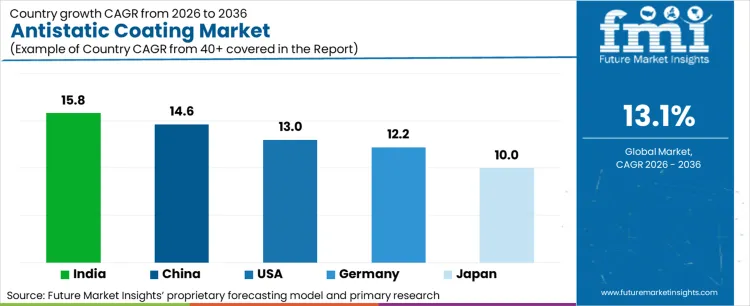
| Country | CAGR (2026 to 2036) |
|---|---|
| India | 15.8% |
| China | 14.6% |
| United States | 13.0% |
| Germany | 12.2% |
| Japan | 10.0% |
Source: FMI analysis, based on proprietary forecasting model and primary research
What industrial policy catalyst is accelerating India's antistatic coating adoption at 15.8% CAGR?
India exhibits the highest market acceleration with a CAGR of 15.8% through 2036, propelled by the Production Linked Incentive scheme targeting USD 400 billion in domestic electronics manufacturing by 2030. Apple, Samsung, and Foxconn have expanded assembly operations in India, with contract manufacturers required to achieve 50-60% domestic value addition to qualify for production incentives. Each new smartphone, tablet, and wearable assembly line requires antistatic-coated carrier tapes, reel covers, tote liners, and protective films-historically imported from Japan, Korea, and Taiwan.
Domestic coating capacity is expanding rapidly through technology partnerships and capital subsidies, with Asian Paints, Berger Paints, and Kansai Nerolac establishing electronics-grade coating formulation capabilities. India's rapidly expanding e-commerce logistics infrastructure and electric vehicle manufacturing ecosystem provide parallel demand drivers .
How is semiconductor and EV manufacturing scale driving China's 14.6% CAGR?
China's market expands at 14.6% CAGR, driven by the world's largest semiconductor fabrication expansion and electric vehicle manufacturing ecosystem. China operates ten Gen-10.5 TFT-LCD fabs, 40+ 300mm wafer fabs, and produces approximately 70% of global EVs-each requiring comprehensive ESD control infrastructure. Domestic coating manufacturers have scaled antistatic PET film and conductive coating capacity, achieving cost positions 20-30% below imported alternatives while meeting GB/T 37977 compliance standards. The convergence of domestic semiconductor self-sufficiency mandates, EV production leadership, and aggressive VOC emission standards (GB 30981 series) creates uniquely favorable adoption economics .
What drives United States market growth at 13.0% CAGR?
The United States expands at 13.0% CAGR, supported by CHIPS Act semiconductor fab construction (Intel Ohio, TSMC Arizona, Samsung Texas, Micron New York) and defense electronics ESD requirements. Each new greenfield fab requires validated antistatic coatings for wafer carriers, reticle pods, tray liners, and shipping bags-specifications favoring domestic suppliers with IATF 16949 and MIL-spec qualifications. The U.S. defense logistics sector's sustained demand for MIL-PRF-81705 Type II static-shielding materials further anchors domestic consumption .
How does German automotive electronics leadership influence 12.2% growth?
Germany advances at 12.2% CAGR, led by premium automotive OEM specifications requiring validated ESD protection for advanced driver assistance systems, infotainment displays, and EV powertrain electronics. German automotive suppliers (Bosch, Continental, ZF) have institutionalized IATF 16949-certified antistatic coating requirements with documented surface resistivity stability through 1,000h 85°C/85% RH aging and 1,000 thermal cycles. Suppliers with dedicated automotive qualification laboratories co-located with German OEM engineering centers capture substantial price premiums and multi-year, multi-model supply agreements .
How does Japan's advanced materials sector shape its 10.0% trajectory?
Japan develops at 10.0% CAGR, reflecting mature semiconductor materials leadership and concentration in high-value, high-purity antistatic coating segments. Toray Industries' January 2026 commercialization of 160°C-resistant polypropylene film demonstrates Japan's continued innovation in high-performance materials for semiconductor and advanced composite applications. While unit volumes are stable, continuous specification escalation-from 10⁹ Ω/sq to 10⁶-10⁸ Ω/sq surface resistivity requirements, from 50μm to 12μm film thickness targets-sustains value growth. Japan's super-aging society and shrinking manufacturing workforce drive automation investments that, paradoxically, increase demand for antistatic coatings compatible with robotic handling systems .
What is the Competition Outlook for Antistatic Coating Market?
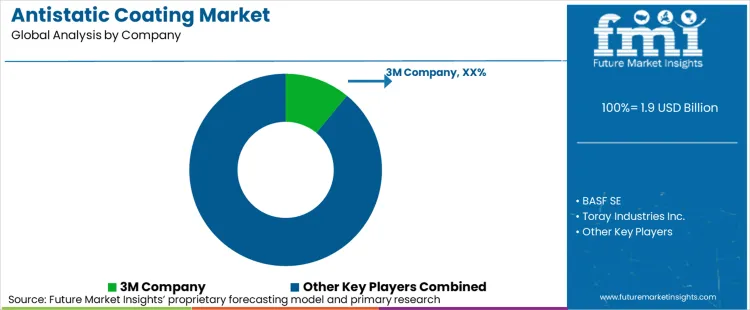
The competitive landscape for antistatic coating has undergone fundamental transformation from fragmented regional formulators supplying commoditized topical antistats to integrated global material science corporations delivering application-engineered, validated coating systems with documented surface resistivity stability, substrate compatibility, and sustainability credentials .
Competitive Differentiation Vectors
Permanent Conductive Coating Formulation: Suppliers maintaining in-house conductive polymer synthesis, carbon nanotube dispersion, or metal oxide coating capabilities secure long-term supply agreements with semiconductor and automotive customers requiring humidity-independent, non-depletable antistatic performance. 3M and BASF lead through proprietary formulation expertise and global regulatory compliance infrastructure .
Substrate-Specific Adhesion Engineering: Antistatic coating performance is highly dependent on substrate surface chemistry. Suppliers with dedicated application laboratories co-located with PET, PP, and PC film manufacturers achieve technical lock-in that commodity formulators cannot dislodge. Toray's integration of film manufacturing and coating development enables optimized PET-based antistatic systems with verified transfer efficiency and cross-cut adhesion .
Sustainability Documentation: Verified recycled content, bio-based polymer content, and solvent-free coating certifications have become non-negotiable procurement requirements for Fortune 500 electronics brands. Suppliers with ISCC PLUS mass balance certification and Environmental Product Declarations capture preferred supplier status and extended contract terms.
Key Players Profiled
- 3M Company
- BASF SE
- Toray Industries Inc.
- Akzo Nobel N.V.
- PPG Industries Inc.
- The Sherwin-Williams Company
- DuPont de Nemours Inc.
- Nippon Paint Holdings Co. Ltd.
- Kansai Paint Co. Ltd.
Source: FMI analysis, based on proprietary forecasting model and primary research
Market Definition
The antistatic coating market comprises revenues generated from advanced coating formulations engineered to prevent electrostatic discharge through controlled surface resistivity (typically 10⁶-10¹¹ Ω/sq) and static decay rates (≤2 seconds per FTMS 101C), enabling damage-free handling, storage, and operation of electrostatic-sensitive devices and materials across electronics packaging, packaging and textiles, industrial applications, display surfaces, and consumer electronics .
The scope includes antistatic coating systems categorized by application segment (electronics packaging, packaging and textiles, industrial applications, display surfaces, consumer electronics), coating technology (conductive coatings, ionizing coatings, antistatic agents, ESD protective layers, plasma treatments), and base material (PET films, PP films, PE films, PVC films, PC films). Products within scope are engineered specifically for intentional electrostatic discharge protection and are designed to achieve validated performance metrics including surface resistivity, static decay time, abrasion resistance, and optical clarity where applicable.
The scope excludes revenues from the manufacture of substrates receiving antistatic coatings; migratory temporary antistats that lose efficacy over time or require humidity for function; non-coating ESD protection methods (wrist straps, heel grounders, ionization blowers); and downstream application, lamination, or installation services.
Formulations failing to achieve minimum static decay time of ≤2 seconds or surface resistivity outside the 10⁶-10¹¹ Ω/sq range intended for ESD control fall outside the defined market boundary.
Scope of Report
| Items | Values |
|---|---|
| Quantitative Units (2026) | USD 1,880 million |
| Application Segment | Electronics Packaging, Packaging & Textiles, Industrial Applications, Display Surfaces, Consumer Electronics |
| Coating Technology | Conductive Coatings, Ionizing Coatings, Antistatic Agents, ESD Protective Layers, Plasma Treatments |
| Base Material | PET Films, PP Films, PE Films, PVC Films, PC Films |
| Regions Covered | North America, Europe, East Asia, Japan, Rest of World |
| Countries Covered | United States, Germany, China, Japan, India, Canada, Mexico, United Kingdom, France, Italy, Spain, South Korea, Taiwan, Brazil, and additional regional markets |
| Key Companies Profiled | 3M, BASF, Toray |
Source: FMI analysis, based on proprietary forecasting model and primary research
Antistatic Coating Market Key Segments
By Application Segment:
- Electronics Packaging
- Packaging & Textiles
- Industrial Applications
- Display Surfaces
- Consumer Electronics
By Coating Technology:
- Conductive Coatings
- Ionizing Coatings
- Antistatic Agents
- ESD Protective Layers
- Plasma Treatments
By Base Material:
- PET Films
- PP Films
- PE Films
- PVC Films
- PC Films
By Region:
- North America
- Europe
- East Asia
- Japan
- Rest of the World
Bibliography
- Warislohner, F. (2025). Asia Pacific Anti-Static Safety Coating Market Regions, Size & CAGR 2026-2033. LinkedIn Pulse.
- BASF SE. (2015). BASF führt neue antistatische MasterTop Bodenbeschichtung ein. Baulinks.
- Composights. (2026). Toray Unveils Industry's First 160 °C-Resistant Polypropylene Release Film. Composights.
- SpecialChem. (2026). Toray develops BOPP film with heat resistance comparable to engineering plastics. SpecialChem.
- Warislohner, F. (2025). High-Performance Anti-Static Coating Products Market Report 2026. LinkedIn Pulse.
- TimesTech. (2026). Toray Unveils World's First 160°C-Resistant Polypropylene Release Film. TimesTech.
Frequently Asked Questions
What is the projected global growth rate for the antistatic coating market?
The global market is projected to expand at a 13.1% CAGR from 2026 to 2036, from USD 1,880 million to USD 6,440 million, reflecting structural convergence of semiconductor node shrinkage driving ESD sensitivity below 5V, global electronics production expanding at 8% annually, e-commerce logistics infrastructure investment, and industrial automation proliferation.
Which application segment and coating technology dominate market demand?
Electronics packaging accounts for 48% of application demand because it serves as the first line of defense against ESD damage throughout the semiconductor and electronics supply chain-from wafer fabrication through finished device transport. Conductive coatings hold 50% of coating technology demand, delivering the most robust and permanent antistatic performance with minimal humidity dependence and superior durability versus migratory alternatives.
Which base material accounts for the largest market share?
PET films account for 52% of base material consumption. Dominance is driven by optical clarity (≥90% transmission), dimensional stability (<0.3% shrinkage at 150°C), high tensile strength enabling down-gauging, established surface chemistry facilitating robust coating adhesion without extensive pretreatment, and broad thickness range accommodating diverse converting processes.
Which regions and countries are expected to lead market expansion over the forecast period?
India is the fastest-growing country at 15.8% CAGR, propelled by PLI scheme electronics manufacturing localization and domestic coating capacity expansion. China follows at 14.6% CAGR driven by semiconductor fab investment and EV production scale. The United States expands at 13.0% CAGR supported by CHIPS Act fab construction. Germany advances at 12.2% CAGR led by automotive electronics ESD mandates. Japan develops at 10.0% CAGR shaped by Toray's advanced film innovations and mature semiconductor materials sector.
Preview the report firsthand - request a free sample
Get SampleGet the brochure for pricing and purchase details.
Get PDFTable of Content
- Executive Summary
- Global Market Outlook
- Demand-side Trends
- Supply-side Trends
- Technology Roadmap Analysis
- Analysis and Recommendations
- Market Overview
- Market Coverage / Taxonomy
- Market Definition / Scope / Limitations
- Research Methodology
- Chapter Orientation
- Analytical Lens and Working Hypotheses
- Market Structure, Signals, and Trend Drivers
- Desk Research Programme (Secondary Evidence)
- Company Annual and Sustainability Reports
- Peer-reviewed Journals and Academic Literature
- Corporate Websites, Product Literature, and Technical Notes
- Earnings Decks and Investor Briefings
- Statutory Filings and Regulatory Disclosures
- Technical White Papers and Standards Notes
- Trade Journals, Industry Magazines, and Analyst Briefs
- Conference Proceedings, Webinars, and Seminar Materials
- Government Statistics Portals and Public Data Releases
- Press Releases and Reputable Media Coverage
- Specialist Newsletters and Curated Briefings
- Sector Databases and Reference Repositories
- FMI Internal Proprietary Databases and Historical Market Datasets
- Subscription Datasets and Paid Sources
- Social Channels, Communities, and Digital Listening Inputs
- Additional Desk Sources
- Expert Input and Fieldwork (Primary Evidence)
- Primary Modes
- Qualitative Interviews and Expert Elicitation
- Quantitative Surveys and Structured Data Capture
- Blended Approach
- Why Primary Evidence is Used
- Field Techniques
- Interviews
- Surveys
- Focus Groups
- Observational and In-context Research
- Social and Community Interactions
- Stakeholder Universe Engaged
- C-suite Leaders
- Board Members
- Presidents and Vice Presidents
- R&D and Innovation Heads
- Technical Specialists
- Domain Subject-matter Experts
- Scientists
- Physicians and Other Healthcare Professionals
- Governance, Ethics, and Data Stewardship
- Research Ethics
- Data Integrity and Handling
- Primary Modes
- Tooling, Models, and Reference Databases
- Data Engineering and Model Build
- Data Acquisition and Ingestion
- Cleaning, Normalisation, and Verification
- Synthesis, Triangulation, and Analysis
- Quality Assurance and Audit Trail
- Market Background
- Market Dynamics
- Drivers
- Restraints
- Opportunity
- Trends
- Scenario Forecast
- Demand in Optimistic Scenario
- Demand in Likely Scenario
- Demand in Conservative Scenario
- Opportunity Map Analysis
- Product Life Cycle Analysis
- Supply Chain Analysis
- Investment Feasibility Matrix
- Value Chain Analysis
- PESTLE and Porter’s Analysis
- Regulatory Landscape
- Regional Parent Market Outlook
- Production and Consumption Statistics
- Import and Export Statistics
- Market Dynamics
- Global Market Analysis 2021 to 2025 and Forecast, 2026 to 2036
- Historical Market Size Value (USD Million) Analysis, 2021 to 2025
- Current and Future Market Size Value (USD Million) Projections, 2026 to 2036
- Y-o-Y Growth Trend Analysis
- Absolute $ Opportunity Analysis
- Global Market Pricing Analysis 2021 to 2025 and Forecast 2026 to 2036
- Global Market Analysis 2021 to 2025 and Forecast 2026 to 2036, By Coating Technology
- Introduction / Key Findings
- Historical Market Size Value (USD Million) Analysis By Coating Technology , 2021 to 2025
- Current and Future Market Size Value (USD Million) Analysis and Forecast By Coating Technology , 2026 to 2036
- Conductive Coatings
- Ionizing Coatings
- Antistatic Agents
- ESD Protective Layers
- Conductive Coatings
- Y-o-Y Growth Trend Analysis By Coating Technology , 2021 to 2025
- Absolute $ Opportunity Analysis By Coating Technology , 2026 to 2036
- Global Market Analysis 2021 to 2025 and Forecast 2026 to 2036, By Base Material
- Introduction / Key Findings
- Historical Market Size Value (USD Million) Analysis By Base Material, 2021 to 2025
- Current and Future Market Size Value (USD Million) Analysis and Forecast By Base Material, 2026 to 2036
- PET Films
- PP Films
- PE Films
- PVC Films
- PET Films
- Y-o-Y Growth Trend Analysis By Base Material, 2021 to 2025
- Absolute $ Opportunity Analysis By Base Material, 2026 to 2036
- Global Market Analysis 2021 to 2025 and Forecast 2026 to 2036, By Region
- Introduction
- Historical Market Size Value (USD Million) Analysis By Region, 2021 to 2025
- Current Market Size Value (USD Million) Analysis and Forecast By Region, 2026 to 2036
- North America
- Latin America
- Western Europe
- Eastern Europe
- East Asia
- South Asia and Pacific
- Middle East & Africa
- Market Attractiveness Analysis By Region
- North America Market Analysis 2021 to 2025 and Forecast 2026 to 2036, By Country
- Historical Market Size Value (USD Million) Trend Analysis By Market Taxonomy, 2021 to 2025
- Market Size Value (USD Million) Forecast By Market Taxonomy, 2026 to 2036
- By Country
- USA
- Canada
- Mexico
- By Coating Technology
- By Base Material
- By Country
- Market Attractiveness Analysis
- By Country
- By Coating Technology
- By Base Material
- Key Takeaways
- Latin America Market Analysis 2021 to 2025 and Forecast 2026 to 2036, By Country
- Historical Market Size Value (USD Million) Trend Analysis By Market Taxonomy, 2021 to 2025
- Market Size Value (USD Million) Forecast By Market Taxonomy, 2026 to 2036
- By Country
- Brazil
- Chile
- Rest of Latin America
- By Coating Technology
- By Base Material
- By Country
- Market Attractiveness Analysis
- By Country
- By Coating Technology
- By Base Material
- Key Takeaways
- Western Europe Market Analysis 2021 to 2025 and Forecast 2026 to 2036, By Country
- Historical Market Size Value (USD Million) Trend Analysis By Market Taxonomy, 2021 to 2025
- Market Size Value (USD Million) Forecast By Market Taxonomy, 2026 to 2036
- By Country
- Germany
- UK
- Italy
- Spain
- France
- Nordic
- BENELUX
- Rest of Western Europe
- By Coating Technology
- By Base Material
- By Country
- Market Attractiveness Analysis
- By Country
- By Coating Technology
- By Base Material
- Key Takeaways
- Eastern Europe Market Analysis 2021 to 2025 and Forecast 2026 to 2036, By Country
- Historical Market Size Value (USD Million) Trend Analysis By Market Taxonomy, 2021 to 2025
- Market Size Value (USD Million) Forecast By Market Taxonomy, 2026 to 2036
- By Country
- Russia
- Poland
- Hungary
- Balkan & Baltic
- Rest of Eastern Europe
- By Coating Technology
- By Base Material
- By Country
- Market Attractiveness Analysis
- By Country
- By Coating Technology
- By Base Material
- Key Takeaways
- East Asia Market Analysis 2021 to 2025 and Forecast 2026 to 2036, By Country
- Historical Market Size Value (USD Million) Trend Analysis By Market Taxonomy, 2021 to 2025
- Market Size Value (USD Million) Forecast By Market Taxonomy, 2026 to 2036
- By Country
- China
- Japan
- South Korea
- By Coating Technology
- By Base Material
- By Country
- Market Attractiveness Analysis
- By Country
- By Coating Technology
- By Base Material
- Key Takeaways
- South Asia and Pacific Market Analysis 2021 to 2025 and Forecast 2026 to 2036, By Country
- Historical Market Size Value (USD Million) Trend Analysis By Market Taxonomy, 2021 to 2025
- Market Size Value (USD Million) Forecast By Market Taxonomy, 2026 to 2036
- By Country
- India
- ASEAN
- Australia & New Zealand
- Rest of South Asia and Pacific
- By Coating Technology
- By Base Material
- By Country
- Market Attractiveness Analysis
- By Country
- By Coating Technology
- By Base Material
- Key Takeaways
- Middle East & Africa Market Analysis 2021 to 2025 and Forecast 2026 to 2036, By Country
- Historical Market Size Value (USD Million) Trend Analysis By Market Taxonomy, 2021 to 2025
- Market Size Value (USD Million) Forecast By Market Taxonomy, 2026 to 2036
- By Country
- Kingdom of Saudi Arabia
- Other GCC Countries
- Turkiye
- South Africa
- Other African Union
- Rest of Middle East & Africa
- By Coating Technology
- By Base Material
- By Country
- Market Attractiveness Analysis
- By Country
- By Coating Technology
- By Base Material
- Key Takeaways
- Key Countries Market Analysis
- USA
- Pricing Analysis
- Market Share Analysis, 2025
- By Coating Technology
- By Base Material
- Canada
- Pricing Analysis
- Market Share Analysis, 2025
- By Coating Technology
- By Base Material
- Mexico
- Pricing Analysis
- Market Share Analysis, 2025
- By Coating Technology
- By Base Material
- Brazil
- Pricing Analysis
- Market Share Analysis, 2025
- By Coating Technology
- By Base Material
- Chile
- Pricing Analysis
- Market Share Analysis, 2025
- By Coating Technology
- By Base Material
- Germany
- Pricing Analysis
- Market Share Analysis, 2025
- By Coating Technology
- By Base Material
- UK
- Pricing Analysis
- Market Share Analysis, 2025
- By Coating Technology
- By Base Material
- Italy
- Pricing Analysis
- Market Share Analysis, 2025
- By Coating Technology
- By Base Material
- Spain
- Pricing Analysis
- Market Share Analysis, 2025
- By Coating Technology
- By Base Material
- France
- Pricing Analysis
- Market Share Analysis, 2025
- By Coating Technology
- By Base Material
- India
- Pricing Analysis
- Market Share Analysis, 2025
- By Coating Technology
- By Base Material
- ASEAN
- Pricing Analysis
- Market Share Analysis, 2025
- By Coating Technology
- By Base Material
- Australia & New Zealand
- Pricing Analysis
- Market Share Analysis, 2025
- By Coating Technology
- By Base Material
- China
- Pricing Analysis
- Market Share Analysis, 2025
- By Coating Technology
- By Base Material
- Japan
- Pricing Analysis
- Market Share Analysis, 2025
- By Coating Technology
- By Base Material
- South Korea
- Pricing Analysis
- Market Share Analysis, 2025
- By Coating Technology
- By Base Material
- Russia
- Pricing Analysis
- Market Share Analysis, 2025
- By Coating Technology
- By Base Material
- Poland
- Pricing Analysis
- Market Share Analysis, 2025
- By Coating Technology
- By Base Material
- Hungary
- Pricing Analysis
- Market Share Analysis, 2025
- By Coating Technology
- By Base Material
- Kingdom of Saudi Arabia
- Pricing Analysis
- Market Share Analysis, 2025
- By Coating Technology
- By Base Material
- Turkiye
- Pricing Analysis
- Market Share Analysis, 2025
- By Coating Technology
- By Base Material
- South Africa
- Pricing Analysis
- Market Share Analysis, 2025
- By Coating Technology
- By Base Material
- USA
- Market Structure Analysis
- Competition Dashboard
- Competition Benchmarking
- Market Share Analysis of Top Players
- By Regional
- By Coating Technology
- By Base Material
- Competition Analysis
- Competition Deep Dive
- 3M Company
- Overview
- Product Portfolio
- Profitability by Market Segments (Product/Age /Sales Channel/Region)
- Sales Footprint
- Strategy Overview
- Marketing Strategy
- Product Strategy
- Channel Strategy
- BASF SE
- Toray Industries Inc.
- Akzo Nobel N.V.
- PPG Industries Inc.
- The Sherwin-Williams Company
- DuPont de Nemours Inc.
- Nippon Paint Holdings Co. Ltd.
- 3M Company
- Competition Deep Dive
- Assumptions & Acronyms Used


