

- Industry Size (2026)
- USD 640.0 Mn
- Forecast (2036)
- USD 2420.0 Mn
- CAGR (2026 to 2036)
- 14.20%
Carbon-Scored PCR Material Marketplace Market Forecast and Outlook 2026 to 2036
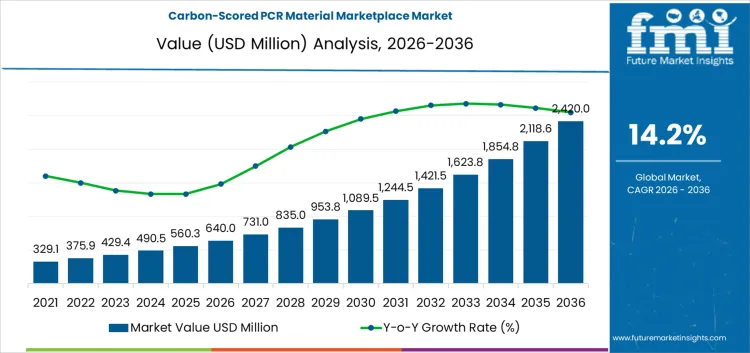
The carbon-scored PCR material marketplace market is likely to be valued at USD 640.0 million in 2026, is set to reach USD 2,420.0 million by 2036, and is expected to expand at a 14.2% CAGR. Demand is being shaped by procurement teams that are being asked to treat carbon intensity as a selection variable, not a narrative claim, so marketplaces are being used to standardize comparison across resin grades, recyclers, and routes-to-market. Value is being captured where carbon scoring can be tied to verified inputs energy mix, processing yields, transport legs, and chain-of-custody records because procurement credibility is being judged under audit conditions.
Platform adoption is being accelerated in high-volume packaging and export-linked supply cahains where carbon disclosure is being scrutinized at the customer level. Pricing power is being shifted toward suppliers whose listings are being supported by repeatable methodologies and third-party validation, while unverified “low-carbon” assertions are being discounted. Over 2026 to 2036, marketplace differentiation is being determined by data normalization, verification workflows, and the ability to convert carbon scores into contracting terms, supplier shortlists, and portfolio-level emissions reporting.
Quick Stats for Carbon-Scored PCR Material Marketplace Market
- Carbon-Scored PCR Material Marketplace Market Value (2026): USD 640.0 Million
- Carbon-Scored PCR Material Marketplace Market Forecast Value (2036): USD 2,420.0 Million
- Carbon-Scored PCR Material Marketplace Market Forecast CAGR 2026 to 2036: 14.20%
- Leading Marketplace Type in Carbon-Scored PCR Material Marketplace Market: B2B PCR Marketplaces
- Key Growth Regions in Carbon-Scored PCR Material Marketplace Market: Asia Pacific, Europe, North America
- Top Key Players in Carbon-Scored PCR Material Marketplace Market: Circular.co, ScrapMonster.com, Cirplus GmbH, Recycles.org.cn, AlibabaB2B, Recykal Marketplace
Carbon-Scored PCR Material Marketplace Market Key Takeaways
| Metric | Value |
|---|---|
| Industry Value (2026) | USD 640.0 Million |
| Forecast Value (2036) | USD 2,420.0 Million |
| Forecast CAGR 2026 to 2036 | 14.20% |
How Is the Global Carbon-Scored PCR Material Marketplace Market Advancing?
The global carbon-scored PCR material marketplace market is advancing rapidly, driven by growing demand for transparent, data-based comparison of recycled material options. Carbon-scored marketplaces enable buyers to evaluate PCR materials not only on price and quality, but also on quantified carbon impact metrics, supporting more informed procurement decisions.
A key driver supporting market growth is the increasing need for measurable carbon differentiation in PCR sourcing. Brand owners and manufacturers are under pressure to demonstrate reductions in material-related emissions, and carbon-scored marketplaces provide structured visibility into the relative carbon footprint of PCR resins sourced from different recyclers and processing pathways. This allows procurement teams to balance cost, performance, and emissions objectives within a single purchasing environment.
Expansion of digital trading platforms within recycled materials markets is further contributing to adoption. As PCR supply chains become more fragmented and global, centralized marketplaces help aggregate supply, standardize data presentation, and improve transaction efficiency. Carbon scoring adds an additional decision layer that supports supplier benchmarking and portfolio optimization.
Technological advancements are strengthening market implementation. Integration with lifecycle assessment datasets, traceability platforms, and supplier reporting tools is improving score accuracy and credibility. As carbon performance becomes a core selection criterion alongside price and availability, carbon-scored PCR material marketplaces are expected to play an increasingly important role in recycled material procurement over the forecast period.
What Is the Segment-Wise Overview of the Carbon-Scored PCR Material Marketplace Market?
The carbon-scored PCR material marketplace market is shaped by demand for measurable emissions data and structured recycled material procurement. Brand sourcing and procurement lead the end-use segment with a 45% share, as brands increasingly seek PCR materials that are not only available and compliant but also quantified by carbon impact metrics. Carbon scoring enables informed procurement decisions aligned with internal emissions targets and reporting frameworks. By marketplace type, B2B PCR marketplaces dominate with a 50% share, reflecting preference for centralized, professional trading platforms that support verified listings, standardized data, and contractual transactions. Together, these segments highlight a market focused on data-backed PCR procurement, transparency in environmental impact, and scalable digital trading infrastructure.
Why Does Brand Sourcing & Procurement Lead the Carbon-Scored PCR Material Marketplace Market?
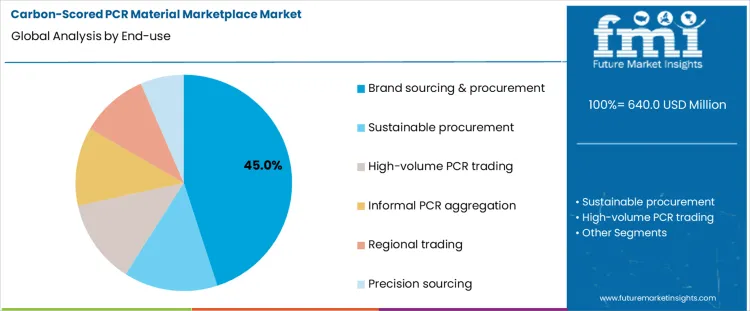
Brand sourcing and procurement account for 45% of market demand because large brands are under increasing pressure to demonstrate measurable emissions reductions alongside recycled content usage. Carbon-scored marketplaces allow procurement teams to compare PCR materials based on both performance specifications and embedded carbon metrics. This supports internal carbon accounting, supplier benchmarking, and compliance reporting. Brands also benefit from improved visibility into upstream recycling practices and logistics-related emissions. As PCR sourcing moves from opportunistic buying to strategic procurement, carbon scoring becomes a key differentiator. This shift positions brand-led sourcing as the primary driver of demand within carbon-scored PCR marketplaces.
How Do B2B PCR Marketplaces Drive the Carbon-Scored PCR Material Marketplace Market?
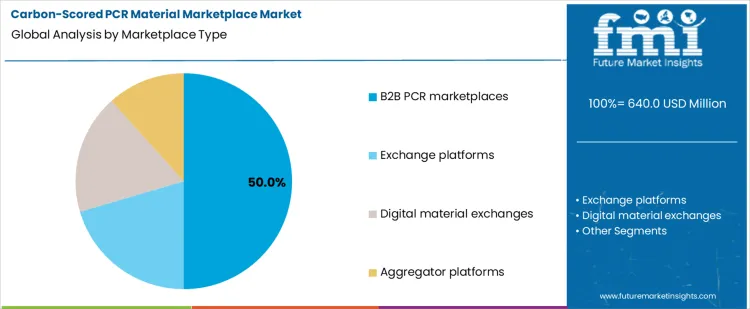
B2B PCR marketplaces represent 50% of marketplace type demand, making them the dominant trading model in the carbon-scored PCR material marketplace market. These platforms provide structured environments where verified suppliers list PCR materials with standardized quality, volume, pricing, and carbon impact data. B2B marketplaces support contract-based transactions, traceability documentation, and integration with procurement systems, reducing friction in high-volume PCR trading. Their scalability and ability to support multi-region sourcing make them suitable for global brands and large buyers. As demand grows for transparent, data-rich PCR procurement, B2B marketplaces continue to anchor market development.
What Are the Key Dynamics for the Carbon-Scored PCR Material Marketplace Market?
Carbon-scored PCR material marketplaces assign carbon scores to PCR materials by evaluating factors such as feedstock origin, processing energy intensity, transportation distance, and recycling method. Key market dynamics include increasing regulatory focus on emissions disclosure, growing demand for carbon accounting in procurement decisions, and brand commitments to emissions reduction targets. Carbon-scored marketplaces enable buyers to evaluate PCR materials not only on price and quality but also on verified carbon impact. As carbon metrics become central to material selection, these platforms are emerging as critical decision-support tools within circular material supply chains.
Why Is the Carbon-Scored PCR Material Marketplace Market Growing?
Expansion of corporate emissions reporting requirements and lifecycle assessment practices is increasing demand for transparent, comparable carbon data at the material level. Buyers are using carbon-scored marketplaces to identify lower-emission PCR options that support internal decarbonization targets. Growth in PCR usage across packaging, consumer goods, and industrial applications is amplifying transaction volumes, making structured digital marketplaces more efficient than bilateral negotiations. As voluntary carbon reduction initiatives and regulatory reporting frameworks converge, carbon-scored PCR marketplaces are gaining traction as standardized platforms for responsible material procurement.
How Are the Key Drivers Shaping the Carbon-Scored PCR Material Marketplace Market?
Advances in data modeling allow marketplaces to assign dynamic carbon scores that reflect real-time changes in energy mix, transport routes, and processing efficiency. Brand sustainability teams are influencing adoption by requiring carbon intensity data as part of supplier qualification. Investors and stakeholders are also driving demand for measurable emissions reductions tied to material sourcing. Collaboration between recyclers, marketplace operators, and verification bodies enhances score credibility. These drivers are transforming PCR marketplaces from price-based trading hubs into multi-criteria platforms where carbon performance directly influences purchasing decisions.
What Is the Growth Outlook for the Carbon-Scored PCR Material Marketplace Market by Country?
| Country | CAGR (%) |
|---|---|
| India | 16.2% |
| China | 15.4% |
| USA | 13.6% |
| Germany | 13.2% |
| Brazil | 12.0% |
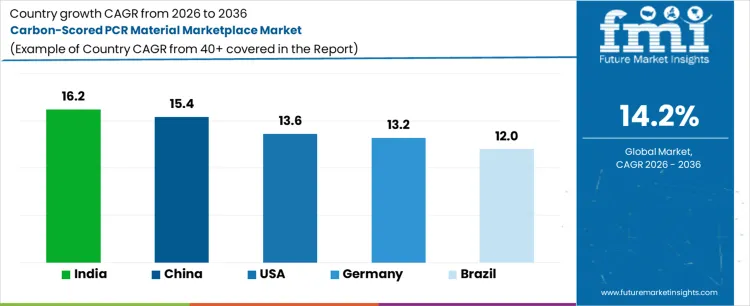
The carbon-scored PCR material marketplace market is expanding as buyers align PCR sourcing with emissions accountability. India leads with a 16.2% CAGR, driven by disclosure needs and organized recycling growth. China follows at 15.4%, supported by export exposure and digital procurement. The USA grows at 13.6%, reflecting climate-linked sourcing practices. Germany records 13.2% growth, driven by regulatory precision. Brazil expands at 12.0%, supported by multinational procurement standards. As carbon metrics influence supplier selection, demand for carbon-scored PCR marketplaces is expected to strengthen across regions.
Why Is the Carbon-Scored PCR Material Marketplace Market Expanding Rapidly in India?
Demand for carbon-scored PCR material marketplace in India is expanding at a CAGR of 16.2%. Brand owners and converters are seeking procurement platforms that link PCR sourcing with quantified carbon impact data. Marketplaces that score PCR materials by emissions intensity help buyers compare suppliers and justify sourcing decisions for internal reporting. Rising EPR enforcement and disclosure expectations are pushing companies toward data-backed procurement tools. Indian recyclers benefit from marketplaces that differentiate materials by verified carbon metrics, improving pricing power. Integration with traceability and verification platforms strengthens buyer confidence. Growth of organized recycling parks supports higher transaction volumes. Procurement teams value platforms that align PCR sourcing with climate reporting workflows. As carbon accountability becomes embedded in packaging decisions, demand for carbon-scored PCR marketplaces in India is expected to grow strongly.
What Is Driving Carbon-Scored PCR Material Marketplace Market Growth in China?
Demand for carbon-scored PCR material marketplace in China is expanding at a CAGR of 15.4%. Large-scale manufacturing and export exposure are increasing interest in PCR sourcing platforms that provide carbon transparency. Marketplaces enable buyers to select PCR grades based on emissions profiles alongside quality and price. Chinese recyclers are adopting carbon scoring to meet buyer expectations and improve competitiveness. Integration with industrial data systems supports reliable emissions attribution. Export-oriented converters rely on marketplace data to support customer audits and reporting. Platform adoption is strengthened by digital procurement maturity across industrial sectors. As carbon metrics gain importance in supplier selection, carbon-scored PCR marketplaces in China are expected to see steady growth.
Why Is the Carbon-Scored PCR Material Marketplace Market Advancing in the USA?
Demand for carbon-scored PCR material marketplace in the USA is expanding at a CAGR of 13.6%. Corporate climate disclosures and procurement accountability are driving adoption of marketplaces that quantify carbon impact at the material level. Buyers value platforms that combine PCR availability with emissions scoring and verification. Marketplaces support supplier comparison, contract negotiation, and audit readiness. Integration with ESG reporting systems increases utility for procurement teams. Recyclers use carbon scoring to differentiate offerings and secure preferred supplier status. Retailer expectations reinforce the need for transparent sourcing data. As climate-linked procurement becomes standard practice, demand for carbon-scored PCR marketplaces in the USA is expected to remain strong.
What Is Supporting Growth of the Carbon-Scored PCR Material Marketplace Market in Germany?
Sales for carbon-scored PCR material marketplace in Germany is growing at a CAGR of 13.2%. Regulatory rigor and high documentation standards favor platforms that provide verified carbon metrics. German buyers prioritize precision and comparability in material selection. Marketplaces that integrate certification, traceability, and emissions data fit established procurement processes. Recyclers benefit from standardized scoring that supports premium positioning. Integration with European reporting frameworks enhances acceptance. Adoption is strongest among packaging and industrial users with strict disclosure needs. As carbon accounting becomes more granular, demand for carbon-scored PCR marketplaces in Germany is expected to grow steadily.
Why Is the Carbon-Scored PCR Material Marketplace Market Growing Steadily in Brazil?
Demand for carbon-scored PCR material marketplace in Brazil is expanding at a CAGR of 12.0%. Multinational brands are introducing carbon-aware procurement practices into local supply chains. Marketplaces help buyers assess PCR options beyond price by adding emissions visibility. Recyclers gain access to broader buyers through standardized carbon scoring. Digital platforms support transparency across variable collection and processing conditions. Adoption is led by larger converters and brand-aligned recyclers. As reporting expectations increase, interest in carbon-scored marketplaces is rising. Growth is steady as platform awareness expands across the PCR ecosystem in Brazil.
How Are Platforms Competing in the Carbon-Scored PCR Material Marketplace Market?
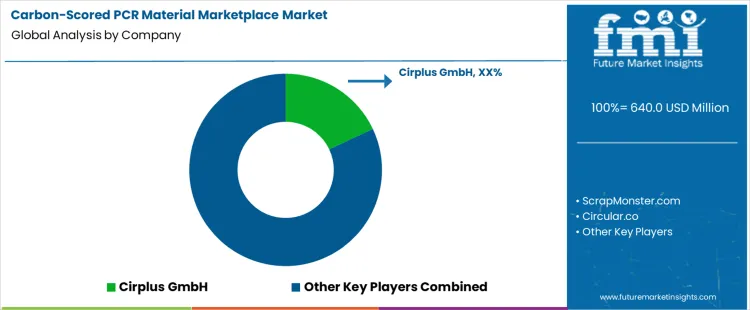
Competition in the carbon-scored PCR material marketplace market is being shaped by how transparently emissions data, pricing signals, and material availability are bundled into transactional platforms. Cirplus GmbH positions its marketplace around verified PCR sourcing with embedded carbon metrics, as highlighted in its product brochures. Material listings are being framed as decision-ready procurement units, where recycled content, origin, and footprint scores are presented alongside pricing and logistics parameters. ScrapMonster.com and Recycles.org.cn are competing through market reach and price discovery. Their platforms emphasize real-time listings, regional availability, and broad recycler participation, with carbon information introduced as contextual intelligence rather than as a primary qualification filter.
Circular.co are competing through risk and impact intelligence layered onto procurement workflows. Circular.co brochures highlight supplier screening, recycled material visibility, and impact scoring designed to support responsible sourcing mandates. Prewave positions its platform around predictive risk analytics, where carbon exposure, supply disruption, and compliance signals are integrated into procurement decisions. AlibabaB2B leverages scale and digital infrastructure, with product materials emphasizing cross-border trading, standardized product data, and integration with enterprise procurement systems. Carbon scoring is being positioned as an incremental data layer that enhances supplier comparison at scale rather than a standalone feature.
Recykal Marketplace is differentiating through direct linkage with recycling networks and domestic compliance frameworks. Its brochures highlight traceable PCR sourcing, carbon visibility at the transaction level, and alignment with producer responsibility requirements. Across the market, carbon scoring is being used to shift buyer focus from lowest-cost PCR toward verifiable, lower-impact material choices. Competitive advantage is being defined by how effectively carbon data is normalized, trusted, and translated into procurement actions without adding friction to existing purchasing workflows.
Carbon-Scored PCR Material Marketplace Market
- Circular.co
- ScrapMonster.com
- Cirplus GmbH
- Recycles.org.cn
- AlibabaB2B
- Recykal Marketplace
Scope of Report
| Attributes | Description |
|---|---|
| Quantitative Unit (2026) | USD Million |
| End-use | Brand Sourcing & Procurement, Sustainable Procurement, High-Volume PCR Trading, Informal PCR Aggregation, Regional Trading, Precision Sourcing |
| Marketplace Type | B2B PCR Marketplaces, Exchange Platforms, Digital Material Exchanges, Aggregator Platforms |
| Regions Covered | Asia Pacific, Europe, North America, Latin America, Middle East & Africa |
| Countries Covered | China, Japan, South Korea, India, Australia & New Zealand, ASEAN, Rest of Asia Pacific, Germany, United Kingdom, France, Italy, Spain, Nordic, BENELUX, Rest of Europe, United States, Canada, Mexico, Brazil, Chile, Rest of Latin America, Kingdom of Saudi Arabia, Other GCC Countries, Turkey, South Africa, Other African Union, Rest of Middle East & Africa |
| Key Companies Profiled | Circular.co, ScrapMonster.com, Cirplus GmbH, Recycles.org.cn, AlibabaB2B, Recykal Marketplace |
| Additional Attributes | Dollar sales by end-use and marketplace type; regional market size and forecast analysis; growth outlook across major regions; adoption trends for carbon-scored PCR trading platforms; assessment of carbon intensity scoring methodologies, price discovery mechanisms, data transparency requirements, and demand patterns across brand procurement teams, recyclers, and regional PCR trading ecosystems. |
Carbon-Scored PCR Material Marketplace Market
End-use
- Brand sourcing & procurement
- Sustainable procurement
- High-volume PCR trading
- Informal PCR aggregation
- Regional trading
- Precision sourcing
Marketplace Type
- B2B PCR marketplaces
- Exchange platforms
- Digital material exchanges
- Aggregator platforms
Region
- Asia Pacific
- China
- Japan
- South Korea
- India
- Australia & New Zealand
- ASEAN
- Rest of Asia Pacific
- Europe
- Germany
- United Kingdom
- France
- Italy
- Spain
- Nordic
- BENELUX
- Rest of Europe
- North America
- United States
- Canada
- Mexico
- Latin America
- Brazil
- Chile
- Rest of Latin America
- Middle East & Africa
- Kingdom of Saudi Arabia
- Other GCC Countries
- Turkey
- South Africa
- Other African Union
- Rest of Middle East & Africa
Bibiliography
- European Parliament, & Council of the European Union. (2025). Regulation (EU) 2025/40 of 19 December 2024 on packaging and packaging waste, amending Regulation (EU) 2019/1020 and Directive (EU) 2019/904, and repealing Directive 94/62/EC. Official Journal of the European Union.
- IFRS Foundation. (2023). IFRS S2: Climate-related disclosures. International Sustainability Standards Board.
- International Organization for Standardization. (2023). ISO 14068-1:2023 Climate change management—Transition to net zero—Part 1: Carbon neutrality. International Organization for Standardization.
Frequently Asked Questions
How big is the carbon-scored pcr material marketplace market in 2026?
The global carbon-scored pcr material marketplace market is estimated to be valued at USD 640.0 million in 2026.
What will be the size of carbon-scored pcr material marketplace market in 2036?
The market size for the carbon-scored pcr material marketplace market is projected to reach USD 2,420.0 million by 2036.
How much will be the carbon-scored pcr material marketplace market growth between 2026 and 2036?
The carbon-scored pcr material marketplace market is expected to grow at a 14.2% CAGR between 2026 and 2036.
What are the key product types in the carbon-scored pcr material marketplace market?
The key product types in carbon-scored pcr material marketplace market are brand sourcing & procurement, sustainable procurement, high-volume pcr trading, informal pcr aggregation, regional trading and precision sourcing.
Which marketplace type segment to contribute significant share in the carbon-scored pcr material marketplace market in 2026?
In terms of marketplace type, b2b pcr marketplaces segment to command 50.0% share in the carbon-scored pcr material marketplace market in 2026.
Preview the report firsthand - request a free sample
Get SampleGet the brochure for pricing and purchase details.
Get PDFTable of Content
- Executive Summary
- Global Market Outlook
- Demand-side Trends
- Supply-side Trends
- Technology Roadmap Analysis
- Analysis and Recommendations
- Market Overview
- Market Coverage / Taxonomy
- Market Definition / Scope / Limitations
- Market Background
- Market Dynamics
- Drivers
- Restraints
- Opportunity
- Trends
- Scenario Forecast
- Demand in Optimistic Scenario
- Demand in Likely Scenario
- Demand in Conservative Scenario
- Opportunity Map Analysis
- Product Life Cycle Analysis
- Supply Chain Analysis
- Investment Feasibility Matrix
- Value Chain Analysis
- PESTLE and Porter’s Analysis
- Regulatory Landscape
- Regional Parent Market Outlook
- Production and Consumption Statistics
- Import and Export Statistics
- Market Dynamics
- Global Market Analysis 2021 to 2025 and Forecast, 2026 to 2036
- Historical Market Size Value (USD Million) Analysis, 2021 to 2025
- Current and Future Market Size Value (USD Million) Projections, 2026 to 2036
- Y-o-Y Growth Trend Analysis
- Absolute $ Opportunity Analysis
- Global Market Pricing Analysis 2021 to 2025 and Forecast 2026 to 2036
- Global Market Analysis 2021 to 2025 and Forecast 2026 to 2036, By End-use
- Introduction / Key Findings
- Historical Market Size Value (USD Million) Analysis By End-use, 2021 to 2025
- Current and Future Market Size Value (USD Million) Analysis and Forecast By End-use, 2026 to 2036
- Brand sourcing & procurement
- Sustainable procurement
- High-volume PCR trading
- Informal PCR aggregation
- Regional trading
- Precision sourcing
- Brand sourcing & procurement
- Y-o-Y Growth Trend Analysis By End-use, 2021 to 2025
- Absolute $ Opportunity Analysis By End-use, 2026 to 2036
- Global Market Analysis 2021 to 2025 and Forecast 2026 to 2036, By Marketplace Type
- Introduction / Key Findings
- Historical Market Size Value (USD Million) Analysis By Marketplace Type, 2021 to 2025
- Current and Future Market Size Value (USD Million) Analysis and Forecast By Marketplace Type, 2026 to 2036
- B2B PCR marketplaces
- Exchange platforms
- Digital material exchanges
- Aggregator platforms
- B2B PCR marketplaces
- Y-o-Y Growth Trend Analysis By Marketplace Type, 2021 to 2025
- Absolute $ Opportunity Analysis By Marketplace Type, 2026 to 2036
- Global Market Analysis 2021 to 2025 and Forecast 2026 to 2036, By Region
- Introduction
- Historical Market Size Value (USD Million) Analysis By Region, 2021 to 2025
- Current Market Size Value (USD Million) Analysis and Forecast By Region, 2026 to 2036
- North America
- Latin America
- Western Europe
- Eastern Europe
- East Asia
- South Asia and Pacific
- Middle East & Africa
- Market Attractiveness Analysis By Region
- North America Market Analysis 2021 to 2025 and Forecast 2026 to 2036, By Country
- Historical Market Size Value (USD Million) Trend Analysis By Market Taxonomy, 2021 to 2025
- Market Size Value (USD Million) Forecast By Market Taxonomy, 2026 to 2036
- By Country
- USA
- Canada
- Mexico
- By End-use
- By Marketplace Type
- By Country
- Market Attractiveness Analysis
- By Country
- By End-use
- By Marketplace Type
- Key Takeaways
- Latin America Market Analysis 2021 to 2025 and Forecast 2026 to 2036, By Country
- Historical Market Size Value (USD Million) Trend Analysis By Market Taxonomy, 2021 to 2025
- Market Size Value (USD Million) Forecast By Market Taxonomy, 2026 to 2036
- By Country
- Brazil
- Chile
- Rest of Latin America
- By End-use
- By Marketplace Type
- By Country
- Market Attractiveness Analysis
- By Country
- By End-use
- By Marketplace Type
- Key Takeaways
- Western Europe Market Analysis 2021 to 2025 and Forecast 2026 to 2036, By Country
- Historical Market Size Value (USD Million) Trend Analysis By Market Taxonomy, 2021 to 2025
- Market Size Value (USD Million) Forecast By Market Taxonomy, 2026 to 2036
- By Country
- Germany
- UK
- Italy
- Spain
- France
- Nordic
- BENELUX
- Rest of Western Europe
- By End-use
- By Marketplace Type
- By Country
- Market Attractiveness Analysis
- By Country
- By End-use
- By Marketplace Type
- Key Takeaways
- Eastern Europe Market Analysis 2021 to 2025 and Forecast 2026 to 2036, By Country
- Historical Market Size Value (USD Million) Trend Analysis By Market Taxonomy, 2021 to 2025
- Market Size Value (USD Million) Forecast By Market Taxonomy, 2026 to 2036
- By Country
- Russia
- Poland
- Hungary
- Balkan & Baltic
- Rest of Eastern Europe
- By End-use
- By Marketplace Type
- By Country
- Market Attractiveness Analysis
- By Country
- By End-use
- By Marketplace Type
- Key Takeaways
- East Asia Market Analysis 2021 to 2025 and Forecast 2026 to 2036, By Country
- Historical Market Size Value (USD Million) Trend Analysis By Market Taxonomy, 2021 to 2025
- Market Size Value (USD Million) Forecast By Market Taxonomy, 2026 to 2036
- By Country
- China
- Japan
- South Korea
- By End-use
- By Marketplace Type
- By Country
- Market Attractiveness Analysis
- By Country
- By End-use
- By Marketplace Type
- Key Takeaways
- South Asia and Pacific Market Analysis 2021 to 2025 and Forecast 2026 to 2036, By Country
- Historical Market Size Value (USD Million) Trend Analysis By Market Taxonomy, 2021 to 2025
- Market Size Value (USD Million) Forecast By Market Taxonomy, 2026 to 2036
- By Country
- India
- ASEAN
- Australia & New Zealand
- Rest of South Asia and Pacific
- By End-use
- By Marketplace Type
- By Country
- Market Attractiveness Analysis
- By Country
- By End-use
- By Marketplace Type
- Key Takeaways
- Middle East & Africa Market Analysis 2021 to 2025 and Forecast 2026 to 2036, By Country
- Historical Market Size Value (USD Million) Trend Analysis By Market Taxonomy, 2021 to 2025
- Market Size Value (USD Million) Forecast By Market Taxonomy, 2026 to 2036
- By Country
- Kingdom of Saudi Arabia
- Other GCC Countries
- Turkiye
- South Africa
- Other African Union
- Rest of Middle East & Africa
- By End-use
- By Marketplace Type
- By Country
- Market Attractiveness Analysis
- By Country
- By End-use
- By Marketplace Type
- Key Takeaways
- Key Countries Market Analysis
- USA
- Pricing Analysis
- Market Share Analysis, 2025
- By End-use
- By Marketplace Type
- Canada
- Pricing Analysis
- Market Share Analysis, 2025
- By End-use
- By Marketplace Type
- Mexico
- Pricing Analysis
- Market Share Analysis, 2025
- By End-use
- By Marketplace Type
- Brazil
- Pricing Analysis
- Market Share Analysis, 2025
- By End-use
- By Marketplace Type
- Chile
- Pricing Analysis
- Market Share Analysis, 2025
- By End-use
- By Marketplace Type
- Germany
- Pricing Analysis
- Market Share Analysis, 2025
- By End-use
- By Marketplace Type
- UK
- Pricing Analysis
- Market Share Analysis, 2025
- By End-use
- By Marketplace Type
- Italy
- Pricing Analysis
- Market Share Analysis, 2025
- By End-use
- By Marketplace Type
- Spain
- Pricing Analysis
- Market Share Analysis, 2025
- By End-use
- By Marketplace Type
- France
- Pricing Analysis
- Market Share Analysis, 2025
- By End-use
- By Marketplace Type
- India
- Pricing Analysis
- Market Share Analysis, 2025
- By End-use
- By Marketplace Type
- ASEAN
- Pricing Analysis
- Market Share Analysis, 2025
- By End-use
- By Marketplace Type
- Australia & New Zealand
- Pricing Analysis
- Market Share Analysis, 2025
- By End-use
- By Marketplace Type
- China
- Pricing Analysis
- Market Share Analysis, 2025
- By End-use
- By Marketplace Type
- Japan
- Pricing Analysis
- Market Share Analysis, 2025
- By End-use
- By Marketplace Type
- South Korea
- Pricing Analysis
- Market Share Analysis, 2025
- By End-use
- By Marketplace Type
- Russia
- Pricing Analysis
- Market Share Analysis, 2025
- By End-use
- By Marketplace Type
- Poland
- Pricing Analysis
- Market Share Analysis, 2025
- By End-use
- By Marketplace Type
- Hungary
- Pricing Analysis
- Market Share Analysis, 2025
- By End-use
- By Marketplace Type
- Kingdom of Saudi Arabia
- Pricing Analysis
- Market Share Analysis, 2025
- By End-use
- By Marketplace Type
- Turkiye
- Pricing Analysis
- Market Share Analysis, 2025
- By End-use
- By Marketplace Type
- South Africa
- Pricing Analysis
- Market Share Analysis, 2025
- By End-use
- By Marketplace Type
- USA
- Market Structure Analysis
- Competition Dashboard
- Competition Benchmarking
- Market Share Analysis of Top Players
- By Regional
- By End-use
- By Marketplace Type
- Competition Analysis
- Competition Deep Dive
- Cirplus GmbH
- Overview
- Product Portfolio
- Profitability by Market Segments (Product/Age /Sales Channel/Region)
- Sales Footprint
- Strategy Overview
- Marketing Strategy
- Product Strategy
- Channel Strategy
- ScrapMonster.com
- Circular.co
- Recycles.org.cn
- AlibabaB2B
- Recykal Marketplace
- Cirplus GmbH
- Competition Deep Dive
- Assumptions & Acronyms Used
- Research Methodology


