

- Market Size (2026)
- USD 250.8 Mn
- Forecast (2036)
- USD 923.4 Mn
- CAGR (2026 to 2036)
- 13.9%
Haptic Feedback Yarns for Interactive Textiles Market Size, Market Forecast and Outlook By FMI
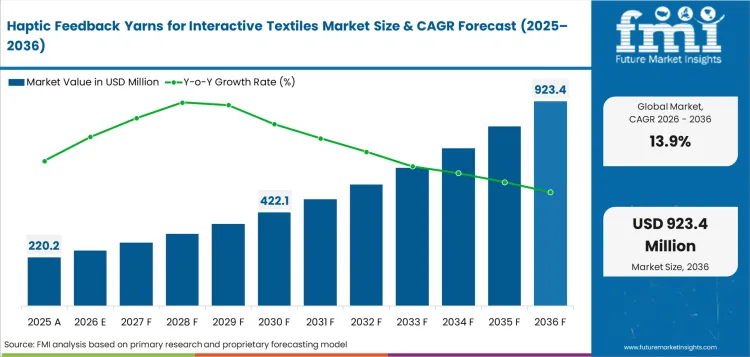
The haptic feedback yarns for interactive textiles market was valued at USD 220.2 million in 2025 and is projected to reach USD 250.8 million in 2026. Industry is forecast to reach USD 923.4 million by 2036 at 13.9% CAGR. Direct OEM programs are expected to account for 62.0% share of distribution channel in 2026. Knitted integration is projected to hold 38.0% share of integration method in 2026.
Garment makers face a practical design problem before haptic yarns integrate from lab sleeves into repeatable product lines. Actuators must deliver a clear feel on skin without adding unsafe voltage or bulky modules. WEAFING points to one route because its electroactive yarns need only 1–1.5 V and can be made by weaving or knitting. Low-voltage contraction gives suppliers a stronger case for washable prototypes and easier garment assembly.
Qualification has become a another driver for the market growth. IEC 63203-201-4:2024 gives buyers a 21-page method for sheet resistance after abrasion across conductive fabrics using conductive yarns. Test-backed resistance data will separate pilot yarns from materials ready for OEM sampling. Spatial control is the next filter for interactive textiles. A MIT and Stanford patent describes eight actuators in a 2×4 grid with high-stiffness areas from 9.78 N/mm to 48.1 N/mm. The design direction favors suppliers able to match actuator placement with predictable pressure zones. OEM teams gain clearer test terms before scale-up.
Summary of the Haptic Feedback Yarns for Interactive Textiles Market
- Demand and Growth Drivers
- XR accessory makers are adding body-mapped touch cues as visual and audio immersion has become a mature user expectation.
- Training garment developers are using tactile guidance to reduce instruction errors during repeated drills.
- Rehabilitation wearables are moving toward softer feedback systems able to support patient use during longer sessions.
- Product and Segment View
- Electroactive polymer-based yarns are forecast to account for 32.0% share in 2026 as soft actuation reduces bulky interface points.
- Knitted integration is projected to capture 38.0% share in 2026 since stretch garments need repeat contact with the body.
- Immersive gaming and AR/VR wearables are expected to hold 36.0% share in 2026 due to early accessory readiness.
- Geography and Competitive Outlook
- China is projected to record 15.4% CAGR by 2036, led by textile production depth influencing faster product tuning.
- United States is expected to expand at 14.9% CAGR by 2036 due to XR accessory density and qualification culture.
- AAC Technologies and Toray Industries influence platform competition through haptic actuation depth and materials process control.
- Analyst Opinion
- Nikhil Kaitwade, Principal Consultant for Industrial Automation at FMI, observes, “Haptic feedback yarns for interactive textiles are moving wearable interfaces from mechanical vibration toward textile-level sensory control. Buyers are now paying a premium for clean garment integration and software-defined sensations. Better-positioned suppliers will treat haptics as an engineered sensory layer woven into the garment structure.”
- Haptic Feedback Yarns for Interactive Textiles Market Value Analysis
- Haptic feedback yarns for interactive textiles are moving wearable interface value from packaged actuators toward yarn-level tactile systems.
- Supplier pricing is tied to durability testing and calibrated response consistency across textile lots.
- OEM buyers are connecting haptic yarn decisions with garment assembly cost and software integration effort.
- Demand is supported by XR garments and rehabilitation wearables seeking softer touch delivery across the body.
Key Takeaways
- The haptic feedback yarns for interactive textiles industry was valued at USD 220.2 million in 2025.
- By 2036, the haptic feedback yarns for interactive textiles market value is expected to reach USD 923.4 million.
- From 2026 to 2036, the sector is projected to expand at 13.9% CAGR.
- Industry revenue is forecast to add an incremental opportunity of USD 672.6 million between 2026 and 2036.
- Direct OEM programs are expected to account for 62.0% share of distribution channel in 2026.
- Knitted integration is projected to account for 38.0% share of integration method in 2026.
- China (15.4% CAGR) and the United States (14.9% CAGR) are projected to lead country-level growth rates during the forecast period.
Haptic Feedback Yarns for Interactive Textiles Market Definition
The haptic feedback yarns for interactive textiles market covers functional yarn systems engineered to deliver tactile output through vibration and deformation. Pressure change and mapped stimulation are included when the feedback element is built into yarn or fabric. Scope includes textile-ready actuation parts sold for gloves, sleeves, vests and soft wearable systems. Revenue covers yarns and yarn-integrated formats sold to product developers and textile manufacturers.
Haptic Feedback Yarns for Interactive Textiles Market Inclusions
Market scope includes electroactive polymer-based yarns and shape-memory yarns. Embedded vibration motor yarn formats are covered as separate actuation options. Conductive pathways and sensor-ready textile structures are included when they are sold with feedback functionality. Application coverage includes immersive gaming and AR/VR wearables. Training wearables and rehabilitation feedback textiles are included when tactile output is a stated product function. Distribution coverage includes direct OEM programs, specialist integrators and textile distributors.
Haptic Feedback Yarns for Interactive Textiles Market Exclusions
Scope excludes standard vibration motors sold without textile integration. Smart watches and handheld controllers are excluded unless yarn or fabric actuation is part of the sold system. Rigid haptic devices are excluded when they do not involve textile structures. Conductive yarns used only for sensing are excluded unless tactile feedback is built into the yarn or fabric package. Apparel without active feedback output is excluded from market value.
Haptic Feedback Yarns for Interactive Textiles Market Research Methodology
- Primary Research: FMI analysts reviewed yarn actuation pathways alongside buyer evaluation needs across XR and rehabilitation programs.
- Desk Research: Public haptics standards, smart textile funding programs and official company releases supported the demand view.
- Market sizing and forecasting: Forecast values used FMI anchors, application-level adoption checks and segment-level share estimates.
- Data validation: Checks compared haptic media standardization with public textile scale-up support and supplier activity.
Why is the Haptic Feedback Yarns for Interactive Textiles Market Growing?
- XR wearables are supporting adoption of haptic feedback yarns for interactive textiles across gloves and sleeves used with immersive content.
- Rehabilitation wearables are using textile feedback to keep motion guidance closer to the body during patient movement.
- Textile scale-up programs are giving developers access to pilot equipment and endurance testing support.
Software readiness is a practical driver for textile haptics. Internet Engineering Task Force published RFC 9695 in March 2025 and registered haptics as a top-level media type for tactile content exchange. Standardized file handling gives software teams a clearer route to connect feedback files with wearable devices. Yarn suppliers benefit when touch cues can be mapped before garment production. Buyers gain better evidence for textile-based feedback working across wearable platforms.
Manufacturing support is shortening the path from prototype work to production. Advanced Functional Fabrics of America announced PAFF 3.0 in December 2025 to support United States textile manufacturers and fabric innovators. Manufacturing USA stated that the program gives access to technical expertise and pilot development capabilities, and product advancement resources with labor costs covered through government funding. Program support lowers trial cost for teams working on wearable computing devices and smart textile functions. Haptic yarn suppliers can use pilot runs to test bending response and wash stability before larger OEM reviews.
Market Segmentation Analysis
- Direct OEM programs are projected to capture 62.0% share in 2026 since haptic yarns need joint design work before garment integration.
- Knitted integration is forecast to account for 38.0% share in 2026 as stretch garments need tactile zones able to move with the wearer.
- Immersive gaming and AR/VR wearables are expected to hold 36.0% share in 2026 led by platform users already buying premium peripherals.
- XR hardware firms are projected to account for 34.0% share in 2026 due to early spending on gloves and sleeves.
- Electroactive polymer-based yarns are forecast to account for 32.0% share in 2026, influenced by soft actuation reducing rigid interface failure.
Segmentation uses five primary groups based on actuation and application as the first view. Integration Method explains how tactile yarns enter the garment. End Use Buyer shows whether device firms or textile firms control purchases. Distribution Channel explains how suppliers reach buyers. Actuation explains whether output comes from polymer response, shape memory or embedded vibration. Application explains whether the buyer seeks immersive feedback, training guidance or medical-adjacent support.
Insights into Haptic Feedback Yarns for Interactive Textiles Market by Actuation
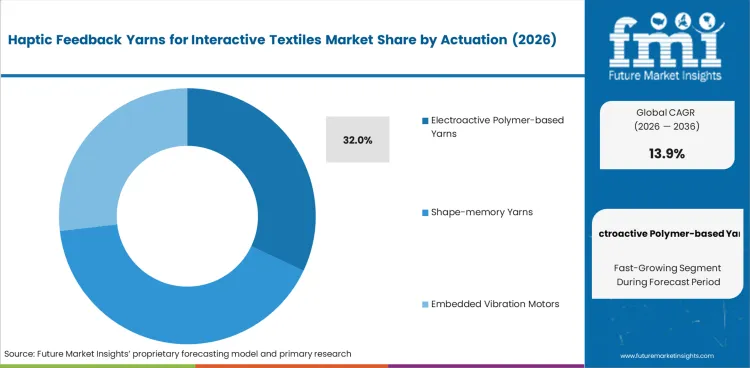
- Electroactive polymer-based yarns are projected to account for 32.0% share in 2026, supported by soft actuation reducing bulky mounts across curved textile surfaces.
- Shape-memory yarns hold a practical role as garment developers test thermal and mechanical response in controlled-use textile products.
Insights into Haptic Feedback Yarns for Interactive Textiles Market by Application
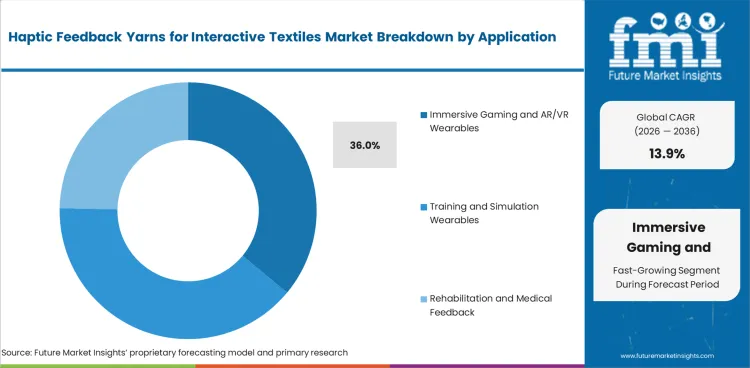
- Immersive gaming and AR/VR wearables are expected to hold 36.0% share in 2026, led by gloves and vests converting body contact into a premium interface feature.
- Rehabilitation and medical feedback has a practical role as product teams use textile cues for guided movement and longer patient sessions.
Insights into Haptic Feedback Yarns for Interactive Textiles Market by Integration Method
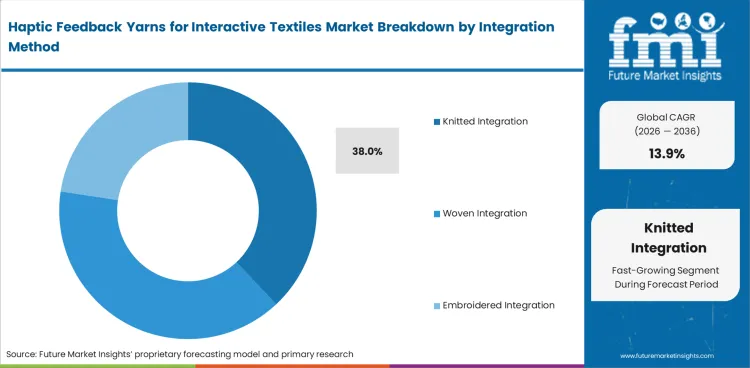
- Knitted integration is forecast to capture 38.0% share in 2026 since stretch fabrics can keep tactile output close to skin during repeated movement.
- Woven integration remains important for structured garments requiring flatter tactile zones and better dimensional control.
Insights into Haptic Feedback Yarns for Interactive Textiles Market by End Use Buyer
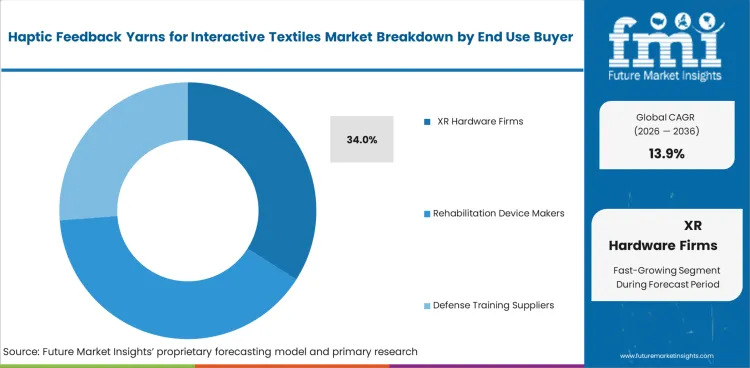
- XR hardware firms are projected to account for 34.0% share in 2026, led by headset and peripheral makers seeking textile touch features.
- Rehabilitation device makers are adopting haptic yarns influenced by soft garments allowing feedback during routine patient movement.
Insights into Haptic Feedback Yarns for Interactive Textiles Market by Distribution Channel
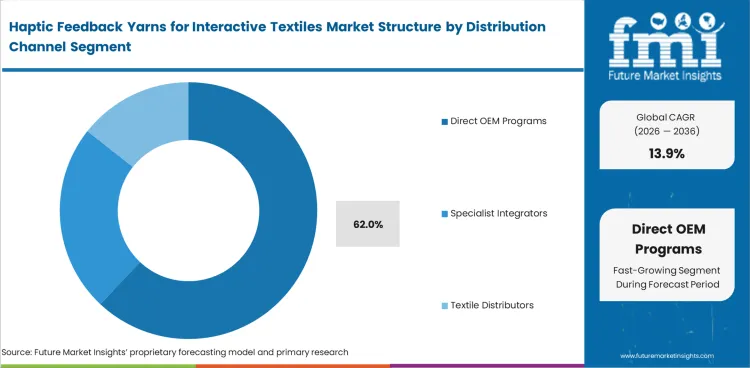
- Direct OEM programs are expected to account for 62.0% share in 2026 as haptic yarns need early material selection and garment-layout input before approval.
- Specialist integrators retain a role in prototypes as early buyers need test garments and support before direct supply contracts expand.
Haptic Feedback Yarns for Interactive Textiles Market Drivers, Restraints and Opportunities
- XR interface migration is making haptic feedback yarns for interactive textiles part of wearable form factors as gloves and sleeves need tactile output without hard modules.
- Wash durability and skin comfort can slow adoption in medical-adjacent garments due to conductive yarns retaining response after cleaning and repeated flexing.
- Haptic media standards create an opportunity for suppliers with software-facing calibration support across wearable computing devices and smart interactive textiles.
Interface migration from rigid modules into fabrics is expected to remain the main commercial driver for haptic feedback yarns for interactive textiles during the forecast period. European Commission’s CORDIS stated in May 2024, WEAFING electroactive yarns can be woven or knitted and need only 1–1.5 V to stimulate contraction and sensation. Low-voltage actuation supports textile-native feedback as garment makers reduce bulky housings and rigid assembly points in XR gloves and training sleeves. Durability will keep medical-adjacent adoption selective as IEC 63203-201-4:2024 and AATCC TM210 place focus on abrasion and laundering resistance for conductive textile products. Software readiness gives suppliers a clearer opportunity because Internet Engineering Task Force registered haptics as a top-level media type in March 2025. AFFOA’s PAFF 3.0 program adds pilot support for bending checks and wash trials before OEM sampling.
Installed Base and Replacement Cycle Analysis
Wearable interface replacement is expected to support haptic yarn adoption as buyers shift from rigid feedback parts toward soft feedback zones. Haply Robotics describes MinVerse as a portable force-feedback 3D input device for 3D creation across manufacturing, industrial design and entertainment. MinVerse reflects how touch feedback is moving beyond simple vibration into controlled force and texture response. Haptic yarns will gain attention once garment makers need similar feedback inside sleeves and rehabilitation wearables. Suppliers will need to prove response repeatability and comfort before textile feedback replaces separate modules.
Production Capacity and Supplier Footprint Analysis
Supplier footprint in the smart fabric supply base is better measured by actuation knowledge and textile process reach. AAC Technologies presents RichTap as an integrated haptic system for device manufacturers and content categories including gaming and audiovisual use. Toray states, its textile business covers nylon and acrylic across apparel and industrial materials. Hyosung TNC states, its textile business offers nylon fibers and specialty yarns through over 50 years of production expertise. Large buyers are likely to favor supplier groups able to connect tactile response with yarn processing and software mapping.
Analysis of Haptic Feedback Yarns for Interactive Textiles Market by Key Countries
.webp "Top Country Growth Comparison Haptic Feedback Yarns For Interactive Textiles Market Cagr (2026 2036)")
| Country | CAGR |
|---|---|
| China | 15.4% |
| United States | 14.9% |
| India | 14.5% |
| United Kingdom | 13.9% |
| Germany | 13.8% |
| South Korea | 13.6% |
| Japan | 12.7% |
Source: Future Market Insights, 2026. India and South Korea values are analyst estimates based on textile electronics readiness and manufacturing depth.
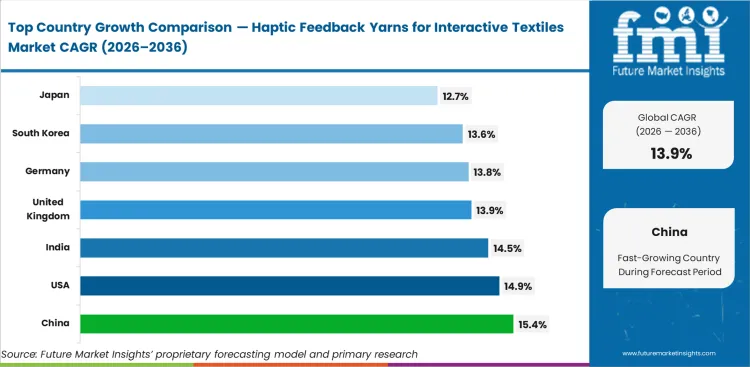
Haptic Feedback Yarns for Interactive Textiles Market CAGR Analysis by Country
- China is projected to record 15.4% CAGR by 2036 due to its dense textile manufacturing base and wearable electronics assembly strength.
- United States is expected to expand at 14.9% CAGR by 2036 as XR accessory supplier networks support higher use of tactile textile interfaces.
- India is forecast to grow at 14.5% CAGR by 2036, supported by textile modernization and wearable product development widening adoption routes.
- United Kingdom is forecast to grow at 13.9% CAGR by 2036 led by smart textile research and wearable design activity.
- Germany is expected to advance at 13.8% CAGR by 2036 since technical textile validation and industrial wearable use support selective adoption.
- South Korea is projected to rise at 13.6% CAGR and Japan at 12.7% CAGR by 2036 through electronics design strength and quality-focused wearable product development.
Country performance differs by manufacturing depth and wearable interface readiness. China and United States track above the global pace due to textile-electronics clustering and higher XR accessory demand. United Kingdom and Germany stay near the global line as smart textile validation supports controlled adoption. Japan shows measured growth due to stricter product testing and slower movement from prototype use into scaled garment programs.
Demand Outlook for Haptic Feedback Yarns for Interactive Textiles Market in China
Industry in China is projected to record a 15.4% CAGR by 2036, driven by textile output and electronics assembly influencing faster design loops. USDA Foreign Agricultural Service reported in December 2025, China above-scale enterprises produced 17.3 million metric tons of yarn during the first three quarters of 2025. Such production depth gives suppliers access to spinning and fabric partners able to trial functional yarn formats. Buyers will value lower iteration cost and quicker garment testing before export programs scale.
- XR accessory producers can use textile haptic zones to reduce rigid parts in gloves and torso wearables.
- Training garment suppliers can gain from domestic fabric conversion capacity shortening sample approval cycles.
- Medical textile developers will need clearer wash durability evidence before hospitals consider feedback garments.
Opportunity Analysis of Haptic Feedback Yarns for Interactive Textiles Market in the United States
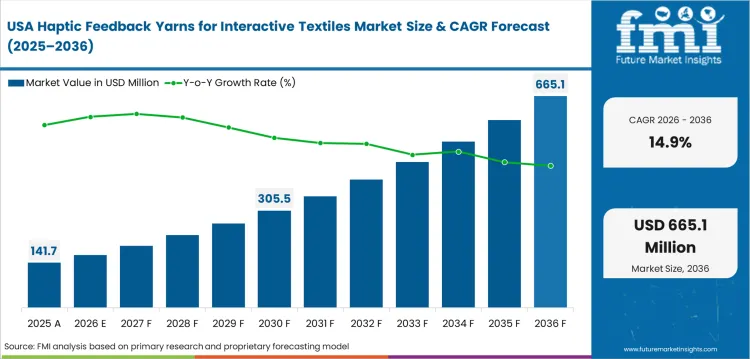
Demand in United States is expected to expand at 14.9% CAGR by 2036, as qualification practices favor test-backed haptic yarn suppliers. Advanced Functional Fabrics of America opened PAFF 3.0 in 2025 with support areas covering textile manufacturing automation and scale-up for advanced fibers and fabrics. Public production support gives early suppliers access to equipment and testing advice before OEM reviews. Purchase decisions should favor yarn systems with documented response after flex and moisture exposure.
- Defense and training buyers can use tactile garments to support repeat drills without relying on visual prompts.
- XR hardware teams can link calibrated response files with software tools to reduce developer workload.
- Rehabilitation device makers will need comfort data and failure-mode records before clinical channel expansion.
Demand Analysis of Haptic Feedback Yarns for Interactive Textiles Market in India
The sector in India is forecast to grow at 14.5% CAGR by 2036, as textile innovation support moves into smart fabric applications. Government of India approved the Tex-RAMPS scheme in November 2025 with an outlay of ₹305 crore from fiscal 2025-26 to fiscal 2030-31. Program coverage includes advanced research in smart textiles and innovation support. Tex-RAMPS funding can raise domestic trial activity for interactive textile yarns and feedback-enabled garments.
- Technical textile mills can test conductive and haptic yarn combinations for wearable export programs.
- Rehabilitation start-ups can use soft tactile feedback to reduce dependence on rigid assistive devices.
- Price-sensitive buyers will require lower-cost actuation packages before broad garment adoption improves.
Sales Analysis of Haptic Feedback Yarns for Interactive Textiles Market in the United Kingdom
Demand in the United Kingdom is expected to advance at 13.9% CAGR by 2036 due to rehabilitation and assistive wearables supporting selective adoption. Buyers in healthcare-adjacent channels will test if tactile cues improve adherence and reduce therapist workload. ClinicalTrials.gov listed research on tactile feedback systems for robotic upper-limb prostheses in 2025. Clinical evidence pipelines support measured adoption instead of novelty-based buying.
- Assistive technology buyers can use textile cues to improve patient engagement during guided movement.
- Product developers will need clear documentation for heat and pressure during repeated skin contact.
- Remote rehabilitation programs can pair haptic garments with biofeedback equipment for guided patient practice.
Growth Outlook for Haptic Feedback Yarns for Interactive Textiles Market in Germany
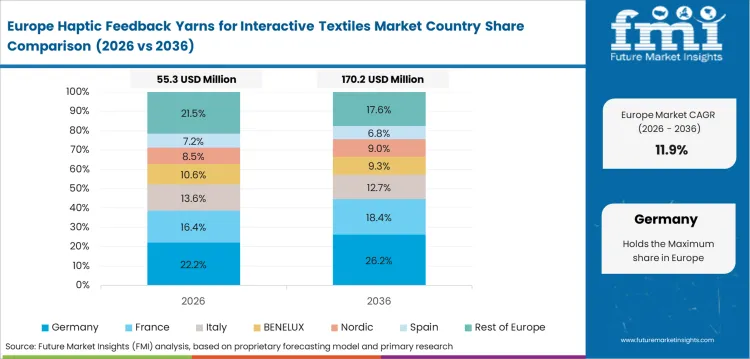
The sector in Germany is projected to rise at 13.8% CAGR by 2036 since industrial buyers value documented performance and controlled production. Federal Statistical Office reported in April 2026, new orders in manufacture of textiles rose 45.2% in February 2026. Factory order activity supports supplier confidence in higher-value textile systems. Haptic yarn vendors should benefit if industrial training and protective wear buyers demand traceable production routines.
- Industrial training suppliers can use tactile cues for safety drills in noisy work settings.
- Technical textile processors can add haptic zones to premium garments after testing proves wash stability.
- European buyers will compare recyclability risks before adopting electronics-rich textile constructions.
Future Outlook for Haptic Feedback Yarns for Interactive Textiles Market in South Korea
The market in South Korea is forecast at 13.6% CAGR by 2036 as consumer electronics supply chains support experimentation with interactive wearables. Gaming and device makers already evaluate tactile feedback as part of user experience. Suppliers can win orders once yarn actuation aligns with developer tools and peripheral design needs. Adoption should move faster in premium accessories than in mass apparel because performance evidence carries higher buyer value.
- Gaming accessory firms can use textile haptics to create stronger body feedback in vests and gloves.
- Wearable electronics makers can test yarn-based actuation beside sensor fabrics for multi-function garments.
- Supply chains will need stable conductive pathways before yarn feedback can enter broader apparel programs.
Demand Outlook for Haptic Feedback Yarns for Interactive Textiles Market in Japan
Demand in Japan is expected to post 12.7% CAGR by 2036, led by precision manufacturing favoring quality-controlled tactile systems. Japan Ministry of Economy, Trade and Industry materials in September 2025 identified wearable technology and smart textiles within export-oriented manufacturing opportunities. Japan’s industrial positioning supports interest in higher-value textile functions over commodity fabric output. Adoption should favor programs with documented lot stability and clear lifecycle testing.
- Precision textile suppliers can use haptic yarns in premium sleeves and rehabilitation garments.
- Robotics developers can test textile feedback around wearable controls and training interfaces.
- Quality-focused buyers will prefer suppliers able to control tactile response across repeated production lots.
Competitive Landscape and Strategic Positioning
- Actuation suppliers compete by proving tactile output after repeated bending and garment movement.
- Materials companies differentiate when yarn mechanics and conductive paths work together across textile production.
- Wearable interface firms support buyers through calibration tools and developer-ready guidance for XR and IoT wearables.
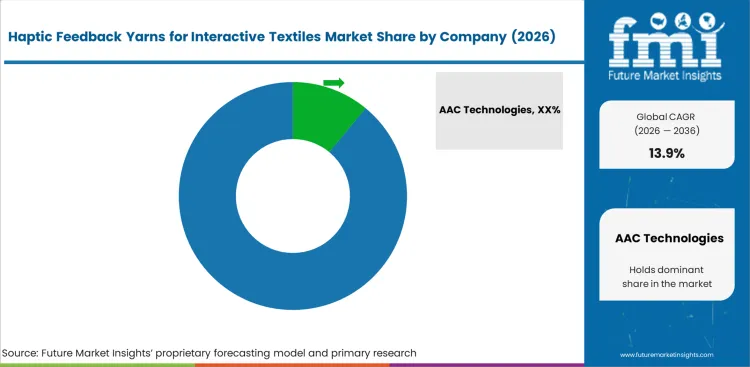
Competition in the haptic feedback yarns for interactive textiles market is progressing from early prototypes to repeatable textile performance. Actuation specialists such as AAC Technologies and Haply Robotics compete on tactile response and interface knowledge. Materials suppliers such as Toray Industries and Teijin Frontier compete on yarn behavior and garment finishing support. Hyosung TNC strengthens the fiber side through high-performance yarn portfolios used in advanced textile applications.
Software support has become a stronger factor in OEM evaluation. IETF haptics media standardization gives developers a clearer route for tactile content exchange. Suppliers with calibration tools and response mapping can connect haptic yarns with XR platforms and IoT wearables. Competitive advantage should favor companies combining reliable tactile output with textile durability and software-ready integration.
Key Companies in the Haptic Feedback Yarns for Interactive Textiles Market
Competition is clearer by role as haptic actuation and textile engineering differ across supplier groups. Wearable integration forms a third capability layer.
- Haptic Actuation Specialists: AAC Technologies and Haply Robotics bring tactile actuator knowledge into XR and interactive device programs.
- Advanced Textile and Fibre Firms: Toray Industries and Teijin Frontier support the textile side of haptic yarn development.
- Wearable Interface and Brand Integrators: Sony Corporation and Nextiles influence adoption through wearable use cases.
- Apparel and Fibre Players: Levi Strauss & Co. and Hyosung TNC support downstream apparel relevance and yarn supply depth.
- Software-facing Integrators: Haptic interface specialists win orders when they connect calibration files with garment design workflows.
Competitive Benchmarking: Haptic Feedback Yarns for Interactive Textiles Market
| Company | Textile Actuation Depth | Wearable Integration Support | Wash Durability Evidence | Geographic Footprint |
|---|---|---|---|---|
| AAC Technologies | High | Strong | Medium | China-centered with global device ecosystem reach |
| Toray Industries | Medium | Medium | Strong | Japan-centered with broad materials reach |
| Teijin Frontier | Medium | Medium | Strong | Japan and Asia textile materials strength |
| Hyosung TNC | Medium | Medium | Medium | Korea-centered with global yarn supply links |
| Sony Corporation | Medium | Strong | Medium | Global consumer electronics and immersive media reach |
| Nextiles | Medium | Strong | Medium | United States centered wearable textile specialist |
| Haply Robotics | High | Strong | Low | North America centered haptic interface specialist |
| Levi Strauss & Co. | Low | Medium | Medium | Global apparel brand with digital garment interest |
Source: Future Market Insights competitive analysis, 2026. Ratings reflect relative positioning based on textile actuation depth, wearable integration support and durability evidence.
Key Developments in Haptic Feedback Yarns for Interactive Textiles Market
- In January 2025, AAC Technologies presented advanced sensory solutions at CES 2025 covering haptics and XR.
- In January 2025, Haply Robotics launched MinVerse as a haptic 3D mouse for immersive 3D interaction.
- In June 2025, Teijin Frontier announced a new stretch fabric for fall/winter 2026 sportswear and lifestyle apparel.
Key Players in the Haptic Feedback Yarns for Interactive Textiles Market
Major Global Players:
- AAC Technologies
- Toray Industries
- Teijin Frontier
- Hyosung TNC
- Sony Corporation
- Nextiles
- Haply Robotics
- Levi Strauss & Co.
Specialist and Regional Players:
- Boreas Technologies
- BeBop Sensors
- Tanvas
- WEART
- SenseGlove
Report Scope and Coverage
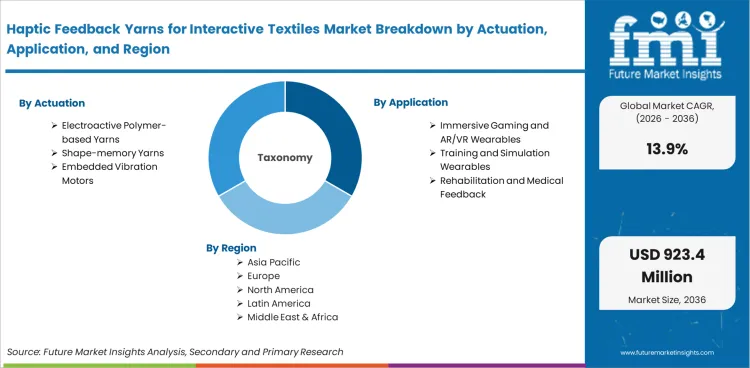
Haptic feedback yarns for interactive textiles market breakdown by Actuation, Application, Integration Method, End Use Buyer, Distribution Channel, and Region.
| Parameter | Details |
|---|---|
| Quantitative Units | USD 250.8 million to USD 923.4 million, at 13.9% CAGR |
| Market Definition | Functional yarn systems able to deliver tactile output through textile structures |
| Actuation | Electroactive polymer-based yarns, shape-memory yarns, embedded vibration motors, other |
| Application | Immersive gaming and AR/VR wearables, training and simulation wearables, rehabilitation and medical feedback, other applications |
| Integration Method | Knitted integration, woven integration, embroidered integration, laminated integration |
| End Use Buyer | XR hardware firms, rehabilitation device makers, defense training suppliers, apparel brands, textile mills |
| Distribution Channel | Direct OEM programs, specialist integrators, textile distributors, online technical channels |
| Regions Covered | North America, Latin America, Western Europe, Eastern Europe, East Asia, South Asia and Pacific, Middle East and Africa |
| Countries Covered | United States, China, India, United Kingdom, Germany, South Korea, Japan and 25+ countries |
| Key Companies Profiled | AAC Technologies, Toray Industries, Teijin Frontier, Hyosung TNC, Sony Corporation, Nextiles, Haply Robotics, Levi Strauss & Co. |
| Forecast Period | 2026 to 2036 |
| Approach | Hybrid top-down and bottom-up sizing using FMI values. Application checks and supplier evidence support validation |
Source: Future Market Insights, 2026.
Haptic Feedback Yarns for Interactive Textiles Market by Segments
Haptic Feedback Yarns for Interactive Textiles Market Segmented by Actuation:
- Electroactive Polymer-based Yarns
- Shape-memory Yarns
- Embedded Vibration Motors
- Other
Haptic Feedback Yarns for Interactive Textiles Market Segmented by Application:
- Immersive Gaming and AR/VR Wearables
- Training and Simulation Wearables
- Rehabilitation and Medical Feedback
- Other Applications
Haptic Feedback Yarns for Interactive Textiles Market Segmented by Integration Method:
- Knitted Integration
- Woven Integration
- Embroidered Integration
- Laminated Integration
Haptic Feedback Yarns for Interactive Textiles Market Segmented by End Use Buyer:
- XR Hardware Firms
- Rehabilitation Device Makers
- Defense Training Suppliers
- Apparel Brands
- Textile Mills
Haptic Feedback Yarns for Interactive Textiles Market Segmented by Distribution Channel:
- Direct OEM Programs
- Specialist Integrators
- Textile Distributors
- Online Technical Channels
Haptic Feedback Yarns for Interactive Textiles Market by Region:
- North America
- United States
- Canada
- Latin America
- Brazil
- Mexico
- Rest of Latin America
- Western Europe
- Germany
- United Kingdom
- France
- Italy
- Spain
- BENELUX
- Rest of Western Europe
- Eastern Europe
- Poland
- Romania
- Rest of Eastern Europe
- East Asia
- China
- Japan
- South Korea
- South Asia and Pacific
- India
- ASEAN
- Australia and New Zealand
- Rest of South Asia and Pacific
- Middle East and Africa
- Saudi Arabia
- United Arab Emirates
- South Africa
- Turkey
- Rest of Middle East and Africa
Research Sources and Bibliography
- European Commission. (2024, May 17). Electroactive fabrics for interactive clothing. CORDIS.
- International Electrotechnical Commission. (2024, December 16). IEC 63203-201-4:2024: Wearable electronic devices and technologies: Part 201-4: Electronic textile: Test method for determining sheet resistance of conductive fabrics after abrasion.
- Du Pasquier, C., Okamura, A. M., Tibbits, S., Tessmer, L., & Scholl, I. A. (2025, June 26). Wearable device concept powered by a combination of soft pneumatic actuators and variable stiffness knitting (U.S. Patent Application Publication No. US20250209895A1). U.S. Patent and Trademark Office.
- Khemani, A., Miller, P., Gould, K., Peckman, B., & Ogawa, S. (2024, October 31). Strain-locking knit band structures with embedded electronics for wearable devices (U.S. Patent Application Publication No. US20240360601A1). U.S. Patent and Trademark Office.
- European Parliament. (2026, February 20). Eco-design requirements for sustainable products. Legislative Train Schedule.
- Muthusamy, Y. K., & Ullrich, C. (2025, March). The “haptics” top-level media type (RFC 9695). Internet Engineering Task Force.
- Advanced Functional Fabrics of America. (2025, December 10). PAFF 3.0: AFFOA broadens support for U.S. textile manufacturers with no-cost development access.
- Press Information Bureau, Government of India. (2025, November 27). Government approves “Tex-RAMPS” scheme to strengthen research, innovation and competitiveness in textiles sector.
- Federal Statistical Office of Germany. (2026, April 8). New orders in manufacturing in February 2026: +0.9% on the previous month.
- U.S. Department of Agriculture, Foreign Agricultural Service. (2025, December 2). China: Cotton and products update.
- European Commission. (2025, June 25). Sustainable solutions for upgraded smart wearables and equipment in sport. CORDIS.
- European Topic Centre on Circular Economy and Resource Use. (2025, March 10). Textiles and the environment: The role of digital technologies in Europe’s circular economy. European Environment Information and Observation Network.
- AAC Technologies. (2025, January 10). Sensory pioneer AAC Technologies unveils comprehensive advanced solutions at CES 2025, raising the bar for the industry. PR Newswire.
- Teijin Frontier Co., Ltd. (2025, June 23). Teijin Frontier develops a next-generation stretch fabric with an extremely fine, multiple crimp structure providing soft and airy comfort. Teijin Limited.
- Liu, H., Zhang, Y., Yang, J., & Tao, X. (2025). Sensory interactive fibers and textiles. npj Flexible Electronics.
Bibliography uses FMI analysis and government sources. Standards evidence and official company sources support haptic feedback yarns for interactive textiles market signals.
This Report Answers
- What is the current and future size of the haptic feedback yarns for interactive textiles market?
- How fast is the haptic feedback yarns for interactive textiles market expected to expand between 2026 and 2036?
- Which actuation type is expected to account for the leading haptic feedback yarns for interactive textiles market share in 2026?
- Which application is projected to account for the leading haptic feedback yarns for interactive textiles industry share in 2026?
- Why are immersive gaming and AR/VR wearables important for haptic feedback yarns for interactive textiles market demand?
- How do knitted integration methods support adoption in interactive textile products?
- Which countries are projected to record faster expansion during the forecast period?
- Who are the main companies active in haptic feedback yarns for interactive textiles?
- How does FMI define the haptic feedback yarns for interactive textiles market scope?
- How does FMI estimate and validate the haptic feedback yarns for interactive textiles forecast?
Frequently Asked Questions
What is the global market demand for haptic feedback yarns for interactive textiles market in 2026?
In 2026, the haptic feedback yarns for interactive textiles market is expected to cross USD 250.8 million as tactile garments move beyond prototypes.
How big will the haptic feedback yarns for interactive textiles market be in 2036?
By 2036, the haptic feedback yarns for interactive textiles industry is anticipated to reach USD 923.4 million as wearable touch interfaces scale.
How much is demand for haptic feedback yarns for interactive textiles market expected to expand between 2026 and 2036?
Between 2026 and 2036, the haptic feedback yarns for interactive textiles sector is expected to expand at 13.9% CAGR as XR and rehabilitation uses widen.
Which actuation segment is expected to lead the haptic feedback yarns for interactive textiles market by 2026?
Electroactive polymer-based yarns are projected to represent 32.0% share in 2026 due to conformable output and lower rigid interface risk.
Which application is expected to lead haptic feedback yarns for interactive textiles market demand in 2026?
Immersive gaming and AR/VR wearables are projected to account for 36.0% share in 2026 as tactile realism supports premium accessories.
Which country is forecast to grow fastest in the haptic feedback yarns for interactive textiles market?
China is projected to record 15.4% CAGR by 2036 as textile production depth and electronics assembly support faster design cycles.
What does the haptic feedback yarns for interactive textiles market include?
Scope includes yarn-level haptic systems integrated into fabrics through knitting and weaving. Embroidery and lamination are covered for tactile output.
How does FMI estimate the haptic feedback yarns for interactive textiles market forecast?
FMI uses supplied values, application checks and supplier evidence to validate forecast size and segment shares across key buyer groups.
Why are knitted systems important in the haptic feedback yarns for interactive textiles market?
Knitted systems keep tactile output close to skin during movement, supporting gloves and vests used in wearable interfaces.
Who uses haptic feedback yarns for interactive textiles?
Main users include XR hardware firms and rehabilitation device makers. Training suppliers and apparel brands complete the user group.
Preview the report firsthand - request a free sample
Get SampleGet the brochure for pricing and purchase details.
Get PDFTable of Content
- Key Takeaways
- Market Size and CAGR
- Top Growth Driver
- Fastest Growing Segment
- Leading Region
- Key Companies
- Emerging Opportunities
- Executive Summary
- Global Market Outlook
- Demand-side Trends
- Supply-side Trends
- Technology Roadmap Analysis
- Analysis and Recommendations
- Analyst Perspective (What is happening? Why now? What should investors know?)
- Key Questions Answered
- How large is the market?
- What is the CAGR?
- What are key trends?
- Which region dominates?
- Who are the leaders?
- Market Overview
- Market Coverage / Taxonomy
- Market Definition / Scope / Limitations
- Research Methodology
- Chapter Orientation
- Analytical Lens and Working Hypotheses
- Market Structure, Signals, and Trend Drivers
- Benchmarking and Cross-market Comparability
- Market Sizing, Forecasting, and Opportunity Mapping
- Research Design and Evidence Framework
- Desk Research Programme (Secondary Evidence)
- Expert Input and Fieldwork (Primary Evidence)
- Tooling, Models, and Reference Databases
- Data Engineering and Model Build
- Quality Assurance and Audit Trail
- Market Background
- Market Dynamics (Drivers, Restraints, Opportunity, Trends)
- Scenario Forecast (Optimistic, Likely, Conservative)
- Impact Analysis
- AI Impact
- Sustainability Impact
- Regulatory Impact
- Technology Impact
- Consumer / Buyer Analysis
- Purchase Drivers
- Adoption Barriers
- Buyer Journey
- Opportunity Map Analysis
- Product Life Cycle Analysis
- Supply Chain Analysis
- Investment Feasibility Matrix
- Value Chain Analysis
- PESTLE and Porter's Analysis
- Regulatory Landscape
- Regional Parent Market Outlook
- Production and Consumption Statistics
- Import and Export Statistics
- Global Market Analysis and Forecast, 2021 to 2036
- Historical Market Size Value (USD Billion) Analysis, 2021 to 2025
- Current and Future Market Size Value (USD Billion) Projections, 2026 to 2036
- Y-o-Y Growth Trend Analysis
- Absolute $ Opportunity Analysis
- Global Market Pricing Analysis, 2021 to 2036
- Global Market Analysis and Forecast, By Component, 2021 to 2036
- Introduction / Key Findings
- Historical Market Size Value (USD Billion) Analysis By Component, 2021 to 2025
- Current and Future Market Size Value (USD Billion) Analysis and Forecast By Component, 2026 to 2036
- Hardware
- Software
- Services
- Hardware
- Y-o-Y Growth Trend Analysis By Component, 2021 to 2025
- Absolute $ Opportunity Analysis By Component, 2026 to 2036
- Global Market Analysis and Forecast, By Application, 2021 to 2036
- Introduction / Key Findings
- Historical Market Size Value (USD Billion) Analysis By Application, 2021 to 2025
- Current and Future Market Size Value (USD Billion) Analysis and Forecast By Application, 2026 to 2036
- Mobile Devices
- Video Games
- Personal Computers
- Automated Teller Machines
- Tele-Operators And Simulators
- Virtual Reality
- Ticketing Counters
- Robotics
- Biometric Devices
- Arts, Design And Handwriting
- Holographic Interaction
- Mobile Devices
- Y-o-Y Growth Trend Analysis By Application, 2021 to 2025
- Absolute $ Opportunity Analysis By Application, 2026 to 2036
- Global Market Analysis and Forecast, By End Users, 2021 to 2036
- Introduction / Key Findings
- Historical Market Size Value (USD Billion) Analysis By End Users, 2021 to 2025
- Current and Future Market Size Value (USD Billion) Analysis and Forecast By End Users, 2026 to 2036
- Corporates
- Security Departments
- Supermarkets And Malls
- Educational Institutes
- Others
- Corporates
- Y-o-Y Growth Trend Analysis By End Users, 2021 to 2025
- Absolute $ Opportunity Analysis By End Users, 2026 to 2036
- Global Market Analysis and Forecast, By Technology, 2021 to 2036
- Introduction / Key Findings
- Historical Market Size Value (USD Billion) Analysis By Technology, 2021 to 2025
- Current and Future Market Size Value (USD Billion) Analysis and Forecast By Technology, 2026 to 2036
- Contact Haptic Technology
- Non-Contact Haptic Technology
- Contact Haptic Technology
- Y-o-Y Growth Trend Analysis By Technology, 2021 to 2025
- Absolute $ Opportunity Analysis By Technology, 2026 to 2036
- Global Market Analysis and Forecast, By Industry, 2021 to 2036
- Introduction / Key Findings
- Historical Market Size Value (USD Billion) Analysis By Industry, 2021 to 2025
- Current and Future Market Size Value (USD Billion) Analysis and Forecast By Industry, 2026 to 2036
- Electronics
- Robotic
- Automobile
- Financial
- Healthcare
- Others
- Electronics
- Y-o-Y Growth Trend Analysis By Industry, 2021 to 2025
- Absolute $ Opportunity Analysis By Industry, 2026 to 2036
- Global Market Analysis and Forecast, By Region, 2021 to 2036
- Introduction
- Historical Market Size Value (USD Billion) Analysis By Region, 2021 to 2025
- Current Market Size Value (USD Billion) Analysis and Forecast By Region, 2026 to 2036
- North America
- Latin America
- Western Europe
- Eastern Europe
- East Asia
- South Asia and Pacific
- Middle East & Africa
- Market Attractiveness Analysis By Region
- North America Market Analysis and Forecast, By Country, 2021 to 2036
- Historical Market Size Value (USD Billion) Trend Analysis By Market Taxonomy, 2021 to 2025
- Market Size Value (USD Billion) Forecast By Market Taxonomy, 2026 to 2036
- By Country
- USA
- Canada
- By Component
- By Application
- By End Users
- By Technology
- By Industry
- By Country
- Market Attractiveness Analysis
- By Country
- By Component
- By Application
- By End Users
- By Technology
- By Industry
- Key Takeaways
- Latin America Market Analysis and Forecast, By Country
- Historical Market Size Value (USD Billion) Trend Analysis By Market Taxonomy, 2021 to 2025
- Market Size Value (USD Billion) Forecast By Market Taxonomy, 2026 to 2036
- By Country
- Brazil
- Mexico
- Chile
- Rest of Latin America
- By Component
- By Application
- By End Users
- By Technology
- By Industry
- By Country
- Market Attractiveness Analysis
- By Country
- By Component
- By Application
- By End Users
- By Technology
- By Industry
- Key Takeaways
- Western Europe Market Analysis and Forecast, By Country
- Historical Market Size Value (USD Billion) Trend Analysis By Market Taxonomy, 2021 to 2025
- Market Size Value (USD Billion) Forecast By Market Taxonomy, 2026 to 2036
- By Country
- Germany
- UK
- Italy
- Spain
- France
- Nordic
- BENELUX
- Rest of Western Europe
- By Component
- By Application
- By End Users
- By Technology
- By Industry
- By Country
- Market Attractiveness Analysis
- By Country
- By Component
- By Application
- By End Users
- By Technology
- By Industry
- Key Takeaways
- Eastern Europe Market Analysis and Forecast, By Country
- Historical Market Size Value (USD Billion) Trend Analysis By Market Taxonomy, 2021 to 2025
- Market Size Value (USD Billion) Forecast By Market Taxonomy, 2026 to 2036
- By Country
- Russia
- Poland
- Hungary
- Balkan & Baltic
- Rest of Eastern Europe
- By Component
- By Application
- By End Users
- By Technology
- By Industry
- By Country
- Market Attractiveness Analysis
- By Country
- By Component
- By Application
- By End Users
- By Technology
- By Industry
- Key Takeaways
- East Asia Market Analysis and Forecast, By Country
- Historical Market Size Value (USD Billion) Trend Analysis By Market Taxonomy, 2021 to 2025
- Market Size Value (USD Billion) Forecast By Market Taxonomy, 2026 to 2036
- By Country
- China
- Japan
- South Korea
- By Component
- By Application
- By End Users
- By Technology
- By Industry
- By Country
- Market Attractiveness Analysis
- By Country
- By Component
- By Application
- By End Users
- By Technology
- By Industry
- Key Takeaways
- South Asia and Pacific Market Analysis and Forecast, By Country
- Historical Market Size Value (USD Billion) Trend Analysis By Market Taxonomy, 2021 to 2025
- Market Size Value (USD Billion) Forecast By Market Taxonomy, 2026 to 2036
- By Country
- India
- ASEAN
- Australia & New Zealand
- Rest of South Asia and Pacific
- By Component
- By Application
- By End Users
- By Technology
- By Industry
- By Country
- Market Attractiveness Analysis
- By Country
- By Component
- By Application
- By End Users
- By Technology
- By Industry
- Key Takeaways
- Middle East & Africa Market Analysis and Forecast, By Country
- Historical Market Size Value (USD Billion) Trend Analysis By Market Taxonomy, 2021 to 2025
- Market Size Value (USD Billion) Forecast By Market Taxonomy, 2026 to 2036
- By Country
- Kingdom of Saudi Arabia
- Other GCC Countries
- Türkiye
- South Africa
- Other African Union
- Rest of Middle East & Africa
- By Component
- By Application
- By End Users
- By Technology
- By Industry
- By Country
- Market Attractiveness Analysis
- By Country
- By Component
- By Application
- By End Users
- By Technology
- By Industry
- Key Takeaways
- Key Countries Market Analysis
- USA
- Pricing Analysis
- Market Share Analysis, 2025
- By Component
- By Application
- By End Users
- By Technology
- By Industry
- Canada
- Pricing Analysis
- Market Share Analysis, 2025
- By Component
- By Application
- By End Users
- By Technology
- By Industry
- Mexico
- Pricing Analysis
- Market Share Analysis, 2025
- By Component
- By Application
- By End Users
- By Technology
- By Industry
- Brazil
- Pricing Analysis
- Market Share Analysis, 2025
- By Component
- By Application
- By End Users
- By Technology
- By Industry
- Chile
- Pricing Analysis
- Market Share Analysis, 2025
- By Component
- By Application
- By End Users
- By Technology
- By Industry
- Germany
- Pricing Analysis
- Market Share Analysis, 2025
- By Component
- By Application
- By End Users
- By Technology
- By Industry
- UK
- Pricing Analysis
- Market Share Analysis, 2025
- By Component
- By Application
- By End Users
- By Technology
- By Industry
- Italy
- Pricing Analysis
- Market Share Analysis, 2025
- By Component
- By Application
- By End Users
- By Technology
- By Industry
- Spain
- Pricing Analysis
- Market Share Analysis, 2025
- By Component
- By Application
- By End Users
- By Technology
- By Industry
- France
- Pricing Analysis
- Market Share Analysis, 2025
- By Component
- By Application
- By End Users
- By Technology
- By Industry
- India
- Pricing Analysis
- Market Share Analysis, 2025
- By Component
- By Application
- By End Users
- By Technology
- By Industry
- ASEAN
- Pricing Analysis
- Market Share Analysis, 2025
- By Component
- By Application
- By End Users
- By Technology
- By Industry
- Australia & New Zealand
- Pricing Analysis
- Market Share Analysis, 2025
- By Component
- By Application
- By End Users
- By Technology
- By Industry
- China
- Pricing Analysis
- Market Share Analysis, 2025
- By Component
- By Application
- By End Users
- By Technology
- By Industry
- Japan
- Pricing Analysis
- Market Share Analysis, 2025
- By Component
- By Application
- By End Users
- By Technology
- By Industry
- South Korea
- Pricing Analysis
- Market Share Analysis, 2025
- By Component
- By Application
- By End Users
- By Technology
- By Industry
- Russia
- Pricing Analysis
- Market Share Analysis, 2025
- By Component
- By Application
- By End Users
- By Technology
- By Industry
- Poland
- Pricing Analysis
- Market Share Analysis, 2025
- By Component
- By Application
- By End Users
- By Technology
- By Industry
- Hungary
- Pricing Analysis
- Market Share Analysis, 2025
- By Component
- By Application
- By End Users
- By Technology
- By Industry
- Kingdom of Saudi Arabia
- Pricing Analysis
- Market Share Analysis, 2025
- By Component
- By Application
- By End Users
- By Technology
- By Industry
- Türkiye
- Pricing Analysis
- Market Share Analysis, 2025
- By Component
- By Application
- By End Users
- By Technology
- By Industry
- South Africa
- Pricing Analysis
- Market Share Analysis, 2025
- By Component
- By Application
- By End Users
- By Technology
- By Industry
- USA
- Market Structure Analysis
- Competition Dashboard
- Competition Benchmarking
- Market Share Analysis of Top Players
- By Regional
- By Component
- By Application
- By End Users
- By Technology
- By Industry
- Emerging Startups
- Innovation Benchmarking
- Competition Analysis
- Competition Deep Dive
- Apple Inc.
- Overview
- Product Portfolio
- Profitability by Market Segments
- Sales Footprint
- Strategy Overview
- Marketing Strategy
- Product Strategy
- Channel Strategy
- Synaptics Incorporated
- Qualcomm Technologies, Inc.
- AAC Technologies Holdings Inc.
- Immersion Corporation
- TDK Corporation
- GoerTek Inc.
- Ultraleap Limited
- Delta Electronics
- Haption
- Apple Inc.
- Case Studies
- Success Stories
- Recent Developments
- Competition Deep Dive
- Assumptions & Acronyms Used


