

- Industry Size (2026)
- USD 6.1 Bn
- Forecast (2036)
- USD 11.4 Bn
- CAGR (2026 to 2036)
- 6.4%
Agro textiles Market Size, Market Forecast and Outlook By FMI
Summary of the Agro textiles Market
- Demand and Growth Drivers
- Protected cultivation adoption is likely to support demand for shade nets, mulch mats, and anti-hail protection as growers move toward higher-yield horticulture.
- Climate variability is likely to remain a key growth driver as agricultural textiles reduce crop losses from hail, sun damage, and pest pressure.
- Government subsidy programs for protected cultivation are expected to support adoption of agro textiles during the forecast period, particularly in India and China.
- Product and Segment View
- Shade nets are likely to remain the leading product segment, supported by use across greenhouse and open-field horticulture to regulate sunlight and temperature.
- Polyethylene is likely to lead the fiber segment, driven by low cost, UV stability, and compatibility with extrusion and netting equipment.
- Crop production is likely to remain the largest application segment as agro textiles cover mulching, bird protection, and windbreak uses.
- Geography and Competitive Outlook
- China is likely to remain a key market owing to its large horticulture and aquaculture base, domestic fiber production, and supportive protected cultivation policy.
- India is likely to sustain demand on account of subsidy schemes for shade nets and mulch film, expanding floriculture exports, and rising fishing net demand.
- Companies that can combine extrusion scale, fiber flexibility, and wide distribution are likely to gain traction during the forecast period.
- Analyst Opinion
- Nikhil Kaitwade, Principal Consultant at FMI says, "Agro textile producers that can couple low cost-per-square-meter with UV-stable, long-life constructions are best placed to win share in subsidy-backed horticulture programs. Operators relying on commodity shade net sales alone are likely to face margin pressure as Asian extrusion capacity scales."
- Agro textiles Market Value Analysis
- The agro textiles market is evolving from a commodity netting category into a more defined protected-cultivation input.
- Adoption is being driven by interest in yield-stabilizing covers for high-value horticulture and floriculture crops.
- The market is also benefiting from the growing use of nets for aquaculture and livestock enclosure applications.
- Demand is further supported by the need for low-cost agricultural inputs that balance durability, UV resistance, and ease of installation.
Key Takeaways, Market Size, and Forecast
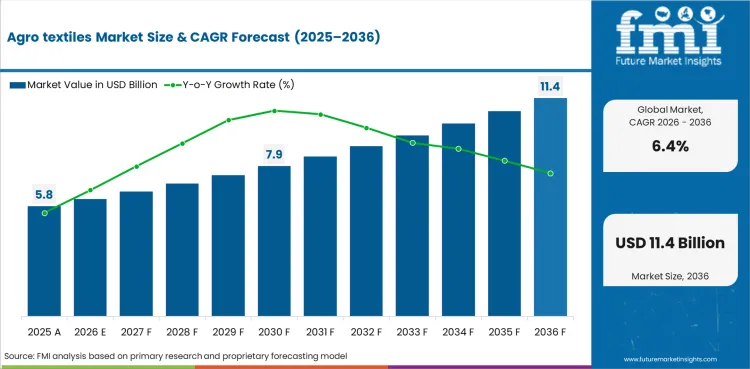
- The agro textiles market is projected to grow from USD 6.1 billion in 2026 to USD 11.4 billion by 2036, at a CAGR of 6.4%.
- The agro textiles market was valued at USD 5.77 billion in 2025.
- By 2036, the agro textiles market is expected to be worth USD 11.42 billion.
- From 2026 to 2036, the market is projected to expand at a CAGR of 6.4%.
- The market is projected to create an incremental opportunity of USD 5.28 billion between 2026 and 2036.
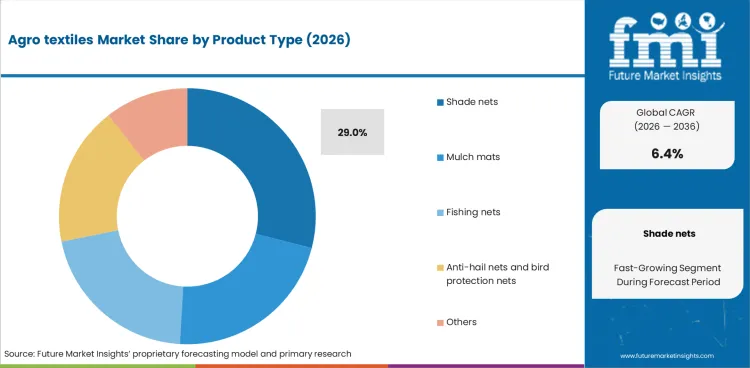
- In 2026, shade nets are expected to account for 29.0% of the product type segment, driven by strong underlying end-use demand.
- Polyethylene will lead the fiber segment with a 33.0% share.
- China (8.6%) and India (8.0%) are two of the fastest growing markets in the world.
Agro textiles Market Definition
The agro textiles market covers synthetic and natural fiber fabrics engineered for agricultural use, including shade nets, mulch mats, fishing nets, anti-hail nets, bird protection nets, windbreaks, and silage covers. Products span polyethylene, polypropylene, nylon, polyester, polyolefin, jute, and wool fibers used across crop production, horticulture, animal husbandry, and agro engineering.
Agro textiles Market Inclusions
Market scope encompasses all commercially traded agro textile products categorized by product type (shade nets, mulch mats, fishing nets, anti-hail and bird protection nets, others), fiber (polyethylene, polypropylene, nylon, polyester, polyolefin, jute, wool), and application (crop production, horticulture, animal husbandry and aqua culture, agro engineering). Revenue coverage spans 2026 to 2036.
Agro textiles Market Exclusions
The scope does not include general industrial textiles used outside agriculture, woven garment fabrics, automotive fabrics, or construction geotextiles. Packaging jute bags used for non-agricultural purposes are also outside the scope.
Agro textiles Market Research Methodology
- Primary Research: FMI analysts engaged fiber producers, net and mulch fabricators, horticulture and aquaculture end users, and subsidy program administrators across India, China, and Europe.
- Desk Research: Combined data from polymer pricing trackers, agricultural ministry subsidy disclosures, and nonwoven industry publications.
- Market sizing and forecasting: Bottom-up aggregation of product type and application revenue, validated against national horticulture area statistics and polymer consumption data.
- Data validation: Cross-checked every quarter against fiber production data, agricultural subsidy allocations, and manufacturer disclosures.
Why is the Agro textiles Market Growing?
Changing crop protection economics is creating demand for agro textile covers that stabilize yields under heat, hail, and pest pressure, while using lower labour inputs than traditional methods.
Subsidy schemes for protected cultivation in India, China, and parts of the EU create a structured demand for shade nets, mulch film, and anti-hail systems at subsidized capital costs for growers.
China leads growth with 8.64%, which is because the country has the largest protected cultivation base, domestic polymer production, and aggressive investment in greenhouse horticulture under its rural modernization policy.
The agro textiles market grows steadily, thanks to protected cultivation mandates, aquaculture expansion, and the need for climate-resilient agricultural inputs that reduce post-harvest losses.
Shade nets are the biggest part of the product segment. Horticulture and floriculture operations use shade nets to manage temperature and light, improving quality consistency for export crops. Fishing nets is the fastest-growing part because aquaculture expansion and fleet modernization require lightweight, durable netting.
Polyethylene dominates the fiber segment because of low polymer cost, UV stabilizer compatibility, and existing extrusion infrastructure. Jute and wool retain niche roles in geotextile and organic farming applications where biodegradability is a procurement priority.
Market Segmentation Analysis
- Shade nets hold 29% of product type share, supported by use across greenhouse horticulture and open-field sun protection for high-value crops.
- Polyethylene leads the fiber segment at 33%, driven by low cost, UV stabilizer compatibility, and extrusion scale.
- Crop production accounts for the largest application share at 36%, reflecting the central role of agro textiles in mulching, bird protection, and windbreak uses.
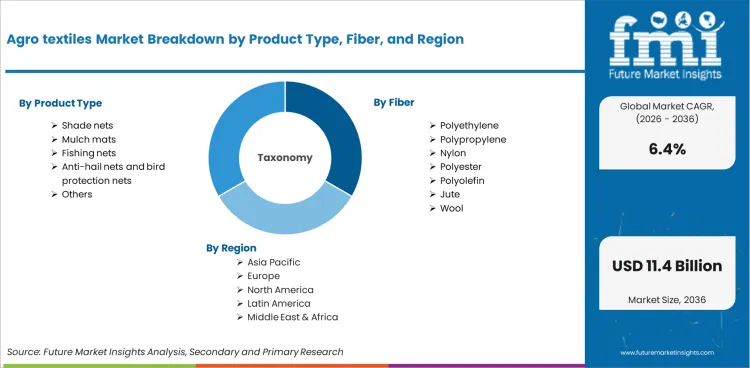
The agro textiles market is divided into groups based on product type, fiber, application, and region. There are Shade Nets, Mulch Mats, Fishing Nets, and Anti-hail and Bird Protection Nets. By fiber, such as polyethylene, polypropylene, nylon, polyester, polyolefin, jute, and wool.
Insights into the Shade Nets Product Type Segment
Agro textiles Market Analysis By Product Type
- In 2026, shade nets will make up 29% of the market. The biggest sub-segment is greenhouse shade netting. UV-stabilized shade nets improve yield consistency and reduce heat stress for horticulture and floriculture operations.
- Mulch mats and anti-hail protection applications concentrate on high-value fruit and vegetable crops, where loss prevention economics justify the covering investment. Bird protection and windbreak uses are growing in orchard and vineyard operations.
Insights into the Polyethylene Fiber Segment
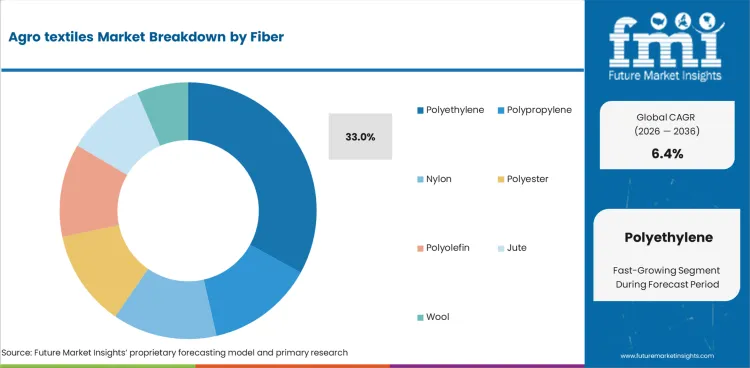
- Polyethylene is the leading fiber. This is because it combines low polymer cost, UV stabilizer compatibility, and existing extrusion infrastructure. HDPE monofilament is used for shade nets, while LDPE films dominate mulch applications.
- The fishing net and aquaculture enclosure sub-segments are driving growth in polyethylene procurement because aquaculture expansion in China, India, and Southeast Asia requires lightweight, UV-stable netting with long service life.
Agro textiles Market Drivers, Restraints, and Opportunities
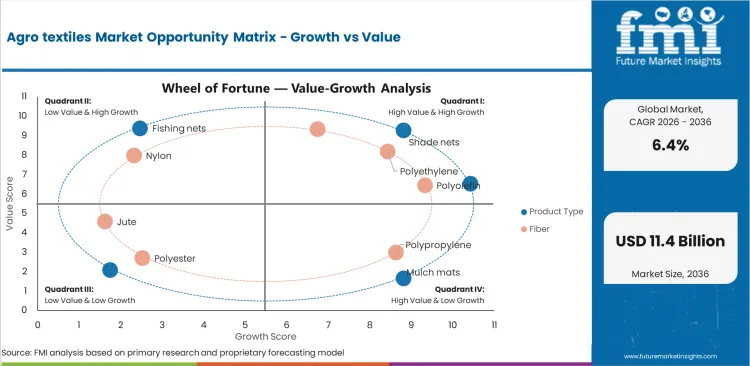
- Climate variability and protected cultivation mandates are creating a structured need for agro textile covers as a risk management input for growers.
- Polymer price volatility makes cost-control hard for converters, which keeps consolidation pressure high in commodity shade net and mulch film categories.
- Aquaculture modernization and fleet renewal are speeding up the adoption of high-specification polyethylene and nylon fishing nets across Asia-Pacific.
The agro textiles market keeps growing because of protected cultivation adoption, aquaculture expansion, and climate risk management. Even though there are problems like polymer price volatility and low product differentiation in commodity categories, there are still chances for growth in high-specification horticulture covers and aquaculture netting.
Protected Cultivation and Yield Stabilization
Demand shows that growers are moving toward covered crop systems that stabilize yields under heat, hail, and pest pressure. Shade nets, mulch mats, and anti-hail covers lower yield variability, which helps horticulture operations meet export-grade quality specifications for floriculture and high-value fruit crops.
Polymer Price Volatility and Margin Pressure
Adoption is limited by polymer feedstock price swings that compress converter margins. High polymer prices make it hard for smaller fabricators to maintain pricing stability with horticulture buyers. Instead, volume is concentrating in larger extrusion operations with hedging capacity and integrated polymer supply contracts.
Subsidy Policy and Horticulture Diversification
Growth is due to government subsidy schemes for protected cultivation equipment, which have led to a demand for shade nets, poly-tunnels, and mulch film across India, China, and parts of the EU. Subsidies are being redirected from commodity support to protected horticulture and water-saving irrigation systems that use agro textile covers.
Aquaculture and Fishing Net Demand
Aquaculture modernization and commercial fishing fleet renewal create sustained demand for polyethylene and nylon fishing nets. This application supports premium pricing for UV-stabilized and high-tenacity constructions, with long-term supply agreements covering large-scale aquaculture operations in China, India, and Vietnam.
Analysis of Agro textiles Market By Key Countries
.webp "Top Country Growth Comparison Agro Textiles Market Cagr (2026 2036)")
| Country | CAGR |
|---|---|
| China | 8.6% |
| India | 8.0% |
| Germany | 7.4% |
| Brazil | 6.7% |
| USA | 6.1% |
| UK | 5.4% |
| Japan | 4.8% |
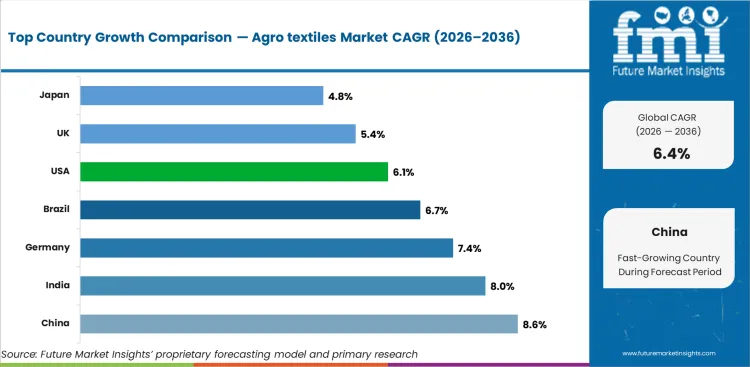
- China is in first place with a 8.6% CAGR, driven by scale of demand, sustained investment, and strong end-use ecosystems.
- India at 8.0% shows strong demand because of supportive policy frameworks and expanding downstream industries.
- Germany at 7.4% and Brazil at 6.7% keep growing thanks to advanced infrastructure and rising adoption across end-use sectors.
- USA at 6.1% and UK at 5.4% show that mature markets are speeding up the adoption of advanced solutions.
The global market for agro textiles is expected to grow at a rate of 6.4% per year from 2026 to 2036. The study covers more than 30 countries, and the main markets are listed below.
Demand Outlook for Agro textiles Market in the United States
Agro textiles Market Country Value Analysis
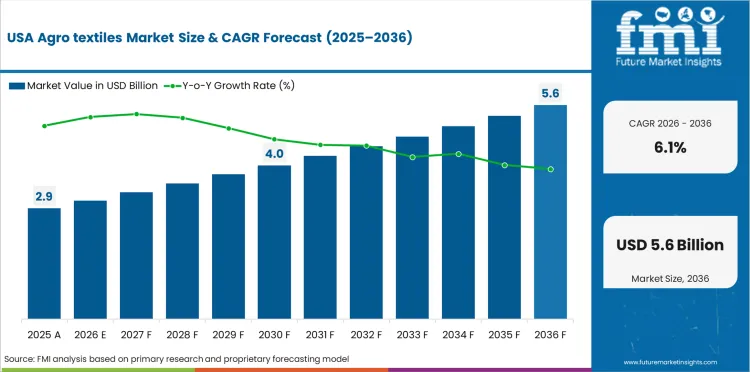
The USA agro textiles market is projected to grow at a CAGR of 6.08% through 2036. This is because of the growth of protected cultivation in greenhouse horticulture, the need for anti-hail protection in orchard and vineyard operations, and the demand for commercial aquaculture netting. Domestic fabricators and Asian importers compete in the US market.
- Demand for high-specification anti-hail nets is driven by orchard and vineyard operators.
- Greenhouse horticulture expansion leads to the purchase of shade nets and climate-control covers.
- Commercial aquaculture operations help find higher-quality polyethylene netting.
Future Outlook for Agro textiles Market in the United Kingdom
The UK agro textiles market is projected to grow at a CAGR of 5.44% through 2036, thanks to a focus on glasshouse horticulture, rules that support climate-adaptation farming, and new higher-specification mulch mat products.
- Glasshouse horticulture is what makes people want shade nets and thermal screens.
- Climate-adaptation policy speeds up the use of anti-hail and protective covers.
- New ideas in biodegradable mulch lead to finding jute and wool as ingredients.
Opportunity Analysis of Agro textiles Market in Germany
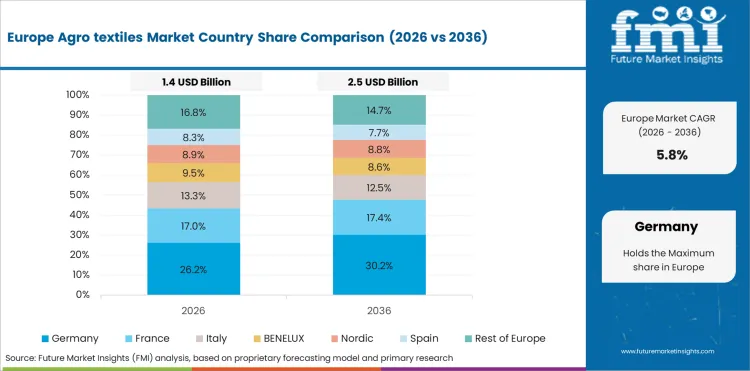
The Germany agro textiles market is projected to grow at a CAGR of 7.36% through 2036. This is due to EU Common Agricultural Policy rural development funding, strong horticulture and floriculture base, and advanced polymer extrusion infrastructure.
- EU rules on protected cultivation push the use of shade nets and anti-hail covers.
- Organic farming makes people want biodegradable mulch and jute fabrics.
- Advanced extrusion technology makes it easier to produce high-specification agro textile covers.
In-depth Analysis of Agro textiles Market in Japan
The Japan agro textiles market is projected to grow at a CAGR of 4.8% through 2036. This is due to the country's intensive horticulture industry, high-value aquaculture production, and culture of innovation in functional agricultural inputs.
- The intensive horticulture industry drives the need for climate-control covers.
- High-value aquaculture production helps with finding high-tenacity netting.
- Innovations in functional agricultural inputs make it possible to use advanced fiber composites.
Sales Analysis of Agro textiles Market in China
The China agro textiles market is projected to grow at a CAGR of 8.64% through 2036. This is because it has the world's largest protected cultivation base, aquaculture expansion is growing, and the government is investing in rural modernization under its agricultural policy.
- The biggest protected cultivation base drives up the demand for shade nets and mulch films.
- Aquaculture expansion makes it possible to buy specialized polyethylene netting.
- Rural modernization mandates hasten the adoption of yield-stabilizing covers.
In-depth Analysis of Agro textiles Market in India
The India agro textiles market is projected to grow through 2036, thanks to subsidy schemes under the National Horticulture Mission, a more modern aquaculture sector, and more organized horticulture producers who are learning about the benefits of protected cultivation.
- The growth of floriculture exports increases the need for shade nets and climate covers.
- Modernizing aquaculture helps the use of polyethylene and nylon fishing nets.
- Organized horticulture growers use subsidized shade net installations to stabilize yields.
Competitive Landscape and Strategic Positioning
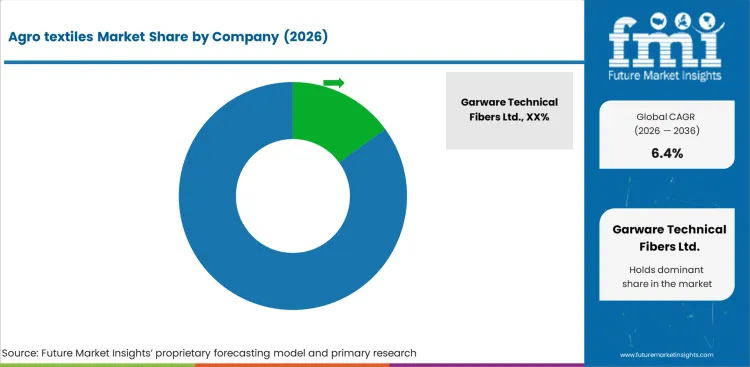
Agro textiles Market Analysis By Company
- Garware Technical Fibers Ltd. leads with 15% share, supported by vertical integration from polymer extrusion to finished netting and long-standing export relationships in aquaculture and agriculture segments.
- Freudenberg Performance Materials, TenCate Industrial Fabrics, and Beaulieu Technical Textiles all offer a wide range of agricultural textile products across horticulture, crop protection, and industrial applications.
- New players are focusing on specialized applications like biodegradable mulch, UV-stabilized anti-hail systems, and high-tenacity aquaculture netting.
Garware Technical Fibers Ltd. is the leader because it integrates polymer extrusion, netting, and export distribution across agriculture, aquaculture, and geosynthetics. Freudenberg Performance Materials offers nonwoven agricultural textiles with European horticulture reach. TenCate Industrial Fabrics and Beaulieu Technical Textiles supply woven and knitted covers for horticulture and floriculture. AB Ludvig Svensson specializes in climate screens for greenhouse cultivation. Karatzis Group manufactures baler twine and netting for European agriculture.
Barriers include polymer feedstock cost volatility, technical specifications for UV stability and tensile strength, established distribution relationships with horticulture cooperatives, and certification requirements for protected cultivation subsidies. Strategic priorities include polymer integration, biodegradable fiber development, and forming partnerships with horticulture cooperatives and aquaculture producers.
Key Companies in the Agro textiles Market
Key global companies leading the agro textiles market include:
- Garware Technical Fibers Ltd. (India), Freudenberg Performance Materials (Germany), TenCate Industrial Fabrics (Netherlands), and Beaulieu Technical Textiles (Belgium) all these companies have strong manufacturing infrastructure for agricultural textile products, established relationships with horticulture and aquaculture producers, and a wide range of offerings, including shade nets, mulch mats, and specialty fibers.
- AB Ludvig Svensson (Sweden), Karatzis Group (Greece), and Mogul Co Ltd (Turkey) have become leaders in their regions by focusing on making specialized agricultural textile products for horticulture and floriculture producers who care about climate control and high-specification crop protection.
- Belton Industries Inc. (USA), Zhongshan Hongjun Nonwovens Co Ltd (China), and others are startups and small and medium-sized businesses that have made a name for themselves by getting into biodegradable mulch, high-UV shade nets, and aquaculture netting. This shows that they could become leaders in the future.
Competitive Benchmarking: Agro textiles Market
| Company | Product Breadth | Fiber Technology | End-User Access | Geographic Footprint |
|---|---|---|---|---|
| Garware Technical Fibers Ltd. | High | High | Strong | Global |
| Freudenberg Performance Materials | High | Medium | Strong | Europe |
| TenCate Industrial Fabrics | Medium | High | Strong | Global |
| Beaulieu Technical Textiles | Medium | Medium | Moderate | Europe |
| AB Ludvig Svensson | Medium | High | Moderate | Europe |
| Karatzis Group | Medium | Medium | Moderate | Europe |
| Mogul Co Ltd | Medium | Medium | Moderate | EMEA |
| Belton Industries Inc. | Low | Medium | Low | N. America |
| Zhongshan Hongjun | Low | Medium | Low | Asia |
Source: Future Market Insights competitive analysis, 2026.
Key Developments in Agro textiles Market
- In 2025, Garware Technical Fibres Ltd. strengthened its aquaculture textiles portfolio by enhancing UV-stabilized netting solutions, supporting the expansion of shrimp and finfish farming operations across Southeast Asia.
- In 2025, AB Ludvig Svensson advanced its greenhouse climate screen solutions, focusing on energy efficiency and climate control optimization for commercial horticulture and floriculture producers in Europe.
Key Players in the Agro textiles Market
Major Global Players:
- Garware Technical Fibers Ltd.
- Freudenberg Performance Materials
- TenCate Industrial Fabrics
- Beaulieu Technical Textiles
- AB Ludvig Svensson
- Karatzis Group
- Mogul Co Ltd
Emerging Players/Startups
- Belton Industries Inc.
- Zhongshan Hongjun Nonwovens Co Ltd
- Others
Report Scope and Coverage
Agro textiles Market Breakdown By Product Type, Fiber, And Region
| Parameter | Details |
|---|---|
| Quantitative Units | USD 6.14 billion to USD 11.42 billion, at a CAGR of 6.4% |
| Market Definition | The agro textiles market encompasses synthetic and natural fiber fabrics engineered for agricultural use, including shade nets, mulch mats, fishing nets, anti-hail and bird protection nets across crop production, horticulture, animal husbandry, and agro engineering. |
| Regions Covered | North America, Latin America, Europe, East Asia, South Asia and Pacific, Middle East and Africa |
| Countries Covered | USA, UK, France, Germany, Italy, South Korea, Japan, China, India, 30 plus countries |
| Key Companies | Garware Technical Fibers Ltd., Freudenberg Performance Materials, TenCate Industrial Fabrics, Beaulieu Technical Textiles, AB Ludvig Svensson, Karatzis Group, Mogul Co Ltd, Belton Industries Inc., Zhongshan Hongjun Nonwovens Co Ltd, Others |
| Forecast Period | 2026 to 2036 |
| Approach | Hybrid bottom-up and top-down methodology starting with verified transaction data, projecting adoption velocity across segments and regions |
Agro textiles Market by Segments
Agro textiles Market Market Segmented by Product Type:
- Shade nets
- Mulch mats
- Fishing nets
- Anti-hail nets and bird protection nets
- Others
Agro textiles Market Market Segmented by Fiber:
- Polyethylene
- Polypropylene
- Nylon
- Polyester
- Polyolefin
- Jute
- Wool
Agro textiles Market Market Segmented by Application:
- Crop Production
- Horticulture, Floriculture and Forestry
- Animal Husbandry and Aqua Culture
- Agro Engineering
Agro textiles Market Market by Region:
- North America
- USA
- Canada
- Mexico
- Latin America
- Brazil
- Chile
- Rest of Latin America
- Western Europe
- Germany
- UK
- Italy
- Spain
- France
- Nordic
- BENELUX
- Rest of Western Europe
- Eastern Europe
- Russia
- Poland
- Hungary
- Balkan & Baltic
- Rest of Eastern Europe
- East Asia
- China
- Japan
- South Korea
- South Asia and Pacific
- India
- ASEAN
- Australia & New Zealand
- Rest of South Asia and Pacific
- Middle East & Africa
- Kingdom of Saudi Arabia
- Other GCC Countries
- Turkiye
- South Africa
- Other African Union
- Rest of Middle East & Africa
Research Sources and Bibliography
- Food and Agriculture Organization. (2025). Protected Cultivation Global Statistics. FAO.
- International Textile Manufacturers Federation. (2025). Global Technical Textiles Report. ITMF.
- European Commission. (2024). Common Agricultural Policy: Horticulture and Protected Cultivation. EC.
- Indian Ministry of Agriculture. (2024). National Horticulture Mission: Subsidy Framework. MoA.
- China National Agricultural Technology Extension Service. (2024). Protected Cultivation Development Report. CNATES.
Frequently Asked Questions
What is the global market demand for Agro textiles in 2026?
In 2026, the global market for agro textiles is expected to be worth USD 6.14 billion.
How big will the market for Agro textiles be in 2036?
By 2036, the market for agro textiles is expected to be worth USD 11.42 billion.
How much do you think demand for Agro textiles will grow between 2026 and 2036?
Between 2026 and 2036, the demand for agro textiles is expected to grow at a CAGR of 6.4%.
Which Product Type segment is likely to be the best seller in the world by 2026?
Shade nets will make up 29% of the market in 2026. This shows that horticulture and floriculture operations are the primary consumers of agro textile covers.
What is causing demand to rise in China?
The China agro textiles market is projected to grow at a CAGR of 8.64% through 2036, thanks to protected cultivation expansion and aquaculture modernization.
What is causing demand to rise in India?
The India agro textiles market is projected to grow at a CAGR of 8.0% through 2036, thanks to horticulture subsidy schemes and floriculture export growth.
What does this report mean by Agro textiles Market definition?
The agro textiles market covers synthetic and natural fiber fabrics engineered for agricultural use, including shade nets, mulch mats, fishing nets, and anti-hail and bird protection nets.
How does FMI make the Agro textiles forecast and check it?
Forecasting models use a hybrid bottom-up and top-down approach, starting with verified fiber production data and checking against horticulture area statistics and polymer consumption data.
What is the global market demand for Agro textiles in 2026?
In 2026, the global market for agro textiles is expected to be worth USD 6.14 billion.
How big will the market for Agro textiles be in 2036?
By 2036, the market for agro textiles is expected to be worth USD 11.42 billion.
How much do you think demand for Agro textiles will grow between 2026 and 2036?
Between 2026 and 2036, the demand for agro textiles is expected to grow at a CAGR of 6.4%.
Which Product Type segment is likely to be the best seller in the world by 2026?
Shade nets will make up 29% of the market in 2026. This shows that horticulture and floriculture operations are the primary consumers of agro textile covers.
What is causing demand to rise in China?
The China agro textiles market is projected to grow at a CAGR of 8.64% through 2036, thanks to protected cultivation expansion and aquaculture modernization.
What is causing demand to rise in India?
The India agro textiles market is projected to grow at a CAGR of 8.0% through 2036, thanks to horticulture subsidy schemes and floriculture export growth.
What does this report mean by Agro textiles Market definition?
The agro textiles market covers synthetic and natural fiber fabrics engineered for agricultural use, including shade nets, mulch mats, fishing nets, and anti-hail and bird protection nets.
How does FMI make the Agro textiles forecast and check it?
Forecasting models use a hybrid bottom-up and top-down approach, starting with verified fiber production data and checking against horticulture area statistics and polymer consumption data.
Preview the report firsthand - request a free sample
Get SampleGet the brochure for pricing and purchase details.
Get PDFTable of Content
- Executive Summary
- Global Market Outlook
- Demand-side Trends
- Supply-side Trends
- Technology Roadmap Analysis
- Analysis and Recommendations
- Market Overview
- Market Coverage / Taxonomy
- Market Definition / Scope / Limitations
- Research Methodology
- Chapter Orientation
- Analytical Lens and Working Hypotheses
- Market Structure, Signals, and Trend Drivers
- Benchmarking and Cross-market Comparability
- Market Sizing, Forecasting, and Opportunity Mapping
- Research Design and Evidence Framework
- Desk Research Programme (Secondary Evidence)
- Company Annual and Sustainability Reports
- Peer-reviewed Journals and Academic Literature
- Corporate Websites, Product Literature, and Technical Notes
- Earnings Decks and Investor Briefings
- Statutory Filings and Regulatory Disclosures
- Technical White Papers and Standards Notes
- Trade Journals, Industry Magazines, and Analyst Briefs
- Conference Proceedings, Webinars, and Seminar Materials
- Government Statistics Portals and Public Data Releases
- Press Releases and Reputable Media Coverage
- Specialist Newsletters and Curated Briefings
- Sector Databases and Reference Repositories
- FMI Internal Proprietary Databases and Historical Market Datasets
- Subscription Datasets and Paid Sources
- Social Channels, Communities, and Digital Listening Inputs
- Additional Desk Sources
- Expert Input and Fieldwork (Primary Evidence)
- Primary Modes
- Qualitative Interviews and Expert Elicitation
- Social and Community Interactions
- Stakeholder Universe Engaged
- C-suite Leaders
- Board Members
- Presidents and Vice Presidents
- R&D and Innovation Heads
- Technical Specialists
- Domain Subject-matter Experts
- Scientists
- Physicians and Other Healthcare Professionals
- Governance, Ethics, and Data Stewardship
- Research Ethics
- Data Integrity and Handling
- Primary Modes
- Tooling, Models, and Reference Databases
- Desk Research Programme (Secondary Evidence)
- Data Engineering and Model Build
- Data Acquisition and Ingestion
- Cleaning, Normalisation, and Verification
- Synthesis, Triangulation, and Analysis
- Quality Assurance and Audit Trail
- Market Background
- Market Dynamics
- Drivers
- Restraints
- Opportunity
- Trends
- Scenario Forecast
- Demand in Optimistic Scenario
- Demand in Likely Scenario
- Demand in Conservative Scenario
- Opportunity Map Analysis
- Product Life Cycle Analysis
- Supply Chain Analysis
- Investment Feasibility Matrix
- Value Chain Analysis
- PESTLE and Porter’s Analysis
- Regulatory Landscape
- Regional Parent Market Outlook
- Production and Consumption Statistics
- Import and Export Statistics
- Market Dynamics
- Global Market Analysis 2021 to 2025 and Forecast, 2026 to 2036
- Historical Market Size Value (USD Million) Analysis, 2021 to 2025
- Current and Future Market Size Value (USD Million) Projections, 2026 to 2036
- Y-o-Y Growth Trend Analysis
- Absolute $ Opportunity Analysis
- Global Market Pricing Analysis 2021 to 2025 and Forecast 2026 to 2036
- Global Market Analysis 2021 to 2025 and Forecast 2026 to 2036, By Product Type
- Introduction / Key Findings
- Historical Market Size Value (USD Million) Analysis By Product Type , 2021 to 2025
- Current and Future Market Size Value (USD Million) Analysis and Forecast By Product Type , 2026 to 2036
- Shade nets
- Mulch mats
- Fishing nets
- Anti-hail nets and bird protection nets
- Others
- Shade nets
- Y-o-Y Growth Trend Analysis By Product Type , 2021 to 2025
- Absolute $ Opportunity Analysis By Product Type , 2026 to 2036
- Global Market Analysis 2021 to 2025 and Forecast 2026 to 2036, By Fiber
- Introduction / Key Findings
- Historical Market Size Value (USD Million) Analysis By Fiber, 2021 to 2025
- Current and Future Market Size Value (USD Million) Analysis and Forecast By Fiber, 2026 to 2036
- Polyethylene
- Polypropylene
- Nylon
- Polyester
- Polyolefin
- Jute
- Wool
- Polyethylene
- Y-o-Y Growth Trend Analysis By Fiber, 2021 to 2025
- Absolute $ Opportunity Analysis By Fiber, 2026 to 2036
- Global Market Analysis 2021 to 2025 and Forecast 2026 to 2036, By Application
- Introduction / Key Findings
- Historical Market Size Value (USD Million) Analysis By Application, 2021 to 2025
- Current and Future Market Size Value (USD Million) Analysis and Forecast By Application, 2026 to 2036
- Crop Production
- Horticulture, Floriculture and Forestry
- Animal Husbandry and Aqua Culture
- Agro Engineering
- Crop Production
- Y-o-Y Growth Trend Analysis By Application, 2021 to 2025
- Absolute $ Opportunity Analysis By Application, 2026 to 2036
- Global Market Analysis 2021 to 2025 and Forecast 2026 to 2036, By Region
- Introduction
- Historical Market Size Value (USD Million) Analysis By Region, 2021 to 2025
- Current Market Size Value (USD Million) Analysis and Forecast By Region, 2026 to 2036
- North America
- Latin America
- Western Europe
- Eastern Europe
- East Asia
- South Asia and Pacific
- Middle East & Africa
- Market Attractiveness Analysis By Region
- North America Market Analysis 2021 to 2025 and Forecast 2026 to 2036, By Country
- Historical Market Size Value (USD Million) Trend Analysis By Market Taxonomy, 2021 to 2025
- Market Size Value (USD Million) Forecast By Market Taxonomy, 2026 to 2036
- By Country
- USA
- Canada
- Mexico
- By Product Type
- By Fiber
- By Application
- By Country
- Market Attractiveness Analysis
- By Country
- By Product Type
- By Fiber
- By Application
- Key Takeaways
- Latin America Market Analysis 2021 to 2025 and Forecast 2026 to 2036, By Country
- Historical Market Size Value (USD Million) Trend Analysis By Market Taxonomy, 2021 to 2025
- Market Size Value (USD Million) Forecast By Market Taxonomy, 2026 to 2036
- By Country
- Brazil
- Chile
- Rest of Latin America
- By Product Type
- By Fiber
- By Application
- By Country
- Market Attractiveness Analysis
- By Country
- By Product Type
- By Fiber
- By Application
- Key Takeaways
- Western Europe Market Analysis 2021 to 2025 and Forecast 2026 to 2036, By Country
- Historical Market Size Value (USD Million) Trend Analysis By Market Taxonomy, 2021 to 2025
- Market Size Value (USD Million) Forecast By Market Taxonomy, 2026 to 2036
- By Country
- Germany
- UK
- Italy
- Spain
- France
- Nordic
- BENELUX
- Rest of Western Europe
- By Product Type
- By Fiber
- By Application
- By Country
- Market Attractiveness Analysis
- By Country
- By Product Type
- By Fiber
- By Application
- Key Takeaways
- Eastern Europe Market Analysis 2021 to 2025 and Forecast 2026 to 2036, By Country
- Historical Market Size Value (USD Million) Trend Analysis By Market Taxonomy, 2021 to 2025
- Market Size Value (USD Million) Forecast By Market Taxonomy, 2026 to 2036
- By Country
- Russia
- Poland
- Hungary
- Balkan & Baltic
- Rest of Eastern Europe
- By Product Type
- By Fiber
- By Application
- By Country
- Market Attractiveness Analysis
- By Country
- By Product Type
- By Fiber
- By Application
- Key Takeaways
- East Asia Market Analysis 2021 to 2025 and Forecast 2026 to 2036, By Country
- Historical Market Size Value (USD Million) Trend Analysis By Market Taxonomy, 2021 to 2025
- Market Size Value (USD Million) Forecast By Market Taxonomy, 2026 to 2036
- By Country
- China
- Japan
- South Korea
- By Product Type
- By Fiber
- By Application
- By Country
- Market Attractiveness Analysis
- By Country
- By Product Type
- By Fiber
- By Application
- Key Takeaways
- South Asia and Pacific Market Analysis 2021 to 2025 and Forecast 2026 to 2036, By Country
- Historical Market Size Value (USD Million) Trend Analysis By Market Taxonomy, 2021 to 2025
- Market Size Value (USD Million) Forecast By Market Taxonomy, 2026 to 2036
- By Country
- India
- ASEAN
- Australia & New Zealand
- Rest of South Asia and Pacific
- By Product Type
- By Fiber
- By Application
- By Country
- Market Attractiveness Analysis
- By Country
- By Product Type
- By Fiber
- By Application
- Key Takeaways
- Middle East & Africa Market Analysis 2021 to 2025 and Forecast 2026 to 2036, By Country
- Historical Market Size Value (USD Million) Trend Analysis By Market Taxonomy, 2021 to 2025
- Market Size Value (USD Million) Forecast By Market Taxonomy, 2026 to 2036
- By Country
- Kingdom of Saudi Arabia
- Other GCC Countries
- Turkiye
- South Africa
- Other African Union
- Rest of Middle East & Africa
- By Product Type
- By Fiber
- By Application
- By Country
- Market Attractiveness Analysis
- By Country
- By Product Type
- By Fiber
- By Application
- Key Takeaways
- Key Countries Market Analysis
- USA
- Pricing Analysis
- Market Share Analysis, 2025
- By Product Type
- By Fiber
- By Application
- Canada
- Pricing Analysis
- Market Share Analysis, 2025
- By Product Type
- By Fiber
- By Application
- Mexico
- Pricing Analysis
- Market Share Analysis, 2025
- By Product Type
- By Fiber
- By Application
- Brazil
- Pricing Analysis
- Market Share Analysis, 2025
- By Product Type
- By Fiber
- By Application
- Chile
- Pricing Analysis
- Market Share Analysis, 2025
- By Product Type
- By Fiber
- By Application
- Germany
- Pricing Analysis
- Market Share Analysis, 2025
- By Product Type
- By Fiber
- By Application
- UK
- Pricing Analysis
- Market Share Analysis, 2025
- By Product Type
- By Fiber
- By Application
- Italy
- Pricing Analysis
- Market Share Analysis, 2025
- By Product Type
- By Fiber
- By Application
- Spain
- Pricing Analysis
- Market Share Analysis, 2025
- By Product Type
- By Fiber
- By Application
- France
- Pricing Analysis
- Market Share Analysis, 2025
- By Product Type
- By Fiber
- By Application
- India
- Pricing Analysis
- Market Share Analysis, 2025
- By Product Type
- By Fiber
- By Application
- ASEAN
- Pricing Analysis
- Market Share Analysis, 2025
- By Product Type
- By Fiber
- By Application
- Australia & New Zealand
- Pricing Analysis
- Market Share Analysis, 2025
- By Product Type
- By Fiber
- By Application
- China
- Pricing Analysis
- Market Share Analysis, 2025
- By Product Type
- By Fiber
- By Application
- Japan
- Pricing Analysis
- Market Share Analysis, 2025
- By Product Type
- By Fiber
- By Application
- South Korea
- Pricing Analysis
- Market Share Analysis, 2025
- By Product Type
- By Fiber
- By Application
- Russia
- Pricing Analysis
- Market Share Analysis, 2025
- By Product Type
- By Fiber
- By Application
- Poland
- Pricing Analysis
- Market Share Analysis, 2025
- By Product Type
- By Fiber
- By Application
- Hungary
- Pricing Analysis
- Market Share Analysis, 2025
- By Product Type
- By Fiber
- By Application
- Kingdom of Saudi Arabia
- Pricing Analysis
- Market Share Analysis, 2025
- By Product Type
- By Fiber
- By Application
- Turkiye
- Pricing Analysis
- Market Share Analysis, 2025
- By Product Type
- By Fiber
- By Application
- South Africa
- Pricing Analysis
- Market Share Analysis, 2025
- By Product Type
- By Fiber
- By Application
- USA
- Market Structure Analysis
- Competition Dashboard
- Competition Benchmarking
- Market Share Analysis of Top Players
- By Regional
- By Product Type
- By Fiber
- By Application
- Competition Analysis
- Competition Deep Dive
- Garware Technical Fibers Ltd.
- Overview
- Product Portfolio
- Profitability by Market Segments (Product/Age /Sales Channel/Region)
- Sales Footprint
- Strategy Overview
- Marketing Strategy
- Product Strategy
- Channel Strategy
- Freudenberg Performance Materials
- TenCate Industrial Fabrics
- Beaulieu Technical Textiles
- AB Ludvig Svensson
- Karatzis Group
- Mogul Co Ltd
- Belton Industries Inc.
- Zhongshan Hongjun Nonwovens Co Ltd
- Others
- Garware Technical Fibers Ltd.
- Competition Deep Dive
- Assumptions & Acronyms Used


