

- Industry Size (2026)
- USD 750 Mn
- Forecast (2036)
- USD 1910.2 Mn
- CAGR (2026 to 2036)
- 9.8%
PFAS Replacement Chemistries for Textiles Market Forecast and Outlook 2026 to 2036
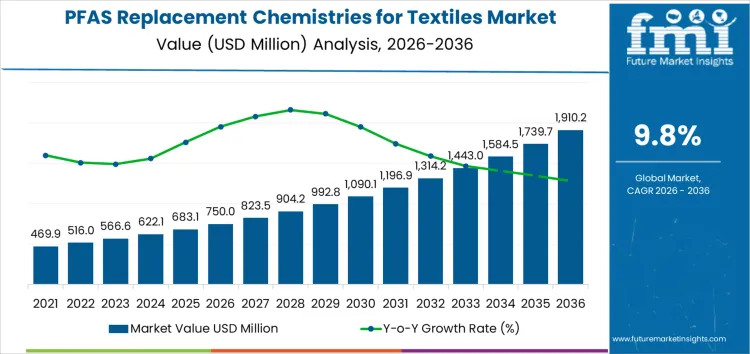
The PFAS replacement chemistries for textiles market is projected at USD 750 million in 2026, reaching USD 1,910.2 million by 2036, growing at a CAGR of 9.8%. Early growth from 2026 to 2030 is fueled by regulatory restrictions on traditional PFAS use and increasing demand for eco-friendly water- and stain-resistant textile treatments. Adoption spans apparel, home textiles, and industrial fabrics, with fluorine-free and polymer-based chemistries gaining traction. Key drivers include consumer awareness, sustainable fashion initiatives, and corporate commitments to chemical safety in textile supply chains.
Between 2031 and 2036, expansion is reinforced by technological advances in durable, high-performance PFAS alternatives, coupled with broader integration across performance fabrics and protective clothing. Market penetration intensifies in emerging regions, supported by industrial collaborations, innovation in fluorine-free formulations, and enhanced textile finishing processes. By 2036, the market demonstrates maturity with diverse chemistries established across multiple textile segments, offering regulatory compliance, environmental benefits, and performance parity with legacy PFAS treatments.
Quick Stats for PFAS Replacement Chemistries for Textiles Market
- PFAS Replacement Chemistries for Textiles Market Value (2026): USD 750 million
- PFAS Replacement Chemistries for Textiles Market Forecast Value (2036): USD 1,910.2 million
- PFAS Replacement Chemistries for Textiles Market Forecast CAGR: 9.8%
- Leading Type in PFAS Replacement Chemistries for Textiles Market: Silicone Based Repellents
- Key Growth Regions in PFAS Replacement Chemistries for Textiles Market: North America, Europe, and Asia Pacific
- Top Players in PFAS Replacement Chemistries for Textiles Market: Chemours, Huntsman Corporation, Archroma, Dow Inc., Rudolf Group
What is the Growth Forecast for the PFAS Replacement Chemistries for Textiles Market through 2036?
From 2026 to 2031, the PFAS replacement chemistries market grows from USD 750 million to approximately USD 1,133 million, representing the early adoption phase. Annual increments increase from USD 75 million in 2026 to USD 109 million in 2031. Growth is driven by adoption in textile manufacturing, apparel, and technical fabrics, where regulatory pressure and sustainability initiatives favor non-fluorinated chemistries. North America and Europe account for roughly 65% of early adoption, with uptake concentrated in high-value textile producers validating chemical performance, stain and water repellency, and compatibility with existing finishing processes.
Between 2031 and 2036, the market expands from roughly USD 1,133 million to USD 1,910.2 million, illustrating the late adoption phase characterized by broader commercialization and multi-site deployment. Annual increments rise from USD 109 million to USD 141 million, supported by repeat procurement, multi-region adoption, and portfolio-wide integration across apparel and technical textile lines. Growth is reinforced by regulatory bans on PFAS, increasing consumer demand for environmentally safe textiles, and normalization of alternative chemistries across global manufacturing. Early-stage growth relied on selective pilot programs, while later expansion reflects structural adoption and scaling across the global textile sector.
PFAS Replacement Chemistries for Textiles Market Key Takeaways
| Metric | Value |
|---|---|
| Market Value (2026) | USD 750 million |
| Forecast Value (2036) | USD 1,910.2 million |
| Forecast CAGR (2026–2036) | 9.8% |
What Is Driving Demand in the PFAS Replacement Chemistries for Textiles Market?
Demand for PFAS replacement chemistries in textiles arose from mounting evidence that per- and poly-fluoroalkyl substances persist in the environment, accumulate in organisms, and resist conventional degradation, raising health and ecological concerns. Textile treatments using PFAS delivered durable water, oil, and stain resistance, but they left residues in finished goods and wastewater that regulators and downstream users found problematic.
Early adoption of alternative chemistries was often reactive, emerging in regions with early regulatory restrictions or where brands faced testing failures for restricted substances. Textile manufacturers experimented with short-chain fluorinated options or non-fluorinated finishes to maintain performance without regulatory risk, but uptake was uneven and focused where supply chain pressures were highest rather than universal.
Future demand for PFAS replacement chemistries in textiles will be shaped by broader policy frameworks, clearer compliance pathways, and performance-driven selection rather than simple substitution pressure alone. Regulatory actions in Europe, North America, and parts of Asia are tightening limits on PFAS in consumer products, defining allowable chemistries and setting phase-out timelines.
Brands and retailers are integrating these restrictions into procurement specifications, requiring textile suppliers to demonstrate absence of regulated PFAS and deliver functional performance on water and stain resistance. Research is advancing alternatives based on silicone, hydrocarbon, and dendrimer-based finishes that approach the repellency of legacy PFAS without creating persistent residues.
What Factors Are Affecting the Demand for PFAS Replacement Chemistries for Textiles Market in Terms of Chemistry Type and Application?
The PFAS replacement chemistries for textiles market is shaped by regulatory bans on fluorinated compounds, brand level chemical restrictions, and shifting performance expectations. Demand focuses on alternatives that deliver water and stain resistance while meeting safety and compliance standards. Adoption patterns vary by fabric type and end use, with performance tradeoffs influencing chemistry selection. Market leadership reflects readiness for large scale deployment and compatibility with existing textile finishing processes rather than experimental performance claims.
What Is Driving Leadership by Chemistry Type in the PFAS Replacement Chemistries for Textiles Market?
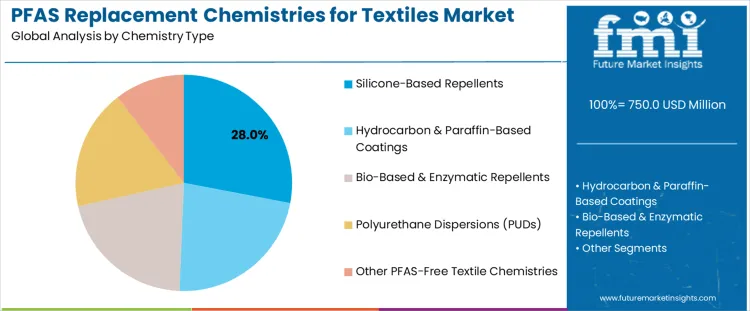
Silicone based repellents account for about 28% of demand because they provide consistent water repellency with low toxicity and strong durability across repeated wash cycles. Textile manufacturers favor silicone systems for their thermal stability and compatibility with common finishing equipment. Their performance is predictable across synthetic and blended fabrics, supporting adoption in regulated export markets. Hydrocarbon and paraffin coatings offer cost advantages but show lower durability. Bio based repellents attract interest but face consistency limits. Polyurethane dispersions serve niche uses. Leadership reflects scalability, process compatibility, and regulatory acceptance.
Hydrocarbon based coatings and paraffin systems remain relevant where cost sensitivity outweighs long term repellency. Bio based and enzymatic chemistries support sustainability goals but require controlled conditions. Polyurethane dispersions perform well on technical fabrics but lack universal applicability. Other PFAS free chemistries remain under evaluation. These alternatives expand choice but do not displace silicone systems, reinforcing leadership driven by balanced performance, established supply chains, and finishing line compatibility across global textile production environments today.
What Is Driving Leadership by Application in the PFAS Replacement Chemistries for Textiles Market?
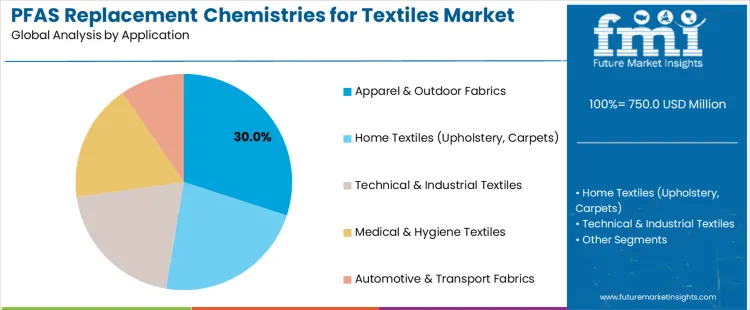
Apparel and outdoor fabrics represent about 30% of demand because water repellency is a core functional requirement in jackets, sportswear, and protective clothing. Brands prioritize PFAS free treatments to meet consumer and regulatory expectations while maintaining performance claims. High production volumes and frequent style turnover accelerate adoption of compliant chemistries. Silicone based repellents are widely specified in this segment due to durability and fabric hand preservation. This application anchors overall demand by combining scale, visibility, and compliance pressure.
Home textiles, technical fabrics, medical textiles, and automotive interiors represent secondary applications with distinct requirements. Upholstery and carpets emphasize stain resistance. Industrial textiles prioritize chemical and heat tolerance. Medical fabrics focus on safety and wash resistance. Automotive uses demand durability under wear. These segments adopt PFAS replacements selectively based on performance needs. Application leadership therefore reflects volume concentration and brand exposure rather than total fabric diversity across textile end markets worldwide today.
How Are PFAS Replacement Chemistries Being Applied Across Textile Manufacturing?
Use appears in apparel, home textiles, and industrial fabrics where water, oil, and stain repellency are required without per- and polyfluoroalkyl substances (PFAS). Manufacturers adopt alternative chemistries, including silicone-based, dendrimeric, or fluorine-free polymer coatings, to impart hydrophobic and oleophobic properties while meeting regulatory and sustainability targets. Performance fabrics, outdoor gear, upholstery, and protective clothing integrate these replacements to maintain durability and functionality. These applications reflect operational and regulatory priorities rather than aesthetic purposes, with adoption driven by compliance, performance retention, and environmental safety.
What Operational and Material Conditions Support Adoption of PFAS Replacement Chemistries?
Selection aligns with textile substrates such as polyester, nylon, and cotton that require uniform coating and long-term durability. Formulations are optimized for adhesion, wash resistance, and mechanical flexibility without compromising fabric hand, breathability, or color. Manufacturing processes integrate treatments into padding, spraying, or roll-coating systems compatible with existing finishing lines. Quality control ensures water and oil repellency meets industry standards while maintaining regulatory compliance. These conditions emerge from operational efficiency, fabric performance, and chemical safety priorities in structured textile workflows.
Which Practical Considerations Limit Wider Use of PFAS Replacement Chemistries?
Repellency performance may be lower than legacy PFAS treatments, requiring optimization for specific end uses. Cost per unit can be higher due to specialized chemistries and process adaptation. Compatibility with dyes, softeners, and finishing agents must be verified. Long-term durability under repeated washing or environmental exposure requires validation. Regulatory approval and eco-label certification vary by region. These factors lead to selective deployment where functional performance, regulatory compliance, and environmental safety justify incremental cost and process adjustments.
What is the Demand for PFAS Replacement Chemistries for Textiles by Country?
| Country | CAGR (%) |
|---|---|
| India | 10.6% |
| China | 10.3% |
| USA | 8.7% |
| Germany | 8.2% |
| South Korea | 7.9% |
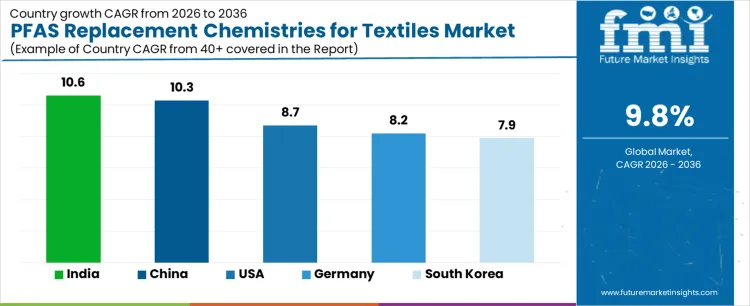
The demand for PFAS replacement chemistries for textiles varies across countries, driven by environmental regulations, textile industry adoption, and increasing consumer preference for sustainable products. India leads with a 10.6% CAGR, supported by rapid growth in textile manufacturing, rising awareness of PFAS hazards, and adoption of eco-friendly alternatives. China follows at 10.3%, driven by large scale textile production, regulatory compliance, and sustainable textile initiatives. The USA grows at 8.7%, reflecting adoption in apparel, industrial textiles, and home furnishings. Germany records 8.2%, shaped by stringent environmental standards and mature textile markets. South Korea posts 7.9%, supported by adoption of PFAS free chemistries in domestic textile production.
How Are PFAS Replacement Chemistries Transforming Textile Treatment in India?
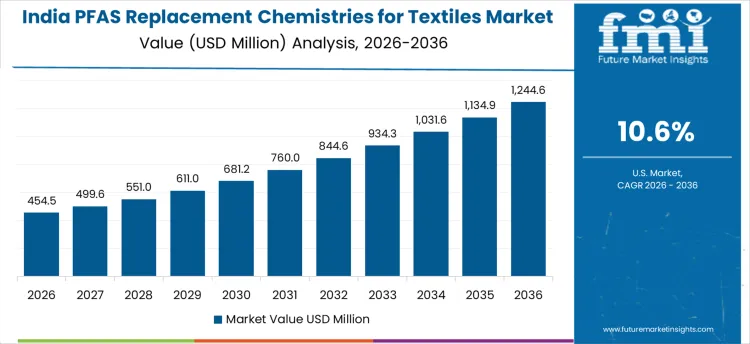
In India, the PFAS Replacement Chemistries for Textiles Market is expanding at a CAGR of 10.6% through 2036, driven by rising adoption of eco-friendly water- and stain-repellent chemistries across textile manufacturing and finishing units. Manufacturers are integrating PFAS alternatives to meet environmental regulations, reduce persistent chemical use, and improve product safety. Demand is concentrated in apparel production hubs, industrial textile finishing plants, and technical textile facilities. Domestic suppliers provide high-performance, regulatory-compliant replacement chemistries compatible with existing finishing processes. Increasing regulatory scrutiny, export quality requirements, and recurring textile treatment operations are sustaining robust adoption nationwide.
- Apparel hubs, industrial finishing plants, and technical textile facilities drive adoption
- PFAS alternatives reduce persistent chemical use and improve safety
- Domestic suppliers provide high-performance, regulatory-compliant solutions
- Recurring textile finishing operations sustain robust adoption
How Are Environmental Regulations Driving PFAS Replacement in China?
In China, revenue is growing at a CAGR of 10.3% through 2036, supported by strict environmental standards targeting PFAS usage in textile production. Manufacturers are deploying replacement chemistries to deliver water- and stain-repellent finishes while meeting emission and safety regulations. Demand is concentrated in industrial textile hubs, apparel manufacturing zones, and technical textile facilities. Domestic suppliers are scaling production of high-performance PFAS alternatives compatible with existing finishing equipment. Regulatory enforcement, growing export compliance requirements, and recurring textile finishing cycles are sustaining rapid adoption nationwide.
- Industrial textile hubs, apparel zones, and technical textile facilities drive adoption
- Replacement chemistries provide water- and stain-repellent performance
- Domestic suppliers scale high-performance, PFAS-free solutions
- Recurring textile finishing cycles sustain rapid adoption
How Are Sustainable Textile Practices Driving Growth in the United States?
In the United States, the market is expanding at a CAGR of 8.7% through 2036, driven by adoption of PFAS-free chemistries in apparel, home textiles, and technical fabrics. Manufacturers are integrating replacement chemistries to comply with environmental regulations, reduce persistent pollutants, and meet consumer sustainability demands. Demand is concentrated in textile finishing plants, apparel production facilities, and industrial fabric manufacturers. Domestic suppliers provide high-performance, regulatory-compliant PFAS alternatives compatible with conventional finishing equipment. Sustainability initiatives, regulatory oversight, and recurring textile finishing operations are sustaining predictable adoption nationwide.
- Textile finishing plants, apparel production facilities, and industrial fabric manufacturers drive adoption
- Replacement chemistries reduce persistent pollutants and enhance sustainability
- Domestic suppliers provide regulatory-compliant, high-performance solutions
- Recurring textile finishing operations sustain predictable adoption
How Are Environmental Compliance and Textile Standards Supporting Growth in Germany?
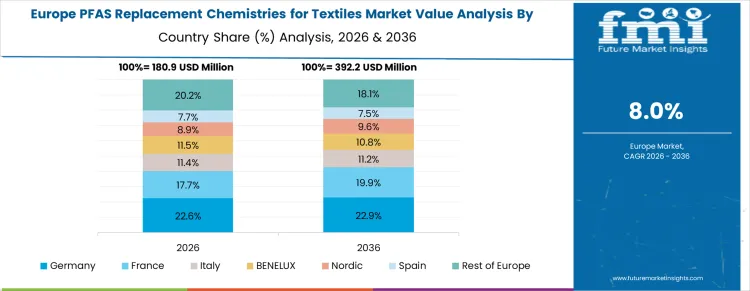
In Germany, revenue is growing at a CAGR of 8.2% through 2036, supported by strict EU regulations limiting PFAS usage in textile applications. Manufacturers are adopting PFAS replacement chemistries to maintain water- and stain-repellent performance while complying with environmental standards. Demand is concentrated in industrial finishing plants, apparel manufacturing units, and technical textile facilities. Domestic suppliers provide high-performance, eco-friendly chemistries compatible with existing finishing processes. Regulatory compliance, quality standards, and recurring textile treatment cycles are sustaining steady adoption nationwide.
- Industrial finishing plants, apparel units, and technical textile facilities drive adoption
- Replacement chemistries maintain water- and stain-repellent performance
- Domestic suppliers provide high-performance, eco-friendly solutions
- Recurring textile treatment cycles sustain steady adoption
How Are Industrial and Environmental Standards Driving PFAS Replacement in South Korea?
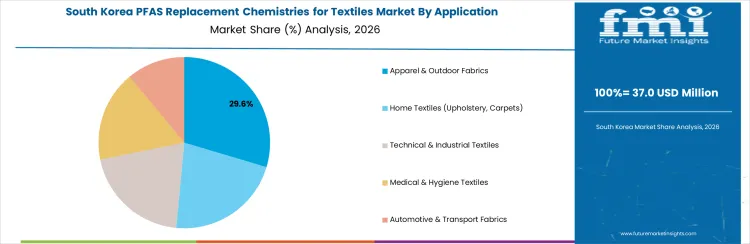
In South Korea, the market is expanding at a CAGR of 7.9% through 2036, driven by adoption of PFAS-free chemistries in textile finishing, industrial fabrics, and apparel production. Manufacturers are integrating replacement chemistries to reduce persistent pollutants, comply with environmental regulations, and meet consumer safety requirements. Demand is concentrated in industrial textile hubs, apparel finishing plants, and technical textile facilities. Domestic suppliers provide high-performance, treatment-compatible chemistries suitable for recurring finishing operations. Regulatory enforcement, sustainability initiatives, and consistent textile production are sustaining steady adoption nationwide.
- Industrial textile hubs, apparel finishing plants, and technical textile facilities drive adoption
- Replacement chemistries reduce persistent pollutants and enhance compliance
- Domestic suppliers provide high-performance, treatment-compatible solutions
- Recurring finishing operations sustain steady adoption
Which Strategic Approaches Are Companies Using to Compete in The PFAS Replacement Chemistries for Textiles Market?
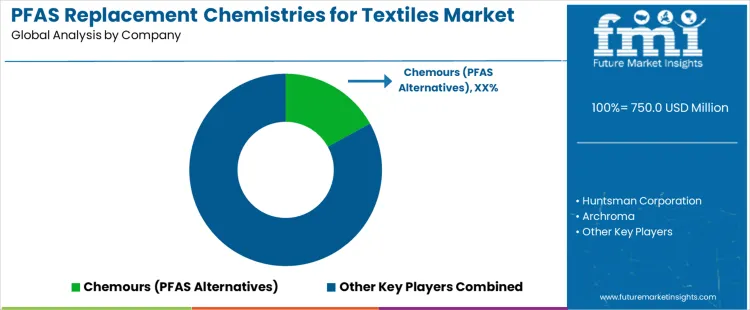
Competition in the PFAS Replacement Chemistries for Textiles Market is shaped by how suppliers balance repellency performance with regulatory durability and processing practicality. Chemours positions its PFAS alternative portfolio around drop in compatibility, allowing textile finishers to retain existing application equipment while shifting chemistry classes. Huntsman Corporation and Archroma pursue performance reconstruction strategies, reformulating water and oil repellency through polymer architecture, crosslinking behavior, and surface orientation rather than direct fluorine substitution. Dow Inc. competes through materials science depth, supplying silicone and acrylic based systems designed to deliver partial functionality with improved regulatory acceptance. Textile mills evaluate these approaches based on consistency after laundering, impact on fabric hand feel, and reproducibility across fiber types rather than initial repellency metrics.
A different competitive logic is visible among specialty finishing suppliers. Rudolf Group emphasizes system level reformulation, combining repellency, durability, and auxiliary finishes to compensate for performance gaps created by PFAS removal. This strategy relies on application know how and process tuning rather than standalone chemistry strength. Across the market, companies invest heavily in co-development with apparel brands and mills to align replacement chemistries with evolving restricted substance lists. Strategies prioritize compliance resilience, global regulatory alignment, and manufacturability at scale. Competitive advantage depends on how smoothly alternatives integrate into existing finishing lines and how predictably they perform across use cycles, not on matching legacy PFAS performance point for point.
Key Players in the PFAS Replacement Chemistries for Textiles Market
- Chemours (PFAS Alternatives)
- Huntsman Corporation
- Archroma
- Dow Inc.
- Rudolf Group
Scope of the Report
| Items | Values |
|---|---|
| Quantitative Units (2026) | USD million |
| Chemistry Type | Silicone-Based Repellents, Hydrocarbon & Paraffin-Based Coatings, Bio-Based & Enzymatic Repellents, Polyurethane Dispersions (PUDs), Other PFAS-Free Textile Chemistries |
| Application | Apparel & Outdoor Fabrics, Home Textiles (Upholstery, Carpets), Technical & Industrial Textiles, Medical & Hygiene Textiles, Automotive & Transport Fabrics |
| Functionality | Water Repellency, Oil & Stain Resistance, Anti-Soiling & Easy-Clean Coatings, Breathable Protective Finishes, Hybrid Performance Coatings |
| End-Use Industry | Textile Manufacturing, Apparel & Fashion, Industrial & Technical Fabrics, Medical & Hygiene, Automotive & Transport |
| Region | Asia Pacific, Europe, North America, Latin America, Middle East & Africa |
| Countries Covered | China, Japan, South Korea, India, Australia & New Zealand, ASEAN, Rest of Asia Pacific, Germany, United Kingdom, France, Italy, Spain, Nordic, BENELUX, Rest of Europe, USA, Canada, Mexico, Brazil, Chile, Rest of Latin America, Kingdom of Saudi Arabia, Other GCC Countries, Turkey, South Africa, Other African Union, Rest of Middle East & Africa |
| Key Companies Profiled | Chemours (PFAS Alternatives), Huntsman Corporation, Archroma, Dow Inc., Rudolf Group |
| Additional Attributes | Dollar by sales by chemistry type, Dollar by sales by application, Dollar by sales by functionality, Dollar by sales by region, Annual procurement cycles, Adoption intervals / breakpoints, Regulatory compliance (EU REACH, US EPA, local standards), Operational efficiency metrics, Integration with existing textile finishing lines, Lifecycle impact assessment, Performance under repeated washing, heat and abrasion, Compatibility with dyes and softeners, Domestic vs. international supplier distribution |
PFAS Replacement Chemistries for Textiles Market Segmentation
Chemistry Type:
- Silicone-Based Repellents
- Hydrocarbon & Paraffin-Based Coatings
- Bio-Based & Enzymatic Repellents
- Polyurethane Dispersions (PUDs)
- Other PFAS-Free Textile Chemistries
Application:
- Apparel & Outdoor Fabrics
- Home Textiles (Upholstery, Carpets)
- Technical & Industrial Textiles
- Medical & Hygiene Textiles
- Automotive & Transport Fabrics
Functionality:
- Water Repellency
- Oil & Stain Resistance
- Anti-Soiling & Easy-Clean Coatings
- Breathable Protective Finishes
- Hybrid Performance Coatings
Region
Asia Pacific
- China
- Japan
- South Korea
- India
- Australia & New Zealand
- ASEAN
- Rest of Asia Pacific
Europe
- Germany
- United Kingdom
- France
- Italy
- Spain
- Nordic
- BENELUX
- Rest of Europe
North America
- United States
- Canada
- Mexico
Latin America
- Brazil
- Chile
- Rest of Latin America
Middle East & Africa
- Kingdom of Saudi Arabia
- Other GCC Countries
- Turkey
- South Africa
- Other African Union
- Rest of Middle East & Africa
Frequently Asked Questions
How big is the pfas replacement chemistries for textiles market in 2026?
The global pfas replacement chemistries for textiles market is estimated to be valued at USD 750.0 million in 2026.
What will be the size of pfas replacement chemistries for textiles market in 2036?
The market size for the pfas replacement chemistries for textiles market is projected to reach USD 1,910.2 million by 2036.
How much will be the pfas replacement chemistries for textiles market growth between 2026 and 2036?
The pfas replacement chemistries for textiles market is expected to grow at a 9.8% CAGR between 2026 and 2036.
What are the key product types in the pfas replacement chemistries for textiles market?
The key product types in pfas replacement chemistries for textiles market are silicone-based repellents, hydrocarbon & paraffin-based coatings, bio-based & enzymatic repellents, polyurethane dispersions (puds) and other pfas-free textile chemistries.
Which application segment to contribute significant share in the pfas replacement chemistries for textiles market in 2026?
In terms of application, apparel & outdoor fabrics segment to command 30.0% share in the pfas replacement chemistries for textiles market in 2026.
Preview the report firsthand - request a free sample
Get SampleGet the brochure for pricing and purchase details.
Get PDFTable of Content
- Executive Summary
- Global Market Outlook
- Demand-side Trends
- Supply-side Trends
- Technology Roadmap Analysis
- Analysis and Recommendations
- Market Overview
- Market Coverage / Taxonomy
- Market Definition / Scope / Limitations
- Market Background
- Market Dynamics
- Drivers
- Restraints
- Opportunity
- Trends
- Scenario Forecast
- Demand in Optimistic Scenario
- Demand in Likely Scenario
- Demand in Conservative Scenario
- Opportunity Map Analysis
- Product Life Cycle Analysis
- Supply Chain Analysis
- Investment Feasibility Matrix
- Value Chain Analysis
- PESTLE and Porter’s Analysis
- Regulatory Landscape
- Regional Parent Market Outlook
- Production and Consumption Statistics
- Import and Export Statistics
- Market Dynamics
- Global Market Analysis 2021 to 2025 and Forecast, 2026 to 2036
- Historical Market Size Value (USD Million) Analysis, 2021 to 2025
- Current and Future Market Size Value (USD Million) Projections, 2026 to 2036
- Y-o-Y Growth Trend Analysis
- Absolute $ Opportunity Analysis
- Global Market Pricing Analysis 2021 to 2025 and Forecast 2026 to 2036
- Global Market Analysis 2021 to 2025 and Forecast 2026 to 2036, By Chemistry Type
- Introduction / Key Findings
- Historical Market Size Value (USD Million) Analysis By Chemistry Type , 2021 to 2025
- Current and Future Market Size Value (USD Million) Analysis and Forecast By Chemistry Type , 2026 to 2036
- Silicone-Based Repellents
- Hydrocarbon & Paraffin-Based Coatings
- Bio-Based & Enzymatic Repellents
- Polyurethane Dispersions (PUDs)
- Other PFAS-Free Textile Chemistries
- Silicone-Based Repellents
- Y-o-Y Growth Trend Analysis By Chemistry Type , 2021 to 2025
- Absolute $ Opportunity Analysis By Chemistry Type , 2026 to 2036
- Global Market Analysis 2021 to 2025 and Forecast 2026 to 2036, By Application
- Introduction / Key Findings
- Historical Market Size Value (USD Million) Analysis By Application, 2021 to 2025
- Current and Future Market Size Value (USD Million) Analysis and Forecast By Application, 2026 to 2036
- Apparel & Outdoor Fabrics
- Home Textiles (Upholstery, Carpets)
- Technical & Industrial Textiles
- Medical & Hygiene Textiles
- Automotive & Transport Fabrics
- Apparel & Outdoor Fabrics
- Y-o-Y Growth Trend Analysis By Application, 2021 to 2025
- Absolute $ Opportunity Analysis By Application, 2026 to 2036
- Global Market Analysis 2021 to 2025 and Forecast 2026 to 2036, By Functionality
- Introduction / Key Findings
- Historical Market Size Value (USD Million) Analysis By Functionality, 2021 to 2025
- Current and Future Market Size Value (USD Million) Analysis and Forecast By Functionality, 2026 to 2036
- Water Repellency
- Oil & Stain Resistance
- Anti-Soiling & Easy-Clean Coatings
- Breathable Protective Finishes
- Hybrid Performance Coatings
- Water Repellency
- Y-o-Y Growth Trend Analysis By Functionality, 2021 to 2025
- Absolute $ Opportunity Analysis By Functionality, 2026 to 2036
- Global Market Analysis 2021 to 2025 and Forecast 2026 to 2036, By Region
- Introduction
- Historical Market Size Value (USD Million) Analysis By Region, 2021 to 2025
- Current Market Size Value (USD Million) Analysis and Forecast By Region, 2026 to 2036
- North America
- Latin America
- Western Europe
- Eastern Europe
- East Asia
- South Asia and Pacific
- Middle East & Africa
- Market Attractiveness Analysis By Region
- North America Market Analysis 2021 to 2025 and Forecast 2026 to 2036, By Country
- Historical Market Size Value (USD Million) Trend Analysis By Market Taxonomy, 2021 to 2025
- Market Size Value (USD Million) Forecast By Market Taxonomy, 2026 to 2036
- By Country
- USA
- Canada
- Mexico
- By Chemistry Type
- By Application
- By Functionality
- By Country
- Market Attractiveness Analysis
- By Country
- By Chemistry Type
- By Application
- By Functionality
- Key Takeaways
- Latin America Market Analysis 2021 to 2025 and Forecast 2026 to 2036, By Country
- Historical Market Size Value (USD Million) Trend Analysis By Market Taxonomy, 2021 to 2025
- Market Size Value (USD Million) Forecast By Market Taxonomy, 2026 to 2036
- By Country
- Brazil
- Chile
- Rest of Latin America
- By Chemistry Type
- By Application
- By Functionality
- By Country
- Market Attractiveness Analysis
- By Country
- By Chemistry Type
- By Application
- By Functionality
- Key Takeaways
- Western Europe Market Analysis 2021 to 2025 and Forecast 2026 to 2036, By Country
- Historical Market Size Value (USD Million) Trend Analysis By Market Taxonomy, 2021 to 2025
- Market Size Value (USD Million) Forecast By Market Taxonomy, 2026 to 2036
- By Country
- Germany
- UK
- Italy
- Spain
- France
- Nordic
- BENELUX
- Rest of Western Europe
- By Chemistry Type
- By Application
- By Functionality
- By Country
- Market Attractiveness Analysis
- By Country
- By Chemistry Type
- By Application
- By Functionality
- Key Takeaways
- Eastern Europe Market Analysis 2021 to 2025 and Forecast 2026 to 2036, By Country
- Historical Market Size Value (USD Million) Trend Analysis By Market Taxonomy, 2021 to 2025
- Market Size Value (USD Million) Forecast By Market Taxonomy, 2026 to 2036
- By Country
- Russia
- Poland
- Hungary
- Balkan & Baltic
- Rest of Eastern Europe
- By Chemistry Type
- By Application
- By Functionality
- By Country
- Market Attractiveness Analysis
- By Country
- By Chemistry Type
- By Application
- By Functionality
- Key Takeaways
- East Asia Market Analysis 2021 to 2025 and Forecast 2026 to 2036, By Country
- Historical Market Size Value (USD Million) Trend Analysis By Market Taxonomy, 2021 to 2025
- Market Size Value (USD Million) Forecast By Market Taxonomy, 2026 to 2036
- By Country
- China
- Japan
- South Korea
- By Chemistry Type
- By Application
- By Functionality
- By Country
- Market Attractiveness Analysis
- By Country
- By Chemistry Type
- By Application
- By Functionality
- Key Takeaways
- South Asia and Pacific Market Analysis 2021 to 2025 and Forecast 2026 to 2036, By Country
- Historical Market Size Value (USD Million) Trend Analysis By Market Taxonomy, 2021 to 2025
- Market Size Value (USD Million) Forecast By Market Taxonomy, 2026 to 2036
- By Country
- India
- ASEAN
- Australia & New Zealand
- Rest of South Asia and Pacific
- By Chemistry Type
- By Application
- By Functionality
- By Country
- Market Attractiveness Analysis
- By Country
- By Chemistry Type
- By Application
- By Functionality
- Key Takeaways
- Middle East & Africa Market Analysis 2021 to 2025 and Forecast 2026 to 2036, By Country
- Historical Market Size Value (USD Million) Trend Analysis By Market Taxonomy, 2021 to 2025
- Market Size Value (USD Million) Forecast By Market Taxonomy, 2026 to 2036
- By Country
- Kingdom of Saudi Arabia
- Other GCC Countries
- Turkiye
- South Africa
- Other African Union
- Rest of Middle East & Africa
- By Chemistry Type
- By Application
- By Functionality
- By Country
- Market Attractiveness Analysis
- By Country
- By Chemistry Type
- By Application
- By Functionality
- Key Takeaways
- Key Countries Market Analysis
- USA
- Pricing Analysis
- Market Share Analysis, 2025
- By Chemistry Type
- By Application
- By Functionality
- Canada
- Pricing Analysis
- Market Share Analysis, 2025
- By Chemistry Type
- By Application
- By Functionality
- Mexico
- Pricing Analysis
- Market Share Analysis, 2025
- By Chemistry Type
- By Application
- By Functionality
- Brazil
- Pricing Analysis
- Market Share Analysis, 2025
- By Chemistry Type
- By Application
- By Functionality
- Chile
- Pricing Analysis
- Market Share Analysis, 2025
- By Chemistry Type
- By Application
- By Functionality
- Germany
- Pricing Analysis
- Market Share Analysis, 2025
- By Chemistry Type
- By Application
- By Functionality
- UK
- Pricing Analysis
- Market Share Analysis, 2025
- By Chemistry Type
- By Application
- By Functionality
- Italy
- Pricing Analysis
- Market Share Analysis, 2025
- By Chemistry Type
- By Application
- By Functionality
- Spain
- Pricing Analysis
- Market Share Analysis, 2025
- By Chemistry Type
- By Application
- By Functionality
- France
- Pricing Analysis
- Market Share Analysis, 2025
- By Chemistry Type
- By Application
- By Functionality
- India
- Pricing Analysis
- Market Share Analysis, 2025
- By Chemistry Type
- By Application
- By Functionality
- ASEAN
- Pricing Analysis
- Market Share Analysis, 2025
- By Chemistry Type
- By Application
- By Functionality
- Australia & New Zealand
- Pricing Analysis
- Market Share Analysis, 2025
- By Chemistry Type
- By Application
- By Functionality
- China
- Pricing Analysis
- Market Share Analysis, 2025
- By Chemistry Type
- By Application
- By Functionality
- Japan
- Pricing Analysis
- Market Share Analysis, 2025
- By Chemistry Type
- By Application
- By Functionality
- South Korea
- Pricing Analysis
- Market Share Analysis, 2025
- By Chemistry Type
- By Application
- By Functionality
- Russia
- Pricing Analysis
- Market Share Analysis, 2025
- By Chemistry Type
- By Application
- By Functionality
- Poland
- Pricing Analysis
- Market Share Analysis, 2025
- By Chemistry Type
- By Application
- By Functionality
- Hungary
- Pricing Analysis
- Market Share Analysis, 2025
- By Chemistry Type
- By Application
- By Functionality
- Kingdom of Saudi Arabia
- Pricing Analysis
- Market Share Analysis, 2025
- By Chemistry Type
- By Application
- By Functionality
- Turkiye
- Pricing Analysis
- Market Share Analysis, 2025
- By Chemistry Type
- By Application
- By Functionality
- South Africa
- Pricing Analysis
- Market Share Analysis, 2025
- By Chemistry Type
- By Application
- By Functionality
- USA
- Market Structure Analysis
- Competition Dashboard
- Competition Benchmarking
- Market Share Analysis of Top Players
- By Regional
- By Chemistry Type
- By Application
- By Functionality
- Competition Analysis
- Competition Deep Dive
- Chemours (PFAS Alternatives)
- Overview
- Product Portfolio
- Profitability by Market Segments (Product/Age /Sales Channel/Region)
- Sales Footprint
- Strategy Overview
- Marketing Strategy
- Product Strategy
- Channel Strategy
- Huntsman Corporation
- Archroma
- Dow Inc.
- Rudolf Group
- Chemours (PFAS Alternatives)
- Competition Deep Dive
- Assumptions & Acronyms Used
- Research Methodology


