

- Industry Size (2026)
- USD 3.0 Bn
- Forecast (2036)
- USD 8.0 Bn
- CAGR (2026 to 2036)
- 10.3%
PFAS Concentration and Destruction Systems Market Size, Market Forecast and Outlook By FMI
The PFAS concentration and destruction systems market was valued at USD 2.7 billion in 2025. Industry is poised to cross USD 3.0 billion in 2026 at a CAGR of 10.3% during the forecast period. Demand outlook carries the total opportunity to USD 8.0 billion through 2036 as legally enforceable federal drinking water limits force municipalities to transition from temporary containment strategies to permanent, on-site mineralization infrastructure.
The transition from legacy granular activated carbon storage to definitive mineralization forces municipal water utilities to embed next generation PFAS destruction reagents directly into their water treatment systems. Municipalities and defense facilities that delay this architectural pivot lose eligibility for critical federal infrastructure grants while risking severe citizen lawsuits. Practitioners recognize that concentrating forever chemicals from millions of gallons of water is only half the battle; the actual bottleneck is the secure elimination of the highly toxic concentrated brine, as traditional incineration faces localized bans. This forces city planners to reject temporary landfilling.
Modular supercritical water oxidation units must reach capital expenditure parity with long-term hazardous waste landfilling before adoption becomes completely self-sustaining. Industrial plant managers must execute on-site destruction procurement contracts before regional incineration bans take full effect, ultimately establishing decentralized, permanent mineralization across major manufacturing hubs.
Summary of PFAS Concentration and Destruction Systems Market
- PFAS Concentration and Destruction Systems Market Definition
- The market comprises specialized hardware that first isolates forever chemicals from high-volume fluid streams into concentrated brines, and subsequently applies extreme thermal, electrochemical, or plasma energy to permanently sever their carbon-fluorine bonds, eliminating environmental persistence.
- Demand Drivers in the Market
- EPA National Primary Drinking Water Regulation limits force municipal water utilities to deploy advanced concentration infrastructure to avoid severe federal compliance penalties.
- Department of Defense mandates to eliminate AFFF firefighting foam runoff compel military facility commanders to procure mobile foam fractionation and plasma destruction units.
- Supply chain ESG audits and zero-liquid discharge regulations drive semiconductor manufacturers to install point-of-source electrochemical oxidation systems to treat their produced water handling lines.
- Key Segments Analyzed in the FMI Report
- Separation & Concentration: 62.5% share in 2026, as high-volume bulk water must first be radically reduced before energy-intensive destruction technologies can be economically applied.
- Wastewater Treatment: 45.0% share in 2026, due to the massive volumes of industrially contaminated effluent requiring immediate isolation before environmental discharge.
- Municipal: 42.0% share in 2026, driven directly by the threat of massive federal penalties and citizen lawsuits.
- USA: 12.5% compound growth, propelled by the Bipartisan Infrastructure Law earmarking billions specifically for emerging contaminant remediation.
- Analyst Opinion at FMI
- Nikhil Kaitwade, Principal Consultant for Industrial Automation, opines, "In my analysis, I have observed that the true bottleneck in PFAS remediation is not capturing the compounds from bulk water, but the secure destruction of the resulting toxic concentrate. Facility operators who continue relying on off-site incineration will face escalating liabilities as local bans on incomplete combustion proliferate. Water network directors who fail to address definitive on-site mineralization will face severe federal penalties and uninsurable civic liabilities."
- Strategic Implications / Executive Takeaways
- Technology vendors must scale destruction module throughput to match municipal continuous-flow requirements before the impending EPA enforcement deadlines.
- Capital project directors should phase out external hauling contracts and mandate on-site mineralization capabilities to eliminate chain-of-custody liability.
- System integrators must develop combined concentration-and-destruction skids utilizing packaged treatment skids to capture decentralized industrial manufacturing contracts.
- Methodology
- Primary Research: FMI conducted detailed technical interviews with principal process engineers, utility network directors, and environmental compliance officers across 40 countries to validate technology deployment timelines.
- Desk Research: Analysts aggregated public standards documentation from global environmental protection ministries, corporate sustainability disclosures, and infrastructure grant allocations.
- Market-Sizing and Forecasting: The model applies a bottom-up methodology starting with global installed base metrics for water treatment nodes and projecting the conversion rate to definitive mineralization standards.
- Data Validation and Update Cycle: Segment forecasts undergo cross-validation against quarterly financial disclosures from leading pure-play water technology conglomerates.
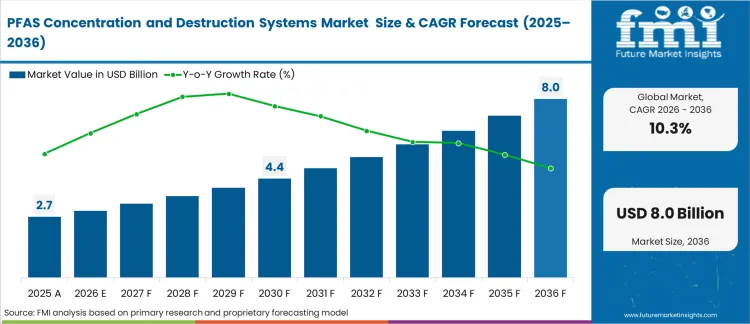
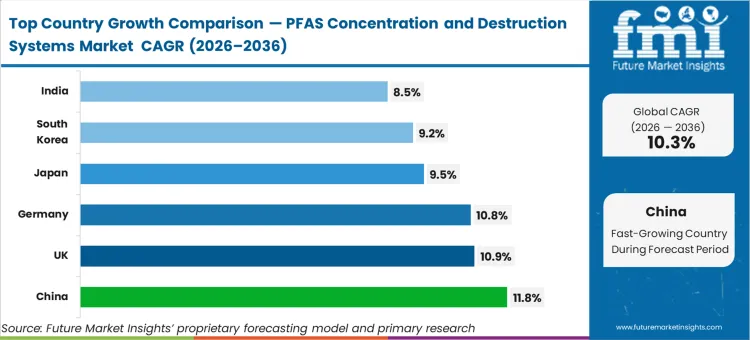
The United States advances at a 12.5% CAGR, driven by the massive capital injection for remediation under the Bipartisan Infrastructure Law and strict EPA limits. China expands at an 11.8% rate as stringent zero-liquid discharge mandates force chemical manufacturers to deploy closed-loop concentration networks. The UK records a 10.9% trajectory, followed closely by Germany growing at 10.8% under the looming EU REACH restriction proposals. Japan tracks at 9.5%, while South Korea reaches 9.2% through semiconductor fab wastewater upgrades. India posts an 8.5% annual expansion. This variance exists because nations with established legal liability frameworks for historical contamination drive immediate hardware procurement over simple monitoring.
PFAS Concentration and Destruction Systems Market Key Takeaways
| Metric | Details |
|---|---|
| Industry Size (2026) | USD 3.0 billion |
| Industry Value (2036) | USD 8.0 billion |
| CAGR (2026-2036) | 10.3% |
Source: Future Market Insights (FMI) analysis, based on proprietary forecasting model and primary research
PFAS Concentration and Destruction Systems Market Definition
The PFAS concentration and destruction systems market encompasses the integrated hardware and specialized processes designed to extract per- and polyfluoroalkyl substances from bulk fluids and subsequently break their carbon-fluorine bonds. This infrastructure shifts remediation from simply capturing and storing forever chemicals to permanently mineralizing them into harmless byproducts like water, fluoride salts, and carbon dioxide.
PFAS Concentration and Destruction Systems Market Inclusions
The market scope includes high-pressure reverse osmosis modules, foam fractionation units, and ion exchange resin vessels used for primary concentration alongside PFAS filtration and treatment media. It fully incorporates supercritical oxidation methods reactors, electrochemical oxidation cells, and non-thermal plasma destruction modules. Specialized brine management hardware and localized sensor arrays monitoring the mineralization process fall within the defined boundaries.
PFAS Concentration and Destruction Systems Market Exclusions
Basic municipal sand filtration setups and standard wastewater screening equipment lacking specific PFAS targeting are excluded. Purely analytical laboratory testing services, environmental testing services, and standalone consulting without hardware provision fall outside the parameters. Traditional off-site hazardous waste incineration services, simple landfill containment liners, and basic ultrapure water supply operations are explicitly omitted from this valuation.
PFAS Concentration and Destruction Systems Market Research Methodology
- Primary Research: Analysts engaged with municipal water treatment directors, industrial zero-liquid discharge engineers, and defense facility remediation commanders to map the exact compliance triggers forcing infrastructure upgrades.
- Desk Research: The data collection phase aggregated compliance roadmaps from the EPA's National Primary Drinking Water Regulation, EU REACH restriction filings, and DOD remediation budgets.
- Market-Sizing and Forecasting: The baseline value derives from a bottom-up aggregation of commercialized destruction module shipments and large-scale ion exchange vessel contracts, applying specific regional regulatory timelines to project future adoption velocity.
- Data Validation and Update Cycle: Projections are rigorously tested against publicly reported capital expenditure guidance from leading public water utilities and specialized environmental remediation contractors.
Segmental Analysis
PFAS Concentration and Destruction Systems Market Analysis by Technology
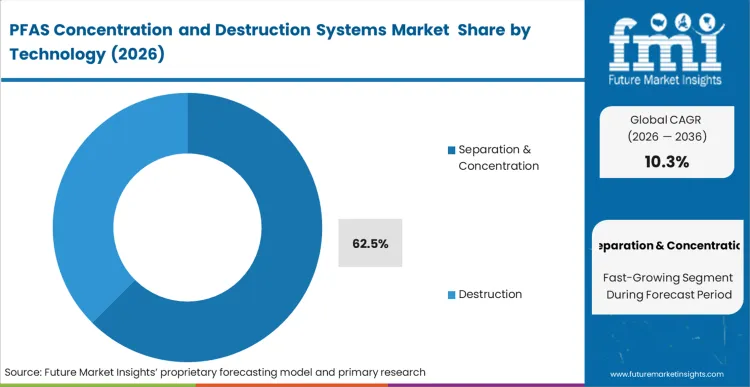
Legacy pump-and-store approaches are rapidly failing under new regulatory scrutiny, forcing a complete overhaul of how forever chemicals are handled. Separation & Concentration holds a dominant 62.5% share in 2026 because reducing millions of gallons of contaminated water down to a few gallons of toxic brine is the absolute physical prerequisite for economical destruction. Municipal utility directors who attempt to apply high-energy destruction directly to bulk flow face prohibitive electricity costs. Based on FMI's assessment, isolating the compounds using robust reverse osmosis or foam fractionation alongside advanced oxidation chemicals for emerging contaminants drastically lowers the operational expenditure of the final mineralization process. Plant managers failing to optimize this primary concentration step using targeted ion exchange resins will quickly burn through their capital remediation budgets.
- Physical prerequisite: High-volume membrane filtration isolates contaminants into manageable volumes, preventing extreme energy expenditure during the final mineralization phase. This saves municipal utility directors millions in annual operating costs.
- Energy optimization: Foam fractionation targets the surfactant properties of the chemicals, stripping them from bulk water without relying on high-pressure fluid handling pumps. This enables process engineers to deploy low-power extraction at remote remediation sites.
- Brine management: Highly selective ion exchange systems capture short-chain variants that slip past standard filters. This ensures environmental compliance officers meet the stringent parts-per-trillion limits mandated by federal regulators.
PFAS Concentration and Destruction Systems Market Analysis by Application
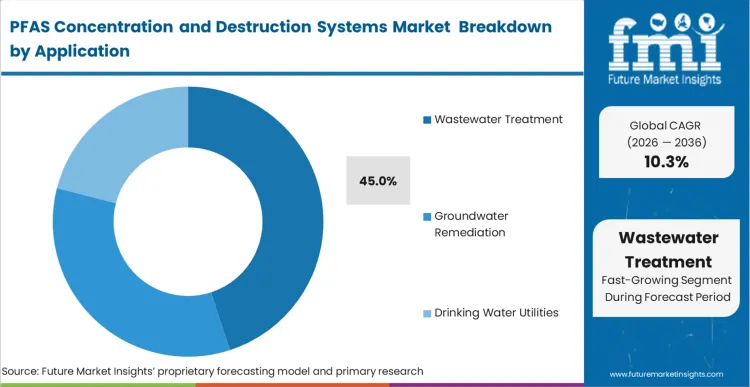
The sheer volume of contaminated industrial discharge specifically exists to solve the problem of localized environmental poisoning before it enters the broader water table. Wastewater Treatment commands a 45.0% share in 2026, as industrial facility operators must isolate forever chemicals before discharging effluent into public sewers. Strict zero-liquid discharge regulations create a compliance threshold that forces the deployment of robust on-site capture systems alongside in situ chemical oxidation agents. In FMI's view, integrating destruction modules directly at the effluent source prevents the costly logistical nightmare of hauling hazardous waste across state lines. Industrial plant managers who bypass this integration risk catastrophic production halts when municipal authorities revoke their discharge permits.
- Discharge compliance: Integrating concentration skids at the end of the manufacturing line ensures that effluent meets zero-liquid discharge criteria. This protects industrial plant managers from sudden municipal permit revocations.
- Logistical simplification: On-site supercritical water oxidation eliminates the need for external hazardous waste hauling. This completely removes chain-of-custody liability for corporate sustainability directors.
- Toxicity reduction: Breaking the carbon-fluorine bond before the wastewater leaves the facility prevents the accumulation of toxic precursors in the surrounding soil. This shields facility owners from future retroactive litigation.
PFAS Concentration and Destruction Systems Market Analysis by End-use Industry
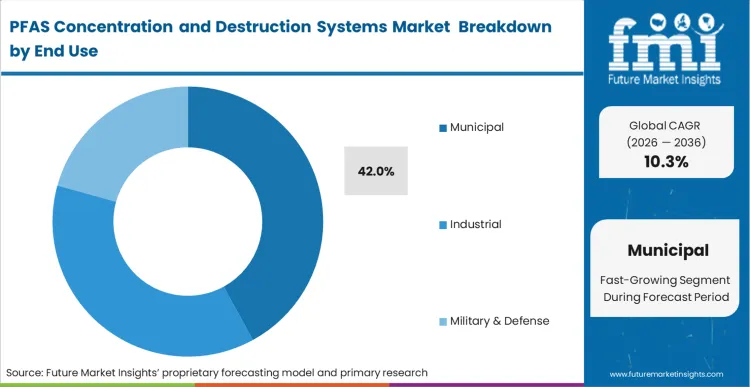
The EPA's legally enforceable Maximum Contaminant Levels establish a rigid compliance gate that municipal water utilities simply cannot ignore. Municipal end-use captures a 42.0% share in 2026, driven directly by the threat of massive federal penalties and citizen lawsuits. City planners and utility network directors are forced to overhaul entire municipal drinking water architectures to ensure absolute public safety, frequently integrating rigorous PFAS detection devices into their upgrades. According to FMI's estimates, securing Federal infrastructure grants specifically requires adopting definitive water purification technologies rather than temporary band-aids. Utility directors who delay upgrading their central treatment plants face immediate disqualification from critical multi-million-dollar federal remediation funding pools.
- Grant qualification: Deploying certified destruction technologies secures access to dedicated federal infrastructure funding. This allows city planners to execute massive overhauls without bankrupting local municipal budgets.
- Public safety: Advanced membrane filtration combined with electrochemical oxidation guarantees parts-per-trillion purity in drinking water. This provides utility network directors with absolute defense against public health litigation.
- Infrastructure modernization: Replacing aging sand filters with targeted ion exchange vessels upgrades the overall resilience of the civic water grid. This enables civil engineers to future-proof facilities against even stricter upcoming regulatory limits.
PFAS Concentration and Destruction Systems Market Drivers, Restraints, and Opportunities
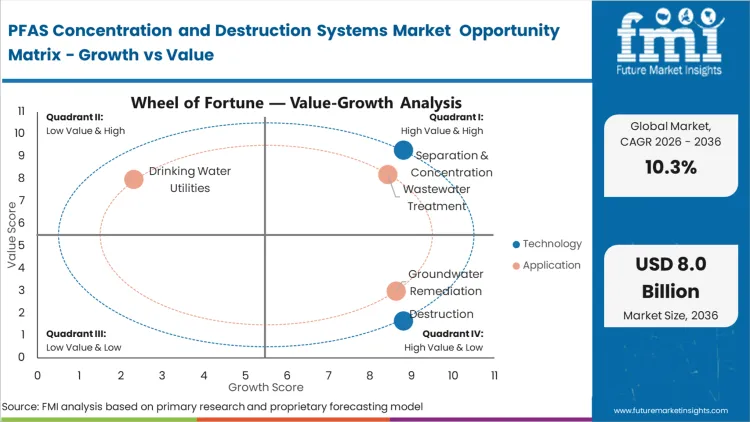
The EPA's National Primary Drinking Water Regulation sets an unprecedentedly strict 4 parts-per-trillion limit, forcing municipal utility directors to aggressively procure advanced concentration and destruction hardware alongside high-grade water and wastewater treatment chemicals. This regulatory threshold renders legacy dilution and basic filtration obsolete. Utilities upgrading their facilities face a strict mandate to deploy permanent mineralization systems to qualify for federal infrastructure funding. Transitioning to closed-loop electrochemical or supercritical oxidation eliminates the compounding liability of storing toxic brine indefinitely and bypassing traditional hazardous waste services. Municipalities that fail to modernize their core treatment layers risk losing their operating permits and facing debilitating citizen lawsuits.
The extreme energy requirements and specialized metallurgy needed to withstand supercritical water oxidation create severe operational friction for early adopters. The highly corrosive nature of the destruction process rapidly degrades standard reactor vessels, necessitating frequent and expensive maintenance. While operators are exploring modular low-temperature plasma and bio-based fluorochemical alternatives, these emerging technologies currently lack the high-throughput capacity required for massive municipal applications. This limitation forces smaller facilities to continue relying on temporary storage until durable, high-capacity destruction modules become economically viable.
Opportunities in the PFAS Concentration and Destruction Systems Market
- Mobile Defense Remediation: Miniaturized plasma destruction units allow military contractors to treat contaminated groundwater directly at remote bases. This allows defense facility commanders to neutralize historical contamination sites using localized United States water treatment system architectures without transporting hazardous liquids off-base.
- Semiconductor Point-of-Source: Utilizing high-precision electrochemical detection cells and oxidation modules designed for low-volume, high-concentration streams allows fab operators to treat etching wastewater inline. This enables semiconductor plant managers to deploy PFAS-free EV battery fire protection coatings logic while maintaining uninterrupted production.
- Landfill Leachate Integration: Upgraded foam fractionation skids permit waste management companies to extract forever chemicals from highly complex landfill runoff, often employing advanced PFAS-free slip leveling coating additives for efficient processing. This prevents site operators from contaminating local municipal water treatment plants when they discharge their treated leachate.
Regional Analysis
Based on the regional analysis, the PFAS Concentration and Destruction Systems market is segmented into North America, Latin America, Europe, East Asia, South Asia, Oceania and Middle East & Africa across 40 plus countries.
.webp "Top Country Growth Comparison Pfas Concentration And Destruction Systems Market Cagr (2026 2036)")
| Country | CAGR (2026 to 2036) |
|---|---|
| USA | 12.5% |
| China | 11.8% |
| UK | 10.9% |
| Germany | 10.8% |
| Japan | 9.5% |
| South Korea | 9.2% |
| India | 8.5% |
Source: Future Market Insights (FMI) analysis, based on proprietary forecasting model and primary research
North America PFAS Concentration and Destruction Systems Market Analysis
The Bipartisan Infrastructure Law injects unprecedented dedicated capital specifically for emerging contaminant remediation, completely altering the region's procurement dynamics following decades of unmitigated firefighting foam usage. This massive federal funding vehicle eliminates the primary economic barrier that previously stalled large-scale municipal upgrades. As per FMI's projection, this aggressive capital deployment strategy directly fuels the demand for high-performance separation and destruction hardware across the continent, deeply integrating them into smart water networks. By building native mineralization capabilities into the foundation of civic water grids, regional utility directors establish highly resilient public health infrastructure. This clean-slate modernization approach entirely bypasses the localized incineration bans that plague older hazardous waste management frameworks.
- USA: The United States Environmental Protection Agency enforces strict Maximum Contaminant Levels that trigger immediate, legally binding compliance upgrades across thousands of municipal water districts. This massive regulatory shock forces utility network directors to abandon temporary landfilling and secure permanent destruction technologies. The resulting wave of federal infrastructure grants ensures widespread municipal solvency during this transition. Advancing at a 12.5% compound rate between 2026 and 2036, this market commands the highest global investment priority. Capital project directors who fail to secure certified hardware face severe federal penalties and complete disqualification from government funding pools.
FMI's report includes comprehensive evaluation of the North American environmental remediation sector, covering Canada and Mexico. The integration of cross-border manufacturing supply chains requires standardized wastewater treatment protocols to prevent downstream contamination across international watersheds, particularly for facilities adopting PFAS-free release inks for flexible packaging.
Asia Pacific PFAS Concentration and Destruction Systems Market Analysis
Stringent zero-liquid discharge regulations targeting the massive industrial manufacturing base form the critical prerequisite for deploying advanced chemical destruction applications alongside modern PFAS-free firefighting foams. Regional environmental ministries actively penalize the continued operation of highly polluting chemical and semiconductor fabrication facilities. This intense regulatory pressure forces industrial plant managers to integrate continuous extraction and oxidation modules directly into their production lines, often supplementing industrial cooling loops. FMI analysts opine that this aggressive push for industrial self-sufficiency accelerates the bypass of legacy containment constraints. The integration of robust on-site destruction architecture establishes highly flexible production environments capable of meeting global export ESG standards.
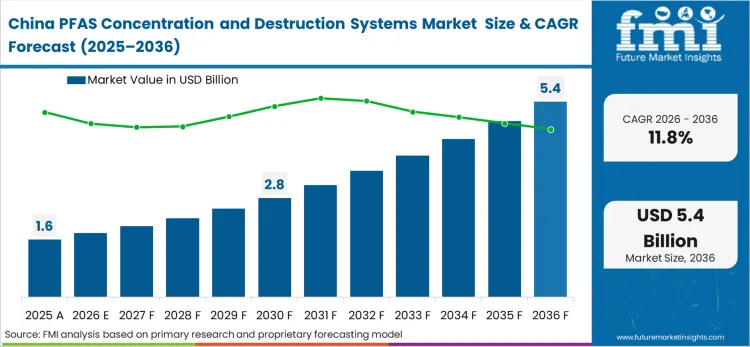
- China: China's sprawling chemical manufacturing sector operates under aggressive national zero-liquid discharge mandates requiring complete containment of toxic industrial effluent. Industrial plant managers must deploy high-throughput concentration systems to capture fluorinated compounds before they enter the regional water table. The sheer volume of manufacturing output establishes a massive installed base of point-of-source electrochemical oxidation units. Expanding at 11.8% between 2026 and 2036, this aggressive modernization strategy prioritizes industrial continuity. Plant operators who fail to implement verified closed-loop destruction face immediate production shutdowns from provincial environmental authorities.
- Japan: Japan's advanced semiconductor fabrication complex operates under extreme purity and environmental discharge tolerances that exceed standard industrial specifications. Facility engineers mandate zero-emission architectures to ensure highly toxic etching byproducts are neutralized completely on-site. The concentration of advanced memory and logic foundries necessitates continuous investment in ultra-efficient non-thermal plasma destruction modules. Tracking 9.5% annual growth to 2036, this zero-tolerance standard becomes the universal procurement baseline. System integrators failing to prove absolute compound mineralization lose access to the next generation of fab expansion contracts.
- South Korea: Strict national chemical management laws in South Korea compel heavy industrial and electronics manufacturers to systematically overhaul their industrial wastewater processes. Procurement specification leads face strict directives to unify disparate remediation processes under a single, highly efficient destruction backbone. The success of these modernization initiatives depends entirely on the availability of compact, high-performance supercritical water reactors. Sustaining a 9.2% CAGR to 2036, this sector rapidly scales up its environmental defenses. Hardware vendors lacking documented compliance with these strict discharge standards face immediate exclusion from major industrial park tenders.
- India: India's pharmaceutical export sector operates under increasingly stringent international supply chain audits requiring immutable proof of sustainable waste management. Process engineers must deploy localized foam fractionation and destruction skids to guarantee that no fluorinated precursors contaminate municipal sewers. The national push toward active pharmaceutical ingredient self-sufficiency triggers a wave of facility upgrades prioritizing verifiable mineralization. Projected at 8.5% compound growth over the forecast period, the demand for cost-effective destruction modules steadily rises. Suppliers failing to provide hardware with built-in remote monitoring mechanisms face disqualification from major life sciences facility tenders.
FMI's report includes detailed analysis of Taiwan, Australia, and the broader ASEAN manufacturing corridor. A defining dynamic in these nations involves the rapid localization of electronic component assembly, forcing contract manufacturers to deploy unified waste architectures to satisfy global brand traceability requirements across segments like PFAS-free easy open can coatings.
Europe PFAS Concentration and Destruction Systems Market Analysis
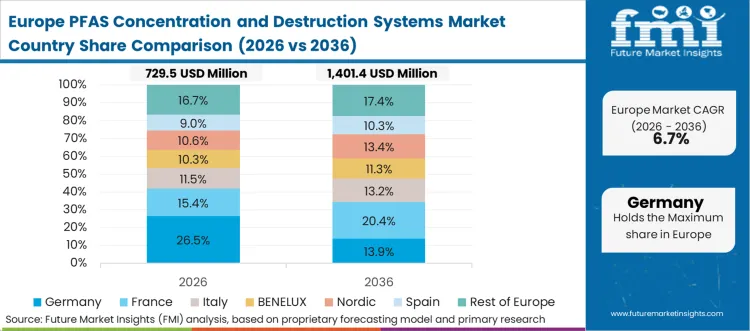
The European Union's sweeping REACH restriction proposals aim to systematically eradicate over 10,000 specific fluorinated compounds from the continental economy, impacting everything from electronics to PFAS-free powder coatings. This continent-wide legislative threat forces automation architects redesigning legacy production lines to integrate continuous chemical extraction alongside standard effluent treatment. The transition requires a complete overhaul of existing waste topologies, shifting from passive containment to active, energy-intensive mineralization governed by constant water quality monitoring. In FMI's view, upgrading the core remediation infrastructure provides the necessary capability to support advanced sustainable manufacturing practices. Facility directors recognize that maintaining outdated disposal contracts severely limits their ability to compete in this highly regulated environment.
- UK: The United Kingdom's environmental agency enforces rigorous point-source pollution controls that penalize water utility operators for discharging contaminated biosolids into agricultural lands. Utility network planners deploying advanced sludge treatment systems mandate architectures capable of completely destroying forever chemicals before land application. The shift toward absolute liability forces grid operators to abandon legacy soil-spreading in favor of resilient electrochemical oxidation. Anchored to a 10.9% annual expansion through the decade, the utility sector systematically upgrades its operational backbones. Systems integrators unable to demonstrate definitive carbon-fluorine bond cleavage forfeit qualification for national water infrastructure projects.
- Germany: Germany's powerful chemical and automotive manufacturing sectors operate under rigorous functional safety and environmental certifications that mandate absolute lifecycle containment. Control systems engineers must demonstrate flawless execution of closed-loop destruction before receiving authorization to connect new production cells to the main factory discharge line. The systemic qualification pressure accelerates the replacement of outdated activated carbon filters with advanced plasma reactors. This continuous qualification constraint sustains a 10.8% compound rate across the forecast decade. Network infrastructure providers targeting domestic plant retooling projects must guarantee verifiable mineralization prior to the finalization of capital procurement budgets.
FMI's report includes thorough investigation of the European environmental compliance framework, encompassing France, Italy, and the Nordics. A prevailing structural condition across these nations is the mandatory adherence to strict extended producer responsibility directives, forcing asset owners to specify complete destruction networks across applications including PFAS-free barrier coatings for food paper.
Competitive Aligners for Market Players
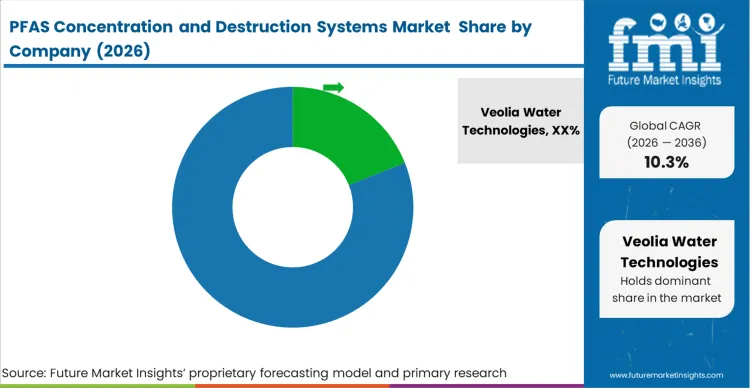
The PFAS concentration and destruction market exhibits a moderately consolidated structure at the top tier, heavily reliant on complex engineering patents and specialized metallurgical expertise. This structure exists because breaking the carbon-fluorine bond requires extreme environments, like supercritical water at 374°C and 221 bar, which demand immense capital intensity and rigorous safety certifications. Industry leaders such as Veolia Water Technologies, 374Water, SUEZ, and Aquagga Inc. have aligned their portfolios to offer end-to-end solutions, integrating primary membrane concentration alongside fluorine-free barrier coatings logic with final on-site destruction. Procurement teams now evaluate vendors primarily on their ability to deliver verifiable, completely closed-loop mineralization without generating secondary hazardous waste streams.
Vendors embedding modular destruction capabilities directly into scalable shipping containers gain a significant architectural advantage over those relying on massive, fixed-plant installations. Companies like Revive Environmental and Ovivo Inc. specifically build high-efficiency foam fractionation and electrochemical oxidation units that replace traditional activated carbon media and can be rapidly deployed to decentralized sites addressing PFAS-free aqueous food packaging coatings compliance. This mobility allows them to bypass the multi-year permitting delays associated with constructing permanent centralized treatment facilities. To displace these agile incumbents, a challenger must specifically engineer destruction reactors that consume significantly less electrical power while processing highly variable brine concentrations.
Large municipal utility buyers actively prevent vendor lock-in by mandating open-architecture concentration systems that can interface with multiple third-party destruction modules, often coordinating with complex industrial systems adopting PFAS replacement chemistries for textiles. This structural tension pits utilities, who want interchangeable commoditized hardware, against dominant vendors seeking to lock clients into proprietary end-to-end service contracts. Consequently, even in this highly specialized market, pricing power remains constrained as municipalities utilize competitive bidding processes anchored by federal grant requirements. By 2036, the competitive trajectory points toward the rapid commoditization of the primary concentration phase, while hyper-competition concentrates entirely on the energy efficiency and durability of the final destruction reactors.
Key Players in PFAS Concentration and Destruction Systems Market
- Veolia Water Technologies
- 374Water
- Aquagga Inc.
- Ovivo Inc.
- SUEZ Water Technologies & Solutions
- Battelle Memorial Institute
- Gradiant Corporation
- Revive Environmental
- 3M Company
- Calgon Carbon Corporation
- CycloPure, Inc.
- Evoqua Water Technologies LLC
Scope of the Report
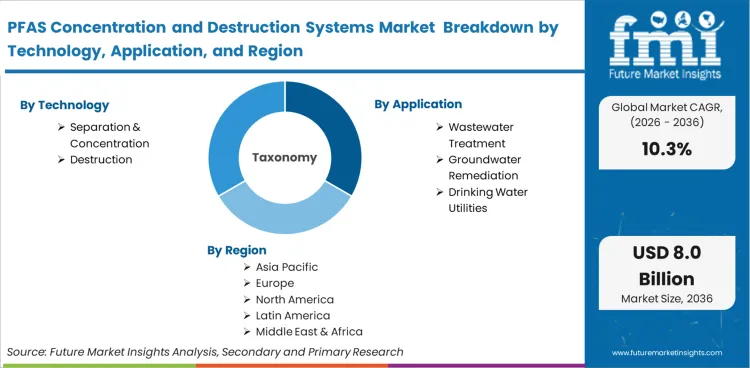
| Metric | Value |
|---|---|
| Quantitative Units | USD 3.0 billion to USD 8.0 billion, at a CAGR of 10.3% |
| Market Definition | The market comprises specialized hardware that first isolates forever chemicals from high-volume fluid streams into concentrated brines, and subsequently applies extreme thermal, electrochemical, or plasma energy to permanently sever their carbon-fluorine bonds. |
| Technology Segmentation | Separation & Concentration, Destruction |
| Application Segmentation | Groundwater Remediation, Wastewater Treatment, Drinking Water Utilities |
| End-use Industry Segmentation | Municipal, Industrial, Military & Defense |
| Regions Covered | North America, Latin America, Europe, East Asia, South Asia, Oceania, Middle East & Africa |
| Countries Covered | USA, China, UK, Germany, Japan, South Korea, India, and 40 plus countries |
| Key Companies Profiled | Veolia Water Technologies, 374Water, Aquagga Inc., Ovivo Inc., SUEZ Water Technologies & Solutions, Battelle Memorial Institute, Gradiant Corporation, Revive Environmental, Evoqua Water Technologies LLC |
| Forecast Period | 2026 to 2036 |
| Approach | The baseline value derives from a bottom-up aggregation of commercialized destruction module shipments and large-scale ion exchange vessel contracts, applying specific regional regulatory timelines to project future adoption velocity. Projections are rigorously tested against publicly reported capital expenditure guidance. |
Source: Future Market Insights (FMI) analysis, based on proprietary forecasting model and primary research
Per- and polyfluoroalkyl substances (PFAS) Concentration and Destruction Systems Market Analysis by Segments
Technology:
- Separation & Concentration
- Destruction
Application:
- Groundwater Remediation
- Wastewater Treatment
- Drinking Water Utilities
End-use Industry:
- Municipal
- Industrial
- Military & Defense
Region:
- North America
- United States
- Canada
- Mexico
- Latin America
- Brazil
- Argentina
- Chile
- Rest of Latin America
- Europe
- Germany
- Italy
- France
- United Kingdom
- Spain
- Benelux
- Nordics
- Central & Eastern Europe
- Rest of Europe
- Asia Pacific
- India
- China
- Japan
- South Korea
- Indonesia
- Australia & New Zealand
- ASEAN
- Rest of Asia Pacific
- Middle East & Africa
- Kingdom of Saudi Arabia
- United Arab Emirates
- South Africa
- Turkey
- Rest of Middle East & Africa
Bibliography
- European Chemicals Agency (ECHA). (2024, January 15). Proposal for a restriction on per- and polyfluoroalkyl substances (PFAS). ECHA.europa.eu.
- Department of Defense (DOD). (2024, March 12). Per- and Polyfluoroalkyl Substances (PFAS) Task Force Progress Report. Defense.gov
- Battelle Memorial Institute. (2024, November 05). PFAS Annihilator: Supercritical Water Oxidation Performance Metrics. Battelle.org.
- American Water Works Association (AWWA). (2024, May 22). Adapting Water Treatment Infrastructure for PFAS Compliance. AWWA.org.
- Semiconductor Industry Association (SIA). (2025, February 10). Phasing Out PFAS in Semiconductor Manufacturing Processes. Semiconductors.org.
- Water Environment Federation (WEF). (2025, January 18). Biosolids and PFAS: Management Strategies and Destruction Technologies. WEF.org.
This bibliography is provided for reader reference. The full FMI report contains the complete reference list with primary research documentation.
This Report Addresses
- Market intelligence to support strategic decision making across high-pressure reverse osmosis membranes, supercritical water oxidation reactors, and mobile foam fractionation units unique to this market
- Market size estimation and 10-year revenue forecasts from 2026 to 2036, supported by EPA compliance roadmap tracking, DOD remediation budgets, and utility infrastructure grant allocations
- Growth opportunity mapping across Technology and Application categories with emphasis on the specific necessity for modular destruction units to reach capital expenditure parity with long-term hazardous waste landfilling
- Segment and regional revenue forecasts covering Separation & Concentration and Wastewater Treatment sub-segments across heavily regulated municipal and semiconductor fabrication environments
- Competition strategy assessment including patent barriers, specialized metallurgical expertise, open-architecture mandates, and decentralized modular deployment capabilities
- Technology development tracking including supercritical water oxidation, electrochemical cells, non-thermal plasma destruction, and ISO 21675 monitoring standards discussed in this article
- Market access analysis covering Bipartisan Infrastructure Law funding pools, DOD procurement pathways, and industrial zero-liquid discharge compliance frameworks
- Market report delivery in PDF, Excel, PPT, and interactive dashboard formats for executive strategy, municipal capital project planning, and operational benchmarking use
Frequently Asked Questions
How large is the PFAS concentration and destruction systems market in 2026?
The market is estimated to be valued at USD 3.0 billion in 2026, driven directly by the immediate necessity for municipal water utilities to comply with strict new EPA limits.
What will it be valued at by 2036?
Market size is projected to reach USD 8.0 billion by 2036 as legally enforceable federal drinking water limits force municipalities to transition from temporary containment to permanent on-site mineralization.
What CAGR is projected?
The market is expected to grow at a CAGR of 10.3%, structurally supported by massive government infrastructure funding earmarked specifically for emerging contaminant remediation.
Which Technology segment leads?
Separation & concentration captures a 62.5% share in 2026 because reducing millions of gallons of contaminated water down to a few gallons of toxic brine is the absolute physical prerequisite for economical destruction.
Which Application segment leads?
Wastewater treatment commands a 45.0% share as strict zero-liquid discharge regulations force the deployment of robust on-site capture systems before effluent enters public sewers.
Which End-use Industry segment leads?
The municipal sector accounts for a 42.0% share, compelled by the threat of massive federal penalties and citizen lawsuits to overhaul entire public drinking water architectures.
What drives rapid growth?
The EPA's National Primary Drinking Water Regulation sets an unprecedentedly strict 4 parts-per-trillion limit, forcing municipal utility directors to aggressively procure advanced concentration and destruction hardware to replace obsolete legacy filtration.
What is the primary restraint?
The extreme energy requirements and highly corrosive nature of supercritical water oxidation necessitate frequent and expensive reactor maintenance, creating severe operational friction for early adopters.
Which country grows fastest?
The USA advances at a 12.5% CAGR, propelled by the Bipartisan Infrastructure Law's unprecedented injection of dedicated capital specifically for emerging contaminant remediation.
How does the EU REACH restriction proposal impact this market?
The looming restriction on over 10,000 fluorinated compounds forces European chemical and automotive manufacturers to deploy continuous extraction and active mineralization systems to ensure absolute lifecycle containment.
Why is legacy Granular Activated Carbon (GAC) storage failing?
GAC simply captures and stores the forever chemicals; transporting and incinerating this spent carbon is facing localized bans due to incomplete combustion spreading toxic precursors downwind, mandating definitive on-site destruction.
How do vendors compete in the destruction phase?
Vendors compete heavily on the energy efficiency of breaking the carbon-fluorine bond; challengers must engineer reactors that consume significantly less power while processing highly variable brine concentrations without producing secondary hazardous waste.
What is the role of foam fractionation in this market?
Foam fractionation targets the surfactant properties of PFAS to strip them from bulk water without relying on high-pressure pumps, enabling highly efficient, low-power extraction at remote remediation sites.
Why are semiconductor fabs investing heavily in electrochemical oxidation?
Fabs operate under zero-liquid discharge mandates; deploying point-of-source electrochemical cells allows them to treat highly concentrated etching wastewater inline, maintaining uninterrupted production.
How is the Department of Defense (DOD) influencing the market?
DOD mandates to eliminate toxic runoff from historical AFFF firefighting foam usage are forcing military base commanders to procure miniaturized, mobile plasma destruction units for remote groundwater remediation.
Why is China expanding at an 11.8% rate?
China's sprawling chemical manufacturing sector is under aggressive provincial zero-liquid discharge mandates, forcing rapid deployment of closed-loop concentration systems to avoid immediate production shutdowns.
What limits the adoption of non-thermal plasma destruction?
While highly effective, current non-thermal plasma technologies lack the massive high-throughput capacity required for continuous municipal applications, limiting their use to lower-volume industrial or military sites.
How do large municipalities prevent vendor lock-in?
Utility planners actively mandate open-architecture concentration systems that can seamlessly interface with multiple third-party destruction modules, utilizing competitive bidding processes tied to federal grants.
What role do ion exchange resins play?
Highly selective ion exchange resins capture short-chain PFAS variants that often slip past standard membranes, ensuring facilities meet stringent parts-per-trillion compliance limits.
How does Japan's regulatory environment shape its procurement?
Japan's advanced foundries enforce zero-emission architectures, necessitating continuous investment in ultra-efficient destruction modules to neutralize toxic etching byproducts completely on-site.
Why are mobile destruction units gaining market share?
Mobile units embedded in shipping containers bypass multi-year permitting delays associated with permanent centralized facilities, allowing rapid deployment to urgent industrial and military contamination zones.
What is the defining metric for successful PFAS destruction?
Complete mineralization, defined as fully severing the carbon-fluorine bonds to yield harmless byproducts like water, fluoride salts, and carbon dioxide without generating intermediate toxic precursors.
Preview the report firsthand - request a free sample
Get SampleGet the brochure for pricing and purchase details.
Get PDFTable of Content
- Executive Summary
- Global Market Outlook
- Demand-side Trends
- Supply-side Trends
- Technology Roadmap Analysis
- Analysis and Recommendations
- Market Overview
- Market Coverage / Taxonomy
- Market Definition / Scope / Limitations
- Research Methodology
- Chapter Orientation
- Analytical Lens and Working Hypotheses
- Market Structure, Signals, and Trend Drivers
- Benchmarking and Cross-market Comparability
- Market Sizing, Forecasting, and Opportunity Mapping
- Research Design and Evidence Framework
- Desk Research Programme (Secondary Evidence)
- Company Annual and Sustainability Reports
- Peer-reviewed Journals and Academic Literature
- Corporate Websites, Product Literature, and Technical Notes
- Earnings Decks and Investor Briefings
- Statutory Filings and Regulatory Disclosures
- Technical White Papers and Standards Notes
- Trade Journals, Industry Magazines, and Analyst Briefs
- Conference Proceedings, Webinars, and Seminar Materials
- Government Statistics Portals and Public Data Releases
- Press Releases and Reputable Media Coverage
- FMI Internal Proprietary Databases and Historical Market Datasets
- Subscription Datasets and Paid Sources
- Social Channels, Communities, and Digital Listening Inputs
- Additional Desk Sources
- Expert Input and Fieldwork (Primary Evidence)
- Primary Modes
- Qualitative Interviews and Expert Elicitation
- Quantitative Surveys and Structured Data Capture
- Blended Approach
- Why Primary Evidence is Used
- Field Techniques
- Interviews
- Surveys
- Focus Groups
- Observational and In-context Research
- Social and Community Interactions
- Stakeholder Universe Engaged
- C-suite Leaders
- Board Members
- Presidents and Vice Presidents
- R&D and Innovation Heads
- Technical Specialists
- Domain Subject-matter Experts
- Scientists
- Physicians and Other Healthcare Professionals
- Governance, Ethics, and Data Stewardship
- Research Ethics
- Data Integrity and Handling
- Primary Modes
- Tooling, Models, and Reference Databases
- Desk Research Programme (Secondary Evidence)
- Data Engineering and Model Build
- Data Acquisition and Ingestion
- Cleaning, Normalisation, and Verification
- Synthesis, Triangulation, and Analysis
- Quality Assurance and Audit Trail
- Market Background
- Market Dynamics
- Drivers
- Restraints
- Opportunity
- Trends
- Scenario Forecast
- Demand in Optimistic Scenario
- Demand in Likely Scenario
- Demand in Conservative Scenario
- Opportunity Map Analysis
- Product Life Cycle Analysis
- Supply Chain Analysis
- Investment Feasibility Matrix
- Value Chain Analysis
- PESTLE and Porter’s Analysis
- Regulatory Landscape
- Regional Parent Market Outlook
- Production and Consumption Statistics
- Import and Export Statistics
- Market Dynamics
- Global Market Analysis 2021 to 2025 and Forecast, 2026 to 2036
- Historical Market Size Value (USD Million) Analysis, 2021 to 2025
- Current and Future Market Size Value (USD Million) Projections, 2026 to 2036
- Y-o-Y Growth Trend Analysis
- Absolute $ Opportunity Analysis
- Global Market Pricing Analysis 2021 to 2025 and Forecast 2026 to 2036
- Global Market Analysis 2021 to 2025 and Forecast 2026 to 2036, By Technology
- Introduction / Key Findings
- Historical Market Size Value (USD Million) Analysis By Technology , 2021 to 2025
- Current and Future Market Size Value (USD Million) Analysis and Forecast By Technology , 2026 to 2036
- Separation & Concentration
- Destruction
- Separation & Concentration
- Y-o-Y Growth Trend Analysis By Technology , 2021 to 2025
- Absolute $ Opportunity Analysis By Technology , 2026 to 2036
- Global Market Analysis 2021 to 2025 and Forecast 2026 to 2036, By Application
- Introduction / Key Findings
- Historical Market Size Value (USD Million) Analysis By Application, 2021 to 2025
- Current and Future Market Size Value (USD Million) Analysis and Forecast By Application, 2026 to 2036
- Wastewater Treatment
- Groundwater Remediation
- Drinking Water Utilities
- Wastewater Treatment
- Y-o-Y Growth Trend Analysis By Application, 2021 to 2025
- Absolute $ Opportunity Analysis By Application, 2026 to 2036
- Global Market Analysis 2021 to 2025 and Forecast 2026 to 2036, By End Use
- Introduction / Key Findings
- Historical Market Size Value (USD Million) Analysis By End Use, 2021 to 2025
- Current and Future Market Size Value (USD Million) Analysis and Forecast By End Use, 2026 to 2036
- Municipal
- Industrial
- Military & Defense
- Municipal
- Y-o-Y Growth Trend Analysis By End Use, 2021 to 2025
- Absolute $ Opportunity Analysis By End Use, 2026 to 2036
- Global Market Analysis 2021 to 2025 and Forecast 2026 to 2036, By Region
- Introduction
- Historical Market Size Value (USD Million) Analysis By Region, 2021 to 2025
- Current Market Size Value (USD Million) Analysis and Forecast By Region, 2026 to 2036
- North America
- Latin America
- Western Europe
- Eastern Europe
- East Asia
- South Asia and Pacific
- Middle East & Africa
- Market Attractiveness Analysis By Region
- North America Market Analysis 2021 to 2025 and Forecast 2026 to 2036, By Country
- Historical Market Size Value (USD Million) Trend Analysis By Market Taxonomy, 2021 to 2025
- Market Size Value (USD Million) Forecast By Market Taxonomy, 2026 to 2036
- By Country
- USA
- Canada
- Mexico
- By Technology
- By Application
- By End Use
- By Country
- Market Attractiveness Analysis
- By Country
- By Technology
- By Application
- By End Use
- Key Takeaways
- Latin America Market Analysis 2021 to 2025 and Forecast 2026 to 2036, By Country
- Historical Market Size Value (USD Million) Trend Analysis By Market Taxonomy, 2021 to 2025
- Market Size Value (USD Million) Forecast By Market Taxonomy, 2026 to 2036
- By Country
- Brazil
- Chile
- Rest of Latin America
- By Technology
- By Application
- By End Use
- By Country
- Market Attractiveness Analysis
- By Country
- By Technology
- By Application
- By End Use
- Key Takeaways
- Western Europe Market Analysis 2021 to 2025 and Forecast 2026 to 2036, By Country
- Historical Market Size Value (USD Million) Trend Analysis By Market Taxonomy, 2021 to 2025
- Market Size Value (USD Million) Forecast By Market Taxonomy, 2026 to 2036
- By Country
- Germany
- UK
- Italy
- Spain
- France
- Nordic
- BENELUX
- Rest of Western Europe
- By Technology
- By Application
- By End Use
- By Country
- Market Attractiveness Analysis
- By Country
- By Technology
- By Application
- By End Use
- Key Takeaways
- Eastern Europe Market Analysis 2021 to 2025 and Forecast 2026 to 2036, By Country
- Historical Market Size Value (USD Million) Trend Analysis By Market Taxonomy, 2021 to 2025
- Market Size Value (USD Million) Forecast By Market Taxonomy, 2026 to 2036
- By Country
- Russia
- Poland
- Hungary
- Balkan & Baltic
- Rest of Eastern Europe
- By Technology
- By Application
- By End Use
- By Country
- Market Attractiveness Analysis
- By Country
- By Technology
- By Application
- By End Use
- Key Takeaways
- East Asia Market Analysis 2021 to 2025 and Forecast 2026 to 2036, By Country
- Historical Market Size Value (USD Million) Trend Analysis By Market Taxonomy, 2021 to 2025
- Market Size Value (USD Million) Forecast By Market Taxonomy, 2026 to 2036
- By Country
- China
- Japan
- South Korea
- By Technology
- By Application
- By End Use
- By Country
- Market Attractiveness Analysis
- By Country
- By Technology
- By Application
- By End Use
- Key Takeaways
- South Asia and Pacific Market Analysis 2021 to 2025 and Forecast 2026 to 2036, By Country
- Historical Market Size Value (USD Million) Trend Analysis By Market Taxonomy, 2021 to 2025
- Market Size Value (USD Million) Forecast By Market Taxonomy, 2026 to 2036
- By Country
- India
- ASEAN
- Australia & New Zealand
- Rest of South Asia and Pacific
- By Technology
- By Application
- By End Use
- By Country
- Market Attractiveness Analysis
- By Country
- By Technology
- By Application
- By End Use
- Key Takeaways
- Middle East & Africa Market Analysis 2021 to 2025 and Forecast 2026 to 2036, By Country
- Historical Market Size Value (USD Million) Trend Analysis By Market Taxonomy, 2021 to 2025
- Market Size Value (USD Million) Forecast By Market Taxonomy, 2026 to 2036
- By Country
- Kingdom of Saudi Arabia
- Other GCC Countries
- Turkiye
- South Africa
- Other African Union
- Rest of Middle East & Africa
- By Technology
- By Application
- By End Use
- By Country
- Market Attractiveness Analysis
- By Country
- By Technology
- By Application
- By End Use
- Key Takeaways
- Key Countries Market Analysis
- USA
- Pricing Analysis
- Market Share Analysis, 2025
- By Technology
- By Application
- By End Use
- Canada
- Pricing Analysis
- Market Share Analysis, 2025
- By Technology
- By Application
- By End Use
- Mexico
- Pricing Analysis
- Market Share Analysis, 2025
- By Technology
- By Application
- By End Use
- Brazil
- Pricing Analysis
- Market Share Analysis, 2025
- By Technology
- By Application
- By End Use
- Chile
- Pricing Analysis
- Market Share Analysis, 2025
- By Technology
- By Application
- By End Use
- Germany
- Pricing Analysis
- Market Share Analysis, 2025
- By Technology
- By Application
- By End Use
- UK
- Pricing Analysis
- Market Share Analysis, 2025
- By Technology
- By Application
- By End Use
- Italy
- Pricing Analysis
- Market Share Analysis, 2025
- By Technology
- By Application
- By End Use
- Spain
- Pricing Analysis
- Market Share Analysis, 2025
- By Technology
- By Application
- By End Use
- France
- Pricing Analysis
- Market Share Analysis, 2025
- By Technology
- By Application
- By End Use
- India
- Pricing Analysis
- Market Share Analysis, 2025
- By Technology
- By Application
- By End Use
- ASEAN
- Pricing Analysis
- Market Share Analysis, 2025
- By Technology
- By Application
- By End Use
- Australia & New Zealand
- Pricing Analysis
- Market Share Analysis, 2025
- By Technology
- By Application
- By End Use
- China
- Pricing Analysis
- Market Share Analysis, 2025
- By Technology
- By Application
- By End Use
- Japan
- Pricing Analysis
- Market Share Analysis, 2025
- By Technology
- By Application
- By End Use
- South Korea
- Pricing Analysis
- Market Share Analysis, 2025
- By Technology
- By Application
- By End Use
- Russia
- Pricing Analysis
- Market Share Analysis, 2025
- By Technology
- By Application
- By End Use
- Poland
- Pricing Analysis
- Market Share Analysis, 2025
- By Technology
- By Application
- By End Use
- Hungary
- Pricing Analysis
- Market Share Analysis, 2025
- By Technology
- By Application
- By End Use
- Kingdom of Saudi Arabia
- Pricing Analysis
- Market Share Analysis, 2025
- By Technology
- By Application
- By End Use
- Turkiye
- Pricing Analysis
- Market Share Analysis, 2025
- By Technology
- By Application
- By End Use
- South Africa
- Pricing Analysis
- Market Share Analysis, 2025
- By Technology
- By Application
- By End Use
- USA
- Market Structure Analysis
- Competition Dashboard
- Competition Benchmarking
- Market Share Analysis of Top Players
- By Regional
- By Technology
- By Application
- By End Use
- Competition Analysis
- Competition Deep Dive
- Veolia Water Technologies
- Overview
- Product Portfolio
- Profitability by Market Segments (Product/Age /Sales Channel/Region)
- Sales Footprint
- Strategy Overview
- Marketing Strategy
- Product Strategy
- Channel Strategy
- Aquagga Inc.
- Ovivo Inc.
- SUEZ Water Technologies & Solutions
- Battelle Memorial Institute
- Gradiant Corporation
- Revive Environmental
- 3M Company
- Calgon Carbon Corporation
- CycloPure, Inc.
- Evoqua Water Technologies LLC
- Veolia Water Technologies
- Competition Deep Dive
- Assumptions & Acronyms Used


