

- Industry Size (2026)
- USD 677.0 Mn
- Forecast (2036)
- USD 1632.4 Mn
- CAGR (2026 to 2036)
- 9.2%
In-Situ Chemical Oxidation Agents Market Forecast and Outlook 2026 to 2036
The in-situ chemical oxidation agents market is valued at USD 677.0 million in 2026 and is forecasted to reach USD 1,632.4 million by 2036, registering a CAGR of 9.2%. Growth is driven by remediation requirements for contaminated soil and groundwater where excavation is impractical. Regulatory enforcement on legacy fuel stations, refineries, and industrial sites supports adoption of in-situ treatment approaches that shorten cleanup timelines and limit surface disruption.
Hydrogen peroxide and Fenton’s reagents represent leading oxidation agent type due to high reactivity, rapid contaminant destruction, and broad regulatory acceptance. Petroleum hydrocarbons, including BTEX and total petroleum hydrocarbons, account for primary target contaminant demand, reflecting prevalence of fuel-related subsurface pollution. Segment structure shows preference for agents that deliver controlled reaction kinetics, deep subsurface penetration, and predictable by-product profiles, supporting effective treatment without secondary contamination risks.
Quick Stats for In-Situ Chemical Oxidation Agents
- In-Situ Chemical Oxidation Agents Value (2026): USD 677.0 million
- In-Situ Chemical Oxidation Agents Forecast Value (2036): USD 1,632.4 million
- Forecast CAGR (2026 to 2036): 9.2%
- Leading Oxidation Agent Type: Hydrogen Peroxide or Fenton’s Reagents
- Fastest-Growing Countries: USA, China, India, Germany, Canada
- Key Players in Global Demand: PeroxyChem (Evonik), Regenesis, Solvay, Carus Corporation, Remondis
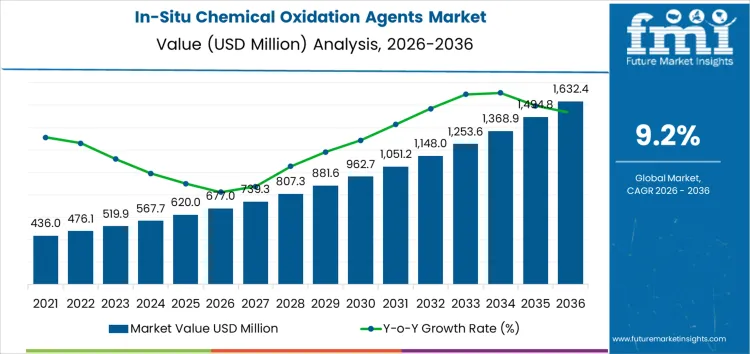
USA, China, India, Germany, and Canada represent fastest-growing countries, supported by brownfield redevelopment, infrastructure upgrades, and groundwater protection mandates. Competitive landscape includes PeroxyChem (Evonik), Regenesis, Solvay, Carus Corporation, and Remondis, focusing on reagent stability, delivery efficiency, and site-specific oxidation performance optimization.
In-Situ Chemical Oxidation Agents Market Key Takeaways
| Metric | Value |
|---|---|
| Market Value (2026) | USD 677.0 million |
| Market Forecast Value (2036) | USD 1,632.4 million |
| Forecast CAGR (2026 to 2036) | 9.2% |
Why is the Demand for In-Situ Chemical Oxidation Agents Market Growing?
Demand for in-situ chemical oxidation agents is growing globally due to increasing regulatory pressure and remediation activity targeting contaminated soil and groundwater. Industrial operations, fuel spills, chemical manufacturing, and improper disposal practices release organic pollutants such as chlorinated solvents, petroleum hydrocarbons, and emerging contaminants into subsurface environments. Environmental standards in multiple regions mandate cleanup to defined risk based thresholds, which motivates adoption of in-situ chemical oxidation (ISCO) agents that break down contaminants at the source without extensive excavation.
Remediation contractors and environmental engineers select oxidants such as hydrogen peroxide, permanganate, and persulfate to generate reactive species that degrade hazardous compounds into less harmful byproducts. Growth in brownfield redevelopment, infrastructure projects, and community health initiatives reinforces investment in efficient, cost effective remediation technologies. Advances in formulation and delivery improve oxidant stability, subsurface transport, and reaction control under varied hydrogeologic conditions. Corporate environmental compliance strategies and liability management priorities further support deployment of ISCO solutions to minimize long term monitoring and maintenance costs. Research and case studies improve understanding of site specific factors that influence performance, broadening applicability across soil types and contaminant profiles.
How Are the Segments Classified in the In-Situ Chemical Oxidation Agents Market?
Demand for in-situ chemical oxidation agents globally is shaped by remediation of subsurface contamination, regulatory cleanup timelines, and preference for in-place treatment methods. Site operators assess oxidation strength, contaminant reactivity, subsurface delivery efficiency, and byproduct formation control. Adoption patterns reflect extensive use across groundwater, brownfield, and landfill remediation programs addressing persistent organic and mixed contaminant plumes.
Which Oxidation Agent Type Represents the Largest Share of Global Demand?
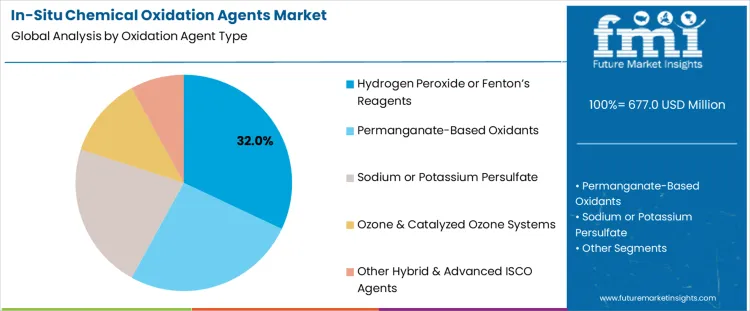
Hydrogen peroxide or Fenton’s reagents hold 32.0%, representing the largest share of global demand. These agents generate highly reactive hydroxyl radicals capable of rapid contaminant breakdown. Permanganate-based oxidants account for 26.0%, offering stability and selectivity for chlorinated solvent degradation. Sodium or potassium persulfate holds 22.0%, supporting activated oxidation under thermal or chemical catalysis. Ozone and catalyzed ozone systems account for 12.0%, enabling strong oxidation with gas-phase or dissolved delivery. Other hybrid and advanced ISCO agents hold 8.0%. Agent-type distribution reflects preference for high-reactivity and controllable oxidation systems.
Key Points
- Peroxide-based systems lead due to high oxidation potential.
- Permanganates provide stability for solvent remediation.
- Persulfates support activated and deep-zone treatment.
Which Target Contaminant Type Drives the Highest Share of Global Application?
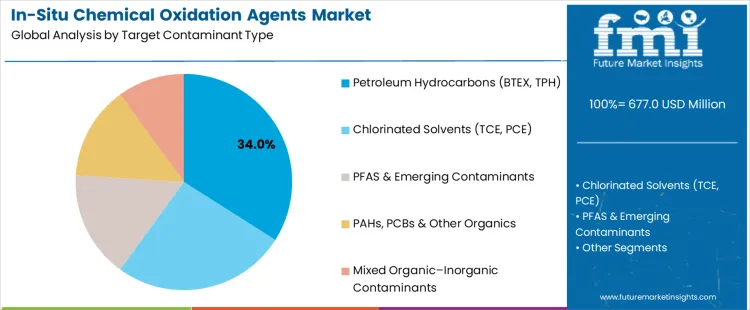
Petroleum hydrocarbons hold 34.0%, driving the highest share of global application. BTEX and TPH contamination remains prevalent at industrial and fuel-handling sites. Chlorinated solvents account for 26.0%, reflecting legacy dry-cleaning and manufacturing contamination. PFAS and emerging contaminants hold 16.0%, reflecting expanding application of ISCO beyond traditional organics. PAHs, PCBs, and other organics account for 14.0%. Mixed organic-inorganic contaminants hold 10.0%. Contaminant distribution reflects historical industrial activity patterns and remediation priority.
Key Points
- Petroleum hydrocarbons dominate due to widespread legacy spills.
- Chlorinated solvents remain key remediation targets.
- PFAS treatment reflects expanding ISCO scope.
Which Application Site Accounts for the Largest Share of Global Demand?
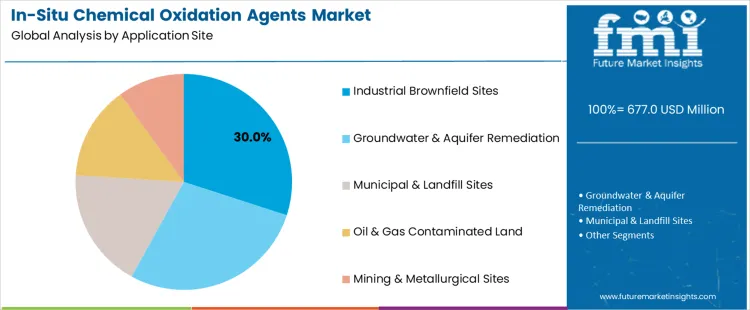
Industrial brownfield sites hold 30.0%, accounting for the largest share of global demand. These sites require rapid remediation to enable redevelopment and regulatory closure. Groundwater and aquifer remediation accounts for 28.0%, addressing contaminant plume migration risks. Municipal and landfill sites hold 18.0%, managing mixed waste leachate impacts. Oil and gas contaminated land accounts for 14.0%, linked to extraction and storage activities. Mining and metallurgical sites hold 10.0%. Application-site distribution reflects concentration of subsurface contamination within legacy industrial zones.
Key Points
- Brownfield sites lead due to redevelopment-driven cleanup.
- Groundwater remediation addresses plume containment.
- Municipal sites manage complex mixed contaminant sources.
What are the Key Dynamics in the In-Situ Chemical Oxidation Agents Market?
Global demand rises as environmental remediation professionals, industry stakeholders, and government agencies adopt in-situ chemical oxidation (ISCO) agents to treat contaminated soil and groundwater without excavation. ISCO agents generate reactive species that degrade organic contaminants such as chlorinated solvents, petroleum hydrocarbons, and emerging contaminants. Adoption aligns with tightening regulatory clean-up requirements, increased brownfield redevelopment, and emphasis on sustainable, cost-effective remediation strategies across regions. Usage spans industrial sites, military bases, landfills, and urban redevelopment projects requiring efficient subsurface contaminant reduction.
How do regulatory clean-up mandates and site rehabilitation priorities shape global demand?
Environmental protection bodies in North America, Europe, Asia-Pacific, and other regions enforce strict remediation standards to protect human health and ecosystems from legacy contaminants. Remediation project managers specify ISCO agents, such as persulfate, permanganate, hydrogen peroxide, and catalytic oxidants to initiate controlled oxidative degradation of recalcitrant organic pollutants in situ, reducing mass and mobility. Industrial sectors with historical contamination, including chemical manufacturing, petroleum refining, and dry cleaning operations, deploy ISCO as part of integrated remediation programmes. Government brownfield initiatives that enable redevelopment of contaminated land reinforce investment in oxidation technologies that meet performance criteria while minimizing surface disruption. Increasing focus on comprehensive site closure drives demand where rapid contaminant mass reduction facilitates regulatory acceptance and reuse planning.
How do subsurface variability, cost considerations, and reagent delivery challenges influence market scalability?
Effectiveness of ISCO agents depends on hydrogeologic conditions, contaminant distribution, soil composition, and oxidant transport behaviour, requiring tailored selection and delivery strategies. Chemical costs, injection system deployment, and monitoring infrastructure influence project budgets, especially for large or heterogeneous sites. Oxidant-reactant contact limitations, radical scavenging by non-target soil constituents, and potential for byproduct formation necessitate design optimization and careful subsurface characterization. Integration with complementary remediation techniques, such as bioremediation or soil vapor extraction, increases complexity and coordination effort. Regulatory frameworks governing injection approvals and performance monitoring vary by jurisdiction, affecting adoption timelines. Global growth depends on continued innovation in robust, cost-effective oxidation formulations and improved delivery systems that support predictable performance across diverse environmental conditions worldwide.
How Is Demand for In-Situ Chemical Oxidation Agents Evolving Globally?
Demand for in-situ chemical oxidation agents is increasing globally due to remediation of contaminated groundwater, regulatory cleanup mandates, and preference for on-site treatment methods. USA leads with a 9.8% CAGR, supported by widespread brownfield remediation and Superfund cleanup activity. China follows at 9.5%, driven by industrial land restoration and groundwater protection policies. India records a 9.3% CAGR, reflecting legacy contamination management and infrastructure-led site redevelopment. Germany posts 8.2%, shaped by precautionary remediation standards and controlled treatment practices. Canada records 8.0%, supported by mining site rehabilitation and federal-provincial remediation programs. Growth reflects sustained reliance on oxidative destruction of persistent contaminants worldwide.
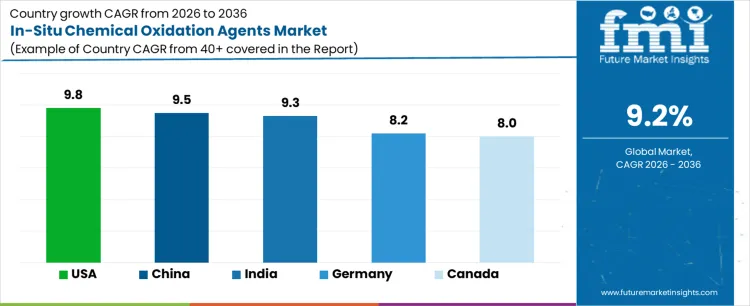
| Country | CAGR (%) |
|---|---|
| USA | 9.8% |
| China | 9.5% |
| India | 9.3% |
| Germany | 8.2% |
| Canada | 8.0% |
What factors are driving strong adoption of in-situ chemical oxidation agents in the USA?
USA demand is driven by extensive groundwater contamination from hydrocarbons, chlorinated solvents, and industrial chemicals. CAGR of 9.8% reflects deployment of oxidants such as persulfates, permanganates, and hydrogen peroxide for site remediation. Regulatory frameworks favor permanent contaminant destruction rather than containment. Brownfield redevelopment programs increase remediation frequency. In-situ application reduces excavation and disposal costs. Established contractor expertise supports consistent use across sites. Growth remains regulation-driven and project-focused, aligned with liability reduction and land reuse objectives.
- Superfund and brownfield remediation programs
- Permanent destruction of groundwater contaminants
- Use of persulfate and permanganate oxidants
- Reduction of excavation and disposal costs
How is China sustaining high growth in in-situ oxidation agent usage?
China demand reflects remediation of industrial parks, petrochemical zones, and manufacturing legacy sites. CAGR of 9.5% is supported by increased use of oxidants to treat soil and groundwater contamination. Centralized environmental enforcement accelerates cleanup timelines. Urban redevelopment pressures favor in-situ treatment for speed and scalability. Domestic suppliers expand production of oxidation agents. Monitoring requirements ensure treatment effectiveness. Growth remains scale-driven and policy-aligned, supported by land reuse mandates and groundwater protection goals.
- Industrial land and groundwater remediation
- Centralized enforcement of cleanup standards
- Preference for scalable in-situ treatment
- Expansion of domestic oxidant supply
What is supporting rising demand for in-situ oxidation agents in India?
India demand is driven by cleanup of contaminated industrial corridors, refineries, and infrastructure projects. CAGR of 9.3% reflects adoption of chemical oxidation to address hydrocarbons and solvents without extensive soil removal. Regulatory scrutiny on hazardous waste disposal encourages on-site remediation. Cost efficiency and minimal site disruption favor in-situ methods. Public infrastructure expansion exposes contaminated land requiring treatment. Growth remains infrastructure-led and compliance-focused, aligned with environmental restoration and development priorities.
- Industrial corridor and refinery site remediation
- Cost-efficient on-site treatment preference
- Reduced reliance on soil excavation
- Infrastructure-driven land cleanup needs
Why does Germany show steady growth in oxidation agent demand?
Germany demand reflects precautionary environmental policy and strict remediation quality standards. CAGR of 8.2% is supported by controlled application of oxidation agents within engineered remediation systems. Operators emphasize site-specific assessment and precise dosing to prevent secondary impacts. Integration with monitored natural attenuation improves outcomes. Strong documentation and validation frameworks guide deployment. Growth remains efficiency-led and compliance-focused, aligned with established environmental protection and land management practices.
- Precautionary remediation standards
- Site-specific and controlled oxidant dosing
- Integration with monitored remediation approaches
- Strong documentation and validation requirements
What supports continued demand growth for in-situ oxidation agents in Canada?
Canada demand is driven by remediation of mining sites, fuel storage facilities, and industrial lands. CAGR of 8.0% reflects increased use of oxidation agents to address solvent and hydrocarbon contamination. Federal and provincial funding supports cleanup projects. Cold climate conditions favor controlled in-situ treatment methods. Indigenous land restoration initiatives further increase remediation activity. Growth remains program-led and compliance-aligned, supported by environmental stewardship and land rehabilitation priorities.
- Mining and fuel site remediation needs
- Federal and provincial cleanup funding
- Applicability under cold climate conditions
- Indigenous land restoration programs
What is the competitive landscape of demand for in-situ chemical oxidation agents?
Demand for in-situ chemical oxidation agents is driven by remediation of chlorinated solvents, petroleum hydrocarbons, and emerging contaminants in soil and groundwater. Treatment programs apply oxidants such as persulfates, peroxides, permanganates, and catalyzed systems to destroy contaminants in place. Buyers evaluate oxidation strength, controllability, subsurface delivery efficiency, reaction longevity, and compatibility with site hydrogeology. Procurement teams prioritize reagents with predictable reaction kinetics, manageable safety profiles, and regulatory acceptance across remediation jurisdictions. Trend in the global market reflects increased preference for in-situ remediation, reduced excavation requirements, and integration of oxidation with bioremediation and containment strategies.
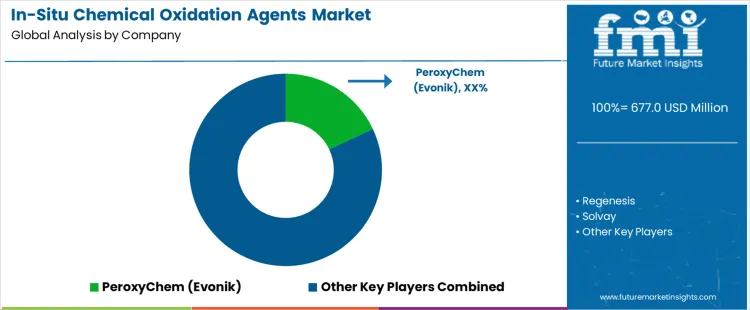
PeroxyChem, operating within Evonik, maintains strong positioning through activated persulfate and peroxide-based oxidation agents used widely in groundwater remediation. Regenesis supports global demand with branded in-situ oxidation solutions combined with site assessment and performance optimization expertise. Solvay supplies hydrogen peroxide and specialty oxidants applied in chemical oxidation programs for complex contaminant profiles. Carus Corporation contributes permanganate-based oxidants widely used for chlorinated solvent destruction. Remondis participates through remediation services and chemical programs integrated into large-scale site cleanup projects. Competitive differentiation depends on oxidation effectiveness, delivery control, safety management, and ability to support site-specific remediation objectives at scale.
Key Players in the In-Situ Chemical Oxidation Agents Market
- PeroxyChem (Evonik)
- Regenesis
- Solvay
- Carus Corporation
- Remondis
Scope of the Report
| Items | Values |
|---|---|
| Quantitative Units | USD million |
| Oxidation Agent Type | Hydrogen Peroxide or Fenton’s Reagents; Permanganate-Based Oxidants; Sodium or Potassium Persulfate; Ozone & Catalyzed Ozone Systems; Other Hybrid & Advanced ISCO Agents |
| Target Contaminant Type | Petroleum Hydrocarbons (BTEX, TPH); Chlorinated Solvents (TCE, PCE); PFAS & Emerging Contaminants; PAHs, PCBs & Other Organics; Mixed Organic-Inorganic Contaminants |
| Application Site | Industrial Brownfield Sites; Groundwater & Aquifer Remediation; Municipal & Landfill Sites; Oil & Gas Contaminated Land; Mining & Metallurgical Sites |
| Regions Covered | Asia Pacific, Europe, North America, Latin America, Middle East & Africa |
| Countries Covered | USA, China, India, Germany, Canada, and 40+ countries |
| Key Companies Profiled | PeroxyChem (Evonik); Regenesis; Solvay; Carus Corporation; Remondis |
| Additional Attributes | Dollar sales by oxidation agent type and target contaminant class; adoption trends for persulfate, permanganate, and catalyzed peroxide ISCO systems; oxidation efficiency and contaminant destruction kinetics across hydrocarbons, chlorinated solvents, and emerging contaminants; compatibility with subsurface geology, groundwater chemistry, and delivery methods; oxidant persistence, rebound control, and byproduct management considerations; regulatory acceptance and site cleanup criteria influencing ISCO agent selection. |
In-Situ Chemical Oxidation Agents Market by Segment
Oxidation Agent Type:
- Hydrogen Peroxide or Fenton’s Reagents
- Permanganate-Based Oxidants
- Sodium or Potassium Persulfate
- Ozone & Catalyzed Ozone Systems
- Other Hybrid & Advanced ISCO Agents
Target Contaminant Type:
- Petroleum Hydrocarbons (BTEX, TPH)
- Chlorinated Solvents (TCE, PCE)
- PFAS & Emerging Contaminants
- PAHs, PCBs & Other Organics
- Mixed Organic-Inorganic Contaminants
Application Site:
- Industrial Brownfield Sites
- Groundwater & Aquifer Remediation
- Municipal & Landfill Sites
- Oil & Gas Contaminated Land
- Mining & Metallurgical Sites
Region:
- Asia Pacific
- China
- Japan
- South Korea
- India
- Australia & New Zealand
- ASEAN
- Rest of Asia Pacific
- Europe
- Germany
- United Kingdom
- France
- Italy
- Spain
- Nordic
- BENELUX
- Rest of Europe
- North America
- United States
- Canada
- Mexico
- Latin America
- Brazil
- Chile
- Rest of Latin America
- Middle East & Africa
- Kingdom of Saudi Arabia
- Other GCC Countries
- Turkey
- South Africa
- Other African Union
- Rest of Middle East & Africa
Frequently Asked Questions
How big is the in-situ chemical oxidation agents market in 2026?
The global in-situ chemical oxidation agents market is estimated to be valued at USD 677.0 million in 2026.
What will be the size of in-situ chemical oxidation agents market in 2036?
The market size for the in-situ chemical oxidation agents market is projected to reach USD 1,632.4 million by 2036.
How much will be the in-situ chemical oxidation agents market growth between 2026 and 2036?
The in-situ chemical oxidation agents market is expected to grow at a 9.2% CAGR between 2026 and 2036.
What are the key product types in the in-situ chemical oxidation agents market?
The key product types in in-situ chemical oxidation agents market are hydrogen peroxide or fenton’s reagents, permanganate-based oxidants, sodium or potassium persulfate, ozone & catalyzed ozone systems and other hybrid & advanced isco agents.
Which target contaminant type segment to contribute significant share in the in-situ chemical oxidation agents market in 2026?
In terms of target contaminant type, petroleum hydrocarbons (btex, tph) segment to command 34.0% share in the in-situ chemical oxidation agents market in 2026.
Preview the report firsthand - request a free sample
Get SampleGet the brochure for pricing and purchase details.
Get PDFTable of Content
- Executive Summary
- Global Market Outlook
- Demand-side Trends
- Supply-side Trends
- Technology Roadmap Analysis
- Analysis and Recommendations
- Market Overview
- Market Coverage / Taxonomy
- Market Definition / Scope / Limitations
- Market Background
- Market Dynamics
- Drivers
- Restraints
- Opportunity
- Trends
- Scenario Forecast
- Demand in Optimistic Scenario
- Demand in Likely Scenario
- Demand in Conservative Scenario
- Opportunity Map Analysis
- Product Life Cycle Analysis
- Supply Chain Analysis
- Investment Feasibility Matrix
- Value Chain Analysis
- PESTLE and Porter’s Analysis
- Regulatory Landscape
- Regional Parent Market Outlook
- Production and Consumption Statistics
- Import and Export Statistics
- Market Dynamics
- Global Market Analysis 2021 to 2025 and Forecast, 2026 to 2036
- Historical Market Size Value (USD Million) Analysis, 2021 to 2025
- Current and Future Market Size Value (USD Million) Projections, 2026 to 2036
- Y-o-Y Growth Trend Analysis
- Absolute $ Opportunity Analysis
- Global Market Pricing Analysis 2021 to 2025 and Forecast 2026 to 2036
- Global Market Analysis 2021 to 2025 and Forecast 2026 to 2036, By Oxidation Agent Type
- Introduction / Key Findings
- Historical Market Size Value (USD Million) Analysis By Oxidation Agent Type , 2021 to 2025
- Current and Future Market Size Value (USD Million) Analysis and Forecast By Oxidation Agent Type , 2026 to 2036
- Hydrogen Peroxide or Fenton’s Reagents
- Permanganate-Based Oxidants
- Sodium or Potassium Persulfate
- Ozone & Catalyzed Ozone Systems
- Other Hybrid & Advanced ISCO Agents
- Hydrogen Peroxide or Fenton’s Reagents
- Y-o-Y Growth Trend Analysis By Oxidation Agent Type , 2021 to 2025
- Absolute $ Opportunity Analysis By Oxidation Agent Type , 2026 to 2036
- Global Market Analysis 2021 to 2025 and Forecast 2026 to 2036, By Target Contaminant Type
- Introduction / Key Findings
- Historical Market Size Value (USD Million) Analysis By Target Contaminant Type, 2021 to 2025
- Current and Future Market Size Value (USD Million) Analysis and Forecast By Target Contaminant Type, 2026 to 2036
- Petroleum Hydrocarbons (BTEX, TPH)
- Chlorinated Solvents (TCE, PCE)
- PFAS & Emerging Contaminants
- PAHs, PCBs & Other Organics
- Mixed Organic-Inorganic Contaminants
- Petroleum Hydrocarbons (BTEX, TPH)
- Y-o-Y Growth Trend Analysis By Target Contaminant Type, 2021 to 2025
- Absolute $ Opportunity Analysis By Target Contaminant Type, 2026 to 2036
- Global Market Analysis 2021 to 2025 and Forecast 2026 to 2036, By Application Site
- Introduction / Key Findings
- Historical Market Size Value (USD Million) Analysis By Application Site, 2021 to 2025
- Current and Future Market Size Value (USD Million) Analysis and Forecast By Application Site, 2026 to 2036
- Industrial Brownfield Sites
- Groundwater & Aquifer Remediation
- Municipal & Landfill Sites
- Oil & Gas Contaminated Land
- Mining & Metallurgical Sites
- Industrial Brownfield Sites
- Y-o-Y Growth Trend Analysis By Application Site, 2021 to 2025
- Absolute $ Opportunity Analysis By Application Site, 2026 to 2036
- Global Market Analysis 2021 to 2025 and Forecast 2026 to 2036, By Region
- Introduction
- Historical Market Size Value (USD Million) Analysis By Region, 2021 to 2025
- Current Market Size Value (USD Million) Analysis and Forecast By Region, 2026 to 2036
- North America
- Latin America
- Western Europe
- Eastern Europe
- East Asia
- South Asia and Pacific
- Middle East & Africa
- Market Attractiveness Analysis By Region
- North America Market Analysis 2021 to 2025 and Forecast 2026 to 2036, By Country
- Historical Market Size Value (USD Million) Trend Analysis By Market Taxonomy, 2021 to 2025
- Market Size Value (USD Million) Forecast By Market Taxonomy, 2026 to 2036
- By Country
- USA
- Canada
- Mexico
- By Oxidation Agent Type
- By Target Contaminant Type
- By Application Site
- By Country
- Market Attractiveness Analysis
- By Country
- By Oxidation Agent Type
- By Target Contaminant Type
- By Application Site
- Key Takeaways
- Latin America Market Analysis 2021 to 2025 and Forecast 2026 to 2036, By Country
- Historical Market Size Value (USD Million) Trend Analysis By Market Taxonomy, 2021 to 2025
- Market Size Value (USD Million) Forecast By Market Taxonomy, 2026 to 2036
- By Country
- Brazil
- Chile
- Rest of Latin America
- By Oxidation Agent Type
- By Target Contaminant Type
- By Application Site
- By Country
- Market Attractiveness Analysis
- By Country
- By Oxidation Agent Type
- By Target Contaminant Type
- By Application Site
- Key Takeaways
- Western Europe Market Analysis 2021 to 2025 and Forecast 2026 to 2036, By Country
- Historical Market Size Value (USD Million) Trend Analysis By Market Taxonomy, 2021 to 2025
- Market Size Value (USD Million) Forecast By Market Taxonomy, 2026 to 2036
- By Country
- Germany
- UK
- Italy
- Spain
- France
- Nordic
- BENELUX
- Rest of Western Europe
- By Oxidation Agent Type
- By Target Contaminant Type
- By Application Site
- By Country
- Market Attractiveness Analysis
- By Country
- By Oxidation Agent Type
- By Target Contaminant Type
- By Application Site
- Key Takeaways
- Eastern Europe Market Analysis 2021 to 2025 and Forecast 2026 to 2036, By Country
- Historical Market Size Value (USD Million) Trend Analysis By Market Taxonomy, 2021 to 2025
- Market Size Value (USD Million) Forecast By Market Taxonomy, 2026 to 2036
- By Country
- Russia
- Poland
- Hungary
- Balkan & Baltic
- Rest of Eastern Europe
- By Oxidation Agent Type
- By Target Contaminant Type
- By Application Site
- By Country
- Market Attractiveness Analysis
- By Country
- By Oxidation Agent Type
- By Target Contaminant Type
- By Application Site
- Key Takeaways
- East Asia Market Analysis 2021 to 2025 and Forecast 2026 to 2036, By Country
- Historical Market Size Value (USD Million) Trend Analysis By Market Taxonomy, 2021 to 2025
- Market Size Value (USD Million) Forecast By Market Taxonomy, 2026 to 2036
- By Country
- China
- Japan
- South Korea
- By Oxidation Agent Type
- By Target Contaminant Type
- By Application Site
- By Country
- Market Attractiveness Analysis
- By Country
- By Oxidation Agent Type
- By Target Contaminant Type
- By Application Site
- Key Takeaways
- South Asia and Pacific Market Analysis 2021 to 2025 and Forecast 2026 to 2036, By Country
- Historical Market Size Value (USD Million) Trend Analysis By Market Taxonomy, 2021 to 2025
- Market Size Value (USD Million) Forecast By Market Taxonomy, 2026 to 2036
- By Country
- India
- ASEAN
- Australia & New Zealand
- Rest of South Asia and Pacific
- By Oxidation Agent Type
- By Target Contaminant Type
- By Application Site
- By Country
- Market Attractiveness Analysis
- By Country
- By Oxidation Agent Type
- By Target Contaminant Type
- By Application Site
- Key Takeaways
- Middle East & Africa Market Analysis 2021 to 2025 and Forecast 2026 to 2036, By Country
- Historical Market Size Value (USD Million) Trend Analysis By Market Taxonomy, 2021 to 2025
- Market Size Value (USD Million) Forecast By Market Taxonomy, 2026 to 2036
- By Country
- Kingdom of Saudi Arabia
- Other GCC Countries
- Turkiye
- South Africa
- Other African Union
- Rest of Middle East & Africa
- By Oxidation Agent Type
- By Target Contaminant Type
- By Application Site
- By Country
- Market Attractiveness Analysis
- By Country
- By Oxidation Agent Type
- By Target Contaminant Type
- By Application Site
- Key Takeaways
- Key Countries Market Analysis
- USA
- Pricing Analysis
- Market Share Analysis, 2025
- By Oxidation Agent Type
- By Target Contaminant Type
- By Application Site
- Canada
- Pricing Analysis
- Market Share Analysis, 2025
- By Oxidation Agent Type
- By Target Contaminant Type
- By Application Site
- Mexico
- Pricing Analysis
- Market Share Analysis, 2025
- By Oxidation Agent Type
- By Target Contaminant Type
- By Application Site
- Brazil
- Pricing Analysis
- Market Share Analysis, 2025
- By Oxidation Agent Type
- By Target Contaminant Type
- By Application Site
- Chile
- Pricing Analysis
- Market Share Analysis, 2025
- By Oxidation Agent Type
- By Target Contaminant Type
- By Application Site
- Germany
- Pricing Analysis
- Market Share Analysis, 2025
- By Oxidation Agent Type
- By Target Contaminant Type
- By Application Site
- UK
- Pricing Analysis
- Market Share Analysis, 2025
- By Oxidation Agent Type
- By Target Contaminant Type
- By Application Site
- Italy
- Pricing Analysis
- Market Share Analysis, 2025
- By Oxidation Agent Type
- By Target Contaminant Type
- By Application Site
- Spain
- Pricing Analysis
- Market Share Analysis, 2025
- By Oxidation Agent Type
- By Target Contaminant Type
- By Application Site
- France
- Pricing Analysis
- Market Share Analysis, 2025
- By Oxidation Agent Type
- By Target Contaminant Type
- By Application Site
- India
- Pricing Analysis
- Market Share Analysis, 2025
- By Oxidation Agent Type
- By Target Contaminant Type
- By Application Site
- ASEAN
- Pricing Analysis
- Market Share Analysis, 2025
- By Oxidation Agent Type
- By Target Contaminant Type
- By Application Site
- Australia & New Zealand
- Pricing Analysis
- Market Share Analysis, 2025
- By Oxidation Agent Type
- By Target Contaminant Type
- By Application Site
- China
- Pricing Analysis
- Market Share Analysis, 2025
- By Oxidation Agent Type
- By Target Contaminant Type
- By Application Site
- Japan
- Pricing Analysis
- Market Share Analysis, 2025
- By Oxidation Agent Type
- By Target Contaminant Type
- By Application Site
- South Korea
- Pricing Analysis
- Market Share Analysis, 2025
- By Oxidation Agent Type
- By Target Contaminant Type
- By Application Site
- Russia
- Pricing Analysis
- Market Share Analysis, 2025
- By Oxidation Agent Type
- By Target Contaminant Type
- By Application Site
- Poland
- Pricing Analysis
- Market Share Analysis, 2025
- By Oxidation Agent Type
- By Target Contaminant Type
- By Application Site
- Hungary
- Pricing Analysis
- Market Share Analysis, 2025
- By Oxidation Agent Type
- By Target Contaminant Type
- By Application Site
- Kingdom of Saudi Arabia
- Pricing Analysis
- Market Share Analysis, 2025
- By Oxidation Agent Type
- By Target Contaminant Type
- By Application Site
- Turkiye
- Pricing Analysis
- Market Share Analysis, 2025
- By Oxidation Agent Type
- By Target Contaminant Type
- By Application Site
- South Africa
- Pricing Analysis
- Market Share Analysis, 2025
- By Oxidation Agent Type
- By Target Contaminant Type
- By Application Site
- USA
- Market Structure Analysis
- Competition Dashboard
- Competition Benchmarking
- Market Share Analysis of Top Players
- By Regional
- By Oxidation Agent Type
- By Target Contaminant Type
- By Application Site
- Competition Analysis
- Competition Deep Dive
- PeroxyChem (Evonik)
- Overview
- Product Portfolio
- Profitability by Market Segments (Product/Age /Sales Channel/Region)
- Sales Footprint
- Strategy Overview
- Marketing Strategy
- Product Strategy
- Channel Strategy
- Regenesis
- Solvay
- Carus Corporation
- Remondis
- PeroxyChem (Evonik)
- Competition Deep Dive
- Assumptions & Acronyms Used
- Research Methodology


