

- Industry Size (2026)
- USD 556.3 Mn
- Forecast (2036)
- USD 1329.1 Mn
- CAGR (2026 to 2036)
- 9.1%
Methane Oxidation Catalysts and Additives Market Forecast and Outlook 2026 to 2036
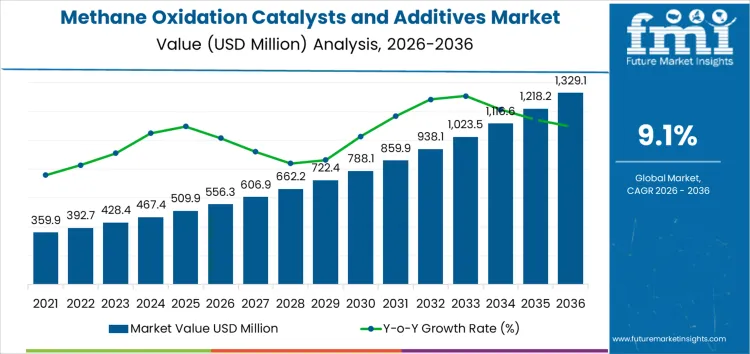
The methane oxidation catalysts and additives market is valued at USD 556.3 million in 2026 and is expected to reach USD 1,329.1 million by 2036, growing at a compound annual growth rate (CAGR) of 9.1%. Market performance will be heavily influenced by cost structures, where high R&D and manufacturing costs create pressure on pricing control. The ability to capture value will not solely depend on volume sold, but rather on the pricing power held by suppliers who can offer differentiated, high-performance solutions. As the market expands, margin concentration will shift toward key players with established technological advantages and economies of scale, enabling them to secure premium pricing for their products. Smaller entrants will face significant challenges, needing to compete on cost-efficiency while navigating the volatility in raw material prices. This uneven value capture, driven by technological expertise and operational efficiency, will define the competitive landscape as suppliers seek to align innovation with long-term profitability.
Quick Stats of the Methane Oxidation Catalysts and Additives Market
- Methane Oxidation Catalysts and Additives Market Value (2026): USD 556.3 million
- Methane Oxidation Catalysts and Additives Market Forecast Value (2036): USD 1,329.1 million
- Methane Oxidation Catalysts and Additives Market Global Forecast CAGR (2026 to 2036): 9.1%
- Methane Oxidation Catalysts and Additives Market Leading Segment: Deployment Method (Fixed-Bed Catalytic Systems) 36%
- Key Growth Regions in Methane Oxidation Catalysts and Additives Market: USA
- Top Players in Methane Oxidation Catalysts and Additives Market: Johnson Matthey, BASF SE, Clariant, Envirotech, Cataler Corporation
What is the Growth Forecast for the Methane Oxidation Catalysts and Additives Market through 2036?
The early vs late growth curve comparison for the methane oxidation catalysts and additives market reveals a more rapid acceleration in growth during the initial years, followed by a stabilization as the market matures. In the first phase (2026 to 2031), the market will experience faster growth, as industries adopt methane oxidation technologies to comply with stricter regulations. Starting at USD 556.3 million in 2026, the market will rise significantly, reaching USD 858.7 million in 2031, driven by early adoption and heightened environmental concerns. During this period, the demand for efficient methane control solutions will increase, especially as industries recognize the economic and environmental benefits of reducing methane emissions.
In the latter phase (2031 to 2036), while the market will continue to grow, the rate of growth will slow down as the technology becomes more established and widely used across industries. The market will increase from USD 858.7 million in 2031 to USD 1,329.1 million by 2036, reflecting a more stable growth rate. This slowdown is typical of a mature market, where adoption becomes widespread and the technology stabilizes in terms of performance and cost. The late growth phase will be characterized by incremental improvements and broader integration of methane oxidation catalysts and additives into industry practices, contributing to steady but slower growth.
Methane Oxidation Catalysts and Additives Market Key Takeaways
| Metric | Value |
|---|---|
| Industry Sales Value (2026) | USD 556.3 million |
| Industry Forecast Value (2036) | USD 1,329.1 million |
| Industry Forecast CAGR (2026 to 2036) | 9.1% |
What Is Driving the Demand for the Methane Oxidation Catalysts and Additives Market Globally?
The global demand for methane oxidation catalysts and additives is being driven by increased regulatory focus on reducing methane emissions and improving air quality in energy, industrial, and transportation sectors. Methane is a potent greenhouse gas with a much stronger near-term warming effect than carbon dioxide, and governments and international bodies are tightening controls on emissions from natural gas systems, landfills, coal mining, and agricultural sources. Technologies that promote oxidation of methane to carbon dioxide at lower temperatures provide a pathway to reduce atmospheric release and meet climate goals.
In addition to regulatory drivers, companies responsible for fossil fuel extraction, biogas production, and waste management face pressure from investors and the public to demonstrate measurable reductions in climate impact. Methane oxidation catalysts and performance additives enhance conversion efficiency in flares, aftertreatment systems, and catalytic reactors, enabling operators to meet emission standards without extensive retrofits. Adoption is supported by advances in catalyst formulations that improve activity in challenging operational conditions, such as low gas temperatures or variable methane concentrations. As environmental monitoring and reporting requirements become more rigorous, facilities seek solutions that offer reliable performance and compliance documentation.
Future demand for methane oxidation catalysts and additives is expected to grow as climate action commitments and sustainability strategies continue to shape industrial investment and policy frameworks worldwide. Ongoing innovation in catalyst materials, such as more active metal oxides and structured substrates, will increase efficiency and lifespan, making solutions more cost effective and appealing across sectors. Integration of methane oxidation systems with digital monitoring and control platforms will help operators optimise performance, track emissions in real time, and demonstrate compliance with tightening standards.
Expansion of renewable natural gas, landfill gas utilisation, and other methane-rich energy streams will sustain interest in oxidation technologies that improve overall environmental performance. Regulatory frameworks that include methane targets in national climate plans and market-based incentives for emission reductions will further reinforce demand. As industries adapt to lower carbon pathways and adopt cleaner energy practices, methane oxidation catalysts and additives that deliver measurable emission reductions and operational reliability are positioned for continued global uptake.
What are the Leading Segments in the Global Methane Oxidation Catalysts and Additives Market?
The global methane oxidation catalysts and additives market is segmented by deployment method and catalyst type. Among deployment methods, fixed-bed catalytic systems lead the market, capturing 36% of the share, followed by coated filters & catalyst layers, liquid additive blends, catalytic membrane & hybrid systems, and other delivery formats. Fixed-bed catalytic systems are preferred for their effectiveness in high-throughput gas treatments. On the catalyst type side, palladium-based oxidation catalysts dominate the market, holding 32% of the share, followed by platinum-based catalysts, metal oxide catalysts (Cu, Mn, Co), nano-structured methane catalysts, and other specialty additives & formulations. Palladium-based catalysts are widely used for their high efficiency in methane oxidation and ability to perform well at relatively low temperatures.
What Drives the Growth of Fixed-Bed Catalytic Systems in the Methane Oxidation Catalysts and Additives Market?
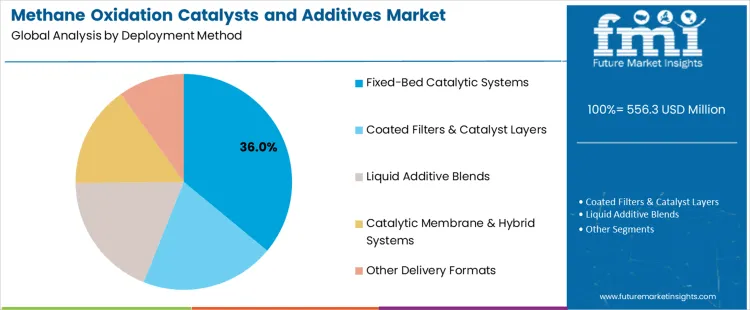
Fixed-bed catalytic systems are the leading deployment method in the methane oxidation catalysts and additives market, holding 36% of the share. These systems are widely used in industrial applications for the continuous treatment of methane-rich gas streams. The fixed-bed configuration provides high contact efficiency between the methane and the catalyst, ensuring effective oxidation even in large-scale operations. The increasing demand for methane emission reduction in industries such as oil and gas, waste management, and natural gas processing is driving the adoption of fixed-bed catalytic systems. Fixed-bed systems are particularly effective for continuous, high-volume applications where efficient and stable methane oxidation is critical. As methane regulations tighten globally and the need to reduce greenhouse gas emissions rises, fixed-bed catalytic systems are expected to remain a dominant solution in the market due to their efficiency, scalability, and proven performance in methane oxidation.
What is Driving the Demand for Palladium-Based Oxidation Catalysts in the Methane Oxidation Catalysts and Additives Market?
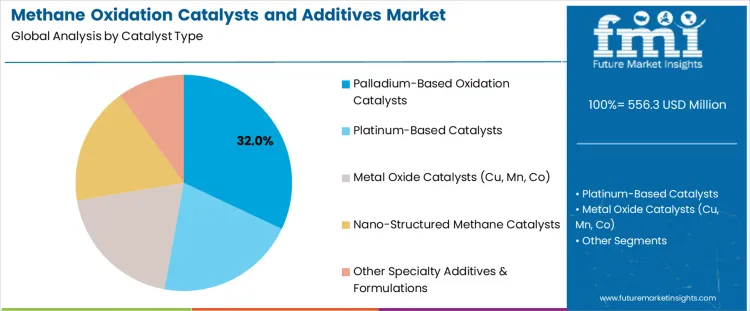
Palladium-based oxidation catalysts are the leading catalyst type in the methane oxidation catalysts and additives market, capturing 32% of the share. These catalysts are preferred for their high catalytic activity and stability in oxidizing methane at relatively low temperatures, making them ideal for methane control applications in both stationary and mobile sources. Palladium catalysts are highly effective at breaking down methane, which is a potent greenhouse gas, into less harmful substances like carbon dioxide and water. Their efficiency, even in low-concentration methane streams, makes them suitable for a variety of applications, including natural gas processing, biogas treatment, and industrial flue gas purification. As environmental regulations become stricter regarding methane emissions, the demand for palladium-based oxidation catalysts continues to grow. The increasing focus on reducing methane emissions, particularly in the oil and gas industry, further supports the adoption of palladium-based catalysts, ensuring their continued dominance in the market.
What are the Key Dynamics in the Global Methane Oxidation Catalysts and Additives Market?
The global methane oxidation catalysts and additives market is expanding as industries and energy producers adopt technologies that reduce methane emissions at source and during combustion. Methane oxidation catalysts accelerate conversion of methane to carbon dioxide and water in engines, turbines, flares and industrial vents. Methane additives enhance catalyst performance and stability under varied operating conditions. Growth reflects climate policy emphasis on reducing potent greenhouse gases, regulatory requirements for emission limits, and investment in cleaner combustion technologies. Adoption spans oil and gas, power generation, waste management and industrial sectors focused on environmental performance and compliance.
What are the Key Drivers for the Methane Oxidation Catalysts and Additives Market?
Regulatory pressure to address methane, a powerful greenhouse gas, is a major driver of market growth. Governments and environmental agencies are implementing stricter monitoring and control measures that require effective oxidation technologies to meet emission limits. Industrial operators seek catalysts and additives that improve methane conversion efficiency and reduce unburned hydrocarbons from vented or flared streams, supporting compliance and lowering climate impact. Advances in material science enable new catalyst formulations with higher activity, longer life and resistance to poisons. Rising corporate climate commitments and investor expectations for sustainable operations further support market uptake.
What are the Restraints for the Methane Oxidation Catalysts and Additives Market?
One restraint is the cost and complexity of integrating advanced methane oxidation systems with existing equipment and processes. Industries with legacy combustion infrastructure may face technical challenges in retrofitting catalysts or optimizing additive dosing without affecting throughput, fuel efficiency or maintenance practices. Perceived cost barriers can delay adoption where regulatory enforcement timelines are extended or market incentives are limited. Performance of catalysts can vary with feedstock composition, temperature and contaminants, requiring site-specific testing and optimization. Some operators may prioritize other emission control measures when methane concentrations are low or when economic pressures limit investment capacity.
What are the Key Trends in the Methane Oxidation Catalysts and Additives Market?
A key trend is development of catalysts and additives that maintain high methane conversion at lower temperatures and in variable operating conditions. Research focuses on novel metal oxides, structured supports and dopants that increase active surface area and reaction rates while minimizing degradation. Integration of real-time monitoring and control systems enhances dosing precision and performance tracking. Collaboration between catalyst developers, equipment manufacturers and end users accelerates validation in field environments such as gas engines, flares and stationary turbines. Emphasis on lifecycle analysis and sustainability reporting encourages buyers to specify technologies that align with emissions reduction commitments and broader climate strategies.
What is the Country-Wise Analysis of the Methane Oxidation Catalysts and Additives Market?
The methane oxidation catalysts and additives market is expected to grow steadily, driven by increasing demand for technologies that reduce methane emissions, a potent greenhouse gas. These catalysts and additives are used to convert methane into less harmful substances, such as carbon dioxide and water, contributing to efforts to mitigate climate change and improve air quality. High-growth markets like China and India are seeing significant demand due to their large industrial sectors and growing focus on environmental sustainability. Developed markets like the United States, Germany, and Canada are also experiencing steady growth, supported by stringent environmental regulations, technological advancements in emissions control, and the global push to address climate change.
| Country | CAGR (%) |
|---|---|
| USA | 9.8 |
| China | 9.5 |
| India | 9.2 |
| Germany | 7.8 |
| Canada | 7.6 |
What is the Growth Outlook for the Methane Oxidation Catalysts and Additives Market in the USA?
The methane oxidation catalysts and additives market in the United States is expected to grow at a steady rate, with a projected CAGR of 9.8%. The USA market is driven by increasing regulatory pressure to reduce methane emissions from industrial sources such as natural gas processing and agriculture. The USA Environmental Protection Agency (EPA) and other regulatory bodies have set stringent methane emission reduction goals, which is accelerating the adoption of oxidation catalysts and additives. With the growing focus on addressing climate change and reducing greenhouse gas emissions, the USA market for methane oxidation catalysts is expected to continue expanding as industries adopt more sustainable practices.
What is the Market Outlook for the Methane Oxidation Catalysts and Additives Market in China?
The methane oxidation catalysts and additives market in China is projected to grow at the highest rate, with a projected CAGR of 9.5%. As the world’s largest emitter of methane, China is facing increasing pressure to address its environmental impact. The country's growing industrial base, particularly in sectors like natural gas extraction, coal mining, and manufacturing, is a significant contributor to methane emissions. In response, China is intensifying efforts to reduce these emissions through the use of methane oxidation catalysts and additives. The government’s commitment to meeting climate goals and adopting cleaner technologies is further boosting the demand for these products. Given the size of the market and the strong regulatory push, China is poised for rapid adoption of methane oxidation technologies.
What is the Growth Forecast for the Methane Oxidation Catalysts and Additives Market in India?
The methane oxidation catalysts and additives market in India is expected to grow steadily, with a projected CAGR of 9.2%. India’s industrial sector, particularly in agriculture and energy, is a significant source of methane emissions. As the country looks to improve air quality and reduce greenhouse gases, the demand for methane oxidation catalysts is rising. The Indian government’s focus on cleaner energy and sustainability, combined with international climate agreements, is driving industries to adopt technologies that can reduce methane emissions. As awareness of climate change and environmental impact increases, the market for methane oxidation catalysts and additives in India is set to grow steadily.
What is the Market Outlook for the Methane Oxidation Catalysts and Additives Market in Germany?
The methane oxidation catalysts and additives market in Germany is projected to grow steadily, with a projected CAGR of 7.8%. Germany’s strict environmental regulations and commitment to reducing greenhouse gas emissions are driving the demand for methane oxidation technologies. As part of its broader efforts to transition to a sustainable, low-carbon economy, Germany is increasingly adopting solutions that address methane emissions from industrial sources. The country’s advanced industrial base, particularly in energy and manufacturing, is expected to continue adopting methane oxidation catalysts to comply with environmental standards. As Germany continues to invest in green technologies and emissions reduction, the market for these catalysts is expected to grow steadily.
What are the Growth Prospects for the Methane Oxidation Catalysts and Additives Market in Canada?
The methane oxidation catalysts and additives market in Canada is expected to grow steadily, with a projected CAGR of 7.6%. Canada’s oil and gas sector, particularly in natural gas production, is a significant source of methane emissions. With increasing regulatory pressure to reduce methane emissions and meet international environmental standards, the demand for methane oxidation catalysts is expected to rise. The Canadian government’s initiatives to improve air quality and mitigate climate change, along with investments in clean technologies, are expected to support market growth. As industries across Canada continue to adopt sustainable practices and reduce their carbon footprint, the market for methane oxidation catalysts and additives will continue to expand.
What is the Competitive Landscape for the Methane Oxidation Catalysts and Additives Market?
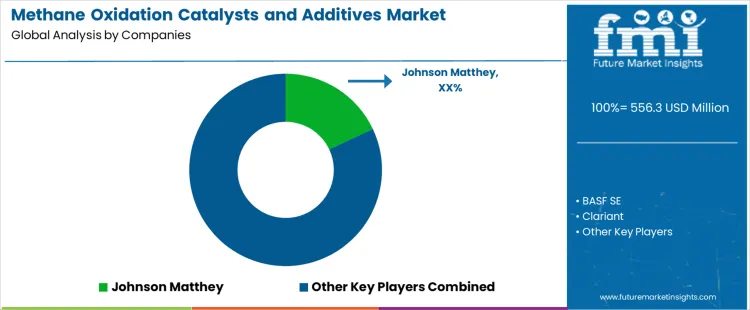
The methane oxidation catalysts and additives market is growing rapidly as industries seek effective solutions to reduce methane emissions, particularly in response to stricter environmental regulations and the global focus on curbing greenhouse gases. Johnson Matthey leads the market with its innovative methane oxidation catalysts and additives, offering high-performance solutions that effectively convert methane into less harmful substances, improving environmental sustainability. Their focus on cutting-edge technology, product efficacy, and regulatory compliance has made them a dominant player in the market. BASF SE, Clariant, and Envirotech are significant competitors, each providing specialized catalysts and additives designed to improve methane oxidation processes. BASF SE focuses on offering advanced catalytic solutions for methane oxidation, while Clariant and Envirotech provide tailored products that meet the increasing demand for eco-friendly emission reduction technologies.
Cataler Corporation further strengthens the competitive landscape by offering high-performance methane oxidation catalysts that are designed to enhance methane removal from industrial emissions. Cataler Corporation focuses on providing efficient, cost-effective solutions that support the growing need for cleaner technologies. These companies compete by focusing on technological innovation, environmental responsibility, and the ability to meet the growing regulatory demand for methane emission control solutions. As global efforts to reduce greenhouse gases intensify, the market for methane oxidation catalysts and additives is expected to continue expanding, driving innovation and competition in the sector.
Key Players of the Methane Oxidation Catalysts and Additives Market
- Johnson Matthey
- BASF SE
- Clariant
- Envirotech
- Cataler Corporation
Scope of the Report
| Items | Values |
|---|---|
| Quantitative Units (2026) | USD Million |
| Catalyst Type | Palladium-Based Oxidation Catalysts, Platinum-Based Catalysts, Metal Oxide Catalysts (Cu, Mn, Co), Nano-Structured Methane Catalysts, Other Specialty Additives & Formulations |
| Application Sector | Landfill & Biogas Methane Oxidation, Oil & Gas Fugitive Emission Control, Industrial Combustion Systems, Automotive & Transport Emission Systems, Agriculture & Waste Treatment Sites |
| Deployment Method | Fixed-Bed Catalytic Systems, Coated Filters & Catalyst Layers, Liquid Additive Blends, Catalytic Membrane & Hybrid Systems, Other Delivery Formats |
| Companies | Johnson Matthey, BASF SE, Clariant, Envirotech, Cataler Corporation |
| Regions Covered | North America, Latin America, Western Europe, Eastern Europe, South Asia and Pacific, East Asia, Middle East & Africa |
| Countries Covered | United States, Canada, Mexico, Brazil, Argentina, Germany, France, United Kingdom, Italy, Spain, Netherlands, China, India, Japan, South Korea, ANZ, GCC Countries, South Africa |
| Additional Attributes | Dollar by sales by catalyst type, application sector, deployment method, and region. Includes market trends in methane oxidation catalysts and additives, performance in various emission control applications, cost-effectiveness, sustainability practices, regulatory compliance, market share and competitive positioning of key companies, and the role of methane oxidation catalysts in improving emission control efficiency, supporting environmental compliance, and enhancing the mitigation of methane emissions across industries. |
Methane Oxidation Catalysts and Additives Market Segmentation
Catalyst Type
- Palladium-Based Oxidation Catalysts
- Platinum-Based Catalysts
- Metal Oxide Catalysts (Cu, Mn, Co)
- Nano-Structured Methane Catalysts
- Other Specialty Additives & Formulations
Application Sector
- Landfill & Biogas Methane Oxidation
- Oil & Gas Fugitive Emission Control
- Industrial Combustion Systems
- Automotive & Transport Emission Systems
- Agriculture & Waste Treatment Sites
Deployment Method
- Fixed-Bed Catalytic Systems
- Coated Filters & Catalyst Layers
- Liquid Additive Blends
- Catalytic Membrane & Hybrid Systems
- Other Delivery Formats
Region
- Asia Pacific
- China
- Japan
- South Korea
- India
- Australia & New Zealand
- ASEAN
- Rest of Asia Pacific
- Europe
- Germany
- United Kingdom
- France
- Italy
- Spain
- Nordic
- BENELUX
- Rest of Europe
- North America
- United States
- Canada
- Mexico
- Latin America
- Brazil
- Chile
- Rest of Latin America
- Middle East & Africa
- Kingdom of Saudi Arabia
- Other GCC Countries
- Turkey
- South Africa
- Other African Union
- Rest of Middle East & Africa
Frequently Asked Questions
How big is the methane oxidation catalysts and additives market in 2026?
The global methane oxidation catalysts and additives market is estimated to be valued at USD 556.3 million in 2026.
What will be the size of methane oxidation catalysts and additives market in 2036?
The market size for the methane oxidation catalysts and additives market is projected to reach USD 1,329.1 million by 2036.
How much will be the methane oxidation catalysts and additives market growth between 2026 and 2036?
The methane oxidation catalysts and additives market is expected to grow at a 9.1% CAGR between 2026 and 2036.
What are the key product types in the methane oxidation catalysts and additives market?
The key product types in methane oxidation catalysts and additives market are palladium-based oxidation catalysts, platinum-based catalysts, metal oxide catalysts (cu, mn, co), nano-structured methane catalysts and other specialty additives & formulations.
Which application sector segment to contribute significant share in the methane oxidation catalysts and additives market in 2026?
In terms of application sector, landfill & biogas methane oxidation segment to command 30.0% share in the methane oxidation catalysts and additives market in 2026.
Preview the report firsthand - request a free sample
Get SampleGet the brochure for pricing and purchase details.
Get PDFTable of Content
- Executive Summary
- Global Market Outlook
- Demand-side Trends
- Supply-side Trends
- Technology Roadmap Analysis
- Analysis and Recommendations
- Market Overview
- Market Coverage / Taxonomy
- Market Definition / Scope / Limitations
- Market Background
- Market Dynamics
- Drivers
- Restraints
- Opportunity
- Trends
- Scenario Forecast
- Demand in Optimistic Scenario
- Demand in Likely Scenario
- Demand in Conservative Scenario
- Opportunity Map Analysis
- Product Life Cycle Analysis
- Supply Chain Analysis
- Investment Feasibility Matrix
- Value Chain Analysis
- PESTLE and Porter’s Analysis
- Regulatory Landscape
- Regional Parent Market Outlook
- Production and Consumption Statistics
- Import and Export Statistics
- Market Dynamics
- Global Market Analysis 2021 to 2025 and Forecast, 2026 to 2036
- Historical Market Size Value (USD Million) Analysis, 2021 to 2025
- Current and Future Market Size Value (USD Million) Projections, 2026 to 2036
- Y-o-Y Growth Trend Analysis
- Absolute $ Opportunity Analysis
- Global Market Pricing Analysis 2021 to 2025 and Forecast 2026 to 2036
- Global Market Analysis 2021 to 2025 and Forecast 2026 to 2036, By Catalyst Type
- Introduction / Key Findings
- Historical Market Size Value (USD Million) Analysis By Catalyst Type , 2021 to 2025
- Current and Future Market Size Value (USD Million) Analysis and Forecast By Catalyst Type , 2026 to 2036
- Palladium-Based Oxidation Catalysts
- Platinum-Based Catalysts
- Metal Oxide Catalysts (Cu, Mn, Co)
- Nano-Structured Methane Catalysts
- Other Specialty Additives & Formulations
- Palladium-Based Oxidation Catalysts
- Y-o-Y Growth Trend Analysis By Catalyst Type , 2021 to 2025
- Absolute $ Opportunity Analysis By Catalyst Type , 2026 to 2036
- Global Market Analysis 2021 to 2025 and Forecast 2026 to 2036, By Application Sector
- Introduction / Key Findings
- Historical Market Size Value (USD Million) Analysis By Application Sector, 2021 to 2025
- Current and Future Market Size Value (USD Million) Analysis and Forecast By Application Sector, 2026 to 2036
- Landfill & Biogas Methane Oxidation
- Oil & Gas Fugitive Emission Control
- Industrial Combustion Systems
- Automotive & Transport Emission Systems
- Agriculture & Waste Treatment Sites
- Landfill & Biogas Methane Oxidation
- Y-o-Y Growth Trend Analysis By Application Sector, 2021 to 2025
- Absolute $ Opportunity Analysis By Application Sector, 2026 to 2036
- Global Market Analysis 2021 to 2025 and Forecast 2026 to 2036, By Deployment Method
- Introduction / Key Findings
- Historical Market Size Value (USD Million) Analysis By Deployment Method, 2021 to 2025
- Current and Future Market Size Value (USD Million) Analysis and Forecast By Deployment Method, 2026 to 2036
- Fixed-Bed Catalytic Systems
- Coated Filters & Catalyst Layers
- Liquid Additive Blends
- Catalytic Membrane & Hybrid Systems
- Other Delivery Formats
- Fixed-Bed Catalytic Systems
- Y-o-Y Growth Trend Analysis By Deployment Method, 2021 to 2025
- Absolute $ Opportunity Analysis By Deployment Method, 2026 to 2036
- Global Market Analysis 2021 to 2025 and Forecast 2026 to 2036, By Region
- Introduction
- Historical Market Size Value (USD Million) Analysis By Region, 2021 to 2025
- Current Market Size Value (USD Million) Analysis and Forecast By Region, 2026 to 2036
- North America
- Latin America
- Western Europe
- Eastern Europe
- East Asia
- South Asia and Pacific
- Middle East & Africa
- Market Attractiveness Analysis By Region
- North America Market Analysis 2021 to 2025 and Forecast 2026 to 2036, By Country
- Historical Market Size Value (USD Million) Trend Analysis By Market Taxonomy, 2021 to 2025
- Market Size Value (USD Million) Forecast By Market Taxonomy, 2026 to 2036
- By Country
- USA
- Canada
- Mexico
- By Catalyst Type
- By Application Sector
- By Deployment Method
- By Country
- Market Attractiveness Analysis
- By Country
- By Catalyst Type
- By Application Sector
- By Deployment Method
- Key Takeaways
- Latin America Market Analysis 2021 to 2025 and Forecast 2026 to 2036, By Country
- Historical Market Size Value (USD Million) Trend Analysis By Market Taxonomy, 2021 to 2025
- Market Size Value (USD Million) Forecast By Market Taxonomy, 2026 to 2036
- By Country
- Brazil
- Chile
- Rest of Latin America
- By Catalyst Type
- By Application Sector
- By Deployment Method
- By Country
- Market Attractiveness Analysis
- By Country
- By Catalyst Type
- By Application Sector
- By Deployment Method
- Key Takeaways
- Western Europe Market Analysis 2021 to 2025 and Forecast 2026 to 2036, By Country
- Historical Market Size Value (USD Million) Trend Analysis By Market Taxonomy, 2021 to 2025
- Market Size Value (USD Million) Forecast By Market Taxonomy, 2026 to 2036
- By Country
- Germany
- UK
- Italy
- Spain
- France
- Nordic
- BENELUX
- Rest of Western Europe
- By Catalyst Type
- By Application Sector
- By Deployment Method
- By Country
- Market Attractiveness Analysis
- By Country
- By Catalyst Type
- By Application Sector
- By Deployment Method
- Key Takeaways
- Eastern Europe Market Analysis 2021 to 2025 and Forecast 2026 to 2036, By Country
- Historical Market Size Value (USD Million) Trend Analysis By Market Taxonomy, 2021 to 2025
- Market Size Value (USD Million) Forecast By Market Taxonomy, 2026 to 2036
- By Country
- Russia
- Poland
- Hungary
- Balkan & Baltic
- Rest of Eastern Europe
- By Catalyst Type
- By Application Sector
- By Deployment Method
- By Country
- Market Attractiveness Analysis
- By Country
- By Catalyst Type
- By Application Sector
- By Deployment Method
- Key Takeaways
- East Asia Market Analysis 2021 to 2025 and Forecast 2026 to 2036, By Country
- Historical Market Size Value (USD Million) Trend Analysis By Market Taxonomy, 2021 to 2025
- Market Size Value (USD Million) Forecast By Market Taxonomy, 2026 to 2036
- By Country
- China
- Japan
- South Korea
- By Catalyst Type
- By Application Sector
- By Deployment Method
- By Country
- Market Attractiveness Analysis
- By Country
- By Catalyst Type
- By Application Sector
- By Deployment Method
- Key Takeaways
- South Asia and Pacific Market Analysis 2021 to 2025 and Forecast 2026 to 2036, By Country
- Historical Market Size Value (USD Million) Trend Analysis By Market Taxonomy, 2021 to 2025
- Market Size Value (USD Million) Forecast By Market Taxonomy, 2026 to 2036
- By Country
- India
- ASEAN
- Australia & New Zealand
- Rest of South Asia and Pacific
- By Catalyst Type
- By Application Sector
- By Deployment Method
- By Country
- Market Attractiveness Analysis
- By Country
- By Catalyst Type
- By Application Sector
- By Deployment Method
- Key Takeaways
- Middle East & Africa Market Analysis 2021 to 2025 and Forecast 2026 to 2036, By Country
- Historical Market Size Value (USD Million) Trend Analysis By Market Taxonomy, 2021 to 2025
- Market Size Value (USD Million) Forecast By Market Taxonomy, 2026 to 2036
- By Country
- Kingdom of Saudi Arabia
- Other GCC Countries
- Turkiye
- South Africa
- Other African Union
- Rest of Middle East & Africa
- By Catalyst Type
- By Application Sector
- By Deployment Method
- By Country
- Market Attractiveness Analysis
- By Country
- By Catalyst Type
- By Application Sector
- By Deployment Method
- Key Takeaways
- Key Countries Market Analysis
- USA
- Pricing Analysis
- Market Share Analysis, 2025
- By Catalyst Type
- By Application Sector
- By Deployment Method
- Canada
- Pricing Analysis
- Market Share Analysis, 2025
- By Catalyst Type
- By Application Sector
- By Deployment Method
- Mexico
- Pricing Analysis
- Market Share Analysis, 2025
- By Catalyst Type
- By Application Sector
- By Deployment Method
- Brazil
- Pricing Analysis
- Market Share Analysis, 2025
- By Catalyst Type
- By Application Sector
- By Deployment Method
- Chile
- Pricing Analysis
- Market Share Analysis, 2025
- By Catalyst Type
- By Application Sector
- By Deployment Method
- Germany
- Pricing Analysis
- Market Share Analysis, 2025
- By Catalyst Type
- By Application Sector
- By Deployment Method
- UK
- Pricing Analysis
- Market Share Analysis, 2025
- By Catalyst Type
- By Application Sector
- By Deployment Method
- Italy
- Pricing Analysis
- Market Share Analysis, 2025
- By Catalyst Type
- By Application Sector
- By Deployment Method
- Spain
- Pricing Analysis
- Market Share Analysis, 2025
- By Catalyst Type
- By Application Sector
- By Deployment Method
- France
- Pricing Analysis
- Market Share Analysis, 2025
- By Catalyst Type
- By Application Sector
- By Deployment Method
- India
- Pricing Analysis
- Market Share Analysis, 2025
- By Catalyst Type
- By Application Sector
- By Deployment Method
- ASEAN
- Pricing Analysis
- Market Share Analysis, 2025
- By Catalyst Type
- By Application Sector
- By Deployment Method
- Australia & New Zealand
- Pricing Analysis
- Market Share Analysis, 2025
- By Catalyst Type
- By Application Sector
- By Deployment Method
- China
- Pricing Analysis
- Market Share Analysis, 2025
- By Catalyst Type
- By Application Sector
- By Deployment Method
- Japan
- Pricing Analysis
- Market Share Analysis, 2025
- By Catalyst Type
- By Application Sector
- By Deployment Method
- South Korea
- Pricing Analysis
- Market Share Analysis, 2025
- By Catalyst Type
- By Application Sector
- By Deployment Method
- Russia
- Pricing Analysis
- Market Share Analysis, 2025
- By Catalyst Type
- By Application Sector
- By Deployment Method
- Poland
- Pricing Analysis
- Market Share Analysis, 2025
- By Catalyst Type
- By Application Sector
- By Deployment Method
- Hungary
- Pricing Analysis
- Market Share Analysis, 2025
- By Catalyst Type
- By Application Sector
- By Deployment Method
- Kingdom of Saudi Arabia
- Pricing Analysis
- Market Share Analysis, 2025
- By Catalyst Type
- By Application Sector
- By Deployment Method
- Turkiye
- Pricing Analysis
- Market Share Analysis, 2025
- By Catalyst Type
- By Application Sector
- By Deployment Method
- South Africa
- Pricing Analysis
- Market Share Analysis, 2025
- By Catalyst Type
- By Application Sector
- By Deployment Method
- USA
- Market Structure Analysis
- Competition Dashboard
- Competition Benchmarking
- Market Share Analysis of Top Players
- By Regional
- By Catalyst Type
- By Application Sector
- By Deployment Method
- Competition Analysis
- Competition Deep Dive
- Johnson Matthey
- Overview
- Product Portfolio
- Profitability by Market Segments (Product/Age /Sales Channel/Region)
- Sales Footprint
- Strategy Overview
- Marketing Strategy
- Product Strategy
- Channel Strategy
- BASF SE
- Clariant
- Envirotech
- Cataler Corporation
- Johnson Matthey
- Competition Deep Dive
- Assumptions & Acronyms Used
- Research Methodology


