

- Industry Size (2026)
- USD 674 Mn
- Forecast (2036)
- USD 1685.6 Mn
- CAGR (2026 to 2036)
- 9.6%
Advanced Oxidation Chemicals for Emerging Contaminants Market Forecast and Outlook 2026 to 2036
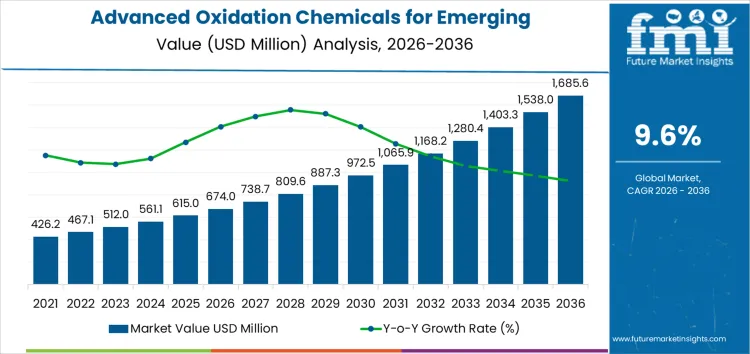
The Advanced Oxidation Chemicals for Emerging Contaminants market is estimated at USD 674 million in 2026, reaching USD 1685.6 million by 2036 at a CAGR of 9.6%. Initial growth from 2026 to 2029 is primarily driven by municipal water and industrial wastewater applications, with liquid dosing solutions and stabilized concentrates forming the dominant product formats. Regulatory frameworks targeting emerging contaminants, alongside increasing adoption of advanced oxidation processes like ozone, UV, and peroxide blends, create early momentum. Growing awareness of water safety and pollution control, coupled with investments in treatment infrastructure, forms the foundation of market expansion during this phase.
Between 2030 and 2036, the market experiences accelerated adoption across healthcare sanitation, food and beverage processing, and aquaculture applications. Innovations in advanced oxidation chemistry, improved operational efficiency, and enhanced environmental compliance contribute to sustained demand. Encapsulated and controlled-release chemical formulations gain traction for specialized applications. Rising pressure from stricter discharge and effluent regulations globally further reinforces adoption. Integration of automated dosing, real-time monitoring, and safer handling practices enables end users to optimize treatment efficacy. By 2036, broad implementation across multiple industrial and municipal sectors solidifies the market’s growth trajectory and establishes a mature, high-value segment within water treatment chemistry.
Quick Stats for Advanced Oxidation Chemicals for Emerging Contaminants Market
- Advanced Oxidation Chemicals for Emerging Contaminants Market Value (2026): USD 674 million
- Advanced Oxidation Chemicals for Emerging Contaminants Market Forecast Value (2036): USD 1,685.6 million
- Advanced Oxidation Chemicals for Emerging Contaminants Market Forecast CAGR: 9.6%
- Leading Type in Advanced Oxidation Chemicals for Emerging Contaminants Market: Ozone & Ozonated Blends
- Key Growth Regions in Advanced Oxidation Chemicals for Emerging Contaminants Market: North America, Europe, and Asia Pacific
- Top Players in Advanced Oxidation Chemicals for Emerging Contaminants Market: Solvay, Evonik, Kemira, SUEZ Water Technologies, Veolia Water Technologies
What is the Growth Forecast for the Advanced Oxidation Chemicals for Emerging Contaminants Market through 2036?
From 2026 to 2031, the advanced oxidation chemicals market grows from USD 674 million to approximately USD 1,031 million, representing the early adoption phase. Annual increments rise from USD 67 million in 2026 to USD 104 million in 2031. Growth is driven by adoption in municipal and industrial water treatment, pharmaceutical effluents, and wastewater treatment plants, where emerging contaminants such as pharmaceuticals, personal care products, and endocrine disruptors require advanced chemical oxidation solutions. North America and Europe account for roughly 60% of early adoption, with uptake concentrated in high-value facilities validating oxidation efficiency, regulatory compliance, and operational integration.
Between 2031 and 2036, the market expands from roughly USD 1,031 million to USD 1,685.6 million, illustrating the late adoption phase characterized by structural deployment and broader commercialization. Annual increments increase steadily from USD 104 million to USD 144 million, driven by multi-site adoption, repeat procurement, and expansion in emerging markets in Asia Pacific and Latin America. Growth is reinforced by regulatory mandates targeting emerging contaminants, increasing environmental compliance requirements, and integration of advanced oxidation chemicals into automated water and wastewater treatment systems. Early growth relied on pilot projects and selective high-value sites, while later expansion reflects normalized adoption and full-scale deployment globally.
Advanced Oxidation Chemicals for Emerging Contaminants Market Key Takeaways
| Metric | Value |
|---|---|
| Market Value (2026) | USD 674 million |
| Forecast Value (2036) | USD 1,685.6 million |
| Forecast CAGR (2026 to 2036) | 9.6% |
What Is Driving Demand in the Advanced Oxidation Chemicals for Emerging Contaminants Market?
Demand for advanced oxidation chemicals to address emerging contaminants grew from gaps in conventional water treatment that became evident as analytical methods improved. Traditional disinfection and treatment processes effectively reduced microbes and some regulated chemical constituents, but they did not reliably remove persistent organic pollutants such as pharmaceutical residues, endocrine-disrupting compounds, and industrial solvents. Utilities and industrial facilities found that these trace contaminants resisted chlorination, coagulation, and biological treatment steps, raising concerns over drinking water safety and regulatory compliance. Early use of advanced oxidation chemicals such as hydrogen peroxide activated with ozone, ultraviolet light, or catalysts was driven by specific breakthrough occurrences rather than widespread treatment redesign. Facilities adopted these chemistries in targeted applications where conventional methods failed to reduce contaminant concentrations to desired levels.
Future demand for advanced oxidation chemicals will be shaped by structured regulatory pressures, source water protection strategies, and performance-based treatment standards rather than by isolated contaminant removal needs alone. Regulatory agencies are increasingly evaluating broader classes of trace compounds in drinking water and setting tighter guidelines, prompting water managers to pursue oxidation pathways that generate highly reactive radicals capable of breaking down complex molecules. Chemical selection is becoming integrated into treatment train optimisation, aligning advanced oxidation with upstream coagulation and downstream filtration to improve overall removal efficiency. Utilities are conducting routine monitoring for a wider array of contaminants, creating documented evidence of treatment gaps that advanced oxidation addresses.
What Factors Are Affecting the Demand for Advanced Oxidation Chemicals for Emerging Contaminants Market in Terms of Oxidation Chemical Type and Contaminant Type?
The advanced oxidation chemicals market for emerging contaminants is driven by growing regulatory focus on substances that evade conventional water treatment processes. Utilities and industrial operators are under pressure to address trace level pollutants linked to long term health and environmental risk. Demand is shaped by treatment reliability, regulatory acceptance, and compatibility with existing infrastructure. Market growth reflects targeted investment in advanced oxidation processes rather than broad replacement of traditional treatment chemistries.
What Is Driving Leadership by Oxidation Chemical Type in the Advanced Oxidation Chemicals for Emerging Contaminants Market?
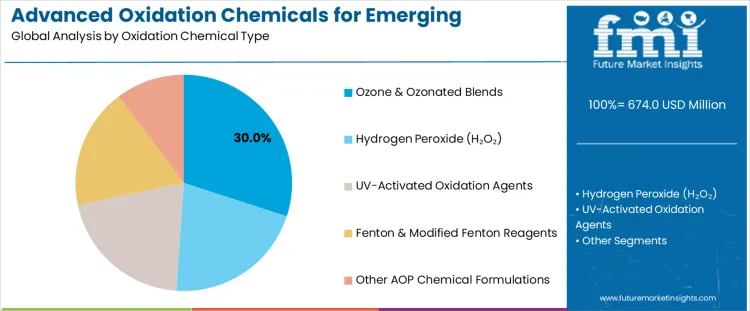
Ozone and ozonated blends account for about thirty percent of demand because they deliver strong oxidation potential against persistent emerging contaminants. Utilities and industrial operators favor ozone where conventional treatment fails to break down complex organic molecules. Ozonated systems support rapid reaction kinetics and can be integrated into existing treatment trains. Their effectiveness across diverse contaminant profiles makes them suitable for pilot scale and full scale deployment in regulated water treatment applications.
Hydrogen peroxide, UV activated agents, Fenton reagents, and other formulations address specific oxidation pathways but remain more situational. Peroxide based systems are valued for control and safety but require activation to reach full effectiveness. UV activated chemistries improve selectivity yet depend on energy input. Fenton reagents target industrial organics but introduce handling complexity. These alternatives expand treatment options without displacing ozone as the dominant chemical foundation within advanced oxidation process design frameworks.
What Is Driving Leadership by Contaminant Type in the Advanced Oxidation Chemicals for Emerging Contaminants Market?
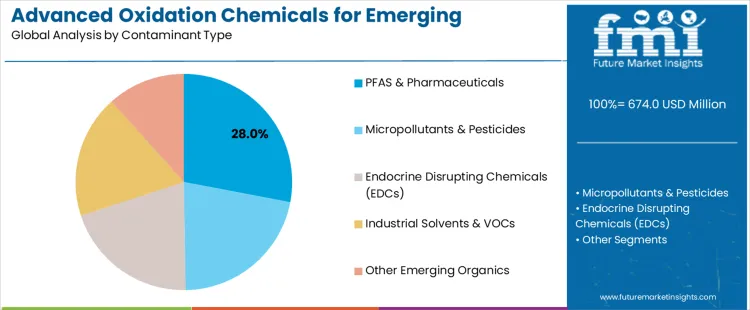
PFAS and pharmaceutical contaminants account for about twenty eight percent of demand because they resist conventional filtration and biological treatment. Regulatory focus on these compounds drives adoption of advanced oxidation chemicals capable of molecular breakdown. Ozone and combined AOP systems are frequently specified to address trace level persistence. Treatment plants prioritize these contaminants due to public health concern, monitoring requirements, and limited alternative removal technologies available today under emerging contaminant regulation programs.
Micropollutants, pesticides, endocrine disrupting chemicals, and industrial solvents form secondary demand segments with varied treatment needs. These contaminants often occur intermittently or at site specific concentrations, influencing chemical selection. Advanced oxidation agents are applied selectively based on influent composition and cost tolerance. Although these segments expand total demand, they do not match the regulatory urgency or consistency associated with PFAS focused treatment programs in large scale municipal and industrial remediation contexts globally.
How Are Advanced Oxidation Chemicals Being Applied for Emerging Contaminants in Water Treatment?
Use appears in municipal and industrial water systems where conventional treatment fails to remove pharmaceuticals, personal care products, pesticides, and other micropollutants. Operators adopt advanced oxidation chemicals (AOCs) such as ozone, hydrogen peroxide, and persulfates to degrade complex organic molecules and achieve regulatory compliance. Drinking water utilities, wastewater treatment plants, and industrial process water facilities integrate AOCs to improve effluent quality, protect public health, and reduce environmental impact. These applications reflect operational and environmental priorities rather than aesthetic purposes, with adoption driven by contaminant removal efficacy and regulatory adherence.
What Operational and Material Conditions Support Adoption of Advanced Oxidation Chemicals?
Selection aligns with water systems requiring high oxidation potential to target recalcitrant organic compounds. Chemical dosing, contact time, pH, and temperature are optimized for efficient degradation while minimizing residual toxicity. Facilities implement monitoring protocols to track contaminant concentrations and oxidant residuals. Operators ensure compatibility with existing infrastructure, including pipelines, pumps, and filtration systems. These conditions emerge from operational efficiency, contaminant control, and environmental compliance priorities in structured water treatment workflows.
Which Practical Considerations Limit Wider Use of Advanced Oxidation Chemicals?
High chemical and operational costs can limit adoption in small or low-margin facilities. Reaction byproducts may require further treatment or monitoring. Safety concerns related to handling and storage of strong oxidants necessitate specialized protocols. Efficacy can vary with water chemistry, organic load, and turbidity. Regulatory approval and environmental discharge guidelines differ by region. These factors lead to selective deployment where contaminant removal, compliance, and operational reliability justify incremental cost and process management.
What is the Demand for Advanced Oxidation Chemicals for Emerging Contaminants by Country?
| Country | CAGR (%) |
|---|---|
| India | 10.4% |
| China | 10.1% |
| USA | 8.5% |
| Germany | 7.8% |
| South Korea | 7.6% |
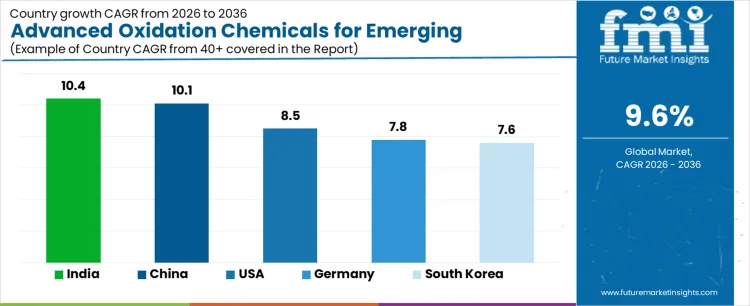
The demand for advanced oxidation chemicals for emerging contaminants varies across countries, driven by water treatment regulations, industrial discharge management, and environmental safety initiatives. India leads with a 10.4% CAGR, supported by growing municipal and industrial water treatment infrastructure, rising awareness of emerging contaminants, and adoption of advanced chemical treatment solutions. China follows at 10.1%, driven by extensive water treatment programs, industrial wastewater management, and regulatory compliance. The USA grows at 8.5%, reflecting adoption in municipal, industrial, and environmental remediation applications. Germany records 7.8%, shaped by mature water treatment systems and stringent environmental standards. South Korea posts 7.6%, supported by industrial water treatment initiatives and advanced oxidation chemical adoption.
How Are Advanced Oxidation Chemicals Tackling Emerging Contaminants in India?
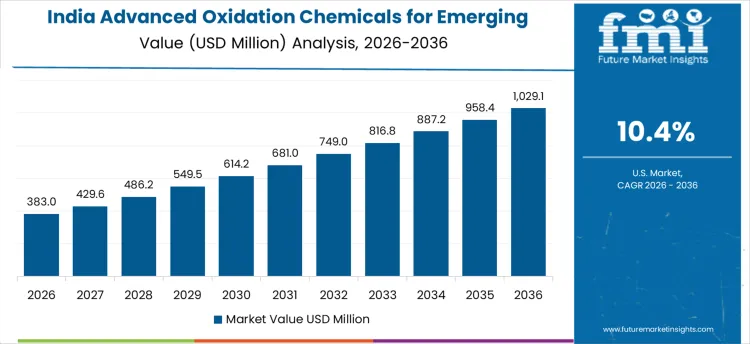
In India, the Advanced Oxidation Chemicals for Emerging Contaminants Market is expanding at a CAGR of 10.4% through 2036, driven by growing adoption in municipal water treatment plants, industrial facilities, and pharmaceutical manufacturing. Facilities are integrating advanced oxidation chemicals to remove micropollutants, pharmaceuticals, and persistent organic compounds from water systems, ensuring safe drinking water and regulatory compliance. Demand is concentrated in urban water networks, industrial processing plants, and pharmaceutical effluent treatment units. Domestic suppliers provide high-performance, environmentally compliant chemicals compatible with various water treatment technologies. Regulatory oversight, recurring treatment programs, and rising water safety awareness are sustaining robust adoption nationwide.
- Urban water networks, industrial plants, and pharmaceutical treatment units drive adoption
- Chemicals remove micropollutants, pharmaceuticals, and persistent organic compounds
- Domestic suppliers provide environmentally compliant, high-performance solutions
- Recurring treatment programs sustain robust adoption
How Is Water Quality Regulation Supporting Growth in China?
In China, revenue is growing at a CAGR of 10.1% through 2036, supported by strict water safety standards and rising concern over emerging contaminants. Municipal utilities, industrial plants, and pharmaceutical facilities are using advanced oxidation chemicals to degrade micropollutants, improve water quality, and comply with environmental regulations. Demand is concentrated in urban water treatment plants, industrial clusters, and pharmaceutical effluent systems. Domestic suppliers are scaling production of high-performance, treatment-compatible chemicals. Expansion of water infrastructure, regulatory enforcement, and recurring treatment cycles are sustaining rapid adoption nationwide.
- Urban water treatment plants, industrial clusters, and pharmaceutical systems drive adoption
- Chemicals degrade micropollutants and improve water quality
- Domestic suppliers scale high-performance, treatment-compatible solutions
- Recurring treatment cycles sustain rapid adoption
How Are Industrial Water Safety Programs Driving Adoption in the United States?
In the United States, the market is expanding at a CAGR of 8.5% through 2036, driven by adoption of advanced oxidation chemicals to remove trace contaminants from drinking water and industrial process streams. Utilities and industrial facilities are using these chemicals to mitigate pharmaceuticals, endocrine disruptors, and persistent organic compounds while ensuring regulatory compliance. Demand is concentrated in municipal water systems, industrial treatment plants, and pharmaceutical manufacturing units. Domestic suppliers provide high-performance, regulatory-compliant chemicals compatible with existing treatment technologies. Recurring water treatment operations, regulatory enforcement, and rising awareness of emerging contaminants are sustaining predictable adoption nationwide.
- Municipal water systems, industrial treatment plants, and pharmaceutical units drive adoption
- Chemicals mitigate trace contaminants including pharmaceuticals and endocrine disruptors
- Domestic suppliers provide regulatory-compliant, high-performance solutions
- Recurring water treatment operations sustain predictable adoption
How Are Environmental Standards Supporting Adoption in Germany?
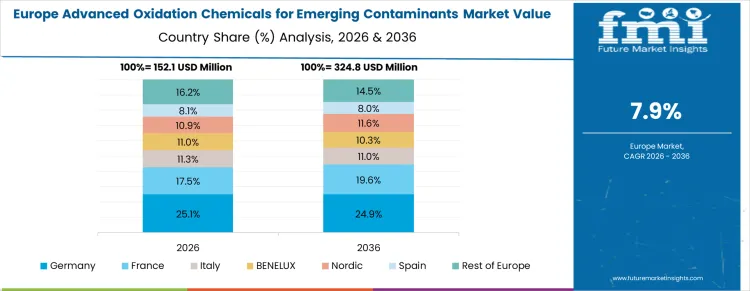
In Germany, revenue is growing at a CAGR of 7.8% through 2036, driven by stringent water quality regulations and the need to remove emerging contaminants from drinking water and industrial wastewater. Municipal utilities and industrial facilities are adopting advanced oxidation chemicals to degrade micropollutants, pharmaceuticals, and persistent organic compounds. Demand is concentrated in municipal water treatment plants, industrial clusters, and pharmaceutical effluent systems. Domestic suppliers provide high-quality, environmentally compatible chemicals suitable for advanced water treatment processes. Regulatory compliance, recurring treatment operations, and public health initiatives are sustaining steady adoption nationwide.
- Municipal water treatment plants, industrial clusters, and pharmaceutical facilities drive adoption
- Chemicals degrade micropollutants and persistent contaminants
- Domestic suppliers provide environmentally compatible, high-quality solutions
- Recurring treatment operations sustain steady adoption
How Are Industrial Water Safety and Infrastructure Driving Growth in South Korea?
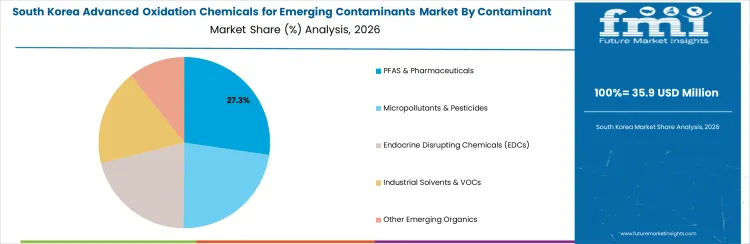
In South Korea, the market is expanding at a CAGR of 7.6% through 2036, supported by increasing adoption of advanced oxidation chemicals in municipal water systems, industrial facilities, and pharmaceutical plants. Facilities are using these chemicals to eliminate micropollutants, pharmaceutical residues, and organic contaminants from water systems while complying with environmental regulations. Demand is concentrated in urban water treatment plants, industrial manufacturing sites, and pharmaceutical wastewater treatment facilities. Domestic suppliers provide high-performance, treatment-compatible chemicals. Rising industrial water treatment requirements, regulatory oversight, and recurring maintenance cycles are sustaining steady adoption nationwide.
- Urban water treatment plants, industrial sites, and pharmaceutical facilities drive adoption
- Chemicals eliminate micropollutants and pharmaceutical residues
- Domestic suppliers provide high-performance, treatment-compatible solutions
- Recurring maintenance cycles sustain steady adoption
Which Strategic Approaches Are Companies Using to Compete in The Advanced Oxidation Chemicals for Emerging Contaminants Market?
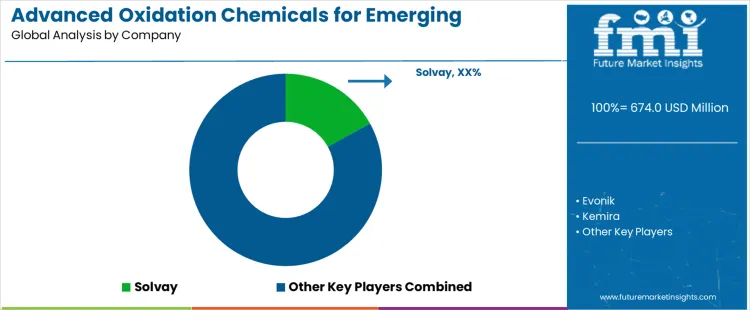
Competition in the Advanced Oxidation Chemicals for Emerging Contaminants Market is shaped by how suppliers address contaminants that are difficult to remove using conventional treatment. Strategies focus on pairing oxidants with process conditions that generate reactive species capable of degrading pharmaceuticals, PFAS precursors, and trace organics. Solvay and Evonik emphasize chemistry performance under controlled reaction windows, supplying hydrogen peroxide and specialty oxidants optimized for UV, ozone, or catalytic activation. Kemira approaches the market through treatment optimization, positioning oxidation chemicals as part of broader programs that manage precursor load and reaction efficiency. Utilities and industrial operators select suppliers based on demonstrated contaminant breakdown across variable water matrices rather than theoretical oxidation strength.
System integration and risk management define competitive differentiation. SUEZ Water Technologies and Veolia Water Technologies compete by embedding advanced oxidation within engineered treatment trains, combining chemicals with reactors, monitoring, and control strategies. Their approach emphasizes pilot testing, contaminant specific modeling, and alignment with regulatory scrutiny for emerging compounds. Chemical selection is influenced by byproduct control, operational safety, and compatibility with downstream processes such as biological treatment or carbon adsorption. Across the market, suppliers invest in validation studies and long term performance data to support conservative adoption. Competitive advantage depends on predictability, regulatory confidence, and the ability to adapt oxidation strategies as contaminant profiles evolve rather than rapid chemistry substitution.
Key Players in the Advanced Oxidation Chemicals for Emerging Contaminants Market
- Solvay
- Evonik
- Kemira
- SUEZ Water Technologies
- Veolia Water Technologies
Scope of the Report
| Items | Values |
|---|---|
| Quantitative Units (2026) | USD million |
| Oxidation Chemical Type | Ozone & Ozonated Blends, Hydrogen Peroxide (H₂O₂), UV-Activated Oxidation Agents, Fenton & Modified Fenton Reagents, Other AOP Chemical Formulations |
| Contaminant Type | PFAS & Pharmaceuticals, Micropollutants & Pesticides, Endocrine Disrupting Chemicals (EDCs), Industrial Solvents & VOCs, Other Emerging Organics |
| Application Sector | Municipal Water & Wastewater, Industrial Effluent Treatment, Groundwater & Aquifer Remediation, Drinking Water Purification, Advanced Treatment & Pilot Systems |
| Delivery Form | Liquid Dosing Solutions, Stabilized Concentrates, Tablet / Powder Formulations, Encapsulated / Controlled Release, Other Specialty Formats |
| End-Use Industry | Municipal Utilities, Industrial Facilities, Pharmaceutical Manufacturing, Food & Beverage Processors, Groundwater Treatment Facilities, Pilot and Advanced Treatment Operators |
| Region | Asia Pacific, Europe, North America, Latin America, Middle East & Africa |
| Countries Covered | China, Japan, South Korea, India, Australia & New Zealand, ASEAN, Rest of Asia Pacific, Germany, United Kingdom, France, Italy, Spain, Nordic, BENELUX, Rest of Europe, USA, Canada, Mexico, Brazil, Chile, Rest of Latin America, Kingdom of Saudi Arabia, Other GCC Countries, Turkey, South Africa, Other African Union, Rest of Middle East & Africa |
| Key Companies Profiled | Solvay, Evonik, Kemira, SUEZ Water Technologies, Veolia Water Technologies |
| Additional Attributes | Dollar by sales by oxidation chemical type, Dollar by sales by contaminant type, Dollar by sales by application sector, Dollar by sales by region, Annual procurement cycles, Adoption intervals / breakpoints, Regulatory compliance (EPA, EU, local standards), Operational efficiency metrics, System compatibility, Lifecycle impact assessment, Recurring treatment operations, Performance under varying pH, temperature, and water chemistry conditions, Integration with automated dosing systems, Domestic vs. international supplier distribution |
Advanced Oxidation Chemicals for Emerging Contaminants Market Segmentation
Oxidation Chemical Type:
- Ozone & Ozonated Blends
- Hydrogen Peroxide (H₂O₂)
- UV-Activated Oxidation Agents
- Fenton & Modified Fenton Reagents
- Other AOP Chemical Formulations
Contaminant Type:
- PFAS & Pharmaceuticals
- Micropollutants & Pesticides
- Endocrine Disrupting Chemicals (EDCs)
- Industrial Solvents & VOCs
- Other Emerging Organics
Application Sector:
- Municipal Water & Wastewater
- Industrial Effluent Treatment
- Groundwater & Aquifer Remediation
- Drinking Water Purification
- Advanced Treatment & Pilot Systems
Region
- Asia Pacific
- China
- Japan
- South Korea
- India
- Australia & New Zealand
- ASEAN
- Rest of Asia Pacific
- Europe
- Germany
- United Kingdom
- France
- Italy
- Spain
- Nordic
- BENELUX
- Rest of Europe
- North America
- United States
- Canada
- Mexico
- Latin America
- Brazil
- Chile
- Rest of Latin America
- Middle East & Africa
- Kingdom of Saudi Arabia
- Other GCC Countries
- Turkey
- South Africa
- Other African Union
- Rest of Middle East & Africa
Bibliography
- World Health Organization. (2023). Guidelines for drinking-water quality: Emerging contaminants and advanced oxidation treatment approaches. World Health Organization.
- USA Environmental Protection Agency. (2024). Advanced oxidation processes for removal of PFAS, pharmaceuticals, and emerging contaminants. USA Environmental Protection Agency.
- European Commission. (2023). Water framework directive technical guidance on micropollutants and advanced oxidation processes. European Commission.
- Evonik Industries. (2024). Hydrogen peroxide and advanced oxidation chemistries for municipal and industrial water treatment. Evonik Industries AG.
- SUEZ Water Technologies. (2023). Advanced oxidation solutions for emerging contaminant removal in water and wastewater treatment. SUEZ S.A.
Frequently Asked Questions
How big is the advanced oxidation chemicals for emerging contaminants market in 2026?
The global advanced oxidation chemicals for emerging contaminants market is estimated to be valued at USD 674.0 million in 2026.
What will be the size of advanced oxidation chemicals for emerging contaminants market in 2036?
The market size for the advanced oxidation chemicals for emerging contaminants market is projected to reach USD 1,685.6 million by 2036.
How much will be the advanced oxidation chemicals for emerging contaminants market growth between 2026 and 2036?
The advanced oxidation chemicals for emerging contaminants market is expected to grow at a 9.6% CAGR between 2026 and 2036.
What are the key product types in the advanced oxidation chemicals for emerging contaminants market?
The key product types in advanced oxidation chemicals for emerging contaminants market are ozone & ozonated blends, hydrogen peroxide (h₂o₂), uv-activated oxidation agents, fenton & modified fenton reagents and other aop chemical formulations.
Which contaminant type segment to contribute significant share in the advanced oxidation chemicals for emerging contaminants market in 2026?
In terms of contaminant type, pfas & pharmaceuticals segment to command 28.0% share in the advanced oxidation chemicals for emerging contaminants market in 2026.
Preview the report firsthand - request a free sample
Get SampleGet the brochure for pricing and purchase details.
Get PDFTable of Content
- Executive Summary
- Global Market Outlook
- Demand-side Trends
- Supply-side Trends
- Technology Roadmap Analysis
- Analysis and Recommendations
- Market Overview
- Market Coverage / Taxonomy
- Market Definition / Scope / Limitations
- Market Background
- Market Dynamics
- Drivers
- Restraints
- Opportunity
- Trends
- Scenario Forecast
- Demand in Optimistic Scenario
- Demand in Likely Scenario
- Demand in Conservative Scenario
- Opportunity Map Analysis
- Product Life Cycle Analysis
- Supply Chain Analysis
- Investment Feasibility Matrix
- Value Chain Analysis
- PESTLE and Porter’s Analysis
- Regulatory Landscape
- Regional Parent Market Outlook
- Production and Consumption Statistics
- Import and Export Statistics
- Market Dynamics
- Global Market Analysis 2021 to 2025 and Forecast, 2026 to 2036
- Historical Market Size Value (USD Million) Analysis, 2021 to 2025
- Current and Future Market Size Value (USD Million) Projections, 2026 to 2036
- Y-o-Y Growth Trend Analysis
- Absolute $ Opportunity Analysis
- Global Market Pricing Analysis 2021 to 2025 and Forecast 2026 to 2036
- Global Market Analysis 2021 to 2025 and Forecast 2026 to 2036, By Oxidation Chemical Type
- Introduction / Key Findings
- Historical Market Size Value (USD Million) Analysis By Oxidation Chemical Type , 2021 to 2025
- Current and Future Market Size Value (USD Million) Analysis and Forecast By Oxidation Chemical Type , 2026 to 2036
- Ozone & Ozonated Blends
- Hydrogen Peroxide (H₂O₂)
- UV-Activated Oxidation Agents
- Fenton & Modified Fenton Reagents
- Other AOP Chemical Formulations
- Ozone & Ozonated Blends
- Y-o-Y Growth Trend Analysis By Oxidation Chemical Type , 2021 to 2025
- Absolute $ Opportunity Analysis By Oxidation Chemical Type , 2026 to 2036
- Global Market Analysis 2021 to 2025 and Forecast 2026 to 2036, By Contaminant Type
- Introduction / Key Findings
- Historical Market Size Value (USD Million) Analysis By Contaminant Type, 2021 to 2025
- Current and Future Market Size Value (USD Million) Analysis and Forecast By Contaminant Type, 2026 to 2036
- PFAS & Pharmaceuticals
- Micropollutants & Pesticides
- Endocrine Disrupting Chemicals (EDCs)
- Industrial Solvents & VOCs
- Other Emerging Organics
- PFAS & Pharmaceuticals
- Y-o-Y Growth Trend Analysis By Contaminant Type, 2021 to 2025
- Absolute $ Opportunity Analysis By Contaminant Type, 2026 to 2036
- Global Market Analysis 2021 to 2025 and Forecast 2026 to 2036, By Application Sector
- Introduction / Key Findings
- Historical Market Size Value (USD Million) Analysis By Application Sector, 2021 to 2025
- Current and Future Market Size Value (USD Million) Analysis and Forecast By Application Sector, 2026 to 2036
- Municipal Water & Wastewater
- Industrial Effluent Treatment
- Groundwater & Aquifer Remediation
- Drinking Water Purification
- Advanced Treatment & Pilot Systems
- Municipal Water & Wastewater
- Y-o-Y Growth Trend Analysis By Application Sector, 2021 to 2025
- Absolute $ Opportunity Analysis By Application Sector, 2026 to 2036
- Global Market Analysis 2021 to 2025 and Forecast 2026 to 2036, By Region
- Introduction
- Historical Market Size Value (USD Million) Analysis By Region, 2021 to 2025
- Current Market Size Value (USD Million) Analysis and Forecast By Region, 2026 to 2036
- North America
- Latin America
- Western Europe
- Eastern Europe
- East Asia
- South Asia and Pacific
- Middle East & Africa
- Market Attractiveness Analysis By Region
- North America Market Analysis 2021 to 2025 and Forecast 2026 to 2036, By Country
- Historical Market Size Value (USD Million) Trend Analysis By Market Taxonomy, 2021 to 2025
- Market Size Value (USD Million) Forecast By Market Taxonomy, 2026 to 2036
- By Country
- USA
- Canada
- Mexico
- By Oxidation Chemical Type
- By Contaminant Type
- By Application Sector
- By Country
- Market Attractiveness Analysis
- By Country
- By Oxidation Chemical Type
- By Contaminant Type
- By Application Sector
- Key Takeaways
- Latin America Market Analysis 2021 to 2025 and Forecast 2026 to 2036, By Country
- Historical Market Size Value (USD Million) Trend Analysis By Market Taxonomy, 2021 to 2025
- Market Size Value (USD Million) Forecast By Market Taxonomy, 2026 to 2036
- By Country
- Brazil
- Chile
- Rest of Latin America
- By Oxidation Chemical Type
- By Contaminant Type
- By Application Sector
- By Country
- Market Attractiveness Analysis
- By Country
- By Oxidation Chemical Type
- By Contaminant Type
- By Application Sector
- Key Takeaways
- Western Europe Market Analysis 2021 to 2025 and Forecast 2026 to 2036, By Country
- Historical Market Size Value (USD Million) Trend Analysis By Market Taxonomy, 2021 to 2025
- Market Size Value (USD Million) Forecast By Market Taxonomy, 2026 to 2036
- By Country
- Germany
- UK
- Italy
- Spain
- France
- Nordic
- BENELUX
- Rest of Western Europe
- By Oxidation Chemical Type
- By Contaminant Type
- By Application Sector
- By Country
- Market Attractiveness Analysis
- By Country
- By Oxidation Chemical Type
- By Contaminant Type
- By Application Sector
- Key Takeaways
- Eastern Europe Market Analysis 2021 to 2025 and Forecast 2026 to 2036, By Country
- Historical Market Size Value (USD Million) Trend Analysis By Market Taxonomy, 2021 to 2025
- Market Size Value (USD Million) Forecast By Market Taxonomy, 2026 to 2036
- By Country
- Russia
- Poland
- Hungary
- Balkan & Baltic
- Rest of Eastern Europe
- By Oxidation Chemical Type
- By Contaminant Type
- By Application Sector
- By Country
- Market Attractiveness Analysis
- By Country
- By Oxidation Chemical Type
- By Contaminant Type
- By Application Sector
- Key Takeaways
- East Asia Market Analysis 2021 to 2025 and Forecast 2026 to 2036, By Country
- Historical Market Size Value (USD Million) Trend Analysis By Market Taxonomy, 2021 to 2025
- Market Size Value (USD Million) Forecast By Market Taxonomy, 2026 to 2036
- By Country
- China
- Japan
- South Korea
- By Oxidation Chemical Type
- By Contaminant Type
- By Application Sector
- By Country
- Market Attractiveness Analysis
- By Country
- By Oxidation Chemical Type
- By Contaminant Type
- By Application Sector
- Key Takeaways
- South Asia and Pacific Market Analysis 2021 to 2025 and Forecast 2026 to 2036, By Country
- Historical Market Size Value (USD Million) Trend Analysis By Market Taxonomy, 2021 to 2025
- Market Size Value (USD Million) Forecast By Market Taxonomy, 2026 to 2036
- By Country
- India
- ASEAN
- Australia & New Zealand
- Rest of South Asia and Pacific
- By Oxidation Chemical Type
- By Contaminant Type
- By Application Sector
- By Country
- Market Attractiveness Analysis
- By Country
- By Oxidation Chemical Type
- By Contaminant Type
- By Application Sector
- Key Takeaways
- Middle East & Africa Market Analysis 2021 to 2025 and Forecast 2026 to 2036, By Country
- Historical Market Size Value (USD Million) Trend Analysis By Market Taxonomy, 2021 to 2025
- Market Size Value (USD Million) Forecast By Market Taxonomy, 2026 to 2036
- By Country
- Kingdom of Saudi Arabia
- Other GCC Countries
- Turkiye
- South Africa
- Other African Union
- Rest of Middle East & Africa
- By Oxidation Chemical Type
- By Contaminant Type
- By Application Sector
- By Country
- Market Attractiveness Analysis
- By Country
- By Oxidation Chemical Type
- By Contaminant Type
- By Application Sector
- Key Takeaways
- Key Countries Market Analysis
- USA
- Pricing Analysis
- Market Share Analysis, 2025
- By Oxidation Chemical Type
- By Contaminant Type
- By Application Sector
- Canada
- Pricing Analysis
- Market Share Analysis, 2025
- By Oxidation Chemical Type
- By Contaminant Type
- By Application Sector
- Mexico
- Pricing Analysis
- Market Share Analysis, 2025
- By Oxidation Chemical Type
- By Contaminant Type
- By Application Sector
- Brazil
- Pricing Analysis
- Market Share Analysis, 2025
- By Oxidation Chemical Type
- By Contaminant Type
- By Application Sector
- Chile
- Pricing Analysis
- Market Share Analysis, 2025
- By Oxidation Chemical Type
- By Contaminant Type
- By Application Sector
- Germany
- Pricing Analysis
- Market Share Analysis, 2025
- By Oxidation Chemical Type
- By Contaminant Type
- By Application Sector
- UK
- Pricing Analysis
- Market Share Analysis, 2025
- By Oxidation Chemical Type
- By Contaminant Type
- By Application Sector
- Italy
- Pricing Analysis
- Market Share Analysis, 2025
- By Oxidation Chemical Type
- By Contaminant Type
- By Application Sector
- Spain
- Pricing Analysis
- Market Share Analysis, 2025
- By Oxidation Chemical Type
- By Contaminant Type
- By Application Sector
- France
- Pricing Analysis
- Market Share Analysis, 2025
- By Oxidation Chemical Type
- By Contaminant Type
- By Application Sector
- India
- Pricing Analysis
- Market Share Analysis, 2025
- By Oxidation Chemical Type
- By Contaminant Type
- By Application Sector
- ASEAN
- Pricing Analysis
- Market Share Analysis, 2025
- By Oxidation Chemical Type
- By Contaminant Type
- By Application Sector
- Australia & New Zealand
- Pricing Analysis
- Market Share Analysis, 2025
- By Oxidation Chemical Type
- By Contaminant Type
- By Application Sector
- China
- Pricing Analysis
- Market Share Analysis, 2025
- By Oxidation Chemical Type
- By Contaminant Type
- By Application Sector
- Japan
- Pricing Analysis
- Market Share Analysis, 2025
- By Oxidation Chemical Type
- By Contaminant Type
- By Application Sector
- South Korea
- Pricing Analysis
- Market Share Analysis, 2025
- By Oxidation Chemical Type
- By Contaminant Type
- By Application Sector
- Russia
- Pricing Analysis
- Market Share Analysis, 2025
- By Oxidation Chemical Type
- By Contaminant Type
- By Application Sector
- Poland
- Pricing Analysis
- Market Share Analysis, 2025
- By Oxidation Chemical Type
- By Contaminant Type
- By Application Sector
- Hungary
- Pricing Analysis
- Market Share Analysis, 2025
- By Oxidation Chemical Type
- By Contaminant Type
- By Application Sector
- Kingdom of Saudi Arabia
- Pricing Analysis
- Market Share Analysis, 2025
- By Oxidation Chemical Type
- By Contaminant Type
- By Application Sector
- Turkiye
- Pricing Analysis
- Market Share Analysis, 2025
- By Oxidation Chemical Type
- By Contaminant Type
- By Application Sector
- South Africa
- Pricing Analysis
- Market Share Analysis, 2025
- By Oxidation Chemical Type
- By Contaminant Type
- By Application Sector
- USA
- Market Structure Analysis
- Competition Dashboard
- Competition Benchmarking
- Market Share Analysis of Top Players
- By Regional
- By Oxidation Chemical Type
- By Contaminant Type
- By Application Sector
- Competition Analysis
- Competition Deep Dive
- Solvay
- Overview
- Product Portfolio
- Profitability by Market Segments (Product/Age /Sales Channel/Region)
- Sales Footprint
- Strategy Overview
- Marketing Strategy
- Product Strategy
- Channel Strategy
- Evonik
- Kemira
- SUEZ Water Technologies
- Veolia Water Technologies
- Solvay
- Competition Deep Dive
- Assumptions & Acronyms Used
- Research Methodology


