

- Industry Size (2025)
- USD 106 Mn
- Forecast (2035)
- USD 187 Mn
- CAGR (2025 to 2035)
- 2.9%
PFAS-Free Powder Coating Texture Additives Market Forecast and Outlook 2026 to 2036
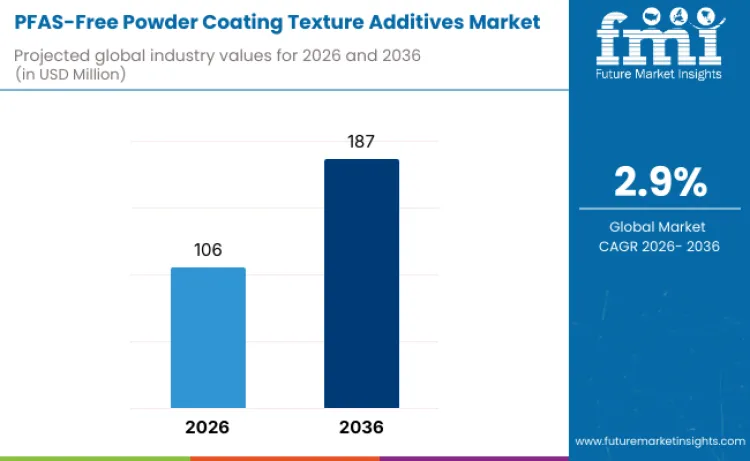
The global PFAS-free powder coating texture additives market, valued at USD 106 million in 2026, is projected to grow to USD 187 million by 2036, with a CAGR of 5.90%. The PFAS-free powder coating texture additives market is driven by rising demand for eco-friendly coating solutions and growing adoption of powder coatings across the automotive and industrial equipment industries.
Matting agents, which account for 25% of the additive market share, are in high demand for their ability to create smooth, consistent finishes with reduced gloss. Smooth texture additives, which account for 25% of the texture type segment, dominate due to their versatile application in a wide range of products requiring smooth surface finishes. The shift toward sustainable and non-toxic coating solutions supports the PFAS-free powder coating texture additives market growth.
Quick Stats for PFAS-Free Powder Coating Texture Additives Market
- PFAS-Free Powder Coating Texture Additives Market Value (2026): USD 106 million
- PFAS-Free Powder Coating Texture Additives Market Forecast Value (2036): USD 187 million
- PFAS-Free Powder Coating Texture Additives Market Global Forecast CAGR: 5.90%
- Leading Additive Type in PFAS-Free Powder Coating Texture Additives Market: Matting agents (25%)
- Key Growth Regions in PFAS-Free Powder Coating Texture Additives Market: China, India, USA, UK, Japan
- Top Players in PFAS-Free Powder Coating Texture Additives Market: Micro Powders, Clariant, Shamrock Technologies, Lubrizol, Wyn Polymers, Covestro, Evonik
PFAS-Free Powder Coating Texture Additives Market Key Takeaways
| Metric | Value |
|---|---|
| Industry Sales Value (2026) | USD 106 million |
| Industry Forecast Value (2036) | USD 187 million |
| Industry Forecast CAGR (2026-2036) | 2.9% |
What Is Driving the Demand for PFAS Free Powder Coating Texture Additives Globally?
Demand for PFAS‑free powder coating texture additives globally is driven by rising regulatory restrictions on PFAS chemicals and growing industry focus on safer, compliant surface finishes. Powder coatings are widely used on appliances, automotive parts, architectural metal, furniture, and industrial equipment. Texture additives provide surface effects such as matte, wrinkle, stone, or textured finishes that enhance appearance and performance. Historically some powder coating systems incorporated PFAS or related chemistries to improve flow, leveling, and surface properties, but tightening controls on PFAS in major markets have pushed formulators to seek alternatives that avoid persistent substances. Regulations in North America, Europe, and parts of Asia now restrict or plan to limit PFAS uses in industrial and consumer products, prompting coating producers and additive suppliers to reformulate texture systems. At the same time, brand owners and end‑use manufacturers are under pressure to satisfy customer expectations for safer materials and environmental stewardship, which increases interest in PFAS‑free additives that can deliver desired texture effects without legacy chemistries.
Future demand for PFAS‑free powder coating texture additives is expected to grow as global powder coating use expands and regulations continue to evolve. Growth in end markets such as construction, automotive, consumer electronics, and furniture supports broader adoption of textured powder coatings, which offer durability, aesthetic flexibility, and performance advantages. Continued innovation in PFAS‑free chemistries and surface modifiers will improve performance parity with traditional systems, encouraging formulators to adopt alternatives that meet regulatory and customer demands. The pace of adoption will depend on factors such as cost competitiveness, supply chain readiness, and ability of new additives to deliver consistent texture quality across applications. Overall, tightening PFAS restrictions, industry commitments to safer materials, and ongoing powder coating growth will support expansion of the PFAS‑free texture additive market.
What Are the Key Segments in Global PFAS‑Free Powder Coating Texture Additives Market?
The global PFAS‑free powder coating texture additives market is segmented by additive type and texture type. Matting agents account for 25% of the market demand, providing surface finish control without PFAS chemistries. In terms of texture type, smooth texture finishes also represent 25% of the market. The shift toward PFAS‑free additives in powder coatings is driven by regulatory action on PFAS substances and growing industry focus on environmentally acceptable and safe coating technologies.
Which Additive Type Drives PFAS‑Free Powder Coating Texture Additives Demand Globally?
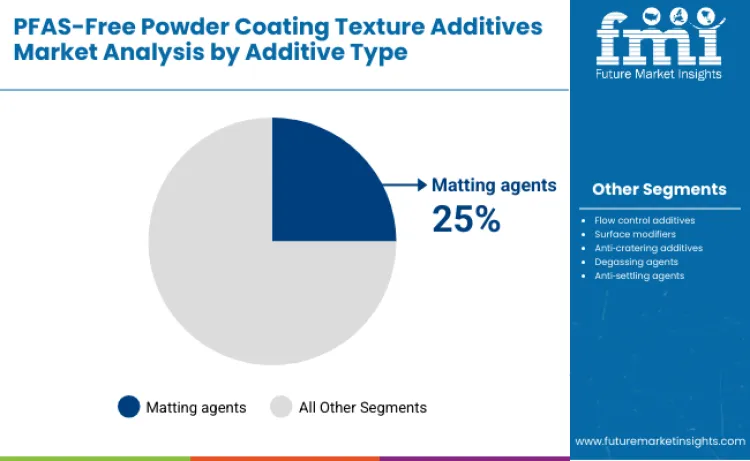
Matting agents are a key additive type in the PFAS‑free powder coating texture additives market, holding about 25% of the share. Matting agents reduce gloss and modify surface appearance without the need for PFAS‑based chemistries, making them suitable for applications that require a controlled, low‑sheen appearance. These agents are used across industries such as architectural coatings, appliances, and automotive parts where specific aesthetic requirements are necessary. The demand for PFAS‑free matting agents reflects broader shifts toward safer, regulatory‑compliant coating additives, as formulators work to replace legacy PFAS‑based additives with alternatives that deliver similar performance.
Which Texture Type Drives PFAS‑Free Powder Coating Texture Additives Demand Globally?
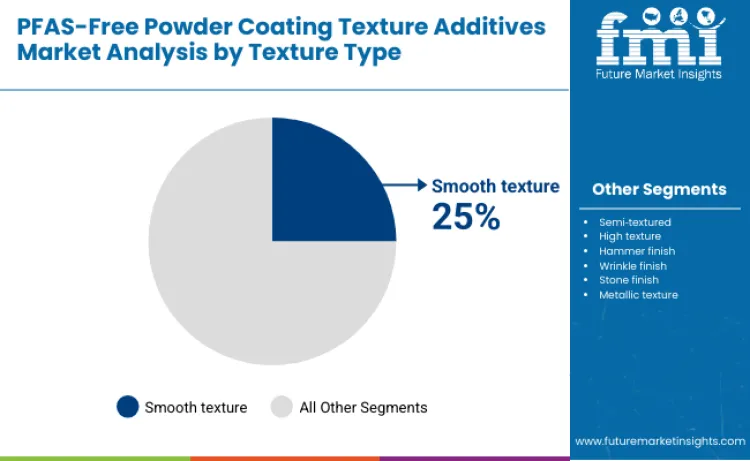
Smooth texture additives account for approximately 25% of the global PFAS‑free powder coating texture additives market. Smooth texture finishes are widely used where uniform appearance and consistent surface feel are essential, such as in consumer electronics, furniture, and premium household goods. The popularity of smooth textures in PFAS‑free coatings is supported by the availability of additive technologies that enhance flow, leveling, and aesthetic quality without using fluorinated components. Smooth finishes are often prioritized in applications where visual appeal and tactile experience are key performance criteria. Other texture types including rough, matte, or specialty finishes also contribute to market demand, but smooth texture remains a core segment due to its broad applicability.
What is the Summary of the Global PFAS Free Powder Coating Texture Additives Market?
The global PFAS‑free powder coating texture additives market is expanding as manufacturers seek safer, environmentally acceptable alternatives to traditional fluorinated texture additives. Powder coatings are widely used to impart protective, decorative, and functional surface properties to metals and other substrates in automotive, appliances, architecture, furniture, and industrial equipment. Demand for PFAS‑free texture additives is rising because of regulatory restrictions on PFAS chemistries, growing consumer and brand preference for non‑hazardous materials, and sustainability commitments by coatings formulators. The market reflects the dual need for performance and compliance in modern coating systems.
What are the Key Drivers for the Global PFAS‑Free Powder Coating Texture Additives Market?
Key drivers include regulatory pressure on PFAS substances in coatings and consumer goods, which pushes powder coating producers to reformulate with PFAS‑free texture additives that meet safety standards. Sustainability goals and corporate environmental policies adopted by major OEMs and suppliers favour materials with lower health and ecological risk. Growing end‑use sectors such as automotive, appliances, architectural coatings, and industrial equipment support wider adoption of PFAS‑free additives because these coatings deliver rugged surface performance. Rising customer demand for eco‑friendly products and transparency in material sourcing further encourages formulators to switch to non‑PFAS texture solutions.
What are the Restraints for the Global PFAS‑Free Powder Coating Texture Additives Market?
One restraint is the technical challenge of achieving the same level of texture control, flow, and surface properties without traditional PFAS chemistries, which have been favoured for low surface energy and ease of processing. Reformulation efforts require significant research and testing to match legacy performance, which can increase development timelines and costs. Higher prices for alternative, PFAS‑free materials compared with conventional additives can deter adoption in cost‑sensitive segments. Variability in global regulatory enforcement and uneven phasing out of PFAS substances across regions may slow urgency for change in some markets.
What is the Global Demand Outlook for PFAS-Free Powder Coating Texture Additives?
The demand for PFAS-free powder coating texture additives is projected to grow steadily across various countries, with China leading the market at a projected CAGR of 11%. India follows closely with a growth rate of 10%, while the USA is expected to grow at 9%. The UK is projected to grow at 8%, and Japan at 7%. The shift towards more sustainable and environmentally friendly coatings, driven by increasing regulatory pressures on PFAS chemicals, is a key driver for the market. As industries such as automotive, construction, and electronics focus on eco-friendly solutions, the demand for PFAS-free texture additives in powder coatings is expected to rise.
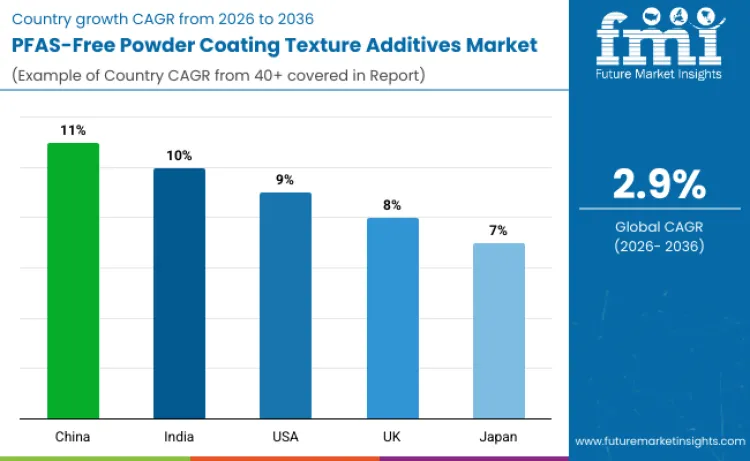
| Country | CAGR (2026-2036) |
|---|---|
| China | 11% |
| India | 10% |
| USA | 9% |
| UK | 8% |
| Japan | 7% |
What is Driving the Growth of PFAS-Free Powder Coating Texture Additives in China?
China is projected to experience the highest growth in the PFAS-free powder coating texture additives market, with a projected CAGR of 11%. The country’s rapidly expanding manufacturing and automotive sectors are the primary drivers of this demand. As China continues to push for environmental sustainability and reduce the use of hazardous chemicals, there is an increasing shift toward PFAS-free alternatives in coatings, including texture additives. The growing demand for eco-friendly and durable coatings in the automotive, electronics, and construction industries is further fueling this market growth. Additionally, China’s stringent environmental regulations are encouraging manufacturers to adopt safer alternatives, positioning PFAS-free additives as a preferable solution. As China's industrial base expands and focuses more on green technologies, the demand for PFAS-free powder coating texture additives is expected to continue rising.
Why is the PFAS-Free Powder Coating Texture Additives Market Expanding in India?
In India, the demand for PFAS-free powder coating texture additives is projected to grow at a CAGR of 10%. The country’s rapidly growing manufacturing sector, particularly in automotive, construction, and consumer goods, is driving the need for high-performance, environmentally friendly coatings. As India continues to focus on sustainable industrial practices, the demand for non-toxic, PFAS-free alternatives in powder coatings is on the rise. Additionally, India’s increasing adoption of green technologies and stricter environmental regulations are pushing manufacturers to replace harmful additives with safer, eco-friendly solutions. The growing focus on health and environmental safety, combined with the rising demand for high-quality, durable coatings, is expected to continue driving the market for PFAS-free powder coating texture additives in India.
How is the PFAS-Free Powder Coating Texture Additives Market Growing in the USA?
In the USA, the PFAS-free powder coating texture additives market is projected to grow at a CAGR of 9%. The USA is one of the largest consumers of powder coatings, particularly in industries like automotive, construction, and electronics. As regulatory frameworks around PFAS chemicals become more stringent, manufacturers are increasingly adopting safer, PFAS-free alternatives to comply with environmental laws. The rise in consumer demand for environmentally friendly products, combined with the need for sustainable coatings in various industrial applications, is driving the growth of PFAS-free additives. Additionally, the USA’s focus on reducing the environmental impact of manufacturing processes and the widespread shift towards green manufacturing practices further contributes to the growing demand for PFAS-free powder coating texture additives.
What is Contributing to the Growth of PFAS-Free Powder Coating Texture Additives in the UK?
In the UK, the demand for PFAS-free powder coating texture additives is projected to grow at a CAGR of 8%. The UK’s increasing focus on sustainability and reducing the environmental impact of manufacturing processes is a key driver of this growth. As the country seeks to eliminate harmful chemicals from its industrial products, there is rising adoption of PFAS-free solutions in powder coatings. The UK’s robust automotive, construction, and electronics sectors are increasingly seeking environmentally responsible materials, further driving the demand for PFAS-free additives. The country’s regulatory environment, which continues to tighten regarding the use of hazardous substances, is also encouraging the transition to safer, non-toxic alternatives. As consumer demand for sustainable and safe products continues to rise, the market for PFAS-free powder coating texture additives is expected to expand steadily.
What is Influencing the Growth of PFAS-Free Powder Coating Texture Additives in Japan?
In Japan, the demand for PFAS-free powder coating texture additives is projected to grow at a CAGR of 7%. Japan has long been committed to sustainability and reducing the environmental impact of manufacturing processes. The demand for PFAS-free alternatives in powder coatings is growing as the country’s automotive, electronics, and construction industries prioritize eco-friendly solutions. Japan’s regulatory environment is pushing for the elimination of harmful chemicals, further encouraging the adoption of PFAS-free additives in industrial applications. As the Japanese government continues to implement stricter environmental policies and consumers increasingly demand sustainable products, the market for PFAS-free powder coating texture additives is expected to continue growing steadily.
What is the Competitive Landscape for the Global PFAS Free Powder Coating Texture Additives Market?
Global demand for PFAS‑free powder coating texture additives is increasing as manufacturers across automotive, appliances, architectural, industrial equipment and consumer goods sectors seek safer, more sustainable alternatives to fluorochemical‑based additives. Texture additives improve surface aesthetics, slip and tactile performance while enhancing durability and uniform finish for powder coatings. Heightened regulatory scrutiny of PFAS chemicals and rising customer preference for eco‑friendly products have accelerated the shift toward formulation ingredients that deliver performance without harmful substances. Growth in construction activities, replacement of legacy products, and expansion of durable goods manufacturing worldwide support steady uptake of PFAS‑free texture additive solutions. Sustainability commitments by original equipment manufacturers and brand owners, along with inclusion of PFAS‑free criteria in procurement standards, further reinforce demand for these specialty additives across regions including North America, Europe and Asia Pacific.
On the supply side, several global chemical, materials and speciality‑additive firms compete to serve this evolving market. Micro Powders is recognised as a leading supplier with strong technical expertise in engineered texture solutions tailored for PFAS‑free powder coatings. Other significant competitors include Clariant, Shamrock Technologies, Lubrizol, Wyn Polymers, Covestro and Evonik. These companies offer a range of additive technologies designed to achieve desired surface profiles and performance while maintaining chemical safety and regulatory compliance. Competition among suppliers focuses on additive performance (control of surface texture, slip and matting), compatibility with diverse powder coating resins, ease of integration into production processes, regulatory compliance with evolving safety standards, and supply‑chain reliability. Companies that combine advanced product innovation, rigorous quality control and broad application support are well positioned to capture growth as coatings formulators and end‑users increasingly prioritize PFAS‑free, high‑performance texture additives in powder coating systems globally.
Key Players
- Micro Powders
- Clariant
- Shamrock Technologies
- Lubrizol
- Wyn Polymers
- Covestro
- Evonik
Scope of the Report
| Items | Values |
|---|---|
| Quantitative Units (2026) | USD Million |
| By Additive Type | Matting agents, Flow control additives, Surface modifiers, Anti-cratering additives, Degassing agents, Anti-settling agents |
| By Texture Type | Smooth texture, Semi-textured, High texture, Hammer finish, Wrinkle finish, Stone finish, Metallic texture |
| By Resin Type | Epoxy powder coatings, Polyester powder coatings, Epoxy-polyester hybrid powder coatings, Polyurethane powder coatings, Acrylic powder coatings, Others |
| By Application | Appliances, Automotive components, Architectural products, Furniture and fixtures, Industrial machinery, Consumer goods, Electrical and electronics |
| By End Use Industry | Manufacturing, Construction, Automotive, Consumer durables, Infrastructure, Industrial equipment |
| By Performance Grade | Standard grade, Premium grade, High-performance grade |
| By Sales Channel | Direct to OEMs, Distributors, E-commerce channels |
| Companies | Micro Powders, Clariant, Shamrock Technologies, Lubrizol, Wyn Polymers, Covestro, Evonik |
| Regions Covered | North America, Latin America, Western Europe, Eastern Europe, South Asia and Pacific, East Asia, Middle East & Africa |
| Countries Covered | United States, Canada, Mexico, Brazil, Argentina, Germany, France, United Kingdom, Italy, Spain, Netherlands, China, India, Japan, South Korea, ANZ, GCC Countries, South Africa |
| Additional Attributes | Dollar by sales by additive type, texture type, resin type, application, end-use industry, performance grade, sales channel, and region. Includes market trends towards PFAS-free alternatives in powder coatings, performance in various applications, cost-effectiveness, sustainability practices, regulatory compliance, market share and competitive positioning of key companies, and the role of texture additives in enhancing the aesthetic and functional properties of powder coatings across various industries like automotive, construction, manufacturing, and consumer durables. |
Key Segments in the PFAS-Free Powder Coating Texture Additives Market
Additive Type:
- Matting agents
- Flow control additives
- Surface modifiers
- Anti‑cratering additives
- Degassing agents
- Anti‑settling agents
Texture Type:
- Smooth texture
- Semi‑textured
- High texture
- Hammer finish
- Wrinkle finish
- Stone finish
- Metallic texture
Resin Type:
- Epoxy powder coatings
- Polyester powder coatings
- Epoxy‑polyester hybrid powder coatings
- Polyurethane powder coatings
- Acrylic powder coatings
- Others
Application:
- Appliances
- Automotive components
- Architectural products
- Furniture and fixtures
- Industrial machinery
- Consumer goods
- Electrical and electronics
End Use Industry:
- Manufacturing
- Construction
- Automotive
- Consumer durables
- Infrastructure
- Industrial equipment
Performance Grade:
- Standard grade
- Premium grade
- High‑performance grade
Sales Channel:
- Direct to OEMs
- Distributors
- E‑commerce channels
Region:
- Asia Pacific
- China
- India
- Japan
- South Korea
- ASEAN
- Rest of Asia Pacific
- Europe
- Germany
- United Kingdom
- France
- Italy
- Spain
- Nordic
- BENELUX
- Rest of Europe
- North America
- United States
- Canada
- Mexico
- Latin America
- Brazil
- Chile
- Rest of Latin America
- Middle East & Africa
- Kingdom of Saudi Arabia
- Other GCC Countries
- Turkey
- South Africa
- Other African Union
- Rest of Middle East & Africa
Frequently Asked Questions
How big is the PFAS-Free Powder Coating Texture Additives market?
The market is valued at USD 106 million in 2026 and is expected to grow at a CAGR of 5.90%, reaching USD 187 million by 2036.
What is the growth outlook for the PFAS-Free Powder Coating Texture Additives market?
The market is projected to grow at a CAGR of 5.90% from 2026 to 2036.
Which region is expected to experience the fastest growth in the PFAS-Free Powder Coating Texture Additives market?
China is expected to lead with a growth rate of 11%, driven by increased demand for sustainable coating solutions.
What are the key applications of PFAS-Free Powder Coating Texture Additives?
PFAS-Free Powder Coating Texture Additives are widely used in automotive, industrial, and consumer goods coatings to enhance surface texture.
Who is the major player in the PFAS-Free Powder Coating Texture Additives market?
The leading player in the market is Micro Powders.
Preview the report firsthand - request a free sample
Get SampleGet the brochure for pricing and purchase details.
Get PDFTable of Content
- Executive Summary
- Market Overview
- Global Market Value, 2020-2025
- Global Market Forecast, 2026-2036
- Market Dynamics
- Drivers
- Restraints
- Opportunities
- Regulatory & Standards Landscape
- Technology & Material Innovation Outlook
- Market Segmentation Analysis
- By Additive Type
- Matting agents
- Flow control additives
- Surface modifiers
- Anti-cratering additives
- Degassing agents
- Anti-settling agents
- By Texture Type
- Smooth texture
- Semi-textured
- High texture
- Hammer finish
- Wrinkle finish
- Stone finish
- Metallic texture
- By Resin Type
- Epoxy powder coatings
- Polyester powder coatings
- Epoxy-polyester hybrid powder coatings
- Polyurethane powder coatings
- Acrylic powder coatings
- Others
- By Application
- Appliances
- Automotive components
- Architectural products
- Furniture and fixtures
- Industrial machinery
- Consumer goods
- Electrical and electronics
- By End Use Industry
- Manufacturing
- Construction
- Automotive
- Consumer durables
- Infrastructure
- Industrial equipment
- By Performance Grade
- Standard grade
- Premium grade
- High-performance grade
- By Sales Channel
- Direct to OEMs
- Distributors
- E-commerce channels
- By Additive Type
- Regional Outlook
- North America
- Latin America
- Western Europe
- Eastern Europe
- South Asia & Pacific
- East Asia
- Middle East & Africa
- Country-Level Outlook
- United States
- Canada
- Mexico
- Brazil
- Argentina
- Germany
- France
- United Kingdom
- Italy
- Spain
- Netherlands
- China
- India
- Japan
- South Korea
- ANZ
- GCC Countries
- South Africa
- Competitive Landscape
- Market Structure Overview
- Company Positioning
- Strategic Initiatives
- Key Player Profiles
- Scope of the Report
- Research Methodology
- Assumptions & Acronyms


