

- Industry Size (2026)
- USD 713.6 Mn
- Forecast (2036)
- USD 2119.4 Mn
- CAGR (2026 to 2036)
- 11.50%
Graphene-Based Coating Additives Market Forecast and Outlook 2026 to 2036
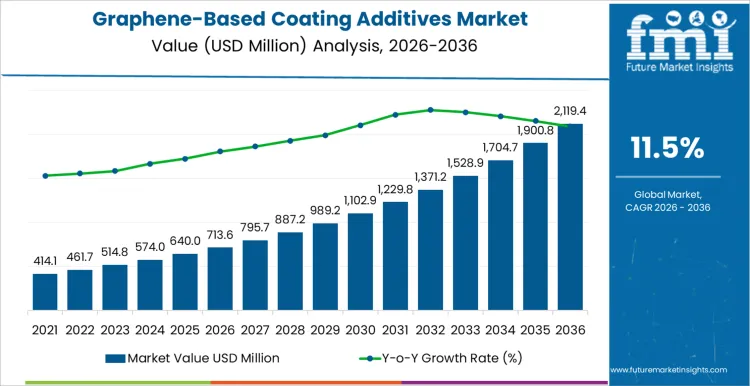
The graphene-based coating additives market is set to expand from USD 713.6 million in 2026 to USD 2,119.4 million by 2036, reflecting an 11.50% CAGR. Growth quality is shaped by strong application concentration in performance-critical coating segments rather than broad, low-margin volume use. Demand is anchored in industrial and heavy-equipment coatings, marine protection, infrastructure assets, and select automotive and electronics applications where durability, corrosion resistance, and lifecycle extension directly influence operating costs.
These end uses exhibit relatively stable coating volumes tied to asset maintenance cycles, refurbishment schedules, and long-life capital equipment rather than short-term consumption swings. End-use dependency favors premium formulations where graphene additives replace or reduce traditional fillers while delivering measurable performance gains at low loadings. This concentration supports pricing resilience but limits rapid commoditization. Volume stability is reinforced by long qualification timelines, formulation lock-in, and conservative adoption behavior among coating manufacturers. As a result, market expansion between 2026 and 2036 is expected to be driven more by deeper penetration into high-value coating systems than by widespread substitution across commodity paint segments.
Quick Stats for Graphene-Based Coating Additives Market
- Graphene-Based Coating Additives Market Value (2026): USD 713.6 Million
- Graphene-Based Coating Additives Market Forecast Value (2036): USD 2,119.4 Million
- Graphene-Based Coating Additives Market Forecast CAGR 2026 to 2036: 11.50%
- Leading Graphene Form in Graphene-Based Coating Additives Market: Graphene Nanoplatelets (44% share)
- Key Growth Regions in Graphene-Based Coating Additives Market: Asia Pacific, Europe, North America, Latin America, Middle East & Africa
- Top Key Players in Graphene-Based Coating Additives Market: Directa Plus, Haydale Graphene Industries, Talga Group, Grafoid, Graphenea, NanoXplore, Versarien, XG Sciences, Applied Graphene Materials, G6 Materials
Graphene-Based Coating Additives Market Key Takeaways
| Metric | Value |
|---|---|
| Graphene-Based Coating Additives Market Value (2026) | USD 713.6 Million |
| Graphene-Based Coating Additives Market Forecast Value (2036) | USD 2,119.4 Million |
| Graphene-Based Coating Additives Market Forecast CAGR 2026 to 2036 | 11.50% |
How Are Performance-Driven Protective Coatings and Material Efficiency Goals Accelerating the Graphene-Based Coating Additives Market?
The graphene-based coating additives market is expanding as coating formulators seek advanced materials that deliver enhanced protection, durability, and multifunctional performance. Graphene’s exceptional mechanical strength, barrier properties, and electrical conductivity enable coatings to achieve improved corrosion resistance, reduced permeability, and enhanced wear performance at low additive loadings. These attributes are increasingly valued in industrial, marine, automotive, and infrastructure coatings, where service life and reduced maintenance extended are critical to lowering lifecycle costs.
Formulation efficiency and compatibility with existing coating systems are key factors shaping adoption. End users evaluate graphene-based additives based on dispersion quality, interaction with polymer matrices, and impact on viscosity, curing behavior, and surface finish. Properly dispersed graphene enhances crack resistance and adhesion while maintaining coating uniformity, making it suitable for both solvent-based and water-based formulations. The ability to replace or reduce conventional fillers and pigments without sacrificing performance is positioning graphene as a high-value additive in next-generation coating formulations.
Regulatory pressure and sustainability objectives are further supporting market growth. Demand for longer-lasting coatings that reduce material consumption, recoating frequency, and environmental impact is increasing across multiple industries. At the same time, advances in graphene production and functionalization are improving cost efficiency and scalability, enabling broader commercial adoption. For additive suppliers, competitive advantage increasingly depends on dispersion technology, application-specific formulation support, and collaboration with coating manufacturers positioning graphene-based additives as a strategic component in high-performance and efficiency-driven coating markets.
How is the Graphene-Based Coating Additives Market Structured by Graphene Form and End-Use Sector?
The graphene-based coating additives market is structured by graphene form and end-use sector, reflecting how dispersion behavior, mechanical reinforcement, and conductivity requirements influence additive selection. By graphene form, graphene nanoplatelets represent the leading segment, as they are widely used to enhance barrier performance, wear resistance, and mechanical strength in coatings. Other forms include reduced graphene oxide and additional graphene derivatives developed for targeted electrical or functional performance. By end-use sector, industrial and heavy equipment applications account for the largest demand, followed by automotive and transport, electronics and energy, and other sectors where coating durability and surface protection are critical.
Why Do Graphene Nanoplatelets Lead Adoption in the Graphene-Based Coating Additives Market?
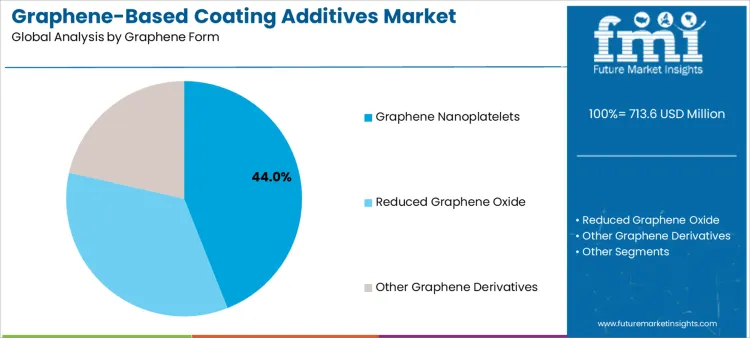
Graphene nanoplatelets account for 44% share of the graphene-based coating additives market because they provide effective reinforcement at relatively low loading levels while maintaining good dispersion in coating matrices. Their plate-like structure creates tortuous paths that improve barrier properties against moisture, chemicals, and corrosion. Coating formulators favor nanoplatelets due to easier processing compared with more complex graphene forms. Compatibility with epoxy, polyurethane, and other industrial coating systems supports broad adoption. These performance benefits combined with scalable production and formulation flexibility explain why graphene nanoplatelets remain the most widely used graphene form.
Why Does Industrial And Heavy Equipment Dominate End-Use Demand in the Graphene-Based Coating Additives Market?
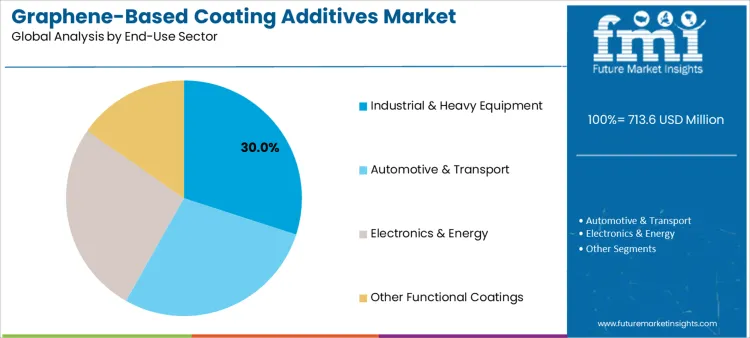
Industrial and heavy equipment applications hold 30% share of the graphene-based coating additives market because machinery, infrastructure, and processing equipment operate under abrasive, corrosive, and high-load conditions. Coatings used in these environments require enhanced mechanical strength, wear resistance, and long service life. Graphene-based additives improve coating durability and reduce maintenance frequency on equipment surfaces. High asset values and long operating cycles justify the use of advanced coating additives. These durability-driven requirements and large coated surface areas explain why industrial and heavy equipment remain the leading end-use sector.
What are the Key Dynamics of the Graphene-Based Coating Additives Market?
The graphene-based coating additives market is driven by demand for advanced coating formulations that deliver enhanced barrier protection, mechanical strength, thermal conductivity, and corrosion resistance. Graphene additives improve coating performance at low loading levels by reinforcing polymer matrices and creating tortuous pathways that inhibit moisture, gas, and chemical ingress. Growing use in industrial coatings, marine and offshore applications, automotive components, and protective infrastructure systems supports market expansion. For coating formulators and manufacturers, dispersion quality, compatibility with resin systems, performance consistency, and cost-to-benefit balance are critical factors influencing adoption and long-term commercial use.
How Do Application Trends and Industry Requirements Shape This Market?
Application trends and industry requirements are shaping the graphene-based coating additives market as end users seek multifunctional performance from coatings without significantly increasing formulation complexity. In corrosion-protection and barrier coatings, graphene additives enhance durability and extend service life under harsh environmental conditions. Automotive and aerospace applications benefit from improved mechanical reinforcement and thermal management. In industrial and architectural coatings, low-loading graphene solutions enable performance upgrades while maintaining process ability and appearance. Compatibility with water-based and solvent-based systems, along with ease of incorporation into existing coating processes, remains essential for large-scale adoption.
Why Do Cost, Dispersion, and Standardization Challenges Restrain Market Growth?
Cost, dispersion, and standardization challenges restrain growth in the graphene-based coating additives market, particularly in price-sensitive coating segments. Achieving uniform dispersion of graphene within coating matrices is technically demanding, and poor dispersion can limit performance benefits. Variability in graphene quality, platelet size, and surface chemistry complicates formulation optimization and performance predictability. Limited industry standards and inconsistent material specifications increase qualification timelines for coating producers and end users. These factors slow adoption where conventional additives offer established performance at lower cost.
How is the Graphene-Based Coating Additives Market Growing across Key Countries?
The graphene-based coating additives market is expanding rapidly as coating formulators seek enhanced barrier protection, mechanical strength, electrical conductivity, and corrosion resistance at low additive loadings. Graphene additives are increasingly incorporated into industrial, marine, automotive, and protective coatings to improve durability, wear resistance, and functional performance without significantly altering formulation rheology. Country-wise growth varies depending on industrial coatings demand, infrastructure investment, and adoption of advanced material technologies. High-growth markets are driven by large-scale industrial activity and rapid commercialization of graphene materials, while mature regions emphasize performance validation, formulation consistency, and integration into premium coating systems.
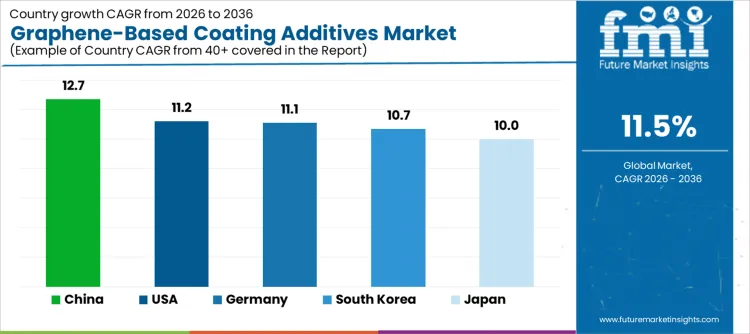
| Country | CAGR (%) |
|---|---|
| China | 12.7 |
| Brazil | 12.3 |
| United States | 11.2 |
| Germany | 11.1 |
| South Korea | 10.7 |
Why is China Leading the Graphene-Based Coating Additives Market?
China’s graphene-based coating additives market is expanding at a CAGR of 12.7% during 2026 to 2036, driven by strong demand from industrial coatings, infrastructure projects, and manufacturing sectors. Graphene additives are increasingly used in anti-corrosion coatings, wear-resistant surfaces, and functional coatings for pipelines, machinery, and construction materials. China’s large industrial base and rapid adoption of advanced materials accelerate commercial deployment. Chinese coating manufacturers prioritize graphene additives that offer improved barrier properties, mechanical reinforcement, and electrical conductivity at low dosages. Domestic graphene producers benefit from large-scale production capacity and cost-competitive supply, enabling wider adoption across industrial coating applications. Integration is strongest in protective coatings for steel structures, marine equipment, and heavy machinery. Procurement decisions emphasize additive consistency, dispersion quality, and compatibility with existing resin systems.
Why is Brazil Emerging as a High-Growth Market for Graphene-Based Coating Additives?
Brazil’s graphene-based coating additives market is growing at a CAGR of 12.3% during 2026 to 2036, supported by rising demand from construction, oil & gas, marine, and industrial maintenance coatings. Graphene additives are gaining traction for their ability to improve corrosion resistance and durability in harsh climatic and operating conditions. Brazilian formulators value graphene additives that enhance coating lifespan while maintaining cost efficiency. Adoption is strongest in protective coatings for infrastructure, pipelines, storage tanks, and offshore equipment. Market uptake is accelerating as local manufacturers test and scale graphene-enhanced formulations. Procurement decisions often favor suppliers offering technical formulation support, stable dispersion quality, and reliable supply. Market growth is supported by infrastructure upgrades, industrial expansion, and increasing focus on extending asset service life through advanced coating technologies.
What is Driving Demand for Graphene-Based Coating Additives in the United States?
The United States graphene-based coating additives market is expanding at a CAGR of 11.2% during 2026 to 2036, driven by demand from aerospace, automotive, industrial, and specialty coating applications. USA. formulators adopt graphene additives to achieve enhanced mechanical strength, improved barrier properties, and multifunctional performance in high-value coatings. Buyers emphasize performance validation, dispersion stability, and repeatability across production batches. Demand is strongest in industrial protective coatings, aerospace components, and specialty conductive coatings rather than mass-volume applications. Procurement decisions prioritize supplier credibility, technical data, and compatibility with advanced resin systems. Market growth is reinforced by continued innovation in functional coatings and increasing use of advanced additives in premium coating formulations.
How is Germany Leveraging Graphene-Based Coating Additives for Advanced Applications?
Germany’s graphene-based coating additives market is growing at a CAGR of 11.1% during 2026 to 2036, supported by strong demand from automotive, industrial manufacturing, and high-performance coating segments. German formulators focus on precision engineering, durability, and predictable performance, making graphene additives attractive for advanced coating systems. Buyers prioritize additives that deliver uniform dispersion, controlled particle size, and measurable performance improvements. Adoption is driven by performance optimization and long-term reliability rather than rapid volume growth. Procurement decisions favor suppliers with strong quality systems, detailed technical documentation, and the ability to support customized coating formulations. Market growth is reinforced by Germany’s emphasis on advanced materials and high-quality industrial coatings.
How is South Korea Expanding Use of Graphene-Based Coating Additives?
South Korea’s graphene-based coating additives market is expanding at a CAGR of 10.7% during 2026 to 2036, driven by demand from electronics, automotive, and industrial coatings sectors. Graphene additives are increasingly used to impart conductivity, abrasion resistance, and barrier enhancement in specialized coating applications. South Korean manufacturers emphasize additive purity, dispersion consistency, and compatibility with automated coating processes. Adoption is strongest in high-performance and export-oriented coating applications. Procurement decisions are influenced by supplier technical capability, product consistency, and alignment with advanced manufacturing standards. Market growth is supported by continued investment in advanced materials and precision coating technologies.
How are Companies Competing in the Graphene-Based Coating Additives Market?
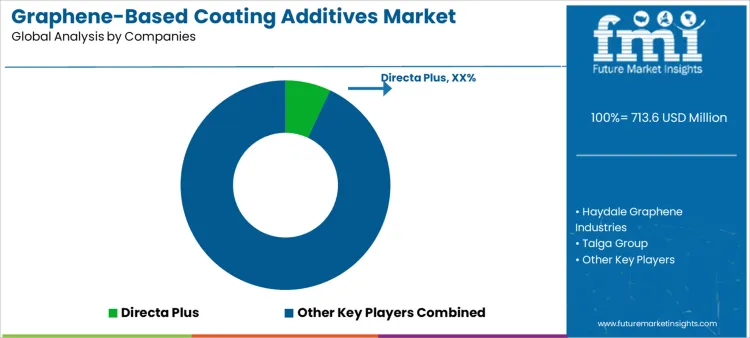
Competition in the graphene-based coating additives market is driven by functional performance (corrosion resistance, conductivity, mechanical reinforcement), ease of dispersion, and documented compatibility with commercial coating systems. As formulators look to enhance durability and multifunctionality without compromising processability, suppliers differentiate through graphene quality, surface chemistry, and technical support for integration into paints, industrial coatings, and specialty formulations.
Directa Plus positions its graphene additives with technical materials that highlight defect-free exfoliation, ease of dispersion in liquid systems, and measurable improvements in barrier and mechanical performance. Its offerings emphasize sustainability credentials and scalability for industrial coatings. Haydale Graphene Industries competes through functionalized graphene products engineered for targeted interactions with resin systems, with product documentation underscoring tailored surface chemistries that improve adhesion and conductivity.
Resource-linked producers and application innovators strengthen competitive breadth. Talga Group and Graphenea differentiate through high-purity graphene materials and additive platforms tailored for corrosion protection and multifunctional coatings, with literature focused on conductivity and mechanical reinforcement at low loadings. Grafoid, often deployed through partner networks, emphasizes proprietary graphene dispersions designed for barrier performance and process compatibility in commercial paint lines.
Regional and diversified graphene specialists add depth through tuned materials and customer support. NanoXplore competes with graphene additives that bolster scratch resistance and thermal stability, while Versarien emphasizes engineered graphene materials for performance coatings. XG Sciences focuses on few-layer graphene products with consistent quality and batch traceability. Applied Graphene Materials and G6 Materials differentiate through nanomaterial dispersion expertise and high-surface-area graphene forms that aim to enhance film integrity and durability. Across the market, competitive advantage is defined by verified performance gains, dispersion ease, and formulation support rather than additive pricing alone.
Key Players in Graphene-Based Coating Additives Market
- Directa Plus
- Haydale Graphene Industries
- Talga Group
- Grafoid (through partners)
- Graphenea
- NanoXplore
- Versarien
- XG Sciences
- Applied Graphene Materials
- G6 Materials
Scope of Report
| Attribute | Details |
|---|---|
| Market Size Unit | USD Million |
| Graphene Form Covered | Graphene Nanoplatelets, Reduced Graphene Oxide, Other Graphene Derivatives |
| End-Use Sector Covered | Industrial & Heavy Equipment, Automotive & Transport, Electronics & Energy, Other Sectors |
| Countries Covered | China, Japan, South Korea, India, Australia & New Zealand, ASEAN, Rest of Asia Pacific, Germany, United Kingdom, France, Italy, Spain, Nordic, BENELUX, Rest of Europe, United States, Canada, Mexico, Brazil, Chile, Rest of Latin America, Kingdom of Saudi Arabia, Other GCC Countries, Turkey, South Africa, Other African Union, Rest of Middle East & Africa |
| Regions Covered | Asia Pacific, Europe, North America, Latin America, Middle East & Africa |
| Key Companies Profiled | Directa Plus, Haydale Graphene Industries, Talga Group, Grafoid, Graphenea, NanoXplore, Versarien, XG Sciences, Applied Graphene Materials, G6 Materials |
| Additional Attributes | Dollar sales of graphene-based coating additives are analyzed by graphene form and end-use sector across protective, functional, and performance coatings. The scope evaluates dispersion quality, barrier enhancement, mechanical reinforcement, electrical and thermal conductivity contribution, and compatibility with solvent-borne and water-borne coating systems. Country-level analysis reflects industrial coating demand, automotive lightweighting trends, adoption of advanced functional coatings, and investments in graphene material commercialization and scale-up. |
Graphene-Based Coating Additives Market by Key Segments
Graphene Form:
- Graphene Nanoplatelets
- Reduced Graphene Oxide
- Other Graphene Derivatives
End-Use Sector:
- Industrial & Heavy Equipment
- Automotive & Transport
- Electronics & Energy
- Other Sectors
Region:
- Asia Pacific
- China
- Japan
- South Korea
- India
- Australia & New Zealand
- ASEAN
- Rest of Asia Pacific
- Europe
- Germany
- United Kingdom
- France
- Italy
- Spain
- Nordic
- BENELUX
- Rest of Europe
- North America
- United States
- Canada
- Mexico
- Latin America
- Brazil
- Chile
- Rest of Latin America
- Middle East & Africa
- Kingdom of Saudi Arabia
- Other GCC Countries
- Turkey
- South Africa
- Other African Union
- Rest of Middle East & Africa
Bibliography
- Wang, Y., Li, Z., & Chen, G. (2024). Graphene nanoplatelet additives for corrosion‑resistant and wear‑resistant coatings: Dispersion, performance, and durability.
- Müller, K., & Schulte, K. (2024). Mechanical reinforcement and permeability reduction in graphene‑modified protective coatings.
- European Commission. (2024). Advanced materials for sustainable and durable coatings. Publications Office of the European Union.
- International Organization for Standardization. (2024). ISO/TR 19733: Nanotechnologies - Matrix of properties and characterization methods for graphene and related materials. ISO.
- Organisation for Economic Co‑operation and Development. (2023). Advanced materials in industrial applications: Performance, safety, and sustainability. OECD Publishing.
Frequently Asked Questions
How big is the graphene-based coating additives market in 2026?
The global graphene-based coating additives market is estimated to be valued at USD 713.6 million in 2026.
What will be the size of graphene-based coating additives market in 2036?
The market size for the graphene-based coating additives market is projected to reach USD 2,119.4 million by 2036.
How much will be the graphene-based coating additives market growth between 2026 and 2036?
The graphene-based coating additives market is expected to grow at a 11.5% CAGR between 2026 and 2036.
What are the key product types in the graphene-based coating additives market?
The key product types in graphene-based coating additives market are graphene nanoplatelets, reduced graphene oxide and other graphene derivatives.
Which coating function segment to contribute significant share in the graphene-based coating additives market in 2026?
In terms of coating function, corrosion protection segment to command 34.0% share in the graphene-based coating additives market in 2026.
Preview the report firsthand - request a free sample
Get SampleGet the brochure for pricing and purchase details.
Get PDFTable of Content
- Executive Summary
- Global Market Outlook
- Demand-side Trends
- Supply-side Trends
- Technology Roadmap Analysis
- Analysis and Recommendations
- Market Overview
- Market Coverage / Taxonomy
- Market Definition / Scope / Limitations
- Market Background
- Market Dynamics
- Drivers
- Restraints
- Opportunity
- Trends
- Scenario Forecast
- Demand in Optimistic Scenario
- Demand in Likely Scenario
- Demand in Conservative Scenario
- Opportunity Map Analysis
- Product Life Cycle Analysis
- Supply Chain Analysis
- Investment Feasibility Matrix
- Value Chain Analysis
- PESTLE and Porter’s Analysis
- Regulatory Landscape
- Regional Parent Market Outlook
- Production and Consumption Statistics
- Import and Export Statistics
- Market Dynamics
- Global Market Analysis 2021 to 2025 and Forecast, 2026 to 2036
- Historical Market Size Value (USD Million) Analysis, 2021 to 2025
- Current and Future Market Size Value (USD Million) Projections, 2026 to 2036
- Y-o-Y Growth Trend Analysis
- Absolute $ Opportunity Analysis
- Global Market Pricing Analysis 2021 to 2025 and Forecast 2026 to 2036
- Global Market Analysis 2021 to 2025 and Forecast 2026 to 2036, By Graphene Form
- Introduction / Key Findings
- Historical Market Size Value (USD Million) Analysis By Graphene Form, 2021 to 2025
- Current and Future Market Size Value (USD Million) Analysis and Forecast By Graphene Form, 2026 to 2036
- Graphene Nanoplatelets
- Reduced Graphene Oxide
- Other Graphene Derivatives
- Graphene Nanoplatelets
- Y-o-Y Growth Trend Analysis By Graphene Form, 2021 to 2025
- Absolute $ Opportunity Analysis By Graphene Form, 2026 to 2036
- Global Market Analysis 2021 to 2025 and Forecast 2026 to 2036, By Coating Function
- Introduction / Key Findings
- Historical Market Size Value (USD Million) Analysis By Coating Function, 2021 to 2025
- Current and Future Market Size Value (USD Million) Analysis and Forecast By Coating Function, 2026 to 2036
- Corrosion Protection
- Conductive & Anti-Static
- Mechanical/Barrier Enhancement
- Corrosion Protection
- Y-o-Y Growth Trend Analysis By Coating Function, 2021 to 2025
- Absolute $ Opportunity Analysis By Coating Function, 2026 to 2036
- Global Market Analysis 2021 to 2025 and Forecast 2026 to 2036, By End-Use Sector
- Introduction / Key Findings
- Historical Market Size Value (USD Million) Analysis By End-Use Sector, 2021 to 2025
- Current and Future Market Size Value (USD Million) Analysis and Forecast By End-Use Sector, 2026 to 2036
- Industrial & Heavy Equipment
- Automotive & Transport
- Electronics & Energy
- Other Functional Coatings
- Industrial & Heavy Equipment
- Y-o-Y Growth Trend Analysis By End-Use Sector, 2021 to 2025
- Absolute $ Opportunity Analysis By End-Use Sector, 2026 to 2036
- Global Market Analysis 2021 to 2025 and Forecast 2026 to 2036, By Formulation Type
- Introduction / Key Findings
- Historical Market Size Value (USD Million) Analysis By Formulation Type, 2021 to 2025
- Current and Future Market Size Value (USD Million) Analysis and Forecast By Formulation Type, 2026 to 2036
- Solvent-Borne Systems
- Water-Borne Systems
- Powder & UV Systems
- Other Sectors
- Solvent-Borne Systems
- Y-o-Y Growth Trend Analysis By Formulation Type, 2021 to 2025
- Absolute $ Opportunity Analysis By Formulation Type, 2026 to 2036
- Global Market Analysis 2021 to 2025 and Forecast 2026 to 2036, By Region
- Introduction
- Historical Market Size Value (USD Million) Analysis By Region, 2021 to 2025
- Current Market Size Value (USD Million) Analysis and Forecast By Region, 2026 to 2036
- North America
- Latin America
- Western Europe
- Eastern Europe
- East Asia
- South Asia and Pacific
- Middle East & Africa
- Market Attractiveness Analysis By Region
- North America Market Analysis 2021 to 2025 and Forecast 2026 to 2036, By Country
- Historical Market Size Value (USD Million) Trend Analysis By Market Taxonomy, 2021 to 2025
- Market Size Value (USD Million) Forecast By Market Taxonomy, 2026 to 2036
- By Country
- USA
- Canada
- Mexico
- By Graphene Form
- By Coating Function
- By End-Use Sector
- By Formulation Type
- By Country
- Market Attractiveness Analysis
- By Country
- By Graphene Form
- By Coating Function
- By End-Use Sector
- By Formulation Type
- Key Takeaways
- Latin America Market Analysis 2021 to 2025 and Forecast 2026 to 2036, By Country
- Historical Market Size Value (USD Million) Trend Analysis By Market Taxonomy, 2021 to 2025
- Market Size Value (USD Million) Forecast By Market Taxonomy, 2026 to 2036
- By Country
- Brazil
- Chile
- Rest of Latin America
- By Graphene Form
- By Coating Function
- By End-Use Sector
- By Formulation Type
- By Country
- Market Attractiveness Analysis
- By Country
- By Graphene Form
- By Coating Function
- By End-Use Sector
- By Formulation Type
- Key Takeaways
- Western Europe Market Analysis 2021 to 2025 and Forecast 2026 to 2036, By Country
- Historical Market Size Value (USD Million) Trend Analysis By Market Taxonomy, 2021 to 2025
- Market Size Value (USD Million) Forecast By Market Taxonomy, 2026 to 2036
- By Country
- Germany
- UK
- Italy
- Spain
- France
- Nordic
- BENELUX
- Rest of Western Europe
- By Graphene Form
- By Coating Function
- By End-Use Sector
- By Formulation Type
- By Country
- Market Attractiveness Analysis
- By Country
- By Graphene Form
- By Coating Function
- By End-Use Sector
- By Formulation Type
- Key Takeaways
- Eastern Europe Market Analysis 2021 to 2025 and Forecast 2026 to 2036, By Country
- Historical Market Size Value (USD Million) Trend Analysis By Market Taxonomy, 2021 to 2025
- Market Size Value (USD Million) Forecast By Market Taxonomy, 2026 to 2036
- By Country
- Russia
- Poland
- Hungary
- Balkan & Baltic
- Rest of Eastern Europe
- By Graphene Form
- By Coating Function
- By End-Use Sector
- By Formulation Type
- By Country
- Market Attractiveness Analysis
- By Country
- By Graphene Form
- By Coating Function
- By End-Use Sector
- By Formulation Type
- Key Takeaways
- East Asia Market Analysis 2021 to 2025 and Forecast 2026 to 2036, By Country
- Historical Market Size Value (USD Million) Trend Analysis By Market Taxonomy, 2021 to 2025
- Market Size Value (USD Million) Forecast By Market Taxonomy, 2026 to 2036
- By Country
- China
- Japan
- South Korea
- By Graphene Form
- By Coating Function
- By End-Use Sector
- By Formulation Type
- By Country
- Market Attractiveness Analysis
- By Country
- By Graphene Form
- By Coating Function
- By End-Use Sector
- By Formulation Type
- Key Takeaways
- South Asia and Pacific Market Analysis 2021 to 2025 and Forecast 2026 to 2036, By Country
- Historical Market Size Value (USD Million) Trend Analysis By Market Taxonomy, 2021 to 2025
- Market Size Value (USD Million) Forecast By Market Taxonomy, 2026 to 2036
- By Country
- India
- ASEAN
- Australia & New Zealand
- Rest of South Asia and Pacific
- By Graphene Form
- By Coating Function
- By End-Use Sector
- By Formulation Type
- By Country
- Market Attractiveness Analysis
- By Country
- By Graphene Form
- By Coating Function
- By End-Use Sector
- By Formulation Type
- Key Takeaways
- Middle East & Africa Market Analysis 2021 to 2025 and Forecast 2026 to 2036, By Country
- Historical Market Size Value (USD Million) Trend Analysis By Market Taxonomy, 2021 to 2025
- Market Size Value (USD Million) Forecast By Market Taxonomy, 2026 to 2036
- By Country
- Kingdom of Saudi Arabia
- Other GCC Countries
- Turkiye
- South Africa
- Other African Union
- Rest of Middle East & Africa
- By Graphene Form
- By Coating Function
- By End-Use Sector
- By Formulation Type
- By Country
- Market Attractiveness Analysis
- By Country
- By Graphene Form
- By Coating Function
- By End-Use Sector
- By Formulation Type
- Key Takeaways
- Key Countries Market Analysis
- USA
- Pricing Analysis
- Market Share Analysis, 2025
- By Graphene Form
- By Coating Function
- By End-Use Sector
- By Formulation Type
- Canada
- Pricing Analysis
- Market Share Analysis, 2025
- By Graphene Form
- By Coating Function
- By End-Use Sector
- By Formulation Type
- Mexico
- Pricing Analysis
- Market Share Analysis, 2025
- By Graphene Form
- By Coating Function
- By End-Use Sector
- By Formulation Type
- Brazil
- Pricing Analysis
- Market Share Analysis, 2025
- By Graphene Form
- By Coating Function
- By End-Use Sector
- By Formulation Type
- Chile
- Pricing Analysis
- Market Share Analysis, 2025
- By Graphene Form
- By Coating Function
- By End-Use Sector
- By Formulation Type
- Germany
- Pricing Analysis
- Market Share Analysis, 2025
- By Graphene Form
- By Coating Function
- By End-Use Sector
- By Formulation Type
- UK
- Pricing Analysis
- Market Share Analysis, 2025
- By Graphene Form
- By Coating Function
- By End-Use Sector
- By Formulation Type
- Italy
- Pricing Analysis
- Market Share Analysis, 2025
- By Graphene Form
- By Coating Function
- By End-Use Sector
- By Formulation Type
- Spain
- Pricing Analysis
- Market Share Analysis, 2025
- By Graphene Form
- By Coating Function
- By End-Use Sector
- By Formulation Type
- France
- Pricing Analysis
- Market Share Analysis, 2025
- By Graphene Form
- By Coating Function
- By End-Use Sector
- By Formulation Type
- India
- Pricing Analysis
- Market Share Analysis, 2025
- By Graphene Form
- By Coating Function
- By End-Use Sector
- By Formulation Type
- ASEAN
- Pricing Analysis
- Market Share Analysis, 2025
- By Graphene Form
- By Coating Function
- By End-Use Sector
- By Formulation Type
- Australia & New Zealand
- Pricing Analysis
- Market Share Analysis, 2025
- By Graphene Form
- By Coating Function
- By End-Use Sector
- By Formulation Type
- China
- Pricing Analysis
- Market Share Analysis, 2025
- By Graphene Form
- By Coating Function
- By End-Use Sector
- By Formulation Type
- Japan
- Pricing Analysis
- Market Share Analysis, 2025
- By Graphene Form
- By Coating Function
- By End-Use Sector
- By Formulation Type
- South Korea
- Pricing Analysis
- Market Share Analysis, 2025
- By Graphene Form
- By Coating Function
- By End-Use Sector
- By Formulation Type
- Russia
- Pricing Analysis
- Market Share Analysis, 2025
- By Graphene Form
- By Coating Function
- By End-Use Sector
- By Formulation Type
- Poland
- Pricing Analysis
- Market Share Analysis, 2025
- By Graphene Form
- By Coating Function
- By End-Use Sector
- By Formulation Type
- Hungary
- Pricing Analysis
- Market Share Analysis, 2025
- By Graphene Form
- By Coating Function
- By End-Use Sector
- By Formulation Type
- Kingdom of Saudi Arabia
- Pricing Analysis
- Market Share Analysis, 2025
- By Graphene Form
- By Coating Function
- By End-Use Sector
- By Formulation Type
- Turkiye
- Pricing Analysis
- Market Share Analysis, 2025
- By Graphene Form
- By Coating Function
- By End-Use Sector
- By Formulation Type
- South Africa
- Pricing Analysis
- Market Share Analysis, 2025
- By Graphene Form
- By Coating Function
- By End-Use Sector
- By Formulation Type
- USA
- Market Structure Analysis
- Competition Dashboard
- Competition Benchmarking
- Market Share Analysis of Top Players
- By Regional
- By Graphene Form
- By Coating Function
- By End-Use Sector
- By Formulation Type
- Competition Analysis
- Competition Deep Dive
- Directa Plus
- Overview
- Product Portfolio
- Profitability by Market Segments (Product/Age /Sales Channel/Region)
- Sales Footprint
- Strategy Overview
- Marketing Strategy
- Product Strategy
- Channel Strategy
- Haydale Graphene Industries
- Talga Group
- Graphenea
- NanoXplore
- XG Sciences
- Directa Plus
- Competition Deep Dive
- Assumptions & Acronyms Used
- Research Methodology


