

- Market Size (2026)
- USD 520 Mn
- Forecast (2036)
- USD 760.2 Mn
- CAGR (2026 to 2036)
- 12.1%
Graphene-Based Anti-Corrosion Coating Additives Market Outlook for 2026 to 2036
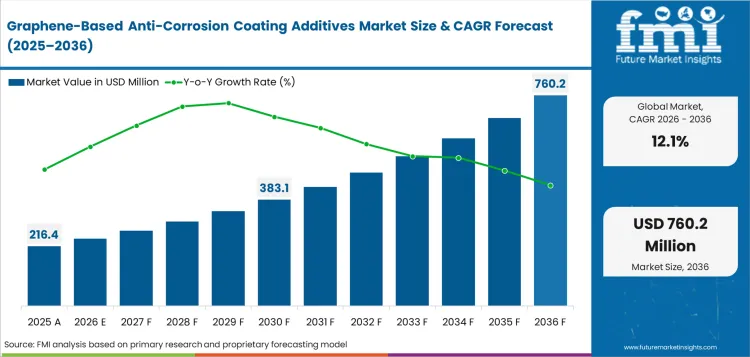
The graphene-based anti-corrosion coating additives market was valued at USD 216.4 million in 2025 and is projected to reach USD 242.6 million in 2026. It is forecast to reach USD 760.2 million by 2036 at 12.1% CAGR. Graphene nanoplatelets are projected to account for 48.0% share of graphene form in 2026. By sales channel, direct formulators are expected to hold 46.0% share in 2026.
Barrier performance and lower coating load are the main formulation requirements behind graphene-based anti-corrosion coating additive adoption. World Corrosion Organization stated in April 2024 that corrosion costs exceed USD 2.5 trillion annually and equal 3% to 4% of GDP in industrialized countries. Such cost exposure keeps asset owners focused on coatings that delay repainting cycles and reduce failure risk. Universal Matter states that its graphene formulation enhances barrier properties, chemical resistance and adhesion for coatings.
Its anti-corrosion primer range uses graphene nanoplatelet dispersions to improve corrosion protection on steel. Gerdau Graphene introduced NanoCORR Shield in June 2024 for solvent-based paints and coatings. NanoCORR Shield demonstrated a 30% to 70% increase in corrosion resistance under salt spray testing. Carbon Waters positions Graph’Up Oxi as an anticorrosion performance additive for paint and varnish. Graphene additives are entering coating formulation choices where barrier performance and lower dosage affect maintenance economics.
Summary of the Graphene-Based Anti-Corrosion Coating Additives Market
- Demand and Growth Drivers
- Marine and offshore operators are testing graphene additives since salt exposure keeps repaint cost high across steel assets.
- Oil and gas coating users are evaluating graphene primers as pipeline and platform owners seek longer coating service life.
- Infrastructure steel programs are creating interest in lower-dosage barrier additives able to support corrosion control without thicker coating layers.
- Product and Segment View
- Graphene nanoplatelets are projected to account for 48.0% share in 2026 due to barrier path formation and easier dispersion.
- Solvent-borne additives are forecast to hold 38.0% share in 2026 since heavy-duty primers keep using solvent systems.
- Marine structures are expected to represent 31.0% share in 2026 as hulls and port assets face salt exposure.
- Geography and Competitive Outlook
- India is expected to post 13.6% CAGR by 2036 as steel output and infrastructure work support protective coating upgrades.
- Brazil is projected at 13.2% CAGR by 2036 due to marine repair and oilfield coating exposure.
- Companies such as Universal Matter and Gerdau Graphene compete on dispersion support for coating formulators.
- Analyst Opinion
- Nikhil Kaitwade, Principal Consultant for Chemicals and Materials at FMI, says, “Graphene additives will not replace every corrosion inhibitor. Value improves in coating systems requiring longer salt spray tolerance and lower zinc loading. Suppliers will gain buyers by proving dispersion stability first. Formulators will treat graphene as a qualification component instead of a commodity powder.”
- Graphene-Based Anti-Corrosion Coating Additives Market Value Analysis
- Graphene additives are moving from lab trials into coating formulations for marine steel and offshore equipment.
- Coating formulators are using graphene nanoplatelets to improve barrier performance without adding heavy film thickness.
- Industrial asset owners are linking corrosion protection with maintenance cost control as repaint cycles affect shutdown planning.
- Demand is supported by steel assets in which salt exposure and chemical contact increase coating failure risk.
Key Takeaways
- The graphene-based anti-corrosion coating additives market size stood at USD 216.4 million in 2025.
- By 2036, the graphene-based anti-corrosion coating additives market is expected to reach USD 760.2 million.
- From 2026 to 2036, the industry is projected to expand at 12.1% CAGR.
- The graphene-based anti-corrosion coating additives market is projected to create an incremental opportunity of USD 520 million between 2026 and 2036.
- Graphene nanoplatelets are projected to account for 48.0% share in 2026.
- Direct formulators are expected to account for 46.0% share of sales channel in 2026.
- India at 13.6% CAGR and Brazil at 13.2% CAGR are the some countries with significant prospects through 2036.
Graphene-Based Anti-Corrosion Coating Additives Market Definition
Graphene-based anti-corrosion coating additives cover graphene nanoplatelets, graphene oxide and related carbon nanomaterials added to paints or primers to improve corrosion resistance. Scope connects with graphene-based material suppliers serving coating formulators. Scope includes additives sold as powders and dispersions. Pastes and masterbatch formats for protective coating formulators are included. Revenue covers additive value only and excludes the full coating price paid by an asset owner. Graphene additives used only for conductivity, thermal control or color effects are outside scope unless corrosion protection is a stated function.
Graphene-Based Anti-Corrosion Coating Additives Market Inclusions
Market scope includes graphene materials used in epoxy and polyurethane coating systems for corrosion protection. Acrylic and alkyd systems are included if corrosion protection is part of the formula. Graphene form includes graphene nanoplatelets and graphene oxide. Reduced graphene and hybrid graphene complete the material scope. Carrier system includes solvent-borne additives and waterborne additives. Powder additives and resin pastes complete the carrier scope. End use includes marine structures and oil and gas. Industrial equipment and infrastructure steel are also covered. Sales channel includes direct formulators and masterbatch suppliers. Specialty distributors and technical licensors complete the channel scope.
Graphene-Based Anti-Corrosion Coating Additives Market Exclusions
Scope excludes graphene used only in batteries and electronics. Concrete and polymer composite uses are excluded unless coating corrosion protection is stated. Full paint revenue is excluded unless the additive value is separately identified. Carbon black, graphite powder and conventional zinc phosphate inhibitors are excluded unless sold with verified graphene content. Decorative coatings are excluded if corrosion protection is not part of the product claim. Assessment scope does not include graphene nanocomposites sold for molded parts unless the same additive is specified for coating use.
Graphene-Based Anti-Corrosion Coating Additives Market Research Methodology
- Primary Research: FMI analysts reviewed graphene supplier portfolios, coating formulator needs and field trial evidence across marine and industrial coating use.
- Desk Research: The study used public data from trade bodies and regulators. Official technical pages and company releases dated from 2024 onward were reviewed.
- Market sizing and forecasting: Market size was estimated using a hybrid top-down and bottom-up approach. Broader graphene coating additive value was narrowed to corrosion protection through corrosion-use share checks.
- Data validation: Forecast checks compared country steel output and chromium restriction signals. Graphene capacity and coating additive supply routes were used as secondary checks.
Why is the Graphene-Based Anti-Corrosion Coating Additives Market Growing?
- Protective coating formulators are testing graphene platelets as barrier enhancers in epoxy primers for long-life corrosion protection.
- Marine and offshore asset owners are adopting graphene-enhanced coatings as saltwater exposure raises repainting and shutdown costs.
- Chromium VI restriction work in Europe is driving interest in non-heavy-metal corrosion control tools for advanced coating systems.
Protective coatings are using graphene-based coating additives to slow moisture penetration to steel. European Chemicals Agency submitted a chromium VI restriction proposal in June 2025 covering certain carcinogenic oxides and salts. Regulatory pressure does not make graphene a direct substitute for every chromium chemistry. Regulatory pressure raises formulator interest in barrier additives able to reduce reliance on heavy-metal corrosion packages. Suppliers pairing graphene with phosphate or epoxy systems secure a clearer entry route into corrosion protection specifications.
Industrial users focus on corrosion cost in assets that are difficult to shut down for repainting. To gauge the scale of steel surfaces at risk, the World Steel Association noted global crude steel production of 159.9 Mt in March 2026 across 69 reporting countries. That production base translates into a vast installed steel footprint that needs long-life protection in factories and marine assets. Graphene additives serve a premium part of this coating pool. Coating suppliers gain after proving a small additive dose improves barrier strength without upsetting viscosity or pot life.
Market Segmentation Analysis
- Graphene nanoplatelets are projected to reach 48.0% share in 2026, led by flake geometry creating a tortuous path for moisture and chloride ions.
- With an estimated 42.0% share in 2026, epoxy systems are expected to lead due to their heavy use in primers for steel assets.
- Buyers using solvent-borne additives are projected to account for 38.0% share in 2026 since high-build protective primers keep solvent platforms in use.
- Marine structures are expected to represent 31.0% share in 2026 given the need for saltwater resistance on hulls and port equipment.
- Direct formulators are forecast to capture 46.0% share in 2026 as coating labs need technical support before scale-up.
The graphene-based anti-corrosion coating additives market is divided into five segment groups. Graphene form and resin compatibility define the technical route. Carrier system, end use and sales channel define the buyer route. Graphene form explains platelet structure and surface chemistry. Resin compatibility shows which coating system accepts the additive without major reformulation. Carrier system explains how the additive is delivered into the paint batch. End use and sales channel show the buyer route and qualification depth required before commercial orders.
Insights into Graphene-Based Anti-Corrosion Coating Additives Market by Graphene Form
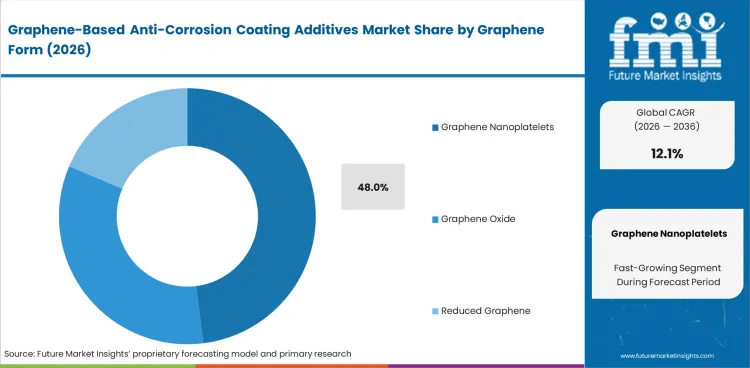
- Graphene nanoplatelets are projected to account for 48.0% share in 2026, supported by barrier path formation and easier dispersion in protective primers.
- Graphene oxide is drawing formulator interest as surface oxygen groups improve wetting inside waterborne and hybrid coating systems.
Insights into Graphene-Based Anti-Corrosion Coating Additives Market by Resin Compatibility
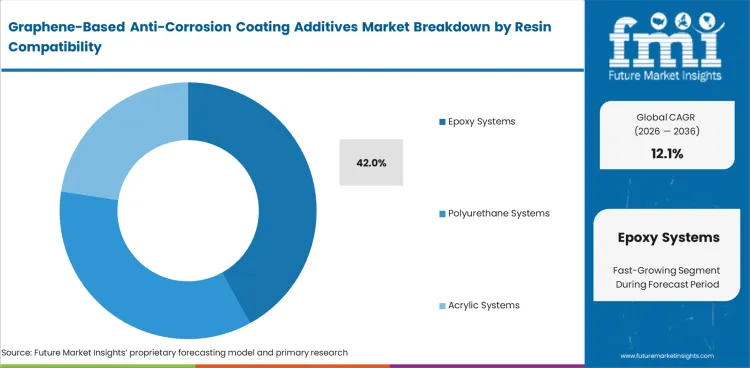
- Epoxy systems are expected to hold 42.0% share in 2026, led by broad use in marine primers and heavy-duty steel coatings.
- Polyurethane coatings are expanding in asset protection as buyers seek abrasion resistance along with corrosion control.
Insights into Graphene-Based Anti-Corrosion Coating Additives Market by Carrier System
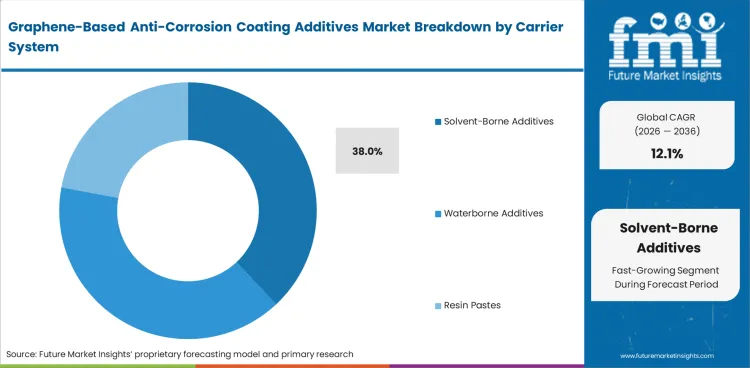
- Solvent-borne additives are forecast to account for 38.0% share in 2026, as heavy-duty primers continue using solvent systems for field reliability.
- Waterborne additives are drawing specification interest as coating makers reduce solvent content without losing barrier strength.
Insights into Graphene-Based Anti-Corrosion Coating Additives Market by End Use
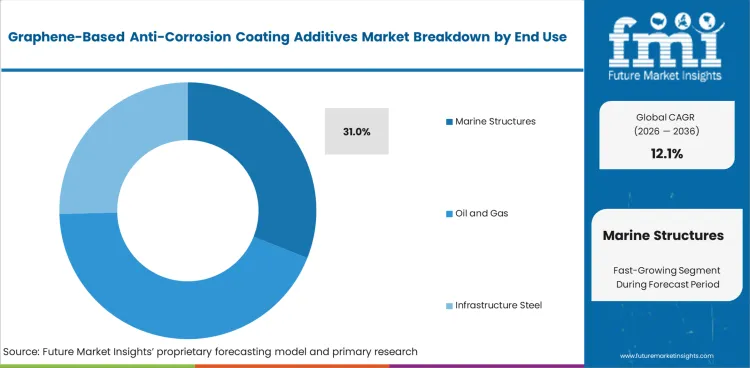
- Marine structures are expected to represent 31.0% share in 2026, driven by saltwater exposure and repainting cost pressure across steel assets.
- Oil and gas assets are expanding additive trials as pipelines and offshore platforms need longer coating service life.
Insights into Graphene-Based Anti-Corrosion Coating Additives Market by Sales Channel
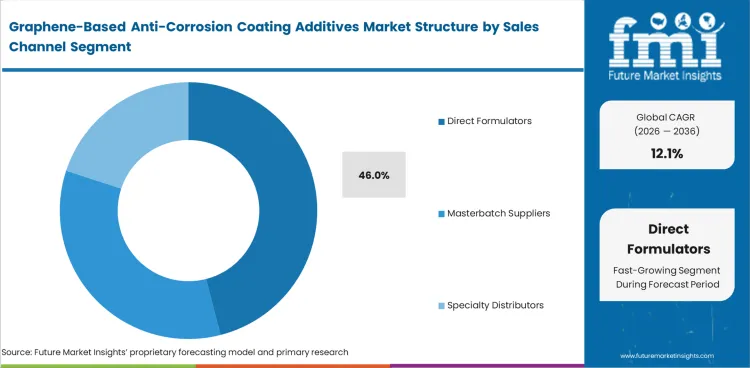
- Direct formulators are projected to hold 46.0% share in 2026, since coating makers need dispersion support before commercial qualification.
- Specialty distributors remain important for smaller coating producers requiring ready-to-blend graphene additives and technical guidance.
Graphene-Based Anti-Corrosion Coating Additives Market Drivers, Restraints, and Opportunities
- Barrier platelet performance raises interest in graphene-modified primers for steel and marine assets.
- Qualification risk slows adoption as poor dispersion can reduce coating life instead of improving protection.
- Chromium VI restriction work in Europe opens room for lower-hazard corrosion control additives.
Barrier performance is the main reason coating labs test graphene-based coating additives in anti-corrosion systems. Gerdau Graphene introduced NanoCORR Shield in June 2024 for solvent-based paints and coatings, and reported 30% to 70% higher corrosion resistance in salt spray testing. Reported improvement gives formulators a practical test benchmark instead of a broad material claim. European Chemicals Agency submitted a chromium VI restriction proposal in June 2025 covering certain carcinogenic oxides and salts. Regulatory pressure strengthens interest in corrosion protection systems with lower heavy-metal dependence. Suppliers gain once they prove stable dispersion and resin compatibility under regular primer mixing conditions.
Barrier Attribute and Claim Preference Analysis
Barrier preference in anti-corrosion coatings is moving from broad graphene claims toward measurable salt spray performance. Gerdau Graphene stated in June 2024 that NanoCORR Shield improved corrosion resistance by 30% to 70% in salt spray testing. Such claims create buyer interest only if dispersion stays stable inside regular primer systems. Coating formulators are expected to evaluate dosage and resin fit together. Repeat batch behavior will decide whether graphene additives move from trial panels into qualified marine and industrial coatings.
Steel Asset Demand Analysis
Steel asset protection is following maintenance cost pressure in marine and infrastructure applications. The World Steel Association’s April 2026 release puts March 2026 global crude steel output at 159.9 million tonnes across 69 reporting countries, underscoring how large the addressable steel surface base is. Those surfaces need coating systems able to resist moisture and chloride exposure over long service cycles. Graphene additives fit the premium part of this pool as buyers seek barrier gains without heavier coating layers. Additive suppliers benefit most from programs combining corrosion testing with coating line compatibility.
Analysis of Graphene-Based Anti-Corrosion Coating Additives Market by Key Countries
.webp "Top Country Growth Comparison Graphene Based Anti Corrosion Coating Additives Market Cagr (2026 2036)")
| Country | CAGR |
|---|---|
| India | 13.6% |
| Brazil | 13.2% |
| South Korea | 12.8% |
| China | 12.4% |
| Germany | 11.9% |
| United States | 10.8% |
| Japan | 10.6% |
Source: Future Market Insights, 2026.
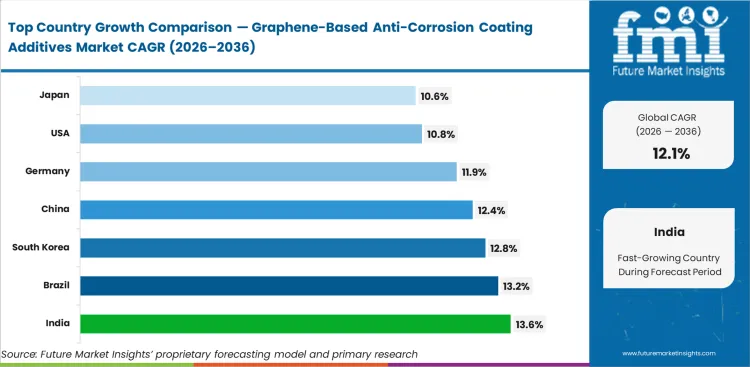
Graphene-Based Anti-Corrosion Coating Additives Market CAGR Analysis by Country
- India is expected to post 13.6% CAGR by 2036 as steel output and infrastructure coating work widen the trial pool.
- Brazil is projected to record 13.2% CAGR by 2036 as oilfield and marine exposure supports premium corrosion systems.
- South Korea is forecast at 12.8% CAGR by 2036, since shipbuilding and industrial coating users test high-performance additives.
- China is expected to advance at 12.4% CAGR by 2036, driven by broad steel production and coating formulation capacity.
- Germany and the United States track near the global pace at 11.9% CAGR and 10.8% CAGR due to stricter qualification cycles.
Demand for graphene-based anti-corrosion coating additives is forecast to rise at 12.1% CAGR from 2026 to 2036. Country-level analysis focuses on steel-intensive economies, marine repair routes and regulatory pressure around hazardous corrosion chemistries. Higher growth countries combine asset exposure with faster trials of advanced additives. Mature countries grow through premium specifications instead of broad coating replacement.
Demand Outlook for Graphene-Based Anti-Corrosion Coating Additives Market in the United States
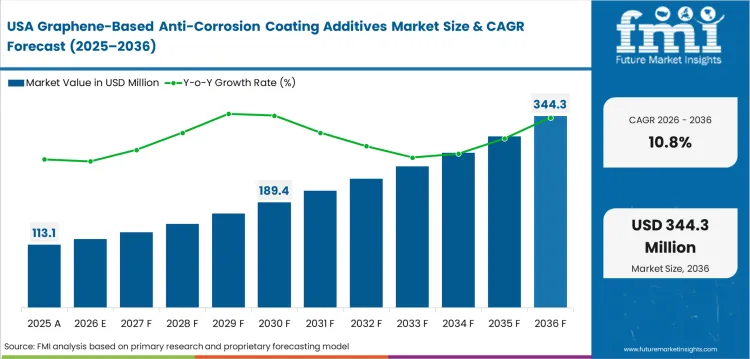
Demand in the United States is projected to record a 10.8% CAGR by 2036 since protective coating users focus on premium asset classes. As an indicator of the domestic steel footprint, the World Steel Association reported USA crude steel production of 7.2 Mt in March 2026. That volume supports steady requirements for bridge, factory and energy asset coatings where owners pay for longer service life. Graphene additives will advance mainly in formulas already commanding a performance premium. Coating makers need test evidence before shifting qualified primer systems.
- Bridge maintenance contractors can test graphene additives in epoxy primers requiring better chloride resistance.
- Offshore energy operators need coatings withstanding splash-zone exposure without forcing a full formulation reset.
- Defense-qualified paint makers can use supplier salt spray data to assess additive fit before specification changes.
Sales Analysis of Graphene-Based Anti-Corrosion Coating Additives Market in China
The sector in China is expected to expand at 12.4% CAGR by 2036, driven by steel production scale promoting corrosion coating trials. China’s scale is evident in World Steel Association data showing 87.0 Mt of crude steel output in March 2026. Broad steel production gives domestic coating formulators many industrial use cases and large volumes of steel to protect. Graphene suppliers succeed by serving paint labs with stable dispersion and local technical support. Cost pressure will keep adoption focused on high-value protective coatings.
- Ship repair and port equipment coatings can use graphene as a barrier additive in high-salt exposure work.
- Industrial equipment makers need additives able to improve primer life without slowing coating line throughput.
- Domestic graphene producers can gain share by pairing powder supply with coating trial support.
Demand Outlook for Graphene-Based Anti-Corrosion Coating Additives Market in India
Sales in India are forecast to grow at 13.6% CAGR through 2036 as infrastructure and steel output expand the coating surface pool. The World Steel Association reported India produced 15.3 Mt of crude steel in March 2026, highlighting the growing base of bridges, rail and industrial assets that require corrosion protection. Monthly production level supports broader use of protective coatings in bridges, rail and industrial assets. Graphene additives can fit projects requiring longer maintenance intervals. Price sensitivity means suppliers must show dosage savings and film-life gains together.
- Public infrastructure coatings can evaluate graphene primers for bridge steel and transport structures.
- Industrial paint makers need additive formats dispersing with current mixing equipment and local resin systems.
- Marine repair yards can test graphene-enhanced systems once suppliers provide salt spray proof under Indian service conditions.
Opportunity Analysis of Graphene-Based Anti-Corrosion Coating Additives Market in Germany
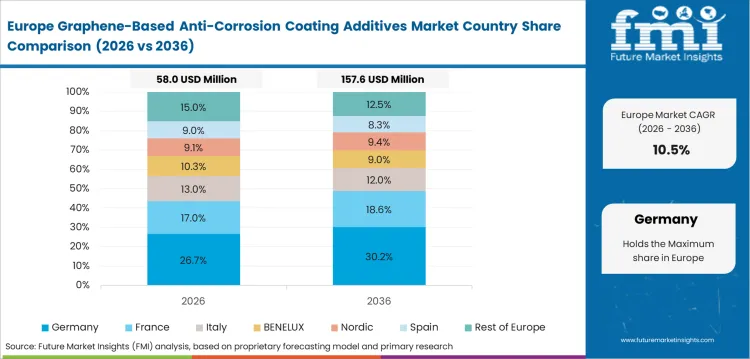
Demand in Germany is expected to advance at 11.9% CAGR by 2036 as industrial buyers test lower-hazard corrosion packages. Steel production remains a meaningful demand anchor: World Steel Association figures show Germany made 3.3 Mt of crude steel in March 2026. European chromium restriction work makes the reformulation route more active for protective coatings across this installed steel base. German coating buyers will move carefully because industrial specifications require long validation cycles. Suppliers able to document compatibility with coating resins secure a stronger entry path.
- Machinery coatings can use graphene additives to improve resistance in factory environments with high cleaning exposure.
- Rail and transport steel applications need long-life primers with clear repair and overcoat instructions.
- Industrial paint labs can trial graphene only after dispersion quality and worker handling data are documented.
Future Outlook for Graphene-Based Anti-Corrosion Coating Additives Market in Japan
Industry in Japan is forecast at 10.6% CAGR by 2036 as careful coating qualification and advanced technical standards shape adoption. In March 2026, Japan generated 6.9 Mt of crude steel, according to the World Steel Association, indicating a sizeable but mature steel base that prioritizes reliability. Mature coating users focus on reliability before changing corrosion packages. Graphene additives can gain in marine and precision equipment applications valuing thinner films. Slow approval cycles keep the country below faster expansion markets.
- Shipbuilding and repair users can assess graphene primers for salt exposure and reduced dry-film thickness.
- Industrial equipment brands need additives with stable dispersion across batch sizes and resin platforms.
- Technical buyers favor suppliers providing particle data and coating panel evidence before pricing talks.
Sales Analysis of Graphene-Based Anti-Corrosion Coating Additives Market in South Korea
The market in South Korea is projected to rise at 12.8% CAGR by 2036, influenced by shipbuilding and coating technology overlap. The World Steel Association logged South Korea’s crude steel output at 5.4 Mt in March 2026, reflecting a strong industrial base with heavy exposure to marine and equipment coatings. Industrial setting supports demand for marine and heavy equipment coatings. Graphene additives can move faster in supplier networks already serving shipyards and industrial paint makers. Performance proof will decide whether trials become regular supply.
- Shipyard coating teams can compare graphene primers with conventional systems during maintenance planning.
- Heavy equipment exporters need corrosion packages supporting warranty confidence in humid and marine climates.
- Graphene suppliers can build acceptance by working with coating labs on dispersion and field repair guidance.
Future Outlook for Graphene-Based Anti-Corrosion Coating Additives Market in Brazil
Demand in Brazil is projected to post 13.2% CAGR by 2036 as oilfield and port infrastructure create high corrosion exposure. In March 2026, Brazil’s crude steel production totaled 2.8 Mt, as reported by the World Steel Association, pointing to a steady steel asset base concentrated around coastal and energy corridors. Offshore energy and coastal assets make coating durability a direct maintenance cost issue. Graphene additives can enter premium coatings targeting splash-zone structures and marine equipment. Local proof under humidity and salt exposure will shape supplier acceptance.
- Oilfield service coating suppliers can test graphene additives for pipeline and platform maintenance work.
- Port equipment operators need coatings able to reduce repaint frequency under salt and abrasion exposure.
- Industrial coating distributors can support adoption by offering small trial quantities with technical mixing guidance.
Competitive Landscape and Strategic Positioning
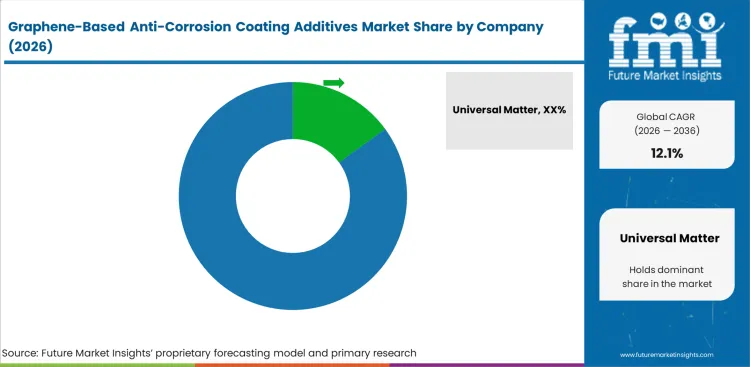
- Coating formulators shortlist suppliers able to provide salt spray panels, dosage guidance and resin compatibility data.
- Entry barriers include agglomeration control and surface treatment knowledge across coating batches.
- Direct support is important since coating labs will not reformulate qualified systems without clear technical evidence.
Graphene additive suppliers compete on proof of performance inside real coating systems. Coating formulators look for stable dispersion, repeat corrosion test results and guidance aligning with existing primer chemistry. Universal Matter uses the acquired Applied Graphene Materials dispersion capability to serve primer and topcoat formulators. Gerdau Graphene focuses on carbon-based nanomaterial additives for paint and coating systems. Both firms operate closer to coating labs than raw material sellers as they support mixing trials and corrosion testing.
Industrial graphene scale forms another competitive filter. NanoXplore promotes high-volume graphene powder capacity and new high-purity grades. First Graphene offers PureGRAPH materials and expanded coating technology after its 2026 acquisition agreement. Graphenea and Talga Group support coating-facing graphene formats through European supply routes. Smaller specialists can win if they solve application support for marine nanocoating and heavy-duty primer users. Suppliers best placed to increase share will combine repeatable dispersion quality with test evidence that coating formulators can use during qualification.
Key Companies in the Graphene-Based Anti-Corrosion Coating Additives Market
Competition is best read by role because graphene supply and coating qualification differ sharply.
- Graphene additive specialists: Universal Matter and Gerdau Graphene hold established positions based on dispersion formats aimed at paints and primers. Universal Matter offers graphene dispersions for anti-corrosion coatings. Gerdau Graphene sells NanoCORR formats for water-based and solvent-based systems. Both compete by reducing formulation risk for coating labs.
- Industrial graphene suppliers: First Graphene and NanoXplore strengthen buyer confidence through larger supply programs and product grade control. First Graphene adds coating formulation assets through its 2026 agreement. NanoXplore offers high-purity xGnP grades and scale signals needed for repeat industrial coating supply.
- European and specialist participants: Graphenea, Talga Group and Haydale Graphene Industries address coating use based on functionalized graphene materials and application partnerships. Graphenea offers graphene materials for coating trials. Talga has coating-facing graphene additives. Haydale supports functionalized graphene routes for inks and coatings.
Competitive Benchmarking: Graphene-Based Anti-Corrosion Coating Additives Market
| Company | Dispersion Control Depth | Coating Qualification Support | Industrial Graphene Capacity | Geographic Footprint |
|---|---|---|---|---|
| Universal Matter | High | Strong | Medium | North America and Europe with AGM dispersion know-how from the acquired Applied Graphene Materials business |
| Gerdau Graphene | High | Strong | Medium | Brazil centered with coatings and construction additive reach |
| First Graphene | Medium | Strong | Strong | Australia centered with global PureGRAPH supply routes |
| NanoXplore | Medium | Medium | High | North America centered with industrial graphene scale |
| Black Swan Graphene | Medium | Low | Medium | North America centered with graphene powder supply |
| Talga Group | Medium | Medium | Medium | Europe centered with graphite and graphene materials |
| Haydale Graphene Industries | Medium | Medium | Low | United Kingdom centered with functionalized graphene capability |
| Graphenea | Medium | Low | Medium | Europe centered with graphene material supply |
| The Sixth Element Materials | Medium | Low | Medium | China centered with graphene powder supply |
| Nanografi Nano Technology | Low | Low | Medium | Turkey centered with nanomaterial distribution reach |
Source: Future Market Insights competitive analysis, 2026. Ratings reflect comparative positioning based on dispersion control depth, coating qualification support and industrial graphene capacity.
Key Developments in Graphene-Based Anti-Corrosion Coating Additives Market
- In June 2024, Gerdau Graphene introduced NanoCORR Shield for solvent-based paints and coatings. Reported 30% to 70% salt spray gains give formulators a measurable anti-corrosion trial point.
- In April 2026, First Graphene signed an agreement to acquire advanced graphene coatings assets for AU$250 thousand.
- In May 2026, NanoXplore launched xGnP D500-HP with 99.8% purity and 500 m²/g surface area.
Key Players in the Graphene-Based Anti-Corrosion Coating Additives Market
Major Global Players:
- Universal Matter
- First Graphene
- NanoXplore
- Black Swan Graphene
Specialist and Regional Players:
- Gerdau Graphene
- Talga Group
- Haydale Graphene Industries
- Graphenea
- The Sixth Element Materials
- Nanografi Nano Technology
Report Scope and Coverage
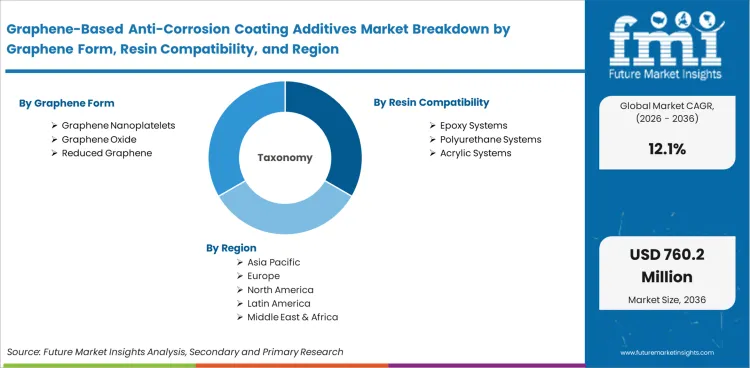
| Parameter | Details |
|---|---|
| Quantitative Units | USD 242.6 million to USD 760.2 million, at 12.1% CAGR |
| Market Definition | Graphene materials added to protective coatings to improve corrosion resistance on metal assets |
| Graphene Form | Graphene Nanoplatelets, Graphene Oxide, Reduced Graphene, Hybrid Graphene |
| Resin Compatibility | Epoxy Systems, Polyurethane Systems, Acrylic Systems, Alkyd Systems |
| Carrier System | Solvent-Borne Additives, Waterborne Additives, Powder Additives, Resin Pastes |
| End Use | Marine Structures, Oil and Gas, Industrial Equipment, Infrastructure Steel, Automotive Components |
| Sales Channel | Direct Formulators, Masterbatch Suppliers, Specialty Distributors, Technical Licensors |
| Regions Covered | North America, Latin America, Western Europe, Eastern Europe, East Asia, South Asia and Pacific, Middle East and Africa |
| Countries Covered | United States, China, India, Germany, Japan, South Korea, Brazil, and 30+ countries |
| Key Companies Profiled | Universal Matter, Gerdau Graphene, First Graphene, NanoXplore, Black Swan Graphene, Talga Group, Haydale Graphene Industries |
| Forecast Period | 2026 to 2036 |
| Approach | Hybrid bottom-up and top-down methodology using graphene coating additive value, corrosion application share and country steel exposure |
Source: Future Market Insights, 2026.
Graphene-Based Anti-Corrosion Coating Additives Market by Segments
Graphene-Based Anti-Corrosion Coating Additives Market Segmented by Graphene Form:
- Graphene Nanoplatelets
- Graphene Oxide
- Reduced Graphene
- Hybrid Graphene
Graphene-Based Anti-Corrosion Coating Additives Market Segmented by Resin Compatibility:
- Epoxy Systems
- Polyurethane Systems
- Acrylic Systems
- Alkyd Systems
Graphene-Based Anti-Corrosion Coating Additives Market Segmented by Carrier System:
- Solvent-Borne Additives
- Waterborne Additives
- Powder Additives
- Resin Pastes
Graphene-Based Anti-Corrosion Coating Additives Market Segmented by End Use:
- Marine Structures
- Oil and Gas
- Industrial Equipment
- Infrastructure Steel
- Automotive Components
Graphene-Based Anti-Corrosion Coating Additives Market Segmented by Sales Channel:
- Direct Formulators
- Masterbatch Suppliers
- Specialty Distributors
- Technical Licensors
Graphene-Based Anti-Corrosion Coating Additives Market by Region:
- North America
- United States
- Canada
- Mexico
- Latin America
- Brazil
- Chile
- Rest of Latin America
- Western Europe
- Germany
- UK
- Italy
- Spain
- France
- Nordic
- BENELUX
- Rest of Western Europe
- Eastern Europe
- Russia
- Poland
- Hungary
- Balkan and Baltic
- Rest of Eastern Europe
- East Asia
- China
- Japan
- South Korea
- South Asia and Pacific
- India
- ASEAN
- Australia and New Zealand
- Rest of South Asia and Pacific
- Middle East and Africa
- Kingdom of Saudi Arabia
- Other GCC Countries
- Turkiye
- South Africa
- Other African Union
- Rest of Middle East and Africa
Research Sources and Bibliography
- European Chemicals Agency. (2025, June 18). ECHA weekly - 18 June 2025.
- First Graphene Limited. (2026, April 28). FGR enters agreement to acquire advanced graphene coatings companies. PR Newswire.
- NanoXplore Inc. (2026, May 5). NanoXplore launches xGnP™ D500-HP, high-purity graphene to replace conventional conductive additives.
- NanoXplore Inc. (2025, September 18). NanoXplore announces supply contract with Chevron Phillips Chemical.
- First Graphene Limited. (2025, July 1). PureGRAPH® orderbook strengthened.
- United States Environmental Protection Agency. (2024, August 5). IRIS toxicological review of hexavalent chromium (Final report, 2024).
- Universal Matter Inc. (2024, December 16). Universal Matter Inc. secures international investment.
- Yadav, A., Panjikar, S., & Singh Raman, R. K. (2025). Graphene-based impregnation into polymeric coating for corrosion resistance. Nanomaterials, 15(7), Article 486.
- Gerdau Graphene. (2024, June 11). Gerdau Graphene introduces ‘NanoCORR Shield’, a graphene-enhanced anti-corrosion chemical additive for solvent-based paints. Newswire.
- World Steel Association. (2026, April 23). March 2026 crude steel production.
Bibliography uses government and trade body sources. Company and official technical sources support graphene additive evidence.
This Report Answers
- What is the current and future size of the graphene-based anti-corrosion coating additives market?
- How fast is the graphene-based anti-corrosion coating additives market expected to expand between 2026 and 2036?
- Which graphene form is expected to lead graphene-based anti-corrosion coating additives demand by 2026?
- Which end use is projected to account for a strong graphene-based anti-corrosion coating additives share in 2026?
- Why are epoxy systems important for graphene-based anti-corrosion coating additives?
- How do dispersion quality and salt spray proof affect buyer acceptance?
- Which countries are projected to record faster expansion during the forecast period?
- Who are the main companies active in graphene-based anti-corrosion coating additives?
- How does FMI define the graphene-based anti-corrosion coating additives market scope?
- How does FMI estimate and validate the graphene-based anti-corrosion coating additives forecast?
Frequently Asked Questions
What is the global market demand for graphene-based anti-corrosion coating additives in 2026?
In 2026, the graphene-based anti-corrosion coating additives market is expected to be worth USD 242.6 million as coating labs move into qualified trials.
How big will the graphene-based anti-corrosion coating additives market be in 2036?
By 2036, the graphene-based anti-corrosion coating additives market is expected to be worth USD 760.2 million as marine and industrial use expands.
How much is demand for graphene-based anti-corrosion coating additives expected to expand between 2026 and 2036?
Between 2026 and 2036, graphene-based anti-corrosion coating additives demand is expected to expand at 12.1% CAGR as barrier additives gain use.
Which graphene form is expected to lead the graphene-based anti-corrosion coating additives market by 2026?
Graphene nanoplatelets are projected to lead with 48.0% share in 2026 due to barrier path performance.
Which end use is expected to lead graphene-based anti-corrosion coating additives demand in 2026?
Marine structures are expected to lead with 31.0% share in 2026 as salt exposure raises coating performance needs.
Which country is forecast to grow faster in the graphene-based anti-corrosion coating additives market?
India is expected to post 13.6% CAGR by 2036 as infrastructure coatings and steel output create a broader trial pool.
What does the graphene-based anti-corrosion coating additives market include?
Scope includes graphene powders, dispersions and pastes used in protective coatings to improve corrosion resistance on metal assets.
How does FMI estimate the graphene-based anti-corrosion coating additives market forecast?
FMI uses graphene coating additive value and corrosion application share. Country steel exposure and supplier activity are used to validate the forecast.
Are graphene additives better than zinc-based corrosion inhibitors?
Graphene additives are better for barrier improvement in selected systems. Zinc-based inhibitors remain useful if sacrificial corrosion protection is required.
How much do graphene additives affect coating cost?
Graphene additives raise formulation cost but can improve value if lower dosage, longer coating life or thinner films reduce maintenance costs.
How do graphene-based anti-corrosion coating additives work?
Graphene platelets create a longer path for water and chloride ions inside the coating film. Better dispersion improves the barrier effect.
How long can graphene-enhanced anti-corrosion coatings last?
Service life depends on resin, surface preparation and exposure conditions. Buyers should rely on salt spray tests and field panels before selection.
Preview the report firsthand - request a free sample
Get SampleGet the brochure for pricing and purchase details.
Get PDFTable of Content
- Key Takeaways
- Market Size and CAGR
- Top Growth Driver
- Fastest Growing Segment
- Leading Region
- Key Companies
- Emerging Opportunities
- Executive Summary
- Global Market Outlook
- Demand-side Trends
- Supply-side Trends
- Technology Roadmap Analysis
- Analysis and Recommendations
- Analyst Perspective (What is happening? Why now? What should investors know?)
- Key Questions Answered
- How large is the market?
- What is the CAGR?
- What are key trends?
- Which region dominates?
- Who are the leaders?
- Market Overview
- Market Coverage / Taxonomy
- Market Definition / Scope / Limitations
- Research Methodology
- Chapter Orientation
- Analytical Lens and Working Hypotheses
- Market Structure, Signals, and Trend Drivers
- Benchmarking and Cross-market Comparability
- Market Sizing, Forecasting, and Opportunity Mapping
- Research Design and Evidence Framework
- Desk Research Programme (Secondary Evidence)
- Expert Input and Fieldwork (Primary Evidence)
- Tooling, Models, and Reference Databases
- Data Engineering and Model Build
- Quality Assurance and Audit Trail
- Market Background
- Market Dynamics (Drivers, Restraints, Opportunity, Trends)
- Scenario Forecast (Optimistic, Likely, Conservative)
- Impact Analysis
- AI Impact
- Sustainability Impact
- Regulatory Impact
- Technology Impact
- Consumer / Buyer Analysis
- Purchase Drivers
- Adoption Barriers
- Buyer Journey
- Opportunity Map Analysis
- Product Life Cycle Analysis
- Supply Chain Analysis
- Investment Feasibility Matrix
- Value Chain Analysis
- PESTLE and Porter's Analysis
- Regulatory Landscape
- Regional Parent Market Outlook
- Production and Consumption Statistics
- Import and Export Statistics
- Global Market Analysis and Forecast, 2021 to 2036
- Historical Market Size Value (USD Million) & Volume (Unit) Analysis, 2021 to 2025
- Current and Future Market Size Value (USD Million) & Volume (Unit) Projections, 2026 to 2036
- Y-o-Y Growth Trend Analysis
- Absolute $ Opportunity Analysis
- Global Market Pricing Analysis, 2021 to 2036
- Global Market Analysis and Forecast, By Graphene Form, 2021 to 2036
- Introduction / Key Findings
- Historical Market Size Value (USD Million) & Volume (Unit) Analysis By Graphene Form, 2021 to 2025
- Current and Future Market Size Value (USD Million) & Volume (Unit) Analysis and Forecast By Graphene Form, 2026 to 2036
- Graphene Nanoplatelets
- Graphene Oxide
- Reduced Graphene
- Hybrid Graphene
- Graphene Nanoplatelets
- Y-o-Y Growth Trend Analysis By Graphene Form, 2021 to 2025
- Absolute $ Opportunity Analysis By Graphene Form, 2026 to 2036
- Global Market Analysis and Forecast, By Resin Compatibility, 2021 to 2036
- Introduction / Key Findings
- Historical Market Size Value (USD Million) & Volume (Unit) Analysis By Resin Compatibility, 2021 to 2025
- Current and Future Market Size Value (USD Million) & Volume (Unit) Analysis and Forecast By Resin Compatibility, 2026 to 2036
- Epoxy Systems
- Polyurethane Systems
- Acrylic Systems
- Alkyd Systems
- Epoxy Systems
- Y-o-Y Growth Trend Analysis By Resin Compatibility, 2021 to 2025
- Absolute $ Opportunity Analysis By Resin Compatibility, 2026 to 2036
- Global Market Analysis and Forecast, By Carrier System, 2021 to 2036
- Introduction / Key Findings
- Historical Market Size Value (USD Million) & Volume (Unit) Analysis By Carrier System, 2021 to 2025
- Current and Future Market Size Value (USD Million) & Volume (Unit) Analysis and Forecast By Carrier System, 2026 to 2036
- Solvent-Borne Additives
- Waterborne Additives
- Powder Additives
- Resin Pastes
- Solvent-Borne Additives
- Y-o-Y Growth Trend Analysis By Carrier System, 2021 to 2025
- Absolute $ Opportunity Analysis By Carrier System, 2026 to 2036
- Global Market Analysis and Forecast, By End Use, 2021 to 2036
- Introduction / Key Findings
- Historical Market Size Value (USD Million) & Volume (Unit) Analysis By End Use, 2021 to 2025
- Current and Future Market Size Value (USD Million) & Volume (Unit) Analysis and Forecast By End Use, 2026 to 2036
- Marine Structures
- Oil and Gas
- Industrial Equipment
- Infrastructure Steel
- Automotive Components
- Marine Structures
- Y-o-Y Growth Trend Analysis By End Use, 2021 to 2025
- Absolute $ Opportunity Analysis By End Use, 2026 to 2036
- Global Market Analysis and Forecast, By Sales Channel, 2021 to 2036
- Introduction / Key Findings
- Historical Market Size Value (USD Million) & Volume (Unit) Analysis By Sales Channel, 2021 to 2025
- Current and Future Market Size Value (USD Million) & Volume (Unit) Analysis and Forecast By Sales Channel, 2026 to 2036
- Direct Formulators
- Masterbatch Suppliers
- Specialty Distributors
- Technical Licensors
- Direct Formulators
- Y-o-Y Growth Trend Analysis By Sales Channel, 2021 to 2025
- Absolute $ Opportunity Analysis By Sales Channel, 2026 to 2036
- Global Market Analysis and Forecast, By Region, 2021 to 2036
- Introduction
- Historical Market Size Value (USD Million) & Volume (Unit) Analysis By Region, 2021 to 2025
- Current Market Size Value (USD Million) & Volume (Unit) Analysis and Forecast By Region, 2026 to 2036
- North America
- Latin America
- Western Europe
- Eastern Europe
- East Asia
- South Asia and Pacific
- Middle East & Africa
- Market Attractiveness Analysis By Region
- North America Market Analysis and Forecast, By Country, 2021 to 2036
- Historical Market Size Value (USD Million) & Volume (Unit) Trend Analysis By Market Taxonomy, 2021 to 2025
- Market Size Value (USD Million) & Volume (Unit) Forecast By Market Taxonomy, 2026 to 2036
- By Country
- USA
- Canada
- Mexico
- By Graphene Form
- By Resin Compatibility
- By Carrier System
- By End Use
- By Sales Channel
- By Country
- Market Attractiveness Analysis
- By Country
- By Graphene Form
- By Resin Compatibility
- By Carrier System
- By End Use
- By Sales Channel
- Key Takeaways
- Latin America Market Analysis and Forecast, By Country
- Historical Market Size Value (USD Million) & Volume (Unit) Trend Analysis By Market Taxonomy, 2021 to 2025
- Market Size Value (USD Million) & Volume (Unit) Forecast By Market Taxonomy, 2026 to 2036
- By Country
- Brazil
- Chile
- Rest of Latin America
- By Graphene Form
- By Resin Compatibility
- By Carrier System
- By End Use
- By Sales Channel
- By Country
- Market Attractiveness Analysis
- By Country
- By Graphene Form
- By Resin Compatibility
- By Carrier System
- By End Use
- By Sales Channel
- Key Takeaways
- Western Europe Market Analysis and Forecast, By Country
- Historical Market Size Value (USD Million) & Volume (Unit) Trend Analysis By Market Taxonomy, 2021 to 2025
- Market Size Value (USD Million) & Volume (Unit) Forecast By Market Taxonomy, 2026 to 2036
- By Country
- Germany
- UK
- Italy
- Spain
- France
- Nordic
- BENELUX
- Rest of Western Europe
- By Graphene Form
- By Resin Compatibility
- By Carrier System
- By End Use
- By Sales Channel
- By Country
- Market Attractiveness Analysis
- By Country
- By Graphene Form
- By Resin Compatibility
- By Carrier System
- By End Use
- By Sales Channel
- Key Takeaways
- Eastern Europe Market Analysis and Forecast, By Country
- Historical Market Size Value (USD Million) & Volume (Unit) Trend Analysis By Market Taxonomy, 2021 to 2025
- Market Size Value (USD Million) & Volume (Unit) Forecast By Market Taxonomy, 2026 to 2036
- By Country
- Russia
- Poland
- Hungary
- Balkan & Baltic
- Rest of Eastern Europe
- By Graphene Form
- By Resin Compatibility
- By Carrier System
- By End Use
- By Sales Channel
- By Country
- Market Attractiveness Analysis
- By Country
- By Graphene Form
- By Resin Compatibility
- By Carrier System
- By End Use
- By Sales Channel
- Key Takeaways
- East Asia Market Analysis and Forecast, By Country
- Historical Market Size Value (USD Million) & Volume (Unit) Trend Analysis By Market Taxonomy, 2021 to 2025
- Market Size Value (USD Million) & Volume (Unit) Forecast By Market Taxonomy, 2026 to 2036
- By Country
- China
- Japan
- South Korea
- By Graphene Form
- By Resin Compatibility
- By Carrier System
- By End Use
- By Sales Channel
- By Country
- Market Attractiveness Analysis
- By Country
- By Graphene Form
- By Resin Compatibility
- By Carrier System
- By End Use
- By Sales Channel
- Key Takeaways
- South Asia and Pacific Market Analysis and Forecast, By Country
- Historical Market Size Value (USD Million) & Volume (Unit) Trend Analysis By Market Taxonomy, 2021 to 2025
- Market Size Value (USD Million) & Volume (Unit) Forecast By Market Taxonomy, 2026 to 2036
- By Country
- India
- ASEAN
- Australia & New Zealand
- Rest of South Asia and Pacific
- By Graphene Form
- By Resin Compatibility
- By Carrier System
- By End Use
- By Sales Channel
- By Country
- Market Attractiveness Analysis
- By Country
- By Graphene Form
- By Resin Compatibility
- By Carrier System
- By End Use
- By Sales Channel
- Key Takeaways
- Middle East & Africa Market Analysis and Forecast, By Country
- Historical Market Size Value (USD Million) & Volume (Unit) Trend Analysis By Market Taxonomy, 2021 to 2025
- Market Size Value (USD Million) & Volume (Unit) Forecast By Market Taxonomy, 2026 to 2036
- By Country
- Kingdom of Saudi Arabia
- Other GCC Countries
- Türkiye
- South Africa
- Other African Union
- Rest of Middle East & Africa
- By Graphene Form
- By Resin Compatibility
- By Carrier System
- By End Use
- By Sales Channel
- By Country
- Market Attractiveness Analysis
- By Country
- By Graphene Form
- By Resin Compatibility
- By Carrier System
- By End Use
- By Sales Channel
- Key Takeaways
- Key Countries Market Analysis
- USA
- Pricing Analysis
- Market Share Analysis, 2025
- By Graphene Form
- By Resin Compatibility
- By Carrier System
- By End Use
- By Sales Channel
- Canada
- Pricing Analysis
- Market Share Analysis, 2025
- By Graphene Form
- By Resin Compatibility
- By Carrier System
- By End Use
- By Sales Channel
- Mexico
- Pricing Analysis
- Market Share Analysis, 2025
- By Graphene Form
- By Resin Compatibility
- By Carrier System
- By End Use
- By Sales Channel
- Brazil
- Pricing Analysis
- Market Share Analysis, 2025
- By Graphene Form
- By Resin Compatibility
- By Carrier System
- By End Use
- By Sales Channel
- Chile
- Pricing Analysis
- Market Share Analysis, 2025
- By Graphene Form
- By Resin Compatibility
- By Carrier System
- By End Use
- By Sales Channel
- Germany
- Pricing Analysis
- Market Share Analysis, 2025
- By Graphene Form
- By Resin Compatibility
- By Carrier System
- By End Use
- By Sales Channel
- UK
- Pricing Analysis
- Market Share Analysis, 2025
- By Graphene Form
- By Resin Compatibility
- By Carrier System
- By End Use
- By Sales Channel
- Italy
- Pricing Analysis
- Market Share Analysis, 2025
- By Graphene Form
- By Resin Compatibility
- By Carrier System
- By End Use
- By Sales Channel
- Spain
- Pricing Analysis
- Market Share Analysis, 2025
- By Graphene Form
- By Resin Compatibility
- By Carrier System
- By End Use
- By Sales Channel
- France
- Pricing Analysis
- Market Share Analysis, 2025
- By Graphene Form
- By Resin Compatibility
- By Carrier System
- By End Use
- By Sales Channel
- India
- Pricing Analysis
- Market Share Analysis, 2025
- By Graphene Form
- By Resin Compatibility
- By Carrier System
- By End Use
- By Sales Channel
- ASEAN
- Pricing Analysis
- Market Share Analysis, 2025
- By Graphene Form
- By Resin Compatibility
- By Carrier System
- By End Use
- By Sales Channel
- Australia & New Zealand
- Pricing Analysis
- Market Share Analysis, 2025
- By Graphene Form
- By Resin Compatibility
- By Carrier System
- By End Use
- By Sales Channel
- China
- Pricing Analysis
- Market Share Analysis, 2025
- By Graphene Form
- By Resin Compatibility
- By Carrier System
- By End Use
- By Sales Channel
- Japan
- Pricing Analysis
- Market Share Analysis, 2025
- By Graphene Form
- By Resin Compatibility
- By Carrier System
- By End Use
- By Sales Channel
- South Korea
- Pricing Analysis
- Market Share Analysis, 2025
- By Graphene Form
- By Resin Compatibility
- By Carrier System
- By End Use
- By Sales Channel
- Russia
- Pricing Analysis
- Market Share Analysis, 2025
- By Graphene Form
- By Resin Compatibility
- By Carrier System
- By End Use
- By Sales Channel
- Poland
- Pricing Analysis
- Market Share Analysis, 2025
- By Graphene Form
- By Resin Compatibility
- By Carrier System
- By End Use
- By Sales Channel
- Hungary
- Pricing Analysis
- Market Share Analysis, 2025
- By Graphene Form
- By Resin Compatibility
- By Carrier System
- By End Use
- By Sales Channel
- Kingdom of Saudi Arabia
- Pricing Analysis
- Market Share Analysis, 2025
- By Graphene Form
- By Resin Compatibility
- By Carrier System
- By End Use
- By Sales Channel
- Türkiye
- Pricing Analysis
- Market Share Analysis, 2025
- By Graphene Form
- By Resin Compatibility
- By Carrier System
- By End Use
- By Sales Channel
- South Africa
- Pricing Analysis
- Market Share Analysis, 2025
- By Graphene Form
- By Resin Compatibility
- By Carrier System
- By End Use
- By Sales Channel
- USA
- Market Structure Analysis
- Competition Dashboard
- Competition Benchmarking
- Market Share Analysis of Top Players
- By Regional
- By Graphene Form
- By Resin Compatibility
- By Carrier System
- By End Use
- By Sales Channel
- Emerging Startups
- Innovation Benchmarking
- Competition Analysis
- Competition Deep Dive
- Universal Matter
- Overview
- Product Portfolio
- Profitability by Market Segments (Product/Region/Sales Channel)
- Sales Footprint
- Strategy Overview
- Marketing Strategy
- Product Strategy
- Channel Strategy
- First Graphene
- NanoXplore
- Black Swan Graphene
- Gerdau Graphene
- Talga Group
- Haydale Graphene Industries
- Graphenea
- The Sixth Element Materials
- Nanografi Nano Technology
- Universal Matter
- Case Studies
- Success Stories
- Recent Developments
- Competition Deep Dive
- Assumptions & Acronyms Used


