

- Industry Size (2026)
- USD 460.0 Mn
- Forecast (2036)
- USD 690.0 Mn
- CAGR (2026 to 2036)
- 4.2%
Wool Dryer Ball Market Size, Market Forecast, and Outlook By FMI
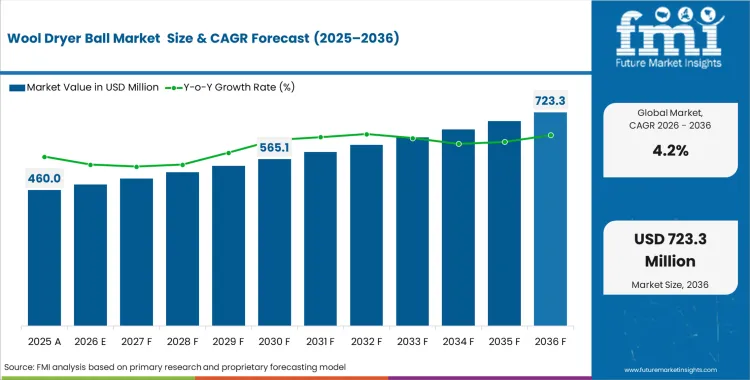
The wool dryer ball market was valued at USD 440.0 million in 2025. Industry is estimated to reach USD 460.0 million in 2026 at a CAGR of 4.2% during the forecast period. Wool dryer ball industry forecast is hinting an estimated size of USD 690.0 million through 2036 as households shift away from single-use synthetic softeners to protect expensive high-efficiency appliance sensors from wax buildup.
Summary of Wool Dryer Ball Market
- The market is estimated at USD 0.44 billion in 2025.
- The market is projected to reach USD 0.69 billion by 2036.
- The market is expected to grow at a CAGR of 4.2% from 2026 to 2036.
- The forecast period represents an incremental opportunity of USD 0.23 billion.
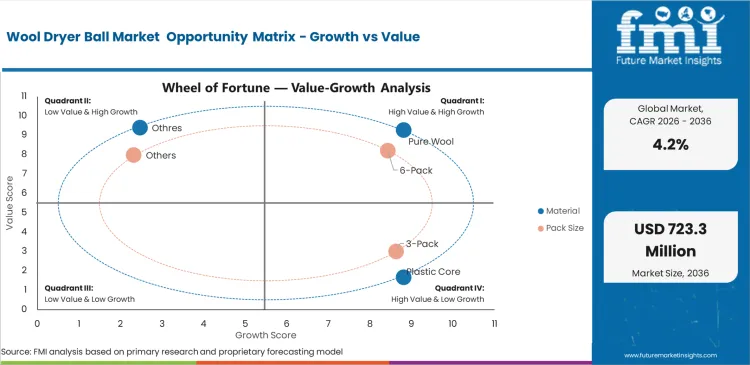
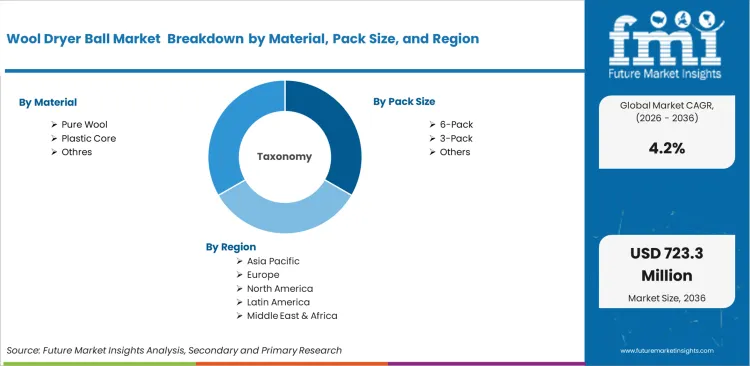
- Pure wool leads the material segment with a 71.0% share.
- 6-pack format dominates the pack size segment with a 38.0% share.
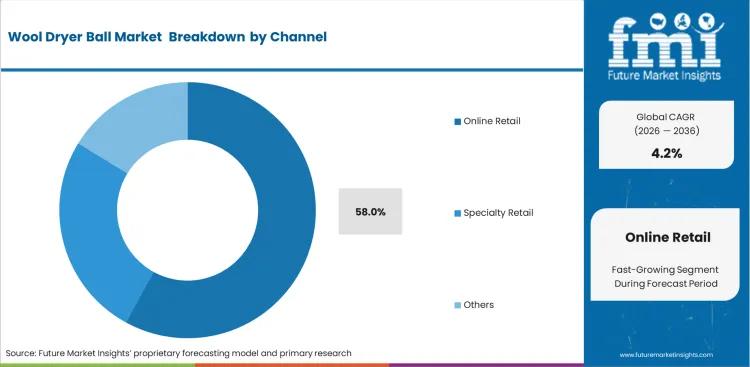
- Online retail leads the channel segment with a 58.0% share.
- Households dominate the end-use segment with a 82.0% share.
- Unscented variants lead the product variant segment with a 67.0% share.
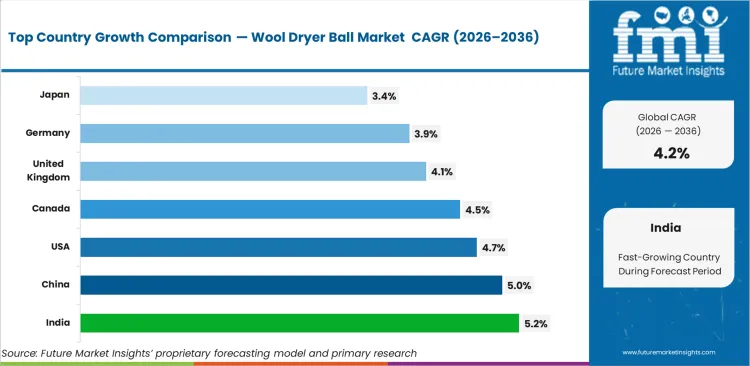
- India (5.2%), China (5.0%), and the United States (4.7%) are among the fastest-growing markets.
Rising awareness around chemical sensitivity is encouraging some consumers to reduce reliance on traditional softening agents. Concerns around skin sensitivity and residue buildup are supporting interest in gentler laundry-care alternatives and lower-residue drying solutions. Purchase decisions in laundry care are influenced not only by sustainability preferences but also by product reusability, perceived fabric care, and appliance-compatibility considerations.
Adoption is also supported by wider consumer preference for reusable alternatives that align with low-residue laundry routines. Warranty preservation drives immediate substitution toward natural dryer sheets alternatives. Broader digital availability continues to improve category visibility and supports incremental household adoption.
India is expected to record a 5.2% CAGR by 2036 as rising middle-class spending lifts adoption of premium appliance-care products. China is anticipated to rise at 5.0%, supported by a deeper e-commerce reach and wider availability of niche laundry-care items. The United States wool dry balls demand is estimated to expand at 4.7% because dryer-based laundry routines remain standard across households. Canada is set to post 4.5%, supported by energy-efficiency standards and steady demand for reusable dryer accessories. The United Kingdom is projected to advance at 4.1% as damp conditions keep indoor mechanical drying relevant. Germany is likely to register 3.9% CAGR, reflecting a preference for chemical-free home-care products. Japan is expected to remain lower at 3.4% because outdoor line-drying still limits addressable use. Clear separation remains between markets where mechanical drying is routine and those where it serves mainly seasonal needs.
Segmental Analysis
Wool Dryer Ball Market Analysis by Material
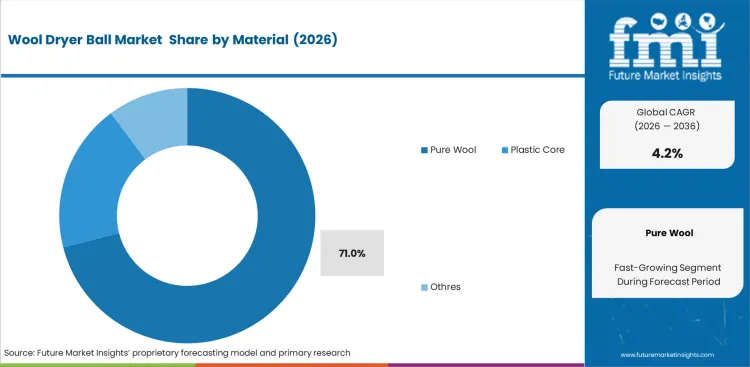
Material purity remains the core reason pure wool stays ahead in this category. Performance in the dryer depends on more than fabric separation, because moisture absorption, heat tolerance, and repeated-cycle durability directly influence product acceptance and repeat purchase. Pure wool is expected to hold 71.0% share of the Material segment in 2026, as it delivers the combination of moisture uptake, structural stability, and low-residue performance that blended constructions struggle to match.
Plastic or mixed-core alternatives may reduce input cost, but they introduce a higher risk of deformation under sustained heat and weaken the product’s ability to support shorter drying cycles. Demand for wool dryer balls vs plastic dryer balls continues to favor pure fleece, where consumers expect eco-friendly laundry accessories to remain effective across hundreds of drying cycles. Evaluating pure wool vs blended dryer balls where reliability matters more than marginal material savings.
- Moisture absorption gap: Pure fleece absorbs and redistributes moisture during the drying cycle, which improves load separation and supports claims around faster drying performance.
- Thermal degradation risk: Blended or plastic-core formats carry a greater risk of warping or structural breakdown under repeated high-heat exposure, which weakens long-term product reliability.
- Sourcing cost exposure: Wool input prices remain more volatile than synthetic substitutes, but manufacturers continue to accept that pressure because lower-purity formats can undermine product performance and increase return risk.
Wool Dryer Ball Market Analysis by Pack size
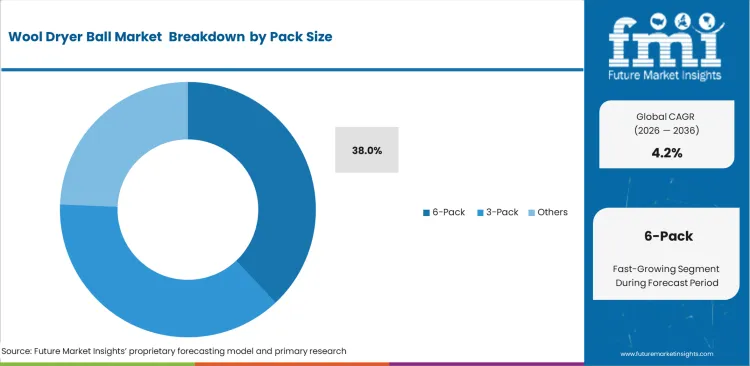
Pack format leadership is shaped largely by fulfillment economics and online basket construction rather than by laundry volume alone. The 6-pack format is estimated to account for 38.0% of the Pack Size segment in 2026, as it gives brands a commercially viable balance between consumer value perception and order-level margin. Smaller configurations may suit lighter residential usage, but they leave less room to absorb packaging cost, freight burden, and customer acquisition expense across digital channels.
Pack size in this category behaves differently from commercial laundry detergent, where volume movement is tied more directly to usage intensity and replenishment cycles. Box sizing, shipping thresholds, and bundle economics continue to favor formats that raise average selling price without a proportional increase in delivery cost. Bulk wool dryer balls sold in 6-pack formats also fit gifting, repeat household use, and multi-load positioning across online storefronts. This keeps the format ahead, where margin discipline matters as much as in-home usage frequency.
- Dimensional weight penalty: Lightweight dryer balls still require bulky packaging, so freight cost is influenced more by parcel size than by product mass.
- Basket size minimums: Six-unit packs help raise basket value and make online selling economics more sustainable across branded websites and marketplaces.
- Inventory holding pressure: Larger pack formats consume more warehouse space, but manufacturers continue to favor them where margin protection outweighs incremental storage pressure.
Wool Dryer Ball Market Analysis by Channel
Channel preference is shaped by purchase behavior, visibility economics, and the way consumers evaluate product performance before trial. Durable laundry accessories do not benefit from the same replenishment rhythm that supports recurring shelf turnover in mainstream retail. Physical stores tend to prioritize liquid detergents, dryer sheets, and pre-treater products that generate faster repeat movement, which leaves less visibility for slower-rotation items such as wool dryer balls.
Digital commerce removes that constraint by giving niche brands direct access to consumers already searching for reusable laundry solutions. Online retail is anticipated to capture 58.0% of the Channel segment in 2026, as brand discovery, product education, and conversion all operate more efficiently through direct digital touchpoints. Visual demonstrations, user reviews, and targeted storefront placement also give online sellers a stronger ability to explain performance benefits that are harder to communicate in-store. Wholesale wool dryer balls also move through digital B2B portals, which broadens reach beyond branded websites and supports access to independent boutiques and specialty retailers.
- Algorithm-driven discovery: Video-led product demonstrations help explain how wool dryer balls work, making online channels more effective for first-time consumer education.
- Shelf-velocity constraints: Physical retail gives more space to fast-moving laundry consumables, which restricts visibility for durable accessories with longer replacement cycles.
- Direct feedback loops: Reviews and product ratings influence trust quickly in this category, making online feedback an important driver of conversion and repeat brand selection.
Wool Dryer Ball Market Analysis by End use
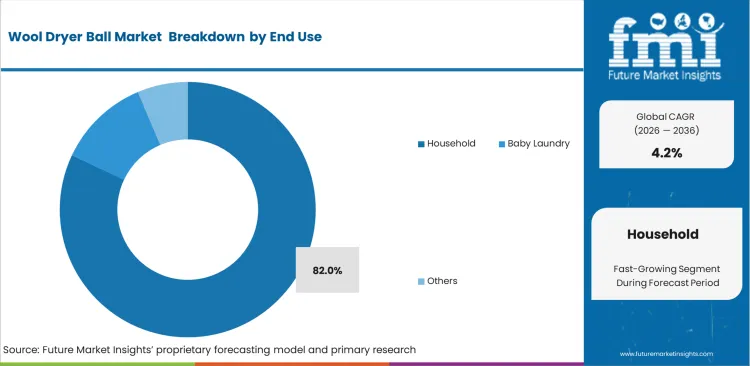
Household demand stays dominant because wool dryer balls are purchased primarily for routine residential laundry rather than for institutional or commercial wash cycles. Households command 82.0% share of the end-use segment in 2026. Early adoption often begins with baby laundry, where sensitivity to fragrance, residue, and skin irritation raises willingness to shift away from conventional softening agents and laundry sanitizers. Wool dryer balls for baby clothes benefit from that use case because product safety perception matters more than small differences in unit cost. Once fragrance-free and low-residue drying habits are established at home, repeat use tends to extend beyond infant garments into general family laundry. This keeps household demand structurally ahead by linking first-time trial to long-term category retention.
- Pediatric recommendation trigger: Infant clothing remains a high-conviction use case because concerns around fragrance, residue, and skin sensitivity make natural drying accessories easier to adopt.
- Entrenched behavioral shift: Fragrance-free laundry routines often continue after the initial baby-care phase, which strengthens repeat household use over time.
- Cross-category expansion: Conversion in this segment can support broader spending on adjacent natural home-care products, improving category value beyond the first purchase.
Wool Dryer Ball Market Analysis by Variant
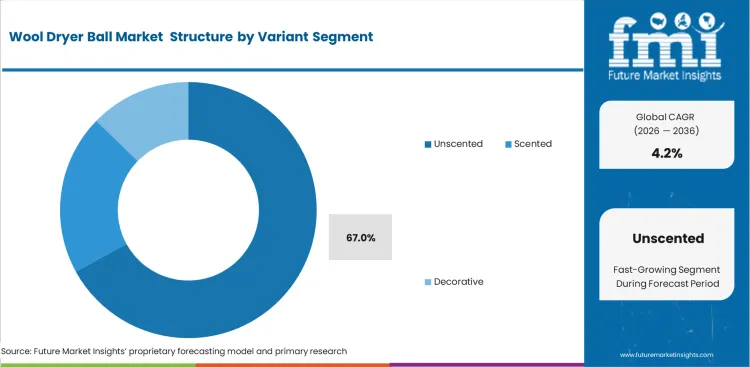
Fragrance limitation is the main reason unscented products remain ahead in this category. Consumer expectations in fabric care have long been shaped by heavily perfumed fabric odor eliminators, but wool dryer balls perform through mechanical action rather than through lasting scent delivery. Natural oils added to fleece lose intensity quickly under dryer heat, which limits their ability to replicate the sensory profile of conventional softening products.
Attempts to build stronger fragrance into the product also create durability trade-offs, as repeated oil exposure can weaken fiber structure over time. Unscented variants are expected to represent 67.0% of the Variant segment in 2026, because neutral performance, product stability, and lower risk of fiber breakdown matter more than added scent in repeated household use. Preference for unscented wool dryer balls remains stronger where consumers prioritize durability and low-residue drying over fragrance carryover.
- Scent evaporation failure: High dryer temperatures reduce the staying power of natural oils, which makes it difficult for scented variants to deliver fragrance intensity comparable to synthetic alternatives.
- Fiber degradation risk: Oil-heavy formulations can shorten product life by affecting fleece integrity, which makes durability a bigger concern in scented formats.
- Sensory recalibration requirement: Category adoption often depends on accepting neutral-smelling garments as clean, especially in households moving away from artificial fragrance systems.
Wool Dryer Ball Market Drivers, Restraints, and Opportunities
Appliance manufacturers voiding warranties for chemical damage compels immediate behavior shifts. Repair technicians increasingly identify synthetic wax buildup on electronic moisture sensors as a primary cause of premature machine failure. Homeowners facing expensive repair bills abandon single-use sheets instantly. This dynamic forces consumers away from recurring dissolvable detergent pods and toward mechanical alternatives. Delaying this switch risks destroying appliances costing thousands. A small upfront accessory purchase becomes highly rational regardless of environmental motivations. Buyers constantly search for the best wool dryer balls vs dryer sheets to protect their investments.
Acoustic annoyance slows adoption severely among apartment dwellers operating machines near living spaces. Hard spheres bouncing against metal appliance drums generate significant noise. Marketing materials consistently downplay this reality. Property managers in high-density buildings often receive noise complaints regarding tumbling accessories. While washing capsules operate silently, mechanical agitators announce their physical presence constantly. Manufacturers attempting to soften exterior layers to reduce noise inevitably compromise moisture absorption capabilities.
Opportunities in the Wool Dryer Ball Market
- Appliance co-branding: Tumble dryer brands bundling approved accessories inside new machines. Appliance product managers gain an easy sustainability win while validating mechanical softening.
- Essential oil subscription: Selling recurring fragrance drops to pair with durable spheres. Retention marketers build predictable revenue streams, replacing lost consumable detergent chemicals sales.
- Private label expansion: Launching private label wool dryer balls for major grocery chains. Retail buyers capture higher margins by removing intermediary brands.
Regional Analysis
Based on regional analysis, Wool Dryer Ball is segmented into North America, Europe, Asia Pacific, and other regions across 40 plus countries.
.webp "Top Country Growth Comparison Wool Dryer Ball Market Cagr (2026 2036)")
| Country | CAGR (2026 to 2036) |
|---|---|
| India | 5.2% |
| China | 5.0% |
| United States | 4.7% |
| Canada | 4.5% |
| United Kingdom | 4.1% |
| Germany | 3.9% |
| Japan | 3.4% |
Source: Future Market Insights (FMI) analysis, based on proprietary forecasting model and primary research
Asia Pacific Wool Dryer Ball Market Analysis
Urban housing density, first-time appliance adoption, and digital commerce are defining the region’s demand pattern. Laundry behavior in the Asia Pacific is changing fastest in cities where limited open-air drying space makes mechanical drying more practical, especially in apartments and high-rise housing. Regional supply conditions also remain favorable, as access to wool inputs and cost-competitive manufacturing gives domestic producers room to compete on price while keeping product availability broad. Demand is being shaped by appliance penetration, online product discovery, and the ability of wool dryer ball manufacturers to serve price-sensitive consumers without relying heavily on imported brands.
- India: Apartment living, rising disposable income, and wider online access are strengthening category demand across urban households. Wool dryer ball adoption in India is expected to rise at a CAGR of 5.2% from 2026 to 2036, supported by growing use of cloth drying machines and stronger acceptance of reusable laundry accessories positioned as premium but practical household products. Local manufacturing also improves affordability, which keeps the category more accessible as demand expands beyond early urban adopters.
- China: Digital retail maturity gives China a structural advantage in this market, particularly where newer household products depend on visual demonstration and fast product discovery. Marketplace reach, social commerce, and broad listing availability continue to reduce trial barriers for wool dryer balls, while domestic production capacity supports quick response to pricing shifts and volume movement. Demand for wool dryer balls in China is projected to increase at a CAGR of 5.0%. China is relevant as both a consumption market and a flexible supply base within the regional chain.
- Japan: Mechanical drying remains less routine in Japan, which keeps category expansion narrower than in larger urban appliance markets across the region. Weather-driven use and dense city living still support a viable demand base, but outdoor line-drying habits continue to limit broader household conversion. Sales of wool dryer balls in Japan are likely to advance at a 3.4% CAGR, as growth remains tied to convenience-led use rather than full replacement of traditional drying practices.
FMI's report includes Australia, South Korea, New Zealand, and Vietnam. Australia and New Zealand remain important through their connection to the regional wool value chain, which supports supply continuity and strengthens the commercial positioning of wool-based drying accessories in premium household-care channels.
North America Wool Dryer Ball Market Analysis
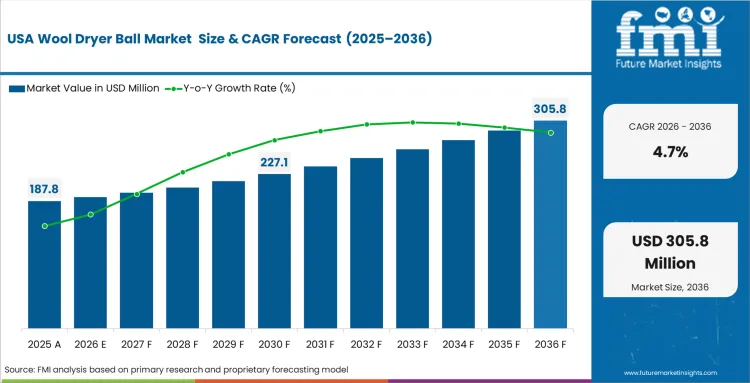
Mechanical drying remains part of routine household laundry across North America, which gives the region a broad installed base for accessory adoption. Category expansion is driven more by substitution within existing dryer use than by first-time appliance penetration, making the commercial opportunity more about converting established laundry habits toward reusable alternatives. Demand also benefits from stronger consumer familiarity with sustainable laundry products, while digital retail and specialty home-care positioning continue to widen access across mainstream and premium channels. North America remains a mature but commercially attractive market where the replacement of disposable softening formats supports steady category growth.
- United States: Widespread tumble-dryer use keeps the United States central to regional demand, especially because consumers already understand the role of add-on laundry accessories in day-to-day fabric care. Product appeal is strengthened by interest in reusable formats that align with appliance efficiency, lower residue, and reduced dependence on disposable softening products. Demand for wool dryer balls in the United States is expected to rise at a CAGR of 4.7%. Continued placement alongside other sustainable home-care items, including concentrated cleaning refills, also helps the category reach consumers looking to replace conventional laundry routines with lower-waste alternatives.
- Canada: Indoor drying needs remain more pronounced in Canada, where colder weather extends reliance on home drying systems through much of the year. Category adoption also benefits from stronger acceptance of products positioned around efficient cycle management and reusable household care. Sales of wool dryer balls in Canada are projected to increase at a 4.5% CAGR from 2026 to 2036, supported by steady refillable household cleaners usage and sustained relevance in winter-weight garment care. This keeps Canada attractive as a stable demand market where climate and household laundry behavior continue to support repeat use.
FMI's report includes Mexico alongside comprehensive assessments of Puerto Rican and broader Caribbean distribution networks. Mexico adds importance through its role as a cost-sensitive but expanding household-care market, where broader appliance penetration and modern retail access are gradually improving the addressable base for reusable drying accessories.
Europe Wool Dryer Ball Market Analysis
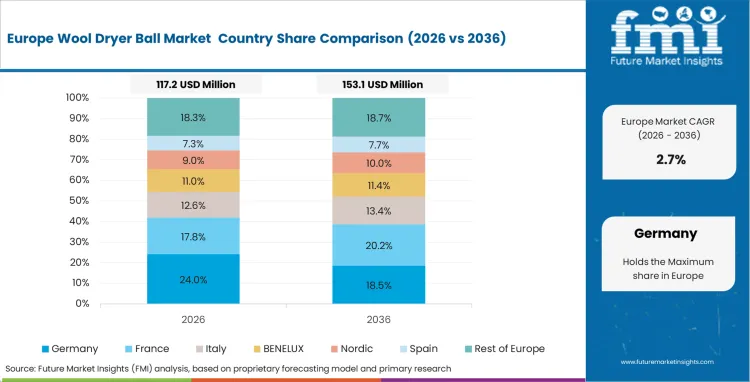
Energy cost sensitivity and tighter preference for low-chemical household care give Europe a distinct demand profile in this category. Purchase decisions are influenced not only by product performance, but also by how effectively wool dryer balls fit lower-energy drying habits, cleaner-label home-care routines, and more scrutinized sourcing expectations. High household utility costs keep cycle-time efficiency relevant, while product acceptance is stronger where consumers actively compare wool dryer balls vs dryer sheets on waste generation, ingredient exposure, and carbon footprint. Europe remains a commercially disciplined market where demand depends on performance credibility as much as on sustainability positioning.
- United Kingdom: Persistent damp conditions keep indoor drying relevant across much of the year, particularly in urban households with limited outdoor drying flexibility. Wool dryer ball adoption in the United Kingdom is projected to increase at a 4.1% CAGR from 2026 to 2036, supported by steady use of mechanical drying solutions and stronger interest in reusable accessories that complement low-chemical laundry routines. Premium positioning also remains viable where consumers place added value on ethical sourcing and natural household care products.
- Germany: Preference for chemical-free living gives Germany a receptive base for reusable laundry accessories that can reduce dependence on conventional softening formats. Product acceptance is strengthened by consumer emphasis on material integrity, lower-residue care, and cleaner household routines, which suits the core proposition of wool dryer balls. Demand for wool dryer balls in Germany is expected to rise at a 3.9% CAGR. Wider availability across mainstream retail is likely to support category normalization, even as buyers continue to expect credible product quality and sourcing standards.
FMI's report includes France, Italy, Spain, and the broader Nordic region. Wholesale distributors operating across the European Union face mounting pressure to standardize product lifecycle tracking from raw agricultural sourcing through final residential disposal. France adds relevance through premium household-care demand, where consumers are more willing to pay for reusable alternatives that align with low-chemical laundry routines and higher product-quality expectations.
Competitive Aligners for Market Players
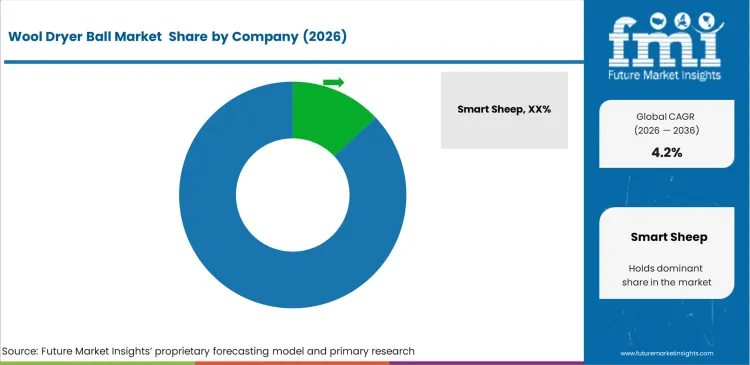
Control over raw material quality and sourcing economics shapes profitability in this category more than brand visibility alone. Consistent access to high-grade fleece at workable pricing remains difficult because wool supply is exposed to weather-linked swings in herd output and shearing conditions. Manufacturers with direct or well-established ties to farming cooperatives in Australia and New Zealand are better placed to reduce spot-market volatility and maintain product consistency. Dependence on third-party manufacturing creates a greater risk of material substitution when margin pressure builds, which can weaken product durability and undermine consumer trust, especially in a category positioned against dryer sheets on performance and material credibility. Reliable wool dryer ball suppliers remain central to competitive stability, particularly where quality variation is quickly noticed in use.
Established participants retain an advantage where long-standing sourcing relationships and verified chain-of-custody systems support consistent cruelty-free and premium-quality claims. Ethical sourcing in this market is not a simple branding exercise because it depends on audited supply routes, documented fiber origin, and tighter control over processing standards from farm to finished product. Newer entrants often struggle to match that standard when they rely on uncertified commodity fleece to enter the market quickly or at a lower cost. That gap matters commercially because eco-conscious consumers tend to scrutinize material credibility across adjacent home-care categories, including laundry detergent enzymes, and are less tolerant of weak sourcing claims.
Durability also changes the economics of category expansion because wool dryer balls are designed to last through repeated use rather than generate frequent replacement purchases. Limiting the recurring revenue profile places more pressure on customer lifetime value, bundle strategy, and fulfillment efficiency. Manufacturers increasingly offset that constraint by pairing the product with fragrance drops, companion detergents, or related laundry-care accessories that can support repeat sales. Execution depends not only on selling a durable product, but also on building a supply and delivery model that can sustain margins in a space long shaped by consumable products such as traditional dryer sheets and hard water builders.
Key Players in Wool Dryer Ball Market
- Smart Sheep
- Woolzies
- Molly’s Suds
- Friendsheep Wool
- Grove Co.
- Nellie’s
- Handy Laundry
Scope of the Report
| Metric | Value |
|---|---|
| Quantitative Units | USD 460.0 million to USD 690.0 million, at a CAGR of 4.2% |
| Market Definition | Felted fleece spheres meant to physically separate wet fabrics inside tumbling appliances comprise this category. Such items reduce drying times and static cling without transferring synthetic residues onto clothing fibers. |
| Segmentation | Material, Pack size, Channel, End use, Variant, Region |
| Regions Covered | North America, Europe, Asia Pacific, Latin America, Middle East & Africa |
| Countries Covered | United States, Canada, China, India, United Kingdom, Germany, Japan |
| Key Companies Profiled | Smart Sheep, Woolzies, Molly’s Suds, Friendsheep Wool, Grove Co., Nellie’s, Handy Laundry |
| Forecast Period | 2026 to 2036 |
| Approach | Global residential tumble-dryer installed base figures anchor baseline calculations for accessory penetration. |
Source: Future Market Insights (FMI) analysis, based on proprietary forecasting model and primary research
Wool Dryer Ball Market Analysis by Segments
Material
- Pure wool
- Blended wool
- Plastic core
Pack size
- 6-pack
- 3-pack
- 4-pack
- XL packs
Channel
- Online retail
- Specialty retail
- Mass retail
End use
- Households
- Baby laundry
- Sensitive skin
Variant
- Unscented
- Scented
- Decorative
Region
- North America
- Europe
- Asia Pacific
- Latin America
- Middle East & Africa
Bibliography
- Australian Wool Innovation. (2025). AWI annual report 2024-25.
- Ceolotto, S., et al. (2024). Putting a new “spin” on energy information: Measuring the role of energy labels for tumble dryers in real life. Energy Efficiency.
- ENERGY STAR. (2024, October). ENERGY STAR Version 1.1 clothes dryers specification.
- Farm Service Agency. (2024, July 9). 2024 graded wool posted prices (per pound, clean basis). U.S. Department of Agriculture.
- USA Department of Agriculture, Economic Research Service. (2026, March 13). Cotton and wool - market outlook.
- USA Department of Energy. (2024, February 29). DOE finalizes efficiency standards for residential clothes washers and clothes dryers, saving Americans billions in annual utility costs.
This bibliography is provided for reader reference. The full FMI report contains the complete reference list with primary source documentation.
This Report Addresses
- Raw material sourcing constraints impacting pure fleece accessories globally.
- Appliance warranty policies driving household substitution away from liquid conditioners.
- Digital shipping economics dictating optimal configuration formats.
- Consumer sensory recalibration required for unscented garment acceptance.
- Acoustic limitations slowing apartment-dwelling adoption rates.
- Gateway purchasing behavior initiated by pediatric skin sensitivity warnings.
- Regional divergence between indoor and outdoor drying cultures.
- Competitive pivot toward subscription fragrance bundles offsetting durable goods limitations.
Frequently Asked Questions
What is the wool dryer ball market size in 2026?
Demand is set to reach USD 460.0 million in 2026 at a CAGR of 4.2%. Expansion relies heavily on consumers abandoning chemical conditioning agents to protect machine sensor functionality. Growth correlates closely with premium appliance adoption across regions requiring indoor drying.
Who are the top wool dryer ball companies?
Smart Sheep, Woolzies, Molly’s Suds, Friendsheep Wool, Grove Co., Nellie’s, and Handy Laundry represent key participants. Incumbents possess deep multi-year relationships with certified organic shearing facilities. They leverage these agricultural networks to guarantee cruelty-free claims that new entrants cannot replicate easily.
Do wool dryer balls reduce drying time?
Pure fleece acts as an active desiccant pulling water away from wet fabrics. Spheres separate garments physically, allowing hot air to circulate freely. Manufacturers leverage this specific mechanical property to claim verifiable energy-saving benefits.
What factors drive adoption in this category?
Appliance sensor degradation compels households to substitute wax-based softeners with mechanical alternatives. Repair technicians increasingly identify synthetic buildup on electronic moisture sensors as a primary cause of premature machine failure. Homeowners abandon single-use items instantly upon learning this fact.
Why do 6-pack formats lead sales?
Dispatching three lightweight spheres costs nearly identical postage as shipping six. Digital native brands upsell larger bundles to achieve profitable average order values. Packaging engineers design boxes specifically to maximize dimensional weight efficiency for standard courier networks.
How does raw material choice affect performance?
Pure fleece acts as a natural desiccant, actively absorbing moisture. Synthetic cores melt or deform under high-heat settings, destroying garments and damaging appliance interiors. Sourcing directors reject blended items to prevent catastrophic melting incidents and associated liability.
Why do unscented variants command majority share?
Essential oils infused into natural fleece evaporate rapidly under intense heat. Consumers conditioned by perfumed liquids expect freshly dried garments to project strong scents. Quality assurance teams block highly scented variants because acidic oils destroy product structural integrity rapidly.
What prevents faster adoption in urban areas?
Hard spheres bouncing against metal appliance drums generate significant noise. Property managers in high-density buildings frequently receive noise complaints regarding tumbling accessories. Manufacturers attempting to soften exterior layers inevitably compromise moisture absorption capabilities.
Why does India show accelerated growth?
Urban professionals purchasing their first mechanical drying appliances integrate natural accessories immediately. E-commerce platforms recommend these items alongside machine purchases, bypassing legacy chemical softeners entirely. Domestic textile manufacturers pivot raw material outputs to capture this emerging demand.
How do brands secure reliable supply chains?
Sourcing leaders negotiate directly with farming cooperatives to bypass volatile spot markets. Established incumbents leverage multi-year relationships with certified organic shearing facilities. Startups purchasing uncertified commodity fleece expose themselves to immediate backlash from vigilant consumers.
What is the primary gateway for household conversion?
Pediatricians advise against exposing infant skin to synthetic fragrances. Parents abandon traditional liquids immediately upon receiving medical advice regarding dermatitis. Users habituated to fragrance-free garments rarely revert to chemical alternatives later, cementing long-term behavioral changes.
Why do supermarkets struggle to sell these items?
Merchandising directors allocate prime shelf positioning to recurring liquid purchases ensuring weekly foot traffic. Durable accessories requiring single annual purchases sit on bottom shelves. Social media demonstration videos convert buyers far effectively than static cardboard packaging.
How do legacy brands maintain revenue streams?
Selling products designed to last thousands of cycles breaks traditional recurring-revenue models. Category leaders aggressively sell consumable liquid fragrance drops. Retention marketers build predictable revenue streams replacing lost consumable chemical sales through essential oil subscriptions.
What role do appliance manufacturers play?
Tumble dryer brands increasingly bundle approved accessories inside new machines. Appliance product managers gain an easy sustainability win while validating mechanical softening. Explicit warranty warnings regarding chemical softeners serve as the strongest conversion catalyst.
Why does Japan lag behind Western adoption rates?
Cultural preferences for outdoor line-drying restrict total addressable machine usage. Growth remains confined to severe weather seasons or highly urbanized zones. Importers struggle convincing traditional households to utilize mechanical tumbling for delicate garments.
How do shipping costs shape product development?
Shipping lightweight spheres penalizes brands paying standard postal rates. Operations managers design exact box dimensions fitting maximum product within minimum cubic space. Profitable digital acquisition requires higher average order values, making small configurations unprofitable.
What happens when consumers use blended synthetic items?
Plastic cores warp under sustained high temperatures common in older machines. Consumers leave negative digital reviews destroying brand credibility. Operations leads compromising on raw material purity face catastrophic return rates within six months.
Why are scented wool variants problematic?
Attempting to mimic traditional synthetic scents using natural oils degrades fleece fibers. Scent evaporation occurs rapidly, leaving clothes smelling neutral anyway. Shoppers must learn to accept neutral-smelling garments as actually clean.
How does European regulation affect adoption?
Stringent chemical regulations combined with high energy costs dictate behavior. Households optimize electricity usage due to regional utility pricing spikes. Shoppers prioritize verifiable supply chain ethics and animal welfare certifications above mere functionality.
What drives Canadian market expansion?
Government-backed efficiency messaging campaigns educate citizens about shortening cycle times safely. Long winters require heavy indoor fabric care. Brands targeting this demographic emphasize winter-weight garment separation capabilities alongside utility savings.
Why do parents avoid chemical softeners?
Synthetic fragrances trigger contact dermatitis in sensitive infant skin. Medical professionals warn against unnecessary chemical exposure. Anxious parents exhibit low price sensitivity when substituting items perceived as toxic or dangerous.
How do startups enter this space successfully?
Digital platforms allow founder-led brands to bypass traditional retail gatekeepers. Social media video demonstrations prove effectiveness visually. Growth marketers rely heavily on digital discovery to educate users about mechanical softening benefits.
What structural barrier blocks further growth?
Consumer sensory recalibration remains difficult. Decades of heavy marketing conditioned buyers to associate strong floral scents with cleanliness. Marketing teams spend massive resources educating buyers about true cleanliness versus artificial masking.
How does DTC economics limit packaging choices?
E-commerce founders attempting to sell smaller configurations burn through margin on fulfillment expenses. Basket size minimums dictate bundling strategies. Supply chain leads balance high-volume bundles against third-party logistics storage limits.
What defines the pure wool segment's dominance?
Performance failures in early generation designs expose synthetic weaknesses. Pure fleece acts as an active natural desiccant pulling water away from fabrics. Synthetic cores merely provide physical agitation without accelerating moisture removal.
Preview the report firsthand - request a free sample
Get SampleGet the brochure for pricing and purchase details.
Get PDFTable of Content
- Executive Summary
- Global Market Outlook
- Demand-side Trends
- Supply-side Trends
- Technology Roadmap Analysis
- Analysis and Recommendations
- Market Overview
- Market Coverage / Taxonomy
- Market Definition / Scope / Limitations
- Research Methodology
- Chapter Orientation
- Analytical Lens and Working Hypotheses
- Market Structure, Signals, and Trend Drivers
- Benchmarking and Cross-market Comparability
- Market Sizing, Forecasting, and Opportunity Mapping
- Research Design and Evidence Framework
- Desk Research Programme (Secondary Evidence)
- Company Annual and Sustainability Reports
- Peer-reviewed Journals and Academic Literature
- Corporate Websites, Product Literature, and Technical Notes
- Earnings Decks and Investor Briefings
- Statutory Filings and Regulatory Disclosures
- Technical White Papers and Standards Notes
- Trade Journals, Industry Magazines, and Analyst Briefs
- Conference Proceedings, Webinars, and Seminar Materials
- Government Statistics Portals and Public Data Releases
- Press Releases and Reputable Media Coverage
- Specialist Newsletters and Curated Briefings
- Sector Databases and Reference Repositories
- FMI Internal Proprietary Databases and Historical Market Datasets
- Subscription Datasets and Paid Sources
- Social Channels, Communities, and Digital Listening Inputs
- Additional Desk Sources
- Expert Input and Fieldwork (Primary Evidence)
- Primary Modes
- Qualitative Interviews and Expert Elicitation
- Quantitative Surveys and Structured Data Capture
- Blended Approach
- Why Primary Evidence is Used
- Field Techniques
- Interviews
- Surveys
- Focus Groups
- Observational and In-context Research
- Social and Community Interactions
- Stakeholder Universe Engaged
- C-suite Leaders
- Board Members
- Presidents and Vice Presidents
- R&D and Innovation Heads
- Technical Specialists
- Domain Subject-matter Experts
- Scientists
- Physicians and Other Healthcare Professionals
- Governance, Ethics, and Data Stewardship
- Research Ethics
- Data Integrity and Handling
- Primary Modes
- Tooling, Models, and Reference Databases
- Desk Research Programme (Secondary Evidence)
- Data Engineering and Model Build
- Data Acquisition and Ingestion
- Cleaning, Normalisation, and Verification
- Synthesis, Triangulation, and Analysis
- Quality Assurance and Audit Trail
- Market Background
- Market Dynamics
- Drivers
- Restraints
- Opportunity
- Trends
- Scenario Forecast
- Demand in Optimistic Scenario
- Demand in Likely Scenario
- Demand in Conservative Scenario
- Opportunity Map Analysis
- Product Life Cycle Analysis
- Supply Chain Analysis
- Investment Feasibility Matrix
- Value Chain Analysis
- PESTLE and Porter’s Analysis
- Regulatory Landscape
- Regional Parent Market Outlook
- Production and Consumption Statistics
- Import and Export Statistics
- Market Dynamics
- Global Market Analysis 2021 to 2025 and Forecast, 2026 to 2036
- Historical Market Size Value (USD Million) Analysis, 2021 to 2025
- Current and Future Market Size Value (USD Million) Projections, 2026 to 2036
- Y-o-Y Growth Trend Analysis
- Absolute $ Opportunity Analysis
- Global Market Pricing Analysis 2021 to 2025 and Forecast 2026 to 2036
- Global Market Analysis 2021 to 2025 and Forecast 2026 to 2036, By Material
- Introduction / Key Findings
- Historical Market Size Value (USD Million) Analysis By Material , 2021 to 2025
- Current and Future Market Size Value (USD Million) Analysis and Forecast By Material , 2026 to 2036
- Pure Wool
- Plastic Core
- Othres
- Pure Wool
- Y-o-Y Growth Trend Analysis By Material , 2021 to 2025
- Absolute $ Opportunity Analysis By Material , 2026 to 2036
- Global Market Analysis 2021 to 2025 and Forecast 2026 to 2036, By Pack Size
- Introduction / Key Findings
- Historical Market Size Value (USD Million) Analysis By Pack Size, 2021 to 2025
- Current and Future Market Size Value (USD Million) Analysis and Forecast By Pack Size, 2026 to 2036
- 6-Pack
- 3-Pack
- Others
- 6-Pack
- Y-o-Y Growth Trend Analysis By Pack Size, 2021 to 2025
- Absolute $ Opportunity Analysis By Pack Size, 2026 to 2036
- Global Market Analysis 2021 to 2025 and Forecast 2026 to 2036, By Channel
- Introduction / Key Findings
- Historical Market Size Value (USD Million) Analysis By Channel, 2021 to 2025
- Current and Future Market Size Value (USD Million) Analysis and Forecast By Channel, 2026 to 2036
- Online Retail
- Specialty Retail
- Others
- Online Retail
- Y-o-Y Growth Trend Analysis By Channel, 2021 to 2025
- Absolute $ Opportunity Analysis By Channel, 2026 to 2036
- Global Market Analysis 2021 to 2025 and Forecast 2026 to 2036, By End Use
- Introduction / Key Findings
- Historical Market Size Value (USD Million) Analysis By End Use, 2021 to 2025
- Current and Future Market Size Value (USD Million) Analysis and Forecast By End Use, 2026 to 2036
- Household
- Baby Laundry
- Others
- Household
- Y-o-Y Growth Trend Analysis By End Use, 2021 to 2025
- Absolute $ Opportunity Analysis By End Use, 2026 to 2036
- Global Market Analysis 2021 to 2025 and Forecast 2026 to 2036, By Variant
- Introduction / Key Findings
- Historical Market Size Value (USD Million) Analysis By Variant, 2021 to 2025
- Current and Future Market Size Value (USD Million) Analysis and Forecast By Variant, 2026 to 2036
- Unscented
- Scented
- Decorative
- Unscented
- Y-o-Y Growth Trend Analysis By Variant, 2021 to 2025
- Absolute $ Opportunity Analysis By Variant, 2026 to 2036
- Global Market Analysis 2021 to 2025 and Forecast 2026 to 2036, By Region
- Introduction
- Historical Market Size Value (USD Million) Analysis By Region, 2021 to 2025
- Current Market Size Value (USD Million) Analysis and Forecast By Region, 2026 to 2036
- North America
- Latin America
- Western Europe
- Eastern Europe
- East Asia
- South Asia and Pacific
- Middle East & Africa
- Market Attractiveness Analysis By Region
- North America Market Analysis 2021 to 2025 and Forecast 2026 to 2036, By Country
- Historical Market Size Value (USD Million) Trend Analysis By Market Taxonomy, 2021 to 2025
- Market Size Value (USD Million) Forecast By Market Taxonomy, 2026 to 2036
- By Country
- USA
- Canada
- Mexico
- By Material
- By Pack Size
- By Channel
- By End Use
- By Variant
- By Country
- Market Attractiveness Analysis
- By Country
- By Material
- By Pack Size
- By Channel
- By End Use
- By Variant
- Key Takeaways
- Latin America Market Analysis 2021 to 2025 and Forecast 2026 to 2036, By Country
- Historical Market Size Value (USD Million) Trend Analysis By Market Taxonomy, 2021 to 2025
- Market Size Value (USD Million) Forecast By Market Taxonomy, 2026 to 2036
- By Country
- Brazil
- Chile
- Rest of Latin America
- By Material
- By Pack Size
- By Channel
- By End Use
- By Variant
- By Country
- Market Attractiveness Analysis
- By Country
- By Material
- By Pack Size
- By Channel
- By End Use
- By Variant
- Key Takeaways
- Western Europe Market Analysis 2021 to 2025 and Forecast 2026 to 2036, By Country
- Historical Market Size Value (USD Million) Trend Analysis By Market Taxonomy, 2021 to 2025
- Market Size Value (USD Million) Forecast By Market Taxonomy, 2026 to 2036
- By Country
- Germany
- UK
- Italy
- Spain
- France
- Nordic
- BENELUX
- Rest of Western Europe
- By Material
- By Pack Size
- By Channel
- By End Use
- By Variant
- By Country
- Market Attractiveness Analysis
- By Country
- By Material
- By Pack Size
- By Channel
- By End Use
- By Variant
- Key Takeaways
- Eastern Europe Market Analysis 2021 to 2025 and Forecast 2026 to 2036, By Country
- Historical Market Size Value (USD Million) Trend Analysis By Market Taxonomy, 2021 to 2025
- Market Size Value (USD Million) Forecast By Market Taxonomy, 2026 to 2036
- By Country
- Russia
- Poland
- Hungary
- Balkan & Baltic
- Rest of Eastern Europe
- By Material
- By Pack Size
- By Channel
- By End Use
- By Variant
- By Country
- Market Attractiveness Analysis
- By Country
- By Material
- By Pack Size
- By Channel
- By End Use
- By Variant
- Key Takeaways
- East Asia Market Analysis 2021 to 2025 and Forecast 2026 to 2036, By Country
- Historical Market Size Value (USD Million) Trend Analysis By Market Taxonomy, 2021 to 2025
- Market Size Value (USD Million) Forecast By Market Taxonomy, 2026 to 2036
- By Country
- China
- Japan
- South Korea
- By Material
- By Pack Size
- By Channel
- By End Use
- By Variant
- By Country
- Market Attractiveness Analysis
- By Country
- By Material
- By Pack Size
- By Channel
- By End Use
- By Variant
- Key Takeaways
- South Asia and Pacific Market Analysis 2021 to 2025 and Forecast 2026 to 2036, By Country
- Historical Market Size Value (USD Million) Trend Analysis By Market Taxonomy, 2021 to 2025
- Market Size Value (USD Million) Forecast By Market Taxonomy, 2026 to 2036
- By Country
- India
- ASEAN
- Australia & New Zealand
- Rest of South Asia and Pacific
- By Material
- By Pack Size
- By Channel
- By End Use
- By Variant
- By Country
- Market Attractiveness Analysis
- By Country
- By Material
- By Pack Size
- By Channel
- By End Use
- By Variant
- Key Takeaways
- Middle East & Africa Market Analysis 2021 to 2025 and Forecast 2026 to 2036, By Country
- Historical Market Size Value (USD Million) Trend Analysis By Market Taxonomy, 2021 to 2025
- Market Size Value (USD Million) Forecast By Market Taxonomy, 2026 to 2036
- By Country
- Kingdom of Saudi Arabia
- Other GCC Countries
- Turkiye
- South Africa
- Other African Union
- Rest of Middle East & Africa
- By Material
- By Pack Size
- By Channel
- By End Use
- By Variant
- By Country
- Market Attractiveness Analysis
- By Country
- By Material
- By Pack Size
- By Channel
- By End Use
- By Variant
- Key Takeaways
- Key Countries Market Analysis
- USA
- Pricing Analysis
- Market Share Analysis, 2025
- By Material
- By Pack Size
- By Channel
- By End Use
- By Variant
- Canada
- Pricing Analysis
- Market Share Analysis, 2025
- By Material
- By Pack Size
- By Channel
- By End Use
- By Variant
- Mexico
- Pricing Analysis
- Market Share Analysis, 2025
- By Material
- By Pack Size
- By Channel
- By End Use
- By Variant
- Brazil
- Pricing Analysis
- Market Share Analysis, 2025
- By Material
- By Pack Size
- By Channel
- By End Use
- By Variant
- Chile
- Pricing Analysis
- Market Share Analysis, 2025
- By Material
- By Pack Size
- By Channel
- By End Use
- By Variant
- Germany
- Pricing Analysis
- Market Share Analysis, 2025
- By Material
- By Pack Size
- By Channel
- By End Use
- By Variant
- UK
- Pricing Analysis
- Market Share Analysis, 2025
- By Material
- By Pack Size
- By Channel
- By End Use
- By Variant
- Italy
- Pricing Analysis
- Market Share Analysis, 2025
- By Material
- By Pack Size
- By Channel
- By End Use
- By Variant
- Spain
- Pricing Analysis
- Market Share Analysis, 2025
- By Material
- By Pack Size
- By Channel
- By End Use
- By Variant
- France
- Pricing Analysis
- Market Share Analysis, 2025
- By Material
- By Pack Size
- By Channel
- By End Use
- By Variant
- India
- Pricing Analysis
- Market Share Analysis, 2025
- By Material
- By Pack Size
- By Channel
- By End Use
- By Variant
- ASEAN
- Pricing Analysis
- Market Share Analysis, 2025
- By Material
- By Pack Size
- By Channel
- By End Use
- By Variant
- Australia & New Zealand
- Pricing Analysis
- Market Share Analysis, 2025
- By Material
- By Pack Size
- By Channel
- By End Use
- By Variant
- China
- Pricing Analysis
- Market Share Analysis, 2025
- By Material
- By Pack Size
- By Channel
- By End Use
- By Variant
- Japan
- Pricing Analysis
- Market Share Analysis, 2025
- By Material
- By Pack Size
- By Channel
- By End Use
- By Variant
- South Korea
- Pricing Analysis
- Market Share Analysis, 2025
- By Material
- By Pack Size
- By Channel
- By End Use
- By Variant
- Russia
- Pricing Analysis
- Market Share Analysis, 2025
- By Material
- By Pack Size
- By Channel
- By End Use
- By Variant
- Poland
- Pricing Analysis
- Market Share Analysis, 2025
- By Material
- By Pack Size
- By Channel
- By End Use
- By Variant
- Hungary
- Pricing Analysis
- Market Share Analysis, 2025
- By Material
- By Pack Size
- By Channel
- By End Use
- By Variant
- Kingdom of Saudi Arabia
- Pricing Analysis
- Market Share Analysis, 2025
- By Material
- By Pack Size
- By Channel
- By End Use
- By Variant
- Turkiye
- Pricing Analysis
- Market Share Analysis, 2025
- By Material
- By Pack Size
- By Channel
- By End Use
- By Variant
- South Africa
- Pricing Analysis
- Market Share Analysis, 2025
- By Material
- By Pack Size
- By Channel
- By End Use
- By Variant
- USA
- Market Structure Analysis
- Competition Dashboard
- Competition Benchmarking
- Market Share Analysis of Top Players
- By Region
- By Material
- By Pack Size
- By Channel
- By End Use
- By Variant
- Competition Analysis
- Competition Deep Dive
- Smart Sheep
- Overview
- Product Portfolio
- Profitability by Market Segments (Product/Age /Sales Channel/Region)
- Sales Footprint
- Strategy Overview
- Marketing Strategy
- Product Strategy
- Channel Strategy
- Woolzies
- Molly’s Suds
- Friendsheep Wool
- Grove Co.
- Nellie’s
- Smart Sheep
- Competition Deep Dive
- Assumptions & Acronyms Used


