

- Industry Size (2026)
- USD 3.4 Bn
- Forecast (2036)
- USD 4.3 Bn
- CAGR (2026 to 2036)
- 2.5%
Ballistic Fabrics Market Size, Market Forecast and Outlook By FMI
In 2025, the ballistic fabrics market recorded a valuation of USD 3.3 billion. Based on Future Market Insights’ analysis, demand is estimated to grow to USD 3.4 billion in 2026 and USD 4.3 billion by 2036. FMI projects a CAGR of 2.5% during the forecast period.
The fundamental procurement logic in this sector is undergoing a hard reset, shifting from "cost-per-yard" to "cost-of-certification." Following the high-profile bankruptcy of ShotStop Ballistics in 2024 due to non-compliant materials, defense ministries and law enforcement agencies are erecting a "trust gate" around their supply chains [1]. Procurement officers are no longer just buying fabric; they are purchasing indemnification against catastrophic failure. This has triggered a bifurcation in the market: verified, integrated primes like DuPont and Honeywell are securing long-term framework contracts, while non-integrated converters are being squeezed out by rising insurance premiums and stricter testing mandates.
Summary of Ballistic Fabrics Market
- Ballistic Fabrics Market Definition
- The industry covers engineered textiles designed to stop projectiles through energy dispersion and tensile strength.
- Demand Drivers in the Market
- Rising geopolitical instability fuels defense budget allocations for soldier modernization programs.
- "Flight to quality" post-scandal drives demand for certified, branded materials.
- Innovations in bio-synthetic fibers like spider silk offer new weight-to-strength possibilities.
- Key Segments Analyzed in the FMI Report
- Material: Glass Fibers lead volume with 44.1% share due to cost-efficiency in vehicle armor.
- Application: Security Equipment dominates with 39.9% share driven by vest and helmet procurement.
- Geography: Asia Pacific production capacity contrasts with North American consumption value.
- Analyst Opinion at FMI
- Nikhil Kaitwade, Principal Consultant for Chemicals and Materials Industry at Future Market Insights, opines, "In the updated version of the Ballistic Fabrics Market Report for 2026 to 2036, CXOs will find insights into the divergence between Asian capacity gluts and Western certification moats. Besides this, my findings point at a strategic consolidation where only fully integrated fiber-to-fabric players will sustain margins against commoditization pressures."
- Strategic Implications/Executive Takeaways
- Secure long-term supply agreements with primes to avoid spot market volatility.
- Invest in NIJ 0101.07 certification to ensure eligibility for next-gen US and NATO tenders.
- Diversify into hybrid fabrics to balance cost and performance for law enforcement markets.
- Methodology
- Validated through first-hand corporate production and capacity data.
- Zero reliance on speculative third-party market research reports.
- Based on verifiable industrial benchmarks and verified sources.
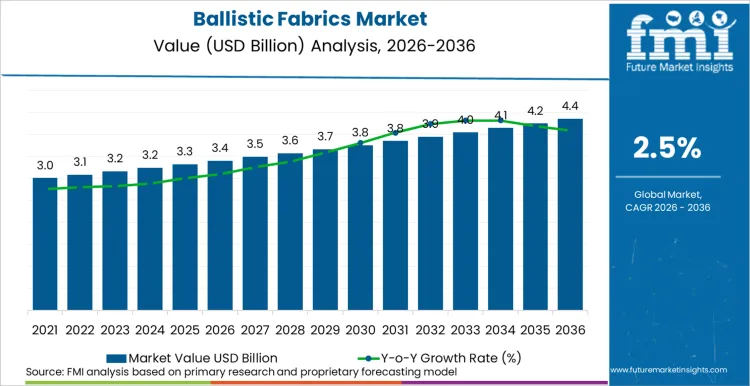
As Vimal Kapur, Chairman and CEO of Honeywell, noted regarding the industry's structural evolution, "Given the sustained market demand for advanced specialty chemicals and materials around the globe, we are confident now is the right time for this business to grow independently, leveraging its leading technologies and deep customer relationships." [2] This signals a strategic decoupling where advanced materials are freed from conglomerate structures to pursue aggressive, specialized growth. For buyers, this implies that future innovation in ballistic protection materials will likely accelerate, as standalone entities allocate capital more efficiently toward next-generation weight reduction technologies rather than broad industrial synergies.
Growth metrics across key economies highlight a distinct split between manufacturing hubs and consumption centers. South Korea (3.3%) and China (2.6%) are driving expansion through massive capacity additions in aramid production to serve industrial exports, while the UK (3.2%) and USA (3.0%) are generating value through high-specification procurement programs like VIRTUS and Force Protection.
Ballistic Fabrics Market Definition
The ballistic fabrics market comprises the global production and trade of high-performance technical textiles engineered to absorb and disperse kinetic energy from projectiles and shrapnel. These materials include woven, non-woven, and uni-directional (UD) structures made from aramid, ultra-high-molecular-weight polyethylene (UHMWPE), and glass fibers. They serve as the critical functional layer in soft body armor, hard armor backing, and vehicle spall liners.
Ballistic Fabrics Market Inclusions
The report includes a comprehensive analysis of market dynamics, featuring Global and Regional Market Sizes (Volume and Value) and a 10-year Forecast (2026-2036). It covers segmental breakdowns by fiber type (Aramid, UHMWPE, Glass), application (Defense, Homeland Security, Industrial), and specific weave technologies. Analysis extends to the integration of these fabrics into ballistic protective equipment and the impact of evolving testing standards like NIJ 0101.07.
Ballistic Fabrics Market Exclusions
The scope excludes raw petrochemical feedstocks (monomers) used to create the fibers and finished armor plates (ceramic or steel) where fabric is not the primary constituent. It also omits standard protective clothing that does not carry a specific ballistic rating (e.g., purely flame-retardant workwear without ballistic capabilities). Retail sales of non-certified "tactical" gear are also excluded to maintain industrial relevance.
Ballistic Fabrics Market Research Methodology
- Primary Research: Interviews were conducted with R&D heads at fiber manufacturers, procurement officers at defense ministries, and armor certification consultants.
- Desk Research: Production data from textile associations, government tender portals, and corporate financial disclosures supported volume benchmarking.
- Market-Sizing and Forecasting: A hybrid top-down and bottom-up model was developed.
- Data Validation and Update Cycle: Outputs undergo anomaly screening, variance checks against military spending budgets, and structured peer review prior to release.
Segmental Analysis
Ballistic Fabrics Market Analysis by Material
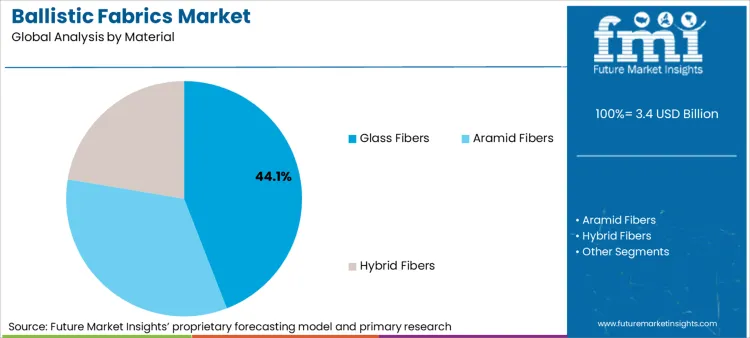
Glass fibers currently hold the dominant volume share at 44.1%, utilized extensively in vehicle armor and spall liners where weight constraints are less critical than in personal protection. However, the value centers are shifting toward Aramid and Hybrid solutions. As per FMI's projection, the aramid segment is witnessing a capacity super-cycle, driven by aggressive expansion in South Korea. Kolon Industries, for instance, completed a major facility expansion in 2024, doubling its annual production capacity to over 15,000 tons to capture the surging demand for dual-use optical and protection fibers [3].
- Glass Fibers: Preferred for static and vehicle applications due to superior cost-to-performance ratios in heavy armor systems.
- Aramid Fibers: Essential for soft body armor; sales are supported by DuPont’s reported volume gains in defense segments [4].
- Hybrid Fibers: Gaining traction as manufacturers blend materials to meet specific threat levels while managing costs, often utilizing high-performance fibers in composite structures.
Ballistic Fabrics Market Analysis by Application
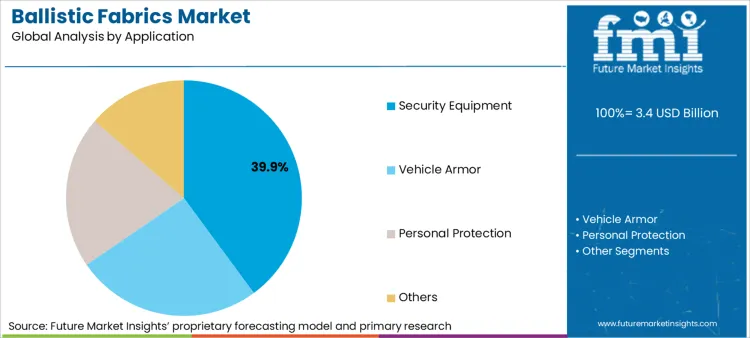
The Security Equipment segment commands 39.9% of the market, fueled by cyclical government tenders for personal protective gear. Demand here is increasingly rigid regarding specifications, leaving little room for non-compliant substitutes. Manufacturers are focusing on ballistic composites that integrate soft fabrics with hard armor backing. The Vehicle Armor segment follows, driven by the need to up-armor light tactical vehicles against IEDs and ballistic threats in conflict zones.
- Security Equipment: Growth is anchored by large-scale soldier modernization programs like the UK's VIRTUS system.
- Vehicle Armor: Demand tracks defense spending on land systems and the retrofitting of law enforcement fleets.
- Personal Protection: Driven by civilian and private security adoption of concealable vests, a segment highly sensitive to weight and comfort.
Ballistic Fabrics Market Drivers, Restraints, and Opportunities
The primary driver for market value is the recapitalization of NATO defense stockpiles and the modernization of police forces globally. The US Army’s FY 2025 budget request includes over USD 229 million specifically for Overseas Operations Costs related to equipment, signaling sustained demand for high-readiness protective gear [5]. This federal funding stream provides a stable demand floor for US-based fabric converters who can meet the stringent Berry Amendment requirements.
However, the market faces significant restraints from raw material price volatility and consolidation. The bankruptcy of ShotStop Ballistics in 2024, following allegations of non-compliant materials, has cast a long shadow over the industry [1]. This event has forced agencies to scrutinize supply chains, creating a barrier to entry for startups and increasing compliance costs for incumbents. Furthermore, established players like Teijin Aramid are executing cost-cutting measures and closing facilities in Europe to cope with stagnating demand and high energy costs, indicating a potential tightening of Western supply [6].
- Certification Mandates: Strict adherence to NIJ and CAST standards is now a binary "go/no-go" for market entry.
- Bio-Synthetic Innovation: Opportunities exist in next-gen materials; Kraig Biocraft is scaling spider silk production to offer lighter, tougher alternatives to traditional aramids [7].
- Capacity Gluts: Asian capacity expansions may lead to price compression in standard modulus grades, squeezing margins for Western producers.
Regional Analysis
Based on the regional analysis, ballistic fabrics market is segmented into North America, Latin America, Europe, East Asia, South Asia, Oceania and Middle East & Africa across 40+ countries. The full report also offers market attractiveness analysis based on regional trends.
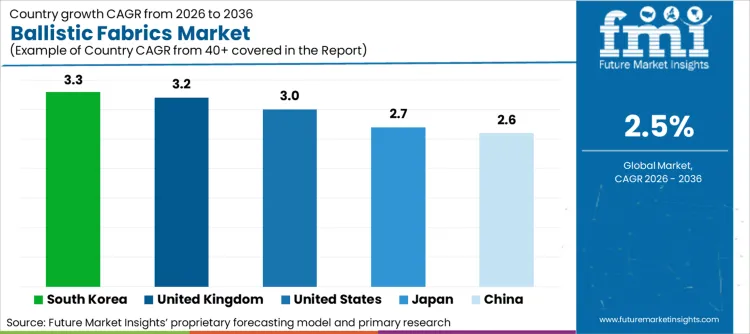
| Country | CAGR (2026 to 2036) |
|---|---|
| South Korea | 3.3% |
| United Kingdom | 3.2% |
| United States | 3.0% |
| Japan | 2.7% |
| China | 2.6% |
Source: Future Market Insights (FMI) analysis, based on proprietary forecasting model and primary research
Asia Pacific Ballistic Fabrics Market Analysis
Asia Pacific is transforming from a consumption market into a global production powerhouse for ballistic raw materials. According to FMI's estimates, the region's growth is structurally supported by massive investments in upstream fiber capacity, particularly in South Korea and China. This localization of supply chains allows Asian armor manufacturers to offer cost-competitive solutions to emerging markets in Latin America and Africa, bypassing Western integrators. The region is leveraging its dual-use industrial base, producing fibers for both 5G optical cables and body armor, to achieve economies of scale that Western competitors struggle to match.
- South Korea: A CAGR of 3.3% reflects Kolon Industries' strategic aggressive expansion, having completed a 300 billion won ($221 million) facility upgrade in 2024 that doubled annual para-aramid capacity to 15,310 tons, directly challenging global incumbents [3].
- China: Growth tracks a 2.6% CAGR, supported by a 31% surge in para-aramid exports in early 2024, driven by the country's push to dominate both the 5G infrastructure and industrial reinforcement markets, which creates a surplus of base material available for ballistic applications [3].
- Japan: Expansion at 2.7% CAGR is linked to the modernization of the Self-Defense Forces and high-tech material exports, with players like Teijin Limited reporting consolidated revenues of JPY 1,032.8 billion, reinforcing their capability to invest in advanced fiber R&D [6].
FMI’s report includes a detailed analysis of growth in the Asia Pacific region, along with a country-wise assessment that includes South Korea, China, and Japan. Readers can also find regional trends, regulations, and market growth based on different segments and countries in Asia Pacific, such as India where indigenization of defense production is creating new opportunities for technical textiles.
North America Ballistic Fabrics Market Analysis
North America remains the center of gravity for high-value, specification-driven demand. The market is defined by the "Buy American" Act and strict NIJ compliance, which insulates domestic producers from low-cost Asian imports. FMI analysts opine that the region is pivoting toward lighter, more flexible solutions, funded by robust federal budgets. The competitive landscape here is reshaping as conglomerates streamline operations to focus on core competencies.
- United States: Demand is projected to rise at 3.0% CAGR through 2036. At 3.0% CAGR, the country outlook is shaped by the US Army's continued investment in soldier protection, exemplified by the USD 229 million allocation in the FY 2025 budget for Overseas Operations Costs, ensuring a steady pipeline for domestic armor manufacturers [5].
FMI’s report includes a detailed analysis of growth in the North America region, along with a country-wise assessment that includes the United States. Readers can also find regional trends, regulations, and market growth based on different segments and countries in North America, including Canada and Mexico which are increasingly integrating into the North American security supply chain.
Europe Ballistic Fabrics Market Analysis
Europe is characterized by a fragmented landscape of national procurement programs and a strong focus on technical innovation. The region is seeing a restructuring of its industrial base, with heritage players adjusting footprints to maintain competitiveness against high energy costs. Governments are prioritizing interoperability and modernization of personal protection equipment (PPE) in response to regional security threats.
- United Kingdom: Growth tracks a CAGR of 3.2% as the Ministry of Defence executes major tenders. A CAGR of 3.2% is underpinned by the VIRTUS Re-Compete contract for torso protection systems, valued up to £135 million, which demands advanced, lightweight ballistic protection materials to reduce soldier burden [8].
FMI’s report includes a detailed analysis of growth in the Europe region, along with a country-wise assessment that includes the United Kingdom. Readers can also find regional trends, regulations, and market growth based on different segments and countries in Europe, such as Germany and France where NATO commitments are driving increased defense spending on protective clothing.
Competitive Aligners for Market Players
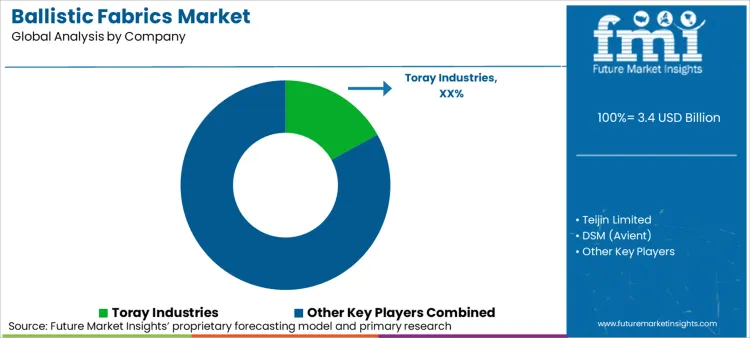
The competitive landscape is bifurcated between integrated chemical giants and specialized fabric converters. Major players like Honeywell and DuPont use their proprietary fiber technologies (Spectra and Kevlar) to control the premium segment of the market. Honeywell's strategic decision to spin off its Advanced Materials business indicates a move to unlock value and focus purely on material science innovation [2]. This separation is expected to increase agility in responding to market needs and allow for more targeted investment in capacity and R&D.
Players like Teijin Aramid are consolidating operations to protect margins. Teijin announced cost-cutting measures and organizational adaptations starting in 2025 to counter increased competition and market conditions, including the closure of its production site in Arnhem-Kleefse Waard [6]. This suggests a maturing market where operational efficiency is becoming as critical as product performance. The acquisition of DSM’s protective materials business by Avient has created a dominant force in the UHMWPE space, further consolidating the high-end fiber market [9].
Recent Developments
The report includes full coverage of key trends from competitive benchmarking. Some of the recent developments covered in the reports:
- In October 2024, Honeywell announced plans to spin off its Advanced Materials business into an independent public company to optimize its portfolio for future growth and capitalize on the demand for advanced specialty chemicals [2].
- In May 2024, ShotStop Ballistics filed for Chapter 7 bankruptcy following federal investigations into the integrity of its ballistic products, highlighting the severe risks of non-compliance and the importance of supply chain transparency [1].
Key Players in Ballistic Fabrics Market
- Toray Industries
- Teijin Limited
- DSM (Avient)
- Honeywell International Inc.
- DuPont de Nemours, Inc.
- Kolon Industries
- Milliken & Company
- SAATI S.p.A.
- Hexcel Corporation
- Kraig Biocraft Laboratories
Scope of the Report
| Metric | Value |
|---|---|
| Quantitative Units | USD 3.4 billion (2026) to USD 4.3 billion (2036), at a CAGR of 2.5% |
| Market Definition | The ballistic fabrics market comprises the global production and trade of high-performance technical textiles engineered to absorb and disperse kinetic energy from projectiles and shrapnel. |
| Material Segmentation | Glass Fibers, Aramid Fibers, Hybrid Fibers |
| Application Segmentation | Security Equipment, Vehicle Armor, Personal Protection, Others |
| Application Coverage | Defense, Homeland Security, Industrial Safety |
| Regions Covered | North America, Latin America, Europe, East Asia, South Asia, Oceania, Middle East & Africa |
| Countries Covered | United States, Canada, Brazil, United Kingdom, Germany, France, South Korea, China, Japan, India, and 40 plus countries |
| Key Companies Profiled | Toray Industries, Teijin Limited, DSM (Avient), Honeywell, DuPont, Kolon Industries, Milliken, SAATI, Hexcel, Kraig Biocraft |
| Forecast Period | 2026 to 2036 |
| Approach | Hybrid top down and bottom up market modeling validated through primary interviews with resin producers and panel manufacturers, supported by trade data benchmarking and plant level capacity verification |
Ballistic Fabrics Market Analysis by Segments
Material
- Glass Fibers
- Aramid Fibers
- Hybrid Fibers
Application
- Security Equipment
- Vehicle Armor
- Personal Protection
- Others
Region
- Asia Pacific
- India
- China
- Japan
- South Korea
- Indonesia
- Australia & New Zealand
- ASEAN
- Rest of Asia Pacific
- Europe
- Germany
- Italy
- France
- United Kingdom
- Spain
- Benelux
- Nordics
- Central & Eastern Europe
- Rest of Europe
- North America
- United States
- Canada
- Mexico
- Latin America
- Brazil
- Argentina
- Chile
- Rest of Latin America
- Middle East & Africa
- Kingdom of Saudi Arabia
- United Arab Emirates
- South Africa
- Turkey
- Rest of Middle East & Africa
Bibliography
- [1] Signal Akron. (2024). Akron police, other agencies file claims against bankrupt company that sold fake body armor (Local government reporting). Signal Akron.
- [2] Honeywell International Inc. (2024). Honeywell Announces Plan to Spin Off Advanced Materials Business to Shareowners (Press release, 8 October 2024). Honeywell (Newsroom / Investor Relations).
- [3] Korea Economic Daily. (2024). Kolon Industries completes facility expansion (Production capacity expansion coverage). Korea Economic Daily.
- [4] DuPont de Nemours, Inc. (2025). DuPont Reports Fourth Quarter and Full Year 2024 Results; Initiates 2025 Financial Guidance (Press release, 11 February 2025). DuPont Investor Relations.
- [5] U.S. Department of the Army. (2024). Department of Defense Fiscal Year (FY) 2025 Budget Estimates: Procurement (Budget justification volumes, PB 2025). U.S. Army / Office of the Assistant Secretary of the Army (Financial Management & Comptroller).
- [6] Teijin Aramid. (2024). Teijin Aramid organization adaptation (Press release, 27 November 2024). Teijin Aramid.
- [7] Kraig Biocraft Laboratories. (2025). Spider silk production cycle update introducing next evolution of recombinant silk platform (BAM-1 Alpha) (Press release, 20 October 2025). Kraig Biocraft Laboratories.
- [8] UK Ministry of Defence. (2024). VIRTUS Re-Compete (Prior information notice / tender notice, published 24 May 2024). UK Government (Find a Tender Service).
- [9] Avient Corporation. (2022). Avient completes acquisition of DSM Protective Materials (Dyneema®) (Press release, 1 September 2022). Avient (Investor News).
This Report Addresses
- Market intelligence to enable structured strategic decision making across mature and emerging defense economies
- Market size estimation and 10 year revenue forecasts from 2026 to 2036, supported by validated capacity and tender benchmarks
- Growth opportunity mapping across aramid, glass, and hybrid fiber forms with emphasis on next-gen weight reduction
- Segment and regional revenue forecasts covering security equipment, vehicle armor, and personal protection applications
- Competition strategy assessment including spinoff models, cost survivability positioning, and compliance capability benchmarking
- Product reformulation and certification tracking including NIJ standards and bio-synthetic fiber adoption
- Regulatory impact analysis covering defense budgets, export controls, and "Buy American" mandates
- Market report delivery in PDF, Excel, PPT, and interactive dashboard formats for executive and operational use
Frequently Asked Questions
How large is the demand for Ballistic Fabrics in the global market in 2026?
Demand for Ballistic Fabrics in the global market is estimated to be valued at USD 3.4 billion in 2026.
What will be the market size of Ballistic Fabrics in the global market by 2036?
Market size for Ballistic Fabrics is projected to reach USD 4.3 billion by 2036.
What is the expected demand growth for Ballistic Fabrics in the global market between 2026 and 2036?
Demand for Ballistic Fabrics in the global market is expected to grow at a CAGR of 2.5% between 2026 and 2036.
Which Material is poised to lead global sales by 2026?
Glass Fibers are expected to be the dominant material, capturing approximately 44.1% of global market share in 2026 due to cost-efficiency in vehicle armor.
How significant is the role of Security Equipment in driving Ballistic Fabrics adoption in 2026?
Security Equipment represents a critical segment, projected to hold a substantial 39.9% share of the total market in 2026 as military modernization drives vest procurement.
What is driving demand in South Korea?
Growth is driven by massive capacity expansions in aramid production facilities, such as Kolon Industries' $221M investment, to serve both domestic and global export markets.
What compliance standards or regulations are referenced for South Korea?
Industrial expansion guidelines and export quality standards for dual-use materials are referenced.
What is the South Korea growth outlook in this report?
South Korea is projected to grow at a CAGR of 3.3% during 2026 to 2036.
Why is Asia Pacific described as a priority region in this report?
Asia Pacific is described as a priority region because it is transforming into a global production hub with significant capacity additions.
What type of demand dominates in Asia Pacific?
Demand is dominated by production-driven export volume and domestic security infrastructure modernization.
What is United Kingdom growth outlook in this report?
The United Kingdom is projected to expand at a CAGR of 3.2% during 2026 to 2036.
Does the report cover United States in its regional analysis?
Yes, the United States is included within North America under the regional scope of analysis.
What are the sources referred to for analyzing the United States?
Official Department of the Army budget estimates and corporate financial reports from DuPont and Honeywell are cited as primary reference sources.
What is the main demand theme linked to United States in its region coverage?
North America demand is associated with high-specification military procurement and strict compliance with NIJ standards.
Does the report cover Japan in its regional analysis?
Yes, Japan is included within Asia Pacific under the regional coverage framework.
What is the main Japan related demand theme in its region coverage?
Technological innovation in high-performance fibers and self-defense force modernization are emphasized.
Which product formats or configurations are strategically important for North America supply chains?
Certified compliant soft armor fabrics and advanced composite hard armor backings are prioritized.
What is Ballistic Fabrics and what is it mainly used for?
Ballistic fabrics are high-strength textiles used to absorb impact energy in body armor, vehicle liners, and protective shields.
What does Ballistic Fabrics Market mean in this report?
Ballistic Fabrics Market refers to the global production, trade, and industrial consumption of engineered textiles for kinetic protection.
What is included in the scope of this Ballistic Fabrics report?
Scope covers aramid, UHMWPE, and glass fiber fabrics for defense, security, and industrial protection applications.
What is excluded from the scope of this report?
Raw chemical feedstocks, finished ceramic/steel plates, and non-ballistic protective clothing are excluded.
What does market forecast mean on this page?
Market forecast represents a model based projection built on defined assumptions for strategic planning purposes.
How does FMI build and validate the Ballistic Fabrics forecast?
Forecast is developed using hybrid top down and bottom up modeling validated through primary interviews and trade data benchmarking.
Preview the report firsthand - request a free sample
Get SampleGet the brochure for pricing and purchase details.
Get PDFTable of Content
- Executive Summary
- Global Market Outlook
- Demand-side Trends
- Supply-side Trends
- Technology Roadmap Analysis
- Analysis and Recommendations
- Market Overview
- Market Coverage / Taxonomy
- Market Definition / Scope / Limitations
- Research Methodology
- Chapter Orientation
- Analytical Lens and Working Hypotheses
- Market Structure, Signals, and Trend Drivers
- Benchmarking and Cross-market Comparability
- Market Sizing, Forecasting, and Opportunity Mapping
- Research Design and Evidence Framework
- Desk Research Programme (Secondary Evidence)
- Company Annual and Sustainability Reports
- Peer-reviewed Journals and Academic Literature
- Corporate Websites, Product Literature, and Technical Notes
- Earnings Decks and Investor Briefings
- Statutory Filings and Regulatory Disclosures
- Technical White Papers and Standards Notes
- Trade Journals, Industry Magazines, and Analyst Briefs
- Conference Proceedings, Webinars, and Seminar Materials
- Government Statistics Portals and Public Data Releases
- Press Releases and Reputable Media Coverage
- Specialist Newsletters and Curated Briefings
- Sector Databases and Reference Repositories
- FMI Internal Proprietary Databases and Historical Market Datasets
- Subscription Datasets and Paid Sources
- Social Channels, Communities, and Digital Listening Inputs
- Additional Desk Sources
- Expert Input and Fieldwork (Primary Evidence)
- Primary Modes
- Qualitative Interviews and Expert Elicitation
- Quantitative Surveys and Structured Data Capture
- Blended Approach
- Why Primary Evidence is Used
- Field Techniques
- Interviews
- Surveys
- Focus Groups
- Observational and In-context Research
- Social and Community Interactions
- Stakeholder Universe Engaged
- C-suite Leaders
- Board Members
- Presidents and Vice Presidents
- R&D and Innovation Heads
- Technical Specialists
- Domain Subject-matter Experts
- Scientists
- Physicians and Other Healthcare Professionals
- Governance, Ethics, and Data Stewardship
- Research Ethics
- Data Integrity and Handling
- Primary Modes
- Tooling, Models, and Reference Databases
- Desk Research Programme (Secondary Evidence)
- Data Engineering and Model Build
- Data Acquisition and Ingestion
- Cleaning, Normalisation, and Verification
- Synthesis, Triangulation, and Analysis
- Quality Assurance and Audit Trail
- Market Background
- Market Dynamics
- Drivers
- Restraints
- Opportunity
- Trends
- Scenario Forecast
- Demand in Optimistic Scenario
- Demand in Likely Scenario
- Demand in Conservative Scenario
- Opportunity Map Analysis
- Product Life Cycle Analysis
- Supply Chain Analysis
- Investment Feasibility Matrix
- Value Chain Analysis
- PESTLE and Porter’s Analysis
- Regulatory Landscape
- Regional Parent Market Outlook
- Production and Consumption Statistics
- Import and Export Statistics
- Market Dynamics
- Global Market Analysis 2021 to 2025 and Forecast, 2026 to 2036
- Historical Market Size Value (USD Million) Analysis, 2021 to 2025
- Current and Future Market Size Value (USD Million) Projections, 2026 to 2036
- Y-o-Y Growth Trend Analysis
- Absolute $ Opportunity Analysis
- Global Market Pricing Analysis 2021 to 2025 and Forecast 2026 to 2036
- Global Market Analysis 2021 to 2025 and Forecast 2026 to 2036, By Material
- Introduction / Key Findings
- Historical Market Size Value (USD Million) Analysis By Material , 2021 to 2025
- Current and Future Market Size Value (USD Million) Analysis and Forecast By Material , 2026 to 2036
- Glass Fibers
- Aramid Fibers
- Hybrid Fibers
- Glass Fibers
- Y-o-Y Growth Trend Analysis By Material , 2021 to 2025
- Absolute $ Opportunity Analysis By Material , 2026 to 2036
- Global Market Analysis 2021 to 2025 and Forecast 2026 to 2036, By Application
- Introduction / Key Findings
- Historical Market Size Value (USD Million) Analysis By Application, 2021 to 2025
- Current and Future Market Size Value (USD Million) Analysis and Forecast By Application, 2026 to 2036
- Security Equipment
- Vehicle Armor
- Personal Protection
- Others
- Security Equipment
- Y-o-Y Growth Trend Analysis By Application, 2021 to 2025
- Absolute $ Opportunity Analysis By Application, 2026 to 2036
- Global Market Analysis 2021 to 2025 and Forecast 2026 to 2036, By Region
- Introduction
- Historical Market Size Value (USD Million) Analysis By Region, 2021 to 2025
- Current Market Size Value (USD Million) Analysis and Forecast By Region, 2026 to 2036
- North America
- Latin America
- Western Europe
- Eastern Europe
- East Asia
- South Asia and Pacific
- Middle East & Africa
- Market Attractiveness Analysis By Region
- North America Market Analysis 2021 to 2025 and Forecast 2026 to 2036, By Country
- Historical Market Size Value (USD Million) Trend Analysis By Market Taxonomy, 2021 to 2025
- Market Size Value (USD Million) Forecast By Market Taxonomy, 2026 to 2036
- By Country
- USA
- Canada
- Mexico
- By Material
- By Application
- By Country
- Market Attractiveness Analysis
- By Country
- By Material
- By Application
- Key Takeaways
- Latin America Market Analysis 2021 to 2025 and Forecast 2026 to 2036, By Country
- Historical Market Size Value (USD Million) Trend Analysis By Market Taxonomy, 2021 to 2025
- Market Size Value (USD Million) Forecast By Market Taxonomy, 2026 to 2036
- By Country
- Brazil
- Chile
- Rest of Latin America
- By Material
- By Application
- By Country
- Market Attractiveness Analysis
- By Country
- By Material
- By Application
- Key Takeaways
- Western Europe Market Analysis 2021 to 2025 and Forecast 2026 to 2036, By Country
- Historical Market Size Value (USD Million) Trend Analysis By Market Taxonomy, 2021 to 2025
- Market Size Value (USD Million) Forecast By Market Taxonomy, 2026 to 2036
- By Country
- Germany
- UK
- Italy
- Spain
- France
- Nordic
- BENELUX
- Rest of Western Europe
- By Material
- By Application
- By Country
- Market Attractiveness Analysis
- By Country
- By Material
- By Application
- Key Takeaways
- Eastern Europe Market Analysis 2021 to 2025 and Forecast 2026 to 2036, By Country
- Historical Market Size Value (USD Million) Trend Analysis By Market Taxonomy, 2021 to 2025
- Market Size Value (USD Million) Forecast By Market Taxonomy, 2026 to 2036
- By Country
- Russia
- Poland
- Hungary
- Balkan & Baltic
- Rest of Eastern Europe
- By Material
- By Application
- By Country
- Market Attractiveness Analysis
- By Country
- By Material
- By Application
- Key Takeaways
- East Asia Market Analysis 2021 to 2025 and Forecast 2026 to 2036, By Country
- Historical Market Size Value (USD Million) Trend Analysis By Market Taxonomy, 2021 to 2025
- Market Size Value (USD Million) Forecast By Market Taxonomy, 2026 to 2036
- By Country
- China
- Japan
- South Korea
- By Material
- By Application
- By Country
- Market Attractiveness Analysis
- By Country
- By Material
- By Application
- Key Takeaways
- South Asia and Pacific Market Analysis 2021 to 2025 and Forecast 2026 to 2036, By Country
- Historical Market Size Value (USD Million) Trend Analysis By Market Taxonomy, 2021 to 2025
- Market Size Value (USD Million) Forecast By Market Taxonomy, 2026 to 2036
- By Country
- India
- ASEAN
- Australia & New Zealand
- Rest of South Asia and Pacific
- By Material
- By Application
- By Country
- Market Attractiveness Analysis
- By Country
- By Material
- By Application
- Key Takeaways
- Middle East & Africa Market Analysis 2021 to 2025 and Forecast 2026 to 2036, By Country
- Historical Market Size Value (USD Million) Trend Analysis By Market Taxonomy, 2021 to 2025
- Market Size Value (USD Million) Forecast By Market Taxonomy, 2026 to 2036
- By Country
- Kingdom of Saudi Arabia
- Other GCC Countries
- Turkiye
- South Africa
- Other African Union
- Rest of Middle East & Africa
- By Material
- By Application
- By Country
- Market Attractiveness Analysis
- By Country
- By Material
- By Application
- Key Takeaways
- Key Countries Market Analysis
- USA
- Pricing Analysis
- Market Share Analysis, 2025
- By Material
- By Application
- Canada
- Pricing Analysis
- Market Share Analysis, 2025
- By Material
- By Application
- Mexico
- Pricing Analysis
- Market Share Analysis, 2025
- By Material
- By Application
- Brazil
- Pricing Analysis
- Market Share Analysis, 2025
- By Material
- By Application
- Chile
- Pricing Analysis
- Market Share Analysis, 2025
- By Material
- By Application
- Germany
- Pricing Analysis
- Market Share Analysis, 2025
- By Material
- By Application
- UK
- Pricing Analysis
- Market Share Analysis, 2025
- By Material
- By Application
- Italy
- Pricing Analysis
- Market Share Analysis, 2025
- By Material
- By Application
- Spain
- Pricing Analysis
- Market Share Analysis, 2025
- By Material
- By Application
- France
- Pricing Analysis
- Market Share Analysis, 2025
- By Material
- By Application
- India
- Pricing Analysis
- Market Share Analysis, 2025
- By Material
- By Application
- ASEAN
- Pricing Analysis
- Market Share Analysis, 2025
- By Material
- By Application
- Australia & New Zealand
- Pricing Analysis
- Market Share Analysis, 2025
- By Material
- By Application
- China
- Pricing Analysis
- Market Share Analysis, 2025
- By Material
- By Application
- Japan
- Pricing Analysis
- Market Share Analysis, 2025
- By Material
- By Application
- South Korea
- Pricing Analysis
- Market Share Analysis, 2025
- By Material
- By Application
- Russia
- Pricing Analysis
- Market Share Analysis, 2025
- By Material
- By Application
- Poland
- Pricing Analysis
- Market Share Analysis, 2025
- By Material
- By Application
- Hungary
- Pricing Analysis
- Market Share Analysis, 2025
- By Material
- By Application
- Kingdom of Saudi Arabia
- Pricing Analysis
- Market Share Analysis, 2025
- By Material
- By Application
- Turkiye
- Pricing Analysis
- Market Share Analysis, 2025
- By Material
- By Application
- South Africa
- Pricing Analysis
- Market Share Analysis, 2025
- By Material
- By Application
- USA
- Market Structure Analysis
- Competition Dashboard
- Competition Benchmarking
- Market Share Analysis of Top Players
- By Regional
- By Material
- By Application
- Competition Analysis
- Competition Deep Dive
- Toray Industries
- Overview
- Product Portfolio
- Profitability by Market Segments (Product/Age /Sales Channel/Region)
- Sales Footprint
- Strategy Overview
- Marketing Strategy
- Product Strategy
- Channel Strategy
- Teijin Limited
- DSM (Avient)
- Honeywell International Inc.
- DuPont de Nemours, Inc.
- Kolon Industries
- Milliken & Company
- Toray Industries
- Competition Deep Dive
- Assumptions & Acronyms Used


