

- Market Size (2026)
- USD 0.6 Bn
- Forecast (2036)
- USD 1.2 Bn
- CAGR (2026 to 2036)
- 7.2%
High-Modulus UHMWPE Yarns for Ballistic Fabrics Market Size, Market Forecast and Outlook By FMI
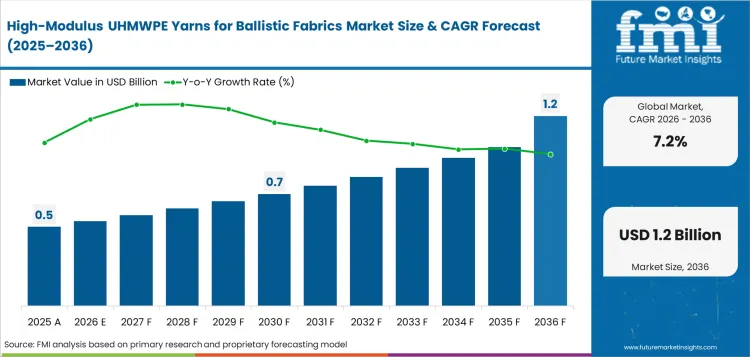
High-modulus UHMWPE yarns for ballistic fabrics were valued at USD 0.5 billion in 2025. The market is projected to reach USD 0.6 billion by the end of 2026 and expand at a CAGR of 7.2% between 2026 and 2036 to reach USD 1.2 billion by 2036. High-modulus filament yarns are expected to lead with a 46.8% yarn type share, and military end users are expected to lead the end-user segment with a 58.0% share.
Material approval is becoming the main pressure point for ballistic fabric suppliers as armor programs move under tighter test regimes. In December 2025, NIJ stated that Standard 0101.07 specifies minimum performance requirements and test methods for body armor used by U.S. law enforcement. NIJ 0101.07 raises the value of yarn lots with stable conversion behavior and clean documentation. Hard armor design is shifting toward lighter UHMWPE UD materials for inserts and helmets.
In January 2025, Avient stated that Dyneema HB330 and HB332 enable up to 45% weight reduction in protective armor systems. Armor makers gain a stronger case for premium yarn inputs if lower weight reduces fatigue without weakening threat protection. Supply strategy is becoming more local in the United States. In January 2026, Solstice announced over $220 million for ballistic fiber expansion and 100 new full-time jobs by 2029. U.S. armor producers gain clearer capacity visibility from domestic Spectra fiber investment.
Summary of the High-Modulus UHMWPE Yarns for Ballistic Fabrics Market
- Demand and Growth Drivers
- Armor fabric makers use high-modulus UHMWPE yarns to reduce fabric weight across soft armor and helmet systems.
- Defense textile programs need stable yarn lots as ballistic testing creates long approval cycles before supply awards.
- Hard armor laminates reinforce yarn demand as plate makers seek lower weight across body armor plates without reducing protection.
- Product and Segment View
- High-modulus filament is expected to lead the yarn type segment with 46.8% share in 2026 as its strength-to-weight performance supports adoption.
- Woven fabrics are expected to lead fabric architecture demand with 37.5% share in 2026 as flexible vest panel use supports demand.
- Soft armor fabrics are expected to hold high-value application demand as daily-wear protection needs lighter fabric packs.
- Geography and Competitive Outlook
- China is expected to record a CAGR of 10.4% through 2036 as domestic fiber capacity and defense textile scale support conversion.
- India is projected to expand at 9.2% CAGR through 2036, as local armor sourcing and capital acquisition programs expand.
- Companies combining polymer spinning skill with ballistic fabric qualification are strengthening their market position during the forecast period.
- Analyst Opinion
- Nikhil Kaitwade, Principal Analyst for Chemicals and Materials domain at FMI, says, “High-modulus UHMWPE yarns are becoming important for armor fabrics seeking lower carried weight and better panel comfort. Defense textile teams need yarn strength with conversion stability. Gel-spinning complexity and qualification testing raise cost. Lot consistency reduces armor rework.”
- High-Modulus UHMWPE Yarns for Ballistic Fabrics Market Value Analysis
- The high-modulus UHMWPE yarns for the ballistic fabrics market is shifting from specialty fiber supply toward a structured armor material input base.
- Adoption is supported by lighter soft armor panels and hard armor laminates requiring stronger yarn performance.
- The market is supported by broader use of ballistic protection material across military and law enforcement programs.
- Certified yarn inputs carry more weight as armor fabric makers need clear ballistic test records and reliable conversion performance.
Key Takeaways
- The high-modulus UHMWPE yarns for ballistic fabrics market was valued at USD 0.5 billion in 2025.
- By 2036, the high-modulus UHMWPE yarns for ballistic fabrics market is expected to be worth USD 1.2 billion.
- From 2026 to 2036, the market is projected to expand at a CAGR of 7.2%.
- The market is projected to create an incremental opportunity of USD 0.6 billion between 2026 and 2036.
- In 2026, high-modulus filament yarns are expected to account for 46.8% of yarn type demand.
- China at 10.4% and India at 9.2% are two of the faster-expanding country markets.
High-Modulus UHMWPE Yarns for Ballistic Fabrics Market Definition
The high-modulus UHMWPE yarns for ballistic fabrics market includes ultra-high molecular weight polyethylene yarns used in protective textile and composite armor structures. These yarns serve soft armor fabrics, helmet fabrics, hard armor laminates, shield materials, and vehicle panel reinforcement. Scope includes high-modulus filament yarns, coated yarns, twisted yarns, and converter-grade yarn supply. Finished armor vests, ceramic plates, standard ropes, and non-ballistic industrial yarns are outside the scope.
High-Modulus UHMWPE Yarns for Ballistic Fabrics Market Inclusions
Market scope covers all commercially traded high-modulus UHMWPE yarns used in ballistic fabric production, categorized by yarn type, including high-modulus filament, standard filament, coated yarn, and twisted yarn; fabric architecture, including woven fabrics, UD laminates, hybrid fabrics, and knitted panels; applications, including soft armor fabrics, hard armor laminates, helmet fabrics, vehicle panels, and shield materials; and end users, including military, law enforcement, homeland security, and private security sectors. Revenue scope covers 2026 to 2036. Stakeholders include UHMWPE yarn manufacturers, polymer resin suppliers, ballistic fabric converters, armor system manufacturers, defense textile suppliers, military procurement agencies, law enforcement buyers, testing laboratories, distributors, and certification bodies.
High-Modulus UHMWPE Yarns for Ballistic Fabrics Market Exclusions
Scope does not include finished body armor products, ceramic armor plates, aramid-only fabrics, non-ballistic industrial yarns, marine ropes, or cut-resistant gloves.
High-Modulus UHMWPE Yarns for Ballistic Fabrics Market Research Methodology
- Primary Research: FMI analysts talked to ballistic fabric converters, armor material suppliers, defense textile buyers, and yarn distributors in major markets.
- Desk Research: FMI combined data from ballistic standards, defense budget releases, supplier product portfolios, and adjacent high-performance fibers for defense demand records.
- Market Sizing and Forecasting: FMI added yarn demand across fabric architecture, armor application groups, and country-level defense textile use from the bottom up.
- Data Validation: Cross-checked every three months against defense material demand, ballistic fabric programs, and company portfolio coverage.
Why is the High-Modulus UHMWPE Yarns for Ballistic Fabrics Market Growing?
- Armor makers are using high-modulus UHMWPE yarns to lower carried weight across vest and helmet fabric systems.
- Fabric converters need tighter yarn quality as ballistic fabric packs must pass repeated threat-level testing.
- Defense buyers are using lighter ballistic protection designs as mobility and comfort become part of equipment review.
NATO defense buying capacity is strengthening across allied markets. NATO’s April 2026 report stated that European Allies and Canada increased defense spending by 20% in 2025 compared with 2024. The same update placed their combined defense investment at over USD 574 billion in 2025. The spending base improves order visibility for armor systems using lightweight UHMWPE yarns. Fabric converters gain from buyers seeking qualified materials for protective equipment programs.
European armor material demand is receiving stronger support from equipment procurement spending. According to the European Defence Agency’s report published in 2025, defense equipment procurement reached EUR 88 billion in 2024. The same stated procurement spending grew by 39% compared with 2023. Higher equipment outlays can lift demand for ballistic textiles used in body armor and vehicle protection. UHMWPE yarn suppliers benefit if the equipment budgets move into protective material orders.
Market Segmentation Analysis
- High-modulus filament is projected to capture 46.8% of yarn type sales in 2026 as light armor fabrics need higher strength at lower fabric weight.
- Woven fabrics are forecast to represent 37.5% of fabric architecture revenue in 2026 as they support flexible armor panels requiring drape and stitching control.
- Soft armor fabrics are anticipated to make up 39.2% of application use in 2026 through steady adoption across vest panels and inserts.
- Military users are estimated to form 58.0% of end-user value in 2026 as armor renewal programs need qualified yarn supply in large volumes.
- Direct contracts are projected to hold 52.0% of channel share in 2026 since armor makers need tighter control over yarn approval and lot records.
The market for high-modulus UHMWPE yarns for ballistic fabrics is divided into five segment groups based on yarn type, fabric architecture, application, end user, and sales channel. Yarn type includes high-modulus filament, standard filament, coated yarn, and twisted yarn. Fabric architecture includes woven fabrics, UD laminates, hybrid fabrics, and knitted panels. Application includes soft armor fabrics, hard armor laminates, helmet fabrics, vehicle panels, and shield materials. End user includes military, law enforcement, homeland security, and private security. Sales channel includes direct contracts, converter sales, and distributor sales.
Insights into High-Modulus UHMWPE Yarns for Ballistic Fabrics Market by Yarn Type
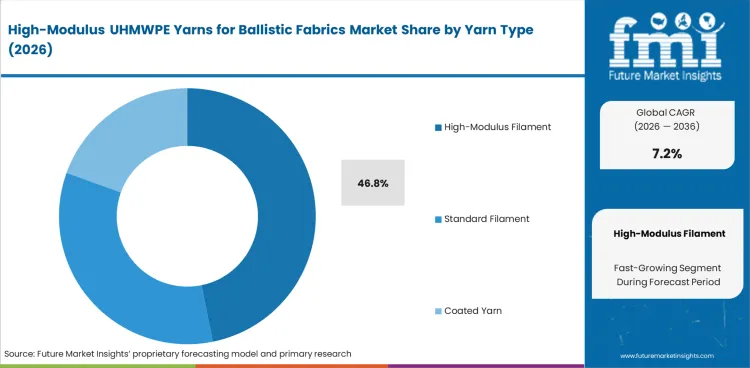
- In 2026, high-modulus filament yarns are expected to make up 46.8% of global yarn type demand. Higher tensile strength helps armor fabric makers reduce layer count across ballistic composites and soft armor packs.
- Standard filament and coated yarn options serve selected cost-sensitive programs. High-modulus filament retains stronger preference in protection systems requiring lower weight and dependable impact resistance.
Insights into High-Modulus UHMWPE Yarns for Ballistic Fabrics Market by Fabric Architecture
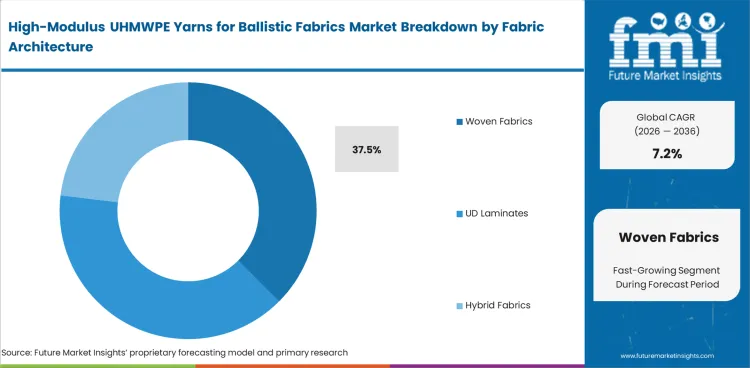
- Woven fabrics are projected to account for 37.5% of fabric architecture segment in 2026. Their drape and stitching behavior make them suitable for flexible vest panels used in daily-wear armor.
- UD laminates and hybrid fabrics address harder protection formats. Woven constructions keep a practical role in soft armor programs needing comfort and fabric handling consistency.
Insights into High-Modulus UHMWPE Yarns for Ballistic Fabrics Market by Application
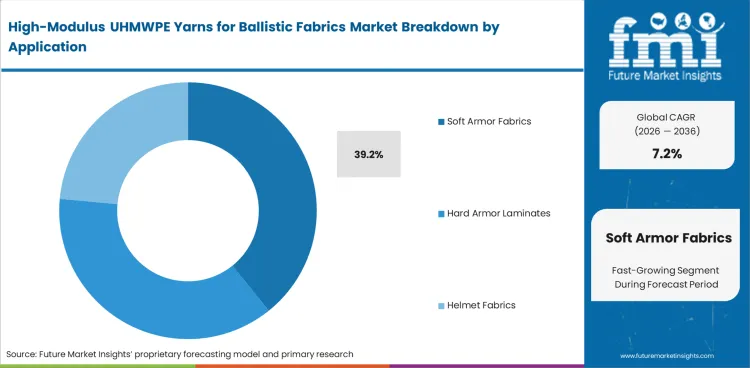
- Soft armor fabrics are expected to represent 39.2% of application segment in 2026. Law enforcement vest programs rely on lighter fabric packs to improve comfort during extended field use.
- Hard armor laminates carry higher material intensity per unit. Soft armor fabrics generate steadier yarn use through vest replacement cycles and broader agency-level adoption.
Insights into High-Modulus UHMWPE Yarns for Ballistic Fabrics Market by End User
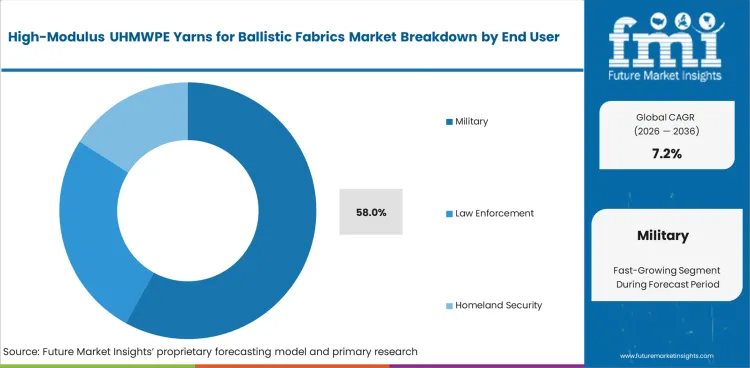
- Military users are forecast to hold 58.0% of end-user demand in 2026. Large armor renewal programs require qualified yarn supply for vest fabrics and helmet shell reinforcement.
- Law enforcement and homeland security users create smaller but specification-driven demand. Military programs lead through larger order sizes and longer equipment replacement cycles.
Insights into High-Modulus UHMWPE Yarns for Ballistic Fabrics Market by Sales Channel
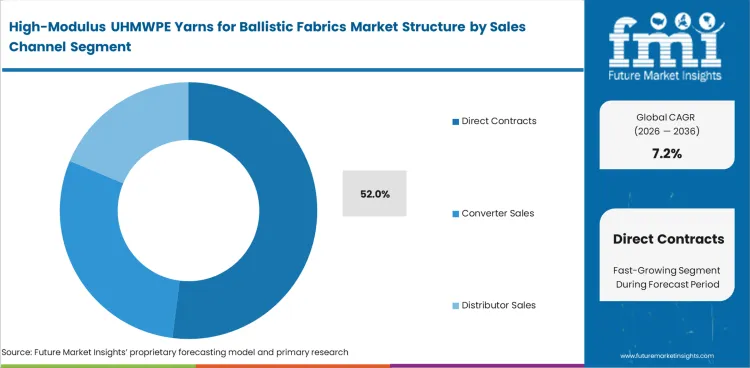
- Direct contracts are projected to account for 52.0% of sales channel segment in 2026. Armor makers prefer direct sourcing to track yarn lots and control qualification records.
- Distributor sales serve smaller armor programs needing faster regional access. Converter sales support fabric makers requiring yarn formats suited to approved ballistic constructions.
High-Modulus UHMWPE Yarns for Ballistic Fabrics Market Drivers, Restraints, and Opportunities
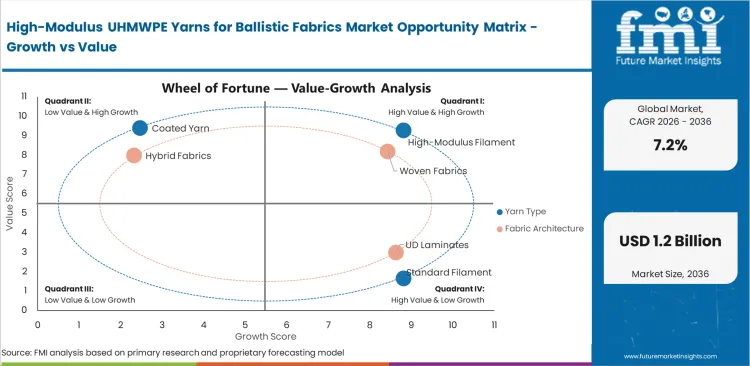
- Armor weight reduction creates structured demand for high-modulus yarns across vest and helmet fabric programs.
- Strict ballistic testing creates entry barriers as every material change can require fresh test evidence.
- Gel-spinning cost pressure limits smaller suppliers as high-strength UHMWPE yarn needs controlled process conditions.
- Hybrid armor structures create opportunity for UHMWPE yarn use alongside ceramics and composite backings.
High-modulus UHMWPE yarns for ballistic fabrics continue expanding as armor makers need lighter fabric packs and dependable ballistic strength. Gel-spinning cost and strict qualification testing can slow broader adoption across selected price-sensitive armor programs. Expansion is expected through soft armor fabrics and helmet reinforcement applications serving military and law enforcement users.
Ethane Export Pull Narrows Feedstock Cushion
High-modulus UHMWPE yarn prices are sensitive to polyethylene feedstock positioning and finishing costs. In March 2026, EIA reported U.S. natural gas plant liquids exports reached 3.1 million b/d in 2025, up 7% from 2024. Ethane exports rose 92,000 b/d, or 19%, and EIA stated that ethane is cracked into ethylene, the base feedstock for petrochemical plastics. The export pull matters for ballistic-yarn buyers because deeper export pull can reduce the North American ethane cushion to help contain polyethylene resin costs. Yarn suppliers may keep base quotes firmer even if spot resin signals soften. Sourcing teams should separate feedstock pass-through clauses from denier-related premiums and define each cost component clearly during negotiations. They should distinguish modulus and ballistic certification premiums to keep pricing structures accurate and avoid confusion during supplier comparisons.
Defense Budgets Lift Qualified Yarn Premiums
Ballistic yarn pricing is being influenced by procurement intensity and petrochemical costs. In April 2025, SIPRI reported world military expenditure reached $2,718 billion in 2024, up 9.4% in real terms. Europe rose 17% to USD 693 billion. NATO members accounted for USD 1,506 billion. For high-modulus UHMWPE yarns, this matters as body armor and helmets require qualified material lots with traceability and repeatable ballistic performance instead of generic fiber supply.
Vehicle liners and soft armor inserts demand certified material consistency, which reinforces strict qualification processes across defense supply chains. As defense budgets rise, mills prioritize certified programs, and they quote longer lead times with fewer free allocations and firmer prices. Buyers should separate commodity yarn negotiations from military-grade qualification capacity because the latter drives premium persistence across supply conditions.
Analysis of High-Modulus UHMWPE Yarns for Ballistic Fabrics Market By Key Countries
.webp "Top Country Growth Comparison High Modulus Uhmwpe Yarns For Ballistic Fabrics Market Cagr (2026 2036)")
| Country | CAGR |
|---|---|
| China | 10.4% |
| India | 9.2% |
| USA | 7.1% |
| Germany | 6.5% |
| UK | 5.8% |
Future Market Insights, 2026.
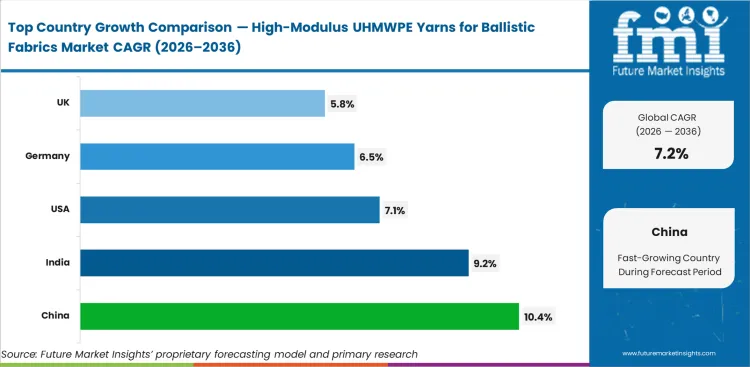
High-Modulus UHMWPE Yarns for Ballistic Fabrics Market CAGR Analysis By Country
- China is projected to record a 10.4% CAGR through 2036 as defense industrial scale strengthens local UHMWPE yarn conversion.
- India’s armor sourcing base supports a 9.2% CAGR during 2026 to 2036 as higher capital acquisition across defense forces supports demand.
- U.S. demand is forecast to expand at 7.1% CAGR by 2036, with large defense buying capacity and strict body armor testing.
- Germany is expected to advance at 6.5% CAGR over the forecast period as mature defense textile activity sustains yarn use.
- UK sales are projected to grow at 5.8% CAGR across the assessment period as armor replacement programs continue at a controlled pace.
Demand for high-modulus UHMWPE yarns for ballistic fabrics is forecast to rise at 7.2% CAGR from 2026 to 2036. Country-level analysis covers the major markets contributing to this forecast, with the markets listed below.
Demand Outlook for High-Modulus UHMWPE Yarns for Ballistic Fabrics Market in China
High-modulus UHMWPE yarns for ballistic fabrics industry in China is projected to record a CAGR of 10.4% from 2026 to 2036. China announced in March 2025 a 7.2% increase in its 2025 national defense budget to 1.784665 trillion yuan. The budget scale strengthens domestic armor material demand and gives local fiber suppliers a larger conversion base. Local producers can gain from helmet fabrics, soft armor layers, and shield materials made for domestic defense channels.
- Defense textile production around Jiangsu and Shandong strengthens supply access for UHMWPE yarn conversion.
- Beijing Tongyizhong and other local fiber producers add domestic supply depth for military armor fabric programs.
- Large national defense spending gives China stronger demand visibility for yarns used in helmets and panel reinforcement.
Sales Analysis of High-Modulus UHMWPE Yarns for Ballistic Fabrics Market in India
India’s high-modulus UHMWPE yarns for ballistic fabrics sector is expected to expand at a CAGR of 9.2% during the assessment period. India allocated over ₹2.19 lakh crore under the capital head for defense forces in FY 2026–27. Out of this amount, ₹1.85 lakh crore was earmarked for capital acquisition. The allocation creates a stronger buying base for armor materials used in personal protection and vehicle survivability.
- Ministry of Defence acquisition programs raise demand for qualified yarn inputs across vest and helmet suppliers.
- Border Roads Organisation allocation of ₹7,394 crore adds defense infrastructure activity near strategic corridors.
- Domestic armor makers need repeatable yarn lots to meet testing needs under Indian and allied protection standards.
Demand Outlook for High-Modulus UHMWPE Yarns for Ballistic Fabrics Market in the United States
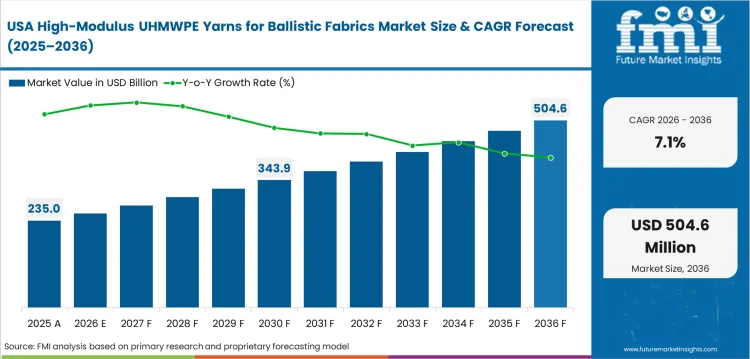
The U.S. high-modulus UHMWPE yarns for ballistic fabrics industry forecast to grow at a CAGR of 7.1% by 2036. The Department of Defense FY 2026 budget request listed a USD 848.3 billion discretionary total and USD 153.3 billion for procurement. The spending depth creates a steady base for personal protection equipment and survivability materials. U.S. buyers value yarn suppliers with test records under NIJ and defense qualification programs.
- NIJ 0101.07 raises review discipline for body armor models used by U.S. law enforcement agencies.
- Defense contractor clusters in Virginia and Maryland strengthen access to armor material review and program testing.
- U.S. fabric converters need yarn traceability across soft armor panels and bulletproof vest production.
Opportunity Analysis of High-Modulus UHMWPE Yarns for Ballistic Fabrics Market in Germany
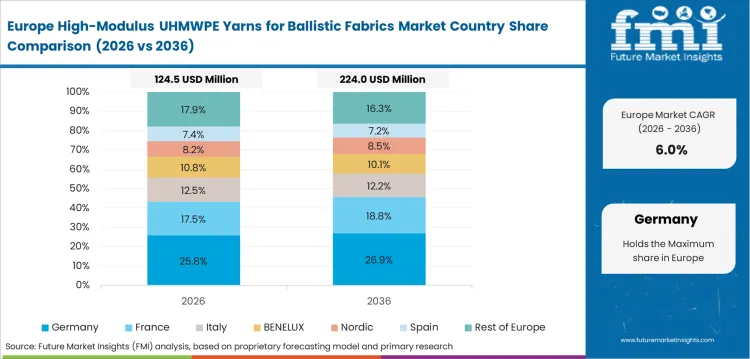
Germany’s high-modulus UHMWPE yarns for ballistic fabrics segment is expected to advance at 6.5% CAGR through 2036. Total defense spending is slated to rise to about EUR 82.7 billion in 2026, as stated by Germany’s Federal Ministry of Finance in July 2025. NATO defense spending is set to reach 2.8% of GDP in 2026. The planned spending adds buying depth for high-performance armor textiles and composite reinforcement materials.
- Bundeswehr equipment renewal raises demand for qualified protective textile materials used in personal armor systems.
- German converter capacity across technical textiles helps yarn suppliers serve defense and industrial fabric customers.
- EU defense coordination can raise demand for local supply chains serving armor and technical textiles.
Future Outlook for High-Modulus UHMWPE Yarns for Ballistic Fabrics Market in the United Kingdom
The UK high-modulus UHMWPE yarns for ballistic fabrics industry is expected to post 5.8% CAGR through 2036. The UK government stated in February 2025 that defense spending will increase to 2.5% of GDP from April 2027. It has set an ambition to reach 3% in the next parliament. The spending path supports demand for armor materials used by defense and security forces.
- UK defense textile buyers require material evidence suited to NATO-aligned body armor and helmet systems.
- Defense activity around Bristol and South Wales adds review capacity for composite and protective material programs.
- Higher defense spending targets can improve order visibility for UHMWPE yarn suppliers serving armor converters.
Competitive Landscape and Strategic Positioning
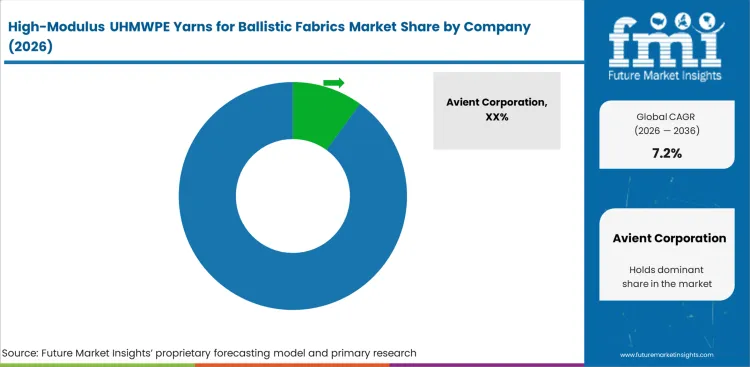
High-modulus UHMWPE yarn suppliers compete on polymer purity and proven armor fabric performance across qualified protective textile programs. Avient holds a strong position through Dyneema fiber platforms and deeper composite material experience globally. Solstice Advanced Materials adds capacity through Spectra fiber heritage after its separation from Honeywell as an independent business. Teijin Limited leverages high-performance polyethylene materials used in protective structures and advanced armor formats.
High process cost and long approval testing increase barriers for new and regional suppliers alike. Smaller suppliers often emphasize price and delivery speed. Large armor makers prefer proven yarn lots. Creep control and denier consistency now guide supplier selection across long armor fabric programs. Companies with reliable test history and predictable yarn behavior are best placed to win repeat supply awards.
Key Companies in the High-Modulus UHMWPE Yarns for Ballistic Fabrics Market
Companies active in the high-modulus UHMWPE yarns for ballistic fabrics market include:
- Avient Corporation, Solstice Advanced Materials, and Teijin Limited have strong material portfolios for ballistic fabric and armor composite use.
- Toyobo MC Corporation and Beijing Tongyizhong New Material Technology Corporation serve protective textile users through high-strength polyethylene fiber products.
- Zhejiang Qianxilong Special Fiber Co. Ltd. and Shandong Jianbang Chemical Fiber Co. Ltd. hold specialist positions across UHMWPE fiber supply and converter-facing yarn demand.
Competitive Benchmarking: High-Modulus UHMWPE Yarns for Ballistic Fabrics Market
| Company | Ballistic Yarn Depth | Fabric Converter Access | Qualification Record | Geographic Footprint |
|---|---|---|---|---|
| Avient Corporation | High | Strong | Strong | Global presence across Asia, EMEA, Latin America, South America, and US/Canada, with global headquarters and manufacturing presence in Avon Lake, Ohio. |
| Solstice Advanced Materials | High | Strong | Strong | U.S.-based specialty materials supplier with Spectra Shield technology used by military, police, and security organizations in over 40 countries. |
| Teijin Limited | High | Medium | Strong | Japan-based group with global facilities and Teijin Aramid locations across the Netherlands, Japan, Thailand, and regional sales offices. |
| Toyobo MC Corporation | Medium | Medium | Moderate | Japan-based supplier with North American business presence through TOYOBO MC U.S.A. in Novi, Michigan, and wider Toyobo group locations. |
| Beijing Tongyizhong New Material Technology Corporation | High | Strong | Moderate | China-centered UHMWPE fiber and composite materials producer with operations based in Beijing. |
| Zhejiang Qianxilong Special Fiber Co. Ltd. | Medium | Medium | Moderate | China-based UHMWPE fiber producer located in Yongkang Economic Development Zone, Zhejiang. |
| Shandong Jianbang Chemical Fiber Co. Ltd. | Medium | Medium | Moderate | China-based fiber producer located in Huimin County, Shandong, with 3 production lines and over 20,000 tons of annual fiber output. |
Future Market Insights, 2026.
Key Developments in High-Modulus UHMWPE Yarns for Ballistic Fabrics Market
- In January 2025, Avient introduced Dyneema HB330 and HB332 for hard ballistic protection. The products target inserts, helmets, and vehicle armor with weight reduction claims for protective armor systems.
- In July 2025, Avient launched Dyneema woven composite technology. The material offers higher abrasion resistance and lower weight compared with its existing high-performance composite portfolio.
- In October 2025, Honeywell completed the spin-off of Solstice Advanced Materials. Solstice began trading as an independent specialty materials company under the ticker symbol SOLS.
Key Players in the High-Modulus UHMWPE Yarns for Ballistic Fabrics Market
Major Global Players:
- Avient Corporation
- Solstice Advanced Materials
- Teijin Limited
- Toyobo MC Corporation
Specialist Players:
- Beijing Tongyizhong New Material Technology Corporation
- Zhejiang Qianxilong Special Fiber Co. Ltd.
- Shandong Jianbang Chemical Fiber Co. Ltd.
Report Scope and Coverage
| Parameter | Details |
|---|---|
| Quantitative Units | USD 0.6 billion to USD 1.2 billion, at a CAGR of 7.2% |
| Market Definition | The market covers high-modulus UHMWPE yarns used in ballistic fabric conversion for armor and protective textile systems. |
| Regions Covered | North America, Latin America, Europe, East Asia, South Asia and Pacific, Middle East and Africa |
| Countries Covered | USA, UK, Germany, China, India, Japan, South Korea, and 30 plus countries |
| Key Companies Profiled | Avient Corporation, Solstice Advanced Materials, Teijin Limited, Toyobo MC Corporation, Beijing Tongyizhong, Zhejiang Qianxilong, Shandong Jianbang |
| Forecast Period | 2026 to 2036 |
| Approach | Hybrid bottom-up and top-down methodology starting with yarn demand and verified ballistic fabric use patterns. |
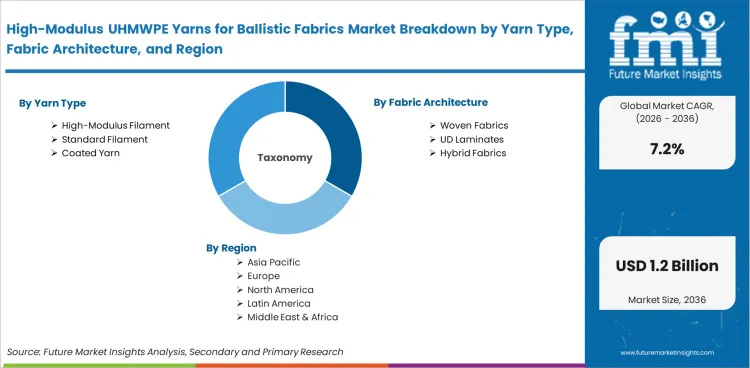
High-Modulus UHMWPE Yarns for Ballistic Fabrics Market Breakdown By Yarn Type, Fabric Architecture, And Region
High-Modulus UHMWPE Yarns for Ballistic Fabrics Market Segmented by Yarn Type:
- High-Modulus Filament
- Standard Filament
- Coated Yarn
- Twisted Yarn
High-Modulus UHMWPE Yarns for Ballistic Fabrics Market Segmented by Fabric Architecture:
- Woven Fabrics
- UD Laminates
- Hybrid Fabrics
- Knitted Panels
High-Modulus UHMWPE Yarns for Ballistic Fabrics Market Segmented by Application:
- Soft Armor Fabrics
- Hard Armor Laminates
- Helmet Fabrics
- Vehicle Panels
- Shield Materials
High-Modulus UHMWPE Yarns for Ballistic Fabrics Market Segmented by End User:
- Military
- Law Enforcement
- Homeland Security
- Private Security
High-Modulus UHMWPE Yarns for Ballistic Fabrics Market Segmented by Sales Channel:
- Direct Contracts
- Converter Sales
- Distributor Sales
Research s and Bibliography
- North Atlantic Treaty Organization. (2026, April 10). Defence expenditures and NATO’s 5% commitment. NATO.
- European Defence Agency. (2025, December). Defence data 2024–2025: Key findings and analysis. European Defence Agency.
- USA Energy Information Administration. (2026, March 30). Natural gas plant liquids exports reached record highs in 2025. Today in Energy.
- Stockholm International Peace Research Institute. (2025, April 28). Unprecedented rise in global military expenditure as European and Middle East spending surges.
- Stockholm International Peace Research Institute. (2025, April 28). Trends in world military expenditure, 2024. SIPRI.
- National Institute of Justice. (2025, December 1). Ballistic resistance of body armor, NIJ Standard 0101.07. U.S. Department of Justice.
- National Institute of Justice. (2025, May 13). Body armor notice: Removal of ballistic resistant body armor models from compliant products list. U.S. Department of Justice.
- Office of the Under Secretary of Defense. (2025, June). Fiscal year 2026 defense budget overview. U.S. Department of Defense.
- Press Information Bureau. (2026, February 3). Defence in Union Budget 2026–27. Government of India.
- State Council of the People’s Republic of China. (2025, March 5). China to increase defense budget by 7.2 percent in 2025. Government of China.
- Federal Ministry of Finance. (2025, July 30). German government intensifies its investment drive: 2026 federal budget and fiscal plan to 2029 adopted. Government of Germany.
- Prime Minister’s Office. (2025, February 25). Prime Minister sets out biggest sustained increase in defence spending since the Cold War. Government of the United Kingdom.
- Avient Corporation. (2025, January 20). Dyneema unveils hard ballistic product innovations enabling 45% weight reduction. Avient.
- Avient Corporation. (2025, July 14). Dyneema changes fabric engineering with new composite technology. Avient.
- Honeywell International Inc. (2025, October 30). Honeywell completes spin-off of Solstice Advanced Materials. Honeywell.
This Report Addresses
- What is the value forecast for high-modulus UHMWPE yarns for ballistic fabrics from 2026 to 2036?
- Which yarn type is expected to lead the market by 2026?
- Which fabric architecture creates the strongest demand for UHMWPE yarn conversion?
- Which application segment uses the highest share of high-modulus UHMWPE yarns?
- Which countries are expected to record faster expansion through 2036?
- Which companies are active in high-modulus UHMWPE yarn supply for ballistic fabrics?
- How does FMI estimate and validate the market forecast?
Frequently Asked Questions
What is the global market demand for High-Modulus UHMWPE Yarns for Ballistic Fabrics in 2026?
In 2026, the global market for high-modulus UHMWPE yarns for ballistic fabrics is expected to be worth USD 0.6 billion.
How big will the market for High-Modulus UHMWPE Yarns for Ballistic Fabrics be in 2036?
By 2036, the market for high-modulus UHMWPE yarns for ballistic fabrics is expected to be worth USD 1.2 billion.
How much is demand for High-Modulus UHMWPE Yarns for Ballistic Fabrics expected to expand between 2026 and 2036?
Between 2026 and 2036, demand for high-modulus UHMWPE yarns for ballistic fabrics is expected to expand at a CAGR of 7.2%.
Which yarn type segment is expected to lead global demand by 2026?
High-modulus filament yarns will make up 46.8% of the yarn type segment in 2026.
What is causing demand to rise in China?
The China high-modulus UHMWPE yarns for ballistic fabrics market is projected to record 10.4% CAGR through 2036, backed by fiber capacity and defense textile scale.
What is causing demand to rise in India?
The India high-modulus UHMWPE yarns for ballistic fabrics market is projected to expand at 9.2% CAGR through 2036, backed by local armor sourcing and capital acquisition programs.
What does this report mean by High-Modulus UHMWPE Yarns for Ballistic Fabrics Market definition?
What does this report mean by High-Modulus UHMWPE Yarns for Ballistic Fabrics Market definition?
How does FMI make the High-Modulus UHMWPE Yarns for Ballistic Fabrics forecast and check it?
Forecasting models use a hybrid bottom-up and top-down approach, starting with yarn demand and checking it against ballistic fabric use patterns.
Preview the report firsthand - request a free sample
Get SampleGet the brochure for pricing and purchase details.
Get PDFTable of Content
- Key Takeaways
- Market Size and CAGR
- Top Growth Driver
- Fastest Growing Segment
- Leading Region
- Key Companies
- Emerging Opportunities
- Executive Summary
- Global Market Outlook
- Demand-side Trends
- Supply-side Trends
- Technology Roadmap Analysis
- Analysis and Recommendations
- Analyst Perspective (What is happening? Why now? What should investors know?)
- Key Questions Answered
- How large is the market?
- What is the CAGR?
- What are key trends?
- Which region dominates?
- Who are the leaders?
- Market Overview
- Market Coverage / Taxonomy
- Market Definition / Scope / Limitations
- Research Methodology
- Chapter Orientation
- Analytical Lens and Working Hypotheses
- Market Structure, Signals, and Trend Drivers
- Benchmarking and Cross-market Comparability
- Market Sizing, Forecasting, and Opportunity Mapping
- Research Design and Evidence Framework
- Desk Research Programme (Secondary Evidence)
- Expert Input and Fieldwork (Primary Evidence)
- Tooling, Models, and Reference Databases
- Data Engineering and Model Build
- Quality Assurance and Audit Trail
- Market Background
- Market Dynamics (Drivers, Restraints, Opportunity, Trends)
- Scenario Forecast (Optimistic, Likely, Conservative)
- Impact Analysis
- AI Impact
- Sustainability Impact
- Regulatory Impact
- Technology Impact
- Consumer / Buyer Analysis
- Purchase Drivers
- Adoption Barriers
- Buyer Journey
- Opportunity Map Analysis
- Product Life Cycle Analysis
- Supply Chain Analysis
- Investment Feasibility Matrix
- Value Chain Analysis
- PESTLE and Porter's Analysis
- Regulatory Landscape
- Regional Parent Market Outlook
- Production and Consumption Statistics
- Import and Export Statistics
- Global Market Analysis and Forecast, 2021 to 2036
- Historical Market Size Value (USD Million) & Volume (Unit) Analysis, 2021 to 2025
- Current and Future Market Size Value (USD Million) & Volume (Unit) Projections, 2026 to 2036
- Y-o-Y Growth Trend Analysis
- Absolute $ Opportunity Analysis
- Global Market Pricing Analysis, 2021 to 2036
- Global Market Analysis and Forecast, By Yarn Type, 2021 to 2036
- Introduction / Key Findings
- Historical Market Size Value (USD Million) & Volume (Unit) Analysis By Yarn Type, 2021 to 2025
- Current and Future Market Size Value (USD Million) & Volume (Unit) Analysis and Forecast By Yarn Type, 2026 to 2036
- High-Modulus Filament
- Standard Filament
- Coated Yarn
- Twisted Yarn
- High-Modulus Filament
- Y-o-Y Growth Trend Analysis By Yarn Type, 2021 to 2025
- Absolute $ Opportunity Analysis By Yarn Type, 2026 to 2036
- Global Market Analysis and Forecast, By Fabric Architecture, 2021 to 2036
- Introduction / Key Findings
- Historical Market Size Value (USD Million) & Volume (Unit) Analysis By Fabric Architecture, 2021 to 2025
- Current and Future Market Size Value (USD Million) & Volume (Unit) Analysis and Forecast By Fabric Architecture, 2026 to 2036
- Woven Fabrics
- UD Laminates
- Hybrid Fabrics
- Knitted Panels
- Woven Fabrics
- Y-o-Y Growth Trend Analysis By Fabric Architecture, 2021 to 2025
- Absolute $ Opportunity Analysis By Fabric Architecture, 2026 to 2036
- Global Market Analysis and Forecast, By Application, 2021 to 2036
- Introduction / Key Findings
- Historical Market Size Value (USD Million) & Volume (Unit) Analysis By Application, 2021 to 2025
- Current and Future Market Size Value (USD Million) & Volume (Unit) Analysis and Forecast By Application, 2026 to 2036
- Soft Armor Fabrics
- Hard Armor Laminates
- Helmet Fabrics
- Vehicle Panels
- Shield Materials
- Soft Armor Fabrics
- Y-o-Y Growth Trend Analysis By Application, 2021 to 2025
- Absolute $ Opportunity Analysis By Application, 2026 to 2036
- Global Market Analysis and Forecast, By End User, 2021 to 2036
- Introduction / Key Findings
- Historical Market Size Value (USD Million) & Volume (Unit) Analysis By End User, 2021 to 2025
- Current and Future Market Size Value (USD Million) & Volume (Unit) Analysis and Forecast By End User, 2026 to 2036
- Military
- Law Enforcement
- Homeland Security
- Private Security
- Military
- Y-o-Y Growth Trend Analysis By End User, 2021 to 2025
- Absolute $ Opportunity Analysis By End User, 2026 to 2036
- Global Market Analysis and Forecast, By Sales Channel, 2021 to 2036
- Introduction / Key Findings
- Historical Market Size Value (USD Million) & Volume (Unit) Analysis By Sales Channel, 2021 to 2025
- Current and Future Market Size Value (USD Million) & Volume (Unit) Analysis and Forecast By Sales Channel, 2026 to 2036
- Direct Contracts
- Converter Sales
- Distributor Sales
- Direct Contracts
- Y-o-Y Growth Trend Analysis By Sales Channel, 2021 to 2025
- Absolute $ Opportunity Analysis By Sales Channel, 2026 to 2036
- Global Market Analysis and Forecast, By Region, 2021 to 2036
- Introduction
- Historical Market Size Value (USD Million) & Volume (Unit) Analysis By Region, 2021 to 2025
- Current Market Size Value (USD Million) & Volume (Unit) Analysis and Forecast By Region, 2026 to 2036
- North America
- Latin America
- Western Europe
- Eastern Europe
- East Asia
- South Asia and Pacific
- Middle East & Africa
- Market Attractiveness Analysis By Region
- North America Market Analysis and Forecast, By Country, 2021 to 2036
- Historical Market Size Value (USD Million) & Volume (Unit) Trend Analysis By Market Taxonomy, 2021 to 2025
- Market Size Value (USD Million) & Volume (Unit) Forecast By Market Taxonomy, 2026 to 2036
- By Country
- USA
- Canada
- Mexico
- By Yarn Type
- By Fabric Architecture
- By Application
- By End User
- By Sales Channel
- By Country
- Market Attractiveness Analysis
- By Country
- By Yarn Type
- By Fabric Architecture
- By Application
- By End User
- By Sales Channel
- Key Takeaways
- Latin America Market Analysis and Forecast, By Country
- Historical Market Size Value (USD Million) & Volume (Unit) Trend Analysis By Market Taxonomy, 2021 to 2025
- Market Size Value (USD Million) & Volume (Unit) Forecast By Market Taxonomy, 2026 to 2036
- By Country
- Brazil
- Chile
- Rest of Latin America
- By Yarn Type
- By Fabric Architecture
- By Application
- By End User
- By Sales Channel
- By Country
- Market Attractiveness Analysis
- By Country
- By Yarn Type
- By Fabric Architecture
- By Application
- By End User
- By Sales Channel
- Key Takeaways
- Western Europe Market Analysis and Forecast, By Country
- Historical Market Size Value (USD Million) & Volume (Unit) Trend Analysis By Market Taxonomy, 2021 to 2025
- Market Size Value (USD Million) & Volume (Unit) Forecast By Market Taxonomy, 2026 to 2036
- By Country
- Germany
- UK
- Italy
- Spain
- France
- Nordic
- BENELUX
- Rest of Western Europe
- By Yarn Type
- By Fabric Architecture
- By Application
- By End User
- By Sales Channel
- By Country
- Market Attractiveness Analysis
- By Country
- By Yarn Type
- By Fabric Architecture
- By Application
- By End User
- By Sales Channel
- Key Takeaways
- Eastern Europe Market Analysis and Forecast, By Country
- Historical Market Size Value (USD Million) & Volume (Unit) Trend Analysis By Market Taxonomy, 2021 to 2025
- Market Size Value (USD Million) & Volume (Unit) Forecast By Market Taxonomy, 2026 to 2036
- By Country
- Russia
- Poland
- Hungary
- Balkan & Baltic
- Rest of Eastern Europe
- By Yarn Type
- By Fabric Architecture
- By Application
- By End User
- By Sales Channel
- By Country
- Market Attractiveness Analysis
- By Country
- By Yarn Type
- By Fabric Architecture
- By Application
- By End User
- By Sales Channel
- Key Takeaways
- East Asia Market Analysis and Forecast, By Country
- Historical Market Size Value (USD Million) & Volume (Unit) Trend Analysis By Market Taxonomy, 2021 to 2025
- Market Size Value (USD Million) & Volume (Unit) Forecast By Market Taxonomy, 2026 to 2036
- By Country
- China
- Japan
- South Korea
- By Yarn Type
- By Fabric Architecture
- By Application
- By End User
- By Sales Channel
- By Country
- Market Attractiveness Analysis
- By Country
- By Yarn Type
- By Fabric Architecture
- By Application
- By End User
- By Sales Channel
- Key Takeaways
- South Asia and Pacific Market Analysis and Forecast, By Country
- Historical Market Size Value (USD Million) & Volume (Unit) Trend Analysis By Market Taxonomy, 2021 to 2025
- Market Size Value (USD Million) & Volume (Unit) Forecast By Market Taxonomy, 2026 to 2036
- By Country
- India
- ASEAN
- Australia & New Zealand
- Rest of South Asia and Pacific
- By Yarn Type
- By Fabric Architecture
- By Application
- By End User
- By Sales Channel
- By Country
- Market Attractiveness Analysis
- By Country
- By Yarn Type
- By Fabric Architecture
- By Application
- By End User
- By Sales Channel
- Key Takeaways
- Middle East & Africa Market Analysis and Forecast, By Country
- Historical Market Size Value (USD Million) & Volume (Unit) Trend Analysis By Market Taxonomy, 2021 to 2025
- Market Size Value (USD Million) & Volume (Unit) Forecast By Market Taxonomy, 2026 to 2036
- By Country
- Kingdom of Saudi Arabia
- Other GCC Countries
- Türkiye
- South Africa
- Other African Union
- Rest of Middle East & Africa
- By Yarn Type
- By Fabric Architecture
- By Application
- By End User
- By Sales Channel
- By Country
- Market Attractiveness Analysis
- By Country
- By Yarn Type
- By Fabric Architecture
- By Application
- By End User
- By Sales Channel
- Key Takeaways
- Key Countries Market Analysis
- USA
- Pricing Analysis
- Market Share Analysis, 2025
- By Yarn Type
- By Fabric Architecture
- By Application
- By End User
- By Sales Channel
- Canada
- Pricing Analysis
- Market Share Analysis, 2025
- By Yarn Type
- By Fabric Architecture
- By Application
- By End User
- By Sales Channel
- Mexico
- Pricing Analysis
- Market Share Analysis, 2025
- By Yarn Type
- By Fabric Architecture
- By Application
- By End User
- By Sales Channel
- Brazil
- Pricing Analysis
- Market Share Analysis, 2025
- By Yarn Type
- By Fabric Architecture
- By Application
- By End User
- By Sales Channel
- Chile
- Pricing Analysis
- Market Share Analysis, 2025
- By Yarn Type
- By Fabric Architecture
- By Application
- By End User
- By Sales Channel
- Germany
- Pricing Analysis
- Market Share Analysis, 2025
- By Yarn Type
- By Fabric Architecture
- By Application
- By End User
- By Sales Channel
- UK
- Pricing Analysis
- Market Share Analysis, 2025
- By Yarn Type
- By Fabric Architecture
- By Application
- By End User
- By Sales Channel
- Italy
- Pricing Analysis
- Market Share Analysis, 2025
- By Yarn Type
- By Fabric Architecture
- By Application
- By End User
- By Sales Channel
- Spain
- Pricing Analysis
- Market Share Analysis, 2025
- By Yarn Type
- By Fabric Architecture
- By Application
- By End User
- By Sales Channel
- France
- Pricing Analysis
- Market Share Analysis, 2025
- By Yarn Type
- By Fabric Architecture
- By Application
- By End User
- By Sales Channel
- India
- Pricing Analysis
- Market Share Analysis, 2025
- By Yarn Type
- By Fabric Architecture
- By Application
- By End User
- By Sales Channel
- ASEAN
- Pricing Analysis
- Market Share Analysis, 2025
- By Yarn Type
- By Fabric Architecture
- By Application
- By End User
- By Sales Channel
- Australia & New Zealand
- Pricing Analysis
- Market Share Analysis, 2025
- By Yarn Type
- By Fabric Architecture
- By Application
- By End User
- By Sales Channel
- China
- Pricing Analysis
- Market Share Analysis, 2025
- By Yarn Type
- By Fabric Architecture
- By Application
- By End User
- By Sales Channel
- Japan
- Pricing Analysis
- Market Share Analysis, 2025
- By Yarn Type
- By Fabric Architecture
- By Application
- By End User
- By Sales Channel
- South Korea
- Pricing Analysis
- Market Share Analysis, 2025
- By Yarn Type
- By Fabric Architecture
- By Application
- By End User
- By Sales Channel
- Russia
- Pricing Analysis
- Market Share Analysis, 2025
- By Yarn Type
- By Fabric Architecture
- By Application
- By End User
- By Sales Channel
- Poland
- Pricing Analysis
- Market Share Analysis, 2025
- By Yarn Type
- By Fabric Architecture
- By Application
- By End User
- By Sales Channel
- Hungary
- Pricing Analysis
- Market Share Analysis, 2025
- By Yarn Type
- By Fabric Architecture
- By Application
- By End User
- By Sales Channel
- Kingdom of Saudi Arabia
- Pricing Analysis
- Market Share Analysis, 2025
- By Yarn Type
- By Fabric Architecture
- By Application
- By End User
- By Sales Channel
- Türkiye
- Pricing Analysis
- Market Share Analysis, 2025
- By Yarn Type
- By Fabric Architecture
- By Application
- By End User
- By Sales Channel
- South Africa
- Pricing Analysis
- Market Share Analysis, 2025
- By Yarn Type
- By Fabric Architecture
- By Application
- By End User
- By Sales Channel
- USA
- Market Structure Analysis
- Competition Dashboard
- Competition Benchmarking
- Market Share Analysis of Top Players
- By Regional
- By Yarn Type
- By Fabric Architecture
- By Application
- By End User
- By Sales Channel
- Emerging Startups
- Innovation Benchmarking
- Competition Analysis
- Competition Deep Dive
- Avient Corporation
- Overview
- Product Portfolio
- Profitability by Market Segments (Product/Region/Sales Channel)
- Sales Footprint
- Strategy Overview
- Marketing Strategy
- Product Strategy
- Channel Strategy
- Solstice Advanced Materials
- Teijin Limited
- Toyobo MC Corporation
- Beijing Tongyizhong New Material Technology Corporation
- Zhejiang Qianxilong Special Fiber Co. Ltd.
- Shandong Jianbang Chemical Fiber Co. Ltd.
- Avient Corporation
- Case Studies
- Success Stories
- Recent Developments
- Competition Deep Dive
- Assumptions & Acronyms Used


