

- Industry Size (2026)
- USD 690.0 Mn
- Forecast (2036)
- USD 1224.0 Mn
- CAGR (2026 to 2036)
- 5.9%
Acoustic Fabrics Market Forecast and Outlook 2026 to 2036
The acoustic fabrics market is likely to be valued at USD 690.0 million in 2026 and reach USD 1,224.0 million by 2036, expanding at a 5.9% CAGR. Value behavior reflects a shift in how interior acoustics are resolved, with greater reliance on surface-based absorption rather than structural modification. Acoustic fabrics operate as functional interfaces within panels, baffles, screens, and furniture systems, enabling absorptive substrates to perform without constraining visual design. Demand is concentrated in offices, hospitality environments, education facilities, and public interiors where reverberation control is evaluated alongside layout flexibility and aesthetic coordination. Specification decisions hinge on airflow transparency, fire compliance, abrasion resistance, and color consistency, since fabrics must maintain acoustic effectiveness while tolerating repeated handling and cleaning. Cost formation favors predictable, repeatable supply across large surface areas rather than high-margin specialty products.
Quick Stats for Acoustic Fabrics Market
- Acoustic Fabrics Market Value (2026): USD 690.0 million
- Acoustic Fabrics Market Forecast Value (2036): USD 1,224.0 million
- Acoustic Fabrics Market Forecast CAGR 2026 to 2036: 5.9%
- Leading Fabric Type by Demand Share: Polyester or PET Fabrics
- Fastest-Growing Countries: India, Vietnam, Indonesia, Turkey, Mexico
- Top Players in Global Demand: Kvadrat, Camira, Guilford of Maine, Maharam, Carnegie Fabrics
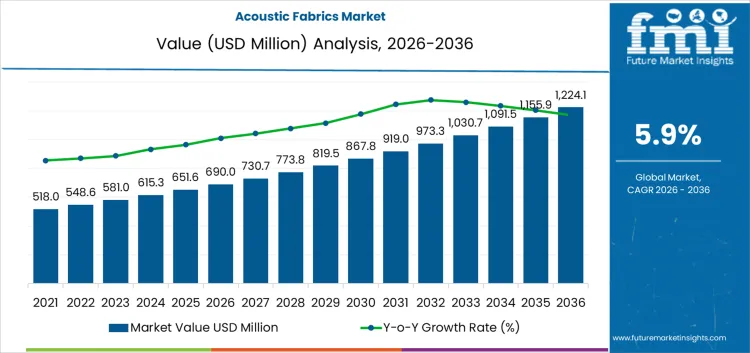
Interior reconfiguration cycles and refurbishment activity account for a substantial share of consumption, as changing space usage often exposes acoustic shortcomings after occupation. Open-plan offices, hybrid collaboration zones, and learning environments generate recurring replacement demand when existing fabric systems lose tension, fade, or no longer meet updated fire and emissions criteria. Adoption varies widely where cost pressure leads to substitution with visually similar textiles that undermine absorption outcomes.
Manufacturing advantage rests with suppliers able to control weave density, dye lots, and certification documentation across multi-phase projects. Distribution aligns primarily with panel manufacturers, system integrators, and fit-out contractors rather than standalone textile channels. Expansion remains tied to accountability for measured acoustic performance at project handover, reinforcing the role of acoustic fabrics as performance-critical components within interior systems rather than discretionary decorative materials.
Acoustic Fabrics Market Key Takeaways
| Metric | Value |
|---|---|
| Market Value (2026) | USD 690.0 million |
| Market Forecast Value (2036) | USD 1,224.0 million |
| Forecast CAGR 2026 to 2036 | 5.9% |
Why is the Demand for Acoustic Fabrics Growing?
Demand for acoustic fabrics is increasing as interior designers, facility planners, and acoustic engineers specify textile-based solutions that combine aesthetic flexibility with sound absorption performance in built environments. Acoustic fabrics are tailored to reduce reverberation and background noise in spaces such as offices, hospitality venues, auditoriums, healthcare facilities, and educational campuses where improved speech intelligibility and occupant comfort are critical. Material characteristics such as noise absorption coefficients, fire performance ratings, and resistance to wear influence selection because fabrics must meet both acoustic targets and compliance standards for public spaces.
Procurement teams assess compatibility with substrate panels, tension systems, and frame assemblies to ensure integration into wall, ceiling, and partition systems without compromising design intent or structural requirements. Growth in open plan workplaces and experiential interiors reinforces use of acoustic fabrics that deliver functional noise control while supporting design trends that favor color, texture, and surface customization.
Expansion of collaborative workspace environments and hybrid meeting areas also supports uptake of acoustic fabrics as part of comprehensive acoustic strategies that address both aesthetic and performance requirements. Architects and technical consultants prioritize fabrics that maintain long-term dimensional stability, resist soiling, and withstand routine cleaning regimens under varied humidity and traffic conditions. Integration with mounting systems and panel substrates requires coordinated testing to maintain consistent acoustic performance across frequency ranges relevant to human speech and mechanical noise. Facility managers and installers value solutions that streamline on-site installation and minimize post-installation adjustment while preserving acoustic targets. These market-specific performance and integration considerations are contributing to sustained demand growth in the acoustic fabrics market.
How Are the Segments Classified in the Acoustic Fabrics Market?
Demand for acoustic fabrics is shaped by interior noise absorption needs, aesthetic integration requirements, and compliance with indoor acoustic standards. These fabrics are used as surface layers on absorptive systems to control reverberation and improve speech clarity. Adoption aligns with expansion of open-plan interiors, multipurpose spaces, and comfort-driven building design. Product selection prioritizes acoustic transparency, durability, and compatibility with panels or furniture systems. Segment classification reflects differentiation by fabric composition, functional application, and end-use environment influencing absorption effectiveness, visual integration, and usage intensity.
Which Fabric Type Represents the Largest Share of Demand?
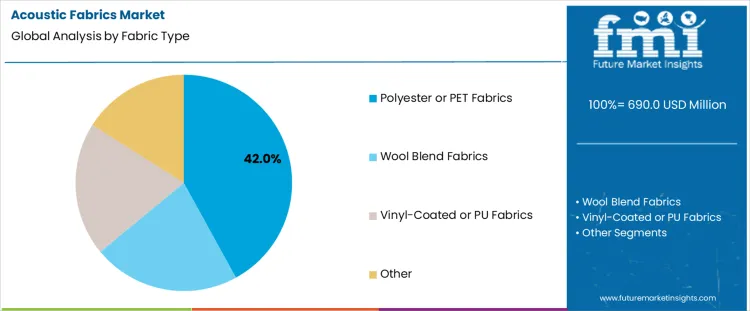
Polyester or PET fabrics hold 42.0%, representing the largest share among fabric types due to durability and acoustic transparency. Synthetic fibers allow consistent airflow resistance essential for sound absorption performance. Color stability and ease of cleaning support long-term interior use. Fire-rated variants meet regulatory requirements in public buildings. Wool blend fabrics provide natural aesthetics with higher cost considerations. Vinyl-coated or PU fabrics emphasize wipeability with reduced acoustic permeability. Fabric type segmentation reflects preference for balanced performance materials combining acoustic functionality, durability, and design flexibility.
Key Points
- PET fabrics support effective sound absorption.
- Durability suits high-traffic interior environments.
- Other fabrics prioritize aesthetics or cleanability.
Which Application Accounts for the Highest Share of Demand?
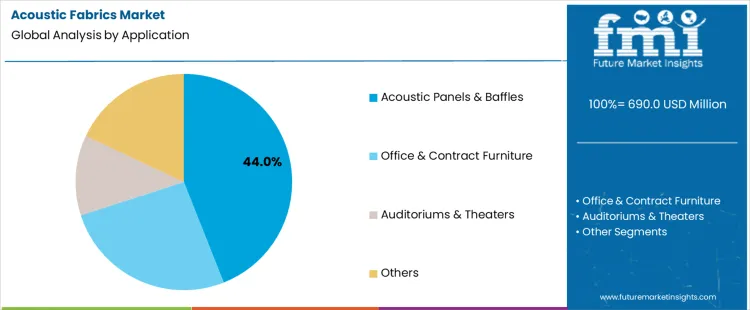
Acoustic panels and baffles hold 44.0%, representing the largest share among applications due to primary absorption function. These systems rely on fabric coverings to protect absorptive cores while allowing sound penetration. Large surface coverage increases fabric consumption per installation. Modular panel designs enable scalable acoustic treatment across interiors. Office and contract furniture integrate fabrics for localized absorption. Auditoriums and theaters require specialized fabrics with performance tuning. Application segmentation reflects concentration where dedicated acoustic elements drive the highest fabric usage.
Key Points
- Panels and baffles require acoustically transparent fabrics.
- Large coverage areas increase material usage.
- Other applications integrate fabrics into furniture or venues.
Which End Use Drives the Largest Share of Demand?
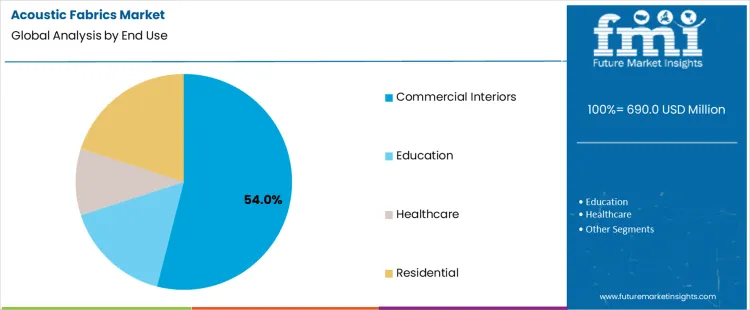
Commercial interiors hold 54.0%, representing the largest share among end-use settings due to workspace density. Offices, hospitality venues, and shared environments require controlled acoustics to support communication. Open layouts increase reverberation challenges addressed through fabric-covered absorbers. Compliance with workplace comfort standards reinforces adoption. Residential use follows with selective deployment. Education and healthcare apply fabrics for clarity and comfort. End-use segmentation reflects dominance where occupancy levels and functional communication needs sustain consistent acoustic fabric utilization.
Key Points
- Commercial interiors face high reverberation demands.
- Communication clarity drives acoustic fabric adoption.
- Other sectors apply fabrics for learning or care environments.
What are the Key Dynamics in the Acoustic Fabrics Market?
Demand for acoustic fabrics reflects surface sound absorption and aesthetic integration requirements in interior acoustic treatments. Adoption concentrates in offices, auditoriums, studios, hospitality interiors, healthcare facilities, and educational buildings. Global scope aligns with interior noise control and design coordination needs. Usage centers on porous textile materials engineered to allow sound penetration toward absorptive backings while maintaining visual finish and durability.
How do interior acoustic performance and design integration requirements shape adoption?
Acoustic fabrics function as facing layers that enable sound waves to reach absorptive substrates without reflection. Demand increases where wall panels, ceiling baffles, and furniture-integrated treatments require visually acceptable finishes. Open-plan offices rely on fabric-covered absorbers to reduce speech reverberation without hard surfaces. Performance depends on airflow resistivity, weave density, and fabric thickness, affecting mid and high frequency absorption. Hospitality and corporate interiors require color, texture, and pattern flexibility to align with branding and design intent. Compatibility with mineral wool, foam, and polyester absorbers supports system integration. Adoption reflects requirement to balance acoustic transparency with interior finish expectations.
How do material durability, compliance requirements, and cost pressure influence market scalability?
Acoustic fabrics must meet fire resistance, smoke development, and emissions standards, increasing material qualification cost. Demand sensitivity rises where budget constraints favor generic textiles with inconsistent acoustic transparency. Durability against abrasion, staining, and UV exposure affects suitability in high-traffic environments. Cleaning and maintenance requirements influence lifecycle cost. Performance consistency varies across dye lots and suppliers, complicating specification control. Custom colors and low-volume runs reduce manufacturing efficiency. Installation tension and backing compatibility affect acoustic outcome. Price competition and project-specific specification constrain scalable, standardized deployment across cost-driven interior construction segments.
How Is Demand for Acoustic Fabrics Evolving Globally?
Demand for acoustic fabrics is expanding globally due to interior noise control requirements, flexible workspace design, and performance-led material specifications. Usage aligns with wall panels, ceiling systems, furniture, and partitions requiring sound absorption with aesthetic integration. Commercial offices, education facilities, hospitality venues, and transport interiors increasingly specify certified acoustic textiles. Retrofit activity rises where existing finishes fail updated reverberation criteria. Growth rates in India at 6.6%, Vietnam at 6.2%, Indonesia at 5.9%, Turkey at 5.5%, and Mexico at 5.1% indicate steady expansion driven by urban construction intensity, interior refurbishment cycles, and compliance with acoustic performance standards rather than decorative textile demand.
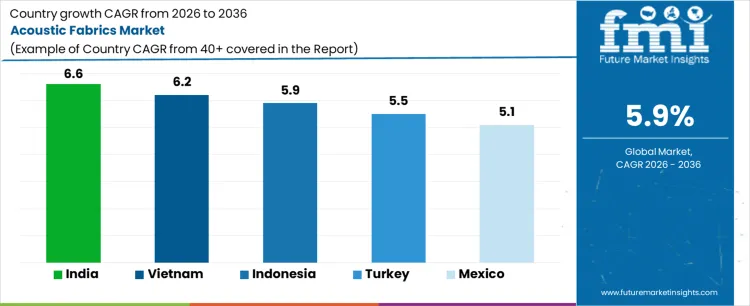
| Country | CAGR (%) |
|---|---|
| India | 6.6% |
| Vietnam | 6.2% |
| Indonesia | 5.9% |
| Turkey | 5.5% |
| Mexico | 5.1% |
What Is Driving Expansion of Acoustic Fabric Demand in India?
Demand for acoustic fabrics in India is growing at a CAGR of 6.6%, supported by dense office environments and institutional interior projects. IT campuses and coworking spaces require fabric-wrapped panels to control reverberation in open layouts. Educational facilities specify acoustic fabrics for classrooms and auditoriums. Healthcare interiors adopt sound-absorbing finishes to improve speech clarity and privacy. Urban retrofit activity increases replacement of hard finishes with absorptive textiles. Domestic manufacturing improves access to certified acoustic fabric ranges. Growth reflects functional interior performance requirements and urban noise exposure rather than fashion-driven textile consumption.
- Open-plan office reverberation control needs
- Education and auditorium acoustic specifications
- Healthcare privacy and speech clarity requirements
- Expansion of certified domestic fabric supply
Why Is Vietnam Seeing Steady Uptake of Acoustic Fabrics?
Acoustic fabric demand in Vietnam is expanding at a CAGR of 6.2%, driven by commercial interiors and hospitality developments. Hotels and serviced apartments specify acoustic fabrics for wall panels and headboards to enhance guest comfort. Office fit-outs adopt fabric finishes for meeting rooms and collaboration areas. Urban redevelopment increases focus on interior acoustic performance. Local converters improve availability of laminated and treated textiles. Growth reflects hospitality and office usage intensity rather than residential luxury textile adoption.
- Hospitality interior sound absorption needs
- Office meeting and collaboration space usage
- Urban redevelopment interior performance focus
- Improved local fabric conversion capability
How Is Indonesia Supporting Growth of Acoustic Fabric Sales?
Sales of acoustic fabrics in Indonesia are growing at a CAGR of 5.9%, shaped by institutional buildings and urban congestion. Universities, airports, and government offices require absorptive finishes to manage echo and crowd noise. High ambient sound levels increase reliance on fabric-based wall and ceiling systems. Educational facilities specify durable, fire-rated textiles. Budget constraints favor standardized fabric solutions with certified absorption values. Growth reflects institutional demand and functional noise management rather than widespread residential application.
- Institutional building noise absorption requirements
- High ambient urban sound conditions
- Education facility fire-rated fabric specifications
- Preference for standardized certified products
What Factors Are Supporting Acoustic Fabric Demand in Turkey?
Acoustic fabric demand in Turkey is expanding at a CAGR of 5.5%, supported by commercial renovation and hospitality refurbishment. Offices undergoing layout reconfiguration adopt fabric-wrapped panels for flexible acoustic zoning. Hotels upgrade interiors to improve guest room and corridor acoustics. Manufacturing capability supports export-oriented acoustic textile production. Retrofit activity sustains replacement demand across existing buildings. Growth reflects refurbishment-led consumption and supplier integration rather than rapid expansion of new commercial construction.
- Office renovation and layout reconfiguration
- Hospitality refurbishment acoustic upgrades
- Export-oriented acoustic textile manufacturing
- Retrofit-driven replacement demand
Why Is Mexico Experiencing Measured Growth in Acoustic Fabrics?
Demand for acoustic fabrics in Mexico is growing at a CAGR of 5.1%, driven by commercial interiors and institutional projects. Corporate offices specify acoustic textiles for meeting rooms and collaborative zones. Educational buildings adopt fabric-based systems for lecture halls. Proximity to manufacturing hubs supports supply of treated textiles. Cost sensitivity encourages use of modular acoustic fabric systems. Growth remains measured, reflecting functional interior requirements and refurbishment cycles rather than expansion of high-end architectural finishes.
- Corporate office meeting space requirements
- Education facility lecture hall applications
- Regional manufacturing and supply availability
- Modular system adoption for cost control
What is the competitive landscape of demand for the acoustic fabrics market globally?
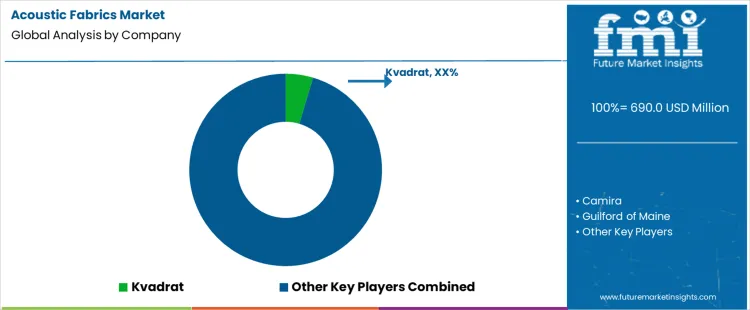
Demand for acoustic fabrics is driven by interior noise control needs across offices, education spaces, transport interiors, and hospitality environments. Buyers evaluate sound absorption contribution, textile density, backing compatibility, fire ratings, cleanability, and long-term color stability. Specification teams assess acoustic performance within panel systems, wall coverings, and furniture integration rather than standalone material properties. Procurement behavior favors suppliers offering tested NRC support data, wide color ranges, and repeatable manufacturing quality. Purchasing decisions emphasize compliance with fire and indoor air standards, durability under heavy use, and alignment with interior design intent. Trend in the acoustic fabrics market reflects increased use of soft acoustic surfaces supporting hybrid workspaces and public interiors.
Kvadrat leads competitive positioning through design-led acoustic textiles combining measurable sound absorption support with architectural-grade aesthetics. Camira competes through technically engineered fabrics developed specifically for acoustic panels, screens, and upholstery systems. Guilford of Maine supports demand with acoustically transparent textiles widely specified for wrapped panels in commercial interiors. Maharam maintains relevance by supplying high-performance acoustic fabrics balancing absorption compatibility with premium design standards. Carnegie Fabrics participates through performance textiles addressing acoustic backing integration, sustainability requirements, and demanding public space use cases. Competitive differentiation centers on acoustic transparency, fire compliance, durability, and ability to support large-scale interior specifications.
Key Players in the Acoustic Fabrics Market
- Kvadrat
- Camira
- Guilford of Maine
- Maharam
- Carnegie Fabrics
- Autex Acoustics
- Mayer Fabrics
- Ultrafabrics
- Pallas Textiles
Scope of the Report
| Items | Values |
|---|---|
| Quantitative Units | USD million |
| Fabric Type | Polyester or PET Fabrics; Wool Blend Fabrics; Vinyl-Coated or PU Fabrics; Other |
| Application | Acoustic Panels & Baffles; Office & Contract Furniture; Auditoriums & Theaters; Others |
| End Use | Commercial Interiors; Education; Healthcare; Residential |
| Sales Channel | Interior Fit-Out Channels; Fabric Distributors; Direct Manufacturer Sales; Other |
| Regions Covered | Asia Pacific, Europe, North America, Latin America, Middle East & Africa |
| Countries Covered | India, Vietnam, Indonesia, Turkey, Mexico, and 40+ countries |
| Key Companies Profiled | Kvadrat; Camira; Guilford of Maine; Maharam; Carnegie Fabrics; Autex Acoustics; Mayer Fabrics; Ultrafabrics; Pallas Textiles |
| Additional Attributes | Dollar sales by fabric type, application, end use, and sales channel; sound absorption and NRC performance linked to weave density, backing systems, and fiber composition; durability, cleanability, and fire rating compliance for commercial and public interiors; aesthetic customization supporting architectural acoustics; procurement patterns shaped by fit-out contractors, fabric distributors, and direct manufacturer project supply. |
Acoustic Fabrics Market by Segment
Fabric Type:
- Polyester or PET Fabrics
- Wool Blend Fabrics
- Vinyl-Coated or PU Fabrics
- Other
Application:
- Acoustic Panels & Baffles
- Office & Contract Furniture
- Auditoriums & Theaters
- Others
End Use:
- Commercial Interiors
- Education
- Healthcare
- Residential
Sales Channel:
- Interior Fit-Out Channels
- Fabric Distributors
- Direct Manufacturer Sales
- Other
Region:
- Asia Pacific
- China
- Japan
- South Korea
- India
- Australia & New Zealand
- ASEAN
- Rest of Asia Pacific
- Europe
- Germany
- United Kingdom
- France
- Italy
- Spain
- Nordic
- BENELUX
- Rest of Europe
- North America
- United States
- Canada
- Mexico
- Latin America
- Brazil
- Chile
- Rest of Latin America
- Middle East & Africa
- Kingdom of Saudi Arabia
- Other GCC Countries
- Turkey
- South Africa
- Other African Union
- Rest of Middle East & Africa
Bibliography
- International Organization for Standardization. (2024). Acoustics-Rating of sound absorption-Application to interior finishes and surface treatments (ISO 11654:2024, revised edition). ISO.
- European Committee for Standardization. (2023). Acoustics-Measurement of sound absorption of building elements-Textile and fabric-covered absorbers (EN ISO 354:2023). CEN.
- European Committee for Standardization. (2024). Fire classification of construction products and building elements-Textile wall and ceiling finishes (EN 13501-1:2024). CEN.
- International Organization for Standardization. (2023). Textiles-Determination of flame spread properties of textile products used in interiors (ISO 15025:2023). ISO.
- USA Environmental Protection Agency. (2023). Controlling Pollutants and Sources: Indoor Air Quality Design Tools for Schools - Materials Selection and Acoustic Finishes Guidance.
Frequently Asked Questions
How big is the acoustic fabrics market in 2026?
The global acoustic fabrics market is estimated to be valued at USD 690.0 million in 2026.
What will be the size of acoustic fabrics market in 2036?
The market size for the acoustic fabrics market is projected to reach USD 1,224.1 million by 2036.
How much will be the acoustic fabrics market growth between 2026 and 2036?
The acoustic fabrics market is expected to grow at a 5.9% CAGR between 2026 and 2036.
What are the key product types in the acoustic fabrics market?
The key product types in acoustic fabrics market are polyester or pet fabrics, wool blend fabrics, vinyl-coated or pu fabrics and other.
Which application segment to contribute significant share in the acoustic fabrics market in 2026?
In terms of application, acoustic panels & baffles segment to command 44.0% share in the acoustic fabrics market in 2026.
Preview the report firsthand - request a free sample
Get SampleGet the brochure for pricing and purchase details.
Get PDFTable of Content
- Executive Summary
- Global Market Outlook
- Demand-side Trends
- Supply-side Trends
- Technology Roadmap Analysis
- Analysis and Recommendations
- Market Overview
- Market Coverage / Taxonomy
- Market Definition / Scope / Limitations
- Market Background
- Market Dynamics
- Drivers
- Restraints
- Opportunity
- Trends
- Scenario Forecast
- Demand in Optimistic Scenario
- Demand in Likely Scenario
- Demand in Conservative Scenario
- Opportunity Map Analysis
- Product Life Cycle Analysis
- Supply Chain Analysis
- Investment Feasibility Matrix
- Value Chain Analysis
- PESTLE and Porter’s Analysis
- Regulatory Landscape
- Regional Parent Market Outlook
- Production and Consumption Statistics
- Import and Export Statistics
- Market Dynamics
- Global Market Analysis 2021 to 2025 and Forecast, 2026 to 2036
- Historical Market Size Value (USD Million) Analysis, 2021 to 2025
- Current and Future Market Size Value (USD Million) Projections, 2026 to 2036
- Y-o-Y Growth Trend Analysis
- Absolute $ Opportunity Analysis
- Global Market Pricing Analysis 2021 to 2025 and Forecast 2026 to 2036
- Global Market Analysis 2021 to 2025 and Forecast 2026 to 2036, By Fabric Type
- Introduction / Key Findings
- Historical Market Size Value (USD Million) Analysis By Fabric Type , 2021 to 2025
- Current and Future Market Size Value (USD Million) Analysis and Forecast By Fabric Type , 2026 to 2036
- Polyester or PET Fabrics
- Wool Blend Fabrics
- Vinyl-Coated or PU Fabrics
- Other
- Polyester or PET Fabrics
- Y-o-Y Growth Trend Analysis By Fabric Type , 2021 to 2025
- Absolute $ Opportunity Analysis By Fabric Type , 2026 to 2036
- Global Market Analysis 2021 to 2025 and Forecast 2026 to 2036, By Application
- Introduction / Key Findings
- Historical Market Size Value (USD Million) Analysis By Application, 2021 to 2025
- Current and Future Market Size Value (USD Million) Analysis and Forecast By Application, 2026 to 2036
- Acoustic Panels & Baffles
- Office & Contract Furniture
- Auditoriums & Theaters
- Others
- Acoustic Panels & Baffles
- Y-o-Y Growth Trend Analysis By Application, 2021 to 2025
- Absolute $ Opportunity Analysis By Application, 2026 to 2036
- Global Market Analysis 2021 to 2025 and Forecast 2026 to 2036, By End Use
- Introduction / Key Findings
- Historical Market Size Value (USD Million) Analysis By End Use, 2021 to 2025
- Current and Future Market Size Value (USD Million) Analysis and Forecast By End Use, 2026 to 2036
- Commercial Interiors
- Education
- Healthcare
- Residential
- Commercial Interiors
- Y-o-Y Growth Trend Analysis By End Use, 2021 to 2025
- Absolute $ Opportunity Analysis By End Use, 2026 to 2036
- Global Market Analysis 2021 to 2025 and Forecast 2026 to 2036, By Sales Channel
- Introduction / Key Findings
- Historical Market Size Value (USD Million) Analysis By Sales Channel, 2021 to 2025
- Current and Future Market Size Value (USD Million) Analysis and Forecast By Sales Channel, 2026 to 2036
- Interior Fit-Out Channels
- Fabric Distributors
- Direct Manufacturer Sales
- Other
- Interior Fit-Out Channels
- Y-o-Y Growth Trend Analysis By Sales Channel, 2021 to 2025
- Absolute $ Opportunity Analysis By Sales Channel, 2026 to 2036
- Global Market Analysis 2021 to 2025 and Forecast 2026 to 2036, By Region
- Introduction
- Historical Market Size Value (USD Million) Analysis By Region, 2021 to 2025
- Current Market Size Value (USD Million) Analysis and Forecast By Region, 2026 to 2036
- North America
- Latin America
- Western Europe
- Eastern Europe
- East Asia
- South Asia and Pacific
- Middle East & Africa
- Market Attractiveness Analysis By Region
- North America Market Analysis 2021 to 2025 and Forecast 2026 to 2036, By Country
- Historical Market Size Value (USD Million) Trend Analysis By Market Taxonomy, 2021 to 2025
- Market Size Value (USD Million) Forecast By Market Taxonomy, 2026 to 2036
- By Country
- USA
- Canada
- Mexico
- By Fabric Type
- By Application
- By End Use
- By Sales Channel
- By Country
- Market Attractiveness Analysis
- By Country
- By Fabric Type
- By Application
- By End Use
- By Sales Channel
- Key Takeaways
- Latin America Market Analysis 2021 to 2025 and Forecast 2026 to 2036, By Country
- Historical Market Size Value (USD Million) Trend Analysis By Market Taxonomy, 2021 to 2025
- Market Size Value (USD Million) Forecast By Market Taxonomy, 2026 to 2036
- By Country
- Brazil
- Chile
- Rest of Latin America
- By Fabric Type
- By Application
- By End Use
- By Sales Channel
- By Country
- Market Attractiveness Analysis
- By Country
- By Fabric Type
- By Application
- By End Use
- By Sales Channel
- Key Takeaways
- Western Europe Market Analysis 2021 to 2025 and Forecast 2026 to 2036, By Country
- Historical Market Size Value (USD Million) Trend Analysis By Market Taxonomy, 2021 to 2025
- Market Size Value (USD Million) Forecast By Market Taxonomy, 2026 to 2036
- By Country
- Germany
- UK
- Italy
- Spain
- France
- Nordic
- BENELUX
- Rest of Western Europe
- By Fabric Type
- By Application
- By End Use
- By Sales Channel
- By Country
- Market Attractiveness Analysis
- By Country
- By Fabric Type
- By Application
- By End Use
- By Sales Channel
- Key Takeaways
- Eastern Europe Market Analysis 2021 to 2025 and Forecast 2026 to 2036, By Country
- Historical Market Size Value (USD Million) Trend Analysis By Market Taxonomy, 2021 to 2025
- Market Size Value (USD Million) Forecast By Market Taxonomy, 2026 to 2036
- By Country
- Russia
- Poland
- Hungary
- Balkan & Baltic
- Rest of Eastern Europe
- By Fabric Type
- By Application
- By End Use
- By Sales Channel
- By Country
- Market Attractiveness Analysis
- By Country
- By Fabric Type
- By Application
- By End Use
- By Sales Channel
- Key Takeaways
- East Asia Market Analysis 2021 to 2025 and Forecast 2026 to 2036, By Country
- Historical Market Size Value (USD Million) Trend Analysis By Market Taxonomy, 2021 to 2025
- Market Size Value (USD Million) Forecast By Market Taxonomy, 2026 to 2036
- By Country
- China
- Japan
- South Korea
- By Fabric Type
- By Application
- By End Use
- By Sales Channel
- By Country
- Market Attractiveness Analysis
- By Country
- By Fabric Type
- By Application
- By End Use
- By Sales Channel
- Key Takeaways
- South Asia and Pacific Market Analysis 2021 to 2025 and Forecast 2026 to 2036, By Country
- Historical Market Size Value (USD Million) Trend Analysis By Market Taxonomy, 2021 to 2025
- Market Size Value (USD Million) Forecast By Market Taxonomy, 2026 to 2036
- By Country
- India
- ASEAN
- Australia & New Zealand
- Rest of South Asia and Pacific
- By Fabric Type
- By Application
- By End Use
- By Sales Channel
- By Country
- Market Attractiveness Analysis
- By Country
- By Fabric Type
- By Application
- By End Use
- By Sales Channel
- Key Takeaways
- Middle East & Africa Market Analysis 2021 to 2025 and Forecast 2026 to 2036, By Country
- Historical Market Size Value (USD Million) Trend Analysis By Market Taxonomy, 2021 to 2025
- Market Size Value (USD Million) Forecast By Market Taxonomy, 2026 to 2036
- By Country
- Kingdom of Saudi Arabia
- Other GCC Countries
- Turkiye
- South Africa
- Other African Union
- Rest of Middle East & Africa
- By Fabric Type
- By Application
- By End Use
- By Sales Channel
- By Country
- Market Attractiveness Analysis
- By Country
- By Fabric Type
- By Application
- By End Use
- By Sales Channel
- Key Takeaways
- Key Countries Market Analysis
- USA
- Pricing Analysis
- Market Share Analysis, 2025
- By Fabric Type
- By Application
- By End Use
- By Sales Channel
- Canada
- Pricing Analysis
- Market Share Analysis, 2025
- By Fabric Type
- By Application
- By End Use
- By Sales Channel
- Mexico
- Pricing Analysis
- Market Share Analysis, 2025
- By Fabric Type
- By Application
- By End Use
- By Sales Channel
- Brazil
- Pricing Analysis
- Market Share Analysis, 2025
- By Fabric Type
- By Application
- By End Use
- By Sales Channel
- Chile
- Pricing Analysis
- Market Share Analysis, 2025
- By Fabric Type
- By Application
- By End Use
- By Sales Channel
- Germany
- Pricing Analysis
- Market Share Analysis, 2025
- By Fabric Type
- By Application
- By End Use
- By Sales Channel
- UK
- Pricing Analysis
- Market Share Analysis, 2025
- By Fabric Type
- By Application
- By End Use
- By Sales Channel
- Italy
- Pricing Analysis
- Market Share Analysis, 2025
- By Fabric Type
- By Application
- By End Use
- By Sales Channel
- Spain
- Pricing Analysis
- Market Share Analysis, 2025
- By Fabric Type
- By Application
- By End Use
- By Sales Channel
- France
- Pricing Analysis
- Market Share Analysis, 2025
- By Fabric Type
- By Application
- By End Use
- By Sales Channel
- India
- Pricing Analysis
- Market Share Analysis, 2025
- By Fabric Type
- By Application
- By End Use
- By Sales Channel
- ASEAN
- Pricing Analysis
- Market Share Analysis, 2025
- By Fabric Type
- By Application
- By End Use
- By Sales Channel
- Australia & New Zealand
- Pricing Analysis
- Market Share Analysis, 2025
- By Fabric Type
- By Application
- By End Use
- By Sales Channel
- China
- Pricing Analysis
- Market Share Analysis, 2025
- By Fabric Type
- By Application
- By End Use
- By Sales Channel
- Japan
- Pricing Analysis
- Market Share Analysis, 2025
- By Fabric Type
- By Application
- By End Use
- By Sales Channel
- South Korea
- Pricing Analysis
- Market Share Analysis, 2025
- By Fabric Type
- By Application
- By End Use
- By Sales Channel
- Russia
- Pricing Analysis
- Market Share Analysis, 2025
- By Fabric Type
- By Application
- By End Use
- By Sales Channel
- Poland
- Pricing Analysis
- Market Share Analysis, 2025
- By Fabric Type
- By Application
- By End Use
- By Sales Channel
- Hungary
- Pricing Analysis
- Market Share Analysis, 2025
- By Fabric Type
- By Application
- By End Use
- By Sales Channel
- Kingdom of Saudi Arabia
- Pricing Analysis
- Market Share Analysis, 2025
- By Fabric Type
- By Application
- By End Use
- By Sales Channel
- Turkiye
- Pricing Analysis
- Market Share Analysis, 2025
- By Fabric Type
- By Application
- By End Use
- By Sales Channel
- South Africa
- Pricing Analysis
- Market Share Analysis, 2025
- By Fabric Type
- By Application
- By End Use
- By Sales Channel
- USA
- Market Structure Analysis
- Competition Dashboard
- Competition Benchmarking
- Market Share Analysis of Top Players
- By Regional
- By Fabric Type
- By Application
- By End Use
- By Sales Channel
- Competition Analysis
- Competition Deep Dive
- Kvadrat
- Overview
- Product Portfolio
- Profitability by Market Segments (Product/Age /Sales Channel/Region)
- Sales Footprint
- Strategy Overview
- Marketing Strategy
- Product Strategy
- Channel Strategy
- Camira
- Guilford of Maine
- Maharam
- Carnegie Fabrics
- Autex Acoustics
- Mayer Fabrics
- Ultrafabrics
- Pallas Textiles
- Kvadrat
- Competition Deep Dive
- Assumptions & Acronyms Used
- Research Methodology


