

- Industry Size (2026)
- USD 980.0 Mn
- Forecast (2036)
- USD 1755.0 Mn
- CAGR (2026 to 2036)
- 6.0%
Acoustic Doors Market Forecast and Outlook 2026 to 2036
The acoustic doors market is set to reach USD 1,755.0 million by 2036, rising from a valuation of USD 980.0 million in 2026, and at a CAGR of 6.0%. Growth trajectory reflects structural changes in building design rather than short-term construction cycles. Demand is anchored in environments where sound control directly affects functionality, compliance, or operational efficiency, including offices, hospitals, educational campuses, hospitality venues, and public infrastructure. Specification decisions are influenced by sound transmission class requirements, integration with fire-rated assemblies, and compatibility with accessibility standards. Spending remains concentrated in commercial and institutional projects where acoustic performance is mandated during design approval, rather than treated as an optional upgrade. Adoption intensity varies across regions depending on enforcement of noise regulations, urban density, and prevalence of mixed-use developments where acoustic zoning becomes unavoidable.
Quick Stats for Acoustic Doors Market
- Acoustic Doors Market Value (2026): USD 980.0 million
- Acoustic Doors Market Forecast Value (2036): USD 1,755.0 million
- Acoustic Doors Market Forecast CAGR 2026 to 2036: 6.0%
- Leading Door Type by Demand Share: Single-Leaf Acoustic Doors
- Fastest-Growing Countries: India, Vietnam, Indonesia, Saudi Arabia, UAE
- Top Players in Global Demand: ASSA ABLOY, dormakaba, Allegion, Hörmann, JELD-WEN
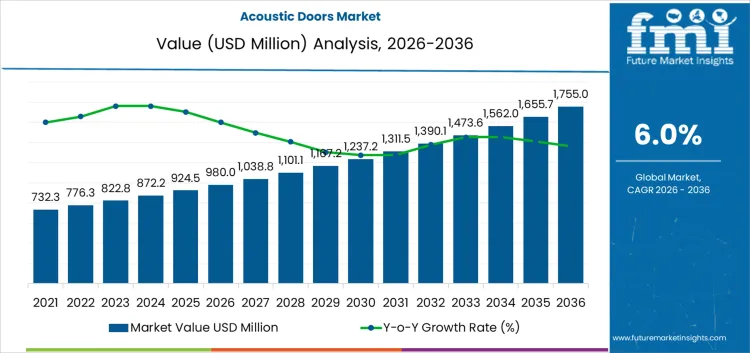
Across the forecast period, expansion patterns are expected to remain closely tied to regulatory frameworks, project-based procurement, and professional specification behavior. Markets with strict building codes, healthcare privacy requirements, or education infrastructure investment show faster uptake than regions driven mainly by discretionary interior refurbishment. Performance verification, installation accuracy, and long-term seal durability influence repeat demand, as post-installation remediation costs remain high for underperforming assemblies. Manufacturers able to deliver certified ratings with consistent manufacturing tolerances retain specification preference over low-cost alternatives. Distribution depends more on contractor networks, architects, and acoustic consultants than on retail channels. The growth reflects compliance-driven adoption and functional necessity, not uniform acceptance across all construction segments or price tiers.
Acoustic Doors Market Key Takeaways
| Metric | Value |
|---|---|
| Market Value (2026) | USD 980.0 million |
| Market Forecast Value (2036) | USD 1,755.0 million |
| Forecast CAGR 2026 to 2036 | 6.0% |
Why is the Demand for Acoustic Doors Growing?
Demand for acoustic doors is increasing as commercial, institutional, and industrial facilities prioritize sound isolation to enhance occupant comfort and operational performance. Acoustic doors are specified in environments where noise control affects productivity, health, and safety, including recording studios, auditoriums, corporate offices, hospitals, and manufacturing plants with high ambient noise levels. Design professionals evaluate sound transmission class (STC) ratings, door core materials, seal integrity, and frame robustness to ensure performance targets are met for specific acoustic profiles.
Procurement teams focus on compliance with building codes and acoustic standards, resistance to wear from frequent use, and integration with fire safety and accessibility requirements because doors must maintain both environmental separation and regulatory conformity. Growth in demand for flexible workspaces and activity-based zoning within buildings reinforces need for solutions that deliver predictable noise attenuation between spaces without compromising structural or aesthetic goals.
Expansion of mixed-use developments, health care facilities, and educational campuses further reinforces uptake of acoustic doors as designers seek to manage sound spill between adjacent functional zones. Facility planners coordinate selection with HVAC and wall assembly decisions because comprehensive acoustic strategies require synergy between doors and surrounding construction elements. Advances in sealing technologies and engineered core materials improve performance under variable conditions while maintaining operational durability. Installation contractors and building owners maintain inventories of certified products that match project specifications to support on-time delivery and reduce risk of post-installation modifications. These application-specific acoustic performance and integration considerations are contributing to sustained demand growth in the acoustic doors market.
How Are the Segments Classified in the Acoustic Doors Market?
Demand for acoustic doors is shaped by noise control requirements, building regulation compliance, and occupant comfort expectations. Facilities deploy these doors to limit sound transmission between functional spaces with differing noise sensitivity. Adoption aligns with expansion of commercial developments, healthcare infrastructure, and mixed-use buildings requiring acoustic zoning. Product selection prioritizes sound attenuation capability, door configuration suitability, and installation compatibility. Segment classification reflects differentiation by door construction type, application environment, and acoustic performance rating influencing deployment density, specification rigor, and lifecycle performance expectations.
Which Door Type Represents the Largest Share of Demand?
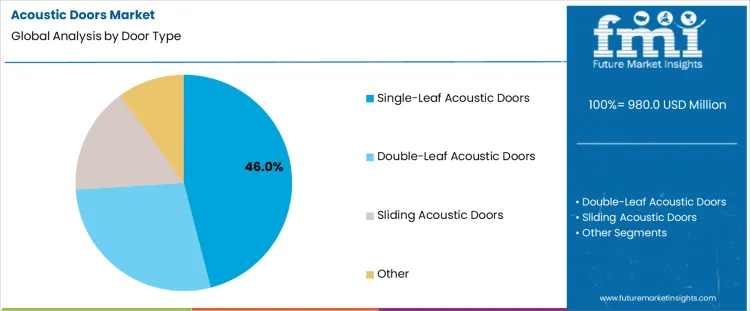
Single-leaf acoustic doors hold 46.0%, representing the largest share among door types due to installation simplicity. Single-panel configurations fit standard door openings without structural modification. Consistent sealing performance supports effective sound attenuation for typical room sizes. Hardware integration remains straightforward, supporting reliable long-term operation. Double-leaf acoustic doors address wider openings with higher installation complexity. Sliding acoustic doors support space-saving requirements with specialized sealing systems. Door type segmentation reflects preference for solutions balancing acoustic performance, ease of installation, and compatibility with conventional building layouts.
Key Points
- Single-leaf doors suit standard architectural openings.
- Installation simplicity supports broad application.
- Other types address wider openings or space constraints.
Which Application Accounts for the Highest Share of Demand?
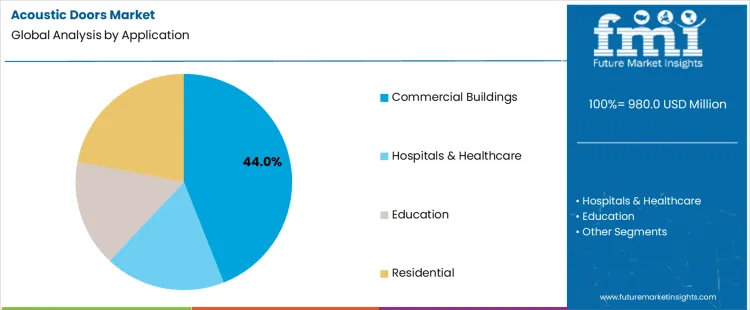
Commercial buildings hold 44.0%, representing the largest share among application areas due to space usage diversity. Offices, conference rooms, and studios require separation between quiet and active zones. Acoustic doors support productivity and privacy across shared environments. Compliance with workplace noise standards reinforces deployment. Residential applications follow with growing focus on home offices and urban noise control. Healthcare settings require acoustic separation for patient care. Education facilities apply doors for classrooms and examination areas. Application segmentation reflects concentration where multifunctional spaces demand consistent sound management solutions.
Key Points
- Commercial spaces require separation of varied noise environments.
- Productivity and privacy drive acoustic control needs.
- Other sectors apply doors for patient, learning, or residential comfort.
Which Performance Rating Drives the Largest Share of Demand?
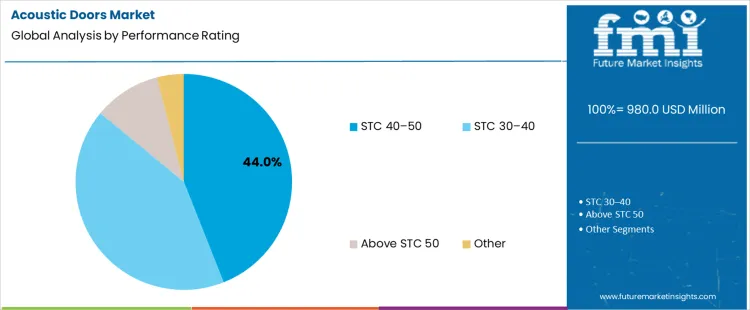
STC 40-50 holds 44.0%, representing the largest share among performance ratings due to balanced attenuation capability. This range meets common building code and functional noise control requirements. Doors in this category provide effective reduction of speech and office noise. Cost and thickness remain manageable for standard installations. STC 30-40 addresses moderate noise separation with lower material requirements. Ratings above STC 50 serve specialized studios and testing rooms. Performance segmentation reflects preference for practical attenuation levels suitable for most commercial and residential environments.
Key Points
- STC 40-50 meets common noise control requirements.
- Balanced performance supports standard installations.
- Other ratings address moderate or specialized acoustic needs.
What are the Key Dynamics in the Acoustic Doors Market?
Demand for acoustic doors reflects sound isolation requirements in buildings where noise control affects functionality, compliance, or occupant comfort. Adoption concentrates in commercial buildings, recording studios, hospitals, hotels, educational facilities, and industrial environments. Global scope aligns with building acoustics standards and interior noise management needs. Usage centers on engineered door assemblies incorporating dense cores, perimeter seals, and threshold systems to achieve specified sound transmission class ratings.
How do noise control requirements and building function shape adoption?
Different building functions impose distinct acoustic performance thresholds. Demand increases where speech privacy, concentration, or equipment noise containment is critical. Hospitals require acoustic doors to limit sound transfer between patient rooms and corridors. Educational facilities adopt doors to reduce cross-room interference during instruction. Hotels rely on acoustic separation to maintain guest comfort in high-occupancy layouts. Studios and broadcast facilities require high-performance doors to isolate recording spaces from ambient noise. Industrial control rooms use acoustic doors to protect operators from machinery noise. Integration with fire-rated and access-controlled door systems influences specification. Adoption reflects functional necessity tied to interior sound management rather than architectural preference.
How do installation complexity, performance verification, and cost pressure influence market scalability?
Acoustic door performance depends on complete system integrity, including frames, seals, and installation accuracy. Demand sensitivity rises where improper installation undermines rated sound reduction. High-performance doors require heavier cores and precision sealing, increasing material and handling cost. Space constraints affect door thickness and swing clearance in retrofit projects. Verification through acoustic testing adds project expense and scheduling complexity. Wear of seals reduces long-term performance, increasing maintenance requirements. Fire and accessibility code compliance narrows design options. Custom sizing and rating requirements limit standardization, constraining scalable deployment across cost-driven construction projects.
How Is Demand for Acoustic Doors Evolving Globally?
Demand for acoustic doors is expanding globally due to stricter noise control standards, urban density, and functional zoning within buildings. Commercial offices, healthcare facilities, hospitality venues, and educational institutions specify acoustic doors to manage sound transmission between occupied spaces. Retrofit activity increases where legacy openings fail updated acoustic performance criteria. Material selection and certified ratings influence procurement decisions. Growth rates in India at 7.8%, Vietnam at 7.2%, Indonesia at 6.9%, Saudi Arabia at 6.4%, and UAE at 6.1% indicate sustained expansion driven by urban construction intensity, regulatory compliance, and building performance optimization rather than decorative interior upgrades.
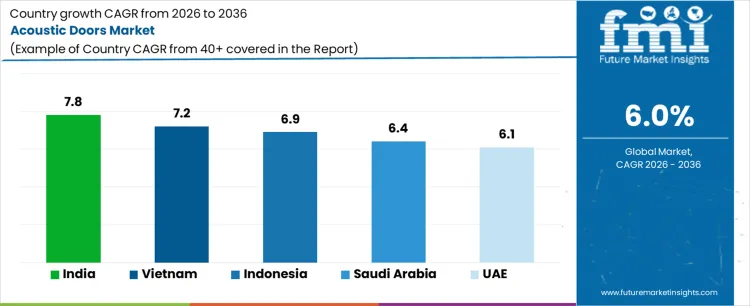
| Country | CAGR (%) |
|---|---|
| India | 7.8% |
| Vietnam | 7.2% |
| Indonesia | 6.9% |
| Saudi Arabia | 6.4% |
| UAE | 6.1% |
What Is Driving Strong Expansion of Acoustic Door Demand in India?
Demand for acoustic doors in India is growing at a CAGR of 7.8%, supported by commercial construction and heightened noise management requirements. IT offices, hospitals, and mixed-use developments require sound isolation between functional zones. Urban density elevates ambient noise exposure, increasing specification of rated door assemblies. Educational institutions adopt acoustic doors for classrooms and examination areas. Retrofit demand emerges from compliance audits and tenant fit-outs. Growth reflects performance-driven building specifications and regulatory enforcement rather than premium interior customization.
- Expansion of IT offices and healthcare facilities
- High urban noise exposure driving acoustic control
- Institutional adoption in education buildings
- Retrofit activity from compliance-driven audits
Why Is Vietnam Experiencing Rapid Growth in Acoustic Door Adoption?
Acoustic door demand in Vietnam is expanding at a CAGR of 7.2%, driven by commercial real estate development and hospitality projects. Hotels and serviced apartments require sound separation for guest comfort. Office buildings specify acoustic doors to support flexible workspace layouts. Urban redevelopment increases focus on building performance standards. Local manufacturers expand availability of rated door systems. Growth reflects commercial usage intensity and hospitality-driven requirements rather than residential luxury demand.
- Hospitality and serviced apartment construction
- Flexible office layout sound separation needs
- Urban redevelopment performance standards
- Improved local supply of rated door systems
How Is Indonesia Supporting Growth of Acoustic Door Sales?
Sales of acoustic doors in Indonesia are growing at a CAGR of 6.9%, shaped by urban infrastructure projects and institutional buildings. Airports, hospitals, and government offices require controlled acoustic environments. High ambient noise levels in cities increase demand for sound-rated openings. Educational facilities adopt acoustic doors for lecture halls and testing rooms. Budget sensitivity favors standardized acoustic ratings. Growth reflects institutional construction and functional requirements rather than widespread residential adoption.
- Institutional buildings requiring noise control
- High ambient urban noise levels
- Education facility acoustic specifications
- Preference for standardized rated products
What Factors Are Supporting Acoustic Door Demand in Saudi Arabia?
Acoustic door demand in Saudi Arabia is expanding at a CAGR of 6.4%, supported by commercial complexes and public infrastructure projects. Government buildings and healthcare facilities specify acoustic performance for privacy and functionality. Hospitality developments emphasize guest comfort through sound isolation. Large-scale construction programs integrate acoustic compliance at design stage. Climate-controlled interiors increase focus on enclosed acoustic performance. Growth reflects institutional and hospitality requirements rather than retrofit-led residential demand.
- Public infrastructure and government buildings
- Healthcare facility privacy requirements
- Hospitality sector sound isolation needs
- Design-stage acoustic compliance integration
Why Is the UAE Showing Steady Growth in Acoustic Door Demand?
Demand for acoustic doors in United Arab Emirates is growing at a CAGR of 6.1%, driven by premium commercial buildings and hospitality standards. Offices, hotels, and conference facilities require controlled sound environments. Mixed-use developments prioritize acoustic zoning across functions. Regulatory emphasis on building quality supports rated door adoption. Retrofit demand arises from tenant upgrades and refurbishments. Growth remains steady, reflecting quality-driven specifications and service-oriented construction rather than rapid expansion of building volume.
- Premium commercial and hospitality standards
- Mixed-use development acoustic zoning
- Building quality and compliance emphasis
- Tenant-led refurbishment and upgrades
What is the competitive landscape of demand for the acoustic doors market globally?
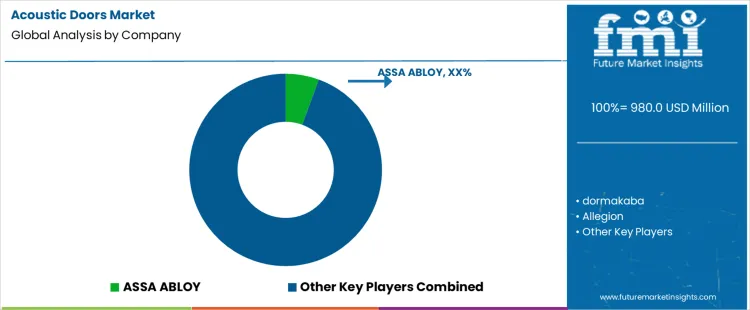
Demand for acoustic doors is driven by stricter building noise regulations, urban densification, and sound control needs in commercial buildings. Buyers evaluate acoustic rating performance, door leaf construction, sealing systems, fire resistance compatibility, durability, and architectural integration. Procurement behavior favors suppliers offering certified sound insulation values, consistent manufacturing tolerances, and compliance with regional building codes. Purchasing decisions emphasize lifecycle durability, installation accuracy, customization capability, and availability across project timelines. Trend in the acoustic doors market reflects rising use in healthcare, education, hospitality, and data centers where controlled sound environments directly affect functionality and occupant comfort.
ASSA ABLOY leads competitive positioning through a broad portfolio of certified acoustic door systems serving commercial, institutional, and industrial projects globally. dormakaba supports demand with integrated door solutions combining access control, fire safety, and acoustic performance for complex buildings. Allegion competes through specification-driven acoustic door offerings aligned with healthcare, education, and office infrastructure requirements. Hörmann maintains relevance by supplying engineered acoustic doors emphasizing precision construction and high sound reduction ratings. JELD-WEN participates through architectural door solutions addressing mid-range acoustic performance needs across commercial and residential developments. Competitive differentiation centers on verified acoustic ratings, compliance breadth, project support capability, and manufacturing consistency.
Key Players in the Acoustic Doors Market
- ASSA ABLOY
- dormakaba
- Allegion
- Hörmann
- JELD-WEN
- Masonite
- Schüco
- Howden Joinery
Scope of the Report
| Items | Values |
|---|---|
| Quantitative Units | USD million |
| Door Type | Single-Leaf Acoustic Doors; Double-Leaf Acoustic Doors; Sliding Acoustic Doors; Other |
| Application | Commercial Buildings; Hospitals & Healthcare; Education; Residential |
| Performance Rating | STC 40-50; STC 30-40; Above STC 50; Other |
| Sales Channel | Specialist Contractors; Direct Manufacturer Sales; Building Distributors; Other |
| Regions Covered | Asia Pacific, Europe, North America, Latin America, Middle East & Africa |
| Countries Covered | India, Vietnam, Indonesia, Saudi Arabia, UAE, and 40+ countries |
| Key Companies Profiled | ASSA ABLOY; dormakaba; Allegion; Hörmann; JELD-WEN; Masonite; Schüco; Howden Joinery |
| Additional Attributes | Dollar sales by door type, application, performance rating, and sales channel; acoustic attenuation effectiveness and sealing integrity across single, double, and sliding configurations; material composition and core construction influencing STC performance ranges; fire rating and code compliance for healthcare, education, and commercial installations; installation complexity and lead times via specialist contractors; procurement patterns spanning direct manufacturer supply and distributor-led projects. |
Acoustic Doors Market by Segment
Door Type:
- Single-Leaf Acoustic Doors
- Double-Leaf Acoustic Doors
- Sliding Acoustic Doors
- Other
Application:
- Commercial Buildings
- Hospitals & Healthcare
- Education
- Residential
Performance Rating:
- STC 40-50
- STC 30-40
- Above STC 50
- Other
Sales Channel:
- Specialist Contractors
- Direct Manufacturer Sales
- Building Distributors
- Other
Region:
- Asia Pacific
- China
- Japan
- South Korea
- India
- Australia & New Zealand
- ASEAN
- Rest of Asia Pacific
- Europe
- Germany
- United Kingdom
- France
- Italy
- Spain
- Nordic
- BENELUX
- Rest of Europe
- North America
- United States
- Canada
- Mexico
- Latin America
- Brazil
- Chile
- Rest of Latin America
- Middle East & Africa
- Kingdom of Saudi Arabia
- Other GCC Countries
- Turkey
- South Africa
- Other African Union
- Rest of Middle East & Africa
Bibliography
- International Organization for Standardization. (2023). Acoustics—Measurement of sound insulation in buildings and of building elements—Part 3: Laboratory measurements of airborne sound insulation of building elements (ISO 10140-3:2023). ISO.
- International Organization for Standardization. (2024). Acoustics—Rating of sound insulation in buildings and of building elements—Part 1: Airborne sound insulation (ISO 717-1:2024). ISO.
- ASTM International. (2024). Standard test method for laboratory measurement of airborne sound transmission loss of building partitions and elements (ASTM E90-24). ASTM International.
Frequently Asked Questions
How big is the acoustic doors market in 2026?
The global acoustic doors market is estimated to be valued at USD 980.0 million in 2026.
What will be the size of acoustic doors market in 2036?
The market size for the acoustic doors market is projected to reach USD 1,755.0 million by 2036.
How much will be the acoustic doors market growth between 2026 and 2036?
The acoustic doors market is expected to grow at a 6.0% CAGR between 2026 and 2036.
What are the key product types in the acoustic doors market?
The key product types in acoustic doors market are single-leaf acoustic doors, double-leaf acoustic doors, sliding acoustic doors and other.
Which application segment to contribute significant share in the acoustic doors market in 2026?
In terms of application, commercial buildings segment to command 44.0% share in the acoustic doors market in 2026.
Preview the report firsthand - request a free sample
Get SampleGet the brochure for pricing and purchase details.
Get PDFTable of Content
- Executive Summary
- Global Market Outlook
- Demand-side Trends
- Supply-side Trends
- Technology Roadmap Analysis
- Analysis and Recommendations
- Market Overview
- Market Coverage / Taxonomy
- Market Definition / Scope / Limitations
- Market Background
- Market Dynamics
- Drivers
- Restraints
- Opportunity
- Trends
- Scenario Forecast
- Demand in Optimistic Scenario
- Demand in Likely Scenario
- Demand in Conservative Scenario
- Opportunity Map Analysis
- Product Life Cycle Analysis
- Supply Chain Analysis
- Investment Feasibility Matrix
- Value Chain Analysis
- PESTLE and Porter’s Analysis
- Regulatory Landscape
- Regional Parent Market Outlook
- Production and Consumption Statistics
- Import and Export Statistics
- Market Dynamics
- Global Market Analysis 2021 to 2025 and Forecast, 2026 to 2036
- Historical Market Size Value (USD Million) Analysis, 2021 to 2025
- Current and Future Market Size Value (USD Million) Projections, 2026 to 2036
- Y-o-Y Growth Trend Analysis
- Absolute $ Opportunity Analysis
- Global Market Pricing Analysis 2021 to 2025 and Forecast 2026 to 2036
- Global Market Analysis 2021 to 2025 and Forecast 2026 to 2036, By Door Type
- Introduction / Key Findings
- Historical Market Size Value (USD Million) Analysis By Door Type , 2021 to 2025
- Current and Future Market Size Value (USD Million) Analysis and Forecast By Door Type , 2026 to 2036
- Single-Leaf Acoustic Doors
- Double-Leaf Acoustic Doors
- Sliding Acoustic Doors
- Other
- Single-Leaf Acoustic Doors
- Y-o-Y Growth Trend Analysis By Door Type , 2021 to 2025
- Absolute $ Opportunity Analysis By Door Type , 2026 to 2036
- Global Market Analysis 2021 to 2025 and Forecast 2026 to 2036, By Application
- Introduction / Key Findings
- Historical Market Size Value (USD Million) Analysis By Application, 2021 to 2025
- Current and Future Market Size Value (USD Million) Analysis and Forecast By Application, 2026 to 2036
- Commercial Buildings
- Hospitals & Healthcare
- Education
- Residential
- Commercial Buildings
- Y-o-Y Growth Trend Analysis By Application, 2021 to 2025
- Absolute $ Opportunity Analysis By Application, 2026 to 2036
- Global Market Analysis 2021 to 2025 and Forecast 2026 to 2036, By Performance Rating
- Introduction / Key Findings
- Historical Market Size Value (USD Million) Analysis By Performance Rating, 2021 to 2025
- Current and Future Market Size Value (USD Million) Analysis and Forecast By Performance Rating, 2026 to 2036
- STC 40-50
- STC 30-40
- Above STC 50
- Other
- STC 40-50
- Y-o-Y Growth Trend Analysis By Performance Rating, 2021 to 2025
- Absolute $ Opportunity Analysis By Performance Rating, 2026 to 2036
- Global Market Analysis 2021 to 2025 and Forecast 2026 to 2036, By Sales Channel
- Introduction / Key Findings
- Historical Market Size Value (USD Million) Analysis By Sales Channel, 2021 to 2025
- Current and Future Market Size Value (USD Million) Analysis and Forecast By Sales Channel, 2026 to 2036
- Specialist Contractors
- Direct Manufacturer Sales
- Building Distributors
- Other
- Specialist Contractors
- Y-o-Y Growth Trend Analysis By Sales Channel, 2021 to 2025
- Absolute $ Opportunity Analysis By Sales Channel, 2026 to 2036
- Global Market Analysis 2021 to 2025 and Forecast 2026 to 2036, By Region
- Introduction
- Historical Market Size Value (USD Million) Analysis By Region, 2021 to 2025
- Current Market Size Value (USD Million) Analysis and Forecast By Region, 2026 to 2036
- North America
- Latin America
- Western Europe
- Eastern Europe
- East Asia
- South Asia and Pacific
- Middle East & Africa
- Market Attractiveness Analysis By Region
- North America Market Analysis 2021 to 2025 and Forecast 2026 to 2036, By Country
- Historical Market Size Value (USD Million) Trend Analysis By Market Taxonomy, 2021 to 2025
- Market Size Value (USD Million) Forecast By Market Taxonomy, 2026 to 2036
- By Country
- USA
- Canada
- Mexico
- By Door Type
- By Application
- By Performance Rating
- By Sales Channel
- By Country
- Market Attractiveness Analysis
- By Country
- By Door Type
- By Application
- By Performance Rating
- By Sales Channel
- Key Takeaways
- Latin America Market Analysis 2021 to 2025 and Forecast 2026 to 2036, By Country
- Historical Market Size Value (USD Million) Trend Analysis By Market Taxonomy, 2021 to 2025
- Market Size Value (USD Million) Forecast By Market Taxonomy, 2026 to 2036
- By Country
- Brazil
- Chile
- Rest of Latin America
- By Door Type
- By Application
- By Performance Rating
- By Sales Channel
- By Country
- Market Attractiveness Analysis
- By Country
- By Door Type
- By Application
- By Performance Rating
- By Sales Channel
- Key Takeaways
- Western Europe Market Analysis 2021 to 2025 and Forecast 2026 to 2036, By Country
- Historical Market Size Value (USD Million) Trend Analysis By Market Taxonomy, 2021 to 2025
- Market Size Value (USD Million) Forecast By Market Taxonomy, 2026 to 2036
- By Country
- Germany
- UK
- Italy
- Spain
- France
- Nordic
- BENELUX
- Rest of Western Europe
- By Door Type
- By Application
- By Performance Rating
- By Sales Channel
- By Country
- Market Attractiveness Analysis
- By Country
- By Door Type
- By Application
- By Performance Rating
- By Sales Channel
- Key Takeaways
- Eastern Europe Market Analysis 2021 to 2025 and Forecast 2026 to 2036, By Country
- Historical Market Size Value (USD Million) Trend Analysis By Market Taxonomy, 2021 to 2025
- Market Size Value (USD Million) Forecast By Market Taxonomy, 2026 to 2036
- By Country
- Russia
- Poland
- Hungary
- Balkan & Baltic
- Rest of Eastern Europe
- By Door Type
- By Application
- By Performance Rating
- By Sales Channel
- By Country
- Market Attractiveness Analysis
- By Country
- By Door Type
- By Application
- By Performance Rating
- By Sales Channel
- Key Takeaways
- East Asia Market Analysis 2021 to 2025 and Forecast 2026 to 2036, By Country
- Historical Market Size Value (USD Million) Trend Analysis By Market Taxonomy, 2021 to 2025
- Market Size Value (USD Million) Forecast By Market Taxonomy, 2026 to 2036
- By Country
- China
- Japan
- South Korea
- By Door Type
- By Application
- By Performance Rating
- By Sales Channel
- By Country
- Market Attractiveness Analysis
- By Country
- By Door Type
- By Application
- By Performance Rating
- By Sales Channel
- Key Takeaways
- South Asia and Pacific Market Analysis 2021 to 2025 and Forecast 2026 to 2036, By Country
- Historical Market Size Value (USD Million) Trend Analysis By Market Taxonomy, 2021 to 2025
- Market Size Value (USD Million) Forecast By Market Taxonomy, 2026 to 2036
- By Country
- India
- ASEAN
- Australia & New Zealand
- Rest of South Asia and Pacific
- By Door Type
- By Application
- By Performance Rating
- By Sales Channel
- By Country
- Market Attractiveness Analysis
- By Country
- By Door Type
- By Application
- By Performance Rating
- By Sales Channel
- Key Takeaways
- Middle East & Africa Market Analysis 2021 to 2025 and Forecast 2026 to 2036, By Country
- Historical Market Size Value (USD Million) Trend Analysis By Market Taxonomy, 2021 to 2025
- Market Size Value (USD Million) Forecast By Market Taxonomy, 2026 to 2036
- By Country
- Kingdom of Saudi Arabia
- Other GCC Countries
- Turkiye
- South Africa
- Other African Union
- Rest of Middle East & Africa
- By Door Type
- By Application
- By Performance Rating
- By Sales Channel
- By Country
- Market Attractiveness Analysis
- By Country
- By Door Type
- By Application
- By Performance Rating
- By Sales Channel
- Key Takeaways
- Key Countries Market Analysis
- USA
- Pricing Analysis
- Market Share Analysis, 2025
- By Door Type
- By Application
- By Performance Rating
- By Sales Channel
- Canada
- Pricing Analysis
- Market Share Analysis, 2025
- By Door Type
- By Application
- By Performance Rating
- By Sales Channel
- Mexico
- Pricing Analysis
- Market Share Analysis, 2025
- By Door Type
- By Application
- By Performance Rating
- By Sales Channel
- Brazil
- Pricing Analysis
- Market Share Analysis, 2025
- By Door Type
- By Application
- By Performance Rating
- By Sales Channel
- Chile
- Pricing Analysis
- Market Share Analysis, 2025
- By Door Type
- By Application
- By Performance Rating
- By Sales Channel
- Germany
- Pricing Analysis
- Market Share Analysis, 2025
- By Door Type
- By Application
- By Performance Rating
- By Sales Channel
- UK
- Pricing Analysis
- Market Share Analysis, 2025
- By Door Type
- By Application
- By Performance Rating
- By Sales Channel
- Italy
- Pricing Analysis
- Market Share Analysis, 2025
- By Door Type
- By Application
- By Performance Rating
- By Sales Channel
- Spain
- Pricing Analysis
- Market Share Analysis, 2025
- By Door Type
- By Application
- By Performance Rating
- By Sales Channel
- France
- Pricing Analysis
- Market Share Analysis, 2025
- By Door Type
- By Application
- By Performance Rating
- By Sales Channel
- India
- Pricing Analysis
- Market Share Analysis, 2025
- By Door Type
- By Application
- By Performance Rating
- By Sales Channel
- ASEAN
- Pricing Analysis
- Market Share Analysis, 2025
- By Door Type
- By Application
- By Performance Rating
- By Sales Channel
- Australia & New Zealand
- Pricing Analysis
- Market Share Analysis, 2025
- By Door Type
- By Application
- By Performance Rating
- By Sales Channel
- China
- Pricing Analysis
- Market Share Analysis, 2025
- By Door Type
- By Application
- By Performance Rating
- By Sales Channel
- Japan
- Pricing Analysis
- Market Share Analysis, 2025
- By Door Type
- By Application
- By Performance Rating
- By Sales Channel
- South Korea
- Pricing Analysis
- Market Share Analysis, 2025
- By Door Type
- By Application
- By Performance Rating
- By Sales Channel
- Russia
- Pricing Analysis
- Market Share Analysis, 2025
- By Door Type
- By Application
- By Performance Rating
- By Sales Channel
- Poland
- Pricing Analysis
- Market Share Analysis, 2025
- By Door Type
- By Application
- By Performance Rating
- By Sales Channel
- Hungary
- Pricing Analysis
- Market Share Analysis, 2025
- By Door Type
- By Application
- By Performance Rating
- By Sales Channel
- Kingdom of Saudi Arabia
- Pricing Analysis
- Market Share Analysis, 2025
- By Door Type
- By Application
- By Performance Rating
- By Sales Channel
- Turkiye
- Pricing Analysis
- Market Share Analysis, 2025
- By Door Type
- By Application
- By Performance Rating
- By Sales Channel
- South Africa
- Pricing Analysis
- Market Share Analysis, 2025
- By Door Type
- By Application
- By Performance Rating
- By Sales Channel
- USA
- Market Structure Analysis
- Competition Dashboard
- Competition Benchmarking
- Market Share Analysis of Top Players
- By Regional
- By Door Type
- By Application
- By Performance Rating
- By Sales Channel
- Competition Analysis
- Competition Deep Dive
- ASSA ABLOY
- Overview
- Product Portfolio
- Profitability by Market Segments (Product/Age /Sales Channel/Region)
- Sales Footprint
- Strategy Overview
- Marketing Strategy
- Product Strategy
- Channel Strategy
- dormakaba
- Allegion
- Hörmann
- JELD-WEN
- Masonite
- Schüco
- Howden Joinery
- ASSA ABLOY
- Competition Deep Dive
- Assumptions & Acronyms Used
- Research Methodology


