

- Industry Size (2026)
- USD 0.3 Bn
- Forecast (2036)
- USD 1.2 Bn
- CAGR (2026 to 2036)
- 13.7%
Battery-Integrating Textile Current Collector Yarns Market Forecast and Outlook 2026 to 2036
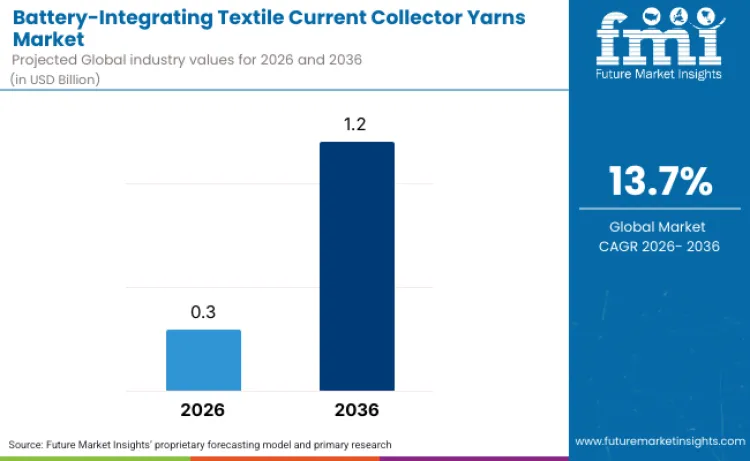
The global battery-integrating textile current collector yarns market is projected to reach USD 0.3 billion in 2026 and expand to USD 1.2 billion by 2036, registering a CAGR of 13.7%. Growth over this period is driven less by experimental garment concepts and more by execution at the materials and compliance level. Two factors dominate adoption decisions, whether current collectors retain conductivity after repeated bending and laundering, and whether textile-integrated battery designs can meet traceability rules originally written for modular battery systems.
This shift toward execution discipline is most visible in defense-linked development programs, where qualification standards mirror field-deployment requirements rather than laboratory demonstrations. leadership commentary from suppliers engaged in USA Army-funded programs highlights how fiber-based battery architectures are moving from research into applied development:
"Advancements in advanced fiber based electronic battery systems are a part of the larger commitment by the Department of War to innovate and collaborate with cutting edge USA companies such as Solidion."
Parallel validation signals are emerging from upstream supply-chain policy, where Cabot Corporation entered award negotiation in September 2024 for up to USD 50 million from the USA Department of Energy to scale domestic battery‑grade carbon nanotube and conductive additive production, strengthening qualification‑ready material availability.
Execution feasibility is further reinforced by upstream scale‑building, highlighted by OCSiAl’s October 2024 commissioning of its Serbia graphene nanotube facility with 60 tonnes of annual synthesis capacity supported by dispersion and quality‑control infrastructure.
Production scale remains constrained by upstream material availability. OCSiAl’s Serbia facility, opened in October 2024, provides a nameplate capacity of 60 tonnes per year of graphene nanotube synthesis, supported by dispersion lines and quality-control laboratories. This capacity expansion improves supply consistency for conductive networks used in textile electrodes and current-collector yarn systems.
Regulatory requirements add a parallel design constraint for EU-facing textile battery programs. Regulation (EU) 2023/1542 establishes battery passport obligations under Article 77, with application timelines that include Article 11 from February 18, 2027. These provisions impose mandatory traceability, removability, and data-structure requirements that are difficult to satisfy with fully blended textile batteries unless current-collector elements are modularized and individually identifiable.
Summary of Battery-Integrating Textile Current Collector Yarns Market
What is Growth Outlook for Battery-Integrating Textile Current Collector Yarns Market as per Future Market Insights Projection?
Future Market Insights projects the battery-integrating textile current collector yarns market to expand at a CAGR of 13.7% from 2026 to 2036, increasing from USD 0.3 billion in 2026 to USD 1.2 billion by 2036.
FMI Research Approach: FMI proprietary forecasting model calibrated to conductor-type adoption and application-led demand weighting, supported by primary interviews and integration readiness checks.
How do FMI Analysts Perceive Battery-Integrating Textile Current Collector Yarns Market to Evolve?
FMI analysts perceive the market evolving from prototype-led textile batteries toward qualification-grade current collector yarn architectures.
FMI Research Approach: Evidence-led assessment of program pull such as in defense and industrial qualification, combined with compliance mapping to EU battery passport obligations that shape component-level design choices.
Which Country is emerging as a Lead Growth Hub for Battery-Integrating Textile Current Collector Yarns?
China is emerging as a lead growth hub, supported by a traceability and coding push that rewards battery subcomponents with standardised identifiers and documented material lineage.
FMI Research Approach: FMI country-level outlook triangulated using standards-led traceability direction and manufacturing-scale readiness signals for battery components.
How Large Will Battery-Integrating Textile Current Collector Yarns Market be by 2036?
The global battery-integrating textile current collector yarns market is projected to reach USD 1.2 billion by 2036.
FMI Research Approach: Long-term revenue forecast derived from demand build-up across wearable batteries, smart garments, and IoT textiles, with segment share logic anchored to conductor performance constraints and integration yield.
What is Definition of Battery-Integrating Textile Current Collector Yarns Market?
The battery-integrating textile current collector yarns market refers to revenues generated from conductive yarn systems engineered to function as current collectors inside textile-integrated energy storage architectures.
FMI Research Approach: FMI market taxonomy and inclusion-exclusion framework aligned to manufacturer-level material revenues.
What are some Globally Unique Trends Shaping Battery-Integrating Textile Current Collector Yarns Market?
Globally unique trends include the transition from electrode fabrics to yarn-based current collectors treated as discrete, qualifiable components, alongside tightening traceability economics driven by battery passport obligations. Upstream conductive input scale building improves feasibility for repeatable electrode networks and current collector systems, reducing supply uncertainty for conductive additives used in textile-integrated batteries.
FMI Research Approach: Trend identification grounded in documented supplier scaling activity and regulation-led compliance mapping for EU-facing textile battery programs.
Battery-Integrating Textile Current Collector Yarns Market Key Takeaways
| Metric | Value |
|---|---|
| Market Value (2026E) | USD 0.3 billion |
| Expected Value (2036F) | USD 1.2 billion |
| Forecast CAGR (2026-2036) | 13.7% |
Source: FMI analysis based on primary research and proprietary forecasting model
Why is the Battery-Integrating Textile Current Collector Yarns Market Growing?
Demand is rising because current collector yarns solve a mechanical problem that limits textile batteries. Sheet-based collectors crack, delaminate, or lose conductive continuity when a garment folds, stretches, or undergoes repeated wash cycles. Yarn current collectors distribute conductive pathways across a knit or weave, reducing localized stress concentration and enabling redundant conduction routes that protect usable capacity over time.
Regulatory pressure is acting as an equivalent qualification filter, as Regulation (EU) 2023/1542 introduces battery passport and traceability obligations from February 18, 2027, shaping component‑level design choices for textile‑integrated batteries.
Upstream additive scale is improving, which increases feasibility for high-volume electrode networks that need conductive percolation at low loading levels. OCSiAl’s Serbia facility provides 60 tonnes annual synthesis capacity and highlights dispersion and quality control capabilities that target large industrial customers.
The adoption pathway is shaped by compliance economics. EU battery passport requirements under Regulation (EU) 2023/1542 create cost and timeline pressure for traceability, data capture, and design choices that enable end-of-life handling. Textile-integrated batteries that cannot separate current collector yarns from substrates face higher compliance friction, pushing the market toward architectures that can be treated as identifiable modules inside garments.
How is the Battery-Integrating Textile Current Collector Yarns Market Segmented?
The battery-integrating textile current collector yarns market is segmented by conductor type and application. By conductor type, the market includes metallic filaments and strands, carbon-based conductors, metal-coated polymer yarns, and other types. By application, the market includes wearable batteries and energy storage, soft robotics and IoT textiles, and smart garments and accessories.
Segment leadership is determined by conductivity stability under flex, resistance drift under cyclic strain, integration yield in textile production, and compliance readiness for traceability documentation.
How do Low-resistance Requirements keep Metallic Filaments and Strands in the lead position by Conductor Type?
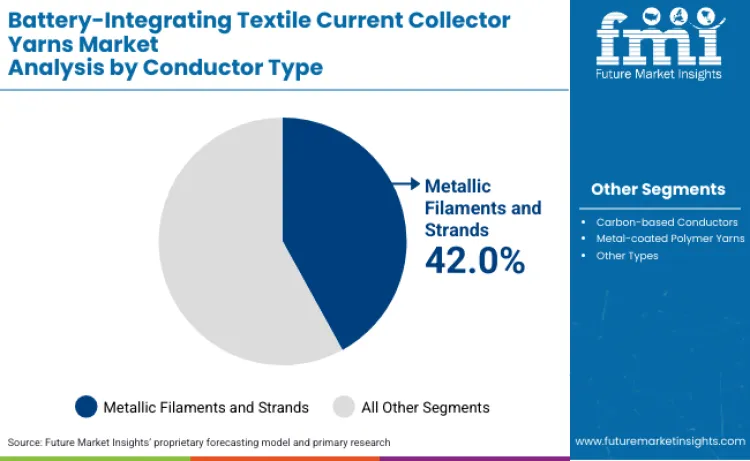
Metallic filaments and strands hold 42.0% share because they deliver predictable low resistance per length, which directly reduces ohmic losses in textile batteries. Current collector performance is a system constraint, not a material preference. Higher resistance collectors increase heat generation under load, reduce usable capacity at peak draw, and force designers to oversize conductor pathways that compromise comfort and drape.
Metallic architectures also fit textile-manufacturing realities. Filament-based conductors can be engineered into multi-filament bundles and protected through yarn design choices that reduce abrasion during knitting and weaving. The economic implication is higher yield and lower scrap risk in production, which matters when brands move from prototypes to repeatable manufacturing.
Why does Wearable Batteries and Energy Storage dominate application share in battery-integrating textile current collectors?
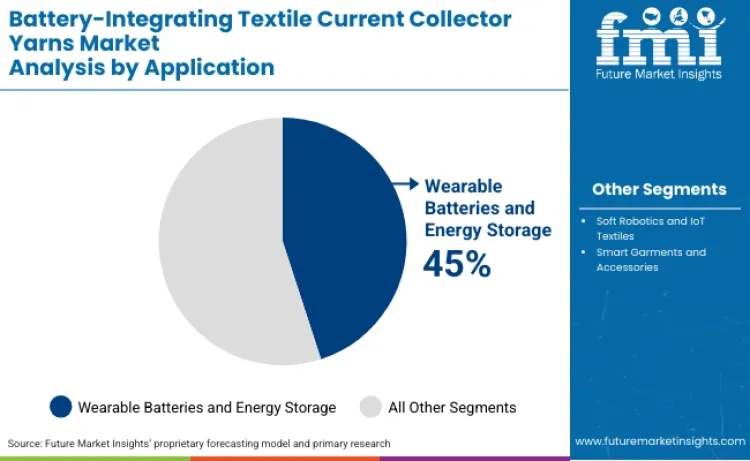
Wearable batteries and energy storage lead with 45.0% share because they represent the most direct value capture from textile energy integration. Energy storage is the bottleneck that limits autonomy in smart textiles. Current collector yarns become essential when energy storage is distributed across the garment to avoid rigid battery packs, reduce pressure points, and support longer wear time.
In China, standards‑driven adoption is reinforced by GB/T 45565‑2025, which establishes mandatory lithium‑ion battery coding and lifecycle traceability rules effective November 1, 2025, favoring identifiable current‑collector subcomponents.
What Influences Growth of the Battery-Integrating Textile Current Collector Yarns Market?
Growth is being shaped by material-scale availability, compliance-led design constraints, and industrial policy that supports vertically integrated supply chains. Material-scale availability is improving for conductive networks used in electrodes and textile energy systems. OCSiAl’s European graphene nanotube facility in Serbia provides 60 tonnes annual synthesis capacity and emphasizes dispersion lines, quality control, and customer audits by major battery manufacturers, which reduces supply uncertainty for high-performance conductive additives and networks. The commercial effect is lower lead-time volatility for conductive formulations and faster iteration cycles for textile battery prototypes that need repeatable conductive behavior.
Compliance-led design constraints are tightening for EU-facing products. Regulation (EU) 2023/1542 sets a battery passport requirement under Article 77 from February 18, 2027 for defined battery categories and sets Article 11 applicability from the same date, creating pressure on removability and traceability logic. Textile batteries built as blended composites face higher documentation and end-of-life constraints. Market winners will be suppliers whose current collector yarn systems can be tracked as identifiable components, supported by stable bill-of-materials control.
Industrial policy and vertical integration are shaping future cost curves. Reliance Industries’ AGM transcript states its battery giga factory will start in 2026 with 40 GWh per year capacity and expand modularly to 100 GWh per year, strengthening the case for India as a cost-reduction pathway for conductive materials and adjacent battery manufacturing capacity. This matters for textile current collectors because cost parity requires scaling conductive inputs and integrating them into mass-market manufacturing ecosystems.
How will Battery-Integrating Textile Current Collector Yarns Demand evolve in Key Countries?
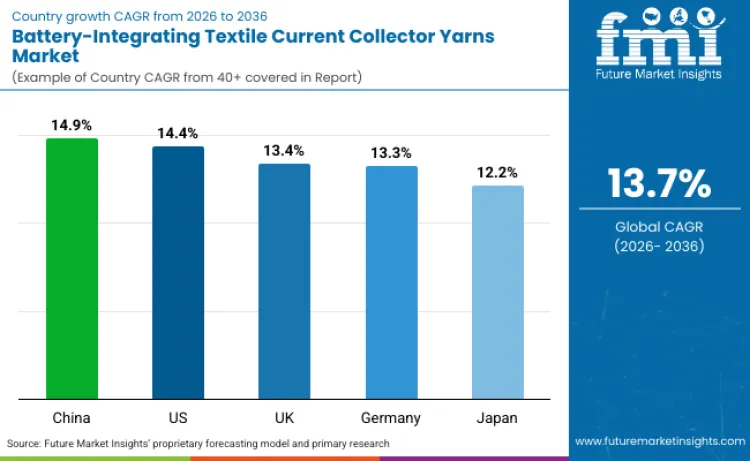
| Country | CAGR (2026-2036) |
|---|---|
| USA | 14.4% |
| UK | 13.4% |
| China | 14.9% |
| Japan | 12.2% |
| Germany | 13.3% |
Source: FMI’s proprietary forecasting model and primary research
How does Defense-led Qualification accelerate adoption of Current Collector Yarn Architectures in the USA?
UK’s demand formalization is supported by standards activity such as British Standards Institution project PWI 00162478, which clarifies expectations for garments integrating active conductive and lighting elements.
Domestic scaling of conductive inputs strengthens this adoption pathway. Cabot Corporation entered award negotiation in September 2024 for up to USD 50 million from the USA Department of Energy to support domestic battery supply chain development. The program focuses on carbon nanotubes and conductive additive dispersions at commercial scale, improving availability of battery-grade conductive materials for yarn-based current collectors and textile energy systems.
Which Safety and Standards Activity in the UK increases Formalization of Integrated Conductive Textile Systems?
UK is forecast to grow at a 13.4% CAGR, aligned with safety and standardization activity that clarifies requirements for conductive elements in protective and functional garments. British Standards Institution lists project PWI 00162478 addressing warning clothing with active lighting. The initiative sits alongside high-visibility standards and defines expectations for garments integrating active conductive components.
Procurement practices reflect this formalization. Buyers request documented safety behavior, reliability under wear conditions, and predictable electrical performance. Current collector yarn suppliers secure qualification when test documentation aligns with procurement requirements in regulated garment categories.
How does China’s coding and traceability push raise demand for trackable battery textile components?
China leads this segment with a projected 14.9% CAGR, supported by coding and traceability requirements that favor components with unique identifiers and documented material lineage. GB/T 45565-2025 establishes coding rules for lithium-ion batteries and is scheduled to take effect on November 1, 2025. The standard reinforces lifecycle traceability expectations across battery supply chains.
Textile battery systems interfacing with micro-battery suppliers face elevated data and coding requirements. Current collector yarns designed as standardized, traceable subcomponents qualify more easily than blended conductive fabrics with unclear composition. Large manufacturing clusters accelerate industrialization of such yarn architectures once standards are defined, increasing demand for suppliers capable of delivering stable lots and consistent electrical behavior at volume.
How does Japan’s Corporate Portfolio Discipline influence Supply of Conductive Filaments for Smart Textile Energy Systems?
Japan is projected to grow at a 12.2% CAGR, shaped by engineering depth and capital allocation discipline within large materials groups. Conductive filament supply for textile batteries is sensitive to such portfolio decisions, given the sustained R&D and pilot-to-scale investment required.
Demand continues where advanced materials capability supports high-performance yarn development for premium smart textile programs. Procurement criteria emphasize documented mechanical fatigue performance and long-term resistance stability, protecting brand risk in high-value end uses.
How does Germany’s applied R&D platform activity translate into industrial validation for textile-integrated energy concepts?
Germany is projected to grow at a 13.3% CAGR, supported by applied R&D platforms that reduce time between laboratory development and industrial validation. Fraunhofer IGCV describes battery technology programs structured as innovation platforms with direct industry participation. These programs enable testing of manufacturability, cycling durability, and integration constraints within production-relevant environments.
German qualification frameworks favor solutions with strong documentation and reproducibility. Current collector yarn platforms specified as components with defined electrical and mechanical properties align well with these expectations, simplifying qualification and procurement.
What is the Competition Outlook for Battery-Integrating Textile Current Collector Yarns?
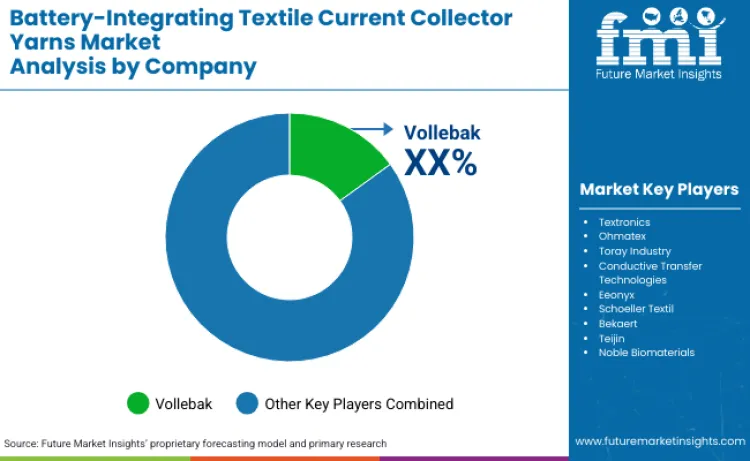
End users enforce three proof requirements during RFP qualification. Current-collector continuity after cyclic bending and laundering. Audit-ready traceability for textile-integrated battery components. Secure access to conductive inputs with repeatable batch quality. These criteria determine supplier eligibility in programs where electrical failure is unacceptable.
Applied validation pathways in Europe are supported by Fraunhofer’s IGCV battery technology platforms that link laboratory development directly with industrial manufacturability and cycling‑durability assessment.
Defense-linked procurement requires upstream material evidence. Buyers request documentation covering resistance drift, fatigue mechanisms, contamination control, and process change management. Supplier selection favors firms capable of supporting formal qualification packages alongside material supply.
Textile platforms carrying both power and data inside fabric structures form another qualification requirement. Noble Biomaterials develops its Circuitex platform to route energy and data through fabrics without discrete wiring. Healthcare and remote monitoring programs apply strict durability and consistency screening. Current-collector yarn suppliers benefit when production lots remain repeatable and test artifacts align with validation protocols.
Compliance requirements reshape textile-integrated battery architecture in Europe. Battery Passport Technical Guidance published in March 2024 mandates digital battery passports from 18 February 2027 for defined battery categories. Requirements include unique identifiers, standardized data fields, and interoperability rules.
Early adoption behavior illustrates compliance expectations. Volvo announced in June 2024 the introduction of an EV battery passport ahead of regulatory deadlines using QR-code access and supply chain traceability. Item-level traceability and audit support emerge as baseline expectations across suppliers. Textile battery programs lacking separable and identifiable subcomponents encounter slower qualification in EU-facing channels.
Suppliers addressing this requirement design current-collector yarns as identifiable modules within textile assemblies. Selection depends on conductivity combined with documentation, bill-of-materials stability, and end-of-life traceability logic aligned with compliance review.
Upstream conductive input availability functions as a gating factor for production programs. Consistent conductive networks are required to achieve resistance targets while maintaining flexibility.
Key Industry Developments
- In 2023, Ohmatex further consolidated its role as a textile battery integration specialist by emphasizing modular fabric architectures in which current-collector yarns are specified as separable electrical layers within multilayer textile systems. This approach reduced qualification friction for OEMs by simplifying failure analysis, documentation, and system troubleshooting, increasing the attractiveness of integration-ready yarn platforms.
- In 2024, Teijin’s functional materials strategy continued to shape competitive dynamics by aligning conductive yarn development with broader performance requirements such as durability, chemical resistance, and long service life. This alignment favored current-collector yarn concepts that could be co-qualified alongside structural and protective textile components, reducing supplier fragmentation and integration risk for large-scale textile energy programs.
Key Players Profiled
- Vollebak
- Textronics
- Ohmatex
- Toray Industries
- Conductive Transfer Technologies
- Eeonyx
- Schoeller Textil
- Bekaert
- Teijin
- Noble Biomaterials
Market Definition
The battery-integrating textile current collector yarns market refers to revenues generated from conductive yarn systems engineered to function as current collectors inside textile-integrated energy storage architectures. These yarns are designed to collect and transport electrons between active electrode materials and external circuit interfaces while remaining compatible with textile manufacturing processes such as knitting, weaving, embroidery, and lamination. The market covers yarn platforms that retain electrical continuity under bending, torsion, abrasion, and repeated flex cycles expected in garments and flexible textile structures.
Market Inclusion
This market includes metallic filaments and strands used as dedicated conductive pathways, carbon-based conductor yarns engineered for distributed conduction, and metal-coated polymer yarns that combine flexibility with conductive surfaces. It includes yarn products sold into textile battery assemblies, wearable battery packs distributed within fabric layers, energy-storing textiles integrated into soft goods, and textile energy modules intended for powering wearable electronics, soft robotics, and IoT-enabled textile systems.
Revenues are measured at the manufacturer level for current collector yarn materials and associated functional yarn constructions sold for integration into textile energy storage systems. Values are expressed in USD billion for the forecast period.
Market Exclusion
This market excludes rigid battery cells sold as discrete components, conventional conductive sewing threads used only for interconnects without a current-collector role, conductive fabrics or foils sold as sheet collectors without yarn form, and non-conductive textile yarns. It also excludes electronics modules, sensors, garment assembly services, software platforms, and downstream retail margins.
Scope of Report
| Items | Values |
|---|---|
| Quantitative Units (2026) | USD 0.3 billion |
| Market Forecast Value (2036) | USD 1.2 billion |
| Forecast Period | 2026 to 2036 |
| Conductor Type | Metallic Filaments and Strands, Carbon-based Conductors, Metal-coated Polymer Yarns, Other Types |
| Application | Wearable Batteries and Energy Storage, Soft Robotics and IoT Textiles, Smart Garments and Accessories |
| Key Countries Covered | USA, UK, China, Japan, Germany |
| Key Companies Profiled | Vollebak, Textronics, Ohmatex, Toray Industries, Conductive Transfer Technologies, Eeonyx, Schoeller Textil, Bekaert, Teijin, Noble Biomaterials |
Battery-Integrating Textile Current Collector Yarns Market by Key Segments
By Conductor Type
- Metallic Filaments and Strands
- Carbon-based Conductors
- Metal-coated Polymer Yarns
- Other Types
By Application
- Wearable Batteries and Energy Storage
- Soft Robotics and IoT Textiles
- Smart Garments and Accessories
By Region
- North America
- Latin America
- Western Europe
- Eastern Europe
- East Asia
- South Asia & Pacific
- Middle East & Africa
Bibliography
- Automotive precedent is shaping traceability expectations, illustrated by Volvo’s June 2024 rollout of EV battery passports using QR‑code based supply‑chain data access ahead of EU compliance deadlines.
- OCSiAl. (2024). OCSiAl Opens First European Graphene Nanotube Facility.
- Cabot Corporation. (2024). Cabot Corporation Selected for Award Negotiation for USD 50 Million from the USA Department of Energy.
- British Standards Institution. (2025). Project PWI 00162478 on warning clothing with active lighting.
- Fraunhofer IGCV. (2026). Battery technology platform and industry innovation programs.
Frequently Asked Questions
How big is the global battery-integrating textile current collector yarns market?
The global battery-integrating textile current collector yarns market is valued at USD 0.3 billion in 2026.
What is the growth outlook for the battery-integrating textile current collector yarns market over the next 10 years?
The market is projected to grow at a CAGR of 13.7%, reaching a valuation of USD 1.2 billion by 2036.
Which segments drive demand in this market?
Metallic filaments and strands lead conductor type share at 42.0%, while wearable batteries and energy storage leads application share at 45.0%.
What are the main risks and constraints affecting this market?
The market faces two primary headwinds: compliance friction driven by battery passport and removability requirements for EU-facing products, and performance liability tied to resistance drift and mechanical fatigue under real garment use conditions.
Preview the report firsthand - request a free sample
Get SampleGet the brochure for pricing and purchase details.
Get PDFTable of Content
- Executive Summary
- Battery-Integrating Textile Current Collector Yarns Market Introduction
- Market Definition
- Market Scope
- Market Taxonomy
- Research Methodology
- Study Framework
- Assumptions and Limitations
- Data Sources
- Market Estimation and Forecasting Approach
- Battery-Integrating Textile Current Collector Yarns Market Dynamics
- Drivers
- Restraints
- Opportunities
- Trends
- Global Battery-Integrating Textile Current Collector Yarns Market Analysis 2021 to 2025 and Forecast 2026 to 2036
- Global Battery-Integrating Textile Current Collector Yarns Market Analysis by Conductor Type
- Global Battery-Integrating Textile Current Collector Yarns Market Analysis by Application
- Global Battery-Integrating Textile Current Collector Yarns Market Analysis by Region
- North America Battery-Integrating Textile Current Collector Yarns Market Analysis
- United States
- Canada
- Latin America Battery-Integrating Textile Current Collector Yarns Market Analysis
- Brazil
- Rest of Latin America
- Western Europe Battery-Integrating Textile Current Collector Yarns Market Analysis
- Germany
- United Kingdom
- France
- Italy
- Spain
- BENELUX
- Nordics
- Eastern Europe Battery-Integrating Textile Current Collector Yarns Market Analysis
- Russia
- Poland
- Rest of Eastern Europe
- East Asia Battery-Integrating Textile Current Collector Yarns Market Analysis
- China
- Japan
- South Korea
- South Asia & Pacific Battery-Integrating Textile Current Collector Yarns Market Analysis
- India
- ASEAN
- Australia & New Zealand
- Middle East & Africa Battery-Integrating Textile Current Collector Yarns Market Analysis
- GCC
- South Africa
- Rest of Middle East & Africa
- Competitive Landscape Analysis
- Key Players Profiled
- Market Definition and Scope
- Market Segmentation Analysis
- Bibliography
- Frequently Asked Questions


