

- Industry Size (2026)
- USD 1.9 Bn
- Forecast (2036)
- USD 2.8 Bn
- CAGR (2026 to 2036)
- 4.1%
Textile Winding Machine Market Forecast and Outlook 2026 to 2036
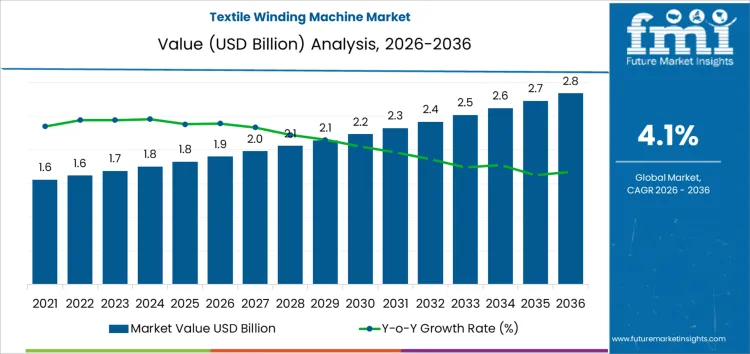
The textile winding machine market is projected to grow from USD 1.9 billion in 2026 to USD 2.8 billion by 2036, registering a CAGR of 4.1%. For senior decision-makers, this market should be viewed as a stability-oriented segment linked to textile production economics rather than cyclical surges. Revenue exposure is influenced by mill utilization rates, labor cost trends, and regional textile competitiveness. Strategic prioritization favors precision and automatic winding solutions that directly reduce defects, downtime, and operator dependency.
Demand timing is uneven, as purchases are typically triggered by modernization programs, energy efficiency upgrades, or quality improvement initiatives rather than capacity expansion alone. Return visibility improves where suppliers secure retrofit contracts, digital upgrades, and long-term service agreements. Geographic exposure remains concentrated in Asia, while developed markets contribute through replacement demand. The market rewards patient investment, disciplined pricing, and strong aftersales capability rather than aggressive scale-driven strategies.
Quick Stats for Textile Winding Machine Market
- Textile Winding Machine Market Value (2026): USD 1.9 Billion
- Textile Winding Machine Market Forecast Value (2036): USD 2.8 Billion
- Textile Winding Machine Market Forecast CAGR 2026 to 2036: 4.1%
- Leading Machine Type in Textile Winding Machine Market: Precision Winders (42% share)
- Winding Machine Market: Asia Pacific, Europe, North America, Latin America, Middle East & Africa
- Top Key Players in Textile Winding Machine Market: Murata Machinery Ltd., Saurer Group, Rieter Holding AG, SSM Schärer Schweiter Mettler AG, SAVIO Macchine Tessili S.p.A., Peass Industrial Engineers Pvt. Ltd., Vandewiele NV, Superba S.p.A., Jwell Machinery Co., Ltd., TMT Machinery Pvt. Ltd.
Textile Winding Machine Market Key Takeaways
| Metric | Value |
|---|---|
| Textile Winding Machine Market Value (2026) | USD 1.9 Billion |
| Textile Winding Machine Market Forecast Value (2036) | USD 2.8 Billion |
| Textile Winding Machine Market Forecast CAGR 2026 to 2036 | 4.1% |
How Are Production Efficiency and Mill Modernization Shaping Demand for Textile Winding Machines?
Demand for textile winding machines is increasingly shaped by manufacturers’ focus on production efficiency, yarn quality consistency, and waste reduction. Spinning and texturizing mills are prioritizing winding equipment that delivers uniform package density, precise tension control, and minimal yarn defects. This shift is creating opportunities for machine manufacturers that can offer high-speed, electronically controlled winding systems capable of supporting diverse yarn types, including synthetic filaments, blended yarns, and specialty technical fibers.
Modernization of textile mills is also influencing purchasing behavior. Many producers are replacing legacy mechanical winders with automated and digitally controlled machines to improve throughput and reduce labor dependency. Features such as automatic doffing, fault detection, and real-time monitoring are becoming standard procurement criteria rather than optional upgrades. Suppliers that provide retrofit solutions, energy-efficient drives, and compatibility with upstream spinning systems are gaining traction among cost-sensitive mills seeking incremental productivity gains without full line replacement.
Regional expansion of textile manufacturing is further supporting market growth. Asia Pacific remains the primary investment hub due to its large-scale yarn production capacity and export-oriented textile industry. At the same time, nearshoring trends and technical textile growth in Europe and North America are generating demand for precision winding solutions tailored to smaller batch production. For equipment suppliers, competitive advantage increasingly depends on customization capability, after-sales service strength, and long-term operational reliability in the textile winding machine market.
What Is The Segment Overview Of The Textile Winding Machine Market?
The textile winding machine market is segmented by machine type and operation mode, reflecting how productivity requirements and automation levels influence purchasing decisions across spinning and yarn processing facilities. By machine type, precision winders represent the leading category, as yarn quality consistency and defect control remain critical for downstream weaving and knitting operations. Other machine types such as cone winders, non-precision winders, and spool and specialty winders address cost-sensitive and application-specific needs. By operation mode, automatic systems dominate, supported by labor optimization, speed consistency, and integration with modern spinning lines. Semi-automatic and manual systems remain relevant in small-scale and regional textile units.
Why Do Precision Winders Lead The Textile Winding Machine Market By Machine Type?
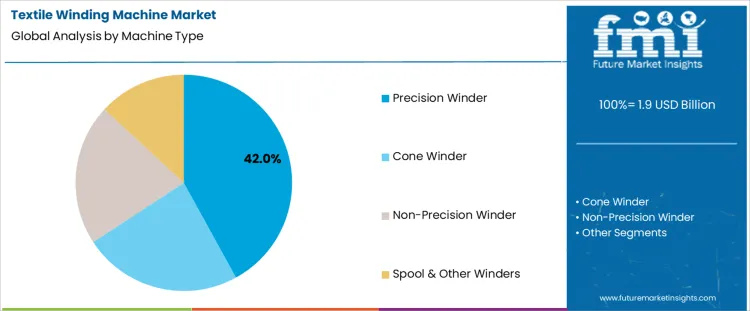
Precision winders account for 42% share of the textile winding machine market because they deliver uniform yarn density, controlled tension, and defect-free package formation. Textile manufacturers supplying apparel, home textiles, and technical fabrics rely on precision winding to reduce yarn breakage and improve loom efficiency. These machines support high-speed operations while maintaining consistent package geometry, which minimizes downstream stoppages. Integration with electronic yarn clearing and monitoring systems enhances quality assurance. For machine suppliers, precision winders offer higher margins through customization, digital upgrades, and service contracts. This combination of quality performance and commercial value explains why precision winders remain the preferred choice across modern textile production lines.
Why Does Automatic Operation Mode Dominate The Textile Winding Machine Market?
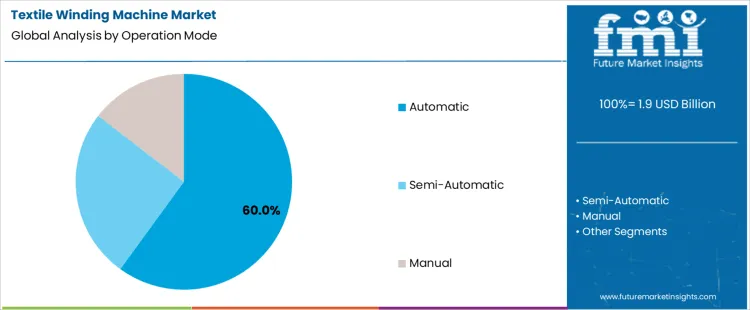
Automatic winding machines lead the textile winding machine market by operation mode with 60% share due to increasing pressure on manufacturers to improve productivity and reduce labor dependency. Automated systems ensure consistent winding speed, tension control, and package changeover with minimal operator intervention. Textile mills adopt automatic machines to manage large production volumes while maintaining uniform quality standards. Automation also supports real-time monitoring, fault detection, and integration with upstream spinning equipment. Rising labor costs and skill shortages accelerate the shift toward fully automatic solutions. For equipment manufacturers and suppliers, automatic winding machines enable scalable deployments and long-term aftermarket opportunities, reinforcing their dominant market position.
What Are The Key Dynamics Of The Textile Winding Machine Market?
The textile winding machine market is driven by demand for high-efficiency, precision winding solutions that support yarn preparation for weaving, knitting, and textile finishing processes. Winding machines are critical for ensuring uniform tension, minimized yarn faults, and optimized package geometry, which directly impact downstream productivity. Adoption is strongest among spinning, weaving, and hosiery manufacturers aiming to reduce waste and improve line efficiency. Supplier differentiation increasingly centers on modular design, ease of changeover, and compatibility with a wide range of yarn counts and materials. For manufacturers and component suppliers, responsiveness to evolving fiber mixes (natural, synthetic, blends) and digital quality feedback loops are becoming strategic imperatives.
How Are Technology And Automation Trends Reshaping The Textile Winding Machine Market?
Technology and automation trends are reshaping the textile winding machine market by integrating smart sensors, servo drives, and real-time monitoring systems. Modern winding machines incorporate automatic tension control, sensor-based fault detection, and self-adjusting traverse mechanisms to enhance yarn quality and reduce manual intervention. Data capture modules that track doff counts, package weights, and yarn breaks feed into MES/ERP systems for production planning and traceability. For suppliers, offering plug-and-play IoT connectivity and software analytics accelerates adoption in Industry 4.0-aligned facilities. Additionally, energy-efficient drives and rapid change-over design increase uptime and lower operating costs, which are high-priority metrics for textile manufacturers.
What Opportunities Are Supporting Growth For Manufacturers In The Textile Winding Machine Market?
Opportunities for textile winding machine manufacturers and suppliers are emerging from increasing demand for specialized yarns used in technical textiles, performance fabrics, and automotive composites. As product complexity rises, winding solutions that provide defect minimization, variable speed control, and precise package formation gain traction. Expansion of spinning capacity in Asia Pacific and Africa offers new volume demand for both standard and advanced winding machines. Retrofit and upgrade services for existing machines such as tension automation and digital monitoring modules present recurring revenue potential. Strategic alliances with textile OEMs, software solution providers, and aftermarket maintenance partners further extend market reach and customer lifecycle value.
How Is the Global Demand Landscape Creating Country-Specific Opportunities in the Textile Winding Machine Market?
Demand for textile winding machines differs widely across countries depending on yarn production scale, fabric export orientation, labor economics, and modernization cycles within spinning and weaving facilities. Asia remains the volume engine of the textile winding machine market, driven by high yarn output and continuous capacity utilization, while North America and Europe reflect upgrade- and retrofit-led demand. China and India dominate growth due to scale and cost competitiveness, whereas the United States, Germany, and the UK prioritize automation, precision winding, and integration with digital textile workflows.
Across regions, manufacturers increasingly evaluate machines based on winding speed stability, tension control accuracy, energy efficiency, and compatibility with synthetic and blended yarns. Suppliers able to tailor offerings to local operating economics and production profiles gain competitive advantage.
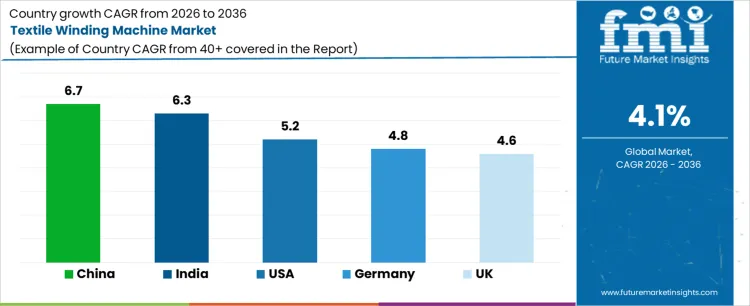
| Country | CAGR (%) |
|---|---|
| China | 6.7% |
| India | 6.3% |
| USA | 5.2% |
| Germany | 4.8% |
| UK | 4.6% |
Why Is China the Core Volume and Replacement Market for Textile Winding Machine Suppliers?
Demand for textile winding machines in China, expanding at a CAGR of 6.7% during 2026 to 2036, is driven by unmatched yarn production volumes and continuous modernization of large-scale spinning operations. China represents both a new-installation and replacement-heavy market, where high machine utilization accelerates wear and drives frequent upgrades. Buyers prioritize winding speed consistency, reduced yarn breakage, and compatibility with synthetic filament and blended yarns. Cost efficiency and local service availability strongly influence procurement decisions. Domestic machine manufacturers dominate standard equipment segments, intensifying price competition. International suppliers find opportunity in high-speed precision winders, energy-efficient designs, and machines supporting specialty yarns. Export-oriented mills also demand automation-ready winding machines that integrate with centralized production monitoring systems. China rewards suppliers that balance competitive pricing with robust performance, scalable production capacity, and localized aftersales support.
How Is India Transitioning from Capacity Expansion to Process Optimization?
Sales of textile winding machines in India, growing at a CAGR of 6.3% from 2026 to 2036, are increasingly shaped by a shift from pure capacity expansion toward process efficiency improvement. While greenfield spinning projects continue, a rising share of investments is directed toward upgrading winding sections within existing mills. Buyers prioritize flexibility, seeking machines capable of handling multiple yarn counts, blends, and batch sizes. Cost sensitivity remains high, yet mills are placing greater emphasis on reducing downtime, improving yarn package consistency, and lowering maintenance effort. Government-led textile incentives indirectly support machinery purchases, particularly in regional clusters. Import substitution trends and local assembly options influence supplier selection. Manufacturers offering modular platforms, retrofit-friendly designs, and operator training gain competitive advantage. India presents long-term opportunity for suppliers aligning cost-performance ratios with productivity gains and supporting decentralized mill operations.
What Sustains Steady Upgrade Demand in the United States?
Demand for textile winding machines in the United States, expanding at a CAGR of 5.2% during 2026 to 2036, is driven primarily by modernization rather than capacity growth. The market is shaped by specialty yarns, technical textiles, and industrial fabric production, where winding quality directly impacts downstream performance. Buyers emphasize precision winding, automation compatibility, and labor reduction to improve operational efficiency. Replacement of older mechanical winders with digitally controlled, sensor-enabled systems is common across established facilities. Procurement decisions favor suppliers with strong engineering support, customization capability, and compliance with safety and operational standards. Volumes are limited compared with Asia, but unit values remain high due to specification-driven purchasing. The United States rewards suppliers positioned around high-performance equipment, retrofit solutions, and long lifecycle value instead of mass-volume machinery offerings.
How Does Germany Maintain a Precision-Oriented Demand Profile?
Demand for textile winding machines in Germany, growing at a CAGR of 4.8% over the forecast period, reflects the country’s emphasis on engineered yarns and technical textile applications. Buyers prioritize winding accuracy, tension consistency, and seamless integration with advanced spinning and weaving systems. Demand is largely replacement-led, driven by continuous process optimization rather than expansion of installed capacity. Procurement cycles are structured and qualification-intensive, requiring detailed technical documentation and proven reliability. German manufacturers invest in upgrades that enhance productivity, energy efficiency, and quality control. Volumes are moderate, yet machine specifications are stringent, supporting higher average selling prices. Germany favors suppliers capable of delivering precision engineering, customization support, and long-term service commitments aligned with high-performance textile production environments.
Why Is the UK a Selective but Stable Market for Winding Machine Suppliers?
Sales of textile winding machines in the United Kingdom, expanding at a CAGR of 4.6% during 2026 to 2036, are driven by niche textile manufacturing and specialty yarn production. Demand is concentrated in technical textiles, composites, and high-value fabric segments rather than mass apparel. Buyers focus on reliability, compact machine footprint, and ease of integration into existing production lines. Replacement demand dominates as facilities modernize aging equipment to meet quality and efficiency requirements. Procurement volumes remain limited, but purchasing decisions are influenced by long-term supplier relationships and aftersales service quality. The UK market favors suppliers offering application-specific configurations, retrofit capabilities, and responsive technical support rather than standardized high-volume machines.
How Are Manufacturers Competing in the Textile Winding Machine Market?
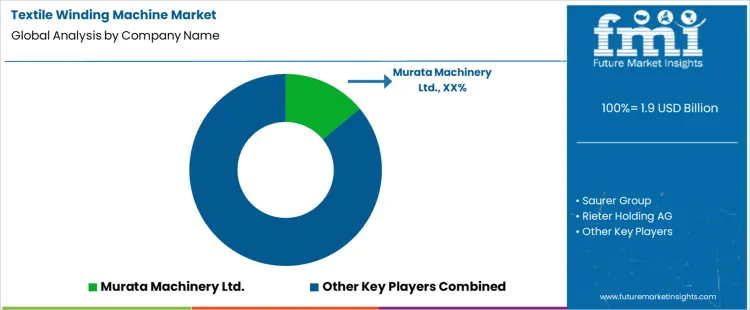
Competition in the textile winding machine market is defined by precision control, modular automation, and documented performance characteristics that appeal to OEMs, converters, and contract winding facilities. Murata Machinery Ltd. leads with electronic winding systems that are presented in official machine brochures emphasizing high-speed precision, minimal tension variation, and integrated PLC control. Its product literature highlights adaptability across filament, staple, and technical yarns with automated recipe saving and rapid changeovers. Saurer Group focuses on servo-drive winding heads coupled with sensor-assisted traversing units. Brochures describe robust frame design and scalable configurations for ring and air-jet winding lines.
European engineering heritage differentiates several suppliers. Rieter Holding AG markets winding machines with official documentation on precision yarn traverse control and integrated tension feedback loops designed for high counts and demanding blends. SSM Schärer Schweiter Mettler AG positions its winding platforms around automatic defect detection and self-optimizing control algorithms, with brochures underscoring uptime and reduced waste. SAVIO Macchine Tessili S.p.A. accents compact multi-spindle designs and ease of maintenance with technical sheets noting rapid spindle change systems and tooling precision.
Manufacturers from Asia are building volume and customization advantages. Peass Industrial Engineers Pvt. Ltd. and TMT Machinery Pvt. Ltd. emphasize cost-effective winding systems with brochures that document tension-stable winding for cotton and blended yarns and local service support networks. Vandewiele NV competes on high-end electronic winding solutions with product literature highlighting remote diagnostics and Industry 4.0 connectivity. Superba S.p.A. positions its systems on speed consistency and ergonomic design with official materials detailing user interface simplicity and changeover efficiency.
Jwell Machinery Co., Ltd. adds competitive breadth through heavy-duty winding frames aimed at technical textile sectors, with specs stressing motor torque control and fiber alignment stability. Other players in the market provide specialized winding heads, tension sensors, and retrofit automation modules that integrate with primary winding platforms. Across suppliers, differentiation is driven by brochure-verified tension control, automation depth, service footprint, and adaptability rather than basic machine pricing.
Key Players in Textile Winding Machine Market
- Murata Machinery Ltd.
- Saurer Group
- Rieter Holding AG
- SSM Schärer Schweiter Mettler AG
- SAVIO Macchine Tessili S.p.A.
- Peass Industrial Engineers Pvt. Ltd.
- Vandewiele NV
- Superba S.p.A.
- Jwell Machinery Co., Ltd.
- TMT Machinery Pvt. Ltd.
- Other Players
Scope of Report
| Attribute | Description |
|---|---|
| Quantitative Unit | USD Billion |
| Machine Type | Precision Winder, Cone Winder, Non-Precision Winder, Spool & Other Winders |
| Operation Mode | Automatic, Semi-Automatic, Manual |
| Countries Covered | China, Japan, South Korea, India, Australia & New Zealand, ASEAN, Rest of Asia Pacific, Germany, United Kingdom, France, Italy, Spain, Nordic, BENELUX, Rest of Europe, United States, Canada, Mexico, Brazil, Chile, Rest of Latin America, Kingdom of Saudi Arabia, Other GCC Countries, Turkey, South Africa, Other African Union, Rest of Middle East & Africa |
| Regions Covered | Asia Pacific, Europe, North America, Latin America, Middle East & Africa |
| Key Companies Profiled | Murata Machinery Ltd., Saurer Group, Rieter Holding AG, SSM Schärer Schweiter Mettler AG, SAVIO Macchine Tessili S.p.A., Peass Industrial Engineers Pvt. Ltd., Vandewiele NV, Superba S.p.A., Jwell Machinery Co., Ltd., TMT Machinery Pvt. Ltd., Other Players |
| Additional Attributes | Dollar sales by machine type and operation mode are analyzed across yarn spinning and finishing processes. The report includes country-level demand assessment, growth projections for 2026 to 2036, evaluation of automation intensity and winding precision, assessment of productivity and quality optimization trends, competitive benchmarking of machinery suppliers, and analysis of modernization investments across textile manufacturing facilities. |
Textile Winding Machine Market by Key Segments
Machine Type:
- Precision Winder
- Cone Winder
- Non-Precision Winder
- Spool & Other Winders
Operation Mode:
- Automatic
- Semi-Automatic
- Manual
Region:
- Asia Pacific
- China
- Japan
- South Korea
- India
- Australia & New Zealand
- ASEAN
- Rest of Asia Pacific
- Europe
- Germany
- United Kingdom
- France
- Italy
- Spain
- Nordic
- BENELUX
- Rest of Europe
- North America
- United States
- Canada
- Mexico
- Latin America
- Brazil
- Chile
- Rest of Latin America
- Middle East & Africa
- Kingdom of Saudi Arabia
- Other GCC Countries
- Turkey
- South Africa
- Other African Union
- Rest of Middle East & Africa
Bibliography
- ITMA Services. (2023). ITMA 2023: Transforming textile and garment manufacturing through innovation. ITMA Services.
- Rieter. (2025). Autoconer X6: Automated material flow and winding systems. Rieter.
- SSM Schärer Schweiter Mettler AG. (2025). Yarn processing and winding systems: Product portfolio. SSM.
- VDMA e.V. (2024). Textile machinery industry economic and market outlook. VDMA.
- Superba. (2023). B402 communication and connectivity solutions for textile machinery. Superba.
Frequently Asked Questions
How big is the textile winding machine market in 2026?
The global textile winding machine market is estimated to be valued at USD 1.9 billion in 2026.
What will be the size of textile winding machine market in 2036?
The market size for the textile winding machine market is projected to reach USD 2.8 billion by 2036.
How much will be the textile winding machine market growth between 2026 and 2036?
The textile winding machine market is expected to grow at a 4.1% CAGR between 2026 and 2036.
What are the key product types in the textile winding machine market?
The key product types in textile winding machine market are precision winder, cone winder, non-precision winder and spool & other winders.
Which operation mode segment to contribute significant share in the textile winding machine market in 2026?
In terms of operation mode, automatic segment to command 60.0% share in the textile winding machine market in 2026.
Preview the report firsthand - request a free sample
Get SampleGet the brochure for pricing and purchase details.
Get PDFTable of Content
- Executive Summary
- Global Market Outlook
- Demand-side Trends
- Supply-side Trends
- Technology Roadmap Analysis
- Analysis and Recommendations
- Market Overview
- Market Coverage / Taxonomy
- Market Definition / Scope / Limitations
- Market Background
- Market Dynamics
- Drivers
- Restraints
- Opportunity
- Trends
- Scenario Forecast
- Demand in Optimistic Scenario
- Demand in Likely Scenario
- Demand in Conservative Scenario
- Opportunity Map Analysis
- Product Life Cycle Analysis
- Supply Chain Analysis
- Investment Feasibility Matrix
- Value Chain Analysis
- PESTLE and Porter’s Analysis
- Regulatory Landscape
- Regional Parent Market Outlook
- Production and Consumption Statistics
- Import and Export Statistics
- Market Dynamics
- Global Market Analysis 2021 to 2025 and Forecast, 2026 to 2036
- Historical Market Size Value (USD Million) Analysis, 2021 to 2025
- Current and Future Market Size Value (USD Million) Projections, 2026 to 2036
- Y-o-Y Growth Trend Analysis
- Absolute $ Opportunity Analysis
- Global Market Pricing Analysis 2021 to 2025 and Forecast 2026 to 2036
- Global Market Analysis 2021 to 2025 and Forecast 2026 to 2036, By Machine Type
- Introduction / Key Findings
- Historical Market Size Value (USD Million) Analysis By Machine Type , 2021 to 2025
- Current and Future Market Size Value (USD Million) Analysis and Forecast By Machine Type , 2026 to 2036
- Precision Winder
- Cone Winder
- Non-Precision Winder
- Spool & Other Winders
- Precision Winder
- Y-o-Y Growth Trend Analysis By Machine Type , 2021 to 2025
- Absolute $ Opportunity Analysis By Machine Type , 2026 to 2036
- Global Market Analysis 2021 to 2025 and Forecast 2026 to 2036, By Operation Mode
- Introduction / Key Findings
- Historical Market Size Value (USD Million) Analysis By Operation Mode, 2021 to 2025
- Current and Future Market Size Value (USD Million) Analysis and Forecast By Operation Mode, 2026 to 2036
- Automatic
- Semi-Automatic
- Manual
- Automatic
- Y-o-Y Growth Trend Analysis By Operation Mode, 2021 to 2025
- Absolute $ Opportunity Analysis By Operation Mode, 2026 to 2036
- Global Market Analysis 2021 to 2025 and Forecast 2026 to 2036, By Region
- Introduction
- Historical Market Size Value (USD Million) Analysis By Region, 2021 to 2025
- Current Market Size Value (USD Million) Analysis and Forecast By Region, 2026 to 2036
- North America
- Latin America
- Western Europe
- Eastern Europe
- East Asia
- South Asia and Pacific
- Middle East & Africa
- Market Attractiveness Analysis By Region
- North America Market Analysis 2021 to 2025 and Forecast 2026 to 2036, By Country
- Historical Market Size Value (USD Million) Trend Analysis By Market Taxonomy, 2021 to 2025
- Market Size Value (USD Million) Forecast By Market Taxonomy, 2026 to 2036
- By Country
- USA
- Canada
- Mexico
- By Machine Type
- By Operation Mode
- By Country
- Market Attractiveness Analysis
- By Country
- By Machine Type
- By Operation Mode
- Key Takeaways
- Latin America Market Analysis 2021 to 2025 and Forecast 2026 to 2036, By Country
- Historical Market Size Value (USD Million) Trend Analysis By Market Taxonomy, 2021 to 2025
- Market Size Value (USD Million) Forecast By Market Taxonomy, 2026 to 2036
- By Country
- Brazil
- Chile
- Rest of Latin America
- By Machine Type
- By Operation Mode
- By Country
- Market Attractiveness Analysis
- By Country
- By Machine Type
- By Operation Mode
- Key Takeaways
- Western Europe Market Analysis 2021 to 2025 and Forecast 2026 to 2036, By Country
- Historical Market Size Value (USD Million) Trend Analysis By Market Taxonomy, 2021 to 2025
- Market Size Value (USD Million) Forecast By Market Taxonomy, 2026 to 2036
- By Country
- Germany
- UK
- Italy
- Spain
- France
- Nordic
- BENELUX
- Rest of Western Europe
- By Machine Type
- By Operation Mode
- By Country
- Market Attractiveness Analysis
- By Country
- By Machine Type
- By Operation Mode
- Key Takeaways
- Eastern Europe Market Analysis 2021 to 2025 and Forecast 2026 to 2036, By Country
- Historical Market Size Value (USD Million) Trend Analysis By Market Taxonomy, 2021 to 2025
- Market Size Value (USD Million) Forecast By Market Taxonomy, 2026 to 2036
- By Country
- Russia
- Poland
- Hungary
- Balkan & Baltic
- Rest of Eastern Europe
- By Machine Type
- By Operation Mode
- By Country
- Market Attractiveness Analysis
- By Country
- By Machine Type
- By Operation Mode
- Key Takeaways
- East Asia Market Analysis 2021 to 2025 and Forecast 2026 to 2036, By Country
- Historical Market Size Value (USD Million) Trend Analysis By Market Taxonomy, 2021 to 2025
- Market Size Value (USD Million) Forecast By Market Taxonomy, 2026 to 2036
- By Country
- China
- Japan
- South Korea
- By Machine Type
- By Operation Mode
- By Country
- Market Attractiveness Analysis
- By Country
- By Machine Type
- By Operation Mode
- Key Takeaways
- South Asia and Pacific Market Analysis 2021 to 2025 and Forecast 2026 to 2036, By Country
- Historical Market Size Value (USD Million) Trend Analysis By Market Taxonomy, 2021 to 2025
- Market Size Value (USD Million) Forecast By Market Taxonomy, 2026 to 2036
- By Country
- India
- ASEAN
- Australia & New Zealand
- Rest of South Asia and Pacific
- By Machine Type
- By Operation Mode
- By Country
- Market Attractiveness Analysis
- By Country
- By Machine Type
- By Operation Mode
- Key Takeaways
- Middle East & Africa Market Analysis 2021 to 2025 and Forecast 2026 to 2036, By Country
- Historical Market Size Value (USD Million) Trend Analysis By Market Taxonomy, 2021 to 2025
- Market Size Value (USD Million) Forecast By Market Taxonomy, 2026 to 2036
- By Country
- Kingdom of Saudi Arabia
- Other GCC Countries
- Turkiye
- South Africa
- Other African Union
- Rest of Middle East & Africa
- By Machine Type
- By Operation Mode
- By Country
- Market Attractiveness Analysis
- By Country
- By Machine Type
- By Operation Mode
- Key Takeaways
- Key Countries Market Analysis
- USA
- Pricing Analysis
- Market Share Analysis, 2025
- By Machine Type
- By Operation Mode
- Canada
- Pricing Analysis
- Market Share Analysis, 2025
- By Machine Type
- By Operation Mode
- Mexico
- Pricing Analysis
- Market Share Analysis, 2025
- By Machine Type
- By Operation Mode
- Brazil
- Pricing Analysis
- Market Share Analysis, 2025
- By Machine Type
- By Operation Mode
- Chile
- Pricing Analysis
- Market Share Analysis, 2025
- By Machine Type
- By Operation Mode
- Germany
- Pricing Analysis
- Market Share Analysis, 2025
- By Machine Type
- By Operation Mode
- UK
- Pricing Analysis
- Market Share Analysis, 2025
- By Machine Type
- By Operation Mode
- Italy
- Pricing Analysis
- Market Share Analysis, 2025
- By Machine Type
- By Operation Mode
- Spain
- Pricing Analysis
- Market Share Analysis, 2025
- By Machine Type
- By Operation Mode
- France
- Pricing Analysis
- Market Share Analysis, 2025
- By Machine Type
- By Operation Mode
- India
- Pricing Analysis
- Market Share Analysis, 2025
- By Machine Type
- By Operation Mode
- ASEAN
- Pricing Analysis
- Market Share Analysis, 2025
- By Machine Type
- By Operation Mode
- Australia & New Zealand
- Pricing Analysis
- Market Share Analysis, 2025
- By Machine Type
- By Operation Mode
- China
- Pricing Analysis
- Market Share Analysis, 2025
- By Machine Type
- By Operation Mode
- Japan
- Pricing Analysis
- Market Share Analysis, 2025
- By Machine Type
- By Operation Mode
- South Korea
- Pricing Analysis
- Market Share Analysis, 2025
- By Machine Type
- By Operation Mode
- Russia
- Pricing Analysis
- Market Share Analysis, 2025
- By Machine Type
- By Operation Mode
- Poland
- Pricing Analysis
- Market Share Analysis, 2025
- By Machine Type
- By Operation Mode
- Hungary
- Pricing Analysis
- Market Share Analysis, 2025
- By Machine Type
- By Operation Mode
- Kingdom of Saudi Arabia
- Pricing Analysis
- Market Share Analysis, 2025
- By Machine Type
- By Operation Mode
- Turkiye
- Pricing Analysis
- Market Share Analysis, 2025
- By Machine Type
- By Operation Mode
- South Africa
- Pricing Analysis
- Market Share Analysis, 2025
- By Machine Type
- By Operation Mode
- USA
- Market Structure Analysis
- Competition Dashboard
- Competition Benchmarking
- Market Share Analysis of Top Players
- By Regional
- By Machine Type
- By Operation Mode
- Competition Analysis
- Competition Deep Dive
- Murata Machinery Ltd.
- Overview
- Product Portfolio
- Profitability by Market Segments (Product/Age /Sales Channel/Region)
- Sales Footprint
- Strategy Overview
- Marketing Strategy
- Product Strategy
- Channel Strategy
- Saurer Group
- Rieter Holding AG
- SSM Schärer Schweiter Mettler AG
- SAVIO Macchine Tessili S.p.A.
- Peass Industrial Engineers Pvt. Ltd.
- Vandewiele NV
- Superba S.p.A.
- Jwell Machinery Co., Ltd.
- TMT Machinery Pvt. Ltd.
- Other Players
- Murata Machinery Ltd.
- Competition Deep Dive
- Assumptions & Acronyms Used
- Research Methodology


