

- Industry Size (2026)
- USD 33.8 Mn
- Forecast (2036)
- USD 70.3 Mn
- CAGR (2026 to 2036)
- 7.60%
Low-Odor Fish Protein Hydrolysates from Med Species Market Size, Market Forecast and Outlook By FMI
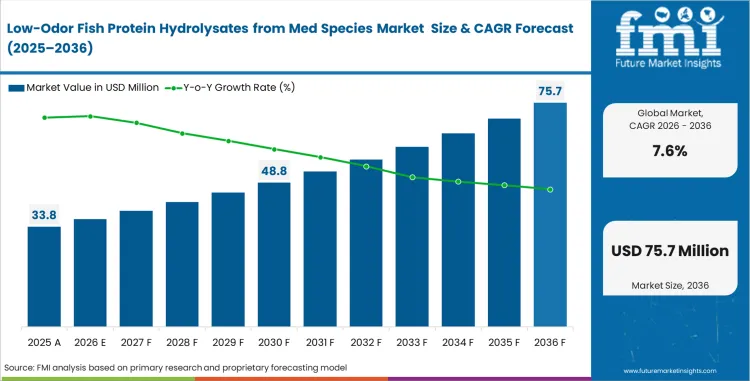
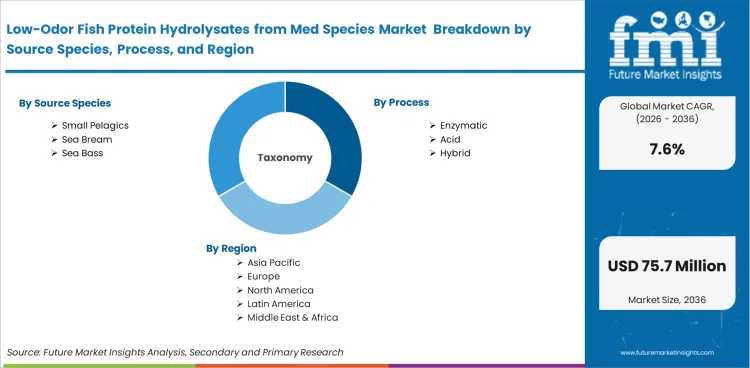
Low-odor fish protein hydrolysates from med species market was valued at USD 31.4 million in 2025. Industry outlook points to USD 33.8 million in 2026, advancing at a CAGR of 7.60% through the forecast period. By 2036, total valuation is expected to reach USD 70.3 million as peptide suppliers that keep odor low, amino acid release consistent, and raw material intake dependable move further into feed, pet food, and nutrition formulations.
Summary of Low-Odor Fish Protein Hydrolysates from Med Species Market
- Market Snapshot
- Low-odor fish protein hydrolysates from med species market is valued at USD 31.4 million in 2025 and is expected to reach USD 70.3 million by 2036.
- FMI places the industry outlook at a 7.6% CAGR from 2026 to 2036, creating an incremental opportunity of USD 36.5 million over the 2026 base.
- This remains a specialized marine ingredient category where odor control, peptide consistency, raw-material traceability, and purification quality carry more weight than tonnage alone.
- Valuation still depends heavily on Mediterranean processing residues, especially small pelagics and sea bream-sea bass side streams, because those inputs offer the most workable low-cost protein base for hydrolysis.
- Market Demand and Growth Drivers
- Fish by-products are drawing closer commercial attention because material that can account for roughly 30% to 70% of processed mass can be redirected into higher-value peptide ingredients instead of lower-value residual output.
- Low-odor formats are on a positive trend as deodorization, membrane filtration, and controlled enzymatic hydrolysis reduce sensory limits that would otherwise narrow food and nutrition use.
- Aquafeed and premium pet food are moving ahead first, largely because digestibility, palatability, and protein concentration support quicker commercial acceptance than mainstream human-food applications.
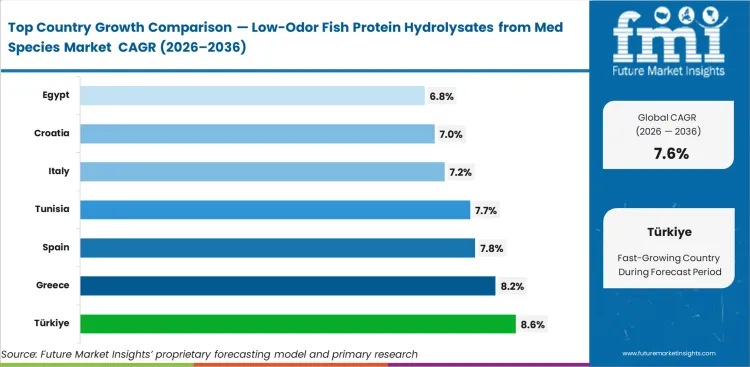
- Country outlook remains strongest in Türkiye at 8.6% through 2036, followed by Greece at 8.2%, Spain at 7.8%, Tunisia at 7.7%, Italy at 7.2%, Croatia at 7.0%, and Egypt at 6.8%.
- Expansion still faces limits from odor-control expense, uneven raw-material quality, fragmented side-stream collection, and the need to separate standard hydrolysates from higher-value low-odor grades.
- Market Product and Segment View
- The sector covers fish protein hydrolysates derived mainly from Mediterranean anchovy, sardine, mackerel, sea bream, sea bass, and mixed processing trimmings, with enzymatic or hybrid hydrolysis serving as the main production routes and powder or liquid formats shaping most commercial use.
- Since Mediterranean landings are broader and sardine-anchovy residues are easier to secure at scale, small pelagics are expected to account for 41% of the Source Species segment in 2026.
- Enzymatic processing is projected to represent 58% of the Process segment in 2026, as it gives suppliers tighter control over peptide profile and better odor correction than simpler bulk routes.
- Powder is likely to contribute 63% of market share by Form in 2026 since dry formats travel more easily, fit premix systems better, and face fewer shelf-life issues.
- Reflecting its faster commercial path for digestible marine-protein inputs, Aquafeed is forecast to make up 36% of the Application segment in 2026.
- Feed grade is anticipated to hold 47% of the Grade segment in 2026, even though food-grade and nutraceutical-grade lines offer the clearer premium route for low-odor differentiation.
- Scope includes deodorized and low-odor hydrolysates made from Mediterranean fish species and aquaculture side streams for aquafeed, pet food, functional food, nutraceutical, and clinical-nutrition use.
- Scope excludes commodity fishmeal, fish oils, collagen-only peptides, crustacean hydrolysates, fertilizer emulsions, and non-deodorized silage streams positioned at the low end of the value chain.
- Market Geography and Competitive Outlook
- Türkiye, Greece, and Spain remain the fastest-scaling production-linked countries, while Italy keeps its role as a technical base for higher-specification hydrolysate development.
- Competition centers on enzyme-process know-how, odor-remediation capability, side-stream supply contracts, spray-drying capacity, and access to aquafeed, pet nutrition, and human-nutrition channels.
Key Takeaways, Market Size, and Forecast
- Low‑Odor Fish Protein Hydrolysates from Mediterranean Species Market is projected to grow from USD 33.8 million in 2026 to USD 70.3 million by 2036, advancing at a CAGR of 7.6%.
- The market was valued at USD 31.4 million in 2025, reflecting its position as a specialized but rising marine ingredient category.
- The market is projected to create an incremental opportunity of USD 36.5 million between 2026 and 2036.
- In 2026, small pelagics are expected to account for 41.0% of the source species segment, benefiting from steadier side‑stream availability and blending flexibility.
- Türkiye (8.6%) and Greece (8.2%) are among the fastest‑growing markets, supported by dense sea bream and sea bass processing capacity.
| Metric | Details |
|---|---|
| Industry Size (2026) | USD 33.8 million |
| Industry Value (2036) | USD 70.3 million |
| CAGR (2026 to 2036) | 7.60% |
Source: Future Market Insights (FMI) analysis, based on proprietary forecasting model and primary research
Odor control now shapes commercial acceptance in a much clearer way than it did a few years ago. Feed formulators, pet food R&D heads, and nutrition ingredient managers may tolerate some variation in peptide profile, but repeat odor complaints rarely pass once a formula reaches commercial production. Low-odor grades therefore sit apart from standard fish protein hydrolysate and broader fish hydrolysate offerings. Bench performance no longer settles the argument on its own. Product development teams now look more closely at how hydrolysates behave after drying, during storage, through fat-system blending, and inside finished recipes, because a weak sensory outcome can delay account conversion for several cycles.
Pilot results start to carry more weight once drying teams and formulation leads see one batch maintain the same odor profile across repeated trials. Movement into premium protein hydrolysate applications becomes easier at that stage, since repeatability begins to matter as much as protein yield. Consistency is what turns technical interest into commercial use.
Türkiye industry outlook is predicted to garner a CAGR of 8.6% owing to dense sea bream and sea bass raw material availability from 2026 to 2036, while Greece follows at 8.2% for similar the same reason. Spain, where the CAGR is projected at 7.8%, and Tunisia, at 7.7% over the forecast, benefit from deeper pelagic handling tied to broader marine protein hydrolysate and marine feed demand. Italy keeps a more selective role in higher-specification development, with industry expansion tracking 7.2% through 2036. Croatia advances from smaller Adriatic side streams and is forecast at 7.0%, while Egypt, supported by aquaculture volume, reaches 6.8% even though more output still moves into simpler feed channels.
Segmental Analysis
Low-Odor Fish Protein Hydrolysates from Med Species Market Analysis by Source Species
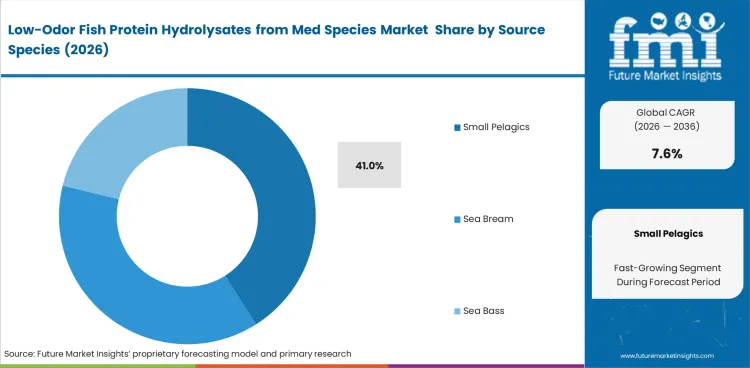
Raw material concentration explains why small pelagics keep their lead in this category. Sardine- and anchovy-heavy intake gives seafood processing managers a broader and more regular side-stream pool than sea bream, sea bass, or mackerel can usually provide, which lowers intake gaps and lets drying lines run more predictably. In 2026, small pelagics are projected to account for 41.0% share. The volume alone does not explain that lead. Feed ingredient managers also prefer raw material groups that can be blended across multiple catches without forcing constant sensory correction, and that advantage keeps small pelagics ahead even when premium species carry a stronger nutrition story. A common outside assumption is that premium fish automatically produce better hydrolysates. Commercial buyers rarely judge it that way. Consistency, intake rhythm, and drying behavior usually matter sooner than species prestige. Side-stream streams tied to broader fish meal and fishmeal and fish oil flows give plant managers a steadier operating base, while delayed collection or poor segregation quickly weakens odor control and lowers usable value.
- Landing continuity: Larger pelagic catches give seafood intake managers more dependable batches, which reduces stop-start hydrolysis runs and lowers the chance of uneven odor carryover.
- Blending discipline: Formulation leads can balance peptide profile and smell more effectively when raw material lots are broader, because extreme lot-to-lot variation raises trial rejection risk.
- Storage tolerance: Plant quality heads gain more room in chilled holding and pre-processing schedules, while weaker intake planning can push raw material quality down before hydrolysis starts.
Low-Odor Fish Protein Hydrolysates from Med Species Market Analysis by Process
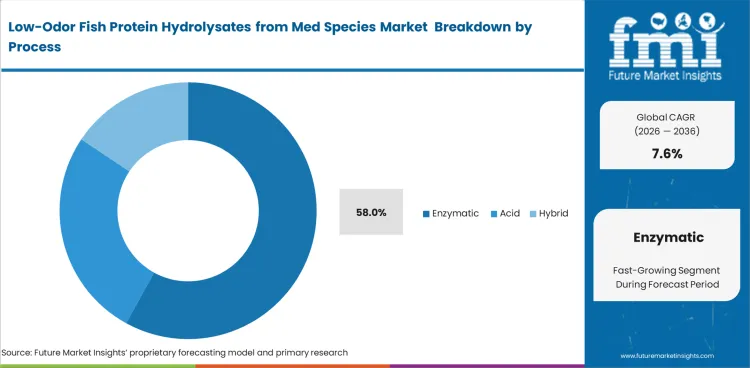
Process choice decides whether a hydrolysate remains a bulk marine protein or moves into a cleaner, higher-value ingredient slot. Enzymatic processing is expected to represent 58.0% share in 2026 because technical teams can guide peptide release more precisely, protect application fit, and reduce harsh notes that simpler routes often leave behind. The process lead here is not just a chemistry story. Product developers buy on how a hydrolysate behaves after drying, storage, and incorporation into finished formulas, and enzymatic routes usually give better control over those steps. Acid processing still serves lower-cost use, while membrane-filtered and hybrid routes improve refinement where sensory limits are tighter. Buyers who misjudge process fit often discover the problem late, after bench samples look acceptable but commercial runs amplify smell or handling weaknesses. Hence, process selection ends up deciding margin more often than yield alone.
- Peptide control: R&D directors favor enzymatic routes when odor targets are narrow, because tighter hydrolysis control lowers the chance of finished-formula rejection during later validation.
- Refinement sequencing: Plant managers using membrane or hybrid steps can remove off-notes more effectively, though extra processing adds cost and slows turnaround when schedules are tight.
- Grade matching: Commercial teams win more repeat business when process design matches end use early, since low-cost routes can undermine premium applications after scale-up.
Low-Odor Fish Protein Hydrolysates from Med Species Market Analysis by Form
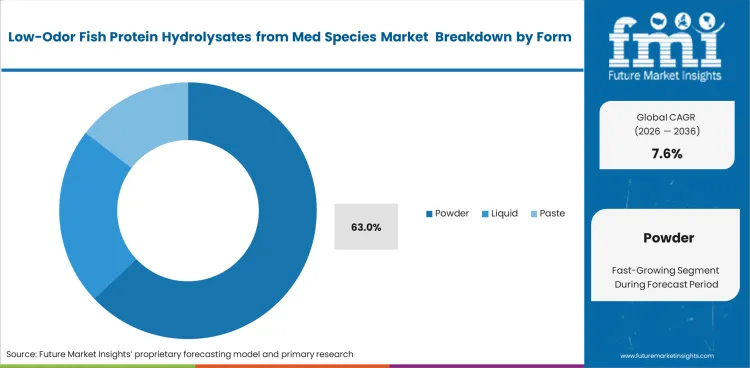
Powder is anticipated to represent 63.0% share in 2026. Handling reality keeps powder well ahead of liquid and paste in this category. Warehousing teams, contract blenders, and export managers all prefer dry formats when marine ingredients need longer shelf life, cleaner freight economics, and easier integration into premix systems. The form choice here says as much about downstream handling as it does about chemistry. Liquid hydrolysates can work well in selected feed uses, yet cross-border movement, storage stability, and dosing convenience usually push buyers back toward dry materials. Powder also makes comparison easier against adjacent ingredients such as fish collagen peptides and cultivated collagen peptides, where dry delivery already fits familiar buying routines. Product teams that choose form mainly on production ease can end up carrying higher storage strain, shorter usable windows, or avoidable freight burden once distribution widens.
- Freight discipline: Export managers prefer powder because lower shipping weight and cleaner handling reduce spoilage pressure and simplify multi-country deliveries.
- Blending ease: Feed mill formulation heads gain more precise dosing with dry inputs, while liquid use can demand extra tank, pump, and sanitation attention.
- Shelf-life control: Inventory planners get longer holding windows from powder formats, but weak drying discipline can still trap odor and create late-stage complaints.
Low-Odor Fish Protein Hydrolysates from Med Species Market Analysis by Application
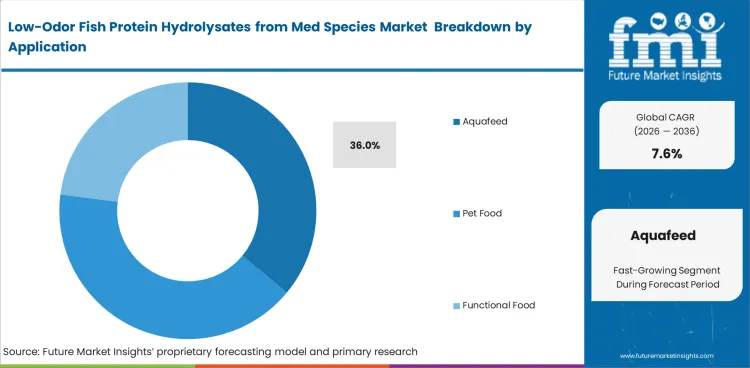
Application mix reflects where low-odor improvement earns a commercial premium fast enough to justify extra processing. Aquafeed is forecast to account for 36.0% share in 2026 because nutrition heads can use marine peptides to support digestibility and palatability without waiting for the slower approval path common in human nutrition. Application leadership here does not mean aquafeed is always the most demanding use. Pet food and nutraceutical buyers often ask harder sensory questions, especially when recipes move toward premium positioning. Aquafeed simply offers a wider first step. Demand from fish based pet food and marine nutraceutical uses keeps value higher at the premium end, yet feed programs still give suppliers the broadest starting base. Suppliers that enter applications without matching odor, solubility, and documentation to each use often face repeat trial cost before they secure any stable volume.
- Feed acceptance: Aquafeed formulators adopt first because marine peptide functionality fits familiar formulation logic and moves through validation faster than mainstream nutrition products.
- Sensory scrutiny: Pet food product managers can pay more for cleaner odor performance, though finished product smell remains a tougher screening step than basic feed trials.
- Value migration: Nutrition ingredient sales teams gain stronger margins when hydrolysates move into premium use, but weak documentation can stop that move early.
Low-Odor Fish Protein Hydrolysates from Med Species Market Analysis by Grade
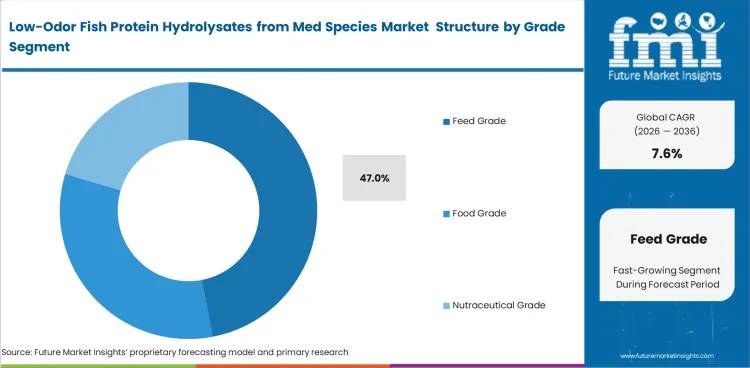
Grade separation shapes commercial value more than many first-time suppliers expect. Feed grade is likely to account for 47.0% share in 2026 because it absorbs larger output volumes, tolerates a wider cost envelope, and gives processors a quicker route to commercial turnover. Share leadership does not automatically indicate the best pricing position. Food-grade and nutraceutical-grade material can earn stronger value, yet each step up demands tighter odor control, cleaner documentation, and more careful consistency management. Buyers comparing refined hydrolysates against marine collagen or purified fish oil ingredients usually expect a more disciplined specification set once grade moves above feed use. Suppliers that label material too high without matching technical discipline risk failed audits, narrower repeat buying, and slower account conversion.
- Volume absorption: Feed-grade lines help processing managers clear larger side-stream flows, which matters when intake rhythm outruns premium demand windows.
- Specification burden: Quality leads face stricter screening as grade rises, because documentation gaps that pass in feed use can block food and nutraceutical entry.
- Margin balance: Commercial managers need both grade tiers, since high-volume feed sales keep capacity moving while refined grades protect value per kilogram.
Low-Odor Fish Protein Hydrolysates from Med Species Market Drivers, Restraints, and Opportunities
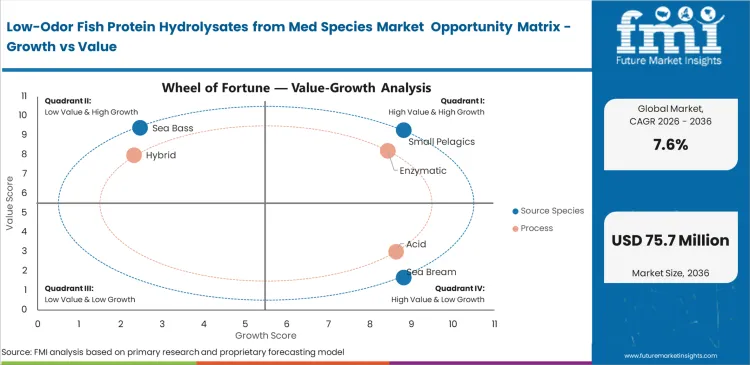
Side-stream monetization keeps this category moving. Seafood processors across Mediterranean species pools face constant pressure to turn more residual mass into saleable ingredients, and hydrolysis offers a practical route when suppliers can keep smell low enough for repeat formula use. Feed formulators and pet food developers also value marine proteins that combine digestibility with easier inclusion behavior. Interest in feed pet hydrolysates and broader feed protein hydrolysates reflects that shift toward cleaner, more application-ready marine proteins.
Approval drag still slows wider adoption. Quality teams may like hydrolysate performance at pilot stage, yet odor variation between lots, raw material inconsistency, and finished-formula carryover can delay repeat orders. Food and nutraceutical buyers are especially careful here. A hydrolysate that looks strong in a technical sheet can still fail once storage, blending, or flavor masking reveal weaknesses that early trials did not catch.
- Application upgrading: Pet food and nutraceutical suppliers can widen value capture by positioning low-odor grades where sensory penalties are severe and repeat quality matters most.
- Raw material sorting: Seafood processors that separate side streams more carefully at intake gain a better route to premium hydrolysate output instead of low-value residual channels.
- Specification clarity: Suppliers that define grade, odor tolerance, and use-case fit early reduce trial waste and shorten account qualification time.
Regional Analysis
.webp "Top Country Growth Comparison Low Odor Fish Protein Hydrolysates From Med Species Market Cagr (2026 2036)")
| Country | CAGR (2026 to 2036) |
|---|---|
| Türkiye | 8.6% |
| Greece | 8.2% |
| Spain | 7.8% |
| Tunisia | 7.7% |
| Italy | 7.2% |
| Croatia | 7.0% |
| Egypt | 6.8% |
Southern Europe Low-Odor Fish Protein Hydrolysates from Med Species Market Analysis
Southern Europe brings a useful mix of seafood handling experience, export discipline, and product-development capability, yet progress in low-odor hydrolysates does not move evenly across the sub-region. Spain carries broader commercial depth because pelagic intake is larger, marine ingredient know-how is better established, and processors are more accustomed to moving beyond residual utilization into value-added conversion. Italy follows a more selective route. Technical work there is tighter and more specialized, particularly where sea bream and sea bass side streams fit cleaner formulation objectives. Croatia operates on a smaller base, though that does not remove it from consideration. Regional sourcing remains narrower, but disciplined handling and shorter sourcing chains can still support viable hydrolysate programs where consistency matters more than volume. Southern Europe therefore works less as a single block and more as a set of country-specific operating models shaped by raw material mix, technical capability, and export readiness.
- Spain: Spain stands out because pelagic handling depth gives processors a broader raw material pool and better continuity across batches. That matters in low-odor hydrolysates, where commercial acceptance depends on repeat sensory performance rather than protein recovery alone. Industry outlook in Spain points to 7.8% CAGR through 2036, supported by established marine ingredient experience and a stronger ability to move material into export-linked applications. Formulation work is easier to scale when intake quality is less erratic and process teams can manage odor correction with fewer interruptions. Spain also benefits from a more practical bridge between industrial seafood processing and refined ingredient output. That link helps suppliers move beyond basic side-stream conversion into cleaner hydrolysate positioning for feed and premium use cases. Commercial potential remains tied to how consistently processors can preserve raw material quality before hydrolysis begins.
- Italy: Italy is expected to post 7.2% CAGR in this market. It holds a narrower yet more technically defined place in this category. Sea bream and sea bass side streams fit well with higher-specification development, especially where processors and product developers are working toward cleaner peptide profiles and more controlled sensory results. Raw material pools remain tighter than in larger pelagic bases, so sector progress depends less on scale and more on precision. By 2036. That figure reflects a more selective industry outlook rather than a weak position. Italian activity is more likely to sit in differentiated hydrolysate development than in broad-volume conversion. Technical refinement gives the country relevance where application fit matters more than throughput. Suppliers that can keep input handling disciplined and batch quality consistent have a clearer route into specialized uses, even if overall commercial spread stays more limited than in Spain.
- Croatia: Croatia works from smaller Adriatic side streams, which gives the country a different commercial profile from larger Mediterranean processors. Scale is limited, so local sourcing discipline and shorter handling routes carry more weight, especially in hydrolysates where odor control can weaken quickly if raw material quality slips. Smaller intake can still support targeted programs where technical control and regional proximity matter more than bulk availability. Croatia is better read as a selective opportunity than a broad-volume platform. Processors that keep sourcing clean, handling windows tight, and batch quality stable can still build commercially relevant positions in uses where consistency matters more than sheer supply depth. Industry outlook in Croatia points to 7.0% CAGR through 2036. That pace remains measured, though it still leaves room for niche development.
Eastern Mediterranean Low-Odor Fish Protein Hydrolysates from Med Species Market Analysis
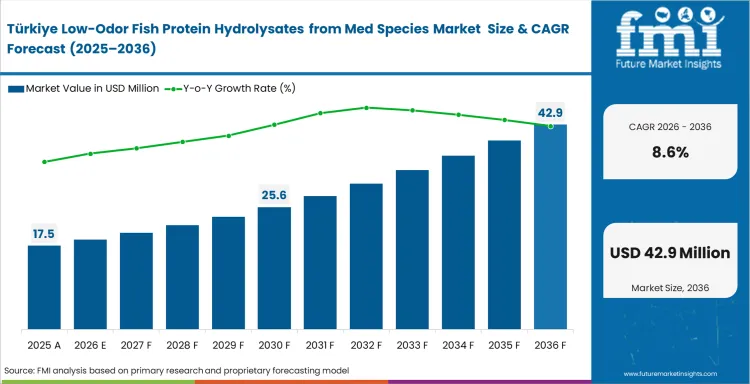
Eastern Mediterranean supply strength comes from concentrated aquaculture activity and closer access to sea bream and sea bass processing flows. Raw material availability is the main reason this part of the region sits ahead in the outlook. Türkiye leads because scale, intake continuity, and conversion potential line up more clearly there than in most neighboring markets. Greece follows from a similar species base, though total commercial spread is somewhat narrower and the operating base is less expansive. What matters in this sub-region is not only access to fish side streams, but the ability to move them into hydrolysate conversion before handling quality drops. That gives Eastern Mediterranean processors a practical advantage in a category where odor stability and usable peptide output depend heavily on early-stage control. Regional progress is therefore tied to how well aquaculture-linked side streams are converted into cleaner, better-positioned ingredient formats.
- Türkiye: Türkiye holds a clear advantage because dense sea bream and sea bass production provides broader raw material continuity for hydrolysate conversion. Intake rhythm matters in this category, and Turkish processors are better placed when batches need to move through handling and drying with minimal disruption. Ingredient suppliers also benefit from a wider processing base, which helps qualification work move ahead with fewer interruptions once sample programs start. Türkiye is likely to register 8.6% CAGR in this market by 2036. Scale remains the main reason it sits at the top of the country ranking, though scale by itself is not enough. Commercial strength comes from pairing that raw material base with steadier conversion discipline and a better chance of maintaining odor consistency across repeated runs. Suppliers active in Türkiye have a more practical route into both broader feed use and more refined applications, provided technical control remains tight through drying and formulation stages.
- Greece: Greece remains close to Türkiye because aquaculture concentration gives it a steady premium-species side-stream base, especially in sea bream and sea bass. That raw material profile supports higher-specification hydrolysate development and gives processors a stronger starting point for applications where sensory performance carries real commercial weight. Commercial width is still narrower than in Türkiye, largely because total scale is smaller and broader conversion capacity is more limited. Greece is less likely to compete on breadth and more likely to matter where species profile, technical handling, and premium-use suitability carry greater weight. Suppliers that maintain consistency can build differentiated positions here, particularly in applications where product quality matters more than volume flexibility. Industry outlook in Greece points to 8.2% CAGR through 2036. That pace keeps the country firmly relevant in refined hydrolysate development.
North Africa Low-Odor Fish Protein Hydrolysates from Med Species Market Analysis
North Africa follows two distinct commercial routes in this category, and that split matters when interpreting country outlook. Tunisia benefits from pelagic processing links and shorter access into Mediterranean ingredient trade. Egypt, by contrast, brings much larger aquaculture volume, but a greater share of material still moves through simpler feed channels before refined hydrolysate conversion becomes routine. One country therefore offers a more export-linked route into cleaner marine ingredients, while the other offers a larger raw material base that still needs stronger conversion discipline to support premium peptide positioning. That difference shapes commercial timing across the sub-region. North Africa remains relevant, though progress depends less on raw volume alone and more on whether processors can move side streams into higher-control hydrolysis instead of leaving them in lower-value output streams.
- Tunisia: Tunisia is forecast to post 7.7% CAGR in low-odor fish protein hydrolysates through 2036. The country benefits from pelagic processing capability and shorter access into Mediterranean ingredient trade, which makes it commercially relevant even without the broadest raw material base in the wider region. Export fit is a central advantage here. Processors that keep odor low and powder quality stable have a clearer route into external ingredient demand, especially where buyers expect better batch discipline than basic residual channels can offer. That outlook reflects a country positioned between practical raw material access and workable export orientation. Tunisia may not carry the same volume appeal as larger fisheries or aquaculture bases, yet it remains well placed where processing competence and delivery into regional ingredient channels matter more than scale alone. Commercial traction will depend on keeping conversion quality consistent enough to support repeat acceptance.
- Egypt: Egypt stays commercially relevant because aquaculture volume is substantial, but that advantage does not automatically translate into faster movement in low-odor hydrolysates. A larger share of side-stream material still travels through simpler feed routes, which slows conversion into cleaner, more carefully documented ingredient channels. Wider uptake therefore depends on how much of that raw material base can be redirected toward higher-control hydrolysis and more reliable sensory management. A CAGR of 6.8% is expected for the Egypt market through 2036. That position is slower than the leading countries, yet it still reflects meaningful sector movement. Egypt’s role is shaped more by conversion discipline than by raw material access, since volume is already present. Suppliers able to improve processing consistency, documentation, and odor management will be better placed to move more material up the value chain over time.
Mediterranean growth does not move as one block. Countries closer to premium aquaculture side streams and refined marine collagen applications move faster, while places tied more closely to bulk fish oil and simpler feed output take longer to convert side streams into higher-value low-odor peptides.
Competitive Aligners for Market Players
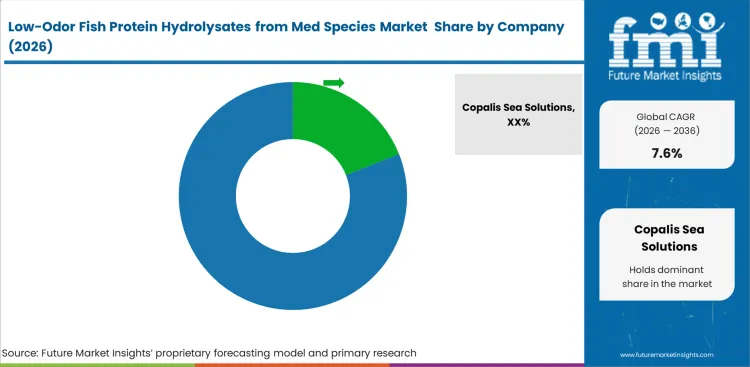
Competition in this category centers on repeat batch behavior rather than headline protein claims. Copalis Sea Solutions, SOPROPECHE, Bio-Marine Ingredients Ireland Ltd., and Scanbio Marine Group all sit in a part of marine ingredients where buying teams test smell, solubility, drying performance, and formulation carryover before they commit. Basic product availability rarely closes business here. Confidence in lot-to-lot behavior does.
Symrise Aqua Feed and Hofseth BioCare ASA benefit when buyers want marine ingredient partners that can speak to application fit rather than supply raw protein alone. That matters more as hydrolysates are compared with adjacent peptide ingredients such as fish collagen peptides and cultivated collagen peptides. Smaller challengers can still win business, though they usually need a sharper use-case focus and cleaner sample-to-scale consistency.
Buyer power stays meaningful because formula teams can test marine proteins against multiple adjacent options before fixing a specification. Janatha Fish Meal & Oil Products and other marine protein suppliers gain ground when they meet odor limits, provide reliable documentation, and keep quality variation under control. Locked-in positions are harder to defend here than in bulk marine proteins because one failed validation round can quickly reopen an account for rivals.
Key Players in Low-Odor Fish Protein Hydrolysates from Med Species Market
- Copalis Sea Solutions
- Symrise Aqua Feed
- SOPROPECHE
- Bio-Marine Ingredients Ireland Ltd.
- Scanbio Marine Group
- Hofseth BioCare ASA
- Janatha Fish Meal & Oil Products
Scope of the Report
| Metric | Value |
|---|---|
| Quantitative Units | USD 33.8 million in 2026, and USD 70.3 million by 2036, at a CAGR of 7.60% |
| Market Definition | Low-odor fish protein hydrolysates derived from Mediterranean fish species and side streams, processed to improve sensory performance, peptide consistency, and application suitability across feed, pet food, and selected nutrition uses. |
| Segmentation | By Source Species, Process, Form, Application, Grade, and Region |
| Regions Covered | Southern Europe, Eastern Mediterranean, North Africa |
| Countries Covered | Türkiye, Greece, Spain, Tunisia, Italy, Croatia, Egypt |
| Key Companies Profiled | Copalis Sea Solutions, Symrise Aqua Feed, SOPROPECHE, Bio-Marine Ingredients Ireland Ltd., Scanbio Marine Group, Hofseth BioCare ASA, Janatha Fish Meal & Oil Products |
| Forecast Period | 2026 to 2036 |
| Approach | Bottom-up volume-to-value sizing built from Mediterranean side-stream availability, hydrolysis conversion, odor-control intensity, and use-case-adjusted selling values |
Source: Future Market Insights (FMI) analysis, based on proprietary forecasting model and primary research
Low-Odor Fish Protein Hydrolysates from Med Species Market Analysis by Segments
By Source Species
- Small Pelagics
- Sea Bream
- Sea Bass
- Mackerel
- Mixed Trimmings
By Process
- Enzymatic
- Acid
- Membrane-Filtered
- Hybrid
By Form
- Powder
- Liquid
- Paste
By Application
- Aquafeed
- Pet Food
- Functional Food
- Nutraceuticals
- Clinical Nutrition
By Grade
- Feed Grade
- Food Grade
- Nutraceutical Grade
By Region
- Southern Europe
- Spain
- Italy
- Croatia
- Eastern Mediterranean
- Türkiye
- Greece
- North Africa
- Tunisia
- Egypt
Bibliography
- European Market Observatory for Fisheries and Aquaculture Products. (2025). The EU fish market 2025 edition. Publications Office of the European Union.
- Federation of European Aquaculture Producers. (2025, January 22). European aquaculture production report 2017-2023 (V1.0).
- Honrado, A., Miguel, M., Ardila, P., Beltrán, J. A., & Calanche, J. B. (2024, September 29). From waste to value: Fish protein hydrolysates as a technological and functional ingredient in human nutrition. Foods, 13(19), 3120.
- IFFO - The Marine Ingredients Organisation. (2025, July). The modern face of marine ingredient production.
- Jenssen, M., Matic, J., Sone, I., Solberg, N. T., Wubshet, S., & Lian, K. (2025, May 06). Protein hydrolysates from Italian sea bream and sea bass aquaculture side streams - chemical, biological, and techno-functional characterization. Frontiers in Marine Science, 12, 1572015.
This bibliography is provided for reader reference. The full FMI report contains the complete reference list with primary source documentation.
This Report Addresses
- Low-odor hydrolysate value creation from Mediterranean small pelagics, sea bream, sea bass, mackerel, and mixed trimming streams.
- Process-level separation between enzymatic, acid, membrane-filtered, and hybrid hydrolysis routes in refined marine protein conversion.
- Commercial difference between powder, liquid, and paste formats when storage, freight, and blending behavior shape account acceptance.
- Application split across aquafeed, pet food, functional food, nutraceuticals, and clinical nutrition with odor sensitivity as a recurring filter.
- Grade movement from feed-grade volume into food-grade and nutraceutical-grade value where documentation and sensory control tighten.
- Country-level outlook for Türkiye, Greece, Spain, Tunisia, Italy, Croatia, and Egypt with varied raw material availability and processing depth.
- Competitive positioning of Copalis Sea Solutions, Symrise Aqua Feed, SOPROPECHE, Bio-Marine Ingredients Ireland Ltd., Scanbio Marine Group, Hofseth BioCare ASA, and Janatha Fish Meal & Oil Products.
- Forecast view for 2026 to 2036 anchored to USD 33.8 million in 2026, USD 70.3 million by 2036, and a CAGR of 7.60%.
Frequently Asked Questions
What is the 2025 value of Low-Odor Fish Protein Hydrolysates from Med Species Market?
FMI estimates USD 31.4 million for 2025. That level points to a niche ingredient category rather than a bulk marine protein business.
What value is expected for 2026?
Demand is expected to reach USD 33.8 million in 2026. Early scale still comes mostly from feed and pet food applications.
What value is projected for 2036?
FMI projects USD 70.3 million by 2036. That outcome signals wider acceptance of low-odor grades in higher-specification applications.
What CAGR is expected from 2026 to 2036?
Low-Odor Fish Protein Hydrolysates from Med Species Market is expected to rise at 7.60% CAGR. That pace fits a specialized ingredient category with selective premium adoption.
Why do small pelagics lead source species demand?
Small pelagics give processors broader and steadier side-stream supply. Consistent intake helps drying teams maintain repeat odor and peptide behavior.
Why does enzymatic processing lead this category?
Enzymatic routes give tighter control over peptide release and smell. Formulation teams prefer that control when finished-recipe acceptance matters.
Why does powder lead by form?
Powder fits storage, freight, and premix handling better than wet formats. Distribution teams also face fewer shelf-life and dosing complications.
Why does aquafeed lead by application?
Aquafeed gives suppliers a faster commercial entry point. Feed formulators can test hydrolysates sooner than human-nutrition teams facing tighter sensory screening.
Why does feed grade stay ahead of higher grades?
Feed grade absorbs larger output and moves faster through commercial channels. Food and nutraceutical grades can earn better value but need stricter control.
Why does Türkiye rise faster than Greece?
Türkiye combines broader raw material availability with a larger processing base. Greece remains strong, though total conversion breadth is somewhat narrower.
What makes odor control so important in this category?
Smell issues can halt repeat buying even after a promising trial. Finished formulas expose weaknesses that technical sheets often fail to show.
What does low odor actually mean for buyers?
Low odor means easier inclusion in finished recipes without harsh carryover. Product teams treat that as a commercial requirement, not a cosmetic benefit.
How do buyers screen hydrolysates before approval?
Teams usually test odor, solubility, storage behavior, and blend performance. One weak result can delay account conversion for several cycles.
Which application offers the broadest first-step opportunity?
Aquafeed offers the broadest first-step route today. Premium pet food and nutraceuticals usually deliver better value once quality proof is stronger.
Why are premium species not always the best raw material choice?
Premium species may carry a better nutrition story, yet intake rhythm matters more. Buyers usually reward consistency before they reward species prestige.
What keeps food-grade and nutraceutical-grade expansion slower?
Tighter documentation and lower tolerance for odor variation slow those grades. Sample success must carry into storage and finished-formula performance.
How do liquid and paste formats remain relevant?
Wet formats still suit selected feed or plant-use cases. Their reach narrows once freight, dosing, and storage burden start to outweigh convenience.
What is the main risk for new suppliers entering this category?
Late-stage sensory failure remains a major risk. A batch that works in pilot form may fail after drying or commercial blending.
Which Mediterranean countries look most commercially attractive?
Türkiye, Greece, Spain, and Tunisia stand out first. Each combines raw material access with a stronger route into refined marine ingredient conversion.
How does this category differ from fishmeal?
Fishmeal serves broader bulk feed use with less sensory refinement. Low-odor hydrolysates target cleaner peptide functionality and closer formulation fit.
What buyer groups matter most in this category?
Aquafeed formulators, pet food R&D heads, ingredient distributors, and seafood processing managers matter most. Each influences acceptance at a different stage.
What will change most by 2036?
More value will shift toward suppliers that prove repeat odor control. Basic hydrolysis capacity alone will be less convincing in premium accounts.
Preview the report firsthand - request a free sample
Get SampleGet the brochure for pricing and purchase details.
Get PDFTable of Content
- Executive Summary
- Global Market Outlook
- Demand-side Trends
- Supply-side Trends
- Technology Roadmap Analysis
- Analysis and Recommendations
- Market Overview
- Market Coverage / Taxonomy
- Market Definition / Scope / Limitations
- Research Methodology
- Chapter Orientation
- Analytical Lens and Working Hypotheses
- Market Structure, Signals, and Trend Drivers
- Benchmarking and Cross-market Comparability
- Market Sizing, Forecasting, and Opportunity Mapping
- Research Design and Evidence Framework
- Desk Research Programme (Secondary Evidence)
- Company Annual and Sustainability Reports
- Peer-reviewed Journals and Academic Literature
- Corporate Websites, Product Literature, and Technical Notes
- Earnings Decks and Investor Briefings
- Statutory Filings and Regulatory Disclosures
- Technical White Papers and Standards Notes
- Trade Journals, Industry Magazines, and Analyst Briefs
- Conference Proceedings, Webinars, and Seminar Materials
- Government Statistics Portals and Public Data Releases
- Press Releases and Reputable Media Coverage
- Specialist Newsletters and Curated Briefings
- Sector Databases and Reference Repositories
- FMI Internal Proprietary Databases and Historical Market Datasets
- Subscription Datasets and Paid Sources
- Social Channels, Communities, and Digital Listening Inputs
- Additional Desk Sources
- Expert Input and Fieldwork (Primary Evidence)
- Primary Modes
- Qualitative Interviews and Expert Elicitation
- Quantitative Surveys and Structured Data Capture
- Blended Approach
- Why Primary Evidence is Used
- Field Techniques
- Interviews
- Surveys
- Focus Groups
- Observational and In-context Research
- Social and Community Interactions
- Stakeholder Universe Engaged
- C-suite Leaders
- Board Members
- Presidents and Vice Presidents
- R&D and Innovation Heads
- Technical Specialists
- Domain Subject-matter Experts
- Scientists
- Physicians and Other Healthcare Professionals
- Governance, Ethics, and Data Stewardship
- Research Ethics
- Data Integrity and Handling
- Primary Modes
- Tooling, Models, and Reference Databases
- Desk Research Programme (Secondary Evidence)
- Data Engineering and Model Build
- Data Acquisition and Ingestion
- Cleaning, Normalisation, and Verification
- Synthesis, Triangulation, and Analysis
- Quality Assurance and Audit Trail
- Market Background
- Market Dynamics
- Drivers
- Restraints
- Opportunity
- Trends
- Scenario Forecast
- Demand in Optimistic Scenario
- Demand in Likely Scenario
- Demand in Conservative Scenario
- Opportunity Map Analysis
- Product Life Cycle Analysis
- Supply Chain Analysis
- Investment Feasibility Matrix
- Value Chain Analysis
- PESTLE and Porter’s Analysis
- Regulatory Landscape
- Regional Parent Market Outlook
- Production and Consumption Statistics
- Import and Export Statistics
- Market Dynamics
- Global Market Analysis 2021 to 2025 and Forecast, 2026 to 2036
- Historical Market Size Value (USD Million) Analysis, 2021 to 2025
- Current and Future Market Size Value (USD Million) Projections, 2026 to 2036
- Y-o-Y Growth Trend Analysis
- Absolute $ Opportunity Analysis
- Global Market Pricing Analysis 2021 to 2025 and Forecast 2026 to 2036
- Global Market Analysis 2021 to 2025 and Forecast 2026 to 2036, By Source Species
- Introduction / Key Findings
- Historical Market Size Value (USD Million) Analysis By Source Species , 2021 to 2025
- Current and Future Market Size Value (USD Million) Analysis and Forecast By Source Species , 2026 to 2036
- Small Pelagics
- Sea Bream
- Sea Bass
- Small Pelagics
- Y-o-Y Growth Trend Analysis By Source Species , 2021 to 2025
- Absolute $ Opportunity Analysis By Source Species , 2026 to 2036
- Global Market Analysis 2021 to 2025 and Forecast 2026 to 2036, By Process
- Introduction / Key Findings
- Historical Market Size Value (USD Million) Analysis By Process, 2021 to 2025
- Current and Future Market Size Value (USD Million) Analysis and Forecast By Process, 2026 to 2036
- Enzymatic
- Acid
- Hybrid
- Enzymatic
- Y-o-Y Growth Trend Analysis By Process, 2021 to 2025
- Absolute $ Opportunity Analysis By Process, 2026 to 2036
- Global Market Analysis 2021 to 2025 and Forecast 2026 to 2036, By Form
- Introduction / Key Findings
- Historical Market Size Value (USD Million) Analysis By Form, 2021 to 2025
- Current and Future Market Size Value (USD Million) Analysis and Forecast By Form, 2026 to 2036
- Powder
- Liquid
- Paste
- Powder
- Y-o-Y Growth Trend Analysis By Form, 2021 to 2025
- Absolute $ Opportunity Analysis By Form, 2026 to 2036
- Global Market Analysis 2021 to 2025 and Forecast 2026 to 2036, By Application
- Introduction / Key Findings
- Historical Market Size Value (USD Million) Analysis By Application, 2021 to 2025
- Current and Future Market Size Value (USD Million) Analysis and Forecast By Application, 2026 to 2036
- Aquafeed
- Pet Food
- Functional Food
- Aquafeed
- Y-o-Y Growth Trend Analysis By Application, 2021 to 2025
- Absolute $ Opportunity Analysis By Application, 2026 to 2036
- Global Market Analysis 2021 to 2025 and Forecast 2026 to 2036, By Grade
- Introduction / Key Findings
- Historical Market Size Value (USD Million) Analysis By Grade, 2021 to 2025
- Current and Future Market Size Value (USD Million) Analysis and Forecast By Grade, 2026 to 2036
- Feed Grade
- Food Grade
- Nutraceutical Grade
- Feed Grade
- Y-o-Y Growth Trend Analysis By Grade, 2021 to 2025
- Absolute $ Opportunity Analysis By Grade, 2026 to 2036
- Global Market Analysis 2021 to 2025 and Forecast 2026 to 2036, By Region
- Introduction
- Historical Market Size Value (USD Million) Analysis By Region, 2021 to 2025
- Current Market Size Value (USD Million) Analysis and Forecast By Region, 2026 to 2036
- North America
- Latin America
- Western Europe
- Eastern Europe
- East Asia
- South Asia and Pacific
- Middle East & Africa
- Market Attractiveness Analysis By Region
- North America Market Analysis 2021 to 2025 and Forecast 2026 to 2036, By Country
- Historical Market Size Value (USD Million) Trend Analysis By Market Taxonomy, 2021 to 2025
- Market Size Value (USD Million) Forecast By Market Taxonomy, 2026 to 2036
- By Country
- USA
- Canada
- Mexico
- By Source Species
- By Process
- By Form
- By Application
- By Grade
- By Country
- Market Attractiveness Analysis
- By Country
- By Source Species
- By Process
- By Form
- By Application
- By Grade
- Key Takeaways
- Latin America Market Analysis 2021 to 2025 and Forecast 2026 to 2036, By Country
- Historical Market Size Value (USD Million) Trend Analysis By Market Taxonomy, 2021 to 2025
- Market Size Value (USD Million) Forecast By Market Taxonomy, 2026 to 2036
- By Country
- Brazil
- Chile
- Rest of Latin America
- By Source Species
- By Process
- By Form
- By Application
- By Grade
- By Country
- Market Attractiveness Analysis
- By Country
- By Source Species
- By Process
- By Form
- By Application
- By Grade
- Key Takeaways
- Western Europe Market Analysis 2021 to 2025 and Forecast 2026 to 2036, By Country
- Historical Market Size Value (USD Million) Trend Analysis By Market Taxonomy, 2021 to 2025
- Market Size Value (USD Million) Forecast By Market Taxonomy, 2026 to 2036
- By Country
- Germany
- UK
- Italy
- Spain
- France
- Nordic
- BENELUX
- Rest of Western Europe
- By Source Species
- By Process
- By Form
- By Application
- By Grade
- By Country
- Market Attractiveness Analysis
- By Country
- By Source Species
- By Process
- By Form
- By Application
- By Grade
- Key Takeaways
- Eastern Europe Market Analysis 2021 to 2025 and Forecast 2026 to 2036, By Country
- Historical Market Size Value (USD Million) Trend Analysis By Market Taxonomy, 2021 to 2025
- Market Size Value (USD Million) Forecast By Market Taxonomy, 2026 to 2036
- By Country
- Russia
- Poland
- Hungary
- Balkan & Baltic
- Rest of Eastern Europe
- By Source Species
- By Process
- By Form
- By Application
- By Grade
- By Country
- Market Attractiveness Analysis
- By Country
- By Source Species
- By Process
- By Form
- By Application
- By Grade
- Key Takeaways
- East Asia Market Analysis 2021 to 2025 and Forecast 2026 to 2036, By Country
- Historical Market Size Value (USD Million) Trend Analysis By Market Taxonomy, 2021 to 2025
- Market Size Value (USD Million) Forecast By Market Taxonomy, 2026 to 2036
- By Country
- China
- Japan
- South Korea
- By Source Species
- By Process
- By Form
- By Application
- By Grade
- By Country
- Market Attractiveness Analysis
- By Country
- By Source Species
- By Process
- By Form
- By Application
- By Grade
- Key Takeaways
- South Asia and Pacific Market Analysis 2021 to 2025 and Forecast 2026 to 2036, By Country
- Historical Market Size Value (USD Million) Trend Analysis By Market Taxonomy, 2021 to 2025
- Market Size Value (USD Million) Forecast By Market Taxonomy, 2026 to 2036
- By Country
- India
- ASEAN
- Australia & New Zealand
- Rest of South Asia and Pacific
- By Source Species
- By Process
- By Form
- By Application
- By Grade
- By Country
- Market Attractiveness Analysis
- By Country
- By Source Species
- By Process
- By Form
- By Application
- By Grade
- Key Takeaways
- Middle East & Africa Market Analysis 2021 to 2025 and Forecast 2026 to 2036, By Country
- Historical Market Size Value (USD Million) Trend Analysis By Market Taxonomy, 2021 to 2025
- Market Size Value (USD Million) Forecast By Market Taxonomy, 2026 to 2036
- By Country
- Kingdom of Saudi Arabia
- Other GCC Countries
- Turkiye
- South Africa
- Other African Union
- Rest of Middle East & Africa
- By Source Species
- By Process
- By Form
- By Application
- By Grade
- By Country
- Market Attractiveness Analysis
- By Country
- By Source Species
- By Process
- By Form
- By Application
- By Grade
- Key Takeaways
- Key Countries Market Analysis
- USA
- Pricing Analysis
- Market Share Analysis, 2025
- By Source Species
- By Process
- By Form
- By Application
- By Grade
- Canada
- Pricing Analysis
- Market Share Analysis, 2025
- By Source Species
- By Process
- By Form
- By Application
- By Grade
- Mexico
- Pricing Analysis
- Market Share Analysis, 2025
- By Source Species
- By Process
- By Form
- By Application
- By Grade
- Brazil
- Pricing Analysis
- Market Share Analysis, 2025
- By Source Species
- By Process
- By Form
- By Application
- By Grade
- Chile
- Pricing Analysis
- Market Share Analysis, 2025
- By Source Species
- By Process
- By Form
- By Application
- By Grade
- Germany
- Pricing Analysis
- Market Share Analysis, 2025
- By Source Species
- By Process
- By Form
- By Application
- By Grade
- UK
- Pricing Analysis
- Market Share Analysis, 2025
- By Source Species
- By Process
- By Form
- By Application
- By Grade
- Italy
- Pricing Analysis
- Market Share Analysis, 2025
- By Source Species
- By Process
- By Form
- By Application
- By Grade
- Spain
- Pricing Analysis
- Market Share Analysis, 2025
- By Source Species
- By Process
- By Form
- By Application
- By Grade
- France
- Pricing Analysis
- Market Share Analysis, 2025
- By Source Species
- By Process
- By Form
- By Application
- By Grade
- India
- Pricing Analysis
- Market Share Analysis, 2025
- By Source Species
- By Process
- By Form
- By Application
- By Grade
- ASEAN
- Pricing Analysis
- Market Share Analysis, 2025
- By Source Species
- By Process
- By Form
- By Application
- By Grade
- Australia & New Zealand
- Pricing Analysis
- Market Share Analysis, 2025
- By Source Species
- By Process
- By Form
- By Application
- By Grade
- China
- Pricing Analysis
- Market Share Analysis, 2025
- By Source Species
- By Process
- By Form
- By Application
- By Grade
- Japan
- Pricing Analysis
- Market Share Analysis, 2025
- By Source Species
- By Process
- By Form
- By Application
- By Grade
- South Korea
- Pricing Analysis
- Market Share Analysis, 2025
- By Source Species
- By Process
- By Form
- By Application
- By Grade
- Russia
- Pricing Analysis
- Market Share Analysis, 2025
- By Source Species
- By Process
- By Form
- By Application
- By Grade
- Poland
- Pricing Analysis
- Market Share Analysis, 2025
- By Source Species
- By Process
- By Form
- By Application
- By Grade
- Hungary
- Pricing Analysis
- Market Share Analysis, 2025
- By Source Species
- By Process
- By Form
- By Application
- By Grade
- Kingdom of Saudi Arabia
- Pricing Analysis
- Market Share Analysis, 2025
- By Source Species
- By Process
- By Form
- By Application
- By Grade
- Turkiye
- Pricing Analysis
- Market Share Analysis, 2025
- By Source Species
- By Process
- By Form
- By Application
- By Grade
- South Africa
- Pricing Analysis
- Market Share Analysis, 2025
- By Source Species
- By Process
- By Form
- By Application
- By Grade
- USA
- Market Structure Analysis
- Competition Dashboard
- Competition Benchmarking
- Market Share Analysis of Top Players
- By Regional
- By Source Species
- By Process
- By Form
- By Application
- By Grade
- Competition Analysis
- Competition Deep Dive
- Copalis Sea Solutions
- Overview
- Product Portfolio
- Profitability by Market Segments (Product/Age /Sales Channel/Region)
- Sales Footprint
- Strategy Overview
- Marketing Strategy
- Product Strategy
- Channel Strategy
- Symrise Aqua Feed
- SOPROPECHE
- Bio-Marine Ingredients Ireland Ltd.
- Scanbio Marine Group
- Hofseth BioCare ASA
- Copalis Sea Solutions
- Competition Deep Dive
- Assumptions & Acronyms Used


