

- Industry Size (2026)
- USD 415.0 Mn
- Forecast (2036)
- USD 879.0 Mn
- CAGR (2026 to 2036)
- 7.8%
Cultivated Fish Collagen Peptides Market Size, Market Forecast and Outlook By FMI
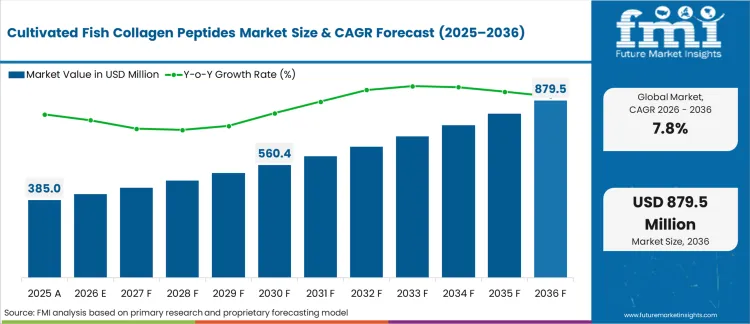
In 2025, the global cultivated fish collagen peptides market was valued at USD 385.0 million. Based on Future Market Insights analysis, the market is estimated to reach USD 415.0 million in 2026 and USD 879.0 million by 2036. FMI projects a CAGR of 7.8% between 2026 and 2036.
The market will add an absolute value of USD 464.0 million between 2026 and 2036, reflecting a near-doubling of the revenue base over the forecast horizon. FMI characterizes this as a compound multiplication trajectory supported by expansion across established and emerging application categories. These projections represent FMI's base-case scenario, contingent on prevailing macroeconomic conditions, consumer spending trends, and regulatory changes across key markets. Growth is primarily driven by rising consumer demand for bioavailable protein supplements, clean-label collagen sources, and aquaculture by-product utilization programs that allow manufacturers to convert fish processing waste into high-value functional ingredients.
Across the global marketplace, consumption of cultivated fish collagen peptides sits at different stages of penetration by region and income level. North America and Western Europe represent premium-market leaders, where demand is driven by value-added nutraceutical formats, sports nutrition, and functional beverage applications with strong per-unit pricing. East Asia - led by Japan and South Korea - occupies a mature and culturally embedded position, where fish-derived collagen is a well-accepted dietary supplement format.
Summary of Cultivated Fish Collagen Peptides Market
- Demand Drivers
- Rising consumer awareness of collagen's role in joint health, skin elasticity, and muscle recovery is accelerating nutraceutical supplement adoption, particularly among adults aged 35 and above in North America, Europe, and urban East Asia, where per-capita supplement spending has grown consistently over the past decade.
- Aquaculture expansion in Asia Pacific and Latin America is broadening the supply base for fish processing by-products, enabling greater raw material availability and lower input costs, which in turn supports product affordability and market penetration in mid-income consumer segments.
- Growing consumer preference for non-bovine, halal-certified, and pescatarian-compatible protein sources is redirecting collagen purchasing decisions from bovine gelatin toward marine and fish-derived peptides, particularly in Middle Eastern, Southeast Asian, and Jewish consumer markets where dietary certification is a purchase prerequisite.
- Key Segments Analysed in the FMI Report
- Nutraceuticals and Dietary Supplements (approximately 42% revenue share): This segment leads the market owing to strong consumer pull for collagen as a standalone supplement - driven by beauty-from-within positioning, joint support claims, and sports recovery formats - combined with high per-unit pricing and established retail shelf placement across pharmacy and health-specialty channels.
- Powder Product Form (approximately 55% volume share): Powder is the dominant delivery format because of its versatility in both consumer self-mixing applications (dissolving into beverages) and industrial use in food and beverage formulation. Its low moisture content extends shelf life and simplifies logistics across both ambient retail and B2B ingredient supply chains.
- Online and E-Commerce Distribution (approximately 31% revenue share in 2025, rising through 2036): Direct-to-consumer e-commerce has grown disproportionately within the cultivated fish collagen peptides category, driven by subscription supplement models, influencer-led beauty nutrition brands, and consumers seeking higher-specification products (specific molecular weights, species-verified sourcing) not always available in mainstream retail.
- Analyst Opinion at FMI
- Nandini Roy, Principal Consultant for Food and Beverages at Future Market Insights, observes that the cultivated fish collagen peptides category is at a structural inflection point driven by two converging forces: the maturation of aquaculture by-product recovery programs in Asia Pacific and the continued premiumization of the functional nutrition sector in Western markets. Her assessment holds that manufacturers who establish verifiable species-level and farm-level traceability - and can communicate that provenance clearly at the consumer level - will command a meaningful pricing premium over commodity-grade competitors, particularly in the nutraceutical and premium food and beverage segments where label transparency is increasingly a purchase decision variable rather than a regulatory afterthought. [2]
- Executive Takeaways
- Ingredient manufacturers sourcing from certified aquaculture operators in Southeast Asia and South America should invest in molecular weight standardization and third-party purity testing to access the pharmaceutical and premium nutraceutical application tiers, where price premiums of 30-50% over food-grade collagen peptides are achievable.
- Brand owners targeting the 35-55 age demographic in North America and Western Europe should prioritize beauty-from-within and joint health positioning in online DTC channels, where subscription repurchase rates for collagen supplements are considerably higher than in brick-and-mortar formats, supporting stronger customer lifetime value economics.
- Players entering price-sensitive emerging markets in South and Southeast Asia should focus on mid-range sachet and ready-to-mix formats distributed through pharmacy chains and mass grocery, using co-branding with established local health brands to overcome consumer skepticism about new functional ingredient categories.
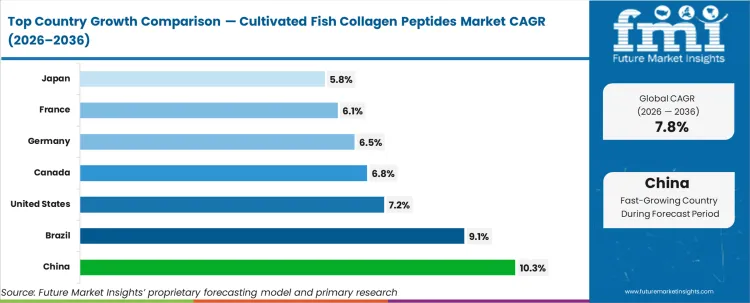
China is in a volume-growth phase, with rapid expansion across both domestic brands and export-grade ingredient production. South and Southeast Asia, along with Latin America, are in earlier-stage, price-sensitive growth where demand is primarily driven by mass-market dietary supplement formats and increasing awareness of functional nutrition. On a country-specific basis, India is projected to lead all markets with a CAGR of 11.2% through 2036, followed by China at 10.3%, Brazil at 9.1%, and South Korea at 8.9%. The United States is forecast at 7.2%, Australia at 7.5%, and Germany at 6.5%, while Japan and France, as more mature markets, are forecast at 5.8% and 6.1% respectively.
Cultivated Fish Collagen Peptides Market Definition
The cultivated fish collagen peptides market encompasses collagen peptides produced through enzymatic hydrolysis of raw materials - principally skin, scales, fins, and bones - obtained from fish raised under controlled aquaculture conditions. The term "cultivated" refers specifically to farmed fish species, distinguishing this supply chain from wild-catch-derived marine collagen. The hydrolysis process breaks down native collagen (primarily Type I) into shorter peptide chains with molecular weights typically ranging from 1,000 to 5,000 Daltons, which deliver improved solubility, digestibility, and functional activity compared to native gelatin or collagen.
Products in this market are classified by form (powder, liquid concentrate, microencapsulated or encapsulated for tablet and capsule delivery), by fish species (tilapia, salmon, cod, carp, tuna, and others), by application end use (food and beverage, nutraceutical and dietary supplement, cosmetics and personal care, pharmaceutical, and animal nutrition), and by distribution channel (retail consumer, foodservice ingredient, and industrial B2B). The market scope covers both retail consumer products and ingredient-grade supply to finished goods manufacturers. Private-label and store-brand collagen products are included where the underlying peptide supply meets the cultivated-fish sourcing definition.
Cultivated Fish Collagen Peptides Market Inclusions
The report covers a comprehensive assessment of the market for the historical period (2021 to 2025) and the projected period (2026 to 2036) for metric tons of collagen peptide volume and value in USD million. It covers segmental breakdowns of the market by product form, application, fish source, end use, and distribution channel, and key regions spanning North America, Latin America, Western Europe, Eastern Europe, South Asia and Pacific, East Asia, and Middle East and Africa.
Cultivated Fish Collagen Peptides Market Exclusions
The report does not include collagen peptides sourced from wild-caught fish, which are covered separately in FMI's broader marine collagen peptides study. Bovine, porcine, and poultry-derived collagen peptides fall outside the scope of this report. Native fish gelatin and non-hydrolyzed fish collagen are excluded, as they constitute a distinct product category with different functionality and application profiles. Fish collagen used exclusively as an input for industrial adhesives, photographic film, or non-food technical applications is not included. The report also excludes raw fish processing by-product trade (scales, skin, and bones as unprocessed commodities) and fish meal, both of which are priced and traded separately from finished collagen peptide products.
Cultivated Fish Collagen Peptides Market Research Methodology
- Primary Research: Interviews were conducted with aquaculture operators, fish processing by-product suppliers, collagen peptide manufacturers, ingredient distributors, nutraceutical and food formulation teams, retail buyers, and end consumers across North America, Europe, and Asia Pacific. Topics covered included category growth trends, raw material pricing and availability, traceability program adoption, molecular weight specification standards, shelf performance by application channel, and consumer purchase drivers and frequency.
- Desk Research: Secondary data sources included company press releases and annual reports from collagen producers, retail trade publications, aquaculture industry association data (including FAO, IFFO, and World Aquaculture Society), government fisheries statistics, national food safety and labeling regulations, household consumption expenditure surveys, and ingredient pricing benchmarks from food industry market intelligence providers.
- Market Sizing and Forecasting: The forecasting model uses a volume-based bottom-up approach constructed by country, calibrated against per-capita consumption of collagen-containing nutraceutical and functional food products, population and demographic data, household income segmentation, and retail and e-commerce distribution penetration rates. Country-level volumes were aggregated to regional totals and validated against trade statistics for fish processing by-product and hydrolyzed collagen exports and imports.
- Data Validation and Update Cycles: Supply-side shipment and production data from collagen peptide manufacturers were cross-referenced against retail audit findings, e-commerce sales estimates, foodservice ingredient procurement data, and primary interview inputs. Discrepancies between supply-side and demand-side estimates were resolved through targeted follow-up interviews with key informants, with final reconciled figures reviewed by FMI's food and beverage research team before publication
Segmental Analysis
Cultivated Fish Collagen Peptides Market Analysis by Application
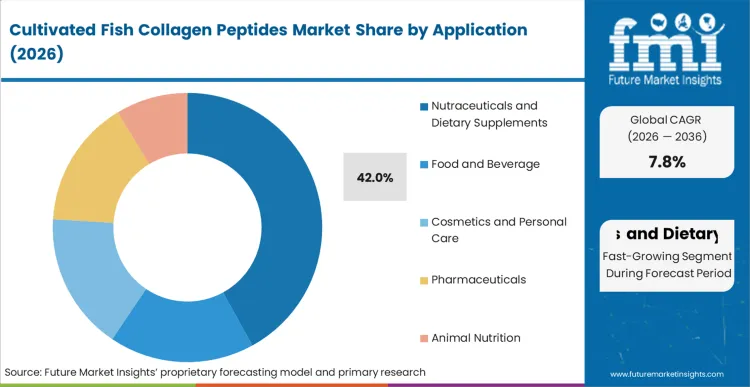
The nutraceuticals and dietary supplements segment holds approximately 42% of global revenue in 2026, driven by strong retail demand for standalone collagen products marketed under joint health, skin-firming, and sports recovery positioning. This segment commands the highest per-unit pricing in the market, as branded supplement manufacturers invest in clinical substantiation, premium packaging, and consumer education. A concrete illustration of this dynamic is Nitta Gelatin Inc.'s 2024 launch of a marine-sourced, low-molecular-weight collagen peptide range specifically formulated for nutraceutical encapsulation, targeting health food specialty retailers in the United States and Europe. [8]
- The food and beverage application segment accounts for roughly 28% of revenue in 2026 and is growing steadily as functional beverage formulators and protein-enriched food manufacturers adopt fish collagen peptides as a clean-label, neutral-taste alternative to bovine-derived collagen proteins. Ready-to-drink collagen beverages have expanded shelf presence in convenience and specialty food retail across Japan, South Korea, and the United States over the past three years. [3]
- The cosmetics and personal care segment contributes an estimated 19% of global revenue, with fish collagen peptides used as active ingredients in anti-aging serums, moisturizing creams, and ingestible beauty products. This segment benefits disproportionately from premium price positioning, as cosmetic-grade peptides with defined molecular weights and tested bioavailability attract price premiums from prestige personal care brands. [4]
Cultivated Fish Collagen Peptides Market Analysis by Product Form
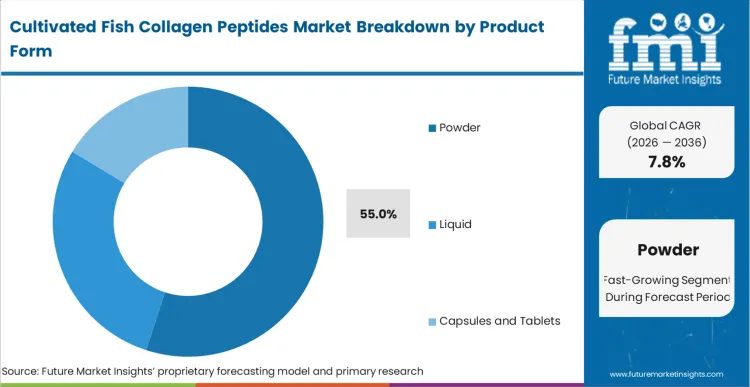
Powder accounts for approximately 55% of market volume in 2026, reflecting the format's dominance across both consumer supplement applications and industrial ingredient supply. The powder format's versatility - it dissolves in water or juice, blends into food formulations, and fills capsules - gives it application coverage no other single format can match. Liquid collagen concentrates hold roughly 22% of value share, positioned primarily in premium functional beverage formats. Capsules and tablets represent 23% of value, concentrated in the pharmacy-channel nutraceutical and pharmaceutical application sub-segments where precise dosing and consumer convenience command premium pricing. GELITA AG expanded its fish collagen peptide powder range with a functional beverage application-specific grade in September 2024, targeting manufacturers seeking clarity-optimized, flavor-neutral ingredient specifications. [6]
- Liquid collagen formats are growing faster than powders on a percentage basis, particularly in East Asian consumer markets where ready-to-drink beauty supplements have an established cultural precedent and high consumer acceptance - Japan's liquid collagen drink category, for example, has recorded consistent retail growth over the past five years. [3]
- Encapsulated and tablet formats are gaining ground in pharmaceutical-grade applications where molecular weight specification, batch traceability, and certificate-of-analysis documentation are contractual requirements from pharmaceutical brand owners and contract manufacturers, reflecting the growing cross-category adoption of fish collagen peptides beyond food and supplement markets. [8]
Cultivated Fish Collagen Peptides Market Analysis by Distribution Channel
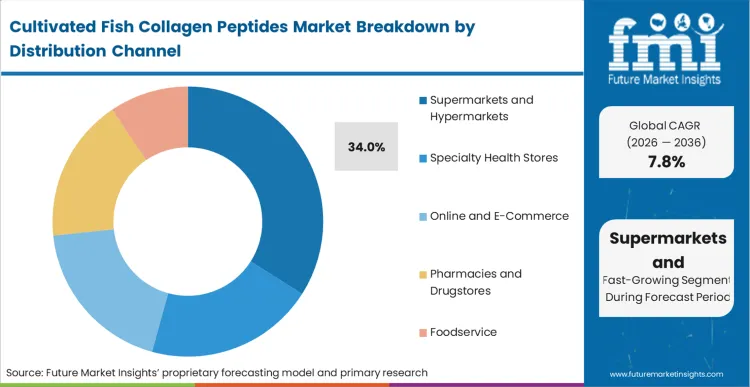
Supermarkets and hypermarkets remain the largest single distribution channel by volume, accounting for approximately 34% of revenue in 2025, driven by high-velocity nutraceutical and functional food listings in mainstream grocery and health food store formats. Online and e-commerce channels represent 31% of revenue and are the fastest-growing distribution pathway, underpinned by subscription supplement models, DTC brand growth, and consumer demand for higher-specification collagen products that require more detailed labeling than mass-market shelf formats allow.
- Specialty health food stores, though a smaller channel by volume, contribute disproportionately to new product introduction and premium tier positioning. They function as trial and awareness channels for higher-specification collagen peptide products - particularly those with verified species sourcing, clinical-grade molecular weight, or certified organic aquaculture claims - before those products scale into mass retail. [4]
Cultivated Fish Collagen Peptides Market Drivers, Restraints and Opportunities
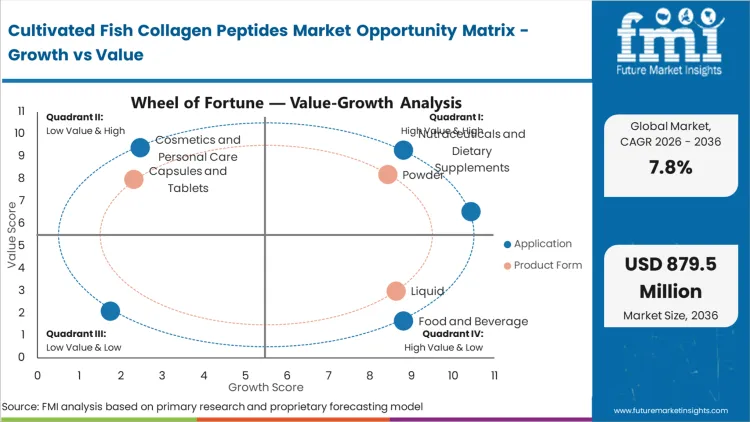
FMI's assessment of the cultivated fish collagen peptides market identifies a category undergoing structural expansion across both developed-market premium applications and emerging-market mass adoption. The competitive supply side has responded to demand growth by investing in hydrolyzing capacity and quality certification infrastructure. The category's trajectory through 2036 is shaped by three interconnected forces: consumer health awareness driving demand, raw material and cost pressures introducing supply variability, and an underdeveloped segment in animal nutrition offering a credible volume growth vector.
- Growing consumer adoption of collagen for joint health, skin aging, and muscle recovery across the 35-and-above demographic in North America, Western Europe, and urban East Asia is the primary demand engine for the market, and it is reinforcing itself through clinical evidence accumulation, mainstream media coverage of functional nutrition, and a shift in supplement purchasing from reactive (treating a diagnosed condition) to proactive (preventing age-related decline) - a behavioral shift that supports sustained repurchase rates and long average customer engagement cycles for branded collagen products.
- Volatility in aquaculture raw material availability poses a meaningful supply-side restraint; tilapia and salmon processing volumes - the two largest by-product sources for fish collagen - can fluctuate with aquaculture disease events, feed cost inflation, and regulatory changes in key producing countries such as China, Norway, and Ecuador, and these supply disruptions translate directly into ingredient price volatility that squeezes margins for finished goods manufacturers who cannot pass full cost increases onto price-sensitive retail buyers.
- The animal nutrition application segment represents a significant underpenetrated growth opportunity: fish collagen peptides have documented benefits as a bioavailable protein and joint health ingredient in companion animal (pet food and supplements) and aquafeed formulations, yet they remain a marginal share of current cultivated fish collagen production; as premiumization in the pet food sector accelerates - particularly in North America and Western Europe - manufacturers with scalable supply of food-grade fish collagen peptides are positioned to enter a fast-growing and structurally underserved application adjacent to their existing nutraceutical business.
Regional Analysis
.webp "Top Country Growth Comparison Cultivated Fish Collagen Peptides Market Cagr (2026 2036)")
The full FMI study covers seven regions - North America, Latin America, Eastern Europe, Western Europe, South Asia and Pacific, East Asia, and Middle East and Africa - and provides market attractiveness scores and per-capita consumption assessments across 30+ countries. The analysis incorporates aquaculture output data, retail and pharmacy channel penetration rates, household income segmentation, and regulatory approval status for collagen peptide health claims by country.
| Country | Value CAGR (2026-2036) |
|---|---|
| United States | 7.2% |
| Canada | 6.8% |
| Brazil | 9.1% |
| Germany | 6.5% |
| France | 6.1% |
| China | 10.3% |
| Japan | 5.8% |
| India | 11.2% |
| South Korea | 8.9% |
| Australia | 7.5% |
Source: Future Market Insights (FMI) analysis, based on proprietary forecasting model and primary research
North America Market Analysis
North America is the highest-revenue region in the cultivated fish collagen peptides market, driven by a mature and growing dietary supplement sector, strong e-commerce infrastructure, and an aging consumer population with high health-and-wellness spending per capita. Demand is concentrated in the nutraceutical and functional food application sub-segments, with premium product positioning supported by third-party clinical substantiation, species-verified sourcing claims, and subscription DTC business models. The retail buyer profile skews toward 35-60-year-old women with above-median household incomes, though sports nutrition-oriented products are expanding male consumer penetration.
- The United States leads North America with a projected CAGR of 7.2% through 2036, underpinned by consistent growth in per-capita dietary supplement consumption and the expansion of fish-derived collagen into mainstream grocery and mass market retail formats beyond specialty health channels.
- Canada is forecast at 6.8% CAGR, with a buyer profile closely aligned to the United States but with meaningful regional demand concentration in Quebec and Ontario, where pharmacy-channel supplement purchasing is particularly well developed.
The full FMI report covers the United States, Canada, and Mexico with country-level volume and value breakdowns, channel analysis, and competitive positioning maps.
Latin America Market Analysis
Latin America is an early-growth region for cultivated fish collagen peptides, characterized by rising middle-class health awareness in Brazil and Mexico alongside increasing aquaculture by-product processing capacity in coastal producing nations. Consumer demand is primarily driven by mass-market dietary supplement formats sold through pharmacies and increasingly through e-commerce platforms, where Brazilian and Mexican consumers are showing growing interest in functional nutrition categories. Price sensitivity remains a meaningful barrier to premium product adoption, and mid-range sachet and ready-to-mix formats are the most commercially viable entry products for this region.
- Brazil leads the region with a 9.1% CAGR forecast through 2036, supported by one of Latin America's largest pharmacy retail networks, a domestic aquaculture industry with tilapia by-product availability, and consumer awareness of collagen as a beauty and joint health ingredient that has accelerated through social media and influencer marketing.
- Mexico is growing steadily within the regional context, with demand driven by urban middle-class consumers in Mexico City and Guadalajara who are increasingly purchasing international functional supplement brands through e-commerce, as well as through domestic pharmacy chains such as Farmacias del Ahorro and Farmacia Guadalajara.
The full FMI report covers Brazil, Mexico, Argentina, Chile, and Colombia with country-level market data.
Europe Market Analysis
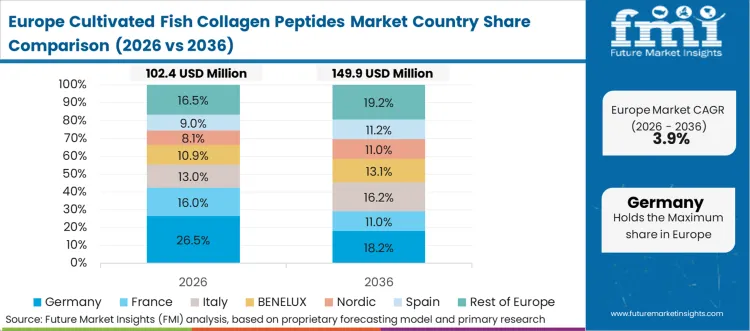
Europe is a mature and highly regulated region for the cultivated fish collagen peptides market, where demand growth is steady rather than rapid, driven by pharmacy-channel supplement purchasing, clean-label food ingredient adoption, and cosmetics industry demand for functional skin care actives. Western European markets - Germany, France, the United Kingdom, and Italy - show established consumer awareness and retailer listings, while Eastern European markets such as Poland and the Czech Republic represent a younger but accelerating growth opportunity as consumer spending on health and wellness products increases. Regulatory compliance with EU Novel Foods regulations and health claim approval status under EFSA are defining structural factors for product commercialization across the region.
- Germany leads Western Europe at a 6.5% CAGR, anchored by a strong pharmacy and health food retail infrastructure and a consumer culture of evidence-based supplement purchasing where clinical claim substantiation and independent quality certification carry meaningful purchase influence.
- France is forecast at 6.1% CAGR, with notable demand from both the dietary supplement channel and the cosmetics ingredient sector, where French prestige personal care brands source high-purity fish collagen peptides as active ingredient inputs.
The full FMI report covers Germany, France, the United Kingdom, Italy, Spain, Poland, and additional European markets with country-level revenue and segmentation data.
Asia Pacific Market Analysis
Asia Pacific is the largest and fastest-growing regional market for cultivated fish collagen peptides, combining mature demand markets in Japan and South Korea with high-growth opportunity in China, India, and Southeast Asia. The region is also the dominant global production hub, with China, Vietnam, Thailand, and Indonesia collectively representing the majority of global fish collagen peptide manufacturing capacity. Consumer acceptance of fish-derived collagen is structurally higher in Asia Pacific than in any other region, supported by long-standing cultural dietary traditions around fish-derived nutrition and centuries of culinary use of fish broth and gelatin.
- China is forecast at 10.3% CAGR through 2036, driven by both domestic consumer demand for beauty supplement products and by-product processing expansion at large aquaculture operations; China is simultaneously the world's largest producer and one of its fastest-growing consumer markets, creating a near-vertically integrated supply-to-demand dynamic with favorable economics for domestic manufacturers.
- India is projected to lead all markets globally with an 11.2% CAGR, reflecting the combination of a large and young population entering the health-conscious consumer segment, rising disposable income in urban centers, and growing commercial availability of fish collagen peptide products through pharmacy and e-commerce channels.
The full FMI report covers China, Japan, South Korea, India, Australia, Indonesia, Thailand, Vietnam, and additional Asia Pacific countries with detailed country profiles.
Competitive Aligners for Market Players
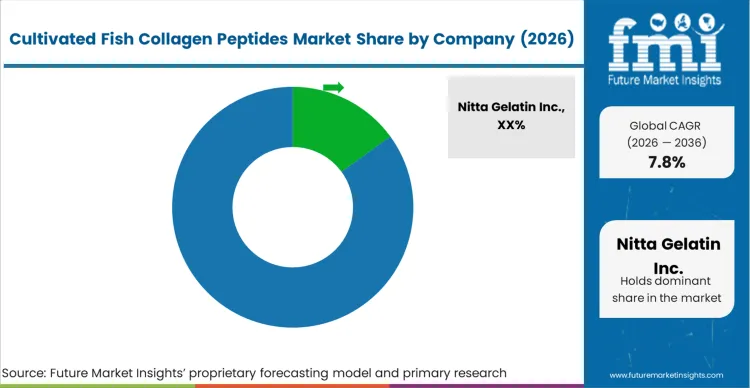
The cultivated fish collagen peptides market operates as a tiered competitive structure. At the premium tier, a small number of global ingredient manufacturers - Nitta Gelatin, GELITA, and Rousselot among them - compete on the basis of technical specification breadth, application expertise, clinical evidence portfolios, and supply chain traceability certification. These companies serve pharmaceutical, premium nutraceutical, and prestige cosmetics clients who pay significant price premiums for batch-consistent, specification-verified collagen peptides. In the mid-tier, regional producers and Asian manufacturers with ISO-certified facilities compete primarily on reliability of supply, pricing, and the ability to customize molecular weight profiles for specific application requirements. At the value end, commodity-grade fish collagen peptide producers - particularly in China and Vietnam - compete on price, with distribution networks weighted toward private-label manufacturers and economy supplement brands.
Retailer and distributor relationships are a meaningful determinant of market access, particularly for mid-tier and value-tier manufacturers seeking shelf space in mass-market supplement retail and grocery. Large ingredient distributors - who aggregate supply from multiple producers and sell to finished goods manufacturers - control a disproportionate share of mid-market ingredient demand, and their approval processes effectively serve as a secondary quality gateway below the tier-1 pharmaceutical-grade standard. Private-label supplement growth has intensified pricing pressure on branded ingredient manufacturers, as retail buyers increasingly use private-label product profitability to negotiate cost reductions from national brand suppliers.
Consumer behavior diverges sharply between the premium and value segments of this market. Premium-oriented buyers - typically higher-income, health-engaged consumers purchasing through specialty retail or DTC e-commerce - demonstrate high loyalty to brands with verifiable sourcing stories, clinical backing, and specific molecular weight claims; they are willing to pay 2-3 times the unit price of private-label equivalents and repurchase at higher frequencies on subscription models. Price-sensitive buyers, concentrated in emerging market channels and mass-market grocery, show high switching behavior, promotional dependency, and willingness to trade brand recognition for price, making private-label uptake rates in these segments consistently higher than in premium channels.
Key Players Covered in the Study
- Nitta Gelatin Inc.
- GELITA AG
- Rousselot (Darling Ingredients)
- Weishardt Group
- Lapi Gelatine S.p.A.
- Nippi Inc.
- Proteinas del Sur
- Hainan Zhongxin Chemical Co., Ltd.
- Shandong Hengxin Biotech Co., Ltd.
- PB Leiner
- Ewald-Gelatine GmbH
- Norland Products Inc.
Scope Report
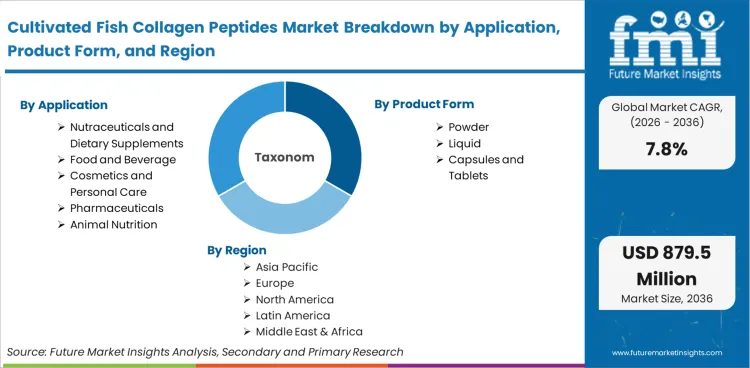
| Metric | Value |
|---|---|
| Quantitative Units | USD 415.0 million in 2026 to USD 879.0 million by 2036 at a CAGR of 7.8% |
| Market Definition | Collagen peptides extracted through enzymatic hydrolysis from the skin, scales, bones, and fins of cultivated (aquaculture-raised) fish species, sold in powder, liquid, and encapsulated forms for use in food and beverage, nutraceutical, cosmetic, pharmaceutical, and animal nutrition applications |
| Product Form Segmentation | Powder, Liquid, Capsules and Tablets |
| Application Segmentation | Food and Beverage, Nutraceuticals and Dietary Supplements, Cosmetics and Personal Care, Pharmaceuticals, Animal Nutrition |
| Fish Source Segmentation | Tilapia, Salmon, Cod, Tuna, Carp, Others |
| End Use Segmentation | Retail, Foodservice, Industrial and B2B |
| Distribution Channel Segmentation | Supermarkets and Hypermarkets, Specialty Health Stores, Online and E-Commerce, Pharmacies and Drugstores, Foodservice |
| Regions Covered | North America, Latin America, Western Europe, Eastern Europe, South Asia and Pacific, East Asia, Middle East and Africa |
| Countries Covered | United States, Canada, Brazil, Mexico, Germany, France, United Kingdom, Italy, Spain, Poland, China, Japan, South Korea, India, Australia, Indonesia, Thailand, Saudi Arabia, South Africa, and 10+ additional countries |
| Key Players Covered in the Study | Nitta Gelatin Inc., GELITA AG, Rousselot (Darling Ingredients), Weishardt Group, Lapi Gelatine S.p.A., Nippi Inc., Proteinas del Sur, Hainan Zhongxin Chemical Co. Ltd., Shandong Hengxin Biotech Co. Ltd., PB Leiner, Ewald-Gelatine GmbH, Norland Products Inc. |
| Forecast Period | 2026 to 2036 |
| Approach | Volume-based bottom-up forecasting model calibrated by country, mapped against per-capita consumption rates, household income segmentation, and retail distribution coverage; validated through cross-referencing trade data, retail audit benchmarks, and primary research interviews |
Cultivated Fish Collagen Peptides Market Analysis by Segments
By Product Form
- Powder
- Liquid
- Capsules and Tablets
By Application
- Food and Beverage
- Nutraceuticals and Dietary Supplements
- Cosmetics and Personal Care
- Pharmaceuticals
- Animal Nutrition
By Fish Source
- Tilapia
- Salmon
- Cod
- Tuna
- Carp
- Others
By End Use
- Retail
- Foodservice
- Industrial and B2B
By Distribution Channel
- Supermarkets and Hypermarkets
- Specialty Health Stores
- Online and E-Commerce
- Pharmacies and Drugstores
- Foodservice
By Region
- North America
- Latin America
- Western Europe
- Eastern Europe
- South Asia and Pacific
- East Asia
- Middle East and Africa
This Report Addresses
- Market intelligence enabling assessment of leading countries, product formats, fish source categories, and distribution channel performance across 30+ countries in the cultivated fish collagen peptides market.
- Volume and revenue forecasts for 2026 to 2036, validated through per-capita consumption modeling, aquaculture by-product production data, and retail audit benchmarks.
- Growth opportunity mapping across product application tiers - pharmaceutical and premium nutraceutical, functional food and beverage, and mass-market dietary supplement - with revenue and volume projections by tier.
- Segment and regional revenue forecasts by product form, application, fish source, end use, and distribution channel across seven regions and 30+ countries.
- Competition strategy analysis covering brand positioning, ingredient specification differentiation, distribution channel structure, recent product launches, and supply chain traceability as a competitive variable.
- Consumer economic context analysis covering GDP per capita, household final consumption expenditure as a share of GDP, and food and consumer spend as a share of household expenditure for ten key markets, calibrated against FMI's per-capita consumption forecasting model.
- Regulatory and labeling compliance tracking covering EU Novel Food authorization status, FDA GRAS determinations, and country-specific health claim approval frameworks for collagen peptide products.
- Report delivery in PDF, Excel data table, PowerPoint summary presentation, and interactive dashboard formats.
Bibliography
- [1] Marine Ingredients Organisation (IFFO). "Global Fishmeal and Fish Oil Production: Market Update and Industry Outlook." IFFO Report, 2023.
- [2] Nandini Roy Choudhury, Client Partner, Food and Beverages, Future Market Insights. Analyst Commentary. Future Market Insights Research Note, 2024.
- [3] Food and Agriculture Organization of the United Nations. "The State of World Fisheries and Aquaculture 2024." FAO, 2024.
- [4] Grand, Sylvie. "Marine-Derived Bioactives: Industry Innovation and Regulatory Pathways." Nutraceuticals World, March 2023.
- [5] Shandong Hengxin Biotech Co., Ltd. "Company Announcement: ISO 22000-Certified Fish Collagen Peptide Production Expansion." Press release, July 2024.
- [6] GELITA AG. "Company Announcement: Fish Collagen Peptide Portfolio Expansion into Functional Beverage Segment." Press release, September 2024.
- [7] Rousselot. "Company Announcement: Partnership with Asian Aquaculture Supplier for Certified Traceable Fish Collagen Source." Press release, January 2025.
- [8] Nitta Gelatin Inc. "Company Announcement: Launch of Marine Collagen Peptide Range for Nutraceutical Applications." Press release, November 2024.
- [9] World Bank Open Data. GDP per Capita, current USD (NY.GDP.PCAP.CD). data.worldbank.org, 2023.
- [10] World Bank Open Data. Household Final Consumption Expenditure as % of GDP (NE.CON.PRVT.ZS). data.worldbank.org, 2023.
- [11] FAO FAOSTAT. Food Expenditure Share Data by Country. fao.org/faostat, 2023.
- [12] OECD.Stat. Household Final Consumption Expenditure by Purpose (COICOP). stats.oecd.org, 2023.
Frequently Asked Questions
How large is the demand for cultivated fish collagen peptides in the global market in 2026?
Based on FMI analysis, the global cultivated fish collagen peptides market is estimated to reach USD 415.0 million in 2026, driven by sustained growth in nutraceutical supplement demand, functional food ingredient adoption, and cosmetics application across North America, Europe, and Asia Pacific.
What will the market size of cultivated fish collagen peptides by 2036?
FMI projects the market to reach USD 879.0 million by 2036, reflecting a near-doubling of the revenue base from the 2026 estimate, supported by expanding per-capita consumption in emerging markets and continued premiumization in developed markets.
What is the expected demand growth rate for cultivated fish collagen peptides between 2026 and 2036?
FMI projects a CAGR of 7.8% for the global cultivated fish collagen peptides market between 2026 and 2036. This rate reflects compound expansion across both established application categories and growth segments including animal nutrition and pharmaceutical applications
Which product form is expected to lead global sales through 2036?
FMI projects a CAGR of 7.8% for the global cultivated fish collagen peptides market between 2026 and 2036. This rate reflects compound expansion across both established application categories and growth segments including animal nutrition and pharmaceutical applications
How significant is the premium segment in driving category value versus volume?
The premium segment - comprising pharmaceutical-grade, clinical-specification, and branded nutraceutical products - represents a disproportionate share of market revenue relative to its volume, as it commands price premiums of 30-50% over commodity food-grade collagen. Premium growth in North America and Western Europe is the primary driver of average selling price stability across the market.
Which distribution channel accounts for the largest share of global revenue?
Supermarkets and hypermarkets account for the largest single channel share at approximately 34% of revenue in 2025. Online and e-commerce follows at roughly 31% and is the fastest-growing channel, supported by subscription supplement models and DTC brand growth.
How does household income growth influence per-capita consumption in emerging markets?
In markets such as India and Brazil, per-capita collagen supplement consumption is closely tied to household income growth and urbanization. As consumers cross income thresholds where discretionary health spending becomes viable - estimated around USD 3,000-4,000 GDP per capita - adoption of functional nutrition products including fish collagen peptides accelerates. This relationship underpins India's 11.2% CAGR projection and Brazil's 9.1% forecast.
Which regions are entering the premiumization phase and what is driving the shift?
China and South Korea are the clearest examples of markets transitioning from volume-led growth toward premiumization. In both markets, consumers are shifting from economy-tier collagen powder products toward branded, species-verified, and clinical-specification alternatives. The shift is driven by rising disposable income among urban middle-class consumers, increased health literacy, and growing retail availability of premium-positioned domestic and international brands.
How does private-label competition affect brand owner pricing and margin?
Private-label collagen supplement products have gained shelf space at major pharmacy and grocery retailers in North America and Europe, placing downward pricing pressure on brand owner products in those channels. Brand owners with verifiable clinical evidence, distinctive sourcing stories, and established consumer loyalty are better positioned to defend price premiums. Manufacturers lacking differentiated claims are more exposed to private-label substitution risk, particularly in mass-market grocery distribution.
What role do clean-label, halal, and species-verified sourcing claims play in purchase decisions?
These claims have become material purchase decision variables for specific consumer segments. Halal certification is a threshold requirement - not merely a preference - in Middle Eastern, Southeast Asian, and observant Muslim consumer markets globally. Species verification and aquaculture certification increasingly matter to health-engaged consumers in North America and Europe who are willing to pay a premium for transparent provenance. Clean-label positioning reinforces the competitive differentiation of fish-derived collagen versus bovine and porcine alternatives among flexitarian and pescatarian consumers.
Preview the report firsthand - request a free sample
Get SampleGet the brochure for pricing and purchase details.
Get PDFTable of Content
- Executive Summary
- Global Market Outlook
- Demand-side Trends
- Supply-side Trends
- Technology Roadmap Analysis
- Analysis and Recommendations
- Market Overview
- Market Coverage / Taxonomy
- Market Definition / Scope / Limitations
- Research Methodology
- Chapter Orientation
- Analytical Lens and Working Hypotheses
- Market Structure, Signals, and Trend Drivers
- Benchmarking and Cross-market Comparability
- Market Sizing, Forecasting, and Opportunity Mapping
- Research Design and Evidence Framework
- Desk Research Programme (Secondary Evidence)
- Company Annual and Sustainability Reports
- Peer-reviewed Journals and Academic Literature
- Corporate Websites, Product Literature, and Technical Notes
- Earnings Decks and Investor Briefings
- Statutory Filings and Regulatory Disclosures
- Technical White Papers and Standards Notes
- Trade Journals, Industry Magazines, and Analyst Briefs
- Conference Proceedings, Webinars, and Seminar Materials
- Government Statistics Portals and Public Data Releases
- Press Releases and Reputable Media Coverage
- Specialist Newsletters and Curated Briefings
- Sector Databases and Reference Repositories
- FMI Internal Proprietary Databases and Historical Market Datasets
- Subscription Datasets and Paid Sources
- Social Channels, Communities, and Digital Listening Inputs
- Additional Desk Sources
- Expert Input and Fieldwork (Primary Evidence)
- Primary Modes
- Qualitative Interviews and Expert Elicitation
- Quantitative Surveys and Structured Data Capture
- Blended Approach
- Why Primary Evidence is Used
- Field Techniques
- Interviews
- Surveys
- Focus Groups
- Observational and In-context Research
- Social and Community Interactions
- Stakeholder Universe Engaged
- C-suite Leaders
- Board Members
- Presidents and Vice Presidents
- R&D and Innovation Heads
- Technical Specialists
- Domain Subject-matter Experts
- Scientists
- Physicians and Other Healthcare Professionals
- Governance, Ethics, and Data Stewardship
- Research Ethics
- Data Integrity and Handling
- Primary Modes
- Tooling, Models, and Reference Databases
- Desk Research Programme (Secondary Evidence)
- Data Engineering and Model Build
- Data Acquisition and Ingestion
- Cleaning, Normalisation, and Verification
- Synthesis, Triangulation, and Analysis
- Quality Assurance and Audit Trail
- Market Background
- Market Dynamics
- Drivers
- Restraints
- Opportunity
- Trends
- Scenario Forecast
- Demand in Optimistic Scenario
- Demand in Likely Scenario
- Demand in Conservative Scenario
- Opportunity Map Analysis
- Product Life Cycle Analysis
- Supply Chain Analysis
- Investment Feasibility Matrix
- Value Chain Analysis
- PESTLE and Porter’s Analysis
- Regulatory Landscape
- Regional Parent Market Outlook
- Production and Consumption Statistics
- Import and Export Statistics
- Market Dynamics
- Global Market Analysis 2021 to 2025 and Forecast, 2026 to 2036
- Historical Market Size Value (USD Million) Analysis, 2021 to 2025
- Current and Future Market Size Value (USD Million) Projections, 2026 to 2036
- Y-o-Y Growth Trend Analysis
- Absolute $ Opportunity Analysis
- Global Market Pricing Analysis 2021 to 2025 and Forecast 2026 to 2036
- Global Market Analysis 2021 to 2025 and Forecast 2026 to 2036, By Application
- Introduction / Key Findings
- Historical Market Size Value (USD Million) Analysis By Application , 2021 to 2025
- Current and Future Market Size Value (USD Million) Analysis and Forecast By Application , 2026 to 2036
- Nutraceuticals and Dietary Supplements
- Food and Beverage
- Cosmetics and Personal Care
- Pharmaceuticals
- Animal Nutrition
- Nutraceuticals and Dietary Supplements
- Y-o-Y Growth Trend Analysis By Application , 2021 to 2025
- Absolute $ Opportunity Analysis By Application , 2026 to 2036
- Global Market Analysis 2021 to 2025 and Forecast 2026 to 2036, By Product Form
- Introduction / Key Findings
- Historical Market Size Value (USD Million) Analysis By Product Form, 2021 to 2025
- Current and Future Market Size Value (USD Million) Analysis and Forecast By Product Form, 2026 to 2036
- Powder
- Liquid
- Capsules and Tablets
- Powder
- Y-o-Y Growth Trend Analysis By Product Form, 2021 to 2025
- Absolute $ Opportunity Analysis By Product Form, 2026 to 2036
- Global Market Analysis 2021 to 2025 and Forecast 2026 to 2036, By Distribution Channel
- Introduction / Key Findings
- Historical Market Size Value (USD Million) Analysis By Distribution Channel, 2021 to 2025
- Current and Future Market Size Value (USD Million) Analysis and Forecast By Distribution Channel, 2026 to 2036
- Supermarkets and Hypermarkets
- Specialty Health Stores
- Online and E-Commerce
- Pharmacies and Drugstores
- Foodservice
- Supermarkets and Hypermarkets
- Y-o-Y Growth Trend Analysis By Distribution Channel, 2021 to 2025
- Absolute $ Opportunity Analysis By Distribution Channel, 2026 to 2036
- Global Market Analysis 2021 to 2025 and Forecast 2026 to 2036, By Region
- Introduction
- Historical Market Size Value (USD Million) Analysis By Region, 2021 to 2025
- Current Market Size Value (USD Million) Analysis and Forecast By Region, 2026 to 2036
- North America
- Latin America
- Western Europe
- Eastern Europe
- East Asia
- South Asia and Pacific
- Middle East & Africa
- Market Attractiveness Analysis By Region
- North America Market Analysis 2021 to 2025 and Forecast 2026 to 2036, By Country
- Historical Market Size Value (USD Million) Trend Analysis By Market Taxonomy, 2021 to 2025
- Market Size Value (USD Million) Forecast By Market Taxonomy, 2026 to 2036
- By Country
- USA
- Canada
- Mexico
- By Application
- By Product Form
- By Distribution Channel
- By Country
- Market Attractiveness Analysis
- By Country
- By Application
- By Product Form
- By Distribution Channel
- Key Takeaways
- Latin America Market Analysis 2021 to 2025 and Forecast 2026 to 2036, By Country
- Historical Market Size Value (USD Million) Trend Analysis By Market Taxonomy, 2021 to 2025
- Market Size Value (USD Million) Forecast By Market Taxonomy, 2026 to 2036
- By Country
- Brazil
- Chile
- Rest of Latin America
- By Application
- By Product Form
- By Distribution Channel
- By Country
- Market Attractiveness Analysis
- By Country
- By Application
- By Product Form
- By Distribution Channel
- Key Takeaways
- Western Europe Market Analysis 2021 to 2025 and Forecast 2026 to 2036, By Country
- Historical Market Size Value (USD Million) Trend Analysis By Market Taxonomy, 2021 to 2025
- Market Size Value (USD Million) Forecast By Market Taxonomy, 2026 to 2036
- By Country
- Germany
- UK
- Italy
- Spain
- France
- Nordic
- BENELUX
- Rest of Western Europe
- By Application
- By Product Form
- By Distribution Channel
- By Country
- Market Attractiveness Analysis
- By Country
- By Application
- By Product Form
- By Distribution Channel
- Key Takeaways
- Eastern Europe Market Analysis 2021 to 2025 and Forecast 2026 to 2036, By Country
- Historical Market Size Value (USD Million) Trend Analysis By Market Taxonomy, 2021 to 2025
- Market Size Value (USD Million) Forecast By Market Taxonomy, 2026 to 2036
- By Country
- Russia
- Poland
- Hungary
- Balkan & Baltic
- Rest of Eastern Europe
- By Application
- By Product Form
- By Distribution Channel
- By Country
- Market Attractiveness Analysis
- By Country
- By Application
- By Product Form
- By Distribution Channel
- Key Takeaways
- East Asia Market Analysis 2021 to 2025 and Forecast 2026 to 2036, By Country
- Historical Market Size Value (USD Million) Trend Analysis By Market Taxonomy, 2021 to 2025
- Market Size Value (USD Million) Forecast By Market Taxonomy, 2026 to 2036
- By Country
- China
- Japan
- South Korea
- By Application
- By Product Form
- By Distribution Channel
- By Country
- Market Attractiveness Analysis
- By Country
- By Application
- By Product Form
- By Distribution Channel
- Key Takeaways
- South Asia and Pacific Market Analysis 2021 to 2025 and Forecast 2026 to 2036, By Country
- Historical Market Size Value (USD Million) Trend Analysis By Market Taxonomy, 2021 to 2025
- Market Size Value (USD Million) Forecast By Market Taxonomy, 2026 to 2036
- By Country
- India
- ASEAN
- Australia & New Zealand
- Rest of South Asia and Pacific
- By Application
- By Product Form
- By Distribution Channel
- By Country
- Market Attractiveness Analysis
- By Country
- By Application
- By Product Form
- By Distribution Channel
- Key Takeaways
- Middle East & Africa Market Analysis 2021 to 2025 and Forecast 2026 to 2036, By Country
- Historical Market Size Value (USD Million) Trend Analysis By Market Taxonomy, 2021 to 2025
- Market Size Value (USD Million) Forecast By Market Taxonomy, 2026 to 2036
- By Country
- Kingdom of Saudi Arabia
- Other GCC Countries
- Turkiye
- South Africa
- Other African Union
- Rest of Middle East & Africa
- By Application
- By Product Form
- By Distribution Channel
- By Country
- Market Attractiveness Analysis
- By Country
- By Application
- By Product Form
- By Distribution Channel
- Key Takeaways
- Key Countries Market Analysis
- USA
- Pricing Analysis
- Market Share Analysis, 2025
- By Application
- By Product Form
- By Distribution Channel
- Canada
- Pricing Analysis
- Market Share Analysis, 2025
- By Application
- By Product Form
- By Distribution Channel
- Mexico
- Pricing Analysis
- Market Share Analysis, 2025
- By Application
- By Product Form
- By Distribution Channel
- Brazil
- Pricing Analysis
- Market Share Analysis, 2025
- By Application
- By Product Form
- By Distribution Channel
- Chile
- Pricing Analysis
- Market Share Analysis, 2025
- By Application
- By Product Form
- By Distribution Channel
- Germany
- Pricing Analysis
- Market Share Analysis, 2025
- By Application
- By Product Form
- By Distribution Channel
- UK
- Pricing Analysis
- Market Share Analysis, 2025
- By Application
- By Product Form
- By Distribution Channel
- Italy
- Pricing Analysis
- Market Share Analysis, 2025
- By Application
- By Product Form
- By Distribution Channel
- Spain
- Pricing Analysis
- Market Share Analysis, 2025
- By Application
- By Product Form
- By Distribution Channel
- France
- Pricing Analysis
- Market Share Analysis, 2025
- By Application
- By Product Form
- By Distribution Channel
- India
- Pricing Analysis
- Market Share Analysis, 2025
- By Application
- By Product Form
- By Distribution Channel
- ASEAN
- Pricing Analysis
- Market Share Analysis, 2025
- By Application
- By Product Form
- By Distribution Channel
- Australia & New Zealand
- Pricing Analysis
- Market Share Analysis, 2025
- By Application
- By Product Form
- By Distribution Channel
- China
- Pricing Analysis
- Market Share Analysis, 2025
- By Application
- By Product Form
- By Distribution Channel
- Japan
- Pricing Analysis
- Market Share Analysis, 2025
- By Application
- By Product Form
- By Distribution Channel
- South Korea
- Pricing Analysis
- Market Share Analysis, 2025
- By Application
- By Product Form
- By Distribution Channel
- Russia
- Pricing Analysis
- Market Share Analysis, 2025
- By Application
- By Product Form
- By Distribution Channel
- Poland
- Pricing Analysis
- Market Share Analysis, 2025
- By Application
- By Product Form
- By Distribution Channel
- Hungary
- Pricing Analysis
- Market Share Analysis, 2025
- By Application
- By Product Form
- By Distribution Channel
- Kingdom of Saudi Arabia
- Pricing Analysis
- Market Share Analysis, 2025
- By Application
- By Product Form
- By Distribution Channel
- Turkiye
- Pricing Analysis
- Market Share Analysis, 2025
- By Application
- By Product Form
- By Distribution Channel
- South Africa
- Pricing Analysis
- Market Share Analysis, 2025
- By Application
- By Product Form
- By Distribution Channel
- USA
- Market Structure Analysis
- Competition Dashboard
- Competition Benchmarking
- Market Share Analysis of Top Players
- By Regional
- By Application
- By Product Form
- By Distribution Channel
- Competition Analysis
- Competition Deep Dive
- Nitta Gelatin Inc.
- Overview
- Product Portfolio
- Profitability by Market Segments (Product/Age /Sales Channel/Region)
- Sales Footprint
- Strategy Overview
- Marketing Strategy
- Product Strategy
- Channel Strategy
- GELITA AG
- Rousselot (Darling Ingredients)
- Weishardt Group
- Lapi Gelatine S.p.A.
- Nippi Inc.
- Proteinas del Sur
- Hainan Zhongxin Chemical Co., Ltd.
- Shandong Hengxin Biotech Co., Ltd.
- PB Leiner
- Ewald-Gelatine GmbH
- Norland Products Inc.
- Nitta Gelatin Inc.
- Competition Deep Dive
- Assumptions & Acronyms Used


