

- Industry Size (2026)
- USD 272.4 Mn
- Forecast (2036)
- USD 713.0 Mn
- CAGR (2026 to 2036)
- 10.10%
Bioreactor Single-Use Protein A Chromatography Media Market Size, Market Forecast and Outlook By FMI
The bioreactor single-use protein A chromatography media market was valued at USD 247.4 million in 2025. The industry is expected to cross USD 272.4 million in 2026 at a protein A media CAGR of 10.10% during the forecast period. Continued investment drives the valuation upward to USD 713.0 million through 2036 as high-titer continuous upstream processes force downstream purification trains to abandon rigid stainless-steel cleaning validation cycles in favour of campaign-matched disposable protein A chromatography media.
Downstream process engineers are being forced to align their capture phase directly with upstream productivity. The decision is no longer about maximizing the lifetime cycles of a protein a resins bed, but about matching the media’s functional lifecycle to a specific clinical or commercial campaign. Delaying this transition leaves biomanufacturers with mismatched process tempos, where upstream bioreactors sit idle waiting for downstream changeover and cleaning-in-place validation. Integrating single-use antibody capture media market formats eliminates this bottleneck entirely, allowing facilities to increase their annual batch turnover without expanding their physical footprint.
Summary of Bioreactor Single-Use Protein A Chromatography Media Market
- Bioreactor Single-Use Protein A Chromatography Media Market Definition
- This market tracks affinity capture media consumed in single-campaign or limited-cycle downstream bioprocessing. It is defined by an operational boundary: the deliberate discarding of high-cost Protein A materials after a specific batch to bypass the time and cost penalties of cleaning validation in multi-product biologics facility protein A capture media environments.
- Demand Drivers in the Market
- The necessity to eliminate cleaning-in-place (CIP) and sterilization-in-place (SIP) bottlenecks compels CDMO facility directors to transition to campaign-use media.
- The rise of highly potent bispecific antibodies is prompting downstream process engineers to fully segregate product streams, relying on disposable flow paths to eliminate cross-contamination risks.
- High-frequency product changeovers in localized biomanufacturing hubs drive operations managers to trade material longevity for facility turnaround speed.
- Key Segments Analyzed in the FMI Report
- Bulk Protein A resin slurry for disposable/flexible columns: Expected to hold 52.8% share in 2026, as this format bridges the gap between traditional packing expertise and the necessity for disposable column hardware.
- Agarose-based media: Anticipated to garner 63.1% share in 2026, remaining the dominant matrix due to decades of regulatory familiarity and proven binding capacities.
- Monoclonal antibodies: Poised to account for 76.4% share in 2026, representing the largest volumetric demand for highly specific affinity capture.
- Biopharmaceutical manufacturers: Estimated to grab 47.2% share in 2026, as established brand owners increasingly adopt hybrid manufacturing models.
- 501-2,000 L single-use-linked campaigns: Projected to hold 44.1% share in 2026, perfectly aligning with the standard volume limit of modern disposable upstream bioreactors.
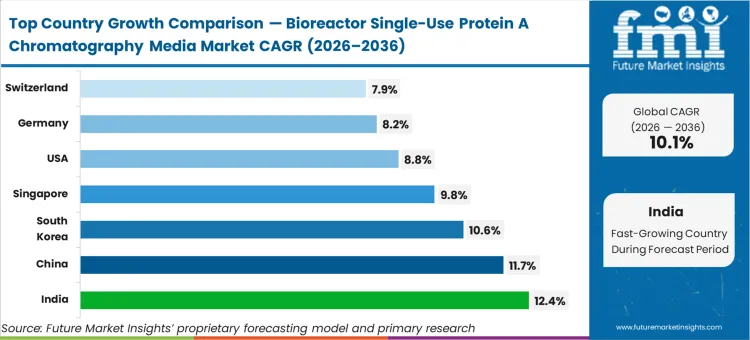
- India: 12.4% compound growth, driven by rapid CDMO expansion and a preference for flexible, multi-product facility designs over rigid stainless steel.
- Analyst Opinion at FMI
- Sabyasachi Ghosh, Principal Analyst, Healthcare, at FMI, opines, "The general market metric focuses purely on the cost per liter of Protein A. However, process engineers know the actual calculation is about time. A disposable column that costs three times as much per use is economically justified if it allows a contract manufacturer to squeeze one additional commercial campaign into their annual production calendar by skipping a two-week validation shutdown."
- Strategic Implications / Executive Takeaways
- Downstream technology vendors must align their pre-packed column capacities exactly with the 2,000L upstream standard to secure commercial-scale supplier contracts.
- CDMO procurement directors should negotiate supply agreements based on campaign cycles rather than bulk volume to hedge against fluctuating clinical trial yields.
- Emerging biotechs face severe supply chain vulnerabilities that require securing dual-sourced disposable capture formats early in Phase II development.
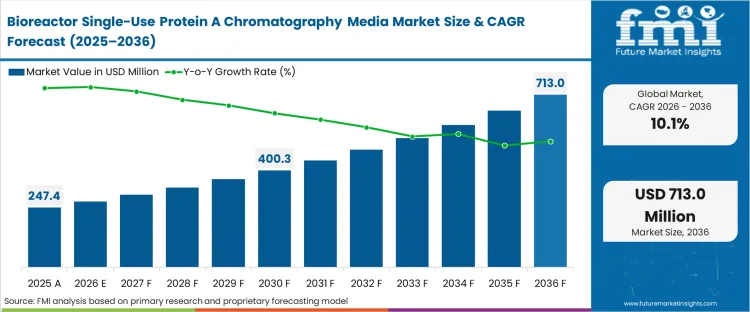
Bioreactor Single-Use Protein A Chromatography Media Market Key Takeaways
| Metric | Details |
|---|---|
| Industry Size (2026) | USD 272.4 Million |
| Industry Value (2036) | USD 713.0 Million |
| CAGR (2026-2036) | 10.10% |
The critical threshold is the harmonization of titer capacities between the single-use bioreactors market limits and disposable column volumes. Once an operation matches the binding capacity of a pre-packed or flexible protein a resins share format to the exact yield of a 2,000 L run, the economic penalty of discarding the media vanishes. Contract manufacturing organizations typically trigger this change to guarantee multi-product facility turnaround times, turning a high-cost capital consumable into a predictable operating expense.
India is anticipated to expand at 12.4%, driven by aggressive clinical-stage CDMO capacity expansions prioritizing flexible processing over rigid infrastructure. China follows at 11.7% as regional biologics scale-up heavily favors protein A chromatography media for single-use bioreactors. South Korea is estimated to advance at 10.6% due to focused investments in modular manufacturing hubs. Singapore is poised to grow at 9.8%, reflecting its role as an agile biomanufacturing anchor in Asia. The United States is projected to record 8.8%, Germany 8.2%, and Switzerland 7.9%. The divergence between these Asian hubs and mature Western markets reflects a fundamental difference in installed base; newer facilities skip legacy stainless infrastructure entirely, embedding disposable capture protocols from day one.
Bioreactor Single-Use Protein A Chromatography Media Market Definition
To explain the bioreactor single-use protein A chromatography media market in simple terms, this market encompasses affinity chromatography materials specifically engineered, formatted, or utilized for limited-cycle or single-campaign capture of immunoglobulins. What is single-use protein A chromatography media operationally? It tracks media deployed explicitly to eliminate cleaning validation and cross-contamination risks between product changeovers, distinguishing it from traditional multi-cycle resin pools intended for years of continuous regeneration.
Bioreactor Single-Use Protein A Chromatography Media Market Inclusions
Included within scope are agarose, synthetic polymer, and membrane-based Protein A supports deployed as bulk slurries for flexible column packing, factory-sealed pre-packed columns, and membrane adsorbers designed for single-use or campaign-use. The scope incorporates media used across clinical and commercial scales, specifically within closed system bioprocessing environments where the downstream capture step is physically discarded after the defined batch or campaign is complete.
Bioreactor Single-Use Protein A Chromatography Media Market Exclusions
The market explicitly excludes reusable Protein A resins permanently installed in stainless steel column architectures intended for hundreds of cleaning and sanitisation cycles over multi-year lifespans. Also excluded are ion exchange, hydrophobic interaction, and mixed-mode resins, as well as the physical hardware of the chromatography skids themselves. These exclusions are maintained because the economics of permanent capital equipment and polishing resins do not share the campaign-specific, consumable-driven procurement dynamics that govern single-use affinity capture.
Bioreactor Single-Use Protein A Chromatography Media Market Research Methodology
- Primary Research: Downstream process development scientists, CDMO facility managers, and bioprocess engineering directors at tier-1 biomanufacturers.
- Desk Research: Biologics license application (BLA) manufacturing process summaries, FDA facility inspection reports, and bioprocessing equipment qualification standards.
- Market-Sizing and Forecasting: Baseline anchored to annual single-use bioreactor volume deployments and clinical monoclonal antibody pipeline progression milestones.
- Data Validation and Update Cycle: Forecasts triangulated against procurement volume reports from dominant life science separations vendors and regional CDMO capacity expansions.
Segmental Analysis
Bioreactor Single-Use Protein A Chromatography Media Market Analysis by Media Format
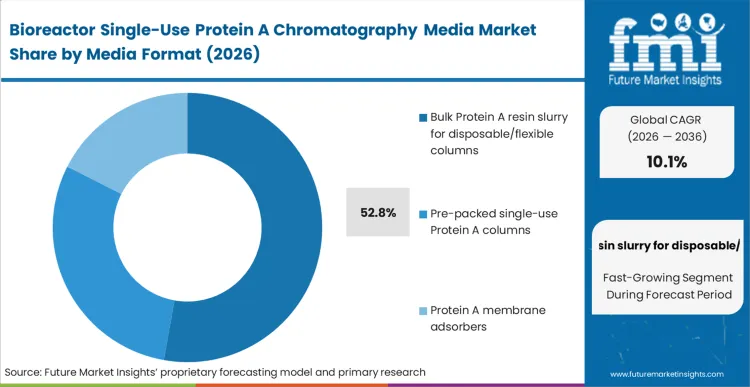
Pre-packed column architectures fundamentally alter how a downstream suite operates by moving the burden of bed integrity and qualification back to the vendor within the prepacked protein A columns market. While Bulk Protein A resin slurry for disposable/flexible columns holds a dominant 52.8% share, primarily due to the vast installed base of operators who still prefer to pack their own single-use hardware, pre-packed formats represent the actual trajectory of the market.
According to FMI's estimates, facilities evaluating prepacked protein A column vs bulk resin options at commercial scale are unwilling to tolerate the labor and failure risks of in-house packing. By procuring a closed, pre-validated capture step, facility managers isolate their operations from packing-induced channeling errors. CDMOs that delay the integration of pre-packed formats struggle to maintain competitive turnaround times, losing contracts to facilities that can guarantee faster product-to-product changeovers.
- Validation transfer: Pre-packed formats offload column qualification testing to the supplier. Quality assurance teams accelerate batch release by relying on vendor-supplied performance certificates.
- Slurry handling: Bulk resin procurement requires dedicated mixing and dispensing infrastructure. Downstream operators maintaining this approach absorb higher labor costs but retain absolute control over column dimensions.
- Membrane kinetics: Operations evaluating whether is protein A membrane chromatography replacing resin columns find that adsorber formats bypass the diffusion limits of traditional beads. Process engineers utilizing the protein A membrane adsorber market achieve extreme flow rates for rapid cycling in low-volume, high-titer scenarios.
Bioreactor Single-Use Protein A Chromatography Media Market Analysis by Matrix/Support
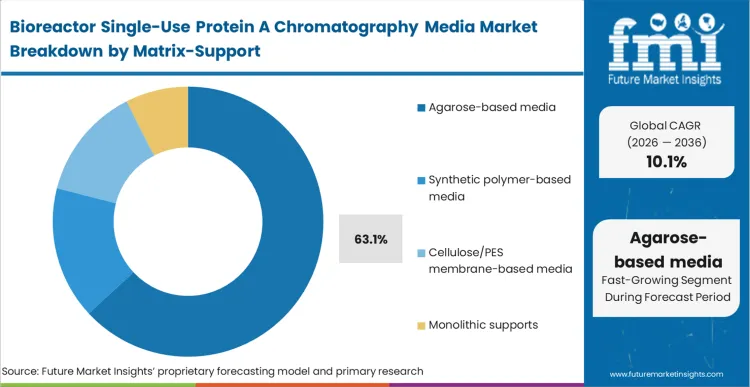
Agarose dominates this market not because it is the most advanced polymer, but because its regulatory pathway is virtually friction-free. The material captures a 63.1% share as regulatory affairs teams at major biopharmas continually default to agarose-based protein A resin for mAbs given its long history of successful BLA filings.
FMI analysts opine that the chemical stability and alkaline resistance of modern agarose allow it to survive aggressive sanitisation even within a limited-campaign lifecycle. Synthetic polymers are attempting to breach this stronghold by offering rigid architectures that do not compress at the high flow rates required by modern continuous processing. However, process development teams evaluating protein A membrane vs resin and synthetic alternatives must justify the qualification risk against the established baseline of agarose. Facilities that fail to evaluate synthetic alternatives risk hitting flow-rate bottlenecks as upstream titers intensify beyond the limits of soft gels.
- Compressibility thresholds: Agarose matrices physically deform under high pressure. Process engineers must balance bed height and flow velocity to prevent catastrophic column pressure spikes during capture.
- Alkaline resistance: Advanced crosslinked supports tolerate high-molar sodium hydroxide. Facility managers rely on this trait to ensure absolute viral clearance between cycles within a single campaign.
- Pore accessibility: Monolithic supports offer uninterrupted convective flow channels. Purification scientists leverage these to capture exceptionally large macromolecules that would otherwise face severe mass transfer resistance.
Bioreactor Single-Use Protein A Chromatography Media Market Analysis by Molecule Purified
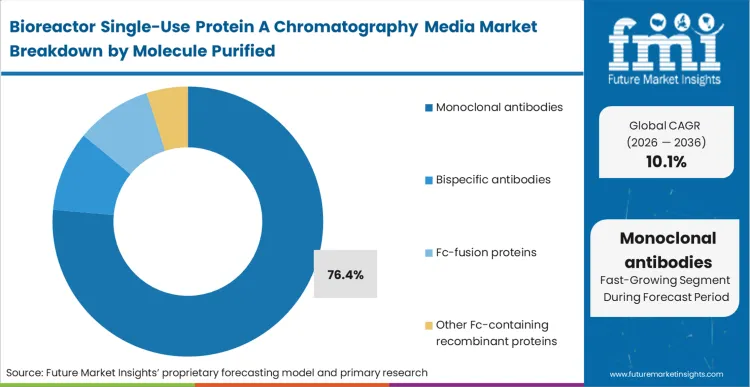
The absolute reliance of monoclonal antibody capture using single-use protein A media on the specific binding affinity of the staphylococcal ligand locks this segment into a 76.4% share of the market. This dynamic forces CDMOs to center their entire downstream platform architecture around this single purification step. As per FMI's projection, the requirement to remove host cell proteins and DNA in one highly efficient capture phase makes alternative separation techniques economically unviable for mAbs. When asking how does antibody pipeline growth affect protein A capture media demand, bispecifics and complex Fc-fusion proteins introduce severe binding complications, often requiring engineered or alkali-stabilized ligand variants to prevent product degradation during elution. Development teams attempting to push bispecifics through legacy mAb capture protocols face crippling aggregate formation and yield loss, directly impacting the commercial viability of their clinical pipelines.
- Elution sensitivity: Standard mAbs release cleanly at low pH. Process scientists standardize their viral inactivation steps directly following this predictable acidic transition.
- Steric hindrance: Bispecific antibodies often present modified Fc regions that interact unpredictably with native ligands. Development groups are forced to qualify highly engineered media variants to achieve acceptable dynamic binding capacities.
- Clearance efficiency: Fc-fusion proteins require precise ligand matching to prevent co-elution of clipped variants. Purification directors must perform exhaustive resin screening to maintain critical quality attributes.
Bioreactor Single-Use Protein A Chromatography Media Market Analysis by End User
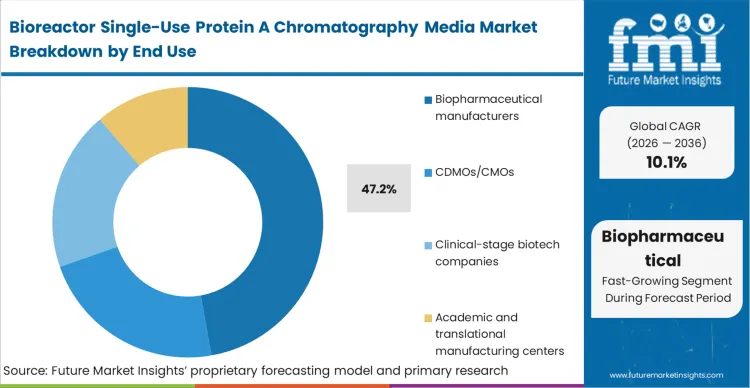
Contract manufacturing organizations (CDMOs/CMOs) are the fundamental engine driving the transition from stainless to disposable, even as biopharmaceutical manufacturing protein A media buyers hold the larger 47.2% share based on legacy volume. CDMOs sell agility; their business model collapses if a suite is offline for three weeks of cleaning validation between a client's Phase II breast cancer biologic and another client's autoimmune therapeutic.
Based on FMI's assessment, established biopharmaceutical manufacturers are slowly adopting this CDMO logic for their own multi-product regional hubs, realizing that capital-heavy, single-product stainless facilities are a liability in a fragmented blockbuster era. Manufacturing directors who cling to dedicated, multi-year resin lifespans in a multi-product environment face crippling overhead costs and uncompetitive suite utilization rates.
- Asset utilization: CDMOs generate revenue only when a suite is actively processing. Operations directors maximize uptime by physically replacing the capture column rather than validating its cleanliness, fueling the CDMO antibody purification media sector.
- Capital allocation: Clinical-stage biotechs lack the capital for permanent infrastructure. Procurement teams at these firms utilize single-use filtration assemblies and disposable media to defer major facility expenditures until post-approval.
- Hybrid integration: Traditional biopharmas operate mixed-use facilities. Facility managers route volatile, high-potency clinical runs, including biosimilar manufacturing protein A capture media demand, through disposable trains while keeping stable commercial products on legacy stainless lines.
Bioreactor Single-Use Protein A Chromatography Media Market Analysis by Workflow scale

The physical geometry of modern single-use bioreactors dictates the downstream capture market, anchoring the 501-2,000 L single-use-linked campaigns segment to a 44.1% share. Because the limit of a disposable upstream bag is roughly 2,000 litres, the downstream capture column must be precisely sized to process this specific volume within a single operational change.
In FMI's view, scaling beyond this volume requires multiplexing bioreactors, which completely changes the cadence of the downstream suite. Facilities attempting to process multiple 2,000 L harvests through an undersized, multi-cycle column negate the time savings of single-use technology. Operations managers must perfectly match their pre-packed column volume to the upstream titre to ensure the entire harvest is captured continuously without product pooling or degradation.
- Batch synchronization: The 2,000L harvest sets the biological clock for the facility. Downstream supervisors size their bioprocess containers and fluid transfer solutions to capture the entire volume in one uninterrupted unit operation.
- Clinical agility: Sub-500L scales demand absolute operational flexibility. Process development engineers swap modular capture formats daily to support rapid, iterative pilot-scale screening.
- Scale-out vs Scale-up: Commercial production relies on replicating 2,000L trains rather than building larger tanks. Plant designers use identical disposable capture columns across multiple parallel lines to simplify tech transfer and validation.
Bioreactor Single-Use Protein A Chromatography Media Market Drivers, Restraints, and Opportunities

The necessity to execute rapid product changeovers without cross-contamination risk forces CDMO facility directors to transition away from permanent stainless-steel capture columns toward flexible bioprocess chromatography media. As biologics pipelines fragment into targeted, smaller-volume therapeutics, the time spent on cleaning-in-place (CIP) and sterilization validation directly destroys the facility's profit margin. Multi-product suites can no longer afford the downtime associated with proving a reusable resin is free of a previous batch's active pharmaceutical ingredient. By discarding the capture media after a campaign, operators convert an unpredictable validation roadblock into a highly predictable consumable expense, driving the single-use downstream purification media market.
The severe supply chain consolidation among major chromatography resin manufacturers creates a bottleneck that threatens clinical timelines. Facility managers are painfully aware that transitioning to single-use, pre-packed columns locks them into proprietary hardware and specific single-use pump connections. When evaluating reusable protein A resin vs single-use protein A media, buyers realize that if a dominant supplier experiences a manufacturing delay or reprioritizes production for pandemic response, biomanufacturers lack the flexibility to simply pack a different resin into their existing hardware. While vendor-managed inventory programs and regional supply agreements attempt to buffer this risk, dual-sourcing pre-packed architectures remains technically difficult and regulatory intensive.
Opportunities in the Bioreactor Single-Use Protein A Chromatography Media Market
- Continuous bioprocessing integration: Multi-column chromatography architectures require identically matched, highly consistent media volumes. Technology vendors who optimize pre-packed formats specifically for simulated moving bed operations capture the highest-margin continuous manufacturing contracts.
- High-titer specialized ligands: Next-generation bispecifics push the limits of traditional dynamic binding capacities. Formulators who engineer alkali-stable ligands capable of surviving aggressive intra-campaign sanitization secure exclusivity in complex molecule development.
- Regionalized supply networks: Geopolitical pressures require local access to critical bioprocessing consumables. Companies establishing downstream processing hardware and packing facilities directly within emerging Asian CDMO hubs bypass global shipping vulnerabilities.
Regional Analysis
Regional analysis indicates that the Bioreactor Single-Use Protein A Chromatography Media Market is categorized into North America, Europe, Asia Pacific, and other regions covering over 40 countries.
.webp "Top Country Growth Comparison Bioreactor Single Use Protein A Chromatography Media Market Cagr (2026 2036)")
| Country | CAGR (2026 to 2036) |
|---|---|
| India | 12.4% |
| China | 11.7% |
| South Korea | 10.6% |
| Singapore | 9.8% |
| United States | 8.8% |
| Germany | 8.2% |
| Switzerland | 7.9% |
Asia Pacific Bioreactor Single-Use Protein A Chromatography Media Market Analysis
The aggressive scale-up of biologics manufacturing across the Asia Pacific is entirely unencumbered by legacy stainless-steel infrastructure, allowing the region to adopt fully disposable architectures from inception. Rather than retrofitting old facilities, capital is flowing directly into modular, flexible plants designed specifically for high-turnover CDMO operations. FMI analysts opine that this advantage allows Asian manufacturers to execute tech transfers and initiate clinical runs in a fraction of the time required by mature Western sites. The procurement strategy here focuses on securing reliable, high-volume streams of protein purification resin to feed these newly minted suites.
- India: FMI estimates the market in India to expand at an annual growth rate of 12.4%. India's rapid expansion of clinical-stage CDMO capacity forces operations directors to prioritize multi-product flexibility over long-term capital equipment. Facility managers rely almost exclusively on disposable capture steps to eliminate the cross-contamination risks that would otherwise fail intense Western regulatory audits. Companies establishing localized packing operations here capture the immediate upside of a supply chain that demands absolute speed.
- China: The sheer velocity of the domestic biologics pipeline in China requires downstream processing to keep pace with explosive upstream single-use bioreactors deployments. Procurement heads actively seek out domestic or localized pre-packed formats to circumvent international trade friction and ensure uninterrupted supply. The market in China is forecast to register a CAGR of 11.7%. This trajectory positions the domestic market to rapidly transition from importing media to potentially exporting standardized disposable purification formats to the broader region.
- South Korea: South Korea’s highly concentrated, mega-scale biomanufacturing hubs are increasingly building out modular, single-use suites alongside their massive stainless capacity to handle complex, lower-volume runs. Over the forecast period, demand in South Korea is set for a CAGR of 10.6%. Process engineers utilise disposable formats to rapidly pilot new molecules before committing them to the permanent infrastructure. This hybrid operational model allows the nation's CDMOs to aggressively bid on diverse clinical pipelines without disrupting their commercial baselines.
- Singapore: Singapore acts as the primary risk-mitigation hub for global biopharmas seeking a secure, highly regulated footprint in Asia. Demand in Singapore is estimated to expand at a CAGR of 9.8%. Supply chain directors mandate the use of pre-validated, pre-packed columns to maintain strict alignment with European and US regulatory expectations. The reality on the ground is that facility downtime in this high-cost labour market is punishing, making the premium paid for single-use capture economically rational.
FMI's report includes additional Southeast Asian and emerging Pacific markets not detailed above. Across these secondary hubs, the lack of deeply experienced downstream packing personnel structurally forces an reliance on pre-packed, plug-and-play chromatography formats to ensure process consistency.
North America Bioreactor Single-Use Protein A Chromatography Media Market Analysis
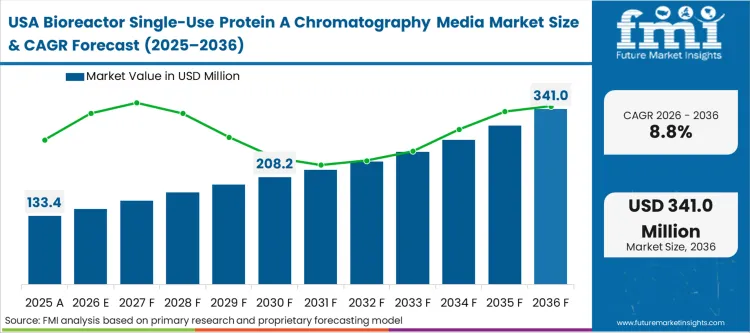
The North American market is defined by the tension between a massive, deeply entrenched stainless-steel installed base and the immediate need to process highly complex, low-volume advanced therapeutics. While mega-blockbuster mAbs still flow through permanent facilities, the sheer volume of novel bispecifics and fragmented clinical pipelines forces procurement teams to aggressively integrate single-use chromatography resin formats into new suite designs. As per FMI's projection, the regulatory comfort level with single-use technologies here is absolute, switching the buyer focus entirely toward supply chain resilience and multi-vendor qualification strategies.
- United States: The concentration of early-stage biotech innovation in the US dictates a development landscape that cannot wait for permanent facility construction. Clinical-stage directors utilize campaign-use formats to push molecules through Phase I and II as rapidly as possible, preserving capital until proof-of-concept is achieved. The United States market is projected to witness growth at a CAGR of 8.8%. Operations that delay qualifying dual sources for these critical disposable formats risk catastrophic clinical delays during supply chain shocks.
FMI's report includes Canadian market dynamics. Canadian biomanufacturing investments are heavily skewed toward pandemic-readiness and sovereign production, structural priorities that mandate the rapid scalability only achievable through fully disposable process trains.
Europe Bioreactor Single-Use Protein A Chromatography Media Market Analysis
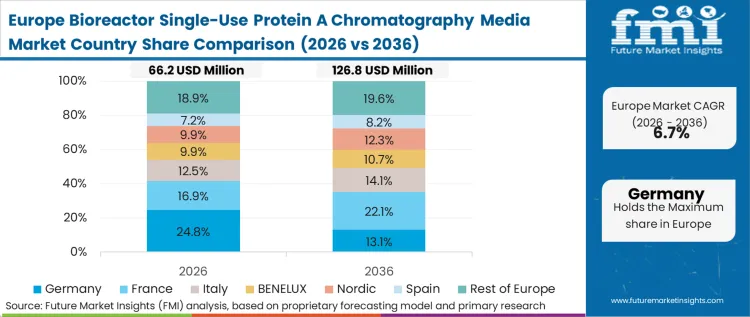
European biomanufacturing operates under the heaviest legacy infrastructure burden, yet it is leading the global industry toward continuous and intensified bioprocessing systems. The structural dynamic here involves retrofitting existing footprints with modular, single-use islands to handle the influx of complex Fc-fusion proteins that perform poorly on older legacy lines. According to FMI's estimates, European regulatory insistence on absolute viral clearance and cross-contamination prevention in multi-product facilities provides the final economic justification for abandoning reusable Protein A in flexible suites.
- Germany: A CAGR of 8.2% is expected for the market in Germany over the forecast period. Germany's dense concentration of established CDMOs and equipment manufacturers forces a highly technical evaluation of pre-packed column performance against legacy stainless standards. Process engineers here demand extreme flow-rate stability and precise packing metrics before transitioning a commercial run to a disposable format. The operational reality is that German suites must maximise the output of their existing square footage, making the elimination of CIP equipment a critical spatial advantage.
- Switzerland: Switzerland's focus on high-margin, highly complex biologics demands absolute precision in the capture phase. Procurement groups prioritize premium, engineered ligand media capable of handling sensitive molecular architectures over simple volume economics. The Swiss market is likely to post a CAGR of 7.9%. The trajectory establishes the country as the premier testing ground for advanced, high-titer continuous single-use purification architectures.
FMI's report includes the United Kingdom and broader EU member states. Across these markets, the regulatory phase-out of certain cleaning chemicals and the high cost of purified water generation structurally advantage facilities that eliminate the CIP requirement entirely through disposable capture.
Competitive Aligners for Market Players
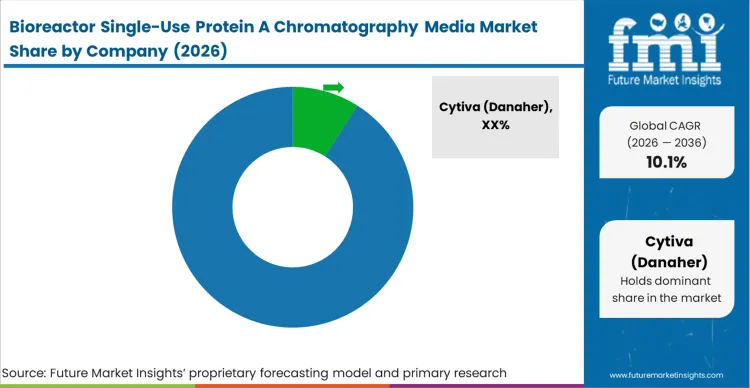
The single-use protein A resin market is highly concentrated due to the extreme technical and regulatory barriers required to validate a primary capture ligand. Buyers evaluating Cytiva, Merck KGaA, and Repligen do not simply compare pricing; they evaluate the vendor’s absolute ability to guarantee supply continuity and the regulatory history of the specific ligand. The primary variable separating qualified protein A chromatography media suppliers from unqualified vendors is the existence of a comprehensive Drug Master File (DMF) and a proven track record of successful BLA inclusions.
Incumbents like Cytiva hold structural advantages through their deep integration into legacy BLA filings, creating a massive barrier to entry because switching a primary capture resin post-approval is economically disastrous for the buyer. Single-use protein A resin manufacturers challenging these incumbents must build not just equivalent binding capacities, but robust, localized packing infrastructure that can deliver preparative chromatography columns faster than the legacy players. Formulating a novel, high-performance synthetic matrix is irrelevant if the vendor cannot guarantee global, redundant supply of the pre-packed hardware.
Large CDMO buyers aggressively resist single-vendor lock-in by designing downstream suites capable of accepting hardware from multiple suppliers. When identifying which companies supply protein A media for disposable workflows, the structural tension between a CDMO’s need for generic, interchangeable preparative and process chromatography connections and the vendor’s incentive to enforce proprietary flow paths will define procurement strategies through 2036. The market will remain concentrated as the sheer capital required to maintain dual-continent resin manufacturing and packing facilities locks out smaller regional participants.
Key Players in Bioreactor Single-Use Protein A Chromatography Media Market
- Cytiva (Danaher)
- Merck KGaA
- Ecolab (Purolite)
- Repligen Corporation
- Sartorius Stedim Biotech
- Tosoh Bioscience
- JSR Life Sciences
Scope of the Report
| Metric | Value |
|---|---|
| Quantitative Units | USD 272.4 Million to USD 713.0 Million, at a CAGR of 10.10% |
| Market Definition | This market tracks affinity capture media consumed in single-campaign or limited-cycle downstream bioprocessing. It is defined by an operational boundary: the deliberate discarding of high-cost Protein A materials after a specific batch to bypass the time and cost penalties of cleaning validation in multi-product facilities. |
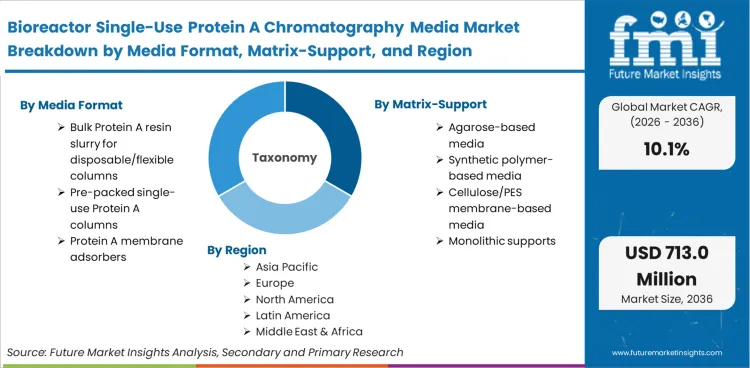
| Media format Segmentation | Bulk Protein A resin slurry for disposable/flexible columns, Pre-packed single-use Protein A columns, Protein A membrane adsorbers |
| Matrix/support Segmentation | Agarose-based media, Synthetic polymer-based media, Cellulose/PES membrane-based media, Monolithic supports |
| Molecule purified Segmentation | Monoclonal antibodies, Bispecific antibodies, Fc-fusion proteins, Other Fc-containing recombinant proteins |
| End user Segmentation | Biopharmaceutical manufacturers, CDMOs/CMOs, Clinical-stage biotech companies, Academic and translational manufacturing centers |
| Regions Covered | North America, Europe, Asia Pacific, and other regions |
| Countries Covered | India, China, South Korea, Singapore, United States, Germany, Switzerland, and 40 plus countries |
| Key Companies Profiled | Cytiva (Danaher), Merck KGaA, Ecolab (Purolite), Repligen Corporation, Sartorius Stedim Biotech, Tosoh Bioscience, JSR Life Sciences |
| Forecast Period | 2026 to 2036 |
| Approach | Primary interviews were conducted with downstream process development scientists and bioprocess engineering directors. Baseline sizing was anchored to single-use bioreactor volume deployments and clinical pipeline milestones. Forecasts were cross-validated against regional CDMO capacity expansions and dominant vendor supply data. |
Bioreactor Single-Use Protein A Chromatography Media Market Analysis by Segments
Media Format:
- Bulk Protein A resin slurry for disposable/flexible columns
- Pre-packed single-use Protein A columns
- Protein A membrane adsorbers
Matrix/support:
- Agarose-based media
- Synthetic polymer-based media
- Cellulose/PES membrane-based media
- Monolithic supports
Molecule Purified:
- Monoclonal antibodies
- Bispecific antibodies
- Fc-fusion proteins
- Other Fc-containing recombinant proteins
End User:
- Biopharmaceutical manufacturers
- CDMOs/CMOs
- Clinical-stage biotech companies
- Academic and translational manufacturing centers
Workflow Scale:
- 501-2,000 L single-use-linked campaigns
- Up to 500 L clinical and pilot batches
- Above 2,000 L modular commercial batches
Region:
- North America
- United States
- Canada
- Europe
- Germany
- United Kingdom
- France
- Italy
- Spain
- Asia Pacific
- China
- Japan
- South Korea
- Taiwan
- Singapore
- Latin America
- Brazil
- Mexico
- Argentina
- Middle East & Africa
- GCC Countries
- South Africa
- Israel
Bibliography
- USA Food and Drug Administration. (2026, January). Novel Drug Approvals for 2025. FDA.
- Merck KGaA. (2025, January). Annual Report - 2024. Merck.
- Sartorius AG. (2025, February). Annual Report 2024. Sartorius.
- Crescioli, S., Kaplon, H., Wang, L., Visweswaraiah, J., Kapoor, V., & Reichert, J. M. (2025, January). Antibodies to watch in 2025. mAbs.
- Wang, X., Xu, J., Guo, Q., Li, Z., Cao, J., Fu, R., Xu, M., Zhao, X., Wang, F., Zhang, X., Dong, T., Li, X., Qian, W., Hou, S., Ji, L., Zhang, D., & Guo, H. (2024, March). Improving product quality and productivity of an antibody-based biotherapeutic using inverted frustoconical shaking bioreactors. Frontiers in Bioengineering and Biotechnology.
- Silva, T. C., Isaksson, M., Nilsson, B., Eppink, M., & Ottens, M. (2025, June). Optimization of multi-column chromatography for capture and polishing at high protein load. Biotechnology Progress.
- Chehraghi, E. J., Akbarzadehlaleh, P., & Shamsasenjan, K. (2025). Purification of Monoclonal Antibodies Using Chromatographic Methods: Increasing Purity and Recovery. Advanced Pharmaceutical Bulletin.
- Ito, T., Uebele, A.-K., Nihei, T., Yamamoto, K., Watanabe, N., Tokieda, Y., & Okada, M. (2024, Nov). Economic analysis of buffer preparation strategy for single-use bioprocessing of monoclonal antibodies. EFB Bioeconomy Journal.
This bibliography is provided for reader reference. The full FMI report contains the complete reference list with primary source documentation.
This Report Addresses
- Market intelligence to support strategic decision-making across pre-packed single-use columns and membrane adsorber categories
- Market size estimation and 10-year revenue forecasts from 2026 to 2036, supported by clinical BLA milestones and bioreactor deployment tracking
- Growth opportunity mapping across molecule-purified dimensions with emphasis on the titer harmonisation threshold between upstream and downstream
- Segment and regional revenue forecasts covering bispecific antibodies across high-turnover multi-product CDMO environments
- Competition strategy assessment, including DMF status, localised packing infrastructure, and global supply redundancy
- Capability development tracking, including high-pressure rigid synthetic polymers and alkali-resistant ligand technologies
- Market access analysis covering FDA viral clearance expectations and cross-contamination prevention standards
- Market report delivery in PDF, Excel, PPT, and interactive dashboard formats for executive strategy, biomanufacturing facility planning, and operational benchmarking use
Frequently Asked Questions
What is the forecast for single-use protein A media through 2036?
The market reaches USD 713.0 million by 2036. This expansion reflects the total architectural movement of new downstream facilities toward modular, campaign-specific purification trains capable of matching upstream single-use bioreactor limits.
Who are the leading suppliers of protein A capture media for single-use facilities?
The market is dominated by legacy vendors like Cytiva, Merck KGaA, and Sartorius, alongside specialty hardware providers like Repligen. These suppliers lead because they pair proven, BLA-validated agarose and synthetic resin chemistries with immense global column-packing infrastructure.
Compare protein A membrane adsorbers versus prepacked columns in single-use mAb purification?
Pre-packed columns offer identical binding capacities and scalability to traditional resin beds, making tech transfer straightforward. Membrane adsorbers bypass diffusion limits to achieve extreme flow rates, making them ideal for rapid cycling of very high-titer, low-volume clinical runs where cycle speed outweighs absolute binding capacity.
Why are prepacked protein A columns used with single-use bioreactors?
They structurally match the exact harvest volume of 2,000L upstream bags. Facility managers utilize them to bypass the massive labor and cross-contamination risks associated with packing and cleaning stainless-steel columns between batches.
How is protein A media used in single-use bioprocessing?
It is physically discarded after a predefined campaign rather than being subjected to weeks of chemical sanitisation. This transforms a high-cost capital asset into a consumable, drastically reducing the facility downtime between multi-product manufacturing runs.
What is single-use protein A chromatography media?
It refers to affinity capture formats such as pre-packed columns, flexible bulk slurries, or membrane adsorbers deployed specifically to eliminate cross-contamination and cleaning validation between biological product runs.
Which Media format segment leads?
Bulk Protein A resin slurry for disposable/flexible columns leads with 52.8% share. This format dominates because operations teams with deep in-house packing expertise prefer to maintain geometric control over their disposable column architectures while still avoiding permanent CIP validation.
Which Matrix/support segment leads?
Agarose-based media dominates with 63.1% share. Regulatory affairs groups default to this matrix because decades of successful BLA filings eliminate the intense scrutiny associated with qualifying novel synthetic polymers for primary capture.
Which Molecule purified segment leads?
Monoclonal antibodies account for 76.4% of the market. The sheer volumetric demand for these therapeutics, combined with their absolute reliance on the specific binding affinity of staphylococcal ligands, forces CDMOs to standardize their chromatography accessories and consumables around this purification step.
What drives rapid growth?
The severe economic penalty of idle suites drives the transition. Contract manufacturers cannot afford the two-to-three-week downtime required to validate equipment cleanliness between client campaigns, forcing the adoption of campaign-use disposable hardware.
What is the primary restraint?
The consolidation of global resin supply creates severe operational risk. Facility managers who adopt proprietary pre-packed columns lock themselves into specific bioprocessing supplies ecosystems, leaving them vulnerable to single-source manufacturing delays.
Which country grows fastest?
India leads at 12.4%, heavily outpacing the United States at 8.8%. India's massive influx of greenfield CDMO investments prioritizes flexible, multi-product suite designs that utilize disposable capture from day one, whereas the US market must carefully navigate retrofitting older, massive stainless-steel installations.
Why does China command an 11.7% growth rate?
Chinese biologics scale-up requires immediate processing capacity that bypasses lengthy hard-piping construction. The domestic market relies on single-use downstream architectures to match their rapid upstream bioreactor deployments.
How does South Korea utilize disposable Protein A formats?
South Korean mega-hubs utilize these formats as modular pilot lines. This allows them to quickly run complex clinical batches without risking contamination within their massive, permanent commercial stainless-steel infrastructure.
What structural barrier prevents synthetic polymers from overtaking agarose?
Synthetic matrices offer superior rigidity, but process development scientists are hesitant to absorb the massive qualification risk required to prove viral clearance and product safety profiles on a novel material when agarose already has guaranteed regulatory acceptance.
How do CDMOs handle bispecific antibody capture?
Bispecifics often require highly engineered, alkali-stable ligand variants to prevent aggregation during the low-pH elution phase, forcing procurement teams to source premium, specialized pre-packed formats rather than standard mAb resins.
What changes when a facility moves from 500 L to 2,000 L scale?
The 2,000 L scale represents the structural limit of standard single-use upstream bags. Downstream managers must procure pre-packed columns precisely sized to process this exact harvest volume continuously, establishing a hard geometric constraint on vendor supply.
Why do traditional biopharmaceutical manufacturers adopt CDMO strategies?
Established brand owners are facing fragmented clinical pipelines rather than single mega-blockbusters. They are adopting localized single-use capture models, including japan protein a resins, to increase the flexibility of their legacy multi-product manufacturing hubs.
How do pre-packed columns reduce validation burdens?
By offloading column packing and bed integrity testing entirely to the vendor, quality assurance teams can execute faster batch releases by relying on the supplier's provided performance certificates.
What role does Singapore play in the global supply chain?
Singapore acts as an agile, highly regulated biomanufacturing anchor. Because facility downtime in this premium-labor market is exceptionally costly, the high price of disposable pre-packed capture columns is economically justified by the increased suite utilization.
How do major players protect their market position?
Incumbents leverage deep integration into existing Drug Master Files (DMFs). Once a specific resin is written into a therapeutic's BLA, the massive regulatory cost of switching materials effectively locks out challenger products for the lifecycle of that drug.
Is protein A membrane chromatography replacing resin columns?
Membranes bypass the diffusion limits of standard porous beads, allowing process engineers to achieve extreme flow velocities. This is structurally necessary when processing very high-titer, low-volume clinical runs where cycle speed is the primary objective, though bulk resin currently maintains dominance by volume.
Why are downstream operations switching from volume to campaign-based procurement?
Clinical yields are highly variable. Instead of buying bulk resin intended to last for years, procurement directors now purchase pre-packed columns designed specifically to last only for the duration of a single Phase II campaign, hedging against clinical trial failures.
Preview the report firsthand - request a free sample
Get SampleGet the brochure for pricing and purchase details.
Get PDFTable of Content
- Executive Summary
- Global Market Outlook
- Demand-side Trends
- Supply-side Trends
- Technology Roadmap Analysis
- Analysis and Recommendations
- Market Overview
- Market Coverage / Taxonomy
- Market Definition / Scope / Limitations
- Research Methodology
- Chapter Orientation
- Analytical Lens and Working Hypotheses
- Market Structure, Signals, and Trend Drivers
- Benchmarking and Cross-market Comparability
- Market Sizing, Forecasting, and Opportunity Mapping
- Research Design and Evidence Framework
- Desk Research Programme (Secondary Evidence)
- Company Annual and Sustainability Reports
- Peer-reviewed Journals and Academic Literature
- Corporate Websites, Product Literature, and Technical Notes
- Earnings Decks and Investor Briefings
- Statutory Filings and Regulatory Disclosures
- Technical White Papers and Standards Notes
- Trade Journals, Industry Magazines, and Analyst Briefs
- Conference Proceedings, Webinars, and Seminar Materials
- Government Statistics Portals and Public Data Releases
- Press Releases and Reputable Media Coverage
- Specialist Newsletters and Curated Briefings
- Sector Databases and Reference Repositories
- FMI Internal Proprietary Databases and Historical Market Datasets
- Subscription Datasets and Paid Sources
- Social Channels, Communities, and Digital Listening Inputs
- Additional Desk Sources
- Expert Input and Fieldwork (Primary Evidence)
- Primary Modes
- Qualitative Interviews and Expert Elicitation
- Quantitative Surveys and Structured Data Capture
- Blended Approach
- Why Primary Evidence is Used
- Field Techniques
- Interviews
- Surveys
- Focus Groups
- Observational and In-context Research
- Social and Community Interactions
- Stakeholder Universe Engaged
- C-suite Leaders
- Board Members
- Presidents and Vice Presidents
- R&D and Innovation Heads
- Technical Specialists
- Domain Subject-matter Experts
- Scientists
- Physicians and Other Healthcare Professionals
- Governance, Ethics, and Data Stewardship
- Research Ethics
- Data Integrity and Handling
- Primary Modes
- Tooling, Models, and Reference Databases
- Desk Research Programme (Secondary Evidence)
- Data Engineering and Model Build
- Data Acquisition and Ingestion
- Cleaning, Normalisation, and Verification
- Synthesis, Triangulation, and Analysis
- Quality Assurance and Audit Trail
- Market Background
- Market Dynamics
- Drivers
- Restraints
- Opportunity
- Trends
- Scenario Forecast
- Demand in Optimistic Scenario
- Demand in Likely Scenario
- Demand in Conservative Scenario
- Opportunity Map Analysis
- Product Life Cycle Analysis
- Supply Chain Analysis
- Investment Feasibility Matrix
- Value Chain Analysis
- PESTLE and Porter’s Analysis
- Regulatory Landscape
- Regional Parent Market Outlook
- Production and Consumption Statistics
- Import and Export Statistics
- Market Dynamics
- Global Market Analysis 2021 to 2025 and Forecast, 2026 to 2036
- Historical Market Size Value (USD Million) Analysis, 2021 to 2025
- Current and Future Market Size Value (USD Million) Projections, 2026 to 2036
- Y-o-Y Growth Trend Analysis
- Absolute $ Opportunity Analysis
- Global Market Pricing Analysis 2021 to 2025 and Forecast 2026 to 2036
- Global Market Analysis 2021 to 2025 and Forecast 2026 to 2036, By Media Format
- Introduction / Key Findings
- Historical Market Size Value (USD Million) Analysis By Media Format , 2021 to 2025
- Current and Future Market Size Value (USD Million) Analysis and Forecast By Media Format , 2026 to 2036
- Bulk Protein A resin slurry for disposable/flexible columns
- Pre-packed single-use Protein A columns
- Protein A membrane adsorbers
- Bulk Protein A resin slurry for disposable/flexible columns
- Y-o-Y Growth Trend Analysis By Media Format , 2021 to 2025
- Absolute $ Opportunity Analysis By Media Format , 2026 to 2036
- Global Market Analysis 2021 to 2025 and Forecast 2026 to 2036, By Matrix/Support
- Introduction / Key Findings
- Historical Market Size Value (USD Million) Analysis By Matrix/Support, 2021 to 2025
- Current and Future Market Size Value (USD Million) Analysis and Forecast By Matrix/Support, 2026 to 2036
- Agarose-based media
- Synthetic polymer-based media
- Cellulose/PES membrane-based media
- Monolithic supports
- Agarose-based media
- Y-o-Y Growth Trend Analysis By Matrix/Support, 2021 to 2025
- Absolute $ Opportunity Analysis By Matrix/Support, 2026 to 2036
- Global Market Analysis 2021 to 2025 and Forecast 2026 to 2036, By Molecule Purified
- Introduction / Key Findings
- Historical Market Size Value (USD Million) Analysis By Molecule Purified, 2021 to 2025
- Current and Future Market Size Value (USD Million) Analysis and Forecast By Molecule Purified, 2026 to 2036
- Monoclonal antibodies
- Bispecific antibodies
- Fc-fusion proteins
- Other Fc-containing recombinant proteins
- Monoclonal antibodies
- Y-o-Y Growth Trend Analysis By Molecule Purified, 2021 to 2025
- Absolute $ Opportunity Analysis By Molecule Purified, 2026 to 2036
- Global Market Analysis 2021 to 2025 and Forecast 2026 to 2036, By End Use
- Introduction / Key Findings
- Historical Market Size Value (USD Million) Analysis By End Use, 2021 to 2025
- Current and Future Market Size Value (USD Million) Analysis and Forecast By End Use, 2026 to 2036
- Biopharmaceutical manufacturers
- CDMOs/CMOs
- Clinical-stage biotech companies
- Academic and translational manufacturing centers
- Biopharmaceutical manufacturers
- Y-o-Y Growth Trend Analysis By End Use, 2021 to 2025
- Absolute $ Opportunity Analysis By End Use, 2026 to 2036
- Global Market Analysis 2021 to 2025 and Forecast 2026 to 2036, By Workflow scale
- Introduction / Key Findings
- Historical Market Size Value (USD Million) Analysis By Workflow scale, 2021 to 2025
- Current and Future Market Size Value (USD Million) Analysis and Forecast By Workflow scale, 2026 to 2036
- 501–2,000 L single-use-linked campaigns
- Up to 500 L clinical and pilot batches
- Above 2,000 L modular commercial batches
- 501–2,000 L single-use-linked campaigns
- Y-o-Y Growth Trend Analysis By Workflow scale, 2021 to 2025
- Absolute $ Opportunity Analysis By Workflow scale, 2026 to 2036
- Global Market Analysis 2021 to 2025 and Forecast 2026 to 2036, By Region
- Introduction
- Historical Market Size Value (USD Million) Analysis By Region, 2021 to 2025
- Current Market Size Value (USD Million) Analysis and Forecast By Region, 2026 to 2036
- North America
- Latin America
- Western Europe
- Eastern Europe
- East Asia
- South Asia and Pacific
- Middle East & Africa
- Market Attractiveness Analysis By Region
- North America Market Analysis 2021 to 2025 and Forecast 2026 to 2036, By Country
- Historical Market Size Value (USD Million) Trend Analysis By Market Taxonomy, 2021 to 2025
- Market Size Value (USD Million) Forecast By Market Taxonomy, 2026 to 2036
- By Country
- USA
- Canada
- Mexico
- By Media Format
- By Matrix/Support
- By Molecule Purified
- By End Use
- By Workflow scale
- By Country
- Market Attractiveness Analysis
- By Country
- By Media Format
- By Matrix/Support
- By Molecule Purified
- By End Use
- By Workflow scale
- Key Takeaways
- Latin America Market Analysis 2021 to 2025 and Forecast 2026 to 2036, By Country
- Historical Market Size Value (USD Million) Trend Analysis By Market Taxonomy, 2021 to 2025
- Market Size Value (USD Million) Forecast By Market Taxonomy, 2026 to 2036
- By Country
- Brazil
- Chile
- Rest of Latin America
- By Media Format
- By Matrix/Support
- By Molecule Purified
- By End Use
- By Workflow scale
- By Country
- Market Attractiveness Analysis
- By Country
- By Media Format
- By Matrix/Support
- By Molecule Purified
- By End Use
- By Workflow scale
- Key Takeaways
- Western Europe Market Analysis 2021 to 2025 and Forecast 2026 to 2036, By Country
- Historical Market Size Value (USD Million) Trend Analysis By Market Taxonomy, 2021 to 2025
- Market Size Value (USD Million) Forecast By Market Taxonomy, 2026 to 2036
- By Country
- Germany
- UK
- Italy
- Spain
- France
- Nordic
- BENELUX
- Rest of Western Europe
- By Media Format
- By Matrix/Support
- By Molecule Purified
- By End Use
- By Workflow scale
- By Country
- Market Attractiveness Analysis
- By Country
- By Media Format
- By Matrix/Support
- By Molecule Purified
- By End Use
- By Workflow scale
- Key Takeaways
- Eastern Europe Market Analysis 2021 to 2025 and Forecast 2026 to 2036, By Country
- Historical Market Size Value (USD Million) Trend Analysis By Market Taxonomy, 2021 to 2025
- Market Size Value (USD Million) Forecast By Market Taxonomy, 2026 to 2036
- By Country
- Russia
- Poland
- Hungary
- Balkan & Baltic
- Rest of Eastern Europe
- By Media Format
- By Matrix/Support
- By Molecule Purified
- By End Use
- By Workflow scale
- By Country
- Market Attractiveness Analysis
- By Country
- By Media Format
- By Matrix/Support
- By Molecule Purified
- By End Use
- By Workflow scale
- Key Takeaways
- East Asia Market Analysis 2021 to 2025 and Forecast 2026 to 2036, By Country
- Historical Market Size Value (USD Million) Trend Analysis By Market Taxonomy, 2021 to 2025
- Market Size Value (USD Million) Forecast By Market Taxonomy, 2026 to 2036
- By Country
- China
- Japan
- South Korea
- By Media Format
- By Matrix/Support
- By Molecule Purified
- By End Use
- By Workflow scale
- By Country
- Market Attractiveness Analysis
- By Country
- By Media Format
- By Matrix/Support
- By Molecule Purified
- By End Use
- By Workflow scale
- Key Takeaways
- South Asia and Pacific Market Analysis 2021 to 2025 and Forecast 2026 to 2036, By Country
- Historical Market Size Value (USD Million) Trend Analysis By Market Taxonomy, 2021 to 2025
- Market Size Value (USD Million) Forecast By Market Taxonomy, 2026 to 2036
- By Country
- India
- ASEAN
- Australia & New Zealand
- Rest of South Asia and Pacific
- By Media Format
- By Matrix/Support
- By Molecule Purified
- By End Use
- By Workflow scale
- By Country
- Market Attractiveness Analysis
- By Country
- By Media Format
- By Matrix/Support
- By Molecule Purified
- By End Use
- By Workflow scale
- Key Takeaways
- Middle East & Africa Market Analysis 2021 to 2025 and Forecast 2026 to 2036, By Country
- Historical Market Size Value (USD Million) Trend Analysis By Market Taxonomy, 2021 to 2025
- Market Size Value (USD Million) Forecast By Market Taxonomy, 2026 to 2036
- By Country
- Kingdom of Saudi Arabia
- Other GCC Countries
- Turkiye
- South Africa
- Other African Union
- Rest of Middle East & Africa
- By Media Format
- By Matrix/Support
- By Molecule Purified
- By End Use
- By Workflow scale
- By Country
- Market Attractiveness Analysis
- By Country
- By Media Format
- By Matrix/Support
- By Molecule Purified
- By End Use
- By Workflow scale
- Key Takeaways
- Key Countries Market Analysis
- USA
- Pricing Analysis
- Market Share Analysis, 2025
- By Media Format
- By Matrix/Support
- By Molecule Purified
- By End Use
- By Workflow scale
- Canada
- Pricing Analysis
- Market Share Analysis, 2025
- By Media Format
- By Matrix/Support
- By Molecule Purified
- By End Use
- By Workflow scale
- Mexico
- Pricing Analysis
- Market Share Analysis, 2025
- By Media Format
- By Matrix/Support
- By Molecule Purified
- By End Use
- By Workflow scale
- Brazil
- Pricing Analysis
- Market Share Analysis, 2025
- By Media Format
- By Matrix/Support
- By Molecule Purified
- By End Use
- By Workflow scale
- Chile
- Pricing Analysis
- Market Share Analysis, 2025
- By Media Format
- By Matrix/Support
- By Molecule Purified
- By End Use
- By Workflow scale
- Germany
- Pricing Analysis
- Market Share Analysis, 2025
- By Media Format
- By Matrix/Support
- By Molecule Purified
- By End Use
- By Workflow scale
- UK
- Pricing Analysis
- Market Share Analysis, 2025
- By Media Format
- By Matrix/Support
- By Molecule Purified
- By End Use
- By Workflow scale
- Italy
- Pricing Analysis
- Market Share Analysis, 2025
- By Media Format
- By Matrix/Support
- By Molecule Purified
- By End Use
- By Workflow scale
- Spain
- Pricing Analysis
- Market Share Analysis, 2025
- By Media Format
- By Matrix/Support
- By Molecule Purified
- By End Use
- By Workflow scale
- France
- Pricing Analysis
- Market Share Analysis, 2025
- By Media Format
- By Matrix/Support
- By Molecule Purified
- By End Use
- By Workflow scale
- India
- Pricing Analysis
- Market Share Analysis, 2025
- By Media Format
- By Matrix/Support
- By Molecule Purified
- By End Use
- By Workflow scale
- ASEAN
- Pricing Analysis
- Market Share Analysis, 2025
- By Media Format
- By Matrix/Support
- By Molecule Purified
- By End Use
- By Workflow scale
- Australia & New Zealand
- Pricing Analysis
- Market Share Analysis, 2025
- By Media Format
- By Matrix/Support
- By Molecule Purified
- By End Use
- By Workflow scale
- China
- Pricing Analysis
- Market Share Analysis, 2025
- By Media Format
- By Matrix/Support
- By Molecule Purified
- By End Use
- By Workflow scale
- Japan
- Pricing Analysis
- Market Share Analysis, 2025
- By Media Format
- By Matrix/Support
- By Molecule Purified
- By End Use
- By Workflow scale
- South Korea
- Pricing Analysis
- Market Share Analysis, 2025
- By Media Format
- By Matrix/Support
- By Molecule Purified
- By End Use
- By Workflow scale
- Russia
- Pricing Analysis
- Market Share Analysis, 2025
- By Media Format
- By Matrix/Support
- By Molecule Purified
- By End Use
- By Workflow scale
- Poland
- Pricing Analysis
- Market Share Analysis, 2025
- By Media Format
- By Matrix/Support
- By Molecule Purified
- By End Use
- By Workflow scale
- Hungary
- Pricing Analysis
- Market Share Analysis, 2025
- By Media Format
- By Matrix/Support
- By Molecule Purified
- By End Use
- By Workflow scale
- Kingdom of Saudi Arabia
- Pricing Analysis
- Market Share Analysis, 2025
- By Media Format
- By Matrix/Support
- By Molecule Purified
- By End Use
- By Workflow scale
- Turkiye
- Pricing Analysis
- Market Share Analysis, 2025
- By Media Format
- By Matrix/Support
- By Molecule Purified
- By End Use
- By Workflow scale
- South Africa
- Pricing Analysis
- Market Share Analysis, 2025
- By Media Format
- By Matrix/Support
- By Molecule Purified
- By End Use
- By Workflow scale
- USA
- Market Structure Analysis
- Competition Dashboard
- Competition Benchmarking
- Market Share Analysis of Top Players
- By Regional
- By Media Format
- By Matrix/Support
- By Molecule Purified
- By End Use
- By Workflow scale
- Competition Analysis
- Competition Deep Dive
- Cytiva (Danaher)
- Overview
- Product Portfolio
- Profitability by Market Segments (Product/Age /Sales Channel/Region)
- Sales Footprint
- Strategy Overview
- Marketing Strategy
- Product Strategy
- Channel Strategy
- Merck KGaA
- Ecolab (Purolite)
- Repligen Corporation
- Sartorius Stedim Biotech
- Tosoh Bioscience
- JSR Life Sciences
- Cytiva (Danaher)
- Competition Deep Dive
- Assumptions & Acronyms Used


