

- Industry Size (2026)
- USD 243.5 Mn
- Forecast (2036)
- USD 887.0 Mn
- CAGR (2026 to 2036)
- 13.8%
Low-pH Stable Probiotic Protection Agents for RTD Drinks Market Forecast and Outlook 2026 to 2036
The low-pH stable probiotic protection agents for RTD drinks market is valued at USD 243.5 million in 2026 and is projected to reach USD 887.0 million by 2036, registering a CAGR of 13.8%. Performance across this period is determined by the technical difficulty of preserving live cultures in acidic liquid environments rather than by overall growth in probiotic beverage consumption. Value concentrates around protection systems that maintain viable counts under low pH, oxygen exposure, and extended shelf life, since failure directly undermines label claims and brand trust. Cost structures favor suppliers with proprietary encapsulation chemistries, validated survival data, and process compatibility with high-throughput RTD manufacturing. Margins tend to accumulate upstream where protection efficacy reduces downstream reformulation risk and product write-offs.
Buyer behavior reinforces this concentration of value capture. Beverage producers show limited tolerance for variability, prioritizing protection agents with predictable performance across multiple acid profiles and processing conditions. Switching costs remain elevated because protection systems are validated at strain, formulation, and shelf-life levels, making late changes operationally disruptive. Procurement decisions therefore emphasize reliability, documentation, and regulatory readiness over marginal price differences. Investment activity focuses on scalable encapsulation platforms that balance protection efficiency with sensory neutrality and clean-label constraints. Between 2026 and 2036, growth quality depends on execution discipline, strain-specific performance assurance, and alignment with tightening probiotic labeling standards, rather than rapid expansion of RTD formats alone.
Quick Stats for Low-pH Stable Probiotic Protection Agents for RTD Drinks Market
- Low-pH Stable Probiotic Protection Agents for RTD Drinks Market Value (2026): USD 243.5 million
- Low-pH Stable Probiotic Protection Agents for RTD Drinks Market Forecast Value (2036): USD 887.0 million
- Low-pH Stable Probiotic Protection Agents for RTD Drinks Market Forecast CAGR (2026 to 2036): 13.8%
- Leading Application Segment in Global Demand: Standard
- Fastest-Growing Countries: India, China, USA, Germany
- Key Players in Global Demand: IFF, DSM-Firmenich, Kerry, ADM, Novonesis, Lonza
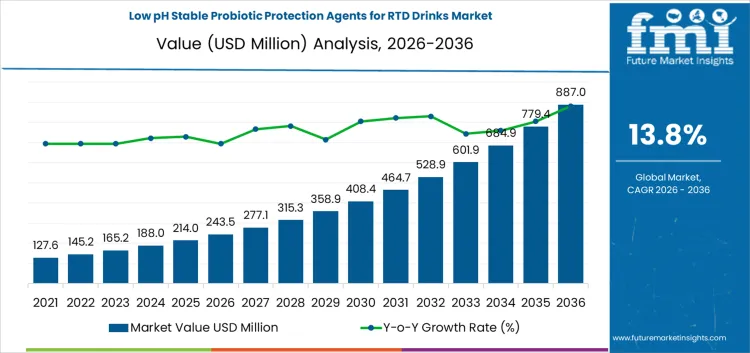
Low-pH Stable Probiotic Protection Agents for RTD Drinks Market Key Takeaways
| Metric | Value |
|---|---|
| Market Value (2026) | USD 243.5 million |
| Market Forecast Value (2036) | USD 887.0 million |
| Forecast CAGR (2026 to 2036) | 13.8% |
Why is the Demand for Low-pH Stable Probiotic Protection Agents for RTD Drinks Market Growing Globally?
Demand for low-pH stable probiotic protection agents for ready-to-drink (RTD) beverages is growing globally due to expanding consumer interest in gut health, digestive wellness, and functional beverages that deliver live cultures with proven benefits. RTD drinks such as fermented juices, kombucha, functional waters, and dairy alternatives often present acidic environments that compromise probiotic viability during shelf life. Probiotic protection agents engineered for low-pH stability enable encapsulation, shielding, and controlled release of beneficial microorganisms, which supports survival through production, storage, and gastric transit. Growth in health-focused beverage segments and rising awareness of microbiome science reinforce preference for products that maintain viable cultures at efficacious levels.
Regulatory frameworks in multiple regions emphasize safety, accurate labeling, and substantiation of probiotic claims, which reinforces selection of protection technologies that deliver predictable performance and meet compliance criteria. Advances in microencapsulation, polymer matrices, and carrier systems improve compatibility with diverse beverage bases while maintaining sensory attributes and clarity. Retail expansion through mass, specialty, and e-commerce channels increases accessibility of probiotic enriched RTD beverages. Continued interest in preventive nutrition, immune support, and digestive comfort strengthens adoption of low-pH probiotic protection solutions across global functional beverage portfolios.
How Is the Global Low-pH Stable Probiotic Protection Agents for RTD Drinks Market Structured?
Global demand for low-pH stable probiotic protection agents in ready-to-drink beverages is driven by formulation challenges linked to acidity, shelf stability, and live culture survivability. RTD drinks require protective systems that preserve probiotic viability during processing, storage, and distribution without altering taste or clarity. Manufacturers focus on protection agents that function under acidic conditions common in functional juices, fermented beverages, and wellness drinks. Adoption reflects broader integration of probiotics into mainstream beverage categories positioned for digestive and overall health support.
Which Application Segment Accounts for the Largest Share of Global Demand?
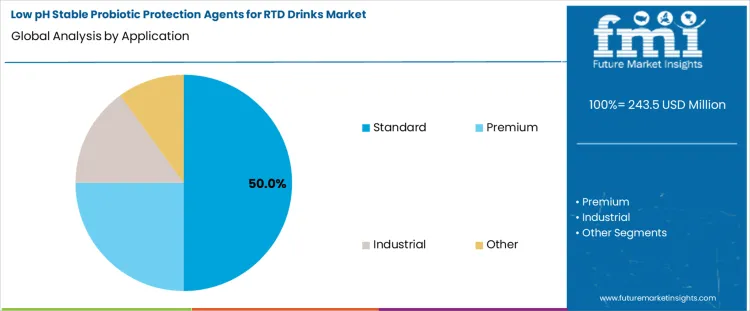
Standard applications account for 50.0% of global demand, reflecting widespread incorporation of probiotic protection agents into mass-market RTD functional beverages. These products prioritize cost efficiency, consistent performance, and compatibility with high-volume production while maintaining probiotic stability at low pH. Premium applications represent 25.0%, driven by fortified wellness beverages and specialized probiotic drinks requiring enhanced protection for differentiated strains and extended shelf life. Industrial applications hold a 15.0% share, linked to bulk probiotic beverage bases and institutional nutrition products where processing robustness is critical. Other applications account for 10.0%, covering niche formulations such as clinical nutrition drinks and emerging functional beverage concepts.
Key Takeaways
- Standard applications dominate due to high-volume RTD beverage production
- Premium products require advanced protection for differentiated probiotics
- Industrial and niche uses remain formulation-specific
Which Product Form Is Most Widely Used for Low-pH Probiotic Protection?
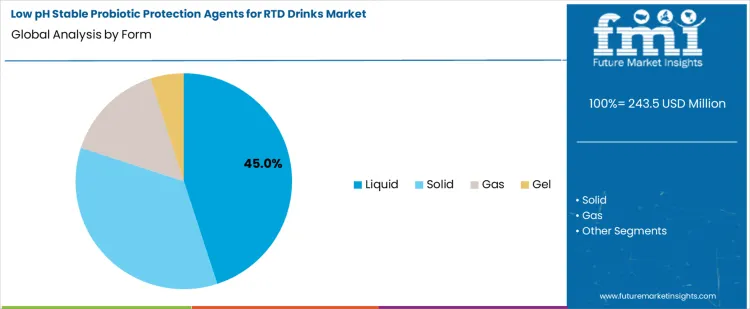
Liquid forms lead with a 45.0% share, favored for direct integration into RTD beverage matrices and uniform distribution during blending. Liquids enable rapid processing and minimize additional dissolution steps, supporting efficient manufacturing workflows. Solid forms account for 35.0%, used where dosing precision and extended storage stability are prioritized before beverage formulation. Gas-based systems represent 15.0%, reflecting specialized applications involving controlled atmosphere processing or carbonation-linked protection strategies. Gel formats hold 5.0%, applied selectively in niche formulations requiring localized encapsulation or staged probiotic release within acidic beverages.
Key Takeaways
- Liquid forms dominate due to ease of beverage integration
- Solid formats support dosing accuracy and storage stability
- Gas and gel forms remain specialized solutions
Which Distribution Channel Leads Global Supply of Probiotic Protection Agents?
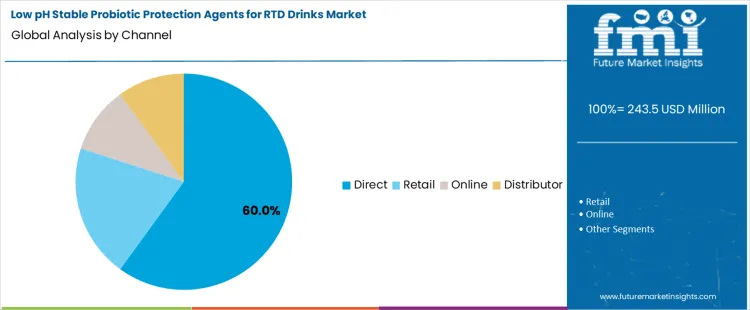
Direct channels account for 60.0% of global distribution, reflecting the technical complexity of low-pH probiotic stabilization and the need for close collaboration between suppliers and beverage manufacturers. Direct engagement supports customization, strain-specific optimization, and validation under acidic conditions. Retail channels represent 20.0%, supplying standardized protection agents for smaller beverage producers and regional brands. Online channels hold 10.0%, supporting pilot development, rapid sourcing, and early-stage innovation. Distributor accounts for 10.0%, enabling broader geographic reach for established formulations without extensive customization.
Key Takeaways
- Direct supply dominates due to technical formulation requirements
- Retail and distributors support standardized solutions
- Online channels facilitate development-stage sourcing
What are the Key Dynamics in the Low-pH Stable Probiotic Protection Agents for RTD Drinks Market?
Global demand rises as beverage manufacturers adopt probiotic protection agents that maintain viability of beneficial microorganisms in low-pH ready-to-drink (RTD) formulations. Protection agents support delivery of live cultures through gastric conditions while enabling broad integration into fruit juices, functional waters, kombuchas, and flavored probiotic beverages. Adoption aligns with rising consumer interest in gut health, immune support, and convenient functional beverages across North America, Europe, Asia-Pacific, and Latin America. Usage spans mainstream, health-oriented, and premium beverage portfolios seeking to differentiate through measurable probiotic benefits.
How do consumer health trends and formulation performance requirements shape adoption?
Consumers increasingly seek RTD beverages that deliver tangible gut health benefits without compromising taste, texture, or beverage stability. Beverage formulators integrate low-pH stable probiotic protection agents to shield sensitive strains from acidic environments during production, storage, and digestion. Protection technologies may include encapsulation matrices, carbohydrate carriers, or tailored coatings that preserve cell viability at typical beverage pH levels. Retailers emphasize products with documented probiotic stability and clear usage guidance to reassure informed buyers. Performance criteria include probiotic survival through shelf life, compatibility with ingredient systems, sensory neutrality, and alignment with clean-label positioning where possible.
How does formulation complexity, cost considerations, and regulatory frameworks influence market scalability?
Low-pH stable probiotic protection agents involve advanced formulation expertise to balance cell viability with sensory and processing demands of RTD drinks. Complex encapsulation or stabilization technologies often incur higher raw material and processing costs compared with standard beverage ingredients. Ensuring consistent probiotic performance requires rigorous quality control, controlled manufacturing environments, and stability testing that increase development cycles. Regulatory frameworks governing probiotic claims, allowable health statements, and labeling of live cultures vary across countries, affecting compliance planning for global product distribution. Integration with diverse beverage matrices demands careful testing to avoid interactions that compromise probiotic integrity or flavor. Long-term market growth depends on continued innovation in cost-effective, scalable protection technologies and alignment of regulatory criteria that support credible probiotic claims and broad functional beverage adoption worldwide.
How Is Demand for Low-pH Stable Probiotic Protection Agents for RTD Drinks Evolving Globally?
Demand for low-pH stable probiotic protection agents for RTD drinks is increasing globally due to growth of functional beverages, acidic formulation challenges, and requirement for live cell viability throughout shelf life. India leads with a 16.1% CAGR, supported by expansion of probiotic drinks in mass and wellness segments. China follows at 15.6%, driven by large-scale RTD production and microbiome-focused innovation. USA records a 14.9% CAGR, shaped by clean-label probiotic beverages and regulatory scrutiny of viability claims. Germany posts 14.2%, reflecting clinical validation standards and controlled formulation practices. Growth reflects shift toward encapsulation, buffering, and carrier systems that protect probiotics under acidic processing and storage conditions.
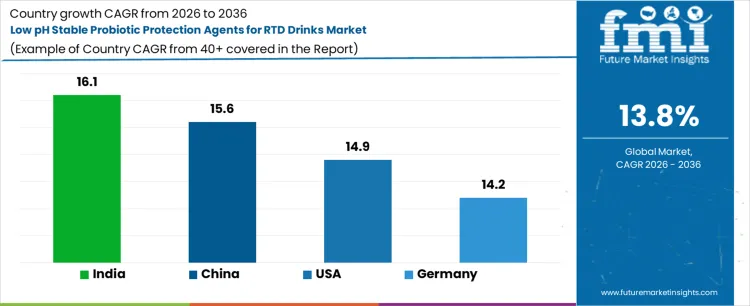
| Country | CAGR (%) |
|---|---|
| India | 16.1% |
| China | 15.6% |
| USA | 14.9% |
| Germany | 14.2% |
What is driving rapid adoption of low-pH probiotic protection agents in India?
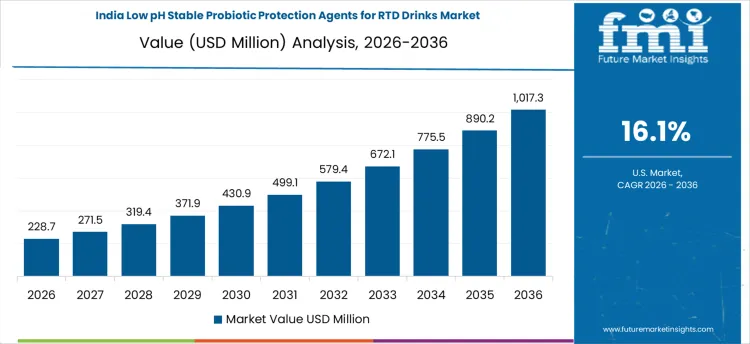
India demand is driven by rapid expansion of probiotic RTD beverages formulated with fruit acids, fermented bases, and vitamin blends. CAGR of 16.1% reflects need to maintain probiotic viability in low-pH environments common in tropical beverage profiles. Manufacturers focus on protection agents that prevent acid shock during processing, filling, and storage. Cost efficiency and scalability influence ingredient selection for mass consumption products. Domestic brands expand shelf-stable probiotic drinks beyond dairy formats. Ingredient suppliers develop encapsulation and carrier systems compatible with local processing conditions. Growth remains consumption-led and formulation-focused, aligned with wellness beverage penetration and infrastructure limitations.
- Expansion of acidic probiotic RTD beverages
- Need to protect live cultures under tropical conditions
- Focus on scalable and cost-efficient protection systems
- Growth of non-dairy probiotic drink formats
How is China sustaining strong growth in probiotic protection agent demand?
China demand reflects large-scale production of functional RTD beverages with fruit-based and low-pH formulations. CAGR of 15.6% is supported by integration of probiotic protection agents that stabilize viability across extended distribution networks. Manufacturers prioritize systems that withstand heat treatment, acidity, and long shelf life. Consumer interest in gut health drives volume growth. Regulatory oversight on probiotic count accuracy reinforces adoption of advanced protection technologies. Domestic ingredient suppliers scale microencapsulation and buffering solutions. Growth remains scale-driven and manufacturing-aligned, supported by functional beverage diversification and quality control requirements.
- Large-scale production of acidic probiotic RTDs
- Need for viability across long distribution cycles
- Regulatory focus on probiotic count accuracy
- Scaling of encapsulation and buffering technologies
What factors are shaping demand growth in the USA for low-pH probiotic protection agents?
USA demand is shaped by clean-label probiotic beverages, regulatory scrutiny of label claims, and consumer expectation for functional efficacy. CAGR of 14.9% reflects adoption of protection agents that preserve probiotic survival in kombucha-style drinks, flavored waters, and juice-based RTDs. Brands emphasize documented viability through shelf life. Cold-fill and minimal processing increase reliance on ingredient-based protection. Ingredient transparency influences system selection. Suppliers develop carrier technologies compatible with acidic matrices and clean-label positioning. Growth remains brand-led and compliance-focused, aligned with evidence-based functional beverage development.
- Clean-label probiotic RTD formulation growth
- Emphasis on shelf-life viability documentation
- Adoption across kombucha and juice-based drinks
- Preference for transparent and compliant systems
Why is Germany showing steady expansion in probiotic protection agent adoption?
Germany demand reflects strong regulatory oversight, clinical validation culture, and cautious functional claim positioning. CAGR of 14.2% is supported by adoption of low-pH probiotic protection agents in medically positioned and pharmacy-distributed RTD beverages. Manufacturers prioritize reproducible viability and stability under acidic conditions. Ingredient systems require documented efficacy and safety. Research-driven formulation supports use of advanced encapsulation and carrier technologies. Consumer trust in scientifically validated products reinforces adoption. Growth remains quality-driven and regulation-aligned, supported by disciplined product development and controlled market expansion.
- Strong regulatory and clinical validation requirements
- Focus on reproducible probiotic viability
- Adoption in pharmacy and medical nutrition channels
- Use of advanced encapsulation technologies
What is the competitive landscape of demand for low-pH stable probiotic protection agents for RTD drinks globally?
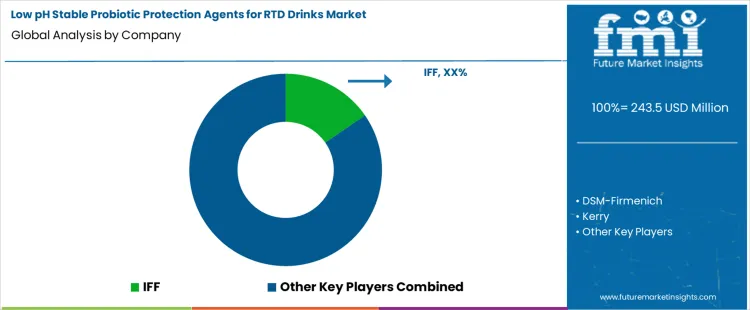
Demand for low-pH stable probiotic protection agents for RTD drinks is driven by growth of ambient-stable functional beverages and challenges associated with probiotic viability in acidic environments. RTD formats such as kombucha, juice blends, and functional waters require protection systems that shield probiotics from acid stress, oxygen exposure, heat treatment, and shelf-life degradation. Buyers evaluate encapsulation efficiency, survival rates at pH below 4, sensory neutrality, and compatibility with pasteurization or cold-fill processes. Procurement teams prioritize suppliers offering clinically validated protection technologies, regulatory compliance across regions, and scalable solutions suitable for high-volume beverage production. Trend in the global market reflects expansion of probiotic beverages beyond dairy and increased emphasis on guaranteed live counts at end of shelf life.
IFF holds leading positioning through advanced encapsulation and stabilization technologies designed to maintain probiotic viability in low-pH beverage systems. DSM-Firmenich supports demand with protected probiotic strains and delivery technologies validated for acidic RTD applications. Kerry contributes protection systems integrated with formulation and taste-masking expertise for functional drinks. ADM supplies probiotic protection approaches and functional matrices supporting stability in challenging beverage conditions. Novonesis advances microbial and encapsulation technologies focused on probiotic survival and performance. Competitive differentiation depends on protection efficiency under acidic stress, shelf-life reliability, regulatory documentation, and ability to integrate seamlessly into RTD beverage formulations.
Key Players in the Low-pH Stable Probiotic Protection Agents for RTD Drinks Market
- IFF
- DSM-Firmenich
- Kerry
- ADM
- Novonesis
- Lonza
Scope of the Report
| Items | Values |
|---|---|
| Quantitative Units | USD million |
| Application | Standard; Premium; Industrial; Other |
| Form | Liquid; Solid; Gas; Gel |
| Channel | Direct; Retail; Online; Distributor |
| Regions Covered | Asia Pacific, Europe, North America, Latin America, Middle East & Africa |
| Countries Covered | India, China, USA, Germany, and 40+ countries |
| Key Companies Profiled | IFF; DSM-Firmenich; Kerry; ADM; Novonesis; Lonza |
| Additional Attributes | Dollar sales by application and form; adoption trends for low-pH protective systems enabling probiotic viability in RTD beverages; survivability metrics under acidic pH, thermal stress, and shelf-life storage; encapsulation efficiency, release kinetics, and sensory neutrality performance; compatibility with aseptic processing, carbonation, and flavor systems; regulatory compliance, strain documentation, and claim substantiation standards influencing probiotic protection agent selection. |
Low-pH Stable Probiotic Protection Agents for RTD Drinks Market by Segment
By Application:
- Standard
- Premium
- Industrial
- Other
By Form:
- Liquid
- Solid
- Gas
- Gel
By Channel:
- Direct
- Retail
- Online
- Distributor
By Region:
- Asia Pacific
- China
- Japan
- South Korea
- India
- Australia & New Zealand
- ASEAN
- Rest of Asia Pacific
- Europe
- Germany
- United Kingdom
- France
- Italy
- Spain
- Nordic
- BENELUX
- Rest of Europe
- North America
- United States
- Canada
- Mexico
- Latin America
- Brazil
- Chile
- Rest of Latin America
- Middle East & Africa
- Kingdom of Saudi Arabia
- Other GCC Countries
- Turkey
- South Africa
- Other African Union
- Rest of Middle East & Africa
Frequently Asked Questions
How big is the low pH stable probiotic protection agents for RTD drinks market in 2026?
The global low pH stable probiotic protection agents for RTD drinks market is estimated to be valued at USD 243.5 million in 2026.
What will be the size of low pH stable probiotic protection agents for RTD drinks market in 2036?
The market size for the low pH stable probiotic protection agents for RTD drinks market is projected to reach USD 887.0 million by 2036.
How much will be the low pH stable probiotic protection agents for RTD drinks market growth between 2026 and 2036?
The low pH stable probiotic protection agents for RTD drinks market is expected to grow at a 13.8% CAGR between 2026 and 2036.
What are the key application types in the low pH stable probiotic protection agents for RTD drinks market?
The key application types in low pH stable probiotic protection agents for RTD drinks market are standard, premium, industrial and other.
Which form segment will contribute significant share in the low pH stable probiotic protection agents for RTD drinks market in 2026?
In terms of form, the liquid segment is expected to command a 45.0% share in the low-pH stable probiotic protection agents for RTD drinks market in 2026.
Preview the report firsthand - request a free sample
Get SampleGet the brochure for pricing and purchase details.
Get PDFTable of Content
- Executive Summary
- Global Market Outlook
- Demand-side Trends
- Supply-side Trends
- Technology Roadmap Analysis
- Analysis and Recommendations
- Market Overview
- Market Coverage / Taxonomy
- Market Definition / Scope / Limitations
- Market Background
- Market Dynamics
- Drivers
- Restraints
- Opportunity
- Trends
- Scenario Forecast
- Demand in Optimistic Scenario
- Demand in Likely Scenario
- Demand in Conservative Scenario
- Opportunity Map Analysis
- Product Life Cycle Analysis
- Supply Chain Analysis
- Investment Feasibility Matrix
- Value Chain Analysis
- PESTLE and Porter’s Analysis
- Regulatory Landscape
- Regional Parent Market Outlook
- Production and Consumption Statistics
- Import and Export Statistics
- Market Dynamics
- Global Market Analysis 2021 to 2025 and Forecast, 2026 to 2036
- Historical Market Size Value (USD Million) Analysis, 2021 to 2025
- Current and Future Market Size Value (USD Million) Projections, 2026 to 2036
- Y-o-Y Growth Trend Analysis
- Absolute $ Opportunity Analysis
- Global Market Pricing Analysis 2021 to 2025 and Forecast 2026 to 2036
- Global Market Analysis 2021 to 2025 and Forecast 2026 to 2036, By Application
- Introduction / Key Findings
- Historical Market Size Value (USD Million) Analysis By Application , 2021 to 2025
- Current and Future Market Size Value (USD Million) Analysis and Forecast By Application , 2026 to 2036
- Standard
- Premium
- Industrial
- Other
- Standard
- Y-o-Y Growth Trend Analysis By Application , 2021 to 2025
- Absolute $ Opportunity Analysis By Application , 2026 to 2036
- Global Market Analysis 2021 to 2025 and Forecast 2026 to 2036, By Form
- Introduction / Key Findings
- Historical Market Size Value (USD Million) Analysis By Form, 2021 to 2025
- Current and Future Market Size Value (USD Million) Analysis and Forecast By Form, 2026 to 2036
- Liquid
- Solid
- Gas
- Gel
- Liquid
- Y-o-Y Growth Trend Analysis By Form, 2021 to 2025
- Absolute $ Opportunity Analysis By Form, 2026 to 2036
- Global Market Analysis 2021 to 2025 and Forecast 2026 to 2036, By Channel
- Introduction / Key Findings
- Historical Market Size Value (USD Million) Analysis By Channel, 2021 to 2025
- Current and Future Market Size Value (USD Million) Analysis and Forecast By Channel, 2026 to 2036
- Direct
- Retail
- Online
- Distributor
- Direct
- Y-o-Y Growth Trend Analysis By Channel, 2021 to 2025
- Absolute $ Opportunity Analysis By Channel, 2026 to 2036
- Global Market Analysis 2021 to 2025 and Forecast 2026 to 2036, By Region
- Introduction
- Historical Market Size Value (USD Million) Analysis By Region, 2021 to 2025
- Current Market Size Value (USD Million) Analysis and Forecast By Region, 2026 to 2036
- North America
- Latin America
- Western Europe
- Eastern Europe
- East Asia
- South Asia and Pacific
- Middle East & Africa
- Market Attractiveness Analysis By Region
- North America Market Analysis 2021 to 2025 and Forecast 2026 to 2036, By Country
- Historical Market Size Value (USD Million) Trend Analysis By Market Taxonomy, 2021 to 2025
- Market Size Value (USD Million) Forecast By Market Taxonomy, 2026 to 2036
- By Country
- USA
- Canada
- Mexico
- By Application
- By Form
- By Channel
- By Country
- Market Attractiveness Analysis
- By Country
- By Application
- By Form
- By Channel
- Key Takeaways
- Latin America Market Analysis 2021 to 2025 and Forecast 2026 to 2036, By Country
- Historical Market Size Value (USD Million) Trend Analysis By Market Taxonomy, 2021 to 2025
- Market Size Value (USD Million) Forecast By Market Taxonomy, 2026 to 2036
- By Country
- Brazil
- Chile
- Rest of Latin America
- By Application
- By Form
- By Channel
- By Country
- Market Attractiveness Analysis
- By Country
- By Application
- By Form
- By Channel
- Key Takeaways
- Western Europe Market Analysis 2021 to 2025 and Forecast 2026 to 2036, By Country
- Historical Market Size Value (USD Million) Trend Analysis By Market Taxonomy, 2021 to 2025
- Market Size Value (USD Million) Forecast By Market Taxonomy, 2026 to 2036
- By Country
- Germany
- UK
- Italy
- Spain
- France
- Nordic
- BENELUX
- Rest of Western Europe
- By Application
- By Form
- By Channel
- By Country
- Market Attractiveness Analysis
- By Country
- By Application
- By Form
- By Channel
- Key Takeaways
- Eastern Europe Market Analysis 2021 to 2025 and Forecast 2026 to 2036, By Country
- Historical Market Size Value (USD Million) Trend Analysis By Market Taxonomy, 2021 to 2025
- Market Size Value (USD Million) Forecast By Market Taxonomy, 2026 to 2036
- By Country
- Russia
- Poland
- Hungary
- Balkan & Baltic
- Rest of Eastern Europe
- By Application
- By Form
- By Channel
- By Country
- Market Attractiveness Analysis
- By Country
- By Application
- By Form
- By Channel
- Key Takeaways
- East Asia Market Analysis 2021 to 2025 and Forecast 2026 to 2036, By Country
- Historical Market Size Value (USD Million) Trend Analysis By Market Taxonomy, 2021 to 2025
- Market Size Value (USD Million) Forecast By Market Taxonomy, 2026 to 2036
- By Country
- China
- Japan
- South Korea
- By Application
- By Form
- By Channel
- By Country
- Market Attractiveness Analysis
- By Country
- By Application
- By Form
- By Channel
- Key Takeaways
- South Asia and Pacific Market Analysis 2021 to 2025 and Forecast 2026 to 2036, By Country
- Historical Market Size Value (USD Million) Trend Analysis By Market Taxonomy, 2021 to 2025
- Market Size Value (USD Million) Forecast By Market Taxonomy, 2026 to 2036
- By Country
- India
- ASEAN
- Australia & New Zealand
- Rest of South Asia and Pacific
- By Application
- By Form
- By Channel
- By Country
- Market Attractiveness Analysis
- By Country
- By Application
- By Form
- By Channel
- Key Takeaways
- Middle East & Africa Market Analysis 2021 to 2025 and Forecast 2026 to 2036, By Country
- Historical Market Size Value (USD Million) Trend Analysis By Market Taxonomy, 2021 to 2025
- Market Size Value (USD Million) Forecast By Market Taxonomy, 2026 to 2036
- By Country
- Kingdom of Saudi Arabia
- Other GCC Countries
- Turkiye
- South Africa
- Other African Union
- Rest of Middle East & Africa
- By Application
- By Form
- By Channel
- By Country
- Market Attractiveness Analysis
- By Country
- By Application
- By Form
- By Channel
- Key Takeaways
- Key Countries Market Analysis
- USA
- Pricing Analysis
- Market Share Analysis, 2025
- By Application
- By Form
- By Channel
- Canada
- Pricing Analysis
- Market Share Analysis, 2025
- By Application
- By Form
- By Channel
- Mexico
- Pricing Analysis
- Market Share Analysis, 2025
- By Application
- By Form
- By Channel
- Brazil
- Pricing Analysis
- Market Share Analysis, 2025
- By Application
- By Form
- By Channel
- Chile
- Pricing Analysis
- Market Share Analysis, 2025
- By Application
- By Form
- By Channel
- Germany
- Pricing Analysis
- Market Share Analysis, 2025
- By Application
- By Form
- By Channel
- UK
- Pricing Analysis
- Market Share Analysis, 2025
- By Application
- By Form
- By Channel
- Italy
- Pricing Analysis
- Market Share Analysis, 2025
- By Application
- By Form
- By Channel
- Spain
- Pricing Analysis
- Market Share Analysis, 2025
- By Application
- By Form
- By Channel
- France
- Pricing Analysis
- Market Share Analysis, 2025
- By Application
- By Form
- By Channel
- India
- Pricing Analysis
- Market Share Analysis, 2025
- By Application
- By Form
- By Channel
- ASEAN
- Pricing Analysis
- Market Share Analysis, 2025
- By Application
- By Form
- By Channel
- Australia & New Zealand
- Pricing Analysis
- Market Share Analysis, 2025
- By Application
- By Form
- By Channel
- China
- Pricing Analysis
- Market Share Analysis, 2025
- By Application
- By Form
- By Channel
- Japan
- Pricing Analysis
- Market Share Analysis, 2025
- By Application
- By Form
- By Channel
- South Korea
- Pricing Analysis
- Market Share Analysis, 2025
- By Application
- By Form
- By Channel
- Russia
- Pricing Analysis
- Market Share Analysis, 2025
- By Application
- By Form
- By Channel
- Poland
- Pricing Analysis
- Market Share Analysis, 2025
- By Application
- By Form
- By Channel
- Hungary
- Pricing Analysis
- Market Share Analysis, 2025
- By Application
- By Form
- By Channel
- Kingdom of Saudi Arabia
- Pricing Analysis
- Market Share Analysis, 2025
- By Application
- By Form
- By Channel
- Turkiye
- Pricing Analysis
- Market Share Analysis, 2025
- By Application
- By Form
- By Channel
- South Africa
- Pricing Analysis
- Market Share Analysis, 2025
- By Application
- By Form
- By Channel
- USA
- Market Structure Analysis
- Competition Dashboard
- Competition Benchmarking
- Market Share Analysis of Top Players
- By Regional
- By Application
- By Form
- By Channel
- Competition Analysis
- Competition Deep Dive
- IFF
- Overview
- Product Portfolio
- Profitability by Market Segments (Product/Age /Sales Channel/Region)
- Sales Footprint
- Strategy Overview
- Marketing Strategy
- Product Strategy
- Channel Strategy
- DSM-Firmenich
- Kerry
- ADM
- Novonesis
- Lonza
- IFF
- Competition Deep Dive
- Assumptions & Acronyms Used
- Research Methodology


