

- Industry Size (2026)
- USD 143.5 Mn
- Forecast (2036)
- USD 321.5 Mn
- CAGR (2026 to 2036)
- 8.40%
Low-Noise Landing Gear Fairing Composite Designs Market Size, Market Forecast and Outlook By FMI
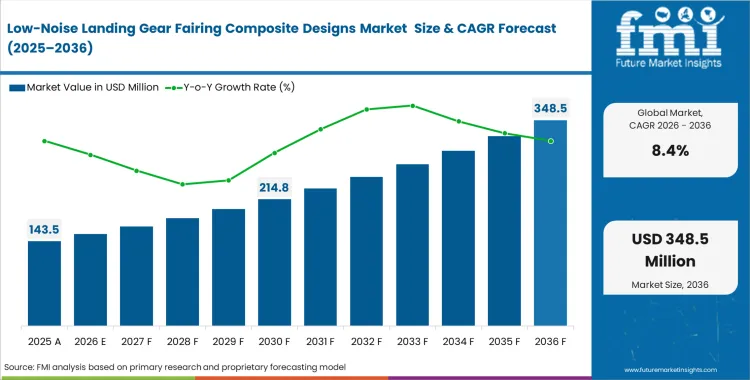
The low-noise landing gear fairing composite designs market reached USD 132.4 million in 2025 and is projected to rise to USD 143.5 million in 2026. Sector is expected to expand at an 8.40% CAGR from 2026 to 2036, taking total value to USD 321.5 million by the end of the forecast period. Demand is being shaped by stricter Chapter 14 acoustic requirements, as aircraft manufacturers face growing pressure to reduce the airframe noise generated by exposed landing gear cavities during approach and landing.
The commercial case for these systems is tied to noise control, weight discipline, and retrofit practicality. Aero-acoustics teams need to lower decibel output without adding mass that would affect payload or fuel efficiency. Full redesign of landing gear assemblies is expensive, certification-heavy, and difficult to justify for incremental acoustic gains. Composite fairings offer a more workable route because they help manage airflow around high-drag cavities while keeping weight additions within acceptable limits. Airlines and operators also have a direct financial reason to consider these upgrades where airports impose tighter operating limits, curfews, or noise-linked landing charges. Once wheel bays are enclosed, airflow around the brake area changes, so thermal performance becomes part of the material selection decision rather than a secondary engineering check.
Summary of Low-Noise Landing Gear Fairing Composite Designs Market
- Market Snapshot
- The low-noise landing gear fairing composite designs market is valued at USD 132.4 million in 2025 and is projected to reach USD 321.5 million by 2036.
- The industry is expected to grow at an 8.4% CAGR from 2026 to 2036, creating an incremental opportunity of USD 178.0 million over the period.
- This market sits inside the aerospace exterior-components space and focuses on composite fairings, covers, and contour treatments designed to reduce landing-gear drag and landing-phase aero-acoustic output.
- The market is shaped by a mix of aircraft noise standards, lightweight-material economics, and certification-led adoption cycles rather than pure volume pricing.
- Market Demand and Growth Drivers
- Demand for this market is rising because landing gear remains one of the main airframe noise sources during approach, making fairing-based mitigation commercially relevant for quieter aircraft programs and retrofit studies.
- Adoption is strengthening because recent work on solid, porous, and wire-mesh fairings shows measurable landing-gear noise reduction, which improves the engineering case for specialized fairing designs.
- Lightweight composite construction is supporting adoption because aircraft suppliers are using thermoplastic and other advanced composite materials to reduce weight, improve production efficiency, and make fairing designs easier to manufacture at scale.
- Among key countries, India leads at 10.1% CAGR, followed by China at 9.2%, United Arab Emirates at 8.9%, Singapore at 8.6%, United States at 7.4%, France at 7.0%, and Germany at 6.8% over the same period.
- Adoption remains constrained by certification timelines, platform-specific design requirements, and the limited business case for operators unless acoustic upgrades also deliver aerodynamic, maintenance, or replacement-cycle value.
- Low-Noise Landing Gear Fairing Composite Designs Market Product and Segment View
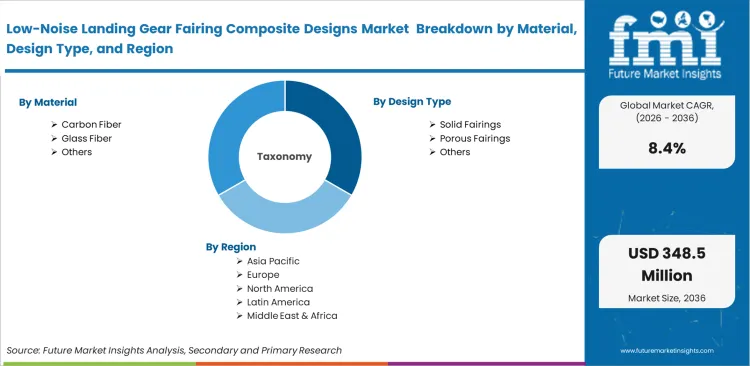
- The market covers fairings built mainly from carbon fiber, glass fiber, hybrid laminate, and thermoplastic material systems for main gear, nose gear, wheel-cavity, and torque-link noise treatment.
- These products are used across commercial jets, business jets, regional aircraft, military aircraft, and emerging AAM platforms, with OEM fit and retrofit both relevant.
- The Carbon fiber segment is expected to account for 46.0% in 2026, supported by its strong stiffness-to-weight profile and a more established aerospace qualification base. That keeps it in a leading position within the material mix.
- Solid fairings are projected to secure 39.0% in 2026 because they offer a clearer certification path and a more straightforward aerodynamic shielding function than less mature porous configurations. Their lower integration risk continues to support wider acceptance.
- In 2026, Commercial jets are anticipated to capture 49.0% of total demand, as narrow-body and wide-body aircraft programs create the largest repeat shipset requirement. Their production scale gives this platform a stronger volume base than other aircraft categories.
- The OEM fit category is likely to represent 58.0% in 2026, since acoustic and drag-management features are easier to incorporate during the original design and certification stage. That gives line-fit installation a clear advantage over later retrofit work.
- Main gear is set to account for 63.0% in 2026 because it creates the largest exposed landing gear geometry and the strongest requirement for fairing-based noise treatment. Demand stays concentrated where the acoustic benefit is most visible.
- The scope includes composite fairing shells, localized aerodynamic covers, wheel-cavity treatments, and noise-targeted landing-gear contour designs, but excludes full landing gear assemblies, brakes, tires, and unrelated engine or fuselage fairings.
- Geography and Competitive Outlook
- India, China, and the United Arab Emirates register the highest percentage growth rates for these acoustic components. High-value demand remains heavily concentrated within the United States. Massive domestic aircraft manufacturing scale and established certification installed base support this continuous North American hardware volume.
- Advanced composite manufacturing capability plays a direct role in competitive standing. Suppliers need to move noise-reduction concepts into certified flight-ready parts within workable program timelines to secure airline and OEM business. Proven landing-gear engineering depth gives established contractors an advantage over companies that only supply materials or subcomponents.
- Key participants include Safran Landing Systems, Collins Aerospace, GKN Aerospace, Spirit AeroSystems, Magellan Aerospace, Ducommun, and TRIUMPH. The supplier base remains moderately fragmented across commercial aircraft programs, although scale and system-level capability still shape leadership positions.
| Metric | Details |
|---|---|
| Industry Size (2026) | USD 143.5 million |
| Industry Value (2036) | USD 321.5 million |
| CAGR (2026 to 2036) | 8.40% |
Source: Future Market Insights (FMI) analysis, based on proprietary forecasting model and primary research
Recent regulatory treatment is also improving the buying case for these components. Approvals for porous and noise-focused surface geometries are helping reduce one of the main barriers to adoption. Buyers are more willing to move ahead when aerodynamic attachments can be assessed as targeted modifications instead of forcing a full undercarriage requalification program. That lowers certification complexity and makes retrofit programs easier to schedule. MRO providers benefit from the same shift because installation planning becomes more defined and easier to align with maintenance windows.
India’s demand for low-noise landing gear fairing composite designs projected to rise at a 10.1% CAGR from 2026 to 2036. In China, the market is projected to grow at a 9.2% CAGR over the same period, supported by narrow-body production activity and continued fleet additions. Demand in the United Arab Emirates is expected to increase at an 8.9% CAGR between 2026 and 2036, helped by hub traffic concentration and the operating importance of airport noise management. Singapore is projected to record an 8.6% CAGR through 2036 as fleet modernization and MRO alignment support adoption. The United States market is expected to expand at a 7.4% CAGR during the forecast period, with fleet renewal and retrofit planning sustaining demand. France is projected to grow at a 7.0% CAGR, while demand in Germany is expected to rise at a 6.8% CAGR from 2026 to 2036. Growth in Europe remains stable because mature installed fleets slow down replacement cycles, even though regulatory pressure still supports the long-term case for quieter airframe configurations.
Segmental Analysis
Low-Noise Landing Gear Fairing Composite Designs Market Analysis by Material
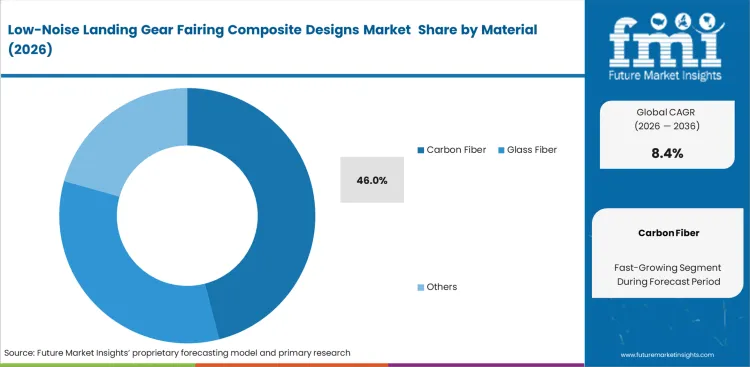
Weight limits shape fairing design, especially on landing gear where dynamic loads are high during approach and deployment. Carbon fiber is expected to account for 46.0% in 2026 because it gives engineers the stiffness needed to keep acoustic fairings stable without adding excess weight. That helps preserve noise-control performance under operating stress. The trade-off comes later in service. Complex composite fairings can be harder to inspect and may raise maintenance effort over time. Cheaper materials reduce upfront cost, but the added weight can affect payload efficiency and weaken the case for adoption. Advancements in composite airframes continuously push these boundaries for landing gear fairing composites market applications.
- Load-related cracking: Repeated gear deployment puts stress on shield attachment points and can accelerate fatigue in rigid designs. That often raises rejection rates during scheduled C-check inspections.
- Internal delamination risk: Acoustic loading can make internal fiber separation harder to identify in thicker layups. Maintenance teams often need ultrasound testing to confirm component soundness.
- Thermal wear: Exposure to high brake heat can degrade resin systems earlier than expected. That can force panel replacement before the planned overhaul cycle.
Low-Noise Landing Gear Fairing Composite Designs Market Analysis by Design Type
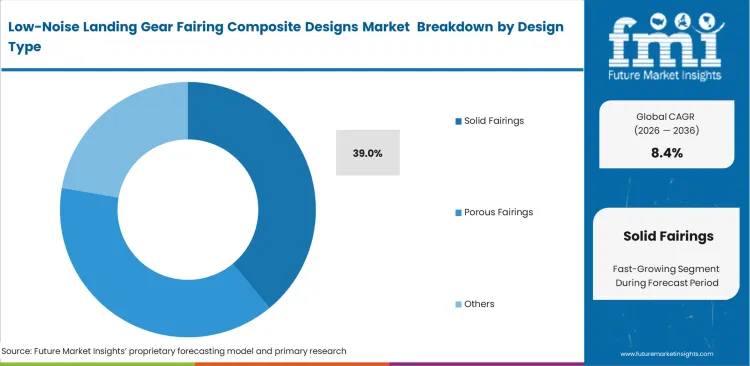
Certification remains a key filter for this segment because any landing gear modification has to pass a demanding qualification process. Solid fairings are projected to secure 39.0% in 2026 as they offer a more predictable certification path and more stable aerodynamic behavior than porous alternatives. Engineers also prefer them because they are easier to model, validate, and integrate. The design still brings follow-on integration work. Smooth fairing surfaces can redirect rainwater and de-icing fluids toward sensitive actuation areas, which means drainage and protection measures often need to be reworked. That can increase modification cost and make a simple noise-control upgrade more involved than it first appears.
- Initial acoustic qualification: Regulatory compliance officers demand proven decibel reduction data before approving modifications. Solid shapes pass wind-tunnel validation rapidly.
- Flight-test validation: Test pilots monitor deployment stability across varied crosswind conditions. Simple aerodynamic profiles prevent unexpected handling anomalies during final approach.
- Fleet-wide standardization: Maintenance planners require interchangeable parts across varying aircraft variants. Standardized solid deflectors streamline inventory management for global airline operations.
Low-Noise Landing Gear Fairing Composite Designs Market Analysis by Aircraft Platform
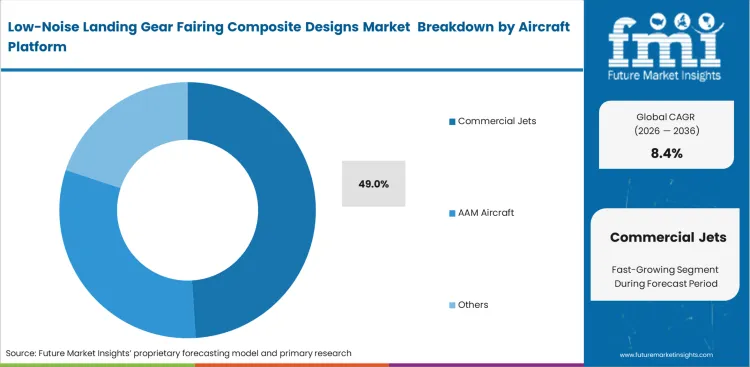
Urban encroachment on major transport hubs places narrow-body and wide-body operators squarely in the crosshairs of noise regulators. Commercial jets claim 49.0% share because these platforms execute high-frequency operations at tightly controlled, curfew-restricted airports. The commercial sector dynamics dictate technological pacing as airline fleet managers face existential threats from escalating noise surcharges. Every decibel stripped from an approach profile translates directly into reduced landing fees and expanded operating windows. Generalists assume wide-body aircraft demand the most acoustic intervention, but seasoned route planners know short-haul narrow-bodies generate compounding daily noise infractions due to sheer cycle volume. Implementing high performance composites alongside optimized undercarriage shields maximizes overall mitigation. Carriers ignoring these acoustic mandates face immediate exclusion from lucrative night-time arrival slots at premium European and Asian destinations.
- Procurement budget allocation: Sourcing directors calculate direct ROI against projected airport noise fines. High-cycle platforms justify premium acoustic treatments within three operational years.
- Turnaround time penalties: Line mechanics battle restricted access to servicing points behind bulky acoustic covers. Hidden labor costs accumulate daily across high-frequency schedules.
- Lifecycle cost evaluation: Financial analysts compare upfront component prices against long-term maintenance burdens. Heavy commercial utilization exposes durability flaws in cheaper laminate designs.
Low-Noise Landing Gear Fairing Composite Designs Market Analysis by Installation
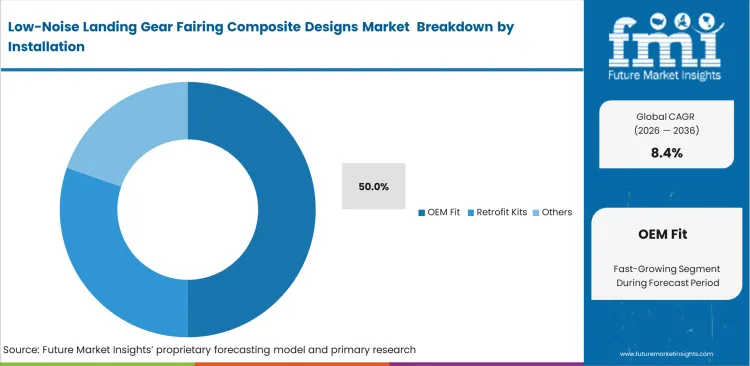
Integrating acoustic mitigation during initial blueprint phases yields vastly superior airflow management compared to post-production modifications. OEM fit is estimated to command around 58.0% share in 2026, as airframe designers bake noise reduction directly into fundamental gear architectures. The resolving aerodynamic conflicts within digital twin environments prevents costly physical redesigns later. Factory installation ensures seamless constitutional bonding and perfect alignment with adjacent bay doors. Industry observers miss that factory-installed acoustic optimization often restricts future brake upgrades, trapping airlines into specific high-temperature brake part numbers that clear tight fairing tolerances. Fleet operators attempting to swap brake suppliers later discover new rotors physically clash with factory acoustic shields. Selecting aftermarket alternatives over OEM integration exposes carriers to disjointed aerodynamic profiles and inferior acoustic attenuation.
- Early adopter integration: Tier-one flight hardware suppliers collaborate directly with airframers during preliminary design reviews. Acoustic engineers lock in optimal geometries before metal is cut.
- Mainstream production scaling: Assembly line supervisors finalize installation sequencing for high-rate manufacturing. Standardized material placement reduces station cycle times.
- Lagging legacy adoption: Operators of older airframes finally capitulate to noise pressure. Retrofit coordinators struggle to adapt modern acoustic shapes to outdated mechanical linkages.
Low-Noise Landing Gear Fairing Composite Designs Market Analysis by End Use
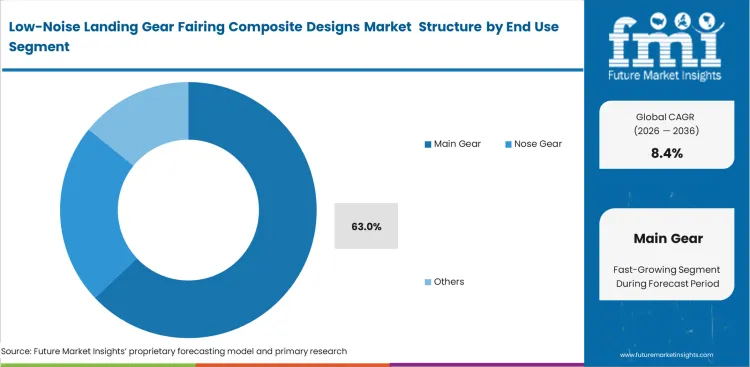
Main gear applications are expected to account for 63.0% in 2026 because they create the largest exposed landing gear surfaces and offer the strongest noise-reduction opportunity. Acoustic design work stays concentrated here, as improvements around the main gear can deliver a more meaningful reduction in approach noise relative to the added weight. Massive physical dimensions demand extensive advanced composites to maintain rigidity without crushing payload margins. A counter-intuitive reality on the tarmac is that enclosing main gear struts traps explosive tire-burst energy. Certification engineers must design sacrificial blow-out panels into acoustic fairings, complicating manufacturing and driving up unit costs significantly. Failure to adequately address this explosive risk halts certification entirely, leaving unapproved aircraft grounded until safety margins are proven.
- Pre-preg raw material sourcing: Materials teams secure dedicated supply lines for specialized aerospace resins to maintain consistent batch quality. That reduces the risk of delamination during high-speed deployment cycles.
- Autoclave curing bottlenecks: Production managers schedule limited oven time for massive main-gear molds. Curing constraints cap monthly output capabilities for tier-one suppliers.
- Next-generation tooling: Manufacturing engineers develop automated fiber placement robots for complex acoustic geometries. Advanced fabrication techniques eventually drive down unit costs for wide-body applications.
Low-Noise Landing Gear Fairing Composite Designs Market Drivers, Restraints, and Opportunities
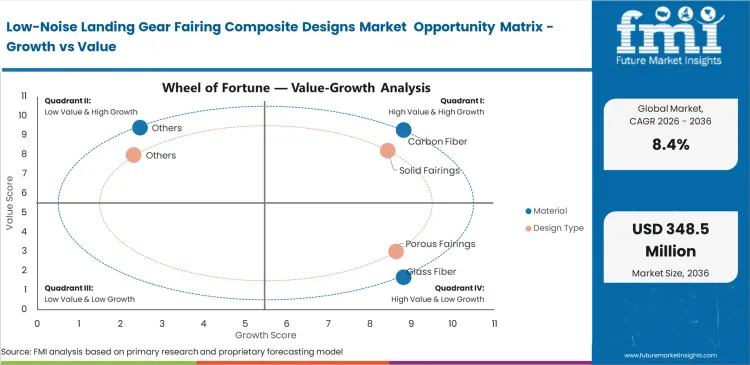
Night-flight curfews across major European and Asian hubs are increasing demand for approach-noise reduction on in-service aircraft. Airlines operating older narrow-body fleets face more pressure where slot access, operating hours, and route economics are tied closely to aircraft noise levels. That is making acoustic upgrades more relevant before full fleet replacement cycles begin. Composite landing gear fairings gain attention in this setting because they offer a practical way to reduce approach noise on existing aircraft without waiting for new platform introductions.
Thermal management remains a real constraint on wider adoption. Fairings that smooth airflow around landing gear can also reduce the natural airflow needed to cool brake systems and nearby components. Engineering teams have to balance noise reduction with ventilation, and that trade-off can slow design validation and certification. Added cooling systems raise weight and complexity, while open venting can weaken acoustic performance. Adoption will stay selective until suppliers improve heat management without losing aerodynamic or noise-control benefits.
Opportunities in the Low-Noise Landing Gear Fairing Composite Designs Market
- Acoustic-thermal hybrid structures: Scientists developing repairable composite leading edge components gain traction by integrating conductive nanomaterials dissipating brake heat without compromising solid acoustic barriers.
- Rapid-release attachment mechanisms: Maintenance directors reward suppliers who engineer secure deployment latches allowing ground crews to strip fairings instantly for expedited brake inspections.
- Additively manufactured porous meshes: Manufacturing engineers bypass autoclave bottlenecks by printing complex acoustic-scattering geometries directly, unlocking customized noise profiles for specific aircraft variants.
Regional Analysis
Based on regional analysis, Low-Noise Landing Gear Fairing Composite Designs Market is segmented into North America, Latin America, Western Europe, Eastern Europe, East Asia, South Asia and Pacific, and Middle East and Africa across 40 plus countries.
.webp "Top Country Growth Comparison Low Noise Landing Gear Fairing Composite Designs Market Cagr (2026 2036)")
| Country | CAGR (2026 to 2036) |
|---|---|
| India | 10.1% |
| China | 9.2% |
| United Arab Emirates | 8.9% |
| Singapore | 8.6% |
| United States | 7.4% |
| France | 7.0% |
| Germany | 6.8% |
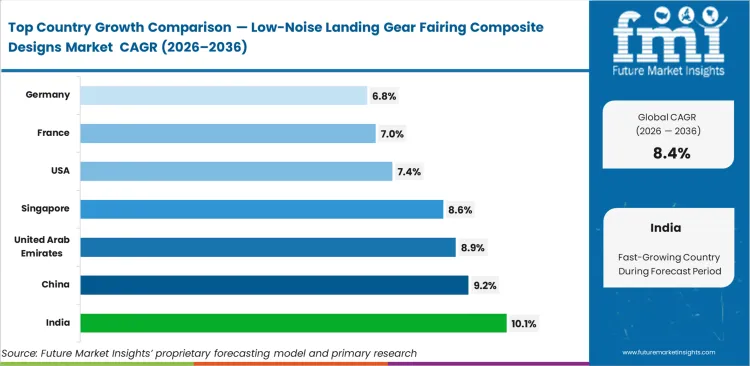
Source: Future Market Insights (FMI) analysis, based on proprietary forecasting model and primary research
Asia-Pacific Low-Noise Landing Gear Fairing Composite Designs Market Analysis
Demand across Asia-Pacific is being shaped by fast fleet growth, rising airport congestion, and tighter noise sensitivity around major urban hubs. Airlines in the region are facing more pressure to manage approach noise as residential development moves closer to airport infrastructure and regulators place greater focus on operating restrictions. That is increasing interest in landing gear noise-control solutions, especially where carriers want to avoid future limits on schedule flexibility. Local aircraft production, expanding MRO capability, and higher narrow-body traffic also support adoption across key markets in the region.
- India: Demand for low-noise landing gear fairing composite designs in India is anticipated to rise at a 10.1% CAGR through 2036. Large narrow-body fleet additions and growing pressure on noise management at major metro airports are strengthening the case for these components. Airlines are more likely to consider factory-installed acoustic solutions where fleet expansion and regulatory exposure are moving together. Maintenance teams will also need stronger inspection capability as composite fairings become part of regular service activity.
- China: The market for low-noise landing gear fairing composite designs in China is projected to grow at a 9.2% CAGR through 2036. Domestic aircraft production, component localization, and long-term sourcing tied to new programs are supporting demand. Local manufacturing also makes it easier to validate durability and improve installation confidence through in-service feedback. Standardized solid fairing designs are likely to gain more traction where maintenance simplicity and production consistency matter.
- Singapore: Singapore is expected to grow at a CAGR of 8.6% during the forecast period. Limited land buffers around flight paths and strict control over airport operations keep noise performance commercially relevant for airlines serving this hub. Operators with premium slot exposure have a stronger reason to evaluate retrofit-ready fairing solutions that can support quieter approach profiles. Demand is likely to remain focused on proven designs that can be installed without adding unnecessary downtime or certification complexity.
FMI’s analysis of the Asia-Pacific market indicates that fleet growth, airport density, and local production capability are shaping demand in parallel. The region offers a strong adoption base because aircraft additions are rising while noise-control expectations are becoming more visible in procurement and retrofit planning.
Middle East and Africa Low-Noise Landing Gear Fairing Composite Designs Market Analysis
Demand in the Middle East and Africa is influenced by environmental operating conditions as much as by acoustic requirements. High tarmac temperatures, brake heat, sand exposure, and ultraviolet stress all affect the durability of composite fairings and the way they perform over time. Buyers in this region place more weight on material stability, thermal tolerance, and documented lifecycle performance before approving broader installation. Suppliers that cannot demonstrate reliable operation under these conditions face a slower route to adoption.
- United Arab Emirates: The United Arab Emirates is set to record an 8.9% CAGR in the low-noise landing gear fairing composite designs market through 2036. Adoption is being supported by wide-body and long-haul operators that need to balance network growth with tighter noise expectations in key overseas markets. Demand also reflects the need for resin systems and hardware designs that can handle high-temperature operating conditions without losing stiffness or service life. Suppliers with proven environmental testing are likely to hold an advantage in this market.
FMI’s analysis of the Middle East and Africa market suggests that environmental durability remains central to supplier selection. Noise reduction matters, but adoption will depend heavily on how well fairing systems perform under heat, sand exposure, and demanding operating cycles.
North America Low-Noise Landing Gear Fairing Composite Designs Market Analysis
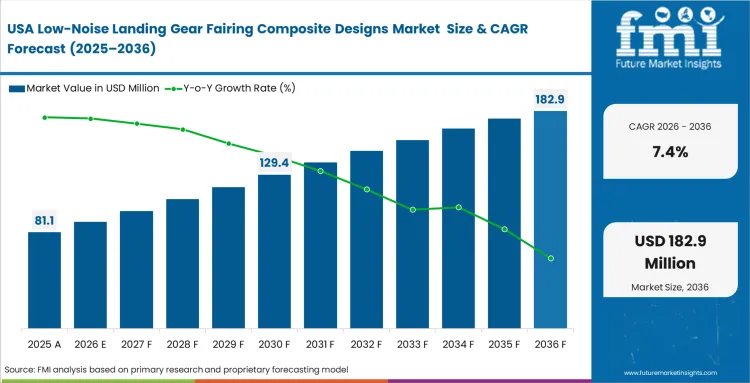
North America remains a selective retrofit market shaped by large installed fleets, mature regulation, and close cost scrutiny. Airlines do not approach these upgrades uniformly across fleets. They evaluate route economics, airport-specific noise rules, installation downtime, and certification timelines before moving ahead. That creates a targeted demand pattern rather than broad replacement activity, but the region still offers meaningful volume because of its large commercial aircraft base and established aftermarket setup.
- United States: Sales of low-noise landing gear fairing composite designs in the United States are expected to increase at a 7.4% CAGR during the forecast period. Airlines are more likely to deploy these upgrades on routes where community noise complaints, coastal airport restrictions, or operating charges create a clearer financial case. Retrofit demand will depend heavily on how easily suppliers can integrate fairings with existing landing gear architecture and how quickly approvals support line-maintenance installation. In that context, related retrofit solutions such as belly fairing modification kits also become relevant, as operators continue to favor upgrades that can be installed with limited downtime. Simpler attachment systems and shorter ground-time requirements will remain important buying factors.
FMI’s analysis of the North America market shows that the business case for adoption is route-specific rather than fleet-wide in most cases. Suppliers that can reduce installation complexity and support faster certification pathways are likely to be better placed in this region.
Western Europe Low-Noise Landing Gear Fairing Composite Designs Market Analysis
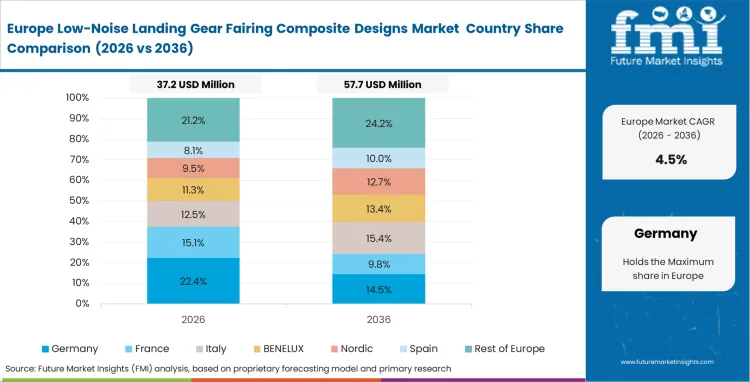
Western Europe continues to set a high bar for aircraft noise compliance. Tight night-flight rules, local limits on airport operating hours, and strong community pressure keep approach-noise reduction high on the agenda. The region also benefits from a dense supplier and engineering base, which supports more advanced design work and faster feedback between manufacturers, operators, and maintenance providers. Qualification standards are demanding, but success here strengthens the commercial position of suppliers in other regulated markets.
- France: The market for low-noise landing gear fairing composite designs in France is expected to grow at a 7.0% CAGR through 2036. Proximity to major aircraft manufacturing and engineering centers supports early integration of new noise-reduction hardware into local programs and airline fleets. Operators also gain from closer feedback loops with suppliers when performance, wear, or installation issues need refinement. Demand should remain supported by strict airport noise expectations and continued emphasis on quieter airframe configurations.
- Germany: Demand for low-noise landing gear fairing composite designs in Germany is anticipated to rise at a 6.8% CAGR through 2036. The market benefits from strong engineering capability and a maintenance culture that supports more precise inspection and qualification work. German operators and suppliers are well placed to work with advanced surface geometries and tighter testing requirements, but that also raises servicing complexity and cost. Growth is likely to remain steady rather than aggressive, with adoption concentrated where the technical and operational case is clear.
FMI's report includes extensive analysis of emerging acoustic regulatory frameworks across Latin America and Eastern Europe. Next-generation composite materials engineered specifically for extreme cold-weather acoustic retention undergo preliminary qualification testing in Nordic aviation facilities.
Competitive Aligners for Market Players
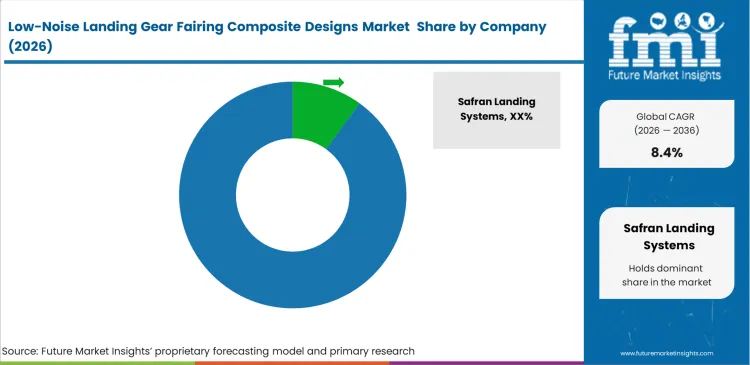
Technical qualification barriers isolate this sector from generic composite manufacturers attempting to pivot into aerospace supply chains. Safran Landing Systems, Collins Aerospace, and GKN Aerospace dominate proceedings not through basic manufacturing capacity, but through absolute mastery of computational aero-acoustics. True competitive advantage relies entirely on predicting how complex composite shapes will scatter low-frequency tonal noise without triggering unpredictable aerodynamic buffeting. When airline procurement directors evaluate aircraft exterior lighting or cabin interiors, they compare unit costs; when evaluating landing gear acoustics, they compare EASA certification pedigrees.
Incumbents defend positions by weaponizing proprietary libraries of wind-tunnel acoustic data and drop-test thermal profiles. Spirit AeroSystems and TRIUMPH hold advantages because they understand exact resonant frequencies of underlying metallic gear assemblies. A new entrant might mold a flawless carbon shell, but without knowing specific vibration harmonics of a deployed Boeing 777 main strut, their fairing will likely amplify noise rather than suppress it. This massive knowledge deficit prevents agile challengers from disrupting established tier-one supply agreements, restricting them to low-margin sub-contracting roles.
Airline technical directors push back against concentrated supplier power by demanding modularity and open architecture in acoustic retrofit kits. Major fleet operators refuse to let a proprietary fairing design dictate choice of brake or tire suppliers. They explicitly require acoustic components accommodating multiple approved wheel configurations. Suppliers who successfully engineer universally compatible noise-shields capture significant market share from entrenched players attempting to enforce closed-ecosystem lock-in.
Key Players in Low-Noise Landing Gear Fairing Composite Designs Market
- Safran Landing Systems
- Collins Aerospace
- GKN Aerospace
- Spirit AeroSystems
- Magellan Aerospace
- Ducommun
- TRIUMPH
Scope of the Report
| Metric | Value |
|---|---|
| Quantitative Units | USD 143.5 million to USD 321.5 million, at a CAGR of 8.40% |
| Market Definition | Components engineered specifically to alter turbulent airflow around deployed undercarriage assemblies define this space. Acoustic suppression takes precedence over simple aerodynamic streamlining. |
| Segmentation | Material, Design Type, Aircraft Platform, Installation, End Use |
| Regions Covered | North America, Latin America, Western Europe, Eastern Europe, East Asia, South Asia and Pacific, Middle East and Africa |
| Countries Covered | India, China, United Arab Emirates, Singapore, United States, France, Germany |
| Key Companies Profiled | Safran Landing Systems, Collins Aerospace, GKN Aerospace, Spirit AeroSystems, Magellan Aerospace, Ducommun, TRIUMPH |
| Forecast Period | 2026 to 2036 |
| Approach | Global commercial aircraft delivery schedules cross-referenced with airport noise-curfew implementation timelines established baseline volume. |
Source: Future Market Insights (FMI) analysis, based on proprietary forecasting model and primary research
Low-Noise Landing Gear Fairing Composite Designs Market Analysis by Segments
Material:
- Carbon fiber
- Glass fiber
- Hybrid laminate
- Thermoplastic
Design Type:
- Solid fairings
- Porous fairings
- Hybrid fairings
- Wheel covers
Aircraft Platform:
- Commercial jets
- Business jets
- Regional aircraft
- Military aircraft
- AAM aircraft
Installation:
- OEM fit
- Retrofit kits
- MRO replacement
End Use:
- Main gear
- Nose gear
- Wheel cavity
- Torque link
Region:
- North America
- Latin America
- Western Europe
- Eastern Europe
- East Asia
- South Asia and Pacific
- Middle East and Africa
Bibliography
- RTX. (2025, January 28). RTX reports 2024 results and announces 2025 outlook.
- NASA. (2025, December 2). Landing Gear Noise Reduction Sub-Project (LGNR).
- Li, S., Zhang, X., & Wang, M. (2024, October). On the mitigation of landing gear noise using a solid fairing and a wire-mesh fairing. Aerospace Science and Technology.
- Domogalla, V., Yin, F., Lummer, M., Wunderlich, T., & Voß, A. (2022). Low-noise design of medium-range aircraft for energy-efficient aviation. Aerospace. German Aerospace Center electronic library
- National Aeronautics and Space Administration. (2025, December 2). Landing Gear Noise Reduction Sub-Project (LGNR). NASA TechPort
This bibliography is provided for reader reference. The full FMI report contains the complete reference list with primary source documentation.
This Report Addresses
- High-frequency commercial operations driving localized noise mitigation targets.
- Specific decibel limits dictating composite material selections across airframe variants.
- Thermal constraint integration stalling immediate undercarriage acoustic modifications.
- Component qualification pathways securing robust tier-one supply contracts.
- Exploding urban encroachment forcing rapid aftermarket retrofit implementations.
- Carbon fiber geometries ensuring critical deployment load stabilities.
- Intense crosswind testing verifying solid deflector aerodynamic reliabilities.
- Regional regulatory frameworks accelerating custom approach-noise interventions.
Frequently Asked Questions
What is the baseline valuation for these acoustic composite geometries?
Revenue establishes USD 143.5 million for 2026, signaling a transition toward mandatory environmental compliance upgrades.
How fast is demand expanding globally?
Adoption advances at an 8.40% CAGR through 2036 as legacy operators modify existing equipment urgently.
What scale will this sector achieve by the forecast end?
Total volume targets USD 321.5 million by 2036, driven heavily by European and Asian night-flight curfews.
Why does carbon fiber hold the dominant share position?
Carbon fiber controls 46.0% because extreme aerodynamic forces demand unmatched rigidity to prevent noise-scattering failures.
What advantage secures solid fairings their leadership?
Solid configurations claim 39.0% share based on highly predictable fluid dynamics accelerating certification testing timelines.
Why do commercial jets dictate the technological pace?
Commercial operations command 49.0% due to intense cycling at urban hubs generating constant noise infractions.
How does OEM installation outperform aftermarket retrofits?
Factory integration accounts for 58.0% share by resolving aerodynamic conflicts digitally before physical assembly begins.
Why target main gear assemblies for acoustic treatment?
Main gear parts represent 63.0% of deployment because their massive physical volume generates the loudest roar.
What non-obvious operational friction slows immediate adoption?
Enclosing brake-assemblies blocks noise but simultaneously chokes vital cooling airflow, frustrating maintenance crews.
How do tier-one suppliers defend dominant market positions?
Incumbents weaponize deep libraries of proprietary acoustic wind-tunnel data preventing challengers from engineering effective suppression.
Why does India present the fastest growth trajectory?
India expands at 10.1% due to explosive fleet scaling intersecting directly with massive urban encroachment.
What differentiates the Chinese acoustic compliance landscape?
China grows at 9.2% as state-backed airframers prioritize community noise standards to ensure export viability.
How do extreme environments affect Middle Eastern deployments?
United Arab Emirates operators face blistering tarmac temperatures, demanding highly specialized heat-resistant acoustic resin matrices.
What commercial outcome awaits operators ignoring these upgrades?
Airlines lacking quiet-technology modifications face immediate exclusion from lucrative night-time arrival slots globally.
How do test pilots validate these acoustic modifications?
Flight test crews rigorously evaluate deployment stability under severe crosswind conditions during final approach profiles.
What unseen maintenance burden accompanies rigid carbon shields?
Ground crews struggle detecting internal formational delamination visually, forcing expensive ultrasound scanning verification protocols.
How do solid deflectors unintentionally complicate systems integration?
Smooth acoustic geometries aggressively channel rainwater directly into sensitive hydraulic actuation bays, requiring drainage redesigns.
Why do airlines demand universally compatible retrofit designs?
Procurement managers refuse proprietary acoustic components restricting their choice of tire or brake suppliers later.
What specific advantage do additive manufacturing techniques offer?
Printing complex composite geometries directly bypasses massive autoclave curing bottlenecks, unlocking customized noise-scattering profiles.
How does the constructional approach in Singapore differ?
Singapore enforces strict absolute decibel limits across geographically dense airspace, driving comprehensive wide-body upgrades.
What prevents generalist composite fabricators from entering?
Acoustic engineering requires extensive predictive modeling of low-frequency aerodynamic tonal noise, demanding specialized aero-acoustic qualification.
How do explosive risks alter fairing manufacturing requirements?
Enclosed main gear struts trap immense tire-burst energy, demanding complex sacrificial blow-out panels.
What role do nanomaterials play in future developments?
Advanced conductive nanoparticles integrated into composed resins help dissipate intense brake heat effectively.
Preview the report firsthand - request a free sample
Get SampleGet the brochure for pricing and purchase details.
Get PDFTable of Content
- Executive Summary
- Global Market Outlook
- Demand-side Trends
- Supply-side Trends
- Technology Roadmap Analysis
- Analysis and Recommendations
- Market Overview
- Market Coverage / Taxonomy
- Market Definition / Scope / Limitations
- Research Methodology
- Chapter Orientation
- Analytical Lens and Working Hypotheses
- Market Structure, Signals, and Trend Drivers
- Benchmarking and Cross-market Comparability
- Market Sizing, Forecasting, and Opportunity Mapping
- Research Design and Evidence Framework
- Desk Research Programme (Secondary Evidence)
- Company Annual and Sustainability Reports
- Peer-reviewed Journals and Academic Literature
- Corporate Websites, Product Literature, and Technical Notes
- Earnings Decks and Investor Briefings
- Statutory Filings and Regulatory Disclosures
- Technical White Papers and Standards Notes
- Trade Journals, Industry Magazines, and Analyst Briefs
- Conference Proceedings, Webinars, and Seminar Materials
- Government Statistics Portals and Public Data Releases
- Press Releases and Reputable Media Coverage
- Specialist Newsletters and Curated Briefings
- Sector Databases and Reference Repositories
- FMI Internal Proprietary Databases and Historical Market Datasets
- Subscription Datasets and Paid Sources
- Social Channels, Communities, and Digital Listening Inputs
- Additional Desk Sources
- Expert Input and Fieldwork (Primary Evidence)
- Primary Modes
- Qualitative Interviews and Expert Elicitation
- Quantitative Surveys and Structured Data Capture
- Blended Approach
- Why Primary Evidence is Used
- Field Techniques
- Interviews
- Surveys
- Focus Groups
- Observational and In-context Research
- Social and Community Interactions
- Stakeholder Universe Engaged
- C-suite Leaders
- Board Members
- Presidents and Vice Presidents
- R&D and Innovation Heads
- Technical Specialists
- Domain Subject-matter Experts
- Scientists
- Physicians and Other Healthcare Professionals
- Governance, Ethics, and Data Stewardship
- Research Ethics
- Data Integrity and Handling
- Primary Modes
- Tooling, Models, and Reference Databases
- Desk Research Programme (Secondary Evidence)
- Data Engineering and Model Build
- Data Acquisition and Ingestion
- Cleaning, Normalisation, and Verification
- Synthesis, Triangulation, and Analysis
- Quality Assurance and Audit Trail
- Market Background
- Market Dynamics
- Drivers
- Restraints
- Opportunity
- Trends
- Scenario Forecast
- Demand in Optimistic Scenario
- Demand in Likely Scenario
- Demand in Conservative Scenario
- Opportunity Map Analysis
- Product Life Cycle Analysis
- Supply Chain Analysis
- Investment Feasibility Matrix
- Value Chain Analysis
- PESTLE and Porter’s Analysis
- Regulatory Landscape
- Regional Parent Market Outlook
- Production and Consumption Statistics
- Import and Export Statistics
- Market Dynamics
- Global Market Analysis 2021 to 2025 and Forecast, 2026 to 2036
- Historical Market Size Value (USD Million) Analysis, 2021 to 2025
- Current and Future Market Size Value (USD Million) Projections, 2026 to 2036
- Y-o-Y Growth Trend Analysis
- Absolute $ Opportunity Analysis
- Global Market Pricing Analysis 2021 to 2025 and Forecast 2026 to 2036
- Global Market Analysis 2021 to 2025 and Forecast 2026 to 2036, By Material
- Introduction / Key Findings
- Historical Market Size Value (USD Million) Analysis By Material , 2021 to 2025
- Current and Future Market Size Value (USD Million) Analysis and Forecast By Material , 2026 to 2036
- Carbon Fiber
- Glass Fiber
- Others
- Carbon Fiber
- Y-o-Y Growth Trend Analysis By Material , 2021 to 2025
- Absolute $ Opportunity Analysis By Material , 2026 to 2036
- Global Market Analysis 2021 to 2025 and Forecast 2026 to 2036, By Design Type
- Introduction / Key Findings
- Historical Market Size Value (USD Million) Analysis By Design Type, 2021 to 2025
- Current and Future Market Size Value (USD Million) Analysis and Forecast By Design Type, 2026 to 2036
- Solid Fairings
- Porous Fairings
- Others
- Solid Fairings
- Y-o-Y Growth Trend Analysis By Design Type, 2021 to 2025
- Absolute $ Opportunity Analysis By Design Type, 2026 to 2036
- Global Market Analysis 2021 to 2025 and Forecast 2026 to 2036, By Aircraft Platform
- Introduction / Key Findings
- Historical Market Size Value (USD Million) Analysis By Aircraft Platform, 2021 to 2025
- Current and Future Market Size Value (USD Million) Analysis and Forecast By Aircraft Platform, 2026 to 2036
- Commercial Jets
- AAM Aircraft
- Others
- Commercial Jets
- Y-o-Y Growth Trend Analysis By Aircraft Platform, 2021 to 2025
- Absolute $ Opportunity Analysis By Aircraft Platform, 2026 to 2036
- Global Market Analysis 2021 to 2025 and Forecast 2026 to 2036, By Installation
- Introduction / Key Findings
- Historical Market Size Value (USD Million) Analysis By Installation, 2021 to 2025
- Current and Future Market Size Value (USD Million) Analysis and Forecast By Installation, 2026 to 2036
- OEM Fit
- Retrofit Kits
- Others
- OEM Fit
- Y-o-Y Growth Trend Analysis By Installation, 2021 to 2025
- Absolute $ Opportunity Analysis By Installation, 2026 to 2036
- Global Market Analysis 2021 to 2025 and Forecast 2026 to 2036, By End Use
- Introduction / Key Findings
- Historical Market Size Value (USD Million) Analysis By End Use, 2021 to 2025
- Current and Future Market Size Value (USD Million) Analysis and Forecast By End Use, 2026 to 2036
- Main Gear
- Nose Gear
- Others
- Main Gear
- Y-o-Y Growth Trend Analysis By End Use, 2021 to 2025
- Absolute $ Opportunity Analysis By End Use, 2026 to 2036
- Global Market Analysis 2021 to 2025 and Forecast 2026 to 2036, By Region
- Introduction
- Historical Market Size Value (USD Million) Analysis By Region, 2021 to 2025
- Current Market Size Value (USD Million) Analysis and Forecast By Region, 2026 to 2036
- North America
- Latin America
- Western Europe
- Eastern Europe
- East Asia
- South Asia and Pacific
- Middle East & Africa
- Market Attractiveness Analysis By Region
- North America Market Analysis 2021 to 2025 and Forecast 2026 to 2036, By Country
- Historical Market Size Value (USD Million) Trend Analysis By Market Taxonomy, 2021 to 2025
- Market Size Value (USD Million) Forecast By Market Taxonomy, 2026 to 2036
- By Country
- USA
- Canada
- Mexico
- By Material
- By Design Type
- By Aircraft Platform
- By Installation
- By End Use
- By Country
- Market Attractiveness Analysis
- By Country
- By Material
- By Design Type
- By Aircraft Platform
- By Installation
- By End Use
- Key Takeaways
- Latin America Market Analysis 2021 to 2025 and Forecast 2026 to 2036, By Country
- Historical Market Size Value (USD Million) Trend Analysis By Market Taxonomy, 2021 to 2025
- Market Size Value (USD Million) Forecast By Market Taxonomy, 2026 to 2036
- By Country
- Brazil
- Chile
- Rest of Latin America
- By Material
- By Design Type
- By Aircraft Platform
- By Installation
- By End Use
- By Country
- Market Attractiveness Analysis
- By Country
- By Material
- By Design Type
- By Aircraft Platform
- By Installation
- By End Use
- Key Takeaways
- Western Europe Market Analysis 2021 to 2025 and Forecast 2026 to 2036, By Country
- Historical Market Size Value (USD Million) Trend Analysis By Market Taxonomy, 2021 to 2025
- Market Size Value (USD Million) Forecast By Market Taxonomy, 2026 to 2036
- By Country
- Germany
- UK
- Italy
- Spain
- France
- Nordic
- BENELUX
- Rest of Western Europe
- By Material
- By Design Type
- By Aircraft Platform
- By Installation
- By End Use
- By Country
- Market Attractiveness Analysis
- By Country
- By Material
- By Design Type
- By Aircraft Platform
- By Installation
- By End Use
- Key Takeaways
- Eastern Europe Market Analysis 2021 to 2025 and Forecast 2026 to 2036, By Country
- Historical Market Size Value (USD Million) Trend Analysis By Market Taxonomy, 2021 to 2025
- Market Size Value (USD Million) Forecast By Market Taxonomy, 2026 to 2036
- By Country
- Russia
- Poland
- Hungary
- Balkan & Baltic
- Rest of Eastern Europe
- By Material
- By Design Type
- By Aircraft Platform
- By Installation
- By End Use
- By Country
- Market Attractiveness Analysis
- By Country
- By Material
- By Design Type
- By Aircraft Platform
- By Installation
- By End Use
- Key Takeaways
- East Asia Market Analysis 2021 to 2025 and Forecast 2026 to 2036, By Country
- Historical Market Size Value (USD Million) Trend Analysis By Market Taxonomy, 2021 to 2025
- Market Size Value (USD Million) Forecast By Market Taxonomy, 2026 to 2036
- By Country
- China
- Japan
- South Korea
- By Material
- By Design Type
- By Aircraft Platform
- By Installation
- By End Use
- By Country
- Market Attractiveness Analysis
- By Country
- By Material
- By Design Type
- By Aircraft Platform
- By Installation
- By End Use
- Key Takeaways
- South Asia and Pacific Market Analysis 2021 to 2025 and Forecast 2026 to 2036, By Country
- Historical Market Size Value (USD Million) Trend Analysis By Market Taxonomy, 2021 to 2025
- Market Size Value (USD Million) Forecast By Market Taxonomy, 2026 to 2036
- By Country
- India
- ASEAN
- Australia & New Zealand
- Rest of South Asia and Pacific
- By Material
- By Design Type
- By Aircraft Platform
- By Installation
- By End Use
- By Country
- Market Attractiveness Analysis
- By Country
- By Material
- By Design Type
- By Aircraft Platform
- By Installation
- By End Use
- Key Takeaways
- Middle East & Africa Market Analysis 2021 to 2025 and Forecast 2026 to 2036, By Country
- Historical Market Size Value (USD Million) Trend Analysis By Market Taxonomy, 2021 to 2025
- Market Size Value (USD Million) Forecast By Market Taxonomy, 2026 to 2036
- By Country
- Kingdom of Saudi Arabia
- Other GCC Countries
- Turkiye
- South Africa
- Other African Union
- Rest of Middle East & Africa
- By Material
- By Design Type
- By Aircraft Platform
- By Installation
- By End Use
- By Country
- Market Attractiveness Analysis
- By Country
- By Material
- By Design Type
- By Aircraft Platform
- By Installation
- By End Use
- Key Takeaways
- Key Countries Market Analysis
- USA
- Pricing Analysis
- Market Share Analysis, 2025
- By Material
- By Design Type
- By Aircraft Platform
- By Installation
- By End Use
- Canada
- Pricing Analysis
- Market Share Analysis, 2025
- By Material
- By Design Type
- By Aircraft Platform
- By Installation
- By End Use
- Mexico
- Pricing Analysis
- Market Share Analysis, 2025
- By Material
- By Design Type
- By Aircraft Platform
- By Installation
- By End Use
- Brazil
- Pricing Analysis
- Market Share Analysis, 2025
- By Material
- By Design Type
- By Aircraft Platform
- By Installation
- By End Use
- Chile
- Pricing Analysis
- Market Share Analysis, 2025
- By Material
- By Design Type
- By Aircraft Platform
- By Installation
- By End Use
- Germany
- Pricing Analysis
- Market Share Analysis, 2025
- By Material
- By Design Type
- By Aircraft Platform
- By Installation
- By End Use
- UK
- Pricing Analysis
- Market Share Analysis, 2025
- By Material
- By Design Type
- By Aircraft Platform
- By Installation
- By End Use
- Italy
- Pricing Analysis
- Market Share Analysis, 2025
- By Material
- By Design Type
- By Aircraft Platform
- By Installation
- By End Use
- Spain
- Pricing Analysis
- Market Share Analysis, 2025
- By Material
- By Design Type
- By Aircraft Platform
- By Installation
- By End Use
- France
- Pricing Analysis
- Market Share Analysis, 2025
- By Material
- By Design Type
- By Aircraft Platform
- By Installation
- By End Use
- India
- Pricing Analysis
- Market Share Analysis, 2025
- By Material
- By Design Type
- By Aircraft Platform
- By Installation
- By End Use
- ASEAN
- Pricing Analysis
- Market Share Analysis, 2025
- By Material
- By Design Type
- By Aircraft Platform
- By Installation
- By End Use
- Australia & New Zealand
- Pricing Analysis
- Market Share Analysis, 2025
- By Material
- By Design Type
- By Aircraft Platform
- By Installation
- By End Use
- China
- Pricing Analysis
- Market Share Analysis, 2025
- By Material
- By Design Type
- By Aircraft Platform
- By Installation
- By End Use
- Japan
- Pricing Analysis
- Market Share Analysis, 2025
- By Material
- By Design Type
- By Aircraft Platform
- By Installation
- By End Use
- South Korea
- Pricing Analysis
- Market Share Analysis, 2025
- By Material
- By Design Type
- By Aircraft Platform
- By Installation
- By End Use
- Russia
- Pricing Analysis
- Market Share Analysis, 2025
- By Material
- By Design Type
- By Aircraft Platform
- By Installation
- By End Use
- Poland
- Pricing Analysis
- Market Share Analysis, 2025
- By Material
- By Design Type
- By Aircraft Platform
- By Installation
- By End Use
- Hungary
- Pricing Analysis
- Market Share Analysis, 2025
- By Material
- By Design Type
- By Aircraft Platform
- By Installation
- By End Use
- Kingdom of Saudi Arabia
- Pricing Analysis
- Market Share Analysis, 2025
- By Material
- By Design Type
- By Aircraft Platform
- By Installation
- By End Use
- Turkiye
- Pricing Analysis
- Market Share Analysis, 2025
- By Material
- By Design Type
- By Aircraft Platform
- By Installation
- By End Use
- South Africa
- Pricing Analysis
- Market Share Analysis, 2025
- By Material
- By Design Type
- By Aircraft Platform
- By Installation
- By End Use
- USA
- Market Structure Analysis
- Competition Dashboard
- Competition Benchmarking
- Market Share Analysis of Top Players
- By Regional
- By Material
- By Design Type
- By Aircraft Platform
- By Installation
- By End Use
- Competition Analysis
- Competition Deep Dive
- Safran Landing Systems
- Overview
- Product Portfolio
- Profitability by Market Segments (Product/Age /Sales Channel/Region)
- Sales Footprint
- Strategy Overview
- Marketing Strategy
- Product Strategy
- Channel Strategy
- Collins Aerospace
- GKN Aerospace
- Spirit AeroSystems
- Magellan Aerospace
- Safran Landing Systems
- Competition Deep Dive
- Assumptions & Acronyms Used


