

- Industry Size (2026)
- USD 1.3 Bn
- Forecast (2036)
- USD 2.7 Bn
- CAGR (2026 to 2036)
- 7.5%
Gear Shift Sleeves Market Forecast and Outlook 2026 to 2036
The gear shift sleeves market is valued at USD 1.3 billion in 2026 and is expected to reach USD 2.7 billion by 2036, reflecting a CAGR of 7.5%. These components sit inside the shift actuation path, where dimensional stability, surface finish, and wear behavior determine shift feel and long term transmission reliability. Demand follows transmission production rather than vehicle assembly counts alone, with higher specification designs appearing first in platforms that target low friction losses and tighter tolerance stacks. Material choice and process control matter because sleeve performance affects noise, vibration, and shift consistency, which are attributes evaluated during vehicle validation rather than after launch.
Sourcing decisions are shaped by platform life cycles and by the desire to minimize variant complexity across global transmission families. Once a sleeve design is validated for a gearbox generation, it is typically locked for the duration of that program to avoid requalification and tooling changes. Automakers and tier suppliers therefore prioritize suppliers that can hold tolerances, manage metallurgical consistency, and support synchronized ramp ups across plants. Volume growth tracks the spread of newer transmission architectures and tighter driveline performance targets, not short cycle changes in model styling or trim mix.
Quick Stats for Gear Shift Sleeves Market
- Gear Shift Sleeves Market Value (2026): USD 1.3 billion
- Gear Shift Sleeves Market Forecast Value (2036): USD 2.7 billion
- Gear Shift Sleeves Market Forecast CAGR 2026 to 2036: 7.5%
- Leading Material Type in Gear Shift Sleeves Market: Leather gear shift sleeves
- Leading Application in Gear Shift Sleeves Market: Passenger vehicles
- Key Growth Regions in Gear Shift Sleeves Market: Asia Pacific, Europe, North America
- Top Players in Gear Shift Sleeves Market: DENSO Corporation, Magna International, Continental AG, ZF Friedrichshafen AG, BorgWarner Inc., Aisin Seiki Co., Ltd.
What is the Growth Forecast for the Gear Shift Sleeves Market through 2036?
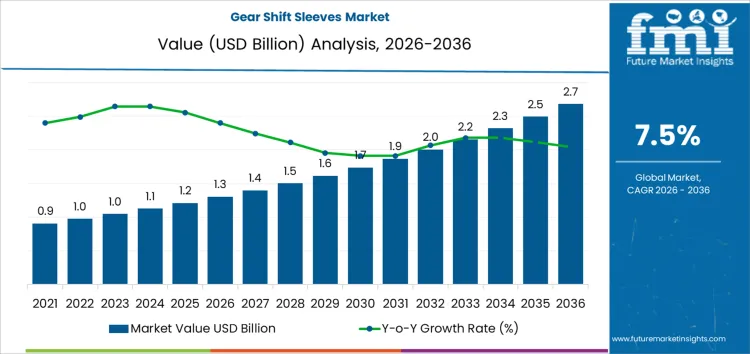
The gear shift sleeves market expands in line with transmission production volumes and the gradual upgrading of shift quality requirements in passenger and commercial vehicles. In 2020, when the gear shift sleeves market is still around USD 0.9 billion, demand is largely driven by conventional manual and automated manual transmissions in high-volume vehicle segments. As the gear shift sleeves market moves to approximately USD 1.1 billion by 2024 and reaches about USD 1.3 billion in 2026, investment is increasingly influenced by the need to improve shift precision, reduce noise and vibration, and enhance durability, especially in cost-sensitive platforms where mechanical solutions remain dominant. At this stage, gear shift sleeves are not premium components but are increasingly specified to meet tighter performance and warranty requirements.
Further growth of the gear shift sleeves market is shaped more by model mix and replacement cycles than by radical transmission architecture changes. By 2030, when the gear shift sleeves market reaches roughly USD 1.7 billion, demand is supported by continued production of manual and hybridized transmissions, as well as by service and aftermarket replacement. As the gear shift sleeves market approaches about USD 2.2 billion in 2033-2034 and reaches approximately USD 2.7 billion by 2036, value growth is driven by higher unit content in multi-speed gearboxes, improved materials, and longer durability specifications. Purchasing decisions remain focused on reliability, wear resistance, and consistent shift feel rather than on brand differentiation or visible feature content.
Gear Shift Sleeves Market Key Takeaways
| Metric | Value |
|---|---|
| Market Value (2026) | USD 1.3 billion |
| Forecast Value (2036) | USD 2.7 billion |
| Forecast CAGR 2026 to 2036 | 7.5% |
How Is the Gear Shift Sleeves Market Enhancing Vehicle Performance and Driver Comfort?
Gear shift sleeves are increasingly adopted to improve tactile feel, durability, and ergonomics in manual and automatic transmission systems. Historically, gear shifters relied on basic materials that offered limited wear resistance, reduced comfort, and susceptibility to abrasion or degradation over time. Modern gear shift sleeves integrate high-quality polymers, leather composites, or reinforced elastomers to provide smooth operation, enhanced grip, and long-term durability under repetitive use. Automotive OEMs, aftermarket suppliers, and vehicle customization specialists prioritize material quality, dimensional accuracy, and compatibility with transmission assemblies. Early adoption focused on high-end passenger vehicles, while current demand spans mainstream cars, commercial vehicles, and performance automobiles, driven by driver comfort expectations, aesthetic considerations, and reliability standards. Material resilience, fit precision, and surface texture influence supplier selection.
Enhancing shift performance and maintaining long-term reliability are driving market growth. Compared with conventional sleeves, modern designs emphasize wear resistance, improved ergonomics, and consistent tactile feedback under varying driving conditions. Cost structures depend on material selection, manufacturing tolerances, and finishing processes, concentrating margins among suppliers capable of delivering high-quality, durable components. Automotive manufacturers and aftermarket providers adopt these sleeves to improve driver experience, reduce maintenance frequency, and enhance interior quality perception. Moving forward, gear shift sleeves are expected to play a key role in vehicle ergonomics and reliability, supporting superior operational feel, extended service life, and consistent performance across passenger and commercial vehicles.
What Factors Are Shaping the Demand for Gear Shift Sleeves Market, Segment wise?
The Gear Shift Sleeves Market in 2026 is structured primarily by interior platform strategy, cost positioning, and brand differentiation objectives rather than by functional performance alone. By material type, demand in the Gear Shift Sleeves Market is distributed across leather gear shift sleeves, polyurethane gear shift sleeves, fabric and textile sleeves, and rubber or silicone sleeves. By application, demand in the Gear Shift Sleeves Market is concentrated in passenger vehicles, commercial vehicles, two wheelers, and aftermarket accessories. These segments reflect different priorities in terms of interior perception, durability requirements, and price sensitivity across vehicle categories.
How Do Interior Positioning and Platform Cost Targets Shape Material Type Demand in the Gear Shift Sleeves Market?
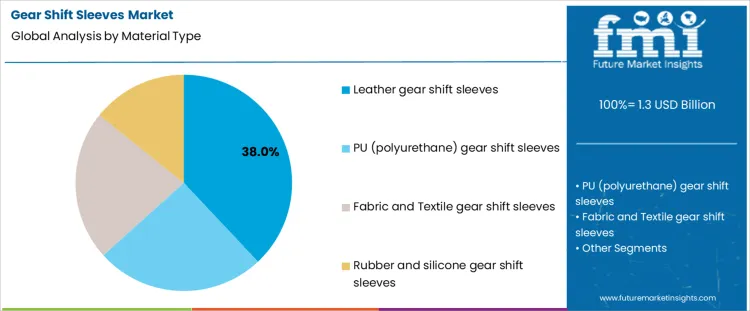
Leather gear shift sleeves account for approximately 38% of demand in the Gear Shift Sleeves Market because leather remains the primary material used to signal interior quality and brand positioning in passenger vehicles. In most vehicle programs, the gear shift area is a frequent touch point and a visible element of perceived craftsmanship. As a result, material choice is often determined by interior design strategy rather than by mechanical necessity. Polyurethane sleeves are widely used in mid-range and cost-sensitive models because they offer visual similarity to leather while supporting tighter cost and sourcing targets.
Fabric and textile sleeves are applied where weight, cost, or styling differentiation is prioritized, particularly in smaller vehicles and two wheelers. Rubber and silicone sleeves are specified mainly for durability, contamination resistance, or utility-focused designs. The structure of the Gear Shift Sleeves Market is therefore driven by how vehicle manufacturers allocate interior cost budgets and define tactile differentiation between trim levels rather than by performance requirements of the shifting mechanism itself.
Why Do Passenger Vehicles Represent the Largest Application Segment in the Gear Shift Sleeves Market?
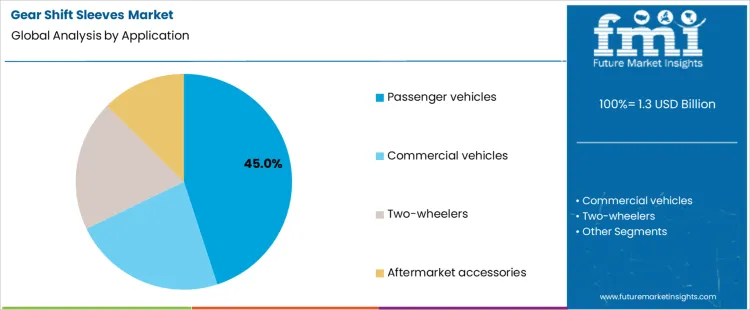
Passenger vehicles account for approximately 45% of demand in the Gear Shift Sleeves Market because this segment places the greatest emphasis on interior appearance, tactile quality, and trim-level differentiation. In passenger cars, gear shift sleeves are not treated as purely protective components but as integrated elements of the cabin design language. Each new model or facelift program typically introduces changes in materials, stitching, color combinations, or surface textures, which creates recurring demand even when mechanical components remain unchanged. Commercial vehicles, by contrast, prioritize durability, ease of cleaning, and cost control, which limits material variety and design turnover.
Two wheelers use simpler constructions and lower material content, which constrains value contribution. The aftermarket segment is driven by customization and replacement demand but remains fragmented and price sensitive. Passenger vehicle programs combine high production volume with frequent interior updates and multi-tier trim strategies. This combination sustains continuous demand and explains why passenger vehicles remain the dominant application segment in the Gear Shift Sleeves Market.
How Are the Key Dynamics Reshaping the Gear Shift Sleeves Market?
The Gear Shift Sleeves Market exists in a strange place between mechanics and perception. A sleeve is not a powertrain component, yet it strongly influences how a gearbox feels, sounds, and ages. In many vehicles, shift quality is judged more by friction, noise, and smoothness than by internal gear geometry. As transmissions become more compact and more standardized, small interface parts carry more responsibility for masking tolerances and wear. This makes the Gear Shift Sleeves Market less about volume and more about where manufacturers decide to solve refinement problems, whether in heavy metal or in quiet, replaceable interface components.
Why the Gear Shift Sleeves Market Is Driven by Shift Feel Engineering?
Modern vehicles compete on perceived quality as much as on durability. A notchy or noisy shift is often caused by tiny misalignments, surface finishes, or tolerance stacks, not by broken gears. Gear shift sleeves absorb, guide, and stabilize motion paths that would otherwise transmit vibration or roughness to the driver. In many platforms, engineers tune shift feels by changing sleeves before touching the gearbox core. This makes the Gear Shift Sleeves Market follow refinement programs and model refresh cycles rather than failure rates. Where shift feel becomes a selling point, sleeve specifications quietly become more critical and more customized.
Why the Gear Shift Sleeves Market Is Sensitive to Manufacturing Tolerances?
As gearboxes shrink and packaging tightens, tolerance margins disappear. Parts that once floated freely now run with minimal clearance. In this environment, sleeves stop being passive guides and start acting as compensators for stack-up errors, thermal expansion, and wear. Material choice, surface finish, and deformation behavior suddenly matter. Some designs work beautifully in theory and become noisy or sticky in production. This makes the Gear Shift Sleeves Market dependent on real factory capability, not just design intent. Where manufacturing control is weak, sleeve designs become conservative. Where control is strong, sleeves become precision tuning elements.
Why the Gear Shift Sleeves Market Follows Transmission Platform Strategies?
Automakers increasingly build many models on a small number of gearbox platforms. When that happens, small components like sleeves are used to differentiate feel between brands, engines, or price points without changing the core hardware. One platform may carry multiple sleeve variants to create different shift characters. This turns the Gear Shift Sleeves Market into a portfolio management tool rather than a simple spare part business. Demand follows how many transmission families exist and how many “personalities” manufacturers want to create from them, not how many cars are produced in total.
What is the Demand Outlook for Gear Shift Sleeves by Country?
| Country | CAGR (%) |
|---|---|
| USA | 7.0% |
| UK | 6.8% |
| China | 8.2% |
| India | 8.5% |
| Brazil | 7.3% |
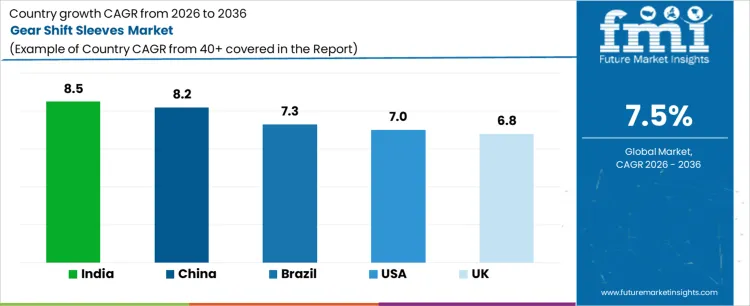
Demand for gear shift sleeves is rising as automotive manufacturers adopt high-performance components to improve transmission durability, driver comfort, and vehicle reliability. India leads with an 8.5% CAGR, driven by growing vehicle production, rising consumer demand for quality interiors, and adoption of advanced gear components. China follows at 8.2%, supported by large-scale automotive manufacturing and integration of durable transmission parts. Brazil records 7.3% growth, shaped by replacement demand and vehicle upgrades. The USA grows at 7.0%, influenced by adoption in passenger and commercial vehicles. The UK shows 6.8% CAGR, reflecting steady use of gear shift sleeves across automotive manufacturing and repair markets.
How do transmission platform cycles shape gear shift sleeve demand in the United States?
Vehicle program planning and transmission platform renewal cycles drive purchasing behavior in United States powertrain supply chains, with gear shift sleeve demand expanding at a 7% CAGR. Most volume is specified during gearbox design freeze rather than sourced through aftermarket channels. Light truck and SUV programs account for a large share of unit flow due to higher transmission torque requirements. Tier one transmission suppliers control sourcing and supplier nomination. Material choice balances wear resistance, shift feel, and cost stability. Once a platform enters mass production, component volumes follow vehicle output for many years. Import parts serve niche high performance applications. Pricing pressure reflects multi-year supply contracts. Commercial success depends on securing positions inside new platform programs rather than chasing short cycle volume swings.
Why do model refresh programs govern demand patterns in the United Kingdom?
Powertrain update schedules and vehicle model refresh programs guide component sourcing in United Kingdom automotive supply chains, with gear shift sleeve demand rising at a 6.8% CAGR. Volume is tied closely to manual and automated manual transmission programs in compact and mid-size vehicles. Tier one gearbox suppliers manage most sourcing decisions. Engineering teams lock material and geometry choices early in development. Once validated, designs remain stable through the full production run. Replacement sales contribute limited incremental volume. Import suppliers serve performance and specialty transmissions. Cost targets and warranty risk shape supplier selection. Order timing follows vehicle launch calendars. Commercial visibility depends on access to new vehicle programs and long term supply agreements rather than short term sales campaigns.
What manufacturing scale effects control demand in China?
Vehicle production expansion and transmission localization programs keep China on an 8.2% growth path for gear shift sleeve volumes. Large scale passenger car output and commercial vehicle assembly drive unit demand. Domestic transmission manufacturers supply most mass market platforms. International suppliers retain roles in higher performance and export oriented gearboxes. Platform standardization across multiple vehicle models amplifies volume per design win. Once approved, components remain in production for extended cycles. Pricing reflects high volume contracts and cost reduction programs. Engineering change frequency remains low after launch. Commercial success depends on securing positions inside major transmission families rather than selling into fragmented aftermarket channels or low volume specialty programs.
Why does platform localization drive growth in India?
Expansion of locally built passenger cars and light commercial vehicles keeps India on an 8.5% growth track for gear shift sleeve demand. Transmission localization programs increase sourcing from domestic and regional suppliers. OEMs and tier one gearbox producers control nomination lists. Component designs are locked early in vehicle development. Once production begins, volumes follow vehicle output across the full model life. Import parts serve premium and export focused vehicles. Cost targets and durability testing influence supplier choice. Replacement sales remain a small share of total volume. Revenue visibility depends on access to upcoming vehicle platforms and powertrain programs rather than selling through independent parts distribution channels.
How do vehicle mix shifts influence demand in Brazil?
Changes in passenger car and light truck production mix shape Brazil demand patterns, with gear shift sleeve volumes growing at a 7.3% CAGR. Manual and automated manual transmissions remain important across many locally built models. Tier one transmission suppliers manage most sourcing relationships. Platform continuity supports stable multi-year order flow once a design is approved. Import parts serve lower volume performance applications. Cost sensitivity and local content rules influence supplier selection. Engineering changes occur mainly during model refresh cycles. Replacement demand contributes limited incremental volume. Commercial success depends on participation in local vehicle programs and long term supply agreements rather than short cycle sales activity to independent repair channels.
What Distinguishes Suppliers in the Gear Shift Sleeves Market in Terms of Design and Integration?
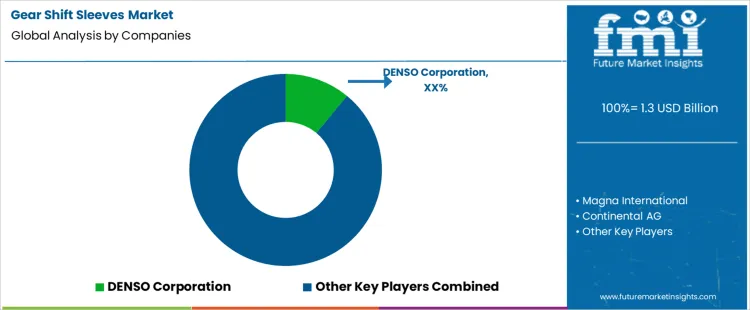
Leading suppliers of gear shift sleeves focus on material durability, precision fit, and compatibility with modern transmission systems. DENSO Corporation develops sleeves engineered for tight dimensional tolerances and wear resistance, supporting smooth gear engagement in passenger and commercial vehicles. Magna International provides gear shift components designed to integrate with electronic and mechanical shift systems, emphasising consistent feel and low vibration. Continental AG supplies sleeves that align with broader drivetrain architectures, offering corrosion resistant surfaces and durability under varied operating conditions. ZF Friedrichshafen AG delivers precision manufactured sleeves as part of integrated transmission modules, balancing strength with manufacturability. BorgWarner Inc. focuses on materials and coatings that enhance sliding performance and reduce noise in gear actuation.
Aisin Seiki Co., Ltd. produces gear shift sleeves tuned to global OEM specifications, emphasising reliability and lifecycle consistency. Other regional and specialist producers offer tailored solutions for specific vehicle platforms or niche transmissions such as commercial or off road applications. Competitive differentiation arises from material selection, surface treatment, and dimensional precision, all of which influence shift smoothness and long term durability. Suppliers with robust engineering support and validation data help manufacturers meet tight assembly tolerances and regulatory requirements. Adoption reflects priorities for performance, reduction of shift effort, and integration with automated or electronic shift by wire systems across varied vehicle segments.
Key Players in the Gear Shift Sleeves Market
- DENSO Corporation
- Magna International
- Continental AG
- ZF Friedrichshafen AG
- BorgWarner Inc.
- Aisin Seiki Co., Ltd.
Scope of the Report
| Items | Values |
|---|---|
| Quantitative Units (2026) | USD billion |
| Material Type | Leather gear shift sleeves, PU (polyurethane) gear shift sleeves, Fabric and textile gear shift sleeves, Rubber and silicone gear shift sleeves |
| Application | Passenger vehicles, Commercial vehicles, Two-wheelers, Aftermarket accessories |
| Region | Asia Pacific, Europe, North America, Latin America, Middle East & Africa |
| Countries Covered | China, Japan, South Korea, India, Australia & New Zealand, ASEAN, Germany, United Kingdom, France, Italy, Spain, Nordic, BENELUX, United States, Canada, Mexico, Brazil, Chile, Saudi Arabia, Turkey, South Africa, and other regional markets |
| Key Companies Profiled | DENSO Corporation, Magna International, Continental AG, ZF Friedrichshafen AG, BorgWarner Inc., Aisin Seiki Co., Ltd. |
| Additional Attributes | Dollar by sales by material type and application; demand driven by transmission platform cycles and shift feel engineering; growth led by higher unit content in multi-speed gearboxes and tighter tolerance requirements; purchasing shaped by durability, wear behavior, dimensional stability, and long-term shift consistency rather than styling alone. |
Gear Shift Sleeves Market Segmentation
Material Type:
- Leather gear shift sleeves
- PU (polyurethane) gear shift sleeves
- Fabric and textile gear shift sleeves
- Rubber and silicone gear shift sleeves
Application:
- Passenger vehicles
- Commercial vehicles
- Two-wheelers
- Aftermarket accessories
Region:
- Asia Pacific
- China
- Japan
- South Korea
- India
- Australia & New Zealand
- ASEAN
- Rest of Asia Pacific
- Europe
- Germany
- United Kingdom
- France
- Italy
- Spain
- Nordic
- BENELUX
- Rest of Europe
- North America
- United States
- Canada
- Mexico
- Latin America
- Brazil
- Chile
- Rest of Latin America
- Middle East & Africa
- Kingdom of Saudi Arabia
- Other GCC Countries
- Turkey
- South Africa
- Other African Union
- Rest of Middle East & Africa
Bibliography
- NITI Aayog & Press Information Bureau, Government of India. (2025, April 15). Powering India’s participation in global value chains: Automotive sector. Government of India.
- International Organization of Motor Vehicle Manufacturers. (2025). World Motor Vehicle Production 2024. OICA.
- European Automobile Manufacturers’ Association. (2025). Economic and market report: Global and EU auto industry – Full year 2024. ACEA.
- International Organization of Motor Vehicle Manufacturers. (2025). World motor vehicle production by country/region and type – 2024 [PDF]. OICA.
Frequently Asked Questions
How big is the gear shift sleeves market in 2026?
The global gear shift sleeves market is estimated to be valued at USD 1.3 billion in 2026.
What will be the size of gear shift sleeves market in 2036?
The market size for the gear shift sleeves market is projected to reach USD 2.7 billion by 2036.
How much will be the gear shift sleeves market growth between 2026 and 2036?
The gear shift sleeves market is expected to grow at a 7.5% CAGR between 2026 and 2036.
What are the key product types in the gear shift sleeves market?
The key product types in gear shift sleeves market are leather gear shift sleeves , pu (polyurethane) gear shift sleeves, fabric and textile gear shift sleeves and rubber and silicone gear shift sleeves.
Which application segment to contribute significant share in the gear shift sleeves market in 2026?
In terms of application, passenger vehicles segment to command 45.0% share in the gear shift sleeves market in 2026.
Preview the report firsthand - request a free sample
Get SampleGet the brochure for pricing and purchase details.
Get PDFTable of Content
- Executive Summary
- Global Market Outlook
- Demand-side Trends
- Supply-side Trends
- Technology Roadmap Analysis
- Analysis and Recommendations
- Market Overview
- Market Coverage / Taxonomy
- Market Definition / Scope / Limitations
- Market Background
- Market Dynamics
- Drivers
- Restraints
- Opportunity
- Trends
- Scenario Forecast
- Demand in Optimistic Scenario
- Demand in Likely Scenario
- Demand in Conservative Scenario
- Opportunity Map Analysis
- Product Life Cycle Analysis
- Supply Chain Analysis
- Investment Feasibility Matrix
- Value Chain Analysis
- PESTLE and Porter’s Analysis
- Regulatory Landscape
- Regional Parent Market Outlook
- Production and Consumption Statistics
- Import and Export Statistics
- Market Dynamics
- Global Market Analysis 2021 to 2025 and Forecast, 2026 to 2036
- Historical Market Size Value (USD Million) Analysis, 2021 to 2025
- Current and Future Market Size Value (USD Million) Projections, 2026 to 2036
- Y-o-Y Growth Trend Analysis
- Absolute $ Opportunity Analysis
- Global Market Pricing Analysis 2021 to 2025 and Forecast 2026 to 2036
- Global Market Analysis 2021 to 2025 and Forecast 2026 to 2036, By Material Type
- Introduction / Key Findings
- Historical Market Size Value (USD Million) Analysis By Material Type , 2021 to 2025
- Current and Future Market Size Value (USD Million) Analysis and Forecast By Material Type , 2026 to 2036
- Leather gear shift sleeves
- PU (polyurethane) gear shift sleeves
- Fabric and Textile gear shift sleeves
- Rubber and silicone gear shift sleeves
- Leather gear shift sleeves
- Y-o-Y Growth Trend Analysis By Material Type , 2021 to 2025
- Absolute $ Opportunity Analysis By Material Type , 2026 to 2036
- Global Market Analysis 2021 to 2025 and Forecast 2026 to 2036, By Application
- Introduction / Key Findings
- Historical Market Size Value (USD Million) Analysis By Application, 2021 to 2025
- Current and Future Market Size Value (USD Million) Analysis and Forecast By Application, 2026 to 2036
- Passenger vehicles
- Commercial vehicles
- Two‑wheelers
- Aftermarket accessories
- Passenger vehicles
- Y-o-Y Growth Trend Analysis By Application, 2021 to 2025
- Absolute $ Opportunity Analysis By Application, 2026 to 2036
- Global Market Analysis 2021 to 2025 and Forecast 2026 to 2036, By Region
- Introduction
- Historical Market Size Value (USD Million) Analysis By Region, 2021 to 2025
- Current Market Size Value (USD Million) Analysis and Forecast By Region, 2026 to 2036
- North America
- Latin America
- Western Europe
- Eastern Europe
- East Asia
- South Asia and Pacific
- Middle East & Africa
- Market Attractiveness Analysis By Region
- North America Market Analysis 2021 to 2025 and Forecast 2026 to 2036, By Country
- Historical Market Size Value (USD Million) Trend Analysis By Market Taxonomy, 2021 to 2025
- Market Size Value (USD Million) Forecast By Market Taxonomy, 2026 to 2036
- By Country
- USA
- Canada
- Mexico
- By Material Type
- By Application
- By Country
- Market Attractiveness Analysis
- By Country
- By Material Type
- By Application
- Key Takeaways
- Latin America Market Analysis 2021 to 2025 and Forecast 2026 to 2036, By Country
- Historical Market Size Value (USD Million) Trend Analysis By Market Taxonomy, 2021 to 2025
- Market Size Value (USD Million) Forecast By Market Taxonomy, 2026 to 2036
- By Country
- Brazil
- Chile
- Rest of Latin America
- By Material Type
- By Application
- By Country
- Market Attractiveness Analysis
- By Country
- By Material Type
- By Application
- Key Takeaways
- Western Europe Market Analysis 2021 to 2025 and Forecast 2026 to 2036, By Country
- Historical Market Size Value (USD Million) Trend Analysis By Market Taxonomy, 2021 to 2025
- Market Size Value (USD Million) Forecast By Market Taxonomy, 2026 to 2036
- By Country
- Germany
- UK
- Italy
- Spain
- France
- Nordic
- BENELUX
- Rest of Western Europe
- By Material Type
- By Application
- By Country
- Market Attractiveness Analysis
- By Country
- By Material Type
- By Application
- Key Takeaways
- Eastern Europe Market Analysis 2021 to 2025 and Forecast 2026 to 2036, By Country
- Historical Market Size Value (USD Million) Trend Analysis By Market Taxonomy, 2021 to 2025
- Market Size Value (USD Million) Forecast By Market Taxonomy, 2026 to 2036
- By Country
- Russia
- Poland
- Hungary
- Balkan & Baltic
- Rest of Eastern Europe
- By Material Type
- By Application
- By Country
- Market Attractiveness Analysis
- By Country
- By Material Type
- By Application
- Key Takeaways
- East Asia Market Analysis 2021 to 2025 and Forecast 2026 to 2036, By Country
- Historical Market Size Value (USD Million) Trend Analysis By Market Taxonomy, 2021 to 2025
- Market Size Value (USD Million) Forecast By Market Taxonomy, 2026 to 2036
- By Country
- China
- Japan
- South Korea
- By Material Type
- By Application
- By Country
- Market Attractiveness Analysis
- By Country
- By Material Type
- By Application
- Key Takeaways
- South Asia and Pacific Market Analysis 2021 to 2025 and Forecast 2026 to 2036, By Country
- Historical Market Size Value (USD Million) Trend Analysis By Market Taxonomy, 2021 to 2025
- Market Size Value (USD Million) Forecast By Market Taxonomy, 2026 to 2036
- By Country
- India
- ASEAN
- Australia & New Zealand
- Rest of South Asia and Pacific
- By Material Type
- By Application
- By Country
- Market Attractiveness Analysis
- By Country
- By Material Type
- By Application
- Key Takeaways
- Middle East & Africa Market Analysis 2021 to 2025 and Forecast 2026 to 2036, By Country
- Historical Market Size Value (USD Million) Trend Analysis By Market Taxonomy, 2021 to 2025
- Market Size Value (USD Million) Forecast By Market Taxonomy, 2026 to 2036
- By Country
- Kingdom of Saudi Arabia
- Other GCC Countries
- Turkiye
- South Africa
- Other African Union
- Rest of Middle East & Africa
- By Material Type
- By Application
- By Country
- Market Attractiveness Analysis
- By Country
- By Material Type
- By Application
- Key Takeaways
- Key Countries Market Analysis
- USA
- Pricing Analysis
- Market Share Analysis, 2025
- By Material Type
- By Application
- Canada
- Pricing Analysis
- Market Share Analysis, 2025
- By Material Type
- By Application
- Mexico
- Pricing Analysis
- Market Share Analysis, 2025
- By Material Type
- By Application
- Brazil
- Pricing Analysis
- Market Share Analysis, 2025
- By Material Type
- By Application
- Chile
- Pricing Analysis
- Market Share Analysis, 2025
- By Material Type
- By Application
- Germany
- Pricing Analysis
- Market Share Analysis, 2025
- By Material Type
- By Application
- UK
- Pricing Analysis
- Market Share Analysis, 2025
- By Material Type
- By Application
- Italy
- Pricing Analysis
- Market Share Analysis, 2025
- By Material Type
- By Application
- Spain
- Pricing Analysis
- Market Share Analysis, 2025
- By Material Type
- By Application
- France
- Pricing Analysis
- Market Share Analysis, 2025
- By Material Type
- By Application
- India
- Pricing Analysis
- Market Share Analysis, 2025
- By Material Type
- By Application
- ASEAN
- Pricing Analysis
- Market Share Analysis, 2025
- By Material Type
- By Application
- Australia & New Zealand
- Pricing Analysis
- Market Share Analysis, 2025
- By Material Type
- By Application
- China
- Pricing Analysis
- Market Share Analysis, 2025
- By Material Type
- By Application
- Japan
- Pricing Analysis
- Market Share Analysis, 2025
- By Material Type
- By Application
- South Korea
- Pricing Analysis
- Market Share Analysis, 2025
- By Material Type
- By Application
- Russia
- Pricing Analysis
- Market Share Analysis, 2025
- By Material Type
- By Application
- Poland
- Pricing Analysis
- Market Share Analysis, 2025
- By Material Type
- By Application
- Hungary
- Pricing Analysis
- Market Share Analysis, 2025
- By Material Type
- By Application
- Kingdom of Saudi Arabia
- Pricing Analysis
- Market Share Analysis, 2025
- By Material Type
- By Application
- Turkiye
- Pricing Analysis
- Market Share Analysis, 2025
- By Material Type
- By Application
- South Africa
- Pricing Analysis
- Market Share Analysis, 2025
- By Material Type
- By Application
- USA
- Market Structure Analysis
- Competition Dashboard
- Competition Benchmarking
- Market Share Analysis of Top Players
- By Regional
- By Material Type
- By Application
- Competition Analysis
- Competition Deep Dive
- DENSO Corporation
- Overview
- Product Portfolio
- Profitability by Market Segments (Product/Age /Sales Channel/Region)
- Sales Footprint
- Strategy Overview
- Marketing Strategy
- Product Strategy
- Channel Strategy
- Magna International
- Continental AG
- ZF Friedrichshafen AG
- BorgWarner Inc.
- Aisin Seiki Co., Ltd.
- DENSO Corporation
- Competition Deep Dive
- Assumptions & Acronyms Used
- Research Methodology


