

- Industry Size (2026)
- USD 3.3 Bn
- Forecast (2036)
- USD 10.2 Bn
- CAGR (2026 to 2036)
- 12.0%
Low-Carbon Hydrogen Solutions for Industrial Cluster Decarbonization Market Size, Market Forecast and Outlook By FMI
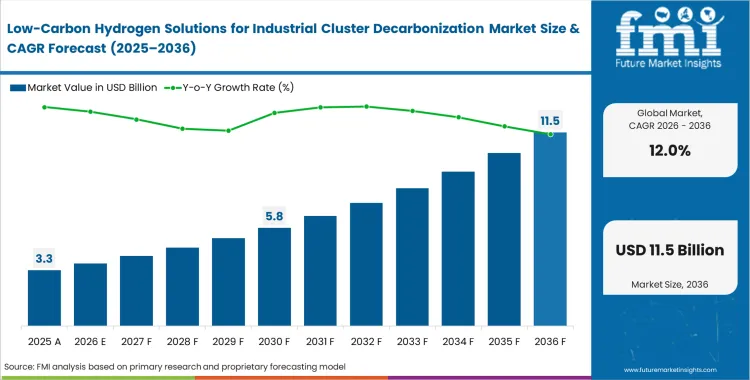
The low-carbon hydrogen solutions for industrial cluster decarbonization market was valued at USD 2.9 Billion in 2025. Cumulative investment is poised to reach USD 3.3 Billion in 2026 at a CAGR of 12.0% during the forecast period. Revenue expansion propels total valuation to USD 10.2 Billion through 2036 as regional consortiums enforce strict emission penalties on heavy emitters driving localized hydrogen industrial decarbonization.
Summary of Low-Carbon Hydrogen Solutions for Industrial Cluster Decarbonization Market
- Market Snapshot
- The low-carbon hydrogen solutions for industrial cluster decarbonization market value is USD 2.90 billion in 2025, projected to reach USD 10.20 billion by 2036.
- The industry is expected to grow at a 12.0% CAGR from 2026 to 2036, creating an incremental opportunity of USD 6.90 billion.
- The market functions as a policy-led industrial decarbonization segment driven by emissions reduction mandates across heavy industries.
- Infrastructure development, including hydrogen hubs, pipelines, and electrolyzer installations, defines market scalability.
- Demand and Growth Drivers
- Demand is increasing due to refining and steel decarbonization requirements, especially in Asia and Europe.
- Electrolysis adoption is accelerating due to renewable energy integration and declining renewable power costs.
- Hydrogen cluster development enables economies of scale and centralized infrastructure investment.
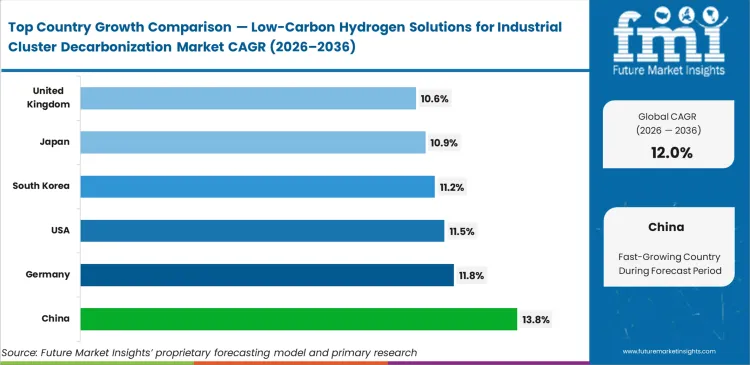
- China leads at 13.8% CAGR, followed by India at 13.5%, Germany at 11.8%, United States at 11.5%, Japan at 10.9%, South Korea at 11.2%, and the United Kingdom at 10.6%.
- Growth is constrained by high hydrogen production costs and limited transport infrastructure.
- Product and Segment View
- The market includes hydrogen production technologies such as electrolysis, SMR, ATR, biomass, and pyrolysis.
- Applications include refining, steel manufacturing, chemicals, power generation, and transport.
- Electrolysis leads the technology segment with 56.0% share due to alignment with renewable energy goals.
- Refining leads the application segment with 31.0% share due to hydrogen consumption in fuel processing.
- Pipeline leads the distribution segment with 44.0% share due to cost-efficient large-scale transport.
- Industrial clusters lead the end-user segment with 63.0% share due to concentrated emissions and infrastructure efficiency.
- Green hydrogen leads the hydrogen type segment with 51.0% share due to zero-carbon production pathways.
- The scope includes hydrogen production, storage, and distribution systems, but excludes retail fueling infrastructure and standalone fuel cells.
- Geography and Competitive Outlook
- China, India, and Germany are the fastest-growing markets; the United States remains a high-value demand center.
- Competition is shaped by large-scale infrastructure investments, partnerships, and technology advancements.
- Key companies include Air Liquide, Linde plc, Air Products, Siemens Energy, Nel ASA, Plug Power, and Shell.
- The market shows moderate concentration with industrial gas leaders dominating large-scale projects.
Low-Carbon Hydrogen Solutions for Industrial Cluster Decarbonization Market Key Takeaways
| Metric | Details |
|---|---|
| Industry Size (2026) | USD 3.3 Billion |
| Industry Value (2036) | USD 10.2 Billion |
| CAGR (2026-2036) | 12.0% |
Source: Future Market Insights (FMI) analysis, based on proprietary forecasting model and primary research
Procurement executives responsible for petrochemical operations are under immediate and intense pressure to secure adequate supplies of zero-carbon feedstock materials. This proactive step is essential before the imposition of stringent carbon border adjustment mechanisms begins to significantly erode profit margins on exported goods. Postponing the finalization of crucial off-take agreements unnecessarily exposes these complex facility operators to the extreme volatility inherent in open-market spot pricing for necessary inputs. Forward-thinking facility management teams are increasingly choosing to secure their long-term supply needs by establishing contracts centered on low-carbon hydrogen solutions. This strategic redirection of capital moves investments away from constructing small, isolated, and inefficient hydrogen generation units at individual sites. This approach of centralized large-scale production fundamentally alters the economic trajectory and long-term operating costs for hydrogen use across numerous heavy industrial sectors.
The speed of the industrial transition for facilities located in close proximity is critically determined by the pace of regulatory approval for shared industrial transport corridors. Government policymakers, through the act of underwriting the necessary right-of-ways for large-scale hydrogen pipelines, dramatically reduce the individual transition costs that single plants would otherwise face. The successful completion and operational status of this shared infrastructure transforms hydrogen technology adoption from a costly, experimental initiative into an absolute necessity for continued competitive operation within the industrial landscape. The framework established by government supports a rapid and cohesive move to cleaner fuel sources.
Global hydrogen energy integration exhibits diverse regional growth trajectories. China's rapid coastal cluster development, fueled by state-directed capital, leads expansion at a 13.8% CAGR. Germany follows with an 11.8% CAGR, propelled by significant retrofitting within chemical parks. The United States expects an 11.5% CAGR, supported by substantial federal production tax credits. South Korea projects an 11.2% CAGR, Japan anticipates a 10.9% CAGR, and the United Kingdom tracks at a 10.6% CAGR. Differences across these regions result from initial infrastructure readiness impacting future energy system incorporation.
Segmental Analysis
Low-Carbon Hydrogen Solutions for Industrial Cluster Decarbonization Market Analysis by Technology
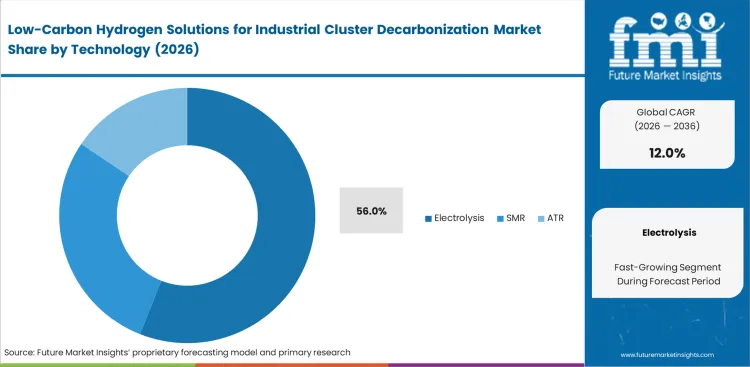
Integrating variable renewable power fundamentally modifies the underlying supply economics for large-scale, centralized hydrogen hubs. Electrolysis segment commands a 56.0% market share, a position strengthened by extensive renewable energy integration, large-scale deployment capabilities, and strict zero-emission compliance rules mandating immediate substitution. Facility operators must secure absolute zero-scope-emission certification for all processes. Procurement personnel at fertilizer consortiums expressly decline proposals based on fossil fuels absent complete carbon capture guarantees. It is essential to recognize that electrolyzer manufacturers prioritize equipment deliveries for consolidated cluster projects above sales to isolated purchasers, often leading to substantial delays. Securing essential hydrogen production technologies necessitates participation in multi-user consortiums. Buyers pursuing independent medium-scale generation initiatives encounter extensive procurement delays and increased costs due to this supply chain prioritization.
- Renewable coupling: Direct physical integration with offshore wind farms eliminates the requirement for grid transmission fees. Plant management benefits from capturing wholesale power pricing directly.
- Stack degradation: Continuous operation under fluctuations in power input significantly accelerates the deterioration of the membrane electrode assembly. Maintenance personnel need to maintain a substantial inventory of complete replacement modules for efficient upkeep.
- Scale threshold: Project financial viability is achieved only beyond gigawatt capacities, making smaller ventures prohibitively expensive. Isolated buyers face substantial price premiums for smaller-scale installations, hindering wider adoption.
Low-Carbon Hydrogen Solutions for Industrial Cluster Decarbonization Market Analysis by Application
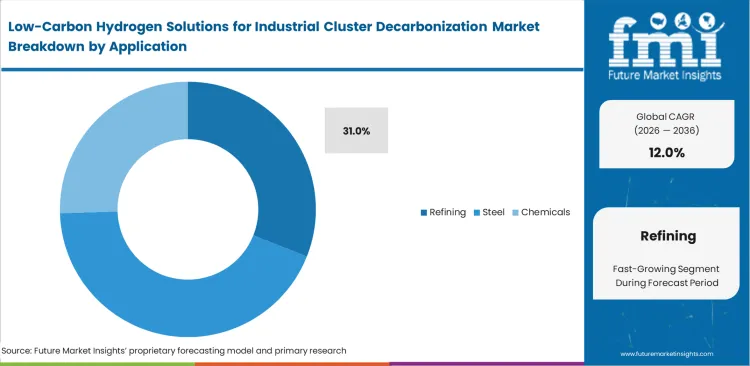
Immediate compliance requirements compel petrochemical production facilities toward aggressive substitution of traditional feedstocks. Replacing existing grey supply with green hydrogen demands zero downstream processing modifications, facilitating rapid deployment. Refinery operations personnel swiftly implement these hydrogen refining applications to meet stringent corporate emission reduction targets.The refining applications segment maintain a 31.0% share, primarily driven by urgent desulfurization compliance regulations and the substantial volume of legacy grey hydrogen consumption demanding rapid green alternatives. A key consideration often overlooked is the role of refineries in effectively subsidizing network infrastructure for smaller, adjacent industries. Facilities postponing this transition face the prospect of substantial carbon tax penalties, severely impacting profitability.
- Desulfurization demand: Stringent limits on fuel sulfur content require continuous heavy hydrogen gas consumption, guaranteeing baseline network utilization from refinery buyers.
- Feedstock purity: Electrolytic generation naturally delivers extremely high-purity inputs, enabling process engineers to eliminate expensive secondary purification stages completely.
- Emission penalties: Established carbon pricing frameworks heavily penalize legacy hydrogen extraction methods, incentivizing compliance officers to avoid millions in annual fines by switching to low-carbon sources.
Low-Carbon Hydrogen Solutions for Industrial Cluster Decarbonization Market Analysis by Distribution
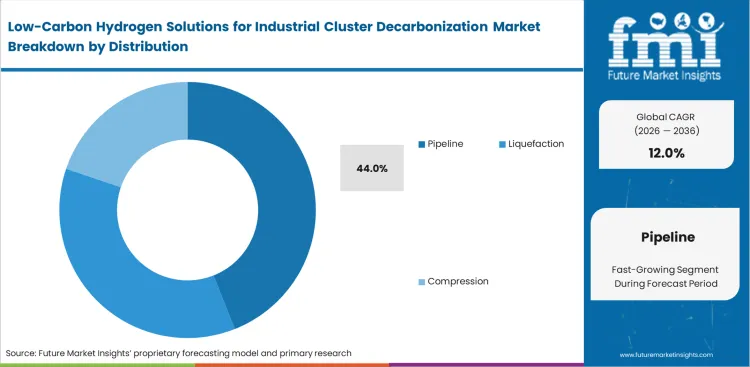
Pipeline distribution segment captures a 44.0% share, supported by superior high-volume economics and the capacity for continuous, pressurized delivery essential for sustained heavy industrial consumption. Volumetric density limitations make long-distance truck transportation economically unfeasible for heavy industrial users requiring large quantities. Infrastructure development teams understand the absolute necessity of reliable, continuous flow capacity for their industrial clients. Pipeline routing specialists often dedicate years to securing necessary municipal easements before initiating the first trenching work. Analysis indicates liquid hydrogen applications face considerable limitations for practical terrestrial cluster delivery. Businesses failing to secure connections to vital hydrogen pipeline infrastructure will face a perpetual cost disadvantage compared to connected competitors.
- Volumetric flow: Continuous pressurized delivery capabilities align perfectly with the sustained consumption profiles of heavy industry, allowing operations teams to eliminate large-scale bulk storage requirements.
- Material embrittlement: High-pressure hydrogen gas causes rapid degradation of standard steel alloys over extended periods of use. Integrity specialists must therefore mandate the use of advanced composite or specialized steel variants for construction.
- Easement acquisition: Obtaining contiguous routing rights through established industrial zones is a complex process spanning multiple years. Planners succeeding in this challenging task gain a durable, often insurmountable, local supply monopoly.
Low-Carbon Hydrogen Solutions for Industrial Cluster Decarbonization Market Analysis by End User
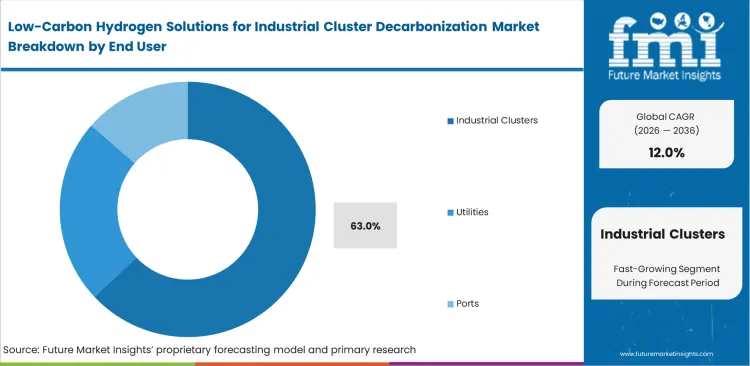
Aggregating demand profiles substantially mitigates the capital risk associated with multi-billion-dollar hydrogen generation projects. Banking syndicates require diversified revenue streams across numerous credit-worthy chemical and steel manufacturing enterprises before approving financing. Park administration serves as the central counter-party facilitating massive, long-term off-take agreements. Many analyses overlook that existing cluster tenants face eviction from shared industrial grids should they resist integration into the new hydrogen infrastructure. Industrial clusters segment command a dominant 63.0% share, supported by localized demand concentration, risk mitigation across multiple off-takers, and maximum capital efficiency per installed unit. Companies that delay adoption risk losing access to shared essential utilities completely.
- Demand aggregation: Consolidating consumption requirements facilitates optimal generation scaling for maximum efficiency. Park personnel negotiate significantly lower unit prices for all participants.
- Risk dilution: Supplying a portfolio of multiple distinct industrial sectors stabilizes overall revenue against individual commodity cycle fluctuations. Financiers approve construction loans with greater speed and confidence due to reduced exposure.
- Geographic density: Co-locating diverse consumers within a compact area minimizes the requirement for expensive, long-distance pipeline runs. Infrastructure management maximizes capital efficiency for every meter installed.
Low-Carbon Hydrogen Solutions for Industrial Cluster Decarbonization Market Analysis by Hydrogen Type
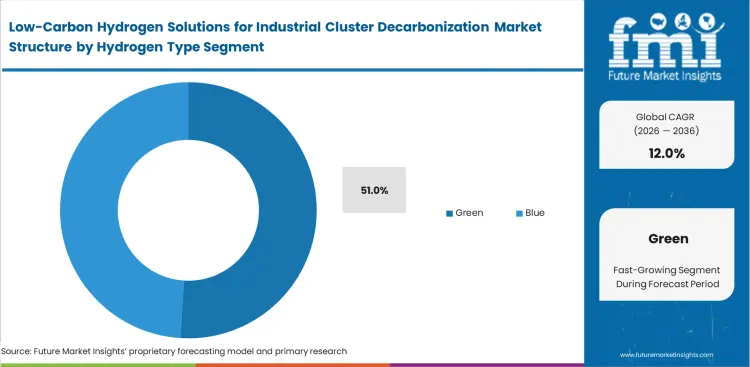
Certification requirements for zero emissions fundamentally dictate procurement strategies across export-focused manufacturing sectors.Corporate sustainability officers require purely electrolytic inputs to maintain essential access to the profitable Europe market. Green hydrogen segment holds a 51.0% market share, fueled by cross-border adjustment mechanisms that penalize residual carbon footprints and strict taxonomy compliance mandates for businesses engaged in international trade. Alternatives derived from fossil fuels are facing increasing scrutiny due to concerns about upstream methane leakage during extraction and transport. The expansion of electrolysis hydrogen generation capacity is the primary determinant of regional industrial competitiveness and future growth. Postponing the adoption of green hydrogen forces companies to relinquish highly profitable export regions, significantly impacting long-term revenue.
- Taxonomy compliance: Strict regulatory definitions of "green" completely exclude inputs derived from fossil fuels, ensuring continuous export access for compliance personnel.
- Power sourcing: Hourly matching of intermittent renewable generation with consumption profiles introduces significant operational complexity. Procurement teams must negotiate sophisticated synthetic power purchase agreements to manage risk.
- Price premium: Initial unit costs for green hydrogen remain noticeably higher than legacy alternatives derived from natural gas. Financial controllers must plan to absorb temporary margin compression until economies of scale are fully realized.
Low-Carbon Hydrogen Solutions for Industrial Cluster Decarbonization Market Drivers, Restraints, and Opportunities
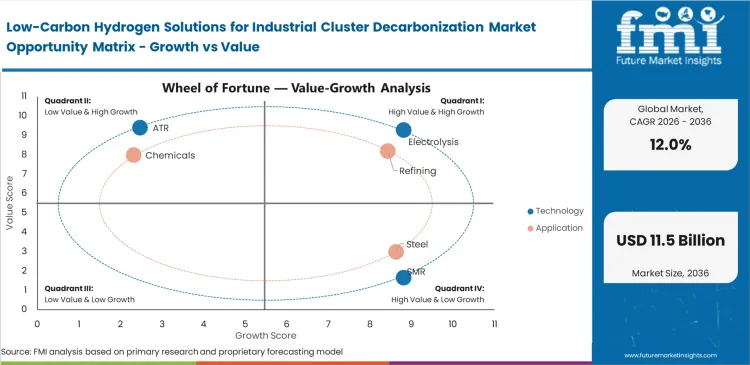
The immediate implementation of rigorous carbon border adjustment mechanisms is compelling major exporting economies to undertake a swift and decisive transition toward substitute feedstocks. Global procurement executives, operating large-scale steel and chemical manufacturing facilities, are now under immense pressure to rapidly secure substantial and reliable volumes of completely zero-emission inputs. This proactive measure is essential to diligently maintain their established global market competitiveness. A failure to finalize these crucial long-term supply agreements promptly will unequivocally guarantee significant profit margin erosion resulting from unavoidable carbon-related financial penalties. Consequently, specialist energy hub developers are opportunistically leveraging this created sense of market urgency to finalize highly lucrative, long-duration supply contracts with end-users.
Persistent and protracted delays in obtaining necessary regulatory clearances for shared pipeline network development are substantially hindering and paralyzing the timelines for localized industrial adoption of new energy sources. Local municipal zoning boards are demonstrably facing considerable difficulty and complexity in efficiently evaluating and granting specialized right-of-way applications, particularly those traversing densely built-up industrial manufacturing zones. Furthermore, dedicated project engineers cannot responsibly finalize the complex construction phases of critical electrolyzer installations without firm, guaranteed assurances regarding the essential off-take routing infrastructure for the produced gases. This relentless bureaucratic friction is effectively trapping and immobilizing billions of dollars in already committed investment capital, while simultaneously imposing significant delays on achieving absolutely critical national decarbonization milestones.
Opportunities in the Low-Carbon Hydrogen Solutions for Industrial Cluster Decarbonization Market
- Oxygen off-take monetization: Capturing massive oxygen byproducts from electrolysis creates secondary revenue streams. Medical and wastewater facility managers purchase this gas locally.
- Grid balancing services: Modulating electrolyzer output during peak power pricing events generates auxiliary income. Plant operators function effectively as demand-response assets.
- Specialty chemical synthesis: Leveraging high-purity inputs for advanced material production yields premium margins. R&D directors develop novel hydrogen hubs infrastructure applications.
Regional Analysis
Based on regional analysis, the low-carbon hydrogen solutions for industrial cluster decarbonization market is segmented into North America, Europe, Asia Pacific, Latin America, and Middle East & Africa.
.webp "Top Country Growth Comparison Low Carbon Hydrogen Solutions For Industrial Cluster Decarbonization Market Cagr (2026 2036)")
| Country | CAGR (2026 to 2036) |
|---|---|
| China | 13.8% |
| Germany | 11.8% |
| United States | 11.5% |
| South Korea | 11.2% |
| Japan | 10.9% |
| United Kingdom | 10.6% |
Source: Future Market Insights (FMI) analysis, based on proprietary forecasting model and primary research
Asia Pacific Low-Carbon Hydrogen Solutions for Industrial Cluster Decarbonization Market Analysis
Government-directed capital allocation accelerates substantial coastal hub infrastructure projects across eastern manufacturing regions. Central planning necessitates concurrent investments in generation and demand-side infrastructure, effectively removing obstacles to adoption. Port authority personnel coordinate gigawatt-scale import and generation facilities immediately adjacent to heavy steel and chemical production zones. FMI observes that merchant hydrogen generation within these specific areas prioritizes national industrial security absolutely over potential export opportunities. This strategic focus ensures a reliable domestic supply for essential heavy industries.
- China: Extensive coordination among state-owned enterprises ensures the simultaneous development of both supply and demand infrastructure across the manufacturing belts in the eastern part of the country. Petrochemical complex personnel secure cost-effective electrolytic gas quickly through mandates issued by centralized planning authorities, guaranteeing rapid availability. China demonstrates a 13.8% Compound Annual Growth Rate (CAGR), propelled by aggressive state-mandated coastal hub construction, massive investments in utility-scale electrolyzer installations, and stringent decarbonization mandates for heavy industrial areas. Regional consortiums are dominating future capacity allocations, completely eliminating the financial risks associated with a single major customer. Furthermore, deep supply chain integration ensures the continuous availability of essential hardware for all localized generation projects. Port administration staff are coordinating gigawatt-scale import facilities, positioning them directly next to heavy steel production areas. Domestic industrial security remains the ultimate and most important priority, overshadowing pure export aspirations in this planned strategic buildout. Companies operating within these specific designated green zones gain insurmountable cost advantages regarding the procurement of zero-carbon feedstock, ensuring competitiveness.
- Japan: Significant geographic concentration necessitates a heavy reliance on imported liquid carriers across the densely populated coastal manufacturing zones. Port management personnel are investing substantial capital in specialized offloading terminals, enabling the efficient handling of bulk zero-carbon shipments crucial for national energy security. Procurement leadership negotiates complex decade-long international supply agreements, aiming to stabilize localized pricing fluctuations and ensure long-term cost predictability. Engineering teams are focusing entirely on specialized integration hardware, linking import terminals with inland chemical parks through dedicated infrastructure. Japan is advancing at a 10.9% CAGR, driven by intense governmental financial support for import terminal infrastructure, strategic alliances with overseas production centers, and strict corporate emission reduction requirements impacting legacy steelmakers. This import-dependent approach creates a notable supply chain vulnerability, requiring substantial investments in buffer storage facilities to mitigate risk. Operations management maximizes efficiency through the intense co-location of both generation and consumption assets within these constrained coastal areas.
- South Korea: South Korea is expanding at an 11.2% CAGR, supported by highly centralized industrial planning, massive corporate commitments toward green steel transitions, and deep integration of supply chain logistics within unified industrial parks. Industrial parks, influenced by major conglomerates (Chaebol), integrate substantial fuel cell power generation alongside heavy chemical production facilities. Operations management personnel are maximizing overall network efficiency through intense geographic co-location of key assets, minimizing transmission losses. Engineering firms are constructing massive local grid connections dedicated entirely to powering multi-megawatt electrolyzer stacks with high reliability. Procurement officers benefit immensely from the extreme proximity between generation assets and end-use manufacturing lines, reducing logistical complexity. The high infrastructure density creates perfect adoption conditions for shared pipeline networks, making distribution economical and reliable. Facilities located outside these designated megahubs face considerable disadvantages regarding long-term utility costs and feedstock access.
Europe Low-Carbon Hydrogen Solutions for Industrial Cluster Decarbonization Market Analysis
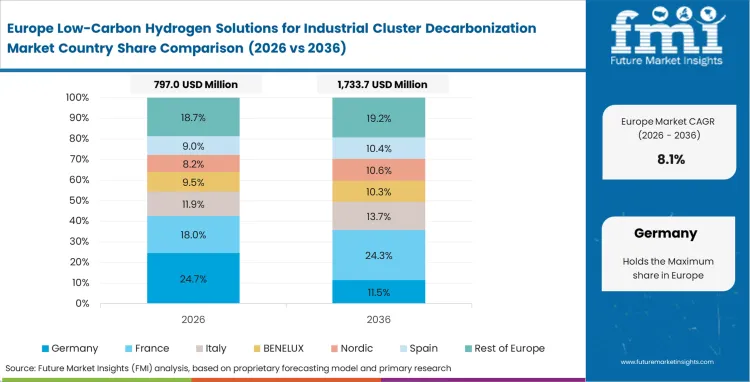
Strict punitive carbon pricing mechanisms are compelling heavy industries toward aggressive infrastructure retrofitting and modernization. Cross-border taxation policies render fossil-based production economically impractical for manufacturers primarily focused on export markets. Chemical park administration staff are acting as central coordinators for substantial shared pipeline networks, directly connecting offshore wind generation with inland consumption centers. Analysis strongly indicates that pipeline connectivity is the single most important factor dictating regional industrial survival in the face of these pressures.
- Germany: The deep integration of chemical manufacturing zones provides massive, established demand centers ready for low-carbon gas. Operations supervisors are leveraging existing pipeline corridors to execute rapid green substitution strategies across these dense industrial areas. Germany exhibits an 11.8% CAGR, fueled by aggressive national decarbonization policies, massive industrial integration within legacy chemical parks, and the urgent necessity to replace imported fossil fuels with domestic renewable resources. Engineering teams are retrofitting legacy distribution networks to ensure the safe and reliable handling of high-purity electrolytic gas at scale. Procurement leadership utilizes aggregated demand profiles to secure favorable long-term energy pricing from offshore wind developers through coordinated agreements. Facilities lacking immediate pipeline access face imminent closure risks due to rapidly escalating carbon penalties, forcing difficult strategic decisions. Regional cluster administration actively penalizes tenants refusing integration into the shared decarbonization grid, ensuring collective participation.
- United Kingdom: Aggressive expansion of offshore wind power generation aligns perfectly with ongoing coastal industrial decarbonization efforts. Cluster management coordinates substantial direct-wire generation projects, entirely bypassing the more volatile national power grids for increased reliability. Regulatory approval delays occasionally impede the final investment decisions regarding critical transport infrastructure, slowing progress. Heavy emitters are collaborating extensively with generation operating companies to secure dedicated power purchasing agreements, guaranteeing long-term energy supply. The United Kingdom is tracking at a 10.6% CAGR, propelled by the strategic geographic alignment between abundant offshore energy resources and legacy coastal manufacturing hubs, alongside robust governmental financial programs specifically targeting industrial cluster decarbonization. Port operating companies are rapidly expanding specialized liquid handling capabilities to support the continuous, high-volume industrial demand for hydrogen derivatives. The co-location of key assets minimizes overall capital expenditure requirements significantly, improving project viability.
North America Low-Carbon Hydrogen Solutions for Industrial Cluster Decarbonization Market Analysis
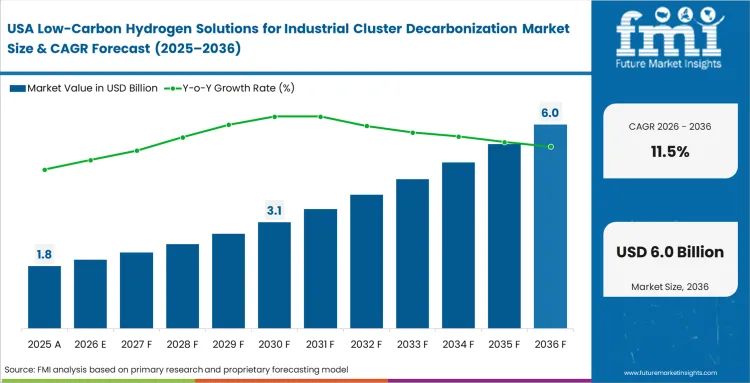
Massive federal production tax incentives fundamentally transform the project economics for utility-scale generation facilities across the continent. Investors are quickly moving to secure prime geographic locations situated near existing petrochemical industry density. Infrastructure planning professionals face considerable difficulty scaling transport networks beyond the immediate generation perimeters due to regulatory and cost hurdles. The availability of cheap natural gas creates massive resistance against green substitution strategies without the support of continuous financial subsidies.
- United States: The United States reports an 11.5% CAGR, driven by unprecedented federal financial incentives, massive localized petrochemical demand centers requiring immediate decarbonization, and extensive existing pipeline right-of-ways adaptable for low-carbon transport. Historic tax credit structures have triggered massive capital inflows into key regional hubs, accelerating development. Procurement officers at Gulf Coast refineries must navigate complex compliance rules to successfully claim the maximum available subsidies. Extreme geographic disparity in infrastructure readiness necessitates highly localized development rather than widespread national adoption of hydrogen solutions. Regional hubs are effectively monopolizing localized industrial growth, attracting heavy manufacturing investments toward subsidized geographic zones. Capital planning emphasizes the construction of facilities adjacent to these hubs to maximize the capture of valuable government subsidies.
A qualitative assessment indicates that Latin America relies significantly on export-oriented derivative synthesis rather than domestic industrial consumption, largely attributable to extreme geographic isolation and a lack of integrated infrastructure. The Middle East & Africa is focusing capital deployment upon massive green ammonia production zones, leveraging abundant solar resources specifically to serve the substantial Europe export markets and secure a long-term economic role.
Competitive Aligners for Market Players
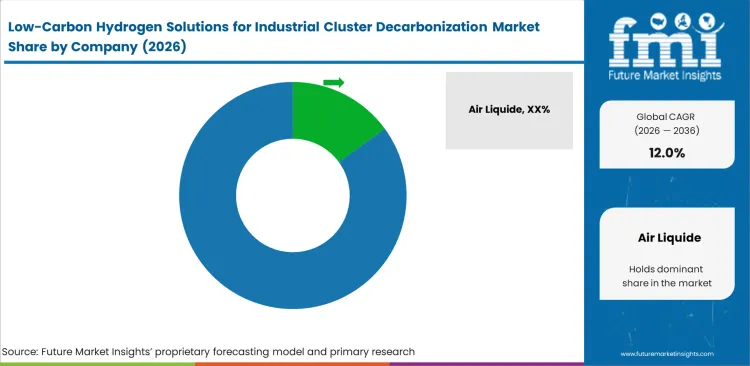
Massive capital requirements restrict prime infrastructure ownership to massive industrial gas conglomerates alongside specialized energy consortiums. Air Liquide and Linde plc dominate early hub formations by leveraging existing grey gas customer relationships. Procurement directors at heavy industrial facilities strongly prefer contracting with established entities possessing proven safety records. Smaller power-to-X technology providers must partner with these giants to access large-scale deployments.
Incumbents possess insurmountable advantages regarding municipal pipeline right-of-ways and established safety certifications. Local zoning boards routinely reject applications from unproven operators proposing high-pressure gas transport through populated zones. Established entities utilize decades of operational data to secure necessary operating permits quickly. New entrants must focus entirely on isolated onsite generation restricting transport necessities entirely.
Heavy industrial consumers actively resist monopolistic pricing structures by demanding open-access pipeline regulations within government-funded hubs. Steel plant directors force multi-vendor access clauses into foundational cluster agreements. Intense push for vendor diversification prevents complete pricing control by incumbent gas suppliers. Open-access infrastructure fundamentally shifts power dynamics toward consumers moving toward 2036.
Key Players in Low-Carbon Hydrogen Solutions for Industrial Cluster Decarbonization Market
- Air Liquide
- Linde plc
- Air Products and Chemicals, Inc.
- Siemens Energy
- Nel ASA
- Plug Power Inc.
- Shell plc
Scope of the Report
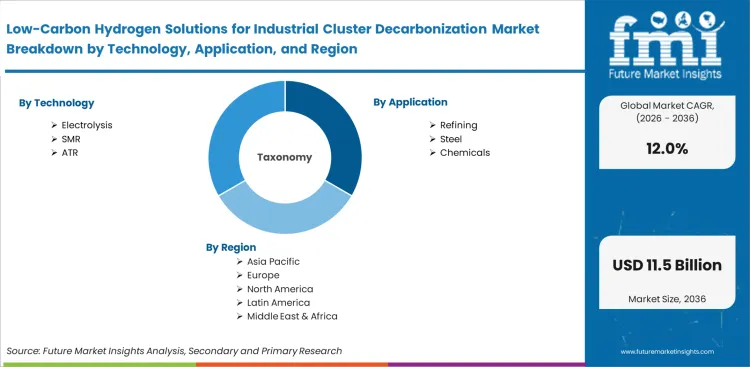
| Metric | Value |
|---|---|
| Quantitative Units | USD 3.3 Billion to USD 10.2 Billion, at a CAGR of 12.0% |
| Market Definition | Centralized generation and distribution networks replacing fossil-based feedstock across heavy manufacturing zones defines this sector. Shared infrastructure lowers delivered costs. |
| Segmentation | Technology, Application, Distribution, End User, Hydrogen Type, Region |
| Regions Covered | North America, Europe, Asia Pacific, Latin America, Middle East & Africa |
| Countries Covered | United States, Canada, Germany, United Kingdom, France, Italy, Spain, China, Japan, South Korea, Taiwan, Singapore, Brazil, Mexico, Argentina, GCC Countries, South Africa, Israel, Rest of Middle East & Africa |
| Key Companies Profiled | Air Liquide, Linde plc, Air Products and Chemicals, Inc., Siemens Energy, Nel ASA, Plug Power Inc., Shell plc |
| Forecast Period | 2026 to 2036 |
| Approach | Final investment decisions for multi-megawatt electrolyzer installations mapped against regional decarbonization timelines. |
Source: Future Market Insights (FMI) analysis, based on proprietary forecasting model and primary research
Low-Carbon Hydrogen Solutions for Industrial Cluster Decarbonization Market Analysis by Segments
Technology:
- Electrolysis
- SMR
- ATR
- Biomass
- Pyrolysis
Application:
- Refining
- Steel
- Chemicals
- Power
- Transport
Distribution:
- Pipeline
- Liquefaction
- Compression
- Onsite
End User:
- Industrial clusters
- Utilities
- Ports
- Transport hubs
Hydrogen Type:
- Green hydrogen
- Blue hydrogen
- Grey hydrogen
Region:
- North America
- United States
- Canada
- Europe
- Germany
- United Kingdom
- France
- Italy
- Spain
- Asia Pacific
- China
- Japan
- South Korea
- Taiwan
- Singapore
- Latin America
- Brazil
- Mexico
- Argentina
- Middle East & Africa
- GCC Countries
- South Africa
- Israel
- Rest of Middle East & Africa
Bibliography
- International Energy Agency. (2025). Executive summary: Global Hydrogen Review 2025.
- European Commission, Taxation and Customs Union. (2026). Carbon Border Adjustment Mechanism.
- USA Department of the Treasury. (2025, January 3). USA Department of the Treasury releases final rules for the Section 45V Clean Hydrogen Production Tax Credit.
- Internal Revenue Service. (2025). Clean hydrogen production credit.
- USA Department of Energy. (2025). Clean Hydrogen Production Tax Credit (45V) resources.
- Federal Register. (2025, January 10). Credit for Production of Clean Hydrogen and Energy Credit.
- Federal Ministry for Economic Affairs and Climate Action, Germany. (2023). National Hydrogen Strategy Update.
This bibliography is provided for reader reference. The full FMI report contains the complete reference list with primary source documentation.
This Report Addresses
- Carbon pricing impacts on petrochemical procurement strategies
- Electrolysis scaling requirements for gigawatt-scale production
- Pipeline right-of-way acquisition friction
- Demand aggregation models within centralized industrial parks
- Zero-scope-emission certification necessities for export manufacturers
- State-directed capital deployment across Asian manufacturing belts
- Open-access infrastructure requirements dictated by steel producers
- Material embrittlement risks associated with pressurized delivery
Frequently Asked Questions
What is low carbon hydrogen in an industrial context?
Low carbon hydrogen refers to production methods generating significantly reduced emissions compared to traditional fossil-fuel extraction. Manufacturers utilize electrolytic or strictly captured generation pathways to replace heavily polluting legacy feedstocks.
How does hydrogen decarbonize heavy industry?
Heavy emitters replace fossil fuels directly within high-heat processes and chemical synthesis. Steel producers utilize this gas for direct iron reduction, bypassing highly polluting blast furnaces entirely.
What industries use hydrogen most aggressively?
Refining complexes and fertilizer synthesis plants represent massive baseline consumption centers. These facilities already rely heavily on grey inputs, making green substitution their primary pathway to corporate emission compliance.
Why does green hydrogen matter for export compliance?
Strict zero-carbon definitions disqualify fossil-derived options utilizing partial carbon capture. Exporters must utilize pure electrolytic generation to maintain Europe market access without massive penalties.
How does hydrogen compare against fossil fuels economically?
Initial unit costs remain significantly higher than legacy options like natural gas. Carbon border adjustment taxes fundamentally alter this equation, penalizing fossil inputs until electrolytic alternatives reach true price parity.
What limits rapid scaling of shared distribution networks?
Municipal zoning complexities and intense material embrittlement risks delay pipeline deployment. Engineers struggle securing contiguous easements through densely packed legacy manufacturing zones.
Why do petrochemical plants prefer clustered supply models?
Clustered demand drastically reduces capital expenditure per unit delivered. Procurement officers avoid single-offtaker financing penalties by participating in diversified consortiums.
What advantage does China hold over competing regions?
State-owned enterprise structures eliminate coordination friction between supply construction and demand commitment. Facilities deploy capital simultaneously rather than waiting for counter-party guarantees.
Why do incumbents maintain dominance in regional hubs?
Decades of operational safety data convince municipal boards to approve specialized right-of-ways. Zoning committees routinely reject applications from inexperienced startups proposing high-pressure transport.
What drives extreme growth expectations within refining segments?
Existing desulfurization units require zero modification to accept green alternatives. Operations managers execute substitutions instantly to avoid escalating carbon tax penalties on current massive grey consumption.
How do steel producers prevent monopolistic pricing?
Large off-takers mandate open-access clauses within foundational cluster agreements. Facility directors require multi-vendor network access before committing billions in transition capital.
What risk exists for companies delaying infrastructure connection?
Laggards face eviction from shared industrial parks as administrators enforce park-wide emission standards. Isolated facilities simultaneously lose access to subsidized low-cost utilities.
Why does electrolysis dominate technological share?
Massive renewable capacity scaling drops underlying power costs significantly. Offshore wind integration allows direct power purchasing outside volatile regional grid pricing structures.
What prevents rapid adoption in the United States despite subsidies?
Extreme geographic separation between prime renewable generation zones and heavy industrial demand centers introduces massive pipeline transport costs. Cheap natural gas also suppresses transition urgency.
How do electrolyzer operators maximize financial returns?
Modulating generation output during peak regional power events allows operators to function as grid-balancing assets. Plant directors capture auxiliary revenue streams beyond direct gas sales.
Why do industrial gas giants prioritize long-term offtake agreements?
Multi-decade volume guarantees secure extremely low-interest financing from banking syndicates. These agreements transfer baseline capacity risk entirely onto heavy industrial consumers.
How does Japan address geographic constraints?
Port authorities invest heavily in specialized liquid carrier offloading terminals. Deep-water infrastructure handles imported bulk shipments since domestic renewable capacity cannot support heavy industrial demands.
What secondary revenue streams exist for centralized hubs?
Capturing massive oxygen byproducts from core electrolysis operations creates localized supply. Medical networks and municipal wastewater plants purchase this gas continuously.
Why do smaller chemical operators struggle securing hardware?
Electrolyzer manufacturers allocate limited production capacity strictly toward massive gigawatt-scale consortiums. Independent buyers face insurmountable procurement queues.
How do material properties limit pipeline deployment?
High-pressure environments severely degrade legacy steel alloys. Integrity engineers must source highly specialized composites, significantly increasing capital requirements per installed meter.
What dictates ultimate regional industrial competitiveness?
Access to low-cost electrolytic generation capacity entirely determines export viability under new global tariff structures. Pipeline proximity dictates facility survival.
Why does Germany exhibit strong growth metrics?
Deeply integrated legacy chemical parks provide massive concentrated demand centers. Operations supervisors leverage existing corridors to execute rapid substitutions before carbon penalties escalate.
Preview the report firsthand - request a free sample
Get SampleGet the brochure for pricing and purchase details.
Get PDFTable of Content
- Executive Summary
- Global Market Outlook
- Demand-side Trends
- Supply-side Trends
- Technology Roadmap Analysis
- Analysis and Recommendations
- Market Overview
- Market Coverage / Taxonomy
- Market Definition / Scope / Limitations
- Research Methodology
- Chapter Orientation
- Analytical Lens and Working Hypotheses
- Market Structure, Signals, and Trend Drivers
- Benchmarking and Cross-market Comparability
- Market Sizing, Forecasting, and Opportunity Mapping
- Research Design and Evidence Framework
- Desk Research Programme (Secondary Evidence)
- Company Annual and Sustainability Reports
- Peer-reviewed Journals and Academic Literature
- Corporate Websites, Product Literature, and Technical Notes
- Earnings Decks and Investor Briefings
- Statutory Filings and Regulatory Disclosures
- Technical White Papers and Standards Notes
- Trade Journals, Industry Magazines, and Analyst Briefs
- Conference Proceedings, Webinars, and Seminar Materials
- Government Statistics Portals and Public Data Releases
- Press Releases and Reputable Media Coverage
- Specialist Newsletters and Curated Briefings
- Sector Databases and Reference Repositories
- FMI Internal Proprietary Databases and Historical Market Datasets
- Subscription Datasets and Paid Sources
- Social Channels, Communities, and Digital Listening Inputs
- Additional Desk Sources
- Expert Input and Fieldwork (Primary Evidence)
- Primary Modes
- Qualitative Interviews and Expert Elicitation
- Quantitative Surveys and Structured Data Capture
- Blended Approach
- Why Primary Evidence is Used
- Field Techniques
- Interviews
- Surveys
- Focus Groups
- Observational and In-context Research
- Social and Community Interactions
- Stakeholder Universe Engaged
- C-suite Leaders
- Board Members
- Presidents and Vice Presidents
- R&D and Innovation Heads
- Technical Specialists
- Domain Subject-matter Experts
- Scientists
- Physicians and Other Healthcare Professionals
- Governance, Ethics, and Data Stewardship
- Research Ethics
- Data Integrity and Handling
- Primary Modes
- Tooling, Models, and Reference Databases
- Desk Research Programme (Secondary Evidence)
- Data Engineering and Model Build
- Data Acquisition and Ingestion
- Cleaning, Normalisation, and Verification
- Synthesis, Triangulation, and Analysis
- Quality Assurance and Audit Trail
- Market Background
- Market Dynamics
- Drivers
- Restraints
- Opportunity
- Trends
- Scenario Forecast
- Demand in Optimistic Scenario
- Demand in Likely Scenario
- Demand in Conservative Scenario
- Opportunity Map Analysis
- Product Life Cycle Analysis
- Supply Chain Analysis
- Investment Feasibility Matrix
- Value Chain Analysis
- PESTLE and Porter’s Analysis
- Regulatory Landscape
- Regional Parent Market Outlook
- Production and Consumption Statistics
- Import and Export Statistics
- Market Dynamics
- Global Market Analysis 2021 to 2025 and Forecast, 2026 to 2036
- Historical Market Size Value (USD Million) Analysis, 2021 to 2025
- Current and Future Market Size Value (USD Million) Projections, 2026 to 2036
- Y-o-Y Growth Trend Analysis
- Absolute $ Opportunity Analysis
- Global Market Pricing Analysis 2021 to 2025 and Forecast 2026 to 2036
- Global Market Analysis 2021 to 2025 and Forecast 2026 to 2036, By Technology
- Introduction / Key Findings
- Historical Market Size Value (USD Million) Analysis By Technology , 2021 to 2025
- Current and Future Market Size Value (USD Million) Analysis and Forecast By Technology , 2026 to 2036
- Electrolysis
- SMR
- ATR
- Electrolysis
- Y-o-Y Growth Trend Analysis By Technology , 2021 to 2025
- Absolute $ Opportunity Analysis By Technology , 2026 to 2036
- Global Market Analysis 2021 to 2025 and Forecast 2026 to 2036, By Application
- Introduction / Key Findings
- Historical Market Size Value (USD Million) Analysis By Application, 2021 to 2025
- Current and Future Market Size Value (USD Million) Analysis and Forecast By Application, 2026 to 2036
- Refining
- Steel
- Chemicals
- Refining
- Y-o-Y Growth Trend Analysis By Application, 2021 to 2025
- Absolute $ Opportunity Analysis By Application, 2026 to 2036
- Global Market Analysis 2021 to 2025 and Forecast 2026 to 2036, By Distribution
- Introduction / Key Findings
- Historical Market Size Value (USD Million) Analysis By Distribution, 2021 to 2025
- Current and Future Market Size Value (USD Million) Analysis and Forecast By Distribution, 2026 to 2036
- Pipeline
- Liquefaction
- Compression
- Pipeline
- Y-o-Y Growth Trend Analysis By Distribution, 2021 to 2025
- Absolute $ Opportunity Analysis By Distribution, 2026 to 2036
- Global Market Analysis 2021 to 2025 and Forecast 2026 to 2036, By End User
- Introduction / Key Findings
- Historical Market Size Value (USD Million) Analysis By End User, 2021 to 2025
- Current and Future Market Size Value (USD Million) Analysis and Forecast By End User, 2026 to 2036
- Industrial Clusters
- Utilities
- Ports
- Industrial Clusters
- Y-o-Y Growth Trend Analysis By End User, 2021 to 2025
- Absolute $ Opportunity Analysis By End User, 2026 to 2036
- Global Market Analysis 2021 to 2025 and Forecast 2026 to 2036, By Hydrogen Type
- Introduction / Key Findings
- Historical Market Size Value (USD Million) Analysis By Hydrogen Type, 2021 to 2025
- Current and Future Market Size Value (USD Million) Analysis and Forecast By Hydrogen Type, 2026 to 2036
- Green
- Blue
- Green
- Y-o-Y Growth Trend Analysis By Hydrogen Type, 2021 to 2025
- Absolute $ Opportunity Analysis By Hydrogen Type, 2026 to 2036
- Global Market Analysis 2021 to 2025 and Forecast 2026 to 2036, By Region
- Introduction
- Historical Market Size Value (USD Million) Analysis By Region, 2021 to 2025
- Current Market Size Value (USD Million) Analysis and Forecast By Region, 2026 to 2036
- North America
- Latin America
- Western Europe
- Eastern Europe
- East Asia
- South Asia and Pacific
- Middle East & Africa
- Market Attractiveness Analysis By Region
- North America Market Analysis 2021 to 2025 and Forecast 2026 to 2036, By Country
- Historical Market Size Value (USD Million) Trend Analysis By Market Taxonomy, 2021 to 2025
- Market Size Value (USD Million) Forecast By Market Taxonomy, 2026 to 2036
- By Country
- USA
- Canada
- Mexico
- By Technology
- By Application
- By Distribution
- By End User
- By Hydrogen Type
- By Country
- Market Attractiveness Analysis
- By Country
- By Technology
- By Application
- By Distribution
- By End User
- By Hydrogen Type
- Key Takeaways
- Latin America Market Analysis 2021 to 2025 and Forecast 2026 to 2036, By Country
- Historical Market Size Value (USD Million) Trend Analysis By Market Taxonomy, 2021 to 2025
- Market Size Value (USD Million) Forecast By Market Taxonomy, 2026 to 2036
- By Country
- Brazil
- Chile
- Rest of Latin America
- By Technology
- By Application
- By Distribution
- By End User
- By Hydrogen Type
- By Country
- Market Attractiveness Analysis
- By Country
- By Technology
- By Application
- By Distribution
- By End User
- By Hydrogen Type
- Key Takeaways
- Western Europe Market Analysis 2021 to 2025 and Forecast 2026 to 2036, By Country
- Historical Market Size Value (USD Million) Trend Analysis By Market Taxonomy, 2021 to 2025
- Market Size Value (USD Million) Forecast By Market Taxonomy, 2026 to 2036
- By Country
- Germany
- UK
- Italy
- Spain
- France
- Nordic
- BENELUX
- Rest of Western Europe
- By Technology
- By Application
- By Distribution
- By End User
- By Hydrogen Type
- By Country
- Market Attractiveness Analysis
- By Country
- By Technology
- By Application
- By Distribution
- By End User
- By Hydrogen Type
- Key Takeaways
- Eastern Europe Market Analysis 2021 to 2025 and Forecast 2026 to 2036, By Country
- Historical Market Size Value (USD Million) Trend Analysis By Market Taxonomy, 2021 to 2025
- Market Size Value (USD Million) Forecast By Market Taxonomy, 2026 to 2036
- By Country
- Russia
- Poland
- Hungary
- Balkan & Baltic
- Rest of Eastern Europe
- By Technology
- By Application
- By Distribution
- By End User
- By Hydrogen Type
- By Country
- Market Attractiveness Analysis
- By Country
- By Technology
- By Application
- By Distribution
- By End User
- By Hydrogen Type
- Key Takeaways
- East Asia Market Analysis 2021 to 2025 and Forecast 2026 to 2036, By Country
- Historical Market Size Value (USD Million) Trend Analysis By Market Taxonomy, 2021 to 2025
- Market Size Value (USD Million) Forecast By Market Taxonomy, 2026 to 2036
- By Country
- China
- Japan
- South Korea
- By Technology
- By Application
- By Distribution
- By End User
- By Hydrogen Type
- By Country
- Market Attractiveness Analysis
- By Country
- By Technology
- By Application
- By Distribution
- By End User
- By Hydrogen Type
- Key Takeaways
- South Asia and Pacific Market Analysis 2021 to 2025 and Forecast 2026 to 2036, By Country
- Historical Market Size Value (USD Million) Trend Analysis By Market Taxonomy, 2021 to 2025
- Market Size Value (USD Million) Forecast By Market Taxonomy, 2026 to 2036
- By Country
- India
- ASEAN
- Australia & New Zealand
- Rest of South Asia and Pacific
- By Technology
- By Application
- By Distribution
- By End User
- By Hydrogen Type
- By Country
- Market Attractiveness Analysis
- By Country
- By Technology
- By Application
- By Distribution
- By End User
- By Hydrogen Type
- Key Takeaways
- Middle East & Africa Market Analysis 2021 to 2025 and Forecast 2026 to 2036, By Country
- Historical Market Size Value (USD Million) Trend Analysis By Market Taxonomy, 2021 to 2025
- Market Size Value (USD Million) Forecast By Market Taxonomy, 2026 to 2036
- By Country
- Kingdom of Saudi Arabia
- Other GCC Countries
- Turkiye
- South Africa
- Other African Union
- Rest of Middle East & Africa
- By Technology
- By Application
- By Distribution
- By End User
- By Hydrogen Type
- By Country
- Market Attractiveness Analysis
- By Country
- By Technology
- By Application
- By Distribution
- By End User
- By Hydrogen Type
- Key Takeaways
- Key Countries Market Analysis
- USA
- Pricing Analysis
- Market Share Analysis, 2025
- By Technology
- By Application
- By Distribution
- By End User
- By Hydrogen Type
- Canada
- Pricing Analysis
- Market Share Analysis, 2025
- By Technology
- By Application
- By Distribution
- By End User
- By Hydrogen Type
- Mexico
- Pricing Analysis
- Market Share Analysis, 2025
- By Technology
- By Application
- By Distribution
- By End User
- By Hydrogen Type
- Brazil
- Pricing Analysis
- Market Share Analysis, 2025
- By Technology
- By Application
- By Distribution
- By End User
- By Hydrogen Type
- Chile
- Pricing Analysis
- Market Share Analysis, 2025
- By Technology
- By Application
- By Distribution
- By End User
- By Hydrogen Type
- Germany
- Pricing Analysis
- Market Share Analysis, 2025
- By Technology
- By Application
- By Distribution
- By End User
- By Hydrogen Type
- UK
- Pricing Analysis
- Market Share Analysis, 2025
- By Technology
- By Application
- By Distribution
- By End User
- By Hydrogen Type
- Italy
- Pricing Analysis
- Market Share Analysis, 2025
- By Technology
- By Application
- By Distribution
- By End User
- By Hydrogen Type
- Spain
- Pricing Analysis
- Market Share Analysis, 2025
- By Technology
- By Application
- By Distribution
- By End User
- By Hydrogen Type
- France
- Pricing Analysis
- Market Share Analysis, 2025
- By Technology
- By Application
- By Distribution
- By End User
- By Hydrogen Type
- India
- Pricing Analysis
- Market Share Analysis, 2025
- By Technology
- By Application
- By Distribution
- By End User
- By Hydrogen Type
- ASEAN
- Pricing Analysis
- Market Share Analysis, 2025
- By Technology
- By Application
- By Distribution
- By End User
- By Hydrogen Type
- Australia & New Zealand
- Pricing Analysis
- Market Share Analysis, 2025
- By Technology
- By Application
- By Distribution
- By End User
- By Hydrogen Type
- China
- Pricing Analysis
- Market Share Analysis, 2025
- By Technology
- By Application
- By Distribution
- By End User
- By Hydrogen Type
- Japan
- Pricing Analysis
- Market Share Analysis, 2025
- By Technology
- By Application
- By Distribution
- By End User
- By Hydrogen Type
- South Korea
- Pricing Analysis
- Market Share Analysis, 2025
- By Technology
- By Application
- By Distribution
- By End User
- By Hydrogen Type
- Russia
- Pricing Analysis
- Market Share Analysis, 2025
- By Technology
- By Application
- By Distribution
- By End User
- By Hydrogen Type
- Poland
- Pricing Analysis
- Market Share Analysis, 2025
- By Technology
- By Application
- By Distribution
- By End User
- By Hydrogen Type
- Hungary
- Pricing Analysis
- Market Share Analysis, 2025
- By Technology
- By Application
- By Distribution
- By End User
- By Hydrogen Type
- Kingdom of Saudi Arabia
- Pricing Analysis
- Market Share Analysis, 2025
- By Technology
- By Application
- By Distribution
- By End User
- By Hydrogen Type
- Turkiye
- Pricing Analysis
- Market Share Analysis, 2025
- By Technology
- By Application
- By Distribution
- By End User
- By Hydrogen Type
- South Africa
- Pricing Analysis
- Market Share Analysis, 2025
- By Technology
- By Application
- By Distribution
- By End User
- By Hydrogen Type
- USA
- Market Structure Analysis
- Competition Dashboard
- Competition Benchmarking
- Market Share Analysis of Top Players
- By Regional
- By Technology
- By Application
- By Distribution
- By End User
- By Hydrogen Type
- Competition Analysis
- Competition Deep Dive
- Air Liquide
- Overview
- Product Portfolio
- Profitability by Market Segments (Product/Age /Sales Channel/Region)
- Sales Footprint
- Strategy Overview
- Marketing Strategy
- Product Strategy
- Channel Strategy
- Linde plc
- Air Products and Chemicals, Inc.
- Siemens Energy
- Nel ASA
- Air Liquide
- Competition Deep Dive
- Assumptions & Acronyms Used


